




Abstract
Amid escalating political and economic challenges, several EU nations have witnessed the emergence of technocratic governments, often perceived as complementary to or alternative for representative democracy. This research endeavors to identify the pivotal determinants of the rise of technocratic governments and to evaluate their prospective political implications. Employing multinomial logistic regression analysis on 285 instances, this study establishes that factors such as economic underperformance, pervasive corruption, party polarization, and surging populism significantly enhance the likelihood of technocratic government inception. Subsequent in-depth case analyses further reveal that the public’s aspiration for efficient governance and the intrinsic paradoxes of party democracy contribute to the phenomenon of technocratic populism. This study underscores the potential discord between technocratic government and representative democracy, emphasizing the need for a more profound exploration and deliberation on efficacious governance.
Keywords
Introduction
As a supranational entity, the European Union (EU) has emerged as a paradigm of regional cooperation in the international community. Through the harmonization of economic policies, the establishment of a common market, and judicial cooperation, the process of European integration has continually deepened. This institutional design not only facilitated the unification and reconstruction of a war-torn Europe but also driven the continent toward shared prosperity and peace. Although the Charter of Fundamental Rights of the European Union and the Treaty of Lisbon do not stipulate specific political systems for member states, they emphasize that “the Union is founded on the values of respect for human dignity, freedom, democracy, equality, the rule of law, and respect for human rights,” and assert that “these values are common to the Member States in a society in which pluralism, non-discrimination, tolerance, justice, solidarity, and equality between women and men prevail” (EU, 2012; Ziller, 2019). This underscores the EU’s commitment to democratic principles and mandates that member states adhere to these values. The EU’s heavy-duty emphasis on democratic principles has made the region a model of representative democracy. However, in recent years, as the European integration process has advanced and the number of member states has increased, the EU has faced multiple crises (Ferrara & Kriesi, 2022). For instance, member states affected by the sovereign debt crisis are under the dual pressures of fiscal austerity and social welfare cuts. Balancing the effective implementation of reform agendas with addressing domestic dissatisfaction and protests has become a primary challenge for party governments (De Sousa et al., 2014). Simultaneously, the influx of refugees has introduced social, economic, and security challenges, leading to disagreements among national parties on how to distribute the responsibility of refugee reception, which complicates policy coordination. Different parties, based on their political interests and voter bases, have proposed starkly different solutions, exacerbating political divisions and posing significant challenges to the EU’s overall coordination mechanisms (Bauböck, 2018). Moreover, Brexit has prompted questions about the future of European integration, further deepening internal divisions over European issues. Some parties have leveraged the Brexit event to question the authority of the EU and the rationale of integration, even advocating for a reassessment of their relationship with the EU (Sindic et al., 2019).
The multiple crises have presented unprecedented challenges for member states. On one hand, party governments are struggling to cope with the increased governance difficulties; on the other hand, the rise of right-wing populist parties across Europe is challenging traditional party politics (Guth & Nelsen, 2021). These parties, which espouse sovereigntist, nationalist, and Eurosceptic views, have capitalized on public discontent with economic hardships, inequality, the refugee crisis, and European integration to criticize The establishment and achieve electoral victories in some member states (Goodliffe, 2015). The series of crises has not only led to value splits and confrontations within member states but also intensified partisan divisions and political polarization. It is evident that the EU’s multiple crises pose a severe challenge to representative democracy.
Amidst the inefficiency and failure of traditional party governments to meet public expectations for effective governance in addressing these crises, a new dynamic is increasingly evident in the political structures of EU member states: the emergence of non-partisan technocrats in cabinet positions, playing significant roles in government decision-making (BBC NEWS, 2011; Bergsen et al., 2022). Unlike experienced political bureaucrats, these technocrats have not undergone public electoral processes and lack extensive political experience. However, their expertise has thrust them to the forefront of government decision-making. This dynamic signifies a shift from the traditional party-dominated cabinets in Europe, and the academic community refers to this new model as “technocratic government” or “technocrat-led government” (Pastorella, 2016b; Wratil & Pastorella, 2018).
Early research primarily focused on the role of technocrats in the European integration process. For instance, studies pointed out that technocrats contributed to the EU policy-making process by providing expert advice and technical support, thereby enhancing the scientific and professional nature of policies (Majone et al., 1996). They also played a crucial role in coordinating transnational institutions, significantly contributing to the maintenance of EU unity (Egeberg, 2006). In recent years, researchers have begun to capture the trend of professionalization in the governance of EU member states, subsequently engaging in in-depth discussions around the “role of technocrats in cabinets.” These discussions, within the EU political context, define “who is a technocrat,” (McDonnell & Valbruzzi, 2014) and the conditions of their appointment, including economic crises, citizen support for expert decision-making (Bertsou & Pastorella, 2017), especially in the context of dissatisfaction with current representative democracy (Schmidt & Gualmini, 2013). Additionally, researchers have focused on public attitudes toward technocrats, exploring whether citizens support technocrats’ participation in government and the reasons behind this support (Merler, 2021). Some scholars acknowledge that technocrats can improve policy quality and governance efficiency, but they caution against their unelected status, which might undermine democratic legitimacy (Caramani, 2020).
Notably, although technocratic governments have manifested in several EU member states, in-depth and systematic academic exploration of this distinctive government model is still in its nascent stages (McDonnell & Valbruzzi, 2014). Current research predominantly focuses on the roles and functions of technocrats, but there is a lack of comprehensive investigation into technocratic governments as a whole. Additionally, studies on this topic often concentrate on individual countries, leading to a fragmented understanding of the mechanisms behind the formation of technocratic governments due to the absence of a multi-country comparative perspective. Based on this context, this article will take all EU member states as the study object, further discussing the reasons for the formation of technocratic governments and their long-term impact on the practice of representative democracy within the EU. This study builds on existing research and, based on path dependence theory (Mahoney, 2000), investigates the mechanisms and political significance of the formation of technocratic governments, proposing that the emergence of technocratic governments represents a deviation from the path of representative democracy.
To thoroughly investigate this topic, we employ a quantitative analysis using the Technocrat Ministers Database (2000–2022), aiming to uncover the key driving factors behind the rise of technocratic governments. The structure of this study is as follows: first, we will review the relevant literature on technocratic governments, focusing on scholarly discussions about their formation logic; second, from a crisis perspective, we hypothesize the reasons for the formation of technocratic governments; next, we detail the research design, data collection methods, and analysis strategies; finally, based on empirical analysis results, we further explore the formation mechanisms of technocratic governments and discuss their democratic implications in depth. We hope that this research will enrich the existing understanding of government types, while re-examining the challenges and potential directions for change that current democratic systems face by discussing the deviation from the traditional European model of representative democracy exhibited by this new governance model.
The Practice of Technocrats and Technocratic Governments in EU Member States
The discussion on “technocrats” began with Meynaud’s (1964) seminal work in 1964, where he defined technocrats as “experts engaged in politics,” emphasizing their non-political nature in government decision-making. As research progressed, scholars further differentiated the “non-political” aspect from “non-partisan” characteristics of technocrats. Even experts, once they enter cabinets and assume ministerial roles, inevitably acquire political attributes (McDonnell & Valbruzzi, 2014). Based on this, Cotta and Verzichelli (2002) proposed a more nuanced definition, suggesting that technocrats should be “ministers lacking parliamentary and party political background while possessing relevant professional expertise for their appointed department.” However, the definition of “party political background” remains contentious. For instance, if an expert supports a party or candidate without joining a party, should they still be considered non-partisan? This debate has led to a refined need for defining technocrats. Subsequently, scholars introduced the criterion of “independence from any political party,” meaning technocrats in EU cabinets have not run for elections or joined any party. Current studies often cite Duncan McDonnell and Marco Valbruzzi’s pioneering research on technocrats. They provided an operational definition of technocrats, stating that at the time of their appointment as prime minister or minister, technocrats (1) have never held office under a party banner; (2) are not formal members of any political party; (3) possess professional knowledge directly related to their government position (McDonnell & Valbruzzi, 2014). Subsequent researchers have largely accepted this definition, viewing technocrats as “non-elected political elites with expertise, skills, and legitimacy derived from neutrality and scientific knowledge.”
Clarifying “who is a technocrat” allows further examination of “why technocrats are frequently appointed in EU member states.” Research rooted in “crisis scenarios” suggests that technocrats emerge in response to crises. Economic crises are the most common context for such appointments, as appointing technocrats as finance ministers can enhance government credibility during financial crises. If a key position like finance minister is held by a non-elected expert with neoliberal economic preferences, it sends a clear signal to investors and stakeholders that the government is serious about market reforms and is committed to maintaining economic stability and meeting debt obligations during the crisis (Alexiadou & Gunaydin, 2019). Additionally, technocrats are often seen as solutions to political deadlock, expected to make decisions based on expertise rather than partisan interests, serving as alternatives to traditional party decisions. During cabinet formations, when political parties cannot propose their candidates for prime minister or other ministerial positions, non-partisan technocrats may be an acceptable solution (Wratil & Pastorella, 2018). Public preference and trust are also crucial factors in technocrat appointments, particularly in crisis times when the public tends to trust expert opinions over traditional political decisions. For example, during the COVID-19 pandemic, public insecurity increased support for technocrats (Cena & Roccato, 2023). Other studies indicate that public trust in the authoritative information provided by technocrats and dissatisfaction with traditional political institutions boost support for technocrats (Ganuza & Font, 2020; Merler, 2021).
During crises, a significant number of non-partisan, non-elected technical experts enter cabinets, holding key positions such as ministers or even prime ministers. These political outsiders, valued for their deep expertise and extensive experience, are seen as crucial resources for addressing specific political, economic, and social issues (Cena & Roccato, 2023; Kuhlmann et al., 2022). This phenomenon has led to a new cabinet formation model in some European countries: technocratic governments. McDonnell and Valbruzzi (2014) conceptualized this government type, positing, via Katz’s (1987) framework of party government, that three criteria define a technocratic regime: (1) Major decisions bypass elected party officials, (2) Policy determinations occur outside party confines and emerge through collective consensus, and (3) Senior officials are not party-appointed. They further between fully technocratic governments and technocrat-dominated governments based on the composition and change dynamics of party/technocrat roles.
It is important to note that in traditional European representative democracy, cabinet formation has always been seen as a crucial link in the chain of representation. In this system, voters participate in open elections to vote for parties or their candidates, and the party or coalition that wins the parliamentary majority forms the cabinet (Lindbeck & Weibull, 1993; Urbinati, 2006). Therefore, the cabinet not only represents party interests but also reflects and fulfills voters’ policy expectations. This representative relationship has been the cornerstone of democratic practice and political stability in EU member states. However, McDonnell and Valbruzzi’s research captures two core characteristics of technocratic governments: non-partisanship and professionalism, which in fact break the electoral-authorization chain of representative democracy. This means that the governance measures of technocrat-led governments do not rely on party platforms and election manifestos but are based on professional expertise and crisis insights. More importantly, the legitimacy of technocratic governments does not directly stem from democratic delegation, nor does it reflect voter preferences and intentions. These features are clearly at odds with traditional representative democracy: in technocratic governments, public elections and party competition are downplayed or bypassed (Pastorella, 2016a). Surprisingly, this form of government has gained acceptance in some European democracies. This raises a perplexing question: why does this deviation from traditional government forms occur?
Building on existing discussions about the roles and appointment reasons of technocrats (Emanuele et al., 2023; Frinken & Landwehr, 2023; Vittori et al., 2023), our research extends the discussion on “technocratic governments,” particularly exploring their formation reasons and deeper political significance. This study makes two main contributions. First, against the backdrop of global democratic recession, it discusses the emergence of non-elected technocrat-led governments and their impact on democratic politics in the EU, a region known for its exemplary representative democracy practices. Second, through case studies of EU member states, it delves into the internal transformation trends of democratic regimes and potential adaptive strategies. Overall, by investigating the underlying structures and dynamics behind technocratic governments and observing how they interact with traditional democratic systems, we hope to deepen the discourse on maintaining the stability of representative democracy during crises.
Theoretic Considerations and Hypotheses: Crises, Exogenous Shocks, and Path Adjustment
Path Dependence Theory and the Emergence of Technocratic Governments in EU Member State
Path dependence theory examine the non-random nature of institutional evolution, positing that once an institution selects a particular trajectory, its future development is likely to continue along this predetermined path (Mahoney, 2000). The core concepts of this theory include “institutional lock-in” and “increasing returns.” Institutional lock-in describes the stable development of an institution along a set path following a critical juncture, with the costs of deviating from this path gradually increasing. Increasing returns focus on the benefits that accrue over time as the institution continues along its established trajectory (Maduro, 2000). In the context of the EU, representative democracy exemplifies the characteristics of path dependence. This system is not only enshrined in the EU’s constitutional framework but also reflected in the practices of its member states. Particularly, post-communist countries in Eastern Europe, upon adopting representative democracy, experienced relatively smooth political transitions, demonstrating the effectiveness of this system in providing stability to emerging democracies (Lewis, 2000).
Although path dependence theory emphasizes the continuity and robustness of institutions, it does not preclude the possibility of institutional change. Indeed, when institutions face crises or exogenous shocks, path deviation or significant adjustments may occur (Torfing, 2009). Although path dependence theory emphasizes the continuity and robustness of institutions, it does not preclude the possibility of institutional change. Indeed, when institutions face crises or exogenous shocks, path deviation or significant adjustments may occur. We argue that the rise of technocratic governments represents an instance of path deviation from representative democracy. This government model employs a more technocratic decision-making approach, circumventing traditional democratic procedures. However, this mode of governance is highly controversial, especially regarding electoral legitimacy (Brown & Williams, 2020). As technocratic governments are not formed through conventional electoral processes, they may be perceived as lacking sufficient democratic mandate. Thus, the emergence of technocratic governments in EU member states can be viewed as an exceptional phenomenon in the context of stable democratic practices, altering established political norms.
A critical question arises: why are political parties willing to diminish their power and collaborate with non-partisan technocrats in certain situations? Upon examining existing research and real-world political contexts, we identify a common driving factor behind the formation of technocratic governments: crisis impact. Whether economic, political, or social, crises create an urgent need for rapid and effective decision-making in a highly uncertain environment (Wratil & Pastorella, 2018). Traditional party mechanisms often struggle to meet the demands for promptness and accuracy in such decision-making. In contrast, technocratic governments, with their non-partisan nature and technical expertise, seem to provide a unique and appropriate solution for crisis management (Pastorella, 2016a). Given these characteristics, it is reasonable to hypothesize that crisis impacts can trigger significant deviations in cabinet formation models.
Hypotheses
During periods of economic prosperity, the governance pressures on political parties are relatively low, and economic issues are less contentious in electoral debates. In such contexts, ruling parties often receive electoral rewards for positive economic performance, thus maintaining government stability. However, economic downturns disrupt this stability. Faced with recessions, fiscal deficits, inflation, and external debt crises, parliamentary parties frequently experience divisions when formulating economic reform plans. To avoid the electoral backlash from failed economic policies, parties may shirk governance responsibilities (Hernández & Kriesi, 2016). In these situations, they tend to invite professional economists and financial experts to devise and implement necessary economic recovery strategies. Technocrats, perceived as experienced, neutral, and unbiased decision-makers, are less influenced by partisan ideologies or political pressures (Alexiadou & Gunaydin, 2019). This approach not only provides a more professional and objective response to economic challenges but also helps enhance the government’s credibility in international financial markets and among investors. Consequently, the impact of economic crises can lead to a path deviation in governance models, with parties increasingly relying on technocratic governments to address complex economic issues (Alexiadou, 2018). Based on the above analysis, we propose the following hypothesis:
H1: Economic downturns significantly increase the likelihood of the formation of technocratic governments.
In the traditional practice of representative democracy, government formation typically occurs post-election, with parties or coalitions that secure a majority responsible for forming the government. Additionally, if an existing government collapses due to a vote of no confidence, parliamentary parties negotiate to establish a new government. However, party polarization as a form of crisis impact can disrupt this stable government formation path. Specifically, if severe political polarization exists within the parliament, forming a new government becomes exceedingly difficult, regardless of whether it is post-election or following the collapse of an existing government.
Political research in EU countries has identified two key dimensions of party competition: the economic dimension (left/right) and the social dimension (GAL/TAN) (Brigevich et al., 2017). the economic (left/right) and the social (GAL/TAN) dimensions. While the former pertains to wealth redistribution, welfare structures, and economic regulation, the latter emphasizes contemporary political concerns, encapsulating “Green, Alternative, Liberal” versus “Traditional, Authoritarian, Nationalism,” often termed the “new politics” dimension (CHES, 2021).Our study posits that when parties are highly polarized along these two dimensions, achieving political consensus becomes challenging, potentially hindering government operations and successful cabinet formation. In this context, technocrat-led governments not only provide temporary political stability but also offer a compromise solution acceptable to various parties (Wratil & Pastorella, 2018). Therefore, we propose the following hypotheses:
H2: Economic polarization among parties significantly increases the likelihood of the formation of technocratic governments.
H3: Social polarization among parties significantly increases the likelihood of the formation of technocratic governments.
Over the past few decades, political party divisions in EU member states have been relatively moderate. Within this context, parties have offered clear political programs during elections, meeting citizens’ needs and providing explicit voting choices (Colomer, 2016). However, multiple crises accompanying the European integration process have disrupted this moderate political practice. Notably, populist parties have rapidly risen by exploiting social discontent (Noury & Roland, 2020).Populism’s core ideology involves opposing the so-called “elite rule” and emphasizing the rights and interests of ordinary people. It criticizes the legitimacy of traditional political elites, accusing them of being disconnected from the populace and internally corrupt. This ideology advocates for more direct democratic methods, rejecting the existing party-based democratic system to some extent (Kaltwasser et al., 2017). Our research suggests that this populism contradicts the characteristics of technocratic governments. While technocratic governments derive legitimacy from experts’ professional knowledge rather than direct public authorization, they emphasize neutrality and reject specific political ideologies. Given this contradiction, when populist parties gain influence in parliament, they are likely to promote policies aligned with their ideology rather than seek technocrats’ advice or intervention. Thus, we propose the following hypothesis:
H4: The rise of populist parties decreases the likelihood of the formation of technocrat governments.
Government corruption not only leads to inefficient use of public resources, but also severely damages the credibility and image of public institutions. This ongoing negative impact may erode public confidence in the existing political system and party structures, reducing support and trust in political parties (Regunadhan, 2023). Against this backdrop, the support and expectations for technocratic governments can be interpreted as a public response to persistent corruption issues within traditional political structures (Brunclík & Parízek, 2019; Hanley, 2018). This shift in public attitude and expectation is based on the theoretical assumption that if politics and parties are widely perceived as the main sources of corruption, reducing their decision-making power and increasing technocratic involvement in policy formulation and implementation could be seen as a strategy to mitigate or even eliminate corruption (Pastorella, 2016b). In other words, as public perception of government corruption rises, the appeal of technocrats, with their professionalism and neutrality compared to traditional political leaders, increases accordingly. In specific political and social contexts, this expectation and pressure for change may break institutional lock-in, prompting voters to seek new governance models to meet their demands for clean politics. Based on the above analysis, we propose the following hypothesis:
H5: There is a positive correlation between the level of corruption and the likelihood of the formation of technocratic governments.
In traditional party politics, post-election power transfers typically occur through mainstream parties or coalitions winning the majority of votes, leading to stable and predictable party politics. However, electoral volatility, which indicates significant short-term shifts in voter support for parties or policies, represents political instability and crisis (Mainwaring & Zoco, 2007). In such contexts, parliaments frequently experience party turnover. When no dominant party or coalition can ensure policy continuity, long-term strategic planning and policy implementation are obstructed, resulting in policy uncertainty and decreased government efficiency. Simultaneously, pronounced electoral volatility may cause ruling or major opposition parties to act more conservatively and cautiously, as any actions could face voter punishment in future elections. This volatility challenges the stability of party politics and may lead to political system upheaval. At such times, technocrat-led governments are viewed as a viable option. Early research from a cost-benefit perspective suggests that this is a strategic decision by parties to avoid potential political risks and governance responsibilities. When parties anticipate high governance costs or expect a decline in support due to certain policies, they may choose to form technocrat-led governments. Particularly when facing potentially controversial reforms, collaborating with like-minded technocrats is a safer choice. Thus, in contexts of high electoral uncertainty and frequent party power turnovers, the likelihood of technocrat-led governments increases. This strategy can be seen as a self-protection mechanism and a way to dilute responsibility for ruling parties, aiming to avoid controversial policy issues and reduce electoral risks (Emanuele et al., 2023; Wratil & Pastorella, 2018).
H6: High electoral volatility increases the likelihood of the formation of technocratic governance.
Path dependence theory provides a robust theoretical framework for understanding the formation of technocratic governments, with the aforementioned six hypotheses reflecting the impact of “crisis shocks.” Whether these shocks originate internally or externally, they can significantly affect the traditional practice of representative democracy in EU member states, particularly regarding the effectiveness and responsiveness of party governments. Such crisis shocks often precipitate the emergence of technocrat-led governments as a new institutional path. In the subsequent data analysis section, we will test these six hypotheses to further identify the specific mechanisms and conditions leading to the formation of technocrat-led governments.
Research Design
Data Collection
To test the hypotheses of this study, we utilized the Technocratic Ministers Dataset (TMD) (Vittori et al., 2023).The TMD covers cabinet information for 31 European democracies from 2000 to 2022, providing detailed records on each cabinet minister’s personal information, including professional expertise related to their ministerial duties, positions, educational background, electoral participation, and party affiliation. This enables researchers to clearly identify whether each minister qualifies as a technocrat. More importantly, the database includes information on parliamentary party positions, economic conditions, and corruption levels for each cabinet’s tenure. Thus, the TMD not only offers extensive coverage but also provides the detailed data needed to test our study’s hypotheses, ensuring solid data support for our research. For the purposes of this study, we selected data from all cabinets in 28 EU member states between 2000 and 2022, resulting in a total of 285 observations.
Dependent Variable: Government Type
The dependent variable in this study is the type of government, classified according to the proportion of technocratic ministers. Using the cabinet member information provided by the TMD, we categorize each government based on the proportion of technocratic ministers into technocratic government, high specialized government, low specialized government, and party government. A technocratic government meets the following two conditions: 1) the prime minister is a technocrat; 2) technocrats constitute more than 50% of the cabinet ministers. If the proportion of technocratic ministers is between 25 and 50%, the government is classified as a high specialized government. If the proportion of technocratic ministers is less than 25%, the government is classified as a low specialized government. If there are no technocratic ministers in the cabinet, the government is classified as a party government (Figure 1). These classification criteria provide a clear basis for the dependent variable for subsequent data analysis.

Cabinet formation in EU countries, 2000 to 2022.
Independent Variables
Economic Performance (H1)
This study hypothesizes that poor economic performance increases the likelihood of forming a technocratic government (H1). Economic recessions or financial crises lead to public and party dissatisfaction with the existing government, increasing the demand for technocratic governments, as technocrats are often perceived to possess higher expertise and managerial capabilities to effectively address economic challenges.
Economic performance refers to the health and growth trends of a country’s economy. In this study, we measure economic performance using the GDP growth rate for the 2 years preceding the formation of the government. Researchers extract the GDP growth rate data for the 2 years before the formation of each government from the TMD and calculate the average as the economic performance indicator at the time of government formation. The unit of measurement for economic performance is percentage (%), representing changes in the annual GDP growth rate. For example, if a country’s GDP growth rates for the 2 years before government formation are 1.5 and 2.0%, the economic performance indicator would be (1.5% + 2.0%)/2 = 1.75%.
Party Position Polarization (H2 and H3)
This study hypothesizes that party position polarization increases the likelihood of forming a technocratic government (H2 and H3). Polarization on economic or social issues exacerbates policy-making disagreements and severely reduces political consensus, making technocrat-led governments a viable solution to political deadlock. Party position polarization is divided into economic position polarization and social position polarization, measured using the TMD indicators “lrgen polarization party system” and “galtan polarization party system.” The LRGEN (Left-Right General) polarization indicator measures the divergence in party positions on economic policies, including attitudes toward government intervention, taxation, and welfare policies. The range is 0 to 1, where 0 indicates all parties are at the same ideological position, and 1 indicates extreme opposition between two parties on the left-right dimension. The GALTAN (Green-Alternative-Libertarian vs. Traditional-Authoritarian-Nationalist) polarization indicator measures the divergence in party positions on socio-cultural issues, including attitudes toward environmental protection, individual freedoms, traditional values, and nationalism. The range is 0 to 1, where 0 indicates all parties are at the same ideological position, and 1 indicates extreme opposition between two parties on the GALTAN dimension. These indicators are extracted from the TMD database, which uses the Chapel Hill Expert Survey (CHES) formulas to measure polarization within the parliament.
LRGEN Polarization Calculation Formula:


GALTAN Polarization Calculation Formula:



Populist Share (H4)
This study hypothesizes that the rise of populist parties decreases the likelihood of forming a technocratic government (H4). Populist parties tend to emphasize direct democracy and oppose technocratic governance. Therefore, when populist parties hold a significant proportion of seats in parliament, the likelihood of forming technocrat-led governments decreases accordingly.
Researchers extract the “populist share” variable from the TMD, calculating the proportion of seats held by populist parties in parliament. The range is 0 to 1, where higher values indicate a higher proportion of populist parties in parliament.
Corruption (H5)
This study hypothesizes a positive correlation between the level of corruption and the likelihood of forming a technocrat-led government (H5). High levels of corruption lead to public distrust in the existing government, prompting parties and the public to seek technocratic governments to reduce corruption through professional and neutral management.
This researcher uses Transparency International’s Corruption Perceptions Index (CPI) to measure corruption. The CPI is a composite index based on multiple sources, reflecting experts’ and businesses’ perceptions of public sector corruption. Researchers extract the CPI values for the 2 years before the formation of each government and calculate the average as the corruption level at the time of government formation. The range is 0 to 100, with higher values indicating lower corruption.
Electoral Volatility (H6)
This study hypothesizes that high electoral volatility increases the likelihood of forming a technocratic government (H6). Frequent electoral volatility and party turnover lead to policy uncertainty and political instability. Technocrat-led governments are viewed as providing political stability, as they are generally perceived as neutral and professional, offering stable governance in uncertain political environments.
This study uses the electoral volatility variable from the TMD to measure the degree of electoral volatility. The range is 0 to 100, where 0 indicates identical vote distribution between elections t and t + 1, and 100 indicates completely different vote distribution between elections t and t + 1. The electoral volatility variable is based on Pedersen’s electoral volatility index formula, calculated by recording changes in party vote shares across different election cycles.




Analytic Strategy
In studying government types, we need to address a statistical issue: how to accurately estimate the effects of multiple independent variables on a categorical dependent variable with multiple categories. When dealing with a binary response variable, traditional binary logistic regression is the standard choice. However, when the response variable has multiple categories, Multinomial Logistic Regression (MLR) becomes the preferred method. The advantage of MLR is that its parameter estimates can be directly interpreted as relative probability ratios between categories, providing an interpretable framework for analyzing and explaining how independent variables affect the outcomes of different categories. Under the guidance of path dependence theory, we hypothesize that crisis shocks (such as economic downturns, party position polarization, etc.) lead to path deviations, resulting in the formation of technocrat-led governments. Through the MLR model, we can quantify the impact of these crisis shocks on the formation of government types and validate our theoretical hypotheses. The fundamental principle of the multinomial logistic regression model is to estimate the log-odds of each category relative to a baseline category, thereby calculating the relative impact of independent variables on each category. The formula is as follows:




To ensure the interpretability of the model, we chose “party government” as the baseline category. This means that the model parameters will show how the log-odds of other government types (e.g., technocratic government, high specialized government, and low specialized government) change relative to the “party government” as the independent variables change. For example, in the MLR model, we can test the impact of economic performance on the formation of technocrat-led governments. By observing the significance and direction of the regression coefficient (GDP growth rate), we can confirm the positive correlation between poor economic performance and the formation of technocratic governments. If the regression coefficient is significant and negative, it indicates that poor economic performance is indeed positively correlated with the formation of technocrat-led governments. Similarly, by observing the significance and direction of the regression coefficients for economic polarization (LRGEN Polarization) and social polarization (GALTAN Polarization), we expect that party position polarization is positively correlated with the formation of technocrat-led governments. If the regression coefficients are significant and positive, it indicates that party position polarization indeed promotes the formation of technocrat-led governments. The testing strategy for other variables follows the same approach, that is, testing the impact of each independent variable on the formation of technocrat-led governments through the MLR model and observing the significance and direction of the regression coefficients. The multinomial logistic regression model employed for this research is as follows:
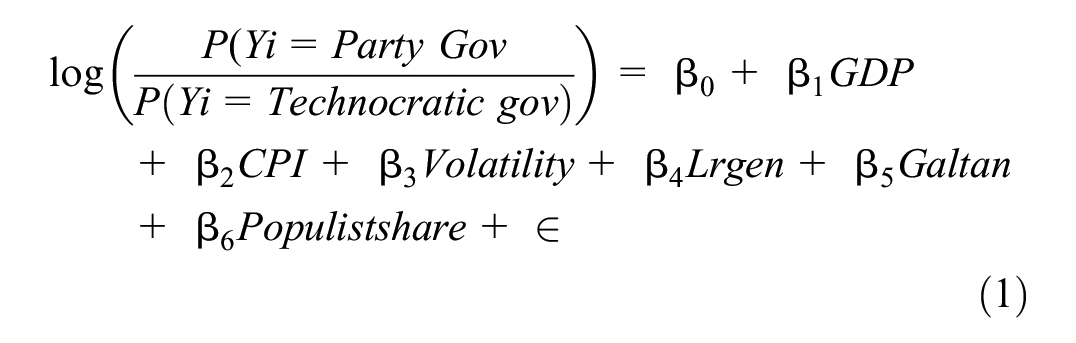
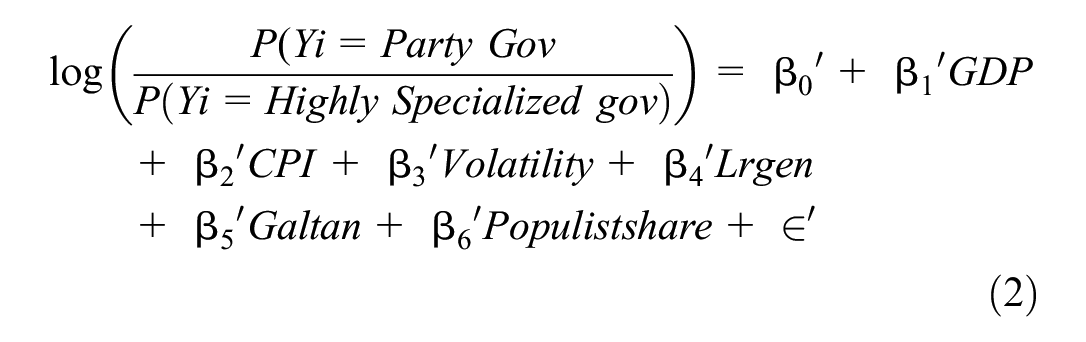

To ensure the accuracy of MLR model, this study conducted model diagnostics. Firstly, we examined the multicollinearity among the independent variables. All variance inflation factor (VIF) values were below the commonly accepted threshold of 10, indicating that multicollinearity within the model is acceptable. Additionally, we assessed the model’s goodness of fit and predictive capability. The model’s McFadden R2 value was 0.163, which is within an acceptable range for model fit. Moreover, the model’s area under the curve (AUC) value was 0.7313, indicating that the model performs well in terms of classification ability.
Figure 2 illustrates the logical structure and analytical strategy of this study. Guided by path dependence theory, researcher have proposed six hypotheses, which are tested using multinomial logistic regression to examine the causal mechanisms behind the formation of technocratic governments.

Analytical framework and methodological approach.
Results
Model Results
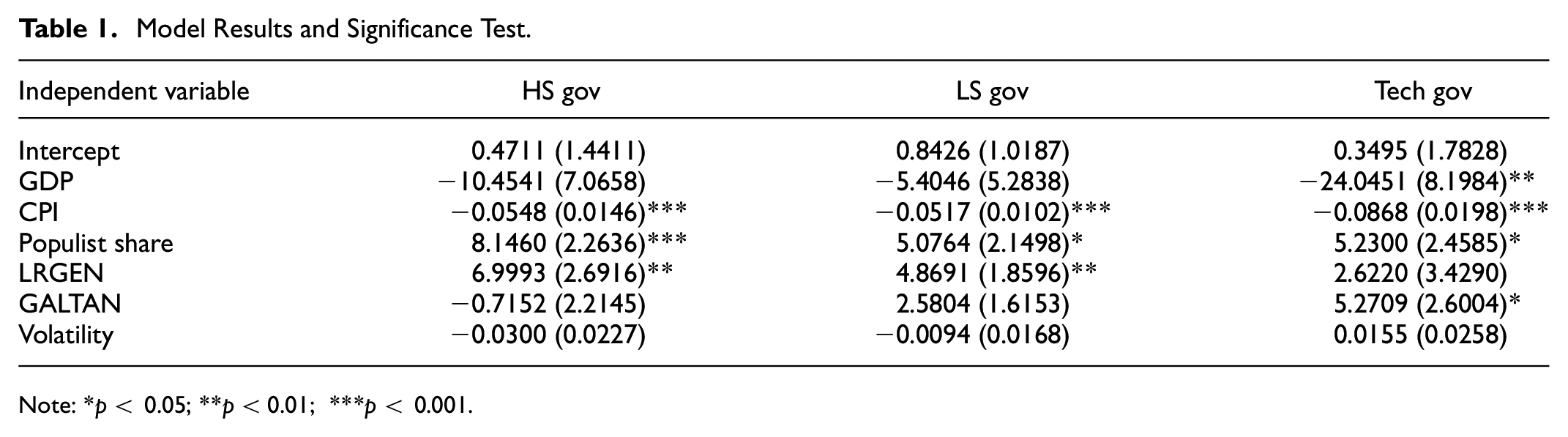
The results of the model (detailed in the Supplemental Material) elucidate the influence of variables on various government types, with a specific focus on technocratic governments. Under constant conditions, a unit increase in GDP diminishes the log odds difference between technocratic and party governments by 24.0451. Similarly, a unit rise in the corruption index causes this difference to lessen by 0.0868. This suggests that elevated GDP and corruption indices statistically diminish the probability of technocratic governments relative to party governments. In contrast, factors like populism, party polarization, and electoral volatility exhibit a positive correlation with the establishment of technocratic governments.
The MLR model assessed the significance of each independent variable (see Table 1). Our findings confirm a notable negative association between GDP growth rate and technocratic government formation (coefficient of −24.0, p < .01), supporting the hypothesis that increased GDP reduces the likelihood of such a government (H1 is validated). Nonetheless, party economic position polarization doesn’t significantly impact the formation of technocratic governments (p = .76), leading to H2’s rejection. Conversely, polarization concerning new political issues significantly bolsters the probability of technocratic government formation (p < .01, validating H3). We also discern a positive relation between the presence of populist parties in parliament and technocratic government formation, negating H4. A decline in the Corruption Perception Index (CPI)—indicating heightened corruption—significantly augments the chances of a technocratic government emerging (validating H5). Electoral volatility’s influence on technocratic government formation is insignificant, prompting us to reject H6.
Model Results and Significance Test.
Note: *p < 0.05; **p < 0.01; ***p < 0.001.
Regarding high specialized governments (HS gov), the GDP coefficient stands at −10.5 but lacks significance (p = .139). This suggests that while heightened GDP might decrease the probability of HS government formation, the association isn’t robust. As with technocratic governments, diminished corruption significantly lowers the odds of an HS government emerging (p < .01). Additionally, a larger parliamentary share of populist parties and increased economic position polarization among parties significantly enhance the likelihood of HS government formation (p < .01).
For low specialized government (LS gov), variables like economic shifts, social position polarization, and electoral variances don’t significantly impact their establishment. Nevertheless, reduced corruption significantly dwindles the chances of LS gov formation (p < .01). Both the presence of populist parties in parliament and economic position polarization between parties significantly favor the establishment of LS gov (p < .01).
The MLR model enables the prediction of the likelihood of specific outcomes related to a given independent variable. The study primarily examines the influence of varying levels of GDP growth, corruption, electoral volatility, and party polarization in the social dimension on the rise of a professionalized cabinet. This predictive interpretation draws on the model’s output (Figure 3).

Predicated probability based on dependent variable.
The findings indicate that an underperforming economy increases the likelihood of both technocratic and HS government emergence, whereas it has an insignificant impact on LS government formation. These observations align with our prior analysis. Decreased corruption levels deter the appointment of technocratic ministers and hinder the establishment of specialized cabinets. Conversely, party polarization in the social dimension enhances the prospects for technocratic and LS governments but impedes HS government establishment. Although electoral volatility does not have a statistically significant influence on the formation of specialized cabinets, the model’s projections display a growing likelihood for technocratic government emergence as electoral volatility rises, while slightly diminishing the chances for HS and LS governments.
Interaction Effects
To explore the interplay of multiple independent variables on the dependent variable, the model incorporates cross-interaction variables. Specifically, this study integrates two sets of cross-interaction variables: GDP growth rate and party polarization in the economic dimension, and corruption and electoral volatility. This enhancement rests on the premise that the GDP growth rate’s impact on cabinet formation may differ depending on party polarization levels. Similarly, the influence of electoral volatility on cabinet formation might be contingent on corruption levels. It’s pertinent to note that introducing interaction variables amplifies the model’s complexity, potentially affecting the stability of coefficient estimates and significance tests. Concurrently, we identified pronounced multicollinearity among certain predictors in the adjusted model. To mitigate these issues and visualize interaction effects, we opted for marginal effect plots, facilitating the discernment of variable effects across different levels of other variables.
Our refined model consistently forecasts the interrelation between economic performance and party polarization in the economic dimension on the likelihood of technocratic government emergence (Figure 4). Importantly, the likelihood of a technocratic government’s rise strongly correlates with the disparity in economic policies among political parties during economic downturns, particularly when GDP growth is negative. In essence, greater economic policy divergence elevates the chances of technocratic government formation. Figure 5 delineates the impact of electoral volatility on the probability of technocratic government formation under varying corruption levels. The findings underscore that even with low electoral volatility, pronounced corruption substantially amplifies the probability of technocratic government inception.
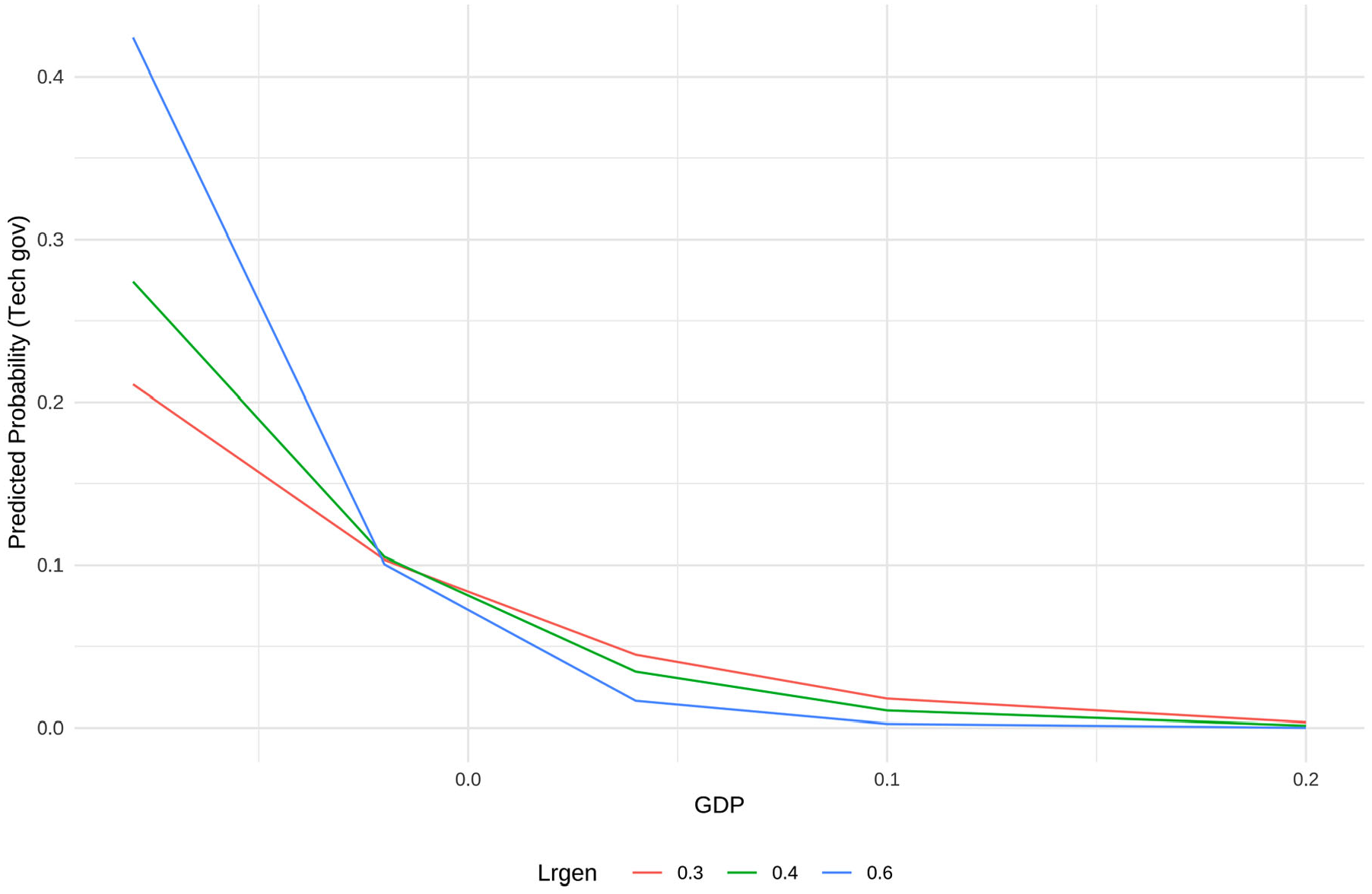
Marginal effect plots based on GDP and LRGEN.

Marginal effect plots based on volatility and CPI.
Discussion
In response to intricate crises, established institutional pathways often undergo re-evaluation and contestation. Crises typically drive governments to consider alternative routes, potentially necessitating the abandonment of deeply rooted decision-making processes (Ebbinghaus, 2005). Building on the quantitative analysis outcomes, this study utilizes process tracing to evaluate path adjustments and discern political ramifications within specific crisis scenarios.
Italy: Techno-Populism
Empirical research indicates that a combination of economic downturns and divergent economic stances among political entities can augment the likelihood of technocratic governments rising to power. Italy’s political trajectory validates this assertion. The emergency financial stabilization package unveiled by the Berlusconi administration during the sovereign debt crisis encountered widespread disapproval. This was epitomized by Umberto Bossi of Lega Nord, the parliament’s second-largest party, vociferously opposing pension reforms (Jones, 2012). Such rifts precipitated the government’s dissolution, setting the stage for Monti’s technocratic regime. This regime fostered a closer collaboration with the European Central Bank and initiated a sequence of contentious economic reforms emphasizing fiscal responsibility (Culpepper, 2014). The ascent of the Draghi administration, steered by the ex-European Central Bank president, further exemplifies technocratic appointments amidst economic crises. Proactively, the Draghi administration introduced targeted strategies, encompassing financial aid and fiscal stimulus, in response to the pandemic’s impact on Italy (Marangoni & Kreppel, 2022).
Contrary to our preliminary postulation opposing technocratic expertise and populist disdain for the elite, the Conte administration validates their coexistence. Giuseppe Conte, donning the Technocrat Prime Minister mantle, leaned heavily on his expert committee during the pandemic, embodying a proficient state overseer. Concurrently, he aligned with prominent populist factions, Five Star Movement (5SM) and The League (Giannetti et al., 2022). Such revamped populist coalitions, blending authoritarian right tendencies with technocratic populism, sidestep traditional left-right polarities (Aprasidze & Siroky, 2020; Mosca & Tronconi, 2021; Zulianello, 2020). They resonate with an electorate disillusioned with the political establishment but valuing technological prowess and administrative professionalism (Buštíková & Guasti, 2019). Evidently, in multifaceted political and economic milieus, technocracy and populism can coexist symbiotically rather than purely in contention.
Post-Communist Countries: Corruption and the Crisis of Political Trust
The model postulates that corruption significantly influences the emergence of professional cabinets. Empirical backing for this proposition is depicted in Figure 5, emphasizing that technocratic governments are more likely in profoundly corrupt contexts, regardless of electoral volatility’s magnitude. Scrutiny of post-communist Eastern European nations corroborates this trend. Specifically, interim governments like the Raykov, Bliznashki, and Yanev Cabinets in Bulgaria, the Rusnok Cabinet in the Czech Republic, and the Cioloş Cabinet in Croatia materialized following their antecedents’ disintegration due to corruption-related uproars that instigated no-confidence motions or large-scale political demonstrations (Racoviţă, 2011; Vachudova, 2009). These technocratic administrations principally aimed to bridge the political power vacuum and ensure efficient state governance.
Indeed, technocratic regimes in post-communist nations unveil unique challenges these regions confront during their political-economic metamorphosis (Hanley, 2018). The legitimacy of political cohorts and elites has been considerably eroded during governance crises, culminating in frequent cabinet reshuffles. The esteem of political entities and elites has significantly eroded during governance crises. Hence, the resultant political turbulence and frequent cabinet reshuffles are predictable outcomes (Brunclík, 2016; Linde, 2009). This erosion of political faith and the diminished credibility of established political groups have bolstered public endorsement for unconventional governance forms, epitomized by technocratic governments. These interim cabinet structures aim to reinstate political equilibrium, awaiting the advent of rejuvenated, credible political entities (Brunclík & Parízek, 2019).
Technocratic Government and Representative Democracy
In specific crisis scenarios, traditional party democracy can undergo notable challenges and path adjustments. Such modifications, particularly characterized by the advent of technocratic governments, emerge as direct responses to crises. This situation prompts a vital inquiry: does such an adjustment signify that representative democracy in EU nations is undergoing substantial transformations? Our quantitative analysis suggests that while technocratic government might be an adopted practice during crises, it doesn’t entirely supplant traditional policy-making processes. Evidence largely supports the notion that post-crisis, political systems generally revert to their conventional institutional pathways, with political parties retaining their centrality. This indicates that technocratic governance primarily functions as a short-lived, emergency governance model, rather than indicating enduring institutional metamorphosis (Pastorella, 2016a). However, such transient modifications undeniably introduce fresh challenges to representative democracy, highlighting that under certain pressures, conventional delegation mechanisms might falter. This mirrors an intrinsic tension in contemporary democracies, epitomized by the dichotomy between the public’s anticipation of efficient governance and the inflexibility intrinsic to party democracy (Flinders & Hinterleitner, 2022). As Mair (2023) denotes it, there is a “dilemma between responsiveness and accountability”. The increasing cartelization of political entities has concurrently diluted their public affiliations (Thomassen & Van Ham, 2014). Coupled with the merging policies across these parties, it has eroded their representativeness to distinct societal factions, paving the way for various social movements, populist politics, and the rise of technocratic governments (Martinelli, 2016; Piquer & Jäger, 2020). Another emergent trend warranting attention is “technocratic populism.” Divergent from classical populism, it signifies a robust confidence in technocratic governance and expertise while simultaneously critiquing traditional political authorities (Fernández-Vázquez et al., 2023). While critiquing established political entities, technocratic populism accentuates confidence in “competent experts,” derived from public discontent with prevailing party democracy and a thirst for efficient governance (Buštíková & Guasti, 2019). This trend, under certain facades, can be a precursor to authoritarian tendencies, potentially impeding or even reverting democratic processes, especially in Eastern Europe’s post-communist nations (Guasti, 2020) .
Conclusion
Amid a series of crises, EU governments grapple with novel political pressures that challenge established trajectories of political decision-making. This research specifically examines the factors propelling the rise of technocratic governance as a response mechanism and delineates its democratic implications through illustrative case studies.
Our findings highlight the vulnerabilities of the conventional delegation approach, especially when confronted with economic turmoil, escalating populism, political malfeasance, and pronounced inter-party divisions. In such scenarios, technocratic governance emerges as a temporary solution adopted by select European nations. While this governmental configuration is not pervasive, its recurrence might intensify during ensuing crises, reflecting the populace’s mounting demand for adept governance. These formations underscore the reevaluation of representative democracy. Notably, contemporary democracies are beleaguered by a palpable discord between the public’s aspiration for proficient administration and the rigidity inherent in party democracy. This tension culminates in the evolving political construct of techno-populism, which capitalizes on the public’s disaffection with current party democracy and their quest for capable governance.
Subsequent studies might consider integrating external pressures, especially those exerted by the EU and global entities, to offer a broader analytical perspective. Our initial insights also suggest varied propensities among countries to embrace technocratic governance. Future investigations could delve deeper into the motivations behind such disparities and examine the reasons some nations remain anchored to conventional party-centric governance even amidst pronounced crises.
Supplemental Material
sj-docx-1-sgo-10.1177_21582440241296931 – Supplemental material for The EU’s Democratic Dilemma: Assessing the Rise and Ramifications of Technocratic Government
Supplemental material, sj-docx-1-sgo-10.1177_21582440241296931 for The EU’s Democratic Dilemma: Assessing the Rise and Ramifications of Technocratic Government by Yiwen Zhang in SAGE Open
Footnotes
Declaration of Conflicting Interests
The author declared no potential conflicts of interest with respect to the research, authorship, and/or publication of this article.
Funding
The author disclosed receipt of the following financial support for the research, authorship, and/or publication of this article: ECNU Academic Innovation Promotion Program for Excellent Doctoral Students(YBNLTS2023-047)
Ethical Statement
This article does not contain any studies with human or animal subjects.

Data Availability Statement
Supplemental Material
Supplemental material for this article is available online.
References
Supplementary Material
Please find the following supplemental material available below.
For Open Access articles published under a Creative Commons License, all supplemental material carries the same license as the article it is associated with.
For non-Open Access articles published, all supplemental material carries a non-exclusive license, and permission requests for re-use of supplemental material or any part of supplemental material shall be sent directly to the copyright owner as specified in the copyright notice associated with the article.
