




Abstract
The diversity of teachers is half that of the student population in Australia. Despite government policies to support internationally trained teachers (ITTs), there remain major structural and institutional barriers working against access to the profession: an information gap, the lack of professional advice, the absence of programmes to help teachers gain accreditation and the lack of mentoring or support programmes. This paper focuses on ITTs undertaking volunteer teaching in community languages schools; these are community-run organisations where over 100,000 children across Australia learn their home language. These sites were selected as they represent a key pathway into further study and employment for ITTs. Findings are drawn from online survey (n=954) and interviews (n=62) exploring professional strengths, needs and experiences. The key finding is the exclusion and ‘problematisation’ of ITTs, rather than recognition of the social, educational and economic benefits represented by this group. The article explores recent government-funded provision of pathways to teacher accreditation and the extent to which these address the barriers identified. There is a discussion of how such a model may be embedded in mainstream teacher education pathways.
Keywords
Introduction
The diversity in Australia’s schools is not matched by diversity in its teaching force. Fifty per cent of Australians are migrants or children of migrants, and over 20% of school students speak a language in addition to English at home (ABS, 2017). In New South Wales (NSW), Australia’s most populous state, 33% of students in government schools but only 11% of teachers come from language backgrounds other than English (Cruickshank, 2004).
This lack of diversity in the teaching profession has been identified in many countries (Boser, 2014; Donlevy, et al., 2006; Partelow et al., 2017). The problem of having a predominantly monolingual/ monocultural teaching body, with its implications for curriculum, resources and teaching, has been the subject of much research: students may be limited in their development of intercultural competence and as global citizens, and students from diverse backgrounds lack role models (Little and Bartlett, 2010; Maddix, 2017).
In the US, a range of programmes to increase the percentage of minority teachers has led to much greater diversity in teachers (Ingersoll et al., 2018; Sleeter and Thao, 2007). The picture in Australia is not as positive. There is a long tradition of teacher professionals of migrant and refugee backgrounds, especially with immigration policies since the 1990s favouring skilled migration, and early studies identified over 15,000 internationally trained teachers (ITTs) unable to get accreditation to teach in Australia (Inglis and Philps, 1995). This led to the establishment of a system of recognition of overseas qualifications and skills (AEI-NOOSR, internationaleducation.gov.au). All Australian state and federal accreditation authorities developed policies and protocols for ‘overseas-trained’ teachers. The issue was thus addressed in policy statements rather than through policy initiatives as in the US and UK (Carrington and Tomlin, 2010).
There is, however, strong evidence of little change, with major Australian reports and studies in the past two decades consistently indicating thousands of teachers unable to gain re-entry to the teaching profession (Santoro et al., 2001). Recent research findings show continuing barriers: a lack of information, advice and support, blocked pathways, barriers of English language proficiency, an absence of upgrading, induction and mentoring programmes and a history of ad hoc initiatives with little continuity (Bense, 2016).
This article addresses two questions: why have systematic barriers continued to exclude ITTs from the teaching profession? And, how can systemic change be effected to facilitate entry to the teaching profession?
This article draws on two recent studies to explore the present situation of ITTs in Australia and the barriers to their re-entry to the profession (Cruickshank et al., 2018, 2021). It then reports on initial evaluation of a set of initiatives which have been developed to provide pathways for ITTs to gain accreditation in Australia. Finally, it discusses how such initiatives can be sustainable given the shift in Australian education to marketisation, central control over funding but devolution of responsibility to local level (Joppke and Morawska, 2014).
Community languages schools
Making contact with teachers of migrant and refugee background is difficult, as many communities have few cultural or religious organisations that act as a focus. Communities are often geographically dispersed, and more established communities tend to fewer cultural affiliation links. For this reason, in our research we have been working through the system of community languages schools. These schools, also known as complementary (UK), heritage language (US) or ethnic schools, are established and run by parents and community members with the aim of passing on cultural and linguistic understandings to second, third and subsequent generations. There is a growing body of research into the schools which exist in most OECD countries (García et al., 2012; Lytra and Martin, 2010). In Australia they have been operating since the 1850s, and now there are over 100,000 children learning one of 64 languages taught by over 10,000 volunteer teachers every week.
Our study of 510 community languages schools in NSW found that 96% of teachers in the schools are overseas-born of migrant and refugee background. Almost 80% are tertiary trained and the majority have teaching experience overseas (55%). Over 80% want to become teachers in Australia but only 4% have managed to do so (Cruickshank et al., 2018). This article thus focuses on the estimated 2000 volunteer teachers of migrant and refugee background in these NSW schools who are trying to gain re-entry to the teaching profession as accredited teachers.
Background
There is now a strong body of research of immigrant and refugee backgrounds. They are generally referred to as ‘overseas-trained teachers’, ‘im/migrant’ or, more recently, ‘internationally educated teachers’ or ‘internationally trained teachers’. This article uses the latter term (ITT) following Proyer et al. (2019). The main contributions to research literature are from North America (Bartlett, 2013; Chassels, 2010; Faez, 2012; Marom, 2017; Pollock, 2010; Schmidt, 2010; Schmidt and Block, 2010), the UK (Maylor et al., 2006, Miller 2008, 2018, 2019; Miller et al., 2008; Warner, 2010) Sweden, Germany and other EU countries (Andersson and Guo, 2009; Grantham et al., 2007; Proyer et al., 2019), Australia (Collins and Reid, 2012; Guo and Singh, 2009; Reid, 2005; Robertson, 2007), Israel (Epstein and Kheimets, 2000; Remennick, 2002) and South Africa (De Villiers, 2007; De Villiers and Weda, 2018; Keevy et al. 2014). Although the majority of these studies explore the benefits and problems of ITTs in the schools, a large number have also explored the issues of ITTs in gaining re-entry to the teaching profession.
This section analyses key findings from these studies. Minty et al. (2008) surveyed and interviewed ITTs and head teachers in London supplementary schools, 65% of whom were teaching community languages. The average age of the teachers was 30–44 and a slight majority were women (54%). They found that most teachers (80%) had overseas degree-level qualifications, and two-thirds had teaching experience outside the UK (average 7.25 years). The overwhelming majority wanted to gain ‘Qualified Teacher Status’ to teach in mainstream schools. They found that most ITTs lacked information on pathways to gain accreditation and upgrading, and were unaware of requirements needed to teach in mainstream schools. This lack of information and advice for ITTs to negotiate pathways is confirmed by many other studies (Cruikshank, 2004; Inglis and Philps, 1995).
The second common theme in studies is the mismatch between the teachers, their qualifications, and the requirements of host country education systems. There are often differences in expectations of levels of qualifications between ITTs’ country-of-origin systems and the host country education system. There is generally little recognition of prior learning. It is difficult for ITTs to upgrade qualifications and gain ‘local experience’; they are often in full-time work with families to support, and costs are often prohibitive. As new migrants, the gaining of financial security takes precedence over retraining to re-establish their career. The few programmes available for them are reported as ad hoc (Marom, 2017; Pollock, 2010). Minty et al. (2008) and other studies also identify the need for high levels of fluency in English and the language of the mainstream schools. It is difficult for recent immigrants to gain the required proficiency.
The third barrier identified is inbuilt bias in education and training systems against ITTs. Preservice teacher education programmes often presume local experiences of education in their structure, assessment and content. There are few continuing induction or mentoring programmes into local education systems. ITTs are often expected to be ‘experienced’ teachers because of their age. There are also studies which indicate marginalisation of ITTs when they manage to gain accreditation and employment in schools. They can often be caught in diminishing spirals of gaining casual work; even if they gain full-time positions they have higher attrition rates because of the difficulties of adjustment, reported lack of support and being placed in hard-to-staff schools (Bartlett 2013; Marom, 2017; Schmidt 2010).
Research design
This article draws on data from a study involving online survey and face-to-face interviews with ITTs working in NSW community languages schools. The survey was developed in collaboration with community members and education system officers after ethics approval was gained from the relevant authorities. Initial questions in the survey established age, gender, country of birth and length of time in Australia. To gain a picture of teachers’ qualifications and training we asked about years of secondary education (drop-down menu), the field (if any) of post-school education (drop-down menu), the type of qualification (open), and if/what they were currently studying. We then asked detailed questions about teaching experience in Australia or overseas. There were self-assessment questions on teachers’ fluency in English and other languages. The final section of the survey focused on professional learning needs: if teachers wanted to become accredited teachers in Australia; if they wanted professional learning in English and their community language. Respondents also had a list of topics for professional learning with strongly agree/ agree/ not important options. They were also asked about their family and work commitments and ability to undertake further study.
There were 903 responses which provided 850 ‘cleaned’ samples once incomplete and doubled-up responses were excluded. We managed to gain a sample of teacher responses representative of languages groups in the broader community. Overall there were 54 languages represented, with large numbers from Chinese (164), Vietnamese (115), Korean (68) and Arabic (81). All recently arrived refugee-background groups were also represented: Tamil (54), Uyghur (2), Assyrian/ Chaldean (14), Dari (13) and Tibetan (14). There were many recently arrived teachers from Iraq and Syria in the Arabic language group.
The main ‘under-response’ in relative terms was from teachers of Arabic backgrounds. We thus employed an Arabic-speaking Research Assistant and made efforts to gain Arabic-speaking interviewees. Face-to-face interviews were an integral part of the process in order to gain more depth in responses around the barriers to re-entry.
In spite of over 400 teachers indicating willingness to be interviewed, only 47 in total were reached. The final concerted effort led to 32 face-to-face interviews. The language breakdown of interviews was as follows: Arabic (12), Armenian (1), Chinese (2), Japanese (5), Korean (3), Tamil (3), Polish (1), Tibetan (1), Assyrian (2) and Dari (2). All interviews were recorded and transcribed. Interviews in Arabic were summarised in English. Interview topics were:
Qualifications gained overseas and in Australia.
Knowledge and sources of information in gaining accreditation in Australia; career goals and expectations and steps taken in achieving these.
Perceived professional knowledge and learning strengths and needs.
Issues for other teachers in their community in gaining accreditation and finding employment.
There was an interactive relationship between survey and interview findings analysis. Interview findings were analysed using content and thematic analysis. Survey findings were given subjective and multivariate analysis. Data were analysed to address the first question: “why have systematic barriers continued to exclude ITTs from the teaching profession?”.
To answer the second question, “how can systemic change be effected to facilitate entry to the teaching profession?”, we draw on initial data from evaluation of initiatives to provide pathways for ITTs into the teaching profession. These were developed following a NSW government grant of AUD$6.7 million in 2017. It was this funding that enabled the research and the development of the initiatives shown in Table 1.
Initiative and data source.
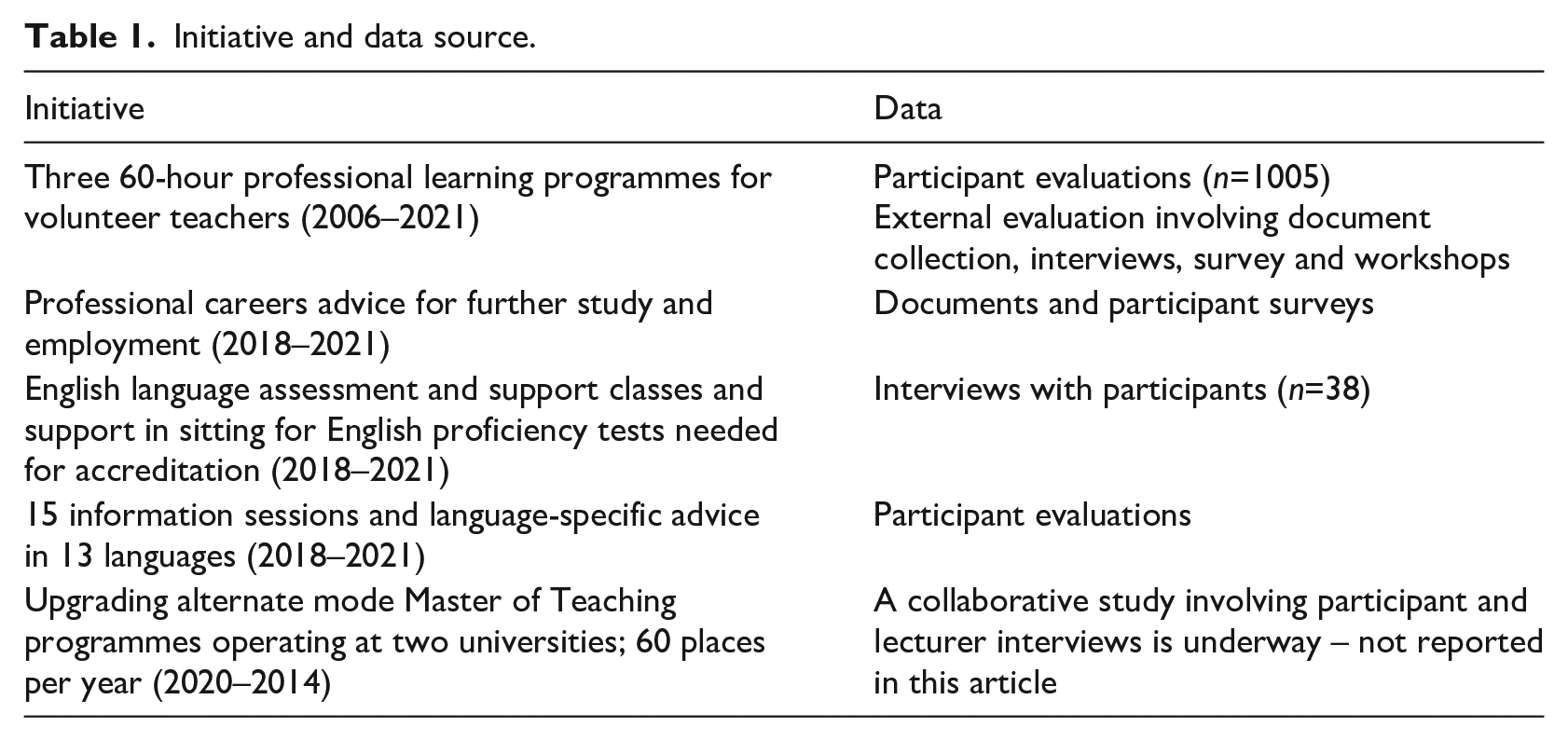
Programme evaluations were conducted with every class (2017–2020) with questions on participant enjoyment of the programme, comments on the lecturers and on their own learning. There were specific questions on assessment tasks, visits to mainstream schools and language-specific sessions. In all 1005 responses were received (78% of total participants). In addition, an external evaluation was conducted of the 2018 and 2019 Leadership and Management programmes for principals (Social Equity Works, 2020). This involved interviews with programme lecturers (n=4), post-programme evaluations (n=101), in-depth feedback by online survey (n=15) and face-to-face workshop (n=12).
Survey findings
The key finding of the survey is that the numbers of ITTs unable to gain entry to teaching in Australia remains unacceptably high. Some 80% of teachers in our study of community languages schools have tertiary qualifications, a finding which aligns with the UK study (Minty et al., 2008). Of those with tertiary qualifications, 44.3% had majors in education. The groups with the highest percentage with majors in education were Japanese (63%), Greek (57.6%), Polish (60%), Swedish (70%) and Macedonian language teachers (71%). In addition to qualifications, teachers also brought much experience in terms of education. In response to questions about teaching experience, 54.9% of teachers reported teaching experience overseas. This is a more accurate picture of those with a teaching background, as in many countries a major in education is not the prerequisite to be a secondary teacher. For example, although only 26.8% of teachers of Indian languages reported a major in education (average 44.3%), 65.1% of the teachers reported teaching experience in India. Some 44% of teachers of Chinese had majors in education but 59.8% had teaching experience overseas. These qualifications are not just something in the teachers’ past: 49% are currently studying in a range of fields, including education. The majority of respondents wanted to become accredited teachers in Australia (75%), but few had been able to do so (3% accredited).
We found that this exclusion seemed to impact greatly on women and that recency of migration was not a factor. Teachers in community languages schools are overwhelmingly female (87%). There is also a spread of ages of the teachers: 33.1% are under 40, 27.5% are aged 40–49 and 34.6% are aged over 50. We found that most teachers had been in Australia a long time: 59.5% of the teachers were in Australia for more than 10 years; 19.4% for between five and nine years; and only 14.6% for four years or less.
The gaining of fluency in English again emerged as a key barrier reported by teachers (80%). Even longer-term residents of Australia reported needing support in learning classroom English. Australian accreditation authorities require IELTS scores of 8 in speaking and listening (equivalent to borderline C2 level in CEFR) and a minimum of IELTS 7 in writing and reading (C1 in CEFR). There is no flexibility in this requirement as happens in many European systems in terms of the CEFR (Bodström et al., 2020). There are also few higher-level or teaching-oriented English programmes that teachers can access, and the costs of any programmes are also prohibitive.
The second barrier was the lack of information. Although all education systems have online information, there is little face-to-face contact with applicants. Few teachers in our survey had accessed the online information, and many teachers were unaware of the differences between their country of origin and Australian education systems. Australian primary teachers are generalists who teach all subjects; specialist language accreditation is then gained on top of this. In our study over 30% of teachers (32.5%) stated that they wanted to become primary languages teachers not realising that they needed first to be accredited as generalist primary teacher. In interview, many stated that they chose language teaching in primary school because they thought classroom management was easier and lower levels of English were required. Many teachers of Mathematics and Science, which are areas of shortage, were opting instead for roles as languages teachers where employment is limited. This could indicate a lack of knowledge of employment options or a lack of confidence in teaching in mainstream classrooms.
The third issue was the absence of professional learning and ways to upgrade qualifications to Australian standards. Teachers were teaching students in community languages schools who were second, third and fourth-generation Australians; students who had only learned through the local education system. The ITTs overwhelmingly reported the need for professional learning in areas which related to teaching in Australia. Teachers were given a list of ten professional topics to respond to. The main areas of interest are shown in Table 2.
Teacher professional learning needs.
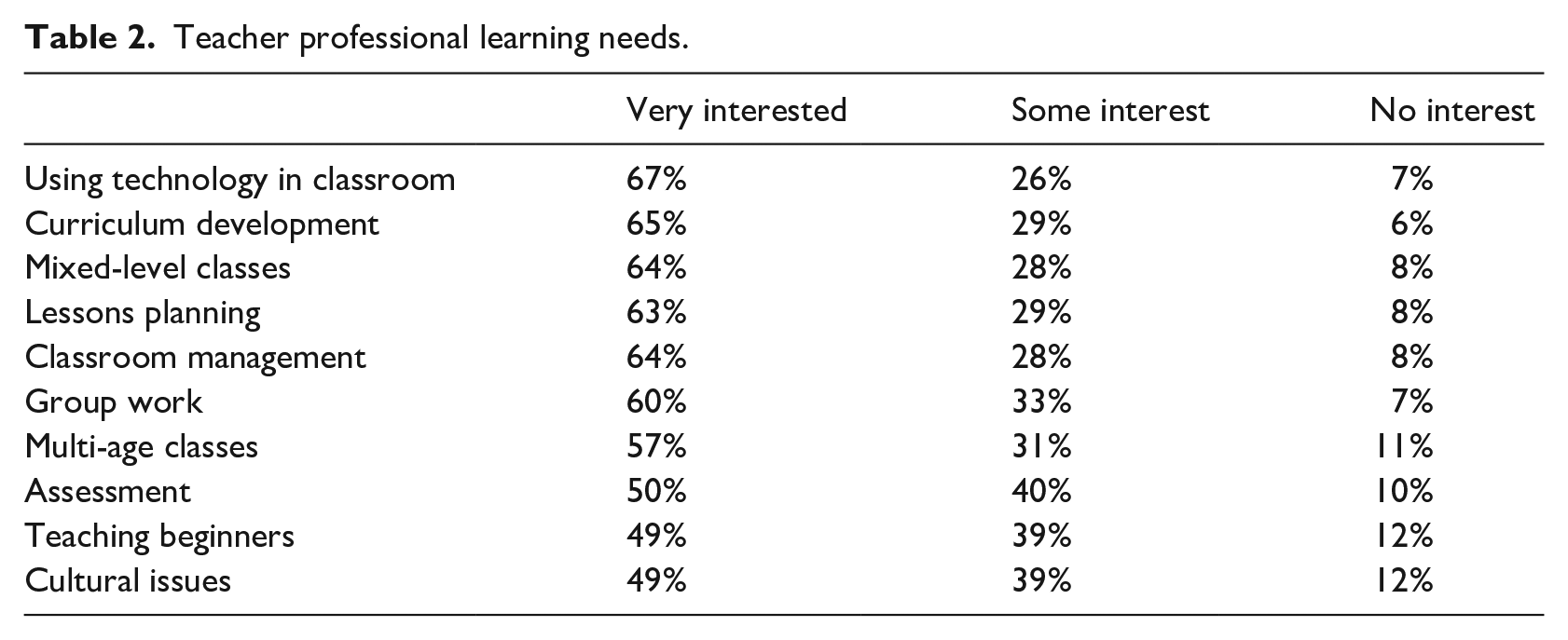
Length of time teaching in the volunteer community languages schools was a significant variable in indicating needs. Teachers who had been teaching for less than 4 years were more likely to want professional learning in classroom management (75%), curriculum development (68%), groupwork (68%) and lesson planning (67%). Teaching beginners also figured highly for this group of teachers (59%), indicating that newer teachers are often placed with beginner students in their language. Teachers who had been teaching for more than 10 years were more interested in using technology in the classroom and had less interest in behaviour management.
In the open response section, the most common request was learning ways to engage students. The terms ‘motivate’ and ‘engage’ were used in the majority of responses. These themes underpinned many of the responses in Table 2. Special needs were mentioned in the open responses by several teachers (n=11).
It is often assumed by authorities that because teachers are ‘native speakers’ of their language, there is no need for professional learning in that language. Our interview findings, however, indicate that only a small percentage of teachers have tertiary study of the language they teach. Over 80% of teachers indicated that they wanted professional learning in understanding and knowing their community language better and thus being able to teach heritage and second-language learners.
ITTs face a final barrier in gaining accreditation: the increase in requirements from 2 to 4 years of post-secondary preservice teacher education in the past decades. Many ITTs have post-secondary preservice teacher education equivalent to only 2 or 3 years. These teachers find it impossible to gain recognition of prior learning and because of work and family commitments cannot attend full-time preservice teacher education programmes from the beginning. When asked if they were prepared to undertake more study to gain these qualifications, 416 replied ‘yes’ and an additional 148 ‘maybe’. This constitutes 66% of teachers: a significant majority when the numbers of those who are past retirement age and those who are already teachers are taken into account.
Focus on issues can be misleading. ITTs are often framed as a ‘problem’ and the focus is on the cost of upgrading and induction programmes and language support (Warner, 2010). There is little mention of the social, educational and economic value ITTs bring. The post-secondary qualifications of 80% of the teachers means an economic bonus upward of AUD$200 million. Teachers had expertise in many areas of shortage in the local system, such as Maths, Science and Technology. Teachers reported fluency in more than 90 languages. Many were also fluent in different dialects or varieties of their languages. Over 47% of teachers were multilingual, speaking more than two languages. The main third language was French (n=66). The next section reports on interview data and explores the issues emerging in survey findings.
Interview findings
Anna 1 worked in aged care but also started teaching in her community language school 4 years ago when her eldest child started high school. The school had just started a preschool group and she was their teacher. She said she had mixed emotions when she started teaching because she was a trained early childhood teacher who had not been able to continue her teaching in Australia. Her students now were second or third-generation Australians and she was teaching through songs and games. She loved getting back to working with children. She recounted her interview with a government department when she first arrived in Australia in 1996.
I showed them my bachelor and masters qualifications and asked about teaching Early Childhood. The man pushed them back to me across the table and told me they were not worth anything in Australia. He told me I could do cleaning or work as a nurses’ aide in aged care or be an assistant in preschool. He told me that if I wasn’t prepared to work hard in Australia I should go back to where I came from. I went home and cried but I gave up ever wanting to be a teacher. I put my papers in the drawer and never looked at them again. (Anna, Early childhood ITT)
This type of account was also echoed by many recent interviewees. And many felt that, in retrospect, they had been given wrong advice by college, university and government officials. Many relied only on advice from friends and others in the community. Several had undertaken courses which they mistakenly thought would qualify them as teachers. Maria had a Bachelor of Education which she did not realise would be accredited to teach in Australia with one or two additional units of study.
I went to the uni. They told me to do a Master of Science. I still wasn’t qualified with two bachelor’s degrees from my country. I then went to TAFE (college) and they told me to do a Teacher’s Aide course, but there are no jobs and it doesn’t help me be a teacher. (Maria, Science teacher ITT).
Another teacher had sent her qualifications by mistake to the federal not the state accreditation authority.
I sent my qualification to NOOSR in Canberra but the letter they sent me is not worth anything. (Yong, primary ITT) They told me to do a childcare certificate course at TAFE (technical and further education college) but I couldn’t get a job. I was an Art teacher in secondary school in Vietnam. They accepted me for migration because of my qualifications but in Australia they are worth nothing. I am doing a course a doctor’s receptionist now just to get a job. (Dao, Art ITT) They university told me to do a Master of Education because I did not have enough teaching subjects in my undergraduate degree. When I finished it, I still couldn’t be a teacher because I had done the wrong course. (Iman, secondary ITT)
It was common for teachers to bring along their qualifications to the research interviews. Many did not mention overseas qualifications because they had been led to believe they were worthless. Mahmoud has a doctorate in education and was a Mathematics and Science teacher, but only stated this after explaining his college-level courses in Australia.
We found that few interviewees knew how to become accredited in Australia. The lack of information meant that many had unrealistic expectations. Mei was a secondary English teacher in China but wanted to be a primary school Chinese teacher in Australia, ‘because my English is not good enough and young children are easier to teach’. She did not know that she needed still to meet generalist teacher standards even as a teacher of Chinese. Many interviewees did not realise that in Australia, primary teachers are generalists, teaching all subjects.
Meeting English language requirements emerged as a second hurdle. The requirement for 7.5 IELTS (CEFR C1) is difficult for many as preparation courses are expensive and there are few higher-level English courses available.
I sat for IELTS five times. Each time I got eight in one area but not all at the same time. In the end I gave up. (Lisa, Mathematics ITT)
The disjunctions between education systems presented problems for many and there was no single pattern. Many primary-trained teachers had begun their teacher training at Year 10 and so were recognised in Australia as 2 but not 4-year trained. Although 2-year-trained teachers in Australia were common in the 1980s, most had been able to upgrade through experience teaching and through professional learning, For ITTs, however, there is no advanced entry available to preservice teacher programmes. Many secondary teachers had insufficient study of education although their undergraduate degrees were recognised. Completing postgraduate preservice courses is difficult because of the cost and also the full-time nature of most programmes.
Teachers of refugee background are particularly disadvantaged. One teacher, of Tibetan background from India, had completed every course that he was able to undertake, but the 5 years of study he completed were not officially recognised. Several refugee-background teachers were also internal refugees in their countries of origin and had disrupted education.
I am Palestinian so I could finish my course but not get a recognised degree in Jordan. I then did a masters online through the Sudan and then I did my teaching certificate. Everything I did has holes in it. In Australia I work as teacher aide. I have done every course I can – I know more than the teachers I support but in the end . . . nothing. (Amira, ITT Special Needs) I had nearly finished my degree when the fighting started. We had to leave. Then they asked me for a transcript from my university. How can I get one? (Sana, medical student)
Teachers of refugee background often have incomplete and disrupted educational backgrounds; they did not choose or plan to migrate. They were often denied access to education in countries of origin or countries of passage. There is great diversity in experiences and backgrounds; teachers need much support in making sense of their qualifications and future trajectories.
Summary
Many teachers report an information gap: few ITTs in our study had any idea of how to gain entry to teaching in Australia even though they had been in Australia for several years. Only two interviewees knew that there was a website with information and advice on how to apply and that they could get their qualifications assessed for free through this website. Teacher accreditation authorities generally have no outreach and little way for teachers to get personalised information because of limited government funding. The information on websites, although well intentioned, presents a barrier for teachers who have English as an additional language.
Many teachers reported receiving inaccurate information and advice from a range of sources: job agencies, tertiary institutions, friends and community contacts. Teachers who had been in Australia for several years also tended to undervalue their previous qualifications. Many showed copies of non-accredited certificate courses gained in Australia and did not mention bachelor’, masters’ or doctoral qualifications gained overseas, and were not aware that their tertiary qualifications could be assessed and recognised for free in Australia. Hardly any interviewees had sought or received professional advice from careers or course advisers.
The second issue was teachers negotiating the equivalence of their overseas qualifications. They needed certified translations and transcripts of study from their institutions overseas. Sometimes this was difficult, especially when teachers were refugees or when there had been a time lapse from when they completed original qualifications. There were also individual difficulties. Several teachers had emigrated just before completing their degrees; others had difficulties because of changes in their tertiary institution. Despite there being general protocols, there were many individual differences and some institutions not covered in the NOOSR guidelines.
The key barrier was gaining required level of proficiency in English. The English language level of 7.5 IELTS is difficult to attain especially when there are few English courses available. It was often the case that teachers did not have the time when they first arrived to undertake free government English programmes because of family and work commitments. After gaining ‘survival’ English in a year or two, they did not see the need for high-level English. It was only when they made the decision to try to re-enter the profession that their level of English became an issue.
Opening pathways
In 2017 NSW government funding of AUD$6.7 million supported the establishment of the Institute for Community Languages Education at Sydney University (SICLE) with one of its main goals as providing professional learning pathways for teachers in NSW community languages schools. This was in response to long-standing community pressure for government recognition of the needs. The NSW Premier and several government ministers had also been students in the community languages schools themselves. The following section explores the initiatives developed and ways in which these initiatives can be sustained and taken up within the regular government and education provisions.
The first step has been the development and provision of three free 60-hour professional learning programmes (see Figure 1). The ‘Community Language Teaching programme’ (foundation) began in 2006 and was funded separately for 11 years; over 2500 community languages teachers have successfully completed it. The programme is delivered on weeknights, weekends and in mixed mode in urban or regional sites close to where teachers live. In 2020 and 2021 classes were delivered online because of the Covid crisis. Groups are taught in English but with some language-specific classes in Chinese, Arabic and other languages. Sessions give a basic introduction to teaching in Australian schools, recent research in education, and practical aspects of teaching such as classroom management, preparing resources, lesson and programme planning and syllabuses. Participants visit mainstream schools to observe classes. They also visit the school and observe classes of a colleague from a different language background. The reason for this (and for mixed-language backgrounds in the one class) is to develop awareness of issues that cut across schools. Assessment tasks include interviewing, assessing and planning for student learning, trialling and evaluating behaviour management plans, developing online/hard copy resources and accompanying lesson plans/ unit of work and lesson reports. The key principle of the programme is flexibility. In 2018 our evaluation identified a large group of Korean teachers with low levels of English; for this reason a specific programme taught in Korean was delivered. Each year resources are updated with new video clips and lesson and unit samples. Evaluation has been consistently positive, with 95%+ agree/strongly agree with the value of all aspects of the course.
The ‘CLT programme (advanced)’ began in 2017 and focuses on advanced teaching skills, programme/unit evaluation and development, reflective teaching and mentoring of other teachers. Participants undertake research and development of negotiated topics in their schools: these include researching/ developing new teacher induction programmes, student engagement programmes and parental support projects. There is a strong focus on new technologies and digital storytelling. The programme was developed because of the large numbers of more recently arrived teachers undertaking volunteer teaching in the schools. These teachers were in need of immediate support and induction into teaching from more experienced mentors.
In 2017, a Certificate in Leadership and Management for Principals/ Executive of Community Languages Schools was developed following discussions with experienced CL principals. The programme, supported by a range of online video content, was run in 2018 for a group of 60 new principals. There are three strands to the programme: academic leadership (recent developments in teaching and learning), people management, and financial/ administrative management of schools. New principals are attached to experienced principal mentors who provide support and advice before, during and following the programme.
All three programmes were accredited by the teacher professional body (NSW Education Standards Authority, NESA) and over 1500 participants have now successfully completed the programmes since 2017. Participant evaluations (n=1005) indicate 96% of teachers agree/strongly agree on the value of the programme. There was a similar positive response to the quality of the lecturers and their teaching and teachers’ own assessment of what they had learned. The practical assignments seem to have been the most popular assignments: preparing a book, lesson and activity planning and behaviour management. In addition, participants greatly value the classroom observation in day schools and the language-specific sessions (Arabic, Chinese, Korean and Tamil). The external evaluation of the Leadership and Management programme found increased self-reported leadership capacity (skills and knowledge), school improvements as a result of the programme and increased confidence in their own leadership capacity (Social Equity Works, 2020).
The second initiative has been the establishment of careers advice with four qualified bilingual Careers Advisers. Services offered include help in planning career paths, accessing opportunities for further study and gaining credit for overseas qualifications. The advisers visit community languages schools and meet teachers on weekdays and weekends in different locations. To date they have advised over 450 teachers. They work closely with the teacher accreditation authority to check their advice and individual issues. Over 40 ITTs have gained accreditation directly because of this service, passing English tests (when needed) and submitting qualifications for approval to the accreditation authorities. An additional 24 have undertaken upgrading programmes at various universities.
The third step has been the provision of English language support for ITTs. The Institute runs two continuing 7-week courses (3 hours a week) focusing on listening/ speaking/ pronunciation and writing. Teachers self-refer or are referred by programme lecturers who judge English proficiency to be at or near the level required for teacher accreditation. Teachers are then supported with half-subsidy in sitting for a government-endorsed English test, and some 42 teachers have gained accreditation through this pathway.
The key initiative has been the development of preservice Master of Teaching programmes for four cohorts of 80 ITTs. Agreements were made with two universities for them to provide these specifically designed for cohorts of ITTs which meet government requirements for accreditation. Teachers undergo a preparation course exploring concepts of academic integrity, practice paraphrasing, citation and referencing. ITTs are introduced to reflective writing and ways of composing digital texts. The universities are also funded for an additional academic support position. All ITTs receive recognition of prior learning as teachers of their community language (from the professional learning programmes). They also graduate with their subject majors from their undergraduate study overseas: the main subjects are Mathematics, Science, Business Studies and Teaching English as an Additional Language. For their subject methods they join classes with other local students.
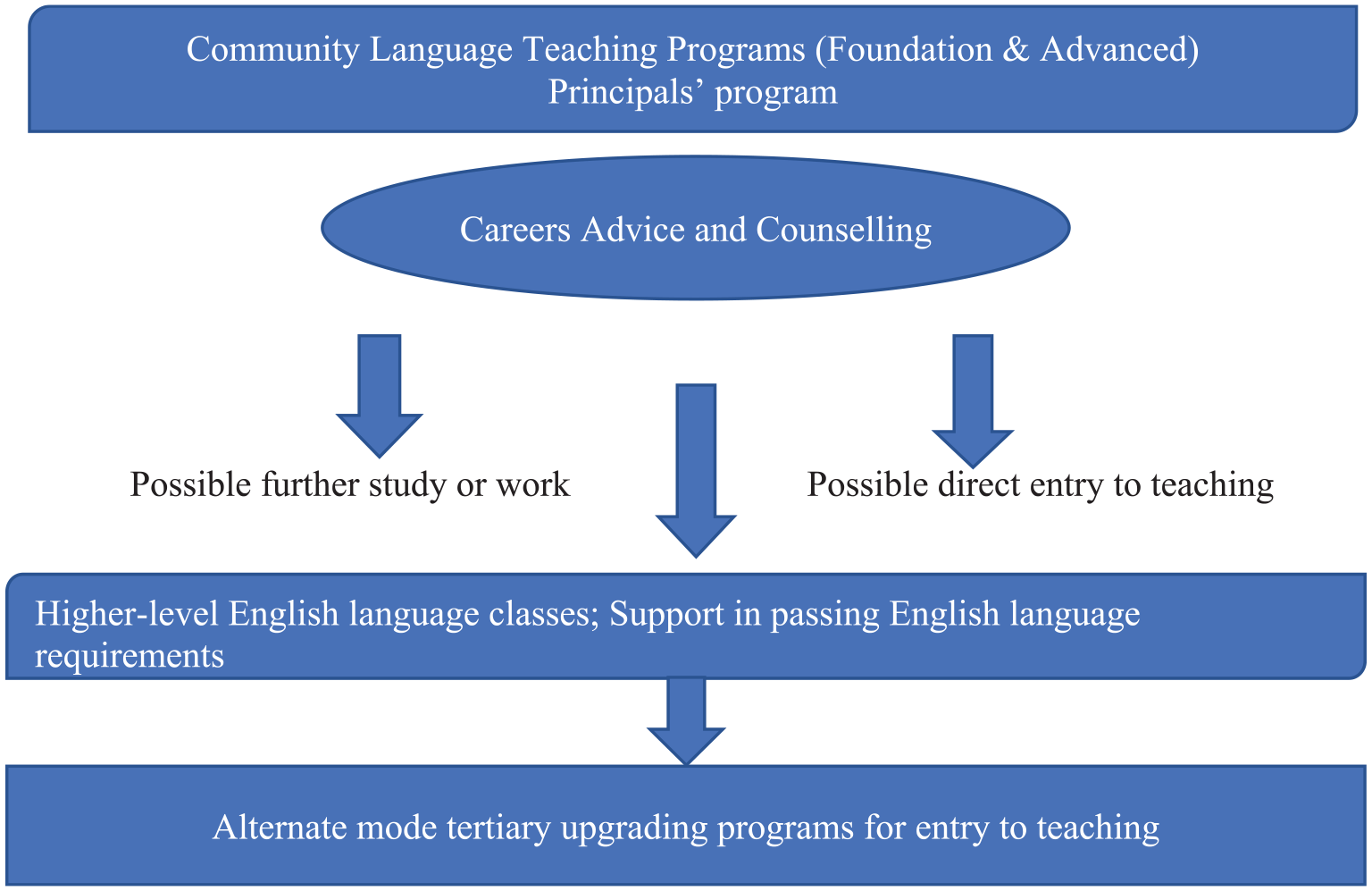
Model of pathways for ITTs.
To what extent are these initiatives sustainable? To what extent can they become part of regular provisions? To answer these questions it is important to take into account the changing educational landscape in Australia and the ways in which they ITTs are being positioned. The next section addresses these questions.
Discussion: ITTs, equity of access and educational change
In Australia, as in many OECD countries, marketisation and school-based management reforms have led to devolved responsibility for budgeting, employment and curriculum to principals and local schools, whilst centralising control over funding and outcomes through external standardised testing (Skerrit, 2019; Trumberg and Urban, 2020; Wilkins et al., 2021). Market-driven reforms in the name of ‘parental choice’ in the 1990s led to the increase of students attending non-government schools to almost 35% (Marginson, 2006). Inequality and segmentation of students by socioeconomic status (SES) and ethnic/ language background is now more pronounced (Connell, 2013; Keddie, 2017; Keddie et al., 2018; Niesche, 2019).
The difficulties of developing and implementing initiatives for ITTs in such a context are numerous. Teacher employment occurs increasingly at school level. Induction programmes for new teachers are now seen as the responsibility of individual schools. There is a reticence by governments and education authorities to take responsibility for central initiatives: this runs counter to the localised, market-driven discourse.
How can individual schools provide the induction, mentoring and support needed for ITTs? This problem underpins the reports from Australia, Canada and the US identifying systemic discrimination against ITTs (Schmidt, 2010). ITTs, as casual teachers, experience ever-narrowing circles of casual employment as schools find it too much to support them into local teaching (Bartlett, 2013; Schmidt, 2010). The policies and protocols developed by governments and teacher accreditation bodies are increasingly reliant on online formats short of face-to-face support: such support is costly. Issues to do with disadvantage and teachers of migrant background cut across local areas and are often beyond the power of individual schools to address. What are the possibilities, then, for government funding for the intervention projects needed to address the issues of ITTs?
Marketplace ideology has also led to a segmented construct of economic cost and benefit. ITTs are constructed as a ‘burden’ on the individual schools because of the cost to provide English language support and to acclimatise to local schools, pedagogical approaches and local curriculum and syllabus (Miller, 2008). This cost is divorced from the benefit of gaining teachers with years of experience plus tertiary study which the host country has not needed to pay for. Given these constraints, the pathways for ITTs may seem fragile and hopes for government funding unrealistic. The following section explores ways the initiatives outlined in this article may be scalable and sustained.
Support for English language development of teachers has been a casualty of the changes. There are few programmes supporting higher-level English development, and the focus is on ‘job readiness’ for retail and service industries. Vocational English programmes tend to be ad hoc and short term. The focus at tertiary level is often on preparation for commercial English tests such as IELTS, and academic and teaching-related English language needs are bypassed.
The key achievement in our case has been the provision of upgrading programmes for ITTs. The looming teacher shortages may be one reason why such programmes could be sustained. The cost of specific courses is not much more than those preservice teachers who have come through the regular pathways. The hope is that with three-year agreements with a range of universities these programmes will continue. Other programmes, such as preparation and English for the classroom courses, may become possible with ‘backward mapping’ from the introduction of upgrading programmes. The shape of these programmes will change over the next year but, on the basis of the number of ITTs now gaining re-entry to teaching and on the basis of our initial evaluations of each initiative, we can state that the pathway is providing a coherent set of steps to address the key issues identified in previous research.
One anomaly in the present situation has been government support for the volunteer community languages schools sector at the same time as lack of support for languages teaching in mainstream schools. This community languages sector is gaining recognition as a key provider of languages not taught in other contexts. The community groups which establish and run the schools are also gaining more of a voice with local, state and national governments (Cruikshank et al., 2021). The provision of support for the professional learning programmes is now a continuing commitment. Within these programmes can be embedded induction programmes to teaching in Australia and the provision of careers advice for teachers. Ideally, such programmes would be better provided by teacher accreditation authorities, but given the financial constraints this may be unrealistic. The community languages schools thus provide a valuable way in which ITTs may gain information on becoming accredited teachers and on getting support from others in the communities.
The segmentation of the education system along class and ethnic lines impacts also on ITTs: the segmentation of students from lower-SES and diverse backgrounds is reflected in the marginal position of teachers who speak a language in addition to English. These teachers (both Australian and overseas-born) are overwhelmingly placed in lower-SES government schools, where the majority of students from non-English speaking backgrounds are also enrolled (Datta-Roy and Lavery, 2017). Such schools are often seen as ‘harder to staff’ and could indicate a level of marginalisation of migrant background teachers identified in American research (Ball and Mannheim, 2016; Bartlett, 2013). The shift to school-based employment can only exacerbate this situation.
Where do ITTs and provisions for them fit in the present educational context? The provision of policy documents which are unsupported by specific funding and initiatives has not led to greater equity for ITTs. Despite policy statements, systematic barriers continue to exclude ITTs from the teaching profession in Australia. Within such a situation, however, there is room for change. Educational systems are not monolithic, and individual tertiary institutions and schools have the flexibility to act for change. This statement in no way should shift the responsibility for addressing equity from systems to individual schools and teachers, but the same thinking which abnegates responsibility also provides the possibilities for change.
The growing body of research internationally into teacher mobility and ITTs is a positive sign. Careers of teachers now typically involve working in a range of countries and contexts; teacher education privileges experience gained outside of country; the hope is that similar privilege can be given to the skills and experiences of ITTs of immigrant and refugee backgrounds as is given to teachers from OECD countries who gain experience teaching internationally.
Footnotes
Declaration of conflicting interests
The author declared no potential conflicts of interest with respect to the research, authorship, and/or publication of this article.
Funding
The author received no financial support for the research, authorship, and/or publication of this article.
