



Abstract
The dearth of teachers from culturally and linguistically diverse backgrounds is a long-standing social justice issue. Their missing knowledge and perspectives in schools have consequences for all students. To understand the international scope of this disparity and teacher pipeline challenge, we examine student demographic changes and teaching career expectations across 24 countries and nearly 1 million 15-year-olds from 2000 to 2022. We show that although the share of students who are of immigrant, language minority, or both backgrounds has steadily increased in most countries, their teaching career expectations (<4%) are consistently lower relative to peers.
Keywords
School disruptions during the COVID-19 pandemic exacerbated preexisting teacher shortages in many parts of the world (Organisation for Economic Cooperation and Development [OECD], 2023). Of particular concern for numerous countries is the shortage of teachers from culturally and linguistically diverse backgrounds (Forghani-Arani et al., 2019). Long-standing calls for increasing teacher diversity recognize that the missing knowledge and perspectives of culturally and linguistically diverse teachers within schools is an international social justice issue that has consequences for all students’ learning experiences. Indeed, studies show teachers from minoritized backgrounds may draw from experiential knowledge to promote students’ critical consciousness and prompt colleagues toward more culturally responsive pedagogies (Kim & Cooc, 2020). Despite the global need for more students from minoritized communities to become teachers, a key question is whether they express interest in the profession.
In this study, we examine diversity in teaching career expectations among children (15-year-olds) internationally over the last two decades. We focus on children from immigrant and language minority backgrounds because during this period, the number of international immigrants more than doubled, and nearly one out of seven immigrants was under 20 years old (United Nations, 2020). Because many immigrant children speak a language different from the receiving society’s national language (International Organization for Migration, 2019), the rise in immigration also means more language minority students in schools. An underrepresentation of immigrant teachers is common in many countries (Donlevy et al., 2016), yet less clear is whether this disparity begins earlier among adolescents. Understanding the extent to which teaching career expectations of adolescents reflect these global trends in immigration has implications for diversifying the teacher pipeline and providing more equitable school systems internationally.
Methods
Data Source
We analyzed data from the Programme for International Student Assessment (PISA). In addition to assessing students’ academic performance at age 15, PISA collects information on their demographic backgrounds, learning environments, and career interests. For participating countries, PISA used a two-stage stratified selection procedure where schools were first sampled with probabilities proportional to the enrollment size, followed by the sampling of 35 to 42 students within each eligible school (OECD, n.d.). We restricted analyses to countries 1 that appeared in each PISA wave and to years that surveyed students about their demographic backgrounds and career expectations. The final sample included five PISA waves (2000, 2006, 2015, 2018, and 2022), 24 countries 2 (Table S1, available on the journal website), and 937,160 students.
Measures
Our outcome is a binary variable for whether a student expected to become a teacher at age 30. Originally an open-ended question about expected occupation, PISA coded responses using the International Standard Classification of Occupation. We defined teaching career expectations as those related to becoming a preprimary, primary, secondary, general, or special education teacher (Table S2, available on the journal website). To examine cultural and linguistic diversity in teaching career expectations amid global immigration trends—and given that PISA does not collect race and ethnicity data—we focused on three student groups. We identified students from immigrant backgrounds if they or either of their parents were born outside the surveyed country (1 = immigrant, 0 = not immigrant). We grouped students from language minority backgrounds if they spoke a language most of the time at home that was different from the official language of their PISA test (1 = language minority, 0 = not language minority). 3 Lastly, to attend to issues of race, ethnicity, and advantage, such as how students may be immigrants but not linguistically minoritized (and vice versa), we created a third group for students who are both immigrants and language minorities (ILM; 1 = ILM/both, 0 = not ILM/neither). This unique intersection captures the teaching career expectations of an underexamined minoritized student group. The three student groups are not mutually exclusive. 4
Analysis
We first documented changes in the proportion of students from immigrant, language minority, and ILM backgrounds in each period. For each minority group, we then estimated the proportion with teaching career expectations and relative to students not from immigrant, language minority, or ILM backgrounds. In all analyses and visuals, conducted using Stata 17.0 (StataCorp, 2023) and R (Posit Team, 2024), we used balanced repeated replication to incorporate the sampling and replicate weights, allowing for population inferences and standard error estimation that account for the two-stage sample design. To capture raw trends in the population of immigrant and language minority students and their teaching career expectations, we do not include covariates. We use Cohen’s h as effect sizes for differences in proportions, such as differences in the proportion of immigrant students between years or differences in teaching career expectations between immigrant and nonimmigrant students in a given year. The supplementary appendix (Tables S4–S9, available on the journal website) provides country-level trends.
Results
Student Demographic Changes
Figure 1 shows a gradual and statistically significant increase in student diversity. The share of all students from immigrant backgrounds increased from 2000 to 2022 (2000: p∧
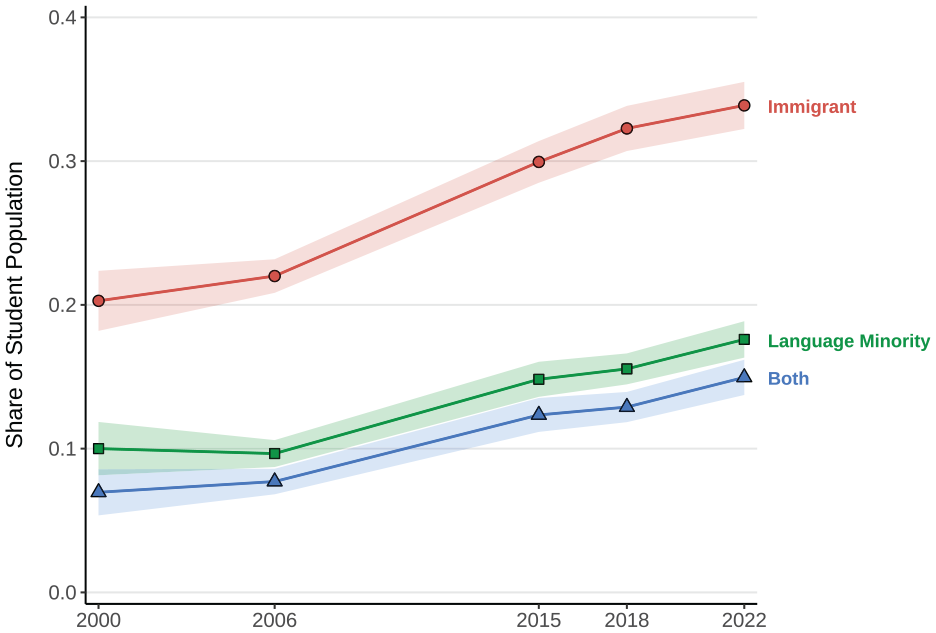
Comparison of immigrant and language minority student populations across participating Programme of International Student Assessment (PISA) countries (n = 24), with shading representing 95% confidence intervals.
Low Teaching Career Expectations
Fewer than 6% of all students in each year expected to become teachers in the future, a pattern that peaked in 2006 and started to decline afterward, notably before the COVID-19 pandemic (see Figure 2). Also notable, despite an increase in student diversity, teaching career expectations during the same period were statistically lower for each minoritized student group relative to their peers, with the gaps narrowing more in recent years. For example, among students from immigrant backgrounds, fewer than 4% held teacher career expectations in any year, about 1 to 2 percentage points lower than peers not from immigrant backgrounds (2022: h = −0.06, 95% CI = [−0.07, −0.06]). Similarly, language minority students were less likely to hold teacher career expectations than peers not from language minority backgrounds (2022: h = −0.04, 95% CI = [−0.07, −0.03]). This pattern is also consistent among ILM students, who tended to hold lower teaching career expectations than peers from neither background (2022: h = −0.06, 95% CI = [−0.09, −0.03). Individual countries vary more in overall levels of teaching career expectations but tend to show similar gaps between each minoritized student group and their peers (Figure S2–S4, available on the journal website). In addition to these gaps, teacher career expectations overall are clearly declining over time in some countries, such as France, Great Britain, and Portugal.
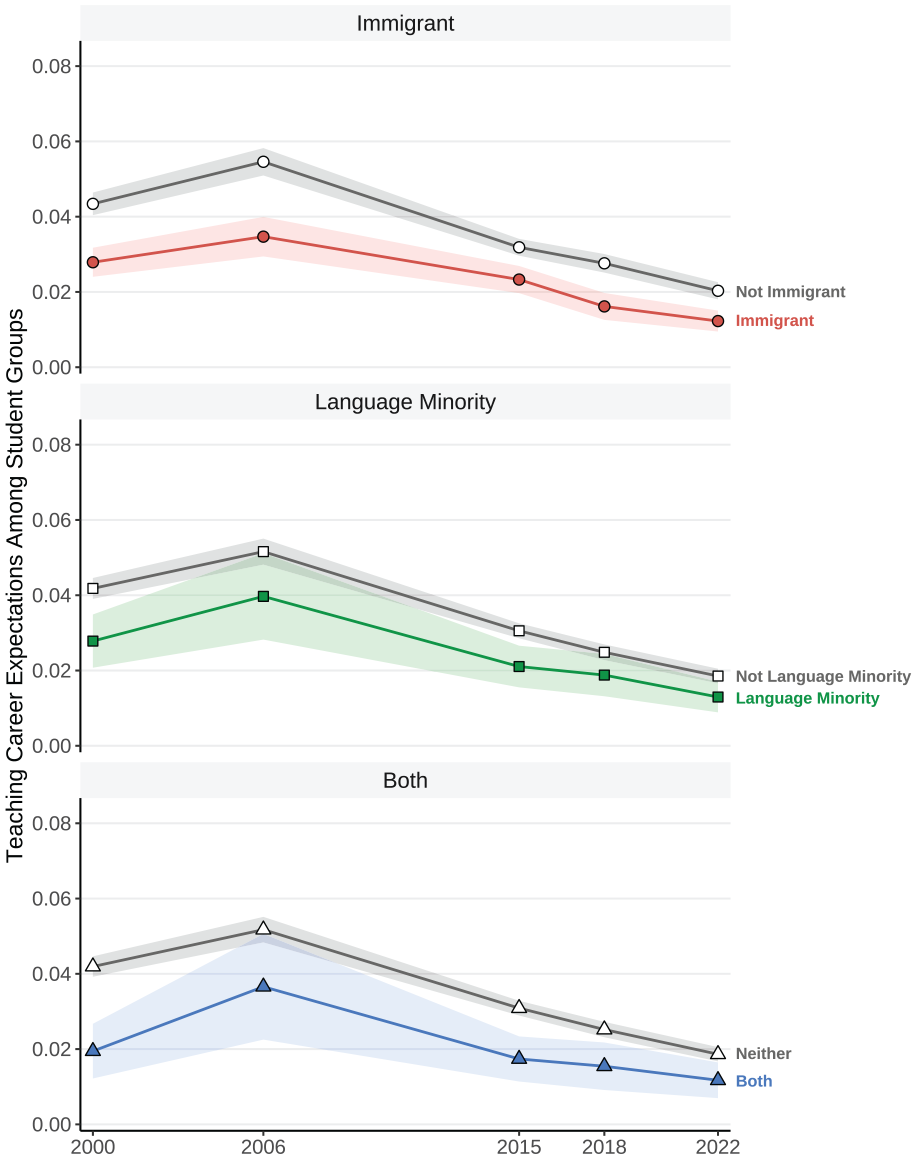
Teaching career expectations among immigrant and language minority students across participating Programme of International Student Assessment (PISA) countries (n = 24), with shading representing 95% confidence intervals.
Conclusion
Analyses of 24 countries in this study show that student populations are becoming more culturally and linguistically diverse worldwide. However, low teaching career expectations among 15-year-olds overall do not portend well for the teacher pipeline. Of particular concern is the lower teaching career expectations among students from immigrant or language minority backgrounds, especially as schools respond to increases in global migration and language diversity. Although the dearth of teachers from culturally and linguistically diverse backgrounds is not new, we provide insight into the magnitude and scope of the pipeline from a global youth perspective. Without addressing early disparities in teaching career expectations, the shortage of culturally and linguistically diverse teachers internationally is likely to continue as well. We caution that the lower teaching career expectations among students from immigrant or language minority backgrounds should not imply a deficit view of them. How young people view any profession is shaped by multiple factors, including whether they have had support and examples to see themselves in it.
Our study shows teacher diversity is not a single-country issue. Advancing culturally and linguistically diverse knowledge in schools requires a teacher pipeline that is responsive to the international trend of increasing immigration. Future research with more international diversity and more nuanced longitudinal data about adolescents’ career expectations and choices—limitations of this study—would provide new information on how teacher diversity changes in relation to the teaching interest of young people and whether early teaching career expectations predict entry into the profession. More research on how immigration and language experiences relate to teaching interests or not is also needed, as is how these patterns may differ by national policies, economic conditions, and social norms (Perumal, 2015). For instance, immigrant and language minority students may select other careers perceived to be less dependent on the dominant language of their context. Current programs that recruit students from immigrant backgrounds into teaching through support networks and informative sessions about the profession, such as those in the United Kingdom and Germany, are promising but remain untested (Donlevy et al., 2016). A deeper understanding of these contexts and programs is critical to ensure diverse knowledge and perspectives within schools that ultimately contribute to creating more equitable learning environments for all.
Supplemental Material
sj-pdf-1-edr-10.3102_0013189X251364275 – Supplemental material for Immigrant and Language Minority Students’ Teaching Career Expectations
Supplemental material, sj-pdf-1-edr-10.3102_0013189X251364275 for Immigrant and Language Minority Students’ Teaching Career Expectations by North Cooc and Grace MyHyun Kim in Educational Researcher
Footnotes

Notes
Authors
References
Supplementary Material
Please find the following supplemental material available below.
For Open Access articles published under a Creative Commons License, all supplemental material carries the same license as the article it is associated with.
For non-Open Access articles published, all supplemental material carries a non-exclusive license, and permission requests for re-use of supplemental material or any part of supplemental material shall be sent directly to the copyright owner as specified in the copyright notice associated with the article.
