




Abstract
Traditionally, preservice teachers (PSTs) have been introduced and socialized to a cartoon of three children attempting to watch a baseball game as the prevailing definition of equity. Yet, in our sociopolitical context where Black, Brown, and LGBTQ+ children are continuously marginalized, we critique whether this simple construction of equity is sufficient. Rather, we build upon these understandings by outlining tenets of critical humanism and exploring the degree to which PSTs fluctuate between technical and humanist conceptualizations in their definitions of equal and equitable instruction. In this large-scale qualitative study using data collected between 2022 and 2024, we analyzed 1,528 PST responses about their conceptualizations of equity and equality. We found that PSTs harbor various conceptualizations of equity that are robust around resource-based teaching attributes such as materials, instruction, and accommodations. However, PSTs presented paradoxical understandings of equity related to treatment and opportunities, revealing tensions between technical and humanizing approaches to education.
Despite decades of theorizing, scholars do not agree on what “equity” and “equality” mean. In 2007, a survey conducted among scholars across disciplines revealed “disagreement and confusion about what those concepts mean and what they involve in terms of goals and results” (Espinoza, 2007, p. 343). Since then, educational scholars have echoed these sentiments (Cochran-Smith, 2020; Levinson et al., 2022; Unterhalter, 2009) and argue that the multiple and sometimes competing definitions of equity and equality contribute to the confusion of implementation in teaching practice (N. S. Bell & Codding, 2021). To this end, scholars have argued to put “equity at the center” of teacher education (Cochran-Smith et al., 2016; Firestone et al., 2023; McDonough et al., 2023; Nieto, 2000) through (a) “conceptualizing inequality and the role of teachers in challenging inequality” and (b) “defining the nature of practice of equity” (Cochran-Smith et al., 2016, p. 68, emphasis original). Like other socially progressive constructs, conceptualizing and defining equity is an evolving endeavor relative to and predicated upon changing social, political, and temporal contexts (Bogotch et al., 2019).
Yet, in the four years since the global pandemic and renewed recognition of systemic racism in the U.S., scholars have called for a re-envisioning of education to support students beyond academic success, particularly students from marginalized backgrounds (Harris & Jones, 2022; Ladson-Billings, 2021). In the country’s return to “normalcy,” Ladson-Billings (2021) reminds us that normal was never good for marginalized children. This begs the question of whether current constructions of equity are sufficient for meeting today’s schooling in a post-pandemic, socially and politically polarized country. In addition, future teachers are being prepared for a different education system than half a decade ago, and shoulder great responsibility in educating the next generation of citizens. This study thus explores how current preservice teachers (PSTs) make sense of equity and equality constructs in teaching and learning. This study is situated in the state of Texas, where divisive political rhetoric and legislation continue to set barriers for public education and marginalize students from diverse racial, ethnic, immigrant, and LGBTQ+ backgrounds (Singh & Carter, 2023; Solomon, 2023). Within this context, we pursue the following research questions:
In this large-scale qualitative research study, we address these questions by analyzing over 1,500 descriptions of how PSTs envision equal and equitable instruction in practice. In what follows, we provide a brief background on post-2020 education and conceptualizations of critical humanizing pedagogy, which we use as a guiding framework for the study. Through iterative, inductive analyses, we present patterns in how PSTs attempted to operationalize notions of equality and equity in their future classrooms and how these aligned, or not, with the proposed tenets of humanizing pedagogy. We end with a discussion of the findings and future implications for teacher education programs.
Conceptualizing Equity in the Current Sociopolitical Context
In recent years, the United States has seen an increase in polarized political rhetoric, anti-critical race theory legislation, book bans, and other forms of educational censorship (Filimon & Ivănescu, 2023). Since 2021, more than 300 legislative pieces banning perceived critical race theory in education have progressed across more than 45 states (Sachs & Young, 2023). In Texas, where this study takes place, 27 legislative pieces have been introduced that censor the teaching of race, sexual orientation, gender identity, and other diversity, equity, and inclusion principles. Three proposed bills—HB3979, SB 3, and SB17—have since passed, becoming law, and censor the teaching of controversial issues, curtail curriculum particularly in social studies courses, bar student credit for courses entailing student activism, and limit efforts that prioritize diversity, equity, and inclusion (Najarro, 2022; Sachs & Young, 2023).
In addition, school districts—particularly through the politicization of the school boards—have integrated additional policies that limit the teaching of racial and gender diversity due to concerns that such teachings make white children feel guilty about their own identity (Hooks, 2021). The impact of these efforts is reflected in the staggering number of book titles (i.e., 4,240) targeted in 2023 for censorship in schools and public libraries (American Library Association, n.d.), which disproportionately target diverse texts featuring characters of color or who identify as LGBTQIA+ (American Library Association, n.d.; PEN America, 2023). In 2022, Texas led the nation for most banned books on themes that centered non-White or LGBTQ+ experiences (Meehan & Friedman, 2023). The political context within education in Texas is reflective of the broader sociopolitical context of the United States, weighing heavily on educational institutions at large (Kelly, 2023; Kelly et al., 2023; Sachdeva et al., 2023; Sawchuk, 2022).
For both veteran and preservice teachers alike, the terms “equality” and “equity” often generate a universally-known image of three children standing on crates attempting to watch a baseball game over a fence (Froehle, 2016; Maguire, 2016). Over time, variations of this image have emerged including the visualization of educational reality (i.e., large disparity of crates between children) and liberation in education (i.e., removal of the fence signaling the breakdown of systemic barriers). Despite revisions, the original images have been used ubiquitously to explain notions of equity and equality, mainly through resource distribution. That is, the focal point of the image is the equitable distribution of tangible resources (i.e., crates to stand upon) for the children to achieve the same goal (i.e., watching the game) and hence equal outcomes. However, we believe that current conceptualizations of equity and equality, commonly socialized through this visual construct, are insufficient for our current socially and politically divisive educational context.
In our current time, it is critical to encapsulate a humanist perspective in the conceptualization of equity. This is not to seek replacement of other conceptualizations per se, but rather a grounding of equity for education, not schooling (Pritchett, 2013). Through their educational censorship efforts, states and districts signal to students that their humanity, or the ability to be their whole selves, is being denied. In addition, these censorship efforts deny students the right to learn about differences, nuances, and the beauty of humanity outside of their own experiences. Within this fraught sociopolitical climate, students and teachers are constrained by tensions between teachers’ pedagogical practices and systemic factors, such as mandated instructional curricula, diversity villainization and erasure, and high-stakes assessments (del Carmen Salazar, 2013; Sachdeva et al., 2023). These mounting restrictive technocratic policies uphold a one-size-fits-all approach, which silences “the complexities of our humanity concerning other peoples’ lived conditions, and in light of what it means to teach, learn and live in the world” (Kinloch, 2015, p. 31). In response, educational scholars have called for schools to resist restrictive educational policies by engaging in the counter-practice of humanizing pedagogies (Freire, 1970; Fránquiz & Salazar, 2004; Huerta, 2011), which, within Freire’s (1970) conceptualization of humanism, seek to nurture and facilitate students’ evolution and processes of “becom[ing] more fully human” (Roberts, 2000, p. 41).
Tenets of Critical Humanizing Pedagogy: A Guiding Framework
For teacher educators, scholars propose a reorientation toward humanization, a critical and intentional promotion of humanizing pedagogies within a process of creating and becoming asset-, equity-, and social justice-oriented teachers (Carter Andrews et al., 2019). Within Freire’s worldview, humanism centers on the capacity to “shape [people’s] experiences and achieve personal and collective self-actualization, thus developing their full humanity” (del Carmen Salazar, 2013, p. 125). As pedagogy and enactment, humanization demands valuing the experiences, perspectives, and cultural knowledges our students bring and carry within and across multiple contexts (Kinloch, 2018; San Pedro & Kinloch, 2017). A humanizing pedagogy is therefore critical for teachers who seek to promote progressive, holistic, and meaningful education that can support students’ self-actualization (Fránquiz & Salazar, 2004; Reyes & Villarreal, 2016). Humanization, then, serves as a conduit and connection to hooks’ (1994) arguments for emancipatory forms of education and Love’s (2017) calls for abolitionist teaching practices whereby teachers acknowledge students’ complex personhood and engage in ways that consciously disavow unjust forms of power, cultivate student agency, and promote democracy within the classroom.
Considering Milner’s (2008) charge that preservice teachers must not only be knowledgeable about equity but also agentive in the fight against injustice to be culturally conscious, Bell et al. (2022) noted that future research is needed to understand how to empower preservice teachers’ critical consciousness and to understand the staying power of equity-focused teacher preparation on their beliefs, knowledge, and practices. To this end, we present three tenets of humanizing pedagogy: moving beyond technical approaches to education, embracing a critical consciousness of power structures, and engaging in self-reflection, action, and responsibility. In what follows, we draw on critical humanist scholars to define and discuss current research related to each tenet.
Moving Beyond Technocratic Approaches to Education
A critical humanist approach to education requires that educators operate beyond technical approaches and transactional perspectives. Bartolomé (1994) defines technical in this sense as “the positivist tradition in education that presents teaching as a precise and scientific undertaking” in which “the solution to the problem of academic underachievement tends to be constructed in primarily methodological and mechanistic terms dislodged from the sociocultural reality that shapes it” (pp. 173–174). Schugurensky (2011) adds that Freire’s view of “education is more than technical training because it involves the full development of the person, it has a humanistic orientation” (p. 67).
Although the constructs of equity and equality have been thoroughly theorized philosophically (Bernardi & Ballarino, 2016; Hatfield et al., 2011; Levinson et al., 2022; Unterhalter, 2009), much of the current literature on equity and equality treats education as a technical issue (Giroux, 1992). For example, Levinson et al. (2022) recently conducted a philosophical analysis of the term “equity” used in education to pull apart its underlying values and underscore its various definitions. By analyzing definitions in internationally-known education documents, the authors identified five meanings of equity: “equal distributions of outcomes across populations; equal outcomes for every child; equal resource allocations across students, schools, districts, states, or nations; equal experiences for each child; and equal levels of growth by each child” (p. 1). Similarly, Espinoza (2007) parsed out equality as “‘equality of opportunity,’ ‘equality for all,’ and ‘equality on average across social groups’” (p. 343) and offered the idea of pursuing equity for a sense of equality for all in terms of “‘equity for equal needs,’ ‘equity for equal potential,’ and ‘equity for equal achievement’” (p. 343). In arguing for a universal definition of equality and equity, Levinson et al. (2022) and Espinoza (2007) focus on academic achievement outcomes and technical approaches that are antithetical to a humanist approach to education.
In contrast, humanizing pedagogy rejects the notion that education can be reduced to universally applicable skills, methods, and materials or that the goal of education is solely for academic achievement and success (Bartolomé, 1994; Roberts, 2000). According to Dewey in 1917, “Education should not be so practical; so devoted to the gains that the great object in life is obscured” (as quoted in Stallman, 2003, p. 18). Rather, the broader purpose of humanistic education is to collectively uplift humanity in that “knowledge is humanistic in quality not because it is about human products in the past, but because of what it does in liberating human intelligence and human sympathy” (Dewey, 2012, p. 244). Dewey argues for an integration of care, humility, empathy, community, tolerance, and sympathy that encourages meaning in learning and life. A complication of decontextualized technical approaches to education leads to the second tenet: critical consciousness of systems of power that operate educational structures.
Critical Consciousness of Power Structures
Central to this perspective of humanizing pedagogy is a critical consciousness of the systemic ways power works in education and the recognition that all pedagogy is inherently political (Giroux, 1988). Freire’s (1970) concept of critical consciousness, or “conscientização,” involves a developed awareness of “social, political, and economic contradictions” to “take action against oppressive elements of reality” (p. 17). del Carmen Salazar (2013) extends this idea to humanizing pedagogy, situating it as a shared quest between teachers and students for “mutual humanization” (p. 56). The goals of this mutual quest are facilitated through “problem-posing education,” wherein students and teachers collaborate as co-investigators to develop critical consciousness (del Carmen Salazar, 2013, p. 127).
Furthermore, Bartolomé (1994) critiques traditional approaches to addressing academic underachievement among marginalized students, as academic disparities often get treated as a technical issue requiring technical solutions, such as heightened accountability and testing measures. Bartolomé (1994) postulates that such a technical perspective fails to recognize the need for teachers to self-reflect and examine their own biases and the systemic inequities within schools. She argues that focusing solely on methods (e.g., instructional curriculum, assessments, and materials) obscures and denies the historical discrimination and dehumanization faced by culturally and linguistically diverse students, and in so doing, one engages in a “form of dehumanization” (Bartolomé, 1994, p. 176).
Scholars in the field of multicultural education have theorized notions of equitable education from a critical consciousness standpoint (McGee Banks & Banks, 1995). Within this body of literature, scholars focus on dismantling power structures for human liberation so that teacher education programs can more fully equip teachers to “form subversive and creative spaces that humanize” (Love, 2017, p. 540). In response to this aim, a growing variety of frameworks exist for preparing PSTs for social justice and equity-oriented education, such as the Equity Literacy framework (Gorski, 2017), Equity Consciousness Continuum (Skrla et al., 2009), and the Equity Knowledge, Skills, and Beliefs framework (Bell et al., 2022). However, despite the rise of frameworks for equitable teaching, recent research has found that most assessments designed for evaluating aspects of PSTs’ learning of equity and diversity within teacher education programs do not sufficiently capture the most pressing challenges around equity and social justice (Chang & Cochran-Smith, 2022).
Self-Reflection, Action, and Responsibility
Recognizing the role of larger power structures does not dismiss the teacher’s agency and role in enacting humanizing pedagogy. In her conceptual literature review of humanizing pedagogy scholarship from across the globe, del Carmen Salazar (2013) presents two (of five) fundamental tenets of humanism related to reflection and responsibility, namely, “Critical reflection and action can transform structures that impede our own and others’ humanness, thus facilitating liberation for all” and “Educators are responsible for promoting a more fully human world through their pedagogical principles and practices” (p. 128). More recently, Carter Andrews et al. (2019) proposed core tenets of a humanizing pedagogy—critical self-reflection, resisting binaries, and enacting ontological and epistemological plurality—which also highlight the role of self-reflection, action, and responsibility. Considering these definitions, we argue that the ability to self-reflect and situate oneself within the plurality of human lives on this planet (while holding critical understandings of the power structures that reinforce the supremacy of some lives over others) is a key tenet of critical humanizing pedagogy.
Recent research has considered how humanizing educational approaches manifest within teacher education, particularly enacting self-reflection and action in field-based spaces (Assaf et al., 2019; Wheeler, 2022). Most recently, Martin-Beltrán et al. (2023) interrogated how PSTs made sense of and strived to embody “humanizing intercultural communicative competence” within a semester-long field-based learning experience with culturally and linguistically diverse students, in which PSTs demonstrated perspective-taking, empathy, and responsive listening, supported by dialogic reflection practices. However, PSTs also faced challenges in discussing more critical topics (e.g., racism and discrimination) and in seeing their complicity within a proliferation of systemic inequities. Overall, the literature suggests that there is a distinct need for PSTs to address their biases and examine the power dynamics of their sociopolitical contexts. Such approaches are not novel (e.g., Gorski, 2017; Skrla et al., 2009); however, we are living in a time in which the ways PSTs are prepared to enact equitable instruction may need to look different than before (Ladson-Billings, 2021).
Methods, Context, and Sources of Data
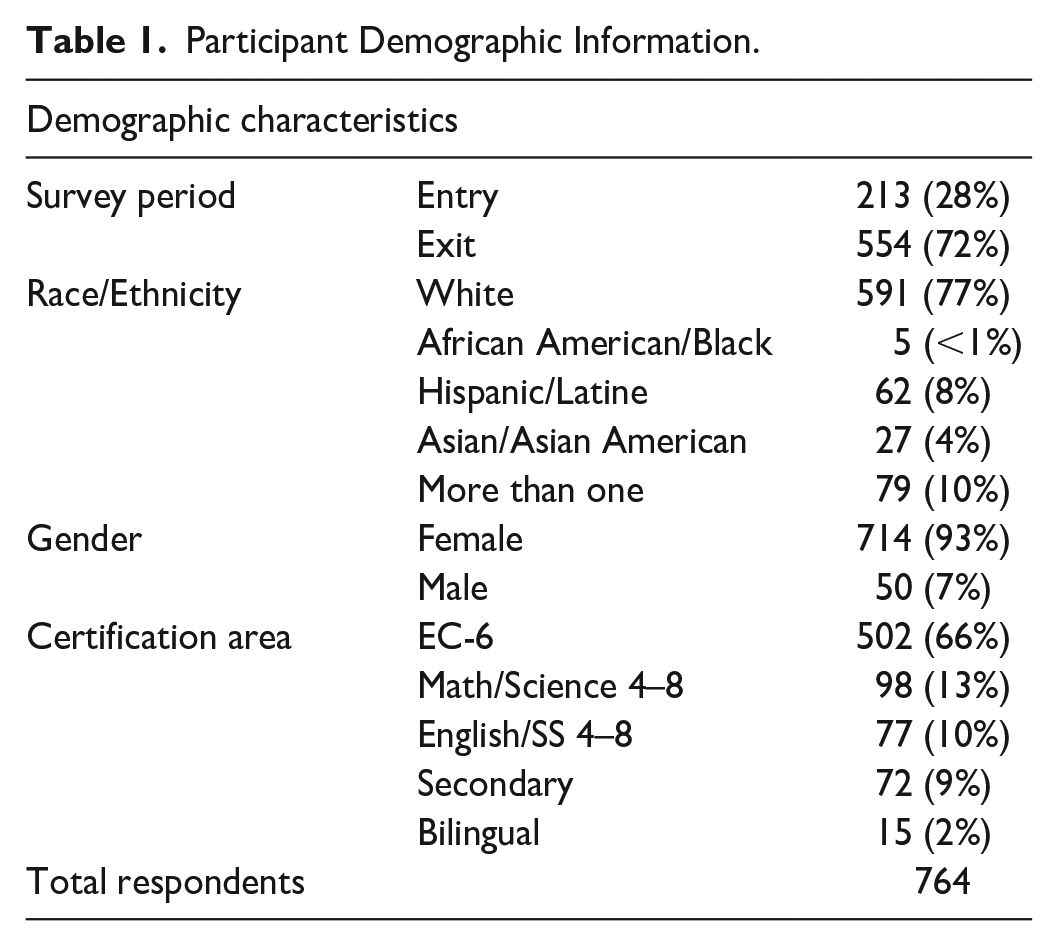
Our sample included undergraduate PSTs enrolled in a teacher education program in one of the largest producers of teachers within Texas, a university-based program at an R1 institution, which graduates approximately 300 undergraduate students per year in one of the following teacher certification programs: Early Childhood through Sixth Grade Core Subjects (66% of PSTs), Middle Grades (4–8) Math/Science (13%), or Middle Grades English Language Arts/Social Studies (10%), Secondary (9%) or Bilingual (2%). The PST sample was 77% white and 93% female, demographics which reflect the overall population of the college of education. In their first semester, PSTs took foundational pedagogy courses (i.e., lesson planning, and classroom management) and began field placement for one day a week. Their second semester consisted of literacy and discipline-specific methods courses and two days of fieldwork at a separate local school district to provide PSTs with a different experience in terms of grade level, subject focus, and demographic makeup of the campus. Their final semester concluded with clinical teaching at a school district of which PSTs provided their preference (often choosing to return to their hometown district), resulting in clinical placements across the state of Texas. In total, PSTs completed 774 hours in their clinical field experience across the three semesters.
Surveys were electronically distributed in the spring semester of 2022 to the spring semester of 2024. PSTs completed an entry survey at the beginning of the program and completed the same survey upon graduating from the program. PSTs were required to complete the survey as part of their program requirements, although the data for this study were taken from supplemental questions for which PSTs volunteered their responses. The required survey questions queried: demographic characteristics, and program feedback. The supplemental survey questions queried: (a) beliefs about, and confidence in, specific pedagogical areas, (b) desired characteristics of the school in which they would like to work, and (c) career plans. Within the optional portion of the survey, the authors focused their analyses on two open-ended items: “Provide an illustration of a classroom centered on equality” and “Provide an illustration of a classroom centered on equity.” Out of 1,178 who completed the survey, 764 participants responded to both discrete questions for a total of 1,528 responses or an overall response rate of 65% (see Table 1 for participant demographics).
Participant Demographic Information.
Methods of Analysis
Our analysis was conducted in two phases. First, we engaged in constant comparative analysis of the raw data (Glaser & Strauss, 1967) by open coding each response within each question (i.e., “Provide an illustration of a classroom centered on equality” or “Provide an illustration of a classroom centered on equality”) using Dedoose qualitative software. Multiple codes were utilized as the richness of data called for such methods (Denzin & Lincoln, 2011). Throughout the open-coding process, the researchers independently open-coded a sub-sample of 20 responses from each question and then met to discuss developing patterns or discrepancies. This process continued–sampling 20 responses from each question and returning to previously analyzed data–until 10% of all the data were open-coded in agreement among the researchers. The researchers wrote analytical memos (Charmaz, 2014) and revisited the data to confirm codes and refine the coding scheme. At this point, we noted that PSTs largely conceptualized equality in their responses as having a quality of sameness and equity as difference.
Interrater reliability tests were then conducted with an outside researcher for code application within and across the questions of equity and equality. An interrater reliability test was conducted using 50 responses, resulting in a pooled Cohen’s kappa of .85. Any discrepancies in the coding were discussed, and the coding scheme was clarified. The authors independently coded the rest of the data using the finalized coding scheme, meeting periodically to discuss any possible outliers and questions. Each response was coded an average number of 1.7 codes per response, ranging between one and four codes per response.
For the second phase of analysis, we drew on the proposed tenets of humanizing pedagogy to identify cross-cutting codes, or codes present in PSTs’ responses from both questions about equitable and equal instruction. We also identified patterns of co-occurrence in these cross-cutting codes with codes from the first round of analysis. Doing so helped us further examine PSTs’ understanding of the relationships between equity and equality and the extent to which critical humanism was apparent in their attempts to operationalize equitable or equal instruction.
Positionality Portrait
In this section, we take an alternative approach to mainstream positionality statements by inviting readers to our “positionality portrait” (see Figure 1). We digress for a moment. A premise for our paper is to re-imagine humanism within education, and thus believe that a positionality statement that labels our gender, sexuality, race, ethnicity, and professional positions to elicit readers’ assumptions about our biases and reflexivity is a dehumanizing and performative endeavor. To be clear, we are not challenging the necessity to be reflexive as researchers, but question the narcissistic, prescriptive, and colonial nature that positionality statements have become, and that critical scholars have noted (Gani & Khan, 2024; Pillow, 2003). Instead of an analysis of the self and holding ourselves to account in our research, current usage of positionality statements have become a form of constructing authority over subject matter, and a form of scientification in qualitative research to increase researcher validity (Pillow, 2003). We ground Milner’s (2007) cautionary message on researcher positionality in education and apply the tenets of his nonlinear framework through a process of visualization.

Positionality Portrait.
In our alternative approach, we collectively shared stories, memories, worries, and laughter that co-constructed our beliefs and experiences throughout our life as students, women, mothers, aunts, partners, citizens, and educators. We reflected upon how this collective knowledge influenced our assumptions, dreams, and vision in education and research. We consistently arrived at the inadequate equity/equality image and used the progressive version (i.e., as liberation) as a jumping point for our portrait. If watching the baseball game is the purpose of education, we felt the need to expand this concept where our conceptualizations of humanism, influenced by Freire and Dewey, can be found. We attempted to visually capture the physical, emotional, experiential, and relational learning beyond the traditional tunnel vision on academic success. Thus, we hold space, though sometimes small, between our thoughts and research practices in framing, interpretations, and interactions with our participants. Our portrait is both pragmatically grounded and a philosophical mirror that reflects each of us in some form—be it past, present, or future—individually and collectively. We invite you, the reader, to envision adding to this portrait where the border extends beyond our imaginings and into yours (e.g., your beliefs, assumptions, and experiences), and ponder our collective work in education for a democratic and pluralistic society.
Results
First-stage analyses revealed five categories in the ways PSTs described different aspects of equitable and equal instruction: materials, instruction, accommodation, treatment, and opportunities. Across these categories, patterns suggest tensions between technical and humanizing approaches to equity and equality within and across codes. In what follows, we describe each code as representative of our first phase of analyses and then discuss and interpret patterns across the codes from our second phase of analysis.
RQ1: How Did Preservice Teachers Conceptualize Equity and Equality in Instruction?
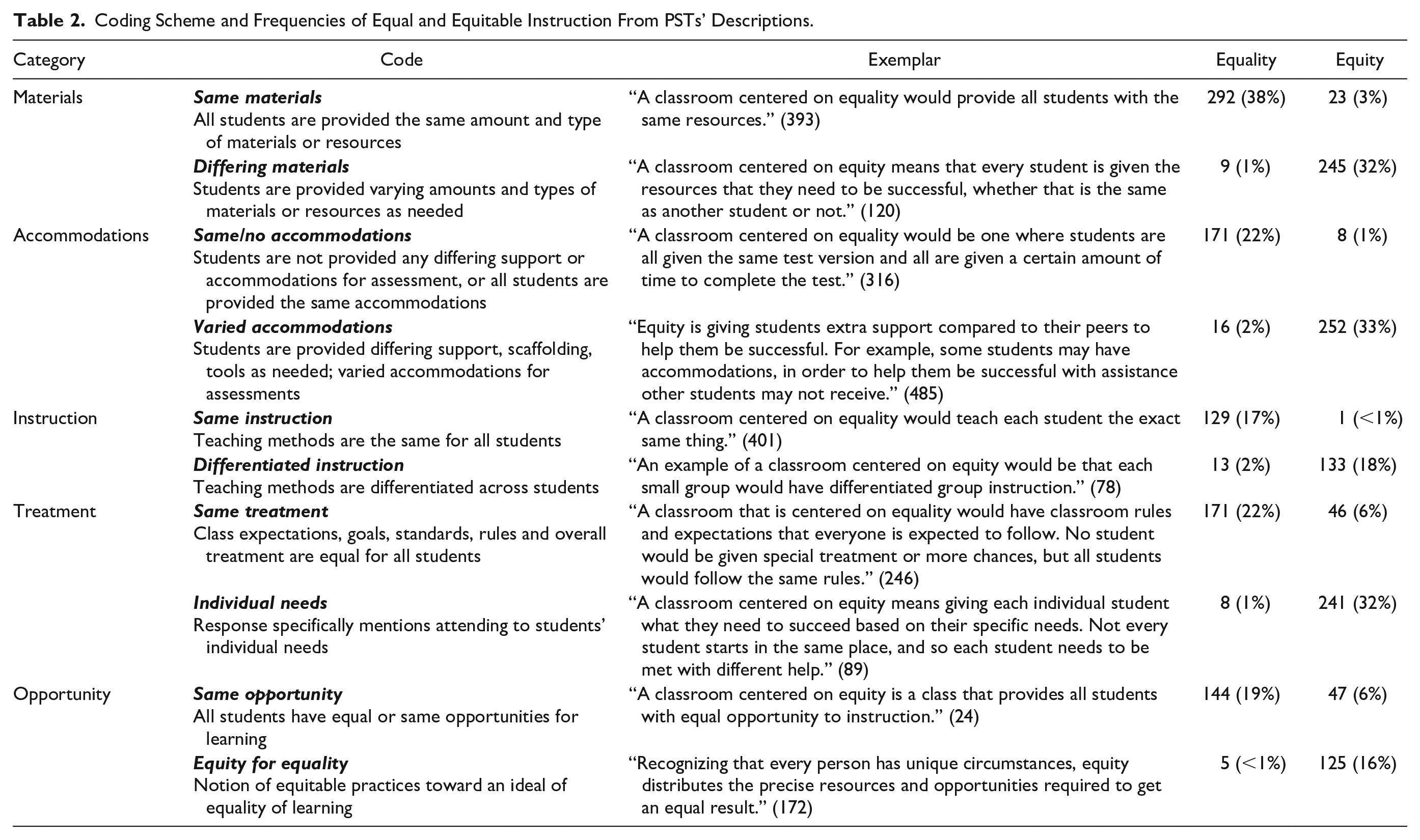
In their responses, PSTs overly characterize equality as sameness and equity as difference. Three categories (i.e., materials, instruction, and accommodation) are juxtaposed as either providing the same (equality) or different (equity) aspect of instruction, whereas the two other categories (i.e., treatment and opportunities) do not neatly follow the same pattern (see Table 2). That is, the code, same treatment under equality was not present in the data as “different treatment” under equity, but as individual needs. Likewise, the code same opportunity under equality did not show up as “different opportunities,” but as equity for equality under equity.
Coding Scheme and Frequencies of Equal and Equitable Instruction From PSTs’ Descriptions.
Materials
Most frequently, in 569 (37%) of the responses across equity and equality, PSTs describe equal and equitable instruction regarding how materials–tangible learning resources–are provided. Within equality responses, PSTs depict providing students with the same materials in amount or type: “In my math classroom centered on equality, each student receives one test and one pencil” (186). In contrast, equity responses describe how students are provided differing materials that vary in amounts and/or types according to students’ needs: “Some students receive multiplication charts or calculators, while others do not. The students that have received these extra items require these items to be successful—the other students do not need these items to be successful” (186).
Accommodations
In 447 (29%) of the overall responses in equity and equality, PSTs describe the provision or exemption of accommodation as a notion of equal or equitable instruction, usually related to assessment. PSTs’ conceptualizations of equal no accommodations included not providing students with any additional supports, particularly as accommodations for tests: “all students only get one class period to finish the test” (411). Or, they conceptualized equality as all students receiving the same accommodations, as in “all students getting additional time on an assessment” (728). However, conceptions of equitable varied accommodations detailed various supports, scaffolding, tools, and accommodations for some students and not others: “some students might have some of their assignments read to them if they are reading below level while others would be expected to read it for themselves” (322).
Instruction
The instruction category refers to 276 (18%) of PST responses, characterizing how a teacher might leverage pedagogical approaches broadly or specifically for their students. PST responses under equal instruction focused on maintaining the same instruction methodologically for all learners: “A classroom that provides the same level of instruction to all students without addressing where they start” (434). Conversely, responses under equity focused on varying teaching methods for specific learners or differentiated instruction such as, “Students are given varying instruction and assignments that are catered to their strengths and understanding, focusing on growth-based learning” (471).
Treatment
In 466 (30%) of the responses across equity and equality, PSTs describe how teachers might treat their students regarding setting expectations and rules. For an equal classroom, PSTs often denote providing the same treatment to learners as a notion of fairness: A classroom centered around equity is where there is no favoritism or preferential treatment to some but not all the students. This requires the teacher to uphold her expectations and rules for everyone and not allow them to slide for some students but not all of them (415).
Unlike the previous three categories, equitable instruction of a teacher’s treatment did not mirror the inverse of the same treatment, or treating students differently. Instead, PST responses depict attending to students’ individual needs: “Equity would be to make sure individual students get their specific needs met even if it differs from what another student may receive” (358).
Opportunities
In 321 (21%) of the descriptions, PSTs articulated equal and equitable instruction related to opportunity. The notion of “opportunity” is described in PST responses as affording students the prospect and avenue for success in the learning environment. In many cases, students specifically stated the word “opportunity” concerning descriptions of equal instruction, such as “students are provided the same opportunities” (402) or otherwise mentioned sentiments such as “[making] sure each student has an equal chance of success” (306). Disparately, under equity, PSTs discussed how differing resources or support should be provided so that all students reach an equal opportunity, level, or goal, termed as equity for equality. This relationship is illustrated in these two responses: “A classroom centered on equity is a classroom where students receive resources based on their needs to reach an equal opportunity” (226), and “everyone would be given different opportunities, materials, and learning experience for everyone to be on the same level” (249).
RQ2: What Humanizing Aspects are Apparent in PSTs’ Conceptualizations of Equal and Equitable Instruction?
Within these categories (i.e., material, instruction, treatment, accommodation, opportunity), patterns suggest tensions across codes in which PSTs express their critical views of technical notions of instruction and areas in which they are still grappling with how to enact humanizing pedagogy. We further analyzed the data to identify two cross-cutting codes—criticality and diversity—that appeared as codes within both questions about equity and equality, as well as identified subcodes within the code equity for equality. We present the findings in this section as three themes: critiques of technical notions of equality, a focus on technical notions of academic achievement, and a focus on technical notions of treatment.
Critiques of Technical Notions of Equality
In 52 (7%) responses, PSTs expressed critiques about equality. PSTs within this group critique equality to the extent that they have concerns about some students being left behind: “This [equality] may not be beneficial for all, because they will still be behind, as their classmates will advance” (379), and lament the notion that “students will either sink or swim” (296). These comments speak to PSTs’ critiques of the technical notions of academic achievement.
PSTs also share concerns about the technical notions of equal instruction. For example, some PSTs are critical of distributing resources equally because of the varying needs of students: “Equal provisions, but without equity it might neglect the greater and specific needs of others” (202). Second, these PSTs scrutinize equal opportunities: “A classroom centered on equality would be providing the same opportunity to each student. This would give every student the same bases of teaching and would not create as successful students as a classroom that is centered on equity” (9). Finally, PSTs are critical of equal expectations, depicted by a PST who states that in a classroom centered on equality, “there is no accounting for students who have been short-handed and will most likely fall behind if held at the same expectations as other students because of the lack of support” (336). These critiques align with concerns about engendering the status quo for student success: “Give every student the same chance regardless if it’s not completely fair or if some students need more to be successful” (280).
A Focus on Technical Notions of Academic Achievement
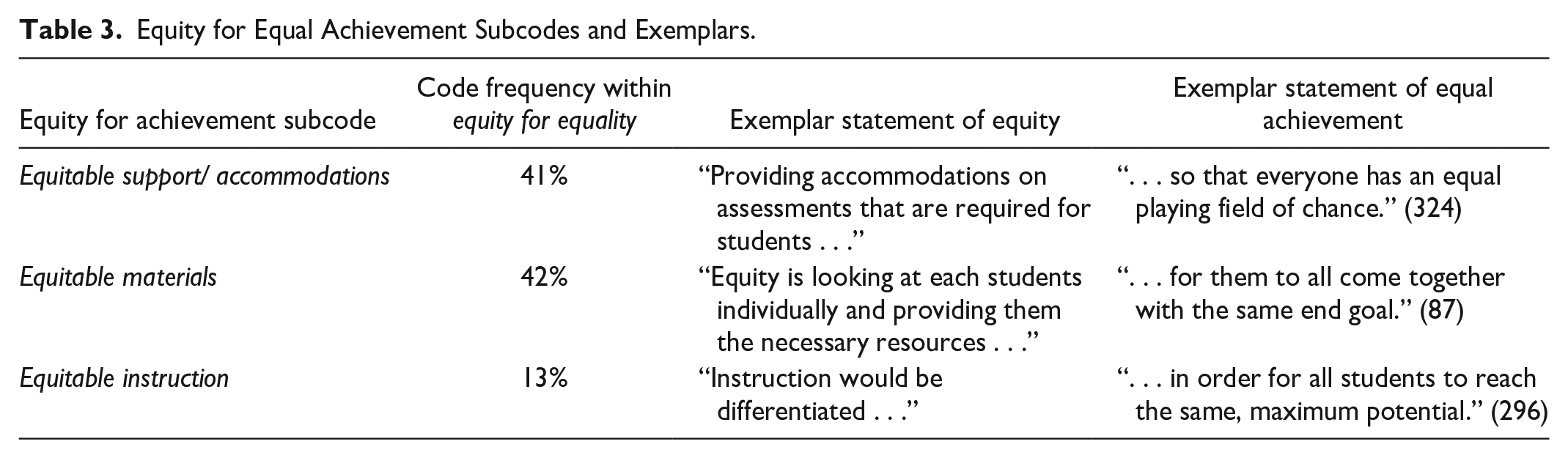
As a means of reconciling their critiques of equality, PSTs offer various means of equity for equal achievement, wherein PSTs envision providing equitable instruction to students according to their needs en route to achieving the same academic goals. These responses are reflected in 126 (16%) of the overall equity statements. To unearth the nuance of this code which emerged uniquely and frequently, we conducted secondary analyses to identify areas of equity for equal achievement. Within this code, PST responses can be parsed further into three subcodes: equitable accommodations (n=52, 41%), equitable materials (n=57, 42%), and equitable instruction (n=17, 13%) for equal achievement. During our coding process, we noted that these responses were frequently co-coded with varied accommodations, differing materials, or differentiated instruction, respectively. Table 3 presents exemplars for each subcode, with responses bifurcated to illustrate how PSTs attended to various aspects of equity for the common goal of equal achievement within their response. For example, within the subcode of equitable accommodations, one PST noted how “Students that need additional or differentiated resources are given access to it on an as-need basis” which represents the equitable or differentiated allocation of resources, toward the end goal of equal achievement which is, “to reach the level that all students are learning at” (22).
Equity for Equal Achievement Subcodes and Exemplars.
Across PSTs’ critiques of equality and their solution of equity for equal achievement, PSTs seem to stress an equal outcome and goal for the academic achievement of all students. As a whole, these patterns present a paradox. Although PSTs challenge equality, they fall short of challenging equality in the context of academic achievement. PSTs’ conceptualizations of educational purpose seem to reside in the technical realm, such as crossing an achievement milestone (or viewing a baseball game in the classic equity visual). Through this conceptualization, achievement is a technical goal, and equity is a vehicular tool that increases students’ capacity for equal achievement. PSTs’ uniform conceptualization of success also assumes that all students have the same educational goals. Yet, progressive and humanistic education focused on students’ agency and self-actualization would support differences in achievement goals, allowing teachers and students to determine differences in educational success. Indeed, only a few conceptualize and complicate the notion that success may look different for each student, as in the following statement: A classroom centered on equity would mean that all students are given the appropriate materials and guidance needed individually for them to be successful, regardless of what other students have/need. The end goal is success for all students, and equity enables different ways for different students to be successful (57).
A Focus on Technical Notions of Treatment and Fairness
PSTs suggest the need for equal treatment—by the teacher and among students—to build a fair classroom environment. PSTs explain, “students are fairly treated and no favorites. There can’t be preferential treatment” (365) and “Being fair and not partial to anything. Not choosing sides and to always do the best for students” (157). Within this conceptualization, we identified another tension as PSTs grappled with enacting fairness alongside their ideals of inclusion. In particular, we identified a pattern of diversity and same treatment codes co-occurring in PST responses. Out of 210 instances of diversity and 218 of same treatment, 36 were coded together, the most frequent co-occurrence for the diversity cross-cutting code.
As PSTs wrestle with how diversity fits within their conceptualizations of equal and equitable instruction, PSTs most explicitly attend to the inclusive aspects of diversity. This perspective is evident in PST responses, where “All of the students are inclusive and kind to each other” (347). In this imagining, PSTs envision a place where “All students [are] working together with no discriminating in any way shape or form” (217). These responses broadly reference diversity and are usually undergirded by equality notions, such as “equality is a classroom full of diversity and celebrating each other’s differences” (334). Most often, equality and inclusion are foregrounded as means of creating a safe and universally comfortable space for all learners: “Students feeling comfortable to walk into the classroom and not feel outcasted or not spoken for. Each student should be acknowledged for who they are, and their backgrounds should be incorporated in some way, shape, or form” (350).
However, PSTs responses about the same treatment reflect another paradoxical conceptualization in conjunction with their ideal of inclusion. In particular, PSTs focus on inclusion and the same treatment to underscore the value of fairness: “Everyone is treated equally during all circumstances no matter culture or color. Giving all students the same rights” (156). Here, PSTs expressed that students should not be treated inferiorly compared with one another; however, they are not explicitly stating that students’ diversity should be embraced and valued. Furthermore, PSTs explain, “No matter the shape, race, or beliefs of someone in my classroom, we will ALL be treated with grace and respect” (99), and “A classroom centered on equity is impartial and fair to each student regardless of where they come from and what they look like,” (278) which may point to a rejection of deficit perspectives. Yet, the PSTs’ usage of phrases such as “no matter” and “regardless” convey a sense of racial and cultural evasiveness. In these conceptualizations, PSTs do not engage with equitable treatment or treating students differently as a strength in instructional practice; rather, they avoid the notion of equitable treatment to express a stance of being anti-discriminatory as a means of creating a fair classroom environment. As one PST states, “That being said, everyone is treated fairly no matter what they look like, what their race is, beliefs, etc.” (299), as they feel, “no student is discriminated for who they are, and every student treated equally” (297). In so doing, PSTs seem to conceptualize treatment more so as a relational construct and not a pedagogical construct.
Discussion
Our inquiry explored PSTs’ conceptualizations of equality and equity in instruction, while also examining critical humanist elements within their perspectives. Our findings suggest that PSTs negotiate various constructs of equity and equality, sometimes in paradoxical, dilemmatic, and antagonistic directions. For instance, while PSTs have a robust understanding of equity as it applies to tangible elements of education (e.g., materials, instruction, and accommodations), they often fall short in operationalizing social, behavioral, and humanistic elements of equitable education, pointing to philosophical differences of what PSTs think equity means and how they are navigating these complex concepts.
These findings align and extend previous research highlighting the impact of tangible notions in PSTs’ schema and development around equity, in terms of tangible teaching practices (Chen & Mensah, 2018), assessments for students with disabilities (Driver, 2019), and asset-based equity pedagogy classroom management (Hinnant-Crawford et al., 2023). Nontangible elements of instruction were filtered through technical principles of education (i.e., academic achievement and equal treatment), disregarding the unique choices, experiences, and identities that encapsulate the full humanity of each child within a classroom. This finding is supported by previous scholarship which espouses the tendency of white PSTs to engage in a technical rationality of teaching as a means by which to close the “achievement gap” and solve other “societal problems” (Aydarova, 2021; Levine-Rasky, 1998; Mosley & Rogers, 2011). Although many PSTs did not engage meaningfully with critical consciousness and hinted at discomfort with diversity topics, it is promising to see that some PSTs embraced and elevated students’ full identities as assets.
Our findings also complicate our previous work presenting equity and equality at opposite ends of a spectrum (Kwok et al., 2021; Kwok et al., 2023), instead positioning equity as a complex concept that is difficult to operationalize given its various definitions in education and society (Cochran-Smith et al., 2016). Although our findings suggest that PSTs express diverse views on equal and equitable instruction, exhibiting varying degrees of complexity and specificity, there are discernible areas where PSTs encounter challenges in fully engaging with these concepts. In what follows, we discuss our findings as they relate to the three tenets of humanizing pedagogy.
Tenet 1: Well-Versed in the Technical
Concerning the first tenet, we confirm what others have explored (e.g., Dale & Hyslop-Margison, 2010), that PSTs have established a firm understanding of the technical aspects of education, particularly the notion of teaching and learning as a transactional endeavor. These transactional aspects are apparent in that most PST responses mentioned allocating tangible, physical materials, or the amount and type of accommodations offered. Indeed, quite a few PSTs directly referenced the well-known equity graphic, such as the following PST: “Think of 3 people trying to see over a tall fence, and they are each given a custom ladder that helps them reach the same height so everyone can achieve their goal” (518) further suggesting the pervasiveness of this visual and the technical, transactional notions behind it.
Related to this PST’s statement that “everyone can achieve their goal,” the goal of education seems to be centered solely on academic achievement. PSTs did not engage with plurality in students’ educational goals, creating a narrow conceptualization of success in education. We are not surprised by these conceptualizations because, as teacher educators, we recognize that PSTs have been educationally socialized to focus on grades, achievement, and notions of academic success. Nonetheless, we believe, and an extensive list of scholarship supports, that most PSTs could be sensitized to issues of inequity, which could allow them to create new meaning and sensemaking about what equitable teaching might encapsulate once they move into full-time teaching (Merryfield, 2000; Mills et al., 2020; Silva et al., 2021; Smith, 2009).
Second, responding to Espinoza (2007) and Levinson et al. (2022), we see that PSTs pinpoint some notions of equity that were identified in their philosophical reasoning. Namely, PSTs discussed aspects of resources, opportunities, and goals, echoing the philosophical conceptualizations that Levinson et al. (2022) identified. In addition, PSTs echo the concept of “equity for equality” posed by Espinoza (2007). In particular, PSTs expressed how they could enact equitable instruction, inclusion, accommodations, and resources for an ideal of equal achievement. Yet, in a similar trend to Levinson et al. (2022) and Espinoza (2007), PSTs’ descriptions encapsulate technical aspects of equitable instruction and not yet humanistic concerns, suggesting PSTs still view material goods and tangible resources as the primary vehicle for improving students’ academic success in education, rather than instruction which is guided by and centers students’ dreams, hopes, and aspirations.
Third, PSTs’ notions of equal treatment and opportunity share this transactional sentiment in the sense that they equate the same treatment with fairness, suggesting that they have not yet grappled with the plurality of what success might mean for different students or the plurality of how they might thrive under different ways of care. In other words, PSTs’ conceptualizations of equal opportunity and treatment reveal technically driven tendencies, which critical humanist scholars warn may result in pedagogical approaches that favor conformity and may be detached from students’ needs and the development of an educational democracy (Bartolomé, 1994; Castro, 2010; Keegan, 2024; Ryan & Healy, 2009).
Tenet 2: Becoming Critically Conscious
While PSTs engaged little with critical notions within the five categories of codes we identified, there was some evidence that PSTs recognized injustice in various forms. For example, PSTs were comfortable detailing the technical distribution of materials, which suggests that they were conscious of class and economic inequality within a classroom. In addition, PSTs’ willingness to try to implement various instructional practices or enforce technical accommodations (e.g., extra time, preferential seating, etc.) for students’ individual needs reflects their understanding of physical, psychological, and neurological differences between children. However, these technical aspects fall short of accommodations requiring differential treatment of students. Indeed, very few PSTs referenced systemic barriers, privilege, power, and race in a humanistic sense. In other words, PSTs addressed inequities more frequently when it encompassed a transactional item or behavior, but not when the response required them to situate their own biases, values, and social constructions around the purpose of education or marginalized children’s experiences. There was surface level engagement with race, power, or consideration of systemic issues within PST responses, representative of what previous scholars describe as tendencies toward race-evasiveness or color-blind racial attitudes (DeCuir-Gunby et al., 2020; Jupp et al., 2019; Shah & Coles, 2020). For example, we suggest that PSTs’ frequently used phrases such as “no matter what” about students’ backgrounds and identities can be seen as a form of racial, cultural, or gender evasiveness, a phenomenon identified in research (Beneke & Cheatham, 2020; Chang-Bacon, 2022).
Although this particular finding might be disheartening, our findings as a whole highlight PSTs’ capacity for critical consciousness growth. This sample of PSTs are still in the beginnings of their career in education, with little experience within the classroom. As such, they might not yet see themselves as having the agency to tackle larger power structures, a notion that others reflect (Bell et al., 2022; Milner, 2008). We are also reminded that teachers operate within the larger systems of power that can aim to dehumanize and deprofessionalize teachers, systems within which PSTs may not see themselves as critically conscious individuals capable of disrupting (Cochran-Smith et al., 2016). Therefore, we believe their recognition of inequities through the tangible elements of education is a promising starting point and perhaps a key aspect for further developing critical humanization as they move into their future classrooms.
Tenet 3: Becoming Self-Reflective, Actionable, and Responsible
Very few PSTs detailed their roles in changing systemic injustices, transforming educational structures, or liberations through education as described by del Carmen Salazar’s (2013) conceptualizations of humanizing pedagogy. For example, they did not express their positionality to their students, nor their positionality within larger systems of education. PST engagement with conceptualizations around plurality as a central understanding of humanity was nearly nonexistent, as seen in their references to equality around opportunity and treatment.
However, most PST responses did align with Martin-Beltrán et al.’s (2023) skills necessary to adopt a critical humanizing perspective. PSTs in this study were adamant about helping students, taking in various perspectives, demonstrating empathy, and creating a space of collective academic success, which can support PSTs’ ability to be self-reflective and critical of their roles as they further develop as teachers. We believe these stances are a crucial first step in bridging their recognition of inequities to action. These findings suggest that PSTs can move toward a critical, self-reflective practice, engage in critical topics (e.g., racism, discrimination), be responsive to inequities, and work toward breaking down systemic barriers while recognizing their positionality in relation to their students, and within their classroom, school, and larger educational system.
Conclusions and Implications
As mentioned, PSTs do not explicitly refer to issues of power, and we recognize that PSTs might have self-censored their survey responses. Considering the interdiscursivity of the text (Fairclough, 1992), PSTs may have shrouded some of their beliefs about equality and equity, as this survey was an institutionalized text, disseminated through the university. Therefore, our finding that PSTs did not describe issues of race or power might be because they were purposefully self-censoring as a navigational move within this institutionalized text, a phenomenon that others have witnessed (Beneke & Cheatham, 2020; Kimmel & Hartsfield, 2019). Future qualitative research might examine PSTs’ beliefs through their discursive, navigational moves within the university and classroom spaces. In addition, PSTs’ reticence to confront and “speak truth” to issues of power is well documented (Lilach, 2020). However, in the current sociopolitical context, there is a pressing need to understand why PSTs are not engaging in discourses about power or systemic inequities, whether this is due to political hostility, fear of cancel culture, or something else. Future research could interrogate this question further, deconstructing why and what undergirds PSTs’ silence on topics of race and power.
We leverage Texas’s hyper-politicized educational context as a case, model, and in many ways, a warning against conservative extremism to learn from and engage in resistance. In particular, the definition of equitable instruction must include explicit notions of how power may privilege some while acting as barriers to others. We argue that contextualized in frequent crises and extreme political divisions, there is an increased need for humanizing education through critical consciousness, self-reflection, and embracing difference. It is necessary to consider that PSTs may be feeling the weight of the current politicized context, as many of us do as teacher educators. Therefore, teacher educators must broach topics of fairness, race, and power in emotionally safe ways that encourage PSTs to engage in critical reflexivity of their own belief systems (Sealey-Ruiz, 2021). Developing a critical lens for understanding issues of diversity, inclusion, equity, and systems of power can empower future teaching generations who must contend with broader sociopolitical issues to put equity at the center of their teaching (Cochran-Smith et al., 2016; McDonough et al., 2023; Nieto, 2000).
One of the implications of this study is a more targeted approach to teacher education and preparation programs. However, we recognize that higher education is also threatened by state censorship laws (Kraemer-Holland, 2023; Pollock, 2023). For example, in Texas, Senate Bill 17 became effective on January 1, 2024 which banned diversity, equity, and inclusion offices and efforts in higher education, and while it does not technically impact university teaching and research efforts, the anti-DEI signaling is clear. At a time when teaching about equity and race can be seen as controversial (Kelly, 2023; Sawchuk, 2022), a critically humanizing approach can be politically strategic to continue the necessary work and to prepare racially, culturally, ability, and humanely responsive PSTs. Therefore, we recommend redesigned teacher preparation programs so that equity—particularly critical critically humanizing pedagogy—and social justice are woven intentionally throughout all courses rather than a stand-alone course which may become an easy political target (Mills & Ballantyne, 2016; Reagan & Hambacher, 2021; Souto-Manning, 2019).
In closing, we like to impress upon readers that the tradition of humanism stresses a process of becoming. We are reminded that our humanity as teacher educators is intricately intertwined with that of our PSTs (Carter Andrews et al., 2019). It is not possible to “arrive at” or “achieve” humanism; rather, we are all working toward “becoming” more human toward self-actualization (Price & Osborne, 2000). We will, and encourage others to, continue this work with Roberts’ (2000) words in mind, “One can never, in the Freirean view, become fully human—one can, at best, become more fully human” (p. 41). As noted in our positionality portrait, we invite others to dream with us, and envision education that serves our individual, collective, and differential humanistic needs. PSTs are not to be blamed as they begin their teaching journeys. Let us humanize their wobbles and processes of becoming more fully human and better support the development of their humanistic teaching capacities. This inquiry into understanding and complicating how PSTs conceptualize equity and equality is a step toward embracing this process of becoming.
Footnotes
Declaration of Conflicting Interests
The author(s) declared no potential conflicts of interest with respect to the research, authorship, and/or publication of this article.
Funding
The author(s) received no financial support for the research, authorship, and/or publication of this article.
