




Abstract
We compare national education policy responses to the COVID-19 pandemic in England, Germany and Italy to explore negotiations about the public good and identify the role that research has played in framing, legitimating and rendering trustworthy the settlements reached. National data, comprising news media reports and publically available documents, are analysed and compared to identify debates about the public good and their consequences within and across national contexts. Our analysis contrasts policy contexts on three dimensions: (a) the range of interests included in debates; (b) the form and locus of decision-making; and (c) public acceptance of policy during implementation. These are related to processes of depoliticising debate and politicising research evidence in each context, as factions position themselves as trustworthy. We suggest that the way research is seen to inform decision-making during crises such as the current COVID-19 pandemic has enduring consequences for public trust in research, the politicians who employ it to justify their decisions and the schools tasked with putting these decisions into practice.
COVID-19 and the public good
Although broadly anticipated by, among others, the World Health Organisation (Maxmen, 2021), the rapid worldwide spread of COVID-19 in the first part of 2020 created considerable uncertainty and, in places, threatened the social order (Choudhry et al., 2020). Preparedness varied considerably from country to country, and the nature and urgency of political responses were mixed (Choudhry et al., 2020). Such crises, Pierre Bourdieu ([1989–1992] 2014) suggests, exacerbate existing antipathies and tensions. In response, while those invested in maintaining the status quo focus on consensus-building, others work to advantage subordinate groups, challenging inequalities in status and dominant ways of thinking and acting.
Our purpose here is to compare government attempts to maintain public confidence and trust as they dealt with a common crisis, and look at how this was affected by differences in policy cultures, contexts and circumstances. To do this, we explore policy-making and implementation in three countries during the early stages of the COVID-19 pandemic, and, in particular, how research, which allows governments to present themselves as impartial as they seek accord (Bourdieu, 1990), featured in debates concerning the welfare of all. We illuminate the relative influence of different groups in policy debates, and the role of epistemic governance in consensus building and the appeasement of marginal interests. Our focus is education, which necessarily had to adapt to changing circumstances and both medical and economic priorities. By analysing education policy-making, we explore how the welfare of those affected was negotiated and agreements reached.
Initial responses to the COVID-19 pandemic were largely managed within nation states, despite calls for supranational coordination (Burns, 2020). Bourdieu ([1989–1992] 2014) recognises that the work of the state is directed by individuals and groups with sometimes incommensurate values and interests. These actors contest, in spaces characterised by unequal social relations, how the welfare of all can best be realised. Compromises and settlements, however fragile and temporary, become the public good, guiding state-workers while serving the values and interests of the dominant classes. We draw on this account to compare the negotiation and early implementation of education policy responses to the crisis, and accompanying guidance. This includes identifying accounts of education and the public good to discern the purposes and priorities that governments and other policy actors ascribed to education, for both dealing with the crisis at hand while sustaining the welfare of all and anticipating future need. We also explore how research was used to frame, legitimate and render trustworthy the settlements reached. Although policy-makers use research to depoliticise debates by claiming the support of apparently neutral evidence and rational argument, opponents contest this and accuse governments of politicising research by conscripting its authority and expertise to defend their claims (Eatwell and Goodwin, 2018). In this regard we ask, what role has medical, social and educational research played in shaping public confidence, trust and debates about the public good as they relate to schools in England, Germany and Italy, how do different forms of research interact and what is the relative influence of each? Having described national contexts, we provide an account of how governments responded to the COVID-19 pandemic and analyse debates about the reopening of schools in each country, including how the data and explanations provided by research were used in negotiating what constitutes the public good, informing decision-making and justifying the measures taken.
England, Germany and Italy
This study is set in three contrasting policy contexts (Gunter et al., 2016) where Programme for International Student Assessment comparisons have identified a strong relationship between school success and socio-economic background (Organisation for Economic Co-operation and Development, 2018). England is a decentralising liberal state that uses test-based accountability and school inspections to shape the work of schools. While the economic benefits of schooling for both students and society in general are emphasised, years of reform have meant that teaching in comprehensive schools is often utilitarian, narrowing student experiences and privileging teacher instruction (Kelly and Kotthoff, 2017).
In Germany, responsibility for education lies with the sixteen federal states (Länder) coordinated by The Standing Conference of the Ministers of Education and Cultural Affairs (Kultusministerkonferenz (KMK)). The extent of central and federal bureaucratic state decision-making is subject to constant negotiation. While schools enjoy much less autonomy than those in England, tendencies towards market orientation are increasing. Although output-oriented governance approaches in the form of national educational standards and comparative surveys, and state-specific assessments, tests and school inspections are used, these are low-stake, providing formative feedback for school development, and overall the school system is characterised by low accountability (Kelly and Kotthoff, 2017).
Italy is an administrative state, where, despite some forays into new public management, government is a centralising and integrating force largely in the Napoleonic tradition. With education a low priority, frequent changes of government have hampered educational governance in recent decades. While financing is centralised, otherwise schools enjoy administrative and didactic autonomy and therefore some flexibility in implementing effective measures for inclusion and providing resources for innovation. However, in contrast to the well-funded provision in England and Germany, government expenditure on education in Italy, in both real and relative terms, is among the lowest in Europe (Eurostat, 2020). Test-based school evaluations, introduced more recently than in England and Germany, are relatively low-stake.
The Italian school system has faced a number of difficulties for decades. About half of school buildings, many in the south, are located in areas of seismic or hydrogeological risk. Small, old classrooms and shortages of resources hamper teaching and learning. Further, the proportion of students leaving school early in the majority of Italian provinces exceeds European Union expectations. Finally, early childhood provision is much scarcer than in England and Germany, and few under two-years old children attend a nursery school (Save the Children, 2020a, 2020b).
Bourdieu’s theory of the state
Bourdieu ([1989–1992] 2014) offers a fragmented and conflictual view of the state. His account exposes as an illusion, the ‘existence and unity of [a] scattered and divided ensemble’ (Waquant, 1993: 41). Green (2013) adds to this critique by recognising the impossibility of reconciling the many actors and multiple interests involved in the work of the state or reducing these to a singular public interest. Nevertheless, the unified state is ‘a well-founded illusion with very real effects’ (Arnholz and Hammersley, 2013: 43). Bourdieu too sometimes seems persuaded by this, asserting that the state exercises a ‘monopoly on the legitimate use of physical and symbolic violence over a definite territory and over the totality of the corresponding population’ (Bourdieu, 1994: 3).
The diversity of competing interests varies from country to country. While the Italian state remains largely hierarchical, Morgan (2007) coined the term polycentric state to recognise how power was devolved to the individual nations of the United Kingdom in the 2000s. German federalism similarly regionalises some areas of decision-making. Jessop (2002) further identifies how state disaggregation through market reform has brought considerable heterogeneity to some polities. The Department for Education in England, for example, is just one actor among many involved in decision-making, as an abundance of government-funded agencies, such as the Office for Standards in Education, Children's Services and Skills who conduct school inspections, compete with other professional and stakeholder organisations, including teacher unions, to influence schools policy. Meanwhile, local authority provision sits alongside semi-commercial and philanthropic middle tier organisations and other intermediaries including multi-academy trusts.
Whatever the nature of the states they serve, state actors are trusted if they are believed to work for the welfare of all without undue personal benefit or privileging the interests of some over others. However, Bourdieu rejects this notion of disinterested service (Arnholz and Hammersley, 2013; Bourdieu, [1989–1992] 2014), suggesting that it is a misrecognition because, despite appearances, the interests of the powerful always dominate. The struggle over what constitutes the public interest and how to best serve the welfare of all is, he argues, set within spaces characterised by unequal social relations, as individuals and groups with conflicting values and priorities construct and contest what constitutes a good life or good society and how these can be realised. Sometimes coalitions of convenience emerge to forward particular courses of action, which can be further mobilised by pressure groups, think tanks and the media. The settlement of this conflict, however fragile and temporary, represents the public good at a specific time, guiding the work of the state while serving dominant values and interests. Over time, adjustments in what constitutes the public good are inevitable, as the privileged seek to secure their interests while maintaining popular assent in changing circumstances. Bourdieu posits that state workers, including teachers and allied professionals, constantly renegotiate the work of the state through categorisation, constructing, setting and policing boundaries in relation to their version of the public good, classifying individuals and intervening when they lie outside the limits of acceptable otherness (Shain, 2013). In so doing, they exert physical, emotional and symbolic violence.
The events of 2020 provide an opportunity to look at the workings of the state through this Bourdieuian lens, to analyse democratic decision-making and ascertain the even-handedness of policy development. While the countries involved responded to similar concerns, decision-making was shaped by differences in national organisation and circumstances. For each country, we examined how the public good was constructed and why people bought into contemporary versions of this when popular assent was achieved. We considered as important both: (a) the diversity of interests represented and their relative influence on public debate; and (b) whether popular consent afforded legitimacy to the resulting policies and their implementation or if this was sufficiently contended to justify a more coercive approach.
Depoliticising policy debates and politicising research
The relationship between policy-making and research is complex and contested. Ozga (2020) points to how, on the one hand, technocratic government is often criticised as anti-democratic and privileging particular interests, while, on the other hand, it is common – as with many of the responses discussed here – for politicians to use scientific and social research to legitimise their policy-making and give the impression of disinterest. For Ozga, science, like policy, is best understood as ‘socially constructed and as shaped at least in part by the contexts of its production and by the social relations in which it is embedded’ (Ozga, 2020: 54). However, she notes, policy-making and science follow opposing logics: while science is concerned with ‘debating, doubting and rejecting knowledge claims’, in policy, ‘the admission of doubt is fatal’ (Demszky and Nassehi, 2014: 113).
Many (such as Fazekas and Burns, 2012) agree that governance and knowledge are mutually constitutive in social administration, with problem-oriented knowledge, which makes claims about what works in addressing social concerns, more valued than disciplinary knowledge. Research into what works uses the methods of science, particularly medicine, to make universal knowledge claims in the social sphere and create the impression that social problems are solvable by technical means following rational analysis. Claims with a strong statistical grounding are particularly valued as research evidence. As a result, Ozga argues, researchers and intermediaries in the guise of experts and consultants have become key policy actors, doing political work by producing, selecting, identifying and translating evidence for policy-makers. Indeed, as Jessop (2002) identified, ‘formal policy actors are replaced by a diversity of actors, public/private hybrids, and non-formal actors (consumers, third-sector members, media) and guided in action by data’ (Ozga, 2020: 55). Together, these form governing assemblages that include both allied and unrelated individuals, groups and organisations, who combine, sometimes loosely but more often through networks, to do public work by encouraging people to act in particular ways.
There is an established tradition of using research evidence and comparative student data to inform policy-making, practice and debate in England (Lawn and Furlong, 2010). Market reforms have opened up middle tier support for school leaders and teachers to commercial and philanthropic enterprises, including brokerage agencies who provide summaries of research findings to support decision-making. ‘What works’, evidence-based practice has become increasingly valued in Germany, and represents the emergent position (Schriewer, 2017), although a strong emphasis on subject-centred teaching remains. Support operates at a federal level, and research evidence is mostly aimed at advisors and administrators and has less direct influence on school leaders and teachers. In Italy, evidence-based education is a focus for education research, but has had little influence on education policy-making and practice.
Ozga (2020) also analyses the processes and consequences of data production, analysis and interpretation, especially by corporate and transnational organisations, which draw actors together to steer or mediate decisions and actions in all areas of life. Bourdieu ([1981–1982] 2019) suggests that policy actors use category systems produced by data generation and processing to achieve this, by varying the consequences for individuals depending on their classification. The present study shows that, while medical data and categories quickly became influential during the early months of the global COVID-19 pandemic, the availability of data in social domains including education was more limited as was government activity in this area.
Method
This study sought: (a) to compare national regional and local education policy responses to the COVID-19 pandemic; (b) to explore negotiations about the public good from which these responses arose; and (c) to identify the role played by research in framing, legitimating and rendering trustworthy the settlements reached, in England, Germany and Italy. This was achieved by analysing debates and their consequences for schools and students between mid-February and the end of May 2020.
The news media direct public attention and contribute to the construction of political and policy agendas, as they report on and provide a forum for public debate (Bourdieu, 1998), and Lingard and Rawolle (2021) suggest cross-field interactions between journalism and policy-making can be significant. In short, journalists present debates in particular ways, selecting what to include, omit and simplify, and may be inclined to privilege particular interests in their accounts and commentaries. Actors can seek redress when these are inaccurate or particularly unfavourable, and muster support by presenting their arguments and challenging others directly. By considering commonalities in reports of the same topics from a diversity of sources including serious newspapers of centrist, centre-left and centre-right persuasion, specialist education newspapers and national television news websites, we sought to construct broadly accepted versions of debates that approximated the public positions taken by the various actors. However, uniformity in reporting can result from media competition, as a story in one outlet subsequently appears in others (Lingard and Rawolle, 2021), so to avoid mistaking copies for corroborating accounts, we used reports published concurrently. In addition, the voices of policy actors themselves in open letters, press releases and statements, along with other publically available documentation, were used to check and develop media accounts.
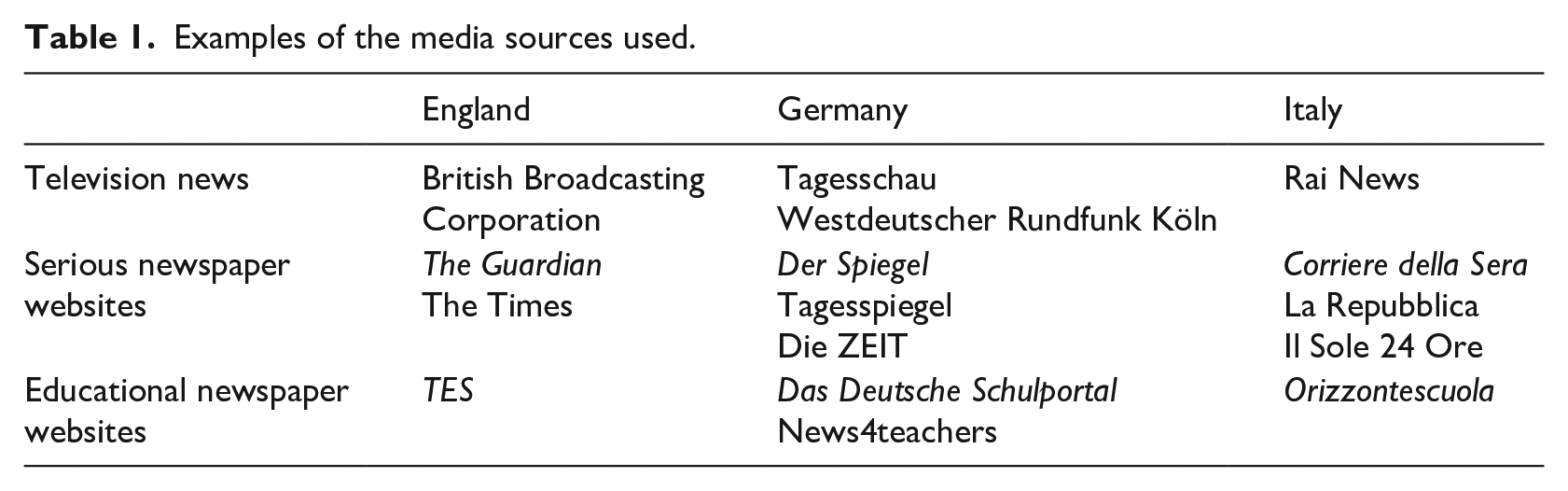
To develop an account of debates relating to school closure and reopening, we drew on 180 news media reports divided equally between the three countries. Examples of sources are included in Table 1, although we went beyond these, especially in Germany and Italy, where federal or regional responses varied.
Examples of the media sources used.
We examined reported debates within and between national and local politicians, scientific advisors and the wider health, education and social research communities, think tanks, health and education administrators, associations, trade unions, professionals, parents and students in all three countries, as well as representatives from commerce including the chief executives of multi-academy trusts in England. As media reports often emphasise conflicts, contradictions and problems, we confirmed their assertions and substantiated and developed our accounts using published documentation from government, scientists and other policy actors, including policy documents, guidance, reports, briefings, press releases, open letters and statements. Accounts for each country aimed to ascertain:
(a) the purposes and priorities for education in dealing with the crisis, in terms of sustaining the welfare of all and anticipating future needs;
(b) the debates that took place including areas of consensus, contention and change, what was decided and how decisions were justified;
(c) how medical, educational and social research were used in debates, whether to inform decision-making, to frame, legitimate and render as trustworthy any measures taken, or to monitor, evaluate and modify implementation, and how the selected studies interacted and their relative influence; and
(d) how implementation of the decisions proceeded, including any public response.
Medical debates in each country largely concerned the contribution of schools to spreading the COVID-19 virus, whether children could be carriers and the risk to teachers and parents. Educational debates focused on the benefits and limitations of home schooling, online learning and moving or cancelling examinations, and especially how these disadvantaged particular groups. Both came together in discussions about reopening schools, balancing risks of spreading the COVID-19 virus with concerns about children’s education and broader welfare and restraints on parents resuming work.
To consider why people largely complied with state activity in the circumstances described, we then analysed the experiences of each country using three dimensions drawn from Bourdieu’s theorisation of the state ([1989–1992] 2014) presented earlier. These were: (a) the range of interests represented in debates about the public good; (b) the locus and form of decision-making; and (c) policy legitimacy and the means of policy implementation. The role played by research evidence in each of these was analysed, as factions positioned themselves as trustworthy in negotiating and forwarding the public good in each country.
National responses to the COVID-19 pandemic
The three countries in this study have all suffered low or reduced public trust in politicians in recent years. In England, where the protracted Brexit (withdrawal of the United Kingdom from the European Union and the European Atomic Energy Community on 31 January 2020) debate had left many disheartened, those expressing confidence in the government’s response to coronavirus declined to half of respondents between early April and late May 2020, while the proportion who trusted government information on COVID-19 fell to 59% (Duffy, 2020). National surveys in Germany suggest that the government enjoyed mostly positive public approval for its handling of the crisis during the first wave of COVID-19, with policies identified as ‘science-based’ supported by the majority of respondents (Wissenschaftsbarometer, 2019). However, while satisfaction with the political response to COVID-19 in Italy was generally high, with the Prime Minister, Giuseppe Conte, gaining public approval, opinion about the educational response was more ambivalent largely because of the limited and troubled efforts to reopen schools (see Table 2).
A summary of national responses.
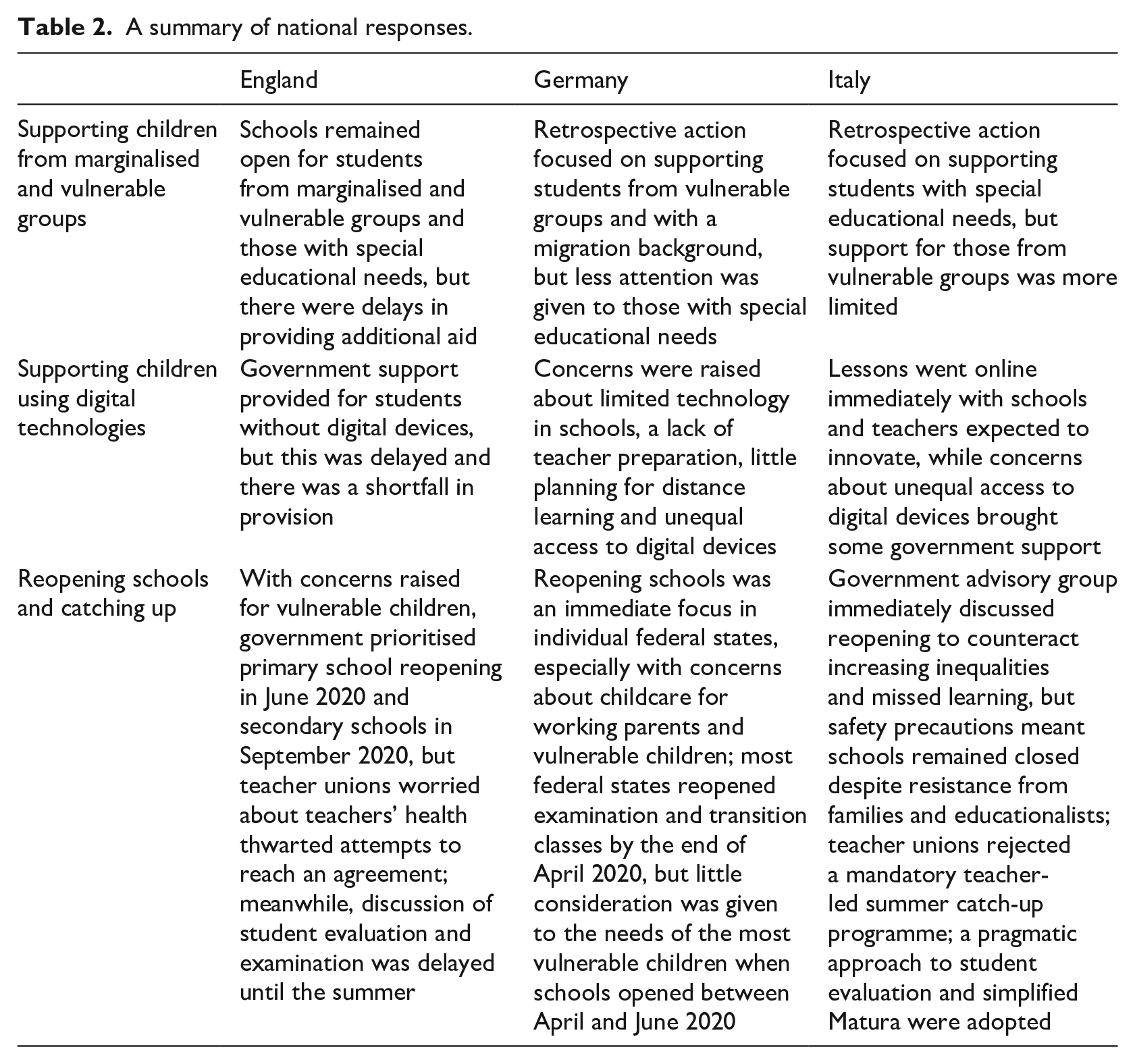
We begin by comparing debates about closing and reopening schools in each country to identify accounts of the public good, negotiations between these, the part played by research and the ease of implementing resulting settlements. The debates identified after the initial analysis fell into two broad areas: (a) the effects of school closures on children from marginalised and vulnerable groups, and how to support them, including the use of digital technologies; and (b) when and how to reopen schools, and how to tackle the consequences of missed schooling. In the account that follows, we reference open letters, statements, press releases and other documentation, but for clarity do not specify the numerous media sources used.
Supporting children from marginalised and vulnerable groups
In England there was broad political agreement on two imperatives for schools following their closure: economically on providing childcare for key workers – those on whom the broader population relied for their basic welfare and wellbeing; and socially on catering for pupils with vulnerabilities including special educational needs and those who might be in danger if they remained at home. Initially, there was concern about the low numbers of attendees from vulnerable groups. Later this extended to concerns about the wider protection of such groups. The charity, School-Home Support, reported a sevenfold increase in child referrals to social services between late March and early May 2020, even though local authority figures had declined over the same period (School-Home Support, 2020). They surmised that the normal means to identify child protection concerns used by local authorities, including through schools and youth clubs, were no longer available. Meanwhile, a food voucher scheme for the families of children eligible for free school meals, introduced when schools first closed, suffered long delays because, school leaders suggested, the company contracted to supply the vouchers was unable to deal with the demand.
Whereas the strategy in England was to keep marginalised and vulnerable students in school, in Germany the approach was to plan for retrospective action. Certainly, COVID-19 raised public awareness of inequalities in educational participation and led to discussions about the educational losers of the crisis. To compensate for learning backlogs resulting from school closures, researchers from the German Academy of Sciences (Deutsche Akademie der Naturforscher), known as Leopoldina as this is where it is located, recommended teaching be offered in the summer holidays, stating that these ‘measures are particularly important for lower-performing pupils and can help to mitigate social inequality’ (Leopoldina, 2020: 13). At about the same time, concerns were voiced about children with migration status or who were socially vulnerable, but those with special educational needs featured only marginally in the public debate. Klaus Hurrelmann, Professor of Public Health and Education at the Hertie School in Berlin, and Dieter Dohmen, Director of the Research Institute for Educational and Social Economics, pleaded for ‘positive discrimination’ for students on the basis of housing conditions or parental employment, and in an open letter to the KMK on 20April 2020, educational researchers and school leaders demanded that educational inequality be tackled as a priority after the reopening of schools (Ackeren et al., 2020). They called for children and young people who most need support, particularly those from socially disadvantaged backgrounds, to return to school first. One petition submitted to the Bundestag, favoured allowing teachers to decide which students should attend, thereby balancing student interests for the public good. However, unlike the Leopoldina (2020) publication or statements from medical experts, the contributions of educationalists received no public response from politicians.
Like Germany, retrospective action was also taken in Italy where the focus of public debate was on how to support children with special educational needs, while consideration of socially marginalised and vulnerable students remained limited. The crisis exposed difficulties faced by the Italian school system for decades, exacerbating the effects of intersecting inequalities on educational opportunities. Before the outbreak, inequalities between culturally, linguistically and socio-economically stratified groups were already high (Save the Children, 2020a), but the socio-economic situation for many of the poorest worsened with the COVID-19 pandemic (Save the Children, 2020b). Even before the lockdown, two-fifths of the most vulnerable families received free or highly subsidised school meals for their children. Now, almost half of parents with children aged between eight and 17 years interviewed had to reduce food costs. Yet despite increasing demands, increased state aid was not forthcoming and support for marginalised children remained local and limited. Socio-economically disadvantaged children with working mothers who, it was assumed, would take on the main responsibility for childcare and home schooling, were particularly affected. Limited childcare already made it difficult for women in particular to combine family and career, but during the COVID-19 pandemic many parents faced the enormous challenge of coping without childcare services and only limited public support (Save the Children, 2020b). A number of female academics highlighted this situation and the lack of a political response, and subsequent debates resulted in some restricted policy initiatives, including the provision of ‘babysitting’ and summer childcare services (Istituto Nazionale della Previdenza Sociale, 2020).
In summary, decision-makers pursued solutions to practical concerns about children from marginalised and vulnerable groups with some success but tended to ignore politicised debates. In England, a pragmatic view of the public good, supported by data, prioritised meeting the basic needs of all. This was widely accepted, despite some operational problems. In Germany, however, a principled debate ensued among educationalists and other commentators about the unequal impact of closure on different social groups, which did not elicit a political response, while public debate in Italy used data to highlight existing difficulties that could be exacerbated by the crisis, garnering broad support but only limited political interest.
Supporting children using digital technologies
Concerns were raised about the necessity to home school as part of the national response to COVID-19 in Germany, even before the lockdown began. During the first few days, a Bildungskrise of limited technology in schools and lack of teacher preparation was identified, marking the return to a political and public debate about the digitalisation of schools from before the COVID-19 pandemic (Kultusministerkonferenz, 2016; Organisation for Economic Co-operation and Development, 2016). Beginning in 2019, the Federal Ministry of Education and Research (Bundesministerium für Bildung und Forschung, (BMBF) supported Länder and municipalities by investing in digital education infrastructure. However, because of federal state bureaucracy, preparation time for teachers and costs associated with device maintenance and staffing, less than 1% of BMBF funded developments had been approved by February 2020. Supporters saw an opportunity to accelerate digitisation, while others simply regarded the project as a failure. Concerns over access and a digital divide accompanied worries about school digitalisation. As pupils had been told to stay at home and use digital devices and tools for learning, a debate about unequal access to mobile devices and digital educational content began in mid-April 2020. Some argued that online learning reproduces social inequalities by favouring a new digital elite over those with limited or no access to communication platforms or mobile devices (Bremm and Racherbäumer, 2020). Given that the BMBF initiative had been launched because teachers seldom used digital media or technologies including mobile devices, an area in which Germany regularly performed poorly in international comparisons (Organisation for Economic Co-operation and Development, 2020), it was no surprise that schools lacked plans for distance learning, leaving individuals to fare for themselves in arranging online access. This brought calls to divert BMBF funding to two emergency programmes: one providing mobile devices; and a second developing new digital content. But even by early May 2020, Birgit Eickelmann, Professor of Education at the University of Paderborn, complained that educational ministers had not consulted educational researchers with expertise in digitalisation in schools.
The extent of the digital divide and limitations in the digitalisation of schools were also a concern in Italy. Many schools lacked technologies, and while government initiatives in the last two decades, such as the National Plan for Digital Schools (Organisation for Economic Co-operation and Development, 2013), focused on strengthening digital competences among teachers and students, high numbers still lacked digital know-how (Save the Children, 2020b). Geographical and age differences in online learning provision persisted, with older students best served. Hence, guidance published by the Ministry of Education, University and Research (MIUR, 2020), which indicated that teaching during school closures could address social isolation by providing online support, was rather ambitious. The implementation of the framework for digital teaching and learning was largely delegated to individual schools and teachers, and this was seen by politicians, school leaders, and parents as an opportunity to innovate and lessen the digital divide. Many institutions at all levels responded to the lockdown by immediately offering online teaching through a range of platforms and devices, and local authorities and publishers provided webinars on online teaching and online teaching materials. But an analysis of national and regional guidelines shows that, while most recommended consideration be given to children with disabilities in online provision (see the decrees of the Prime Minister: DPCM, 2020; see also regional documents: Province of Bolzano, 2020a, 2020b), little reference was made to other student groups. In May 2020, however, the Ministry of Education (2020a) document told teachers that students without a suitable device or with only shared access to a family computer would receive government support. The Smart Class initiative followed (Ministry of Education, 2020b), through which schools could apply for funding to purchase technological devices. In the interim, schools were encouraged to consider alternatives such as communication by phone or encouraging classmates to share notes. The importance of teaching in some form, for motivating and encouraging all learners, especially those less engaged or otherwise disadvantaged, was emphasised along with the suggestion that family involvement may be necessary to achieve this. Early surveys and other research evidence showed that while students, especially in secondary and tertiary education, were satisfied with distance learning, there were problems accessing suitable technologies (ASTAT, 2020) and specific support for disadvantaged learners. However, most politicians ignored this despite the media attention it received. Meanwhile, educationalists, teachers, parents and students adopted diverse positions on teaching and learning with digital media, from outright rejection to the demand that this become the preferred approach in future.
Local school authorities also had their own interests and used the media and research to convey a positive image of online teaching and educational provision during the lockdown. In South Tyrol, school administrators used the findings of a survey and parent interviews (Province of Bolzano, 2020c) to demonstrate their success in managing online teaching and home schooling in an attempt to counter popular perceptions of educational injustice. However, the socio-economic background of the participants was not recorded in this study, and since the survey was conducted using e-mail addresses known to schools, it is likely that disadvantaged families with little online access, were not included.
England has long been an enthusiastic adopter of digital technologies in schools. By 2016, around three-quarters of primary and secondary schools used mobile technologies including tablets in the classroom (British Educational Supplers Association, 2016). A year later interactive whiteboards were almost universal (British Educational Supplers Association, 2017). Clearly, the provision of resources is of huge commercial interest. However, studies (summarised in McFarlane, 2019) provide mixed reports about the effectiveness of technologies in supporting learning in the classroom, and while most students have online access outside school, the benefit of Internet use away from the classroom is also unclear (McFarlane, 2019). Even so, education provision during school closures in England was entirely online for most children. In mid-April 2020, the government announced that care leavers, children with social worker support and those pupils sitting national examinations the following year without digital devices would be given these to enable them to study online, and children in families without online access would receive mobile or broadband routers (Department for Education, 2020). Trade union leaders generally welcomed this initiative, some calling for it to apply to all age groups, although Mary Bousted, Joint General-Secretary of the National Education Union, asked for government assurance that schools would not be expected to deliver the normal curriculum through online media. She reminded the government that such arrangements could only be temporary and not replace the necessary social contact provided by schools, although they would help children stay connected to friends, teachers and youth workers. Secretary of State for Education, Gavin Williamson, indicated that the £85 million scheme would pay for about 200,000 devices, the first of which would reach pupils by the end May 2020, although many had still not been received by mid-June 2020. As responsible bodies, local authority schools and academy trusts were allocated these resources based on the number of eligible pupils and a Department for Education estimate of the proportion without access to appropriate devices. But by early May 2020, school leaders were publicly complaining about a shortfall in the number of laptops they had been allocated under the scheme.
Initially, there was much talk of extensive online teaching for the majority of students and some called for an educator-designed and led educational technology platform in England. Wales, Scotland and Northern Ireland already had platforms, providing resources to support the use of digital technology in schools. Among those to respond were nine multi-academy trusts who formed the Oak Academy. This largely charitable endeavour supported by Williamson, received some government funding and a generous contribution from Google. Forty teachers together compiled a sequenced plan of hour-long online lessons and curricular resources, including videos, worksheets and quizzes, for use by teachers and directly by students. This followed the government commissioning a ‘rapid evidence assessment’ of research on distance learning in early April 2020 that reported three weeks later (Education Endowment Foundation, 2020), summarising the findings from 60 systematic reviews and meta-analyses. It concluded that the results from online approaches were either higher or the same as those from traditional instruction, but was met with disbelief by the teacher unions, leading the authors to concede that more research was needed. Indeed, responding to the Oak Academy, National Association of Head Teachers General Secretary, Paul Whiteman, warned that online resources could not replace human interaction or a teacher in front of a class, adding that their use should not go beyond the COVID-19 lockdown. His views were corroborated retrospectively, when surveys revealed that the majority of students studied for less than two hours per working day for the rest of the school year (Green, 2020).
In short, in Germany and Italy, where longstanding concerns and a history of ineffective top-down governance prevailed, governments limited both their engagement in debates about the public good of digitising schooling and any solutions offered. In the more heterogeneous English environment, where digital infrastructure and capacity were reasonably developed, most policy actors anticipated that technology would serve the public good by providing a workable educational alternative during the school closures.
Reopening schools and catching up
From early March until the end of May 2020 – when the highest number of new infections and deaths occurred – economic, health and education decision-making was largely top-down as the Italian Government directed the response to the COVID-19 pandemic centrally. Normally, the regions are responsible for operational policy implementation. However, state intervention was justified by the exceptional nature of the epidemic, and the national civil protection system was activated. Announcements, mostly by Conte, emphasised that politicians and a multidisciplinary team of experts had taken decisions together, an approach that the government used to legitimate decision-making throughout the crisis. This all-male technical–scientific committee established by decree in early February 2020 comprised the head of civil protection and specialists mainly in the fields of hygiene and public health medicine, epidemiology and infectious diseases. However, the dialogue between educationalists and politicians was limited (Tolomelli, 2020), and there was little discussion of alternative viewpoints or educational problems.
Initially, public trust increased but, as the public discourse turned to the economy, parents who could not return to work because of childcare costs or who felt overwhelmed by juggling home working and schooling increasingly called for schools to reopen. Just after the COVID-19 outbreak, educationalists and psychologists had spoken of a generational catastrophe and pushed for school reopening. However, virologists advised against this because ’especially primary school children would be difficult to control’, so social distancing would be problematic. Indeed, structural and economic constraints, such as small, old classrooms and shortages of the necessary materials, prevented the adoption of strict safety precautions primarily designed for adults and required for reopening (Save the Children, 2020a).
As school closures extended, criticisms of school governance by families and the wider population grew. These emphasised the negative impact on children with disabilities and socio-economically disadvantaged students. Media reports used studies of school closures in the past, such as after natural catastrophes, to warn that social disparities would grow. While policy-makers used public health justifications for lasting closures, they ignored pedagogical research pointing to consequences for the cognitive, social and emotional development of children and adolescents and medical evidence indicating a reduced risk of infection among children. A call by several female scientists in July 2020, asked the then Minister for Education, Lucia Azzolina, to review guidelines for returning to school which, they argued, compromised the educational rights and mental health of students (Gandini et al., 2020). Meanwhile, teacher unions argued against a suggestion that teachers supervise students during the summer break, supporting instead the employment of teacher volunteers and provision of additional resources for activities to promote basic competencies and counteract early school leaving, which was expected to increase as a result of the COVID-19 virus (Confederazione Generale Italiana del Lavoro, 2020).
To secure public approval in the United kingdom, Westminster claimed their approach was ‘science-led’. However, media and other expert commentators questioned the membership, operation and neutrality of their Scientific Advisory Group for Emergencies (SAGE). This led to the establishment of an independent ‘shadow’ group (Calnan et al., 2020), which expressed concern at the government’s careless use of statistics, particularly in its daily briefings, just as an editorial in the British Medical Journal evaluated the government’s handling of the crisis as ‘too little, too late, too flawed’, and suffering from ‘delay and dilution’ and a ‘narrow scientific view’ (British Medical Journal, 2020).
Prime Minister Boris Johnson’s announcement of school closures in March 2020 met with broad public support, and by May 2020 the focus had turned to reopening. Primary schools were prioritised, following advice from SAGE that this would aid transition to secondary school in September 2020 (Scientific Advisory Group for Emergencies, 2020). This debate saw considerable polarisation between the government and academy leads on the one hand, and teacher unions with the support of the British Medical Association on the other hand. Even by mid-April 2020, the leaders of some large multi-academy trusts had pushed the government for an early reopening date. Open letters to heads in the national media and personal communications followed, citing the risk of irreparable damage to vulnerable children, but revealing a lack of sensitivity to concerns by teachers for their own health (Gibbons, 2020). Hence, in early May 2020, nine trade unions issued a joint statement on the medical risks of reopening for teachers and the spread of COVID-19, even with class sizes reduced and social distancing enforced (Trades Union Congress, 2020). Here medical concerns were, for the first time, set against the social and educational impact of school closures on families and children, including concerns for mental health and wellbeing. The government focused on the need to prevent students from falling behind, and vowed to reopen schools for many pupils on 1 June 2020. Published in mid-May 2020, an Institute for Fiscal Studies survey of 4000 families in England had suggested that children from more affluent households were spending 30% more time each day on educational activities than their poorer peers, increasing the urgency of the debate (Institute for Fiscal Studies, 2020). At the same time, the Children’s Commissioner for England, Anne Longfield, criticised the squabbling between teacher unions and the government and urged them to work together to reopen schools as soon as possible. There were also growing concerns about the gendered impact of school closures, with evidence from an audit of organisations early into the lockdown suggesting that domestic abuse cases had increased during the period of lockdown (Office for National Statistics, 2020). Further, a University College London longitudinal study identified the lack of childcare as significant in almost half of female redundancies during this period, while many other women continued to bear the brunt of childcare and home schooling and therefore struggled to return to work (Univerity College London, 2020).
Meanwhile, opposition politicians urged the government to publish their scientific advice on reopening schools. This turned out to be qualified and inconclusive (Scientific Advisory Group for Emergencies, 2020). Meanwhile, the lack of progress on testing or a technological solution to monitoring and controlling infections using a mobile phone app provided little reassurance. By the end of May 2020, it was clear that public confidence in or appetite for reopening was limited, and as local administrations in Birmingham, Liverpool and Manchester suggested that implementation would be impossible and local public health officials said it was dangerous to do so, the government backed down. Teacher unions and local government, both citing medical worries, had overcome arguments on behalf of students by government, academy chain leads and others, backed by social research but without robust medical evidence. Given their earlier experiences of market reform, it is little surprise that trade unions were defensive in seeking the interests of their members. Nor was it unusual for local officials to support their communities, especially as regional inequalities were widening. Yet it was uncertainty that made it difficult to reach agreement. Trade unions and local government were unable to agree on what constituted acceptable risk, while the government and middle tier were unwilling to acknowledge the difficulties that schools faced or doubts about the best way forward.
In March 2020, the Robert Koch Institute (RKI), the German government’s public health institute, recommended school closures to contain the COVID-19 pandemic, based on historical data and mathematical models. At the same time, they discussed the challenges of childcare and employment, especially for key professionals (Robert Koch Institute, 2020). A KMK resolution to waive compulsory school attendance and close all schools nationally followed, with childcare provided for doctors, nurses, police officers and other emergency workers, all of whom enjoyed popular approval. From the start of the lockdown, federal states discussed school reopening and childcare for working parents. Initially, each state had different expectations about when schools would reopen depending on local circumstances, some aiming for the end of March 2020 and others the end of April 2020. There were repeated postponements. In April 2020, a team of researchers from the Leopoldina published ‘Coronavirus pandemic – A sustainable solution to the crisis’ (Leopoldina, 2020). The national government saw this report as a guide to lifting restrictions. It recommended that schools reopen step by step ‘as soon as possible’ (Leopoldina, 2020: 12), taking account of local conditions, and starting with primary schools because ‘children require the most support and guidance, and their parents are more heavily dependent on schools for childcare’ (Leopoldina, 2020: 12). Among other measures, the report proposed smaller class sizes and keeping students in specified groups. Nevertheless, this paper was criticised as unrealistic, unclear and failing to recognise the burden of home schooling, distance learning and social expectations in employment and childcare for women. And while the report emphasised the social significance of school-based learning and the fear that existing inequalities would be exacerbated, children with special educational needs were only mentioned briefly.
By the end of May 2020, parents and teachers were still calling for a plan for reopening. The Friedrich Ebert Foundation engaged an expert group of educational researchers, medical doctors, parents and teachers to explore this (Jungkamp et al., 2020). But despite earlier assurances, little thought was given to the needs of vulnerable children when school reopening began. School authorities treated schools for students with special educational needs like other schools, even though their social, educational and medical requirements differed.
In Italy, policy-makers sought a pragmatic approach to student evaluation. Teachers assessed pupils using distance learning approaches, allowing children to pass the school year, and requirements for the Esame di Maturità terminal examination for secondary education were simplified. In England, examinations only became important in the summer, but from the start of the crisis, examinations were a significant concern in Germany. Where schools faced local closures, parents demanded an emergency plan for Abitur cohorts that prioritised the needs of employers and universities. However, teachers’ associations and trade unions emphasised the protection of teachers and students and called for a Notabitur award based on student performance during the school year. Some questioned the necessity of the Abitur and suggested new forms of university entrance examination. Schleswig-Holstein was the first federal state wanting to cancel the examination to protect the health of students and teachers, which was welcomed by trade unions. Some federal states discussed postponing examinations by one or two months, a few proposed starting them early and others stuck to existing arrangements. All rejected the Notabitur. By late March, the KMK agreed that examinations either take place as planned or by a catch-up date at the end of the school year, leading students from different localities to write open letters to their respective ministries of education, identifying a ‘disrespect for risk groups’ (Vieth-Entus, 2020). One ministry reacted, recognising the stressful situation of students, but stating that they could not act otherwise because they ‘would be threatened with non-recognition of the Abitur’ by the KMK. Meanwhile, the Leopoldina agreed that examinations should take place at all levels, and recommended schools reopen graduating classes first, including transition classes to vocational or gymnasium upper schools. Almost all federal states had done so by the end of April 2020.
Comparing negotiations about school reopening is revealing. Central government in Italy and Germany prioritised public health over reopening, despite campaigns by other national and regional actors with social, educational and economic concerns; the very concerns that central government in England highlighted when arguing for reopening, before bowing to objections on medical grounds from other national and regional actors. Meanwhile, examination arrangements, simplified in Italy and largely ignored in England, were a key concern in Germany. To many, cancellation or even modification was unthinkable. Federal states proposed alternatives, while teachers’ bodies expressed concern for the welfare of their members and students complained about unfairness, but eventually almost all states reinstated examinations with little change. To explain this and other areas of negotiation we now turn to Bourdieu, before using his frame, introduced earlier, to compare responses to the COVID-19 pandemic more broadly.
The dynamics of crises
Bourdieu ([1989–1992] 2014) suggests that, during periods of crisis and social upheaval, habitus – the web of personal dispositions that shape an individual’s encounters with others and the world – becomes misaligned as fields – the arenas where these interactions play out – change (Fowler, 2020; Sapiro, 2013). There are a number of examples above. With school closure, for example, parents, particularly women, unable to continue working from home because of childcare and home schooling responsibilities, faced economic difficulties in all three countries. Students with specific needs or vulnerabilities missed out when home schooling was unable to address these, those with limited or no digital access were disadvantaged when educational provision moved online, and the loss of face-to-face social opportunities afforded by schooling affected the wellbeing of many.
Such field changes heighten existing conflicts, trigger resentment and lead to a realignment within and between decision-makers, intellectuals and various social groups. For subordinate groups, resentment stems from the contrast between their own lack of symbolic recognition or status, and the ‘relational continuity [of the] structural efficacy of elites in regulating their own reproduction’ (Fowler, 2020: 444). At such times, the political classes remain focused on maintaining control of decision-making and the consent of all, while still privileging dominant interests. Meanwhile, public intellectuals, scientists, experts and their brokers and interpreters, and social commentators fall into two camps. For those representing the interests of the subordinate, crises present an opportunity to challenge the existing order; an order that those who align with the establishment seek to defend. So, those concerned by the unequal impact of school closure on different social groups, and others seeking greater digitalisation in schools, took up these causes at the start of the crisis in Germany, as did those with existing concerns in Italy. Interestingly, subsequent arguments for school reopening on social, educational and economic grounds provided both a challenge to government actions in Germany and Italy and a defence of the government in England. However, none of these principled arguments or objections were ultimately successful.
According to Bourdieu ([1989–1992] 2014), the state sustains continuity and unity by establishing a national habitus encompassing popular rituals, a consecrated culture bestowed with symbolic status, and national myths. In Germany, the Abitur examination is a long established social ritual for the privileged and aspiring, an iconic signifier of German culture, history and tradition, and a symbolic means of bestowing social standing. This explains why suggested changes met such resistance. First introduced in 1788, the Abitur remains an unwavering, enduring and highly valued indicator of status, whose worth increases amid other uncertainties. To some extent the observation still holds, ‘that the strict use of the Abitur for academic, professional and occupational purposes categorises the German people into the “haves and have-nots.” Demands for the possession of the Abitur have developed an educational caste system throughout the long years of its use’ (Dewitt, 1955: 353). Building on national habitus, governments deploy notions of shared interests and rights to distract from their favouring of particular interests. In response to concerns of inequity, the government in England kept schools open for the children of key workers and those with special needs and vulnerabilities to alleviate the specific difficulties facing these groups, although not all who could took advantage of this did so. Similarly, all three governments attempted to provide digital devices to students without access, with varying degrees of ambition and success. Such practical measures were received positively, despite some shortages.
Governments claim ‘to state the public good, to be the public good and to appropriate public goods’ (Bourdieu, [1989–1992] 2014: 86), with their activities underwritten by the certainties of the law, science and other institutions and traditions. These are portrayed as trans-historical and universal, transcending their social conditions of production, while those engaged in legal, scientific or similar practice are characterised by their ‘interests in disinterestedness’ (Bourdieu, 1990: 110–111). Aside from medical research and epidemiological understandings, statistical surveys and investigations served this role in large part for all involved in negotiating the public good during the first lockdown, while those making principled cases using the often more culturally contingent ideas and findings of social and educational research were less influential. Nevertheless, Bourdieu suggests, those with specific expertise can mobilise symbolic challenges to inequalities in status, and cultural challenges to dominant ways of thinking and acting at times of crisis (Fowler, 2020). One approach is to identify particular cases that contradict shared interests or universal claims. So, although governments cast the lockdown as in the interests of all and used epidemiological evidence to justify this, in practice it highlighted the continuing unequal status of women and the young, both of whom were disproportionately disadvantaged by school closures, as subsequent social research studies reported. More positively, the demand for digital provision challenged existing cultural expectations of face-to-face schooling by increasing awareness of future opportunities, while also identifying some of the potential benefits and limitations of digitalisation.
State responses to COVID-19
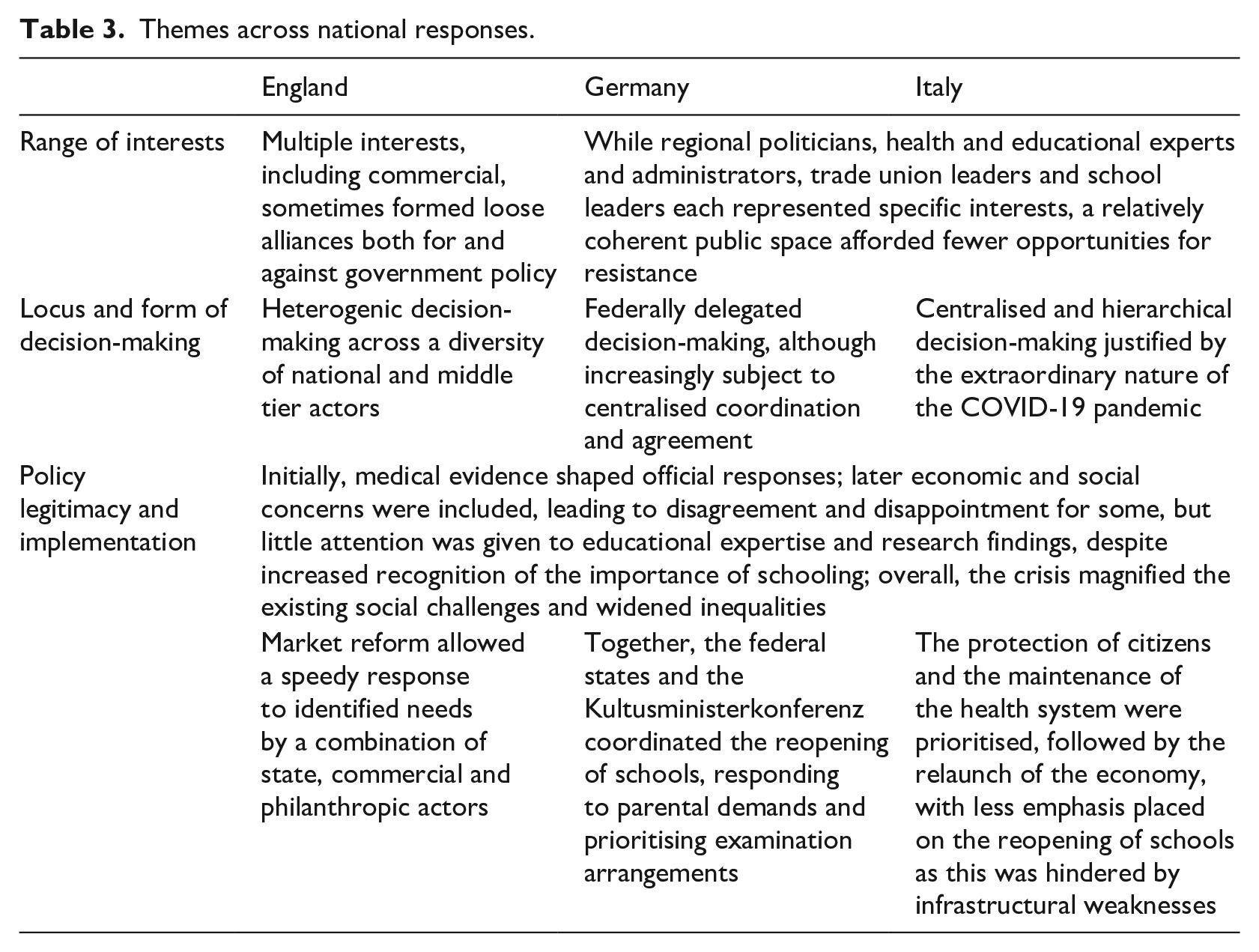
We now consider further why people largely complied with state activity in the circumstances described (see Table 3).
Themes across national responses.
Range of interests
Clearly, there were a number of times where the various actors involved in decision-making worked to forward specific interests as they negotiated the public good (Bourdieu, [1989–1992] 2014). Some used evidence to bolster their positions in negotiations, which stumbled when contradictions in evidence and its interpretation led to uncertainty in the decision-making process and reduced public trust. Negotiations often pitted social or educational priorities – including advocacy for children’s right to education – on the one hand, and economic ones on the other hand, against medical imperatives in all three countries. However, these differed between countries in both substance and the extent to which those representing different groups became allied. In England, for example, because of market reform there were many organisations with interests in schooling, and some coordinated their actions for or against government policy, albeit loosely. While academy leads and the government formed a governing assemblage (Ozga, 2020) to push for reopening, it was longstanding policy actors, namely local authorities and trade unions, who built on public scepticism and mistrust to resist these plans successfully because they had both the arguments and means to do so. In contrast, a less fractured public space afforded fewer opportunities for alliances to exert influence in Italy and Germany, as their principled arguments were not backed by threats of action. Indeed, the conflicting interests of the teaching profession, trade unions and academy leaders in England was significant, making it more difficult for the government to maintain coherence.
There were many examples of how health, economic, social and educational interests competed with each other. The developing medical discourse classified children as COVID-19 virus spreaders to be kept at home on the one hand (by the RKI in Germany, for example), and barriers to employment for parents needing childcare on the other hand (as expressed by the governments in all three countries). Later, students’ right to take terminal examinations (identified in Italy in Germany) was set against the protection of vulnerable (as voiced by student groups in different states in Germany). Sometimes, actors adopted contradictory positions to forward their own interests. When the debate in Germany focused on school reopening, teachers’ associations used medical arguments to maintain closure, in the face of some criticism. However, they argued against using distance learning to help prevent the spread of the COVID-19 virus by suggesting that schools were poorly resourced, teachers were underprepared and access to devices was too unequal. As a result, the debate swung back and forth between online learning and school reopening, until eventually, frustrated with this indecision, the KMK acted unilaterally. Similar concerns were raised by teachers’ associations, educational researchers and policy-makers in all countries.
Finally, there were examples where the interests of some social groups simply could not be met in education, even though the changes required were achieved in other areas. In Italy, for example, while a resumption of economic and commercial activities in compliance with national regulations was possible, often involving combinations of remote and on-site working, such arrangements were impossible for many in an education system that lacked resources. As the need for social distancing became nationally mandated, this prevented school reopening because teacher numbers were insufficient and school buildings were inadequate. Large numbers of students, small numbers of teachers, relatively small classrooms and a lack of alternative spaces meant that education policy-makers could not find safe, sustainable and financially viable solutions. Media reports identified this as an example of how education was of little importance to politicians when compared with economics. As a result, families considered themselves abandoned by the state and caught between remote working expectations and home schooling demands. And despite generally high public approval for the government’s handling of the crisis, the ambivalence many felt about their educational response was compounded by a perception that education experts had little involvement in finding solutions.
Locus and form of decision-making
Significantly, decision-making and administration lay at different levels in each country, being largely centralised in Italy and more delegated and heterogeneous in Germany and England, although in both cases increasingly subject to central coordination. Indeed, the COVID-19 pandemic increased awareness of differences between the nations of the United Kingdom. Despite its progressive fragmentation during the previous three decades, the state moved centre-stage as a political authority as the crisis took hold in England, provoking some politicians to warn of authoritarianism or technocratic populism. However, years of neoliberal reform and austerity had left state capacity much reduced. Having encouraged their autonomy, the government could not now force schools to reopen. Meanwhile, the lack of governance at a local level had led to a diversity of middle tier provision driven by multiple interests, many commercial. Nevertheless, such organisations can respond quickly to market opportunities, as illustrated by Oak Academy, a development shaped by customer – that is, teacher – demand and taken for granted assumptions, rather than student interests. Inevitably, the resulting platform employed structured, teacher-led approaches to knowledge transmission, similar to those that dominate face-to-face teaching, and minimised opportunities for student exploration and interaction. The picture was a little more straightforward in Germany and Italy. The locus of decision-making during the crisis in Germany was mainly regional or local depending on the medical severity of the crisis in the federal state, while central advisors such as the Leopoldina guided decision-making at an inter-federal level, with national committees coordinating federal cooperation and agreement. On occasion, they also drew a line under debates that were not moving towards a resolution, by bringing federal ministers together to work through a solution. Meanwhile, the centralisation of decision-making in education in Italy was offset by the provision of additional support in health and education to the regions.
For the most part, governments maintained control consensually as they moved from negotiating the public good to implementing the settlements reached. In so doing, states inflict symbolic violence – when individuals or groups misrecognise their subaltern position – by classifying people, objects and activities using categories that benefit the already privileged (Bourdieu, [1989–1992] 2014, [1981–1982] 2019). State-sanctioned institutions are awash with such categorisations, from the roles, responsibilities and experience of various actors to the approaches used for identifying expectations and needs. The consequences of stratification using state-sanctioned medical and educational measures for individuals can be significant. In each country, official responses to the virus used both existing and newly developed health, education and social classification frameworks to further the public good during the first wave. Initially, medical categories used health concerns to regulate social mixing, especially with vulnerable groups such as the elderly and those with other risk factors. Soon, the economic categories of key workers in England and key professionals in Germany and later Italy, whose children required childcare to allow them to continue working, separated those who could attend schools from those who could not. Less explicitly, parents, especially women, were expected to prioritise home teaching and found it hard to also secure recognition as home workers. Later in all three countries, various policy actors called for an acknowledgement of this non-categorisation and for specific student groups, disadvantaged by a one-size-fits-all approach, to receive greater attention. These included students with migration status, especially in Germany, or those who were socially vulnerable, socio-economically disadvantaged, had specified needs or were in transition and examination years. Indeed, as mentioned earlier, in Germany and Italy, the maintenance of existing educational classification systems – the Abitur in particular and the Matura to a lesser extent, both of which favour already advantaged students – became the subject of much debate, indicating their valued position in society. Meanwhile, other educational categories such as the constitution of schooling were redefined to encompass online learning and students were classified according to their digital access, while in England face-to-face work became childcare for socially valued employees and vulnerable students. In all cases, rather than benefiting all, home circumstances – specifically access to digital devices, suitable working spaces or knowledgeable adults – became more significant for school success. Bourdieu and Passeron (1977) identify how schooling takes place in social spaces inhabited by actors who are unequally positioned to forward their own interests. Although schools create the illusion of equal opportunities, it is the unequal distribution of beneficial capitals and the dispositions of habitus, acquired through socialisation outside school, that regulates educational success. Hence, the form of schooling and approaches to school and student evaluation serve to reproduce inequality. Now, the same inequalities manifest in students’ preparedness for school served also to shape their experiences of schooling at home.
Policy legitimacy and implementation
Compliance was generally maintained as the crisis unfolded, with agreement fostered through appeals based on shared expectations. As Bourdieu ([1989–1992] 2014) suggests, the doxic state sustains a common sense account of how the material and social worlds operate; an account that persuades the subaltern to accept inequitable treatment. Here, doxa includes the taken for granted assumptions and accepted narratives that sustain health and education policy, provision and practice. Many appear benign and gain almost universal acceptance, with deniers regarded as eccentric or irrational. An example is the contention that, as the COVID-19 virus can be deadly or life changing, decision-makers should prioritise containment over economic and social activities, including those that promote other forms of wellbeing. However, as the risk of serious illness is not the same for everyone, this means that some – namely, the young and healthy – must follow imposed restrictions without obvious benefit; indeed, they may be considerably disadvantaged. Bourdieu and Wacquant (1992) refer to a willingness to accept, among other things, the activities of the state as illusio. Complementing doxa, this involves buying into apparently benign narratives about the work of the state as a public good and accepting the common sense logic underpinning them. Initially, most people accepted restrictions on their freedom to protect the lives of the elderly and vulnerable in their communities; either they had friends and loved ones who needed protection, or they felt a civic duty bolstered by campaigns to protect health workers and hospitals. Nevertheless, we have seen how economic, social and educational concerns increased as the crisis continued. Some sought adjustment from a view of the public good overwhelmingly concerned with the welfare of the medically vulnerable to one that embraced the economically, socially and educationally vulnerable too. In relation to school attendance, for example, immediate concerns about spreading the COVID-19 virus offered in support of closure were weighed against longer-term impacts on children’s life chances to argue for reopening.
In aligning with common sense assumptions and collective narratives, Bourdieu ([1981–1982] 2019) asserts that state-sponsored category systems – such as those of vulnerability or social importance – are also taken as the natural state of affairs. Each country identified and made provision for such groups of parents or students, and we have discussed the consequences of this. Yet, while some resisted categorisation and its consequences, most complied, misrecognising these as right and just. Even those least likely to benefit in Germany and Italy, for instance, agreed that classes preparing for state examinations should return to school first, and that assessments should take place, preferably in their original form. Meanwhile, in all three countries it was widely held that some form of later compensation was necessary for specific students. The crisis had magnified existing challenges and exacerbated established inequalities, with the least influential bearing most of the costs. While already vulnerable and disadvantaged children were the educational victims of the crisis, working mothers were socially and economically disadvantaged but received little help. Yet, in reality, all students lost out because of school closures and differed only in the quality of support they received.
Research and decision-making
Just as medical priorities outweighed all others, so medical research dominated in all three countries, with relatively little attention given to educational expertise and research findings in discussions about schooling. But even when social research was attended to, we found parallels to Ozga’s (2020) analysis that studies modelled on science, particularly medicine, were assumed rigorous and trustworthy and their methods applied uncritically to formulate universal claims from statistical analyses. Hence, the production, analysis and interpretation of data became consequential in their own right, as actors seeking to influence policy-makers, commissioned experts and consultants to evidence their arguments. We also found that pragmatic approaches to social concerns garnered more attention than disciplinary arguments. In England, for example, the government agreed to practical support for students identified as vulnerable using school data, whereas politicians in Germany and Italy more often ignored concerns for student groups whose marginalisation was explored in social research.
All three countries initially saw in technology a way of maintaining educational provision in some form and providing opportunities for social contact for students. In England, where technology represents a public good in its own right, politicians cast digital tool use in schools as an economic imperative, crucial for preparing students for future work and promoting commercial competitiveness nationwide, while many assumed technological solutions could be found for social problems (Ozga, 2020). However, longstanding technology use in English schools contrasted with Germany, where debates about digitalisation in schools started later than in other countries and there was greater scepticism about teaching using technology, and Italy, where low levels of expenditure on education had prevented technological development in schools. While the move to home schooling rekindled debates in German schools, providing impetus for those seeking greater digitalisation, there were also contrary calls from traditionalists. As in other areas, educationalists were marginal to these discussions, which were oriented towards economic imperatives, linked to comparative surveys and focused on the practical concerns of resourcing, competence and access. Likewise, there were fears about students’ digital access in Italy, where the government seemed to appreciate social concerns but did little to alleviate them, while educational decision-making was largely delegated to local authorities and schools. Politicians made few contributions to debates about the public good of digitising schooling among educationalists, students and parents. Their approaches, both nationally and locally, were responsive and often inadequate or impractical, even as some local administrations presented a positive picture using partial data. With data identifying need, few in England doubted that technological solutions were required. The government appeared again to follow a pragmatic path by widening access to digital devices and, drawing on market efficiency to get things done quickly, as commercial, philanthropic and state providers developed a national online platform together, although subsequent usage data called its impact into question. Only teacher unions worried; their concerns about technology replacing teachers no doubt compounded by government commissioned research asserting the equivalence of online and face-to-face provision. Nevertheless, after years of neoliberal public service reform, many accepted markets as an important way of promoting human flourishing, while providers of devices, media and infrastructure were no doubt pleased with the commercial opportunities they were afforded.
In all three countries, the public good in school closure rested with the need to minimise transmission of the COVID-19 virus. Responses were informed by medical research ideas and data. The immediate concern was the protection of all and prevention of hospital overload. Those voicing concern about longer-term physical or mental health and economic, social or educational wellbeing had little influence. In Italy, the expert advisory committee drew their legitimacy largely from medical research, their makeup reflecting government priorities; minimising death rates before reopening the economy. This contrasted with the concerns of a popular coalition that included educationalists, scientists and parents, who drew on both medical and pedagogical research to emphasise students’ immediate social needs and their long-term educational development, but were challenged by trade unions seeking to protect teachers, and largely ignored by decision-makers. There are similarities with Germany, where the impatience of federal states suggests that economic concerns were high on their agenda, as they were frustrated by the caution of central government prioritising public health. Yet the opposite happened in England. With the support of academy trust leads, the government sought to reopen schools in early summer 2020 citing evidence of social, educational and mental health concerns from a number of surveys. However, teacher unions, backed by doctors’ organisations, used medical evidence to express concern for teachers’ wellbeing. When government advisors published an inconclusive report on the benefits of school reopening, a loose assemblage of local government and opposition politicians joined the teacher unions to stall this; all at a time when questions were being raised about the reliability of technology developed to help monitor the spread of the COVID-19 pandemic. Everywhere, the results were the same. Decision-makers acted cautiously in conditions of uncertainty; where data and understandings were limited, analyses unconvincing or technological solutions doubtful, they chose or conceded to epidemiological concerns over all others.
The contingency of taken for granted expectations is clear. National and local cultures, policy contexts (including the organisation of public institutions and the importance, value and purposes ascribed to these) and circumstances (such as infrastructural constraints and infection rates) reflected dominant assumptions and shaped responses in each country. Culturally, for example, England followed its long tradition of pragmatism, whereas rules and principles were valued in Germany, while the strength of feeling for maintaining the Abitur reflected its social significance there, thwarting attempts at alternative arrangements. Similarly, technological optimism was limited in Italy and Germany but stronger in England. In terms of organisation, centralised states assumed greater control in Italy and Germany, whereas the disaggregated English state could not impose its will. However, England’s neoliberal reform context encouraged a market solution to the lack of a digital platform. Finally, with regard to circumstances, the Italian government’s decision to relaunch the economy while placing less emphasis on the reopening of schools stemmed from infrastructural weaknesses that made social distancing difficult.
Research, trust and the public good
Our analysis uses public records to present a complex picture of decision-making in three countries. We have identified how actors negotiating the public good position themselves as legitimate and trustworthy, sometimes using research. As Ozga (2020) points out, much to the frustration of politicians, the research process is messy, occasionally imprecise or mistaken, and opens up debate to alternative interpretations and analyses, sometimes inconclusively. The way research evidence appears to inform decision-making has enduring consequences for public trust in research data and findings, the politicians who employ these to justify their decisions and the institutions and individuals tasked with implementing the resultant policies. Contradictions in evidence, such as whether children are carriers of the COVID-19 virus, affect public confidence, as do perceptions that evidence, such as that on the dangers of school reopening for teachers, is partial or flawed. Meanwhile, misgivings that groups, such as school authorities or teacher unions, have chosen evidence from a variety of alternatives to suit their particular arguments, undermine claims of disinterest. Together, these can fuel scepticism and doubt. We hope that wider circulation of more sophisticated accounts of the relationship between research and policy, such as ours, may lessen this scepticism and doubt.
Those tasked with serving the public good are further compromised when it is apparent that they are not acting for the welfare of all, particularly when some benefit disproportionately from the measures taken and those already advantaged gain the most. We have identified cases of this. Few objected to the lockdown favouring the elderly and medically vulnerable or prioritising the childcare needs of essential workers; but our analysis also shows, for example, how moves to home schooling and decisions around examinations favoured privileged students. The insights Bourdieu provides into the workings of the state have been central to this account.
Footnotes
Declaration of conflicting interests
The authors declared no potential conflicts of interest with respect to the research, authorship, and/or publication of this article.
Funding
The authors received no financial support for the research, authorship, and/or publication of this article.
