




Abstract
There exist some rare private schools that attempt to mitigate the anti-democratic qualities of the private schooling sector in England. This article reports on a study of private schools that aim to promote equality and participation through some aspects of their operations. It considers to what extent the governance structures within the schools support their aspirations and what this means for the public good more generally. English private schools are accountable to the state under The Education (Independent School Standards) Regulations 2014 (hereafter Independent School Standards, 2014), corporate law and the majority are accountable under the Charities Act, which requires them to demonstrate public benefit. The schools reported here have a commitment to the public good that extends beyond these limited accountabilities, demonstrating the weaknesses of the public good as it is presently defined by the state and also advancing understanding on the extent to which the schools can be regarded as Fraser’s (1990) counterpublics.
Introduction
Study of privatisation in public sector schooling has increased awareness of how governance practices in individual schools contribute to and are enactments of the overall political organisation of society, which is how Yeatman (2004) defines the state. Privatisation is generally perceived as a movement away from the public towards the private (Starr, 1988). This article problematises the total exclusion of the public from our view of the private sector, recognising both that by its nature the neoliberal state defines and restricts the public aspects of public institutions (Ball, 2009), and that expressions of democratic equality exist even within private sector schooling. It reports on a study of schools in England that are private in that they are generally funded by private sources and freed from many of the regulations of state-funded schooling, yet they still retain some commitment to the state through education, charity and company legislation. There are differences between private and state schools’ relationships with the state, yet the privatisation of state-funded schooling and policy debates in England that advocate greater accountability of private schools may reduce the significance of these differences. Furthermore, some schools within the private sector deliberately construct for themselves an even closer relationship with the public good, encouraging discourse and deliberation on political, social and economic concerns among its citizenry and may even act as Fraser’s (1990) counterpublics where: ‘subordinated social groups invent and circulate counterdiscourses’ (Fraser, 1990: 67).
This article is related to an ongoing strand of work that is exploring the nature of the public good and its connections with democracy and social justice in schooling in an era of increasing privatisation of public services. While the study drawn upon examined the public good within governance, curriculum pedagogy, intake and outcomes within the private schooling sector in England, this article is solely concerned with the extent and nature of governance for the public good. The governance of schooling is especially important, because it offers opportunities for children and young people to practise democratic citizenship beyond what is possible from curriculum and pedagogical reform alone. Private schools and the public good are often seen as antithetical to one another; yet, investigations of private schooling can raise questions about the normative legitimacy of the state as a public sphere (Fraser, 2014) when the public sphere is conceived as multiple publics and private schools are conceived as potentially strong counterpublics that sit outside of weaker mainstream publics (Fraser, 1990). The schools discussed in this article are rare within the generally elitist fee-paying private schooling sector in England, which caters to only 7% of school children. The schools are different from other schools in private schooling, because they aspire to mitigate or in some cases overcome the anti-democratic features of the sector. Elsewhere regarded as ‘alternative’ schools (Carnie, 2003; Kraftl, 2014), in this study such schools are considered of interest, because they are on the one hand private, or set apart from society, yet on the other promote values for an equal and participatory society. They are also part of an established schooling sector, unlike their newly established counterparts in England, the state-funded independent free and academy schools. The private schools discussed in this article are important locations in which we can investigate at close hand the limits to social justice when private interests are prioritised over the public good. These investigations contribute to our wider understanding of the nature of the public good in contemporary schooling.
The article considers the nature of the public in current schooling policy in England, drawing upon Larabee’s (1997) three approaches to schooling that are driven by three competing views of the purpose of education. Larabee’s democratic equality approach is related to Dewey’s (1916) democratic ideal that promotes equality through equal exchange among diverse participants. The approach to schooling most favoured by policy makers, however, is a social mobility approach. Aspirations for social mobility are often driven by the desire for equality of opportunity, yet in practice policies of social mobility fuel competition and are fundamentally divisive. The article draws parallels between a social mobility approach and the way social equality is generally addressed within private schools. It explains how and to what extent private schools in England are governed by the state under the Independent School Standards (2014), corporate law and the majority held liable under the Charities Act, which requires them to demonstrate public benefit. The public good to which they are held accountable is limited, and very few of them demonstrate a commitment to democratic equality. Yet the fact that some do hold themselves accountable to a democratic public is something that should not be ignored in a critical analysis of education. Examples of strong democratic publics existing within private education necessitate refined conceptualisations of public education. This article builds an argument for the significance of the public in private schooling to democratic equality, social justice and the public good by reporting upon the findings on governance from a study of English private schools.
Public and private goods
In his article on public versus private goods in American education, Larabee (1997) argues that politics is the underlying problem of education, because different ideological positions inform different practices and ultimately drive different goals for education. He identifies three alternative, ideologically driven approaches towards differing social outcomes for schooling: democratic equality, social efficiency and social mobility. His analysis helps to explain why different educational policies might adopt similar language that apparently supports social justice, yet propose achieving social justice through such different means. It also provides tools with which to untangle the differences in intent and outcome of educational practices within single school sites.
Larabee defines the goal of democratic equality to be the preparation of the young: ‘with equal care to take on the full responsibilities of citizenship in a competent manner’ (Larabee, 1997: 42). In a democratic equality approach to schooling it is regarded as in the public interest to educate the young in the deliberation, opinion formation and decision-making that they will require as full participants in democratic publics. In this approach governance plays an important role in education as a vehicle by which children and young people can practise democracy. The practice of democracy in education is fleshed out in Dewey’s (1916) democratic ideal, which is taken to be the extent to which group members have: ‘an equable opportunity to receive and to take from others’ and a: ‘large variety of shared undertakings and experiences’ (Dewey, 1916: 92) and, there is: ‘not only freer interaction between social groups … but change in social habit – its continuous readjustment through meeting the new situations produced by varied intercourse’ (Dewey, 1916: 94).
Larabee’s social efficiency approach to education focuses on the development of a well-functioning and therefore highly specialised and differentiated society, typified by high quality vocational education that aims to develop human productivity. He describes a social mobility approach as the perception that education: ‘is a commodity, the only purpose of which is to provide individual students with a competitive advantage in the struggle for desirable social positions’ (Larabee, 1997: 42). Larabee’s (1997) argument is that the focus on: ‘individual status attainment’ within a social mobility approach to schooling is even further removed from the public good than a conservative, social efficiency approach that values education for its contribution to the overall development of human capital. While the Nuffield Review of 14 – 19 Education and Training (Pring et al., 2009) recommended diversifying curriculum and qualifications to more efficiently meet the specialist needs of complex, post-industrial Britain, the Conservative-Liberal Democrat coalition government elected in 2010 focused upon elite curriculum and educational pathways for England. 1 While a new Conservative majority government has recently been elected in the United Kingdom, residual education policies of the last government for addressing disadvantage (like pupil premium funding that is targeted funding for supporting the attainment of individual children and the Progress 8 school performance measure that uses attainment data of select curriculum areas to provide a measure against which schools are compared) are a social mobility approach. Recognition of the anti-democratic features of government policy helps to disentangle the pursuit of the public good from the work of the state. Private schools that address social inequalities largely approach social advantage as an individual, private good that could be competed for with effort and ability (i.e. bursaries) or valued service learning primarily for the benefits it accrued the learner (Boyask, 2015b), and therefore are also more closely aligned with Larabee’s social mobility approach to schooling.
It is common to dichotomise between public and private schooling, conflating public with the state and private with market, yet many warn against this reductionist thinking (Starr, 1988; Robertson et al., 2012; Wilson, 2012). The privately funded schooling sector has ties to the state through the Independent School Standards (2014) and many, but not all, private schools are accountable under the Charities Act 2011 as well as through regulation of their business practices through company law. Some suggest that these ties are insufficient for holding private schools to account (Millar, 2011; Stewart, 2014), and recently the United Kingdom’s government has suggested private schools require further regulation through inspection by Ofsted (Paton, 2014). The regulatory framework for private schools, however, does indicate that overall private schools have a commitment to the public interest, at least in as much as the public sphere is institutionalised through the state.
Drawing from Habermas (1991), Fraser (1990) argues that the public sphere is: [a] theater [sic] in modern societies in which political participation is enacted through the medium of talk. It is the space in which citizens deliberate about their common affairs, hence, an institutionalized arena of discursive interaction (Fraser, 1990: 57).
Both Habermas and Fraser argue that the public sphere is conceptually distinct from the state, yet a parliamentary state is an institutionalisation of the public sphere. Fraser’s (1990, 2014) contention that publics are multiple further suggests that, while the Westminster parliament is indeed a manifestation of a public, we might also regard democratic governance within organisations such as schools as manifestations of publics. Furthermore, Fraser’s argument suggests we must: (1) guard against privatising all that is not state lest we exclude some public interests and privilege others; (2) recognise the public dimensions of counterpublics that exist outside of mainstream publics; and (3) not exclude economic exchange from the public sphere where it cannot be deliberated upon and debated. Indeed, as neoliberalism has taken hold as the dominant ideology of the English state all of its expressions of the public are enmeshed with economic values. This is not to argue that the current politic is a healthy amalgamation of state and economy; the development of an enterprise culture in the United Kingdom has resulted in the impoverished communitarianism predicted by Peters and Marshall (1996) and embattled the common school (Fielding and Moss, 2011). Rather it means that we should not close our eyes to the fact that even as the economic politic dominates the work of public institutions, aspirations for equality are being expressed through their privatised services and commissioning, albeit in a limited and changed form (Boyask, 2015a).
Governance for the public good in private sector schooling
Within education we have seen in recent years an expansion of private involvement in state schooling, including the development of public-private partnerships (Robertson et al., 2012). This can be attributed to the desire to tap into what is perceived to be the innovation and efficiency of the private sector, while retaining some state regulation and central control for the purposes of equity (Lubienski, 2003, 2009). In England we have seen the growth of privatised schooling through the academies programme, which has resulted in a new type of semi-autonomous school that is publicly funded, but privately governed through an academy trust (which is a charitable company made up of two tiers of governance: members of the trust and the board of governors). The separation within academies between funding from the state and management through the academy trust means they adhere to the OECD’s (2012) definition of a private school that is: ‘managed directly or indirectly by a non-government organisation’ (OECD, 2012: 18). Traditional private schools are further removed from some elements of state control, yet neither are they entirely deregulated. In their comparison of quasi-markets of schooling in 19 countries Lubienski and Linick (2011) argued that non-state or private schools in England and Wales received a comparatively low level of state funding and are subject to a low level of regulation. More recently there has been debate in policy circles about increasing state expectations and regulation of private schools (e.g. BBC, 2014; Hunt, 2014).
Currently, private schools are released from delivering the national curriculum, yet must provide a curriculum of: ‘linguistic, mathematical, scientific, technological, human and social, physical and aesthetic and creative education’ (Independent School Standards, 2014). They must provide for the: ‘spiritual, moral, social and cultural development of pupils’ through the promotion of moral principles, by precluding: ‘the promotion of partisan political views’ and offering a balanced view of political issues if they arise. Schools are also required to undergo inspection by a government approved inspection agency, although this is not restricted to Ofsted (a non-ministerial government department) as is the case with state-funded schools. Their governance arrangements are also more flexible than state-funded schools. It is a requirement that the school is led by a proprietor who is responsible for the management of the school and may be an individual or a ‘body of persons corporate or unincorporate’ (Independent School Standards, 2014). Private schools may be either profit generating businesses (sole trader or limited companies) or charitable companies. The business structures of the schools determine the nature of the proprietor and, as will be shown in the findings reported below, are in some respects influential upon governance practices at the schools.
While one of the main arguments of advocates for private sector involvement in schooling is that it promotes innovation, empirical evidence from privatised state-funded schools show that they are less likely than public counterparts to innovate (Lubienski, 2009). Following the argument that private sector involvement enhances innovation, private schools do not appear to be especially innovative either, particularly in respect of promoting democracy. Corporate structure is one way that a school might express its difference from others. Not only are the options for difference limited by regulation but, in practice, the corporate structures of private schools are more similar even than the legislation allows. Most private schools are charities rather than profit-making entities. Charity status confers the advantage of tax concessions (Fairburn, 2013). Charity law means that the schools must therefore adhere to one or more of the purposes of charities (of which one is the advancement of education) and additionally contribute to public benefit. There has been considerable debate over the meaning of public benefit and how it can be achieved through the advancement of education within private schools (Millar, 2011; Fairburn, 2013). The revised definition of public benefit is that the charitable purpose must: ‘benefit the public in general, or a sufficient section of the public’ and must: ‘not give rise to more than incidental personal benefit’ (Charity Commission, 2013). There is also guidance from the Charities Tribunal in 2010 that the poor must not be excluded from benefit.
There is recent guidance for trustees of state-funded schools on public benefit. There is no guidance on public benefit specifically for private schools beyond that which emerges through case law. A case put before the Charities Tribunal in 2010 by the Independent Schools Council (ISC), which is the largest body representing private schools in the United Kingdom, found two out of five private schools assessed for public benefit did not meet the requirements. The case included complaints from the schools that the requirements for public benefit were unstated and therefore unfair. An issue considered by the Tribunal was what constituted a sufficient section of the public and whether beneficiaries could be those who can afford to send their children to private schools (Fairburn, 2013). The Tribunal refused to give any definitive answer, suggesting that individual circumstances would dictate what was and what was not sufficiently to the public benefit. The Tribunal did conclude that a school’s charitable status was dependent upon what it was set up to achieve, not on what it presently does, and that trustees should decide on what is appropriate public benefit within their particular circumstances. It also claimed that a charitable private school would not be acting for public benefit if it only acted in the interests of its fee-paying students. In the absence of any clear guidance other than the stipulations about ensuring the poor are not excluded from benefit and that schools should provide benefit to more than fee-paying students, public benefit has largely been interpreted by school trustees as the offer of bursaries towards the fees of those who could not otherwise afford to attend, or support for the social mobility of a minority. In 2013 a report by the UK government’s Public Administration Select Committee (PASC) suggested that the Charity Commission is asked to do too much and is not sufficiently resourced to ensure public benefit from organisations awarded charitable status. The Charity Commission is limited in its capacity to provide oversight of private schools’ commitment to public benefit, both in law and practice. The hands-off approach of the Charity Commission in both its refusal to define public benefit and limited oversight of public accountability due to restrictions in its resourcing might therefore make it appear ideologically neutral; yet similarities in the way public benefit is interpreted suggest there are strong normalising influences upon private schools. A future study is planned for further investigation of public benefit and how it is shaped by charity law. The research reported in this paper, however, shows that in some rare cases public benefit is interpreted by private schools as benefit for a democratic public. It is also possible for an ideology of democratic equality to inform how a private school interprets its public accountability through corporate law.
In recent years the move towards blurring of public and private entities through privatisation, quasi-markets and social enterprise has resulted in the development of new forms of legal structure that are specifically intended to further social aims. Community interest companies (CIC) are a new company type that appeared in 2005 and have been adopted by groups of schools for collective commissioning of school services. Since the beginning of 2013 there have emerged charitable incorporated organisations (CIO), a new regulatory structure for schools who wish to operate as charities, providing an alternative to registering as both company and charity. There is also a rapidly growing interest in the school sector in mutuals and co-operative trusts as a means to administer charities and limited companies. The schools in this study tend to predate these changes and therefore have more traditional structures; yet there is some indication that the chosen structure is correlated to participation in school governance at the schools, which has been interpreted in this study as evidence of democratic ‘equal and free exchange’ between different members of the school community in school decision-making (Dewey, 1916). The research reported in this article sought private schools that demonstrated some form of commitment to democratic equality within the five dimensions of governance, curriculum, pedagogy, school intake and outcomes (at societal, school and student levels). While each of the dimensions investigated should contribute to achieving the political aspirations of democratic equality, governance seems particularly important to this goal because it provides children and young people with the opportunity to practise within an authentic context of democratic citizenship.
Conditional equality in private schooling: A research study
The research which this article draws upon was a desk-based study that developed understanding iteratively and in response to the problematic of conflicts between public and private interests in state-funded independent schools and traditional private schooling, following a pragmatic line of inquiry (Biesta and Burbules, 2003). The inquiry started with a review of the available websites of all private schools in England (n=1924) to identify only those schools that publicly express a commitment to principles of equality and participation as they are characterised in Dewey’s (1916) democratic ideal. The schools were categorised on the basis of this review as excluded, included or requiring further investigation. For a school to be included evidence was sought in these data of statements that resonated with Dewey’s (1916) democratic ideal as it has been defined earlier in this article. To state simply, evidence was sought that the school had a commitment to equal and free exchange within some kinds of relationships between different members within the schools (internal relationships), and/or in equal and free exchange in the relations between the school and external groups, particularly others who differ from those within their school community (external relationships). It is recognised that an expression of equality is not the same as the enactment of equality and that the data are limited to providing only an indication of the extent of democratic ideals in private schooling. This was a small-scale study with limited resources, but what the chosen method lacked in depth it made up for in reach.
The data collection began with a single search in EduBase (Department for Education database of schools) selecting ‘Independent schools’ as type of school, and ‘open’ and ‘open, but proposed to close’. Only schools in England and not the other three nations of the United Kingdom were selected. This search identified 1924 private schools collected on one day (in case of changes over time) that were entered into a database along with the identifying details held in EduBase. As the research continued, it became apparent that some schools in this database were misclassified, i.e. some were included when they were not independent schools and, more problematically, some independent schools were classified wrongly so did not show up in the initial search. One school subsequently found and included in later stages of the research is identified. Once the records were entered into the database, each school name was put into Google so that the website of the school could be reviewed. Some websites were very straightforward to find (and the schools were verified via the postcodes to make sure it was the right school). Others required the postcode to be put into the search engine in order to find the website. There were 182 schools with no websites and these were excluded from the study. This was a particular issue for faith schools: only one Jewish school had a website, and many Islamic schools did not have websites. Another 31 schools were excluded, because appropriate information was not accessible from their website (e.g. website down, website in a foreign language, website had little information). This left 1711 schools in the survey.
The starting point was looking for a statement on the ethos of the school. In most cases the website had a page which was titled ‘ethos’, ‘philosophy’, ‘aim’, ‘vision’ or ‘values’. If this was not obvious, the internal search engine for the site was used and searched for these terms. Sometimes this turned up results in the school’s prospectus or website. The history, intake policy, funding and any other pertinent information were also reviewed. These were compared with Dewey’s (1916) democratic ideal. To help recognise democracy in actual rather than ideal publics (Fraser, 1990), websites were also compared with a statement of philosophy taken from a ‘standard’ school, i.e. standard in the sense it provided a normative reference point against which other schools could be compared, rather than an ideal type of democratic school. This school was the democratic school, Sands, investigated in a previous case study of democratic publics in private schooling (Boyask, 2013). This previous study helped inform the criteria for inclusion of schools used in the larger study. Sands School was not an archetype, because like other schools in the private sector there were limits to its democracy, yet because its inclusion was established it provided an important benchmark against which to examine whether other schools were more or less democratic in their ethos.
It became apparent through the survey that the final category was necessary for schools that express or realise their commitment to equality in ways unanticipated by the researchers, thereby raising the need for inductive analysis as well as a straightforward comparison. This was the case for some schools with a faith ethos where equal relations were conditional upon supplication to a higher authority, which were each assessed on a case by case basis, and also for the many private schools that offered service learning, described by Dymond et al. (2013) as a way for students to learn through: ‘authentic, hands-on projects that connect their learning to the real world’ (Dymond et al., 2013: 293). It was concluded that, in most of the cases examined, relationships in service learning were not equitable and therefore generally not used as grounds for inclusion in this study. This was generally because the private school students, who were in a privileged position themselves, gave service to others who were perceived to be less fortunate. Schools that obviously showed no especial commitment to equality were marked as not being included in the study. Those which seemed as if they might be candidates for further study were assigned a ‘maybe’ status and longer was spent looking at the websites.
The schools that were categorised as included were then put into a new spreadsheet. The websites were revisited to clarify the basis for selection. The reasons for inclusion were then grouped into five themes: governance, pedagogy, curriculum, intake and outcomes. Each school could have information in any of these themes, and there also could be conflicting reasons for inclusion or exclusion across the themes (i.e. one school could have a ‘yes’ in governance, but a ‘no’ in intake). Through this process 64 schools were identified for which there was a case for inclusion from our data source (which was limited to what a school publicly expresses about its practice on its own website) within at least one of the five themes. In other words, 3.7% of private schools publicly expressed on a school website commitment to equality within our terms of reference.
The next phase of the research was to select schools for case study from the 64 included schools. The case studies were also desk-based and data collection consisted of developing case files from publicly accessible documentary sources (such as websites, school census data, inspection reports, school prospectuses, newspapers, instruments of government, public benefit and annual financial reports, and extant research) and telephone interviews with school leaders, governors or administrators. The case studies did not involve direct observation of practices at the schools, which could be seen as a limitation of the data collected, though direct observation within a case study may also distort findings through problems of perception and researcher bias (Hammersley et al., 2002). The case studies were developed on a premise that general understanding can be developed through theoretical inference (Gomm et al., 2002). The intention was to gather enough data or raw materials from which to construct new knowledge about how the school intended to work towards equality within one of the five dimensions of governance, pedagogy, curriculum, intake and outcomes, and through correspondence with the context of private schooling and how that has been understood theoretically (Biesta and Burbules, 2003). This meant that the case studies were not constructed according to external rules about what data must be collected, but were developed on the basis of what was available that was of use to the particular issues of interest within that case study school.
The decision to include a school for case study was made through discussion within the research team, identifying significant features of the schools and the different ways that they met the conditions for inclusion in the study. The schools were grouped, resulting in 17 different types of school that varied in how they realised their commitment to democracy through the school’s responsibility to wider society, the way the school was organised, leadership of the school, the school’s approach to inclusion, how the school managed its financial commitments and the school’s definitions of learning. Schools were selected for case study from each of the 17 groupings. The number of case studies increased to 18 when it was realised that one of the schools that had been expected to turn up in the list of included schools had not been identified in the initial review and represented an approach to equality that had not been recognised in any other schools. Following up on this point it seemed that the school had been classified in EduBase as an ‘Other Independent Special School’ (which were not included in the original review) despite it not conforming to the EduBase glossary definition, which is a school that caters: ‘wholly or mainly for children with statutory statements of special educational needs’.
The identification of such a limited number of schools in the initial review raised important ethical questions regarding confidentiality and anonymity. In most cases the schools have very specific characters, and it would be impossible to say much that was meaningful about such well-known schools if it was a condition to maintain anonymity. The available data was also specific to the school, because of the special character of these schools, and not in the regular formats of data returned for state-funded schools. For example, not all private schools participate in national qualifications, meaning that achievement data may or may not map onto national attainment data. With little available statistical information about the schools, some data had to be requested directly from schools through interviews depending upon to what was available in each case and adapting information sheets to suit. Of the 18 case study schools, 8 agreed to participate in an interview. Individuals are not identified within the study, and any personally identifiable information (including restricted data) is aggregated or obscured. Schools are identifiable.
Governance in the case study schools
The list of the 18 case study schools, including the dimensions in which the case study schools were included and identified as having a commitment to equality and participation, and summary of type of data collected, are listed in Table 1 above.
The 18 case study schools.
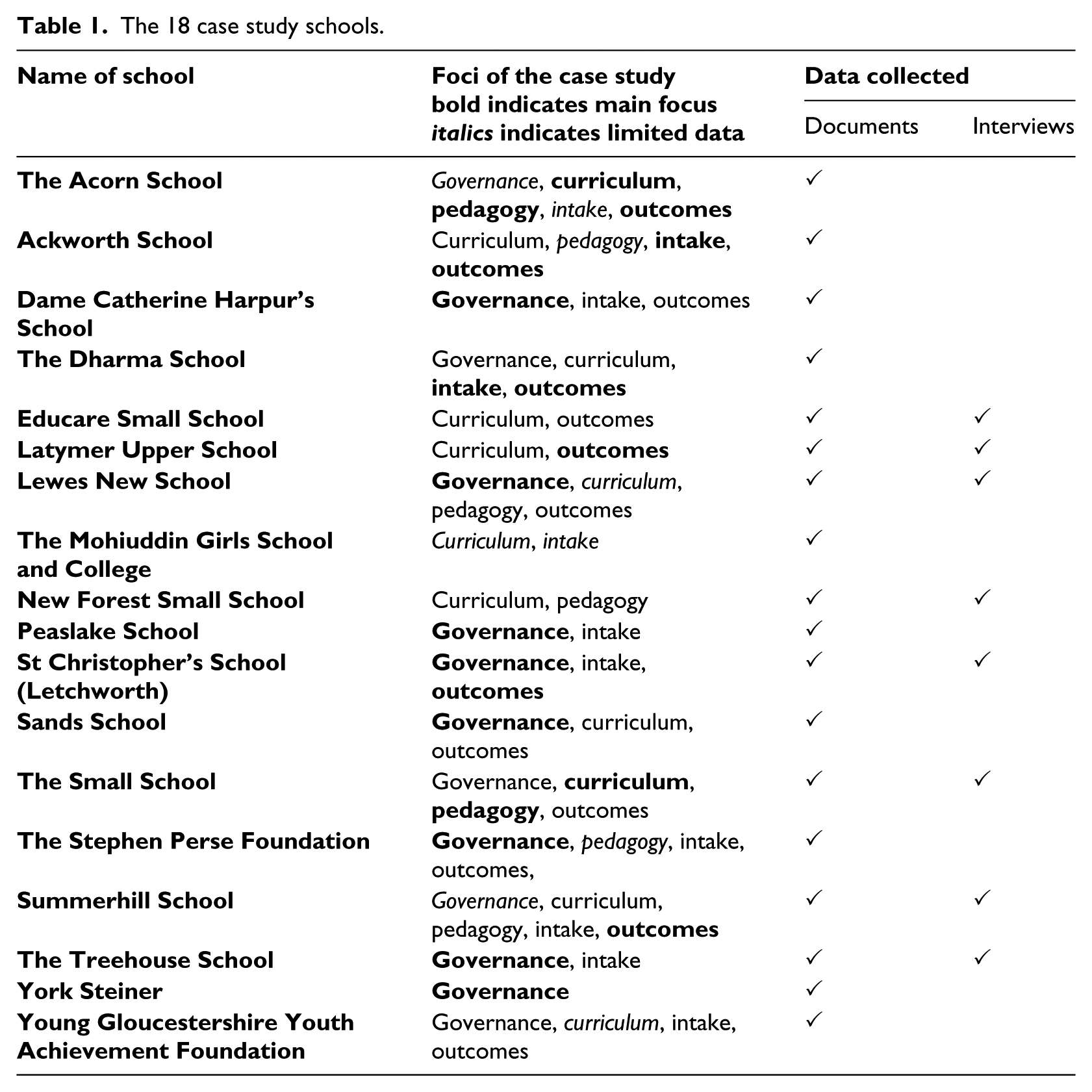
All the documentary evidence was sourced and analysed and the salient information entered into spreadsheets, while the original documents are held on file. The spreadsheets hold demographic information about the schools, references to existing study and literature (in particular Carnie (2003), which mentions a number of the case study schools) and quotations from the documents and interviews selected, because they illuminate how the schools enact their philosophies within the five dimensions of governance, curriculum, pedagogy, intake and outcomes. The development of these case files formed the first phase of analysis.
The next phase of analysis looked across the schools at the five dimensions. The analysis of the case studies presented here is within the area of school governance, because, as described above, governance is most closely associated with the goals of democratic equality and presents opportunities for students’ authentic engagement in democratic publics. Each of the other four dimensions has also been analysed and reported upon (Boyask, 2015b). The findings on school governance have been extended into an ongoing investigation into the nature of the public in present day English schooling, which includes and goes beyond the private schools discussed in this article, using an extended case methodology that looked for patterns and points of significance emerging from the data and exploring these insights through appropriate theoretical frames (Burawoy, 1998).
Figures from the ISC indicate that of their member schools 82% are charities and 16% are profit-making (ISC, 2013). Of the case study schools, 16 or 89% had opted for charity status and therefore were required by the Charities Act to demonstrate public benefit. Two of the schools (The Acorn School and Summerhill School) chose not to adopt charity status and therefore have no requirement to show public benefit. These two schools are least tied to the state of all the case studies, yet represent quite different manifestations of governance. Summerhill is notable for the participation of students in governing the school, offering us a vision of Fraser’s (1990) strong counterpublics constructed outside of the weaker mainstream public sphere of the state. ‘We are a self-governing community, which means that the whole group makes all the decisions regarding our daily lives in the school’ (Readhead, 2009: 8). There are, however, limits to the participation of the students. ‘The business side, the hiring and firing of staff, intake of pupils etc. are not the responsibility of the community although input is always available and welcome’ (Readhead, 2009: 8). At The Acorn School there was no evidence found of commitment to participation in its governance beyond the company proprietors, even though it is evident in other aspects of its operation. The Acorn School’s annual return to Companies House in 2012 reveals that the school is a private company limited by shares, which is potentially a profit-making structure, and is directed solely by the Head Teacher and school bursar.
The majority of the remaining case study schools had opted for a private company limited by guarantee structure, which, until recently, had been the company structure most commonly adopted for non-profit organisations. An exception was St Christopher’s School (Letchworth) that has a share model of business (private company limited by shares) that is potentially profit-making and is the same company structure as The Acorn School. At St Christopher’s School (Letchworth) and unlike The Acorn School, its charity status excludes profit-making.
The 16 schools that are charities have a range of approaches to governance. This includes Sands and York Steiner that appear to extend their commitment to participation and democracy to their governance structures, widening the range of participants included in the opinion formation and decision-making that constitutes Fraser’s (1990) strong democratic publics. These aspirations are expressed in publicity material and on their websites, but the schools are particularly noteworthy because they embed their commitments to equality in governance within their legal documentation (such as instrument of government, and financial and public benefit reports). Other schools used standard legal templates or perfunctory language. Yet there is a significant difference between Sands and York Steiner schools, because at Sands they deliberately engage students in governance: In accordance with the Conduct of the School as laid out in its Instrument of Government, School management is effected by discussion and consensus and due regard is taken by the Governors of the views and wishes of the staff and pupils on all matters relating to the management, conduct and underlying philosophy of the School and behaviour in the School (Sands School Trustees’ Report and Financial Statements for the Year Ended 31 July 2012).
Whereas at York Steiner statements made about governance are limited to the participation of adults within the school community.
The revised management structure continues to bring improvements in accountability, flow of communication and governance. Parental skills are being widely used in management bodies, resulting in improved management and decision-making. The College of Teachers continues to ensure the spiritual essence of Steiner education remains strong and that pedagogical support, advice and guidance is available to all within the school (York Steiner Annual Report and Financial Statements for the year ended 31 August 2012).
At Sands their democratic philosophy leads them to include students in most, but not all, forms of decision-making at the school, aligning with the educational goals of Larabee’s (1997) democratic equality, whereas at York Steiner governance is distributed only among teachers, parents and other adults within the school community and incorporated into operational management. Democracy in the governance at St Christopher’s School (Letchworth) appears more limited, although is targeted towards students. The school promotes a form of self-government that includes a school council of senior pupils, whole school meetings and pupil observers who observe class teaching and provide teachers with feedback (according to written notes on self-government from 2012 provided by the school). The following are examples of decisions that have been made through self-government: Among the issues that have been settled by Council in the last decade have been the structure of the Council and its constitution, the establishment of the ‘Coffee Shop’, the setting up of a system to give grants to clubs and societies, the refinement of the caution money system to compensate both individuals and the School for unattributed damage, the abolition of the caution money system, the establishment of an annual summer fair, the making compulsory of the School meeting, the banning of South African produce in the 1980s but not those of Nestle in the 1990s after hearing both sides of the argument, the use of the school minibuses and the carrying of a banner at an anti-war demonstration (Notes on Self-Government from school, 2012).
While the council can make recommendations to school leaders and governors, the self-government system is largely removed from the main governance, leadership and management structures at the school. The Head can veto any policies emanating from the school council.
Evidence of participation in governance was sought not just in respect of members of the school community, but also the extent to which the school encouraged free exchange with others from social groups different from itself. Dewey (1916) claims that interchange between different social groups is a feature of a democratic society: The more activity is restricted to a few definite lines – as it is when there are rigid class lines preventing adequate interplay of experiences – the more action tends to become routine on the part of the class at a disadvantage, and capricious, aimless, and explosive on the part of the class having the materially fortunate position (Dewey, 1916: 81).
Governance and oversight through a representative and democratically elected local government should theoretically ensure schools also engage with difference externally through administration and governance practices. While St Christopher’s School (Letchworth) clearly intended to have a disinterested group of governors who: ‘represent a range of skills and experiences, developed in different walks of life, enabling them to contribute ideas, to make judgments and to see the School’s work in a wider context’ (School website, accessed 10 June 2013) the majority of the governors in 2012/13 had a close connection with the school, either as present or past parents or former pupils.
The governance structure at Lewes New School requires that 50% of the governing body is made up of parents and current or former teaching staff. Lewes New School also enshrines a special responsibility for trustees from outside the direct school community, yet it has also drawn them from niche, arguably elite, groups such as the spiritual group Subud, Guerrand-Hermès Foundation for Peace and the professoriate. It is difficult to argue that they interrupt the ‘rigid class lines’ as required within a Deweyan democracy. This commonality of social class is even more pronounced within the Stephen Perse Foundation in respect of governance. It has an outreach programme working with state-funded partner schools on projects of curriculum and pedagogy. There is also evidence of some engagement with outside organisations in its external governance relationships; however, the school’s relationship is with colleges of the University of Cambridge and thus it may be argued these are relations between elite equals rather than an extension of democracy to groups unlike itself.
The extent and nature of the public good
The introduction to the special issue of the journal in which this article sits asks to what extent are principles of democracy and equality compatible with the policies of modernisation of the last few decades (Rasmussen et al., this issue)? The policies of marketisation and new public management discussed by authors of the other articles sit more comfortably with values of competition and self-interest. Private schooling is an established education market in which we can examine at close hand what happens when aspirations for democratic equality are played out within an education context dominated by relations of consumption and performativity. Following Fraser’s (1990) redefinition of the ‘public’ as multiple publics of differing strengths, we should also recognise the public dimensions of private organisations lest they are entirely set apart from public scrutiny and critical analysis. It is also the case that private organisations are not necessarily weaker publics than the public as it has been institutionalised within the state and what we know as public education. Wahlström (2010) implies that Fraser’s publics extend to all who are affected by a governance structure. In the case of transnational developments in education policy, these structures may be supranational, but in other cases such as the governance structures of individual schools they may be quite localised publics. The strength of such publics is dependent on: ‘the “force of public opinion”’ and whether: ‘a body representing it is empowered to translate such “opinion” into authoritative decisions’ (Fraser, 1990: 75). Furthermore, recognition and resultant analysis of the publicness of private institutions may provide opportunities for their redefinition along democratic lines.
The survey of private schools in England (n=1711) revealed that 64 schools (3.7%) publicly express a commitment to principles of equality and participation as defined by the terms of reference outlined above. The main criterion for inclusion in the study was Dewey’s democratic ideal. It was evident through the review of websites, however, that private schools address social inequality through a number of means, and not all were recognised as grounds for inclusion. Excluded schools typically engaged students in service learning, where the service providers were the main beneficiaries, and offered bursaries based on merit. What distinguished the included schools from these schools were differences in their conceptualisation of educational goals. The 64 schools included in this study, because they express some commitment to democratic equality, are working both within and against the limits of educational policy and, furthermore, within and against the limits of the educational market. Their position is evidently precarious, and it is noteworthy that since this research began, 3 of the 18 case study schools have closed (although one of these has found a new place for itself as a state-funded free school).
That 96.3% of privately funded schools did not obviously display a commitment to a democratic public good may not be unsurprising to either proponents or opponents of private schooling, but it is an important figure to contemplate. There is clearly little diversity in respect of the political drivers within the private schooling sector, even though the private sector generally is represented as a site of innovation and novelty compared with the sluggish and conservative state (Mazzucato, 2013). The main ties to the state for private schools are through the Independent School Standards (2014) and, for those who adopt charity status, charity law. Charity law in England is particularly interesting, because it includes the explicit requirement for schools to demonstrate public benefit, albeit largely leaving the schools themselves to define the nature of public benefit. The survey of schools found a similarity of approach to public benefit among most private schools, including the promotion of service learning, fee relief through bursaries and in some cases wider community use of the school facilities. The similarity of approach was even evident among those schools included in the study and, of those with charity status, only a few went beyond this approach to demonstrate clear evidence of democratic governance. The lack of diversity suggests that some process outside of the legislative framework, which is so loosely defined, is driving approaches to public benefit. The commonality of approach warrants additional investigation to understand its origins. Initial thoughts are that there are hidden coercive practices of governance acting upon the schools through an enmeshing of the regulatory discourses of state and market.
The public is not restricted to schools that have opted for charity status. The two case study schools that opted out of charity status have quite different governance structures and approaches to student engagement, even though they are both profit-making businesses. The Acorn School makes a clear distinction between governance by the proprietors and equality for pupils enacted through curriculum and pedagogy. Summerhill also distinguished between the business practices of the school and the role of students, but did engage students in forms of self-government that would prepare them for the citizenship roles envisaged by Larabee (1997) in his democratic equality approach to schooling. The included schools that show evidence of democracy, and support opinion formation and decision-making in their governance practices, go beyond Charity Commission requirements to demonstrate public benefit, whether they have charitable status or not.
The effects of charity law are closer to Larabee’s (1997) individualistic and competitive social mobility approach than democratic equality. This is a restricted notion of the public good that focuses upon the advancement of individuals who have experienced financial disadvantage and shows how the legislative state is enmeshed with the market. By restricting its influence to the most vulnerable in society, it conforms to a market view of the state as a safety net against market failure (Robertson et al., 2012; Mazzucato, 2013).
So, if the neoliberal state is not intending to support democratic equality, then how should we conceptualise private schools with loosened ties to the state that are intending to support democratic equality? Fraser (1990) offers us a rationale for conceptualising schools outside of the mainstream as potentially strong counterpublics, a view that is supported by a relative understanding of notions of public and private (Wilson, 2012), differentiating between the state and the public and engaging with the complexities of the actual rather than idealised public sphere. Fraser’s conceptualisation of counterpublics within actually existing democracies and her provocative suggestion that self-managed institutions outside of direct state control may provide sites in which to develop strong, alternative publics, is a potential way of describing these schools: One set of questions concerns the possible proliferation of strong publics in the form of self-managing institutions. In self-managed work-places, child care centers, or residential communities, for example, internal institutional public spheres could be arenas both of opinion formation and decision-making (Fraser, 1990: 75–76).
While Fraser’s (1990) depiction of multiple and polyvocal publics that exist both within and outside of the state offers a novel way of conceptualising private schools, care must be taken with this concept. Institutions outside of the state, an institutionalised public sphere, are not necessarily the strong counterpublics envisaged by Fraser. While the schools included in this study show some alignment with a democratic ideal, none of the schools in this study conformed to that ideal. They vary in the extent to which they address equality through their governance practices, and some showed no particular commitment to democratic governance or may promote elitism through governance structures. The contradictory drivers within these private school sites mean that they, like the mainstream public sphere where its policies of modernisation have been built from the limited public participation of an impoverished democracy, are limited forms of public. The advantage, however, of conceptualising schools like the included private schools as counterpublics is that it provides a means to retain sight of the educational goal of democratic equality, even when this goal is disregarded as a legitimate goal for schooling within the neoliberal state.
Footnotes
Acknowledgements
I would like to acknowledge the valued contributions made to the research by Dr Jennifer Lea and Dr Alison Black who provided research assistance on the study reported in this article. I would also like to thank the School of Education at Plymouth University (now Plymouth Institute of Education) for supporting the original case study at Sands School, the schools that have contributed data and the British Academy and Leverhulme Trust for jointly funding the project reported on here, ‘Social Justice in Privatised Schooling’.
Declaration of conflicting interest
The author(s) declared no potential conflicts of interest with respect to the research, authorship, and/or publication of this article.
Funding
The author(s) disclosed receipt of the following financial support for the research, authorship, and/or publication of this article: The main study reported in this project was funded by a British Academy/Leverhulme Small Grant, Grant number SG120772. The original case study that informed the main study was funded by Plymouth University.