




Abstract
The school closures due to the ongoing worldwide COVID-19 pandemic have posed an enormous challenge for all entities that take part in our children’s education. By displacing learning from schools to home environments, the crisis poses a risk of emotional and motivational problems. Based on research regarding the role of peers, learning in groups, school belonging, and educational equity, we explored students’ emotional and motivational processes in relation to different aspects of social support and the school environment. In the present study, 279 students from 20 classes of two secondary schools completed a questionnaire on their contextual situations in distance learning, the organization and amount of their learning, and the resulting emotions and motivations. Results show that students’ perceived joy during the crisis was relatively low, while perceived anxiety was relatively high. Regression analyses showed relations of general enjoyment and joy of learning in the crisis to self-efficacy belief, which was in turn influenced by environmental predictors such as support from family and school as well as the student–teacher relationship. Thus, school authorities and teachers can effectively contribute to students’ mastering of the crisis by establishing a transparent information policy, well-structured learning routines, and virtual lessons.
Keywords
Introduction
The ongoing worldwide COVID-19 pandemic has evolved into a severe crisis that is affecting life in a multitude of ways. Not only do we have to cope with illness and loss, as well as overstrained care systems, but the measures enacted to prevent the uncontrolled spread of the virus have also resulted in multifaceted problems. Strict limitations on social contacts have led to curfews and the closure of bars and restaurants, cultural sights, and museums as well as public institutions such as kindergartens, schools, and universities. This not only means tremendous economic costs and afflictions for many people but also isolation for the elderly, excessive demands on families with children, and new challenges for the educational system (Carillo and Assunção Flores, 2020; Huber and Helm, 2020a, 2020b; Voss and Wittwer, 2020).
While many schools have tried to maintain learning for their students by offering assignments, materials, and support via different communication channels, relevant school functions, such as allocation, socialization, and access to a group of peers (Pekrun, 1992), could not or at least not extensively be addressed. The absence of direct contact at school impairs the development of a feeling of belonging, reduces opportunities to compare oneself with others, and hinders students from making friends and playing together, thus, impairing socioemotional development (for a review, see Rubin et al., 2006). Beyond socioemotional development per se, however, these social factors, such as social climate, have been related to academic enactment (Anderman, 2002, 2003; Osterman, 2000; Vitaro et al., 2001) as well as emotion regulation (Järvenoja and Järvela, 2009) and emotional wellbeing. In particular, students’ emotional wellbeing relies largely on interactions with peers (Ream, 2005; South and Haynie, 2004; Stanton-Salazar and Spina, 2005). The emotional factors go hand-in-hand with motivation, such as student self-efficacy, which is a relevant aspect of student learning (Pajares, 1996) and is affected by school-related contexts, such as teacher–student interaction (Gröschner et al., 2018).
Thus, students’ emotional and motivational states might be significantly affected by the challenging situation during the COVID-19 crisis, including loss of contact with teachers and peers, increased dependence on family support, and poor interaction patterns in digital learning sessions. As there is still a research gap especially concerning student perceptions, the present study aimed at investigating the emotional and motivational consequences of distance learning within the scope of the COVID-19 pandemic from the student perspective.
Theoretical background
Due to the COVID-19 pandemic being relatively new to European countries, the scientific literature on the emotional and motivational consequences of distance learning related to pandemics is scarce (DeMatthews et al., 2020). The first results addressing the COVID-19 pandemic focus on the general consequences of school closures (Huber and Helm, 2020a, 2020b), on teachers (Voss and Wittwer, 2020), or on very specific aspects, such as teachers’ knowledge acquisition (König et al., 2020). Students’ perspectives are (except for a survey by Huber and Helm, 2020a, 2020b), to our knowledge, yet to be investigated in depth. For this reason, beyond the literature related to the dependent and independent variables in this study and the first empirical findings regarding the COVID-19 crisis, in this section we refer to the literature regarding the role of student learning at home versus student learning at school.
Homeschooling in non-pandemic circumstances
Previous results from research on “homeschooling” under non-pandemic circumstances and homework (Hagenauer and Oberwimmer, 2019; Kohler, 2011; Trautwein et al., 2006) are relevant as the role of the teachers as well as the role of social support (e.g., by family and peers) is increasingly important in this context. In this regard, research shows that especially the organization of education matters. Martin-Chang et al. (2011), for instance, found that students who received structured homeschooling outperformed public school students in all subjects but that students who received unstructured homeschooling showed statistically significant reduced performances compared to public school students. As distance learning under COVID-19 circumstances is much more a consequence of a closed school than a voluntary decision to be educated at home, students in distance learning might be especially disadvantaged (Helm et al., 2021) because many parents have no time to guide their children during their lessons. This is especially relevant when teachers do not pre-structure the working process (Voss and Wittwer, 2020). Another substantial difference between homeschooled children and children in distance learning during COVID-19 is the number of social contacts. While homeschooled children and publicly schooled children do not differ in number of social contacts (Chatham-Carpenter, 1994), and homeschooled children participate in more extracurricular social activities than publicly schooled children (Ray, 2017), during the COVID-19 pandemic school closure period, all extracurricular activities have been cancelled. Thus, the pandemic poses an exceptional challenge to students’ socioemotional wellbeing.
In addition to research in the scope of private homeschooling, a large number of (correlational) studies investigated the relation between social integration/commitment to the school and emotion/motivation in public schools. Support from family and school has been shown to promote persistence and perseverance as well as self-efficacy (Datu, 2017; Eskreis-Winkler et al., 2014; Strayhorn, 2014).
Research on student emotions: The roles of enjoyment, the joy of learning, and anxiety
Emotions are closely connected to the learning process (Linnenbrink-Garcia et al., 2016; Pekrun, 2009; Schutz and Lanehart, 2002; Steinmayr et al., 2020). They influence several information processing mechanisms, including attention and recall but also other variables relevant to learning, such as self-regulation and motivation (Pekrun, 2009; Pekrun et al., 2002). Additionally, emotions influence academic achievement by modulating engagement (Linnenbrink, 2007; Linnenbrink and Pintrich, 2004). Positive emotions are positively correlated to self-regulated learning (Boekaerts et al., 2000; Carver and Scheier, 1990; Pekrun et al., 2002). Anger and anxiety have been found to be related to avoidance (Carver and Harmon-Jone, 2009) or extrinsic motivation, which, in turn, is related to a lack of engagement (Assor et al., 2005). Moreover, it has been proposed that emotions signal the occurrence of an emotionally relevant event and characterize the nature of the resulting motivation (Assor et al., 1986; Buck, 1988; Frijda, 2003). Regarding the present context of research on learning during the COVID-19 pandemic, Huber and Helm (2020a) reported on a correlation of positive emotions with learning outcomes as well as the student–teacher relationship, but the researchers found no correlation between any of the student outcomes with the quality of the digital lessons. Technical equipment was associated with higher positive emotions, investment, and learning outcomes. A negative correlation of negative emotions with learning outcomes was found (Huber and Helm, 2020a; Steinmayr et al., 2020). Indicators of independence (“I considered it especially challenging to plan my learning on my own”) were associated with learning outcomes, investment, and positive emotions and negatively correlated with negative emotions (Huber et al., 2020).
Research on self-efficacy as student motivation, time for learning, and learning outcome
Following the general expectancy–value model of achievement choices (Eccles, 2005), motivation as an essential precursor of effective learning (including a high time investment) is not only influenced by anticipated joy, task difficulty, and achievement motives but depends on a complex interplay of intrapersonal and environmental factors, including ability, siblings, interpretations of former experiences, gender roles, cultural stereotypes, the attitudes of the social agents, goals, and expectations. One often-investigated construct of expectation is self-efficacy (Bandura, 1977). Self-efficacy refers to the belief in one’s own capability to solve problems or master challenges within a certain area of competence. Therefore, self-efficacy is future-oriented and task-specific (Bong and Skaalvik, 2003). It is acquired through repeated experiences of successful behavior but also the subjectively experienced belief of social agents in one’s own abilities. Self-efficacy fosters the motivation to learn and to develop new skills (Schunk, 1985). In previous studies, self-efficacy was found to be an influential factor for self-regulation and academic achievement (Bandura, 1977; Pekrun and Perry, 2014; Ryan and Deci, 2000) as well as a predictor of mathematics performance (Pajares and Graham, 1999). It has been shown to be influenced by the learning environment through certain positive experiences, reinforcing feedback, verbal encouragement, social persuasion, and adequate task difficulties (Harter, 1978; Usher and Pajares, 2008; Vallerand and Reid, 1988). Self-efficacy is especially important for children at risk to develop a sense of agency. Therefore, teachers should aim at directing students’ attention to their psychological capital (Seligman, 2002), thus supporting the development of self-efficacy, confidence, hope, and resiliency. This belief is the motivational basis of effort (such as the amount of time spent on learning or perseverance) and learning outcomes (such as knowledge or skills), which are typically measured by self-reporting, teacher questionnaires, standardized assessments, and/or school grades.
Quality of (virtual) exchange during digital lessons
Research has shown that an effective student–teacher relationship is correlated with better academic achievement (Graziano et al., 2007) as well as more frequent use of self-regulated learning strategies (Patrick and Ryan, 2005), learning motivation, and interest (Wentzel, 1998). Therefore, positive student–teacher relationships might prevent students from failing (Pianta et al., 1995). A relationship, that fosters educational outcomes, is characterized by students feeling that their teacher sees them and cares about their concerns, that they can entrust their problems to their teacher, and that their teacher appreciates them. This impression must be built up by positive teacher–student interaction and student–student interaction (Allen et al., 2011; Brophy and Good, 1974; Goodwin et al., 2021). Therefore, it is questionable whether a high-quality student–teacher relationship can be preserved during distance learning. The lack of face-to-face personal contact limits the whole range of information that is typically transmitted during the interaction and impedes many informal occasions to talk about personal emotions, experiences, and worries as well as to ask questions (Resnick et al., 2015). In addition, during structured online lessons, it is challenging to introduce a productive culture of questioning and discussing (Kiemer et al., 2015; Walshaw and Anthony, 2008). While the teacher needs to eliminate disturbances by students during virtual meetings, he or she has only a few opportunities to monitor and regulate attention processes or cheating attempts (Rovai, 2007).
Beyond the absence of direct student–teacher interactions, virtual exchange also reduces contact with peers. A large amount of learning in different respects happens in interaction with peers at school. Cartland et al. (2003) found that school life, with its social networks, peer interaction, and opportunities to receive informal help and support with emotional issues is an important resource for adolescents. Additionally, the sense of community or relatedness with the school has been found to influence not only psychosocial wellbeing but also motivation and attitudes (Bateman, 2002; Pretty et al., 1994). Different viewpoints foster lively discussions and widen the scope of one’s own rational horizon. Peers can help each other to understand tasks and problems and share strategies or serve as models for observational learning (Webb et al., 2002). Dropping out of school has been found to be better predicted by social factors than by parental factors (Vitaro et al., 2001). This might be due to the mediating role of social interactions with teachers (Perry et al., 2002) and peers (Webb and Mastergeorge, 2003) for self-regulated learning (Zimmerman, 1989).
Furthermore, in the direct effects of contact with peers on learning, which is frequently investigated in group-work settings (Webb and Palincsar, 1996), socioemotional components play a central role (Bateman, 2002; Battistich and Hom, 1997; Pretty et al., 1994; Rubin et al., 2006; Zins et al., 2004). Eisenberg et al. (1998), for instance, showed that expressive environments are positively correlated with the capacity to understand emotional expressions and to regulate emotions (Eisenberg et al., 1998; Fried, 2010). In line with this finding, it has been proposed that emotion-related classroom activities might foster competent emotion regulation, which, in turn, is associated with student engagement, motivation, and commitment and, consequently, learning outcomes (Fried, 2011). It has been shown that individual and social elements contribute to intrinsic group dynamics in collaborative learning situations. Collaborative work at school offers numerous opportunities for experiencing social challenges and developing strategies for individual self-regulation as well as co-regulation and shared regulation (Järvenoja and Järvela, 2009). Schunk (1999) argued that attempts to influence others in co-regulation serve the aim of co-constructing a learning environment that is cognitively, motivationally, and emotionally satisfying for the individual. Thus, social processes at school are an important component of learning motivation and emotional wellbeing (Thompson and Fine, 1999). Therefore, the absence of group-work settings and other opportunities for social and socioemotional learning might lead to worse understanding, less depth of processing, a reduction in or loss of motivation, and problems in emotion regulation.
Research on supportive aspects and school-related factors
Although the amount of influence of structural conditions, such as family background, is under debate (Kundu, 2017), research has shown that social aspects and a student’s individual pre-conditions play a key role in educational outcomes (Schubert and Becker, 2010; Vieluf et al., 2020). Sociodemographic characteristics, such as status, residential area, and family income, have been shown to be relevant predictors of student learning outcomes, for example, for college readiness and academic development (Duncan and Murnane, 2014; Fruchter et al., 2012; Sharkey, 2013; Schubert and Becker, 2010; Taylor et al., 2004). For instance, parents’ social heritage and educational aspiration are central for children’s educational aspiration and success (Buchmann and Dalton, 2002; Dupriez et al., 2012). Especially after-school learning and homework are influenced by parents’ social background (Hagenauer and Oberwimmer, 2019). Trautwein et al. (2006) considered parent characteristics to be a relevant component of homework quality. In addition, significant others, such as teachers or peers at school, or in other contexts, are taken into account. However, these trajectories are not inevitable. Studies have found that school and high-quality teaching are likely to initiate a contextual change from a disadvantageous social background to an education-oriented expedient one (Aikens and Barbarin, 2008; Downey et al., 2004; Temple et al., 2000).
Presence at school might be one means of reducing structural inequality and buffering the effects of social background (Downey et al., 2004). Downey et al. (2004) considered schools as equalizers that may correct for social disadvantages. Apart from the social isolation and lack of peer learning, distance learning is also challenging due to organizational and contextual caveats. Many families’ houses and apartments are not large enough to offer a quiet space for students to learn, and not every family has enough computers or fast-enough Internet access (Fairlie, 2012: 1–2).
Control–value theory of achievement emotions
Summarizing the results above, Pekrun and Stephens (2009) developed a model that explains the relations of learning and achievement with contextual and individual characteristics (see Figure 1). The model proposes that learning and achievement, which massively depend on motivation, problem-solving, and cognitive resources, are related to emotions, especially activating joy and inhibiting anxiety, which in turn are related to certain appraisals such as self-efficacy beliefs. These appraisals are the result of an interaction of environmental factors, including instruction, autonomy support, feedback and sanctions, and achievement expectations. The environmental factors operate within the social contexts of children, that is, mainly at home and at school. This model illustrates the complex preconditions of successful and healthy learning and at the same time demonstrates the challenge of COVID-19 school closures, especially for those children with a low-income social background.
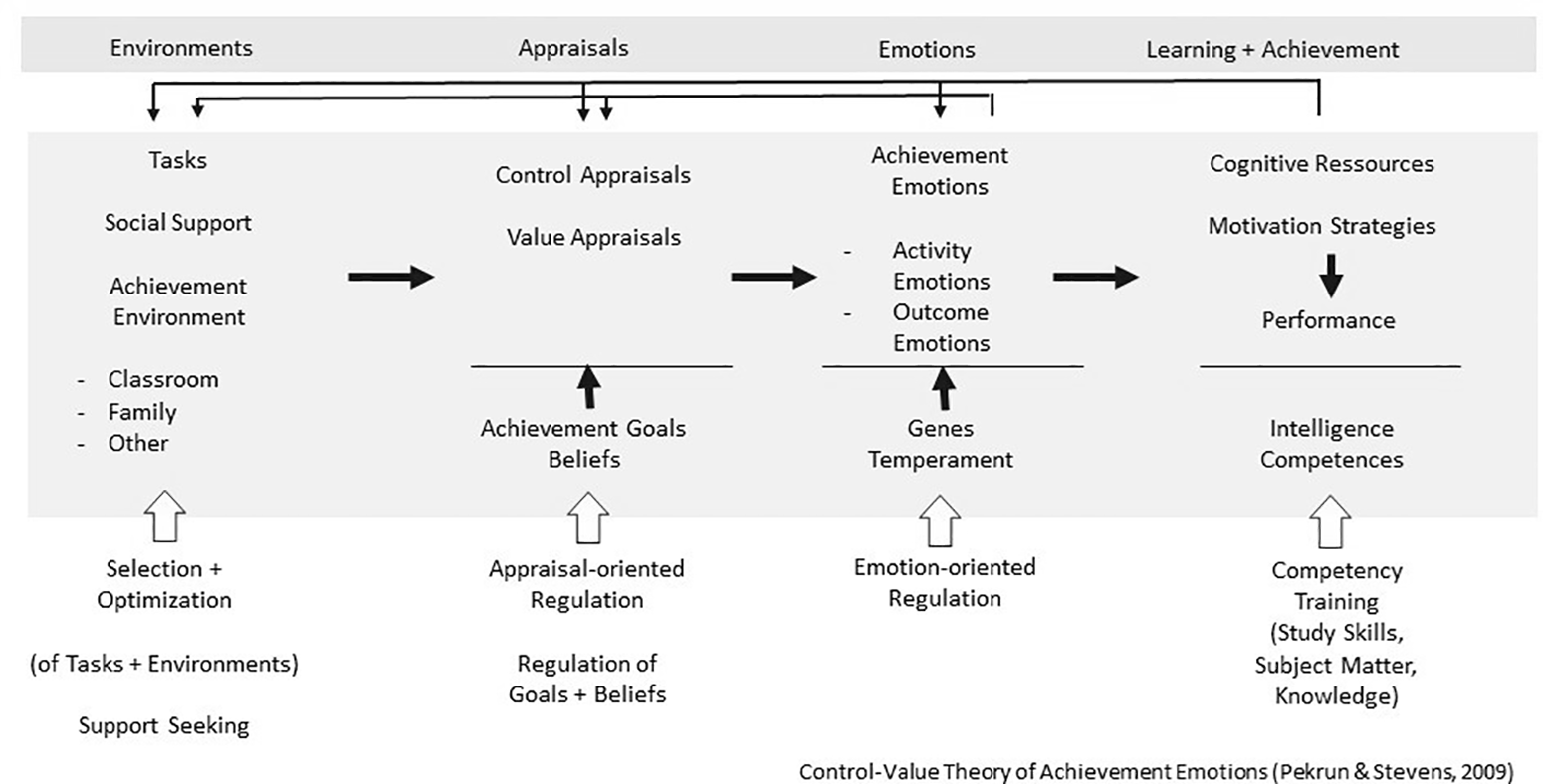
Control–value theory of achievement emotions (Pekrun and Stephens, 2009).
In the context of COVID-19, the influence of the school as a learning environment is assumed to be reduced. Furthermore, Huber and Helm (2020b: 249) related the amount of learning, especially of less-motivated students, partly to control by the teacher. Thus, support from teachers and other caregivers might be a means of regulating learning behavior in less conscientious students. During school closures, the role of the family becomes pronounced in that students are surrounded by the values and attitudes, cultural peculiarities, and specific role images of their families around the clock. Additionally, they depend on the knowledge and skills of their parents and siblings in terms of technical issues and school content and on the time capacities of the respective family members. These resources are explored as “support by the family” in the present study.
Overall, the school closures associated with the COVID-19 pandemic are likely to pose a severe rupture in students’ school life, including: a massive reduction in social contact; limited access to help; few opportunities to learn in group-work settings; likely reduced student–teacher interaction; and a strong correlation of possibilities in academic development with the family’s social, ethnic, and educational background (Steinmayr et al., 2021). These constraints and inequalities might result in students’ poor emotional and motivational constitution.
The present study
In sum, previous research on the relation between different sources of support, as well as other contextual factors, and emotional and motivational consequences has suggested that the school closures during the COVID-19 pandemic pose a risk for the emotional wellbeing and educational success of students in general and students from less-supportive families in particular (Helm et al., 2021). Although the studies by Huber and Helm (2020a, 2020b), Huber et al. (2020), and Helm et al. (2021), provide an overview of a wide range of school-relevant variables from several perspectives, a thorough understanding of emotional and motivational processes, as well as “buffering mechanisms,” requires more faceted information on students’ perception of the crisis and their emotions, motivations, and contextual help structures. Another limitation of Huber and Helm’s (2020a, 2020b) study is that they used only single items to assess students’ perceptions.
Therefore, we build on that knowledge and aim at providing a more insightful perspective on students’ emotional and motivational perceptions regarding distance learning during the COVID-19 pandemic by systematically analyzing the relations of the various preconditions of learning that were suggested by Pekrun and Stephens (2009). We aim at exploring the consequences of the COVID-19 school closures from a student-centered perspective and at revealing possible strategies for buffering the negative consequences of the crisis. Because the transition to adolescence is an especially demanding period, when isolation from peers can be particularly negative for students’ emotional wellbeing and motivational processes, we focus on secondary education, that is, Grades 5–12 with students aged 10–19 years. The self-report questionnaire covered the students’ emotional and motivational consequences as well as contextual conditions, working styles, and different school-based activities, with most concepts measured as scales of multiple items to cover all possible facets.
The following research questions are addressed:
RQ1: How do secondary school students perceive distance learning regarding emotions and self-efficacy?
RQ2: How closely does the relation of self-efficacy and emotion in COVID-19 distance learning with contextual circumstances follow the principles of the control–value theory of achievement emotions?
RQ3: Which environmental factors are relevant in the context of learning during the COVID-19 school closures?
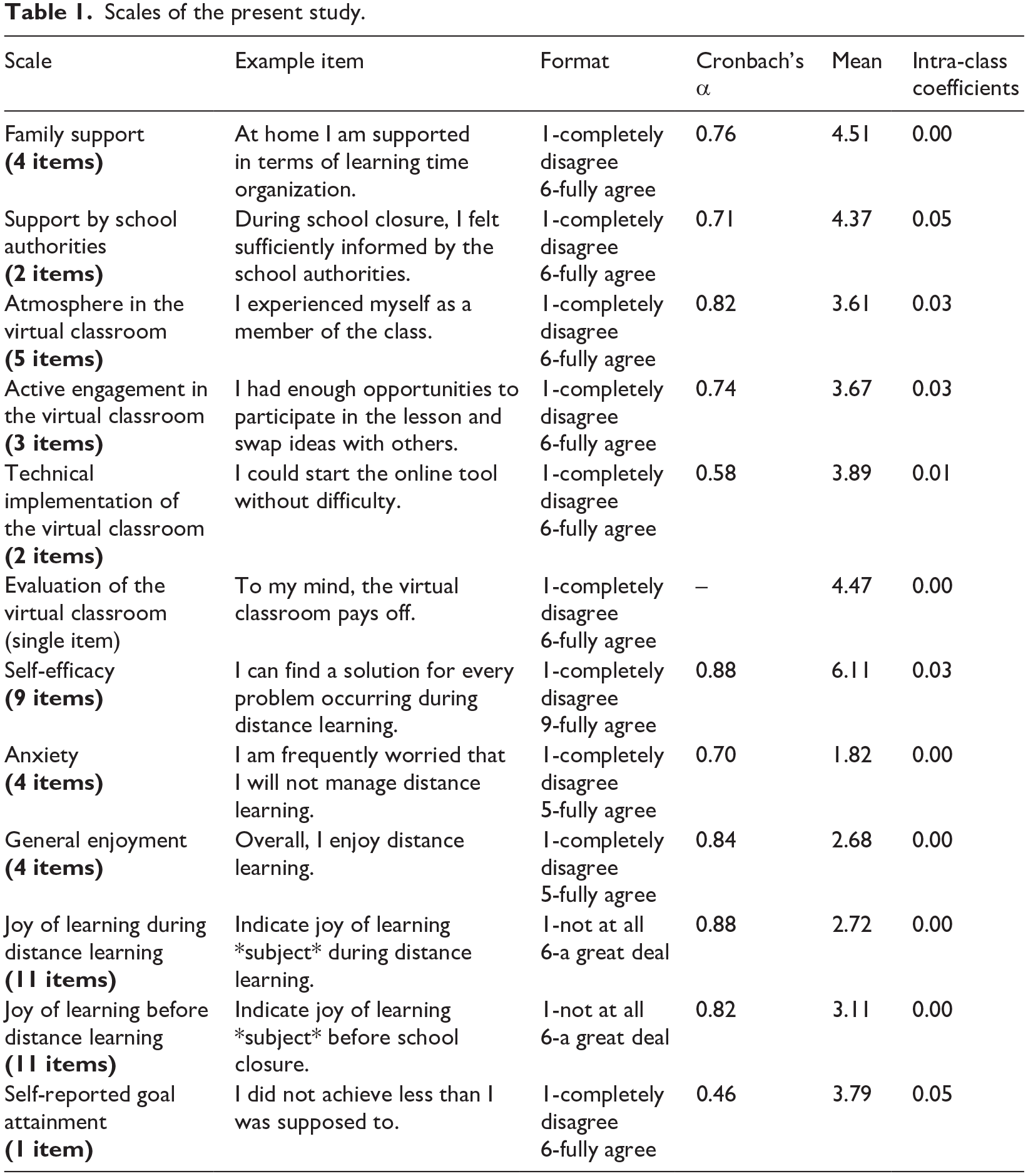
The control–value theory of achievement emotions (Pekrun and Stephens, 2009) served as a framework for the selection of relevant variables in four central areas (see Table 1).
Scales of the present study.
Method
Participants
Participants were 279 students (49.1% male, mean age = 12.08 years) of 20 classes (Grades 5–12) from two schools in Jena (Germany) who participated voluntarily for no compensation. Two hundred and thirty-seven students filled out a paper-and-pencil survey, while 42 students filled out the online form of the questionnaire. The mean age of the participants was 12 years and 29 days; 66% were in Grades 5 and 6 and 34% in Grade 7 and above. The authors are aware that the data could be of a hierarchical structure. Taking this aspect into consideration, intra-class coefficients (ICCs) were calculated, which are presented in Table 1. However, because all relevant coefficients are smaller than 6% and the sample size is not sufficient for structural equation modeling, we neglected the class level in our analyses.
Questionnaire
The questionnaire was newly developed in response to the COVID-19 crisis, and existing instruments were administered. The selection of relevant scales and the structure of the method section follows the control–value theory of achievement emotions (Pekrun and Stephens, 2009).
Environmental factors: Virtual exchange in online lessons, student–teacher relationship, and support by family and school
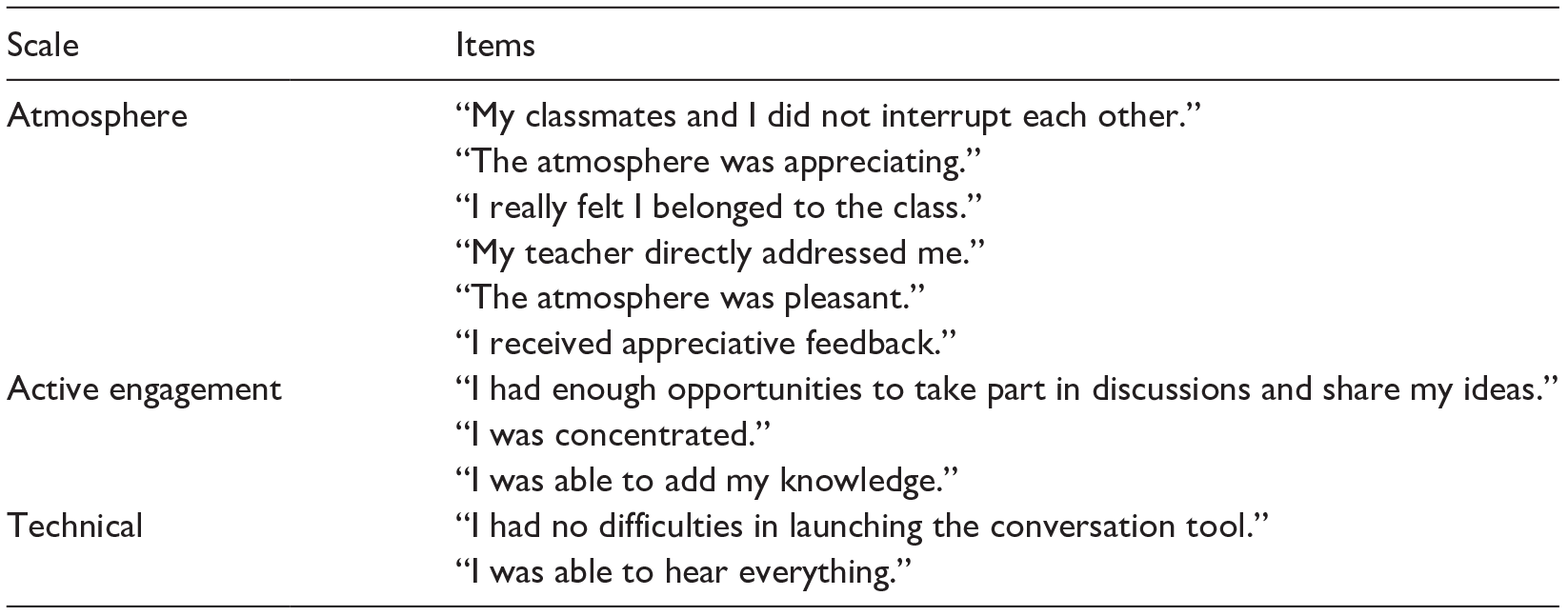
In order to assess the influence of the family, a support-by-family scale was developed (Appendix 1). The aim of the scale was to assess whether students have options to receive help by family members at home. To capture the support by school authorities, students were asked if they felt well informed by the school administration (e.g., head master), and if they knew who to ask for when problems occurred during distance learning. Additionally, the student–teacher relationship and the perceived quality of lessons in the virtual classroom were assessed. In this regard, the three subscales covered atmosphere, active engagement, and technical implementation (see Appendix 2). Example items, reliabilities, means, and ICCs of all scales can be found in Table 1.
Appraisals: Self-efficacy
As an important appraisal construct, self-efficacy is a determinant of high learning motivation and has been previously related to higher educational outcomes (Pajares, 2003). In the present study, self-efficacy was measured with a scale adapted from Schwarzer and Jerusalem (1999).
Emotions: Fear, general enjoyment, joy of learning
Student emotions were accessed by using Frenzel et al.’s (2016) enjoyment and anxiety scales. In addition, a single item for each school subject was administered, and students were to indicate how much they enjoyed the respective subject: (a) before school closure; and (b) during school closure (1 = not at all; 6 = a lot). Joy and anxiety were selected as relevant emotional variables in learning processes (Csikszentmihalyi, 1990; Eysenck, 1979, Pekrun, 2006, 2009). Pekrun (2009) stresses the importance of inhibition by anxiety and activation by joy. This activating component would not have been fully covered by a more general perspective on wellbeing. For this reason, we decided to complement general enjoyment by adding subject-specific joy to the questionnaire.
Learning and achievement
The self-report questionnaire was not accompanied by any form of objective instrument to access learning or achievement. However, students were asked, if they felt to have managed everything they had been supposed to (“I did not achieve less than I was supposed to”). This single item was rated on a scale, ranging from 1 (completely disagree) to 6 (fully agree).
Procedure
The study was run within the first weeks after students returned to in-person school following a 12-week period of distance learning due to COVID-19 in spring 2020 (first lockdown). Around 50% of the students were on their first day back or had not been back to school at all when they completed the questionnaire. Due to the compulsory schooling in Germany, all students had received assignments during the period of distance learning (March–June 2020), which they had to complete at home. However, the number of assignments as well as constraints concerning the amount of time spent on learning varied greatly.
Students below age of 14 were required to hand in written consent from their parents to participate. The questionnaire was administered as an online or paper-and-pencil version and was filled out individually by the students. The paper-and-pencil questionnaire was handed out by the teachers.
Data analysis
Data from the paper-and-pencil questionnaires and the online survey were matched, and missing values were excluded from the analyses following an available-cases approach (pairwise). Means and standard deviations were calculated for all variables of interest. Items were aggregated to scale values, and the respective scale reliabilities were calculated. The resulting scales and the example items, means, and corresponding reliabilities are shown in Table 1. All variables were correlated with each other using the Pearson correlation coefficient r. The resulting correlation matrix (Table 2) served as basis for a forward selection procedure, which defined the correct order of variables in the regression analyses.
Intercorrelations of all variables of the linear regression model.
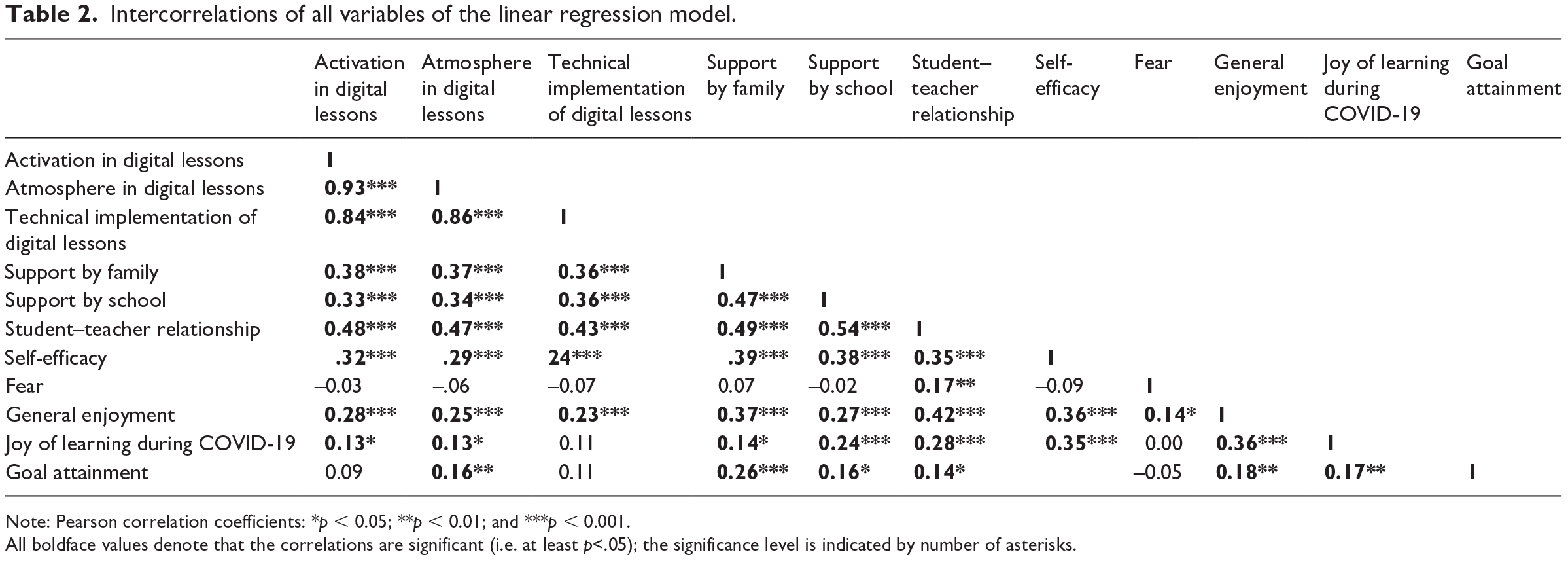
Note: Pearson correlation coefficients: *p < 0.05; **p < 0.01; and ***p < 0.001.
All boldface values denote that the correlations are significant (i.e. at least p<.05); the significance level is indicated by number of asterisks.
In order to replicate the relations of contextual variables and variables relevant for learning suggested by the control–value theory of achievement emotions (Pekrun and Stephens, 2009), a three-step regression analysis was conducted. Each step investigated the regression from one level in the model of Pekrun and Stephens (2009) to the level below. Thus, the following multiple linear regressions were conducted: regression from appraisals to environments; regression from emotions to appraisals; and regression from performance to emotion. Because there were three emotions, the second step was threefold. The recurrent loops in the model have been ignored in order to reduce the complexity of analysis. The regression weights of the predictors of each model are reported together with an adjusted R².
Results
Students’ emotions during distance learning (research question 1)
Anxiety
Anxiety was mean (M) = 1.82 (standard deviation (SD) = 0.92), which is higher than the mean student value in the calibration sample (M = 1.5, SD = 0.52, Frenzel et al., 2016). Neither support by relatives nor support by school authorities was correlated with anxiety scores.
General enjoyment
Mean general enjoyment was M = 2.68 (SD = 1.12), which is lower than the mean student value in the calibration sample (M = 3.30, SD = 0.58, Frenzel et al., 2016). It was positively correlated with self-efficacy (r = 0.36, p < 0.001). A correlation analysis of enjoyment with variables of contextual support revealed a statistically significant positive correlation with support by families (r = 0.37, p < 0.001) and support by school (r = 0.27, p < 0.001). In addition, all three scales concerning virtual classroom activities were positively correlated with general enjoyment (atmosphere: r = 0.25, p < 0.001; active engagement: r = 0.28, p < 0.001; and technical implementation: r = 0.23, p < 0.001).
Joy of learning
Mean subject-related joy of learning was M = 2.72 (SD = 1.15). This was significantly lower than the mean retrospectively reported subject-related joy of learning before COVID-19 school closures (M = 3.11, SD = 1.00, p < 0.001). Additionally, joy of learning was statistically significant and positively related to self-efficacy (r = 0.35, p < 0.001). Support by family (r = 0.24, p < 0.001) and support by school (r = 0.17, p < 0.01) were statistically significantly correlated with joy of learning. Similar to general enjoyment, subject-related joy of learning was positively correlated with atmosphere (r = 0.13, p < 0.05) and active engagement (r = 0.13, p < 0.05) in the virtual lessons.
Students’ self-efficacy during distance learning (research question 1)
Regarding student self-efficacy, the mean was M = 6.11 (SD = 1.69). Receiving help from families (r = 0.39, p < 0.001) and from schools (r = 0.38, p < 0.001) were significantly positively correlated with self-efficacy. In the context of virtual exchange, all three measures were positively correlated with self-efficacy (atmosphere: r = 0.29, p < 0.001; active engagement: r = 0.32, p < 0.001; and technical implementation: r = 0.24, p < 0.01).
Performance: Goal fulfillment
Mean goal fulfillment was M = 3.79 (SD = 1.79). Support by family (r = 0.26, p < 0.001) and support by school (r = 0.16, p < 0.05), and atmosphere (r = 0.16 p < 0.01) were correlated with students’ perceived learning outcome.
Prediction of the control–value theory of achievement emotions (research question 2) including relevant environmental factors (research question 3)
Tables 3–7 show the three steps of regression analyses and contain β-values for all predictors that are in boldface type when the respective predictor explains a significant amount of outcome variance.
Linear regression: self-efficacy.
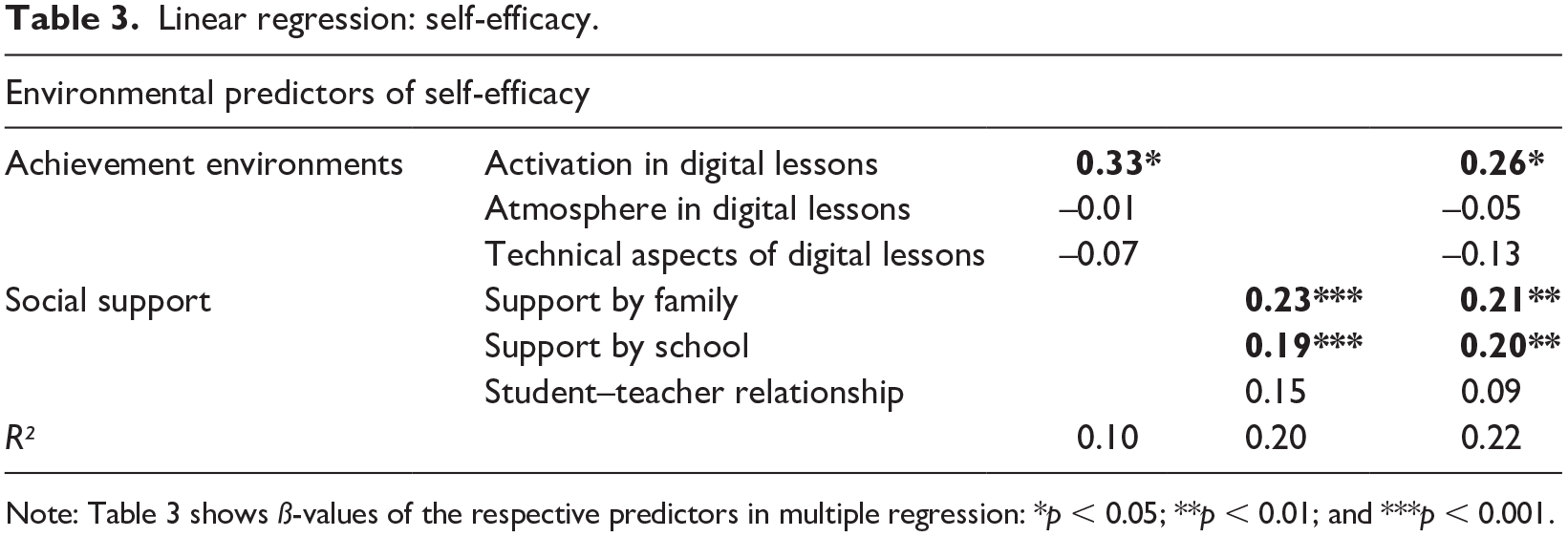
Note: Table 3 shows ß-values of the respective predictors in multiple regression: *p < 0.05; **p < 0.01; and ***p < 0.001.
Linear regression: General enjoyment.
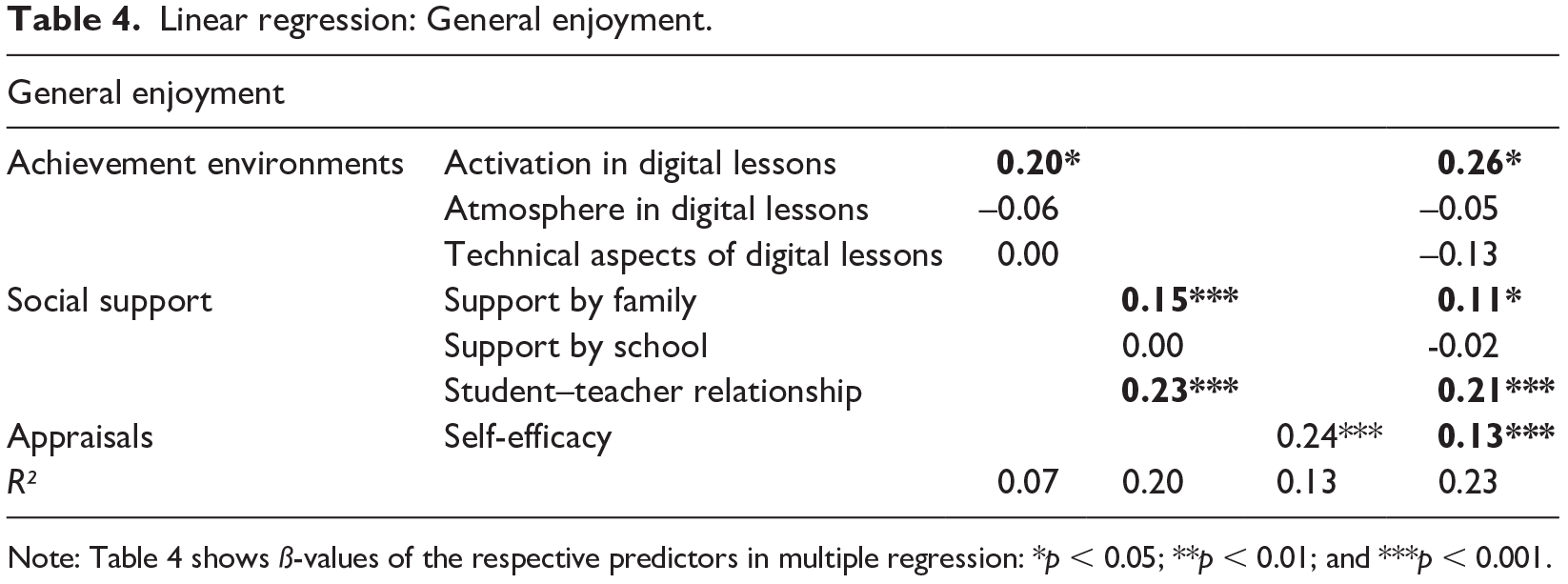
Note: Table 4 shows ß-values of the respective predictors in multiple regression: *p < 0.05; **p < 0.01; and ***p < 0.001.
Linear regression: Joy of learning.
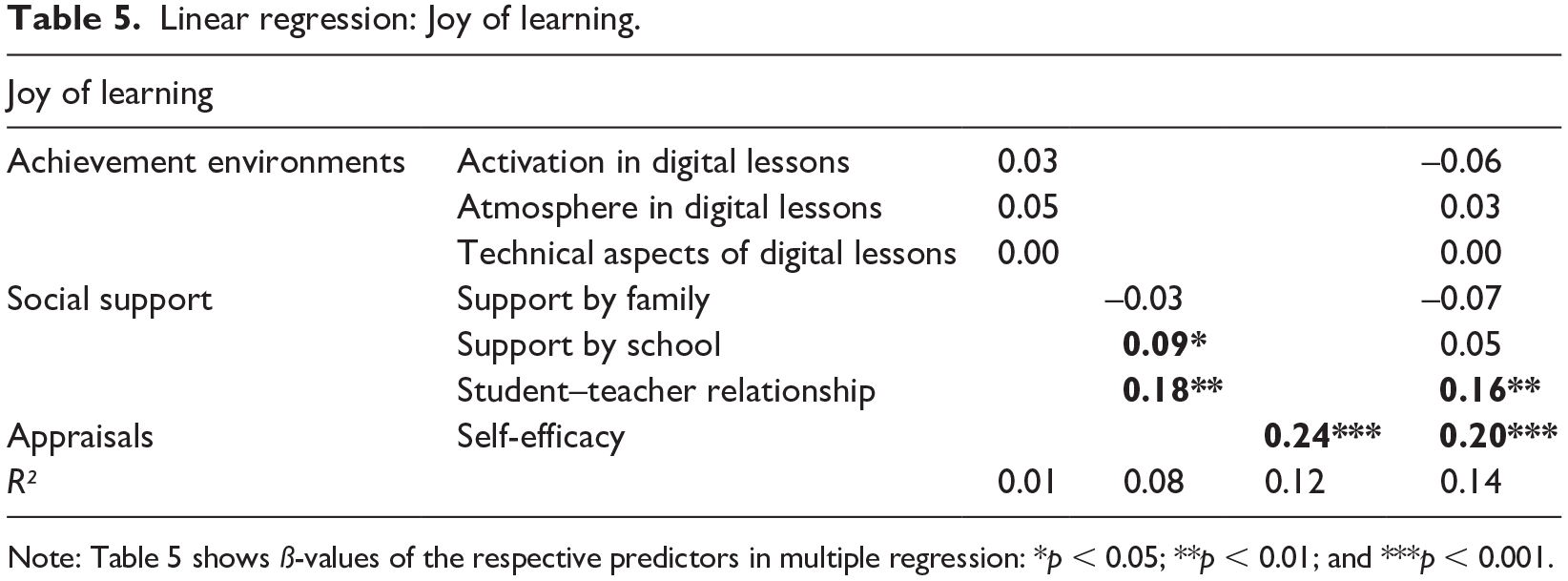
Note: Table 5 shows ß-values of the respective predictors in multiple regression: *p < 0.05; **p < 0.01; and ***p < 0.001.
Linear regression: Fear.
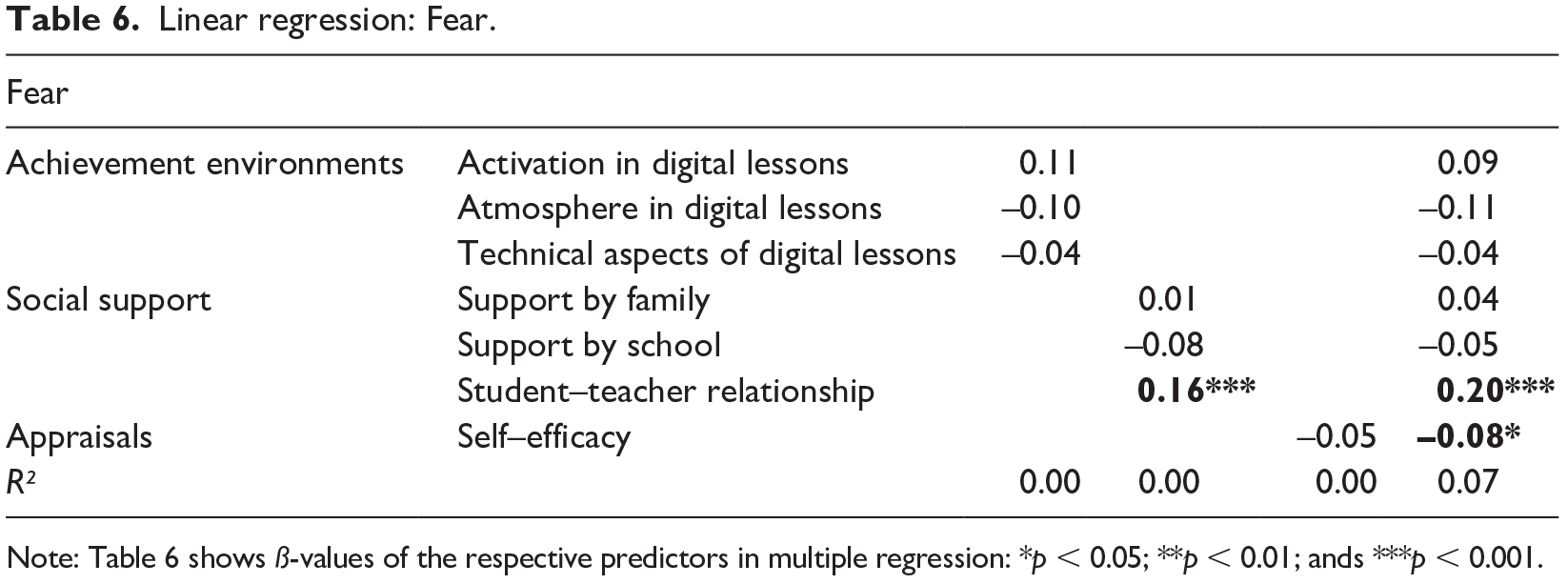
Note: Table 6 shows ß-values of the respective predictors in multiple regression: *p < 0.05; **p < 0.01; ands ***p < 0.001.
Regression of goal attainment on emotion, appraisals, and environment.
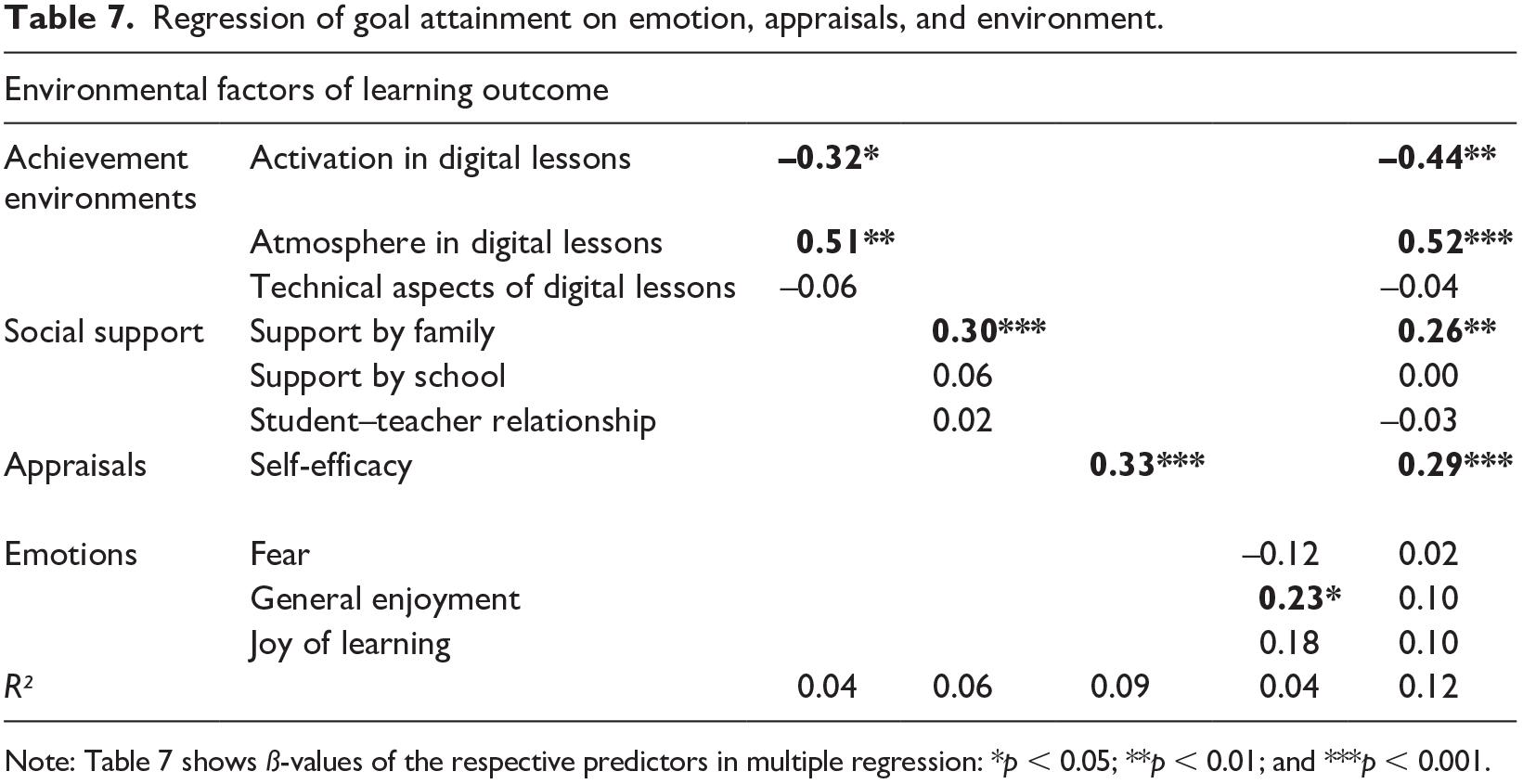
Note: Table 7 shows ß-values of the respective predictors in multiple regression: *p < 0.05; **p < 0.01; and ***p < 0.001.
Environmental factors predict self-efficacy
In the first step (Table 3), we explored the role of environmental factors by predicting self-efficacy on achievement environments (R² = 0.10) and social support (R² = 0.20), which were summed in a third model (R² = 0.22). The relevant predictors for self-efficacy were activation in digital lessons (β = 0.26, p < 0.05), support by family (β = 0.21, p < 0.01), and support by school (β = 0.20, p < 0.01).
Self-efficacy predicts emotions
The second step was the regression from general enjoyment (R² = 0.13), joy of leaning (R² = 0.12), and fear (R² = 0.00) on self-efficacy (Tables 5 –7). The respective regression weights were β = 0.24 (p < 0.001) for self-efficacy predicting general enjoyment, β = 0.24 (p < 0.001) for self-efficacy predicting joy of learning, and β = -0.05 (not significant) for self-efficacy predicting fear. Additionally, a direct regression from the respective emotion to the environmental factors plus self-efficacy was calculated. Explained variance was R² = 0.23 for general enjoyment, R² = 0.14 for joy of learning, and R² = 0.07 for fear, respectively. In the general enjoyment model, with general enjoyment as a dependent variable, significant predictors were activation in digital lessons (β = 0.26, p > 0.05), support by family (β = 0.11, p < 0.05), and self-efficacy β = 0.13 (p < 0.001). In the model with joy of learning as a dependent variable, relevant predictors were student–teacher relationship (β = 0.16, p < 0.01) and self-efficacy (β = 0.20, p < 0.001). Finally, in the model with fear as a dependent variable, significant predictors were student–teacher relationship (β = 0.20, p < 0.001) and self-efficacy (β = -0.08, p < 0.05).
Emotion predicts goal attainment
In the third step, we predicted students’ goal attainment by general enjoyment, joy of learning, and fear (R² = 0.04). The only significant predictor of goal attainment was general enjoyment (β = 0.23, p < 0.05). The explained variance of the regression was R² = 0.12. In this case, significant predictors were activation in digital lessons (β = -0.44, p < 0.01), atmosphere in digital lessons (β = 0.51, p < 0.001), and self-efficacy (β = 0.29, p < 0.001).
Discussion
In the present study, the consequences of the school closures during the COVID-19 crisis with regard to emotion and self-efficacy were investigated. This study focused on an exploration of student feelings and motivation during the first lockdown in spring 2020. As research lacks knowledge regarding students’ perceptions during this period of time, a more detailed focus was on the role of supportive family and school-related factors as well as the perceived virtual exchange during digital lessons.
The first research question addressed the role of emotions in distance learning during COVID-19. The descriptive results showed that general enjoyment was rated higher than fear. This result is consistent with previous studies (Frenzel et al., 2016). However, joy was higher than joy in the calibration sample, and fear was lower than fear in the calibration sample (Frenzel et al., 2016). This might be a first indication of negative emotional consequences of the COVID-19 school lockdown during spring 2020.
In order to answer the second research question, we adapted the control–value theory of achievement emotions (Pekrun and Stephens, 2009) as a framework to investigate the prediction of emotions, self-efficacy, and goal attainment. In the first step, the regression of self-efficacy on the environmental predictors showed a medium-to-high predictive value, with social support being more relevant than the variables of the digital classroom. However, besides support by family and school, activation in digital lessons was significantly related to self-efficacy. In the second model, it was shown that self-efficacy is related to general enjoyment and joy of learning but not fear. Additionally, the environmental factors predicted emotions beyond self-efficacy. Thus, a model including the direct effects of environmental factors and self-efficacy showed better adjusted R² than just the regression from emotion to self-efficacy. In the context of emotion prediction, student–teacher interaction was significantly relevant in all three models. This corroborates previous findings (Allen et al., 2011; Brophy and Good, 1974; Graziano et al., 2007). Surprisingly, we found a positive relationship between fear and student–teacher relationship. A closer look at the items explains this finding. Student–teacher relationship is partly measured by items that address the role of teachers in caring for students and asking about their wellbeing or mastery of assignments. Taking this content of the items into consideration, it is plausible that teachers pay special attention to students they know to be more “shy” or “anxious” compared to others (Nyborg et al., 2020). This may lead to higher values on the scale regarding student–teacher relationship for anxious students. Interestingly, support by family is only predictive for general enjoyment but not for joy of learning, although students learned at home. This not only indicates that both constructs are worth considering but also that joy of learning rather reflects an emotion that is closely connected to learning and the respective socialization agents (teachers and classmates). The small effect size on the model for fear suggests that this emotion might be better predicted by variables not included in the model (e.g., personal traits or learning experiences). In the third step, a regression model with medium effect size resulted. When emotions alone are included as predictors for self-reported goal attainment, general enjoyment has a statistically significant effect. However, in a model with all predictors included, the direct effects of achievement environments and self-efficacy on goal attainment outperform the effects of emotions. This suggests that, although general enjoyment is a predictor of goal attainment, the greatest portion of the explained variance is actually due to self-efficacy, which in turn leads to general enjoyment (Pekrun and Stephens, 2009).
Concerning research question 3, it was found that for emotional wellbeing (i.e., enjoyment, joy of learning, and absence of fear), the student–teacher relationship was an important environmental factor. However, general enjoyment is also influenced by support from family and activation in digital lessons. Additionally, a central component of wellbeing is self-efficacy, which is also highly correlated to support by family and school as well as activation.
The present study corroborated the theoretical assumption that when students are learning at home, parents and other family members are particularly relevant to supporting learning. With regard to performance level in the theoretical model of Pekrun and Stephens (2009), we investigated the role of students’ perceived goal attainment, general enjoyment, and self-efficacy. Thus, family support is important for emotion and motivation during COVID-19 distance learning. However, learning-related outcomes, such as self-efficacy and goal attainment, are also particularly related to support from school, such as information or relationships and the activation in digital lessons. Thus, although parents partly take on the role of educational agents, the main influence on education-related outcomes remains within the reach of social agents from school (Hattie, 2009). Consistent with the findings in non-pandemic circumstances (Pajares, 2003), support by relatives and support by school authorities were both positively correlated with student self-efficacy. Thus, these contextual conditions indirectly exert their influence through appraisals.
Communication and a good relationship with school agents becomes especially relevant in the COVID-19 crisis, when students are learning at home and are particularly exposed to social inequalities. It has been shown that schools can be an equalizer for developmental and cognitive differences that are induced by social inequalities. Downey et al. (2004) showed that during the summer break from school, the gap between socially advantaged and socially disadvantaged students, which had been reduced after school enrollment, becomes larger again. Thus, in the context of COVID-19, it is particularly important to maintain active communication between students and teachers and classmates to ensure that students feel well-informed and know who they can turn to with their issues and concerns at any point in time.
To sum up, while most previous studies have included responses only from parents and teachers (Helm et al., 2021, Steinmayr et al., 2020), the present study offers detailed insights into the emotional and motivational constitution of students immediately after distance learning. The study results corroborate the existing findings on the capacity of support by relatives and support by school authorities, thus emphasizing the importance of well-structured learning, productive virtual exchange during digital lessons, and support by school authorities. In contrast to Huber and Helm’s (2020b) “school barometer” survey, the majority of the sample in the present study filled out a paper-and-pencil questionnaire that was distributed by a teacher in class. Thus, the sample was less selective in terms of motivation, and students with limited technical resources and competencies could be included.
Limitations and future research
There are some limitations that need to be taken into account when interpreting the present results and addressing future research. At first, the design of the study would suggest considering a multilevel data analysis approach. However, the ICCs calculated for each variable of interest (Table 1) showed that the variance between subjects within schools was not considerably smaller than the variance across schools (ICC < 0.06), and therefore, a multilevel approach could be neglected in this study. However, the findings should be carefully interpreted, taking into account the sample size and number of classes involved in this study. Since the student perspective on motivational and emotional consequences of COVID-19 is still understudied, explicit hypotheses concerning these questions were not formulated. Thus, while the present study was rather exploratory, it offers a good basis for future studies. Although the sample size was small, the correlational inferences are valid within the given range of variable values. In this regard, beyond the considered classroom realities (such as perceived quality of virtual exchange during digital lessons), future studies should include the organization of distance learning in more detail (e.g., the portion of self-paced learning, students’ daily schedule, the amounts of individual and group work). Additionally, the differential moderating effects of gender, age, and socioeconomic status should be considered. Concerning digital classes, future studies should investigate what methods and strategies lead to teaching quality and are successfully transferred into the digital classroom, and which formats are newly developed in response to the different requirements of distance learning and the emotional, motivational, and outcome-related consequences (Voss and Wittwer, 2020). Furthermore, it would be valuable to explore other achievement-related emotional states (such as resignation and depression, boredom, frustration, hope, or pride). Additionally, beyond the student perspective, it is relevant to include teachers’ perspectives, which would allow for a better understanding of differences in academic outcomes, emotions, and motivations.
As the present data are cross-sectional, and the results are mainly based on correlational analyses that considered only one point in time, future research should include follow-up measurement points, for example, by comparing control conditions (classes at home due to quarantine conditions) to classes with in-person schooling. This methodological setting would allow access to data in a quasi-experimental setting (DeMathews et al., 2020) with a control group and a repeated measurement in order to make valid inferences on causal relations. This also allows controlling for the general effects of the crisis, that is, fear of infection or stress due to parents’ economic problems. Thus, further research is needed (DeMathews et al., 2020) to better understand educational processes in a pandemic, covering learning outcomes, motivations, and emotions. At the moment, the authors are conducting another study that allows the sample to be extended to n = 500+ students, which permits (under control of whether the lockdown was in 2020 or 2021) the application of structural equation modeling. Additionally, a teacher questionnaire will offer further insights into student emotions, motivation, and learning outcomes in combination with teaching practice.
Conclusion
The present results reveal that support structures are well suited to buffer negative effects on emotional wellbeing, motivation, and learning outcomes. However, this implies that students in socially under-privileged contexts suffer more from school closures than those who receive a high amount of support at home (Helm et al., 2021). Therefore, establishing and maintaining productive relationships and communication structures between students and teachers is important to compensate for social inequalities during distance learning. The study results indicate that those school-based variables are relevant and can induce effects above and beyond the impact of family and social background even in the crisis.
The present prognosis of the COVID-19 pandemic foretells that humanity, and with it, education, is at a turning point. Schools have begun to rethink educational processes, implement digital tools, replace analogue with digital tools, and encourage students to work at home as much as possible. Distance learning emerged from necessity in the COVID-19 crisis, but it might become a virtue for those who see the potential for differentiation and the individual development of skills. Therefore, the crisis also offers the opportunity to rethink the present educational structures and practices. However, in-person school fulfills many needs of our children that cannot be fulfilled from a distance (Pekrun, 2009). Students need to meet with their peers, move together, eat together, have informal contact, find opportunities to incidentally observe others’ behavior, and experience daily life together with all the senses. Often, schools are the only place to equalize social inequalities and provide opportunities to children who are economically, socially, or culturally disadvantaged. Although the effects of school policy and teaching on emotion, motivation, and learning outcomes could be found in the present study, it remains an open question whether distance schooling can fully meet the requirements for equalizing from a distance.
Footnotes
Appendix
Items included in the digital learning scales.
| Scale | Items |
|---|---|
| Atmosphere | “My classmates and I did not interrupt each other.” |
| “The atmosphere was appreciating.” | |
| “I really felt I belonged to the class.” | |
| “My teacher directly addressed me.” | |
| “The atmosphere was pleasant.” | |
| “I received appreciative feedback.” | |
| Active engagement | “I had enough opportunities to take part in discussions and share my ideas.” |
| “I was concentrated.” | |
| “I was able to add my knowledge.” | |
| Technical | “I had no difficulties in launching the conversation tool.” |
| “I was able to hear everything.” |
Declaration of conflicting interests
The authors declared no potential conflicts of interest with respect to the research, authorship, and/or publication of this article.
Funding
The authors received no financial support for the research, authorship, and/or publication of this article.
