




Abstract
Teachers trained in one country are often not allowed to serve as teachers in another country because their teacher’s license is not recognised as equivalent. The barriers these teachers have to overcome in order to work in their profession again are high and often require further (full) teacher training at the university. The paper provides insights into the conditions for teachers who participate in (re-)qualification programmes in Germany and Europe. By linking the theoretical concepts of a biographical approach to teacher professionalisation and transnationalisation in education, the results of an interview study with teachers who have participated in a programme for refugee teachers at a university in Germany are presented. The Grounded Theory analysis reconstructs the strategies of internationally educated teachers managing to keep up their hope to be able to work as teachers again and thus counter the formal de-professionalisation they are facing.
Keywords
The opportunities to work as a teacher in Germany based on qualifications obtained in another country are limited. In line with research on the situation in other countries of the Global North there are various barriers these teachers have to overcome to be able to work in their profession again (for an international review see Bense, 2016). Teachers from abroad face multiple challenges beginning with the issue that their university education usually does not meet the requirements of the German teacher-training programmes. However, in some federal states of Germany the school authorities recognise the potential of the internationally educated teachers 1 to contribute to the German school system. Since 2016 a number of qualification programmes for recently immigrated refugee teachers have been established by universities to support these teachers in finding a way into the school system.
In the context of such programmes this paper questions how the process of trying to re-enter the teaching profession as an internationally educated teacher is interlinked with professional biographical development tasks. For this purpose, a biographical perspective on teacher professionalisation is chosen in order to focus on the process of ongoing professionalisation that has taken place across more than one school system. By using the concept of transnationalisation (Glick Schiller, 2010; Pries, 2010) it is critically stressed that the teacher education is predominantly organised on a national or state-specific basis without taking teacher mobility adequately into account. Even though inter- and supranational governance strategies regarding teacher training are present (e.g. OECD 2010, 2013, 2018), the state, the school system and the teaching profession in Germany are closely related to each other. The mobility of teachers and their professional inclusion in another school system raises theoretical questions about the common national understanding of teacher professionalisation.
This paper gives an overview of the opportunities and challenges for teachers trained in one country to work in another and of the qualification programmes for refugee teachers with a focus on the German state of North Rhine-Westphalia (Section 1). Based on the theoretical framework of a biographical perspective on teacher professionalisation as well as on the concept of transnationalisation (Section 2), the paper presents results from a Grounded Theory interview study with teachers participating in a programme for refugee teachers at a university in North Rhine-Westphalia (Section 3). In conclusion, the transnational biographical self-positionings on the professionalisation of teachers taking part in a (re-)qualification programme for refugee teachers are elaborated as counter-narratives to the lack of recognition experienced by internationally educated teachers (Section 4).
Internationally Educated Teachers in Germany and Europe
Germany is one of the main European destinations for asylum seekers from conflict and war zones worldwide. According to the German Federal Office for Migration and Refugees (BAMF), more than 11,000 persons applied for asylum in Germany in 2016 who had previously worked in the teaching profession (“lehrende Berufe”) in their country of origin (Neske, 2017: 9). 2 While around 5,000 refugee and non-EU-teachers were registered in Germany between 2014 and 2018, in 2019 only 250 people with a nationality of a country of origin classified as “not safe” are working as teachers at (vocational) schools in Germany (FDP-parliamentary group, 2019 based on data of the BAMF). However, the mobility of teachers is not only linked to forced migration: in Europe secondary school teachers are one of the most mobile groups of employees (European Commission, n.d.).
The majority of teachers with foreign qualifications (regardless of whether they are asylum seekers or not) are not allowed to work in their profession without further qualification. The barriers teachers trained abroad have to overcome are placed on a formal-administrative level, university level, on the level of schools as potential employers as well as on the level of informal social status (Resch et al., 2019 with a focus on Austria). The provision of programmes and support services for immigrated teachers in Europe as well as countries of the Global North can be seen as an indicator of the difficulties these professionals face (e.g. Bense, 2016 with a special focus on Australia; Gross, 2018 for the USA; Proyer et al., 2019 for Austria, Germany and Sweden).
In Germany, the opportunities to work as a teacher with foreign qualifications are traditionally limited because of the specific structure of teacher education and licensing (for an overview see Cortina and Thames, 2013): During their education prospective teachers for primary schools are prepared to teach three subjects, teachers for secondary schools two subjects (content knowledge and pedagogical content knowledge), they have to perform courses in general pedagogical knowledge and also practice-related studies in schools. The first, university-based phase of teacher education leads to a Master degree (Master of Education). After that the future teacher enters into the second phase: practical training in a specialised teacher-training seminar. It concludes with a final examination under state authority. 3 Besides this regular path to become a teacher in Germany there are side-entrance programmes for people with a university degree to be qualified to work as a school teacher. In addition to content and pedagogical knowledge, teachers from abroad need to prove (content) language skills in German and knowledge of the German school system in order to work in a public school. The qualifications required from these teachers to successfully enter into the German school system are therefore challenging and often lead to further (full) studies at university. For refugee teachers these barriers are met while living under precarious and insecure conditions and facing the general challenges of labour inclusion experienced by refugees (Farrokhzad, 2018).
In recent years, also in Germany qualification programmes for internationally educated (refugee) teachers have been developed with the aim to support their re-entry into the teaching profession (e.g. at the University Potsdam 4 and the University of Education Weingarten). In North Rhine-Westphalia (NRW), Germany’s most populated federal state, since spring 2020 five universities offer a one-year qualification programme for refugee teachers (Universities of Bielefeld, Bochum, Cologne 5 , Duisburg-Essen and Siegen) supported by the German Academic Exchange Service (DAAD) with financial means of the Ministry of Culture and Science of the German State of North Rhine-Westphalia. 6
The (political) hopes linked to such programmes are multidimensional. They relate to the professional inclusion of recently immigrated professionals into the labour market as well as the need of experienced teaching staff in times of teacher shortage in some school subjects in many regions of Germany (Standing Conference of the Ministers of Education and Cultural Affairs of the States in the Federal Republic of Germany, 2018; for primary school level see Klemm and Zorn, 2019). In addition, language skills as well as knowledge of the situation of refugee families of internationally educated teachers taking part in such programmes are considered as a valuable resource for working with multilingual students, newly arrived students as well as with parents who do not speak the official school language. In this regard, the (re-)qualification programmes for recently immigrated (refugee) teachers in Germany are linked to a broader discourse on the absence of teacher diversity in many schools in Germany and migrant teachers in particular. Based on research from the teachers’ perspective (Akbaba, 2017; Fabel-Lamla and Klomfaß, 2014; Rotter, 2012), the students’ perspective (Rotter, 2015) and the analysis of policy papers (Akbaba et al., 2013), rather critical questions are raised on the essentialist assumption that migrant teachers in general have special skills and a specific interest to take responsibility for the success of migrant students and therefore compensate for previous structural failures in dealing with migration in the German school system (Bräu et al., 2013; Lengyel and Rosen, 2015). The ambivalent link between recently immigrated teachers and the demand for teacher diversification in terms of corresponding political hopes has been addressed by Schmidt and Schneider (2016).
In contrast to the fact that the topic of internationally mobile teachers is connected with the discourse on migrant and minority teachers, there are no signs of a connection to the dynamics of educational internationalisation concerning global and/or European teacher education policies in terms of quality assurance, standard-based teaching and school management (e.g. European Commission, 2007; OECD, 2005, 2010, 2013, 2018; for critical analyses see Ball, 2007; Waldström, 2015; with a focus on Europe see Hummrich, 2018; for a post-colonial perspective see Bagchi et al., 2014). These macro level developments are not related to or seem to have effects on the formal regulations for internationally educated teachers in Europe so far.7,8 Although there have been some efforts to establish common global and European perspectives and policies on teachers and teacher education, to date they have not led to a substantial opening of the highly state-regulated German teacher education system, governed by each of the 16 states of the Federal Republic of Germany. Evetts (2013: 779) points out that “the role of the nation-state has always been critical in theorizing about professions” because the nation-state is in power of what is defined as professional as well as the recognition of educational certificates. The perception of a selective interconnection of internationalisation efforts at a global system level on the one hand and migration-related diversification on the other hand is also found in the work of Hummrich and Pfaff (2018).
Against this background, in this paper the specific situation of refugee teachers is embedded in the educational field of teacher professionalisation theory. For this purpose, a biographical perspective on professionalisation is chosen and linked to the concept of transnationalisation as the theoretical frame for the following interview study.
Teacher Professionalisation and Transnationalisation in Education
Teacher Professionalisation
In contrast to traditional sociological theories that define profession through categories that the work of a teacher only partially meets, there is a specific discourse on teacher professionalism and professionalisation. In the German-speaking countries it is characterised by a broad distinction of three perspectives (Terhart, 2011): the structural-theoretical approach, the competence-based approach, and the biographical approach. The structural-theoretical approach aims to understand the specific structural logic of the pedagogical professionalism and the tensions of pedagogical work by using reconstructive-hermeneutic methodology (for an overview see Helsper, 2011). In order to deal with the uncertainties in pedagogical interaction which cannot be resolved (e.g. the balancing of a professional relationship between being close and distant), the reflective analysis of one’s professional actions is seen as the basis for further professionalisation. On the contrary, the competence-based approach of teacher professionalisation aims to define and prove the (development of) specific teachers’ competences. These competences refer e.g. to the pedagogical content knowledge, professional beliefs, work-related motivation, and self-regulation (Kunter et al., 2013). From this perspective, the level of professionalism can be measured based on defined areas of competence. Teacher are considered to be competent and therefore professional if they have a high level of knowledge of action in the defined areas of competence.
Due to their focus and research methodology, both approaches are mostly seen in contrast with one another. The professional biographical approach on professionalisation is understood as a third perspective, which is partly considered as a link between the first two approaches. Research in this perspective shares the idea that professionalisation cannot be detached from the respective biography and is seen as an ongoing process. Because of this understanding of professionalisation, the biographical approach is addressed in this paper. Central to the biographical perspective is the idea that teacher professionalisation is a continuous developmental task or problem. Teachers have to handle professional developmental tasks during their training and career in order to find suitable solutions for themselves and others (Hericks, 2009: 102). According to Fabel-Lamla (2018: 82), the professional biographical perspective is not a clearly defined approach. Rather, this perspective unites different strands of research which can be broadly differentiated into research that looks at modelling phases or steps of career paths of teachers on the one hand and research on teacher biographies on the other.
The first strand of the biographical perspective on teacher professionalisation focuses on the question of specific developmental tasks and phases that teachers go through in the course of their career. With the help of different methodological research approaches, models have been developed that systematise the developmental tasks of teachers. As a well-known example, Huberman (1989) developed a model with five phases in the careers of teachers based on biographical interviews with 160 Swiss secondary school teachers with various amounts of years in service. Huberman’s professional life cycle model starts with entering the profession as a phase of survival (first to third year), then moves on to a phase of stabilisation, which then develops either into experimentation and professional activism or a phase of self-doubt and negative evaluation of the teacher profession. The professional life cycle ends with a phase of stabilisation and withdrawal after 30 to 40 years in service, which is either perceived as positive or negative, depending on the experience gained as a teacher. Although this model provides a broad overview of phases of the teacher’s professional life cycle, it does not seem to show any career paths that differ from the “normal case”, e.g. because of different or parallel qualification paths, breaks from teaching for different reasons or international migration (for a critical view on the idea of modelling professional development as a linear process of improvement Herzog et al., 2007: 33).
The second strand in the biographical approach to teacher professionalism is based on the individual life stories of teachers and aims to reconstruct the way in which teachers cope with specific structural conditions of the teaching profession during their teacher biography. It is mostly based on biographical in-depth studies on teacher narrations and examines the relation of biographical experiences, the (development of the) professional self and professionalisation of teachers (for an overview on research on teacher biographies in Germany see e.g. Kunze and Stelmaszyk, 2004; Reh and Schelle, 2006). Some research focuses on the professional biography as part of the whole life cycle by also addressing the decision to become a teacher or the time after retirement. Other biographical research is based on the experiences of teachers who are addressed as members of certain social groups such as migrant teachers (Fabel-Lamla and Klomfaß, 2014; Rotter, 2012).
It becomes apparent, that the biographical approach of teacher professionalisation is based on different research methodologies. While models of progression have the common goal to design steps or phases of professional development based on quantitative and/or qualitative empirical research, biographical analysis studies aim to map individual and therefore possibly non-linear career paths.
The aim of this paper with regard to teachers with foreign qualifications in Germany taking part in a university programme is to reconstruct their professional developmental tasks and how they deal with them under the condition of a change of school system. These teachers try to re-enter their profession after migration and want to work as a teacher in Germany despite the mentioned barriers they face. For a sensitising theoretical framework that fits the situation of these internationally educated teachers, the theoretical perspective on teacher professionalisation will be linked to the concept of transnationalisation to be able to understand the specific tasks of refugee teachers that arise when trying to change from one national school system to another under insecure conditions.
Transnationalisation in Education
After Green (2019: 1), the term transnationalism is likely to have first appeared regularly in the US political sciences in the 1970s. In the early 1990s, however, the terms transnationalism / transnationalisation were theorised in various academic disciplines (e.g. Basch et al.,1994). In the field of education, Adick defines transnationalisation as a general term for all those phenomena that go beyond “individual social entities (nation, ethnicity, culture) as well as being of a different nature than inter-societal (inter-national, inter-cultural) relations” (Adick, 2005: 244). Central to the concept of transnationalisation is the statement against a “methodological nationalism” (Wimmer and Glick Schiller, 2003) that identifies the nation-state society as the central point of reference without any reflection on the one hand and ignores processes of de-territorialisation and deconstruction of the spatial conditions of the social on the other hand. Transnationalisation provides a perspective that is well suited to understand pluri-local and nation-state overcoming boundaries of relations, but without overlooking the continuing nation-state dependencies (Pries, 2013: 883) that exist, especially in relation to the public school system in most nation-states. In this way, the concept of transnationalisation does not only offer a perspective for examining the multidimensional processes in the interconnection of education, nation and supranational structures, but also for criticising them. 9
Within the research area of transnationalisation in education the term transnational education was first used in higher education by the UNESCO and the Council of Europe (Adam, 2001: 9) and has since then been extended to other areas of education (Adick, 2005; for a transnational perspective on schools in Germany and Switzerland see Edelmann, 2015; Hornberg, 2012; Hummrich and Pfaff, 2018; Karakaşoğlu and Vogel, 2019; Sieber, 2007). According to Carnicer and Fürstenau the potential of the term transnational education is to “reflect the ways in which education is being affected by, but also influencing, social processes that transcend national borders” (2019: 385). It will become apparent in the future, if the perspective of transnational education is capable of interrupting the common contradiction that, on the one hand, the phenomena of international education, the exclusive educational migration (boarding schools, universities, etc., see Terhart 2020 for Germany) and the development of international educational certificates and career systems are promoted, and on the other hand, school education and further education for less privileged migrants are seen as problematic and a burden to national school systems (also see Hummrich and Pfaff 2018). Therefore, Adick (2018) correctly points out the gaps in research on transnational educational processes in the public school system, vocational training and informal and non-formal educational settings. It is stressed that corresponding empirical research on cross-border phenomena in schools and other educational institutions has to take (global) inequalities into account (Wimmer, 2008).
Regarding transnational dynamics between an in part national and in part beyond-national references in the field of education at institutional and individual level, teachers also move into focus. Studies with a focus on the mobility of teachers from an explicit transnational perspective are rather rare (Manik, 2005; Schmidt and Schneider, 2016; Schratz, 2014; Waldström, 2015). Reference to so-called transnational teachers is made by Soong’s research on mobile teachers migrating to Australia. Soong (2017) develops her concept of transnational teachers based on research on the use of principles of free-market capitalism by mobile teachers (Reid, 2016) as well as the work of Levitt and Glick Schiller (2004) on the agency of actors moving in transnational fields with reference to Bourdieu’s theory of practice (Bourdieu 1990). The free movement of teachers in a global education market is not directly transferable to the vulnerable situation of refugee teachers. Nevertheless, the concept of transnational teachers by Soong is in some ways helpful to understand the challenges of teachers who were forced to migrate as a result of war and oppression and who want to work as a teacher again. Therefore, also for refugee teachers the following applies under different circumstances: “Transnational teachers encounter fields with rules which are new to them, their habitus must gauge the field, figure out the logic of the field and how to best position oneself. Habitus, as a socialised subjectivity, is a product of embodied social practices and is considered as a tool for helping transnationals to mediate change within a foreign field” (Soong, 2018: 407).
With this, Soong refers to the challenges of transnational teachers to handle their self-positioning and cope with personal and professional developmental tasks and managing burdens in the new social field.
Based on previous research analysing the situation of internationally educated (refugee) teachers, for this paper the chosen theoretical framework combines the biographical perspective on teacher professionalisation with the concept of transnationalisation with reference to structures of inequality. This draws attention to the professionalisation of teachers who are mobile for different reasons and who try to work in a new national school system and engage with the respective expectations of teachers. In the following section, results of an interview study with participants of a (re-)qualification programme for refugee teachers at a German University are presented, focusing on the biographical professional developmental tasks these teachers have to cope with.
Interview Study on the Transnational Biographical Professionalisation of Teachers taking part in a (Re-)qualification Programme for Refugee Teachers in Germany
Methodology
Based on the perspective of professionalisation as an ongoing biographical development task, teachers trained abroad that are attending a one-year (re-)qualification programme for refugee teachers, were asked to share their experiences in an interview study carried out before and after the programme: the semi-structured interviews conducted before the programme focused on the expectations concerning the German school system (internships are completed as part of the programme) based on the experiences in the school systems in which they had been working previously. The interviews held after participating in the programme focussed on their experiences during their school internships and how these effected their professional and their ideas on further steps of their career as teachers.
In total 20 interviews were conducted and analysed using the process of comparative theoretical coding and conceptualisation of the Grounded Theory Methodology (Glaser and Strauss, 1967). The goal of this research methodology is to generate a theory based on empirical data by reconstructing “patterns of action and interaction between and among various types of social units (i.e., actors)” (Strauss and Corbin, 1994: 278). In a process of open, axial and selective coding of interview sequences, the coding paradigm of the Grounded Theory Methodology was used (ibid.: 280). This action-theory based heuristic structures the analysis by reconstructing the context (causal conditions), the intervening conditions, the strategies and the consequences of the phenomenon of such programmes. Through the iterative process of theoretical conceptualisation of the data a substantive theory is developed of how refugee teachers shape the school system change from a professional biographical perspective (Strauss and Corbin, 1994). Before the programme started twelve participants were interviewed and after the programme eight participants were interviewed, of which six took part in both interview phases. The results are presented below in a substantive theory of limited range. The interviewees had the choice between interviews held in German, English and/or another language. Most participants chose German and/or English and one interview was conducted in Turkish. 10
Results
In the following the results are presented in the systematics of the coding paradigm in text and a visual scheme, to reveal the relation between the elements of the action-based theory of limited range.
The context for (re-)qualification programmes for refugee teachers are the barriers for refugees to enter into the labour market on the one hand interwoven with the specific barriers for teachers trained abroad to enter into the German school system on the other hand (see Section 1 of this paper). Even though all of the teachers participating in the programme are confronted with these barriers, they differ according to their respective life situations, for example, depending on family obligations or different asylum residence regulations. The mostly formal non-recognition of professional qualifications of refugee teachers leads to the phenomenon of (re-)qualification programmes for refugee teachers. These programmes function like “a bottleneck”, and should improve the chances of access to the labour market. The Cologne programme provides a German language course, knowledge of the German school system and pedagogical content knowledge as well as practical experiences in the German school system and counselling on different opportunities to work in the field of education. Although such programmes support teachers, it is to be seen critically that they at the same time support the existing system of formal non-recognition in some way. Moreover, none of the programmes offer a guarantee of subsequent employment as a teacher, as one interviewee points out at the beginning of the programme just after the pre-course in German language has started: “Our first priority is of course German. That is our expectation. They have already told us that the programme does not give us permission to teach. The programme will make us familiar with the system and so far our expectations have been fulfilled” (Mr S._pre_pos. 115).
Under these circumstances, the questions arise how the participants deal with the situation of further developing a professional perspective that is formally framed by non-recognition and therefore leads to de-professionalisation in the new national context. How do they manage to take part in an intensive and demanding further training programme despite the uncertainty regarding the future professional path in Germany? To understand the strategies the participants of a (re-)qualification programme for refugee teachers use to react on this, the biographical perspective on professionalisation as a sensitising concept provides a theoretical framework (see Section 2 of this paper): the internationally educated teachers arrange their experiences along their respective professional biographical development process that takes place across different school systems. If, from a structural perspective, the differences regarding the qualification in particular come to the fore, the interviewees refer specifically to already experienced or imagined similarities between working as a teacher in different countries before the start of the programme.
A central topic of their reassurance of being a competent teacher while changing the school system is the work with children. “Children are children” (Mr. L_pre_pos. 129) can be considered the in-vivo-code for this perspective of the teachers. Working with children as a constant across different national contexts also forms the basis for a transnational self-image when a teacher argues: “And to me children are all the same, somewhere they live. The world is a small village now and all children can learn (-) from each other. Therefore, it makes no difference to me whether I teach here or in Syria. The main thing is (–) I see our children properly educated (Mr Y._pre_pos. 49).
The reference to “our children” here is explicitly not understood to be national. Mr. Yasin sees his responsibility as a (mobile) teacher for the education of future generations and thus makes clear not only his world view of a global connection but also his value orientation concerning a transnational pedagogical responsibility. With regard to the internships as part of the programme, another teacher states that children share many experiences, especially due to technological developments in a globalised media childhood, and she therefore suspects that student in a school in Germany are not much different to students in a school in Turkey: “Because kids are (–) almost the same all around the world. Because in the age of technology, kids see and hear and learn from each other very fast and their behaviour is (-) becoming more and more similar. So, of course I’m expecting to see or experience some differences, but I think I can cope with that” (Mrs M._ pre_pos. 65).
Some interviewees have already gained experience in the German school system through previous internships or imagine the students to be similar regardless of the school system. Referring to children establishes a bridge between the previous professional work and the intended professional life in Germany. The belief that children all over the world show similarities in behaviour represents a unifying perspective for the participants and maintains their pedagogical professionalism of being a teacher despite the respective national context.
In addition to that, some participants also point to their extensive practical experience as teachers, which is presented as an advantage for the intended work at a school in Germany and again supports their professional background. Against the background of the experienced formal non-recognition of the qualification as a teacher and the accompanying social downgrading, the clear references to the existing knowledge and skills as a teacher in the interviews before and after the programme are to be interpreted as a strategy to question de-professionalisation.
“Yes, I have many experiences. I have seen thousands of students with different styles, different personalities, I have some ideas to use (-) [. . .] so I can carry my experiences to my new teaching position, I hope” (Mrs M._ pre_pos. 71). “I have worked for about ten years and I have seen so many different students and you collect so many experiences or information. If a situation repeats itself, I know: ‘what can I answer. How or (-) what can I do in this situation’” (Mr W._post_pos. 155).
Concerning the experiences, references are made not only to the work with the students, but also to the existing professional knowledge of the subjects taught by the participants. It becomes apparent that in the interviews before the start of the programme, particular attention is drawn to the importance of the subject for the interviewees as an English teacher points out: “I have seen the English books here, they are the same, the same topics, the same (-) all of them, I can say 90 percent are like the books we learned with in Iraq” (Mr M._pre_pos. 145).
If differences between the school systems are pointed out, this refers to structural differences that the participants have already experienced or imagined. A participant assumes thirty percent differences between the Turkish and German school systems, which he identifies as the school uniform, the architectural design of schools, and the assumed greater freedom of students and less authoritarian style of teachers in Germany. The majority of both school systems are therefore similar for Mr. Şimşek (Mr S._pre_pos. 81).
In addition to references to existing academic and practical qualifications gained through previous work as a teacher in another country (or countries), the interviewees also refer to specific language proficiency and knowledge arising from the migration situation and experiences of being a refugee in Germany. The focus here is on matching their own language skills with the languages of many (newly arrived) students. Some teachers refer very directly to their language skills, for example when the English teacher Mr Massoum reports that he presented himself as a multilingual professional to the colleagues at school at the beginning of the internship: “when I did my internship in (city name), I introduced myself and then I said I speak four languages if anyone needs” (Mr M._post_pos. 159). Before the internship, another English teacher also points out to be able to get in contact with the parents that do not speak the German language: “Perhaps also contact with the parents, because I have heard that some Turkish parents do not have (-) contact with the school so often because they cannot speak German. So, this could also be helpful for the rest of the teachers. I could be a kind of translator” (Mrs M._pre_pos. 75).
In the interviews held after the programme, it becomes obvious that the teachers did support students with no or little language skills in German during their practical experiences in schools based on their proficiency in other languages and their knowledge on multilingual didactics gained in the programme.
In addition to language skills, references to previous work as an assistant in a refugee support programme was mentioned, which is referred to as useful for working with students and their families who have also applied for asylum in Germany (Mr M._post_pos. 163). Mr Lahham, a teacher for economics, refers to his refugee status as an advantage when working with newly arrived children due to his “experience with bad situations” (Mr L._Post_pos. 127). He is convinced that he can offer specific knowledge to solve problems of the refugee students “correctly and fast” (Mr L._Post_pos. 130-131). Reference is also made to the opportunity to function as a role model or as a supporter when it comes to anticipated insecurities of newly arrived students: “to help the students feel better, especially those who come from abroad. Ahm, because if they see the teacher as themselves, they feel more, I would feel better about myself, I would feel more comfortable” (Mrs M._post_pos. 134).
Not only the direct interaction in everyday school life is addressed, but also the level of the school and the school system. Mr Akman refers directly to the Ministry of Education and his conviction that “they believe that foreign teachers can solve problems of foreign students. I think so, too” (Mr A._pre_pos. 115) and in this context takes over the political hopes that were critically discussed in section 1. In this sense, migration-related knowledge used as a resource for re-entering into the teaching profession becomes apparent (also see Economou 2020 for the Swedish context). Furthermore, teacher diversity is addressed and the suggestion is made: “if the teachers are mixed from the culture that is in Germany as a multiculture that is in Germany also very good because uh in the school system in Germany you can add the others as well” (Mr L._pre_pos. 163). Internationally educated teachers relate their individual situations to the broader discourse on migrant teachers as part of an organisational development of schools that respond to the reality of a multidiverse society.
The emphasis on being able to build on existing professional resources can be seen as a sign that the interviewees are in a position where they are under the impression that they have to prove themselves as professionals. Therefore, it is not surprising that concerns before the start of the programme or the appearance of difficulties within the programme are hardly explicitly mentioned. Only the proficiency in German as a central barrier is a very important topic in the interviews at the beginning and at the end of the programme. The language proficiency itself as well as the discourse on language skills teachers have to provide can be defined as an intervening condition with great impact on the future opportunities: “Language is important. Must be developed. (-) Yes, then everything comes. Language is important now, vocabulary” (Mr B._pre_pos. 89). A Math teacher who has already made several attempts to work in the educational sector in Germany and has already worked in the Kindergarten and afternoon day-care at a school notes: “I was a teacher and I like my job and I have tried to work as a teacher here. You have to be a realist. I have language problems. Otherwise (-) I have without language/ I could control the class here and if I can speak well, surely I can teach here too” (Mr F._pre_ pos. 63).
The strong emphasis that linguistic abilities in German language are the primary problem for the re-entry into the profession at the same time strengthens the individual’s professional self-location as a teacher. The language barriers before and also after participation in the programme are presented as manageable: “The obstacle between (-) me and my profession is the language” (Mr Y._pre_1_pos. 49). This strong focus on language proficiency in German is not surprising, since this is the expectation that is raised for recently immigrated people in general and for teachers in particular. 11
However, it is striking how much the focus is on language proficiency and how little in comparison to this the barriers of the non-recognition of former qualifications and (in-)formal expectations as a teacher they have to meet are taken up; even if these have led to the offer of a (re-)qualification programme for refugee teachers in the first place. However, Mr Wassif expresses his feelings of frustration at not being adequately qualified despite the current shortage of teachers in North Rhine-Westphalia: “Although they have a shortage of teachers, I hear that, I hear every day, every day: ‘currently teachers have a lot of chances’, but we have (-) 1000 deficits and you get a refusal so easily” (Mr W._post_pos. 191).
Even though refugee teachers face multiple barriers, the individual situation of qualification differs in terms of the subject(s), pedagogical certification, length of work experiences and the level of qualification as intervening conditions. Despite difficult circumstances, participants at the beginning of the programme are convinced that they are able to handle the work as a teacher in Germany if they improve their language proficiency in German. The evaluations after the one-year programme concerning their professional experience in other countries and in Germany are, as expected, more differentiated and also point to new experiences concerning specific expectations regarding teacher qualification, e.g. of lesson planning and design in Germany.
However, these new experiences are not discussed as further barriers, but as impulses for their own professional development to have an insight of the school system in Germany. Material conditions such as better technical equipment for science lessons at the internship school (e.g. Mr B._post_pos. 7) are addressed, but also the experience of forms of teaching, that are classified as more “open”. When asked if their understanding of their role as a teacher has changed, some interviewees state that it has remained the same. Other interviewees refer to experiences that have certainly brought them to reflect on their own role as a teacher. These professional developmental processes are addressed in connection with the experience of a specific teaching practice, which can be described in summary as student-centred: “You have to pay attention and you can’t just work like we were taught and apply that here. That’s not possible, because the students have to work more by themselves here” (Mr B._post_pos. 33). “Here (-) the teacher is still responsible but the students are in the middle, I see that. The teacher guides and controls everything but students are responsible for their own learning” (Mrs M._post_pos. 64).
Based on the internship experiences, the more student-centred teaching is perceived as an enrichment, even if questions are raised regarding the adequate quality of the students’ guidance for self-directed learning. The new practical experiences are linked back to existing theoretical pedagogical knowledge by the former participants concerned and become knowledge for action, as Mrs Mutlu, who has previously also worked as an English teacher in an English-speaking country, continues: “Now I see myself more like a kind of guide, rather than (-) a teacher of everything. That’s what I had in my head in my mind before, but now I can put it into practice. Its lovely. I can try if I have the chance /laughs/” (Mrs M._post_pos. 68). “For example, the cooperation of students (–) I saw this method for the first time in Germany (-) yes, I read about this method in Turkey, but did not see it until the internship – that was a new experience for me” (Mr A._post_pos. 13).
It becomes apparent that the concept and culture of teaching in schools in Germany is included and reflected by the refugee teachers as part of their overall professional development process. This process not only continues along the experiences made in different school systems but is also shaped by this change itself. Individual experiences are taken up with reference to different structural conditions in the respective national education systems and different schools. Some of the teachers are familiar with student-centred teaching on a theoretical level, but little or no practical experience has been gained so far. The possibility of carrying out forms of lesson planning and implementation experienced during their internships is presented by referring to it as an enrichment for their own professional actions. In summary, the resulting professional uncertainty in the new context and a review of pedagogical experiences in different national school systems seem to lead to a broader perspective on the individual teacher acting, as Mrs Mutlu points out: “My scope or perspective is enlarged, it is wider now, I believe” (Mrs M._post_pos. 59).
In the interviews, references to existing professional qualifications and practical experiences as teachers as well as an interest in an ongoing teacher professionalisation are revealed. The language skills in German, which are mentioned as being not yet sufficient, are seen as the central barrier to professional re-entry. At the same time the formal non-recognition of qualifications as well as a deficit-oriented perspective on internationally educated teachers is only implicitly addressed. The development of the key category that links the previous theoretical conceptualisations expresses the relevance of this findings: A practice of managing to keep up the hope is revealed. The following scheme gives an overview structured by context, phenomenon, intervening conditions and strategies in relation to each other.
Discussion and Outlook
Teachers taking part in a (re-)qualification programme for refugee teachers have to manage to keep up the hope of achieving the aim to re-enter their profession – despite the many barriers. The stable motivation to make use of the opportunity offered by a (re-)qualification programme can be found regardless the formal difficulties. This is based on the emphasis on school subject content knowledge and work experience as a teacher as well as aspects mentioned that are related to migration and self-positioning as transnational teachers. These transnational references have to be seen in relation to the expectations placed on the teachers in regard to the discourse on migrant teachers in Germany as well as on the (simultaneous) personal interest of bringing in their language and migration-related knowledge as useful competencies for working as a teacher in the German school system. The emphasis on hope in the developed theory may interlink with the immigrant-optimism-hypothesis (Heath and Brinbaum, 2007) with reference to the idea that migration is usually based on the hope of a better life (under different circumstances this applies to labour migration as well as to forced migration). The belief that the individual’s life and the lives of the following generation can improve through migration, leads in some ways to a need for optimism. Furthermore, the findings correspond with research by Seukwa (2006) on youth from African countries in Germany, in which he refers to a habitus of the art of survival (“Habitus der Überlebenskunst”) to show how young people develop strategies for the development of their educational and professional pathway while facing the conditions of multiple barriers and insecurities. Nevertheless, the idea of hope should not be understood too positively. Rather, hope in this case implies a pressure, which is to be viewed critically in terms of the labour opportunities opened up for people with foreign qualification who have fled their country (Figure 1).
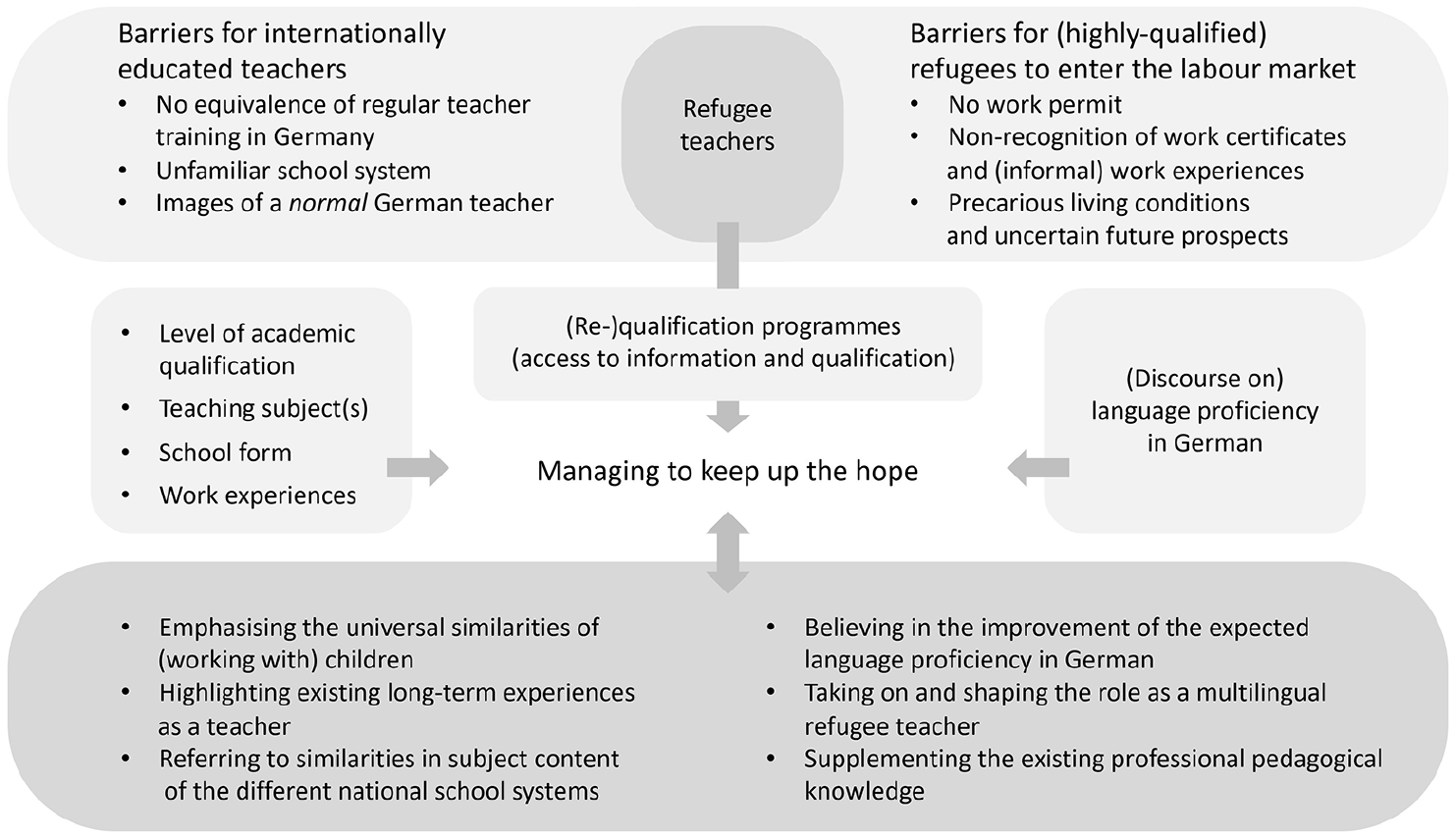
Theoretical scheme on the situation of internationally educated teachers taking part in a (re-)qualification programme for refugee teachers in Germany.
In Germany as in many other countries, refugees face specific barriers to their entry into the labour market, which teachers also have to deal with. In combination with the general problems for teachers trained abroad because of the specific teacher training regulatory in Germany, a special situation arises for refugee teachers. Based on the existing (re-)qualification programmes in Germany it will become evident how these offers will affect the professional entry of former participants in the long term after they have finished the one-year programme. 12 Based on the experience of not being recognised as teachers, the interviews offer a platform for the self-positioning of internationally educated teachers to strengthen their professional transnational position. Presenting themselves as qualified and experienced teachers thereby represent a counter-narrative that provides a new, yet mostly unheard voice on de-professionalisation of international teachers in Germany (to counter-stories of immigrant teachers in Canada see Cho 2010). Moreover, the professional development of internationally educated teachers provides indications of transnational professionalisation that has not yet been taken adequately into account in teacher professionalisation theory.
When changing the context of a national school system, the mostly state regulated qualification processes of teachers are questioned. Concerning teacher migration this often leads to the specific need to prove qualification and to attempt further qualification that meets the regulations in teacher training. Programmes support (refugee) teachers from abroad in some European countries as well as in North America and Australia to gain further formal qualification. However, these support structures do not overrule formal regulations for teachers with foreign qualification. Rather, these programmes represent the first phase of access, a foot in the door so to say, to a topic that has not been considered in Germany for many years.
From a biographical perspective on teacher professionalisation programmes addressing internationally educated teachers offer the opportunity for reflective negotiation and professional development as a teacher. Teachers who have fled their country are creating these experiences under challenging life conditions. In this context, their own professional development is given the status of processing and defending against the experienced formal non-recognition and most likely a lack of social recognition as teachers, since they are labelled predominantly as refugees. By maintaining the self-image as a teacher, the teachers uphold their social status that existed before their forced migration. Giving up the hope of continuing to work in their profession would be equivalent to the acceptance of the formal and informal non-recognition. As the teachers taking place in the university programme have not entered the school system as a labour market yet, further research has to show how the practical experiences and job opportunities following such programmes for internationally educated teachers are experienced by the teachers and the schools and, if so, what further professional biographical development is taking place. The potential for a transnational perspective on teachers who are experienced in working across different national school systems is inherent to this process. This can be seen as an advantage for the school system – including all its actors – in a de facto plural society like Germany, as it is for many other countries. Internationally educated teachers need to be recognised and given the opportunity to enrich the school system in Germany. They should be offered support in this regard.
Footnotes
Declaration of conflicting interests
The author declared no potential conflicts of interest with respect to the research, authorship, and/or publication of this article.
Funding
The author received no financial support for the research, authorship, and/or publication of this article.

Notes
Author biography
Henrike Terhart, educational scientist at the Department of Education and Social Sciences, University of Cologne, Germany. Her research interests are education, migration and social justice, newly arrived students and internationally educated teachers, professionalisation and school development, qualitative educational and social research.