




Abstract
This article explores the link between the OECD TALIS 2013 survey’s framework for defining the ideal teacher and national educational goals by focusing on the teacher self-efficacy items, using cross-country comparisons. Surprisingly, cross-country analysis of the TALIS 2013 data combined with World Value Survey data about Desired Child Qualities demonstrates that the OECD TALIS teacher self-efficacy items are aligned with traditional collectivist educational goals. Thus, the findings indicate that the ideal teacher characteristics embodied in the OECD TALIS 2013 teacher self-efficacy items favour countries that prioritize socialization and culturalization. The implications for theory and practice are discussed herein.
Introduction 1
Globalization, and the social, political and economic interactions it produces, have become highly influential for societies and individuals (Berkovich and Benoliel, 2020a). Although some scholars see benefits to the globalization process, others argue that globalization-related policy processes tend to constrain policy and decision-making at the national level (Collet-Sabé, 2017). Research has emphasized the unique role of the OECD and its international education surveys in the development of the global educational field in the developed world (Lingard and Sellar, 2016; Meyer and Benavot, 2013; Sjøberg, 2015). Prior research on the OECD’s efforts in education revealed the organization’s patterns of interaction, its staff’s sense-making and the discursive strategies used to shape worldwide understandings of ‘quality’ education (Sørensen and Robertson, 2017). What we know less about is how the OECD’s evaluations serve to legitimate and/or undermine particular educational goals, i.e. the societal orientation or goals that individual nations want their educational systems to promote.
The current study directly addresses this gap by showing how the OECD’s surveys legitimate and/or undermine specific educational goals. More specifically, this study attempts to show how the OECD’s Teaching and Learning International Survey (TALIS) acts and is used as an epistemological tool that legitimizes and/or undermines specific educational goals. For this purpose, we have used cross-country quantitative analysis of the TALIS 2013 data combined with World Value Survey (WVS) data on Desired Child Qualities (DCQ) at the national level. Specifically, we propose to enquire into teachers’ sense of self-efficacy index from TALIS 2013. We have focused on the teachers’ sense of self-efficacy index from TALIS 2013 because previous research supported the proposition that teachers with high self-efficacy work harder, are more involved and are more persistent (Holzberger et al., 2013). However, teachers’ self-efficacy has not only a functional role but also a self-constituting identity-related role.
Our research examines whether the manner in which TALIS 2013 frames ‘teacher professionalism’ is aligned with educational goals at the national level. The present inquiry is in line with the stream of works criticizing OECD assessment frameworks as justification for global policies (Berkovich and Benoliel, 2020a; Feniger and Lefstein, 2014). Thus, the research’s central contribution is to develop new insights into how a particular form of professionalism promoted by TALIS 2013 is linked to national educational aims.
Literature review
Education governance, the OECD and teacher professionalism
Modern globalization is viewed as an extension of the neoliberal economic agenda (McLellan, 2005). In the neoliberal agenda, education is seen as an asset that secures future work opportunities on the individual level and competitiveness in an emerging global market on the national level (Seddon et al., 2013). The rise of a global educational policy arena is highly intertwined with educational discourse based on data, reports and international comparisons (Ball, 2012). In the globalized educational policy discourse, standardized measurements are supposed to be policy tools, enhancing the quality of a nation’s human capital and, as a result, the nation’s international economic competitiveness (Rinne and Ozga, 2013). Lingard and Rawolle (2011) refer to an emerging ‘global education policy field’ with statistics as a leading point in its existence. In this regard, grades and country classifications published by the OECD are considered the most popular international criteria regarding the potential capacity of a country to overcome the educational challenges of a global knowledge economy (Fischman et al., 2018). This is well demonstrated by the high profile and impact of the OECD’s Programme for International Student Assessment (PISA) (Feniger and Lefstein, 2014).
According to Sellar and Lingard (2014) the OECD exerts its influence through infrastructural and epistemological governance. The former involves international systems that collect and compare statistical data on education. The latter reflects the OECD’s ability to influence the opinions of key actors in the educational field on the local, national and global levels (Lingard and Sellar, 2016). Effectively owned by members who ‘cannot easily criticize the data or analyses’ (Carroll and Kellow, 2011: 5), the OECD can exert soft power through peer pressure, termed ‘normative governance’ by Woodward (2009). More specifically, through ‘soft’ persuasion, the OECD promotes the idea that educational quality can be represented by performance in a series of educational indicators. Therefore, such educational indicators serve not only to inform the process of policy generation but also to justify and validate the use of comparative data as a policy tool in the education governance framework (Addey et al., 2017; Lingard et al., 2016). Moreover, the OECD’s organizational adaptation ability across the various public policy domains has been recognized as a factor contributing to the enhancement of its cognitive and normative governance influence (Lingard et al., 2016).
Global influence has also contributed to a reconfiguration of teachers as professionals. International agencies argue that teachers can and should play a role in developing the requisite ‘human capital’ for the global knowledge economy in order to ensure national economic competitiveness (Robertson and Dale, 2015), but that the way their work is organized in its current form works against this (MacBeath, 2012). Therefore, teacher education, as a key to improving student learning and ‘educational quality’, is challenged by the necessity to develop ‘high-quality teachers’, despite the significant differences between countries (Hardy, 2018; Mundy et al., 2016). New expectations and demands, and an increased level of accountability, are thus being imposed on schools and teachers, putting teachers under the new microscope of ‘quality’ (Caena, 2014; Robertson, 2012). In the developed regions of the world, the OECD has led this reconfiguration of teaching since the mid-2000s (Robertson, 2016; Sørensen and Robertson, 2017). According to Robertson (2012), through research, international reports, policy guidelines, analyses and assessments, the OECD’s influence in framing teacher qualifications and teaching methods in specific ways has become substantial, promoting both standardization in data collection and shared solution sets.
TALIS survey and the teachers’ self-efficacy index
In 2006, the OECD launched its ‘Teaching and Learning International Survey’ (TALIS) initiative. TALIS has been described as a ‘collaboration’ between member states of the OECD and non-members. TALIS is a cross-national survey applied to a representative sample of teachers. TALIS follows a five-year cycle (2008, 2013, 2018). The TALIS programme focuses on teachers’ work and school leadership and is aimed at generating knowledge about teachers. The TALIS 2013 conceptual framework includes several themes (Rutkowski et al., 2013). Specifically, for school leadership, TALIS includes indicators on distributed and team leadership. Regarding teachers’ work and personal beliefs and feelings, TALIS covers themes such as appraisal of and feedback to teachers, and teachers’ pedagogical beliefs, attitudes and teaching practices, including new indicators on the profile of student assessment practices. Also, the theme of teacher training, which includes indicators on professional development and initial teacher education, has been included in the TALIS questionnaire. Other indicators included in the TALIS 2013 survey are teachers’ job satisfaction, the school and classroom climate, and teachers’ self-efficacy. 2
It is claimed that the TALIS initiative promotes a learning culture among teachers that focuses on individual careers and the idea of promoting the good teacher as a competent and continuous learner (Robertson, 2013). The underlying assumption is that the OECD educational surveys measure the ‘proper skills’ and that, therefore, governments should tailor their educational policies and reforms according to the findings of these surveys if they wish to maximize their human capital (Berkovich and Benoliel, 2020a; Morgan and Shahjahan, 2014). Scholars have argued that such surveys are political tools that promote wider neoliberal political objectives, infringing upon teachers’ professional autonomy (Morgan and Volante, 2016). According to the critical literature, international assessment tools presume to present ‘knowledge for policy’ as ‘objective’ data; however, in practice they include a specific definition of a ‘problem’ and a specific ‘preferred solution’ (Rinne and Ozga, 2013).
In comparison to the other OECD programmes (i.e. PISA), the TALIS initiative is considered much more diverse, taking a range of approaches to education and pedagogy (Fraser and Smith, 2017) and is relatively unaffected by processes of ordinalization and competitiveness by comparison (Sørensen and Robertson, 2020). For instance, the TALIS conceptualization of pedagogy expresses ‘child-centred’ constructivist philosophies, but also ‘structured teaching’ direct transmission philosophies (Cerqua et al., 2017; Sørensen and Robertson, 2017). TALIS’s programme and documents specific to teachers communicate both ‘knowledge economy’ and a human capital agenda, as well as professional capital (Berkovich and Benoliel, 2020a; Fraser and Smith, 2017). The OECD’s desire and effort to link TALIS and PISA have been suggested as a possible ‘threat’ to TALIS’s ideological and pedagogical multiplicity (Fraser and Smith, 2017; Sørensen, 2017).
In the present study, we have focused on teacher efficacy as expressed in TALIS 2013. The term self-efficacy was introduced as a psychological-functional concept by Bandura (1977), capturing the belief that anyone can perform successfully in a specific situation. This concept has become very popular and has raised considerable interest among educational researchers (Klassen et al., 2011). Teacher self-efficacy is defined as a teacher’s belief in his or her ability to promote positive and desirable learning outcomes among students (Dembo and Gibson, 1985; Tschannen-Moran and Hoy, 2001). As teacher self-efficacy has been empirically tied to student achievement (Zee and Koomen, 2016), it has become a central idealized goal in educational policy documents. For instance, Burns and Darling-Hammond (2014) made teacher self-efficacy a key theme alongside other themes (i.e. teaching conditions, teacher preparation and development, teaching practices, school leadership and school climate, as well as appraisal and feedback) in their TALIS 2013-based policy report.
Teacher self-efficacy is considered an underlying construct that influences teachers’ knowledge and control of subject matter, base, teaching strategies and desire to make an impact on students (Blonder et al., 2014). However, it is worth noting that teacher self-efficacy is said to refer to ‘teachers’ belief in their abilities to achieve desired results in their teaching and students’ learning’ (Sun and Xia, 2018: 88, emphasis added). Thus, the concept of teacher self-efficacy has a unique place among teachers’ beliefs as a meta concept that reflects idealized teaching outcomes that implicitly state preferred goals. Moreover, the focus on self-efficacy echoes other psychological framing that emphasizes actors’ traits and tendencies over relational processes and situational aspects (Day and Zaccaro, 2007). The OECD’s attempt in the TALIS initiative to reorient the discussion of teacher self-efficacy from the teacher level, which occupied most of the prior explorations on the concept (Fackler and Malmberg, 2016), to the policy level, and to engage in cross-country comparison, is not a simple matter, and this endeavor ignores the possibility that teacher efficacy is context specific (Tschannen-Moran and Hoy, 2007).
One piece of empirical evidence regarding the context-specific nature of teacher self-efficacy showed that the variance was not just attributable to individual variability (i.e. 2.9% between schools and 8.5% between countries) (Fackler and Malmberg, 2016). Moreover, the interpretation of what is teacher self-efficacy is context dependent. For example, Liu and Hallinger (2018: 511) saw fit to delete two items from a US teacher self-efficacy scale due to ‘unsuitability for Chinese classroom environment’. Thus, each teacher self-efficacy conceptualization is likely to express societal preferences. Accordingly, the question becomes: who is the ‘ideal teacher’ according to the TALIS 2013 self-efficacy items? Scholars have suggested that ideal teaching is closely related to societal educational aims (Connell, 2009; Lamm, 1986). Accordingly, we propose a broader interpretation and argue that any new definition of ‘teacher professionalism’ necessitates a thoughtful reflection of educational aims.
Societal models and the goals of education and teaching
The discourse on the aims of education is rooted in a philosophical debate on the long-term objectives of education, which can be traced back to the intellectual legacy of Plato and Aristotle (Higginbotham, 1976). Although educational aims are considered long-term goals, they are fundamental in shaping individual pedagogical cognitive and affective goals for learning (Harpaz, 2008, 2015; McMillan, 2010). The aims of education embody an agreement on educational and pedagogical practices. This agreement serves as a coordination tool among individuals through which the behaviour of educated persons within the society in which they grew up can be explained (Lamm, 1986). Yet, reorienting pedagogy involves modifying educational aims, since pedagogy packages the teacher’s work with the goals, beliefs and theories that guide it in a way that makes it difficult to separate one from the other (Alexander, 2008). However, when applied to the purposes of teacher education, the identification of different purposes of education also forms a useful analytical tool for considering how teachers are positioned through professional learning policies. In this regard, the examination of preferred characteristics in children often refers to the balance found between two fundamentals: intellectual heteronomy (i.e. collectivist orientation, manifested, for example, in obedience to authority) and intellectual autonomy (i.e. individualist orientation, manifested, for example, in independent thinking) (Acevedo et al., 2015; Kohn, 1969). The emphasis on specific desired child characteristics (DCQ) is recognized as the product of the interaction between a range of historical, structural, economic, social, theological, technological and cultural factors (Alwin, 2001).
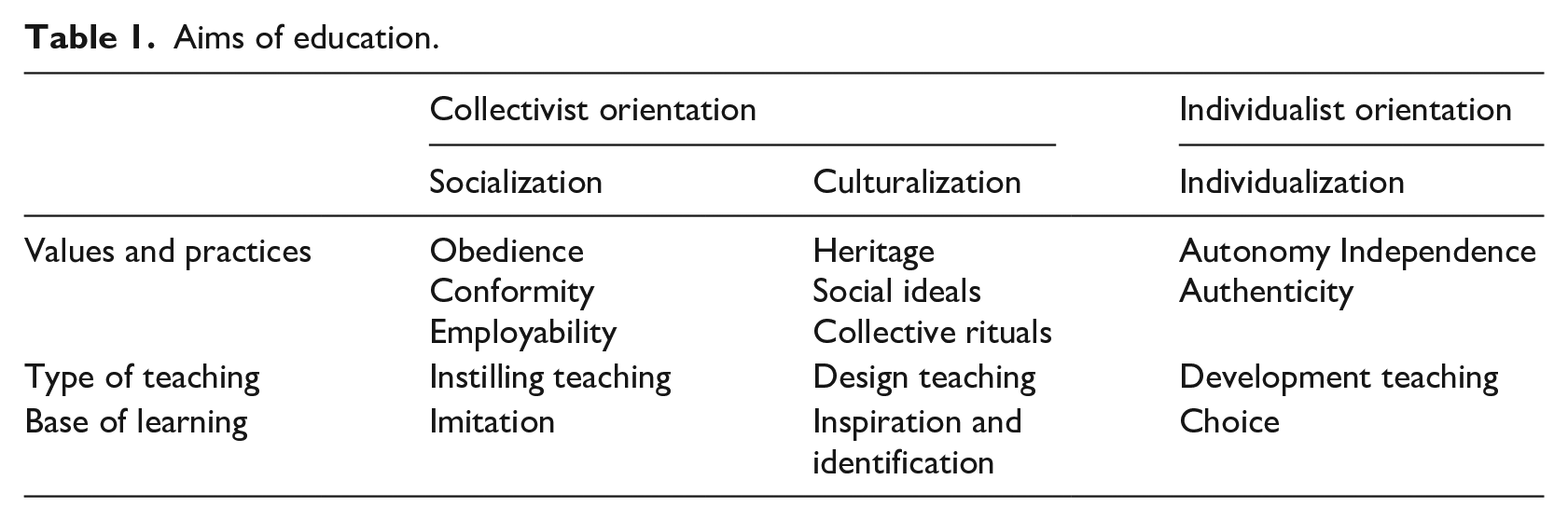
Lamm (1976, 1986) outlined three aims in education, arguing that education can serve three different ‘masters’: society, culture and individuals. Socialization emphasizes social assimilation and demands that education focus on developing knowledge, skills and the obedience necessary to fit into the existing social and economic structure. This aim is promoted by ‘teaching that instils’, in which demonstration and practice are central. The teacher illustrates behaviours that students are encouraged to imitate (Harpaz, 2008). Culturalization emphasizes the ‘fitting’ culture and demands that education focus on the cross-generational transfer of preferred values and practices. This aim is promoted by ‘teaching that shapes’, in which teachers serve as role models and inspire identification with themselves, with historical or fictional figures and with ideas (Harpaz, 2008). These two ‘masters’ represent collectivist-oriented aims that are linked to intellectual heteronomy. However, the third master, individualization, emphasizes the concept of a distinct self and focuses on cultivating autonomous and independent individuals. This aim is promoted by ‘teaching that develops’ in which teachers provide learners with a range of free choices and independence, and assist them in their personal growth and in the self-development of an authentic personality (Harpaz, 2008). Thus, individualization represents individually oriented aims that are linked to intellectual autonomy (see Table 1).
Aims of education.
Individualism is known to characterize Western society, where the emphasis is placed on the development of the individual (Lee and Walsh, 2001). This is essentially an individual mechanism that begins to operate when children first come into direct contact with the world. In this mode of thought, the self is associated with the autonomous or self-sufficient individual. Because more individualistic cultures are associated with skill-related outcomes such as school achievement (Phalet and Hagendoorn 1996; Ward and Kennedy, 1999), the educational focus on the individual is defined and nurtured through professional standards.
In contrast to the emphasis on autonomy and rights found in more individualistic societies, in more collectivistic societies (valuing socialization and culturalization), social relationships more closely reflect the duties rather than the rights of the individual (Miller, 1994). In more collectivist cultures, social connectedness, obedience to authority and the maintenance of social harmony are emphasized (Greenfield et al., 2003). Moreover, collectivism emphasizes social institutions. For instance, in collectivist societies religion is based on social connections which are an integral part of religious identity and are structured through communal ritual and tradition (Cohen and Hill, 2007). Since collective cultures tend to focus on group goals and compliance with social norms, education defines the personal will and motivation of children. Children are expected to renounce their personal independence and expression because much higher value is placed on the needs of the collective. This enables the collective to become more productive and children to be included and accepted in the society as adults (Acevedo et al., 2015).
Any educational discourse that refers to effective teaching obviously implies a new examination of educational aims (Murphy, 2008). Our goal was to discover the educational aims emerging from the OECD TALIS 2013 concerning teacher professionalism. Accordingly, the current study attempts to address the following research questions:
Are the educational aims emerging from the OECD TALIS 2013 survey’s items about teacher self-efficacy more collectivist-oriented or more individualist-oriented?
Which of the DCQ variables best predict teachers’ self-efficacy according to the TALIS framework?
Method
Participants and procedure
The data integrated two cross-national databases: The World Values Survey (WVS) and TALIS 2013. The WVS project was developed in 1981 with the support of a global network of social scientists. The goal of the project is to capture values and changes in values across cultures and countries, and to make these values and changes more comprehensible (Stonefish and Kwantes, 2015). The WVS is said to be the largest academic, cross-country, longitudinal investigation of human values and it is also the most diverse in the socio-economic profile of the participating counties. 3 Among the value-related topics covered by the survey are economic growth, democracy, religion, gender equality, social capital and personal well-being. 4 The survey data is not only used by academics in the fields of political science, sociology, social psychology, anthropology and economy but also by local government officials and international agencies such as the World Bank. 5 The WVS wave 5 data included 77,000 respondents from 54 countries. WVS surveys include residents (not only citizens) between the ages of 18 and 85, inclusive. The minimum necessary sample size to be achieved is N=1200. From the WVS wave 5 data, we identified items in the 2005–2009 survey assessing the DCQ that are conceptually associated with Lamm’s aims of education. TALIS 2013 included data on educational systems in 30 countries and 4 sub-national entities, and is based on responses from over 4 million lower secondary school teachers (OECD, 2014). From the TALIS 2013 database, we identified items addressing teacher self-efficacy as most relevant to taping the TALIS images of the ‘ideal’ teacher and teaching methods. Combining the available data, we constructed a dataset drawn from participants in the following 18 countries: Australia, Brazil, Bulgaria, Canada, Chile, Finland, France, Italy, Japan, Malaysia, Mexico, Netherlands, Norway, Poland, Romania, South Korea, Spain and Sweden. Countries that did not have data available from both surveys were eliminated from the final data file.
Measures
Desired child qualities (DCQ)
The survey included the following question: ‘Here is a list of qualities that children can be encouraged to learn at home. Which, if any, do you consider to be especially important?’ Respondents were asked to choose up to five qualities from a list that included independence, hard work, feeling of responsibility, imagination, tolerance and respect for other people, thrift (saving money and things), determination and perseverance, religious faith, unselfishness and obedience.
Teachers’ self-efficacy
The teacher self-efficacy indices in TALIS 2013 measure three aspects of teacher self-efficacy, asking teachers to rank the extent to which they believe they can do the following: 1) classroom management, such as efficacy in classroom management and controlling disruptive behaviour in the classroom – a sample item is: ‘Calm a student who is disruptive or noisy’; 2) instruction, such as using a variety of assessment strategies and providing alternative ways to explain instructional material when students initially fail to comprehend the material – a sample item includes: ‘Implement alternative instructional strategies in my classroom’; and 3) student engagement, such as motivating students who show low interest in schoolwork and helping students to learn to think critically – a sample item includes: ‘Get students to believe they can do well in school work’.
Control variables
In the TALIS 2013 survey database, we identified two relevant controls for the purpose of this study: teacher experience and teacher participation in professional development in the last 12 months.
Analytic strategy
The analysis involved several steps. First, the two data files were aggregated at the national level and merged. Second, we performed Pearson correlations between WVS DCQ items and TALIS 2013 teacher self-efficacy items. Third, we performed a set of regression analyses in which we entered relevant DCQ predictors together with other predictors derived from the TALIS 2013 survey in order to predict teacher self-efficacy according to the TALIS framework.
Results
Pearson correlations were performed between WVS DCQ items and TALIS 2013 teacher self-efficacy items in order to determine if the educational aims emerging for the OECD TALIS 2013 survey were more collectivist-oriented or more individualist-oriented. The correlation analyses provide several important insights. First, significant negative associations between the DCQ of independence (−.41<r<−.59, p<.001), determination (−.41<r<−.59, p<.01) and responsibility (−.41<r<−.63, p<.01), and most of the TALIS 2013 teachers’ self-efficacy items were found. Second, significant positive associations emerged between the DCQ of religious faith (.42<r<.72, p<.01) and obedience (.40<r<.55, p<.01) with multiple TALIS 2013 teachers’ self-efficacy items. However, no relationship was found between DCQ of tolerance and respect, unselfishness, hard work and saving money and the TALIS 2013 teachers’ self-efficacy items (p>.10). DCQ of imagination produced only one negative correlation with the TALIS 2013 teachers’ self-efficacy (r=−.47, p<.01). It seems that in countries where a large proportion of the population values the educational goals of independence, determination and responsibility, more teachers emerged as displaying a lower level of self-efficacy according to the TALIS 2013 framework. By contrast, in countries where a large proportion of the population values the educational goals of religious faith and obedience, more teachers emerged as having high self-efficacy according to TALIS 2013.
Predicting teacher self-efficacy according to the TALIS 2013 framework
To investigate which of the proposed WVS DCQ variables best predict teacher self-efficacy according to TALIS, we performed stepwise regression analyses for each of the 12 TALIS 2013 teachers’ self-efficacy items separately (Table 2). We entered only WVS DCQ variables that showed significant correlations with teacher self-efficacy items, namely independence, determination, responsibility, religious faith and obedience. We also controlled for the influences of teacher experience and teacher participation in professional development in the past 12 months.
Final results of stepwise regression analyses predicting teachers’ self-efficacy by TALIS framework at the country level (N=18).
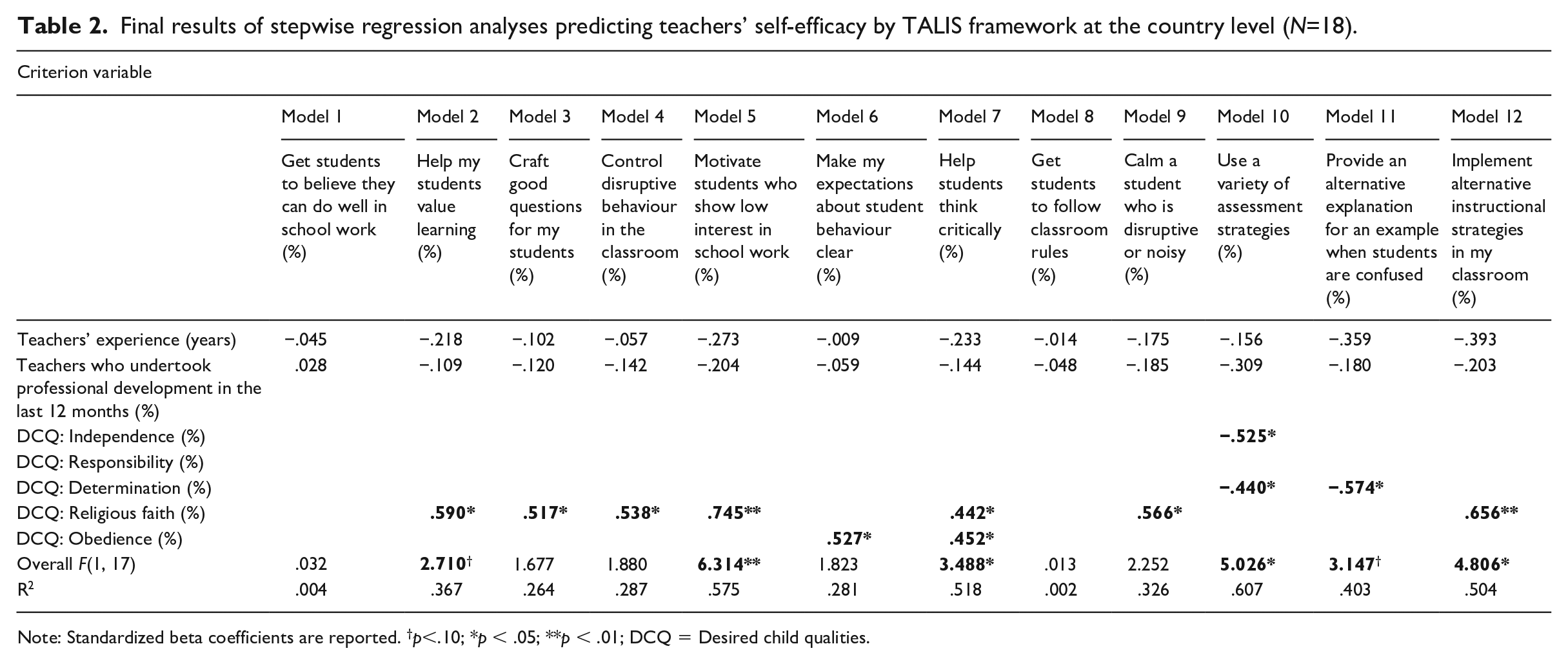
Note: Standardized beta coefficients are reported. †p<.10; *p < .05; **p < .01; DCQ = Desired child qualities.
The DCQ of religious faith emerged as a significant positive predictor of seven items included in the TALIS 2013 teachers’ self-efficacy framework (.44<β<.74, p<.05). In six of the items, the DCQ of religious faith was the sole significant predictor, explaining between 26% and 57% of the variance in the TALIS 2013 teacher self-efficacy items. Second, the DCQ of obedience emerged as a significant positive predictor of two items included in the TALIS 2013 teachers’ self-efficacy framework (.45<β<.52, p<.05). Third, of the remaining DCQ items entered in the models, determination emerged as a negative predictor of two items included in the TALIS 2013 teacher self-efficacy analysis. In one of these cases, determination joined responsibility as a second predictor. Finally, the DCQ of independence did not emerge as a significant predictor of any of the TALIS 2013 teachers’ self-efficacy items.
Discussion
Recent literature in the field of comparative education has acknowledged the power and impact of global forces in educational processes, influencing the subject matter of education, teaching methods and testing goals (Berkovich and Benoliel, 2020a; Kelly et al., 2017). Teachers, their methods of teaching and their methods of learning are becoming central issues, both at the local and the global levels (Sørensen, 2016). Through public statements and publications, the OECD has facilitated the development of a discourse that promotes a new concept of teacher professionalism. The present study focused on TALIS 2013 to better understand the OECD’s view of ideal teaching as manifested in the teacher self-efficacy survey items. Our unique approach sheds new light on a key psychological-functional conceptualization of ideal teachers in the TALIS survey (i.e. teachers’ self-efficacy) by exploring the interaction of its vision of ideal teaching with national educational goals. Thus, the present study goes beyond exploring the content of TALIS items and focuses on the applicative use of TALIS as a tool that conceptualizes the ideal form of ‘teacher professionalism’.
The first goal of the study was to identify whether the educational aims emerging from the OECD TALIS 2013 survey were more collectivist-oriented or more individualist-oriented. The research results indicated that in countries where a large proportion of the population values the educational goals of independence, determination and responsibility, fewer teachers displayed a high level of self-efficacy according to the TALIS 2013 framework. By contrast, in countries where a large proportion of the population values the educational goals of religious faith and obedience, more teachers had high self-efficacy according to TALIS. Therefore, our results showed that the new professionalism as represented by the OECD TALIS 2013, through the teachers’ self-efficacy items, is aligned with traditional collectivist educational goals. In other words, TALIS’s psychological-functional definition of an ideal teacher as manifested in the teacher self-efficacy items seems to align with the classic conservative teaching model that emphasizes normative behaviours and integration into society. Thus, teachers serve as both role models and rule-enforcers (Jones, 2009). The operation of teacher self-efficacy is linked with classroom management, but it is worth remembering that discipline can take not only a conservative form that highlights rules and punishments but also a liberal and progressive form that highlights respect, collaboration and self-discipline (Johnson et al., 1994). This further suggests that the OECD’s reports and frameworks frame societal goals which might capture not only particular forms of individualization that value personal goals and self-interest but also collective societal duties and role obligations as well (Berkovich and Benoliel, 2020b). Hence, our results may indicate that global agencies tie themselves to multiple societal goals that are often conflicting. This finding echoes prior discussion in the ideology of neoliberalism, often associated with international agencies, as claiming to combine liberal and conservative ideals but in practice adopting standardizing practices that subject practice to a conservative agenda (Apple, 2004). As in other OECD large-scale assessments initiatives such as PISA, we expect that here too TALIS will further assist the construction of conservative countries (e.g. East Asian countries) as reference societies in the face of national economic competition and sense of national crisis (Waldow et al., 2014).
Regarding the DCQ variables that best predict teacher self-efficacy according to the TALIS 2013 framework, first, surprisingly, the findings of our cross-country analysis indicated that independence did not predict any of the TALIS 2013 teacher self-efficacy items. We can interpret this finding such that the ideal TALIS teaching method is not compatible with individualization, which reflects the DCQ of independence and imagination where the emphasis is placed on the development of the individual (Lee and Walsh, 2001). Second, and more importantly, the DCQ of obedience and the DCQ of religious faith emerged as significant positive predictors of TALIS 2013 teacher self-efficacy items. These results show that the psychological-functional characteristics (i.e. teacher self-efficacy) of the ideal teacher favour countries that prioritize: 1) socialization, which is characterized by social assimilation, and demands that education focus on developing knowledge, skills and the obedience necessary to fit into the existing social and economic structure; and 2) culturalization, which emphasizes the ‘fitting’ culture, and demands that education focus on the cross-generational transfer of preferred values and practices.
These first results are important because they emphasize that socialization and culturalization, which represent collectivist-oriented aims and are linked to intellectual heteronomy, are aligned with teacher self-efficacy as framed by the OECD TALIS. These findings complement and add nuances to prior studies on TALIS that indicate that TALIS incorporates various preferences and biases about education and pedagogy (i.e. Fraser and Smith, 2017; Robertson, 2013; Sørensen and Robertson, 2017). Thus, our results point to another bias of a different nature in the TALIS design itself, as this is hidden in the psychological-functional conceptualization of ideal teaching.
In addition, our findings suggest that TALIS, at least in the self-efficacy items, has a prominent collectivism teaching bias. These results highlight the societal ideology promoted by the TALIS 2013 assessment framework on teacher self-efficacy which framed how the ideal teacher is expected to behave. Often, models of teachers’ professionalism in the 21st century are narrowly defined in terms of their autonomy – the autonomous public service model vs. the highly regulated workers’ model (Rinne and Ozga, 2013). However, this debate separates teaching from its broader and fundamental role in the social fabric as promoting national individualization or collectivism. Thus, de facto according to TALIS, ideal teachers are teachers who fit the classic conservative collectivist ideal of role models and rule enforcers (Harpaz, 2008), in contrast to the role of giving ‘high-quality client services’ and showing flexibility to clients’ needs (Rinne and Ozga, 2013: 103).
Uncovering this bias further highlights the tensions within and between the OECD activities and large scale assessment programmes (e.g. TALIS, PISA). This might be a result of the organization being based on multilateral governance (Mundy, 2007) as it needs to appeal to and satisfy multiple national governments and stakeholders. Accordingly, being identified as adopting a specific ideological stand or a specific set of policies might limit the OECD’s reach (Lingard and Sellar, 2016; Valiente, 2014). That is not to say that the OECD has no underlined ideological and policy agenda, but rather that it is often mixed with other ideological and policy elements. For instance, Fraser and Smith (2017) argue that the OECD has also come to emphasize teacher professionalization without abandoning its prior ideological basis in human capital theory.
Limitations and future research
The major strength of the present study was that the likelihood of common method variance was low because data was collected from two sources (Avolio et al., 1991): WVS (DCQ) and teacher self-efficacy (OECD TALIS). Also, to ensure that all comparisons made in the current study used the same variables for each country, countries that for some reason had missing data were excluded from the sample. However, several limitations of the study warrant further attention in future research. First, the study’s sample is small and this might affect both the power of the analyses and their robustness. Nevertheless, this constraint is a common problem of cross-country analysis (Berkovich, 2016). Since the number of participating countries grew to 48 in the TALIS 2018 cycle, future studies can replicate this research using a larger sample. Second, the cross-sectional design of the present study raises the issue of causality. The data cannot provide direct evidence of causal links between our variables. Third, we did not account for additional explanatory cultural indicators at the national level. For instance, variability in cultural dimensions within countries might also help to explain variations in teacher self-efficacy indicators. Fackler and Malmberg (2016: 186) reported in their study on teacher self-efficacy in 14 countries that ‘A stricter model in which the factor loadings were constrained across the teacher, school and country levels fitted data less well at the school and country levels’. Such evidence of inability to produce measurement invariance necessitates that future research investigate cultural influences on OECD assessments.
Conclusion
The literature suggests that a ‘global education policy’ environment is forming and that international agencies acting in this space promote the transformation of state educational systems towards a neoliberal model (Ball, 2012). The OECD, appealing mainly to highly developed countries, has become a very influential international organization in this global policy space. The OECD invests heavily in framing a Gordian link between a neoliberal attitude to education, on the one hand, and employment and productivity, on the other. Prior research has shown that the OECD’s educational agenda and policies are based on economic rationality in which education serves to advance the goal of producing the human capital countries require in order to compete in the global market, thus distancing education from its role as a socio-political venture that seeks to enhance cohesiveness, equality and democracy (Lewis, 2014; Walker, 2009). Based on this vision, it has been asserted that the OECD has an agenda to produce individuals that fit the role of entrepreneurial lifelong learners who are well behaved and well integrated into society (Walker, 2009). Put another way, the OECD seeks to produce individuals that act as consumerist self-capitalizing individuals in a neoliberal society (Lingard, 2009).
In this context, new models of ideal teaching that take ‘quantified’ and ‘standardized’ approaches that suit the global knowledge-based market economy have been introduced by the OECD among others through the TALIS survey and TALIS-related discourse (Berkovich and Benoliel, 2020a). The present study explored the relationship of OECD TALIS 2013 teacher self-efficacy items to WVS DCQ items at the national level. Our findings, suggesting that TALIS’s 2013 teacher self-efficacy conceptualization is aligned with traditional collectivist education goals, are surprising. According to our results, this psychological-functional concept in TALIS, often valued due to its contribution to learning and achievement, seems to encompass a societal preference that has not been reported so far. Our findings join previous works that have suggested that the TALIS framework is more pluralist in its educational and pedagogical approaches. It seems that the TALIS initiative, due to its ambitious goal of promoting ‘ideal’ teaching methods, serves the OECD multilateral governance challenges, on the one hand, but on the other, undermines its efforts towards promoting ordinalization linked with political neoliberalism. Thus, our work offers an additional explanation of why comparison and vertical ordering associated with TALIS remain largely muted (Sørensen and Robertson, 2020).
Footnotes
Declaration of conflicting interests
The authors declared no potential conflicts of interest with respect to the research, authorship and/or publication of this article.
Funding
The authors received no financial support for the research, authorship and/or publication of this article.
