




Abstract
Teacher collaboration has gradually become a common idea in the reform of teacher education all over the world. However, up to now, the current situation of teacher collaboration is still isolated and conservative to a certain extent. How to avoid being mere formality and promote the development of teachers’ cooperative practice effectively has become an urgent problem for educational researchers and practitioners. Based on the data of TALIS 2018, this study focuses on the impact of teacher cooperation on teaching practice in China and the United Kingdom, with teacher self-efficacy playing the mediating role. Above all, SPSS 23.0 was used for data preparation, descriptive statistics, and Pearson product difference correlation analysis. Then, maximum likelihood estimation and robust standard deviation (MLD) were applied to estimate confirmatory factor analysis and structural equation model through Mplus 7.4. In addition, bootstrap self-help sampling method was adopted to test the mediating effect. About the direct effects of teacher collaboration on teaching practices, the results indicated that exchange and co-ordination was positively related to clarity of instruction in both China and England while professional collaboration was not significantly related to clarity of instruction in the two countries. In terms of the mediating role of self-efficacy between teacher collaboration and teaching practices, the study revealed the indirect effects of professional collaboration on three sub-scales of teaching practices exist via teacher self-efficacy in both China and England. Theoretical and managerial implications regarding using teacher self-efficacy as a mediating variable to examine the effect of common collaboration forms on specific teaching practices were discussed. Limitations and further research were also offered.
Keywords
Introduction
Teacher collaboration has aroused researchers’ interest since the 1980s (Eshchar-Netz & Vedder-Weiss, 2022; Vangrieken et al., 2015). This concept has been intensively used in the literature of professional learning community (PLC) during the past 40 years and collaborative effort among teachers exerts unique role in sustaining the development of PLC (Ning et al., 2015). Teacher collaboration refers to the continuous unity of active and regular collaborative activities between teachers from one-time interaction to a higher level (Vangrieken et al., 2015). Research over the past 40 years has shown that teachers engaged in collaborative activities tend to gain higher teaching confidence and reduce the sense of isolation compared with teachers working alone (Reeves et al., 2017). Specifically, effective teacher collaboration is conducive to students’ achievement (e.g., Y. Goddard & Kim, 2018; Reeves et al., 2017), teacher’s development such as commitment, confidence, morale, and self-efficacy (e.g., Duyar et al., 2013), and school development (e.g., Webs & Holtappels, 2018).
Researchers have linked teacher collaboration, self-efficacy, and teaching practices in various ways (Y. Goddard & Kim, 2018). For example, Kim et al. (2017) examined the relationship between teacher collaboration and specific instructional practice (learner-centered practice) and found the informal school-based collaboration had an effect on learner-centered teaching. Further, when teacher collaborate together with a focus on development of instructional changes, they are more capable of improving students’ learning. That is, their self-efficacy is underpinned (Y. Goddard & Kim, 2018). Zeng and Day (2019) pointed out that policies in England appeared to overemphasize on teacher’s functional aspect (knowledge; competency) in contrast to neglect their attitudinal aspects (efficacy; motivation; commitment) and then called for more empirical research that should engage in probing the relationship between teachers’ functional ability and attitudinal capacity. Although plenty of researches have been conducted regarding the relationships among teacher self-efficacy, collaboration, and teachers job satisfaction (Çoban et al., 2023; S. Liu et al., 2021; Y. Liu et al., 2023), very few of which explores the relationships among teacher collaboration, self-efficacy, and instructional practice in an indirect way. As such, the present study intends to use teacher self-efficacy as a mediating variable to examine the effect of common collaboration forms (i.e., professional collaboration, exchange, and co-ordination) on specific teaching practices (i.e., clarity of instruction, cognitive activation, and classroom assessment).
Teacher collaboration is a significant research topic widely discussed worldwide, due to its prominent role in strengthening teachers’ development expectations, improving teachers’ ability to reflect, and promoting organizational learning from school (Hargreaves, 2019). Numerous countries have laid emphasis on Teacher collaboration in teacher professional development. The latest national professional standards for teachers in China include teamwork, collaboration, and exchange in the requirements of teachers’ professionalism (Ministry of Education, 2019). In England, teachers’ continuous professional development gradually becomes an important tool for teachers to comply with policy implementation (Park & Lee, 2015). In the United States, teachers may collaborate on the job activities; however whether they are able to actually participate in collaborative activities still face many challenges (Johnston & Tsai, 2018). How to make collaboration work and avoid becoming a mere formality has become the consensus of all countries to improve the quality of teaching. A close partnership communication network has been established between China and England since 2014 due to the implementation of China-England Mathematics Teacher Exchange (MTE) Program (H. Yuan & Huang, 2019). The MTE program has an important impact on the practice of mathematics teaching (Boylan et al., 2018). In order to carry out this study, the Teaching and Learning International Survey (TALIS) 2018 data were selected. TALIS 2018 was a large-scale representative survey of teachers, school leaders, and teaching conditions. It provides public data from 48 participating countries/economies (including China and England), which makes it possible to explore and compare how teacher collaboration affects teaching practices in China and England (Organization for Economic Cooperation and Development [OECD], 2019c). It is expected, by analyzing TALIS 2018 data, the practical and beneficial suggestions could be yielded for teachers’ professional development for both China and England.
First, Shanghai and England have similar economic, cultural, and educational backgrounds. Shanghai is an economically developed region in China. Its GDP, infrastructure and economic structure are developing rapidly and gradually close to the level of developed countries. As China’s foreign window, Shanghai, like Britain, is the convergence of world culture, with multi-cultural coexistence. Second, both Shanghai and England participated in the TALIS project in 2018. TALIS2018 investigated teacher cooperation and teaching practice. With sufficient data support, Shanghai and England have comparable research conditions. Third, through comparison, it can promote the understanding of the impact and differences of teacher cooperation between China and the UK on teaching practice, and build a bridge for the communication of educational ideas between China and the UK. Different teaching traditions should learn from each other in cross-cultural comparison and examination. The research from the cross-cultural perspective makes us realize that the truly optimized classroom teaching is an inclusive teaching of the advantages and advantages of the classroom teaching tradition under the background of eastern and Western cultures. It is a kind of integration and unity of eastern and Western teaching ideas and teaching methods. This kind of education based on integration and unity puts forward a new topic of great significance to the teaching reform, which requires researchers and practitioners to break through the original model framework with an open attitude and cross-cultural awareness, and innovate and integrate on the basis of mutual absorption and tolerance.
The present study aims to explore how teacher collaboration affects teaching practices in China and England using the structural equation model based on the TALIS 2018 data.
Specifically, two research questions guide the current study:
What is the direct effects of teacher collaboration on teaching practices in China and England, respectively?
Does teacher self-efficacy play a mediating role between teacher collaboration and teaching practices in China and England, respectively?
Literature Review
Teacher Collaboration
Teacher collaboration has drawn educators and policy makers’ attention globally given that teachers who participate in teacher collaboration appear to be more reflective toward their instructional practices, be more inspired to try novel instructional strategies, and have more potential to improve teacher professionality (e.g., Bush & Grotjohann, 2020; Doppenberg et al., 2012; Gräsel et al., 2006; Reeves et al., 2017; Ronfeldt et al., 2015). Vangrieken et al. (2015) described teacher collaboration as a continuum from one-off interactions to higher levels of activity and regular collaborative activity between participants. These collaborative activities have been presented by diverse forms in the literature.
A large amount of collaborative activities have been presented by diverse forms in the teacher collaboration literature. For instance, Little (1990) firstly defined the generic construct of teacher collaboration: Storytelling, help and assistance, sharing, and joint work. Specifically, the terms of storytelling and help and assistance tend to be less intensive to call for collaboration due to the one-direction feature. That is, individuals only need to convey anecdotes to listener or afford assistance for people who ask for help. However, the mutual interplay can be involved in sharing. It includes share their experience, views, methods, or materials with each other. Most importantly, joint work represents the higher level of collegiality as well as the true collaboration spirit. Later on, Gräsel et al. (2006) developed Little’s concept of teacher collaboration to a three-level model: exchange, division of work, co-construction. First, they renamed Little’s sharing to exchange, which suggested a way of sharing materials, information, and knowledge. Second, division of work anticipated the common goal among participants and meant to divide tasks for everyone. Third, co-construction referred to working altogether until tasks were completed. Therefore, extant teacher collaboration literature has demonstrated that collaborative activities may occur on a continuum from relatively complete independence to complete collaboration.
Teacher collaboration is a concept extensively used in different contexts. Specifically, teacher collaboration presented in different forms and terms from western countries in China (Paine & Fang, 2006; Zheng et al., 2019a). R. Yuan et al. (2018) observed that teacher collaboration in China is organized by teacher research group (jiaoyanzu in Chinese) where the same subject teachers work together routinely to discuss teaching and students’ learning. Zheng et al. (2019a) identified four different levels of teacher cooperation at National, provincial, district, and school levels.
At each level, teachers were work together to have lesson preparations, to have public lesson observations, or to critique other teachers’ classes. Jiaoyanzu is the basic form of school level collaboration that teachers can work together at daily bases. For other levels, only selected numbers of teachers have the opportunity for participation. In contrast to England, two major forms were employed to foster teachers’ collaboration and professional development (Adams, 2017; Zeng & Day, 2019). For example, Zeng and Day (2019) pointed out that formal collaborative works (i.e., team planning and preparation of lessons and formal staff meetings) and informal collaborative activities (i.e., informal dialogue with colleagues in school) were the major forms of teacher collaboration for the secondary teachers via analyze quantitative and qualitative data. Specifically, Adams (2017) showed that English teachers were more prone to benefit from informal professional learning (i.e., informal sharing of problems and resources) and had few opportunities for collaboration. Additionally, Adams also revealed that teacher collaboration was limited to school-based cycle and any collaboration beyond the school seems to be constrained by performative structures.
New constructs of teacher collaboration have emerged from the use of large scale data studies such as TIMSS and TALIS. Although the items presented in these large scale surveys are different, they demonstrated the basic elements of exchanging materials and engaging in collective teaching practice which were commonly applied by many education systems. García Torres (2019) adopted TALIS 2013 questionnaire to investigate US teacher collaboration with the relation of distributed leadership and job satisfaction. In this study teacher collaboration were measured by four items such as teaching jointly as team in same class and observing other teachers’ classes. Reeves et al. (2017) used TIMSS questionnaire to investigate teacher collaboration activities in Japan and United States that only contained five items. These items are similar to the items adopted by García Torres (2019) study. Certainly, many studies have investigated at least one form of collaboration and found several advantages of using at least one form of collaboration by utilizing different samples. However, little is known about which form of collaboration may be more beneficial in China and England by utilizing TALIS 2018 database. In this study, two forms of cooperation representing different degrees of cooperation were used, namely, professional cooperation between teachers in the classroom, and communication and coordination between teachers (see method section for details). These two types of cooperation come from the TALIS 2018 study, Professional cooperation means deeper cooperation and higher interdependence between participants, while communication and coordination means lower interdependence between participants and is considered a lower level of cooperation (Duyar et al., 2013; García Torres, 2019; OECD, 2014b). Studying various types of collaboration in two different cultural contexts will provide valuable insight for teachers, managers, and policy makers.
Teaching Practices and Teacher Collaboration
A large body of studies have identified teachers’ classroom instruction as the most crucial component in student learning (J. J. Chen & Guo, 2018; Fischer et al., 2020; Hattie, 2012; Joo, 2020). International studies in past decades have revealed two major approaches toward teaching: teacher-directed and student-centered (J. J. Chen & Brown, 2016; Tobias & Duffy, 2010). Teacher-directed approach provides a well-structured learning pattern. Teachers guided by this approach appear to control their students’ learning process precisely and act as a knowledge transmitter. However, student-centered approach, which is rooted in constructivism, aims to inspire students’ active engagement in learning and promotes knowledge’s construction (Caro et al., 2016). Aside from these two forms of teaching, researchers (e.g., Fischer et al., 2020; Heaysman & Tubin, 2019) incorporate assessment components into teaching practices. Classroom assessment (i.e., teacher feedback), for example, is suggested to integrate into instructional practices gradually (Fischer et al., 2020). Feedback, which exist in daily teacher-student interaction, is identified as an innovative teaching practice to facilitate students’ learning (Heaysman & Tubin, 2019; Vlachou, 2015).
The positive effect of teacher collaboration on teaching practices has been consistently shown in the extant literature (e.g., Kim et al., 2017; Y. Goddard & Kim, 2018; Hatlevik & Hatlevik, 2018; Parise & Spillane, 2010; Reeves et al., 2017). In particular, Kim et al. (2017) explored the relationship between teacher collaboration and learner-centered instruction via analyzing 1,653 teachers in 149 Korean middle schools and found that instructional change toward learner-centered teaching was promoted by teachers who participated in informal school-based teacher collaboration. Further, Y. Goddard and Kim (2018) employed multilevel structural equation modeling to examine the relations between teacher perceptions of collaboration and differentiated instruction. Findings showed that in school where teacher collaboration perceived more, then differentiated instruction reported use greater.
Teacher Self-efficacy, Teacher Collaboration, and Teaching Practice
Teacher self-efficacy receives great attention for educational researchers due to the promising role that teachers play in students’ learning (Y. Liu et al., 2021). Derived from the social cognitive theory, self-efficacy is considered as the conviction that one can successfully execute the behavior required to produce a given outcome (Bandura, 1977). Teacher self-efficacy is defined as teacher’s beliefs about self-referent judgment to complete specific tasks that subject to educational goals (Granziera & Perera, 2019). The importance of teacher self-efficacy emerges from its cyclical nature: Higher levels of efficacy beliefs lead to greater efforts by teachers, which in turn leads to better performances, which again provides information for forming higher efficacy beliefs (Tschannen-Moran et al., 1998). Tschannen-Moran and Hoy (2001) presented a three-factor model of teacher self-efficacy: Efficacy for student engagement, efficacy for classroom management, and efficacy for instructional strategies. The present study also covered the three essential aspects following TALIS 2018. The extant literature consistently show that teacher with high level of self-efficacy is conducive to student’s learning and school improvement (Zheng et al., 2019a).
Researchers (e.g., Duyar et al., 2013; R. Goddard et al., 2015; Goddard & Kim, 2018; Kim et al., 2017; Sehgal et al., 2017) have suggested that teacher collaboration have positively effect on their self-efficacy. For instance, Duyar et al. (2013) found that teacher collaborative activities significantly predicted teachers’ self-efficacy by applying TALIS data, which included 178 principals and 2,967 teachers. R. Goddard et al. (2015) demonstrated that collective efficacy beliefs were predicted by teacher collaboration when explored roles of instructional leadership, teacher collaboration, and collective efficacy beliefs in support of student learning. Similarly, Kazemzadeh et al. (2017) claimed that EFL teacher’s perceptions and practices of collaboration had positively relations to their self-efficacy.
A large body of research (e.g., Nie et al., 2013; Ross & Gray, 2006; Zheng et al., 2019b) has concluded that teacher perceived self-efficacy higher, their teaching practices, and their student development could become better. For instance, Ross and Gray (2006) revealed that teachers with a greater sense of teaching efficacy were more confident in their teaching abilities, persistent when learning is difficult, and willing to try new teaching strategies via investigating 3,042 elementary teachers in Ontario district. Nie et al. (2013) found that teachers’ self-efficacy perceived higher, the inventive instructional methods used more when they explored the role of self-efficacy in the instructional innovation. In short, there is a close tie between teacher collaboration, teacher’s self-efficacy, and instructional practices.
So far, many researchers have explored the indirect effects of teacher self-efficacy in educational settings (Han et al., 2019; Ross & Gray, 2006; Simbula et al., 2011). For example, Han et al. (2019) explored the relationship between challenge job demands, job resources, emotional exhaustion, and work engagement with the mediation role of teacher self-efficacy and found that teacher efficacy can mediate the effect of challenge job demands and job resources on work engagement. Hu et al. (2019) also took teacher self-efficacy as a mediating variable to investigate the association between school climate and preschool teacher stress and showed principal collegial leadership exerts a significant negative effect on preschool teachers’ stress via the mediating role of teacher self-efficacy. Therefore, teacher self-efficacy as personal resource is a crucial teacher characteristic, which not only can be influenced by learning environments but also can mediate their work engagement and work moods effectively. A paralleled argument made in the present study is that teacher self-efficacy may play a mediating role between teacher collaboration and teaching practices in the contexts of China and England.
Conceptual Framework
In the present study, teacher self-efficacy is considered as a mediating variable to examine the effect of common collaboration forms (i.e., professional collaboration, exchange, and co-ordination) on teaching practices (i.e., clarity of instruction, cognitive activation, and classroom assessment). Certainly, this model is identified by reviewing a wide range of literature for teachers to engage in effective collaboration and therefore promote teaching practices, which has suggested the different but supportive evidence of the link among the variables.
Studies in past four decades have shown that teachers who work in collaborative activities tend to have higher teaching confidence and feel less isolated than teachers who work alone (Reeves et al., 2017). Effective teacher collaboration are conducive to teacher’s development (e.g., commitment; confidence; morale; self-efficacy) (Duyar et al., 2013). This shows teacher self-efficacy can be improved by means of teacher collaboration. Meanwhile, the extant literature has suggested that teacher with a higher self-efficacy are willing to try new teaching methods and devoted to improve their teaching practices (Nie et al., 2013).
Although the three constructs adopted in our research are barely employed in one study, the paired relationships among teacher collaboration, teacher self-efficacy, and teaching practices have been empirically explored in different studies. In this sense, this study establishes its conceptual framework in order to provide a comprehensive understanding of the relationship among teacher collaboration, teacher self-efficacy, and teaching practices (see Figure 1).

Conceptual framework.
Methods
Quantitative methods were mainly used in this study. Specifically, SEM is used to examine the paths between potential variables directly and indirectly affected to answer research questions. In this section we introduce the data, samples, variables, and analytical procedures as well.
Data and Samples
This study utilizes an international database from the 2018 TALIS (OECD, 2018), which is one of a number of other activities and studies within the Organization for Economic Cooperation and Development (OECD) program of assessing and monitoring the policies, practices, and outcomes of education systems worldwide. In China and England, as in other countries, TALIS had a two-stage sampling design. In the first stage, schools were divided into groups by regions and the number of teachers etc. A sample of schools was then randomly selected to participate in the study from each group. The target school sample size was 200 lower-secondary schools. In the second stage, a random sample of 20 teachers was selected in each school. If a school had fewer than 20 qualified teachers, all teachers should be selected (OECD, 2019a). This two-stage sampling design was able to ensure that the TALIS data were representative of teacher population in each participating country.
This study used teacher data from China and the England, of which 3,976 (2,941 women and 1,035 men) were from China and 2,376 (1,537 women and 839 men) from the England. Among the Chinese teachers, 84.8% were from public schools and 15.2% were from private schools. With regard to the teaching experience, 16.0% were less than 5 years, 15.0% were between 6 and 10 years, 15.0% between 11 and 15 years, 16.3% between 16 and 20 years, and 37.4% above 21 years. For the England sample, there were 841 teachers from public schools and 1535 from private schools. In terms of the teaching experience, 23.2% were less than 5 years, 21.5% were between 6 and 10 years, 21.5% between 11 and 15 years, 15.6% between 16 and 20 years, and 18.2% above 21 years.
Variables
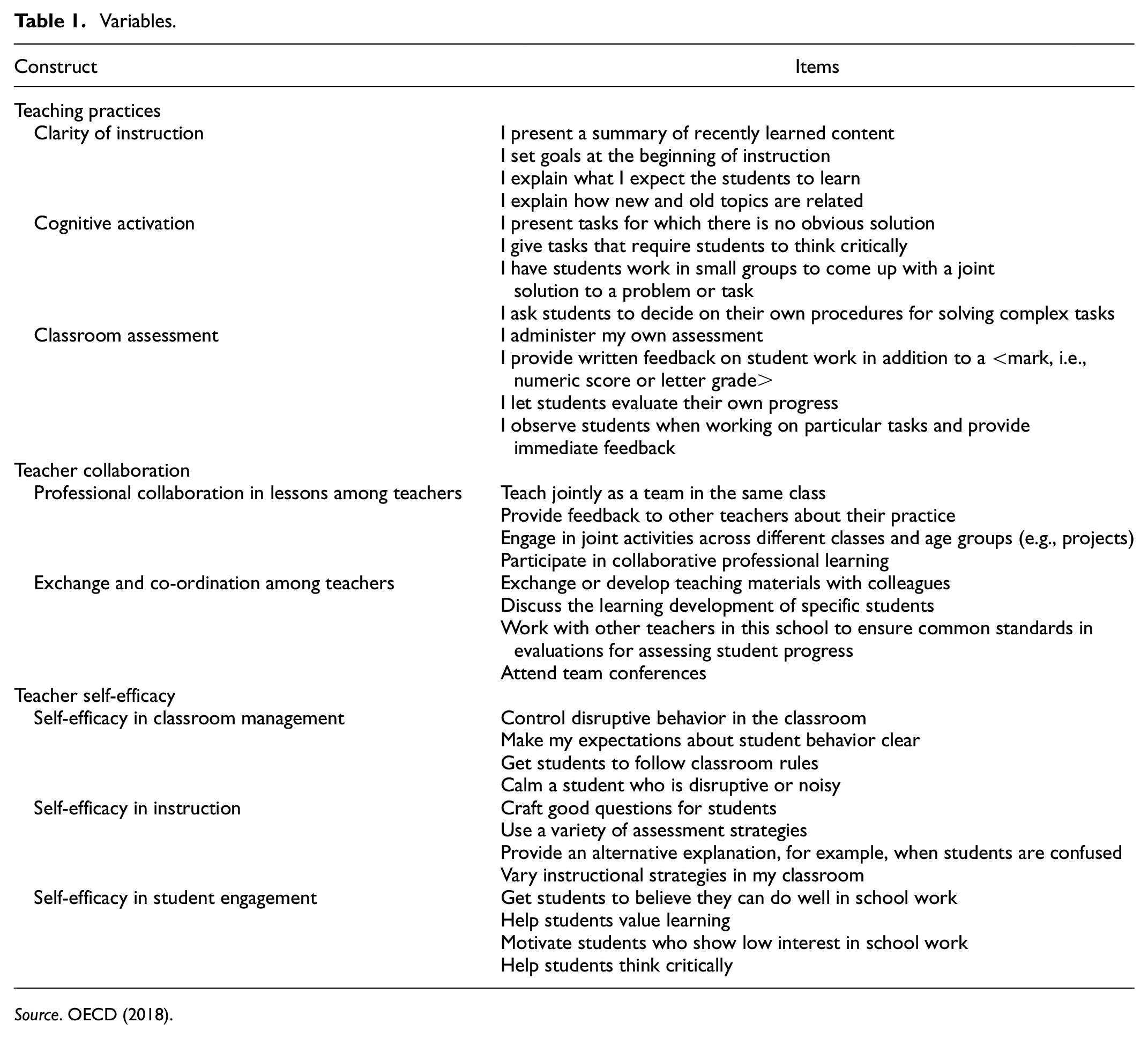
In this study, dependent variable, independent variable, and intermediate variable were selected from TALIS 2018 (OECD, 2018). A detailed description is as follows (see variables in Table 1).
Variables.
Source. OECD (2018).
Dependent Variable
The dependent variable is teaching practices (TP), which is based on three subscales: clarity of instruction (CLAIN), cognitive activation (COGAC), and classroom assessment (ASS). The CLAIN scale consists of four items (OECD, 2018): (a) I present a summary of recently learned content, (b) I set goals at the beginning of instruction, (c) I explain what I expect the students to learn, and (d) I explain how new and old topics are related. Similarly, the COGAC scale includes four items (OECD, 2018): (a) I present tasks for which there is no obvious solution, (b) I give tasks that require students to think critically, (c) I have students work in small groups to come up with a joint solution to a problem or task, and (d) I ask students to decide on their own procedures for solving complex tasks. The items in the CLAIN scale are usually associated with teacher-directed forms in teaching practices. The COGAC scale emphasized more on student-centered teaching behaviors. More recently, classroom assessment, as an additional of teaching practices, has garnered much attention (OECD, 2019b). Hence, on the basis of teaching practices with teacher-directed and student-centered, we added classroom assessment to the teaching practices variable with four items (OECD, 2018) (e.g., I observe students when working on particular tasks and provide immediate feedback, to address the frequency that a teacher adopted different assessment skills in their teaching). In short, the dependent variable of this study is teaching practices with three subscales. Each scale was measured on a four-point Likert scale, with response 1 for “never or almost never,” 2 for “occasionally,” 3 for “frequently,” and 4 for “always.”
Independent Variable
The independent variable is teacher collaboration (TC). This construct contains two subscales: professional collaboration in lesson (COLES), and exchange and co-ordination (EXCH). Each construct includes four items (OECD, 2018), respectively (see Table 1). All items were measured on a six-point scale from 1 to 6, with “1” representing “never” and “6” standing for “once a week or more.”
Mediating Variable
The mediating variable in the present study is teacher self-efficacy (SELF). In TALIS 2018 questionnaire teacher self-efficacy was categorized as three subscales (efficacy in classroom managements, efficacy in instructions, efficacy in student engagements). Each subscale was comprised of four items (OECD, 2018), all of which were measured on a four-point Likert scale, with response 1 for “not at all” and 4 indicating “a lot.” In the present study SELF was run as a composite score to facilitate data analysis.
Analysis Procedures
SPSS 23.0 and Mplus 7.4 were adopted for data analysis. Firstly, SPSS was used for descriptive statistics. Secondly, Mplus was used for the confirmatory factor analysis (CFA) and structure equation modeling (SEM) with maximum likelihood estimation. The CFA examined the construct validity of the measurement model. SEM is to examine the direct and indirect effects among variables. Specifically, the independent variable directly influences on the dependent variable and the independent variable has an indirect effect on the dependent variable through mediating variable. The model fit is determined by a series of acceptable indicators (e.g., RMSEA < 0.8, SRMR < 0.8, CFI > 0.9, and TLI > 0.9) (Schreiber et al., 2006). For mediation analysis, the bootstrap method is used to detect the indirect impact (Hayes, 2009).
Results
Firstly, it was necessary to test the reliability and CFA of each scale in order to evaluate the fit between the model and the data. Secondly, descriptive statistics results were presented to initially understand the basic information of the latent variables (such as professional collaboration). Thirdly, SEM was performed to answer the first research question about the direct effects of teacher collaboration on teaching practices in China and England. Fourthly, mediation analysis was further calculated to verify the indirect effect of teacher collaboration on teaching practices through teacher self-efficacy, aiming to answer the second research question.
Reliability and CFA Analysis of the Scales
Reliability and CFA analysis of each scale were tested in each educational context. In China, the results showed that the reliability coefficients of each scale were acceptable with Cronbach’s alpha coefficients ranging from .939 to .999. The CFA analysis of CLAIN, COGAC, and ASS indicated a fit model (χ2 = 376.690, df = 50, p < .000, RMSEA = 0.045, CFI = 0.965, TLI = 0.953, SRMR = 0.036). The CFA analysis of TC showed an appropriate model fit (χ2 = 367.695, df = 15, p < .000, RMSEA = 0.077, CFI = 0.958, TLI = 0.922, SRMR = 0.032). For the SELF, the CFA analysis indicated a good model fit (χ2 = 1,285.876, df = 51, p < .000, RMSEA = 0.078, CFI = 0.938, TLI = 0.920, SRMR = 0.044). In England, the Cronbach’s alpha values of all scales ranged from .991 to .998, indicating that further analysis were appropriate. The results of the CFA analysis indicated that the TP (χ2 = 158.840, df = 46, p < .000, RMSEA = 0.037, CFI = 0.964, TLI = 0.948, SRMR = 0.029.), TC (χ2 = 88.551, df = 16, p < .000, RMSEA = 0.064, CFI = 0.969, TLI = 0.945, SRMR = 0.028), and SELF(χ2 = 461.127, df = 50, p < .000, RMSEA = 0.062, CFI = 0.945, TLI = 0.928, SRMR = 0.045) had a good fit with the data.
Descriptive Statistics
Descriptive statistics for each latent variable in Chinese sample are presented in Table 2. For the three subscales of teaching practices, the mean of clarity of instruction (M = 12.34, SD = 1.97) is the highest, followed by cognitive activation (M = 9.96, SD = 2.77) and the mean of the lowest is classroom assessment (M = 9.12, SD = 1.95). In terms of the two constructs of teacher collaboration, the mean of exchange and co-ordination (M = 10.99, SD = 2.10) is higher than that of professional collaboration (M = 9.10, SD = 1.95). Teacher self-efficacy has a mean score of 12.69 and a standard deviation of 2.69. Table 1 also displays correlations among the six constructs, all of which are significant.
Descriptive Statistic and Pearson’s Correlation Among Latent Variables.

Note. CLAIN = clarity of instruction; COGAC = cognitive activation; ASS = classroom assessment; EXCH = exchange and co-ordination; COLES = professional collaboration in lessons; SELF = teacher self-efficacy.
p < .01.
In England, among the three subscales of teaching practices, the highest mean is clarity of instruction (M = 12.33, SD = 1.85) and the lowest is cognitive activation (M = 9.91, SD = 1.92). The classroom assessment has a mean score of 12.19 (SD = 1.87). For teacher collaboration, exchange and co-ordination has a higher mean score of 0.98 (SD = 1.95) than that of professional collaboration (M = 9.13, SD = 1.76). The mean score of teacher self-efficacy is 12.67 (SD = 2.02). The correlations between the six scales are all significant (see from Table 2).
Structural Equation Modeling Results
In China, the model fitting index showed that the structural model has a good fit to Chinese data (χ2 = 6,021.608, df = 478, p < .000, RMSEA = 0.054, CFI = 0.918, TLI = 0.910, SRMR = 0.043). Table 3 showed that there is no statistical significance between professional collaboration and teaching practices in three constructs: clarity of instruction (β = −.006, p > .05), cognitive activation (β = .080, p > .05), and classroom assessment (β = .020, p > .05) in China. The exchange and co-ordination positively and significantly predict clarity of instruction (β = .206, p < .01) and classroom assessment (β = .261, p < .01), whereas it is not significant for cognitive activation (β = .067, p > .05). Teacher self-efficacy has a significant positive impact on clarity of instruction (β = .399, p < .001), cognitive activation (β = .341, p < .001), and classroom assessment (β = .426, p < .001), respectively. Meanwhile, there is a significant positive correlation between professional collaboration and teacher self-efficacy, while exchange and co-ordination shows a positive relationship with the teacher self-efficacy but not significant (see Table 3).
Standardized Coefficients for SEM Effects in China and England.

Note. CLAIN = clarity of instruction; COGAC = cognitive activation; ASS = classroom assessment; EXCH = exchange and co-ordination; COLES = professional collaboration in lessons; SELF = teacher self-efficacy.
p < .05. **p < .01. ***p < .001.
In England, the model achieved a good fit: χ2 = 2,101.202, df = 474, p < .000, RMSEA = 0.038, CFI = 0.919, TLI = 0.910, SRMR = 0.037. The results indicated that professional collaboration is a strong predictor of cognitive activation (β = .406, p < .001) and has a significantly positive association with classroom assessment (β = .152, p < .05), in contrast to a non-significant factor for clarity of instruction (β = .044, p > .05). The independent variable of exchange and co-ordination has a significantly positive relationship with clarity of instruction (β = .118, p < .05) and serves as a significant and negative predictor of cognitive activation (β = −.173, p < .01), but it is not significant for classroom assessment (β = .073, p > .05). Teacher self-efficacy has a significant positive impact on clarity of instruction, cognitive activation, and classroom assessment, respectively (see Table 2 for details). Meanwhile, there is a significant positive correlation between professional collaboration and teacher self-efficacy (β = .1238, p < .001).
Mediation Analysis
The indirect effects of the two subscales of teacher collaboration on the three subscales of teaching practices were explored via the mediating variable of teacher self-efficacy. According to Hayes (2009) study, the indirect effect is significant if zero is not between the lower and upper bound in the 95% confidence interval (CI). The findings based on Chinese data are, professional collaboration has a positive and significant indirect effects on teaching clarity (β = .109, p = .000, 95% CI [0.064, 0.161]), cognitive activation (β = .093, p = .000, 95% CI [0.053, 0.138]), and classroom assessment (β = .166, p = .000, 95% CI [0.068, 0.173]) via teacher self-efficacy. Nevertheless, exchange and co-ordination has no indirect effect on the three subscales of teaching practices via teacher self-efficacy (see Table 4).
Mediating Model Results in China and England.

Note. CLAIN = clarity of instruction; COGAC = cognitive activation; ASS = classroom assessment; EXCH = exchange and co-ordination; COLES = professional collaboration in lessons; SELF = teacher self-efficacy.
In England, the results showed that teacher self-efficacy was a significant mediator between professional collaboration and teaching practices (see Table 4). That means, professional collaboration has the indirect effects on clarity of instruction (β = .132, p = .000, 95% CI [0.071, 0.193]), cognitive activation (β = .104, p = .000, 95% CI [0.058, 0.145]), and classroom assessment (β = .078, p = .000, 95% CI [0.042, 0.114]) via teacher self-efficacy (see Table 4).
Discussion
The study explored the direct and indirect effects of teacher collaboration on specific teaching practices in both China and England. Findings showed that exchange and co-ordination was positively related to clarity of instruction in both countries, but was negatively related to cognitive activation in England whereas non-significant in China. Professional collaboration was positively related to teaching practices in two subscales (i.e., cognitive activation and classroom assessment) in England whereas non-significant to any of the three subscales in China. Moreover, professional collaboration had the indirect effects on all the three subscales of teaching practices via teacher self-efficacy in both China and England. These findings may add new knowledge and provide mutual understanding on teacher collaboration in the two countries as they strove to establish a cross-cultural teacher community of practice (Huang et al., 2019).
Direct Effects of Teacher Collaboration on Teaching Practices
The first research question asks the direct effects of teacher collaboration on teaching practices. Findings revealed that in China, there is no statistical significance between professional collaboration and teaching practices in any of the three constructs (clarity of instruction, cognitive activation, and classroom assessment). Exchange and co-ordination only affect positively clarity of instruction and classroom assessment, but insignificant on cognitive activation. By contrast, in England, professional collaboration is associated positively with cognitive activation, classroom assessment while insignificant to clarity of instruction. The higher frequency of exchange and co-ordination among teachers promotes clarity of instruction but weakens cognitive activation. From here we see that exchange and co-ordination was positively related to clarity of instruction in both China and England, while professional collaboration was not significantly related to clarity of instruction in the two countries. This result is consistent with the finding of Kim et al. (2017) study. These results may imply a constructive conclusion for educators that more frequent the exchange and co-ordination among teachers, more conducive to improve their teaching clarity in both China and England. This finding suggests that teacher training organizations in the two countries may take exchange and co-ordination as priority for novice teachers’ training. In fact, unlike veteran teachers, novice teachers need to learn how to develop teaching materials and to use curriculum standards correctly (e.g., Yang, 2015), which are part of training content in exchange and co-ordination.
The present study showed that the mean score of classroom assessment in China (M = 9.12) was relatively lower than that in England (M = 12.19). Since most items in classroom assessment reflect formative assessment beliefs, this finding indicates teachers in England may adopt more formative assessment than teachers in China. Although China has called for taking formative assessment into consideration since 2001, primary and secondary school teachers still lack the practical consciousness and ability to apply formative assessment to class, especially the practical activities of using classroom assessment to improve teaching practices (D. H. Zheng, 2014). In China, the exam-driven culture still dominates K-12 education. The two high-stakes exams, high school entrance exam and college entrance exam, overwhelmingly influence teachers’ decision-making in class. By contrast, Department for Education and Skills (DfES) in the UK paid attention to employ formative assessment to facilitate student’s learning since 2002 and provided teachers with various resources regarding formative assessment (Vlachou, 2015). This finding calls for new investigations on the role of formative assessment to improve students’ achievement in China and England given that Chinese participants outperformed their UK counterparts in PISA 2018 (OECD, 2019b).
The result also showed that the different effects of professional collaboration on teaching practices between two countries. In particular, professional collaboration was positively related to cognitive activation and classroom assessment in England whereas non-significant to teaching practices in any of the three subscales in China. On the one hand, the finding revealed that the implementation of collaborative activities and development of teacher collaboration in England may be more effective than the implementation in China. This seems contradictory to the cultural identities in the two countries (Hofstede, 2015). Due to collectivist and solidarity, Chinese teachers should more prone to participate in collaboration while England teachers may be more resistant to group activities influenced by individualism and liberalism (Zeng et al., 2017). Future research is needed to explore this controversial issue.
On the other hand, this finding supported that the new relationship between professional collaboration and cognitive activation. Most items incorporated in cognitive activation reflect higher order thinking, entailing students to assess, integrate, and utilize prior knowledge in the context of problem solving (Lipowsky et al., 2009). Professional collaboration is relatively higher degree of collaborative activity than exchange and co-ordination in fostering teacher’s professional learning (García Torres, 2019). Teachers in England may gain higher order thinking skills during their professional collaboration, and then these skills are applied directly in their teaching practices. By contrast, Chinese teachers may acquire these skills other way. They have been trained intensively to solve complex problems as necessary skills during their undergraduate or graduate studies (Meng, 2018); it is easy for them to internalize these skills by themselves. The finding suggests that professional collaboration is a good way to facilitate teachers to adopt cognitive activation in their teaching practice in England, but not in China. Researchers are recommended to initiate new project to explore and compare how teachers in the two countries learn and teach higher order thinking skills.
Mediating Role of Self-efficacy between Teacher Collaboration and Teaching Practices
The second research question explores the mediating role of teacher self-efficacy with respect to teacher collaboration and teaching practices. The findings revealed that in China, teacher self-efficacy is a fully mediator between professional collaboration and clarity of instruction, cognitive activation, classroom assessment. By contrast, England teachers’ self-efficacy is a fully mediator between professional collaboration and clarity of instruction, but it is a partly mediator between professional collaboration and cognitive activation, classroom assessment. So an interesting finding from the present study is that the indirect effects of professional collaboration on three sub-scales of teaching practices exist via teacher self-efficacy in both China and England. This finding is consistent with the research results of Y. Goddard and Kim (2018) study, showing that self efficacy improved students’ learning. By contrast, there are no indirect effect of exchange and coordination on teaching practices via teacher self-efficacy in the two countries. In addition, These findings indicate that there is a similar pattern regarding the role of teacher self-efficacy exists between teacher collaboration and teaching practices in China and England. This is contradictory to the extant literature (e.g., C. Chen, 2017; Schwarzer & Scholz, 2000) where teacher self-efficacy was perceived as a cultural specific variable associated with individual and collectivist cultural values.
The results revealed that the importance of teacher self-efficacy in mediating the relations between professional collaboration and teaching practices in both China and England. Future research may include more countries given that 79 countries participated in PISA 2018 study. In particular, for those countries whose collaborative level was relatively lower, improving their teacher self-efficacy may be a good way to enhance teaching quality, which had been recommended in many studies (e.g., Nie et al., 2013; Ross & Gray, 2006; Zheng et al., 2019b).
Theoretical and Managerial Implications
Few research explores the relationships among teacher collaboration, self-efficacy, and instructional practice in an indirect way. This study tries to fill these gaps in the literature. As such, the present study intends to use teacher self-efficacy as a mediating variable to examine the effect of common collaboration forms (i.e., professional collaboration, exchange and co-ordination) on specific teaching practices (i.e., clarity of instruction, cognitive activation, and classroom assessment).
The study provides the practical suggestions that could benefit for teachers’ professional development both in China and England. Firstly, this study provides educators with a conclusion that the direct effects of teacher collaboration on teaching practices in China and England is mainly reflected in the significantly positive relationship between the independent variable of exchange and co-ordination and the clarity of instruction. This suggests that teacher training organizations in the two countries may take exchange and co-ordination as priority for novice teachers’ training. Secondly, the results revealed that teacher self-efficacy play a mediating role between teacher collaboration and teaching practices in China and England, moreover, professional collaboration has a positive and significant indirect effects on teaching clarity, cognitive activation, and classroom assessment via teacher self-efficacy. This finding suggests that teacher training organizations in the two countries may explore how to improve teachers’ self-efficacy, so as to realize the positive impact of teachers’ cooperation on teaching practice.
Limitations and Further Research
This study has two limitations. First, the Chinese sample was drawn from Shanghai, a well-developed modern city in China. Shanghai teachers are with higher qualifications than other areas in China. So the Chinese sample may not represent the average competency of Chinese teachers. Secondly, the current study also have a limited scope of teachers who merely teach lower secondary schools. Future study may investigate Chinese teachers in different areas including under-representative areas, and in different grade levels including elementary and high schools.
Conclusion
This study aimed to examine the relationship between teacher collaboration and teaching practices with the mediating role of teacher self-efficacy in China and the United Kingdom. By using data from the 2018 Teaching and Learning International Survey (TALIS), the effects of collaboration forms (i.e., professional collaboration, and exchange and co-ordination) on teaching practices (i.e., clarity of instruction, cognitive activation, and classroom assessment) were explored. The findings revealed that firstly, about direct effects of teacher collaboration on teaching practices, in China, there is no statistical significance between professional collaboration and teaching practices in any of the three constructs clarity of instruction, cognitive activation, and classroom assessment. And exchange and co-ordination can only affect positively clarity of instruction and classroom assessment, but it doesn’t work on cognitive activation. However, in England, professional collaboration is associated positively with cognitive activation, classroom assessment, but it doesn’t make sense for clarity of instruction. And the higher frequency of exchange and co-ordination among teachers promotes clarity of instruction but weakens cognitive activation, while don’t work on classroom assessment. From here we see that exchange and co-ordination was positively related to clarity of instruction in both China and England, while professional collaboration was not significantly related to clarity of instruction in the two countries. The result also showed that the different effects of professional collaboration on teaching practices between two countries, that was professional collaboration was positively related to cognitive activation and classroom assessment in England whereas non-significant to teaching practices in any of the three subscales in China. Secondly, about mediating role of self-efficacy between teacher collaboration and teaching practices, in China, teacher self-efficacy is a fully mediator between professional collaboration and clarity of instruction, cognitive activation, classroom assessment. However, teacher self-efficacy is a fully mediator between professional collaboration and clarity of instruction, but it is a partly mediator between professional collaboration and cognitive activation, classroom assessment in England. From here we see that the indirect effects of professional collaboration on three subscales of teaching practices exist via teacher self-efficacy in both China and England. The study provides the practical and beneficial suggestions for teachers’ professional development for both China and England.
Footnotes
Author Contributions
WX proposed the methodology, gave the formal data analysis, and wrote the original formal draft. YS performed the writing—review and editing. XL performed the funding acquisition and data collection. SL wrote the first English version draft.
Declaration of Conflicting Interests
The author(s) declared no potential conflicts of interest with respect to the research, authorship, and/or publication of this article.
Funding
The author(s) disclosed receipt of the following financial support for the research, authorship, and/or publication of this article: This study was funded by Heilongjiang philosophy and social sciences research planning project (No. 19EDE335).

Availability of Data and Materials
The dataset supporting the conclusions of this article is included within the article and its submitted additional file—“submission_data.dta,” which is in Stata format.