



Abstract
This study aimed to explore determinants that predict doctoral students’ concern about completing their degree in time with a case from a research-focused university in Korea. This study used survey data of 499 doctoral students enrolled in a case university and conducted both quantitative and qualitative analysis. The results from this study indicate that the level of concern for delay in time-to-degree appeared significantly higher for
Introduction
Doctoral training plays an important role in a globalized knowledge-driven economy, since highly educated and professional manpower is becoming more essential to maintaining and improving national competitiveness (Harman, 2002; Neumann & Tan, 2011). As a result, many countries have implemented various efforts to improve competitiveness of their doctoral programs (Nerad, 2010; Kehm, 2009).
However, doctoral education is increasingly being more criticized due to its ineffectiveness in preparing doctorates for the rapidly changing social environment (Cuthbert & Molla, 2015). For example, previous researches pointed out some of the problems including low completion and high dropout rate (Gardner, 2009; Van Ours & Ridder, 2003), and lack of transferrable competence developed by junior doctorates due to narrowly focused nature of doctoral training program (Gold & Dore, 2001; Nerad, 2010).
Aside from these issues, another important challenge surrounding doctoral education is related to the ongoing increase in duration to complete the doctoral degree (Kim & Otts, 2010; Russo, 2004; Wao, Dedrick, & Ferron, 2011) where such concern has been shared by many countries (Elgar, 2003; Van de Schoot et al., 2013; Geven, Skopek, & Triventi, 2018). Notional PhD duration is known to be between three to four years depending on country context (Sadlak, 2004); however, in reality it takes much longer time to complete a doctoral degree with various reasons.
Although there have been ongoing debates on how to define the most “sufficient” or “ideal” amount of time required for effective PhD training (e.g. Geiger 1997), many researchers agreed that excessively long time-to-degree may cause numerous negative effects at various levels (e.g., Van de Schoot et al., 2013). Wao et al. (2011) distinguished such negative factors in three different levels; namely, national level, institutional level, and individual level as follows. First, at the national level, a longer time-to-degree generates more waste and ineffective usage of vast amounts of public resources that support doctoral students. At the institutional level, universities have to spend extra resources to support doctoral students and such inefficiency may place negative perceptions on an institution’s accountability for doctoral training. Moreover, lengthy time-to-degree for doctoral programs may deter undergraduate or master students considering doctoral degrees, thus disadvantaging institutions by making it more difficult to attract bright students to their programs (Evangelauf, 1989). Lastly, most critical and direct effects are inevitably brought to doctoral students at the individual level. Lengthy time-to-degree causes increased opportunity costs due to the delay in entering the labor market which generates higher levels of anxiety and stress for doctoral students (Hoffer & Welch, 2006; Wao et al., 2011; Wao, 2010). Moreover, long time-to-degree for new doctorates usually places a negative signal for the labor market and employers, which is regarded equivalent to low competency, insufficient qualification, limited capability for self-management, or an unwise selection of research field (Caparrós-Ruiz, 2019). Therefore, it is necessary to have a better understanding on the factors that influence delay in time-to-degree for doctoral students, especially whether such delay is caused by individual factors (e.g., gender, age) or is due to poor organization of doctoral programs.
In this regard, the purpose of this study is to explore the determinants of doctoral students’ concern about completing their degree in time with a case from a research university in South Korea (hereafter ‘Korea’). Although previous studies that examined various factors associated with predicting doctoral students’ time-to-degree provided valuable implications, such findings may not fully explain similar phenomena in different cultural and social settings such as Korea. For example, the topic on doctoral students’ lengthy time-to-degree has been mostly addressed by scholars in United States due to ongoing issues related to low completion rate caused by various individual and institutional factors, such as diverse doctoral student composition (e.g., ethnicity, nationality) and strict regulation by universities in “weeding out” weak candidates through various assessment mechanisms during the doctoral program (de Valero, 1996; Bair & Haworth, 2004; Most, 2008; Gardner, 2009). However, the Korean doctoral education context is different in terms of student composition where the student body is relatively more homogeneous (race and ethnicity) and the student assessment mechanism during the doctoral program is generally much looser compared to US doctoral education. Moreover, doctoral students in Korea receive significantly lower levels of financial support compared to their counterparts in other advanced nations. Academic culture in Korea is more hierarchical where individual faculty members (i.e., advisors) hold significant impact on deciding doctoral students’ admission and graduation.
In particular, the case university addressed in the current study is a noteworthy case because of its unique characteristics of lengthy time-to-degree which is much longer than the national average or even global standard. For example, the national average time-to-degree for doctoral degree in Korea is approximately 5.2 years (Ryu et al., 2017), whereas the average duration of the case university is 6.5 years, which is 1.3 years longer than national average. Also, it takes much longer time in some disciplines, such as 9.6 years for arts and humanities, 8 years for social science, and 7 years in natural sciences (source: Internal Graduate Education report of the case university, 2014), which is also substantially longer compared to the global average. Therefore, findings from the current research may contribute to enriching discussions on the existing literatures regarding doctoral students’ time-to-degree reflecting context of an East Asian higher education system that has experienced rapid expansion in doctoral education.
In this context, the research questions of this study are as follows: First, do students’ levels of concern on delay in time-to-degree differ according to their personal background (e.g., gender, age, marital status, etc.), program characteristics (program type, advisor academic rank etc.) and disciplinary field (
To answer these questions, this study used survey data of 499 doctoral students from the case university and conducted descriptive and regression analysis. Moreover, the study interviewed 15 doctoral students to support and better explain the context of statistical analysis outcomes for more in-depth discussion.
Literature Review
Factors Influencing Doctoral Students’ Time-to-Degree
Previous researches on time to doctorate degree (or time to PhD completion) that are mostly based on a Western doctoral education context (e.g. US, Australia and European countries) identified various factors which lengthen or shorten time-to-degree to different extents and in different ways, by using quantitative or qualitative approaches. Most of the factors cover multiple levels which include an individual level and a program/department level, as well as an external level (e.g., institutional and societal). Yet, the specific impacts of these factors should be varied according to different educational and social contexts.
Individual Factors
At the individual level, typical demographic variables such as gender, age and race/ethnicity of students are proved to be influential factors in previous researches. Moreover, some other individual factors (such as types of financial support that doctoral students receive, educational experience before enrolling in the doctoral program) are also found to influence time to doctoral degree.
First, whether doctoral students are provided with funding (e.g., scholarship or fellowship) is often identified as a common factor in determining doctoral students’ degree completion and its duration (Abedi & Benkin, 1987; Bowen & Rudenstine, 1992; Ehrenberg & Mavros, 1995; Bair & Haworth, 2004; Hoffer & Welch, 2006; Geven, Skopek, & Triventi, 2018; Nisticò, 2018; Caparrós-Ruiz, 2019). Moreover, specific types of scholarship have a varying effect on time-to-degree. Those who received a research assistantship spent less time to complete their degree compared to those who received a teaching assistantship or other funds, which is more time intensive and less relevant for their research or dissertation (Ehrenberg & Mavros, 1995; Hoffer & Welch, 2006; Van Der Haert et al., 2014; Zhou & Okahana, 2019). A similar conclusion is drawn from Waaijer, Heyer, and Kuli’s (2016) study, which pointed that employed PhD candidates who are recruited by the university complete their degree faster than non-employed candidates due to easier access to the research infrastructure and supervisory relationship.
Second, doctoral students’ previous education background plays an important role in determining time-to-degree. For example, those who earned a master degree before their doctoral program spend less time compared with those who only had a bachelor degree (Siegfried & Stock, 2001; Visser, Luwel, & Moed, 2007). It is because master students are often required to submit a thesis or take part in a research project which prepares research skills for a doctoral program (Hoffer & Welch, 2006).
Moreover, other general personal characteristics, such as gender, age, ethnicity, marital status, and foreign student status, showed different degrees of impact. For example, Kim and Otts (2010) found that students who started doctoral programs at an older age take longer to earn degrees across all fields of study. Caparrós‐Ruiz’s (2019) finding also supported that there is a positive correlation between the starting age of the program and time-to-degree.
Also, doctoral students’ race and ethnicity also influence time-to-degree. For example, Kim and Otts (2010) have found that Asian and Caucasian students obtained their doctorate degrees faster than other races, and the research assistantships received by Asian and Caucasian students are significantly higher than Black and Latino students. Moreover, nationality status (i.e., domestic or foreign) of doctoral students is considered as a potential determinant of time-to-degree (Most, 2009; Wright & Cochrane, 2000).
Lastly, previous studies found gender is a strong predictor of time-to-degree where males spend less time than females to finish the program (Seagram, 1998; Visser et al., 2007; Potvin & Tai, 2011; Lin & Chiu, 2014), probably due to a gender inequality prevailing in access to research resources in male-dominated academia (Lott, Gardner, & Powers, 2009). Moreover, the findings of Van de Schoot et al.’s (2013) study in the Netherlands suggest marital status is associated with female candidates’ delay in attaining PhD degrees, and having children under the age of 18 has a significant effect on delay for male rather than female candidates.
Departmental and Institutional Factors
At departmental and institutional level, the factors having effect on time-to-degree primarily include program structural factors (e.g., size of program), integration factors (e.g., supervision quality, peer interaction, etc.), graduation requirement (e.g., academic publications and thesis writing), as well as factors related to the characteristics of the discipline and institution. For example, some studies (Bowen & Rudenstine, 1992; Stricker, 1994; Groen et al., 2008; Stock, Finegan, & Siegfried, 2009) showed a significant association between department size and time-to-degree: the bigger the department size, the longer it took for students to attain their degree.
On the other hand, doctoral students’ academic and social integration with their advisor and peer group were found to be significant predictors that determine doctoral students’ learning experience, as well as their time-to-degree (Seagram, Gould, & Pyke, 1998; de Valero, 2001; Nerad & Cerny, 1993; Van de Schoot et al., 2013; Geven, Skopek, & Triventi, 2018).
First, the quality of supervision provided by the advisor, and advisor characteristics, are regarded as key determinants. For example, Lindsay’s (2014) study identifies supervisory support as a “helpful” factor for thesis writing during PhD programs. Wao and Onwuegbuzei (2011) interviewed two different groups based on their duration of time-to-degree (long versus short) and pointed out long time-to-degree group students reported more dissatisfaction with the lack of research supervision than students who had shorter time to degree. This finding supported the conclusion of previous studies which showed lack of training for independent research (Hansen, 1990), guidance about general examinations (Nerad & Cerny, 1993), mentoring and advising (Manis et al., 1993), and less frequent interaction (e.g. research meetings) and collaborations with supervisor (Seagram, Gould, & Pyke, 1998), were perceived to generate a longer time-to-degree.
Second, advisor characteristics such as academic rank may influence doctoral students’ degree attainment process. Although the relationship between advisor’s academic rank and their quality of supervision needs more thorough examination, some studies have pointed out that there is a distinct difference in faculty members’ teaching and research styles according to their academic rank. For example, previous studies pointed out that as faculty members mature along with their career advancement, they have more expertise and knowledge that can effectively motivate their students in the classroom (e.g., Chang et al., 2011). On the other hand, junior professors may prioritize their own careers ahead of student supervision due to various pressures related to obtaining tenure for job stability (Crawford & Olsen, 1998).
Third, doctoral students’ fields of study (disciplines) are proven to be an important factor which affects completion rates and average time-to-degree significantly; that is, those who pursue a PhD in humanities and social studies take longer to graduate than those in
Lastly, in terms of institutional characteristics, Stock et al. (2009) found that the students enrolled in institutions with higher reputations obtained their doctorate degrees faster than those who enrolled in institutes with lower prestige. Also, Science and Engineering Indicators (National Science Foundation, 2014) showed that time-to-degree was shortest at research universities with very high research activity, while it is longer at universities that were less strongly oriented toward research.
Doctoral Students’ Research Productivity and Job Market Prospects
Although previous studies suggest that the condition of job market and doctoral students’ time-to-degree is not always consistent (Groen, 2016; Stock & Siegried, 2006) it can be strongly argued that “overproduction” of PhD degree holders in rapidly shrinking academic job markets is putting doctoral students under great pressure (Larson et al., 2014; Mckenna, 2016). In fact, in many countries, PhD graduates have little chance to take full advantage of their qualifications when looking for a job, especially in humanities and arts fields (Cassuto, 2015; Jaschil, 2017).
As a result, in order to survive in such deteriorating job market condition, today’s doctoral students are faced with much pressure to secure their career readiness through publishing more research works before they enter the job market. Also, an increasing number of doctoral programs in research universities are requiring their doctoral students to publish in globally recognized journals as a major graduation criterion.
Indeed, doctoral students’ publication activities are proved to be a critical factor in the PhD experience, as well as for their long-term research careers. Horta et al. (2019) indicated that the types of funding support do not affect time-to-degree in Portugal, yet funded students who publish during their PhD spend less time to graduate than funded students who do not. Whereas for unfunded students, publishing led to an extension of time to PhD completion. Also, doctoral students’ publications are found to have a significantly positive correlation between publishing during PhD and their long term research productivity in later career in terms of visibility and collaborations (Horta & Santos, 2016). Moreover, doctoral students’ research productivity has positive effects on the experience and emotional engagement of these future researchers (Mantai, 2017).
However, doctoral students’ publication process can be stressful in many ways. For example, Li (2016) suggested doctoral students’ engagement in publishing in
Context of Doctoral Education in Korea
Graduate education in Korea, including doctoral education, has expanded rapidly since the 1990s. In 2018, there were approximately 76,320 doctoral students in Korean universities and each year approximately 14,000 new doctoral degrees are awarded (source:
The Korean government has implemented various support policies in order to improve graduate education and to foster world-class research universities. Typical graduate education support policies include BK21 (Brain Korea 21) and the
The doctoral education model in Korea largely resembles the coursework-based US graduate education system. Students usually complete a structured curriculum for up to two years. After completing the course, students will need to take a comprehensive exam or qualifying exam to write a dissertation, and in some cases, particularly in a research focused university, students are required to publish their research work as a core graduation requirement. As a result, the research productivity of Korean doctoral graduates is considerably competitive. According to a report published in 2015, new doctoral degree holders who received their degree from Korean universities published 2.33 articles in domestic peer-reviewed journals, and 2.78 articles in international peer-reviewed journals on average during their doctoral program (Song et al., 2015). Among various discipline fields, new doctorates from natural sciences had the highest rate of publications in international peer-reviewed journals (4.54 articles), which indicates that doctoral students in Korea are actively engaged in international publication activities as a result of government and universities’ efforts to establish world-class research universities. In fact, Shin et al. (2014) suggested that the research productivity of locally trained academics in Korea is more productive than returnees from abroad, especially in non-
Major challenges surrounding doctoral education in Korea include a mismatch between the number of doctoral graduates and available academic job positions. This unemployment issue for doctoral degree holders is steadily increasing and appears to be particularly high in areas where career choices are limited (e.g., arts, humanities, and natural sciences). Moreover, the academic employment market is becoming increasingly competitive, and the average age for entering academia as a faculty member is consistently rising. In 2010, the average age of newly appointed faculty in all areas was 39.4 years, but in 2014 it increased to 43.6 years (e.g., Lim & Shin, 2018).
Data and Analytical Model
Case University Context
The case university was founded in 1946 and has a reputation as the most selective university in Korea. The university aims to establish itself as “world-class” institution and has made various policy efforts to increase its research performance and global visibility since the early 2000s.
As aforementioned, one of the notable characteristics of the case university is related to its lengthy time-to-degree. Although the doctoral program in the case university is designed with typical four years course, the average time-to-degree is much longer compared to the national average, and even global average. According to the internal institutional report which focused on analyzing the university’s doctoral degree completion across various disciplines, the average institutional time-to-degree was 6.5 years (12.5 semesters) in 2014. However, it takes much longer time in some disciplines, such as 9.6 years (19.2 semesters) in the College of Humanities, 8 years (15.7 semesters) in the College of Social Science, and 7 years (13.9 semesters) in the College of Natural Science (source: Internal Graduate Education report of the case university, 2014). However, little effort has been paid to investigate factors that shape such phenomena.
Data Sources
The data used for this study were drawn from the “Doctoral Student Survey in East Asian Flagship Universities” which was sponsored by the National Research Foundation in Korea in the period 2014–2017 (Shin et al., 2015). The study collected both quantitative and qualitative data on doctoral students’ learning experiences in major research universities in Korea, Hong Kong, and Singapore. As for the survey, there is a total of 56 questions that focus on doctoral students’ experience, as well as their future career plans and job market prospects. The survey items were co-developed by research members in South Korea, Hong Kong, and Singapore, and were based on preliminary interviews and previous studies related to doctoral education (e.g., Golde & Dore, 2001; Nerad & Cerny, 1993). As for sampling strategy, the research team aimed to collect survey data according to the actual proportion of doctoral student enrollment across various disciplines (arts and humanities, social science, science and engineering); therefore, no more data collection was done once the specific quota was fulfilled in each discipline. The research team visited research labs for data collection considering the low online response rate, and a small reward was provided for respondents in return.
In regards to discipline group, students enrolled in music and sports, medicine, pharmacy, and dentistry, were excluded from data collection to achieve more consistent outcomes because the nature of doctoral training in these disciplines is different from general disciplines. Also, part-time students were excluded because their motivation and general experience in doctoral programs may be very different from full-time students. Overall, the survey data collection was finalized by autumn 2015, and a total of 499 observations were used for the quantitative analysis.
On the other hand, the research team conducted in-depth interviews in order to understand the results from quantitative analysis more thoroughly. A total of 15 students participated in the interview (9 from the
A summary of the survey respondents is as follows. Among total respondents, 61.1% were male, 42.9% of the respondents were receiving scholarships, and 49.9% of respondents were awarded a bachelor’s degree from the case university (i.e., inbred students). When looking at distribution of years of study, almost half of the respondents (49.7%) were in the early phase of the doctoral program (1st–2nd year) and 38.1% of respondents entered the PhD program via the Master-PhD integrated program without a master’s degree. A small proportion of students identified themselves as international students (15.6%). Doctoral students enrolled in
Variables and Analytical Method
This study used both quantitative and qualitative approaches to investigate factors influencing doctoral students’ concerns about concluding their degree in time. First, t-test and
The dependent variables of this study are measured by doctoral students’ level of concern on completing their degree in time. This is measured by the question “I’m concerned that I may not graduate on time” with a Likert scale of 1–7. Independent variables reflect major factors suggested from previous studies. In total, three categories were used which include personal characteristics, PhD program characteristics, research productivity and job market prospects.
Sample demographic information

Sample demographic information
First, personal characteristics include gender, age, marital status, whether student is awarded a scholarship, international student status, years of doctoral study, inbred status, and career goal (whether the doctoral student wishes to pursue a postdoc plan and whether becoming university faculty is a long term career goal). This study included doctoral students’ inbred status because students who obtained their undergraduate degree from the same institution possess distinctive characteristics in terms of their cognitive ability as well as socialization experience (e.g., relationships with faculty are more established). Years of doctoral study is categorized in three groups: 1–2 years (coursework stage), 3–4 years (pre-candidate stage), more than 5 years (dissertation writing stage).
Variables and measures

Second, program characteristics include discipline (
Third, research productivity and job market prospects include the number of
Descriptive Statistics and T-test Analysis
Descriptive statistics of major variables used in this study, including dependent variables, are shown in Table 3. The average level of concern about delay in graduation is 4.22 out of 7 which can be considered relatively high. The average value of other independent variables is students’ perception of the quality of supervision (5.07), job market prospects (3.40), and peer interaction (4.91). In the case of the number of
Descriptive statistics
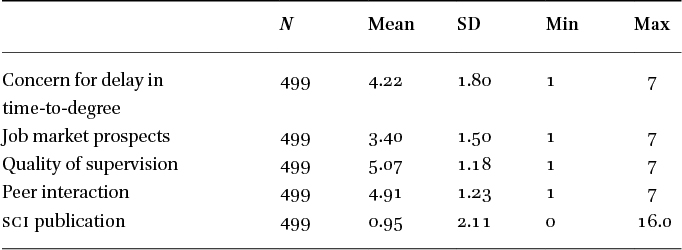
Descriptive statistics
According to t-test and
Table 5 displays a summary of
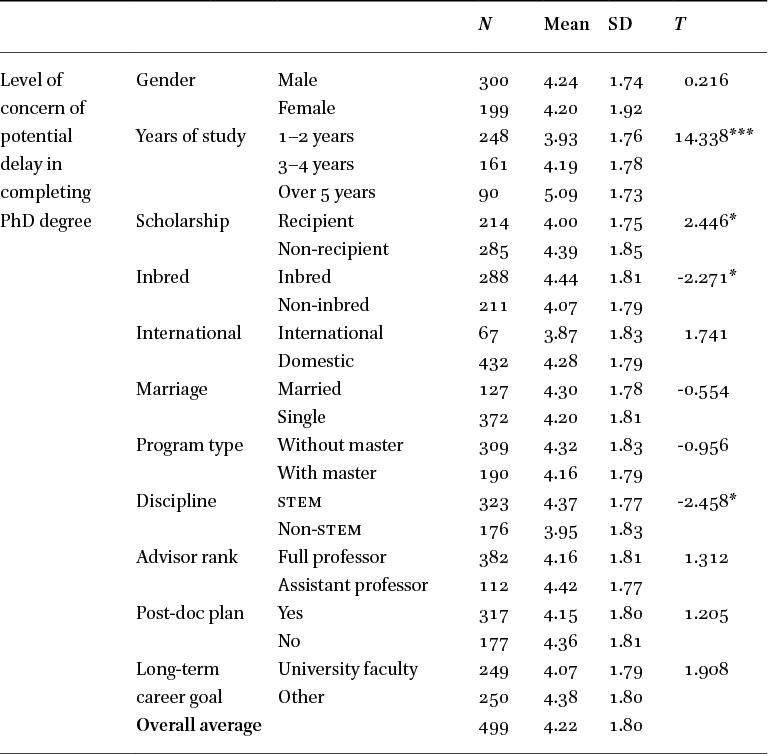
* p < .05 ** p < .01 *** p < .001
In terms of program characteristics, quality of supervision (ß = -.193, p < .001) and advisor’s academic rank (ß = -.388, p < .05) was a significant predictor for reducing doctoral students’ concerns about time-to-degree delay. However, other program characteristics such as program type (whether a student holds master degree), quality of peer interaction, the size of a peer student group did not predict the outcome variable. Lastly, doctoral students’ research productivity (ß = -.150, p < .001) and job market prospects (ß = -.194, p < .001) were found to be significant predictors. Moreover, the regression outcome shows that the discipline (

* p < .05 ** p < .01 *** p < .001
Second, the research ran regression analysis according to doctoral students’ discipline type separately, and the results show that there are distinctive differences in factors predicting concern about time-to-degree according to the disciplinary context. As for non-
On the other hand, as for
This study examined factors that influence doctoral students’ concerns about completing their degrees in timely manner in one of the major research-focused universities in Korea. Based on the findings of the study, there are two major points of discussion which include “disciplinary difference on role of research productivity” and “impact of scholarship”. In this section, qualitative (interview) data are used to support the discussion more effectively.
Disciplinary Difference on the Role of Research Productivity
This study found that doctoral students in
Due to the nature of
First, doctoral students in Korea, especially in the case university, are engaged with extensive administrative tasks related to externally funded projects that interrupts their time to focus on developing their research. Hong et al.’s (2015) study compared differences of doctoral program experience between doctorates who were trained in domestic and overseas institutions; it was found that domestic degree holders spent significantly longer hours in administrative tasks or other research activities that are not related to their own interests, whereas foreign degree holders spent longer hours focusing on their own research.
I’m on my 7th year already but I still don’t have publication record. It may sound like a bad excuse, but I think I could have published if not for those project works. It makes very difficult to concentrate.
Second, some students reported frustration resulted from unavailability of effective supervision that can help them to publish more research. Supervision issues can derive from numerous factors, including an advisor’s laissez-faire supervision style, or a student’s passive attitude. However, in the current study many interviewees pointed out that it is their advisor’s lack of expertise or interest that hinders effective supervision. Such ineffective supervision results from an advisor’s engagement in acquiring research funding with topics that are not directly related to the advisor’s expertise; hence, as the interviewee below observes, “nobody in the laboratory really knows” how to tackle the problem when difficulty arises. As a result, in many cases, doctoral students were “lost” in the middle of nowhere, without clear guidance and left alone to make their own progress.
We have like 6 projects going on at the moment, but they are all different. I think he’s not able to give us proper instruction on what to do because he also doesn’t really know about this topic. He seems to be quite lost and confused too.
Third, interestingly, it was found that in some cases there is a clear mismatch between the level of publication output required by the official program, and what is unofficially required by the advisor. In short, official program requirements are often considered merely “minimum” requirements, and the actual decision making is based on an advisor’s own standard. Such unwritten rules were found to be generating great difficulty and confusion for doctoral students.
When you visit our program’s website, you can see that there are official requirements for research publication for us to graduate. but in reality, it is usually much higher(requirement) and really depends on the advisor. Officially, we are able to graduate with two
Last contextual factor that causes potential delay in completing a doctoral degree in timely manner is aligned with doctoral student exploration issue. Although this factor cannot be generalized and applied to all doctoral students, it was evident that some students are forced to stay in doctoral programs for the wrong reasons. In fact, doctoral students are regarded as the frontline researchers who are in charge of taking significant role in carrying out various R&D activities in universities where they contribute in cultivating new knowledge (Larivière, 2012). Reflecting such facts, interview results (such as that quoted below) show some advisors are reluctant to let their students graduate because it generates loss for the availability of well-trained labor force in their laboratory.
Our advisor is notoriously famous for not making his students graduate in time. A few years ago, he actually declared that official time-to-degree in his program is 8 years regardless if we already have master’s degree or not. Why? When we graduate he’s losing all his best trained senior students and it will take him a long time to train new students! Now everyone knows about this so of course nobody wants to study in our lab, so there are no incoming new students which worsens our situation.
Role of Doctoral Student Funding
Results from this study support finding from previous studies that the availability, as well as types, of funding support for doctoral students are one of the key factors that determine their degree completion, as well as duration (Caparrós-Ruiz, 2019; Ehrenberg & Mavros, 1995; Hoffer & Welch, 2006). This study found that the role of scholarship showed an opposite effect on doctoral students according to their discipline. For
On the other hand, non-
I am required to work only 20 hours per week on the surface, but it takes a lot more time than that because of all the side works that I’m asked to do. It takes a lot of my energy and time, and it definitely interrupts me from focusing on my research.
Conclusion and Policy Implications
This study aimed to explore determinants that predict doctoral students’ concerns about completing their degrees in time in a research-focused university in Korea. This study concludes that doctoral students’ potential delay in graduation is more affected by program or environmental factors, such as emphasis on research productivity and job market prospects, rather than their personal characteristics. Also, this study found that influential factors appear differently across disciplines; in particular, the role of research productivity and job market prospects are more apparent in
First, as pressures increase for doctoral students to publish their research in globally renowned peer-reviewed journals, more systematic and transparent supervision is required to prepare students to achieve such goals. As Lee and Kamler (2008) noted, there is a lack of effectiveness in preparing students to participate in the research publication arena, which requires more concrete pedagogical attention from advisors. Moreover, such an issue may be even more problematic in a non-English speaking country like Korea where students can experience more difficulty with publishing their research in English as a foreign language. However, results from this study indicate that many doctoral students were not receiving effective supervision from their supervisors which increases the level of burden. Given the growing importance of research productivity from early career, Horta and Santos (2016) also suggested that incentive schemes, or regulations that promote publication performance during doctoral programs, should be considered by universities.
Second, this study pointed out that delay in time-to-degree of doctoral students is potentially generated by unwritten rules for publication criteria that are often set by individual advisors which create mixed signals to doctoral students. Ehrenberg et al. (2007) also pointed that vague graduation requirements, and lack of departmental clarity in regard to rules and expectations, undermine successful PhD completion. Therefore, it is important for the department and individual advisors to provide more accurate information to students when they embark on the journey to a doctoral program. In order to achieve this, it can be carefully suggested that the case university should establish a more systematic and structural approach to managing its doctoral program completion, and reduce individual faculty’s level of autonomy in determining doctoral students’ graduation, in order to prevent any potential form of student exploitation. Such effort is especially required for the case university to attract its undergraduate graduates to enroll in graduate education because lengthy time to degree is one of the main reasons on why graduates from the case university decide to study abroad for doctoral degrees.
Third, it is important to acknowledge how the role of scholarship is positively associated in increasing students’ concern about completing their degrees in time for the non-
Last, as aforementioned, the major purpose of this study is not based on advocating or asserting that shortening PhD completion duration is the most effective means of improving doctoral education. It certainly requires a substantial amount of time and effort to cultivate competent doctorates. However, the current study argues that excessively lengthy time-to-degree may harm overall effectiveness of the doctoral student experience as well as program competitiveness especially if such delay is caused by structural problems rather than individual student factors.
One of the limitations of this study is that the analysis of this study is not based on actual time-to-degree, but based on doctoral students’ self-reported concern about completing their degree in time. Therefore, the findings from this study should be carefully approached when comparing findings from existing literature that were based on actual time-to-degree. Nevertheless, the results from the current study in general shows consistency from previous studies’ findings and provide meaningful empirical evidence that are helpful to understand factors affecting lengthening time-to-degree, reflecting the case university and Korean context. Moreover, because the current study is limited to doctoral students’ perceptions only, future research should also look into faculty members’ (advisors’), as well as university administrators’, perspectives on factors that determine doctoral students’ time-to-degree, to provide an enrichment and triangulation of the data. Moreover, future research should investigate the context that shapes non-
Footnotes
Acknowledgements
This research is supported by the National Research Foundation of Korea (