




Abstract
In the aftermath of the 2008 Global Financial Crisis, European authorities reinforced the economic objectives of European lifelong learning policy, promoting employability solutions to address youth unemployment, and increasing their political influence on the implementation of national lifelong learning reforms. This article investigates to what extent these supranational policy orientations have been translated into concrete national lifelong learning initiatives. Although European countries were not equally affected in terms of time and intensity by the rise in youth unemployment rates, the political responses from their governments shared a central focus on employability solutions to youth unemployment in lifelong learning policy reforms. Our comparative analysis shows how different lifelong learning policy initiatives managed to ‘educationalise’ a structural economic problem (i.e. youth unemployment) into an individual educational concern (i.e. lack of education and skills). We argue that the ‘educationalisation’ of youth unemployment through lifelong learning policies is a crisis management strategy, which has allowed governments to focus on the individual symptoms of the problem while avoiding offering solutions to the underlying structural causes of young people’s poor labour market prospects.
Keywords
Introduction
The impact of economic crises on education policy is becoming an area of growing interest in comparative education research (Peters et al., 2015). Crises are moments when dominant economic and policy paradigms are questioned, opening opportunities for alternative policy ideas and policy changes (Jessop, 2013). Economic crises are also moments for strategic intervention on the very same institutional structure of the state, which becomes the object of reform by those who manage to impose their own definition of the causes of the crisis and the most appropriate policy solutions (Hay, 1999). The recent 2008 Global Financial Crisis (GFC) had a severe impact on European labour markets, producing a sharp increase in youth unemployment rates, forcing European Union (EU) authorities and national governments to articulate political responses to this challenge. Lifelong learning (LLL) policies became strategic tools in the EU’s political response to the youth unemployment challenge and, thus, an area of intense activity and reform (Heyes, 2013). While EU LLL policy trends following the 2008 GFC have been increasingly documented and critically analysed within the comparative education literature (Milana and Holford, 2014; Zarifis and Gravani, 2014), much less is known about to what extent these supranational policy orientations have actually been adopted by national governments and how they have been translated into concrete LLL policy initiatives (Saar et al., 2013), particularly in relation to young people.
This paper presents a comparative documental analysis of 54 national LLL policy initiatives targeting young people in nine European countries between 2010 and 2016. This analysis offers an opportunity to assess the influence of EU authorities on national LLL policies, as well as the level of policy convergence among countries in their political responses to the youth unemployment challenge after the 2008 GFC. The study is based on a policy mapping and review exercise carried out by 14 teams participating in a Horizon 2020 research project. The paper interrogates and compares LLL policies in relation to the objectives of LLL, the construction of target groups, modes of learning delivery, private sector involvement and success criteria. The comparison shows wide convergence of national LLL policies around the EU employability agenda, although the actual materialisation of this agenda into concrete LLL policy designs varies across countries. It also shows how LLL policies contributed to the ‘educationalisation’ of the youth unemployment problem, allowing EU authorities and national governments to demonstrate a high level of reform activity without addressing the structural economic causes of unemployment.
The first section of the article reviews recent trends in EU LLL policy, as well as some major criticisms raised by the literature in relation to the objectives of LLL, the limitations of using employability policy solutions to address youth unemployment, and the growing influence of EU institutions on national LLL reforms. The methodology section outlines the analytical framework of the study and the data sampling and analysis procedures followed in the comparison. The findings of the study are presented in three different sections. The first contextualises the economic effects of the crisis on the study countries and analyses the main objectives of their LLL policies. The second section looks at how LLL policies construct their target groups and their different modes of learning delivery. The third section analyses private actors’ level of involvement in LLL policies and how the success criteria of these policies are defined. The concluding section summarises the main findings of the study and reflects on the limitations of LLL employability agendas for tackling youth unemployment in different European contexts.
The economic turn of European lifelong learning policy
The EU responded to the 2008 GFC and Eurozone contagion with the imposition of brutal austerity measures in Southern Europe (Hall, 2012), tighter intergovernmental control of public finances through the European Fiscal Compact (Fabbrini, 2013), and the continuation of a neoliberal social agenda with a focus on structural and economic competitiveness through the ‘Europe 2020’ strategy (Copeland and James, 2014). Instead of questioning the economic imaginaries that led to global systemic failure (Jessop, 2013), EU authorities (i.e. the European Commission) have taken advantage of the political opportunity offered by the crisis to reinforce the neoliberal orientation of their social policies and to continue ‘business as usual’ (Jessop, 2015). As part of this neoliberal social agenda, the objectives of European LLL policies have focused on recovering and improving economic growth and, at the same time, guaranteeing social inclusion through access to employment, particularly for young people (European Commission, 2010; Moutsios and Kotthoff, 2007; Saar et al., 2013).
A narrow instrumental and neoliberal version of LLL has become explicit within the EU agenda and a key policy tool in its economic recovery plans (Špolar and Holford, 2014). LLL is a policy idea that has evolved from its original humanistic and utopian conception developed by the United Nations Education, Scientific and Cultural Organization (UNESCO) (Delors, 1998; Faure et al., 1972) to the more utilitarian and economic interpretation promoted by the Organisation for Economic Co-operation and Development (OECD) and the EU (Elfert, 2015). The malleability and ambiguity of the concept has allowed international agencies to accommodate very different – and sometimes contradictory – policy aims and orientations under this powerful idea (Jarvis, 2009). Contrary to the humanistic conception of LLL – intended to widen participation over the lifespan through adult education (Ouane, 2009) – the EU has favoured the adoption of a more utilitarian conception. This utilitarian approach envisages LLL mainly as a social control mechanism to reintegrate disadvantaged populations into society through employment (Coffield, 1999; Schuller, 2009).
The focus of LLL policies on young people has a long history in the EU (European Commission, 2000, 2006; European Commission, 2001). However, the recent emergence of young adults as their main target group (European Commission, 2010) should be understood as a new policy shift in the aims and orientations of LLL policy, placing greater emphasis on LLL as an instrument to tackle the high levels of youth unemployment that followed the crisis (Rasmussen, 2014a; Riddell and Weedon, 2012). Despite there being several cultural, demographic and economic reasons for the interest in youth as a specific social group (Furlong and Cartmel, 1997), the very definition of ‘youth’ as an age category is highly problematic because it comprises a wide range of living conditions, cultures, education backgrounds and labour market situations in different countries (Côté and Bynner, 2008; Rinne and Jarvinen, 2010).
Furthermore, European policies construct young adults as their target groups by focusing on individual aspects that highlight a shortfall or problematic position of this population in terms of education, the labour market or other domains of social life (i.e. not in education, employment or training, NEET) (Schneider and Ingram, 1997). European LLL policies for young people, as preferred visions of personal and social development, typically impose expectations on young adults based on culturally defined visions of ‘normal’ trajectories through education and the labour market, exacerbating existing inequalities of class, gender and ethnicity among their beneficiaries (Alheit and Dausien, 2000, 2002).
LLL has featured prominently in the EU response to rising levels of youth unemployment following the 2008 GFC. Under the European Commission notion of ‘flexicurity’ (European Commission, 2007), the European Employment Strategy has regarded education and training as the principal means by which workers will get employment security. Alongside active labour market programmes, LLL is supposed to contribute to the employment security of young people by improving their ongoing employability (Heyes, 2013). Instead of focusing directly on the economic causes of job losses and the subsequent effects on the social rights of the most vulnerable workers, the European Commission has advocated for the ‘flexibilization’ of labour market regulations and a ‘training first approach’ to youth unemployment initiatives (European Commission, 2009). This has resulted in LLL policies devoted almost exclusively to employability and activation (e.g. ‘Youth Guarantee Schemes’), matching skills to labour market needs (e.g. ‘Agenda for New Skills and Jobs’), and increasing mobility within Europeanising labour markets (e.g. ‘Youth on the Move’). While employability has been at the heart of EU LLL policy for at least two decades (Brine, 2006; Hake, 1999; Lefresne, 1999), its importance has been reinforced after the 2008 GFC (Fejes, 2014).
The ambition of addressing economic problems such as youth unemployment through educational solutions not only alters the meaning and the objectives of LLL (Biesta, 2006); it also shows a political preference among European authorities to focus on individual symptoms rather than on structural causes of social problems (Hay, 2013). The employability agenda is a clear example of the ‘educationalisation’ of economic problems, as it assumes that the future of work can be improved through raising the skills that individuals acquire from education and training institutions and bring to the workplace (Peters et al., 2019). Supply side fundamentalism of employability agendas (Peck and Theodore, 2000) places the responsibility of improving employment levels entirely on the shoulders of education and training providers and young people, without questioning the macro-economic factors and labour market dynamics that shape the demand side. For instance, when analysing the impact of welfare state regimes on barriers to participation in adult education, Rubenson and Desjardins (2009) argue that traditional methodological individualism reduces the explanation of educational participation to a question of individual motivation and ignores the importance of politics, labour markets and social background in explaining cross-national differences and similarities. Precisely because of these omissions, the effectiveness of this agenda for reducing youth unemployment is, at the most, very limited. EU institutions have emphasised workfare and individuals’ responsibilities to secure a sustained source of income, making the effective realisation of social rights dependent on the demand dynamics of labour markets.
The crisis has also offered an opportunity for European institutions, mainly the European Commission, to gain political influence in the implementation of national policies (Bauer and Becker, 2014). Most EU LLL policies have been incremental and of an emergency nature, leading to fragmented multi-level governance of the field (Holford et al., 2008). One of the reasons for this fragmentation is that the pretended unity of the ‘lifelong learning policy field’ is more discursive than real, given the sectoral nature of most policy initiatives. In addition to sectoral silo policymaking, further challenges exist in the funding schemes and mechanisms of coordination between different levels of government (e.g. European Social Fund, ESF) and beyond government (e.g. independent training providers and employers).The European Commission took advantage of the gravity of the job crisis to demand a more influential role in the coordination and implementation of European LLL policy initiatives in member countries (Lahusen et al., 2013). The European Council embraced the idea of a cross-sectorial approach to tackling the specific situation of youth unemployment (European Council, 2009), and adopted a resolution for the renewed youth policy to be focused on education and employment (European Council, 2010). Likewise, the European Parliament pleaded for improved policy coordination and a tighter monitoring system, urging member countries to be more proactive in their commitment to implementing European LLL policy initiatives such as the Youth Guarantee Schemes (YGS) (European Parliament, 2009), which materialised in the European Council agreement of April 2013 (European Council, 2013).
The EU has gained large influence on the LLL policies of its member states; discursively through the Open Method of Coordination (OMC) and financially through the ESF (Rasmussen, 2014b). However, it would be simplistic to assume a direct impact of EU LLL policy orientations on national reforms and a seamless convergence across European countries (Green, 2002; Jakobi and Rusconi, 2009; Prokou, 2008). As comparative education scholarship has shown, the influence of global agendas is mediated by political (e.g. party coalitions, veto points) and economic factors (e.g. public finances, business demands) that shape their adoption at national and subnational level (Steiner-Khamsi, 2014; Verger, 2014). The main objective of this paper is to empirically determine to what extent these European supranational policy orientations have actually been adopted by national governments and how they have been translated into concrete LLL policy initiatives for young people.
Methodology, methods and data
This paper aims to contribute to the literature on LLL policy in Europe through the comparative qualitative analysis of 54 national LLL policy initiatives targeting young people in nine European countries 1 between 2010 and 2016. The main research question of the study is: ‘To what extent have LLL policy orientations promoted by the EU been adopted by national governments and translated into concrete LLL policy initiatives for young people?’ We are particularly interested in investigating how LLL policies have tried to ‘educationalise’ the youth unemployment problem under the employability agenda, and how the economic and educational dimensions of the problem and its solutions are incorporated in the design of LLL policies.
In recent years, an emerging body of literature in the social sciences has pointed out the recurrent ‘educationalisation’ of social problems in the political management of tensions and contradictions emerging from capitalist development in liberal democracies (Smeyers and Depaepe, 2009; Tröhler, 2017). Governments offer the appearance of addressing economic problems by allocating responsibility for solving them to education institutions that are incapable of producing the necessary change (Bridges, 2008). Given the political difficulty of intervening and restructuring economic relations under neoliberal orthodoxy, the causes and solutions to economic problems are gradually absorbed under educational discursive frameworks (Fendler, 2018). Within these frameworks, pedagogical optimism serves the purpose of reframing structural problems as individual ones that can and should be addressed by changing the capacities and motives of individuals (Labaree, 2008). As a result of this ‘educationalisation’, individuals are required to constantly prove their market value through their employability, trainability and flexibility (Depaepe et al., 2008). The contradictions emerging from the 2008 GFC and the resulting youth unemployment challenge offer a unique opportunity to investigate the ‘educationalisation’ of social problems through a comparative analysis of LLL policies in Europe.
Our study draws on the LLL policy mapping and document review exercise carried out by 14 research teams participating in a Horizon 2020 project in 18 European functional regions 2 (two socio-economically contrasting regions per country) 3 . The comparative design of this multi-country study required the development of common guidelines for the selection of LLL policies, which are the main unit of analysis (Kotthoff et al., 2017). The study adopts a broad definition of ‘policy’, which includes initiatives ranging from a low level of materiality – such as national LLL strategies – to very concrete policy programmes. These initiatives could have been introduced by an institution or group of institutions at the national or local level, or by a network of social actors. As the remit of LLL goes beyond the field of education, the mapping exercise included education, labour market, social and youth policies.
LLL policies were selected that targeted an age range of 18–29 years old to accommodate different definitions and understandings of young adults in the participating countries. In terms of timeframe, the selection comprised initiatives that were adopted between 2010 and 2016, which corresponds to the period that followed the 2008 GFC. The three most significant LLL policy initiatives in terms of political relevance (i.e. presence in public media, commitment from policy actors) in each of the 18 regions were selected for in-depth document analysis (N=54). For each policy, thick descriptions of ‘policy profiles’ were produced by local teams based on the analysis of the content and context of the available policy texts (i.e. official policy documents, policy statements and website information). The analysis of these policy texts together with their production context provided an entry point to identify the policy discourses that prevailed in the design of each policy (Ball, 1993; Fairclough, 2013).
For the construction of these policy profiles, local research teams interrogated the content of policy documents for each policy following the three evolutionary mechanisms proposed by Jessop (2010): variation, selection and retention. Firstly, the variation mechanism refers to the problematisation of a specific policy domain (e.g. education). This process of policy variation can be triggered by events and/or contextual changes (e.g. economic crisis, youth unemployment) and generates the need to review policy discourses, policies and practices, adapting them to the new circumstances. Secondly, the selection mechanism refers to the political struggle between competing definitions of the causes of the problem (e.g. lack of education) and the policy solutions to be adopted (e.g. work-based learning). Finally, the retention mechanism refers to the institutionalisation of a given policy solution through different governance technologies (e.g. public–private partnerships, accountabilities) for their incorporation into actors’ practices (e.g. technocrats, practitioners, beneficiaries).
The evolutionary mechanisms framework was operationalised in five areas of interrogation: variation (objectives of LLL), selection (construction of target groups, policy solutions) and retention (public/private involvement, success criteria). As a result, information from policy documents was extracted in relation to: (a) the definition of social challenges and the objectives of the policy; (b) the construction of target groups as beneficiary populations of the policy; (c) the selection of the most appropriate policy solutions to the problem; (d) the level of involvement of public and private actors in the policy; and (e) the implicit or explicit demarcation of success criteria to evaluate the effectiveness of the policy.
In order to facilitate comparison among the large number of policies, the information extracted for these five areas of interrogation was categorised through a hybrid process of inductive and deductive analysis by the authors of this article that involved several iterations (Fereday and Muir-Cochrane, 2006). Initial inductive categorisations made by each individual team member were later discussed in a group and reshaped according to theoretical conceptualisations from the LLL policy literature and our focus on the educationalisation of social problems. We paid particular attention to how the economic and educational dimensions of the problems and the solutions were represented in the five areas of interrogation.
For the categorisation of the objectives of LLL policies, we followed Biesta’s (2006) typology of the social functions of LLL, which differentiates between economic, personal development and democratic objectives. For the construction of target groups, we looked into the individual aspects that highlight a deficit or problematic position of young people in different domains of social life (Schneider and Ingram, 1997), identifying five categories: low educated, NEET, unemployed, social risk (e.g. poverty, migration, health, family circumstances) and young (age based). To categorise the policy solutions, we considered the different modes of education and training delivery (Greinert, 2010), resulting in five groups: work-based learning (WBL), employability/entrepreneurship training, formal education, non-formal education, and career guidance. The categorisation of public and private involvement differentiates between initiatives where private actors only provide information and those where they are also involved in provision. Finally, we classified policies in terms of how accountability measures explicitly or implicitly defined the success criteria of the intervention (Mitchell, 2006), resulting in four categories: educational attainment, employment, education and/or employment, and personal and/or community development. In cases where more than one category was explicitly mentioned, we chose the most prevalent one.
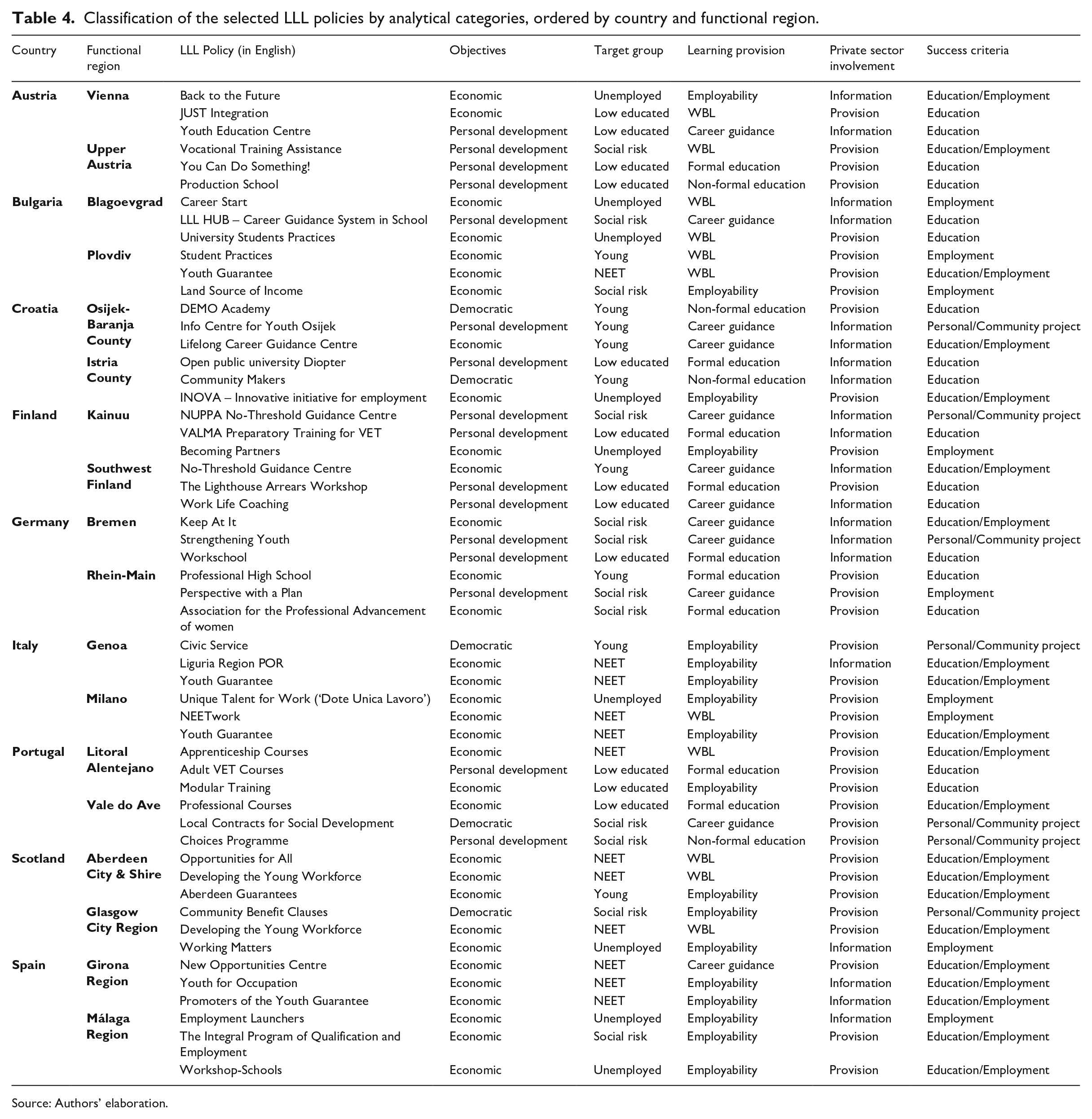
The classification of the 54 European LLL policies based on these analytical categories (see Table 4 in the appendix) allowed us to identify convergent and divergent trends in the adoption of the employability agenda among the participating countries. It also permitted us to compare how different policy designs managed to devise educational solutions to social and economic problems. The results of the comparison are presented in the following sections according to the three evolutionary mechanisms: variation (economic crisis and the objectives of lifelong learning), selection (employability policy solutions) and retention (public–private partnerships and accountabilities).
Economic crisis and the objectives of lifelong learning
Economic crises are very powerful triggers of public policy variation, including in education. The 2008 GFC affected all European countries, but the timing and intensity of its effects varied significantly across countries. As we cannot assume a direct and automatic impact of the economic crisis on the objectives of LLL policy, in this section we discuss economic dynamics and national LLL political responses separately. We first contextualise the economic, labour market and educational circumstances in the study countries through comparative descriptive analysis of secondary statistics, and then compare the objectives of LLL policies and reflect on the relative influence of the economic context on them.
The crisis negatively affected economic growth and employment rates in all the countries in the sample, forcing them to increase public expenditure on social protection. The main decrease in gross domestic product 4 (GDP) was experienced between 2008 and 2009, with an average decrease of −€1,600 across the 28 European Union member countries (EU-28), ranging from −€2,800 in Finland to −€500 in Bulgaria (Eurostat, 2019a). However, it is worth noting that the 2008 figures ranged from a minimum of €11,100 in Bulgaria to a maximum of €32,700 in Austria, showing the wide dispersion of purchasing power across European countries. One of the immediate responses to the 2008 GFC was an increase in social expenditure over the recession and post-recession periods (Eurostat, 2019b). When comparing the share of GDP spent on social protection 5 between 2007 and 2014, Finland is the country with the largest increase (6.6%), followed by Spain (4.4%) and Portugal (4.2%).
With regard to youth unemployment, 6 there is greater variation across countries and time. Most countries experienced a sharp increase in youth unemployment rates between 2008 and 2014, although this was not the case in Austria and Germany, where figures remained constant (Eurostat, 2019c). By 2015, youth unemployment figures recovered to 2005 levels in most of the countries under study, although Spain (28.7%), Italy (16.2%), Portugal (11.2%) and Croatia (10.7%) were the exceptions with a significant increase in youth unemployment rates. In a context of deteriorated labour market opportunities, young people tended to stay in education for longer and continue their studies in post-compulsory education. This trend is very clear when we look at the decrease in rates of early leaving from education and training 7 from 2006 to 2016. Portugal displayed the sharpest reduction from 38.5% in 2006 to 14% in 2016. A similar pattern is observed in the other two Southern European countries, which reduced early leaving from education and training from 20.4% to 13.8% (Italy) and from 30.3% to 19% (Spain). Reductions were more modest in the rest of the countries considered, but all of them presented lower figures in 2016, ranging from 13.8% in Bulgaria to 2.8% in Croatia (Eurostat, 2019d).
In this context of large youth unemployment, most LLL policies in our study prioritised economic over personal development and democratic aims (see Table 4 in the Appendix). Biesta (2006) has shown that the relative importance of these objectives varies over time and countries depending on the dominant LLL policy orientations. In our sample, most LLL policies (33 out of 54) were oriented towards economic objectives. The concrete formulation of these economic objectives varied depending on economic and social contextual factors. In the regions with more dynamic labour markets, the shortage of skilled workers appeared as an area of direct concern for LLL (e.g. ‘You Can Do Something’ in Upper Austria, or ‘Work Life Coaching’ in Southwest Finland). Conversely, in the regions with more challenging economic environments, tackling youth unemployment was the main objective of LLL policies (e.g. ‘Career Start’ in Blagoevgrad, Bulgaria, or ‘The Integral Program of Qualification and Employment’ in Málaga, Spain).
Personal development was the second objective that most frequently appeared as the main aim of LLL policies for young people (16 out of 54). The objective of learning to develop one’s potential and talents (Biesta, 2006) clearly manifested in LLL policies that seek to improve the learning opportunities of young people without further predetermined economic consideration. This was the case for LLL policies offering second educational opportunities (e.g. ‘Vocational Training Assistance’ in Upper Austria), preventing early leaving from education and training (e.g. ‘Preparatory Training for VET’ in Kainuu, Finland) or supporting young people in the development of a life plan (e.g. ‘ Perspective with a Plan’ in Bremen, Germany). Finally, the objective of improving the quality of democratic life was central only in a few LLL policies (5 out of 54). These policies aimed to empower young people as contributors to democratic life in their communities (e.g. ‘Community Makers’ in Istria, Croatia, or ‘Community Benefit Clauses’ in Glasgow, Scotland).
The comparison shows a marked economic orientation in the objectives of LLL policies across Europe following the 2008 GFC. However, this trend is far from homogeneous across European countries. In the most affluent countries, LLL policies are seen as a tool to upgrade the skills of the workforce and enhance economic growth (e.g. Austria, Germany). In contrast, in less affluent countries LLL policies are seen as a direct response to high levels of youth unemployment (e.g. Italy, Spain). Personal development is the main objective of many LLL policies in Austria (four out of six), Finland (four out of six) and Germany (three out of six). In these cases, access to LLL opportunities among early leavers from education and training is presented as a strategy to prevent future employment and social inclusion problems among young people (Parreira do Amaral and Zelinka, 2019), which is also aligned with EU policy orientations (European Council, 2011).
Employability policy solutions
Policy selection is the most contentious moment in the policy process as it entails identifying the causes of the policy problem to be addressed and choosing the most suitable policy solution to address this problem. In the context of an historic rise in youth unemployment rates across Europe, and instead of questioning the economic and labour market policies that led to the crisis, European authorities redoubled their efforts to advance employability policy solutions that assume that the main causes of youth unemployment are to be found at the individual level. Employability solutions tend to pass the responsibility of finding a job and avoiding potential social exclusion to the individual young adult. In this sense, LLL policies contribute to transforming a structural economic problem into an individual one, usually of an educational nature.
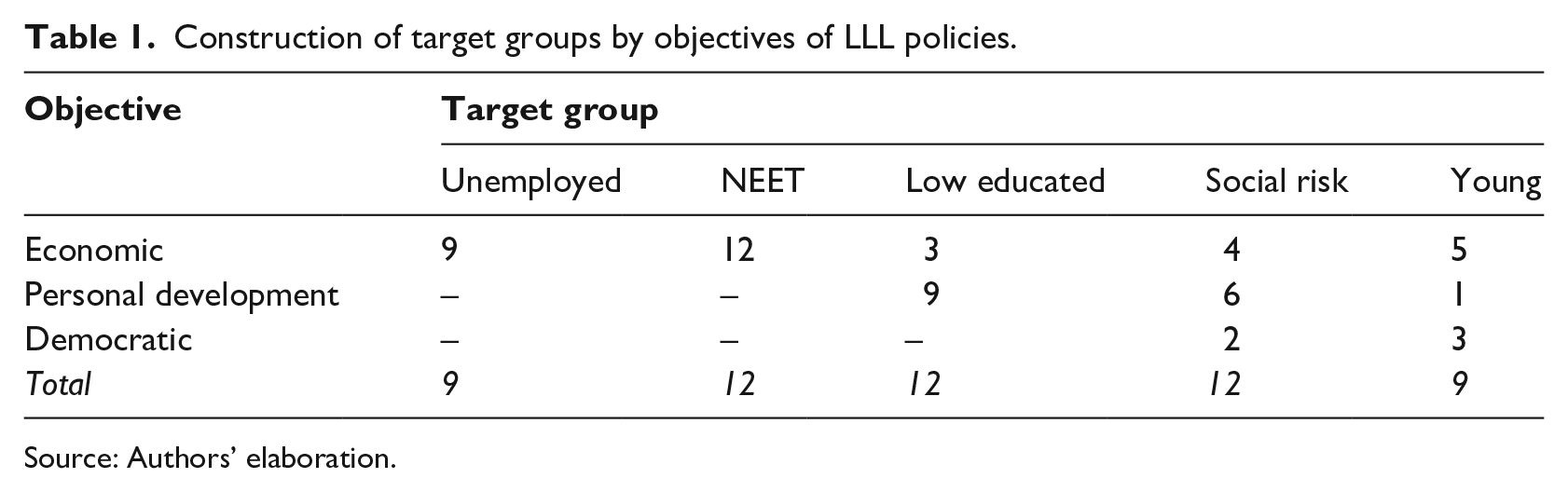
When analysing the construction of young adults as target groups in LLL policies, NEET and early leavers from education and training (or ‘low educated’) are the most commonly invoked categories (see Table 4 in the Appendix). The NEET category is particularly prevalent in Italy, Scotland and Spain; ‘low educated’ is more prevalent in Austria, Finland and Portugal; ‘social risk’ in Germany; ‘unemployed’ in Bulgaria and Spain; and ‘young’ as an age category in Croatia. What is more interesting is that when we analyse the relationship between the objectives of LLL policies and the construction of target groups (see Table 1), all the LLL policies that constructed their target groups as ‘unemployed’ (N=9) or ‘NEET’ (N=12) also had economic objectives. The NEET category seems to play a central role in the ‘educationalisation’ of economic problems through the construction of the target group. While the problem to be addressed is recognised as economic, the cause of the problem is defined in terms of unemployed young people’s lack of engagement in education and training.
Construction of target groups by objectives of LLL policies.
Source: Authors’ elaboration.
The link between NEETs as a target group and the Youth Guarantee (YG) as a policy solution is explicit in many of the policies. Some policies targeting NEET youth are so explicit in their links with YG funding that the scheme is mentioned in the name of the policy (e.g. ‘Youth Guarantee’ in Plovdiv, Bulgaria; ‘Promoters of the Youth Guarantee’ in Girona, Spain; ‘Youth Guarantee’ in Genoa, Italy; or ‘Aberdeen Guarantees’ in Aberdeen, Scotland). While the NEET target group is the most common among the LLL policies under study, in some countries the use of the term is problematic. Criticisms of the derogatory character of the NEET category has led governments in some countries to avoid this concept in policy documents and use other terms that basically refer to the same reality. This is the case of ‘Opportunities for All’ in Aberdeen, Scotland. The policy targets young people aged 16–25 years at risk of negative destinations (i.e. not in education or training or employment); it offers them a learning or training placement (typically an apprenticeship) and it is funded through the YG, but it never refers to this group of young people as NEETs. In other countries, such as Italy, the term NEET is widely accepted, and it is explicitly used even in the name of some policies. The ‘NEETwork’ policy in Milano is one example of this, which seeks to reach and engage NEETs in education and training opportunities (mainly traineeships) funded through the Lombardy Region YG.
Most of the LLL policies that constructed their target groups as ‘low educated’ had as their main objective the personal development of their beneficiaries, clearly linking social exclusion problems to the low educational attainment of young people. For example, the ‘You Can Do Something’ policy in Upper Austria targets adults aged 22 and above that have not attained post-compulsory education or whose educational attainment is not recognised because it was acquired in a different country. These populations are considered to be at a greater risk of unemployment or social exclusion, and they are offered the opportunity to acquire a qualification through formal education and have prior learning recognised. Similarly, the ‘Work Life Coaching’ policy in Southwest Finland targets students at risk of not completing vocational education and training (VET), especially those with special education needs, health problems or low linguistic skills. These students are offered guidance and support, particularly in terms of access to the on-the-job component of VET, so that they can complete their studies.
The European Commission has been promoting the implementation of YGs in all member countries with the explicit objective of reducing the number of NEETs. This initiative aims to ensure that all young people aged 15–24 receive a good-quality offer of employment, continued education, apprenticeship or traineeship within four months of becoming unemployed or leaving formal education. Among the different educational and training offers included in YGs, WBL opportunities (i.e. apprenticeships) are preferred by the European Commission for their capacity to provide work-relevant education and training that could facilitate a quick and smooth transition from school to work. When we look at the dominant forms of education and training provision in the sample of LLL policies, the majority either provide short employability courses or some form of WBL. Employability courses are the preferred solution in Italy and Spain, and different forms of WBL have been adopted in Bulgaria and Scotland.
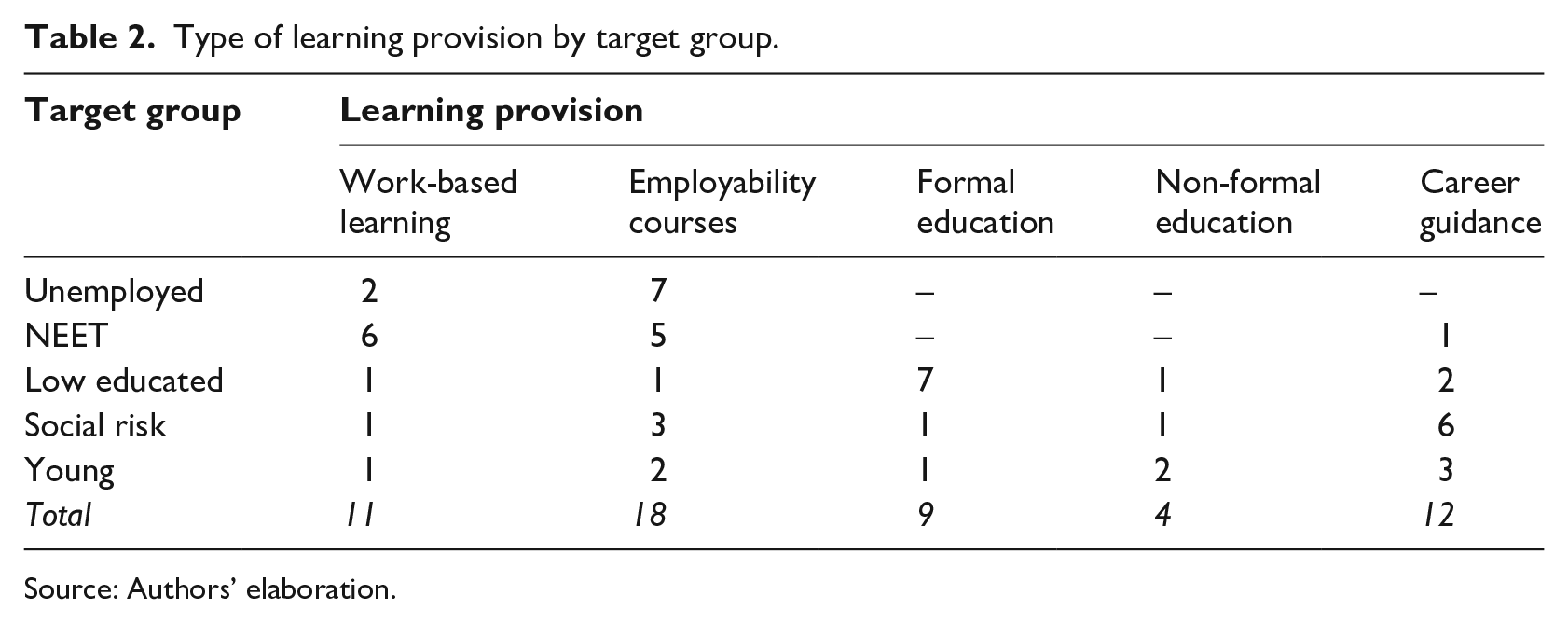
When we analyse the relationship between target group construction and form of provision, employability courses and WBL are the most typical solutions offered to unemployed youth and NEETs (see Table 2). In countries where formal education does not include WBL provision, LLL policies like ‘Apprenticeship Courses’ in Alentejo, Portugal, offer this kind of provision to NEETs through training centres linked to employment services. Similarly, in countries such as Bulgaria with large unemployment among higher education graduates, LLL policies offer WBL, typically in the form of traineeships (e.g. ‘Career Start’ and ‘University Student Practices’ in Blagoevgrad, ‘Student Practices’ in Plovdiv). In Spain, where youth unemployment is also very high, employment services are the ones offering employability courses to NEETs and unemployed youth (e.g. ‘Youth for Occupation’ in Girona and ‘Workshop Schools’ in Málaga).
Type of learning provision by target group.
Source: Authors’ elaboration.
Career guidance and formal education are also important forms of LLL policy provision, but they serve different target groups depending on the country. In countries like Germany and Austria, there is great concern for young people not able to complete an apprenticeship who are considered to be at risk of social exclusion. Different LLL policies target this population in the two countries by offering career guidance and second opportunity schemes aimed at reintegration into the apprenticeship system (e.g. ‘Keep At It’ in Bremen, Germany; ‘Production School’ in Upper Austria). In other cases, such as ‘NUPPA No-Threshold Guidance Centre’ in Kainuu, Finland, the definition of youth at social risk is broader and career guidance is offered to every person under the age of 30 in challenging circumstances. Similarly, in the Croatian region of Osijek-Baranja, which suffers from high youth unemployment and early leaving from education and training, career guidance opportunities are offered to all young people through policies like ‘Lifelong Career Guidance Centre’ and the ‘Info Centre for Youth’. Non-formal education is clearly a less favoured policy solution, as policies tend to favour education and training that leads to some form of qualification or certificate that can be valued by the labour market.
These policy trends show a wide adoption of employability solutions to youth unemployment problems in the countries under study. The financial commitment from European authorities to ensure the implementation of YGs across Europe seems to be an important driver of their dissemination. However, institutional path-dependencies could explain some differences in the way these schemes have been implemented in the different countries. Countries with long-standing systems of WBL provision (e.g. Austria, Germany) mainly use LLL policies to reintegrate young people at risk of not completing post-compulsory education into the education system. In the case of countries where WBL is not an important component of formal education provision (e.g. Italy, Spain), LLL policies focus on the provision of work-relevant learning through ad hoc employability training, apprenticeships, internships or traineeships.
Public–private partnerships and accountabilities
The retention of a given policy solution into institutional and legal frameworks occurs through governance technologies that seek to ensure that policy changes are incorporated into the daily practices of key actors (e.g. technocrats, practitioners, beneficiaries). The discursive emphasis of European authorities on employability solutions to the youth unemployment problem, particularly in the form of YGs, has been accompanied by significant financial commitments from the Youth Employment Initiative and the ESF to ensure their implementation among member countries. These financial commitments brought certain conditionalities in the form of public–private sector collaboration and accountability mechanisms. The rationale behind these conditionalities followed the principles of new public management (Field, 2000; Sultana, 2011), understanding that these policies should not require a larger commitment of the state sector in the direct provision of learning, but a stricter regulatory and monitoring role in its implementation.
All the LLL policies under study included some form of public–private partnership in their implementation, meaning that the involvement of the private sector was explicit in all the policy documents. However, policies varied in the level of private sector involvement. We classified LLL policies into two groups, depending on whether the private sector was only involved in the provision of information (20 out of 54) or in the direct provision of learning (34 out of 54). LLL policies with direct involvement of private actors in the provision of learning predominated in countries such as Portugal, Italy and Scotland; while policies where private actors only provided information predominated in countries such as Croatia and Finland.
A clear pattern emerges when we consider the type of intervention and the level of private sector involvement in LLL policies. The direct involvement of the private sector in the provision of learning was more prominent in WBL and employability courses. This is the case for private companies’ involvement in apprenticeship provision through ‘Developing the Young Workforce’ in Scotland, or private providers of employability courses through the ‘Unique Talent for Work’ in Milano, Italy. The provision of information from the private sector was particularly important in career guidance policies. This is the case for street workers employed by independent education providers offering career guidance through ‘Strengthening Youth’ in Bremen, Germany; private companies offering guidance through ‘Work Life Coaching’ in Southwest Finland; or employers’ organisations offering career guidance through the ‘Lifelong Learning Career Guidance Centre’ in Osijek-Baranja, Croatia. While all these examples refer to the involvement of business or for-profit actors, civil society organisations were also involved in the implementation of many LLL policies, particularly those not directly seeking economic objectives. Examples include courses offered by youth associations through ‘Community Makers’ in Istria, Croatia, or the part-time vocational training offered by non-profit organisations through the ‘Association for the Professional Advancement of Women’ in Frankfurt, Germany.
LLL policies in the sample also differed in the success criteria established for accountability purposes. Although not all policies were explicit in their accountability mechanisms, for all of them it was possible to identify the types of criteria used to evaluate their success. A large number of LLL policies explicitly mentioned the improvement of educational attainment as the main success criterion of the intervention. This includes LLL policies that only incorporated educational success criteria (17 out of 54), and policies that considered that either educational attainment or gaining employment were indicators of success of the intervention (21 out of 54). This is particularly surprising in cases such as ‘University Students’ Practices’ in Blagoevgrad, Bulgaria, where the objective is to integrate graduates into the labour market, but the policy is only evaluated by the number of students participating in and completing the training.
Conversely, the number of LLL policies that incorporated access to employment as their main success criterion was relatively small (9 out of 54). This is the case for ‘Becoming Partners’ in Kainuu, Finland, one of the few policies that actually evaluates and tracks the employment trajectories of its beneficiaries. Finally, a smaller number of policies did not require any form of educational attainment, qualification or change in employment status, but the development of a personal or community project by the young person (7 out of 54). This includes LLL policies that evaluate their success by beneficiaries’ ability to develop a personal plan (‘Choices Programme’, in Vale do Ave, Portugal) and those in which young adults develop a plan for improving living conditions in their communities (‘Community Benefit Clauses’ in Glasgow, Scotland).
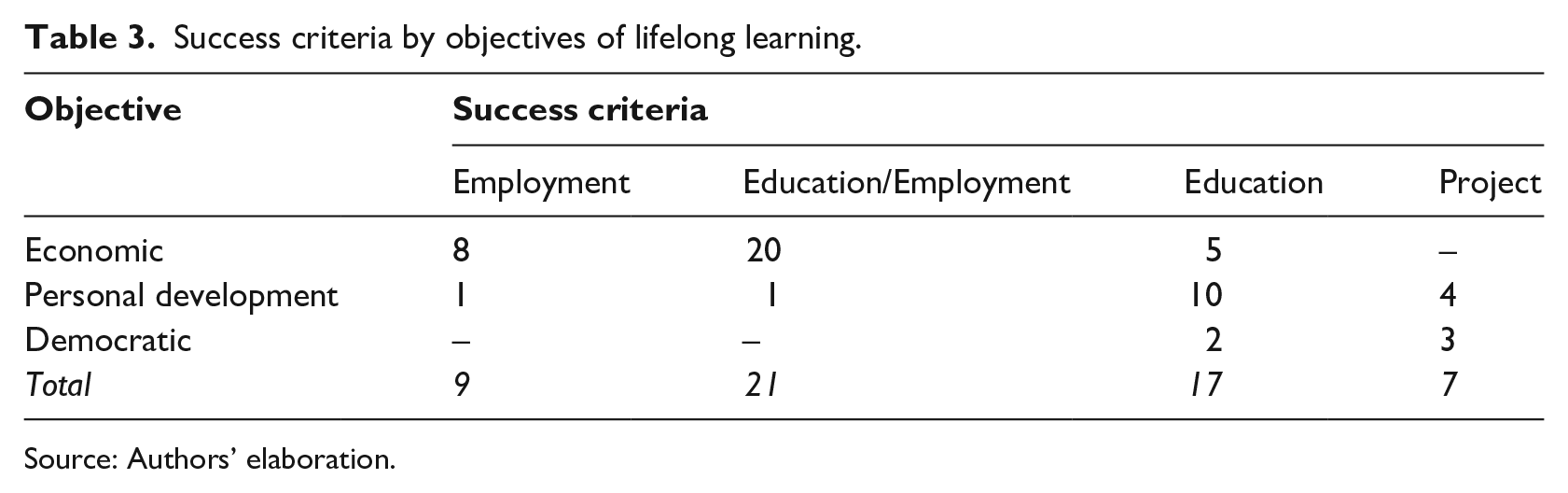
When we compare the criteria used to evaluate the success of LLL policies with the objectives that they were pursuing, a very interesting pattern emerges. There is a clear mismatch between the economic objectives of most LLL policies and the educational nature of the criteria used to judge their success (see Table 3). The majority of LLL policies in the sample had an economic orientation and tried to offer responses to employment challenges with employability solutions. However, when we look at the criteria used to evaluate these very same policies, we see that they do not aim to have a direct impact on the employment situation of young people. It seems that, under the employability agenda, enhancing the educational attainment of young adults is already considered an indicator of success when tackling youth unemployment, assuming that those trained under these LLL policies will be able to find a job in the labour market.
Success criteria by objectives of lifelong learning.
Source: Authors’ elaboration.
The lack of consideration paid to demand side dynamics in LLL policies is an important omission in the theory of change of employability solutions to youth unemployment. This policy omission should not be read as a technical problem in the design of LLL policies, but as a political strategy to manage the contradictions of economic challenges through LLL policy. As the ‘educationalisation’ literature has shown (Smeyers and Depaepe, 2009), governments purport to be tackling economic challenges with educational solutions because they require less political commitment, not because they are proven to be more effective. A good example of this lack of trust in the effectiveness of LLL interventions on youth unemployment is that they are not required to solve the unemployment problem to be considered a success. As a crisis management strategy, LLL policies have allowed governments to show a great deal of activity in their educational responses to the youth unemployment problem, with very little accountability for the effectiveness of these policy solutions.
Conclusions
The comparative analysis of LLL policies targeting young adults in nine European countries has shown wide convergence in the adoption of European employability policy solutions to the youth unemployment challenge in the years that followed the 2008 Global Financial Crisis. The convergence in LLL policy orientations across Europe towards an economic goal can be explained by the efforts of European authorities to coordinate and gain political influence in national policy responses to the crisis. However, even if LLL policies have generally shifted towards an economic orientation, their materialisation into concrete LLL policy designs differs across countries. While in Southern European countries the main objective was to tackle the high levels of youth unemployment, in countries with more dynamic labour markets the objective was to upgrade the skills of the workforce and address skill shortages in the economy. In terms of the policy solutions adopted, the Youth Guarantee Scheme model offering work-oriented education and training to unemployed youth (i.e. NEETs) has been replicated in all the study countries, even if in different forms. In Central European countries with well-established apprenticeship systems (e.g. Austria, Germany), LLL policies have been used to reintegrate young people into the formal education system or to prevent their dropout. By contrast, in Eastern and Southern European countries with school-based secondary education (e.g. Bulgaria, Croatia, Italy, Portugal, Spain), LLL policies have been mainly used to offer short employability courses and expand the work-based learning opportunities available to unemployed youth.
In a context of severe economic and employment crisis, the appeal of employability policy solutions to political authorities is not surprising. Instead of questioning the economic models and labour market dynamics that have caused the increase in youth unemployment, national governments have preferred to educationalise these economic problems and to focus on getting unemployed youth into education and training. As a crisis management strategy, the educationalisation of youth unemployment through LLL policies allows national governments to legitimise their political action under the guise of tackling the problem. However, assuming that the continued training of young people would lead to reductions in youth unemployment is quite problematic in itself, particularly in Southern European contexts with high levels of unemployment. Supply side interventions in LLL may be easier to sell as policy solutions to national governments, but their effectiveness will most likely be mediated by the contextual economic factors that drive demand for skills and labour. Ignoring these determinants in the design of LLL policies necessarily produces very unequal results among European regions and countries and will probably frustrate the aspirations of many of their beneficiaries.
Footnotes
Appendix
Classification of the selected LLL policies by analytical categories, ordered by country and functional region.
| Country | Functional region | LLL Policy (in English) | Objectives | Target group | Learning provision | Private sector involvement | Success criteria |
|---|---|---|---|---|---|---|---|
|
|
|
Back to the Future | Economic | Unemployed | Employability | Information | Education/Employment |
| JUST Integration | Economic | Low educated | WBL | Provision | Education | ||
| Youth Education Centre | Personal development | Low educated | Career guidance | Information | Education | ||
|
|
Vocational Training Assistance | Personal development | Social risk | WBL | Provision | Education/Employment | |
| You Can Do Something! | Personal development | Low educated | Formal education | Provision | Education | ||
| Production School | Personal development | Low educated | Non-formal education | Provision | Education | ||
|
|
|
Career Start | Economic | Unemployed | WBL | Information | Employment |
| LLL HUB – Career Guidance System in School | Personal development | Social risk | Career guidance | Information | Education | ||
| University Students Practices | Economic | Unemployed | WBL | Provision | Education | ||
|
|
Student Practices | Economic | Young | WBL | Provision | Employment | |
| Youth Guarantee | Economic | NEET | WBL | Provision | Education/Employment | ||
| Land Source of Income | Economic | Social risk | Employability | Provision | Employment | ||
|
|
|
DEMO Academy | Democratic | Young | Non-formal education | Provision | Education |
| Info Centre for Youth Osijek | Personal development | Young | Career guidance | Information | Personal/Community project | ||
| Lifelong Career Guidance Centre | Economic | Young | Career guidance | Information | Education/Employment | ||
|
|
Open public university Diopter | Personal development | Low educated | Formal education | Information | Education | |
| Community Makers | Democratic | Young | Non-formal education | Information | Education | ||
| INOVA – Innovative initiative for employment | Economic | Unemployed | Employability | Provision | Education/Employment | ||
|
|
|
NUPPA No-Threshold Guidance Centre | Personal development | Social risk | Career guidance | Information | Personal/Community project |
| VALMA Preparatory Training for VET | Personal development | Low educated | Formal education | Information | Education | ||
| Becoming Partners | Economic | Unemployed | Employability | Provision | Employment | ||
|
|
No-Threshold Guidance Centre | Economic | Young | Career guidance | Information | Education/Employment | |
| The Lighthouse Arrears Workshop | Personal development | Low educated | Formal education | Provision | Education | ||
| Work Life Coaching | Personal development | Low educated | Career guidance | Information | Education | ||
|
|
|
Keep At It | Economic | Social risk | Career guidance | Information | Education/Employment |
| Strengthening Youth | Personal development | Social risk | Career guidance | Information | Personal/Community project | ||
| Workschool | Personal development | Low educated | Formal education | Information | Education | ||
|
|
Professional High School | Economic | Young | Formal education | Provision | Education | |
| Perspective with a Plan | Personal development | Social risk | Career guidance | Provision | Employment | ||
| Association for the Professional Advancement of women | Economic | Social risk | Formal education | Provision | Education | ||
|
|
|
Civic Service | Democratic | Young | Employability | Provision | Personal/Community project |
| Liguria Region POR | Economic | NEET | Employability | Information | Education/Employment | ||
| Youth Guarantee | Economic | NEET | Employability | Provision | Education/Employment | ||
|
|
Unique Talent for Work (‘Dote Unica Lavoro’) | Economic | Unemployed | Employability | Provision | Employment | |
| NEETwork | Economic | NEET | WBL | Provision | Employment | ||
| Youth Guarantee | Economic | NEET | Employability | Provision | Education/Employment | ||
|
|
|
Apprenticeship Courses | Economic | NEET | WBL | Provision | Education/Employment |
| Adult VET Courses | Personal development | Low educated | Formal education | Provision | Education | ||
| Modular Training | Economic | Low educated | Employability | Provision | Education | ||
|
|
Professional Courses | Economic | Low educated | Formal education | Provision | Education/Employment | |
| Local Contracts for Social Development | Democratic | Social risk | Career guidance | Provision | Personal/Community project | ||
| Choices Programme | Personal development | Social risk | Non-formal education | Provision | Personal/Community project | ||
|
|
|
Opportunities for All | Economic | NEET | WBL | Provision | Education/Employment |
| Developing the Young Workforce | Economic | NEET | WBL | Provision | Education/Employment | ||
| Aberdeen Guarantees | Economic | Young | Employability | Provision | Education/Employment | ||
|
|
Community Benefit Clauses | Democratic | Social risk | Employability | Provision | Personal/Community project | |
| Developing the Young Workforce | Economic | NEET | WBL | Provision | Education/Employment | ||
| Working Matters | Economic | Unemployed | Employability | Information | Employment | ||
|
|
|
New Opportunities Centre | Economic | NEET | Career guidance | Provision | Education/Employment |
| Youth for Occupation | Economic | NEET | Employability | Information | Education/Employment | ||
| Promoters of the Youth Guarantee | Economic | NEET | Employability | Information | Education/Employment | ||
|
|
Employment Launchers | Economic | Unemployed | Employability | Information | Employment | |
| The Integral Program of Qualification and Employment | Economic | Social risk | Employability | Provision | Education/Employment | ||
| Workshop-Schools | Economic | Unemployed | Employability | Provision | Education/Employment |
Source: Authors’ elaboration.
Declaration of conflicting interests
The author(s) declared no potential conflicts of interest with respect to the research, authorship, and/or publication of this article.
Funding
The author(s) disclosed receipt of the following financial support for the research, authorship, and/or publication of this article: This research is supported by the YOUNG_ADULLT Project ‘Policies Supporting Young People in their Life Course. A Comparative Perspective of Lifelong Learning and Inclusion in Education and Work in Europe’, funded by the European Union’s Horizon 2020 research and innovation programme under grant agreement No 693167.
