



Abstract
In welfare-policy studies, conditions are often depicted at a national level. This is the case not least in studies of young people’s paths and detours to working life. Studies at a high aggregation level have their advantages when it comes to distinguishing differences in living conditions between countries at similar economic development levels and examining the degree to which these differences can be related to institutional inequalities, differences in so-called welfare-policy regimes. But there is also a risk that studies of national regimes obscure the differences in socio-geographical conditions that exist in all countries. In this article we show how the socio-geographical conditions, to a great degree, affect young people’s ability to find work on the Swedish labor market with good development and support possibilities. A starting point is that the image of the Swedish transition regime as universalistic, as is often depicted in comparative research on young people’s transitions, obscures significant differences in young people’s transition and establishment patterns that are related to geographical residence. The Swedish universalistic regime encompasses a large and, over time, growing socio-geographically related spread of establishment opportunities for youths and young adults. We illustrate the circumstances by presenting comparable data in the form of an establishment index on the conditions for youths and young adults in Sweden’s 290 municipalities.
Aim and points of departure
The image of the Swedish welfare-policy regime has long been characterized by high education and employment participation, small income differences, equal conditions and significant social mobility (Busemeyer, 2016; Ryner, 2007; Walther, 2006). The Swedish labor market is characterized by high union affiliation and a large spread of collective agreements. Employers are also to a great degree affiliated with interest groups that regulate the conditions at industry and workplace levels via negotiations with union representatives. Taken together, this has resulted in high entry-level salaries and a compact salary structure (Nordström Skans et al., 2017; Skedinger, 2006, 2011).
Meanwhile, in recent decades the regime has been characterized by changes in many fundamental aspects and at many levels. Employment participation remains high, but unemployment is now much higher compared to the conditions up to the end of the 1980s. Income differences have grown quickly in Sweden, according to a number of international comparisons (Organisation for Economic Co-operation and Development (COED), 2015, 2016a, 2016b, 2017), at the same time as social insurance is less income-compensatory and the labor market policy is undergoing rapid transformation and privatization 1 .
In this article, we primarily focus on the part of the Swedish welfare-policy regime that affects the conditions for youths and young adults. The conditions for this group have also substantially changed in recent decades (Olofsson and Wikström, 2018), involving increasingly lengthy and vulnerable transition processes from school to working life. The proportion of employed is lower, and the proportion of youths who neither work nor study (not in employment, education or training; NEET) is higher than in previous decades. The latter group includes primarily youths born outside Sweden, a group that has grown substantially as a proportion of the population, as well as people who have had difficulty completing an education at the primary and upper-secondary levels.
Despite the changed conditions, the image remains of a Swedish welfare-policy regime that creates beneficial and equal conditions – that enables a significant amount of social mobility (Busemeyer, 2016; Walther, 2006). This image is especially prominent in international and comparative-focused studies (Busemeyer, 2016; Pohl and Walther, 2007; Ryner, 2007; Thelen, 2014; Walther, 2006). These studies mainly ignore the structural changes that have characterized the Swedish economy and labor market in recent years, as well as the reorientation of policy that has occurred through reduced taxes, slimmed down social security systems and privatization of public agencies associated with schools and social care. But that’s not all. They also ignore the growing socio-geographical gaps, which can be seen as a product of both structural changes in the economy and ideologically motivated changes to policy and fundamental welfare institutions. The aim of this article is to problematize the image of Sweden as a universalistic transition regime against the background of growing differences in socio-geographical conditions. The empirical point of departure for the article is a weighting of socioeconomic and socio-geographical variables related to the conditions in Sweden’s 290 municipalities. The article presents an establishment index, which summarizes the opportunities for labor market establishment among youths and young adults aged 16–29 years in the country’s municipalities.
The concept of transition regimes – on the image of opportunities for establishment among youths in Sweden
Within the international, comparative research on young people’s transitions, researchers have presented various typologies in the quest to better understand different countries’ national regulation of young people’s transitions from school to working life (Iannelli and Smyth, 2008; Niemeyer, 2007; Pohl and Walther, 2007; Walther, 2006). In this article, we mainly refer to Walther’s (2006) concept of transition regimes. This concept indicates that the opportunities for establishment in the labor market are affected by the fact that different countries have different rules and institutional environments in relation to the labor market, education, and welfare policy, with immediate effects on patterns of entry into working life, when it comes to time aspects as well as volumes and the jobs’ character. In this context, the term regimes alludes to Gøsta Esping-Andersen’s (1990) distinction between a Scandinavian, a continental and an Anglo-Saxon welfare-capitalist regime. These regimes represent ideal types; that is, the intent is not to describe individual countries’ conditions in detail but to distinguish patterns that make it possible to understand the central components of a social system.
The way a regime is designed thus affects both qualitative and quantitative aspects of transition patterns, both access to jobs and the character of jobs. Walther (2006) identifies four transition regimes: the liberal, the employment-centered, the sub-protective and the universalistic.
The last of these regimes, the universalistic, is associated with the Nordic countries; that is to say, Sweden, Denmark, Finland and Norway. A common conception is that the welfare regime in these countries creates favorable conditions for youth transition to working life (Busemeyer, 2016; European Union (EU) Research on Social Sciences and Humanities, 2004). This is considered to be due to a universally focused welfare policy that includes resource-weak groups and minimizes negative effects of economic fluctuations. It is also pointed out that the educational system at primary level avoids an early sorting of students into more and less studious, thereby giving everyone a better opportunity for further education. Add to this a labor market that is regulated via nationwide collective agreements and that does not disfavor outsiders to any greater extent.
Capitalistic welfare states and the social reproduction of the workforce
A further development in the studies on welfare and transition regimes that has come to be inspirational is denoted as varieties of capitalism (Hall and Soskice, 2001). National economists, political scientists and sociologists have deepened the comparative welfare research by going from more descriptive and functionalist approaches regarding regime design to studies in which a macro perspective on institutional clusters is anchored in theories on individuals’ motives for their actions. The point of departure is then that different social systems are a source of varying incitement structures that influence individuals’ behavior patterns. Differences in individuals’ education choices are a factor that is often ascribed great significance (Ashton et al., 2000; Soskice, 1998).
In regimes where traditional vocational education and competence development via labor market policy have a weak position, primarily within liberal market economies like the UK and the US, a stronger division is created between internal and secondary labor markets whereby a significant portion of the population have social benefits at an extremely low level and are left to seek low-paying jobs. There is great mobility, but the possibilities to develop advanced work-related qualifications are few. Those who have the resources and ability to complete more advanced training can establish themselves in internal labor markets and thereby gain access to more advanced vocational training, qualified jobs and workplace-related social benefits. The point of departure is thus, among other things, that the Nordic countries represent a different kind of capitalism, marked by less distinct categorization between internal and secondary labor markets, with stronger incentives for individuals to choose vocational education, better possibilities to access qualified vocational training at workplaces, a generally stronger social safety net and more equal income distribution.
From a Marxist perspective, the different regime designs could be interpreted as models for the social reproduction of the workforce within a capitalist economic system (McDermott, 2007). In the early years of industrialized society, reproduction of the workers’ capacity to work – that is, the knowledge and physical energy that are converted into the production of products and services – was not the object of social efforts. The maintenance of the capacity to work was seen as an individual’s own responsibility, and workers who were no longer able to work were left to seek care within their family, poor relief or private charity. Along with economic development and growing demands for the workforce’s productive capacity, it also became increasingly rational for employers to organize reproduction of the workforce along collective lines. According to Marxist researchers, this is the fundamental motive for welfare-state efforts, not least in the field of education and within labor market policy (Bowles et al., 2017). These efforts contribute to raising wage-earners’ productivity and redistribute costs of reproduction. Social reproduction systems differ in various capitalist economies at equal development levels. Explanations of these differences tend to be based on class-related and political power relations. In countries where workers’ movements have managed to mobilize stronger influence through unions and left-wing political parties, relations in the labor market and within the welfare-state system have been formed that are more inclusive and less socially differentiated.
Criticism of the regime perspective
The regime perspective on young people’s transitions has been exposed to extensive criticism. Questions have been raised, inter alia, about the existence of a uniform, universalistic regime in the Nordic countries (Helms Jørgensen et al., 2019; Lorentzen et al., 2019; Lundahl and Olofsson, 2014). Among other things, criticism has been voiced that the regime concept obscures fundamental differences between countries. Relations between school and working life are an example of an area in which conditions are extremely different. Vocational education in Sweden and Finland is highly school-based, whereas Denmark and Norway have developed apprentice systems and a closer collaboration between school and working life (Helms Jørgensen et al., 2019).
Another critical point of departure is that the regime perspective is too functionalistic, addressing descriptions rather than explanations of differences and development patterns. To some degree, the theory development in connection to the research on ‘varieties of capitalism’ serves as a response to this criticism. Here, the intention is to anchor the analysis of institutional structures on a comprehensive macro level in theories on individuals’ actions.
A more fundamental critical point has noted that transformations of European and American capitalist economies are more multifaceted than what emerges in regime research. The image of cohesive regimes is regarded as decreasingly relevant, among other things against the background of global economic integration and the effects of information technology on production and working methods. We have experienced fundamental changes in the industrial mass production system that enhanced economic growth and constituted a driving force behind the full employment in leading capitalist welfare states during the decades that followed World War II. A third industrial revolution is sometimes spoken of, connected to the dissolution of Fordism, and in recent years also a fourth industrial revolution in the wake of advanced information technology and fully automated production processes (Iveroth et al., 2018; Magnusson, 2012).
Additionally, it can be mentioned that the adaptation to the EU’s economic-political legal framework is considered to have limited the possibilities to conduct a welfare policy along Keynesian lines, which undercuts conditions for the universalistic regime. In practice, this means that the possibilities to underbalance public budgets in order to more offensively invest in education and labor market policy during depressions are curtailed. Decreases in economic growth and increased unemployment are met with fiscal cuts instead of increased expenditures. As more market-liberal ideas have come to dictate the departure points for economic policy, focus has landed on supply relations rather than the demand situation. This means, for instance, that social problems like unemployment are not explained by insufficient demand in the economy, in accordance with the Keynesian doctrine. Instead, unemployment is seen as a result of high wage levels, regulations regarding employment protection, and compensation levels during unemployment, which make it riskier for employers to hire people and partly dampen unemployed people’s interest in looking for a job.
There are also a number of studies that support the view that there are other fundamental patterns of change in working life in developed capitalist economies that affect all countries regardless of regime. Guy Standing’s (2014, 2016) study on the precariat has received a great deal of attention. Basically, this view concerns an increasingly substantial social differentiation in the wake of globalization, weakened union organizations and the breakthrough of a more market-oriented economic policy in older industrialized countries of the west. Policy is formed by strong economic interest groups that ally themselves with a shrinking but well-off middle class, at the same time as growing groups of young people, migrants and the resource-weak see increasingly worse yields from the ‘old’ welfare state. In working life, they are left to atypical employment conditions, with insecure and temporary jobs with weak salary development and limited social benefits. The growing interest in NEET groups in many lands – that is, youths who neither work nor study – is an indication that our developed economies contain relatively large groups with weak resources and significant social vulnerability (Eurofound, 2016; SOU, 2013: 74).
Studies support the notion of an increasing segmentation of the labor market along a number of parallel lines, connected to unequal terms for women and men, fragile establishment opportunities for non-European immigrants and unfavorable terms for many young adults. This is also something that has been asserted in the European Commission’s recommendations for a more active social inclusion, as well as in the guidelines for the member states’ common employment policy.
A larger European research project with participants from a number of countries has presented information on establishment opportunities, confirming that increasing numbers of citizens are affected by social risks associated with vulnerable employment conditions, recurring periods of unemployment, and low income (Frazer and Marlier, 2010). Regarding the Nordic countries, it was noted that low income, or so-called poverty risk, was significantly higher among young adults compared to those who were middle-aged and older. The generational differences on average were greater than those within the EU 2 . There is also much that supports the view that these differences may have increased along with growing refugee immigration, concentrated to young ages, and continued challenges involving a large proportion of youths who have difficulty meeting educational requirements at primary and upper-secondary levels. According to Eurostat, in Sweden the average proportion of 20- to 24-year-olds with weak social standing as well as poverty risk for the years 2011–2017 was 33%, compared with 31% in Great Britain and 27% in Germany. The average for the entire EU was 31% (Eurostat, 2019).
Marxist-inspired researchers have noted that there is a built-in dynamic associated with changes in industrialized society; that is, a dissolution of the Fordist or mass production-focused economy, increasing social differentiation, and the widespread trend of making cuts to and privatizing parts of the welfare state. Along with more knowledge-intensive jobs, the economic transformation also contributes to more low-qualified jobs within the service sector. Privatizations create space for market relations and profit-driving production within new sectors outside the industry sector, while activation policy, harder demands on the unemployed and reduced compensation guarantee the workforce reserve needed to support private company interests in their entrance into new markets (Jessop, 1993, 2013).
Welfare-policy research discusses the phenomenon of work-welfare cycling (McCollum, 2012). This concept refers to the situation of large groups, comprised mostly of youths, migrants and the low-educated, tending to get caught in back-and-forth movements between short-term, unqualified jobs and periods of unemployment with social support. These movements bring with them a significant social vulnerability for the individuals involved, and also generate long-term costs associated with ill health and weak support possibilities. The costs are carried by the individuals themselves as well as taxpayers. But it is also asserted that work-welfare cycling satisfies the need for a loosely bound workforce on secondary labor markets, where demands for both vocational skills and company-specific competence are low and where job offerings are often short-term. The increasing tendency of employers to offer jobs without employment security or possibilities for competence development has been shored up by the deregulation of workers’ rights combined with an activation policy based on work-first principles, and has contributed to an increasingly strong segmentation pattern in the labor market (McTier and McGregor, 2018). Work-welfare cycling occurs in liberal as well as in more regulated welfare states. There is not much to support the opinion that countries with greater income inequality and fewer regulations of the labor market have better possibilities to avoid the negative effects of this type of labor market segmentation (Olofsson and Panican, 2019).
It is important to stress that this is different from what some labor market researchers call job shopping, a transitory period in people’s younger years when individuals test different jobs to ultimately land in an established, more secure position. Instead, what we refer to are individuals risking successively having increasingly weaker opportunities in the labor market because their knowledge and skills are becoming obsolete and their possibilities for learning and development are cut off. Added to this are all the other social risks associated with weak labor market ties, ill health and weakly developed networks. The process of marginalization easily becomes self-fulfilling, and risks resulting in complete exclusion.
There is reason to take this criticism seriously. At the same time, though, we assert that there are other weaknesses in the regime perspective when it comes to an obscuring of differences in opportunities for establishment within countries. In the rest of this article we present a picture of highly varied opportunities for establishment between Sweden’s municipalities.
A measurement of young people’s opportunities for establishment on the municipal level
In order to analyze opportunities for young people’s labor market establishment, an establishment index has been constructed for Sweden’s 290 municipalities. 3 The index summarizes opportunities associated with sociodemographic conditions in municipalities, educational performance and level, and conditions related to the labor market. While most of the statistics are taken from Statistics Sweden’s public databases, we also make use of public statistics from the Swedish Public Employment Service (Arbetsförmedlingen), the Public Health Institute (Folkhälsoinstitutet), the National Insurance Office (Försäkringskassan), the Swedish National Agency for Education (Skolverket), the National Board of Health and Welfare (Socialstyrelsen) and the Swedish Association of Local Authorities and Regions (Sveriges Kommuner och Regioner, SKR).
In creating indexes, the goal is often to establish measurements of broader phenomena; in our case, it is to illustrate structural differences in establishment opportunities. Within social science research it is common to make use of information on various conditions – for example, income and education levels – in order to be able to say something about a broader phenomenon, such as social class belonging (Blaikie, 2009).
We want to stress that our establishment index is in no way meant to serve as a review of the policy being conducted in each municipality. Rather, the aim is to sketch a broad picture of how structural conditions affect young people’s labor market and support opportunities, and the degree to which these conditions vary among Sweden’s municipalities.
It should also be noted that the index does not explain anything; we have not conducted any regression analyses. Instead, the index illustrates associations that could be the subject of further analysis, and that could serve as the basis for a discussion on policy initiatives. We have weighted a number of variables connected to the three dimensions presented below, and in relation to each dimension have also conducted a factor analysis to discern the variables with the strongest common variation. The factor analysis aims to discern underlying or latent variables that influence the associations that can be discerned between the original variables we have worked with.
The construction of the establishment index has thus been based on three dimensions: sociodemographic, education-related and labor market-related. These dimensions are intended to reflect what research says about how structural conditions influence young people’s labor market establishment (Olofsson, 2014; Olofsson et al., 2012). The dimensions have then been combined in an establishment index, with the aim of providing a comprehensive picture of how opportunities for young people’s labor market conditions vary among different municipalities. Our intent is that the index will contribute to the understanding of the significance of the socio-geographical context for young people’s opportunities for establishment. The index can also provide a picture of how nationally established institutions – for instance, in connection to education or labor market policy – influence these opportunities.
The index is based on average yearly information for all variables for the period 2011 through 2017. To ensure a uniform index, we have had to reverse a number of variables so that all pointed in the same direction (according to the formula maxvalue + minvalue – variable). We have also recoded our variables to range between 0 and 1. This means that we have not weighted any variable or dimension higher than another. The regularization has been done using the formula (variable – minvalue)/(maxvalue – minvalue). On the other hand, we did originally conduct a factor analysis and ultimately also a Cronbach’s alpha test in order to get an idea of the strength of the variables’ common variation. Finally, the indexes for the three dimensions have been weighted together and divided by three (Cronbach’s alpha = 0.89).
Establishment patterns according to our index
Seen from a broader Swedish perspective, we can note that transitions to work vary greatly in different parts of the country. While this is hardly surprising, the differences are highly remarkable. If one assumes the concept of a coherent universalistic transition regime, there is a risk that the great differences in establishment opportunities faced by young people and migrants in various parts of the country will be obscured. It will also make it difficult to design constructive political solutions, since the sets of problems and needs vary among the country’s regions and municipalities.
Sociodemographic background
The sociodemographic dimension contains information on the population of the municipality as regards age structure; proportion of young men; proportion of students in total; proportion of university students; change in proportion of young adults born outside Sweden (between 2007 and 2017); the municipality’s tax rate; and proportion of those employed in a municipal occupation (aged 20–64 years). In connection to the factor analysis, an index was constructed. A higher index value means the municipality is characterized by a young age structure, a relatively high proportion of young women, a high proportion of students, a low tax rate and a lower proportion of municipal employees. In Figure 1, the index values are related to information on the average income per person over 16 years of age in the municipality.
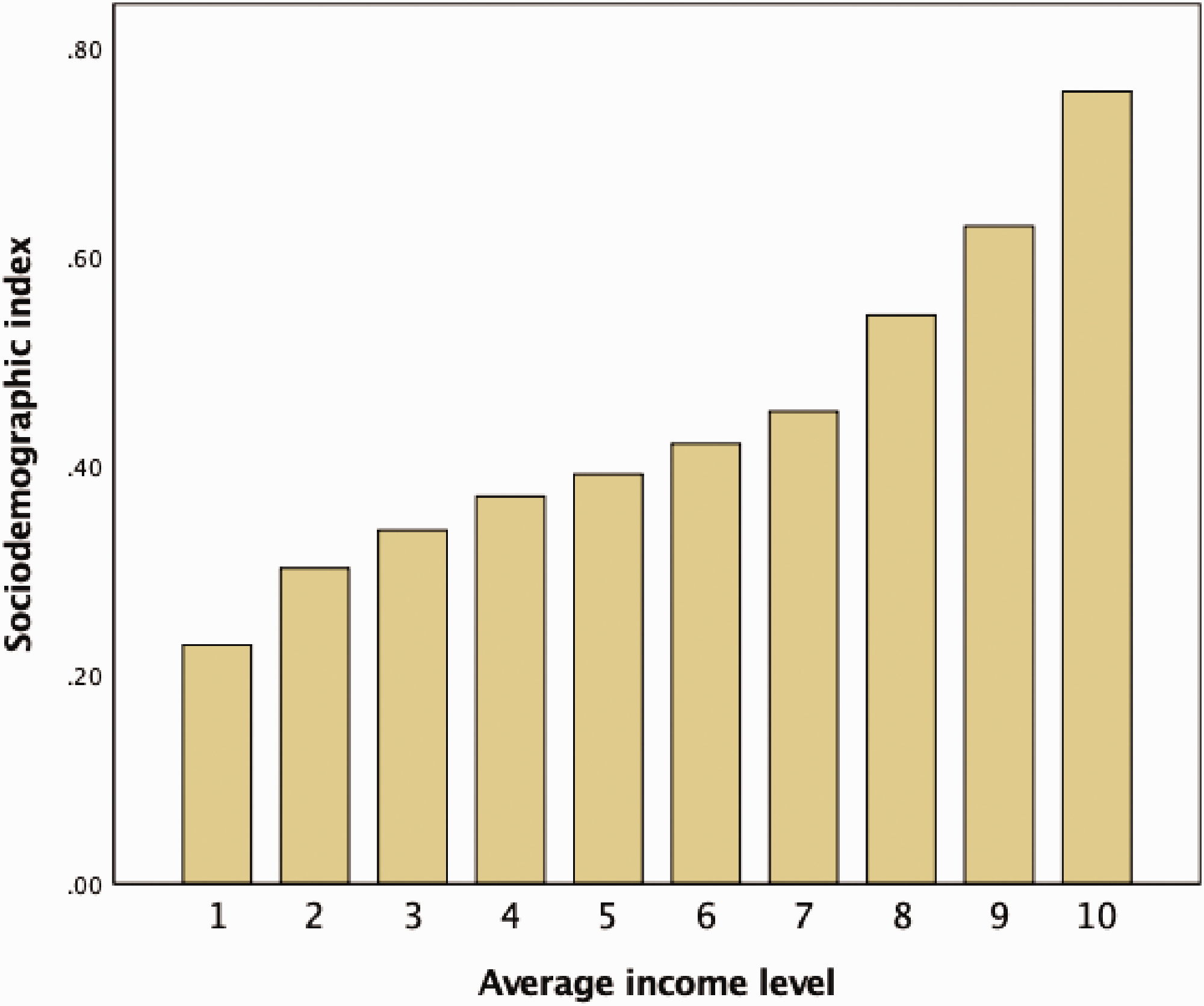
The municipalities categorized into decile groups based on average income. Sociodemographic index (Y axis) and grouping of municipalities based on average income level (X axis). Information pertains to the average for years 2011–2017.
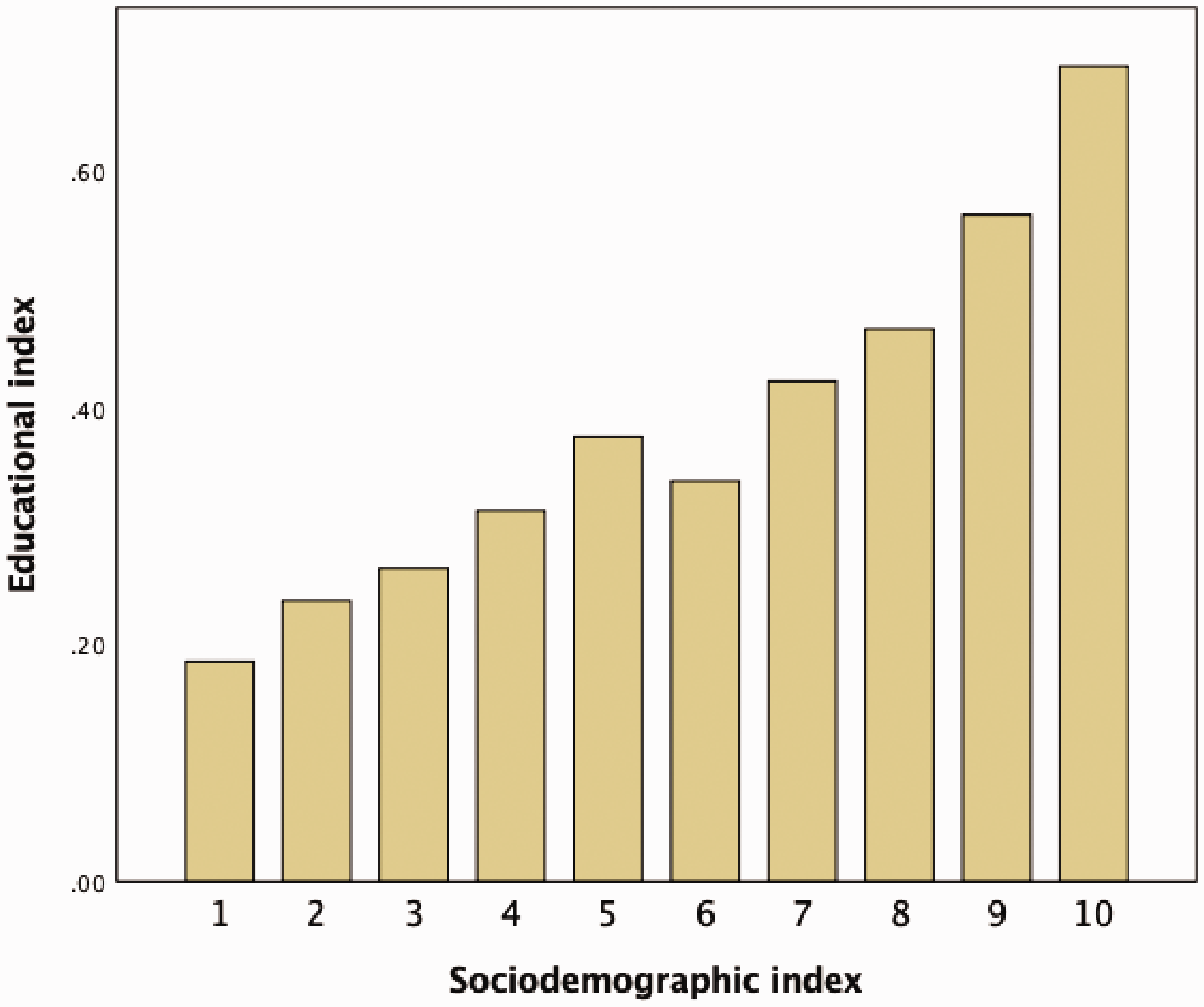
Municipalities categorized into decile groups based on the values in the sociodemographic index. Educational index (Y axis) and sociodemographic grouping of municipalities (X axis). Information pertains to the average for years 2011–2017.
As shown in Figure 1, association between the values in the index and the average income in the municipalities is extremely strong. This means that municipalities with a high average income per inhabitant are characterized by a relatively young population structure, a relatively large proportion of young women and a weaker increase in recent years in the proportion of inhabitants born outside Sweden. They also have a relatively low tax rate and a lower proportion of people employed in municipal occupations. The opposite conditions apply in municipalities with lower average incomes.
When we take a closer look at which municipalities are behind the various municipality groups, a pattern emerges. Among the 10% of municipalities with highest index values, 13 of 29 are located in Stockholm County; that is, the capital city region. Göteborg, Linköping, Lund and Malmö are also included in this category. These are municipalities with relatively large and young populations, large centers of academic learning and a significant proportion of their inhabitants comprising students. At the other end of the scale we find primarily smaller municipalities located in Norrland and middle Sweden, such as Arjeplog, Vingåker, Kramfors, Munkfors, Pajala and Övertorneå. The index indicates that small municipalities with aging populations not only suffer from a growing demographically conditioned support burden and a high tax incidence, but have also seen a rapidly growing proportion of young adults born outside Sweden. A low proportion of students can inhibit development of local and regional industry, and impede long-term establishment opportunities. The high proportion of young men should be regarded with the consideration that women are more inclined to study and thus move to areas with centers of learning, at the same time as there are more men than women in the growing group of people born outside Sweden.
Educational background
An analysis of the municipalities’ conditions in the area of education has been conducted in the same manner as that of the sociodemographic conditions. After a factor analysis, the following variables were distinguished in relation to educational background: average merit ratings in primary school; proportion of people ineligible for upper-secondary school vocational programs; proportion of students in upper-secondary school vocational programs, proportion of students in introduction programs; 4 and proportion of people aged 20–24 years without a completed upper-secondary education. Also included were changes in the proportion of young adults born outside Sweden and the proportion of the adult population with a low economic standard. 5 The motive for including information on low economic standard is that economic vulnerability has been seen to have a decisive effect on educational results. Changes in the proportion of people born outside Sweden also affect the study results.
If we then construct an index illustrating the educational dimension at the municipal level with a departure point in the variable presented above, and relate it to the grouping of municipalities established in our sociodemographic index, a clear pattern emerges.
As can be seen in Figure 2, association is strong. 6 The 29 municipalities with the highest sociodemographic index have an educational index approaching 0.7, compared with an average of under 0.2 for the 29 municipalities with the lowest sociodemographic index. While there is reason to stress that there is a distribution within the municipality groups, the internal distribution is limited in relation to that between the groups. Three municipalities stand out with unexpectedly high educational indices in relation to the sociodemographic index: Båstad, Höganäs and Pajala. At the top end, there are 11 municipalities in Stockholm County or areas with large centers of academic learning such as Uppsala and Umeå. There are also negative deviations in relation to the sociodemographic index. These include, for instance, Göteborg, Sweden’s second-largest city, which is in the decile group with the second-highest municipality index. When it comes to Malmö, the deviation is significantly greater: Sweden’s third-largest municipality, Malmö, lies somewhere in between, in the decile group in fifth place.
Generally, however, this means that municipalities with a disadvantageous age structure, a low proportion of students, a higher proportion of young men and a rapidly growing proportion of inhabitants born outside Sweden also show worse educational performance in primary and upper-secondary school. The average merit ratings are lower, a higher proportion of youths do not qualify for the upper-secondary school vocational programs, and a higher proportion do not attain upper-secondary competence. These municipalities are also characterized by a greater proportion of their population living with a low economic standard, or with poverty risk. This last proportion has also grown in connection to the increase in the group of non-European immigrants, but this is not the only explanation; the group experiencing economic vulnerability is also larger among those born in Sweden. This reinforces the pattern of weak educational results. Weak performance in primary and upper-secondary school offers worse possibilities for further studies and lifelong learning, and in turn risks leading to long-term social risks associated with unemployment, low income and ill health.
Labor market background
We have thus also chosen to distinguish a number of variables that summarize conditions in municipalities from a labor market perspective. The analysis of information on the opportunities in the labor market in the municipalities has been conducted in the same way as previously. A factor analysis resulted in the selection of the following variables for our labor market index: proportion of the young and adult population that neither works nor studies (NEETs); proportion of unemployed among youths and young adults; proportion of youths and adults who work; immigration surplus in the municipality (positive or negative); and a socioeconomic sorting list (SKL) for estimating the proportion of the population with excess risk of being dependent on social support.
If the labor market index is related to the categorization of municipality groups according to the sociodemographic index, the pattern shown in Figure 3 emerges:
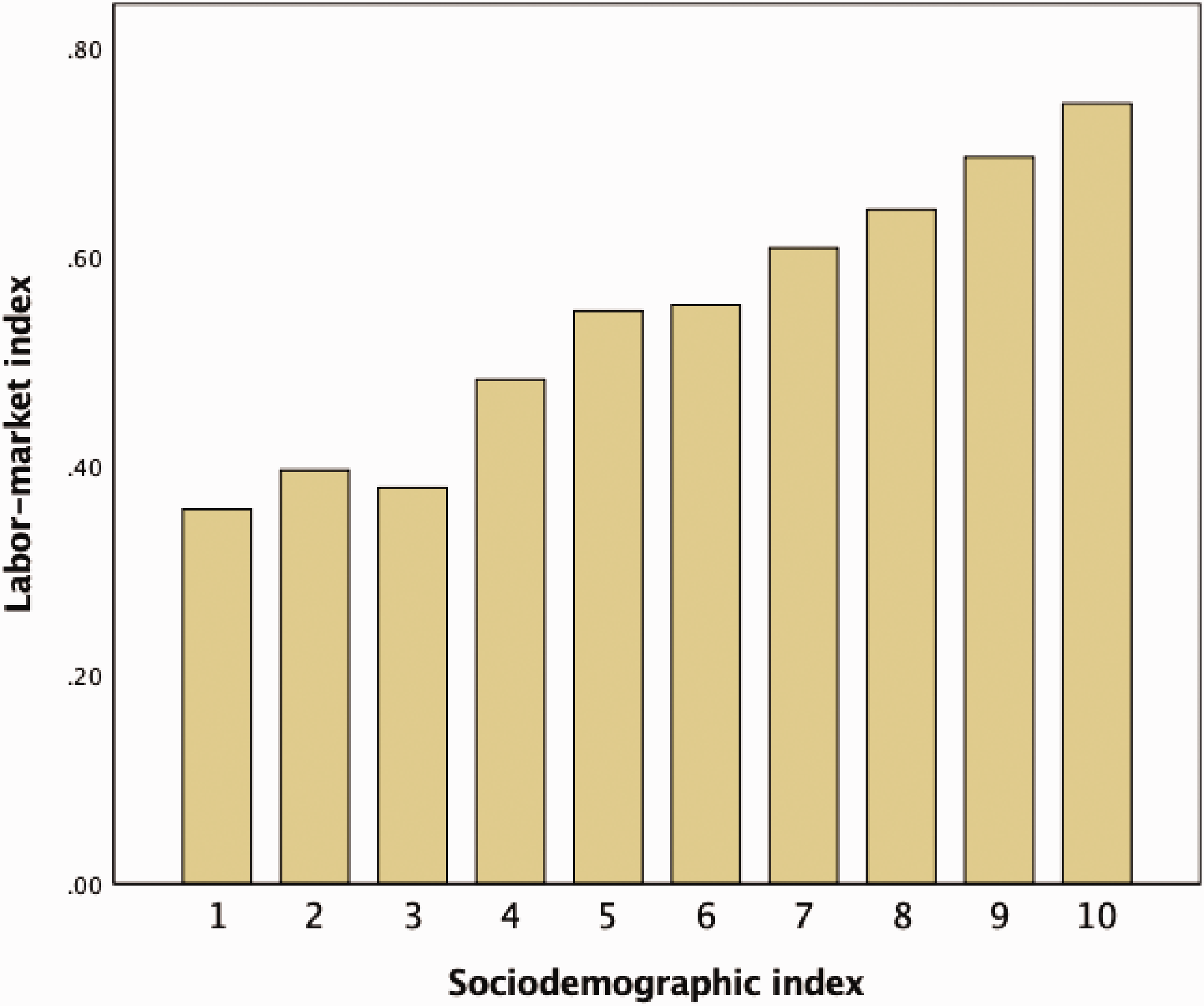
Municipalities categorized into decile groups based on values from the sociodemographic index. Labor market index (Y axis) and grouping of municipalities (X axis). Information pertains to the average for years 2011–2017.
As seen in Figure 3, the association between the indexes is strong, albeit not as strong as between the educational and sociodemographic indices. 7 Once again, the municipalities in the Stockholm region are substantially overrepresented among those with high index values, with 11 municipalities in Stockholm County in the first decile group. But there are also municipalities, a total of five, that deviate from this. Those that deviate the most negatively in relation to the sociodemographic index are Landskrona and Malmö in Skåne County, both having relatively high unemployment numbers among young adults and a high proportion of people born outside Sweden in their populations. Gällivare and Kiruna in Norrbotten deviate positively, with a higher value in our labor market index than what could be expected considering their placement according to the sociodemographic index.
The conclusion is that municipalities with a high proportion of inhabitants who neither work nor study, a high proportion of unemployed and a low employment rate are also to a greater degree characterized by disadvantageous sociodemographic conditions, with a disadvantageous age structure and a significant out-migration of youths to areas offering education as well as larger city regions. At the same time, municipalities with a weak labor market have in recent years taken in a significant proportion of people born outside Sweden, primarily in their younger years. The increase in the proportion of people born outside Sweden has been more striking in smaller and rural municipalities than in large cities.
A total index for establishment opportunities
The three indices discussed here can now be summarized in a total index – or a comprehensive establishment index – that offers an overall picture of the opportunities for establishment at the municipal level in various parts of the country. The total index summarizes the opportunities connected to the sociodemographic conditions in the municipality, educational performances and education levels, and conditions related to the labor market. The lower the index value, the more disadvantageous the opportunities. In Figure 4, municipalities have been categorized into 10 groups according to our total index, whereby the lowest decile group (Group 1) has the lowest index values and the highest decile group (Group 10) the highest. According to our total index, the municipality groups have in turn been related to an average of the proportion in the municipalities of young adults aged 20–29 years who support themselves through social subsidies or welfare. The information on welfare includes economic support, compensation for open unemployment, sick pay, early retirement benefit and sickness benefit, as well as parents’ allowance. The information is recalculated to whole-year equivalents, which means that two part-time compensations are recalculated to one full-time compensation, four compensations of 25% each are recalculated to full-time compensation for one individual, etc.
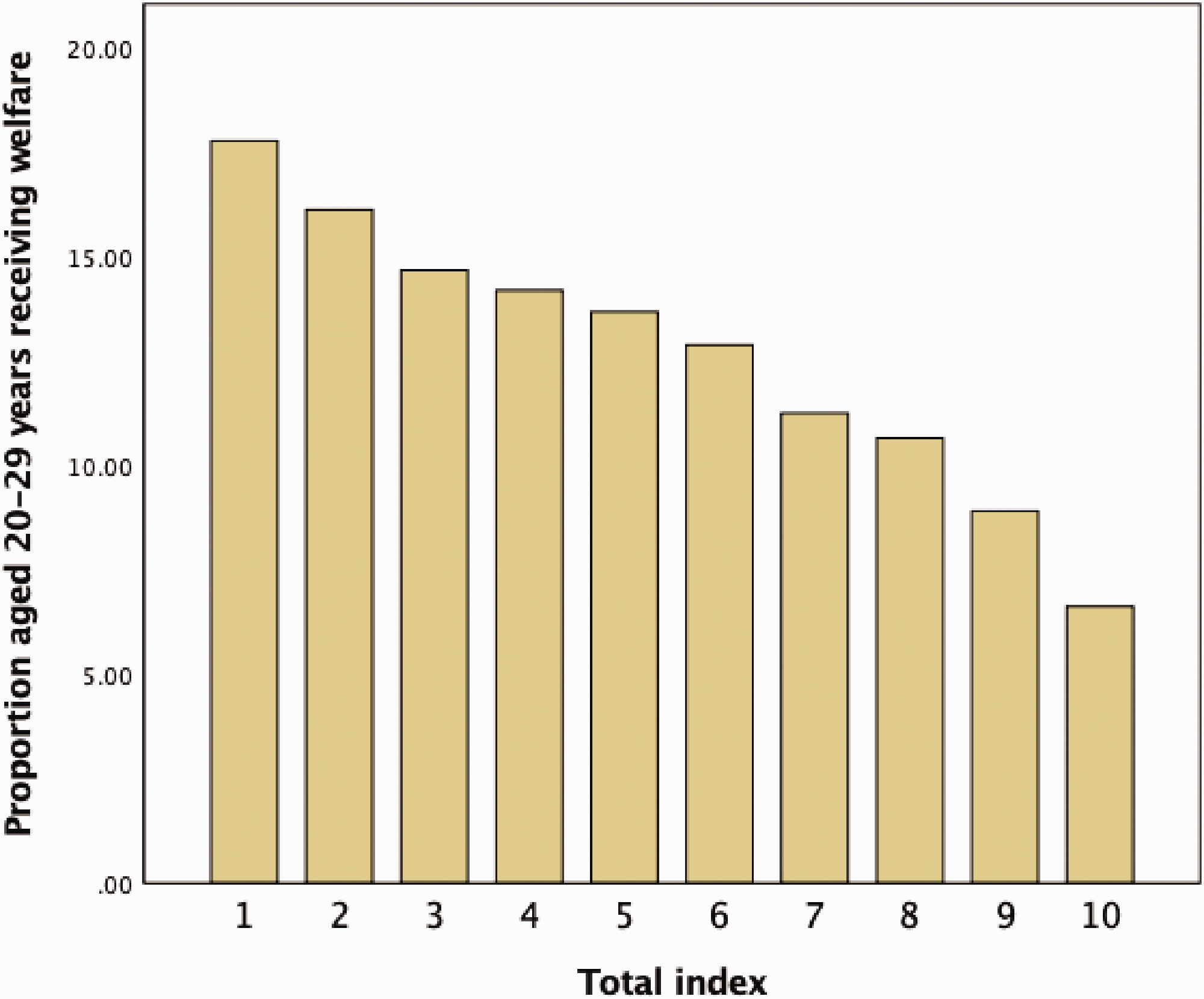
Municipalities categorized into decile groups based on total index values. Proportion aged 20–29 years receiving welfare (Y axis) and grouping of municipalities (X axis). Information pertains to the average for years 2014–2018.
As shown in Figure 4, there is a very strong association between the municipalities’ index values according to our total index and the proportion of young adults living on welfare. 8 The lower the total index, the higher the proportion of young adults receiving welfare. In the municipality group with the highest total index there are 15 municipalities in Stockholm County, 6 in the greater Göteborg area and 4 in the greater Malmö area. The municipality group with the lowest index, with only a small number of exceptions, is comprised mostly of municipalities in middle and northern Sweden; from Flen and Vingåker in Sörmland, Filipstad in Värmland and Ljusnarsberg in Örebro County to Överkalix and Övertorneå in Norrbotten. Most of these municipalities have low populations, and many are also geographically remote.
Discussion and conclusions
How, then, are we to understand the great socio-geographical differences as well as the extensive challenges for low-educated and newly arrived migrants in relation to the universalistic transition regime? While the comparatively and historically focused welfare-policy research undoubtedly offers important clues as to differences between countries when it comes to institutional conditions for welfare on an overall level, the patterns that emerge also need to be elaborated and anchored in knowledge on local and regional conditions. If we speak of the possibilities for young adults and people born outside Sweden to find stable jobs with good support possibilities, it becomes obvious that the opportunities differ greatly between various regions and municipalities. The geographical starting position – the place where one has grown up or has come to – has decisive significance for individuals’ career paths and social conditions.
As stated earlier, the regime perspective on young people’s transitions has been exposed to a great deal of criticism. Some critics argue that the regime perspective is too functionalistic and fails to explain differences and development patterns. Others, and perhaps more relevant for this article, have directed their criticism at the idea of a uniform, universalistic regime in the Nordic countries (Helm Jørgensen et al., 2019; Lorentzen et al., 2019; Lundahl and Olofsson, 2014). The regime perspective, according to critics, obscures fundamental differences between Nordic countries. For example, there are extensive variations when it comes to school–work relations and the organization of vocational education and training (Helm Jørgensen et al., 2019). These are highly relevant observations, and in this article we provide a further dimension, namely that variations when it comes to school-to-work transition and labor market opportunities can be vast, not only between countries, but also within countries.
Changed opportunities for education and work as well as growing income differences illustrate that the universalistic regime is under significant pressure. A clear change in recent years, to offer a concrete example, is the emergence of increasingly more temporary jobs. Generally, temporary employment does not offer the same possibilities for learning and influence in the workplace as a permanent job does. For natural reasons, youths are overrepresented among those who are temporarily employed. Women have traditionally been overrepresented here, but in the most recent period the proportion has also substantially increased among men. Among people with a foreign background there is double the proportion of temporarily employed (25%) compared to among those with a Swedish background (12–13%).
Here as well, data from Statistics Sweden on the population’s living conditions support the impression of a place-bound dimension. The proportion of temporarily employed is higher in municipalities outside the large city regions. A significantly greater proportion of those who are low-educated are also left to temporary jobs.
Opportunities in the labor market are thus influenced not only by socio-geographical and socioeconomic factors, but also by ethnic background factors. People with low education, in their younger years and with a foreign background are to a higher extent left to atypical jobs – a pattern that is substantial in all municipalities, not least in the large cities’ immigrant-dense suburban areas, but that becomes all the more decisive in municipalities far from the large city regions.
Broad efforts are needed, both to work against the tendencies towards increased segmentation of the labor market and to prevent the negative social consequences of increased differences in establishment opportunities. Suggestions are often put forward for competence policy initiatives and a fusion between education and labor market measures, as well as a need for broader engagement by the parties in the working life, in both Swedish and international contexts (European Employment Policy Observatory (EEPO), 2015; OECD, 2018; SOU, 2019: 3). The discussion often involves opportunities for youths with a weak educational background, many times in combination with a foreign background. But it is important to stress that challenges must also be seen from a socio-geographical perspective. The conditions in various parts of the country differ, and quite dramatically; if we do not take these differences into account, it will be difficult to design effective efforts. Furthermore, it will be impossible to offer labor market and education efforts that come anywhere near fulfilling the fundamental welfare-policy goals of equal opportunities.
Footnotes
Declaration of conflicting lnterests
The author(s) declared no potential conflicts of interest with respect to the research, authorship, and/or publication of this article.
Funding
The author(s) received no financial support for the research, authorship, and/or publication of this article.
