




Abstract
This article analyses and compares the evolving role of general subjects in the curricula of initial upper secondary vocational education and training (VET) in Finland and Sweden during the 1990s and 2010s. The research illustrates how Bernstein’s concept of ‘pedagogic code’ supports comparative studies on principles guiding changes to curricula and how the role of general studies in VET has been redefined. The findings show that while a principle of ‘market relevance’ has been central to VET over the decades since the 1990s, it has been subject to varying interpretations. The shifts in interpretations have guided the organisation of VET in these two countries in different directions, including the role of general subjects within the curriculum. On a general level, the countries share some key similarities. Both countries emphasised lifelong learning and a broadening of VET in the 1990s, based on a core principle of ‘flexibility’. In the 2010s, the earlier promotion of flexibility and universal access to higher education was superseded by a stronger focus on employability and entrepreneurship in addition to students’ command of more specific vocational tasks.
Introduction, background and purpose
The purpose of this study was to analyse similarities and differences within and between the Swedish and Finnish initial vocational education and training (VET) systems, and particularly their curricular development during the 1990s and 2010s. By analysing central policy and curricular documents, we investigated how VET is organised within the upper secondary education system, and what the role and position of general subjects has been in the construction of this organisation. Thus, the object of inquiry was not the pedagogical process itself (e.g. classroom practices), but rather the normative guidelines and frameworks that have been given nationally and which determine the goals and basic conditions for what is possible in pedagogical processes. An investigation into the political process and actors (e.g. political parties), as well as the question of why this development came about, were beyond the scope of this study.
The role of general subjects – such as languages, mathematics and humanities (e.g. history, religion, sports, civics) – in the curriculum of VET is significant as the idea of progress from one level of education to another is the basis for curriculum planning. The logic and presupposition is that a curriculum, on any level, is based on knowledge and skills that learners have gained on previous levels. Thus, what knowledge and skills students have had access to shape their ability for further educational transitions. Consequently, access to general subjects can stratify young people into different educational pathways, not least because eligibility for higher education (HE) is often also linked to them content-wise and structurally.
As part of the education system, VET is already a stratified form of education with respect to socio-economic background and gender. Youth with a working-class background are typically overrepresented in initial VET (Nylund et al., 2017; Bol et al., 2014; Ho, 2012), and there is a particularly prominent gender segregation across different vocational programmes (Fehring and Herring, 2013; Ledman et al., 2018). Accordingly, the organisation and distribution of knowledge in VET has important societal implications (Nylund et al., 2017). While class and gender stratification are rather well-documented aspects of VET, this study focuses on content-related effects of the classification and framing of VET, with a particular focus on general subjects.
Previous research (see Angus, 2015; Francia, 2011; Lynch, 2006) has identified an international education policy trend since the late 1980s promoting a principle of ‘market relevance’ as a strengthened driver for defining educational goals. The trend is reflected in the influence of neo-liberal ideas in education implying that the organisation of education needs to be more thoroughly governed by market principles – such as efficiency, new public management (NPM) and responsiveness to labour market needs – rather than for the purpose of educating citizens for the democratic state per se. Another related and documented policy trend has been the shift in curricular focus from knowledge to competence (Bernstein, 2000; Deakin Crick, 2008). As Wahlström (2016) and others (Pépin, 2007; Vassallo, 2017) have noted, the shift from knowledge towards competence has been promoted in the transnational policy arena by, for instance, the EU and the OECD. In terms of VET, Bernstein (2000) and others (e.g. Wheelahan, 2010) have described how the organisation of knowledge has become increasingly ‘generic’, meaning that knowledge in its own right – independently of whether it is rooted in disciplinary or professional fields – has become marginalised in favour of preparing students to constantly adapt to changing (labour) market demands. In the context of VET, this reorganisation of hierarchies of knowledge, skills and competencies, in turn, has led to a focus on relatively low-skilled work-based learning (Ball et al., 1999; Canning, 1998; Wheelahan, 2007). Accordingly, previous research seems to suggest a connection between a curriculum emphasising market principles and the promotion of competency-based training (CBT) (Hodge, 2016; Wheelahan, 2007). 1
Both of these trends of ‘market relevance’, that is, NPM and the shift from knowledge to competencies, have been central to the development of education policy over the past few decades in Sweden (Carlbaum, 2012; Dovemark, 2010; Lundahl et al., 2010; Nylund, 2013) and also, more moderately, in Finland (Isopahkala-Bouret et al., 2014; Lappalainen and Lahelma, 2016). The period from 1990 to the 2010s in many ways represents a ‘paradigm shift’ for education in the Nordic countries (Beach, 2018; Lappalainen et al., 2018; Lundahl, 2016), particularly in Sweden, from a system focused on equality and cohesion to a system strongly influenced by market principles with increasing social divisions. In this study, we set out to examine if and what implications this policy paradigm of market relevance has had for how relations of the VET curricula and general subjects are organised in Finland and Sweden. These countries offer an interesting comparison as they are similar in terms of being Nordic countries associated with a ‘Nordic model’ of education that prioritises equality (Lappalainen and Lahelma, 2016), but at the same time they are also clearly different in terms of how VET is organised in the context of upper secondary education more broadly. With this article, we thus hope to contribute to a deeper understanding of shifts in this market relevance policy paradigm and the redefinition of educational goals in a Nordic context (Blossing et al., 2014; Lappalainen and Lahelma, 2016; Nylund et al., 2018). Accordingly, the research questions that guided this study were:
1) How have VET and the general subjects been classified and framed in the targeted reforms of the 1990s and 2010s?
2) What principles underpin how VET and general subjects are classified and framed?
3) What key similarities and differences between developments of VET curricula in Sweden and Finland can be identified?
The structure of this article proceeds as follows. We first present the theory, methodology and empirical basis of our research. Thereafter, we present an analysis of the Swedish and Finnish cases individually, that is, diachronically. The diachronic analysis is followed by a synchronic analysis of the developments in Sweden and Finland, and we conclude with a discussion about the dominant characteristics of these changes.
Theory, methodology and empirical basis
Conducting a comparative analysis of two countries that structure upper secondary school, curricula and policy processes in different ways, poses a methodological challenge. In order to try to overcome this challenge, we applied Bernstein’s (2000) theory of pedagogic codes to analyse the core principles that guide the selection and organisation of content and learning in vocational education. An important reason for using the theory of pedagogic codes and their modalities was that it creates a common language to describe and compare curricular principles across different reforms and countries. Basil Bernstein’s theories and concepts, such as regarding horizontal and vertical knowledge discourses, have been actively developed and applied to research during the last decade (Martin and Maton, 2016; Shay, 2013; Young, 2008). While some of his concepts have received plenty of attention, the concept of pedagogic code, particularly for use in comparative curriculum analysis, has not been as thoroughly explored. We hope that our present study makes a useful contribution by developing such forms of analysis.
A pedagogic code can be analytically derived from the combined results of, and relationships between, the classification and framing of education (Bernstein, 2000). In short, classification is about how boundaries are set up, that is, how different categories are constructed by being distinguished from other categories (e.g. school subjects). Classification is thus a relational concept that concerns the ‘what’ of education. A strong classification indicates clear boundaries between, for example, subjects or different educational programmes. A weak classification, in contrast, indicates blurred boundaries in which the separation, for instance of one school subject from another, becomes less clear. In our research, we used the concept of classification to investigate how VET is coordinated (i.e. more or less integrated or isolated) in relation to HE preparatory programmes and working life, and how the general subjects are integrated in the curriculum.
The second key concept when analysing a pedagogic code is framing, which concerns the relationships set up within a given classification. Framing concerns the ‘how’ of education in terms of the core principles regulating communication and learning. Key aspects of framing include, for instance, how learning is to be evaluated, and both the sequencing and pacing of learning. Framing, like classification, can have strong or weak forms. Strong framing consists of clear and explicit rules and principles for the pedagogic communication, while framing is weak when the rules and principles of the pedagogic communication are more implicit or ‘invisible’. In this study, we used the concept of framing to investigate how control over the educational content in VET is organised and distributed, inter alia, through steering by policy and curricular documents such as syllabuses and assessment criteria.
The classification and framing of a curriculum can thus be strong, weak, or anything in between. Furthermore, the classification and the framing of a particular practice can vary independently of one another. Classification and framing also have both internal and external dimensions. For instance, the relationships between subjects in a VET curriculum could change (thus changing its internal classification) while its organisation in relation to the labour market (external classification) remains the same. In short, a code is a complex composition of power and control, and emerges from what principles govern how knowledge and learning are organised, including the content, breadth and subdivisions of that knowledge and the order in which it is gained.
In this study, we analysed the VET curricula as expressions of different modalities of a pedagogic code. The term modality (Bernstein, 2000) refers to changes in patterns of classification and framing that can occur without dissolving a basic code, in this case a ‘VET code’ that separates VET from other upper secondary, higher education preparatory programmes (HEPP). To speak of a code in this theoretical context, one must identify a specific orientation to meaning, that is, a particular configuration of classification and framing. 2 A ‘VET code’, briefly, historically identifies: (a) the relationship between VET and preparing students for positions that have less power, prestige and influence in the social division of labour (see Avis and Atkins, 2017; Nylund, 2012); (b) the priority given to a certain type of knowledge that is oriented towards ‘doing’ and ‘behaving’ rather than towards theoretical systems of meaning or critical thinking (see Apple, 2004; Rosvall et al., 2016); and (c) an overrepresentation of young people with lower socio-economic backgrounds in this type of education (Lahelma, 2009; Nylund et al., 2017; Silver and Brennan, 1988). The concept of pedagogic code is formulated on a level that is sufficiently abstract to offer an analytical language which enables comparisons between the countries while simultaneously being open and dynamic enough to allow for the analysis of both continuity (e.g. a ‘VET code’) and change.
In our analysis, aside from primary sources, we have also drawn on previous studies. The primary sources that have been selected for our analysis were, foremost, the actual curriculum texts (Curriculum for Upper Secondary School, Lpf94 and Lgy11; National Board of Education, 1995 and 2014, respectively). These were combined with key policy texts, particularly the white and green papers (Govt. Bill, 1990/1991:85; Govt. Bill, 2008/2009:199; Ministry of Education, 1996; Ministry of Education and Culture, 2011; Swedish Government, 1992, 2008) that underlie the reforms. In our research, we found crucial differences between the Finnish and Swedish curricula as likewise reported in the study by Lappalainen et al. (2018). Therefore, the texts used and their place in the analysis differ between the two countries. In Sweden, the educational policy that underlies the reforms, diploma goals and syllabuses plays a more important part in teasing out the differences between the 1990s and 2010s, because Sweden’s ‘unified’ structure of upper secondary school means the curricula themselves (Lpf94 in the 1990s and Lgy11 in the 2010s) are very similar at the ‘top level’. 3
In Finland, our focus is on the national qualifications framework, established by the National Board of Education. The national core qualifications play a significant role in steering VET in Finland. They set out a common basis for all vocational institutions providing education towards a particular qualification and, in turn, make those institutions eligible for state funding. The quantity and proportion of general studies is the same across all national core qualifications independent of the study programme (Law on Vocational Education 21.8.1998/630; Law on Vocational Education 11.8.2017/531). Individual education providers build their own curriculum within the framework given by the national core qualifications framework, and thus the specific syllabus and its organisation may differ from institute to institute, but the core elements remain the same across the nation. The legislation for general upper secondary education (GUS) and VET have, in principle, been kept apart as separate entities over the decades.
Methodologically, the choice of Bernstein’s conceptual framework allows us to draw conclusions on how the shifts in policy and redefinitions of curricula have changed the relations between VET programmes and general upper secondary programmes. We describe the shifts on the basis of the data and present outcomes of these redefinitions for VET programmes and their curricula both internally and externally through the adoption of Bernstein’s concepts. We have identified changes and different modalities in our data by comparing the reasoning and justification given for general subject provision both diachronically, looking at the changes from the 1990s to the 2010s in each country, and synchronically, by comparing the country cases.
Upper secondary education is organised differently in Finland and Sweden. For example, vocational and academic tracks are often housed within the same institutions in Sweden but are pursued in separate upper secondary schools in Finland. Approximately 33% of the student population in Sweden is enrolled in vocational programmes, while the number is closer to 40% in Finland (Nylund et al., 2018). VET programmes in both countries differ in key respects, such as knowledge content, traditions of workplace learning, the proportion of boys and girls enrolled, and transitions to HE. Our analysis below focuses on the general subjects and addresses the general educational patterns of upper secondary schools’ VET programmes in both countries. However, for the sake of clarity in presenting our analysis, we illustrate these general patterns by focusing on one example of a VET qualification, namely the Vehicle and Transport programme, for comparison between the two countries. We first describe the changes in classification and framing of VET in each country in broad terms, drawing on previous studies and our key empirical documents. Then, we analyse changes in the classifications and framing of general subjects, their relative emphasis in each curriculum, and the reasoning and level of importance attached to them. Finally, we present a comparative analysis between Finland and Sweden during the 1990s and the 2010s and how this development can be understood as expressions of different code modalities.
VET in Sweden
Classification and framing of VET in Swedish curricula
In Sweden, the reform during the 1990s (Govt. Bill, 1990/1991:85) represented a much weaker classification of vocational education as a whole, both internally and externally, in comparison with the previous curriculum (Lgy70). Internally, the vocational programmes became less differentiated, with fewer entry and exit points. For example, it was suggested that the first year of VET programmes should have common content across all specialisations, where previously they had been differentiated (Govt. Bill, 1990/1991:85, 55). Externally, in relation to HEPP, all upper secondary school programmes became three years in length, which for most vocational programmes meant being extended by one year. This extension was mainly intended to accommodate the introduction of a number of general subjects in the vocational curricula which would occupy at least 30% of the programme (Govt. Bill, 1990/1991:85, 96). Extending vocational programmes also meant that graduates of these programmes became eligible for HE, a new ambition that was made explicit in the diploma goals for vocational programmes (National Agency for Education, 1994). Overall, these diploma goals were quite general in character. The new general subjects were supported by common course plans for all students in upper secondary school, since they were intended to have similar content and play a similar role in all upper secondary programmes. In short, a key principle of the 1990 reform was that of, to use Bernstein’s (2000) phrase, ‘bringing together’, which meant a weaker classification of vocational education achieved primarily by giving more emphasis and prominence to general subjects. In the government bill that launched the reform, the idea of an uncertain future raising the demand for more general knowledge content and a more flexible organisation of upper secondary education was at the core of this reform process: The new type of upper secondary school will educate people who will be active in the labour market of the future. Changes happen fast. It is impossible to make exact predictions today about what international influence, increased competition, new technologies and changing work organisations will mean for society and thus also for education. Upper secondary education must therefore not only provide a good amount of general knowledge as the basis for change and development of each citizen. Upper secondary school itself must also contain a large amount of flexibility and incentives as well as room for change and improvement. (Govt. Bill, 1990/1991:85, 50–51; translated from Swedish)
In the reform, the notion of flexibility is closely related to the idea of a ‘knowledge society’ (see e.g. Govt. Bill, 1990/1991:85, 42), a society that is perceived as rapidly changing, not least in terms of the labour market, with increasing internationalisation and increasing demands on knowledge: The development of working life means, among other things, that boundary transcendence between different vocational areas is needed and that demands be made on the awareness of both one’s own and others’ competences. This, in turn, increases demands on the school’s working methods and work organisation (Lpf94: 5; translated from Swedish).
This conception of society and the labour market resulted in a weaker framing. More specifically, it resulted in the content of syllabuses being framed in terms of educational goals to be achieved (for teachers to interpret), more loosely framed (non-competitive, non-relative) assessment criteria and more opportunities for students to choose freely among courses. In short, control by the state and the labour market was reduced and the influence of local actors (students, teachers, municipalities) was enhanced. The reform can be seen, in part, as an expression of market-oriented ‘laissez-faire’ ideas about education, in which it is the responsibility of each individual to shape his or her own future (see Olofsson, 2010). However, it is important to underline that the notion of flexibility and market relevance, although it is the most prominent principle of the reform, co-exists with a range of other principles that are also important for how VET is organised, such as preparing students for their role as citizens and highlighting the importance of environmental and international issues (Govt. Bill, 1990/1991:85, 159–160).
In contrast to the 1990s, in regard to classification, the 2011 reform is characterised by the principle of ‘keeping apart’. At the most general level, the curriculum of the 1990s was very similar to the new one that emerged in the 2010s, except that, in the latter, entrepreneurship became a new overarching theme that was intended to permeate all content (Lgy11). Thus, at the top level (see note 3) of the Lgy11 curriculum, more general goals and competences such as education for citizenship were now also stressed. However, there were more radical changes at lower levels, that is, in the more detailed parts with respect to the content definition of the curriculum. If we compare the diploma goals of the VET programmes, the emphasis has clearly shifted towards ‘working life’ and making students more employable. This new ambition is illustrated by the specification of particular careers as goals for those completing specific programme types, that is, there is stronger internal classification. If we take the Vehicle and Transport programme as an example, one programme is supposed to lead to a career as a truck driver and another to one as a car mechanic, whereas the previous exam was more general. Another change in the 2011 curriculum is that many previous diploma goals have disappeared, such as ‘understanding the role of vehicles and aircraft in society’ and ‘the ability to discuss and consider ethical issues in relation to the student’s occupation’ (National Agency for Education, 1999; our translation). In addition to some goals that do not directly relate to a future vocation disappearing, other general goals, such as knowledge of sustainable development or communication and language skills, have now been assigned functions that relate to rather more specific occupational contexts (Nylund and Rosvall (2016)). An illustration of this tendency is the revised description of language skills in the Vehicle and Transport programme. The 1990s diploma goals stated that: The programme prepares students for both national and international activities, which requires language skills and understanding of other cultural patterns … to be able to communicate in Swedish and English in a way that is appropriate to the needs of the profession, social life and further studies. (National Agency for Education, 1999: 15–16; translated from Swedish)
The Lgy11 curriculum replaces this passage with the following text: Students should also develop professional language skills that can be applied in different situations, with a vocabulary that is relevant to their profession in both Swedish and English. Additionally, students should develop their ability to document their work according to the requirements of relevant industries. (Lgy11: 23; translated from Swedish)
The principle of ‘keeping apart’ from general programmes is also illustrated at the course plan level, inter alia, by the fact that previously common general subjects are now differentiated across VET and HEPP programmes, both in terms of space and content. On the general level, there is also a stronger framing of the content, that is, where what was set out as ‘goals’ in the 1990s curriculum has been replaced by ‘central content’ that teachers must include in their teaching. Further, the students’ freedom to choose between courses has been reduced and is more strongly framed (Nylund, 2013). These changes mean that VET programmes no longer make students eligible for HE, and subsequently this goal has been removed from the diploma goals. The ‘framing’ of VET could be summarised as having shifted so that the state and the labour market now have greater control over the content, while the influence of local actors (students, teachers, municipalities) has declined. The primary discursive principle for the framing of VET is now to make the VET student employable. In order to meet the changing requirements of the labour market, a new institutional framework for organising programme content was proposed, with a close collaboration between industry and the National Agency for Education at its core. The main purpose of this new organisation is described as being to: [m]atch education supply with labour market demand in order to facilitate the transition of young people from vocational education to working life. Labour market conditions can change rapidly. (Govt. Bill, 2008/2009:199, 47; translated from Swedish)
Employers’ interests are incorporated into both the design and the future development of the programme’s steering documents. In brief, a tight coupling between employers’ temporary demands and the design of vocational programmes has been established, meaning that the curriculum is strongly demand driven (Nylund, 2013). The increased emphasis on workplace relevance is also illustrated by the introduction and strengthening of apprenticeship education (Arneback and Nylund, 2017).
Other examples of how the reforms differ in terms of classification concern eligibility and admission rules. In the 1990s (Lpf94), admission requirements became more homogeneous in that eligibility requirements were the same for all upper secondary programmes. In the 2010s (regarding Lgy11), the tendency switched to the opposite, establishing different admission requirements for VET and HEPP, with the entry demands for VET being lower. 4
In short, the Swedish VET curricula of the 1990s and 2010s represent two modalities that differ in key aspects. The curriculum of the 1990s represents a weaker classification and framing of VET, both internally and externally, while the 2011 curriculum represents the opposite. They are also based on different key ideas: while the reform in the 1990s was concerned with ‘flexibility’, the reform of 2011 became focused on ‘employability’. The differences are also expressed by the classification and framing of general subjects within the broader curriculum.
Classification of general subjects in Swedish VET
The role and emphasis of general subjects in the curricula of the 1990s and 2010s differ in significant ways. However, there are also similarities. First of all, it is by and large the same subjects that are classified as general subjects in the two curricula. In the 1990s curriculum (Lpf94), these were: Swedish, English, social science, religious instruction, mathematics, natural science, physical education and art/music/drama. In the later curriculum (Lgy11), they were the same with the exception that the category of art/music/drama was replaced with that of history. The main changes undertaken relate to the amount of time assigned to each subject and to the classification of the subjects. In VET, the emphasis dedicated to general subjects fell from 750 to 600 credits. The subjects of social science and Swedish received only half of the attention in the 2011 VET curriculum that they had been given in the previous version (falling from 200 to 100 credits). Even more fundamental changes are evident when comparing the subject plans.
In comparing the guidelines for VET students’ study of Swedish, for example, a number of differences are apparent. Among other things, the syllabus of the Lgy11 curriculum removed the more general educational goals, such as artistry, coverage of existential issues, source criticism and the development of an in-depth understanding of people from other cultures and different living conditions (Nylund and Rosvall, 2016). While the previous syllabus for the basic Swedish course has had a fairly broad scope, in the 2011 syllabus the orientation leaned more towards specific knowledge. In place of earlier phrases – such as ‘participate in conversations and discussions with different purposes’ and ‘be able to gather and evaluate information and knowledge from libraries and databases’ – the new course description emphasises more practical language skills such as ‘the use of presentation aids and linguistic correctness’. Furthermore, the explicit goal of preparing students to act as citizens has disappeared from the syllabus. These changes are representative of a tendency across all general subjects (Nylund et al., 2017).
In the 2011 curriculum, the content of general subjects is more bound to the specific vocational focuses of the different VET programmes. This, together with the reduced space for these subjects, has led to the creation of different syllabuses for VET and HEPP regarding many general subjects (Swedish, natural science, social science, history, mathematics). The general pattern is that the content of VET syllabuses is comparatively more focused on the individual while the HEPP syllabuses offer a more structural analysis of social phenomena (Nylund et al., 2017). For example, syllabuses in social science for both HEPP and VET (1b and 1a1) cover private economics, but, in contrast to the HEPP syllabus, the VET syllabus does not cover national or international economics and there is no content relating to understanding ideologies (Nylund et al., 2017). If we take mathematics as another example, in VET this is classified by what is ‘typical of a programme [and] the opportunities and limitations of mathematics in these situations’ (Mathematics 1a).
In short, the Lgy11 curriculum is a clearer expression of a ‘VET code’ – in which general subjects become more context bound, contain fewer general skills and do not aim to provide general eligibility to HE – in contrast to the Lpf94 curriculum. The diachronic analysis of Swedish VET curricula of the 1990s and 2010s presented above is summarised in Table 1.
The code modality of Swedish VET in the reforms.
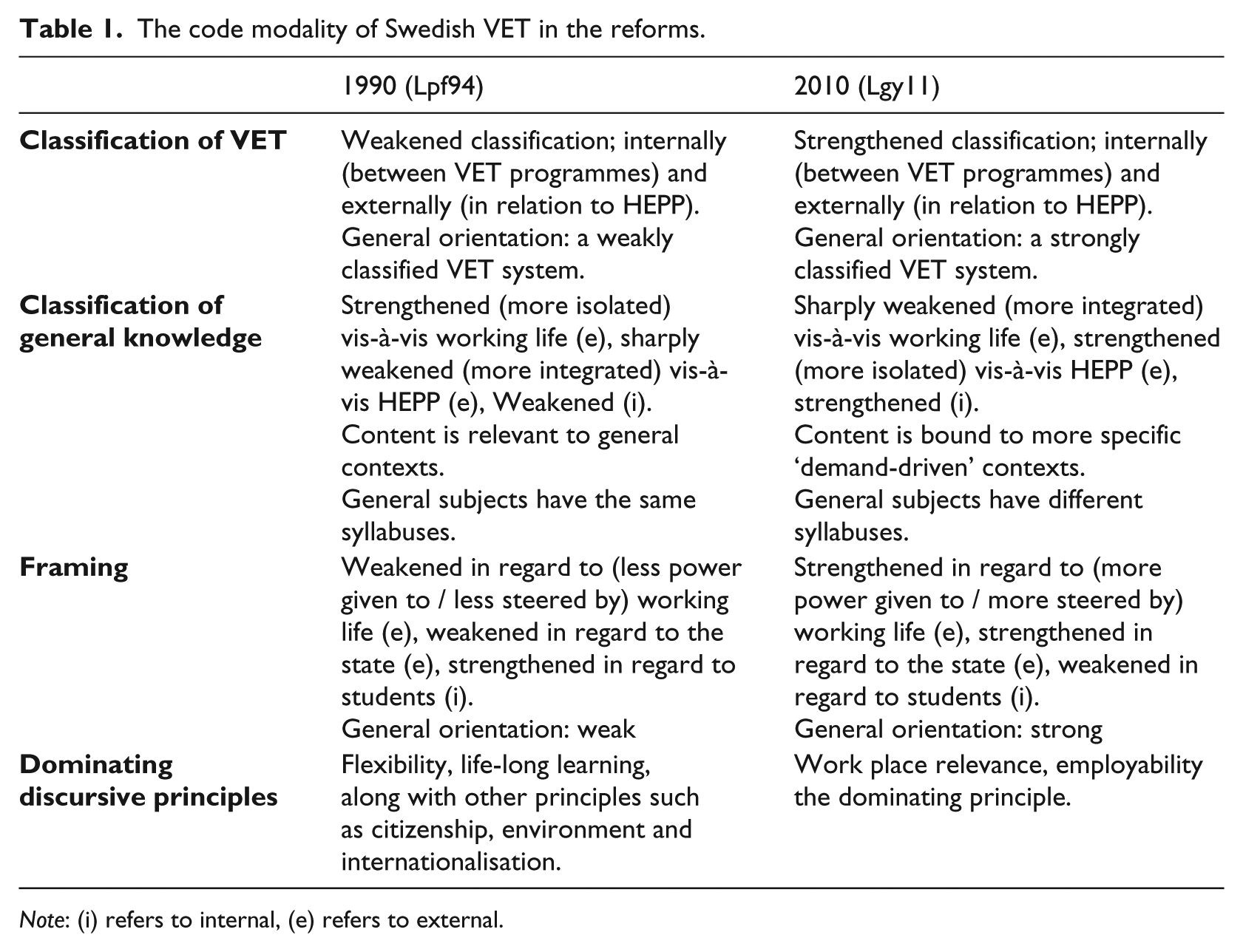
Note: (i) refers to internal, (e) refers to external.
VET in Finland
Classification and framing of VET in Finnish curricula
In Finland, upper secondary education for young people has been offered in two main forms: general upper secondary education (GUS) and vocational upper secondary education (VET). Traditionally, GUS was the only 5 educational route that made students eligible to study at the traditional universities. In the 1990s, the distinction between GUS and VET became more ambiguous, primarily due to VET programmes becoming longer and including more general subjects (Stenström and Virolainen, 2016). The internal classification of VET remained strong: VET programmes were diverse and clearly differentiated from one another. In the 1990s, the earlier structure of parallel two- or three-year vocational programmes was replaced by more modularised VET programmes that students could complete consecutively (Ekola, 1991; Laukia, 2013). This change was intended to reduce duplication across different courses of study and to promote progression. It was felt that VET should offer broad general vocational education geared towards a broad occupational field (Väärälä, 1995). Since the later reform of 1995, those who had completed a two-year qualification became eligible to pursue a relevant subject at a polytechnic, and those with a three-year qualification became eligible to study any subject at a polytechnic (Stenström, 1997). At that time, access to traditional science universities was, in principle, attainable by VET students, subject to entrance examinations or specific quotas, but it was uncommon. Following further reforms to VET programmes during 1998–2001, they all enabled students to proceed to HE. Since the 1990s, the post-secondary, so-called ‘college’ level, VET was gradually displaced by polytechnics (referred to as universities of applied sciences, UAS, since 1 January 2006) (Numminen, 2000; Stenström and Virolainen, 2016). The UAS introduced a binary system of HE, becoming the primary route for VET graduates to access HE, which accelerated making HE a mass phenomenon. In sum, the classification of VET vis-à-vis GUS was sustained on the education system level, externally, when VET and GUS remained separate routes of education, but it became somewhat ambiguous internally through the reclassification of general knowledge due to the increased amount of general studies in VET.
A step towards system-level weakening of the VET classification vis-à-vis GUS occurred as a result of the youth education experiment inspired by the Swedish reform of the 1990s (Meriläinen and Varjo, 2008). It allowed Finnish VET students to choose study elements from GUS. Later on, this right for students to choose specific courses of study was replaced by an obligation on the part of education providers to collaborate regionally (Law on Vocational Education, 21.8.1998/630, 10§; Numminen et al., 1999; Virolainen and Stenström, 2015). The experiment produced a model of so-called ‘dual qualifications’, making it possible for students to complete the matriculation examination for GUS as well as gain a VET qualification through combined studies. This model of institutional collaboration has been adopted by some regions and is now provided in several Finnish cities (Kumpulainen, 2014; Mäensivu et al., 2007).
In the 2000s, periods of on-the-job learning and skills demonstrations were adopted as part of VET in Finland (Räisänen and Räkköläinen, 2014; Virtanen, 2013). These pedagogic shifts put more emphasis on workplace learning, strengthening not only the internal framing of Finnish VET programmes but also the classification of VET curricula, externally, as distinct from GUS, through increased vocational specialisation. However, they did not necessarily impact the provision of general subjects within VET.
The latest national framework for VET qualifications has been gradually adopted since 2015. By putting more focus on work-based learning, it has enhanced the distinction between VET and GUS in Finland. As a result, there is now a stronger classification of VET as a whole than there was in the 1990s. At the curriculum level, there has been a shift in how diploma goals are defined. The ongoing reforms 2015–2018 stress individuals’ right to progress at their own pace, and promote achieving learning outcomes by combining multiple learning methods (e.g. work based, distance learning, or school based) as well as support getting accredited for prior learning. Students’ competences are assessed through practical demonstrations of their skills.
Alongside curricular changes, the distinction between VET and GUS has sharpened further due to the traditional universities putting more emphasis on the matriculation examination from GUS as a condition for admission to their courses. Some UAS have also put in place entrance examinations for VET graduates in order to test whether their skills, particularly in languages and mathematics, are adequate for further studies. These shifts have been fuelled by a funding formula that favours reduced study durations (Ministry of Education, 2016).
Classification of general subjects in Finnish VET
In the 1990s, the basic structure of Finnish VET qualifications combined compulsory vocational studies, optional studies and general subject studies with compulsory and optional elements. General studies comprised a quarter of the whole qualification, that is, 20 out of 80 study credits. General subject studies included the official domestic language and communication, the second official domestic language, foreign languages, mathematics, social and working life, civics, and physical and health education (National Board of Education, 1995: 65). The general studies component was similar across all VET qualifications. The justifying discourse given at the onset of national requirements regarding these general studies emphasised complexity and changes in society, and how command of these subjects enhanced students’ capacity to adapt to such changes, as illustrated in the curriculum, for example, for the qualification as a mechanic: In a society structured by multiformity, people demand a broad and rich education that includes free choice. Competence involves adaptability, meaning that mathematics and science education, social and humanistic studies, communication competence, language skills and social abilities become more and more important in almost all vocations. General studies promote broad vocational education, which combines strong vocational competence with all-round education and values. It helps people to survive in changing conditions and to develop vocational competence when occupational tasks and the environment change. Broad, all-round vocational education gives people the ability to progress to higher education, supports them in maturing from youth to adulthood, and gives them life management abilities. Having multiple options also allows for individual orientation (National Board of Education, 1995: 65; translated from Finnish)
Those who moved from GUS to VET were exempt from general studies. Furthermore, within the framework of inter-institutional cooperation, VET students also had the right to choose general subjects from general upper secondary schools (National Board of Education, 1995: 107–108).
The pedagogical guidelines for general studies suggested that these could be partly or wholly integrated into the vocational subjects, but that students should be graded for them separately. For instance, in theory, the curriculum for mechanics enabled students to transition into UAS, but, as the UAS system was still emergent at the time, higher education was more generally achieved by gaining the qualifications established for technicians and engineers (National Board of Education, 1995: 13).
As part of the latest VET reform (from 2015 to the present and ongoing), the national framework for vocational qualifications has been realigned. The general studies element is still similar across all VET qualifications. The qualification consists of vocational, common and free-choice studies. In the latest (2016) national qualifications framework, general studies, as part of the common studies, include up to 35 competence points out of a total of 180, which is relatively less than what it was in the 1990s. However, students may complete more studies as part of their qualification if this is required due to field-specific or local requirements, and they can also choose additional courses that are not required, simply to strengthen their vocational competences.
General studies, as part of VET programmes, have been further defined to include competences in: communication and interaction (languages); mathematics and natural, societal and working life subjects (including entrepreneurship and entrepreneurial activity, sports and health education); and society and culture (e.g. ethics and psychology). In principle, the right to access HE through a VET qualification has not changed, but it is now up to students to decide for themselves whether or not they need more general studies within their individual study plan in order to be appropriately prepared for higher education.
The meaning given to general studies has also changed since the 1990s. In addition to the aims being defined in relation to vocational, common and optional studies, some ‘overarching aims’ as ‘key competences’ of lifelong learning curricula are given. These are to be embedded in the common vocational and general studies and their assessment criteria should support the: ‘development of competences needed for continuous learning, survival in working life situations and to face new challenges in the future’. These elements are presented on the last pages of the curriculum document and include, for example, learning and problem solving, initiative taking and entrepreneurship, professional ethics, sustainable development, active citizenship, understanding of various cultures, and health, safety and management at work (National Board of Education, 2014: 259–260).
The most notable change with respect to individual diploma goals in contrast to the 1990s is that there are more specified qualifications available within the diploma structure. For example, concerning the Vehicle and Transportation field, new qualification titles, such as ‘car salesperson’ and ‘parts salesperson’, have been created, while the traditional qualification title of ‘vehicle mechanic’ has remained in place as such. At the same time, this introduction of new qualification titles has not happened at a similar pace across all fields. Rather, its rollout has been dependent on field-specific developments and initiatives by social partners. The new range of qualifications reflects how technologies and business cultures have changed, and that the emphasis is increasingly on business and services within the field. Altogether, the internal framing of VET qualifications has strengthened. Study goals are now presented explicitly in relation to assessment criteria, which are themselves more specified than in the 1990s and differentiate between levels of command. This tendency is reflected in how the general legitimation of diploma goals for certain titles, such as the qualification of a ‘car mechanic’, is stipulated. In the following quotation of the national requirements, it can be seen how versatility has become a demanded characteristic of competencies needed in the branch: The environment for car mechanics is international and networked. There is a demand for various kinds of versatile, competent personnel in the field. Customer orientation and quality of service is important to all tasks. The prerequisite for these is having versatile competences, the ability to apply technical skills, and good customer orientation as well as collaborative skills. The need to follow and apply new technology as well as recycle materials creates a challenge (National Board of Education, 2014: 1, Autumn 2016 curriculum; translated from Finnish).
In the 1990s, in contrast, the focus was on commonly demanded job skills and typical employers (National Board, 1995: 27). On the whole, the way in which diploma goals are set out in the national requirements has become more complex and detailed.
To summarise, in the latest national qualifications framework, the discourse regarding curricular aims has shifted towards an emphasis on task-specific skills and competencies. There has been a change from holistic goal setting towards more specified, narrow and detailed diploma goals that relate to specific occupational tasks. Not only the diploma goals but also the instructions for assessment have become more detailed, structured and specific. In regard to specific goals, there are now multiple layers of key competences for lifelong learning to be embedded throughout the curriculum, including vocational skills, general studies, optional studies and individual free-choice studies (National Board of Education, 2014: 21–27). The inclusion of overarching curricular aims, such as building key competences for lifelong learning, makes the structure of the national qualifications framework more varied and complex. Altogether, there is a shift from education for society towards an emphasis on individual competence development and individuals’ own responsibility for achieving this. The major shifts in the code modality of Finnish VET from the 1990s to the 2010s are summarised in Table 2.
The code modality of Finnish VET in the reforms.
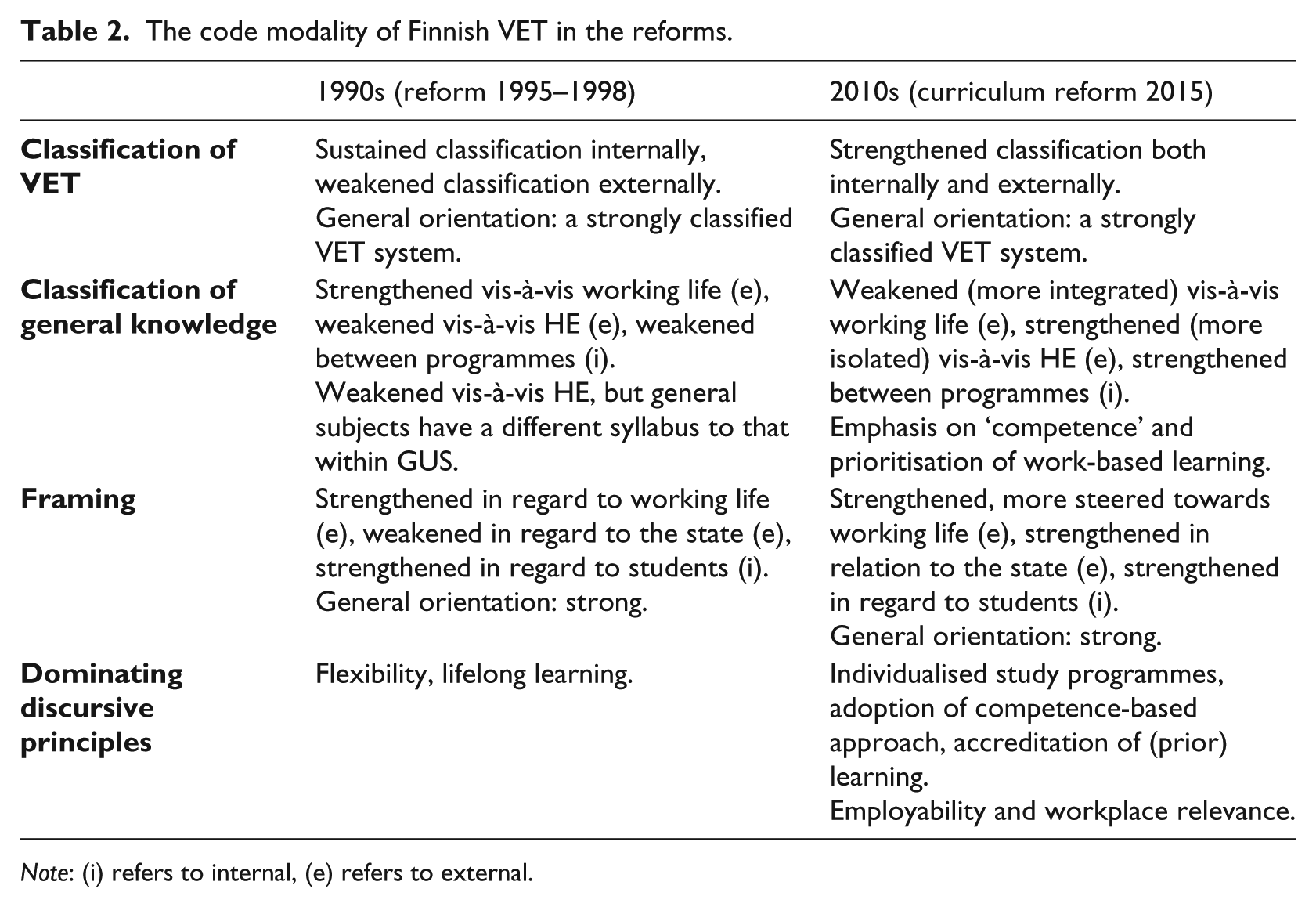
Note: (i) refers to internal, (e) refers to external.
Comparing the code modalities of Finland and Sweden from the 1990s to the present
Below, we summarise and synthesise our findings of the diachronic analysis of the curricular developments as code modalities, presented in Tables 1 and 2, and discuss what conclusions can be drawn concerning the main similarities and differences between Sweden and Finland during the 1990s and 2010s in this regard.
It is clear, based on our analysis, that both countries have been part of the same international policy meta-discourse over the period studied, which has set the same basic frame for the code modality of VET. This is evident in how the same overarching ideas about the purpose and ideal organisation of VET prevail in both countries. In the 1990s, Sweden’s VET reform resulted in a more unified model and structure for upper secondary education than in Finland, where VET and GUS curricula have been kept separate with the exception of some elements of individual choice that had been experimented with since the 1990s. Nonetheless, in both countries, the classification and framing of VET with respect to general upper secondary education weakened during the 1990s as a result of extending VET programmes, itself driven mainly by more emphasis on general subjects. The VET curricula were defined fairly broadly and as preparatory to particular fields rather than to specific tasks. This was seen as a way to give students the capacity to adapt to changes in the world of work and to society more generally. While Sweden’s unified approach to upper secondary education was not implemented in Finland, Finland experimented with the promotion of more flexibility, individual progression (including the possibility of pursuing higher education) and lifelong learning in the youth education experiment. These characteristics were later enhanced as part of the mainstream VET route. The code modality of the 1990s was thus a weaker classification and framing of VET, reflecting principles of lifelong learning, ‘freedom of choice’ and equity combined with a stronger classification of general studies vis-à-vis working life and a weakened classification of general studies in relation to general programmes. While some basic characteristics of the modality of the 1990s, such as freedom of choice, resonated with what had in previous research been linked to neo-liberalism (Angus, 2015; Francia, 2011; Lynch, 2006), there were still commitments to equity, in particular in Sweden, that anchored the education policies by being more responsive to citizenship needs than would be the case later on in the 2010s.
In the 2010s, both countries still seemed to partake in the same meta-discourse (Cedefop, 2018), but one that was expressed in a code modality conveying a stronger classification and framing of VET and shifting towards greater emphasis on competence, specific vocational knowledge, employability and entrepreneurship compared to the modality of the 1990s. In contrast to Finland, the 2011 reform in Sweden represents a step back in regard to access to higher education, that is, a stronger classification of VET driven in part by giving less emphasis and a more vocational focus to general subjects within curricula. Meanwhile, in Finland, through the reforms in both the 1990s and 2010s, VET had moved towards stronger internal framing through enhanced on-the-job training and skills demonstrations as pedagogic approaches within VET. The emergence of a competence-based approach as a dominant principle in Finland, in 2016, meant a stronger classification of VET in this sense. Both countries have recently given more emphasis to a market principle in shaping their curriculum, and other principles (such as equity or citizenship) have become weaker than they were in the previous curricula. Furthermore, this market principle is interpreted in a different way from that in the 1990s. This is highlighted, inter alia, by the growing emphasis on employability, more context-bound knowledge, entrepreneurship and individual progress. Still, Finland’s steps towards an explicitly prioritised competence-based approach, including the establishment of assessment criteria that distinguish between levels of competence, seem to constitute a stronger and more thorough shift in modality. Thus, Finland is more clearly part of the international policy trend of promoting ‘competence’ and ‘lifelong learning’ (Bernstein, 2000; Deakin Crick, 2008; Vassallo, 2017), and even more so in the 2010s than was the case in the 1990s. The curricular development in Sweden, when contrasting the 1990s with the 2010s, represents rather the opposite trend, that is, a movement away from ‘generic’ skills to a more strongly classified curriculum featuring more context-bound knowledge.
In both countries, the volume of general subjects within their VET curriculum decreased in the 2010s, and the principles guiding the curricular content emphasise relevance to the labour market. This implies a weaker connection between general subjects and disciplinary or theoretical knowledge within VET. Contemporary policy can thus be seen as strengthening a VET code, since giving priority to a type of knowledge that is oriented more towards ‘doing’ and ‘behaving’ than towards theoretical systems of meaning has been one of the defining features of the VET code throughout history (Apple, 2004; Rosvall et al., 2016). This is also reflected in the patterns of transitioning from VET to HE following the reforms during the 2010s in Finland and Sweden. In Sweden, the number of students transitioning from vocational programmes to higher education has reduced considerably since the reform in 2011. For instance, the number of transitions to higher education among students in the first post-reform cohort immediately after finishing their vocational programmes was approximately 30% lower than before the reform (Nylund et al., 2018). In Finland, the transitioning effects of the 2015 reform up to 2018, are not yet visible, but some UAS have already proposed entrance examinations for VET graduates.
As stated earlier, the importance of lifelong learning is still clearly visible in the Finnish VET curriculum. However, its basis may be weakening since the structure of the national qualifications framework has become more complicated and multi-layered. In Finland, the dominant competence approach emphasises students’ command of specific tasks, both by how diploma goals are defined and through assessment. In contrast to Finland at that time, the Swedish reform during the 2010s decreased the emphasis given to individual choice and also placed more emphasis on studying history, which is not offered in VET in Finland. Also, with respect to the education system, the Swedish VET model is still more unified in its organisation than the Finnish VET model, in which GUS and VET have remained clearly separate types of upper secondary education from the 1990s through to the present, apart from the experimental framework mentioned earlier.
Conclusions and discussion
Our research questions concerned how VET and general subjects have been classified and framed in Finland and Sweden in the 1990s and 2010s, and what principles are underpinning their organisation. One main finding and conclusion of our study is that while a focal principle of the organisation of VET in all reforms has been the relation to the changing labour market, the different interpretations of this labour market relation, or ‘market principle’, have led to code modalities that are, in many ways, quite different. While all of the reforms have promoted content that is more about abilities than knowledge, the reforms of the 1990s and 2010s differ both in how ‘the market’ is understood and in how education should be organised to adequately meet the market’s demands. In the 1990s, the market was perceived to be dynamic and constantly changing (see e.g. Govt. Bill, 1990/1991:85, 50–51; Lpf94: 5; National Board of Education, 1995: 65), which was responded to with a weaker framing of education and a less strongly classified VET system. There was an idea of markets where students’ and teachers’ ‘freedom of choice’ was prioritised and flexibility and lifelong learning promoted. In the 2010s, contrastingly, the labour market came to be perceived as having more specific demands that have to be met, and, simultaneously, employability and entrepreneurship were promoted more and more. 6 To achieve this, a stronger framing and classification of VET was put forth. Subsequently, the employers and the state became prioritised as the crucial agents for steering education, although more clearly so in Sweden than in Finland. In the 1990s, students were perceived as persons who would be active in shaping the uncertain future, mainly through exercising individual responsibility. In the 2010s, the priority is that students adapt to existing demands in the current labour market. Thus, there was a more long-term principle at work in the 1990s, whereas there is a more short-term principle at work in the modality of the 2010s. Another key difference is that, as stated earlier, the reforms in the 1990s brought multiple organisational principles to VET, while the reforms in the 2010s focused more dominantly on one factor, that of employability. Again, this has been more evident in Sweden, because in Finland the multi-layered character of the national framework and emphasis on individual choice have moderated as well as complicated the picture.
These different interpretations of the purpose of VET and a market principle have led to quite differently perceived roles for general subjects within VET regarding the 1990s and 2010s. In the modality of the 1990s, general subjects were given the role of promoting various values, ranging from access to HE and promoting citizenship to creating a flexible workforce. In the modality of the 2010s, general subjects are given a more instrumental and narrow role in creating employable workers. At the most basic level, the reforms in both countries can be said to represent two different core principles: first, ‘integration’ in the 1990s, and second, ‘differentiation’ in the 2010s. This is the case despite the fact that all of these reforms have been influenced by a principle of market relevance. This raises the question, as some previous researchers have pointed out (Kingfischer and Maskovsky, 2008), that perhaps concepts such as ‘neo-liberalism’ or ‘market relevance’ are at times used to capture too broad a range of phenomena. Our analysis of the code modalities in the 1990s and 2010s suggests that quite different interpretations of ‘market relevance’ as a principle have been at work during these periods. The concept of code modality, illuminating both developments within and between countries, helps to unpack curricular and policy development as a multi-layered process that includes very different interpretations of market relevance regarding the periods studied. This indicates the importance of intricate conceptual tools when analysing the implications of market relevance or the neo-liberal policy paradigm for educational goals, and not only concerning VET in Nordic countries but also regarding other educational contexts. Since the organisation and distribution of knowledge in VET have important societal implications, the changes in the definitions of the general subjects in both countries suggest a need for future research on students’ choice of general subjects, VET students’ success in HE and the labour market of their field of study, and gendered patterns between VET programmes in relation to the subjects. In this article, we have not focused on the different actors of the curriculum process (political parties, etc.), nor tried to explain why this curriculum development came about. Though there are studies on these issues (see e.g. Hickox and Lyon, 1998; Lundahl et al., 2010; Nylund et al., 2017), these are also questions that warrant further investigation if we are to understand the period 1990–2010s more fully.
Footnotes
Declaration of conflicting interests
The author(s) declared no potential conflicts of interest with respect to the research, authorship, and/or publication of this article.
Funding
The author(s) disclosed receipt of the following financial support for the research, authorship, and/or publication of this article: This work was supported by NordForsk through the Nordic Centre of Excellence JustEd [grant number 57741], NordVET [grant number: 54782] and the network Vocational education, transitions, marginalisation and social justice [grant number 57741]. The work was also supported by Vetenskapsrådet (the Swedish Research Council) [grant number 2015–02002].
