




Abstract
It is well established that participation in formal adult education varies by individual background characteristics. However, less attention has been paid to examining inequality in participation as a consequence of policy changes, such as educational expansion. This paper examines the process of tremendous expansion in Swedish Higher Vocational Education (HVE), a vocationally oriented postsecondary educational segment driven by labor market needs. Using a demographic approach with a sociological lens on educational participation, we analyze administrative data from registers, uncovering who has been served by this expanding adult educational form. Our results indicate that expansion of HVE has led to growth in participation for policy-prioritized groups, although the rate of growth in enrollment between groups varies and corresponds to population changes. We also locate the extent of cumulative advantages in participation and discuss these results in relation to social (in)equality in formalized HVE.
Introduction
Sweden has often been heralded as spearheading developments within the field of adult education and has traditionally adopted policies where civic and cultural competences are championed. This paper examines the recent trend toward expanding a vocationally oriented segment of postsecondary education, also known as Higher Vocational Education (HVE, or yrkeshögskoleutbildning). Swedish HVE offers shorter-length postsecondary training programs, which are designed with reference to local labor market needs and operated in partnership with future employers. This educational form thus differs from the preceding infrastructure of adult learning as it caters to demand-driven provision and is focused on employability. Since HVE was formally institutionalized, it has grown rapidly, with the number of enrolled participants more than doubling between the period 2007 and 2020 (MYH, 2021).
Through the availability of administrative registers of participation, this paper traces how participation in this expanding segment has changed and which groups have been served, in conjunction with population changes. While this study explores the phenomenon of work-related HVE expansion from one particular national site, it is empirically and theoretically generative to the broader adult education literature for several reasons. First, it contributes to research on the vocational turn at higher levels of education (Brint et al., 2005; Symes & McIntyre, 2000; Boeren & Holford, 2016). This trend is related to increasing demands on individuals to rapidly adjust to labor market needs, and transformations due to technological and industrial developments that place pressure on adults to engage in continuous training (Jarvis, 2010; World Economic Forum, 2016).
Second, although it is well established that participation in adult education varies by individual background characteristics, less attention has been devoted to analyzing inequality in participation as a consequence of policy changes, such as the introduction and expansion of a new educational segment (Lee & Desjardins, 2021). We make an empirical contribution in this regard using data from registers that cover all participants and that allows us to study changes in the HVE student population, in relation to broader demographic changes. Finally, by examining the expansion of an educational form that is labor market-driven through individual-level characteristics of participants, we can situate what kind of learning paradigm Swedish HVE falls under. For example, by examining whether HVE is used by individuals to improve their position in the labor market or if it serves a compensatory role for those with difficulties having their previous education and labor market experiences recognized.
In the text to follow, we offer a background of Swedish HVE. We then map out relevant previous research, concentrating on educational expansion and the vocational turn in higher levels of education, ahead of presenting our research questions and aims. These sections foreground our methodological considerations where we outline our research approach shaped by the demographic method with a sociological lens on HVE participation, before presenting the results and conclusions.
Background: What Is Swedish HVE?
Discussions on hybrid forms of postsecondary education and training have been picking up in recent years. Viewed as hybrid or transitional qualifications, the contemporary topology of the HVE landscape possesses distinct national characteristics, with each country's system varying greatly in aims and purpose (Bathmaker, 2017; Gallacher et al., 2012). While “Europeanization” and related processes have played a part in conflicts and consensus on institutional change in collective skill systems (Busemeyer & Trampusch, 2011), comparative work undertaken by regional organizations shows that there is no clear consensus on the definition of HVE (Ulicna et al., 2016). Nevertheless, many countries in the European Union have some form of HVE that is aligned to the European Qualifications Framework levels 5 and above, which is also where Swedish HVE is located (Ulicna et al., 2016).
The Swedish case of HVE resembles the Nordic state-led model of formal adult education, to some extent (Desjardins & Ioannidou, 2020). This educational form is publicly funded and often organized by a range of nonacademic actors such as private companies, municipalities, or training centers. Each program has a steering group of industry representatives and this high degree of stakeholder involvement in shaping training content is usually brought forth as an institutional signum. Central to this educational form is the work placement component, where participants have to do one or several stints of internship as part of their program. The HVE programs we examine are short cycle, averaging around 2 years, and can be delivered on campus, via distance education, or a combination. Training providers submit proposals to secure program funding, are evaluated based on demonstrated local labor market needs and their previous track record as providers. Consequently, programs are launched and dismantled based on their ability to secure stints of funding from the governmental authority, Myndigheten för yrkeshögskolan.
From its conception, Swedish HVE was positioned as a flexible policy tool for responding to changing economic conditions as well as structural changes within the labor market (SOU 2008:29). In policy formulations over the last two decades, attention has been directed at youth unemployment, training people for new forms of work, combating gender segregation in the labor market, as well as more recently, labor market integration of newly arrived migrants. While Swedish higher educational reforms and expansion of the 20th century aimed at enabling social mobility for individuals but resulted in other forms of inequality and differentiation (Börjesson, 2011; Hällsten, 2010; Thomsen et al., 2016), the motivations leading up to the expansion of HVE have been different. HVE's expansion has been driven by arguments about the need for employers to find “skilled” workers, as well as rationalities to equip workers with the “right competence at the right time”—a slogan often found on promotional materials (Ye, 2018). Swedish HVE thus provides an interesting site for examining the political appeal of publicly funded higher vocational education.
The public investments noted here build on a longer tradition in Sweden of prioritizing the learning of adults, as well as the state's active involvement in sponsoring adult education and skill formation. Formal adult education in Sweden receives strong institutional support and from a comparative perspective, the country has among the highest share of the adult population participating in different sorts of educational activities (Desjardins & Rubenson, 2013). Compared to other contexts, there is also less stigma associated with reentering school and training as adults (Kilpi-Jakonen & Stenberg, 2014). While there might be different prerequisites to determining a participant's eligibility to apply for an HVE program (e.g., language requirements or upper-secondary grades), participants can “compensate” the absence of certain academic qualifications with demonstrated work experience. The connotations of embarking on HVE might therefore look quite different when compared to other countries where the postsecondary vocational education sector is often positioned as “second chance” education, or a social mobility enabler for those who dropped out of initial education (Webb et al., 2017).
Given the extent through which HVE has been expanding and increasing in volume, one would expect to find ample research on this topic. However, this is an educational segment that hitherto has been insufficiently explored in the Swedish context. Most available publications come in the form of commissioned reports (Andric & Regnér, 2018; SCB, 2017). Lind and Westerberg (2015) mapped trajectories of participants who began training in 2006 and completed by 2010, focusing on the pre- and post-training labor market outcomes and differences between participants, when HVE was still in its experimental state. Other studies focus on policy reforms and their enactment in practice (Köpsén, 2019; Lindell, 2006; Persson Thunqvist, 2015). All of the above suggest an opportunity to study social recruitment into higher vocational educational programs, taking into account the changing demographic characteristics of the entire student population, and uncovering how recruitment patterns have changed from the phase of experimentation to its eventual formalization and expansion.
Educational Expansion and the Vocational Turn in Higher Levels of Education
Over the turn of the 21st century, there has been a renewed interest among academics to write about the vocational turn in higher levels of education. Although research on formalized HVE does not fall back on much longevity, other higher educational institutions with long histories, such as community colleges and folk high schools, have fulfilled similar functions of vocational training for adults (Brint & Karabel, 1989; Rubenson et al., 1999; Zeuner, 2010). Yet systematic examinations on how participation changes as these segments undergo expansion have been few.
A classical theme in sociological research has been examining the expansion of higher education and its effects on the participation patterns of different segments of the population. One common finding is that selectivity in a specific educational trajectory tends to retain a strong relationship to social stratification, even as the entire landscape of higher education expands (Boudon, 1974; Jonsson & Erikson, 2007; Thompson & Simmons, 2013). The main reason attributed to these patterns has been that selection mechanisms shift from barriers for entering tertiary education, into fine-grained differentiation found between fields of study, or institutional hierarchies erected between educational sectors.
Expansion in higher education has often been driven by motivations for widening access to education and a means for social mobility but has also been argued to be a consequence of intensified economic competitiveness (Thompson & Simmons, 2013). As the expansion of Swedish HVE occurs on the back of an expanded higher education segment that developed in the 20th century, it is valuable to examine the demographic and social utilization of these new educational opportunities, in both absolute and relative terms. Even though HVE in Sweden is largely publicly funded, unlike the expansion of higher education that has been premised on equity goals, this form of vocational education has a very clear mandate to train participants for work. In this paper, we depart from the classical sociological literature on educational expansion that has a strong emphasis on class mobility. Rather, we attend specifically to how participation in HVE varies by key social dimensions that of participants’ gender, migration status, age, and pre-training socioeconomic status, as HVE's expansion has been rooted in combating labor market challenges associated with these dimensions.
Participation in Formal Adult Education
While research on formalized HVE is varied in scope, the literature on how participation in formal adult education varies by individual characteristics or national contexts is a rich area we can learn from. For instance, studies have demonstrated how adult vocational motivations vary by gender in different ways, and that institutional contexts matter when disentangling these individual-level effects (Boeren & Holford, 2016). Earlier studies also show that age has been one of the strongest determining characteristics for participation, and that older workers participate less in continuing education and training (Blossfeld et al., 2014; Boeren et al., 2010; Desjardins et al., 2006). In Sweden, a main driver of population changes over the last decade, and as HVE expanded, has been immigration. Extant research demonstrates how relational and institutional factors—such as how stratified a country's schooling system is, or what kinds of alternative access to higher education there are—can impact immigrants’ likelihoods and preferences to participate in vocational education at higher levels, and that these outcomes vary by immigrant subgroups (Abrassart et al., 2020; Griga & Hadjar, 2013).
For policymakers, formalized adult learning has been seen as an important device for reducing social inequalities. However, earlier studies on participation have found that learning opportunities are accumulated and used disproportionately among already-advantaged individuals (Boeren, 2009; Vono de Vilhena et al., 2014; Kilpi-Jakonen & Stenberg, 2014). In sociological literature, this cumulative advantage principle is known as the Matthew effect (Merton, 1968). Previous research on participation in Swedish formal adult education, for example, found the Matthew effect to dominate; participants with higher levels of education had a greater probability of enrollment (Kilpi-Jakonen & Stenberg, 2014). Various reasons have been offered to explain this effect, such as how organized and formalized learning can erect barriers to participation among those with less resources (Boeren, 2009; Vono de Vilhena et al., 2014).
That participation in formal adult education varies within and between countries, and factors impacting who participates in formal adult learning are multifaceted, is well established in the literature (Boeren, 2009; Lee & Desjardins, 2021). However, the conclusions for these variations differ, with some arguing that national institutional settings matter while others suggesting that life course constraints are what influences participation decisions more than institutional arrangements (Blossfeld et al., 2014; Boeren & Holford, 2016; Bratsberg et al., 2020). These various lines of reasoning are linked to conceptions of whether formal adult learning plays a compensatory or “upskilling”role in people's lives. Furthermore, Lee and Desjardins (2021) recently noted that despite the growing literature on participation, less scholarly attention has been accorded to analyzing inequality in adult learning participation as a result of policy changes. Through this paper, we set out to examine how differences in enrollment by social groups are manifested in participation for work-related adult education, with the expansion of HVE as the key policy change process.
Research Aims
This paper thus addresses which groups are served by HVE's expansion in Sweden, how participation has varied and has grown at different rates, alongside population changes. Based on previous research as well as policy priorities of expansion sketched out above, we focus on the dimensions of participants’ age, migration status, gender, and their pre-training socioeconomic status. Harnessing newly available register data at the population level, we study participants who have enrolled from the time the Swedish HVE system was in its experimental phase, through to its formalization and expansion (2005–2019).
Specifically, our analysis will address the following research questions: (i) Which groups have been served by the expansion of HVE in Sweden, and how has recruitment changed over time? (ii) How do the dimensions of migration status, gender, age, previous education, and income relate to the probability of enrolling in an HVE program? (iii) How have growth rates in participation varied between groups, as the educational segment underwent rapid expansion, and as the population transformed? We elaborate on our research approach below.
A Sociological Lens and Demographic Approach to Examining Adult Education Participation and Expansion
To accomplish our research aims, we use a demographic research approach with a sociological lens to educational participation and expansion. The use of newly available register data for our analysis allows this study to make a significant advance in a field where comprehensive quantitative analysis has been viewed as the “methodological underdog” (Fejes & Nylander, 2015; Boeren, 2018). Our main concern is to map out the social usage of HVE in relation to different segments in the Swedish population, with administrative data that are available through population registers, and to relate the outcome of our investigations to the wider landscape of adult education.
From previous research on the expansion of higher education and participation in adult education, specifically in Nordic countries, we expect that participation in HVE will have a strong compensatory focus. Since participation in Swedish university education is high and the barriers to entering other forms of tertiary education are relatively low, we expect HVE participation to be dominated by social groups that typically encounter difficulties in receiving recognition from their previous educational engagements. Hence, those who do not have postsecondary degrees should be overrepresented among the participants, as would immigrants and younger participants coming directly from upper-secondary schools with vocational orientation. We also expect that those with lower incomes are more likely to benefit from and to enter into this educational form. For the pattern of participation to be consistent with previous research in adult education, older population segments would have a lower likelihood to participate than younger participants.
Data and Method
The data from Swedish registers allow us to study all applicants and enrollees in HVE, rather than a sample. Using individual identifiers, students and applicants to HVE can be connected to their other administrative records to identify their gender, age, country of birth, and previous education and income (pre-enrollment). Our period of analysis is 2005–2019, and we focus on participation outcomes at 4 years during the observed period (2005, 2009, 2015, and 2019). Importantly, these timepoints coincide with the experimental, formalization, and expansion phase of HVE. The next sections describe the construction of our variables and our analytical approach.
Enrollment and Participant Variables
Enrollment data come from participants registers for the years 2005–2019. Any participant who appears in these registers in the relevant years qualifies as enrolled. The participant body is analyzed according to basic sociodemographic variables. Age and gender are taken from the complete population registers, and age is categorized into four intervals: 18–25, 26–35, 36–45, and 46 + , representing the various stages of one's work–life trajectory. Using the immigration register, participants are categorized into three groups according to their country of origin: born in Sweden, born outside Sweden in an OECD country, and born outside Sweden in a non-OECD country. This categorization proxies for the educational and labor market structures in participants’ countries of origins, while keeping the number of groups for this variable manageable.
As we are keen to explore the educational trajectories of participants before they commence training, participants are categorized by their level of educational attainment in the relevant year (2004, 2008, 2014, and 2018), pre-enrollment. This educational variable is taken from the LISA 1 yearly administrative register and split into four categories. These different educational backgrounds correspond to different levels of opportunity and motivations for entering HVE. Those with a postsecondary degree (any postsecondary studies 2 years or longer) are likely to be upskilling within their existing field or getting a more specialized qualification for work. Among students with an upper-secondary degree, we make a distinction between those who had academic upper-secondary education (upper-secondary degree with general/academic focus and any general postsecondary studies shorter than 2 years) that typically prepares students for postsecondary education, and vocational upper-secondary (upper-secondary degree with vocational focus and any vocational postsecondary studies shorter than 2 years) that typically prepares students for a vocation. Finally, we also include those whose education is lower/other (participants without upper-secondary studies, or whose education is unknown).
In addition to the measure of previous education, we include a measure of disposable income, also taken from the LISA register in the relevant year (2004, 2008, 2014, and 2018), pre-training. For each year, we split the income distribution into quintiles, calculated separately for each gender and limited to those aged 18–60. The relative income measure captures the returns to their economic activities prior to entry into HVE, allowing us to distinguish participants who have had jobs with relatively high earnings from those with low earnings. Such a distinction is important as these different groups likely have different motivations for participating in HVE.
Analytical Strategy
Our analytical strategy has three stages. First, we map out absolute growth patterns over time, for the various social groups descriptively. Second, we use a logistic regression approach to study social selection. To do this, we study enrollment at four years during the observed period (2005, 2009, 2015, and 2019) and run separate regression models for each year. The study population in each model are all people in Sweden aged 16–60 in the years 2004, 2008, 2014, and 2018. The outcome is “Enrolled in HVE within the following year”. This approach allows us to study the association between individual characteristics and probability of HVE enrollment. Comparing estimates between the 4 years examined shows how this relationship changed as HVE expanded dramatically over the time period studied.
We employ a stepwise method for our analysis, meaning that each analyzed year has two models. The first model for each year includes the sociodemographic characteristics (e.g., gender, country of origin, and age group) as well as interactions between the country of origin and the gender and the country of origin and the age group. These interactions are included as due to the heterogeneity of the HVE system, we expect that age and gender would have different effects on individuals’ likelihoods to participate, depending on their country-of-origin group. For example, there is a sizable immigrant population in Sweden who arrive in the middle of their working life and for these individuals, enrolling in HVE is expected to be more likely than for Swedish-born individuals.
The second model for each year includes additional controls for individuals’ level of education and income, to show the participants’ previous educational background and position in the labor market prior to enrolling in HVE. Results are presented as odds ratios (OR) coefficients. To ease interpretation of the results, and to allow comparison between the separate models, we use Stata's margins command to calculate the predicted probabilities for enrollment in relation to selected covariates and show these results in a figure format (Mood, 2010).
Third, and following this exploration of the association between individual attributes and probability of HVE enrollment, we show growth in the raw enrollment of different groups, as well as the growth in enrollment rates. The latter measure takes into account the demographic changes that took place in Sweden between 2005 and 2019, specifically the substantial increase in the number of immigrants in the population.
Results
The total enrollment in HVE grew dramatically, from 24,000 students in 2005 to 45,331 in 2019. Table 1 shows the descriptive statistics for the 4 years studied comparing the composition of HVE enrollees with the entire population (aged 18–60). As shown, women are somewhat overrepresented in HVE (52%–55% of the student population vs. 49% of the total population). Swedish-born people are also somewhat over-represented (80%–87% of HVE participants, but 75%–85% of the population), as well as youths aged 18–25 (33%–51% of HVE participants, but 17%–19% of the population). Up to 20% of HVE students already have another postsecondary qualification prior to enrolling, which is lower than the population average. The majority of HVE participants have earnings within the two bottom quintiles, though this income gradient becomes much weaker over time.
Distribution (%) of Gender, Country of Origin, Age Group, Previous Education, and Income in the Higher Vocational Education (HVE) Population Enrolled Among All Possible Adult Learners (All) (2005, 2010, 2015, and 2019).
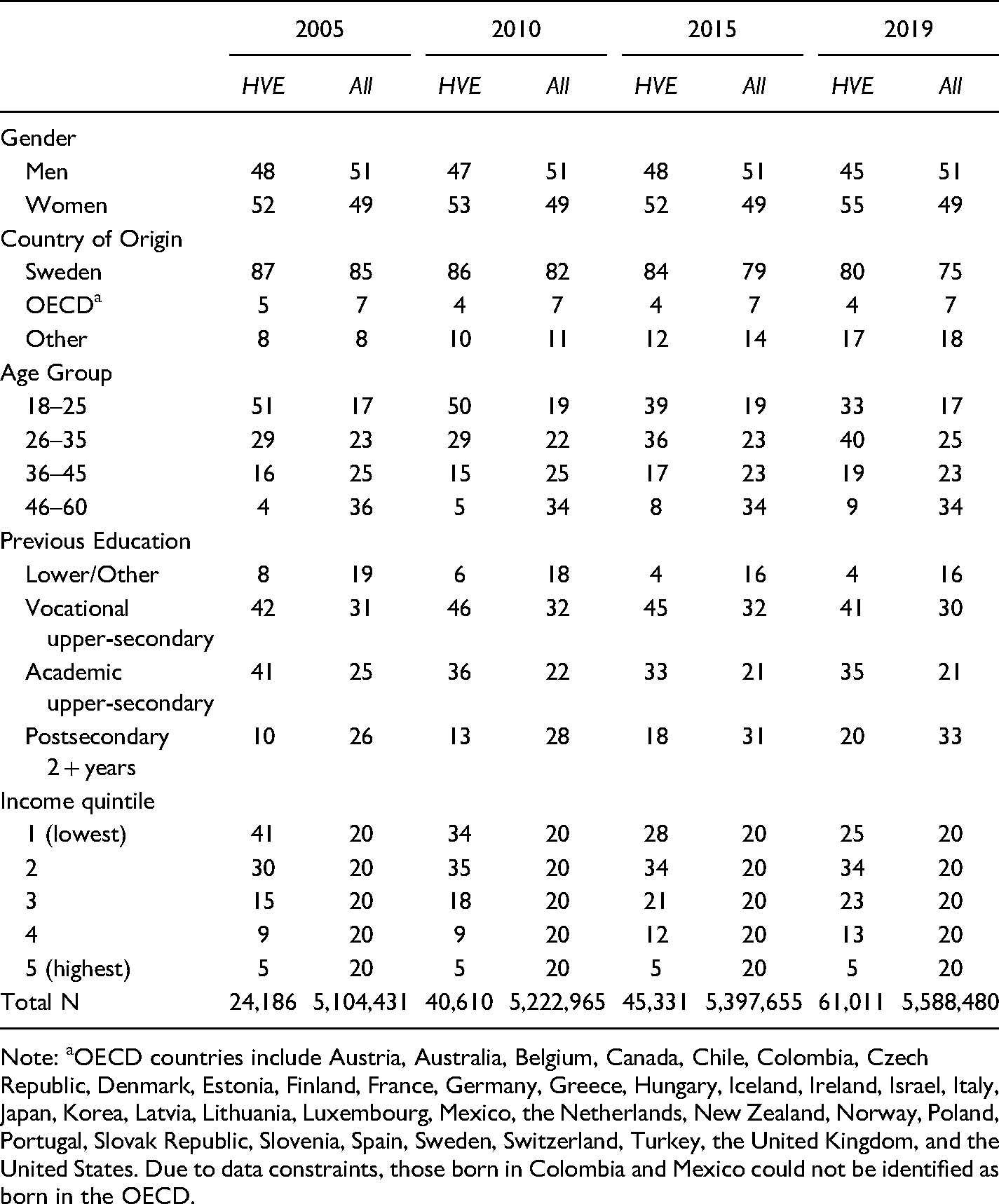
Note: aOECD countries include Austria, Australia, Belgium, Canada, Chile, Colombia, Czech Republic, Denmark, Estonia, Finland, France, Germany, Greece, Hungary, Iceland, Ireland, Israel, Italy, Japan, Korea, Latvia, Lithuania, Luxembourg, Mexico, the Netherlands, New Zealand, Norway, Poland, Portugal, Slovak Republic, Slovenia, Spain, Sweden, Switzerland, Turkey, the United Kingdom, and the United States. Due to data constraints, those born in Colombia and Mexico could not be identified as born in the OECD.
To further study the relationship between sociodemographic variables and participation in HVE, we performed a series of logistic regression analyses. The regression analysis is performed in two steps. As stated above, the first models include gender, age, country of origin variables, and interactions between (i) gender and country of origin and (ii) age and country of origin. In the second set of models, we include information about individuals’ education and income. Results are reported using OR and presented in Table 2.
Logistic Regression Analysis: Sociodemographic Variables as Predictors of Higher Vocational Education (HVE) Enrollment (2005, 2010, 2015, and 2019).
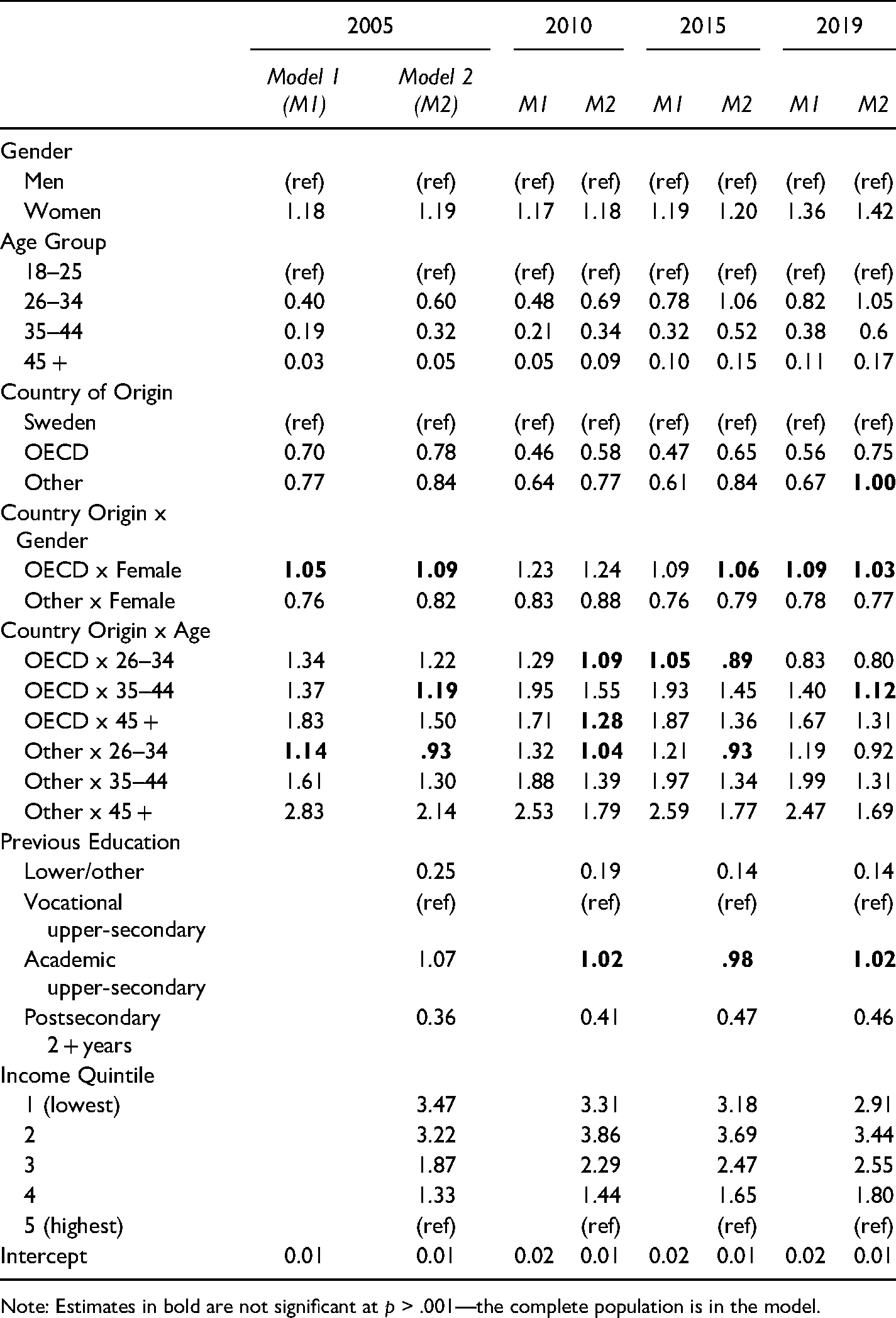
Note: Estimates in bold are not significant at p > .001—the complete population is in the model.
Results from Model 1 reflect the descriptive composition of the sample: women, youth, and Swedish-born were more likely to enroll. This model also included two interaction terms. First, the interaction between gender and country of origin showed that women immigrants from non-OECD countries were somewhat less likely to enroll in HVE compared to women in other country groups. We also performed an interaction between age and country of origin, and this analysis showed that foreign-born individuals were to a certain extent more likely to enroll at later ages than Swedish-born individuals. These results suggest that HVE functions as a pathway for labor market training for foreign-born individuals in older ages.
Model 2 included education and income in addition to the covariates from Model 1. As expected, those who have completed postsecondary education and those who have high incomes were less likely to enroll in HVE. Including education and income in the model affects the demographic estimates. Those in older age groups and those born outside of Sweden were more likely to enroll in HVE than in models where education and income are not controlled for. This suggests that the significant foreign-born enrollment in HVE is related to foreign-born individuals having lower incomes and education than Swedish-born individuals.
To ease interpretation of the results, Figure 1 shows the predicted probability of enrollment in HVE in the four different years, generated using the margins command in Stata, and estimated from the full model including education and income controls, with all variables at means. This figure shows the steady expansion of HVE education, seen by the increased probability of enrollment associated with every group. Women's participation has been slightly more likely than men's from 2005, and women are increasingly more likely than men to enroll in HVE over time.
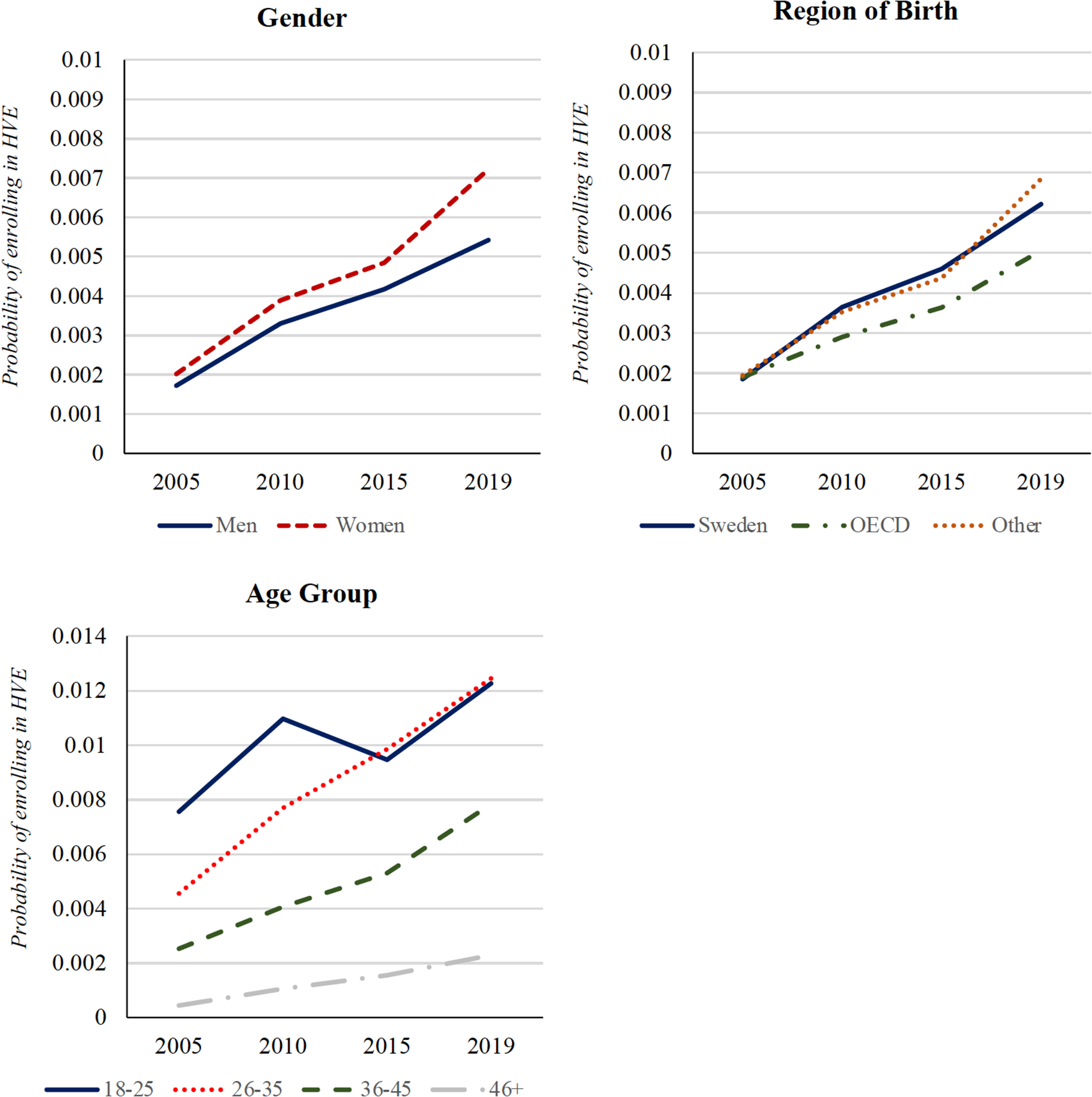
Predicted probability margins for demographic variables: Outcome is “probability of enrolling in HVE”.
In terms of country of origin, once education and income are taken into account, those born in Sweden and those born outside the OECD countries had a similar probability of enrollment and a similar growth in this probability. Non-OECD immigrants were somewhat more likely than those born in Sweden to participate in HVE in the latest years observed. Immigrants from OECD countries were less likely to enroll in HVE. For age groups, youth (18–25) were the group with the highest probability of participating until 2015. Models for enrollment in 2015 and 2019 predict a similar probability of enrollment for the 26–35 age group. The probability of participating in HVE has also grown among adults 35 + over the time period studied. The expansion of HVE in Sweden has thus not been limited to participation from the youngest age groups.
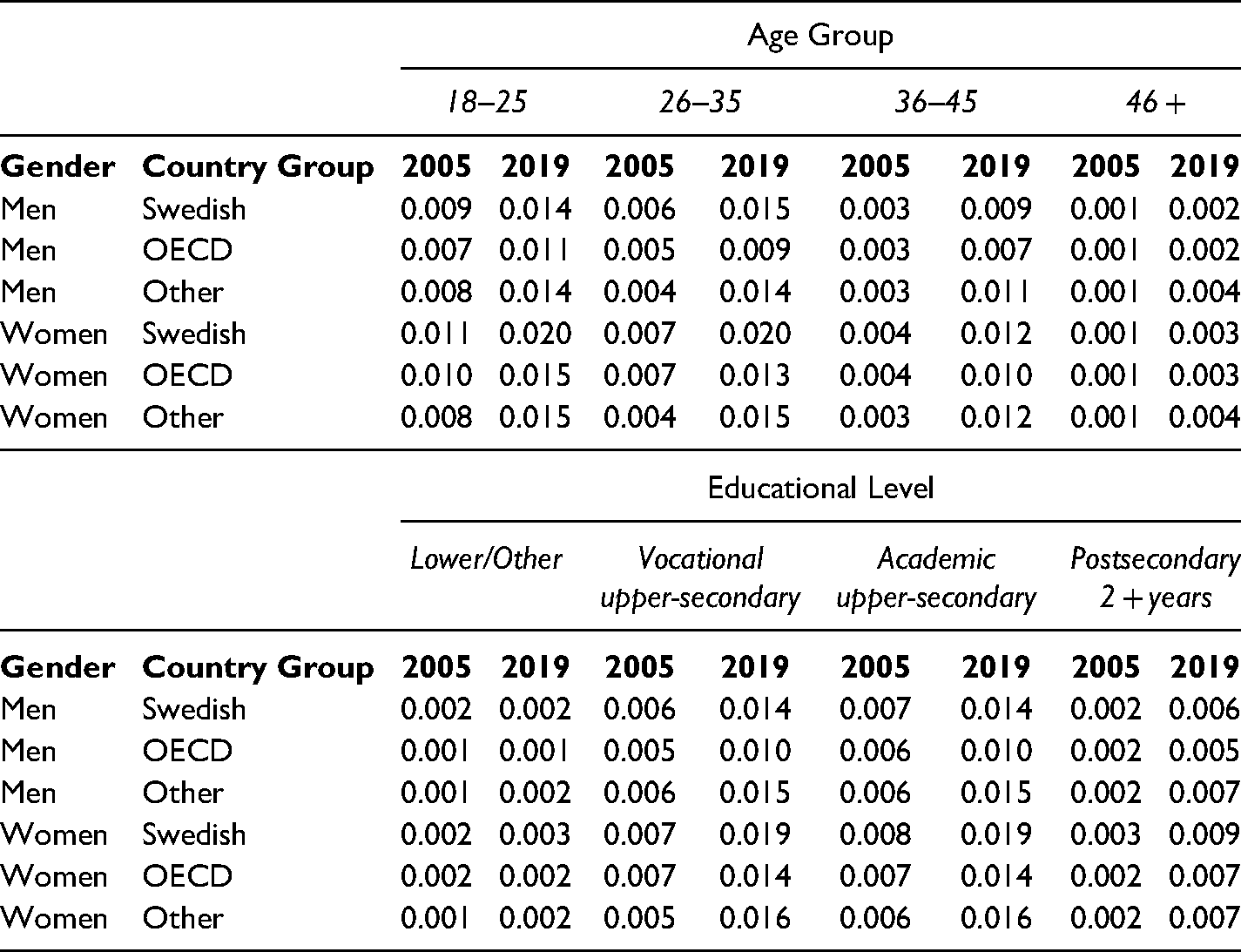
To consider the interplay between the sociodemographic factors and the probability of enrolling in HVE over time, Table 3 shows the predicted probability of enrolling in HVE for men and women by country of origin and age group, and by country of origin and educational level. The results shown in Table 3 further illustrate the pattern observed in the descriptive statistics: participation among men and women grew similarly (though slightly more for women). Participation grew rather evenly within the different age groups when comparing between country groups. Table 3 shows that the probability of participation for foreign-born men and women has grown relatively evenly across all levels of education, including among the highest-educated, where the initial extent of HVE participation was very low. The interaction between education and HVE enrollment also confirms the earlier results that show only minor differences in probability of HVE participation among those with an academic upper-secondary qualification versus a vocational upper-secondary qualification.
Predicted Probability of Enrolling in Higher Vocational Education (HVE) for Men and Women by Country of Origin and Age Group, and by Country of Origin and Educational Level 2005 and 2019.
To move from the individual to the aggregate level, the final step in the analysis was to show how the participation of different groups changed over time in relation to population changes (specifically, the growth in the foreign-born population, and subsequent slight younger shift in the age distribution).
Figure 2 shows the expansion of the HVE system as a whole and the participation of selected groups. The blue circle represents the growth in the overall enrollment in the HVE system between 2005–2009 and 2015–2019. This figure shows that overall enrollment (seen for men and women) grew by about 50% between this time period. The participation among 18–25-year-olds actually decreased slightly in the time period studied, while participation grew between 50% and 100% for those aged 26–45. While Swedish and OECD participants’ enrollment grew by 50%, participation among foreign-born students from non-OECD countries grew by 150%.
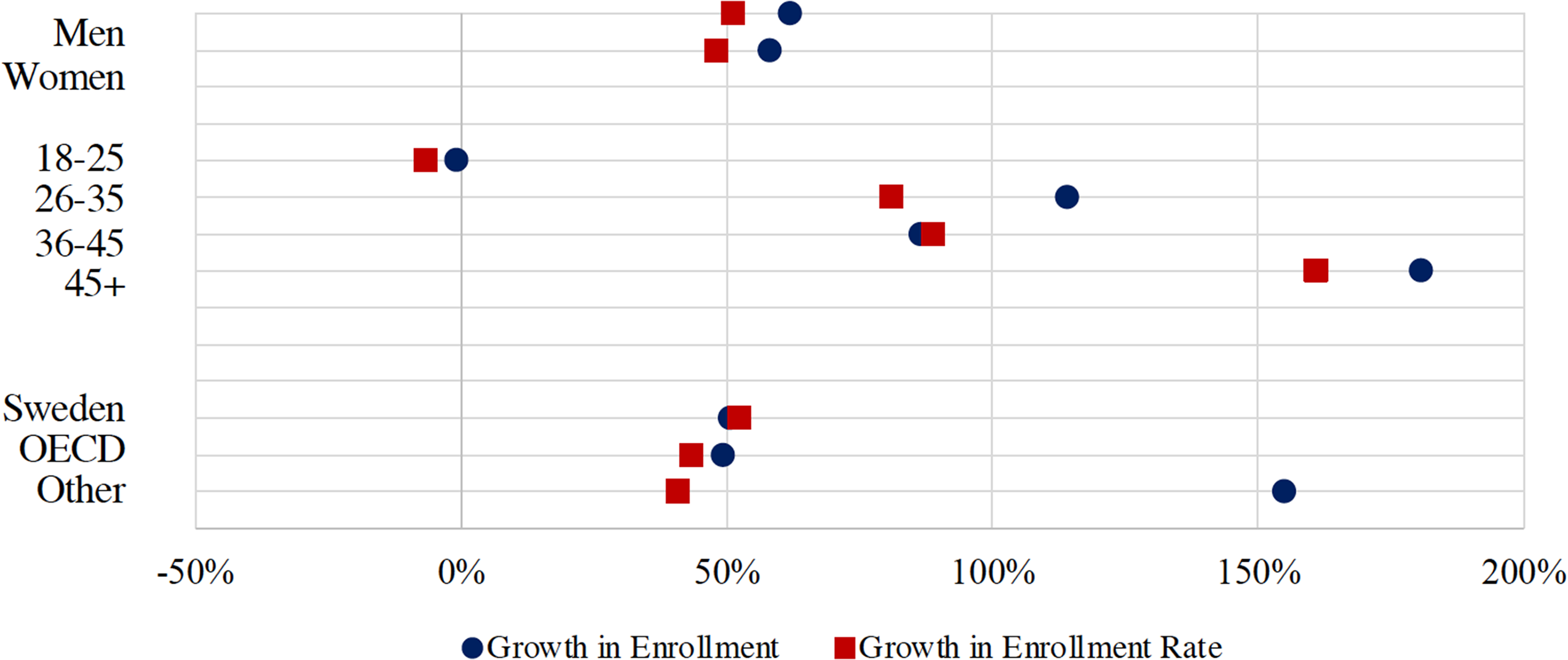
Growth in Higher Vocational Education (HVE) participation between 2005–2009 and 2015–2019.
The red squares in Figure 2 represent growth in the enrollment rate, thus allowing us to take into account the demographic shifts in Sweden during the time period studied. Taking into account enrollment rate growth rather than simply enrollment, non-OECD students had a similar rate of growth in HVE enrollment compared to the other country groups. The growth in enrollment rates for 26–35-year olds is also partially explained by demographic changes. These results provide a contextualization of the earlier results on individual enrollment probability. While youth (18–25) were the most likely to enroll in HVE, their actual enrollment and enrollment rate did not grow significantly between 2005–2009 and 2015–2019. Furthermore, even though 26–35-year olds and non-OECD immigrants increased their enrollment, much of this increase can be explained by the larger number of these individuals in the population, rather than by a significantly higher probability to enroll in HVE compared to other groups. We discuss key themes from these results below.
Discussion: On the Social Recruitment of Participants to HVE
The expansion of the Swedish HVE is an interesting case of the contemporary politics of adult learning systems. On the one hand, it carries on some features of active labor market policies, with high and inclusive participation that has been used to characterize the landscape of Swedish adult education (Desjardins & Ioannidou, 2020; Desjardins & Rubenson, 2013; Rubenson et al., 1999). On the other hand, one might see the expansion of HVE as bringing new and diverging features to these policies and their realizations. Traditionally, the Swedish adult education system has had strong orientation toward compensatory education, and for fostering democratic virtues of citizenship (Desjardins & Rubenson, 2003; Rubenson et al., 1999). Although “human capital” has always been part of the rationale for investing in adult education, the infrastructure has largely been built by organizations in civil society (folkbildning) or local municipality education (komvux), primarily aimed at compensating for previous gaps and setbacks at secondary and upper-secondary school. However, in the latter part of the 20th century, employers grew increasingly disappointed with school-centeric vocational education provided at upper-secondary, while the world of work necessitated continuous training as the economy transformed (Persson Thunqvist, 2015; Nilsson, 2006). The strong expansion of HVE, with its employer-oriented provision as well as strong emphasis on processes of “re- or up-skilling” the labor force, is interesting in this regard as it might be seen as an expression of the heightened importance of local labor market needs in the modus operandi of contemporary adult learning systems.
The policy priority of using adult learning as part of an activistic state, in order to solve labor-market matching challenges, is of course far from unique for Sweden. In Denmark, a similar vocational turn within adult education policy has been identified starting from the late 1990s, in tandem with the development of Swedish HVE expansion described above (Rasmussen et al., 2019). Boeren and Holford (2016, p. 121) noted that vocationalism has become the “conventional wisdom of policy elites” and before the recent wave of expansion of HVE in many countries, scholars have been critically discussing the “vocational turn” taking place within educational forms such as community colleges (Brint & Karabel, 1989). Hence, in the last half century, vocational education in many developed economies has been advocated as a solution to complex, thorny societal problems ranging from unemployment to addressing anxieties about making education more relevant to the changing contours of the world of work (Grubb, 1985, p. 527).
In this paper, we provided a sociological and demographic analysis of which groups the rapidly expanding HVE segment has served in the last two decades. Specifically, we analyzed the relationship between a range of sociodemographic variables and participation in HVE as the population transformed. Several interesting patterns emerged from our results, and we will discuss three themes in closing.
Participation Growth Alongside Segment Expansion and Population Transformation
One of the main features from our findings is methodological in nature. The expansion phase of HVE, coincided with drastic transformations in the composition of the Swedish population as a whole, brought about by high levels of immigration. In our analyses, we illustrate how it is paramount to take into consideration such demographic changes when assessing participation rates in adult learning institutions. While the absolute growth in enrollment to HVE of individuals born outside of Sweden and the OECD amounted to 150% during the study period, these groups’ relative propensity to enter the programs of HVE was shown to be roughly on par with its gradual expansion. Even though the participation of foreign-born students in the HVE system grew substantially, much of this growth is fuelled by changing demographics, that is, the larger size of the foreign-born population in Sweden over this period. This population transformation characteristic might be an extreme case as Sweden received record numbers of refugees and asylum seekers during the period 2010–2016. However, it provides an important methodological reminder for evaluating participation rates alongside underlying demographic changes.
HVE’s Increasing Importance for Retraining and “Upskilling”
As for the patterns of participation based on previous education, gender, and income, these results depart slightly from our initial hypothesis of HVE participation being dominated by social groups who typically encounter difficulties in receiving recognition from their previous educational engagements. Compared to the population as a whole, we found that women, youth, and Swedish-born are overrepresented among HVE participants and that a proportion of participants have pursued academic tracks at upper-secondary schools or even attended postsecondary education before embarking on vocational training. Those with lower incomes were overrepresented among the participants but even so, we observe a trend of rising participation among higher income groups, over time.
Again, when we take population changes into consideration, despite youth constituting a significant share of the HVE student body, there has been static growth for the 18–25 age group over time as older groups increased their probability of enrolling in HVE. This finding raises important questions in relation to addressing youth unemployment, a societal problem that became more pronounced after the financial crisis of 2007/2008 and, again, as a consequence of the 2020 pandemic (SCB, 2021). The expansion of HVE in Sweden has meant that participation has become increasingly pluralistic over time, rather than becoming more and more dominated by social groups that normally do not attend higher education, or suffer from unemployment and precarity in the labor market.
Cumulative Advantage and HVE Participation
One hypothesis of adult learning participation that has been supported in various studies, and that we briefly discussed above, is that of “Matthew effects” (Boeren, 2009; Kilpi-Jakonen & Stenberg, 2014). In our case, those who have enough resources to make use of new possibilities of training might be in a position to make use of them, whereas those who live in scarcity do not. However, our findings on HVE participation both follow and depart from the thesis of “giving more to those who have more” (Merton, 1968).
For example, in relation to educational backgrounds and previous income of participants, those who have completed postsecondary education and those who have high incomes were found to be less likely to enroll in HVE, although the trend is changing gradually in the opposite direction over time. Yet, we also find minor differences in the probability of HVE participation among those with an academic upper-secondary qualification versus a vocational one. This finding is interesting because vocational upper-secondary education is supposed to be sufficient to qualify graduates directly for employment within their vocational field, whereas the academic track is supposed to prepare the students for university studies. Taken together, these results add to the impression that the policy of expanding adult learning possibilities for various occupational roles has attracted an array of people of different backgrounds, whether they are participating to further “up-skill” themselves in an area they already have a foot in, or are seeking to “re-skill” themselves after contemplating other occupational possibilities at the postsecondary level.
Conclusion
Knowledge of the historical participation patterns of HVE is important for contributing to general understanding on issues of social (in)equality in formalized vocational adult education, not least due to the economic volatility that many societies are experiencing as a result of the recent COVID-19 pandemic. In Sweden, the pandemic led to a sudden economic downturn which intensified unemployment among the youth, and resulted in a spike in the number of redundancies, particularly in the service sector, among young adults and the migrant population (SCB, 2021). HVE was once again mobilized as a key device for strengthening and directing “skills supply” as the government mobilized resources to mitigate these labor market challenges (Regeringskansliet, 2020). The emergence of this employer-driven educational form that involves different stakeholders has thus been viewed as important for mitigating education-to-work transitions and problems pertaining to fluctuations inherent to short-term changes in the economy. How this educational form has adapted to demographic changes and created conditions for sustainable labor force participation is a multifaceted problem, which we expect will receive much more research attention in the future.
Similar to the observed growth in participation rates for formalized adult learning in many OECD countries (Desjardins & Ioannidou, 2020), Swedish HVE has grown rapidly in the period 2005–2019, and enrollment has grown for all groups. Our findings show that there are patterns of differentiation in participation by group enrollment, which are congruent with earlier evidence that suggest that participation in organized adult learning differ by individual-level characteristics such as gender, age, and educational backgrounds (Blossfeld et al., 2014; Boeren & Holford, 2016). One contribution through these analyses has been to highlight the importance of explaining participation growth alongside educational expansion and population transformation. We also find that in this particular case of work-related education expansion, participation is not merely for compensatory reasons as the expansion has attracted a broader array of participants from more diverse social backgrounds.
There are limitations to our present study. Since our analysis on participation is based on individual-level data of social attributes of enrollees, it does not uncover underlying motives, experiences, or decision-making processes among participants. Another area that could not be addressed here is how participation varies by field of training; this aspect is being taken up in future research work by the authors. However, this paper has generated results that can compel further meaningful examinations, for example, by investigating what kinds of logics drive participation in HVE, and how these drivers for participation in HVE might differ from higher education. Future qualitative research in this area would permit a deeper understanding of these pluralistic experiences and aspirations, which could complement our current register-based analyses of the social recruitment to HVE.
Footnotes
Acknowledgments
We gratefully acknowledge the research funding from the Swedish Research Council (grant number VR-2019-04146). We also thank our colleagues at Stockholm University's Department of Education and the Swedish Institute for Social Research for their comments and insights on earlier drafts of this paper.
Declaration of Conflicting Interests
The author(s) declared no potential conflicts of interest with respect to the research, authorship, and/or publication of this article.
Funding
The author(s) disclosed receipt of the following financial support for the research, authorship, and/or publication of this article: This work was supported by the Vetenskapsrådet (grant number VR-2019-04146).
