




Abstract
The starting point for this inductive study is to determine, through a search of studies, what critical viewpoints in terms of research are delivered, based on experiences, observations and evaluation, concerning the Bologna Process over time? The aim is to present a description using a thematic analysis based on data from 38 papers (2004–2016) that reveal the critical reasoning behind the research. The reasoning is critical in the sense that various authors have elaborated on and problematized aspects of the Bologna Process in terms of what to avoid and/or have characterized aspects related to the Bologna Process that are not desirable. Based on the outcome of the thematic analysis, theorists were selected in order to deepen the reasoning and meaning highlighted in three themes. The findings are further discussed in terms of knowledge and curriculum development for the future and the advancement of European higher education policy and beyond on equal terms. The article suggests that there are causes for concern regarding unwanted consequences in the aftermath of the Bologna Process.
Introduction
In view of the many ways in which the Bologna Process (BP) involving 48 member states affects conditions for the future development of internationalization in higher education (HE) across Europe, the implications of the BP deserve close and ongoing attention. The BP is an open method of coordination (OMC) and an intergovernmental means of governance in the European Union (EU), based on the voluntary cooperation of its member states (The Open Method of Coordination At a Glance, 2014). The present study follows up on an earlier article on the BP (Wihlborg and Teelken, 2014) and also includes studies published between 2013 and 2016. The material involved in this article also includes studies that express critical viewpoints related to the BP, whether it is described as not being desirable for some reason, as problematic in some sense, and/or as problematic in terms of ‘what to avoid’. In the previous article (Wihlborg and Teelken, 2014), it became clear that – considering the significance of the BP and the volume of papers delivered on the subject – surprisingly few critical or reflective research studies had been conducted on the effects of the BP and the intentions or outcomes of its implementation. However, in the previous article, some strong concerns emerged through the analysis pointing towards a critical stance on the BP: political elements, quality issues, superficial transparency, standardization and neoliberal trends in HE. The present study deepens the previous examination of actual and possible developments and illustrates the critical viewpoints related to the BP. Data concerning a critical viewpoint from a previous study (Wihlborg and Teelken, 2014) are included (see later and Table 1), in addition to studies published from 2013 to 2016, in this updated and extended analysis. The results are explored and problematized in this article, deepening our understanding of the BP from a critical point of view. Assuming that the BP is an essential part of ongoing internationalization/globalization forces, this study is applicable in the wider debate on internationalization as a phenomenon that will positively or negatively affect the future of HE ideology and practice. This includes views on humanity, society, epistemology, pedagogy (i.e. teaching and learning theories and approaches, including development of abilities and competences), and policy and politics on institutional, local, societal and international levels. In acknowledging the BP as a strong force in the past decade, influencing HE in Europe and beyond, it is reasonable to raise some valid concerns about the process.
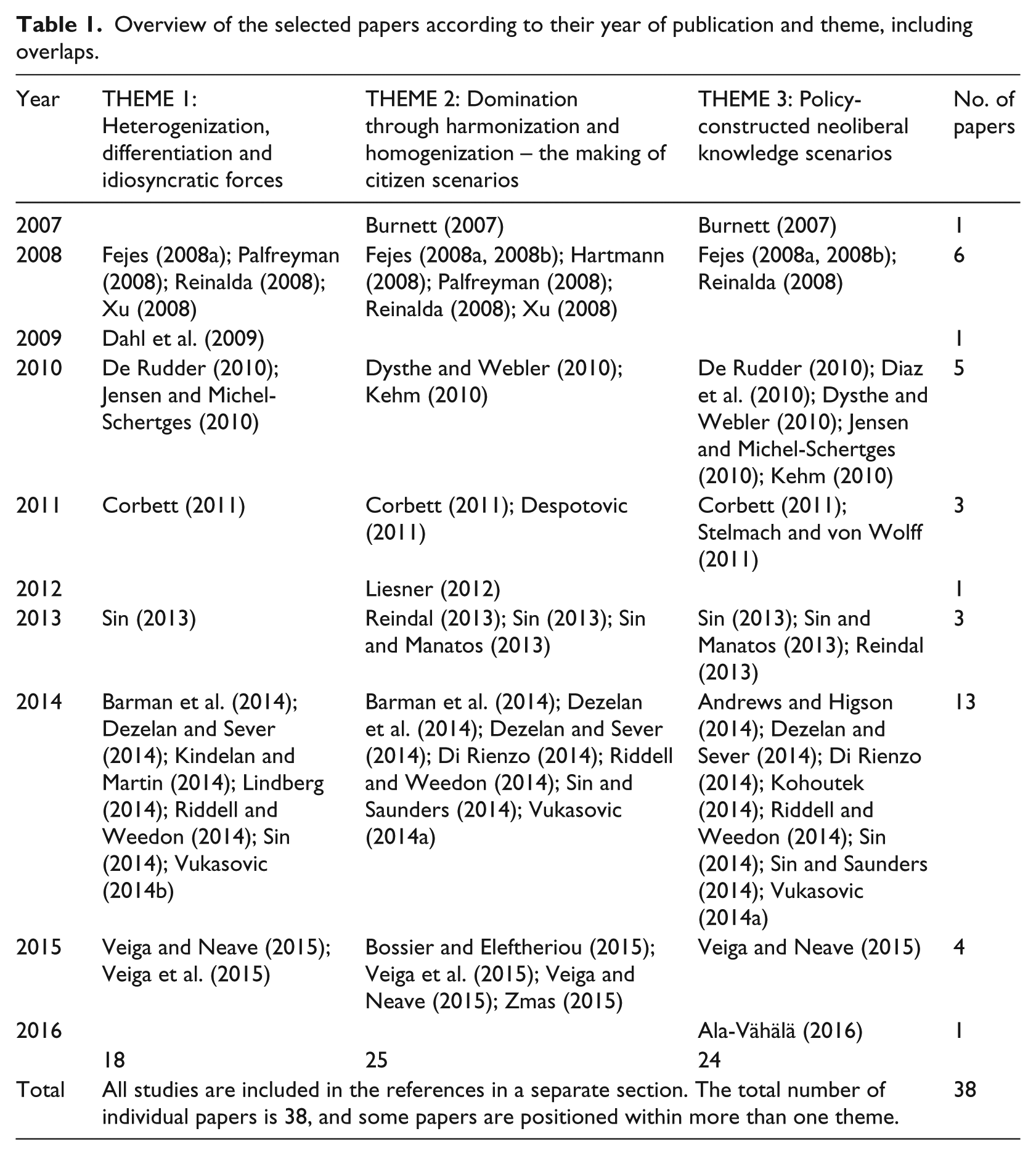
Overview of the selected papers according to their year of publication and theme, including overlaps.
The BP as part of internationalization
In recent decades, internationalization has been a significant movement in HE throughout the world (see De Wit, 2003; De Wit et al., 2015; European University Association (EUA), 2013; European Commission, 2010, 2013, 2015, and ongoing), and in Europe, the BP is a central part of this process. In relation to the Europeanization of HE, globalization and internationalization represent an ongoing debate and are frequently problematized (Dale and Robertson, 2009). Recently, Bengtsen and Barnett (2017: 114) discussed the dark side of HE in relation to the present-day discourse of navigating ‘through alignment procedures and evidence-based intellectual leadership’. At a time when HE paradigms are being disrupted by cultural flows, technological innovation, economic conflicts of interest (Marginson and Rhoades, 2002, Marginson and Sawir, 2005, Marginson, 2017) and emerging worries on the horizon (cf. the social and political effects of Brexit), Knight’s observations from 2007 are still relevant: ‘today, in the first decade of the 21st century, another set of related terms is emerging that includes transnational education, borderless education, and cross-border education’ (Knight, 2007: 211). Knight (2015) later questioned whether HE was having an identity crisis, arguing that the changing meaning of internationalization calls for updating its definition. If so, it can be assumed that the BP is a strong driver of HE in Europe, thus involved in the internationalization process of HE. Interaction across national borders not only creates possibilities but also generates tensions and dilemmas at systemic levels, thereby becoming a driver of both desirable and not-so-desirable changes at national and local levels (cf. Sursock and Smidt, 2010). Against this backdrop, it is important to consider changes in HE related to the BP, both at the policy level and in academic practice. Through a search for studies expressing critical views on the BP and a thematic analysis of 38 studies, this article explores, describes and problematizes critical viewpoints and reflections regarding the BP.
The BP: an ongoing issue
In the European context, the Bologna Declaration (1999) has been a work in progress for nearly two decades (cf. European Commission, 2010, 2013, 2015, and ongoing). For instance, the second key priority area of the European Commission’s Communication (2013) on European Higher Education in the World emphasizes the development of internationalization at home, as does the EU’s strategy for internationalizing European HE (The Education, Audiovisual and Culture Executive Agency (EACEA), 2016). Given the increasing demand for internationalization, the Council of Europe urges its member states to foster an international culture. The BP and its policy represents one of the most systematic drives thus far to increase international academic cooperation and mobility in the EU. At its inception, the BP was acclaimed and regarded as a coherent, harmonious phenomenon that would promote mutually enriching exchanges between the EU member states (cf. Keeling, 2006). However, the BP’s actual effects may not match these initial expectations.
Not seeing the whole picture
The Leuven Declaration (2009), Budapest–Vienna Declaration (2010) and Bucharest Communiqué (2012) all highlight critical issues concerning the BP, and some authors have raised questions about the real effects of the resultant policy changes (Leisyte et al., 2014; Robertson, 2006; Veiga and Neave, 2015). According to these authors, the bulk of the literature on the BP does not examine long-term effects at a structural level. Previous studies (Teelken and Wihlborg, 2010, Wihlborg and Teelken, 2014) have suggested that research on the effects of the BP showed a lack of critical examination; however, a few studies, including explorative studies, have investigated the BP from a critical standpoint, taking a reflective approach (discussed elsewhere, Wihlborg and Teelken, 2014). This lack of critical reflection on the BP was observed at the beginning of the BP implementation phase by Huisman (2009; cf. Huisman et al., 2012) and by Neave and Amaral (2008). Veiga and Amaral (2009: 67) declared that ‘the implementation of Bologna in Portugal has been achieved in name only … [showing] an implementation in form rather than in substance’. Several authors (see Ravinet, 2008) have also critically discussed various governments’ strategic use of the BP as an opportunity to push politically desired reforms.
Critical views on the impact of structural changes
This article maintains that any consideration of internationalization processes must account for the numerous and sometimes conflicting changes, structural or otherwise, that affect HE in Europe and across the globe. While research focused on the BP from a critical point of view has been limited up to now, most notably after the BP’s intended implementation in 2007, a richer debate exists on the wider structural trends affecting HE in Europe as well as worldwide. Policy trends in the internationalization of and within HE have been discussed from a wide range of perspectives in the last two decades (Stensaker et al., 2008; Teichler, 2004). Transnational processes involving HE have recently been discussed and have become increasingly complex (Robertson, 2001). Conversations on the economic dimensions affecting these changes focus on corporations (Schrecker, 2010), commodification (Meek, 2003), marketization (Brown, 2015; Brown and Carasso, 2013; Lynch, 2006), privatization (Ball, 2012; Ball and Youdell, 2008; Lundahl et al., 2013), academic capitalism and the knowledge economy (Marginson, 2010a, 2010b; Marginson and Rhoades, 2002; Marginson and Sawir, 2005). Assessments of the changes mentioned here also consider the trend of research-led institutions choosing or being forced to review their core missions to make them more entrepreneurial and market-relevant (Pusser and Marginson, 2013). Furthermore, several ways of looking at HE and rethinking development have surfaced in empowered contemporary discourses; for instance, Naidoo (2011) elaborated on education and the new imperialism. According to Naidoo, the new imperialism ‘presents a framework for understanding the actions of powerful states through an analysis of the intertwined logic of economics, competition and the struggle for hegemony involving complex networks of economic, military, political and discursive power’ (Naidoo, 2011: 42).
Critical viewpoints concerning the BP’s social impact
The BP’s involvement in developments in and of HE has also been analysed against the background of wider societal trends, primarily through a postmodern lens with a focus on neoliberal influences (Peters, 2012; Peters and Britez, 2010). Discussions on education have also arisen in light of the neoliberal trend of globalization (Morley et al., 2014). Klemenčič (2015b, 2017) contributed to this conversation, saying that steering HEI [HE institutions], governments face a difficult policy challenge whether to concentrate resources in a few world-class universities […] or to try to pursue a world-class system in the sense of promoting quality across the entire HE system [with references to Van der Wende, 2001] along with regional development. Internationalisation can be viewed as a key driver to achieve either of these two objectives. (Klemenčič, 2017, keynote speech at the European Conference on Educational Research).1
In light of such deep-reaching changes affecting HE, and with no clear explanation of the dynamic interplay between internationalization versus globalization in relation to HE, the need emerges to redefine fundamental understandings of the university construct and to imagine new directions for its evolution (Barnett, 2013, 2016).
The idea of equal accessibility to (and equal opportunities in) HE is under debate (cf. HEI strategies to develop internationalization at home to support equal opportunities). It is reasonable to reflect further on what can be learned and what should be avoided when developing HE in light of BP-related internationalization trends that affect equality. Research indicates that due to increased geopolitical and economic imperatives in pursuit of international studies, reinforcement is needed to support learning experiences and equal accessibility for both staff and students. This rising trend has been observed in institutions seeking to enhance campus internationalization (Robson, 2016; Wihlborg and Robson, 2017) and create inclusive, collaborative learning communities supported by multimedia (Wihlborg and Friberg, 2016; Wihlborg, Friberg, Rose and Eastham, 2017). In a recent article on the BP, Brögger (2016: 87) problematized the notion that ‘the rule of this competitive, mimetic desire for better performance is what makes the Bologna mode of governance feasible’. Discussing a main driver related to the BP in terms of desirability of being employable (which is an uncertain area and often a short-term issue), one concern is whether the developments (cf. Simons, 2015; Simons and Masschelein, 2009) that follow the BP are desirable in relation to the long-term effects of possible reproduction through the maintenance of a standardized HE structure, for instance as regards equality and development of knowledge. Thus, in terms of knowledge development, more of the same does not always lead to new and creative approaches. Supporting internationalization-framed policy drivers such as the BP requires critical reflection, and alternative conceptualizations of aspects related to an internationalized curriculum and its developed discourse (in and of HE) must be considered based on equality between the countries involved. Critical reflection involves constantly asking questions, such as why these outcomes are desirable (or not) and what should be avoided or promoted (and for what reasons). Considering the rapid changes in society and the lack of studies taking a critical stance on the BP, it is reasonable to further consider how the BP implemented so far interacts with wider societal challenges and demands that have already arisen or may yet manifest.
Method
This study is the follow up to a previous study (Wihlborg and Teelken, 2014) (including studies published between 2004 and 2013; Wihlborg and Teelken, 2014) and also involves studies published between 2013 and 2016. It aims to refine those studies by identifying and looking at research that expresses critical viewpoints. Studies that became relevant to be included in this study, and which arose from the previous study (Wihlborg and Teelken, 2014), have been allocated in the theme critical standpoints, but these were few in number. In this follow-up study, a deeper analysis was conducted of studies identified as expressing critical viewpoints concerning the BP, published between 2013 and 2016. Studies listed under the theme ‘critical viewpoints’ from the previous paper (Wihlborg and Teelken, 2014) were therefore included, with some exceptions (see later). Thus, the material selected for deeper analysis included articles from the previous study (Wihlborg and Teelken, 2014) that were deemed relevant to the current study. Since the previous study covered data up to March 2013, this date was used as the starting date for the new search for data (Table 1). The keywords from the previous search for data were retained when bringing the material up to date, but analyses in the current study were only carried out on peer-reviewed articles (as a criterion) related to the BP in Europe. The following keywords in various combinations were used: ‘Bologna Process AND reflecting/reflection/reflections, criticism, educational assessment, assessment, quality, critical analysis, critical review, comparative studies, retro perspective, students’ attitudes, students’ experiences and teaching’ (Wihlborg and Teelken, 2014: 1088). In the selection process, book chapters, reports and studies in languages other than English, and that only pointed to an abstract policy level with little or no problematized reasoning on consequences, were excluded. Data were collected from the Education Resource Information Center (ERIC, EBSCOhost) international database for the social sciences and education, which provided the researcher with an overview of the field. Data collection involved several steps, namely choosing relevant databases and search criteria (inclusion and exclusion) and stating further delimitations (to be explained later).
Specific focus
A previous search for material in ERIC retrieved works published between 2004 and 2013. Initially, this produced 161 records that were read in full, 91 of which were selected for analysis through different phases of exclusion. The results divided the analysed material into three themes (Wihlborg and Teelken, 2014) as follows: challenges (62 records), tension (43 records) and critical standpoints (24 records). The studies categorized under the latter theme (24), which was the only theme to take a distinct critical stance in relation to the BP (discussed elsewhere; see Wihlborg and Teelken, 2014), were included in the present study, but book chapters, reports and studies of the BP in regions outside of Europe (n = 7) were excluded from continued analysis. This left 17 records from the critical standpoints group (study 1) to be included in the current study for further analysis.
A new ERIC search of sources published from March 2013 to August 2016 (based on the same search terms used in the earlier ERIC search) retrieved a total of 91 records, which were read in full. Exclusions in several phases narrowed the pool to n = 42 (such as, no distinct focus on critical aspects in relation to the BP, but rather a major focus on another subject where the BP was mentioned in passing), then to n = 29 (not problematizing or discussing the outcomes, consequences and/or meanings from a critical point of view) and then finally to n = 18 records, all of which involved a critical assessment, investigation, standpoint and/or perspective. These 18 records were included in this study’s thematic analysis.
A search of peer-reviewed articles in Web of Science published from March 2013 to August 2016 using the search phrase ‘Bologna AND critical’ produced 34 records. Exclusions (i.e. duplicates, studies that did not focus on the BP from a critical point of view and studies that mentioned the BP but did not offer any critical reflection concerning outcomes, risks or what to avoid) led to n = 3 records that expressed a critical standpoint.
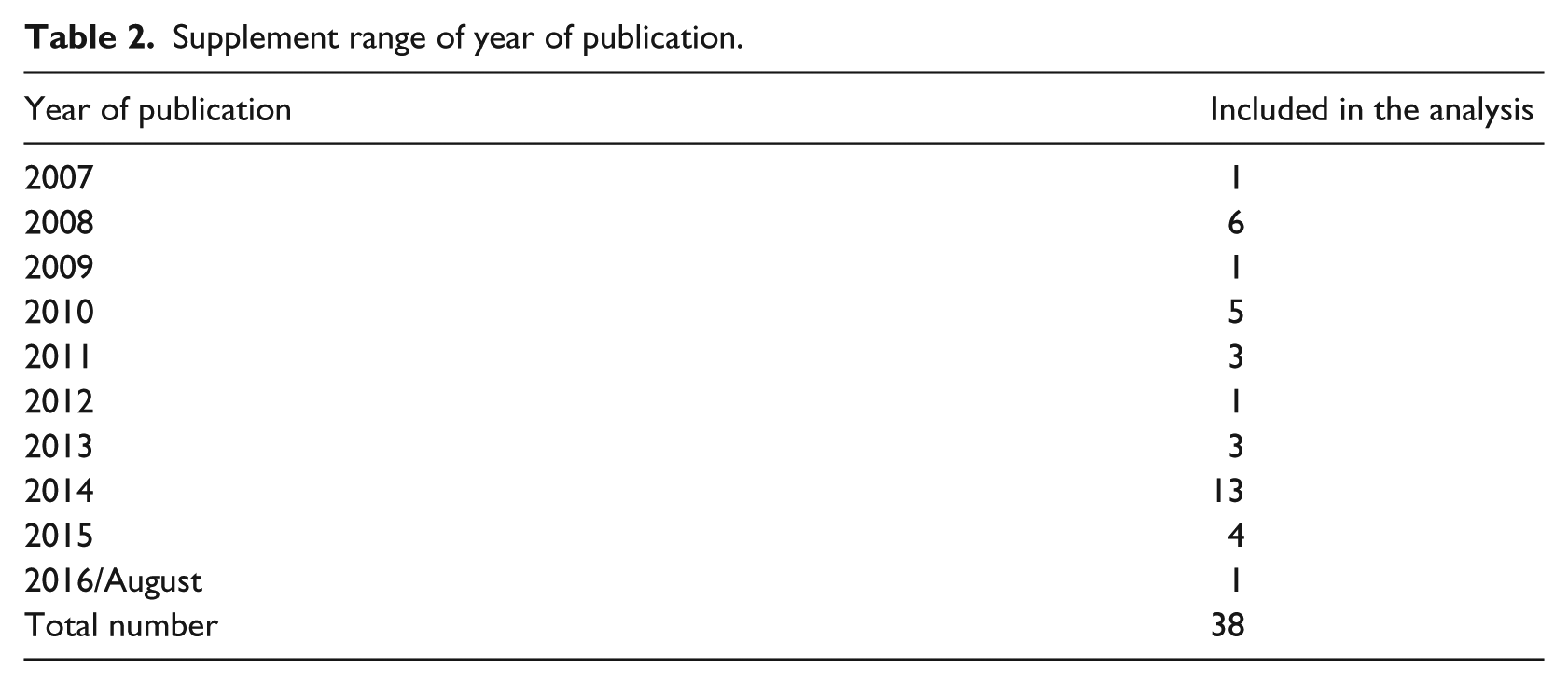
In all, a total of 17 + 18 + 3 = 38 articles were selected for further analysis (see overview in Table 2).
Supplement range of year of publication.
Interpretation analysis
Using an adaptation of Mayring’s (2000) inductive approach, the studies were read and evaluated in full to identify relevant content for the analysis in order to construct themes from a thematic content analysis. Each statement in the whole dataset was compared and contrasted regarding inherent meanings related to any critical viewpoint mentioned. By this process, data of relevance were highlighted, and other parts were excluded as irrelevant for further analysis. Pools of content issues emerged from data regarding the critical viewpoints related to the BP (i.e. content expressed in terms of ‘what to avoid’, ‘what is not desirable’ and ‘risks’), which became the foundation for thematic differentiation. Interpreting the overall meaning of the emerging themes involved a summative qualitative approach to content analysis (Mayring, 2000). Text-based data were then approached in relation to particular contexts, with a focus on critical reasoning and problematizing the undesirable effects, outcomes and risks of the BP and what to avoid (described in the themes).
The emergent patterns were used to describe different themes related to the BP, which enabled broad interpretations using the theoretical framework outlined later. The theorists mentioned earlier were selected after the thematic analysis and thus were sensitive to the findings of the thematic analysis and in line with an inductive approach.
The three themes identified in the analysis were labelled as follows: heterogenization, differentiation and idiosyncratic forces (n = 18); domination through harmonization and homogenization, as well as the making of citizen scenarios (n = 26); and policy-constructed neoliberal knowledge scenarios (n = 24). The sum of the studies included in the three themes exceeds the total number of studies (n = 38) due to some overlaps.
All the studies in the current search described and took up a critical stance regarding the BP, as opposed to only expressing an opinion in passing (such studies were excluded from the search). The same content related to different specific contexts (with reference to the BP), which resulted in different meanings. Thus, several of the studies represented more than one of the three themes (Table 1), where different contexts were involved in relation to the same content or vice versa. For instance, becoming a world (international) citizen involves becoming knowledgeable on specific conditions (equality, homogenization and adaptation). Each theme consisted of content mediating a meaning in terms of critical viewpoints deduced from various contexts.
Theoretical framework
Sursock and Smidt’s (2010) critical reflections on criteria supporting the diversification of national HE systems were of interest in the previous paper by Wihlborg and Teelken (2014). To expand on these reflections, this study turns to the work of theorists who were chosen based on the relevance of their work to the findings of the thematic analysis. The rationale behind the choice of theorists is linked to the content that came to the foreground in the analysis (i.e. as shown by the three themes). Gramsci’s (1971, 1977, 1978; Bates, 1975) process of theoretical cultural hegemony was used to assess trends in the empirical data, enabling the researcher to identify some consequences of the BP’s policy design in European HE concerning views of knowledge. In HE, according to Gramsci and cultural hegemony, dominant ideas of what is ‘normal’ and ‘legitimate’ in knowledge development have a huge impact on social and political movements, based on the assumption that knowledge is a social construction. This idea was applied to the data collected in the current article to reflect on the issue of legitimizing social structures as promoting or diminishing internationalization, focusing on aspects related to the BP, with equal conditions and accessibility. Policy development (such as that of the BP) sometimes demands subordination to dominant civic institutions and markets, instead of allowing a civic liberty to think differently, challenge assumptions and norms, and formulate novel ideas. This statement is relevant to the BP’s intention and ability to provide equal opportunities for students, allowing them to develop critical thinking.
Nussbaum’s (2000, 2002a, 2002b, 2002c, 2004a, 2004b, 2006, 2011) view on liberal humanism becomes relevant, since she emphasizes the importance of quality of life and equity within and between countries, assuming that economic growth requires acknowledging ‘what all citizens are entitled to by virtue of being human’ (Nussbaum, 2000: 33), also assuming that social progress involves the conditions of human development and capability. Through Nussbaum’s theoretical lens, the BP’s influence on HE (supported by local and national policies and political decisions) is relevant, as we reflect on what the push towards becoming international citizens involves. Specifically, it involves eliminating inequality based on gender, class, religion or ethnic origin. Prerequisites (e.g. concerning dominance) for the development of the global society and local variations should be recognized in real terms as regards countries’ assessments of democracy (Nussbaum, 2000).
The critical, postcolonial positions of Andreotti (2006, 2011), Abdi and Shultz (2008) and Andreotti and Souza (2011) were useful in identifying some of the opportunities and constraints that the BP offers in terms of developing abilities, skills and competencies for critical thinking, understanding(s) of ‘the other’ and ‘otherness’, and cultural diversity and citizenship. According to Andreotti (2006), power (on whose terms and under what conditions) and knowledge in terms of boundaries (e.g. accessibility) should be made apparent (continuously). The construction of knowledge development, according to Andreotti’s view, is accomplished by acknowledging inclusions rather than exclusions; thus, being able to validate mainstream values and traditions becomes relevant.
Findings
In line with the findings from the previous paper (Wihlborg and Teelken, 2014), it was confirmed that only a few empirical studies (based on experiences, observations and evaluations) have taken a distinctly critical (ontological) stance on the issues arising from the BP. Three themes were discerned and described, maintaining a focus on the critical viewpoints observed in the studies analysed. Several studies included more than one theme, leading to some overlap derived from various contextual frames. The meanings of these viewpoints are summarized and introduced briefly later, but the descriptions of these viewpoints are more nuanced at the thematic level.
Summative description
The identified content, in line with an inductive explorative approach, meant reflecting specific contexts. It included economic, social, organizational and educational implications and consequences. The societal implications of the BP at a macro level that were also related to exemplified consequences were examined, including the North–South power balance, the production of a globalized mobile workforce and a shift towards supranational governance. These implications counteract the trends deemed important in the BP in supporting collaboration on equal grounds, by showing that economic and market drivers in governance, teaching and learning can lead to other outcomes than those initially aimed for. Organizational implications at the HE institution level include reduced academic autonomy, standardization and organizational development, as measured by quality indicators. Pedagogical implications (derived from policy at the organizational level) ensuing from the BP include decoupling teaching from research, shallow definitions of employability and lifelong learning, a lack of depth and critical perspectives. A strong policy mechanism became visible, showing the BP as a main driver of HE in Europe; the BP involved a market-driven, knowledge-based economic discourse and sought to create EU citizens, implementing neoliberal strategies and dominant cultural dependency.
Theme 1: Heterogenization, differentiation and idiosyncratic forces
The focus of this theme is on the changes resulting from the BP that occurred over time on local, national, international and global levels, as well as the drivers related to the BP’s push for diversification on all of these levels. Being able to reflect on emerging societal differences, since these can lead to different consequences of the same intention (e.g. that of the BP), is a given. In various studies, not addressing these differences is considered to be a rather naïve approach, based on the notion that the BP is good because we think it is (i.e. it leads to good outcomes for all). A critical standpoint emphasizes that such a naïve attitude merges differences into a joint spectrum of agreements (without any need for including issues concerning power, dominance or equality), supporting the idea that a utopia will occur without any effort. How these differences collide, contradict and counter one another needs to be acknowledged, according to this critical point of view, and is still very much an open issue (n = 18 studies). Practices that are more dominant, supporting the reproduction of certain values over others as problematic, are emphasized, and it is stressed that the meaning of cultural dominance needs to be addressed further when it comes to future developments supported by BP directives. In order to limit dominance of one country’s practice, according to this body of data, local and national influences should be reinforced as counteracting requirements for standardization and equalization of cultural differences. In these studies, critical reflection comes to the fore in terms of whether the BP’s policy documents support cultural interaction, leading to different cultural influences and producing new and insightful approaches to cultural settings, relating to other contexts of an egalitarian socio-cultural character. It is questioned whether the BP (as being an OMC), has the strength to minimize the risk of promoting the development of European citizens based on some social values over others (see also the other themes). Emphasizing the risk of power related to the meaning of compliance, and that HEI communities, both on faculty and departmental levels as well as cross-national ones, face various challenges, leads to emancipation and alienation. HEI compatibility is related to competitiveness in the meaning of being market sensitive, and attractiveness includes being ranked and valued when compared to other institutions.
Theme 2: Domination through harmonization and homogenization – the making of citizen scenarios
The focus of this theme is on flows between societies in terms of technology, services, goods, education, human movements and many other forms of exchange. The idea is that flows lead to a form of acculturation, transforming differences into similarities (or a spectrum of similarities) within a range of acceptability, in relation to the BP. According to these views, implying that power and the meaning of superiority and inferiority should be made visible rather than ignored, raises questions and criticisms about what culture is adapting to what other culture and on what grounds (n = 26 studies). The adoption of a Euro-American social model (Western/Americanized practices and values) is partly connected to market demands and the employability perspective linked to HE. Thus, the internationalization and globalization process worldwide also becomes a homogenization dilemma in relation to the making of a world/European citizen. The critique addresses and criticizes ideas that cultural differences and rivalries should be solved through standardizing drivers and curricula, and explain that this idea takes a new meaning when it encounters reality and risks adopting stipulated dominant ideals without a negotiation margin. Uniformization, in line with the BP and beyond, leads to concerns of control, power, market influences, and the demands and status distinctions of countries/nations, some (countries) more powerful and wealthier than others. This is compared and related to what has long been known as a North–South or global North and global South issue (cf. the previous theme). The BP’s effects outside the EU are problematized and related to not only a European context but also a globalized world (e.g. global capitalism). Becoming a citizen is linked to accessibility and equality issues – social inclusion versus exclusion – in terms of EU standards for citizenship. Standardization through academic curricula is a critical issue in terms of what forces are fabricating Europe and changing the academic curriculum. Stipulated superficial conformity at a higher organizational level creates confusion when it descends through an organization and is concretized at the institutional level, particularly in teaching and learning and in acknowledging what pedagogical ideology is. Dominant cultural and economic influences are highlighted, as well as how to nurture diversity and promote convergences (on whose terms), examining which domination leads to what deconstruction concerning HE. The risk that a need for adaptation will bring about economic dependency and camouflage essential equality issues is also explored.
Theme 3: Policy-constructed neoliberal knowledge scenarios
The focus here (n = 24 studies) is on whether education has become a business that labels knowledge production as a commodity. The views are underpinned by the condition that the need for lifelong learning is part of a constructed view of knowledge development, which is mainly understood as an objective (rather than subjective) value. There is a concern that knowledge is primarily judged as being responsive to market demands. Lifelong learning is linked to the European qualification framework and stipulated through European quality reforms in the BP, which supports a functional mercantile dimension. Knowledge, it is stated, becomes an issue of business and a commodity supported by market forces. Students are customers and their approaches to HE lead to customization of constructed knowledge and practices, as demanded by the EU market. Critics of this point of view problematize the risk of alignment of quality assurance to rather become an issue of rigid standardization. The focus on the risk of using quality standards to align assessments and qualifications, which commodify and standardize knowledge, in turn diminishes the development of creativity, critical thinking and reflection. The standardization of curricula complicates and undermines other possibilities. Arguments have been posited that standardization primarily supports policy reinforcement and fabricates a stereotype in which dominant countries take on a leading role. The risk of reinforcing European construals of subjects and shaded values without any critical and valued reflection, in relation to the EU social space, is addressed. A main argument of this point of view is that groups or nations that are underrepresented due to their political or economic statuses are participating as non-equal partners in the development of the BP and its HE and are denied a position in which they could define the nature of knowledge. Via neoliberal strategies of modernization (through the BP) between non-equal partners involving cultural dependency in terms of power, identity and status, a mechanical change (in and of HE) is stressed over collaborative, transnational academic development; this includes, according to arguments in this body of data, administrative power over academics. Thus, the critical point of view is that learning is directed by the dominant cultures’ influence over curricula, supported by the BP’s request for comparability and compatibility. Academic autonomy and leadership have become divided in practice, with administrative authority on the one side and academics on the other. Academics’ schedules are largely dictated by the BP, and their time for developing creative professional activities concerning teaching and learning is consequently limited. Neoliberal strategies underpinning the EU and BP policy are in favour of free-market capitalism, thereby fostering competition and competitiveness over compatibility, where the use value and exchange value of commodities become drivers. Thus, issues are raised in terms of ranking between universities and other economic factors, where administrations tend to cling to power rather than accept cross-national academic unification.
Methodological delimitations
The current search identified studies from recent decades that investigate, describe and problematize the BP from a critical point of view, thereby sharpening the current responsive understanding of the BP in HE. The number of studies involved in the analysis (38) over a set period (2004–2016) was judged to justify transferability to a reasonable degree. Only a few studies between 2007 and 2016 retrieved from the databases used in this study took a distinct critical stance on the BP in relation to the development of HE. However, a vast number of books and reports address HE and the BP, some of which include critiques of the hindrances, obstacles, noncompliance, challenges and adaptation of the policy. Some of these sources are presented in this article’s background section, but they were excluded from the analysis since they did not qualify as peer-reviewed, published scientific papers, or did not have a distinct focus on the BP. Since not all databases were included, the present study should not be assumed to offer comprehensive coverage of this subject considering the amount of material available on the BP. Most material produced is in favour of the BP but is not included in this analysis. Nevertheless, as stated, there are a limited number of studies taking a critical stance on the issue, and these studies are the target of this study. The choice to describe the results thematically and then interpret the meaning of select content using the described theoretical frame is justified as a reasonable method of analysis and interpretation. The aim is to present a reasonable picture, pointing to the critical viewpoints emerging from the collected data through a thematic analysis. The three themes related to the BP and HE should be considered as a whole.
One limitation of this study was that the raw data did not provide a clear picture of the BP’s progression, as it failed to show the progression of the current BP and its desired and undesired consequences over time, even though undesirable future outcomes were problematized and what to avoid was outlined. Perhaps this gap in the literature was due to a lack of risk and consequence analysis during the BP implementation. Although it was not possible to draw a clear distinction between the globalization and internationalization of specific forces, which are different but related factors (cf. Altbach and Knight, 2007), it would not have been fruitful to do so, as the intention here was not to elaborate on the distinctions between the conceptualized meanings of these terms in relation to the BP per se. The interpretation of the themes is of limited scope and depth but is judged to have highlighted crucial and critical views regarding the BP, supported by a theoretical framework. Theorists were invited retroactively, depending on what the thematic content showed. Some overlap was unavoidable, as some studies elaborated on similar content (e.g. equity) related to various contexts and thus could be related to several themes, but this is acceptable in a qualitative analysis.
Assuming the BP is part of an internationalizing discourse concerning HE, issues of distinguishing between internationalization and globalization were likely to be found in the data. The analysis, however, focused on the various meanings associated with the criticisms of the BP and, therefore, made no attempt to separate the two concepts. Rather, internationalization and globalization were acknowledged as framing the BP, and no conceptual definitions of these terms were presented. It should be noted that neoliberalism and post-liberalism were problematized in the raw data but not in relation to each other and to the BP (that is, separately but not relationally); neither were the distinctions on and the interrelationship between globalization and geopolitics (cf. Khanna, 2008; Ritzer and Dean, 2015; Steinmetz, 2012) and their relation to the BP and future scenarios. The following future scenarios were observed in some of the studies: ideal scenarios to be developed in an emerging new world, future (imaginary) possibilities to be proposed which involve the BP as a reasonable inclusion, and scenarios to avoid in the future (e.g. the dominance of one culture over another). The purpose of this article was not to elaborate on definitions and make distinctions. The research question was meant to identify critical viewpoints concerning the BP through a search for material and further elaborate on the selected data, conducting a thematic analysis and problematizing the outcomes with the support of some of the theorists’ voices. It is judged that the three themes contributed to a reasonable understanding of the issue of interest.
Discussion and conclusions
It was observed that few studies took a distinct critical stance (Wihlborg and Teelken) when examining the effects of the BP and questioning whether these effects are desirable or hindering in comparison to potential alternatives. This observation suggests that ambiguities and some undesirable effects exist in the BP in terms of its structural shape, content and underlying pedagogical intentions.
The findings of the analysis were assessed in terms of their contextual meanings, according to Nussbaum’s view of citizenship, in an internationalized and/or globalized world, as well as through Gramsci’s lens of cultural hegemony and Andreotti’s view concerning postcolonial influences on HE. This article set out to investigate critical viewpoints on the BP, and each of the included studies focused on various issues/problems and consequences, what to avoid and undesirable outcomes related to the BP and HE in Europe. The themes identified in the present analysis reveal a variety of approaches, discussing problematic aspects of the BP in several frameworks and contexts. Researchers were concerned with international relationships, the world’s economic and social order, the development of European HE institutions, becoming a citizen, governance, university organization and management, teaching and learning in HE, and issues related to the development and views of knowledge. Some of the major issues embedded in these frameworks are highlighted below.
Knowledge and curriculum development in the future
When deciding how to develop or alter the BP for the future, the following issues should be considered to evaluate the opportunities and limitations of the process: the development of abilities, skills and competencies for critical thinking; understandings of the other and otherness; cultural diversities; and the construction of citizenship. As Nussbaum (2002a: 291) states, assuming that ‘universities are shaping future citizens in an age of cultural diversity and increasing internationalization’ (cf. globalization), the manifestation of their goal will not ‘arise magically out of good intentions: we need to think about how our educational institutions contribute to that goal’. Nussbaum continues by describing diversity and university curricula in relation to the requirements of citizenship and the cultivation of humanity by focusing on the ability to criticize one’s own traditions and ‘think as a citizen of the whole world’ (Nussbaum, 2002a: 289); one must imagine being in the other’s position to further develop one’s capability to understand inequalities and global justice (Nussbaum, 2002a, 2002b, 2002c, 2004a, 2004b, 2006, 2011).
This has also become a critical issue in developing internationalized curricula, or, rather, something other than a standardized Western Enlightenment-informed curriculum. Curricula that fail to foster an ability to conduct a critical examination of oneself and one’s traditions (in relation to cultivating humanity) have been criticized. This type of citizenship development generally contradicts the idea of European citizenship stated by the BP intentions. An internationalized HE, according to such critics, involves epistemological challenges concerning knowledge, such as achieving quality assurance for contrasting idiosyncratic, heterogeneous or harmonized issues. For example, one challenge is emphasizing cross-disciplinary subject knowledge (e.g. based on curriculum constructions) instead of reducing, standardizing and implementing dominant knowledge or skills without reflection. Andreotti (2006, 2011) makes similar assumptions and argues that if you look at the BP and look beyond a globally oriented citizenship (rather than an EU citizenship), there is a risk that education becomes caught in between the two. HE risks reproducing a dominant Western Enlightenment-inspired discourse while facing the challenge of elaborating and critically reflecting on the inequalities embedded in that dominant discourse. Constructing an international curricula, when considering the risks involved of a standardization of HE, becomes important for all these reasons.
According to the results, a knowledge-based economy (Jessop et al., 2008; Münch, 2016) supports the idea of promoting economic capital, which in turn increase the probability of influencing curriculum decisions. When linked to market competition, this also leads to a counter effect in the harmonization effort assumed through ideas embedded in the BP. Thus, the idea that BP members joining forces would level out inequalities is disputable. Münch (2014, 2016) has discussed the global struggle for excellence that universities must face in terms of academic capitalism and in relation to the European space.
[T]he [BP] combines global forces of transnational integration and national disintegration, of replacing hierarchies by markets and public service by private service involving greater social inequality within national societies […The BP is] way beyond the European space of [HE] – not only a European response to globalization but is itself also part of the forces driving globalization and the transformation of social life coming about with that process. (Münch, 2016: 3)
In line with some of the findings in this article, Stein and Andreotti (2017) claim that the neoliberalization of HE has roots in the push to intensify a capitalist market, which is a marketizing, privatizing and financializing trend of many societies (cf. Marginson, 2006; Pusser, 2014). Referencing Harvey’s (2007) accumulation by dispossession concept, Stein and Andreotti (2017: 173) state that ‘the neoliberalization of HE itself as well as many critical responses to it operate from within the same modern/colonial global imaginary, and […] this in turn circumscribes possibilities for imagining different horizons’. They suggest that we should be facing this paradox to reveal new possibilities and re-examine existing ones in negotiations around HE curricula. This article’s results agree with this assumption, adding that modernization and neoliberal-based strategies raise concerns about non-equal partnerships and cultural dependencies and about reforms through the BP. Thus, it is suggested that political and market-driven influences should be further discussed in more critical terms.
Advancement of European HE policy
The BP, applied through the OMC, needs to ‘tackle the modernization and advancement of [HE] across Europe through agreeing on common objectives that are then transposed onto the national level by a way of policy convergence across states participating in the process’ (Klemenčič, 2015a: 3). If not, the OMC and its effectiveness become risks when promoting widening access for underrepresented groups. Reflecting on the meaning of cultural hegemony (with references to the findings) using Gramsci’s (1971, 1977, 1978) view (see also Bates, 1975; Lears, 1985), some of the consequences of the BP policy’s design in relation to the development and outcomes of HE can be revealed. With the BP, political statutes in the participating 48 states are crucial. Domination through socioeconomic strength and the power to impose ideological and cultural values and conditions, for example, is more prominent in some member states than in others. According to Gramsci, social forces are influenced by the production and transnational flows of capitalism, which focuses on capital and labour. In this system, HE becomes a commodity (Brown, 2015; Lynch, 2006; Meek, 2003; Pusser and Marginson, 2013) and the meaning of employability can take different forms (cf. Simons, 2015; Simons and Masschelein, 2009). Epistemological questions arise, and tensions between educational standards on the one hand and plurality, heterogeneity and individual development on the other, become an issue. Drawing from the idea of diversification, in line with Sursock and Smidt (2010), standardization might hinder desirable, creative or novel development in HE, and the results indicated that structural and strictly standardized policy conditions could limit possibilities for negotiation concerning desirable development on equal terms. In contrast, supporting the strategizing of a future European HE system open to multiple variations and innovative developments should be a desirable goal in order to avoid the pitfalls of systemic drivers of standardization and a lack of margin for negotiations.
Europe and beyond on equal terms
Gramsci (1971) related internationalization to globalization by stating that supremacy prevails. While also referring to Gill (1995: 400, 402, 412), Bieler and Morton (2004) interpreted Gramsci’s statement as the ‘politics of supremacy is organized through two key processes: the new constitutionalism and disciplinary neo-liberalism and the concomitant spread of market civilization’ (Bieler and Morton, 2004: 97), which leads to ‘the hollowing out of democracy and the affirmation, in matters of political economy, of a set of macro-economic policies such as market efficiency, discipline and confidence, policy credibility and competitiveness’ (Bieler and Morton, 2004: 97).
The idea of homogenization – the international flow of goods, capital, services, technology, HE and people – calls for standardization, which involves adaptation based on the subordination of some states in relation to others rather than infusion on equal terms (cf. Ritzer, 2010). Thus, in line with the presently dominant Euro-American model, even if collaboration is assumed to be based on democracy, cultural differences will still interfere (Ritzer and Dean, 2015; cf. Appadurai, 1996). From this point of view, and from a collaboration perspective aiming at preventing inequality, collaboration cannot be separated from constraints. This is the case for what the BP offers in terms of developing abilities, skills and competencies for critical thinking; understanding the other and otherness; and understanding cultural diversity and citizenship on equal terms. Such a collaborative approach requires a ‘built-in module’ in the design that enables a means of constant problematization, making ontological and epistemological issues visible in an ongoing construction of an internationalized curriculum. Gramsci’s theoretical arguments on international and global development relate to the notion of a consumer culture. According to this point of view, the knowledge economy’s questions about employability versus efficiency (as a competitive force) point to predicaments of inequality. The Europeanization process, according to the findings, brings employability risks to EU member states through HE-related standardization. If the instrumentalization of a curriculum is increased (Manicas, 2016; Mavelli, 2014) – here, this is done according to a Europeanization process also supported by the BP – and if consumerism makes economic motives even more pronounced, leading to the establishment of HE as a business (Altbach and Knight, 2007; Dale and Robertson, 2009; Fairclough and Wodak 2008; Morley et al., 2014; Olssen and Peters, 2005; Roberts and Peters, 2008), these developments would not be favourable according to Gramsci’s arguments. Rather, Gramsci stresses a cultural-related development of HE and HE ideology, which is assumed also to involve sustainability concerning environmental issues. As highlighted in the present study’s findings, the critical point of view on the prevailing free-market policy can be expressed in relation to the BP. Compared to a free-market policy discourse, a more desirable non-commodity-dominant discourse could be promoted through the BP, considering that the BP would continue to be a strong force in the future (discussed elsewhere, Wihlborg and Robson, 2017). This in turn means a need for the reconceptualization of higher education ideology in a European and international context. The reasons for such a reconceptualization have yet to be made visible and comprehensible, however. Turner (2007) asserts that [we] need to attend to the various dimensions of globalization [internationalization] and their causal priority […] we can simplify […this by] suggesting that globalization [internationalization/Europeanization] has four major dimensions: economic, cultural, technological and political. Any comprehensive analysis of the futures of globalization [internationalization/Europeanization] would have to consider all four dimensions and their interaction. (Turner, 2007: 676)
The force of the BP’s scale, according to Robertson (2006, 2009a, 2009b, 2011), is that the ascendancy of neoliberal theory in policymaking gave prominence to particular ways of looking at (higher) education—as human capital, as an engine for economic growth, as a private rather than public good, and as a new services sector within the economy. (Robertson, 2009a: 70)
Thus, policies have been aligned in the first instance with the Organization for Economic Co-operation and Development as a knowledge-based economic discourse, rather than considering other dimensions as equally important, such as cultural diversification.
Research implications
A meta-analysis concerning the BP discourse and its consequences is justified in terms of illustrating where not to go from here, what pitfalls to avoid, what direction is most desirable and for what reasons, and whether and why there are any conflicts of interest. How this can be done is beyond the scope of this article; however, looking at today’s possibilities, it is recommended that methods that can handle complex material and highlight different scenarios be used. To make various scenarios visible (i.e. to be proactive rather than simply doing and then reacting), desirable outcomes must be more distinctly justified by a high degree of complexity. Several complexity theorists include chaos as a necessary precondition for development (Eisenhardt et al., 1995; Morin, 2008). With reference to Eisenhardt et al. (1995), Morin (2008: 63) noted that ‘in a universe of pure order, there would be no innovation’. This means that chaos (or complexity) consists of not only a dark, destructive side but also a creative, constructive side with new and desirable possibilities. Here, standardization and stagnation are contrasted with variations in and developments of novel discourses that cohere with future demands and needs. In simplified terms, for instance, the BP could be compared as a commodity-dominant discourse with a non-profit-based one in order to minimize the importance of economic factors. In terms of the relationships between the BP discourse and the world, such predictions could shed light on what future outcomes are the most advantageous and not based primarily on economic growth. A presentation of several outcomes provides an opportunity to compare and understand the differences between these outcomes from a national, international and global perspective. Altbach and Knight (2007: 303) already posed the question of whether the EU would protect its European HE spaces and, in harmonizing HEIs, whether the BP initiatives would ‘affect international patterns within the EU and the rest of the world’ (cf. Altbach, 2006). These questions are just as relevant as ever in our critical assessment when developing HE and its future agenda. Turner (2007) states in regard to sustainability challenges being on the agenda in all HEIs, that it is fruitful to include variations, differences (and similarities), ethics, avoiding (or showing) subordination, idiosyncrasies, maximizing and minimizing the lack of democracy, and economic versus noneconomic factors. From Turner’s perspective, sustainability challenges involve the following dimensions as the economic and technological (including global markets of goods, services and labour); the informational and cultural (such as global knowledge, religious revival movements and radical fundamentalism); the legal and political (human rights, legal pluralism and legal regulation of trade); and the medical and health aspects. (Turner, 2007: 676)
Assuming that the complexity of social change is related to a phenomenon such as the BP, this is made more evident in terms of the social interplay between transnational (or supranational) perspectives and complex nuances at national, local and even individual levels. As mentioned, more of the same does not always lead to novelty and creative development. Then, beyond simply looking at ways to drive internationalization by supporting strong drivers such as the BP, we must look at the deeper implications of competing and the opposite and alternative conceptualizations of HE as a phenomenon (e.g. those that counteract a market-driven perspective), and perhaps consider how they relate to wider, contemporary and emerging societal challenges.
Footnotes
Declaration of Conflicting Interests
The author(s) declared no potential conflicts of interest with respect to the research, authorship, and/or publication of this article.
Funding
This research received no specific grant from any funding agency in the public, commercial, or not-for-profit sectors.
