




Abstract
The question of what Europe is remains under-explored in the literature on European matters, and this suggests a need to formulate a definition of ‘Europe’. This paper suggests that it is not possible to resolve the problem of the meaning of Europe without considering its higher education developments. The Bologna Process is a recent European intergovernmental higher education project having the aim of forming the European Higher Education Area by making degrees compatible in its signatory countries. In addition, other countries beyond this Area also intend to adopt the Bologna Process in order to converge their higher education structures. It is argued that the Bologna Process is an essential consideration in approaching the definition of Europe because it expands European borders and promotes the idea of a common European identity within them. These changes are supplemented by building up tensions in the development of territory–identity compatibility in the growing European community. The difficulty, if not impossibility, of solving these problems makes Europe dynamic in the Bologna Process, and suggests the depth of the meaning the borders, delineated by the Bologna Process, convey.
Introduction
It is a paradox that, more often than not, the definition of what ‘Europe’ is remains underdeveloped in the literature that discusses European matters (e.g., Novoa and Lawn, 2002; Papatsiba, 2009). It is unclear whether, for instance, Europe is the European Union (EU), or a geographical Europe as part of the continent of Eurasia, or the territory of the European Higher Education Area (EHEA). The lack of explanation in the literature of what Europe means suggests there is perhaps a common assumption about a shared understanding of Europe. A close analysis of the literature that does speculate about the meaning of Europe (e.g., Eder, 2006; Dale and Robertson, 2009) shows that such an assumption is erroneous: a definition of Europe requires further exploration.
The aim of this paper is to seek to answer the following question: What role does the Bologna Process play in shaping the meaning of Europe? The Bologna Process is a European intergovernmental higher education (HE) project designed to make degrees compatible and comparable in its 48 signatory countries that would, in its turn, facilitate the development of the EHEA. A fully functioning EHEA is planned to be achieved by 2020, to include mainly EU countries, as well as nearby states spreading as far to the east as Kazakhstan and Russia, and to the south to Turkey (EHEA, 2014). In addition, the Bologna Process has had an impact on higher education systems in other parts of the world, for instance in Africa (Eta, 2014).
This paper does not seek to develop some kind of definitive conceptualisation of what should be regarded as ‘Europe’. Rather, the aim is to demonstrate that it is not possible to resolve the question of the essence of Europe without considering recent developments in higher education in the context of the Bologna Process.
The interrelatedness of the image of Europe and its general education space – not just HE – is apparent in the literature. Specifically, some authors, such as Grek (2008), tend to use the concepts of Europe and its education space interchangeably in their discussions of European education in the context of recent reforms. Equally important here are the claims that the construction of education space makes Europe governable (Lawn and Grek, 2012), and that education is associated with the ‘fabrication’ of Europe (Novoa and Lawn, 2002: 3). Furthermore, Europe and its education space appear to be interrelated in the sense that a European education space is not seen as one of many European issues (such as, for example, economy, citizenship, etc) but rather as a growing main concern in Europe. Specifically, Grek (2008) argued that education became the centre of European policy-making. These authors do not focus specifically on higher education, but their claims about education overall imply a similar potential for higher education.
Exploring the role of the Bologna Process in shaping the meaning of Europe is significant and timely. Europe as a converged competitive area with distinct traditions and identity has been promoted through a number of political–economic initiatives, such as the establishment and enlargement of the EU, the Free Trade Association, and the Economic and Monetary Union of the EU (Wolczuk, 2009). The Bologna Process is the largest European initiative in terms of physical geography, attractive with regard to the facilitation of a European identity through educational matters. This initiative is distinct from other projects in Europe (see above). The Bologna Process is focused purely on higher education. Arguably it is also the most straightforward path towards the facilitation of a European identity, if Field’s view that identity is mainly constructed through education (Field, 2003) is accepted. Taking into consideration the concept of ongoing development of the Bologna Process, it is suggested that it will be important for the higher education community of the current EHEA and other states that adopted the Bologna Process to shift their attention from its performance indicators. As important, it is argued, will be a consideration of this study in order to be able to take a wider look at what has been happening, understand the role of the Bologna Process in shaping the essence of Europe and their share in its construction, and be fully informed about the associated opportunities and risks.
This paper argues that the Bologna Process contributes to defining Europe by changing its geopolitics through expanding its borders and promoting the idea of a common European identity within these borders. This is accompanied by aggravating tensions in the development of a territory–identity integrity in Europe constructed by the Bologna Process – when the identity of peoples residing in a certain territory is not aligned with the geopolitics of the territory. The difficulty, if not impossibility, of achieving instantly such a compatibility between the borders of the EHEA and identity of peoples within them makes Europe dynamic and constantly under construction in the Bologna Process.
The paper is structured as follows. A critical literature review of how Europe tends to be viewed is presented first. This broad literature (not necessarily focused on higher education) identifies a gap in the explanation of the meaning of Europe and highlights several conceptual ideas that build a theoretical basis for answering the main research question of this paper. This is followed by a review of the literature on the Bologna Process, which suggests its potential to have a constitutive effect on the meaning of Europe. In addition, the analysis of the Bologna Process international ministerial communiques and declarations, as the main empirical method in this paper, is explained. The findings of how the Bologna Process expands European borders, and what sort of European identity it promotes within these borders, are then presented. It is also shown how the expansion of European borders and the promotion of a common European identity within them is accompanied by accumulating problems in the development of a territory–identity compatibility in Europe. In the context of the Bologna Process, it is argued that the apparent impossibility of solving this problem causes Europe to remain in the process of creation.
Debates about Europe
Dale and Robertson (2009) argued that a single view of Europe and what it means to be ‘European’ is lacking. Indeed, most of the perspectives on what Europe is concentrate on the idea of its borders. One example of this is the EU versus geographical Europe dissonance. ‘Europe’ is very often used to denote the EU (Novoa and Lawn, 2002; Papatsiba, 2009). This is the case even though geographically Europe extends further to the east from the EU border, encompassing some non-EU countries such as Moldova, Ukraine, a small western part of Russia (Walters, 2009). Another example of how Europe is viewed in relation to its borders is the debate about boundaries between the EU and non-EU countries. Eder (2006) distinguishes inner and outer boundaries of Europe, constructed by the peoples inside and outside the EU.
A specific example of the content of this debate is the European Neighbourhood Policy (ENP) countries. The ENP, developed in 2004, aims at avoiding ‘the emergence of new dividing lines between the enlarged EU and our [EU’s] neighbours and instead strengthening the prosperity, stability and security of all. It is based on the values of democracy, rule of law and respect of human rights’ (EEAS, 2014). Whilst initially the ENP was arranged for the neighbouring post-Soviet countries (Kochenov, 2011), it is now proposed that the ENP will embrace the 16 closest neighbours of the EU (EEAS, 2014).
While most of the scholars who research the ENP consider the impact of the EU on the neighbourhood states, others take a slightly different position and dwell on the impact of the ENP states on the EU. On one hand, based on the quotation above, the ENP countries can be seen as an integral part of Europe together with the EU. This is the case because the countries that joined the ENP agreed to follow European values of democracy and the rule of law. On the other hand, the ENP is seen by some authors as a tool with which to draw another boundary around the EU and define that which is within the EU as European, and what is not within the EU as non-European, and will never be. According to Browning and Christou (2010), the ENP states help to demarcate the ultimate borders of the EU. This seems to contradict the concept noted earlier about the ENP being a tool to avoid the emergence of new dividing lines between the EU and its neighbours. However, Browning and Christou’s (2010) suggestion about some constitutive effect of the ENP states that have a label of non-EU states finds support in the literature. A similar idea is also expressed by Nikolaidis who claimed that ‘the major aim of this initiative is to create a ring of friends around the borders of the new enlarged EU’ (Nikolaidis, 2005: 6). The ENP does not offer any prospects of EU membership to its participatory counties (Lavenex, 2008; Epstein and Sedelmeier, 2011). According to Kochenov (2011) this is because the domestic situation in the ENP states, especially the level of democracy, is less conducive to meeting the EU conditionality than in the EU candidate nations.
Lawn and Grek (2012) acknowledged that the idea of borders is a typical way of conventional thinking about Europe because people tend to apply their conception of country boundaries to speculate about Europe. However, apart from the emphasis on the problem of borders that define Europe, these authors maintain that Europe is ‘a space of meaning’, rather than ‘merely a place’ (Lawn and Grek, 2012: 13).
This current paper is based upon and supports Lawn and Grek’s (2012) notion of Europe as ‘a space of meaning’ with the implication that both variants are two separate ways of viewing Europe. The idea put forward by Lawn and Grek is extended and it is suggested here that Europe is, indeed, a space of meaning that, however, should not be viewed as an idea separate from the view that it is a place with borders. Rather, it should be seen as an idea including borders, which also shape the meaning of Europe.
The notion that borders are not simply geographical lines on a map is also supported by Eder (2006) and Walters (2009). Eder argued that borders are both ‘hard’ and ‘soft’ lines at the same time (Eder, 2006: 255). They are hard because, obviously, they are demarcated on a map. They are also soft because they are borders between people – borders that are imagined, negotiated and, thus, socially constructed. Eder argued that both aspects of bordering interact because there is a two-way process ‘from boundaries to identity and back to the real borders’ (Eder, 2006: 268). Similarly, Walters stated that ‘borders have become a meta-concept: all manners of social issues now find expression and connection in a language of boundaries, margins and frontiers’ (Walters, 2009: 485). Accordingly, the essence of Europe as a ‘space of meaning’ depends on the meaning which is attributed to it by those who reside both within and beyond this space.
Lawn and Grek (2012) mentioned that the idea of viewing Europe as ‘a space of meaning’ is built on another concept – the ‘imagined community’. This concept was introduced by Anderson to explain nations and the phenomenon of nationalism (Anderson, 1983: 15); it relates to a more general context, not limited to Europe. Anderson further suggested that nations are imagined because all their members do not know one another, and yet they all consider themselves to be part of a communion. Nations differ because the ways in which they are imagined are distinct. Consequently, nationalism is not about awakening a nation but, rather, about inventing a nation where it does not exist. It seems that these ideas of Anderson (1983) became the foundation upon which Lawn and Grek (2012) developed their notion of Europe as ‘a space of meaning’, because the essence of Europe can be seen as depending on how it is imagined.
Another important point here is the fact that whatever Europe may be, it encompasses a number of countries. Regardless of what physical space they occupy, it is important to be mindful of the challenges with regard to generating a homogenous meaning of European-ness within this space. A critical factor here is building European identity in these different countries. Derrida (1992) called for the European identity-seeking process to be regarded as building commonality together with the unavoidable respect for differences. Derrida argues for the facilitation of commonality, given that cooperation rights among European countries have been growing in the post-Cold War era. Nevertheless, Derrida acknowledges the respect being given to diversity, and this is recognised by Derrida to be the only possible way for commonality in Europe to be promoted. Derrida maintained that centralised authority in this process cannot be established because this would undermine the respect for diversity which constitutes an integral part of European identity. Similarly, a more recent study by Eriksen and Fossum (2007) contains a reference to European integration as ‘a union of deep diversity’ (Eriksen and Fossum, 2007: 6).
Further discussion in this present paper suggests that borders, besides being a typical way of looking at Europe, convey certain meanings and should be seen as an inherent part of the definition of Europe as ‘a space of meaning.’ In fact, borders gain, or rather maintain, their constitutive effect on the definition of Europe. Geography cannot be seen as neutral and unaffected by politics, an essential factor in the debates outlined above even though these debates emphasise geographical problems. This present paper discusses further the role of higher education, in the context of the Bologna Process, in defining Europe. Both the expansion of the territory of Europe and the promotion of a common identity within it, in the context of the Bologna Process, should be seen as part and parcel of the space of meaning of Europe. These developments are intertwined given that the geography and politics of the EHEA seem to go hand-in-hand.
The potential of the Bologna Process to construct the meaning of Europe
Having demonstrated that a comprehensive explanation of what ‘Europe’ means is lacking in the literature, it is important to consider how Europe is positioned in relation to the Bologna Process in the relevant literature. The analysis below will show that the Bologna Process is presented in the literature as having the potential to affect the meaning of Europe.
Since the image of Europe and its higher education might be related (Grek, 2008), it is important to look at how exactly the Bologna Process is evaluated in the literature. According to the published work, it appears that the Bologna Process has been expanding in terms of the number of countries that join it, as well as in terms of the initiatives with which the Bologna Process becomes associated.
According to Terry (2010), the Bologna Process has, since its inception, attracted new member states and new international stakeholders. Terry argued that, initially, the Bologna Process was suggested in 1998 by ministerial representatives of four Western European nations: the United Kingdom, Germany, France and Italy. They decided to call upon other countries to join them in the initiative to build the EHEA. Currently, 48 nations, mainly the EU states and a number of nearby non-EU nations, are working to implement the Bologna Process and thus to develop the EHEA (see Figure 1). Monaco and San Marino are the only two states that have not yet obtained membership in the EHEA. In addition to the ministries of education in the membership nations, there other international stakeholders that became involved in the support of the development of the EHEA – for instance, the European Commission and the European Students’ Union.
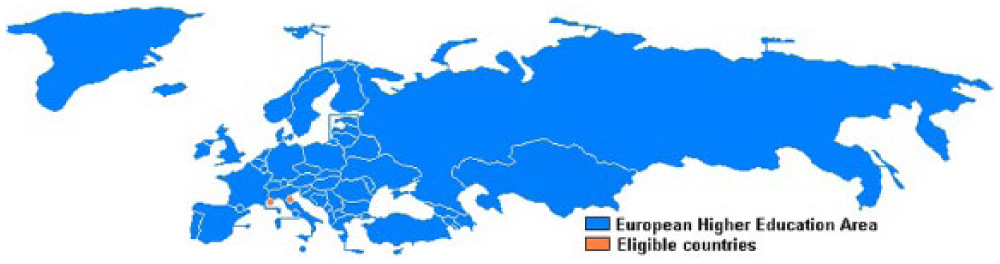
The countries of the EHEA.
There are also countries in other parts of the world that have chosen to follow the Bologna Process or are considering doing so. Specifically, there is research about adoption of the Bologna Process in a region in Africa (Eta, 2014). The Economic and Monetary Community of Central Africa emerged with the aim of promoting cooperation among its members: it currently includes Cameroon, Central African Republic, Chad, Republic of Congo, Equatorial Guinea and Gabon. People in this region speak a common language (French), use common currency, and have a common passport. To integrate further the countries that comprise this economic and political union, the Bologna Process has been accepted (Eta, 2014). As well as the spread of the Bologna Process in Africa, it is clear from the literature that the Bologna Process is also a matter of interest in the USA and some countries of South America (Terry, 2010). Whilst less interest has been expressed by East Asian countries, there have been studies investigating the readiness of, for instance, China and the Association of South Eastern Asian Nations, to participate (Zeng et al., 2013). This interest in the Bologna Process in different parts of the world suggests that it is possible that its implementation will extend beyond the borders it has currently reached in the EHEA.
In addition to attracting new member states and new international stakeholders, the Bologna Process has expanded the number of its objectives and clarified relevant meanings since its inception. As a result the Bologna Process is becoming the largest and most influential international higher education initiative. Vogtle and Martens, for instance, claimed that the Bologna Process ‘presents the largest ongoing reform initiative in higher education’ (Vogtle and Martens, 2014: 246). This enhanced status of the Bologna Process may be attributed at least partially to the idea that the Bologna Process acts like a snowball, attaching other initiatives to itself as it develops. This is implied by Dobbins and Knill who stated that ‘…it is often difficult to disentangle Bologna from… related convergence-promoting factors… These include, to mention a few, cooperation with the Organisation of Economic Co-operation and Development (OECD) and World Bank’ (Dobbins and Knill, 2009: 398). There is also a similar argument in favour of the multiplicity of higher education reforms over the last years, with the main objective of these reforms being the establishment of common reference points in higher education systems in European countries (Stiwne and Alves, 2010). Furthermore, the EHEA appears to encompass other emerging areas which have not gained as much momentum as the EHEA itself but which are still recognised to be associated with European higher education. For instance, it has been suggested that the European e-Learning Area is being developed as a result of the eLearning Program promoted by the European Commission and governed by similar arrangements to those of the EHEA (Salajan, 2013). I would argue that this similarity arises from the superior status of the EHEA. Similarly, the European Research Area was initiated, after 2000, in the framework of the Lisbon Agenda targeting economic competitiveness of Europe. The European Research Area was eventually affiliated with the EHEA, which became an umbrella organisation for the entire Lisbon Agenda (Huisman and Van der Wende, 2004; Corbett, 2011).
The encapsulation of all of the above initiatives in the Bologna Process has been aimed at the development of a European identity in the Bologna Process nations (Papatsiba, 2009). The discussions of the image of the student and the image of the citizen in the Bologna Process literature coincide. Flexibility and mobility are now seen as essential characteristics of both the student (Brine, 2006) and the citizen (Papatsiba, 2009). The relationship between the development of citizens’ and students’ identities is justified by Zgaga (2009). Zgaga claimed that ‘citizenship is a concept inherent to the idea of the university and the role of higher education’ (Zgaga, 2009: 177). The connection between the development of citizens’ and students’ identities is also implied by Papatsiba (2009) who claimed that flexible and mobile citizens are formed through education mobility programmes. In addition, the construction of a European citizen through Bologna happens in opposition to the construction of ‘the other’ – someone who is excluded and in relation to whom the European citizen should be competitive (Fejes, 2008). Fejes argues further that the ‘other’ is then constructed though the narrative about being devoid of the characteristics that the European citizen has – flexibility, autonomy and self-regulation. However, according to Fejes (2008), although Bologna aims to converge higher education structures and, as a result, the characteristics of European citizens cultivated thought higher education, diversity in higher education traditions is respected. This is in line with the arguments of Derrida (1992) and Eriksen and Fossum (2007). It was noted above that these authors have stated that wider Europeanisation has been linked to convergence in certain aspects, while others remained unchanged, and this resilience was respected. This perspective on European integration, in general as well as specifically in the context of the development of the Bologna Process, moves away from an either/or perspective used by a number of other authors who have analysed the Process.
Such a dualistic position can be traced in the following. One group of scholars acknowledges evolving convergence in the EHEA in the context of the loss of diversity. To illustrate this, Field (2003) and Pyykko (2008) maintained that the Bologna Process is a threat to national higher education systems, cultures and identity, given the need to change programme and course content within the Process. In addition, this literature also acknowledges an opposite case, in which diversity is perpetuated through limited convergence. In particular, another group of scholars, including Portela et al. (2009) and Zgaga (2009), has stated that higher education systems in the Bologna Process countries undergo mainly technical implementation of reforms without significant change in essence because of the absence of strict control over the implementation of the Bologna Process and because of the persistence of national cultural, historical, economic and political contexts. It can be concluded that a European identity in the EHEA is not facilitated, because little convergence is triggered by the Bologna Process.
Further investigation of Europe in the Bologna Process
The analysis of the literature above has demonstrated that the Bologna Process may be contributing to the construction of the meaning of Europe. To explore exactly how it can do so, an analysis of formal documents was conducted: this collection and analysis of international ministerial communiqués and declarations dealing with the Bologna Process is the main empirical method used for this present study. Nine documents, collected from the official website of the EHEA (EHEA, 2014), were considered: the Sorbonne Joint Declaration (1998), the Bologna Declaration (1999), the Prague Communiqué (2001), the Berlin Communiqué (2003), the Bergen Communiqué (2005), the London Communiqué (2007), the Leuven–Louvain-la-Neuve Communiqué (2009), the Budapest-Vienna Declaration (2010) and the Bucharest Communiqué (2012). These were produced at international, ministerial, Bologna Process conferences. As is apparent from the publication dates of these documents, the conferences were held every two–three years following the inception of the Bologna Process.
All of these documents were analysed thematically. Themes as units of analysis are useful for interpretation (Merriam, 2009), and for uncovering meanings (Rubin and Rubin, 2012). The information in the documents was manually coded with regard to broad categories such as synonyms of the notion ‘Europe’, the territory of Europe, European identity and citizenship. These categories were chosen because they appeared to be the most prominent in the relevant literature (as discussed above).
The Bologna Process expanding the borders of Europe
This section presents the analysis of the Bologna Process declarations and communiques. This analysis supports the idea already suggested in the literature – that the Bologna Process has the potential to contribute to defining the meaning of Europe. In addition, the analysis conducted on the documents demonstrates that the Bologna Process shapes the meaning of Europe as associated with European borders and the identity of the peoples within them. The Bologna Process expands European borders. The analysis also shows that the promotion of a common European identity within these extending borders is accompanied by accumulating problems in the development of a territory–identity compatibility in Europe. The perceived impossibility of solving this problem causes Europe to remain in the process of creation, in the context of the Bologna Process.
European borders developed and changed in the course of the Bologna Process. Europe and the EHEA are used interchangeably in all the Bologna Process documents that were analysed. The EHEA, and thus Europe, were initially associated only with the EU. For instance, it is stated in the Sorbonne Declaration that ‘the fast growing support of the European Union, for the mobility of students and teachers, should be employed to the full’ (Sorbonne Joint Declaration, 1998: 2). Europe in the Bologna Process was seen in terms of the EU in 1998 because the first signatory Bologna Process countries were EU nations – Germany, Italy, France and the United Kingdom. A year later, when more countries joined the Bologna Process, a ‘growing awareness… of the need to establish a more complete and far-reaching Europe’ was mentioned in the Bologna Declaration (1999: 1). In addition, the enlargement of the EU was recognised in the Prague Communique (2001) as a reason for involving more countries in the Bologna Process. The idea of the EU expansion was not mentioned thereafter in subsequent Bologna Process documents – perhaps because too many non-EU countries started joining. It appears, according to anecdotal evidence, that some of these countries were not regarded by the EU representatives as having the potential to meet the criteria for joining the EU. Arguably this is a turning point in moving away from the conceptualisation of Europe in terms of the EU in the Bologna Process. Europe evolved to be concerned with the entire growing EHEA which was, at each stage of its development, clearly demarcated from the rest of the world with which the EHEA was supposed to compete (Berlin Communique, 2003).
The Bologna Process expands European borders more than any other recent initiative discussed earlier. It also shapes Europe: it constructs a Europe where common European values and a common European identity are developed. ‘European values’ seem to be a foundation of European identity.
European values are discussed in the Bologna Process documents with regard to the ideas of democracy, freedom, ‘belonging to a common social and cultural space’, and respect for diversity (Bologna Declaration, 1999: 1). Another European value is the geopolitical status of Europe that seeks both to respect everyone beyond its borders and support everyone within its borders. It also aims to be distinct globally by becoming the most competitive knowledge economy in the world (Prague Communique, 2001). European values also include openness to ideas and knowledge improvement (Bergen Communique, 2005). The importance of European values in the EHEA can be detected in the fact that only countries that are party to the European Cultural Convention have been eligible to join the Bologna Process (Budapest–Vienna Declaration, 2010).
A European identity in the EHEA is based on these values. It was suggested in the literature review above that mobility and flexibility are now regarded as the main characteristics of both students and citizens. The analysis of the Bologna Process documents adds that a European identity involves the development of the image of a lifelong flexible and mobile student whose constant self-improvement enriches a positive appearance of Europe and its worldwide competitiveness. Specifically, ‘we see the development of national and European frameworks for qualifications as an opportunity to further embed lifelong learning in higher education’ (Bergen Communique, 2005: 3). Furthermore, the EHEA aims to prepare the student ‘…for the labour market, for further competence building and for active citizenship’ (Bergen Communiqué, 2005: 6).
Despite the existence of such generalising claims in the Bologna documents about all students in the EHEA, in reality not all individuals may have opportunities to access higher education, benefit from the lifelong learning opportunities and, consequently, become one of the building blocks for the EHEA with its ideas of active citizenship, European values and identity. Powell et al. (2012) analysed what they called ‘the skill-formation system’ of Europe. They argued that despite the general discourse of civic and social participation and inclusion in the EHEA this space is not yet inclusive to all with regard to becoming a student in all the participating countries; there is a problem with exclusion in this respect. Europe is thus still emerging as a ‘space for all’ only within its borders.
The promotion of a commonality in the EHEA in terms of the European identity and the image of the student has been taking place at the same time as the promotion of respect for diversity in cultures, languages, national higher education systems and university autonomy. Specifically, it is stated in the Bologna Declaration (1999) that, ‘…we hereby undertake to attain these objectives – …taking full respect of the diversity of cultures, languages, national education systems and of university autonomy – to consolidate the European area of higher education’ (Bologna Declaration, 1999: 3). This respect for diversity might perhaps seem to be a somewhat paradoxical basis for promoting a common identity. Generating convergence might be easier in the context of abandoning diversity, because it seems to be a phenomenon antithetical to convergence. This and other challenges in promoting a common European identity will be further discussed below.
Europe has been dynamic in the Bologna Process because the territory–identity integrity problem of Europe has been gradually developing with the expansion of European borders. For instance, Russia’s membership in the EHEA is an interesting case. Its authoritarian government and anti-western ideology (Kuzio, 2012) seems to be at odds with the European values associated with the respect for diversity, noted above. Solutions to this discrepancy between one growing space and the non-unified identity of its peoples have been sought but, to date, not found. This adds to the work of Lawn and Grek (2012) who suggested that Europe is dynamic because the identification of its essence is always pursued by interested parties. This vision of Lawn and Grek (2012) of a European identity can readily be applied to what is happening with this identity specifically in the context of the Bologna Process. Convergence in the EHEA, coupled with the preservation of diversity, might be the force that creates the overarching essence of a European identity in the EHEA.
Both convergence and respect for diversity are advocated in international ministerial documents (e.g., Bologna Declaration, 1999; Budapest–Vienna Declaration, 2010). The argument by Derrida noted above, concerning the integration process in Europe occurring while preserving diversity, can have value in the case of the Bologna Process. The declaration of the respect for diversity in the context of convergence, which might be seen as restricted in such circumstances, can be viewed as conducive to the involvement of more and more countries in the Bologna Process. Given that the timing of the involvement of the Bologna Process signatory states differs, so must the respect for diversity in these countries. Anecdotal evidence suggests that the countries that joined later were obliged to agree to a set of conditions for convergence already established (such as a certain system of study cycles, credit system, university autonomy, etc). Thus, hypothetically, the extent of respect for diversity that newer countries should demonstrate is perhaps greater than that of the countries that have been in the Bologna Process for some time. The respect that countries already party to the Bologna Process should demonstrate is in relation to the variations of the implementation of the Bologna Process ideas among themselves. This respect should be also demonstrated in relation to newly-joined countries, with time needed to undergo reform processes in order to reach the level of convergence that exists among those countries having joined the Bologna Process earlier.
This idea is aggravated by the inviting nature of the Bologna Process, which respects the differences of all the countries it has involved but, at the same time, overlooks these differences to an extent because of the promoted convergence. All of this suggests the need to speculate whether this is in any way related to the colonial role of Europe of the past. It seems clear that the term ‘colonialisation’, if defined as pertaining to forceful invasion, is inappropriate in the Bologna context. The Bologna Process is based on voluntary involvement and participation, despite the fact that voluntarism involves conforming to peer-pressure and seeking solutions to national problems in higher education and beyond, solutions which themselves drive joining and participation in the Bologna Process, at least in Eastern and Central European countries (Zgaga, 2009). However, voluntarily giving up some freedom in steering national higher education for the sake of the benevolent EHEA goals, as explained earlier, and accepting the wider consequences it yields, makes the Bologna Process both a benign, and possibly a risky, project for the signatory countries, as will be detailed below.
The promotion of a seemingly benevolent idea of a European identity within a growing EHEA might be seen as placing some countries into the periphery, especially those located beyond the boundaries of either the EU or even those of geographical Europe. This suggests that the debate on common values that stem from the common history of European countries (Berlin Communique, 2001) is alien to these ‘peripheral’ states. These peripheral countries should then respect the idea of a European identity more than ‘non-peripheral’ European countries need to respect the identity of these (peripheral) countries; and these peripheral countries need to work towards the facilitation of a European identity. This suggests the requirement for some sort of regionalisation in the EHEA. There are those countries that need to respect more and those countries that need to be respected more. Such an imbalance of power among the members of the EHEA is perhaps both a result of the expanding European borders and part of the meaning of Europe in the context of the Bologna Process.
All of these examples support the idea that European borders contribute not only to the delineation of its territory, but also to the construction of the meaning of Europe through developing the European identity. They also show how the expansion of European borders and the promotion of a common European identity within them is accompanied by accumulating problems in the development of a territory–identity compatibility in Europe constructed by the Bologna Process. The extreme difficulty of dealing instantly with this problem, and the need to look for a solution, requires Europe to remain dynamic in the Bologna Process.
Conclusions
Placing the Bologna Process at the centre of analysis in the speculations about Europe has showed that European borders are being expanded. It has also helped in reaching an understanding that the meaning of Europe is shaped in the Bologna Process through the development of a European identity. This identity is linked to an unreconciled struggle between convergence and the preservation of divergence. Expanding borders and the tensions associated with the European identity render Europe dynamic and constantly under construction in the Bologna Process. It is argued that this research, exploring the role of the Bologna Process in shaping the meaning of Europe, is significant and timely for the higher education community of the states that joined the Bologna Process, because they need to adopt a wider perspective with regard to the Bologna Process and understand the broader implications of the continuation of the spread of the Process. They need to understand the role of the Bologna Process in shaping the essence of Europe and their role in its construction, and they need to be fully informed about the opportunities and risks they have been facing while being involved in the Bologna Process.
Further research is needed to identify differences in the role of the Bologna Process in the creation of Europe within and beyond the EHEA, such as in Africa and South America. This should be followed by attempts to integrate research on defining Europe from multiple perspectives to arrive at an abstract conceptualisation of what can be regarded as ‘Europe’. This is essential for understanding further the political processes in which a currently fragmented and vague entity referred to as Europe is involved.
Footnotes
Declaration of conflicting interest
The authors declare that there is no conflict of interest.
Funding
This research received no specific grant from any funding agency in the public, commercial, or not-for-profit sectors.