




Abstract
This paper focuses on the influence of socio-economic risk factors and different aspects of the home learning environment in early childhood on children’s language competencies (vocabulary and grammar skills). The assumption is that children with more risk factors have lower competencies, but the home learning environment (measured by everyday activities at home and cultural activities) acts as a protective factor against risk. The data (n = 2406 children) are a sample of the German National Educational Panel Study (NEPS), which collects longitudinal data on a sample of four-year-old children starting in preschool. The regression models show higher levels of vocabulary and grammar skills for children with fewer socio-economic risk factors. This influence persists even after adding both indicators of the home learning environment. However, there is an additional small effect of the home learning environment on children’s language competencies. Practical and policy implications of the study are discussed, especially against the background of the reduction of social disparities in Germany.
Keywords
Introduction
Various studies have highlighted the social disparities in children’s competencies in western countries (Becker, 2004; OECD, 2014), and, from early childhood on, children already differ in their language, mathematical and basic academic skills (Aunio et al., 2015; Biedinger, 2011; Weinert et al., 2010) – this is especially true for Germany. Different explanations for those findings can be found, including socio-economic risk factors (e.g. poverty, migration background), that might influence children’s competencies (Laucht et al., 2000; Miller et al., 2016; Mistry et al., 2010; Sammons et al., 2008). During early childhood the relationships between socio-economic risk factors and children’s reading and mathematics achievement are more pronounced (Duncan et al., 1998). Current research discusses cumulative risk models, first proposed by Rutter (1987), that take into account the high likelihood of co-occurrence of risk factors for children’s development such as poverty, low parental education and unemployment (Burchinal et al., 2000; Dearing et al., 2009; Rathbun and West, 2004). Moreover, studies in line with the bioecological theory by Bronfenbrenner and Morris (2006) mention the proximal processes of the home learning environment (e.g. low cognitively stimulating parenting such as rare joint book reading or rare board game play, low maternal sensitivity, for example no prompt responses to children’s needs, or rare physical affection) as a reason for the relationships between social disparities and children’s competencies (Anders et al., 2013; Ebert et al., 2013; Lehrl et al., 2012; NICHD ECCRN, 2003). Other research according to Bourdieu (1983, 1984) focuses more on cultural practice within the families (e.g. visits to the theatre, cultural materials such as literature, artwork, poetry) as reasons for differences in children’s competencies (Dumais and Ward, 2010; Schlee et al., 2009). So far, the relationships between risk factors and children’s competencies have been addressed from different perspectives or disciplines. A combined approach integrating these different perspectives is still lacking. Thus, Hasselhorn et al. (2015) advocate for more transdisciplinary discussions on issues surrounding children at risk of poor educational outcomes in western European societies (in particular, in Germany). They provide a theoretical framework including individual (e.g. language skills, genetic makeup such as gender), contextual factors (e.g. home learning environment, familial activities, preschool quality) and societal circumstances as well as political context (e.g. educational system, beliefs) to disentangle important mechanisms that are related to poor educational outcomes. We follow this framework because it adequately frames the current German discussion concerning the relationships between socio-economic risk factors, home learning environment and children’s competencies.
Empirical evidence regarding the relationships between early socio-economic risk factors, aspects of the home learning environment and children’s competencies is, however, limited. For pedagogues and policy makers it is of special interest to know which aspects of early childhood might boost or dampen children’s competencies, particularly with regard to language skills. Language skills, as coding and communication systems, are needed to support children’s acquisition of knowledge in various other domains (Weinert, 2006). Thus, social disparities in later school achievement have – at least partially – been attributed to differences in (German) language skills (Stanat, 2006). Consequently, the purpose of the present study is to investigate the influences of early socio-economic risk factors and different aspects of the home learning environment in early childhood on children’s vocabulary and grammar competencies (as the key components of language acquisition) at preschool. The data are a sample of the National Educational Panel Study (NEPS; for an overview, see Strietholt et al., 2013) in Germany that focuses on the development of children starting in preschool.
The current paper is structured as follows: the next section introduces the current state of research concerning the relationships between socio-economic risk factors, different aspects of the home learning environment, and children’s language skills. Following this, the research questions, methods and results of the current study are presented. Finally, the findings are discussed.
Current state of research
There are various explanations for the differences in child outcomes, some of which are highlighted in the following sections.
Relationships between socio-economic risk factors and language skills
Risk factors are often defined as biological and environmental conditions that increase the likelihood of negative outcomes (Klebanov and Brooks-Gunn, 2006). Typical socio-economic risk factors are, for example, low income, low socio-economic status (SES), low educational level and no occupation; each factor correlates with children’s language competencies (e.g. Burchinal et al., 2000; Niklas et al., 2017; Rathbun et al., 2005). Large longitudinal studies combine multiple dichotomous risk factors with each other and analyze the influence of this cumulative risk index on language skills, including the Early Childhood Longitudinal Study-Kindergarten Cohort (ECLS-K) study (e.g. Rathbun and West, 2004; Rathbun et al., 2005), the National Institute of Child Health and Human Development (NICHD) Study of Early Child Care (e.g. Dearing et al., 2009), the National Early Head Start Research and Evaluation Project (e.g. Mistry et al., 2010) as well as further research (e.g. Burchinal et al., 2006; Cadima et al., 2010; Niklas et al., 2017; Oliver et al., 2014; Rouse and Fantuzzo, 2009). The main result of this research is that multiple disadvantaged children had poorer language outcomes than other non- or less-disadvantaged children (for an overview, see Evans et al., 2013). However, the diversity among risk factors (e.g. number of included risk factors, measures) makes it difficult to compare results across studies.
Relationships between home learning environment and language skills
The home learning environment represents the amount and variability of stimulation that a child receives, including the availability of educational resources such as books at home, and the nature of everyday activities such as reading to the child, using complex language, playing with numbers and counting (e.g. Hart and Risley, 1995; Melhuish et al., 2008). The general assumption is that the home learning environment directly influences children’s competencies. There are many studies using different measures of the home learning environment and assessing its effects on language skills during the preschool phase (Boyce et al., 2013; Ebert et al., 2013; Lehrl et al., 2012; Melhuish et al., 2008; Niklas and Schneider, 2017; for an overview, see Kluczniok et al., 2013). For instance, findings of the German longitudinal study BiKS (Educational Processes, Competence Development and Selection Decisions at Preschool and School Age) indicate that the home learning environment (measured as home literacy, e.g. frequency of shared book reading, number of children’s books) is positively associated with children’s vocabulary at age three (Ebert et al., 2013) as well as to other emerging literacy skills at the end of preschool (e.g. grammar, knowledge of letters; Lehrl et al., 2012). Moreover, Melhuish et al. (2008), drawing on data of the Effective Provision of Preschool Education Project (EPPE) from the UK, show the importance of the home learning environment (measured by frequency of everyday activities, e.g. playing with letters/numbers) for literacy achievement at age five. In this context, it is important to emphasize that the influence of the home learning environment was over and above that of the standard proxy measures of parental education and SES (also defined as risk factors). Sylva et al. (2004) summarize this EPPE finding as follows: there is a difference between ‘what people are and what people do’ (Sylva et al., 2004: 164), indicating that proximal processes are more important than distal factors for child outcomes. Niklas and Schneider (2017) found long-term effects of the early home learning environment (measured by 11 items, e.g. number of books in the household, visits to libraries, playing dice games) on children’s competence development at the end of elementary school in a German study called ‘School-ready Child‘. In sum, these studies all conclude that the home learning environment matters for preschool-aged children.
Furthermore, another aspect of the home learning environment can be differentiated – the cultural activities in families (e.g. visits to the theatre, museums, opera or cultural courses). Cultural activities are a part of Bourdieu’s concept of cultural capital (Bourdieu, 1983, 1984). Cultural capital is an explanation of the reproduction of social inequalities in western European societies. The transmission of cultural capital in families and schools is a central mechanism of this reproduction. The educational system reflects the predominant culture and the corresponding cultural capital of parents with high status. Intermediate family behavior is in line with institutional expectations (Jungbauer-Gans, 2004). In addition, teachers’ expectations of the pupils are shaped by their own social status. As a consequence, children achieve better performance ratings than children of families with lower cultural capital (Bourdieu and Passeron, 1990). The theory of cultural capital is tested in different studies (Prieur et al., 2008; Rössel and Beckert-Zieglschmid, 2002; Xu and Hampden-Thompson, 2012). The results show that cultural capital in western European societies is an important factor for status preservation, academic achievement and school career. Since the 1950s and 1960s there has been a change in the German educational system: school achievement became more important for higher education than the status of the families. To offset the decline of status, investments in the cultural capital of children increased. Parents invest early in their children’s skills in order to improve their later educational success (Becker, 2010; Mudiappa and Kluczniok, 2015). Thus, cultural activities can be seen as a special indicator of the home learning environment because they are different from the everyday activities of the family (e.g. role playing, picture book reading), take place outside the families, and require financial and time resources. Moreover, such activities are an expression of specific lifestyle as well as cultural taste and practice, and are an investment in the cultural capital of the children (Kraaykamp and Nieuwbeerta, 2000; Pellerin and Stearns, 2001).
Empirical references to the effects of cultural activities on children’s language competencies in the early years are very rare. Thus, we also refer to studies focusing on other child outcomes (e.g. mathematics, general cognitive skills) and children at elementary school age to underline the importance of cultural capital for educational success. Based on a German and Turkish sample with preschool-aged children, Becker (2011) reported that activities (measured as an additive index of eight items, e.g. visiting a library or museum with the child) have a significant positive relationship with children’s cognitive skills and children’s vocabulary, controlling for child background factors (e.g. education, income, gender). Drawing on the same sample, Klein and Becker (2017) found no significant influence of the parental cultural activities (e.g. visiting the museum) on vocabulary, but a significant positive relationship between parent–child activities (e.g. telling stories or playing board and card games) and children’s vocabulary. More empirical references are reported for children at elementary school age. Dumais (2006) analyzed the data from the ECLS-K from the USA concerning first- to third-graders’ participation in cultural and leisure activities (e.g. dancing or drawing lessons) and their impact on school performance (reading performance and teachers’ assessments of linguistic abilities). She found significant positive effects between reading development between first and third grade and the number of children’s activities. Dumais concluded that cultural and leisure activities are significant for school performance and that disadvantaged children especially benefit from such activities. Mühler and Spiess (2008) reported similar results for preschoolers in Germany. They found a positive connection between informal early education activities (e.g. music and painting lessons) and adaptive behavior (everyday skills); a positive link to language, motoric and social skills was not found. Schlee et al. (2009) examined the influence of cultural resourcing and social capital on school performance in reading at the elementary school by using the ECLS-K data. Better performance in reading is affected by reading to children, in particular reading daily and visiting libraries. Chiu et al. (2015) analyzed the effects of cultural capital in the family (e.g. cultural activities, audiovisual technologies) and reading motivation on reading behavior in elementary school. The results showed no significant direct effect of family cultural capital on reading behavior. However, family cultural capital had a significant indirect effect on reading behavior through reading motivation. The authors concluded that if children lack reading motivation, they do not develop good reading behaviors, even when cultural capital in the family is available. Kloosterman et al. (2010) used panel data from a Dutch educational survey. The authors analyzed the effects of parental reading practice (e.g. frequency of reading a newspaper, reading aloud to the child) and school involvement (e.g. education-related activities such as attending parents’ evening) on children’s academic performance (language and arithmetic) during primary school. They found that parental reading practice and involvement impacted children’s language performance, while the arithmetic competence is only influenced by the parental involvement.
In summary, there is a lack of studies in early childhood assessing the relationship between cultural activities and children’s language competencies. Therefore, the present study tries to fill this research gap and to generate new knowledge.
Research questions
There is little empirical evidence concerning the interplay between socio-economic risk factors, home learning environment and children’s competencies. Consequently, the present study examines the relationships between early socio-economic risk experiences, aspects of the home learning environment (everyday activities at home, cultural activities) and children’s competencies in vocabulary and grammar at preschool in Germany, testing if the influences of the home learning environment exist after controlling for risk experiences. In particular, we analyze the additional impact of the home learning environment on vocabulary and grammar skills. The question is whether both aspects of the home learning environment act as protective factors against socio-economic risk.
Method
Sample
This paper uses data from the NEPS Starting Cohort Kindergarten (Blossfeld et al., 2011). From 2008 to 2013, NEPS data were collected as part of the Framework Program for the Promotion of Empirical Educational Research funded by the German Federal Ministry of Education and Research. As of 2014, NEPS is carried out by the Leibniz Institute for Educational Trajectories at the University of Bamberg in cooperation with a nationwide network. The Starting Cohort Kindergarten collects longitudinal data on a starting sample of four-year-old children and their parents in preschool (wave 1: 2010/2011) over the preschool and elementary school phase.
A two-stage sample design was employed to select a nationally representative sample of children attending German preschools in 2011. The primary sampling unit was a random sample of German elementary schools. Then, a sample of preschools related to the selected participating schools was drawn. Out of these preschools, the participating preschools were determined by random sampling. Questionnaires and tests are conducted in these preschools. All four-year-old children from the selected preschools were invited to participate. This two-stage method ensures that a high number of four-year-olds in preschool will also be included in the sample of first graders.
In the present study, the sample size at wave 1 was 2406 preschool-aged children with valid data for vocabulary and grammar skills.
Measures
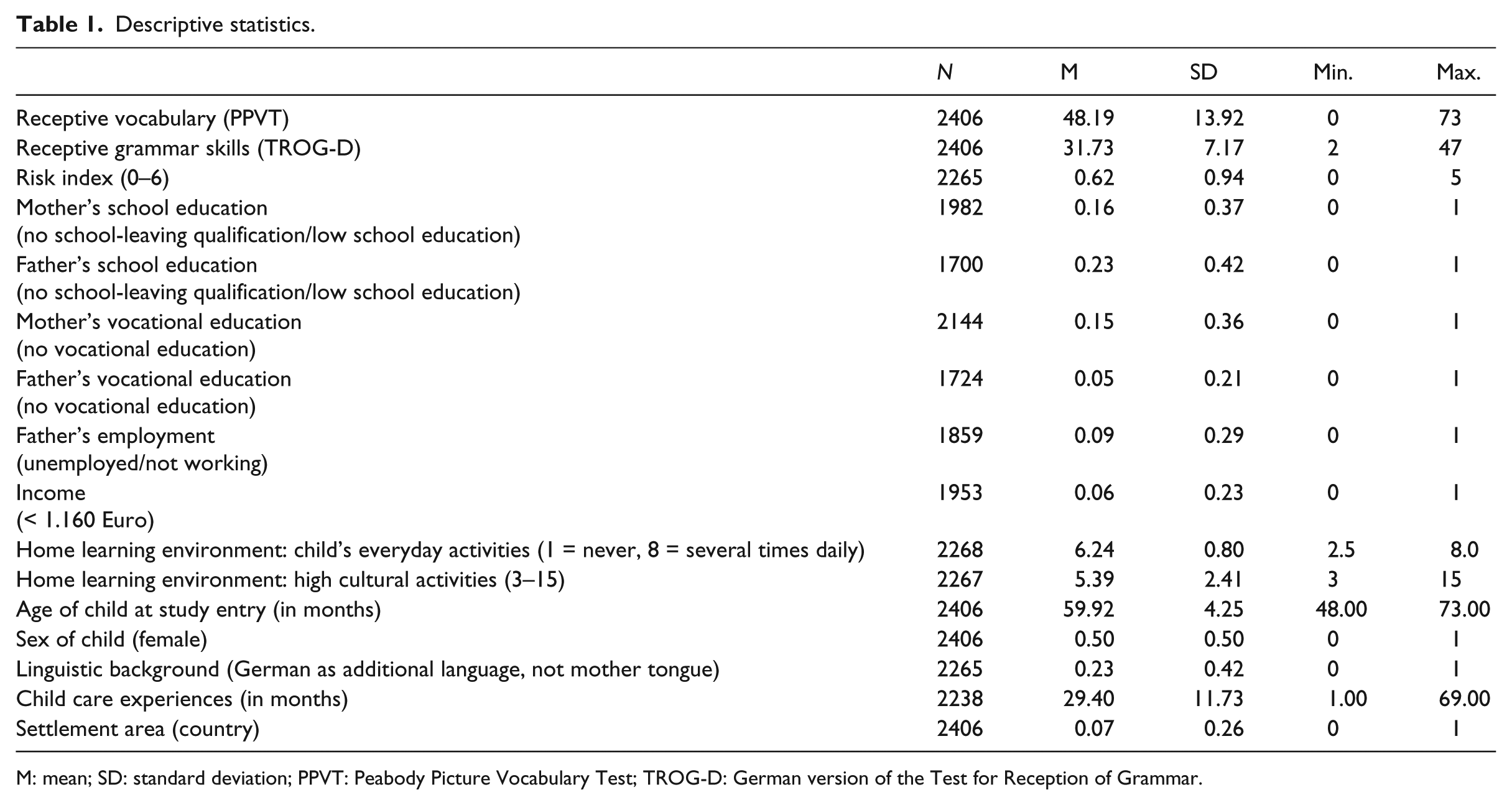
All measures used in the analyses are described in the following sections. Additionally, Table 1 provides the summary descriptive information for all variables used.
Descriptive statistics.
M: mean; SD: standard deviation; PPVT: Peabody Picture Vocabulary Test; TROG-D: German version of the Test for Reception of Grammar.
Outcome measures
Receptive vocabulary
Receptive vocabulary is one of the best indicators of language competencies (Weinert, 2010). The Peabody Picture Vocabulary Test (PPVT) is an international, widely used instrument for measuring receptive vocabulary over a wide age spectrum, and is also easy to carry out and evaluate. The PPVT displays an adequate convergent validity indicating high correlations with other language subtasks (e.g. Wechsler Intelligence Scale for Children or the Oral and Written Language Scales). In NEPS, an adapted German version of the PPVT (Dunn and Dunn, 1981) is used. The adapted version for NEPS is based on the data of the European Child Care and Education Study (ECCE) and BiKS Study (ECCE Study Group, 1997; Rossbach et al., 2005). In this individual test at preschool, the child is presented by a well-trained test administrator with one lexical item at a time in German, and his or her task is to select the picture out of four pictures that the word refers to (77 items in total; Cronbach’s Alpha = 0.86). Items were presented in order of increasing difficulty. In order to avoid overstraining of the children in case of poor performance, the test is stopped after six consecutive wrong answers. Each correct response was scored as one point. For the analyses, we used the outcome measure at wave 1 (preschool) as the dependent variable.
Receptive grammar
Together with vocabulary knowledge, grammatical skills are a good predictor of measures of reading comprehension later in elementary school (Ebert and Weinert, 2013). The TROG-D (Fox, 2006) is the German version of the Test for Reception of Grammar (TROG; Bishop, 1989). In this test, the child has to listen to a German sentence (using a CD player and headsets) and must choose the picture that fits that sentence (generally out of four options). The grammatical structure of the sentences varies systematically while the words used in the sentences – that is, the vocabulary – are held rather constant and easy. The TROG is an economical and suitable approach for assessing the listening comprehension of grammatical structures in large-scale studies such as the NEPS (Lorenz et al., 2017). The preschool version comprises 48 items (Cronbach’s Alpha = 0.74). Children were tested individually by a well-trained test administrator. Items were presented in order of increasing difficulty. In order to avoid overstraining of the children in case of poor performance, the test is stopped after five consecutive sets have been classified as wrong. For the analyses, the correct answers of each child were added up, resulting in a sum score between 0 and 48 for wave 1 as the dependent variable.
Predictors
Socio-economic risk factors
Six indicators are included representing socio-economic risk conditions. The items are selected on a theoretical basis and based on prior research (Burchinal et al., 2000; Hanson et al., 2011; Laucht et al., 2000; McCartney et al., 2007; Mistry et al., 2010; Sameroff et al., 1987, 1993; Sammons et al., 2008). They relate to factors concerning the SES experienced by children during early childhood. Furthermore, given the co-occurrence of risk factors, this cumulative risk approach adequately treats the problem of multicollinearity in multivariate regression analyses to assess risk–child outcome relations (Mistry et al., 2010). All items are measured through the parent interview or questionnaire at the beginning of the study (wave 1). The risk index was computed as a count risk score assessing the number of socio-economic risk factors reflecting children’s risk experiences, because it is the accumulation of these risk factors that has been found to be most associated with children’s outcomes (Rutter, 1987). Like other structural aspects of the family, the risk factors often covary and interrelate and are usually represented by a cumulative risk index reflecting the risk exposure (Rathbun et al., 2005). For each indicator, families received a score of one if they met or exceeded the risk threshold described for each indicator and a score of zero if they fell below it. The total risk score ranges from zero to six and indicates the extent of early socio-economic risks in the families. The following items were used.
Mother’s school education: no school-leaving qualification/low school education (‘secondary modern school qualification’) = 1; middle/high school education (‘secondary school certificate’/’higher education entrance qualification’) = 0.
Father’s school education: no school-leaving qualification/low school education (‘secondary modern school qualification’) = 1; middle/high school education (‘secondary school certificate’/‘higher education entrance qualification’) = 0.
Mother’s vocational education: no vocational education = 1; completed vocational education = 0.
Father’s vocational education: no vocational education = 1; completed vocational education = 0.
Father’s employment: unemployed/not working = 1; employed/working = 0. 1
Income: < 1.160 Euro = 1; > 1.160 Euro = 0. 2
For the analyses, we used the risk index measured at wave 1 as an independent variable.
Home learning environment: everyday activities at home
The scale contains 10 items representing the frequency of a plethora of the child’s everyday activities at home (e.g. role-play, making music, picture books). These items have been used successfully in previous studies (Linberg, 2016; Melhuish et al., 2008). The parents were asked how often the child is engaged in these activities. The scale ranges from 1 (never) to 8 (several times daily). Cronbach’s Alpha is 0.68. For the analyses, we used the scale measured at wave 1 as the independent variable.
Home learning environment: cultural activities
To measure the cultural activities of the families we developed a scale representing family’s participation in different activities including three items (visiting a museum or an art exhibition; visiting an opera, a ballet or a classical concert; visiting the theatre). These items have been used successfully in other studies before (Becker, 2011; Mudiappa and Kluczniok, 2015). The parents were asked how often they participated in these activities in the past 12 months (1 = never, 5 = more than 5 times). Based on these three items an additive scale was built. For the analyses, we used the scale measured at wave 1 as the independent variable.
Control variables
Some variables influence child outcomes. Based on the literature (Hartas, 2011) and after careful preliminary analyses, we selected the following set of variables as predictors (covariates) with potential influence on children’s competencies: age of the child at entry to the study (in months), the child’s gender (0 = male, 1 = female), linguistic background (measured by the mother tongue: 0 = German as mother tongue, 1 = German as additional language), 3 children’s experiences in child care (duration in months) at wave 1 as well as an indicator for the settlement area of the family (0 = town, 1 = country) to control for regional effects.
Data analysis
In the first step of the analytic process, descriptive data for all considered variables were compared to get an impression of the sample’s composition. Next, bivariate Pearson correlations were conducted to show the intercorrelations of the variables used. Third, stepwise regression analyses using AMOS were chosen to examine the relation of early socio-economic risk experience and both aspects of the home learning environment on children’s vocabulary and grammar skills. The stepwise procedure used to test our hypotheses involved five steps: first, a null model (model 1) was specified, considering child’s age at assessment at wave 1, child’s gender, child’s linguistic background, child’s experience in child care and settlement area as predictors of vocabulary and grammar skills. Next (model 2) we tested the influence of children’s early socio-economic risk experience on predicting vocabulary and grammar skills, controlling for age, gender, linguistic background, child care experiences and settlement area. In models 3 and 4 the additional influence of both aspects of the home learning environment were analyzed, controlling for child background factors. Thus, we can test whether there is an additional effect of the home learning environment on vocabulary and grammar skills beyond the potential influence of risk experience. The overall model (model 5) includes both of the home learning environment indicators simultaneously. All continuous variables were z-standardized before being included in the multivariate analyses.
In social science research, missing values are a particular challenge. For the multivariate analyses, the multiple imputation of missing values is proposed (Rubin, 1987; Schafer, 1997), which is sufficiently demonstrated. Thus, multiple imputation procedures provide more valid results than analysis with non-imputed data, which are highly distorted (Allison, 2001; Rubin, 1996). In our study, missing data ranged from 0% to 7% for the analyses of variables (see Table 1). To deal with missing data in our analyses, we chose the full information maximum likelihood approach (Arbuckle, 1996) that is implemented in AMOS and uses valid information of all observations for model estimation. Model fit was evaluated by the amount of explained variance.
Results
Descriptive findings
Table 1 presents the descriptive information for the sample. The sample consists of 50% girls. The children at the beginning of the study are, on average, five years old; 23% of the children have another linguistic background than German. The children have, on average, 29 months of experience in early child care, with a wide range. Only 7% of the sample lives in rural areas.
Children show a mean (M) of 48.19 (standard deviation (SD) = 13.92) in vocabulary and a mean of 31.73 (SD = 7.17) for grammar skills. With regard to the socio-economic risk index, the total score at wave 1 is, on average, M = 0.62 (SD = 0.94; possible range: 0–6). The risk index displays sufficient variance, as can be seen from the minimum and maximum (min. = 0, max. = 5), indicating a broad variety of risk exposure in the families. More than one third of the children (38.1%) have at least one risk factor present (not tabled).
Children do everyday activities such as puzzles, role play, picture books or singing several times a week (M = 6.24, SD = 0.80). The scale ‘cultural activities’ displays a mean of 5.39 (SD = 2.41), indicating that the families have done one of the three cultural activities more than five times in the past 12 months.
Moreover, it can be seen that the sample is well distributed. For example, the sample consists of children with high-risk experiences and lots of everyday activities at home or cultural activities in the family and vice versa (cross-tables not displayed).
Bivariate correlations
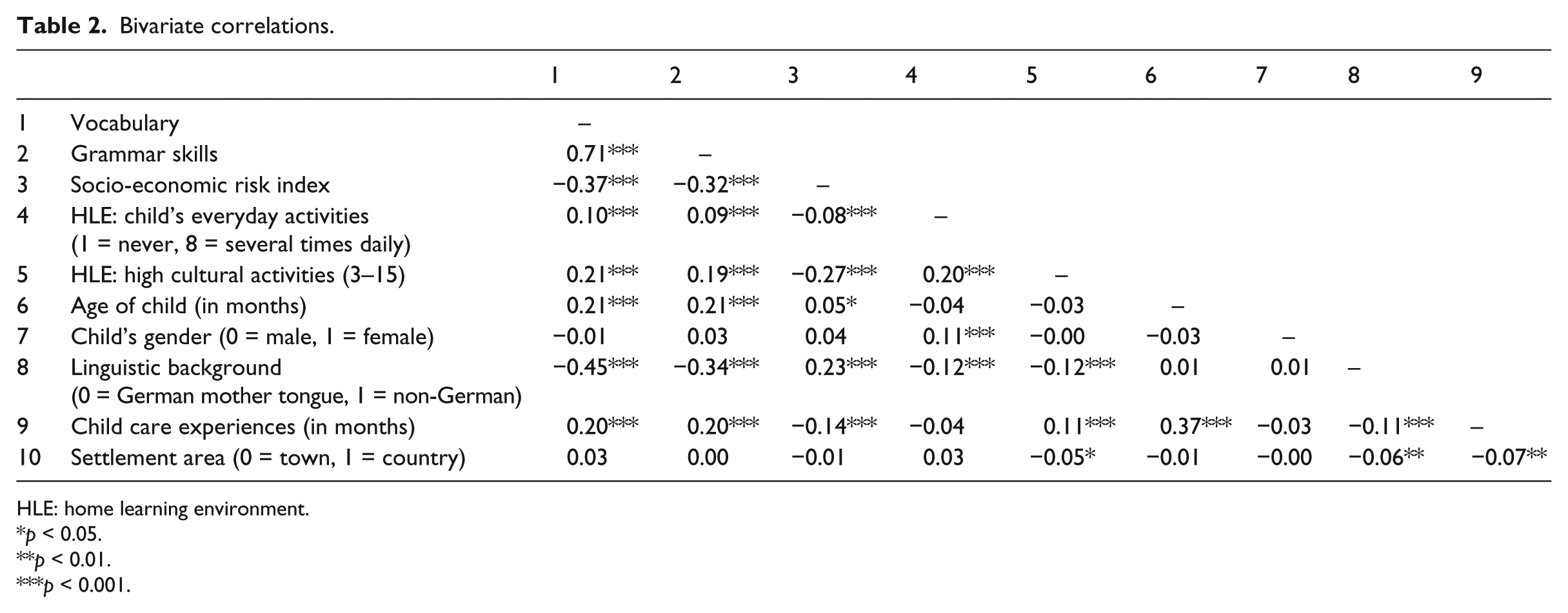
Table 2 presents the bivariate Pearson correlations of children’s vocabulary, grammar skills, the socio-economic risk index, both indicators of the home learning environment (everyday activities at home, cultural activities) and the covariates. Both language outcomes highly correlate, indicating similar aspects of language competencies. The risk index negatively correlates with the quality of the home learning environment (everyday activities at home, cultural activities) as well as with the children’s language competencies. Consistent with our expectations, the more socio-economic risk factors in early childhood there are, the worse the quality of the home learning environment and the worse the language competencies are. Both scales measuring the quality of the home learning environment (everyday activities at home, cultural activities) display a low correlation, indicating different aspects of the home learning environment. Most of the covariates are related to children’s vocabulary, grammar skills, socio-economic risk factors and both indicators of the home learning environment.
Bivariate correlations.
HLE: home learning environment.
p < 0.05.
p < 0.01.
p < 0.001.
Multivariate regression analyses
The main research question addressed the relationships between early socio-economic risk experiences, different aspects of the home learning environment and children’s competencies in vocabulary and grammar at preschool, testing if the influences of home learning environment exist after controlling for risk experiences.
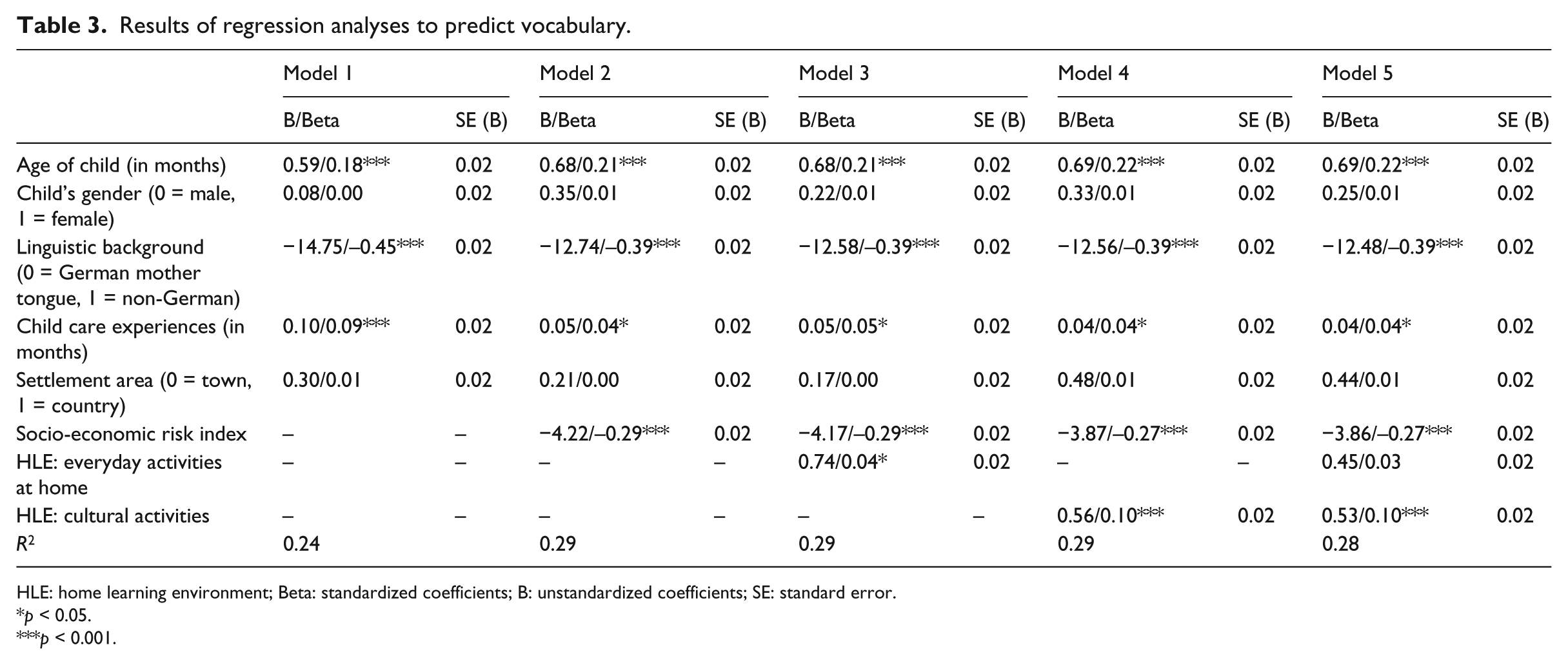
In Table 3 the unstandardized as well as standardized coefficients are displayed for the dependent variable vocabulary. The results of model 1 show that child’s age, linguistic background and child care experience are highly predictive for vocabulary. In model 1 and in all other models, older children, children with German as mother tongue and children with more child care experience display a larger vocabulary. In model 2 the risk factor is added and shows a significant effect: children with higher risk exposure in early childhood display lower scores on the vocabulary test taking child background factors into account. In the subsequent models (3 and 4) the additional effects of both aspects of the home learning environment are tested. Model 3 displays an additional positive (even if small) effect of the everyday activities. Children with more frequent everyday activities at home show a larger vocabulary, controlling for child background factors and risk exposure. Model 4 shows an additional (even if small) influence of cultural activities taking child background factors and risk exposure into account. Children from families who participate in cultural activities more often show better competencies in vocabulary. In the overall model (model 5) it can be seen that the influence of cultural activities remains significant, whereas the influence of everyday activities loses impact. The explained variance of the models ranges between 24% and 29%.
Results of regression analyses to predict vocabulary.
HLE: home learning environment; Beta: standardized coefficients; B: unstandardized coefficients; SE: standard error.
p < 0.05.
p < 0.001.
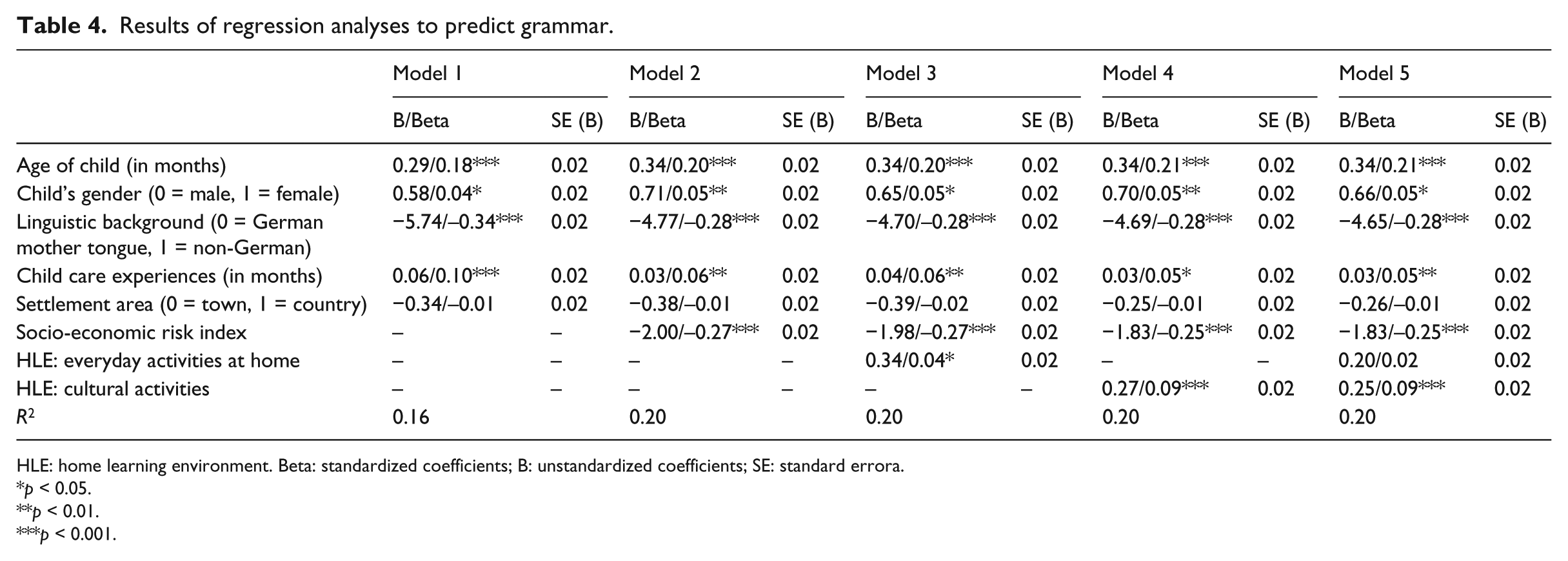
In Table 4 the unstandardized as well as standardized coefficients are displayed for the dependent variable grammar skills reporting similar results to those for vocabulary. Solely, the child’s gender also shows a significant positive influence on grammar skills in favor of girls. The explained variance of the models ranges between 16% and 20%.
Results of regression analyses to predict grammar.
HLE: home learning environment. Beta: standardized coefficients; B: unstandardized coefficients; SE: standard errora.
p < 0.05.
p < 0.01.
p < 0.001.
To sum up, both aspects of the home learning environment show additional (even if small) influences on vocabulary and grammar skills beyond the influence of risk experience and other child background factors. Analyzing both aspects of the home learning environment simultaneously, only the influence of cultural activities remains significant, indicating a higher importance of cultural practice on children’s language skills compared to everyday activities.
Discussion
The present study examines the relationships between early risk experiences, different aspects of the home learning environment and children’s competencies in vocabulary and grammar at preschool in Germany, testing if the influences of both aspects of home learning environment (everyday activities at home, cultural activities) exist after controlling for risk experiences. In particular, we were interested in the additional effect of the home learning environment on children’s language skills. The results show a larger vocabulary and better grammar skills for children with fewer socio-economic risk factors. This result is in line with the findings of other studies analyzing the effects of cumulative risk factors on children’s language skills (Burchinal et al., 2006; Dearing et al., 2009; Mistry et al., 2010; Rathbun et al., 2005). Moreover, the present study shows that this influence persists even after indicators for the home learning environment were taken into account. This indicates a strong impact of early risk experiences on receptive vocabulary and grammar skills. However, we found an additional (even if only small) effect of both aspects of the home learning environment on children’s language competencies, indicating that children from families with stimulating everyday activities as well as rich cultural opportunities display slightly better language competencies. Given such small effect sizes, it should also be noted that we controlled for risk experiences and other child background factors. Thus, the present study can be linked to previous research that highlights the importance of a stimulating home learning environment on children’s language competencies at preschool (Boyce et al., 2013; Burchinal et al., 2006; Ebert et al., 2013; Lehrl et al., 2012; Melhuish et al., 2008). Additionally, our study helps to fill the previously mentioned research gap concerning the importance of cultural capital in early childhood on children’s language skills at preschool. In particular, previous research is limited to older children (e.g. elementary school, secondary school; Baumert et al., 2003; Szczesny and Watermann, 2011). Thus, the present study highlights that investments in cultural capital should start in early childhood by carrying out cultural activities in order to build a ‘cultural basis’ (Georg, 2004). Our results show that this cultural basis positively influences children’s language competencies. It can be assumed that a frequent engagement with cultural activities (e.g. visiting museums) promotes sensomotor, affective and cognitive abilities (Fuchs, 2005). This process can be seen as an active transmission of cultural capital from parents to their children. Therefore, children from families with high cultural capital show better competencies than children from families with lower cultural capital.
Altogether, our findings indicate that the home learning environment sets an important (even if small) starting point for child development by influencing the language skills of preschool-aged children.
In sum, we find social disparities in early childhood represented by risk exposure and both aspects of the home learning environment, which influence children’s language skills. Children with more socio-economic risk experiences and low-stimulating home learning environments in early childhood display a smaller vocabulary and worse grammar skills. Moreover, our results provide an initial indication of the theoretical framework by Hasselhorn et al. (2015) which highlights the contextual factors (e.g. familial activities) that are related to poor educational outcomes. Hence, our results also point out that more interdisciplinary studies in early childhood are necessary for analyzing the relationship of risk factors and educational outcomes, and to get more information on the impacts of different risk conditions in early childhood. In this regard, differential effects should also be analyzed to find out whether specific groups of children (e.g. low or high home learning environment) are more or less impacted by risk factors in their language development.
In order to reduce social disparities, two points for policy and practice seem to be meaningful: first, parents should be reminded that the ways that they interact with their children are important for child development. In this context, the quality of the home learning environment and participation in cultural activities in early childhood are important issues in family education programs. For policy, it seems to be important to make such offers low-threshold and easily accessible, in order to reach as many families as possible, in particular families with children at risk. Moreover, local partnerships (e.g. between preschools, elementary schools, libraries) might be an excellent opportunity to provide low-threshold access to familial and cultural activities. Although preschool is not mandatory in Germany, nearly all children in Germany attend a preschool in the year before school enrolment. At the age of three only 89% of children in this age group attend a preschool (Autorengruppe Bildungsberichtersttatung, 2018). When focusing on children at risk (with German as a second language and low SES) it can be even 10% lower (Autorengruppe Bildungsberichterstattung, 2014). Preschool, therefore, seems to be a great opportunity for children and their parents to come in contact with cultural education at an early age (e.g. joint visit to a museum), especially for children at risk. Second, it seems necessary that parental investments start early in childhood. The participation of cultural practice forms attitudes, knowledge and behavior (e.g. abilities of social communication) and will give children an edge in school performance (Mudiappa, 2014). Thus, a strong foundation for children’s further educational careers could be provided and social disparities will be weakened.
Although the present study has a number of important findings, there are also limitations. First, all analyses were cross-sectional and tests of association, not causation. This does not allow us to make causal inferences. Second, we used a cumulative risk index (e.g. Rutter et al., 1997) which enables the simultaneous consideration of multiple socio-economic risk factors within a single variable. The motivation for this approach was that children experience different risk factors as whole risk in their early lives, which influences their development. So, a simultaneous consideration of multiple risk factors within a single variable seems to be more appropriate. Moreover, the cumulative risk index avoids the problem of multicollinearity of the risk factors (Mistry et al., 2010). However, the unique effects of each risk factor could not be analyzed. Third, a change of cultural activities in western European societies should be considered. Thus, new forms of activities or technical innovations (e.g. e-books) should be discussed concerning the measurement. Furthermore, general statements of the influence of cultural capital are limited. As Kingston (2001) argued, the influence of cultural capital on school success depends on the current context of societies. For example, the necessity of cultural habits in school varies between the USA and Germany. In Germany, these habits are a part of high school education and schools spend a lot of time facilitating these experiences. Moreover, the impact of cultural capital in school is not clear. Natriello and Dornbusch (1983) reported that students with good (cultural) behavior in the classroom (e.g. good manners) impact teachers’ perception of the students’ performance (see also Borg, 2015). This raises the question of whether a student’s cultural capital impacts the judgement of or is a cognitive bias of the teacher. In addition, everyday communication practice should also be taken into account. The results of Baumert et al. (2003) showed that stimulating (cultural) communication between parents and their adolescent children (e. g. discussion about current political topics, news and cultural events) impacts children’s competencies. For preschool-aged children it might be assumed that growing up in a highly stimulating learning environment at home with many communicative activities might influence the early competence development. And, last but not least, our analyses are limited to the German context and the outcome variables represent a limited measure of the German language skills of preschool-aged children. Both indicators focus only on receptive vocabulary and receptive grammar as two important parts of language skills. Consequently, our results cannot be transferred to language competencies in a comprehensive sense or other developmental domains. Although there were good reasons for using the German versions of the PPVT and TROG-D, another limitation needs to be discussed. The total scores of both instruments substantially correlate with linguistic background, indicating lower language skills for children with German as an additional language. This finding corresponds with the results of other (German) studies, showing that receptive vocabulary and grammar skills are highly sensitive to indicators of social background (e.g. Becker, 2010; Ebert et al., 2013).
Future research should analyze the long-term associations of early risk factors and child development during elementary and secondary school. Furthermore, other learning environments of children (e.g. instructional quality in elementary school) should be included as mediators for the relationship between socio-economic risk factors and child development. Finally, further developmental domains (e.g. math, socio-emotional skills) should be considered to generate more comprehensive knowledge in this field.
Footnotes
Declaration of conflicting interests
The author(s) declared no potential conflicts of interest with respect to the research, authorship, and/or publication of this article.
Funding
The author(s) received no financial support for the research, authorship, and/or publication of this article.