




Abstract
The links between tracked secondary schooling and social selection form part of a complex narrative regarding educational inequality in European schools. The relative contribution of family and school to unequal educational outcomes has dominated educational debates across the continent for more than 50 years. This article contributes to this debate by focusing on a sample of students in the final year of schooling in three schools in northern Italy. It asks whether there are social differences in enrolments and aspirations across the three different types of schools. It also considers whether aspirations can be linked to differences in levels of family support or to school-related factors. To examine these links, we consider four main ways of conceptualising aspirations and propose an approach that draws on theories explaining preference formation and choice.
Keywords
Introduction
The contribution a tracked school system makes to social selection has been one of the major education debates since the mid-20th century. In European systems, especially where tracking of secondary school students into separate schools has a long history, arguments regarding the effects of tracking on equity have dominated the literature. This includes consideration of the age at which tracking should take place, and the best combination of specialisations and curriculum in the different sites. However, the impact these scholarly debates on tracking have had in redressing inequality has been minimal. One recurring theme in the literature concerns young people’s aspirations. There are different ways of conceptualising aspirations. How aspirations are understood, in terms of both how they are considered to develop and their impact on educational and employment outcomes, has significant implications for the types of policies and practices deemed necessary, fair and effective.
This article considers this debate in the context of a small case study of three specialist upper secondary schools in northern Italy, focusing on students in the final year of schooling. It examines the extent to which there are social differences in enrolments and aspirations, including the students’ aspirations for university and their perceptions of their parents and teachers’ aspirations for them, across this sample of three schools. It also considers whether aspirations can be linked to differences in levels of family support or whether school-related factors may be more influential. To examine the links between aspirations, social background and young people’s trajectories, we draw on theories explaining preference formation and choice.
The next section discusses the literature on the impact of tracking on opportunities and outcomes. This is followed by an overview of the Italian school system and then an explanation of the method used for this study. The findings are presented and discussed in the next two sections, followed by some concluding comments.
The impact of tracking: previous evidence
The links between tracking and social selection have been well documented in a range of national contexts and over time. There is considerable international evidence that tracking is associated with the over-representation of low socio-economic status (SES) students in vocational tracks and their under-representation in university-preparatory tracks (e.g. Baudelot and Establet, 1971; Dupriez et al., 2012; Duru-Bellat and Kieffer, 2000; Mare, 1981). There is also evidence from the Program for International Student Assessment (PISA) studies that early tracking has an especially strong influence on social selection (McGaw, 2004), with students from lower socio-economic status backgrounds more likely to enter vocational tracks.
In the European context, it has been argued that the tracking of students into general and vocational streams (or tracks) in secondary school has led to social segregation as a strategy for the management of diversity and the growing demand for schooling from an emerging middle class (Polesel, 2007). Ringer (1969, 2000) argued, in the context of Germany, that tracking has performed the role of socially segregating the secondary school population, with access to university usually restricted to those in the general track – a track dominated by the bourgeoisie. Roach (1991) also notes the role played by universities, through their restrictive entry practices and regulations, in shaping the nature of upper secondary schooling systems in England as well as the curriculum options available in different school types.
The relationship between school tracking and socio-economic status has also been confirmed historically in the Italian research (Benadusi, 2007; Buffoni, 1993). More recently, Panichella and Triventi (2014) have considered the relationship between socio-economic status and the transition from junior secondary to upper secondary school and the relationship between socio-economic status and tracking. On the first point, they found that social inequalities in the probability of making the transition from junior secondary to upper secondary education, evident in earlier research (e.g. Cobalti and Schizzerotto, 1993), have declined in Italy. However, with respect to the second issue, Panichella and Triventi (2014) found that the link between social status and the type of track selected has strengthened over recent years, with those students from higher social status backgrounds becoming increasingly more likely to attend a Liceo.
Bonizzoni et al. (2014) provide important insights into the way in which teachers and family interact in the process of track selection in Italy. Based on data from a study of immigrant children in Italy, they argue that track selection is only partly based on achievement, with teacher assumptions and preconceptions about what they believe families might want playing an important role in the advice they give. For example, teachers might believe that ‘disadvantaged’ students will feel uncomfortable in social terms in the most academic type of school (Liceo) or will be unable to cope with the academic curriculum there or might prefer to follow a more direct route through vocational programmes into the labour market. It is these dangerous and sometimes ill-founded assumptions that may be guiding the process of track selection, to the detriment of the students already possessing fewer cultural and academic resources.
There is also evidence of regional differences in the relationship between socio-economic status and track selection, with a gap in the educational outcomes achieved in the north and in the south of Italy. These differences are significant but can be obscured in figures reported for the whole of Italy. Ballarino et al. (2014) note that the chances of higher socio-economic status students enrolling in the university-preparatory track (Liceo) are approximately equal in the north and the south. However, lower socio-economic status students are more likely to enter vocational tracks (Istituto Tecnico or Istituto Professionale) in upper secondary schooling in the north than they are in the south. This contributes to disproportionately fewer low socio-economic status students in southern Italy making the transition to upper secondary school. As a result, school completion rates are weaker in the south compared with the north. An analysis of inequalities in track selection should then acknowledge the role played by vocational education in contributing to improved school completion rates, at least in the north. Ballarino et al. (2014: 84) suggest that the vocational qualifications offered within the Istituto Tecnico and Istituto Professionale in the north ‘ensure relatively good income and life chances, (while) in the South the lack of industrial development may have kept low the labour market values of such diplomas’. Regional differences also impact on university-educated youth, with geography a key driver of graduate employability (Ciriaci and Muscio, 2014).
The strong socio-economic status effect on the trajectories of Italian students raises questions about how family, schools and youth aspirations are linked to social status and track selection.
Family
The influence of family on educational outcomes has been identified and discussed in the literature. This includes the family’s role in creating good study habits, providing opportunities for extra-curricular activities and allowing creative pursuits (Ferguson, 2007), and supporting the development of motivation (Grolnick et al., 2009). Heckman (2008, 2011) notes differences between high socio-economic status and low strong socio-economic status students in both cognitive skills and transversal skills (e.g. motivation, ability to work with others, focus, self-regulation). However, as we have argued elsewhere (Authors, 2017), the focus of these studies on the family often provides little insight into the processes that occur within schools.
Schools
Some of the significant literature on the role of schools examines the way they contribute to the systematic structuring of opportunities. Bourdieu (e.g. 1966; Bourdieu and Passerson, 1977) explains how the cultural capital of students is mediated by schools through tracking, curriculum, subject hierarchies and the relative ability of schools to select their students and impose meritocratic values of success and failure. Tranter (2012: 913) argues that the ‘school curriculum continues to entrench social reproduction through a sorting and selecting process that directs post-school opportunities along class lines’. She argues that the curriculum in secondary schools ‘incorporates an arbitrary hierarchy of cultural capital’ (2012: 913) which simultaneously advantages those from higher socio-economic status backgrounds while disadvantaging those from lower socio-economic status backgrounds. Dupriez et al. (2012) discusses the competing influences here. A student’s self-concept may be adversely affected by self-comparisons with fellow students in a high performing class but their social aspirations are likely to increase the higher the average socio-economic status background of their cohort. Goodson (1983) identifies the relative capacity of students from different backgrounds to access different points within the status hierarchy of the curriculum and Bernstein (1971, 1973, 1977) provides insight into the role of linguistic capital in differentiating students.
Aspirations
Linked to both family and school composition is the issue of student aspirations and how they perceive their parents’ and teachers’ aspirations for them. In policy debates and in the literature, there are four broad types of explanations concerning the relationships between disadvantage and youth aspirations. These will be described in stark terms to highlight the differences and the implications for analysis and for policy.
The first type of explanation considers that disadvantaged people have lower aspirations, which explains and justifies their situation. Traditionally this explanation is based on the idea that inequality is an inevitable aspect of the human condition. The more contemporary version is framed by the assumption that modern developed societies are merit-based. In a meritocracy, individuals are held responsible for the circumstances in which they find themselves, including their own success or failure in education and employment (Sandel, 2017; Sayer, 2012). Responsibility can be extended to the family or to a marginalised community more broadly but in ways that still obscure or ignore structural factors.
There are two main policy responses. The first involves little more than minimal welfare provision for the most disadvantaged. The second attempts to raise individual aspirations without addressing the material conditions of deprivation, the effects of privilege or the ways opportunities in education and the labour market are structured. For example, Spohrer’s (2011) analysis of UK policy documents shows how social inclusion is individualised and psychologised, with the solution limited to a matter of changing the attitudes of those from disadvantaged backgrounds.
The second type of explanation is based on the idea that lower aspirations are the result of people from disadvantaged backgrounds making rational assessments of what they are likely to achieve. Boudon (1973), for example, argued that the lower aspirations of low socio-economic status students are based on an individual objective appraisal of their chances of attaining high-status occupations. This type of rational choice argument is most commonly associated with the economist Gary Becker (1971, 1976, 1995) and is embedded in mainstream economics. These aspirations may not be fixed. Dumora (1998, 2004) found that French students became more pragmatic as they approached the final years of schooling, with their aspirations more closely reflecting their social background (see discussion in Dupriez et al., 2012).
While there is the potential for this view of aspirations to focus attention on the circumstances that stunt individual’s ambitions, there is a tendency to locate responsibility primarily with the individual and to normalise situations of disadvantage. This is particularly pronounced when the rational agent is considered to be operating in a meritocracy. The potential for a policy response is more limited than in the case of the first type of explanation but there is the potential to focus on improving the relative advantage of more motivated or exceptional individuals through raising their aspirations.
The third type of explanation focuses on structural factors but pays little or no attention to individual agency. This is typified by some traditional Marxist approaches, which identify the role of the school as one of sorting students and legitimating the conditions of inequality, based on existing structures of property relations (e.g. Baudelot and Establet, 1971; Bowles and Gintis, 1976). This perspective is not very influential in current debates and is noted only for completeness.
The fourth type of explanation pays attention to both structural factors and individual agency and is informed by literature examining the impact of disadvantage and how individuals form preferences. The ways in which disadvantage shapes young people’s opportunities have been theorised by Bernstein (1971, 1973, 1977), Bourdieu (e.g. 1966; Bourdieu and Passeron, 1977) and Lareau (2011) among others. Benadusi (2007), in an analysis of the relationship between socio-economic status (measured in various ways) and educational outcomes in Europe, notes not only the enduring and strong relationship between socio-economic status and educational success, but also the particularly strong impact of cultural capital (as measured by parents’ education and possession of cultural artefacts in the family) compared with economic capital (as measured by parent’s occupations).
Similarly Sen (2009) and Nussbaum (2000, 2011) argue that our sense of who we can be and what we can do is strongly influenced by our circumstances, particularly circumstances of profound disadvantage. They draw attention to the need for meaningful opportunities and the potential for them to be underpinned by social, cultural and financial resources. Sayer (2012) argues that Sen and Nussbaum’s approach needs to be strengthened to highlight the impact of job shortages and of unequal access to different types of work on social and economic inequality.
Research from the field of behavioural economics can also help explain how opportunities are constrained. It demonstrates the way preferences – aspirations are a form of preference – are influenced by circumstances and by the framing of options (e.g. Hausman, 2012; Kahneman and Tversky, 2000). Aspirations are neither fixed, inherent characteristics nor the product of a narrow self-interested rationality. This provides the scope and the moral imperative to systematically address inequality to expand opportunities (Nussbaum, 2011). Finally, Beck alerts us to the perils of assuming the ‘cultural homogeneity of the so-called “working class”’ (2007: 687). He notes that the expansion of access to university in the 1960s and 1970s created opportunities for the children of working-class families to attend university and that it is their children at university now ‘who count as the children of parents with a university education’ (2007: 687), despite their parents’ humbler origins. Simplistic and deterministic readings of the role of socio-economic status are clearly of limited theoretical utility. We will argue that it is only analysis consistent with the fourth group of explanations that can determine the extent and nature of the impact of factors such as the family and the school on youth aspirations and trajectories.
Italian schools
Italy’s tracked upper secondary school system consists of different school types offering a selection of curriculum specialisations. These can be divided into three broad categories, which include the university-preparatory grammar schools (Liceo), the advanced technical schools (Istituto Tecnico) and the vocational schools (Istituto Professionale). The Liceo enrols approximately 50.9% of the cohort, the Istituto Tecnico approximately 30.5% and the Istituto Professionale approximately 18.6% (La Repubblica, 2016). Each of these categories may be further sub-divided into curricular or occupational specialisations. For example, a Liceo may focus on humanities (Liceo Classico) or sciences (Liceo Scientifico), the two most common forms, with Art/Music and Foreign Languages the other, but less common, options. The Istituto Tecnico may focus on manufacturing, surveying, commercial and business activities or a range of other occupational areas. Similarly, the Istituto Professionale may focus on industrial or agricultural processes, tourism or trades, amongst others.
The wide range of options suggests a very high level of differentiation and specialisation in Italy, compared with other European systems, and traditionally, these specialisations have been delivered within dedicated stand-alone schools. However, more recently enrolment pressures and efficiency drives have seen amalgamations and mergers, with some schools offering two or three specialisations (or more), or a number of sites with different specialisations coming together under the administration of one principal and leadership team to create some economies of scale.
With respect to the selection of students into these tracks, it might be noted that the process occurs at age 14, after three years of common junior secondary schooling (Scuola Media Unica). Compared with other systems, this is neither so early as in most German states and the Netherlands, where tracking occurs between the ages of 10 and 12, nor so late as in the Scandinavian systems, where it occurs at age 16. We also note that it is also a process that allows some agency on the part of students and their families. On the basis of a formal appraisal at the end of junior secondary school, students are counselled on the most appropriate track but are not bound to accept the advice they receive. Moreover, all upper secondary tracks allow the option of completing the upper secondary school diploma (maturità), which provides at least the formal opportunity to access university.
Grab (2015) draws a link between the curriculum of the Liceo, as originally established in the early 1800s by the Emperor Napoleon (then head of the Italian state) and the social function of these schools, which was ‘training its [the state’s] future officials and professional class’ (2015: 528). Grab traces the roots of contemporary debates, which reflect a history of significant unease regarding the role of Latin in these schools. Giovanni Scopoli, for example, who was appointed Director General of Education in 1809, argued that Latin principally benefitted only those who already had learning, while the Italian language would contribute to greater independence and to the diminution of the influence of the Church on Italian politics. Grab (2015) also alludes to the overtly reproductive role (in social and gender terms) of the Liceo, describing one of its earliest functions as ‘rewarding military officers and public servants by granting their sons priority in attending the licei’ (2015: 535).
Method
This article reports student survey data from an online survey of final year (maturità) students conducted in October 2015 in three upper secondary schools located in a regional capital city in north-eastern Italy. The three schools represented the three main types of upper secondary schools – a Liceo, an Istituto Tecnico and an Istituto Professionale. For the purposes of this analysis, we treat these three broad upper secondary school types in Italy as three distinct categories. However, we note that in many of our analyses the strongest differences exist between the university-preparatory track (Liceo) and the two other (vocational) tracks. In cross-country comparisons, such as Contini and Scagni (2011) and Erikson et al. (2005), this is a common approach, as it aligns closely to the students’ decisions on post-school study and allows a common comparative framework across nations. It also suggests that the decision to follow a ‘university-preparatory track’ (or not) may be a stronger discriminating feature of the curriculum than the occupational distinctions implicit in the different streams offered in the two types of vocational school. The value of this approach was put to the test in the analyses that follow and this showed that, on most of the measures used, both background characteristics and attitudinal variables, the Tecnico and Professionale students showed marked similarities, contrasting strongly with their peers in the Liceo.
The study targeted all students in their final year of schooling in the three schools. The Principal’s office in each of the three schools emailed students a letter explaining the study, seeking their consent to participate and providing a link to an online survey. This approach generated 203 useable survey responses – 74 from a Liceo Classico (named Liceo for the purposes of this article), 79 from an Istituto Tecnico (named Tecnico) and 50 from an Istituto Professionale (named Professionale). The survey sought information regarding the students’ gender, name of school, their views on a range of issues relating to their studies and a response to a request for permission to re-contact them upon completion of their studies 15 months later, along with names and contact details. Approximately half of the achieved survey sample agreed to be re-contacted in 2016 after finishing school and also provided contact details (email or mobile phone number).
Aspirations were largely considered in terms of the desire to attend university and were measured from a range of perspectives. Students were asked questions about their post-school plans, their relationship to their teachers and school and their views of the role their parents and family played in supporting them. Two main sets of items focused on aspirations. First, the students were asked about their study and work plans upon completion of school, including their desire to attend university or other study destinations. They were also asked whether they ‘would rather be working than at school’. Second, the students were asked whether they believed that their parents and teachers had ‘high aspirations’ for them. These items were designed to investigate the relative roles played by socio-economic status, school type family and teachers in supporting aspirations to attend university. Our study uses a measure of parents’ education as a proxy for socio-economic status. This is in line with many other studies conducted in the Italian context, which show that in Italy parents’ education has a larger effect on educational outcomes than broader measures of social class, which may include income, occupational status and other measures (Barone et al., 2010; Benadusi, 2007; Triventi et al., 2016).
Findings
The study found strong evidence of social selection amongst the three schools (as shown in Figure 1). The greatest differences were between the Liceo and the two more vocationally oriented schools, with a majority of respondents in the Liceo (62.2%) having at least one university-educated parent, compared with 10.9% of the students in the Professionale and 9.6% of the students in the Tecnico. By comparison, 37.0% of the students in the Professionale and 26.0% of students in the Tecnico had parents neither of whom had progressed beyond junior secondary school, while in the Liceo there were no students with parents who had not completed at least upper secondary education or higher.
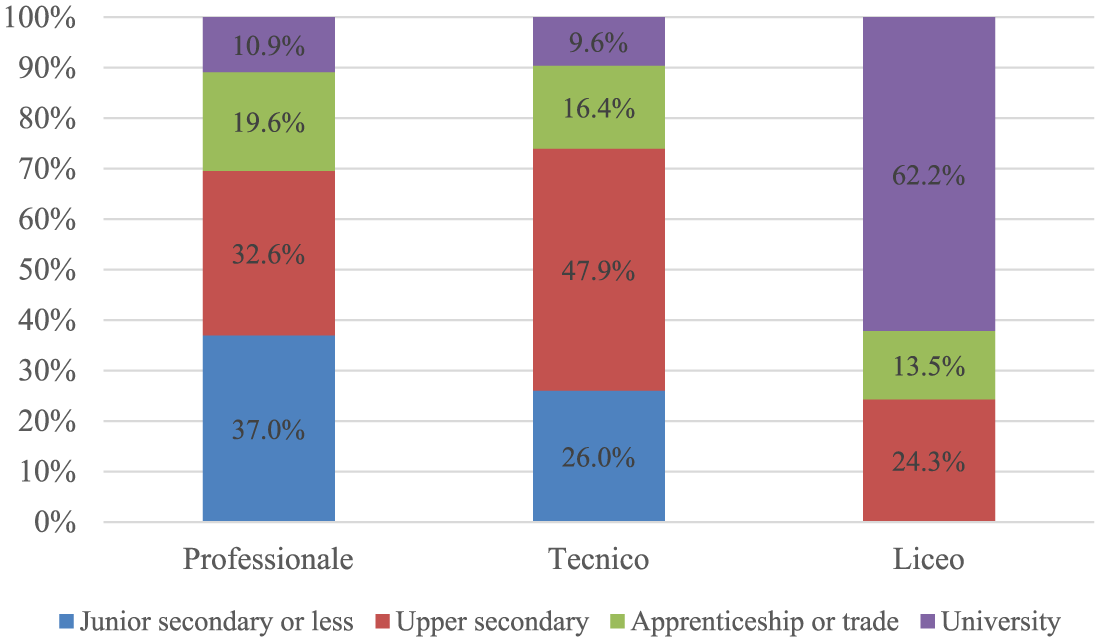
Education levels of parents, by school.
This confirms previous findings linking the socio-economic status of students and track selection in Italy and, indeed, elsewhere in the world. It also suggests that the dichotomy of university-preparatory schooling and vocational schooling (as opposed to a hierarchy of multiple school types) may be a more useful tool of analysis, as suggested by Contini and Scagni (2011) and Erikson et al. (2005), than the hierarchy implicit in the tripartite structure of Italian upper secondary schooling. In particular, it confirms the specific link between university-educated parents and enrolment in a university-preparatory track. In other words, it does not show a graduated rise in enrolments in a hierarchy of schools associated with a graduated rise in social status. The important role of the Istituto Tecnico in providing Italian industry with highly skilled technicians and its consequent status in the institutional hierarchy of upper secondary schools in Italy have been recognised (Istituto Toniolo, 2013) relative to the role of the Istituto Professionale. However, the social composition of the two schools examined in this study was not found to differ greatly. Each displayed a significantly different social composition to the Liceo. This is supported by previous studies such as Fini’s (2007), which also reported evidence of the dichotomous nature of track selection in Italian schools.
Aspirations were also very different in the different schools (see Figure 2). Virtually all the students in the Liceo aspired to go to university, compared with only half of those in the Tecnico and a little over one-third of those in the Professionale. Only one respondent in the Liceo (1.4%) expressed a desire to begin work directly after completing school, compared with 42.4% of those in the Tecnico and 63.9% of those in the Professionale. Although there are some differences between the Tecnico and the Professionale, these results once again suggest a dichotomous relationship between the different types of upper secondary school, with the results from the Liceo standing in stark contrast to those from the two vocational schools (Istituto Professionale and Istituto Tecnico).
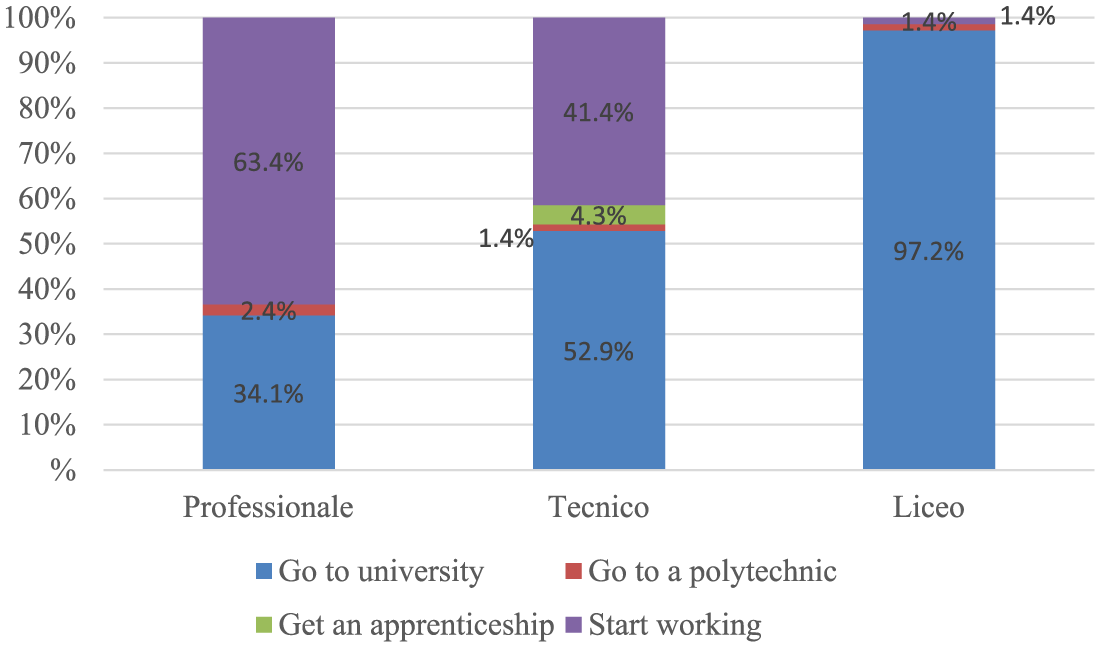
Students’ post-school aspirations, by school.
Very low numbers of students selected the other two available responses to this question, namely obtaining an apprenticeship and entering a polytechnic. This reflects the relatively minor role that formal apprenticeship training plays in the Italian labour market (and its vocational training institutions) and the relatively undifferentiated nature of the Italian higher education sector, which is almost uniformly made up of traditional university providers.
Students’ attitudes to their school also varied and once again the greatest differences were observed as between the Liceo and the other two schools (see Figure 3). Overall, the students in the Liceo were most likely (48.0%) to select an unambiguously positive image to describe their school (a happy family, a home away from home or a beehive of activity), compared with those in the Tecnico (16.4%) and those in the Professionale (14.7%).
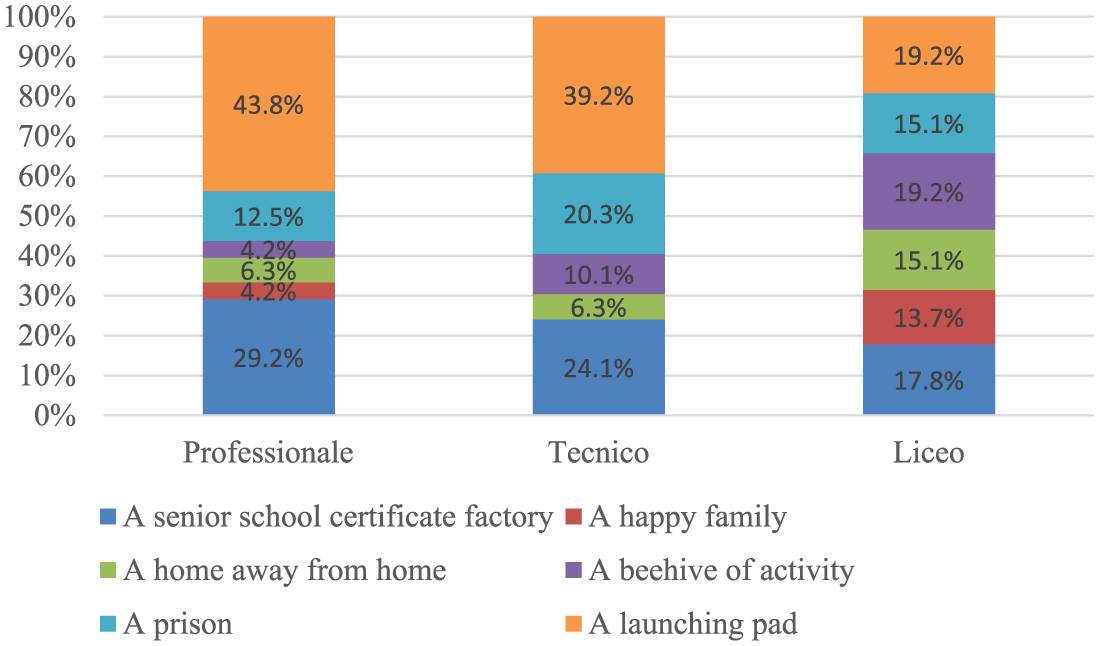
Students image of their school, by school.
By comparison, the students in the two vocational schools were more likely to select senior secondary certificate factory or a launching pad than were the students in the Liceo. This suggests a more instrumental understanding of the role of their school in providing experiences and supports quite separate from those of the home (rather than seeing school as a ‘happy family’ or ‘home away from home’ as in the Liceo). This pattern may also reflect students’ accommodation of the status hierarchy of the different types of school. The final and most negative image – a prison – did not show a strong social pattern. It was selected by 12.5% of respondents in the Professionale, 20.3% of respondents in the Tecnico and 15.1% of respondents in the Liceo.
Finally, this article considers the results of an analysis of students’ views of their parents and their schools, broken out by school (see Table 1). We begin by noting that there are few statistically significant school-related differences in the views of the students on most of the items. The one exception is for the statement ‘I would rather be working than at school’ (see Figure 4), where students in the Professionale and in the Tecnico were the two most likely groups to agree with the statement that they would rather be working than at school (55.4% in the Professionale and 46.6% in the Tecnico), compared with a much lower proportion of respondents in the Liceo (12.3%). Even here, the strong dichotomy between the Liceo and the other school types emerges.
Student views of school and family (agree or strongly agree).
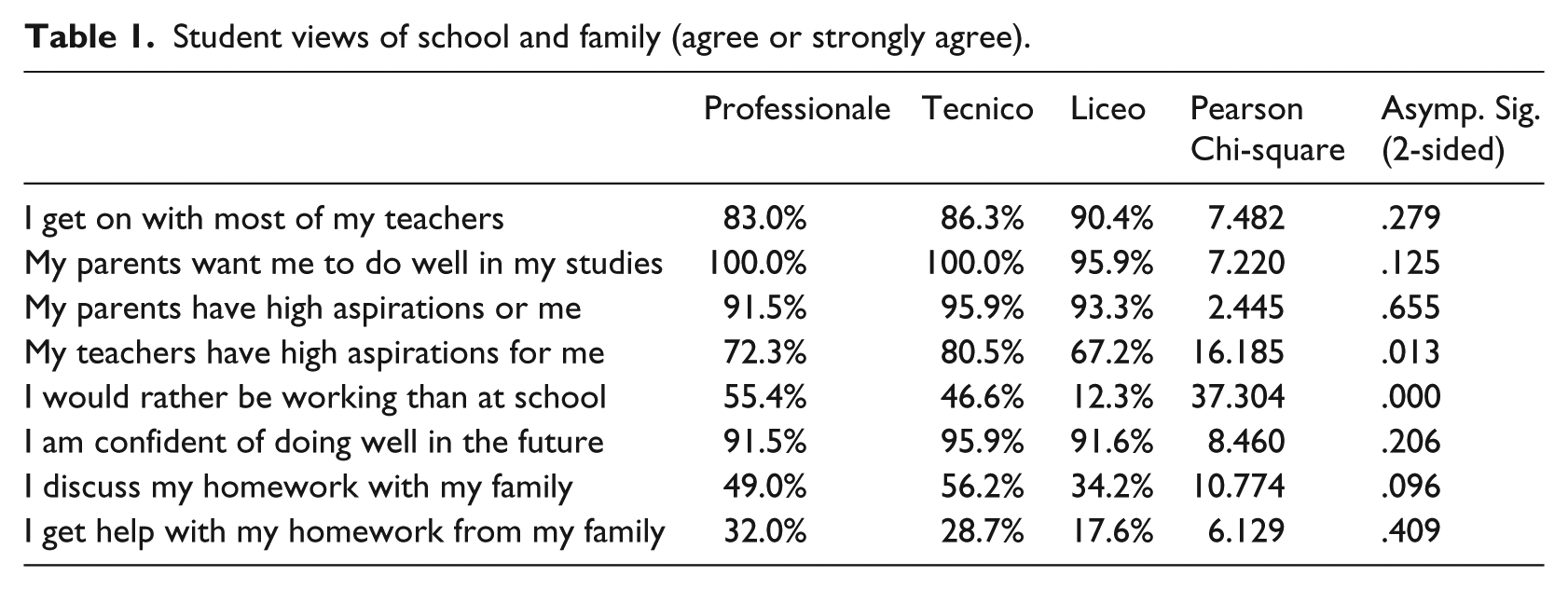
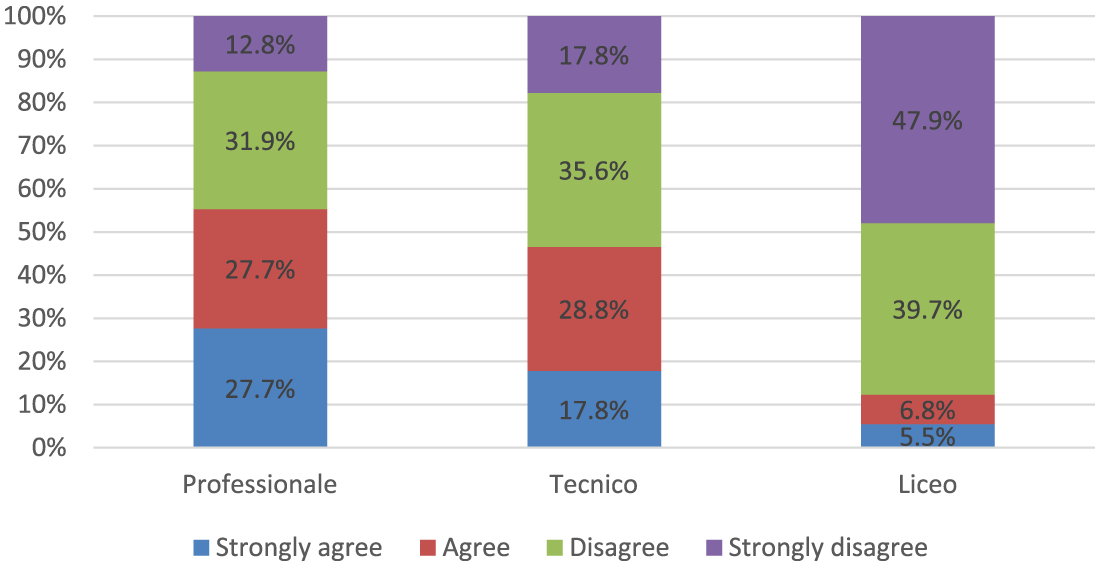
‘I would rather be working than at school’, by school.
However, closer analysis of these results shows some interesting patterns. To begin, all the students report strong levels of family support and confidence regarding their future, regardless of their school type. On the item ‘My parents want me to do well in my studies’, support is actually stronger amongst the students in Tecnico and Professionale, and the highest levels of support for this statement (strongly agree) were chosen by 63.8% of students at Professionale and 69.9% of students at Tecnico, compared with 55.4% of students at Liceo. If the vocational schools (Professionale and Tecnico) are combined as a single entity (vocational), the cross-tabulation of Liceo against vocational shows a statistically significant difference in the results (Pearson chi-square value of 6.762, significant at .034). Similarly, students in the Professionale and in the Tecnico were more likely to agree with the proposition ‘I discuss my homework with my family’ than were students in the Liceo. Again, if the Liceo and the vocational students are analysed dichotomously, the differences become statistically significant (Pearson chi-square value of 7.984, significant at .046). It might be noted that the students in the university-preparatory Liceo are also the least likely of the three groups to report that they obtain help with their homework from their family, although the results are not statistically significant.
If, as some of the research suggests, the level of family support, encouragement and expectation is the primary factor explaining students’ aspirations and track selection (e.g. Ferguson, 2007; Heckmann, 2011), then it might be expected that responses would differ across the three types of schools. Such an analysis would suggest that students from the two vocational school sites might be expected to report lower levels of parental support and confidence than those in the university-preparatory Liceo.
It may be that the responses to the survey reflect different expectations of the level of support parents should offer rather than the actual level of support and encouragement provided. However, the differences in the students’ perceptions are significant. Nussbaum (2000) and Sen (2009) describe how the experience of disadvantage can shape an individual’s sense of what someone in their position can reasonably expect in terms of opportunities, resources and support, a phenomenon described as adaptive preference formation. The findings of this study suggest that the aspirations of young people from lower socio-economic status backgrounds in the two vocational schools are not being curtailed by a lack of interest or lack of encouragement from their families, relative to those of students in the university-preparatory school.
This is not to underestimate the role of the family in providing students with the cultural capital required to succeed in education. Rather, we would suggest that focusing exclusively or too heavily on the family can obscure the role of the schools. Instead of examining what the family does not and perhaps cannot provide, we need to consider what the school does not provide and seemingly is not expected to provide. More specifically, it is critical to understand and actively counter the ways in which education systems entrench privilege and normalise the replication of disadvantage across generations. Schools should legitimately be expected to help expand the real (as opposed to formal) opportunities available to young people from disadvantaged backgrounds.
Discussion
The data lead us to suggest the emergence of two main sets of findings relating to these three schools. First, they suggest a strong relationship between the levels of the students’ family education, their school type and their university aspirations, and that this relationship takes the form of a marked dichotomy between the Liceo and the other two vocational school types. This is supported by earlier research and points to the almost seamless alignment between the academic and cultural values and aspirations of university-educated parents and the academic and cultural values and aspirations apparent in the university-preparatory track, as manifested in the Liceo. It confirms what we know from the international literature in general and the Italian literature specifically about the role of schools in the reproduction of social status from one generation to the next.
Second, they suggest that the students in the two lower socio-economic status vocational schools receive no less support at home than their higher socio-economic status peers in the Liceo. Based on this admittedly small sample of upper secondary school students, one might argue that there is strong support from the family for all students, regardless of their school, as shown by the reported willingness of all parents to help their children with their homework and the willingness of the students to discuss their homework with their parents (the latter statement receiving more support among the students in the two vocational schools). Similarly, virtually all the respondents reported that their parents had high aspirations for them and wanted them to do well in their studies (the latter statement again gaining even stronger support from the students in the two vocational schools).
Why then are the students in the vocational schools less likely to aspire to university? Our small sample size does not allow us to answer this empirically, but rather points to the need for further research. It does, however, point to concepts arising from the theories in this field. To analyse these phenomena further, we return to the four types of explanations presented earlier in this paper, acknowledging that they provide only a starting point for understanding what is happening in this small selection of schools in Italy. To begin, we could assume that students from lower socio-economic status backgrounds have lower aspirations (the first type of explanation) or that they opt for a lower track on the basis of a rational assessment of their longer-term prospects (the second type). The danger here is that both types of explanations can be deployed in ways that normalise structural inequalities, locating responsibility for unequal outcomes with the individual or the family. These types of arguments may also provide comfort for those of us who are more privileged because it allows us to attribute our success to ability and hard work, which Sandel (2017) describes as meritocratic hubris. The third type, focusing on structural factors, relegates the role of school to a mechanism serving the needs of capitalist society, not acknowledging its potential for agency or interrogating what it might actively do to address inequality.
There is, however, the potential for these observations about the effect of disadvantage to provoke a very different response. Understanding the ways in which disadvantage restricts aspirations and/or the capacity to realise those opportunities makes addressing the impact of disadvantage an urgent and compelling priority. The idea that a young person’s aspirations can be expanded in such a way is consistent with the fourth type of explanation. It also helps us to explain why the aspirations for university amongst the students attending the lower track schools are not entirely extinguished. This focuses attention on the social and financial resources needed to make opportunities meaningful. Relevant factors include the structure of the education system, the curriculum and the pedagogies associated with it and the school culture, including the extent to which this culture aligns with the manners and behaviours of the more privileged groups. These are fertile sites for reform and action, showing the potential to inspire and motivate students, as we see amongst the minority in our sample who are from the Istituto Professionale and Istituto Tecnico and yet still aspire to enter university. Longer-term opportunities and outcomes are also shaped by the labour market, especially by the availability of high-quality jobs and inequalities in the distribution of different types of work (Sayer, 2012). The level of inequality within the society is another important factor impacting on a broad range of factors (e.g. see Wilkinson and Pickett, 2009). We are not arguing that a university pathway is the only one that should be valued but that socio-economic status should not determine who accesses that option.
These findings suggest that the source of this misalignment may just as likely be located in the school as in the family. If we consider the nature of the curriculum in the different types of Italian schools, this becomes somewhat clearer. While all types of upper secondary school mandate the teaching of Italian, English, history, mathematics and science, the Liceo is differentiated by its inclusion of Latin among its mandatory subjects. In the case of the Liceo Classico (the humanities Liceo), Ancient Greek is also required. These are the kinds of subjects that place the highest cultural and academic demands on the students and that seem to be the most sensitive to the educational background of the students’ parents (e.g. see Teese, 1998).
We would also point to the role played by track selection at the age of 14 in Italy, somewhat later than European systems such as the German, Dutch and Austrian, but earlier than those of the Scandinavian nations. Ringer (2000), Whitty (2001) and others question the efficacy of tracked systems on the basis of their detrimental, socially selective and excluding effects. We note that McGaw (2004) not only identified early streaming in European systems as contributing to social selection but also to lower levels of educational performance overall.
Conclusion
This case study of three specialist upper secondary schools in northern Italy found social differences in enrolments and aspirations. While our study is based on a small sample of schools in a relatively homogeneous and wealthy city in northern Italy, we have noted that our findings regarding the strong influence of socio-economic status on educational trajectories and on the types of transitions made from education into employment are not dissimilar from those found in previous research investigating socio-economic status and educational outcomes. They confirm the careful analytical and theoretical work of researchers such as Benadusi (2007) who have noted the links between socio-economic status and educational outcomes and who have focused on the role of family cultural capital, student aspirations and the relationship between them.
We would suggest, however, that what is more contentious is how this relationship should be understood. Our study suggests that youth trajectories through education are not necessarily linked (or not predominantly linked) to perceived levels of family support. The students in the lower socio-economic status vocational schools indicated clearly that they received no less support than their higher socio-economic status peers in the Liceo. While this cannot be confirmed in this small study, the views expressed by students regarding support received from their parents, viewed through the theoretical lens described above, suggest a locus of policy action focused on the school deserves investigation.
Italy’s system of tracked secondary schools, while it shows a high level of differentiation compared with many other international systems, is not unusual in the European context. Most European continental secondary school systems show high levels of curricular and social segregation and even in the systems of the United Kingdom there is significant, if less formal and obvious, differentiation between the many providers operating in the post-compulsory environment, including sixth form colleges, FE colleges, a range of comprehensive providers and both public and private institutions.
For this reason, the ways in which our study suggests that pathways and aspirations may be conceptualised across a segregated and differentiated range of schools points to some common issues across nations. Understanding different pathways and different aspirations as inevitable characteristics of disadvantage or as the result of a rational assessment of prospects individualises the problem, naturalises inequality and reduces the imperative to take action to redress it. Our study suggests a more realistic view of these differences might be to acknowledge the intersection between the individual and the structural factors. We also suggest that it is important to take account of the social, cultural and financial resources that expand or contract meaningful opportunities and affect the possibility that those opportunities may be realised. This is not just an intellectual exercise. The way aspirations and outcomes are theorised can have a tangible impact on policy – on the policy objective, on the necessity for action and on the most effective point of intervention.
Footnotes
Acknowledgements
The authors wish to thank Professor Massimiliano Costa and Professor Umberto Margiotta of Università Ca’ Foscari, and the head teachers and staff of the participating schools, for their input into the survey instruments and their facilitation of the fieldwork.
Declaration of conflicting interest
The author(s) declared no potential conflicts of interest with respect to the research, authorship, and/or publication of this article.
Funding
The author(s) received no financial support for the research, authorship, and/or publication of this article.