



Abstract
The right to education is crucial for solving gender inequalities in developing countries. Set against the backdrop of persistent gender disparities starting from primary education level in Pakistan, using capability approach, this article analyses gender inequalities in education in the Punjab province through the effectiveness of the Girls’ Stipend Programme (GSP) on girls’ educational opportunities using a mixed methods approach. The GSP, aims to increase female enrolment in public schools, and targets families from lower socio-economic backgrounds. The findings show that the GSP has led to short-term impact on girls’ increased enrolment in middle schools, although issues of access to education such as physical safety, transition to secondary schools and the quality of schooling needed attention. The parental aspirations for girls’ education is high particularly among mothers from lower economic backgrounds and main driver for female education but the larger question of the instrumental role of education in transforming gender inequalities is still pertinent.
Keywords
Introduction
The relationship between economic growth and development has been explored in a number of studies (Schultz, 1961; Lucas, 1988; Barro, 1991, 2013; Mankiw et al., 1992; Todaro and Smith, 2015; Hanif and Arshed, 2016; Arshed et al., 2019). It has been suggested that developing countries should implement polices and invest in programmes that increase educational attainment (Becker, 1995; Hanushek and Kimko, 2000; United Nations Development Programme (UNDP), 2010; World Bank, 2011; Hanushek and Woessmann, 2015; Hossain and Hickey, 2019). Several countries, including Pakistan, have implemented Conditional Cash Transfer (CCT) programmes, which offer cash to poor families conditioned upon satisfying certain behavioural changes in order to address the intra-household spread of poverty and inequalities in human capital investment (Chaudhry and Parajuli, 2010; Sugiyama, 2011; Millán et al., 2019; Ascher, 2020).
Female education is explicitly linked to development outcomes and is seen as critical to inter-generational knowledge transfer, gender equality and social change (Subrahmanian, 2007; Somani, 2017; Wodon et al., 2018; Kopnina, 2020). Women’s access to, and participation in, education has been positively correlated with, among other things, improved child wellbeing, lower birth rates and lower maternal mortality rates (Gakidou et al., 2010; Miller et al., 2017). Nonetheless, despite increasing numbers of girls enrolling in school in the last decade, some 62 million girls worldwide were still denied the right to primary or secondary education [The United Nations Educational, Scientific and Cultural Organization (UNESCO, 2015)]. In Pakistan, 5 million children do not attend primary school, out of which 62% of them are girls (Human Rights Watch, 2018). According to the economic survey of 2014–15, the literacy rate in Pakistan is 58% for males and 47% for females (Pakistan Bureau of Statistics, 2016). Pakistani boys receive on average twice as much schooling (5 years) compared to Pakistani girls, who receive on average 2.5 years of schooling (Latif, 2009). Many factors contribute towards gendered inequalities in education in Pakistan that compounds girls’ disadvantages in education (Malik and Courtney, 2011). These include financial pressures, preferences given to sons over daughters in education (Qureshi, 2004; Myers and Harvey, 2011; Muhammad and Sharif, 2018), infrastructure issues within the educational system (lack of basic facilities such as buildings, drinking water, electricity, toilets and furniture), geographical issues, physical distance between home to school, and wider social barriers in the environment including pervasive sexual violence towards women and girls embedded in wider class and gender dynamics (Agarwal et al., 2020; Javeed, 2020). In the Punjab province of Pakistan, many families must choose between saving for their daughters’ dowries or paying for their education Global Campaign for Education [(GCE), 2005)], leading to dropout from school in the period before marriage.
Conflict and religious ideologies also affect girls’ chances of schooling. The bombing of girls’ schools as well as the targeting of girls and teachers by militant Islamist groups blocked millions of girls’ access to school (King and Winthrop, 2015). Girls’ right to schooling is compromised by the low value attached to their education, but this is reinforced through social practices, political contexts and gendered ideologies.
Girls’ rights to schooling: applying the rights framework
Capability approach was pioneered by the Indian economist Amartya Sen during 1980s and the concept of capability was first mentioned in his Tanner Lectures on Equality of What? (Sen, 1979). It is used to argue that inequality can be best addressed through the idea of capabilities (Nussbaum, 2000; Roche, 2009; Orchard and Yopo, 2018; Hart, 2019). Capability is defined as a substantive freedom with value in and of itself, beyond instrumental or cultural expectations, emphasising the importance of both the economic and non-economic inputs that can determine and describe appropriate people’s functioning, that is various states of human beings and activities that a person has achieved, and capability which refers to the opportunity they have to achieve them (Rai, 2002; Orchard and Yopo, 2018).
The central question in the capability approach is not just how satisfied a woman is with what she does but the opportunities and liberties she has; it is not just a matter of resources but how the available resources work to enable women to function. For instance, in the case of nourishment, it is the nutritional level of an individual that matters and not just the supply of food or the utility of eating (Nussbaum, 1999). From a capability perspective, gender inequality in education is not simply about lack of access but represents the deprivation of capabilities by limiting and restricting the agency of female students and denying them recognition and respect (Molla and Gale, 2015). Education then is seen as a capability for life beyond educational institutions (Loots and Walker, 2015).
Girls’ educational rights in developing contexts.
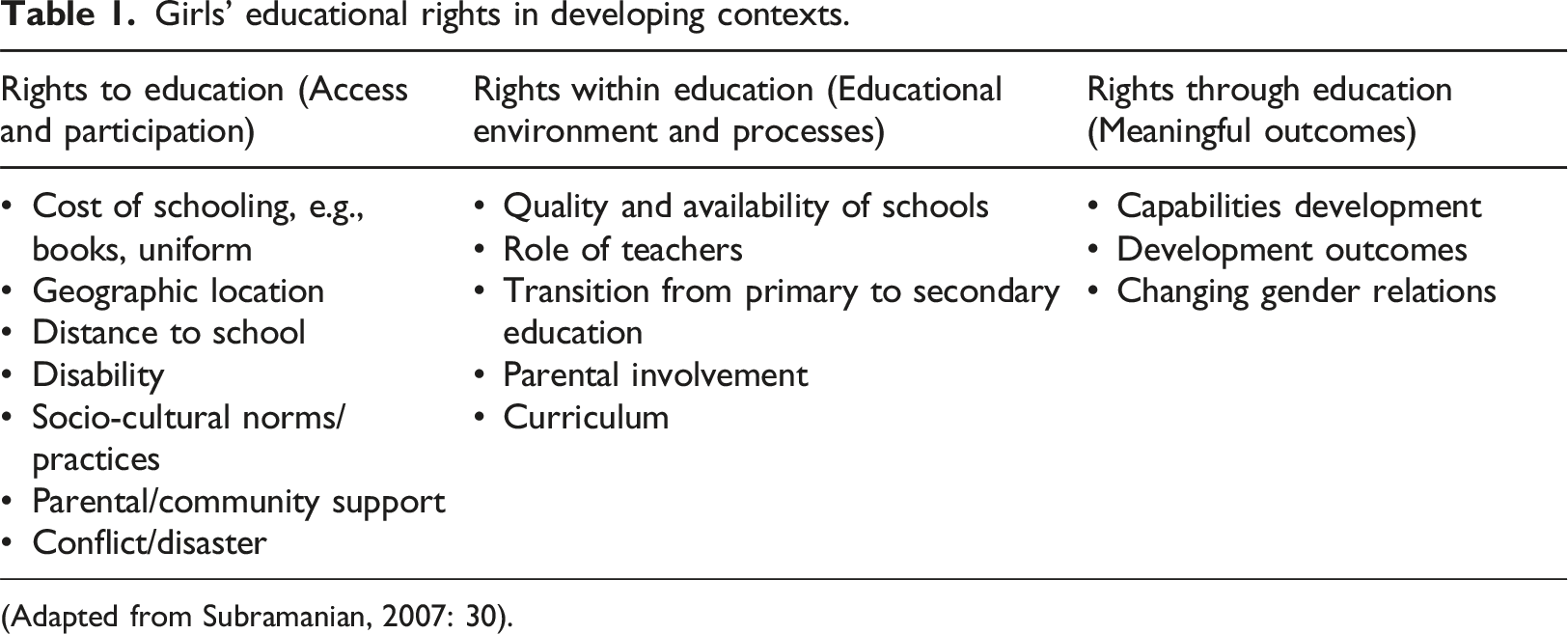
(Adapted from Subramanian, 2007: 30).
The foremost issue that comes as a right to education is access to an educational institution. In developing regions such as sub-Saharan African and South Asian countries, access to education is unevenly distributed and is influenced by various intersecting differences such as poverty, gender, location and matters of social status such as caste and prestige. The direct and indirect costs of schooling is the main factor hindering access to school (GCE, 2005), suggesting there is a strong relationship between household income and access to education, as income strongly influences decisions about children’s enrolment, retention and progression in school. While this effect has generally decreased at the primary level in many countries, it still has differential effects on the poor, particularly at higher educational levels (Lewin, 2007; Ilie et al., 2021).
Geographical disadvantage is further exacerbated by poverty and gender. The rural/urban differences are striking where secondary education provision is concentrated in urban areas (Lewin, 2007; UNESCO, 2014). In Balochistan in southwestern Pakistan, only around a quarter of girls from poor households achieve basic numeracy skills. Long distances to school pose a further obstacle to girls’ access in most developing countries. Parents are often reluctant to let their daughters walk long distances for their safety and security (GCE, 2005; Mughal et al., 2019). In Pakistan, concerns about girls’ safety and observance of the cultural norm of purdah (seclusion) 1 imposes a distance penalty on girls (Andrabi et al., 2007 as cited in Qureshi, 2018). Purdah norms in rural Pakistan restrict female mobility outside of the house, particularly when girls reach puberty. If girls are not accompanied to school, this can damage a girl’s reputation or honour and that of her family, with potentially dire consequences for young women. Therefore, girls either walk to school with friends or are accompanied by a household member, which can be hard to maintain over extended periods (Qureshi, 2018).
Realising the right to education alone is insufficient, however, if what is offered is of poor quality. The global shift in focus from an emphasis on access, to an emphasis on quality, has provided the impetus to look at the school environment and the role it plays in outcomes (Cameron, 2011; Wang and Degol, 2016). Schools are also sites in which dominant social and cultural norms and attendant inequalities are transferred, with particular consequences for girls and students from disadvantaged backgrounds (Ames, 2012; Domina et al., 2017). In many cases, the non-availability of flexible schooling leads girls to attend Koranic (religious) schools (Andrabi et al., 2005; Cockcroft et al., 2009; Moyi, 2012).
The contribution of parental involvement in children’s education in Pakistan has received greater attention in recent years and is being formally addressed in many national and international policies (Parveen et al., 2016; Pasha et al., 2021). Parents who have some formal education tend to participate more in home-school cooperation than parents with little or no education. Parents from working-class backgrounds are more likely to withdraw from active involvement in their children’s education, making teachers solely responsible (Andrabi et al., 2012; Abid et al., 2021). Positive parental attitudes towards education can play an important role shaping their daughters’ educational choices (Iqbal et al., 2013), but also in helping to challenge entrenched attitudes and reduce social and gender inequalities (Vryonides, 2007). Parental involvement is also central to educational attainment and outcomes.
Girls stipend programme in Pakistan
The Punjab Education Sector Reform Programme (PESRP) was launched in 2003, funded by the World Bank and the UK Department for International Development. To increase access to schools and demand for girls’ education in poor families, a targeted educational expenditure, the Girls’ Stipend Programme (GSP) was launched in 2004 by the government. The main objective was to improve enrolment in 4621 middle and 2990 secondary schools for girls in the public sector by addressing the constraints of affordability and distance (see PESRP website). The stipend [a cash transfer of 600 Pakistani Rupees (PKR)] 2 is distributed every 3 months to households with girls in Grades 6–8. This is active in 16 districts with low female literacy levels, on the condition of meeting the criterion of 80% school attendance. In 2006, it was extended to high-school girls and the amount was increased to PKR 900 quarterly. 3
The first impact evaluation of programme was conducted in 2006 by the State Bank of Pakistan (SBP). This study evaluated the impact of PESRP on primary rate enrolment and found significant improvement the gross and net primary enrolment rates in Punjab provinces (SBP, 2006). The second impact study by Chaudhury and Parajuli (2006) conducted on behalf of the World Bank found a direct impact on enrolment rates for girls. The third evaluation was conducted by Chaudhury and Parajuli (2010) who noted an effect in terms of increased female enrolment in state schools. The stipend programme increased female enrolment in public schools in Punjab province. The number of females enrolled in grades 6–8, on average increased by 9–23 percentage points, and an average treatment effect on proportion of school attendance for 10–14-year-old girls ranging from 10 to 13 percentage points (Chaudhury and Parajuli 2010: 3582).
Studies on evaluating the impact of the GSP on the educational outcomes of adolescent girls show some positive influence on the girls’ progression through, and completion of middle school, with additional short-term impacts in terms of increased enrolment across different grades in middle school, and an increased likelihood of transitioning to high school and completing at least one high-school grade (World Bank, 2011; Masood, 2015). The World Bank’s study also found that the programme appeared to divert boys to private schools at the primary level. This is because ‘the share of these schools is growing, they are affordable (relative to the value of the stipend), and they are of higher quality relative to public schools’ (World Bank, 2011, Xii).
Research aims
Using a rights-based approach to education, this article focusses on the GSP Programme in Pakistan that aims to improve school enrolment of girls from lower economic backgrounds. The impact evaluation studies of CCTs and GSPs have not addressed the instrumental role of education in transforming gender inequalities and enhancing the capabilities of girls or the role of parental perceptions and aspirations in girls’ education (De la Brière and Rawlings, 2006; Lewis and Lockheed, 2006; World Bank, 2011; King and Winthrop, 2015). Moreover, girls’ dropout from the secondary level of schooling, even with the availability of the stipend, has received scant attention in the research on the impact of CCTs. The aims of this study are to contribute to this body of knowledge through research conducted in the Punjab province of Pakistan and to explore the ways in which educational opportunities provide an opening for enhancing human capabilities and challenge subordinate gender relations.
Methods
This study used a mixed method design to gain a thorough understanding of gender inequalities in education in the Punjab province, combining patterned regularity with contextual complexity (Teddlie and Tashakkori, 2009; Cohen et al., 2018). Primary data collection took place in three districts from amongst 16 targeted districts for GSP disbursement having low literacy rates: Kasur, Okara and Rahim Yar Khan (RYK) in 2013, 2014 and 2015. According to Pakistan Social and Living Standards Measurement Survey (PSLM) 2013 and 2015, the literacy rate for Kasur is 54%, for Okara 55% and for RYK 45%. The level of development in the chosen districts differed greatly from the provincial metropolis (Lahore), for instance the extent of urbanisation, living standard, communication and transportation facilities and the provision of electricity.
A survey was used first to gain an understanding of parents’ perceptions of girls’ education and to evaluate the impact of the GSP on social attitudes. The survey had five sections: section A covered socio-demographic characteristics of the sample, whilst section B asked questions about dropouts, reasons for dropouts and its impact. Section C explored parental perceptions on female education (its purpose, values and outcomes), their preferences in terms of educating their son or a daughter, traditional gender roles and the allocation of economic resources, with choices for saving for marriage, dowry payments or spending on their education, views regarding girls’ early marriage and their daughters joining the labour market. Section D sought parental views on the quality of public schools (infrastructure, curriculum and parent–teacher interaction), disbursement of the GSP and its impact on girls’ enrolment, retention and transition. Finally, Section E asked questions about parental and community involvement in girls’ education, political support, impact of fundamentalism and terrorism on girls’ education. Although this article focuses largely on qualitative insights, the survey broadened our understanding of the topic and the lived experiences of parents, to share all the findings of which would require publication of additional articles.
One hundred and twenty parents of girls attending the middle level of school (Grade 8) took part in the survey. A simple random sampling approach was used for the survey, and the sampling frame was the attendance registers of female students in the selected districts. Households were contacted with the help of the local school administration. To get information directly from the government offices/sources was a difficult task which was only made possible with the help of key informants. With the assistance of one key informant, we first contacted the project office of GSP called Programme Monitoring and Implementation Unit (PMIU) based at Lahore and obtained the record of schools located in the chosen districts. The key informants were identified due to their position in the provincial public sector ranging from high to middle level of management who also helped in networking. The headteachers helped us in negotiating access, being locals, they already had a strong rapport with the families. They were of great help in convincing and seeking the cooperation of all the participants to take part in the study. The researchers distributed 120 questionnaires, all of which were completed and returned, achieving 100% response rate.
The demographic characteristics of the sample showed that most of the participants had a large household size: 47.5% of the sample had 5 to 7 children, and 7.5% had 8 to 10 children, with all of them receiving the monthly stipend. Out of 120 participants, 60 from Kasur (50% of the sample), 30 from Okara (25%) and 30 from RYK (25%) responded to the survey. Eighty-seven were women (72.5%) while 33 (27.5%) were men. All the participants fell in the age group ranging from 20 to 60 years, with most aged 31–50 years. Around 65% of women and 41% of men were aged 31–40 years while 31% of women and 50% of men were aged 41–50 years.
Next, 15 semi-structured interviews were conducted with public sector officials in the provincial and district education departments using a snowball sampling technique, to seek their views about GSP and its impact on girls’ educational opportunities and gender inequalities, these interviews were not included in the survey. These interviews were conducted in their offices and each interview took about 60–90 minutes. A further 18 semi-structured interviews were conducted with parents who had completed the survey, to track the progress of their daughters from Grade 8 onwards. The interviews focussed on dropouts, parental perception of education, gendered expectations and roles, and quality of public schools. These interviews were conducted in participants’ homes and lasted between 40 and 60 minutes.
Interview schedules and information about the study was provided to participants in Urdu and Punjabi, the two main languages spoken in the area. Permission and written consent were obtained using the appropriate forms, which also gave assurances about confidentiality and anonymity. The researchers explained and read the content of the consent form to uneducated parents. Techniques in descriptive statistics (frequencies and cross-tabulations) and principal components analysis were used to analyse the data. Factor analysis is a technique to reduce large sets of variables to smaller number of themes or factors (Meyers et al., 2017). We used thematic analysis to analyse the interview data.
Findings and discussion
Rights to and within education: household level factors
This section presents findings from the research that relate to the main factors at the household level that can enable or constrain girls’ rights to education (access and participation), rights within education (educational environment), at both middle and secondary level of education, and rights through education (development of capabilities) across the study regions.
Rights to education
Material contexts and schooling experiences
The sample reflected that the majority of households were from lower socio-economic backgrounds (based on their monthly income) in all three regions. This group barely meet the basic needs of their family such as food, shelter, medicine, electricity bills, education etc. 4 The households in our sample were in three categories: ‘very low’ monthly income was categorised as being below 10,000 Pakistani Rupee (PKR) (36.7% of participating households); ‘low’ monthly income was categorised as between 10,000 and 30,000 PKR (55.8% of households in the sample) and ‘lower middle’ income included those with an income between 30,000 and 50,000 PKR (5.8% of households in the sample). A significant number of participants experienced financial hardship. For households with very low and low monthly incomes, the cost of sending children, particularly girls, to school was a substantial burden on their domestic budgets and many struggled to meet some or any of the associated costs. Even the participants from the ‘lower middle’ income group experienced financial constraints in managing the cost of girls’ schooling.
Motivation and aspirations of parents
Financial considerations aside, parental perception of girls’ education did not appear to be a hindrance to their daughters’ right to education, at least at middle and secondary educational levels. The overall perception of education, of both fathers and mothers, was positive and revealed a demand in the families for the girls’ education. Most of the participants expressed a strong desire to educate their daughters at least until secondary level. This very much contradicts Purewal and Hashemi (2015) who found over half of the household heads being in favour of boys’ schooling. Most of the participants, both fathers and mothers, expressed positive attitudes towards education in general and felt that education was not only a central need and basic right but was also a valuable means to an end. For example, a woman (parent) in rural Kasur said: Education is our basic right, and it should be compulsorily given. Nowadays education for everyone is a must and we cannot do anything without education. It is the duty of the government to provide this right to everybody. I do not want any other thing, but I want educational rights for my children.
Girls’ education up to the secondary level was valued by most of the households, and the stipend was seen as having an important role in secondary education and beyond. Nonetheless, those women who had attained a primary or middle level of education showed greater aspirations for their daughters’ education. For example, a woman (parent) in Okara with primary level education said: There is no comparison between an educated and not educated person. If children and particularly girls get an education, they can make their life. I am doing embroidery just for my children and especially for my daughters so that they can lead a comfortable life and should not be denied education. I want them to study as much as they can.
Women with a secondary education or above placed a much higher value on their girls’ schooling. For instance, a woman (parent) in Kasur having secondary education said: I always wished to study more, beyond Higher Secondary School [that is Grade 12 in Pakistan]. I envy those who have studied up to master’s level. I was married early when I was in grade 10. Since then, I always had remorse that because I left and was married so early that I could not appear even in my matriculation
5
examination [equal to GCSE in the UK]. However, my daughters now want to become doctors and they have high aspirations for their future. Moreover, I will try my best to fulfil their dreams even if we are not given any financial incentive.
The fact that the educational level of mothers seems to have an impact on the schooling of their girls supports the case for more public investment in female schooling – the intergenerational effects of such investments will reduce the gender gaps in schooling in multiple ways (Glick and Sahn, 2000). However, in some cases, it was noted that the support for girls’ education was related not only to the education of mothers but to the education of fathers as well. Where male participants had a secondary level of education or above, they were more inclined towards supporting their daughter’s education. For example, a man (parent) in Kasur having secondary education said: I will let my daughter finish her education first then I will think about her dowry. I understand what is better for my daughter that is why I am doing much hard work for my daughter’s education. She can also enter the formal labour market. I will not have any objection.
Thus, the girls’ educational opportunities were strongly linked with their parents’ education. In most contexts, the mothers’ educational level had considerable influence and in some, the fathers’ educational level led to greater support for the girls’ education.
Women in the sample who had no formal education, also acknowledged the value of educating their daughters. These women were aware of an educational deficit in their own lives and the problems this had created or amplified, related to poverty and low social prestige. As one woman (parent) in Kasur said: My father wanted me to study while I never thought about the benefits of education. Now I realise and want to do something for my children as the educated persons earn respect in society... [I] want my children to lead a respectable life.
Another woman (parent) in RYK said: We are uneducated people. There is no tradition of giving education to females in our family. We migrated to Karachi for employment where we saw another world. Then we realised the importance of education. Now I want that my daughters should be educated so that they can survive in this world and make their lives better than mine.
Overwhelmingly, the job of encouraging their daughters into and through education fell on the shoulders of mothers in the sample. Mothers who had a secondary or higher level of education and were living in semi-urban areas of the study region provided a supportive and facilitating environment for their daughters. They helped them with their homework, pushed them to study properly, arranged tuition for them and spared them from household labour to improve their educational outcomes. These mothers also met the teachers of their girls to enquire about their progress. In this way, mothers were making a conscious effort to shape the educational experience of their daughters to be different from their own experience.
One man (parent) in Okara having secondary education bought additional reading materials (for instance children’s magazines) for his daughter. However, this kind of support was not the norm.
Gendered expectations and norms
The section above considered how parental attitudes and attainment impacted on their support for girls’ education. However, the analysis of primary data also revealed how gendered expectations impacted upon the rights to education of girls. Most of the participants felt that the GSP was partially helpful in meeting some of the direct cost-related needs of the girls who were attending school at the time of the fieldwork. The majority of women in the sample engaged in childcare, taking care of the elderly and the sick and managing the household chores as well as doing craftwork (e.g. sewing). The majority of participants expressed their desire that the government should increase the stipend money and extend it to higher education. They also thought that uniforms, stationary items and transport facilities should be provided free of charge for girls, particularly for those at secondary school, as this placed additional extra economic burdens, particularly in households with more than two children. However, such demand was not shown in relation to boys, which suggests that the parents would exercise trade-offs only in respect of girls’ schooling if they had to choose between the schooling of either their son or daughter.
Gendered norms and patriarchal practices such as son-preference, gender role ideology, early marriages of daughters and saving for their dowries led to certain practices (such as removing girls from school) with negative effects on the girls’ futures and the division of work inside and outside of the home. The ideology of preferring sons to daughters was very strong amongst the participants. For example, one woman with a BA,
6
a government employee in Kasur said: I prefer to send my son to school if choice is given because he will be my support in old age. I will not send my daughter only because she will be married and go to her in-laws, which is her real home.
The education of daughters in less-developed areas and amongst the participants belonging to poor socio-economic status was considered as a threat as it challenged the accepted gender order embedded in traditional culture. For instance, a female official in RYK quoted the views of a woman belonging to the ‘lower’ income group who declined to send her daughter to school: If girls are allowed to go to school, they will learn how to write. If they learn how to write then they will write letters to boys, develop illicit relationships and ultimately will elope with some boy thus bringing dishonour to the family... So how can I allow my daughter to go to school and learn all bad things?
The gender norm of preferring sons over daughters was noted in both the semi-urban and rural areas of the study regions and was supported by educated as well and non-educated participants. For instance, a woman (parent) in Kasur having no education said: A daughter should take care of family/home as her proper place is in the home. It does not matter if she is educated or not. She will only be valued if she will do the household chores and take care of family members. Otherwise, she cannot earn respect.
Men also expressed similar views. For instance, one man in Okara having middle education stressed that it is the responsibility of females only to do household chores and take care of family members. Purewal and Hashemi (2015) report similar findings.
The ideology of male offspring preference and allocating women to the reproductive sphere leads to lesser investment in female education, as does having to save for their dowry. The majority of participants reported family constraints as well as community pressures. For instance, a woman (parent) in Kasur having secondary education said: We need to conform with societal expectations. People want an educated girl as well as dowry. Dowry is must. People want to take it. They say what you have given to your daughter- just education, what we will do of her education? We have to give dowry and for this, we have to save on a regular basis.
Participants’ gender, education or geographical location did not influence the existing socio-cultural norms of marrying girls early or finding an equally educated match for them. Rather it was the pressure exerted by the families and biradari (kinship) which was an obstacle to girls’ right to education. One woman (official) in Okara with a BA degree shared how the practice of marrying a daughter within families (kinship marriages) does not consider a girl’s educational level: We are from a landlord family. If our daughter is educated up to masters’ level and there is a boy in the family who has just secondary education but can afford a family, even then we will marry our daughter to him.
Embedded gender norms and socio-cultural practices have further implications for the future productivity of girls, particularly with respect to the labour market. Such perceptions and attitudes suggest that women would have fewer chances to obtain paid work and consequently, fewer opportunities to change their circumstances. For most female participants, their husbands were the decision-making authority in this regard. For example, a woman (parent) in RYK having no education said: My husband does not want his daughter to enter the labour force. He says: it is not right to consume the income of a daughter. However, I want my daughter to do some job and be respectable. If her in-laws allow her, she could do some paid work.
For many in the sample, especially men, the reproductive role of girls was more important than education or work, as one man in RYK having primary education said: ‘girls should not do any kind of job. It is not their responsibility to feed the family. Their proper role is to take care of her parents, husband and children’.
Thus, parental awareness was not the only factor shaping girls’ educational opportunities. The costs and benefits associated with educating a daughter may be different for a family from those associated with a son’s education and the resultant returns from his schooling. A woman in RYK also reported having a fear of local tribal leaders and landlords (waderas) or their agents, who sometimes harassed girls on their way to school.
Rights in education: Facilities and provision
The first factor included the infrastructure and school facilities such as proper buildings, drinking water, separate toilets, overcrowding in the classrooms and availability of female teachers for girl students. The school staff in the study regions were all female. The majority of participants agreed that their daughter’s school had a proper building and a boundary wall. However, some mentioned inadequate space for classrooms and playground for the students, overcrowding in the existing classrooms, the state of cleanliness of the toilets and the availability of drinking water in the girls’ schools. This finding is in line with Agarwal et al. (2020) and Javeed (2020) who found most public schools in developing countries lack basic facilities. The majority of the participants agreed that the teacher of their daughters gave them proper attention and regular parent-teacher meetings were held to discuss the progress of their daughters. Parveen et al. (2016) found similar views and that parents indirectly involve themselves in the teaching-learning process and expect the teachers to educate children in every aspect. The job of meeting with teachers fell overwhelmingly on the shoulders of mothers in the sample. Although the majority of parents were satisfied with the role of teachers and their interaction with the teachers while discussing the progress of their daughters, they also mentioned that their daughters were asked to do errands at school, referencing the practice of cleaning the classrooms by girls before the start of school. Some participants questioned the relevance of the curriculum taught in public schools to the labour market. A woman (parent) with middle school education had this to say: If my daughter only completes her primary education, she can do nothing except washing dishes at rich people's homes [house maid]. If she completes her secondary education, she can do sewing at home. This indicates an opinion that she cannot get paid work and has to resort to sewing at home.
Some participants remained neutral, which indicated that they did not have enough knowledge about the curriculum. This might be due to their own educational level. The participants also expressed their concern regarding the availability of labour market opportunities that were available to the students who graduated from private sector schools. They also expected that the government should provide jobs to their children after the completion of their schooling.
The majority of participants had a middle school for girls near their homes, however, they expressed concerns regarding the distance to high schools (Grade 9–10), higher secondary schools (Grade 11–12) and colleges in their respective areas. The distance to the higher education institutions has potential implications for the girls’ further education beyond the middle level of schooling since parents were reluctant to send their daughters alone to school if it meant travelling a long distance. Participants did not even allow their daughters in middle school to travel alone; some family member accompanied them to school, or they travelled in groups. As already discussed, this was for a range of reasons including concerns over security and family honour, as this woman (parent) went on to say; ‘We have many fears; therefore, girls should not go alone. I still have fears in my heart even if they go in groups. Society is rotten. One should be very careful’.
Purewal and Hashemi (2015: 989) also found this to be the case; ‘the spatial and security dimensions of girls travelling to and from school and sensibilities in maintaining girls’ “respectability” in the public sphere provides another set of rationale for gender bias against girls’ schooling’.
Many participants felt that the government should improve things, either by increasing the value of the stipend or arranging transport to schools. Some participants recommended the upgrading of existing primary or middle schools to secondary schools or colleges so that their daughters would not have to travel long distances for higher education.
Rights through education
Comparing participants’ views by gender and region regarding the education of girls and their bargaining power, we found that the participants in Kasur and Okara believed that education will or can improve the bargaining power of their daughters in families as compared to RYK. The number of women who expressed positive views was greater than men in all three districts. This suggests that women in the sample had an idea, perhaps, of their own limitations in terms of educational disadvantage. These mothers had higher aspirations for their daughters – that they would enjoy a better quality of life and greater decision-making powers in their lives because of participation in education. This echoes Qureshi’s (2012: 219) sentiment that, ‘investing in female education today will not only empower females today but as a positive externality will also lead to gender equity in educational outcomes in the future’.
However, some participants in RYK were neither clear nor convinced about the linkage between education and bargaining power due to low literacy level of the sample. A woman in RYK, married, no education, working on daily wages said: Power? A female has no power… if someone is highly educated; she is considered breaking the rules of the family by expressing her views. She cannot argue… She has to speak very strategically so that no one could get angry. In our society, a female has no place without a family or the support of a male, including our fathers and brothers. To raise our voice means to lose that support… where will we go then?
This reflects the position of women in gendered hierarchies and power relations, through the economic power of males (the male breadwinner concept and male control over property) and the dominance of men in decision-making within the household.
The men in this study were also keen to maintain their dominance. They openly expressed unease at the notion of gender equality or empowering women to participate in decision-making in the household. A man (in RYK, married, middle education and working as a labourer) said: We have Biradari (kinship) system here. If a woman argues with her male head of the household, everyone would come to know. This becomes very insulting and he cannot show his face to anyone in the baradari.
In the three districts, most participants agreed that if their daughter is educated at least up to secondary level, she will gain awareness about her rights. A man (in Kasur, married, secondary education and working as a shopkeeper) said: ‘An educated daughter will try to get her rights herself. What is important is that after education she gets an awareness about what are her rights’. This statement is very much in agreement with Rahman et al., (2018) who state Pakistani society is hierarchical in nature and displays gender differences in power relations between men and women.
A woman (in Okara, primary education, married and self-employed) said: ‘that if a girl is educated, she can make her life…. She will have knowledge about her rights’.
Some participants linked the bargaining power of an educated girl with having some sort of power or autonomy and the ability to participate in decision-making within the family. Here empowerment is seen as relational, as people are empowered or disempowered in relation to one another (Mason, 2003 cited in Murphy-Graham, 2010). This suggests that social norms and intimate family relations influence the complexity and dynamics of empowerment, and disempowerment. Unequal power relations embedded in patriarchal socio-cultural norms, values, practices and traditions constrain women’s empowerment at the micro level, which ‘constrain their capacity to exercise agency in key areas of their lives and relationships’ (Kabeer et al., 2011: 5). Girls were not expected or encouraged to enter the labour market because of their marital obligations, labour market segregation and insufficient labour market opportunities. In some cases, girls were required to take care of siblings and to manage the household when their mothers had to work; in other cases, they assisted their families by working in the informal sector, such as doing embroidery or sewing at home, or working in the fields during the harvest season. This shows the entrenchment of gender role ideology where girls are expected to perform traditional feminine roles.
This study noted a positive impact of older girls’ schooling on the educational outcomes of younger siblings, particularly on younger brothers’ literacy and numeracy. These inter-sibling education externalities were more fruitful in rural areas where the older sisters were among the first family members to acquire schooling as noted by Qureshi (2018). Further, evidence suggests that gender practices can be changed through participation in education, for example, when a girl’s marriage is delayed or put off as a result of continuing education. Those girls who attended middle school (Grades 6–8, age groups 10–14) and completed high school (Grade 10 until the maximum age of 16) fall into this category.
Conclusion
This article has analysed the effectiveness of the GSP in reducing gender inequalities in education in the Punjab province through an exploration of girls’ educational opportunities, using a mixed methods design. We found that the GSP had contributed to improved female enrolment in the study regions, improving parental perceptions of girls’ education, as well as attitudes towards gender equality more generally. The analysis of survey data revealed that most of the participants (both male and female) were aware of the importance of educating their daughters and the aspiration to provide them with schooling at least until middle or secondary school levels. Participants also acknowledged the inter-generational and instrumental benefits of girls’ education and agreed that education would provide an important source of support for their daughters. Most of the survey participants acknowledged that if a woman has enhanced bargaining power as a result of her educational attainment, this will have positive implications for future generations of girls and the inter-generational transmission of welfare. Largely, access to education, particularly until the middle level of schooling, does secure girls’ rights to and within education, through their access to school and participation in education, although their rights through education are still undermined by the gender norms and patriarchal ideologies prevalent in Pakistan.
Although most participants recognised the importance of girls’ education, a substantial number adhered to existing gender norms, patriarchal ideologies and socio-cultural practices. For instance, the ideology of restricting women to the reproductive sphere deprived some girls of formal schooling, pushing them instead into religious schools. Male dominance in household decision-making regarding girls’ future lives contributed towards their educational disadvantage.
Some of the positive aspects of the study related to the emotional and physical involvement of mothers in their daughters’ education. The mothers were not only trying to provide a favourable environment in their homes that allowed girls to attend school but were also managing the educational affairs of their daughters in school, through being actively engaged with teachers. The centrality of mothers to the educational attainment of girls was notable.
The physical quality of schools and distance to the high school was a persistent factor in the quality of education as identified by most of the participants, as well as the public sector officials themselves. Building new high schools at a reasonable distance from the middle schools was not a priority of the provincial government; however, it has serious implications for girls’ education, leading some girls to drop out in Grade 9. The occurrence of permanent dropout of both older boys and girls in the survey sample was noted, although it was higher among girls, for the gender-specific reasons already described. Moreover, the dropout rates from the middle level of schooling were higher in the district of RYK compared to Kasur and Okara. The main reasons were poverty, distance to girls’ middle and secondary schools, safety of girls and lower parental educational levels.
The mushrooming of low-cost private schools, specifically in semi-urban areas, provides a challenge to the public schools in retaining students. In addition, religious schools work as an alternative to modern schooling in preparing girls for their reproductive roles as good wives and mothers (Bradley and Saigol, 2012). Thus, in the field of education, different players/actors are involved in competing for legitimacy, and the private and religious schools in this study were holding high-value cards (Baeck, 2009) and the organisational or institutional capital valued by the parents. The intersection of gender, poverty, culture and location exacerbate gender inequality. Investing in female education may be one step in changing entrenched socio-cultural norms and gender role ideologies and influencing the capabilities of girls and their families in development choices.
Footnotes
Declaration of conflicting interests
The author(s) declared no potential conflicts of interest with respect to the research, authorship, and/or publication of this article.
Funding
The author(s) received no financial support for the research, authorship, and/or publication of this article.
