




Abstract
Based on ethnographic fieldwork in six different types of rural area and their schools in different parts of Sweden, this article identifies how rural schools relate to the local place and discusses some of the educational implications from this. Recurrent references to the local community were present in some schools and people there explicitly positioned themselves in the local rural context and valorised rurality positively in education exchanges, content and interactions, with positive effects on young people’s experiences of participation and inclusion. These factors tended to occur in sparsely populated areas. An emphasis on nature and its value as materially vital in people’s lives was present as was a critique of middle-class metrocentricity. Such values and critique seemed to be absent in other areas, where rurality was instead often represented along the metrocentric lines of a residual space in modernizing societies.
Introduction
The present article has used ethnography to make participant observations in six local neighbourhood schools in rural parts of Sweden. Together with interviews and the collection of local documents it shows three factors in particular that also relate to how rural education is described in other European educational research (e.g. Hargreaves et al., 2009; Michalak, 2009; Poikolainen, 2012; Vigo and Soriano, 2014). These are firstly how rural communities and their schools are very different to each-other and are differently positioned and affected by national education policies (Bagley and Hillyard, 2014). Secondly what the visible effects of this seem to be on schools, education and educational experiences, motivations and behaviour in local communities. Thirdly, what the possible policy implications of this can be for a more generative theory and politics of rural schooling today (Corbett, 2015). Previously contributions to policy have to a degree lacked sufficient nuance due to three limitations that we try to address in this article by employing three different research corrections.
The first correction is one that addresses a key imbalance in rural and urban research on education and youth experiences. It departs from the recognition that although there are many investigations about urban youth and their social involvement and marginalization in education and wider society (Michalak, 2009; Poikolainen, 2012), research on rural youth is scarce and it tends to be conducted from rather urban-centred perspectives and theories (Åberg-Bengtsson, 2009; Author1 and Author3, 2007) due to what Farrugia (2014: 293) describes as an “unacknowledged metrocentricity”. The second addressed imbalance is that, perhaps because of this, notions of rurality and rural education tend to be uniform, abstract and rather simplistic (Bagley and Hillyard, 2014). Within society as it is today, spaces form clearly distinct realities (Lefebvre, 1991; Massey, 1994) and individuals construct their identities in relation to the different possibilities and contexts for inclusion, social participation and agency that these places provide (Trondman, 1995; Vigo and Soriano, 2014; Waara, 2011). Educational politics seem to currently deny rural populations this kind of recognition of the rights and possibilities of active agency (Åberg-Bengtsson, 2009; Hargreaves et al., 2009), with this corresponding to the third point of imbalance we try to address. This is the passivity that is often accorded toward rural spaces and their agents, and the passive object status that is often given to the concept of rurality (Balfour et al., 2008). We agree with Corbett (2015) when he states that rural schools can and should be politically discoursed and expressed in educational policy and practice as places where the complex work that deals with local and specific rural problems is done but that this kind of recognition is not what characterizes present educational policy-making.
In the article we will thus attempt to showcase the different conditions that can characterize rural places and their schools. When doing so we attempt to address what is meant and understood by the concept of rurality in education and rural education policy. We bind these perspectives together with the help of an analytical understanding of space in accordance with Massey (1994) and Lefebvre (1991), and metrocentricity from the work of Farrugia (2014). We identify how education policy works through different rural areas differently and we do battle, like Bagley and Hillyard (2014) and Corbett (2015), against a uniform image of the countryside with roots that are identified from urban research and notions of a problematic, marginalized youth from passive and poor environments who lead deprived lives (Öhrn, 2012). What we identify is far from passivity and deprivation. We recognize instead how place is actively attended to in some respect in every rural school in our research. But it is also attended to differently as the different places provide different possibilities and contexts for addressing the local community from in education, not the least due to the predominant economic conditions and production relations. This is shown in the article when we identify how people in some of the rural schools in the research position themselves explicitly in the local rural context and valorize rurality in education exchanges, content and interactions. There is an emphasis from people in these schools on nature and its resources as materially vital in the lives of rural people in ways that are misunderstood by urban politicians, who then legislate policies based on these misrepresentations that work against the interests of the rural community. What is voiced here is recognition, deconstruction and strong critique of middle-class metrocentricity. These forms of critique appeared in schools in the more sparsely populated areas but they seemed to be absent in other areas, where rurality was instead often represented along metrocentric lines, as a residual space in modernizing societies (Åberg-Bengtsson, 2009; Bagley and Hillyard, 2014; Balfour et al., 2008; Chandler, 1990; Corbett, 2015).
Theory
Theoretically the project draws on materialist spatial geographic theory as represented in the work of Doreen Massey (1994), where space is understood as continuously in process and shaped through socio-spatial and material practices in forms of interaction that both produce and contextualize the relations of production and historical social relations. There is a close connection between space, place and the construction of social relations and spatial identities from this theoretical position (Lefebvre, 1991). As Corbett (2015) has suggested, education is as significant in and to local lives as is labour or production, and as are community and production relations, and experiences and understandings of it are formed in concrete space and time contexts (Balfour et al., 2008).
A certain place at a certain time shows a particular mix of social relations, but the identity of a place is meaningful according to Massey (1994) and Lefebvre (1991) also in the sense of it largely deriving from the specificity of its interactions with spaces outside (Johansson, 2017; Vigo and Soriano, 2014). As Massey (1994) and others, such as Chandler (1990), point out the growth of industrial capitalism saw the massive reorganization of vast areas in (former/then) rural spaces in Europe, and this created pockets of semi- and peri-urban industrialization and settlement in these areas. Yet at the same time other areas were left relatively untouched by industrialization and their settlements remained quite sparse. Thus, the effects on rural areas vary between being centrifugal and centripetal forces; that is, either pushing populations out of a rural area or drawing them in, depending on assumed economic needs and current economic climate (Balfour et al., 2008). Education relations in local communities are formed at least in part in relation to the conditions of economic and cultural production, the convictions of value that agents generate, and the push versus pull forces they may exact.
Rural spaces are depicted as simple but they are in fact complex and multi-layered social constructions in respect to which understandings of local educational needs and possibilities and their manifestation in educational policy and practice are dialectically related (Balfour et al., 2008). This can also be seen through previous research. For instance, research shows youth in marginalized, poor urban areas to describe their neighbourhood in contrast to the more prestigious, wealthy areas (Öhrn, 2012), and there are indications that hegemonic understandings of urban living appear to be vital for the identity constructions made by rural youth (Johansson, 2017; Svensson, 2010) concerning for example understandings about what a good life is, which in turn has implications for young people’s thoughts about their future and chances of social inclusion and influence now and in the future.
Research sites: researched schools and their location
There are many different forms of rurality and to avoid stereotyping rurality as one category, we chose to include sparsely populated areas, tourist municipalities, and small industrial (and “de-industrialized”) communities from different parts of Sweden in our research. These locations each represent an official category in formal definitions of rural places (Sveriges Kommuner och Landsting, 2011). Within them Sweden is currently politically divided into 290 municipalities and 20 counties. One of the main towns in the municipality will be its seat and the site of the municipal offices. The six schools selected for the study were chosen to provide a variation in terms of area, location in the north or south of the country, distance to the municipal seat, and classifications of the local labour market. The characteristics of the schools and their municipalities are shown in Table 1.
Researched schools and their location.
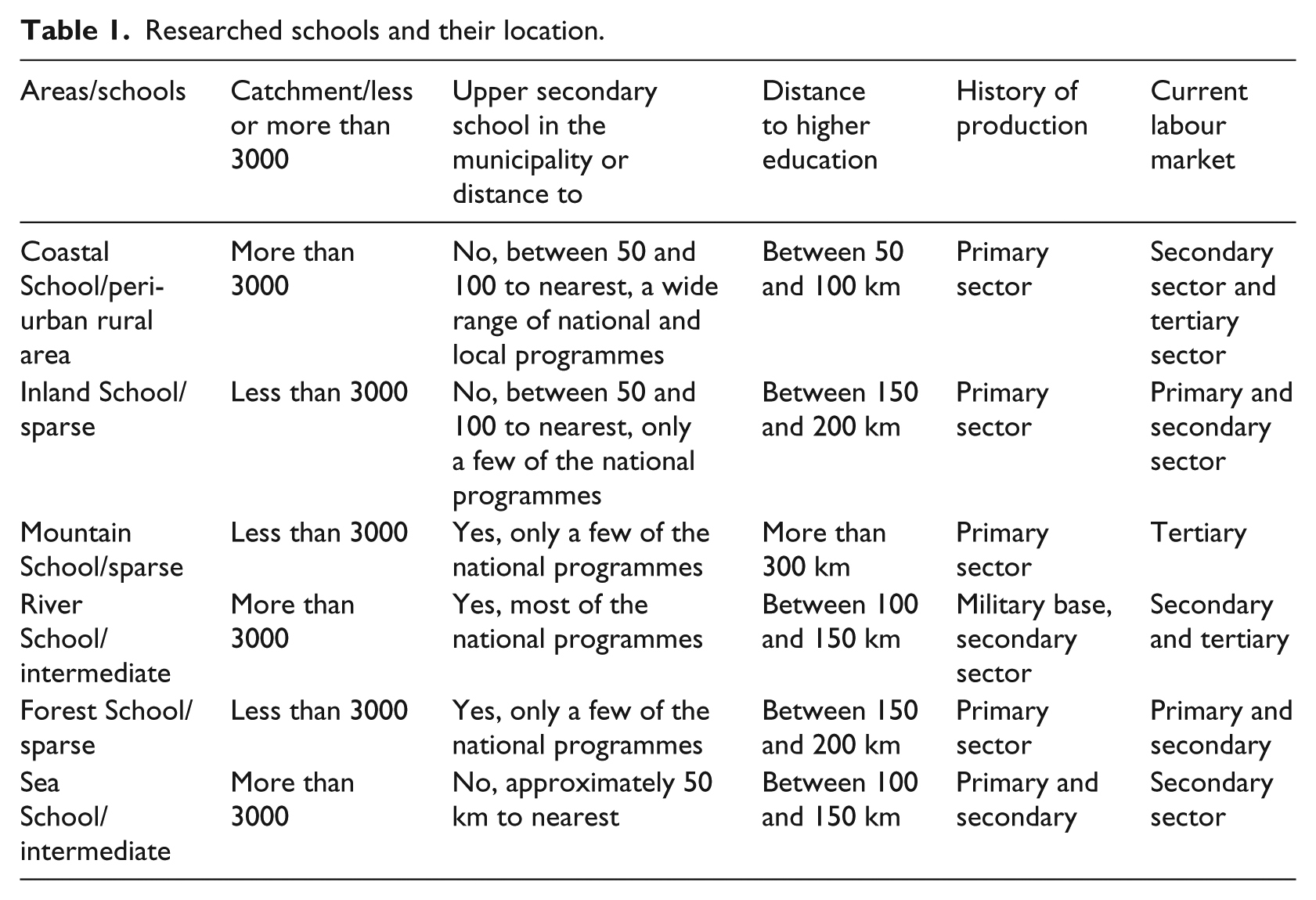
All the researched schools come from one of three broad types of area and all of them except Forest School and River School were the only secondary schools in their municipality. The areas are: (a) intermediate rural areas with diversified employment situated at some distance from urban centres or having some moderate difficulties of access to them and having low- to-medium income levels in primary, secondary and tertiary sectors; (b) peri-urban rural areas with an increasing population and a predominance of employment in the tertiary sector with medium-to-high income levels; and (c) sparsely populated areas with small settlements and lower economic activities that are principally confined to the primary sector and sometimes tourism.
Methodology
The chosen methodology for this research was ethnography. Ethnography focuses on the study of cultural formation and maintenance in particular places through multiple methods for the generation of diverse forms of data based on the direct involvement and long-term engagement of the researcher(s) as the main research instrument. The intention is to provide accounts of how the everyday practices of those engaged in educational processes are implicated in broader social relations and cultural production, and to highlight the agency of educational subjects in these processes. Five weeks of continuous fieldwork was planned for one class from each school (grade 8 or 9) to these ends to be carried out by three individual researchers in 2015–2016, one at each site, with occasional visits from others in the research team (i.e. the five co-authors of the article).
Temporally compressing fieldwork in this way is one of several ways of using research time ethnographically (Jeffrey and Troman, 2004). However, being able to accommodate five consecutive weeks in the field at each site was in the end found to be problematic. Due to other commodified labour at their different workplaces, the three field researchers were not able to accomplish five consecutive weeks of fieldwork and three to five one to two week visits were carried out at each site instead. As Jeffrey and Troman (2004) write this represents an intermittent time mode. It is meant to allow a flexible approach to the frequency of site visits and progressive focusing in relation to the participant observation and general data production. It involves the development and continual evaluation of a characteristic ethnographic spiral of research planning and reflection, data production and analysis, new planning, and further data production and analysis along the lines of the collective ethnography developed by Tuula Gordon and associates (Gordon et al., 2006). It involved the team members doing the following:
Reading each individual researcher’s fieldwork narratives carefully to identify the main concepts and ideas and their possible relationships and general implications.
Checking the relevance of the concepts within the scope of the project.
Identifying patterns in the field terms of the cultural processes that may be evident.
In our collective ethnography each individual project researcher has thus concentrated on her or his designated research site but the investigations are also strongly jointly planned and collective discussions are used as a means to help to develop reflexive interpretations. This is common in multi-sited ethnography and vertical case analysis, where joint discussions and analyses are used to identify tentative themes and questions about the emergent ideas, practices, discourses, tools, and institutional arrangements between and across our various sites over time (Eisenhart, 2017).
Altogether 340 hours of classroom observation were conducted. They focused on presentations of place and on participation, pupil influence, and conflicts in the school, as well as how places and their relations were presented and positioned in the curriculum and interactions. The observations included field conversations but we have also employed formal interviews with pupils (with 136 pupils; 68 boys and 68 girls) and staff at the schools, which were also supplemented by observations in the neighbourhood and some document analyses. By placing emphasis on learning from informants we have been particularly convincing at providing details from interactions inside everyday life contexts and settings.
Analysis and results
In line with our aims and theoretical positioning, whether and how teaching relates to place was inquired into, as was young people’s views of inclusion, fellowship and conflict, and their positioning of the local school and community. The analyses point to considerable differences between the researched schools and the results are organized under a series of thematized subheadings that try to express this. These are: (a) differences when presenting the school: local or national/global relations; (b) the local context and its resources: the material value of nature in education; and (c) urban estrangement as an educational interpellation and a policy dilemma.
Differences when presenting the school: local or national/global relations
One obvious characteristic of education is that the input in the classroom is not only meant to produce knowledge and skills that are specific only to the particular (scholastic) context, they are meant to have value also to what is practiced outside of the classroom and for the future. In addition, an important part of school life also includes the opportunity to experience a range of activities outside of the classroom in extra-curricular activities. Some schools were explicitly connecting to local characteristics and themes in these ways, thus strengthening their relations to the outside world and recognizing values worthy of curriculum inclusion, whereas others seemingly related very little to the local context, choosing either to specialize in scholastic codes only or to valorize global world content rather than local content.
Forest School exhibited tendencies toward weakening boundaries of insulation through the inclusion of local content. It had paintings of the local landscapes and images of local, often historic, social/labour relations on walls and message boards that explicitly positioned the school in the local geography and the community members’ local history. It also had large glass display cases in the hallways with animals, trees and background sceneries from the local area as well as wall decorations with local handicraft, and posters with local sayings and jokes in the local dialect. Wall paintings from pupils from the 1970s were also present.
Coastal School was at the other extreme. It had few visible signs showing a recognition of value of the local neighbourhood. In fact, cultural and physical geographical imagined closeness to parts of the world other than to the local were stressed instead. An example was when a politician during an interview and in a public talk recurrently stressed that the Swedish capital “Stockholm was only an hour away by air”. Another was when an official in the municipality stated that “you can live here and still be part of something bigger” and there were also references to ideal identities as “citizens of the world” and to the advantages for young people of moving away from the area to widen their perspectives and opportunities. References to the global context were used regularly to highlight the local community’s closeness to the wider world: When you look at this (points to the map) you see that we are citizens of the world. That goes for language as well, almost all of us in the world speak English, we are global citizens and we have a global language. Identity today is less connected to where we were born. We travel an incredible amount. It is often cheaper to fly to the Mediterranean than to Stockholm. (Coastal School, 27 January)
The predominant representations from outside the school were from the world beyond the local neighbourhood, but this does not mean representations of the local were totally absent. They were not, but they were different. Whilst Forest School lifted the value of the local positively, in Coastal School the reverse was apparent. The view of the local community was typically one presenting the local community as benefitting from linkages to other places. There were few examples of the value in the local context for global conditions and no forms of interdependence were described where the local community was also actively contributing.
These findings relating to Forest School and Coastal School were also looked at in respect of the data that have been produced at the other sites. What we found was that the differences in the spatially contextualized relations expressed about the local and the global seemed to relate to type of rural area. The schools that positioned themselves in the local neighbourhood through material and social references that valorized local conditions, values, practices and conditions positively, were typically from the more sparsely populated areas (Forest, Inland and Mountain Schools), whilst schools with few or negative references were from intermediate and peri-urban rural communities (Coastal, River and Sea Schools).
The positive representations of the local took place through various poster or other forms of displays and by recurrent references to the local community and its traditions, values, and history. One example came from Mountain School when the history teacher took the class to visit the local museum; another came from Forest School and the present local labour market and the competences it required. Pupils in these schools were regularly given assignments that targeted local values or traditions: A local garage owner visited the pupils to talk about human interactions and communication … to show that you must be able to communicate with tourists who arrive here and need to have their cars fixed. You should actually be able to accept 30 000 people each summer and provide good service and be able to communicate … (Forest School, March 26) The museum pedagogue held a lecture about local events during the Second World War, showed a film of local woman (with a heavy dialect) who was imprisoned in a Nazi camp in Norway, and we walked through the museum to see the local artefacts from the war. (Mountain School, 21 October).
After this we asked some pupils about their visit to the museum. They said that it was interesting and that they knew about some of the individuals presented, and that they got new information that they did not know before. One pupil said that it was especially thrilling that a path she used to take in the mountains had been used by refugees and that some of them had even died there.
There are similar findings found Inland School, where all pupils were to work with various aspects of the local trade and industry by focusing either on the local small industries (tourism, trade, and farming) or working with “The forest”, in relation to different sub-themes such as “The forest and the economy”, “Biodiversity in the forest”, “Cultural environments of the forest”, and “The social values of the forest”. The forest was a compulsory component on the curriculum and the teacher emphasized the importance of highlighting the favourable aspects of local forestry. The pupils also visited a local national park and worked with tasks related to National Parks in several subsequent lessons: As a final written account of the work, the pupils are supposed to write an essay where they discuss why National Parks are important and what makes particular National Parks special […]. They were given a booklet with information about National Parks and …a recently published newspaper article about their local National Park. (Inland School, 14 October)
The unique assets of the local contexts that should be acknowledged not only by the locals, but also more widely were characteristically made into central parts of various assignments at Forest, Inland and Mountain Schools, where it was also common to ask pupils to learn about and highlight what was valuable in the area. In Forest School forestry and associated small industries were highlighted. In Mountain School tourism, culture and local history were highlighted, and in Inland School the region being “unique, biodiverse and rich in natural resources” (teacher) was stressed, along with a notion of the value and challenges of an untamed nature and sustainability.
Local value was seen also in other ways. In home economics in Mountain School for instance the teacher made a point of (the locally accessible) moose meat being a more sustainable meat choice than (the nationally widely bred) cow, pig or chicken, and this theme of the value of local game was repeated also by pupils. In Forest School a special sports event in school ended with a joint banquet with moose meat provided by the local hunters and when the pupils were to observe an animal dissection in biology class, they were provided with a moose head, not a more common pigs head: The teacher continues that the next lesson they will start a new theme in biology. ‘We will dissect a moose head. We will start with the eyes and then continue with the brain.’ The teacher however makes a reservation because she is dependent on the luck of hunters: ‘I have some contacts and hopefully they be able to put a moose down for us’. (Mountain School, 12 November)
The presence of themes of local nature in the sparsely populated areas accords with previous research. Rye (2006: 410) for instance concludes from a review of empirical research that there is a coherent structure of how people conceive of the rural across Europe. He wrote that “Nature/natural seems the most prominent feature of rurality and that rural life is conceived as being more ‘natural’ than life in the cities”. The pupils in our study as also took up this kind of positioning and identity, including interestingly also new arrivals (Author2, 2017).
The local context and its resources: the material value of nature in education
There is a strong joint theme of nature and the good associated with it in the schools in the sparsely populated areas. Rural life is presented as close to nature and natural, and both classroom observations and pupil interviews point to the strong appreciation of nature through tales and poems about access to forests, mountains and rivers, and the feeling of freedom associated with being in nature. Similarl to Stenbacka (2012: 70), there was a common language for expressing aspects of rural living such as peace, quiet, and freedom.
These are also features that figure in the representations of rural in other schools, though less so and less spontaneously in the schools in the peri-urban industrial and de-industrializing areas such as Coastal, River, and Sea Schools. But nature in the sparsely populated areas is also presented as important for material survival. Hunting in particular is referred to in the researched schools as part of rural people’s livelihood, and is frequently put forward by pupils as a prominent activity in local adult society that is also central to their own leisure time preferences: The pupils discuss the benefits of the forest, emphasizing its peace and quietness, the clean air, and the fact that everyone has access to it. They also emphasize… how important hunting is in Sweden… One boy also talks about driving a snowmobile in the forest, saying that the best places to go snowmobiling are in the mountains and that driving snowmobile is less controlled in Sweden than in many other countries. Sports activities to practice in the forest are also mentioned. They include orienteering, horse-riding and running, spending time in the forest with the family and just having a cup of coffee or going fishing. The teacher asks the pupils to elaborate on the meaning of hunting more specifically. One boy answers: It provides food. Another boy answers: It limits the moose population. (Inland School, 9 October)
Nature is presented here as materially, culturally, and socially important. But the economic and social values are also intertwined and the economic value of hunting is recurrently highlighted in relation to people’s often rather modest incomes. The pupils have learnt about the different economic conditions in sparsely populated areas compared to the ones found in other spaces, where commodity forms of labour value proliferate through industrial production (mining, forestry, and wood pulp). Also, the pupils from the peri-urban and intermediate rural areas do not seem to consider the value of the rural in the same material terms as those from sparsely populated areas do. They rather adopt the fetishized economic form of value of nature characteristic for metrocentric politics as identified in Farrugia (2014).
Urban estrangement as an educational interpellation and a policy dilemma
Understandings of the value, materiality, demands, and realities of life in sparsely populated areas and the dependency on, rewards from, and responsibilities toward nature that develop and are communicated in schools are sometimes put in contrast to urban life and its estrangement from nature. An urban inability to understand rural life and to fathom the complexity and potential harshness of it is present in the comments from informants. There is they suggest an inadequate urban relation to and understandings of nature in general and in the capital of Stockholm in particular, whose citizens, and politicians in particular, are regarded as not really having a serious conceptualization of what nature really is.
Urban estrangement is also coupled to an urban romanticizing of nature. For instance, in Forest School there was frequent mention of urban misconceptions of how to handle the growing wolf population in Sweden. Those in power are said to argue for the preservation of wolves and decide accordingly, without knowing about the “reality” of their presence. A comfortable and urban middle class who have never seen a wolf or the damage it causes take a stance on what the acceptable size of the wolf population should be “without understanding the dangers that rural people and domestic animals are subjected to. The double economic value of hunting is also misrepresented. ‘We hunt to get our food and what happens if the wolf takes it all’” (Pupil, Forest School).
Within the common emphasis on rural closeness and dependence on nature in school content in the sparsely populated areas a rather striking difference could be noticed with the schools in the peri-urban and rural intermediary communities. These schools made, as mentioned earlier, far fewer references to the local surroundings and their particular merits and impact, but in addition there were also fewer explicit challenges to the urban norm of for instance restricting hunting and closing small schools in sparsely populated areas. These come only from the sparsely populated rural areas. As one teacher there said, “I am very tired of city life values being taken as a norm and schools being seen as better just because there are more pupils” (Teacher, Mountain School).
Political decisions are clearly understood and communicated as having been steered by a metrocentric ideology, not scientific facts, local experience, or a well-grounded familiarity with rural life and rural spatial variations (Massey, 1994). Indeed, according to Åberg-Bengtsson (2009), scientific research seems to have only been heeded when it was in line with government ideas to globalize and urbanize the curriculum and its value base, or to close rural schools rather than keep them open. This seems to be detrimental to the educational opportunities available to and availed of by local youth in sparsely populated rural areas. If there is an upper secondary school in their local town or at commuting distance, it often has only a limited selection of programmes (Authors 2017). They also have fewer private supplier independent schools to choose from than do pupils in these other areas (Dovemark and Erixon Arreman, 2017; Lundahl, 2011). So even the new education politics of the education quasi-market seems to be failing rural areas, which seems to affect students with shortage in economic, social, and cultural resources more than other (Authors, 2018).
Discussion
Using ethnographic research what we have done in this article is to try to challenge urban dominance and metrocentricity in relation to rural education research, by engaging with people in the context and flow of history of their everyday educational lives and schooling experiences. When doing this we have given primacy to interactions with local people in the production of data and have tried to meaningfully learn from these interactions and respectfully understand and represent the participants’ perspectives on their educational experiences. Using the spatial theories of Massey (1994) and Lefebvre (1991), we have then also tried to shift the focus of analysis of education and education behaviour away from individual pupils alone, in their schools, with their teachers, to a complex integrational spatial focus on pupils, teachers, schools, and other local resources and their social relations and relationships in a living place and a spatial context within the flow of material history (Balfour et al., 2008).
Based on this analysis, what the present article makes clear is that sparsely populated areas and rural intermediary and small industrial communities do not express the same kind of relationships through school content as in the national and global context, nor the same relations to their local environment. Neither rural areas, the people in them, nor their curriculum contents are in any way homogenous. There were some similarities though. Youth in both sparsely populated areas and in rural intermediary industrial and peri-urban areas related positively to the local context and their lives there in school. However, teaching in rural intermediary industrial and peri-urban areas also tended to buy into and reproduce aspects of the predominant urban discourse that emphasizes global interrelations as important and that represents rurality as a needy problematic context. There was, for instance, often a clear encouragement from agents of the schools to pupils to leave the area for a better educational future and life opportunities and this was also picked up on by these young people.
To our knowledge this did not happen in the three schools in the sparsely populated areas, where both teachers and pupils positioned themselves more distinctly in relation to their neighbourhood through curriculum content selections, and presented their neighbourhoods in rather appreciative terms that highlight the presence of resources above the difficulties of living in a dwindling industrial economy. This did not mean that these agents failed to see advantages with young people getting a good high school education that allowed them the opportunity to study further, if they wish to, and they also realized that young people might have to leave the local place, at least temporarily, to fulfil this ambition. But nature itself was a point of value and this was represented in schools in curriculum content and everyday interactions. Nature was associated with material value, pleasure, survival, leisure, freedom and a natural way of life. It was however definitely not an idyll that was described. In fact local voices almost always presented the notion of the idyll in relation to a critique of an urban estrangement from nature that had gained global precedence above the more realist local portrayal. Economic life was described as harder than in other areas and decisions by politicians from outside the region were described as being dislocated from local consciousness and problematic for local life-style and survival.
Coming from a rural community was thus described in all six areas in relation to an urban discourse. But there were two different urban discourses with distinctly different valorizations that were related to: one by the schools in more sparsely populated areas (Forest, Inland, and Mountain Schools); and one by the schools from the three other areas (Coastal, River, and Sea Schools). The first discourse is a discourse about urban failure, either in terms of urban inability to cope with nature or to understand it, as with regard to its romanticizing of nature, or in terms of political metro-centricity and an urban middle-class self-assumed sense of moral and intellectual superiority. Åberg-Bengtsson (2009) also pointed to this problem. Politics are being made based on distanced and inaccurate misrepresentations of rural needs and conditions through a middle class metrocentricity that works against the interests of communities not for them (Balfour et al., 2008; Leyshon, 2008).
In the sparsely populated rural areas individuals perform and describe a way of life, a culture, where nature is a link between people and their surroundings that is fundamental to the physical and cultural survival of the place and the people in it. These factors are given a place in school content too and can be seen in interactions, in local school interiors, and in the curriculum (Vigo and Soriano, 2014). Individual pupils, school practices, and content differ within the sparsely populated areas with respect to type of local conditions and local activities in this respect. There is a generally closer relationship expressed to local conditions and a reliance on them is described in school content. In the more populated peri-urban rural areas there is a different interdependence expressed in relation to economic production. More extended levels of differentiation are expressed based explicitly on a more complex local division of labour and the fusion of markets. A value is described too in relation to the growth of cities and interdependency in social and global economic bonds and these factors are also specifically reproduced in the local curriculum.
Some key themes can be identified as intertwined within the disclosures of the article in these respects. They include a global urban middle-class hegemony and a policy inaccuracy for sparsely populated rural areas and their people that is related to it. As Corbett (2015) describes the situation, the global middle-class urban hegemony also creates and then uses a negative imagery and pre-associations of place and space against the interests of a concept of an active rurality as a value in its own right in and in relation to schooling processes there. Idealizations are produced on the one hand and discourses of cultural deficit concerning the people from rural places on the other, both of which lead to a politics that can add weight to a further economic and social hollowing out of these regions. As described by Åberg-Bengtsson (2009) this kind of hollowing out includes the merger and closure of schools and increases in fiscal and temporal costs for rural youth to gain an academic education with a high exchange rate value. Thus, official politics not only fail to make positive identifications of rural conditions, they actually significantly misrepresent people, the characteristics of the places they live in, and their interests, skill sets, and commitments (Corbett, 2015).
Productive capital in rural areas in Sweden has historically been associated with agriculture, forestry, mining, and timber and wood pulp manufacturing, and what we have identified is that whilst these productive forces remain important in any given rural area, spatial vitality seems to be identified in terms of the local production economy and its position within a global network of capitalistic relations, and examples of the local production economy will often be found in school content. However, when there is an absence of agricultural, mining, or production industry other foundations of spatial value need to be found to maintain an understanding of local places as being vital social and cultural spaces and we have identified different features in these respects.
The identified features include tourism, recreation and hunting (sometimes in combination), supplementary economic activities (sometimes also connected to hunting) and they challenge typical ideas of rurality as concerned with isolation, poverty, marginalization, depopulation, conservatism, racism, exclusion and, and in particular, passivity. Moreover, we also identify different educational content inclusions corresponding to them and, as Åberg-Bengtsson (2009), we also see that the negative valuations of rurality are semi-fictional hegemonic products of modernity and postmodernity that are ideologically imposed on rural spaces. They represent in this sense another aspect of industrial and post-industrial political metrocentricity (Farrugia, 2014; Massey, 1994) that seldom construct rurality as constituting dynamic possibilities that have their own values independent of urban conditions (Bagley and Hillyard, 2014). What we indicate is that local people can both transcend this hegemony and construct a positive concept of the value of rural spaces and carve out a meaningful place for education in relation to these local value sets (Balfour et al., 2008: Hargreaves et al., 2009; Vigo and Soriano, 2014).
The ideologies of the big school as better and the urban middle-class as cleverer are part of this problem (Åberg-Bengtsson, 2009; Hargreaves et al., 2009). But also other complex difficulties that face the rural reach have emerged among the indications and implications from our research. The first of these involves the continual need to consider and counter current historically structurally-formed forms of class cultural superiority that can work as a hegemonic force to help sustain the social reproduction of ideologies of difference with material consequences. These cultural practices are ingrained in our political, institutional, and legal structures and are almost quite literally taken for granted (Öhrn, 2012). They are embodied in our schools through the content, structure, and workings of the official curriculum and their presence and current domination of official educational codes make any claims toward educational justice and fairness in our educational system questionable.
These factors can be deduced very easily from the present study. Ideology and social representations/discourses have been identified that favour urban political models and curriculum modalities that reproduce them. But also important is the ways they can be and are countered in living educational spaces and processes, through conscious and unconscious acts of resistance. The message from this for education politics is that the dominance in education policy of (global) metrocentric values and middle-class educational codes and ideologies is a problem for sparsely populated areas and the pupils there, but that adults and children with strong links to rural communities are still able to define value in terms of local conditions through loyalties that exist in relation to local culture rather than national authority systems (Corbett, 2015). These loyalties can be seized upon and used in a more progressive curriculum that is better geared to and driven by local values and local knowledge (Balfour et al., 2008; Vigo and Soriano, 2014).
Official representations often stubbornly distort the real conditions and needs of rural communities (Åberg-Bengtsson, 2009). These conditions today include the material hollowing out of regions, capital flight, movement of commodified labour, and negative representations of places and their people. They are apparent in many rural areas and despite, or indeed even perhaps because of them, greater economic demands are imposed on rural parents through education centralization effects. Parents in rural areas, particularly remote ones, more often belong to low income levels and they are now having to pay for their children to attend a school further away in terms of both travel time and the social distance of educational content to home conditions and values, with this inducing a double problem of education justice (Balfour et al., 2008). Rural children’s future education plans have been identified to be in line with the economic realities of their neighbourhoods and their families, and although parents are reluctant to talk about it, the fact is that the poorest among them simply may not be able to afford to bear any further increases in their fiscal responsibilities for the education of their children. What price then the Swedish model of an equitable standard of freely available public comprehensive education that is easily accessible for all when (economically poor) parents have to foot the bill of an increasingly alienated/alienating education for their children?
Conclusions
The article set out to challenge and compensate for earlier limitations in educational research relating to an imbalance in rural and urban research on education and youth experiences and a predominance of urban-centred perspectives and theories where notions of rurality and rural education tend to be uniform, abstract, and rather simplistic (Bagley and Hillyard, 2014). Within society as it is today, spaces form clearly distinct realities (Lefebvre, 1991; Massey, 1994) and individuals construct their identities in relation to the different contextual possibilities where any notion of rural in relation to rural education, be this in terms of politics or experience, in line with Corbett (2015), Farrugia (2014) and Massey (1994), is rural precisely in terms of its relationship to different and dynamic local spatial variables and forces that are created by and in interaction with local agencies and resources.
These factors are visible in the article in relation to the content concerning conditions of economic and cultural production in local communities, the convictions of value that agents generate and act in relation to with respect to them in schools, and the push and pull forces they may exact on individuals because of this. They concern quite simply how agents from the different schools and their communities referred to their local communities and their traditions and values in school activities and talk. There were qualitatively significant differences in these respects. In the three schools from the sparsely populated areas, agents consistently and explicitly positioned themselves in the local neighbourhood by creating and using strong discursive strands connected to the concept of local value. The agents in the other schools did not do this. These other schools were in areas that were (or had once been) strongly tied to manufacturing industries, and within them the metrocentric discourse of rural areas as residual places was more often and more clearly reinforced than challenged and elements of the global context were consistently included in school content, along with references to local production industry.
However, there were nevertheless still some importantly different valorizations of local value between these three other schools. For instance, when local production industries were buoyant the tendencies were to generate a content that generated pull forces that promoted the value of staying in the local place or returning to it following higher education. When local production industry was in decline or had been closed down, content that contributed to the generation of push forces prevailed more often. Expressions of an experience of a lack of local value prevailed in these circumstances and the under-resourcing and social hollowing out of areas, in terms of services, was present and haunted our conversations, and content in school looked away from the local to global conditions of production and possibilities. To have a decent life you have to get on, and to get on you have to get away from here was the suturing concept of educational value and the key contextually reconstructed understanding of the rural space was in line with this.
Despite their differences, the contextual reconstructions of local value in school content in the three schools from the areas with past or present connections to (and reliance on) local production industry still corresponded to metrocentric positionings of rural places as residual spaces in a global society. This was not so in the three schools in the sparsely populated areas. First of all, despite differences in the conversations and content presented in the schools, in all cases alternative local value forms to those of capitalist industry were actively contextually reconstructed, where nature itself was reproduced as a source of value. In this sense the three school communities and their agents could be considered therefore as valorizing an identity of a local community in its own right, on its own terms, with its own value forms, independent of those provided by the capitalist society that they belonged to and this was visible in educational content and its interpellations.
Nature and local history and culture were seen to have and be given space and value in the curriculum in their own right, on local terms, and beyond the value of economic conversion and accumulation. This applied even though commodity value forms of nature were also identified in school content, talk, and interaction. A challenge toward metrocentricity was also identified as mounted in school content on occasions, and the politics of metrocentricity were identified as possible for local agents to at least partially deconstruct in field conversations and interviews in terms of their sources, and critique in terms of their insensitivity to the local context. Industrial and post-industrial political metrocentricity seldom constructs rurality as constituting dynamic possibilities that have their own values independent of urban conditions but local people can both transcend this hegemony, construct a positive concept of the value of rural spaces, and carve out a meaningful place for education in relation to these local value sets.
Footnotes
Declaration of Conflicting Interest
The authors declare that there is no conflict of interest.
Funding
The author(s) disclosed receipt of the following financial support for the research, authorship, and/or publication of this article: Rural youth. Education, place and participation” (Swedish Science Council Education Sciences Committee: Project No: VR 2013-2142).
