




Abstract
This study is part of a larger project with the general aim of developing the ability of preschool practitioners to reflect critically on their practice related to children's grief and questions about death. The article is based on six focus-group interviews and a workshop during which preschool practitioners reflected on and worked with a national crisis management tool: the crisis box. Through the theory of didactic transposition the analysis sheds light on how death education and crisis management related to death in Swedish early childhood education represents a disconnect between the practitioners’ discomfort with teaching about biologic death and the children's need of comfort and understanding of what biologic death entails. The realization of this disconnect prompted the practitioners to consider developing a child-friendly didactic tool that would better support children's emotional processing and that could also be used for proactive death education. Our findings indicate that early childhood educators are in need of training in how to teach about the biological facts of human death in terms of universality, irreversibility, nonfunctionality, causality, and noncorporeal continuation. Only this way can educators be equipped with the knowledge, skills, and confidence to engage in open and age-appropriate conversations with children about biologic death, fostering a supportive and safe environment for them to express their feelings and ask questions.
Introduction
In Sweden, over 80% of all children aged 1–5 years are enrolled in preschool education. In the age range 3–5, the rate is 95% (Skolverket, 2023). 1 Consequently, the Swedish preschool is not only the first stage of the national education system but also an important socialization arena where practitioners are given the task to promote children's learning as well as their social and psychological well-being. In addition, preschool practitioners are given the task to “ensure that each child develops the ability to discover, reflect on and work out their position on different ethical dilemmas and fundamental questions of life in daily reality” (Skolverket, 2018:13). The situations in which children experience death may vary. Children can be exposed to existential questions concerning death and dying, both in their everyday lives and through various forms of media reports about armed conflicts and fatal gun violence that has troubled Swedish society in the past few years (Sturup et al., 2019). In addition, in Sweden around 3,500 children experience the loss of a parent every year. Sudden death caused by suicide, violence, or accident affects around 600–650 children per year (MFOF.se). Hence, it is inevitable that preschool practitioners face situations in which they have to manage children's coping with grief following traumatic loss, as well as their questions about death in relation to traumatic or tragic events.
In Swedish preschools, crisis situations related to tragic events or grief are to be handled according to institutional crisis-response plans. These plans have been developed following a national tragedy, when 63 teenagers died in fire in a youth club. In relation to this tragic event, the Swedish National Agency for Education was given the task by the government to investigate how schools dealt with crisis management. The government report (Dnr 1999/1532/S) has shown that schools had a key role in the grief work, that they needed a crisis strategy and that rituals and symbolic acts were appreciated by the grieving students. As a direct consequence of the report the National Agency published a crisis-management manual in which an example is given for material for a so called “crisis box” with a tablecloth, a candle holder, candle, matches, a condolence book, poems, and a cassette tape with calm music (Skolverket, 2000b. 41). The pronounced aim of the crisis box is preparedness for unforeseen events that involve death (Skolverket, 2000b). Since 2000 the crisis box seems to have become standard equipment in Swedish schools and preschools. 2 Yet, there are no evaluations or studies that address the content and usage of this crisis management tool, either in schools or preschools.
The aim of this article is to explore preschool practitioners’ reflections on how, when, why, and for whom the crisis box is useful and how its didactic potential could be developed. Theoretically, the paper engages with the didactics of death (Galende, 2015) according to which death education ought to be dealt with either as any other curricular subject, in response to specific events, or in both ways (Bowie, 2000).
Literature review
In our study, death education implies any approach designed to reduce death-related grief and anxiety, as well as working proactively with children's understanding of what biological death entails. This is why the literature review is structured to consider works focusing on death education for young children on the one hand, and on strategies for supporting children in grief in preschools on the other.
Research on how children understand death has been dominated by the cognitive developmental perspective. According to the research within this perspective, children include the term death in their vocabulary as early as age two (Carey, 1985); however, a full understanding of death does not develop before age seven at the earliest (Slaughter, 2005; Slaughter and Lyons, 2003). In order to understand what biological death entails, children need to make meaning of the fact that death is not something that can be reversed; that it is a permanent condition, as well as a natural process, unavoidable for all living things; and that most of the times death is caused by natural factors over which we do not have control (Christian, 1997).
At the same time, research on children's interest in and fear of death (Slaughter et al., 1999) shows that that fear of death typically emerges in the preschool period and that learning the biological facts about death is associated with children feeling less afraid of it (Author). Thus, teachers may calm children’s fear about death and dying through teaching about biological death. Yet, practitioners often express ambivalent feelings about talking of death in general and with young children in particular (Puskás et al., 2023; Holland, 2008). Teachers often feel that they lack sufficient training/knowledge about the didactics of death and do not know how to deal with their own attitudes and fears towards it (Bowie, 2000; Galende, 2015).
Research on death education in terms of grief management also shows that practitioners in preschools and schools hold a unique key to helping children grieve (Dyregrov et al., 2013; Lytje and Dyregrov 2022, 2023). For children and adolescents who have little or no experience with loss, death, grief, and mourning the teachers’ expertise and support may be essential for healthy grieving to occur (Case et al., 2020). This is why the attitudes, experiences, and competence of school teachers and preschool practitioners is of particular importance for being able to discuss death-related questions.
When it comes to research on how educational institutions support children in grief, most of the research has been conducted in schools, with a few important exceptions. Lytje and Dyregrov (2022, 2023) studied bereavement responses in Danish day-care institutions that, similarly to Swedish preschools, provide day care for children up to six years. They found that Danish day-care staff considered their role to provide support not only to the grieving child but also to the family. Lytje and Dyregrov (2022) also found that the support of practitioners focused not only on processing the children's grief but also on helping children to understand what has happened. One possible explanation for the staff's engagement suggested in the article was the availability of a bereavement-response plan that is available at many Danish educational institutions (Lytje and Dyregrov 2023).
Predetermined bereavement-response plans are available not only in Denmark but also in other Scandinavian countries, including Sweden. In a comparative study of 30 Norwegian and 65 Danish bereavement response plans used in day-care situations, Lytje et al. (2023) found that the two systems of response have the same origin but have developed in different directions. The aim with both countries’ response plans is to provide structured responses when families and children experience grief and other challenging life circumstances. The Norwegian plans were found to be broader in terms of what kind of crisis situations the contingency plan should cover. The terminology for response plans also differs in that they are generally called bereavement-response plans in Denmark and contingency plans in Norway (Lytje et al. 2023).
To our knowledge, there is no systematic study of the Swedish response plans, but each preschool and school is obliged to have a so called crisis plan (MSB and SKR 2021) that regulates crisis preparedness and crisis management in schools and preschools. Our article provides some insights into how preschool practitioners in Sweden reflect upon the role of the crisis box that is part of their preschools’ crisis plans. As mentioned in the introduction, the crisis box was introduced by the Swedish National Agency for Education's crisis management manual that provides examples of crisis plans used in different schools.
Theory
In order to be able to explore and problematize the content and the function of the crisis box we draw on the didactic transposition theory (Chevallard and Bosch, 2020) in relation to the didactics of death. The concept didactics of death has been defined as the knowledge and skills teachers need in order to be able to tackle the issues related to death (Galende, 2015). The didactics of death may be set into practice either proactively, as a curricular subject, or reactively, implying that death is solely discussed when necessary (Bowie, 2000). Yet both approaches require discussing death in biological terms, thereby supporting children's grief as well as their understanding of death as final, irreversible, and inevitable (Christian, 1997; Joy et al., 2024).
We position ourselves within the research field on didactic transposition (Bosch and Gascón, 2006) through which we make visible how something generated outside preschool is transposed to preschool out of a social need to deal with crisis situations and children's questions related to death in an educational institution for young children. Didactic transposition is based on the idea that the teachers’ epistemological beliefs and knowledge are an integral part of the didactic relation between teachers and children. In the school subjects, “the taught knowledge, the concrete practices and bodies of knowledge proposed to be learned at school, originates from what is called the scholarly knowledge, generally produced at universities and other scholarly institutions, also integrating elements taken from a variety of related social practices” (Chevallard and Bosch, 2020: 214). Applied to our own preschool context this helps us to highlight that what is practiced in preschools originates in institutions and is constructed in practices outside the preschool. Didactics of death reflects the dialectical unity of theory and practice related to different notions on what, how, when, why, and for whom the crisis box is useful and how its didactic potential could be developed.
Method
This study is part of a larger project, the general aim of which is to develop the ability of preschool practitioners to reflect critically on questions, topics, and theories related to different understandings of death(s). At the beginning of the project, research collaboration was initiated with three preschools in different catchment areas—urban, suburban, and rural. This paper is based on six focus-group interviews in three preschools and a workshop with preschool practitioners representing two preschools. The focus-group interviews lasted for 38–59 min. each and the topic of the interviews was how practitioners worked with issues related to death. Data were collected using video (focus-group interviews) and audio recordings (workshop). The number of participating practitioners in the focus-group interviews ranged from three to seven. The six focus-group interviews focused on the practitioners’ previous experiences of working with existential questions, and how they deal in their everyday practice with the issues of death in relation to children's interests and inquiries. During these interviews each group described a box that they were given the task from their respective municipalities to put together, as part of the municipalities’ crisis plans. The three boxes described in the three different preschools, situated in three different municipalities had the same content: a candlestick and a candle, a white tablecloth, a book about death and sorrow, a vase for flowers, and photo frames. During the focus-group interviews, none of the informants could recall how the boxes were ever used in the preschools they worked in. At a later stage of the project, we organized a workshop to which we asked the participants to bring along their crisis boxes. Practitioners from two of the three preschools accepted our invitation and participated in the workshop that focused on the didactics of death. The third preschool chose not to continue with their participation in our project, referring to the ongoing COVID pandemic.
The aim of the workshop was to share preschool practitioners’ experiences of working with issues related to biological death, and to investigate the advantages and disadvantages of the crisis boxes. At the same time the crisis boxes served as stimulus material for natural conversation between the practitioners because it enabled them to reflect on their own experiences of what children in grief are in need of (Törrönen, 2002). These activity-oriented questions (Colucci, 2007) were used to solicit the practitioners’ reflections on and discussions about how they could include death education in everyday practice. The strategy of involving activity-oriented questions also proved to be beneficial for focusing the attention of the group on the core topic of the study, as the content of their own crisis boxes made it easier for the participants to recall their experiences of addressing the issue dealing with crisis management in relation to children's grief.
Ethics
The participating preschool practitioners were informed about the advantages and the risks of participating in a study that focuses on potentially sensitive questions related to death. To eliminate the risk of feeling “unprofessional” as regards to death education, we explained that that the study was not evaluative in nature. We also clarified that participating was voluntary, and that the research data are treated as strictly confidential (Adler, Salanterä and Zumstein-Shaha, 2019). The information letter and the consent form for written consent were approved by the Swedish Ethical Board and the consent form was signed by all participants. All participants were given pseudonyms to ensure their confidentiality.
Data analysis
The collected data material was transcribed and qualitatively processed with the help of a computer-assisted qualitative data analysis program, MaxQda. At the first stage the coding was done inductively; data were chunked into small units and marked with a descriptor by one of the researchers (Leech and Onwuegbuzie, 2008; Strauss and Corbin, 1994). As a result of inductive coding, we have identified a pattern related to the crisis box with didactic significance. Therefore, in the second stage, the coding was done deductively using the theory of didactic transposition (Bosch and Gascón, 2006) while focusing on the notions on how, when, why and for whom the crisis box is useful, and how its didactic potential could be developed. During this stage, a developmental sequence of narratives was identified that shed light on how group reflections promote transformative change for death education. The extracts included as illustrations in this article have been translated with particular consideration of the preschool practitioners’ own way of expressing themselves. This is why we have at times applied non-idiomatic translation in order to ensure that the meaning of the expression is recreated in the target language.
Results
Supporting children in grief is part of everyday preschool practice. During the first round of focus-group interviews, practitioners in all three preschools narrated cases where they faced situations in which they tried to support bereaved children and their families or answered children's questions about death. A preschool practitioner in preschool 2 narrated:
Excerpt 1
We’ve seen a parent pass away and the family didn’t want to talk about his death at home. [At home] the child was told that the father “just laid and rested,” so to speak, “he was very tired so” … Then it became difficult because, the news about the fathers’ death spread on Facebook so other children (in the preschool) knew and said to this child that “Your father is dead”; “No he is not!” (said the child). (P6)
The crisis box as a tool for grief management
Eventually, practitioners in all three preschools described a crisis box, that they themselves put together in accordance with their preschool's crisis plan, to be used as a crisis management tool. The three preschools developed their own crisis box independently, but when we compared their narratives, it became clear that the content of the three boxes was the same. The following discussion illustrates the “becoming” of the box's content in preschool 3:
Excerpt 2
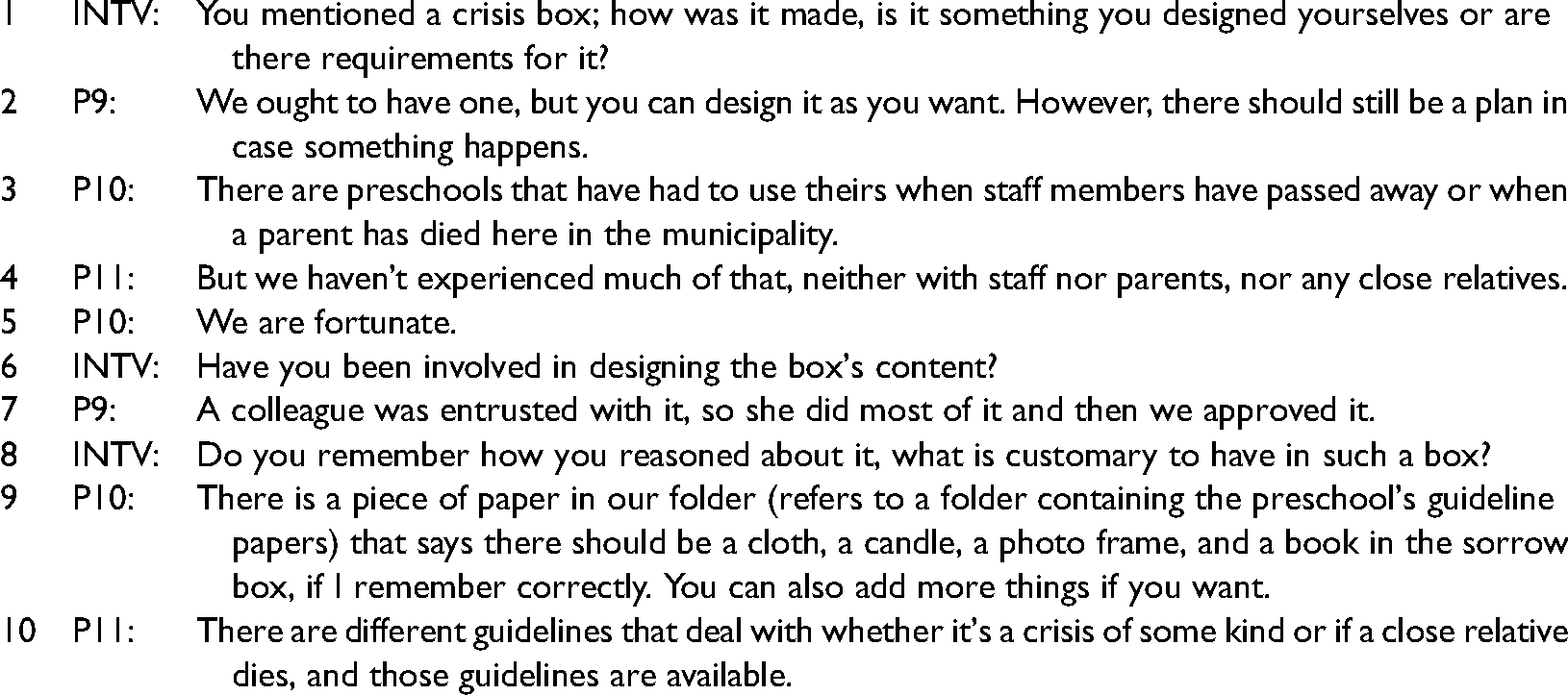
Excerpt 2 shows that the content of the box is approved but not reflected by the participants. P10 assumes that the equipment of the box—a candlestick and a candle, a white tablecloth, a children's book about death and sorrow—has been formed in accordance with some guidelines. She adds that the content of the box can be extended but that has not been done. P11 clarifies that the guidelines P10 refers to are part of a crisis management plan the preschool follows.
A similar conclusion is drawn in one of the other preschools: The crisis box and its content, in all three municipalities in which the preschools are located, have been designed at the central level and implemented at the local level. As all preschools presented their box at the first interview as a central part of their work with death education, we asked the practitioners to also bring their respective crisis boxes with them to the common workshop.
A considerable part of the workshop was dedicated to the crisis boxes’ design and content. The practitioners were asked to present, compare, and discuss the content of their respective boxes for each other and discuss their content. At first, the practitioners stated that the content of their respective boxes was more or less the same. During further discussions, they reached an insight that can be interpreted as an AHA experience because they found that the content of the boxes was “depressing.” What they found depressing was the design of the content because it reminded them of mourning rituals that adults were familiar with.
Only one of the workshop participants has had direct experience of putting the crisis box into work when a child in her previous workplace died. She narrated the experience of death among children as follows:
Excerpt 3
We used the crisis box and created a memory table with a candle and a photo (of the child) in the photo frame. But it is also very much of an adult perspective. It felt very good with the white tablecloth and the neutral setting for the adults, but the children started to bring pink things, everything they found in pink, because she (the dead child) loved pink. They (the children) placed pink items on the memory table covered with the white tablecloth. So I think that the children did not find the memory table beautiful. It was beautiful only from an adult perspective; the children wanted to embellish it with glitter. (P7)
Prior to the workshop, this materiality of mourning has gone largely unnoticed by the practitioners, probably because of their routine familiarity with it (Brennan, 2018). During the workshop, the practitioners realized that the current design of the crisis box did not resonate with children, who wanted to personalize and embellish the memory table with items that held meaning for them. This realization prompted the practitioners to consider developing a child-friendly sorrow box that would better support children's emotional processing.
The material objects on the memorial table display reverence for the dead, while the space created by these items ties the living to the dead. For adults, the memorial table marks death and remembrance in situ and provides a space for expressing social solidarity (Brennan, 2018). However, when the practitioners looked at the crisis boxes from the perspective of the children, they realized that the crisis box's content was not relevant for children who had no experience of rituals whereby the absent person is made present for the mourners in the form of a space for a public ritual (Hallam and Hockey 2001; Maddrell, 2016). While the expressed aim with the crisis boxes was to reduce the negative effects of a trauma caused by the death of someone in the preschool or caused by events that upset children's feelings, as the discussions evolved, the preschool practitioners became more convinced that the crisis boxes represented an adult perspective on grief management.
A crisis box for children—working reactively from a child perspective
The realization that the crisis box was not child friendly and did not contribute to death education became a turning point in the discussion about an alternative box designed for children.
Excerpt 4
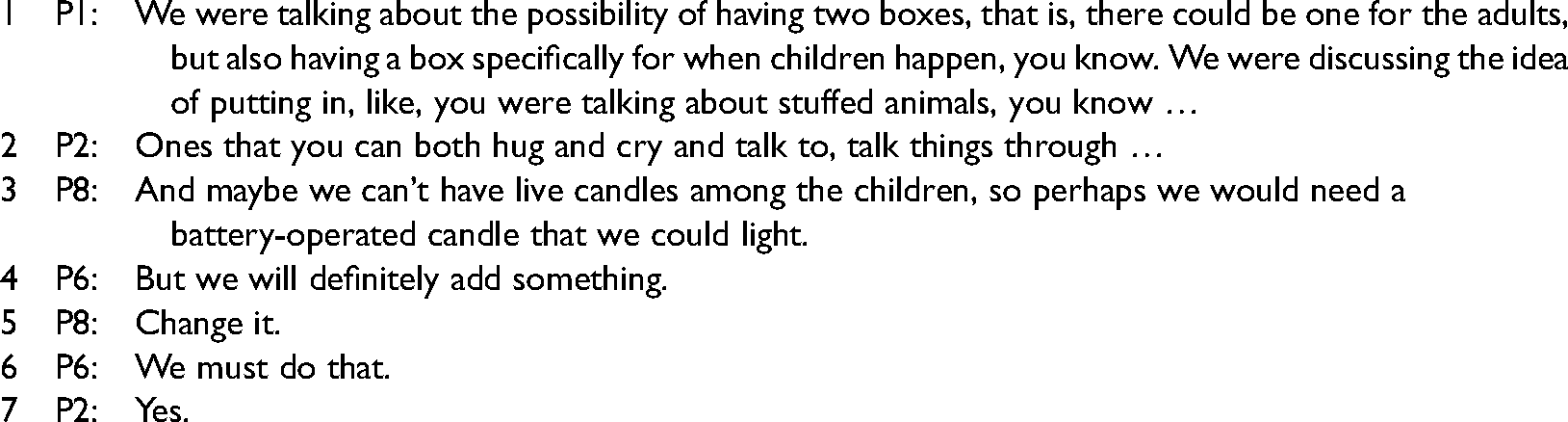
The excerpt shows how the participants of the workshop agreed that a crisis box for children should be developed. Thereafter the discussion focused mostly on the content of a child-friendly box. A common view among participants was that children needed help with processing their emotions, and for doing that they needed to talk about their feelings and grief, and feel supported:
Excerpt 5
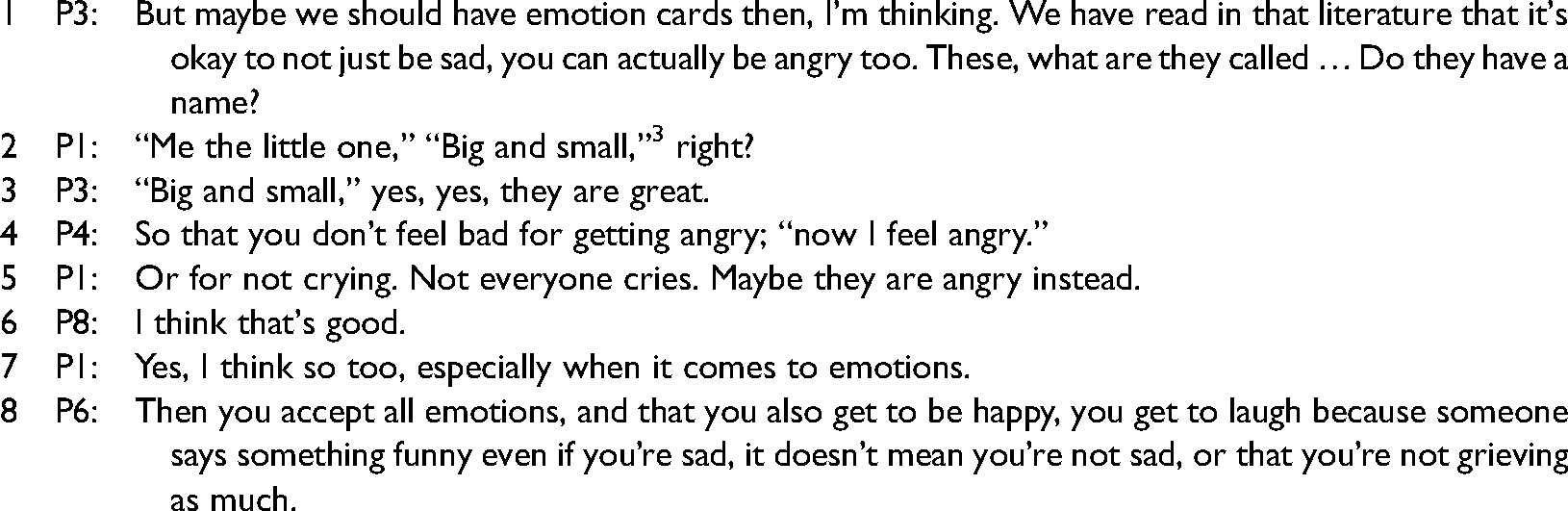
The practitioners stressed the importance of being able to express and interpret emotions regardless of whether it was sadness, happiness, or anger. Using emotions cards, mentioned in Excerpt 5 appeared to be a common way of helping children develop their emotion knowledge through discussing possible feelings shown on the pictures as, according to the discussions, all participants had experience of making use of them. Furthermore, the practitioners’ reflections witness an awareness of the importance of working with children's reactions to death and loss, and helping children to accept their emotions. During the discussions, the practitioners asserted that in addition to emotions cards, the child-friendly crisis box should include other artefacts that may help children to come to terms with their emotions. Thus, the child-friendly crisis box would also include soft toys to play with and talk to, snuff blankets to cry with, picture books with a relevant theme, paper and pencils to draw with, and links to films about death and sorrow. As the interview extracts reveal, the crisis box directed to children was envisioned as a kit that would help the practitioners to work reactively, that is, the focus is on helping children work through grief and loss. Overall, the discussions about a child-friendly crisis box had a great focus on the care aspects, while sidelining the educational aspects of death education. The focus of attention was on responsiveness to children's needs of comfort, assertiveness, and interpreting their own and others’ feelings. One of the participants summarized what was said:
Excerpt 6
The important thing is to take care of the child; that the children would get to process what has happened and their feelings. Here, I think, at least, the child should get to process what has happened, you know. Then we can have another box where we work preventively, where we maybe have more open-ended questions.
Proactive death education
Working proactively was talked about as another way of approaching death education. Ideas about how and what to teach proactively were discussed in terms of what artefacts to obtain and how to make them available to children in everyday practice. Another box with artefacts was proposed that would make talking about death “easy to handle.” This proactive box was imagined as a package of artefacts that would enable both children and practitioners to engage in conversations about death as a biologic phenomenon. The practitioners stressed that the content of the box “needs to be comfortable for all.” One of the practitioners highlighted that:
Excerpt 7
It is important that we would be comfortable with using the box together with the children, so that we could make the children feel safe to talk about death, so that they would not become like us who find talking about death scary.
As the discussions went on, one of the practitioners mentioned the human life cycle as a possible way of talking about death as a part of life. She suggested that they could “follow a person from birth to adulthood, aging and death.” The idea that the teaching would involve “the human life cycle” was dismissed by the other participants.
Excerpt 8
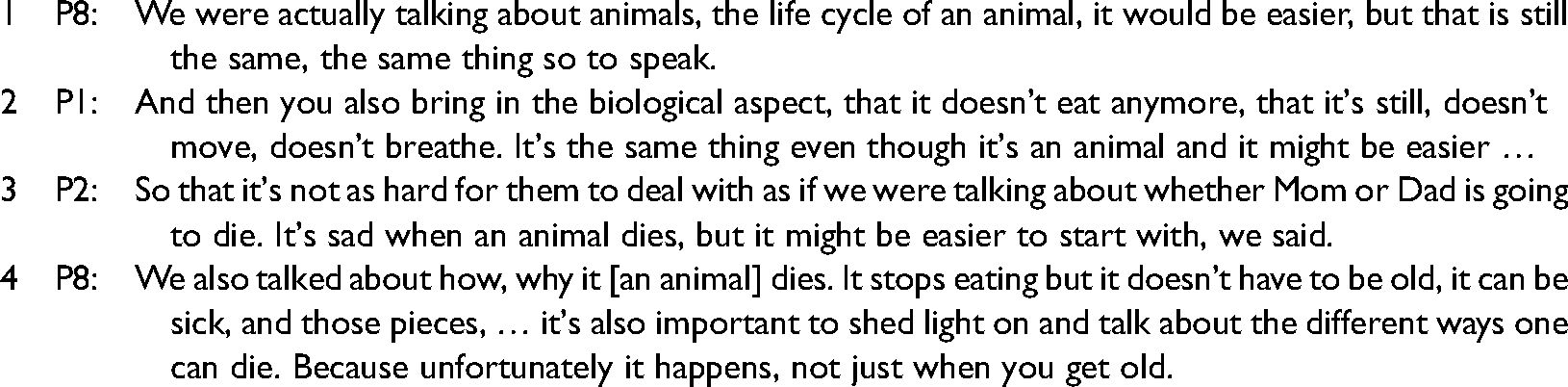
As the excerpt shows the practitioners found it difficult to talk about biologic death in relation to human beings. One way or another, all three practitioners state that it is easier to talk about the death of animals than of human beings. Their reluctance to talk about death of humans is motivated by the children's feelings. However, the fact that none of them touches upon the other aspects of biologic death—universality, irreversibility, and noncorporeal continuation—indicates that talking about biologic death may be challenging for the practitioners themselves.
At the same time, they acknowledge the importance of teaching children about death in terms of non-functionality and causality. They emphasized the importance of discussing the various ways in which death can occur, as it can happen at any age.
Discussion
The analysis sheds light on the challenges of death education and crisis management related to death in Swedish early childhood education. In alignment with the didactic transposition theory (Bosch and Gascón, 2006), our study could make visible how something generated outside preschool is transposed to preschool out of a social need to deal with crisis situations and children's questions related to death in an educational institution for young children. The presence of the crisis box in preschools can be traced back to a broader national phenomenon related to mourning rituals rooted in Lutheran Christian tradition. The discussion around the crisis box's design and content resembling traditional mourning symbols and reflecting cultural and religious influences, is consistent with the work of Galende (2015) and Spišiaková (2022), which highlights the impact of cultural and religious factors on death-related practices and rituals.
Yet, the crisis box that during the focus-group interviews was presented as a self-evident crisis and grief management tool was, in the course of the workshop, reevaluated and questioned from a child perspective. Lytje and Dyregrov's (2023) study on Danish practitioners’ attitudes towards their own bereavement plan also highlighted a lack of reflection and relevance in practitioners’ approaches to supporting children experiencing grief. This similarity suggests a shared need for reflective practices and improvements in crisis management strategies across different cultural contexts. As our study shows, the existing crisis-management plan and tool gave the practitioners false security in terms of grief management. During the workshop, the participants came to the realization that their crisis boxes did not meet the needs of young children experiencing grief. This realization indicates that when the practitioners came to discuss whether and how their crisis management tool was useful, the focus shifted to the children's needs and the practitioners role in providing support in times of crisis, as well as in helping children to understand biologic death. Thus, similarly to Danish day-care staff (Lytje and Dyregrov 2022), the practitioners’ focus is not only on processing the children's grief but also on helping children to understand what happens when one dies.
The findings of the analysis align with previous research that emphasized the importance of death education, and the need for practitioners to engage in reflective practice. During the workshop, when preschool practitioners from different municipalities engaged in reflexive practice, the discussions expanded beyond reactive approaches to grief support and touched on the importance of proactive death education. Nevertheless, the discussions also highlighted the practitioners’ awareness of their own discomfort surrounding talking about human death, as well as talking about death in terms of irreversibility, universality, and noncorporeal continuation. The discussions also highlighted the practitioners’ awareness of their own discomfort surrounding talking about human death, as well as talking about death in terms of irreversibility, universality, and noncorporeal continuation. The participants’ acknowledgement of their own discomfort and anxieties surrounding conversations about death corresponds to the findings of Bowie (2000) and Spišiaková (2022), which emphasize the importance of creating a safe and open environment for discussing and exploring death-related topics, addressing practitioners’ fears and promoting meaningful engagement with the subject.
This study indicates that it is crucial for early childhood educators to critically evaluate the suitability and relevance of the artefacts they use, especially when dealing with sensitive topics such as death and grief. Furthermore, the fact that the content of the crisis box was found to be more relevant and meaningful to adults than to children highlights the importance of adopting a child-centered approach when creating a crisis-response plan specifically directed at young children. The discussions analyzed above led to the realization that there was a growing recognition of the need for proactive death education to help children understand and cope with death as a natural part of life. This shift in perspective highlights the importance of incorporating both reactive and proactive strategies in supporting children's emotional well-being and developing their understanding of death. Nevertheless, the practitioners expressed discomfort and anxiety when discussing and teaching the children about biologic death. This reflects a broader societal discomfort with discussing biologic death, and the need for educators to receive appropriate training and support in addressing this topic. Our findings indicate that early childhood educators are in need of training in how to teach about the biological facts of human death in terms of universality, irreversibility, non-functionality, causality, and noncorporeal continuation. Only in this way can educators be equipped with the knowledge, skills, and confidence to engage in open and age-appropriate conversations with children about biologic death, fostering a supportive and safe environment for them to express their feelings and ask questions.
Footnotes
Declaration of interest statement
We confirm that this manuscript has not been published elsewhere and is not under consideration by another journal. We confirm that the research meets the ethical guidelines of the Swedish Research Council. We confirm that we have no conflict of interest.
Funding
The authors disclosed receipt of the following financial support for the research, authorship, and/or publication of this article. This work was supported by the Swedish Research Council (Vetenskapsrådet) (grant number 2018-03839).

Notes
Author biography
Tünde Puskás is Professor in educational practice at Linköping University, Sweden. Her research focuses on linguistic, cultural and religious diversity in preschools.
Anita Andersson is a Lecturer at Linköping University, Sweden. Her research focuses on religion didactics and existential issues in Swedish preschools.
Virginia Slaughter is Professor of Psychology at the University of Queensland, Australia. Her research focuses on social and cognitive development in infants and young child.