




Abstract
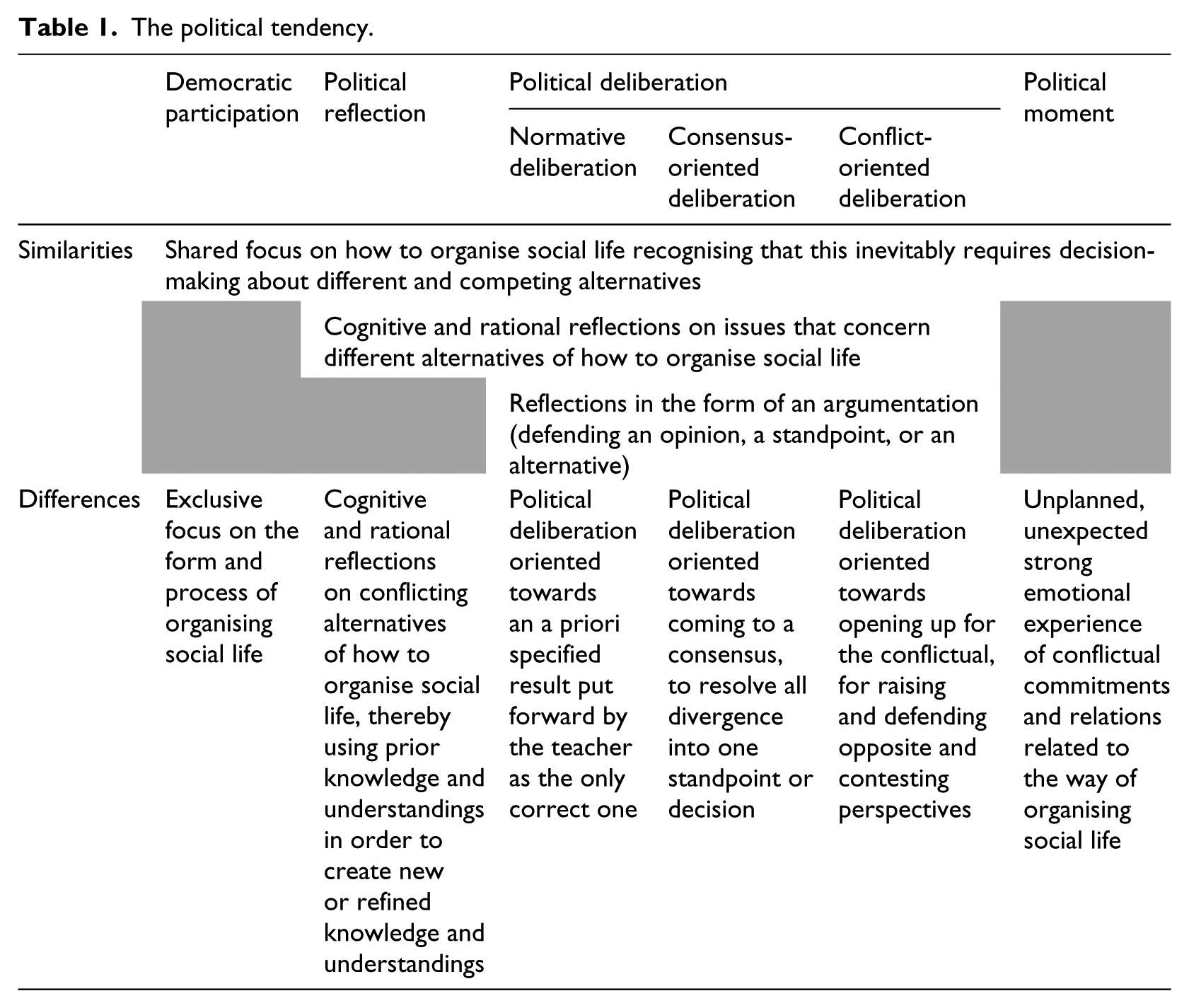
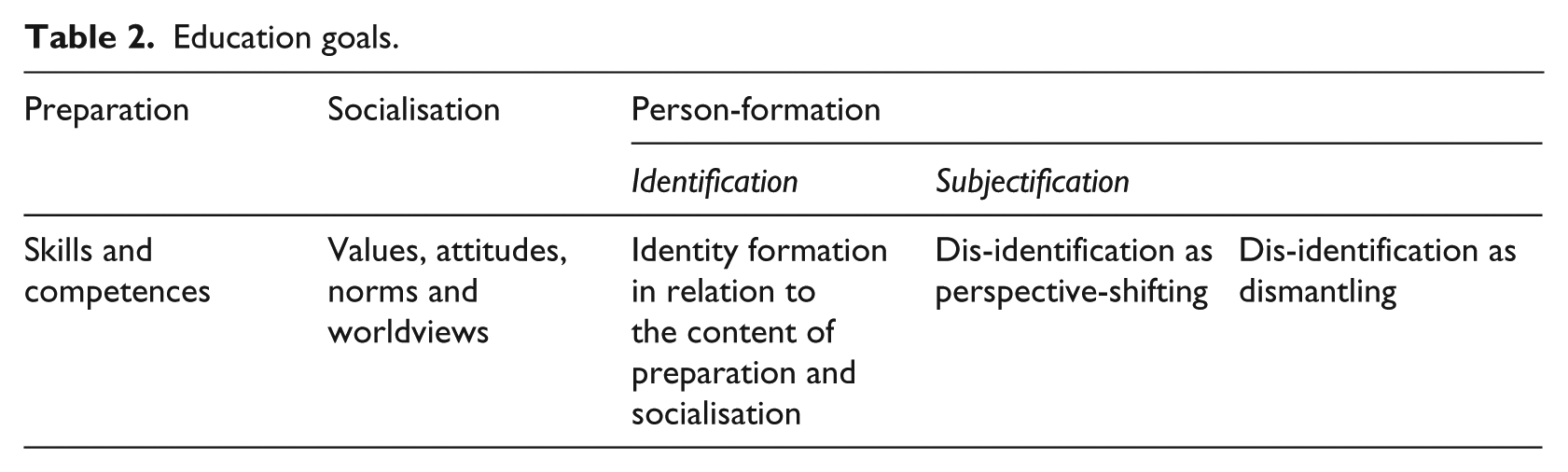
This article presents a categorisation of the different situations in which the political dimension of environmental and sustainability education can be handled and experienced in practice: the ‘political tendency’. Using a methodology inspired by Wittgenstein’s user perspective on language, we empirically identified situations that express the political tendency by looking for language games centred around the question of how to organise social life, recognising that this inevitably requires decision-making about different and competing alternatives. Classifying these situations resulted in a typology (the political tendency) that distinguishes ‘Democratic participation’, ‘Political reflection’, ‘Political deliberation’ (sub-divided into ‘Normative deliberation’, ‘Consensus-oriented deliberation’ and ‘Conflict-oriented deliberation’) and ‘Political moment’. Next, we discuss the developed typology from an educative perspective, showing that the distinguished situations in the political tendency differ as to how they enable the foregrounding and backgrounding of different educational goals: preparation, socialisation and person-formation (i.e. identification and subjectification as perspective shifting and subjectification as dismantling).
Introduction
In the field of environmental and sustainability education (ESE) research, it is repeatedly argued that attention should be paid to the political dimension of teaching and learning in the context of environmental and sustainability issues. Claims and appeals made in this respect are varied. Some authors (e.g. Levy and Zint, 2013) argue that ESE has an important role to play in fostering political engagement, that is, in engaging people in political action and stimulating them to participate in politics related to sustainability concerns. The aim, then, is to ‘empower individuals to share the concerns, interests, and specialized knowledge that they have about their environment with officials and decision-makers whose choices can have substantial consequences for environmental sustainability’ (Levy and Zint, 2013: 555) by writing letters and emails, demonstrating, etc. Related to that, appeals are made to ESE in view of preparing for politically engaged sustainable citizenship (e.g. Huckle and Wals, 2015; Levy and Zint, 2013). ESE, here, is about fostering the attitudes, knowledge, skills and values that will enable people to successfully play their role as an active citizen in the pursuit of a more sustainable world. Other scholars argue for fostering action competence (Jensen and Schnack, 1997; Mogensen and Schnack, 2010). Democratic, participatory and action-oriented forms of teaching and learning, they write, should help develop students’ ability, motivation and desire to play an active role in finding democratic solutions to sustainability problems. Furthermore, ESE researchers highlight the importance of stimulating people to become political subjects (Lundegård and Wickman, 2012; Mogensen and Schnack, 2010), for example, through deliberation on a desirable, sustainable future. Then, people are no longer the objects of control and guidance by others but initiative-takers, doers that take their place on the stage among other people, thereby constantly creating new relations to the world. Others, like Räthzel and Uzzell (2009), emphasise the need for reflecting on political processes, relations and structures, such as power relations associated with the way in which we organise consumption and production in our society, the functioning of political institutions and the way people relate to them, etc. Furthermore, appeals are made to ESE to contribute to political literacy (Huckle, 2009): propositional and procedural knowledge of environmental and development issues and the politics of sustainable development; knowledge about the main political disputes and about what beliefs the main contestants have of them; skills – intellectual, communication, political and action skills – needed to ‘make a difference’; the ability to consider and apply a range of procedural and substantive ethical principles; the ability to apply relevant knowledge, skills and values when making judgements and taking informed action; etc. Recently, an increasing number of scholars also emphasise the importance of paying attention to the political in ESE practices by acknowledging conflict as an integral part of education in the face of sustainability issues. ESE, then, should foster openness for different perspectives and requires a space for learners to express, explore and confront a plurality of dissonant and conflicting voices since controversy is inevitably embedded in sustainability issues (e.g. Lundegård and Wickman, 2007; Sund and Öhman, 2014; Van Poeck et al., 2014; Wals and Heymann, 2004).
Scrutinising these writings reveals that different understandings exist – containing both similarities and differences – of what we above broadly labelled ‘the political dimension’ of ESE. This variety of perspectives covers a wide scope of ideas and associated practices ranging across the analytical distinction between ‘politics’ and ‘the political’ made by post-foundational political scholars such as Chantal Mouffe (2005, 2009). 1 ‘Politics’, according to Mouffe, refers to dealing with everyday political problems by deploying an ensemble of strategies, actions, procedures, discourses and institutions which seek to establish a certain hegemonic order in the organisation of human coexistence. ‘The political’, on the other hand, refers to the dimension of antagonism that is inherent in human relations and prevents a final closure of any given order. By introducing this notion, Mouffe highlights that every hegemonic order is contingent and that politics are inevitably conducted in conditions that are always potentially conflictual. There is no final ground, no socially, rationally or morally objective essence that can serve as a foundation for solving political problems.
Triggered by the rich conceptual diversity – and associated ambiguity – in ESE research literature, the purpose of this article is to contribute to further clarification of the political dimension of ESE through an investigation of how it appears in educational practice by presenting a categorisation of different manifestations. In doing so we will take departure in the work by Öhman and Östman (2008) who created a typology of the ethical and moral dimensions of ESE which they call the ‘ethical tendency’. Using this as a model, we will develop and present a typology for addressing the political dimension of ESE in educational practice: the ‘political tendency’.
After explaining the basic assumptions and principles underpinning the methodological approach we used for constructing the typology in the next section, we present the political tendency classification. We use examples from our own empirical research to illustrate the different types of practical manifestations of the political dimension of ESE. Next, we discuss the developed typology from a pedagogical perspective. That is, we return to the distinguished educational situations in the political tendency by connecting them to educational theory about the role and purpose of education. In doing so, we aim to contribute to a more nuanced understanding of the very diverse and particular ways in which the political dimension of ESE can be handled and experienced in practice. Rather than developing general or universal arguments and principles about the importance of ‘politicising’ ESE practice or seeking to support or refute essentialist, homogenising claims about ESE as a ‘post-political’ (Knutsson, 2013) practice, we want to develop and present practical clarifications of the political tendency that can serve as conceptual tools for reflection and discussion of what it means to address politics and the political in concrete ESE practices and how different ways of doing this have very different educational implications.
The methodology: clarification through assembling reminders
The method that Öhman and Östman (2008) used in their work on the ethical tendency, and which we will also use here, takes its inspiration from Wittgenstein’s way of working. Stenlund (2000) highlights two characteristics in Wittgenstein’s work. The first one is that Wittgenstein does not construe a theory. He instead solves, or maybe more correctly, dissolves, problems or misunderstandings using concrete examples in order to remind the readers about ordinary and basic traits in our use of language that we have forgotten over time (Joseph et al., 2001: 72–90; Stenlund, 2000: 20–22; Wittgenstein, 1953/1997: § 127). The second characteristic in Wittgenstein’s work is his approach that the reminders are supposed to be recognisable amongst ordinary language users (Stenlund, 2000: 36). This approach becomes visible in his advice that we should look at the circumstances in which the words and sentences are used (see, e.g., Wittgenstein, 1953/1997: § 66, 1969/1997: § 501). It is in this context that Wittgenstein’s term ‘language-game’ becomes crucial. With this term he wanted to ‘bring into prominence the fact that the speaking of language is part of an activity, or of a form of life’ (1953/1997: 23).
Wittgenstein’s work is based on the idea that most theories on language use a third person perspective (a spectatorship perspective) of language. In its most basic terms, such a perspective characterises language as consisting of three separate parts: 1) the words, sentences, etc., 2) the world and 3) the meaning. These theories attempt to explain how these three parts come together and thereby make meaning about the world possible. According to Wittgenstein, these theories create misunderstandings and problems because in language use the connection between the words, meaning and the world is already there. When one reads a newspaper one does not try to create a connection between the symbols (words), the world and the meaning: while reading, the words do already (in most cases) have meaning. Hence, if one does not start by dividing language into these three elements, there is no need to make up explanations for how they come together. Instead, Wittgenstein uses a first-person perspective (a language-user perspective) on language (Monk, 1991). In line with this perspective he maintained that the psychological (our thoughts, beliefs, wishes, attitudes, values, etc.) and our way of using language are so intimately connected that it is unreasonable to understand them as two distinct processes (see Monk, 1991: 473–475). This user approach to language is described more concretely by Cavell (1999), who writes: In ‘learning a language’ you learn not merely what the names of things are, but what a name is; not merely what the form of expression is for expressing a wish, but what expressing a wish is; not merely what the word for ‘father’ is, but what a father is; not merely what the word for ‘love’ is, but what love is. In learning language, you do not merely learn the pronunciation of sounds, and their grammatical orders, but the ‘forms of life’ which make those sounds the words they are, do what they do – e.g., name, call, point, express a wish or affection, indicate a choice or an aversion, etc. (177–178)
This user approach to language means that when we learn the word ‘political’ or ‘politics’ we not only learn how to spell it, but also learn how to use it in order to do something – point to a specific mode of governance, name a specific form of decision making, express a conflict, etc. Methodologically speaking, this way of approaching language has the consequence that what is regarded as hidden in a spectatorship approach to language is seen as visible in a user perspective. In most cases we can immediately ‘observe’ what people are trying to do or communicate by the way they use language in specific situations. This is a result of having learned psychological language (e.g. knowing how to express a wish, a desire, or an opinion) at the same time as we learned psychological experience: what a wish, a desire, or an opinion is. 2
Working with recognisable reminders for constructing typologies and classifications such as the political tendency and using Wittgenstein’s term ‘language game’, the researcher is situated as a first-person language user in a specific circumstance. It prevents the researcher from escaping into a theoretical and, thereby, a spectator position on language. Öhman and Östman (2008) used this method in order to clarify the ways in which morality and ethics are staged in education. They took concrete examples from educational practices as reminders of the specific function of value judgements connected to the ethical tendency. 3 The result of a researcher collecting and classifying reminders is a typology (a classification) of situations where morality and ethics are staged in educational practice, and where the differences and similarities between these situations are clearly visible. The reminders that will be used in this article are those that illustrate an ordinary and basic trait of a language game (an activity and the language use that is integral to the activity) that demonstrate how the political dimension of ESE arises in educational practice; this is how the basic criterion of this political dimension that is presented below becomes visible in the ordinary language use in specific situations.
Öhman and Östman (2008) approach ethics and morals in their investigation not as ‘theoretically demarcated concepts, but rather as a feature of human thinking and behaviour’ (p. 4). This means that an absolute (universal) clarity can never be created: the only thing to be hoped for is clarity in relation to a specific context – in our case an educational context – and to a specific purpose – here to create a typology (see next section for further discussion). Öhman and Östman (2008) named their typology the ‘ethical tendency’. Analogically, approaching politics and the political as another prominent feature of human thinking and behaviour that cannot be captured in a single theoretical definition, we used the method of collecting and systematising recognisable reminders from educational practices in order to create a typology that we name ‘political tendency’.
The empirical material that we investigated in order to create this typology comes from two doctoral research projects in Belgium and Sweden. The Belgian project consisted of multiple case studies of seven varied (formal and non-formal) ESE practices. 4 The empirical data consists of documents (78), transcripts of audio-recorded in-depth interviews (19) as well as field notes and transcripts of video-recorded direct observations of educational activities (45) that varied in duration from half an hour to maximum of a whole day. Methodological information and considerations regarding data collection and analysis are described in full detail in a PhD dissertation by Van Poeck (2013). We also used a case study from a Swedish doctoral research project. The empirical data consist of one video-recorded lesson (65 minutes) and 13 handwritten questionnaires consisting of two open questions: 1) describe how you experienced the lesson and what you learned from the lesson, and 2) describe the emotions the discussion raised. Methodological information and considerations regarding data collection and analysis are described in full detail in a PhD dissertation by Håkansson (2016).
The working procedure we used consisted of two steps. First, we identified situations where the political dimension of ESE became visible, guided by the criterion described in the next section. The second step was to sort these identified situations into groups by looking for similarities and differences between them. We assembled situations that were similar into groups. Then, these groups were compared to each other in order to discern if the groups differed in such a way that the differences could be formulated in a concise and coherent manner. Through this comparison of similarities and differences we could eventually come up with groups of situations where each group contained situations that shared a similarity that, at the same time, was clearly different from the other similarities that were constitutive for the other groups (criterion of internal homogeneity and external heterogeneity).
The political dimension of ESE
In order to identify situations where morality and ethics were part of the educational activities and actions, Öhman and Östman (2008) searched for situations where people expressed what Wittgenstein (1993) called ‘absolute values’. For our purpose of identifying situations that express the political tendency, we will look for other traits in the use of language and focus on language games centred on the question how to organise social life recognising that this inevitably requires decision-making about different and competing alternatives.
When deciding on this criterion, an important issue was to avoid making it too narrow – as would be the case by using a definition from a specific, for example, post-foundational, theoretical perspective. We needed a criterion that is broad enough to cover a rich variety of practical manifestations of the political dimension of ESE in line with the wide scope of theoretical perspectives ranging across the distinction between ‘politics’ and ‘the political’ described above. Furthermore, vital aspects of politics and the political elaborated in political science literature (Hay, 2007; Heywood, 2000) had to be covered: ‘politics as government’ (the activities of the state); ‘politics as public life’ (the management of community affairs); ‘politics as conflict resolution’ (compromise, conciliation, negotiation and other strategies); and ‘politics as power’ (deciding on the production, distribution and use of scarce resources).
At the same time we wanted to make the criterion basic and understandable in an everyday sense. Therefore, we also tested the criterion by applying it to imagined everyday situations that could be seen as expressions of the political tendency of our lives, such as: ‘How shall we distribute the scare resources amongst the citizens?’, ‘What is the right way of governing the society?’, ‘Who shall have the right to vote?’, ‘What is the best way to empower people to raise their voices in public debates?’, ‘How can we come to agree?’ and ‘How can we live together in a world with such huge differences?’. When scrutinising these and other questions that we in our ordinary lives (using language in an ordinary way) recognise as ‘political’, we found that the criterion functioned in relation to the purpose of our investigations. As we also mentioned above, it is thereby important to realise that it is impossible to create one universal formula that defines all possible situations within the political tendency. According to Wittgenstein, making an objective distinction between correct and incorrect meaning or interpretation does not assume the existence of a general, invariable criterion but, rather, a specific practice that can never be made fully explicit (Smeyers, 2002/2004). It is a perspective of meaning as use (Smeyers, 2002/2004: 116). Wittgenstein was very specific on this anti-essentialist perspective, and he used the term ‘family resemblance’ to remind us that an order, as any typology is, consists of a complicated network of differences and similarities that criss-cross each other, as is the case when one tries to describe the similarities between members of a family (Wittgenstein, 1953/1997: § 67). Although every situation is basically new and every use of a word is therefore, in a way, always different, these different user contexts are connected through family resemblances. As such, there is no absolute, internal or external reference point, nor is this a matter of arbitrary distinctions or connections. It is important to highlight that any collection of reminders is always done in relation to a specific purpose (Wittgenstein, 1953/1997: § 127), which means that the typology we will present is not the Typology, but one of many possible typologies. Our hope is that the one we developed and present here is useful in creating clarifications both for researchers and for practitioners and that it contributes to enriching the understanding of the political tendency in educational practices.
Results: the political tendency
Democratic participation
What distinguished the category Democratic participation from the other described below is its exclusive focus on the form and process of participation in democracy. It is a particular way of addressing the overall, shared question of how to organise social life, namely through a focus on how to distribute voices and power within the classroom and the school as an institution. The purpose of the activities is to pay attention to the social life within this institution in such a way that the different voices and thereby different alternatives will be heard.
We found one example of Democratic participation in a Belgian environmental management project for kindergarten, primary and secondary schools (‘Environmental Performance at School’, ‘Milieuzorg Op School’ – MOS). The project attempts to raise students’ awareness of environmental problems through the school’s own environment. A school entering the MOS project commits itself to developing environmental performance activities in order to become an eco-friendly and sustainable school. The project urges the schools to broaden the involvement of a variety of actors that can bring in expertise and suggestions and contribute to environmental performance activities. A key role is reserved for the students as the project is built on the strong belief that students’ participation and intensive engagement in the school’s environmental management is a powerful and valuable educational method. This is predominantly applied through the establishment of so-called ‘MOS councils’, student councils that function as environmental management task forces preferably with representatives of all classes. In most schools, these representatives are selected through formal elections for the MOS council.
Through these activities, the students are assumed to learn how to participate in decision-making about sustainability issues in a democratic way. Several teachers we interviewed, emphasised that in doing so, they want to prepare children and youngsters for their future role in society. Thus, some of the activities within MOS focus exclusively on training the students to participate in a democratic way in the organisation of the social life in the school. This focus is visible in the following excerpt of a transcript of an observation of a MOS council meeting in a primary school during which the teacher and students discuss the organisation of a march for sustainable transportation in the school’s neighbourhood:
My question for you: do you think that, just like last year, we should make noise during the march so that… Last year we made instruments, remember, these rattles, right? Do you think there should be instruments again, so that people from the neighbourhood know that we pass by? And it can… just think how you see it, if you say yes I want noise, I’d like that, just say how you see it. And then we can decide later what we can choose, right? [the teacher gives the floor to the students that raise their hand]
I want to make an instrument, well it’s not an instrument but such a square box and then you need sticks to just drum on it.
Do you have that?
No.
So you’d want to make that in school then?
Yes.
Okay. I’ll go on first. All ideas are good, right?
Yes I’d want to do that but… I don’t know an instrument but… Why I want it? Then we attract more attention and then people say what is that and then they look outside and they can see the banners well.
I’ll come back to that. You say: also big banners? [pupil 2 nods]
We can drum on pans with wooden spoons.
[…] Okay. We heard some things now. I heard from somebody we can drum on old, old pans. I also heard, some children play an instrument. I heard that X, if he gets the materials, that he then wants to create instruments. Good. My question for you is that you just think for a while and say, or think, what’s for you, in your own view, uhm, the best for Friday. […] Then we’ll see what the majority decides and we can then maybe, if you don’t fully agree, change it a bit. Okay. Is there already someone who says I want it like that? But we let the others have their say, right? Everybody gets the chance and then we see. I’ll start with you and then follow the circle.
Sometimes this exclusive focus on the form and process of participation can make the practitioners lose sight of the content of participation, the subject matter that is dealt with. As in the example above, we found that when it comes to giving students power in the schools’ environmental management, this is often limited to having a say in decisions that are only indirectly connected with the sustainability issue at stake. This is a classical didactical dilemma that can occur if the form and process becomes too predominate in the practice (see Fensham, 1988).
Political reflections
An example of Political reflections also comes from our analysis of the Belgian MOS project. The coordinator of the project explained that one of its purposes was to make the students take up and reflect on broad questions:
When a situation or problem occurs, which students are involved in from the start, like okay, what do we find here? Where does it come from? Why does this happen or not? And that students are questioned themselves. Where does it come from? Help to find out, is it a good or a bad thing? Are we satisfied that this happens or is it a problem? Why is it a problem? Who’s the victim, right, or who benefits? Who suffers from it? And if they are motivated then to… what can we do about it? What would be possible solutions?
These questions illustrate what distinguishes the category Political reflections from the other situations in the political tendency: they manifest the teachers’ aim of making students rationally reflect on the activities they are involved in and that concern the common, political focus on the way we organise our social life in relation to certain sustainability problems. By asking the question of, for example, who suffers from it and who benefits from it the issue of conflicting interests behind solutions and decisions is brought into focus. Through the question ‘what are the possible solutions?’ different competing alternative are highlighted (a pluralistic point of view).
Another instance of political reflection is the following statements by two Swedish students in the questionnaire that was part of an investigation described below under the heading Consensus-oriented deliberation: ‘After this kind of lesson you start to think of how many opinions that should be allowed in our society.’ This statement is a reflection on the discussion and concerns whose opinions should be counted and whose should not in a society and thus connects to the issue of power. Another statement is the following: ‘got a new way of seeing how different you can be seen on foremost political decision methods’.
Characteristic of Political reflections is its emphasis on cognitive and rational reflections on issues that concern different alternatives of how to organise social life, also taking into account the consequences (inclusions and exclusions) of decisions about different alternatives. In relation to Democratic participation this practice differs in that the focus is not on the form and process, but on using prior knowledge and understandings in order to create, with reflections, new or refined knowledge and understandings. A major difference in relation to practices of deliberation (see next section) is that in Political reflections the students are not required to take a stand and (learn to) defend it (argumentation).
Political deliberation
Also in practices of Political deliberation political reflections do occur, but these reflections are made in relation to the context of argumentation, when defending an opinion, a standpoint, or an alternative, in light of a real or potential decision regarding how to organise social life. We have found three distinct ways in which deliberation can be executed in an educational context: Normative deliberation, Consensus-oriented deliberation and Conflict-oriented deliberation.
Normative deliberation
Normative deliberation differs in relation to the two others described below in its orientation towards an a priori specified result as the only correct one. The expected outcome of the argumentation – in the form of a decision regarding the way to organise social life – is already set by the teacher but not known in advance by the students; the agenda is implicit. Because of its pre-set outcome we call this category Normative deliberation.
We will illustrate Normative deliberation by drawing on our observation of a workshop about the ecological footprint for employees of a company in Belgium. The activity was organised within working hours and run by a freelance educator of an environmental organisation that aims to promote ecological behaviour change. The workshop started with a PowerPoint presentation through which the educator explained the concept. After the presentation, the participants were divided into small groups to discuss behaviour clues for reducing their ecological footprints. Next, each group had to report on their findings. The excerpt below is a sequence of the whole-group discussion that followed when one of the sub-groups reported its findings. They reached the conclusion that their ecological footprint would benefit from using their cars less and biking or walking short distances:
One obvious improvement would be to bike or walk short distances.
What would you consider a short distance?
Going to the bakery, for instance.
How much is that in miles?
One and a half?
No, let me help you out: in fact, we should bike any distance under 3 miles.
Hello-o!! (laughter)
Why 3 miles? Because cars consume most over short distances. (…)
Then we also had to say why we found it difficult. We found it can be time-consuming at times.
Remember the word I just used: planning?
Yes, but still…
After urging them to be more specific regarding what a ‘short’ distance is, the educator reacts with expressing disagreement (‘no’) and introducing a norm: ‘we should bike any distance under 3 miles’. Doing so, he indicates that this is not a matter of divergent opinions and considerations but a matter of fact (‘in fact’) that everyone should behave according to a certain, very specific standard. By setting this norm, he makes the participants react and take a stand on the postulated standard about how to behave in a certain situation. Throughout the workshop, we observed many similar interventions by the educator that (re-)oriented the discussion towards the normative knowledge, facts, clues and guidelines that form the content of his presentation and the carefully prepared workshop scenario (see also Van Poeck and Östman, forthcoming). As a result, the participants’ attempts to bring conflictual and emotionally invested concerns and commitments (e.g. lack of time) into the conversation were repeatedly countered and the frame of deliberation became normative: only one solution regarding how to organise social life sustainably was counted as valid.
Consensus-oriented deliberation
Contrary to the example of the ecological footprint workshop, in Consensus-orientated deliberation the outcome of the deliberation is not a priori set by the teacher. Characteristic of this type of deliberation is instead its orientation towards coming to a consensus, or to deliberate in the atmosphere that all divergence can finally be resolved into one standpoint or decision.
We found examples of Consensus-oriented deliberation in the video-recording of Swedish students who participated in a lesson on sustainable development. Together with a teacher we designed a lesson that we thought would optimise the possibility of generating a conflict-oriented discussion amongst the students. 5 The lesson can be characterised as pluralistic since it opens up for including a plurality of ways of approaching environmental and sustainability issues the ecological, cultural, economic, political and social aspects connected to them (e.g. who the central stakeholders are, and what the solutions to the problems might be). The class was split into two groups and each group got special instructions about what to discuss: one group was instructed to discuss whether you should break the law in order to create a sustainable society and the other group was instructed to discuss the possibilities of creating a sustainable society, especially regarding what to do with the citizens that are unwilling to contribute to realising this goal. The group discussions were teacher-free, while the teacher coordinated the whole-class discussion that followed the group discussion. We video-recorded the discussion by both groups as well as the subsequent whole-class discussion. Immediately after the lesson the students were given a questionnaire with two questions: describe i) how you experienced the lesson and what you learned from it and ii) what emotions the discussion raised. In the excerpt from the small-group discussion below, students discuss the question of how to reach a sustainable society when citizens are unwilling to participate in this goal. During this discussion, the teacher approaches and asks the group to summarise their discussion before they join the other group.
[inaudable] People stop whining and not go on nagging about everything.
That was your suggestion.
(points at Mark) I agree on that.
Freedom in every aspect is bothersome as hell.
It was an alternative that we brought up. I didn’t say we agree on that. It was an alternative that I brought up, it was a position that I pushed.
I agree with you [inaudible].
Democratic reduction for the best of the public.
And you know what that is?
Yes (long pronunciation).
We agree that maybe it was a bit too much freedom, thus in some cases ….
… Yes a bit too much freedom….
Little too much to choose from and a few too many rights in some cases. Cannot we agree that we thought that?
A few too many rights and a bit too much freedom?
It is clear that the students’ arguments are directed towards reaching mutual agreement, particularly on the idea that there is too much freedom in the society, too much democracy. This conclusion was expressed in both groups and it was also raised in the whole-class discussion.
Conflict-oriented deliberation
We found an example of Conflict-oriented deliberation in our analysis of a guided tour of a CSA (Community Supported Agriculture) farm for a group of Belgian university college students. They visited this farm and others in the context of a course on sustainable agricultural techniques. The students were accompanied by their professor, and the tour was guided by a farmer. It started in a hangar where the students, the professor and the farmer stood in a circle. The students took notes and the farmer talked about how he chose to run his farm, drawing on what he called ‘the three Ps’, which stand for ‘Planet’, ‘People’ and ‘Profit’: three concerns that you must take into account when you work as a farmer. He told the students that he believed that planet should be the major concern, but that others might think people or profit should come first. He then tried to start a discussion with the students, urging them to articulate their points of view.
Repeatedly, he explicitly called on the students to object his explanations and opinions if they disagreed with him. There were situations where the students reacted on his statements in a way that showed that they were provoked and started to contest the farmer’s standpoints and arguments. In such situations controversy arose. As the deliberation continued, students increasingly voiced divergent points of view and more and more students got involved in the discussion. This illustrates what makes Conflict-oriented deliberation stand out compared to the other categories in the typology: it opens up for the conflictual in the deliberation through making the students raise and defend opposing and contesting perspectives. For example, when the issue of agricultural subsidies was discussed, the following comments were made:
I don’t receive any subsidies. And I also think that it would be very good to say that we are putting an end to them.
But you also don’t make a living from [farming]! (original emphasis)(raises her voice)
I do make a living from it. (original emphasis)
Oh, you said yourself that you don’t pay yourself a wage! (raises her voice)
Yes but that’s different. You don’t need a wage to be able to make a living from it. I eat from it. That’s a big difference. If you think I’ve got 2,000 euro on my account at the end of the month. I think I’ve got 900 euro or something like that on my account.
The farmer took a firm stand arguing that, in his view, financial support for farmers should be abolished. His argument to put an end to agricultural subsidies suggested a decision of inclusion and exclusion – that is, of which concerns are to be taken into account and which are not. Doing so, he highlighted the existence of different and competing alternatives. The dialogue between the farmer and the student that followed shows how both are deeply engaged in this discussion and that, for them, there is something at stake. This is visible in their strong expressive mode: the emphasis in ‘I do’ and the raise of the student’s voice. Indeed, at another point during the conversation student 2 said that her parents run a conventional pig farm. Thus, when it comes to decisions about agricultural subsidies, there is something at stake that concerns her deeply as her family’s livelihood depends on it.
Political moment
A Political moment is related to what Öhman and Östman (2008) described as a Moral reaction: ‘situations of unpremeditated reactions where we take an absolute responsibility for someone or something’ (p. 63). The similarities between a Moral reaction and a Political moment are the strong emotional experience and that these experiences are not planned in advance. These are things that the person afterwards would describe as unexpected – ‘it came to me; I did not look for it’. We call an immediate, strong experience a poignant experience. The difference between a Moral reaction and Political moment is the content of this reaction. In the case of a Moral reaction, this content is situated in the private sphere and concerns moral relations. It is an experience of absolute moral responsibility for someone or something (Öhman and Östman, 2008: 63). In a Political moment the content of the poignant experience expands to the public sphere and concerns political relations. It is an experience of undecidability 6 and antagonism regarding the way of organising social life under the condition of conflictual commitments and relations.
The following examples come from a Swedish student’s answers on the questionnaire after the lesson that was described above.
Pupil D: At the same time the classmates’ contributions sometimes make me worry about different worldviews and accordingly how different my own worldview other could run our world.
This reaction demonstrates an emotional involvement in the issues that were addressed in the classroom discussion. Words such as ‘worry’ reveal that Pupil D was not indifferent to the classmates’ worldviews, and the gap between these and this student’s own worldview. This statement describes an experience of possible exclusion of one’s own worldview in favour of others’, totally different, worldviews in decisions on how the world should be organised and governed. His reflection shows how social life emerges for this student as constituting an ‘us’ and a ‘them’, the included and the excluded. Simultaneously, it becomes clear for the participants who are the opponents or the antagonists – in this case, these ‘others’ are some of the classmates.
Another example comes from an interview with the coordinator of a Belgian regional centre for action, culture and youth. One of the activities of this organisation was to make documentaries about sustainability issues. During interviews as well as observations, the coordinator and volunteers of the centre regularly expressed concern for and emotional involvement with people affected by sustainability problems. For example, when the coordinator talked about how he felt and what he thought during and after filming conversations with people suffering from ecological issues and poverty for the documentaries:
Such things will always be rather, not rather but very emotional. […] Those are the people you love and all, uh, so … yeah … After shooting those scenes … every time we needed quite a while … an hour or two … to chill out before we could go on. That’s heavy stuff, you know, even today. Also when you see that. Even when I see that film for the twentieth time, when it’s been a while, it’ll still fills me with emotions and indignation. And it makes me think, hey man, it’s such an indifferent system, there’s so much injustice in this shit society, I don’t want to have anything to do with that.
This excerpt shows an emotional involvement (in words like ‘love’, ‘heavy stuff’ and ‘indignation’) and reveals how the interviewee was incapable of accepting the current organisation of social life in an unjust ‘shit’ society. In this way, he takes an antagonistic position towards this society.
Both Pupil D’s and the interviewed coordinator’s statements reveal a reflection on strong feelings that struck them suddenly in a specific situation. Such a poignant experience cannot be empirically observed by outsiders, but expressions and reflections such as the ones presented above do reveal the process of inquiry that follow these strong emotional experiences (see also Håkansson and Östman, forthcoming). It is precisely this emergence of immediate, unpredictable and unexpected strong emotional experiences, revealed through the student’s and coordinator’s reflections, that made us distinguish this situation from Conflict-oriented deliberation. 7 Whereas the latter was characterised by a deliberation between the farmer and the student, both of them cognitively and rationally defending different and irreconcilable interests and commitments as legitimate opponents in a deliberation process, we can say that in the Political moment the conflicting commitments and associated antagonistic relations are suddenly discovered through a strong emotional experience that is made sense of through an inquiry.
Discussion: the educational in the political tendency
As argued, this article aims to contribute to a more nuanced understanding of the particular ways in which the political dimension of ESE can be handled but also experienced in educational practice. Therefore, we continue with a discussion about the typology presented above from an educational theoretical perspective. Reflecting on the distinguished educational situations in the political tendency by drawing on educational theory about the role and purpose of education, we aim to deepen our understanding of how different ways of handling and experiencing this political dimension are related to different education aims and dynamics. Therefore, we will first elaborate on the educational theoretical framework we will apply to discuss our typology and then address the categories of the Political tendency with these different aims and purposes of education.
Preparation, socialisation and person formation as companions
Three distinct aims are ascribed to education. First, education involves preparation. Preparing students for a future role or task can take many different forms: preparation for the next step in the educational system, preparation in order to be able to take care of one’s own health or family, making sure that everybody can read and write or other basic skills for participating in society. Most subjects, if not all, have an explicit preparation goal. In an ESE-context it is often argued that we need to prepare (Gough and Stables, 2012: 370) students for contributing to a more sustainable future by developing critical thinking and active citizenship skills and abilities (UNECE, 2011a). Others argue that students need to acquire basic knowledge in the natural sciences because it can prepare them for understanding the limits of Earth or that we need to ‘equip people with the values, competences, knowledge and skills that are necessary for them to put the green economy concept into practice’ (UNECE, 2011b). Thus, the content characterising the preparation goal is specific skills and competences.
Another frequently described aim of education is socialisation: teaching students certain values, attitudes, norms and worldviews so as to socialise them into the prevailing standards of a particular social order (Apple, 1979; Bourdieu and Passeron, 1970; Durkheim, 1981/1911). In relation to ESE, this socialisation content (Östman, 1996) of values, attitudes, norms and worldviews can, for example, take the form of socialising students as sustainable citizens that are ‘action competent’, that is, willing and able ‘to play an active role in finding democratic solutions to problems and issues connected to sustainable development’ and are motivated ‘to be active citizens who are able to set the agenda for changes if necessary’ (Mogensen and Schnack, 2010: 68–69). Thus, the socialisation content in this case takes a specific shape: the attitude of ‘being willing’, ‘being motivated’ and ‘being an active citizen’. Others will argue that the pursuit of a more sustainable world requires the socialisation of individuals in the sense of adopting the proper, that is, ecologically sound attitudes (e.g. Monroe 2007; Paden and Chhokar, 2007).
The third aim is connected to the formation of the self which we will call hereinafter person-formation: being and becoming a person. Person-formation is often equated with identification: the formation of an identity. The development of an identity occurs in relation to the content of preparation and socialisation. When learning, for example, dos and don’ts about reducing one’s ecological footprint, one will automatically also develop an identity in relation to that learning, such as ‘I am an environmentalist’ or ‘an ecological lifestyle is not my thing’. A specific identity development that can occur in relation to socialisation is, for example, that of a good sustainable citizen. In both examples, identity development occurs through an identification process within the discourse-practice 8 in which one is taking part.
In addition to identification, person-formation is also a matter of subjectification (Rancière, 1987, 2003; Simons and Masschelein, 2010; Van Poeck and Vandenabeele, 2012). Whereas identification is a process of taking up an identity within an existing order, thereby reproducing this order, Rancière (1995, 1999) emphasises that subjectification, on the other hand, always involves ‘dis-identification’ in relation to the existing order: it disrupts the discourse-practice in which one is participating by establishing a subjectivity, by embracing a way of being that has no place in the existing order of things. ‘Subjectification’ is thus a process through which new ways of doing and being come into existence. It is about intervening in the common ground of the discourse-practice of which one is becoming part using an intervention that creates a dissensus, or a disruption of this common ground. Subjectification is therefore a supplement to the existing order (Rancière, 2003), because it adds something to it and, in doing so, also divides the existing order. In this sense, subjectification is paradoxical since it puts ‘two worlds in one and the same world’ (Rancière, 2004: 304); the subject is using the language of a particular discourse-practice, and is in that sense part of it, but at the same time the person shows that (s)he does not belong to it (see Simons and Masschelein, 2010: 595). It is precisely this very paradoxical character of subjectification – connected to identification by the exact opposite movement of dis-identification, which can only take place by taking departure from a discourse-practice and disrupting it from within – that made us group them together under the same heading of person-formation (see Table 1), even if they differ significantly. It shows how person formation is a complex process of identification and dis-identification through an ambiguous interplay between two paradoxical components of person-formation content: identity and subjectivity. It also shows how (political) identities and subjectivities are collectively constructed in encounters with particular we/they demarcations (Mouffe, 2005), for instance, by taking on an identity by connecting to a ‘we’ (e.g. environmentalists) that are opposed to a ‘they’ (e.g. polluters) or by creating a subjectivity that disrupts the taken for granted ‘we’ in the existing order.
The political tendency.
We should note that preparation, socialisation and the person-formation that we call identification are companions. They come together. Taking departure in Dewey’s (1938/1963) term collateral learning and Schwab’s (1962) term meta-learning, Roberts and Östman (1998) developed the term companion meaning. With this term they wanted to emphasise that every teaching activity has a certain meaning making in the forefront, but that there are always other meanings that follow automatically, in the background: companion meanings. A lesson about atomic theory, for example, will have the teaching and learning of scientific meanings of atoms, molecules, etc. as the main goal. Yet, a particular understanding of nature will automatically accompany these scientific meanings: an atomistic and deterministic view of nature developed since 1600 and that continues to affect our society largely up to today (Worster, 1985). As such, the preparation goal of developing particular scientific competences simultaneously goes with socialisation of specific values, attitudes, norms and worldviews characterising modern society. At the same time, the students will automatically form – or re-form – their identity in relation to this learning content (‘I am useless in chemistry’ or ‘I am an objective, rational and neutral scientist’). This teaching places preparation in the foreground, but socialisation and identification are in the background, offering certain companion meanings to be learned at the same time. Furthermore, as argued above, identification and subjectification are in their own, paradoxical ways, also companions: so as to enable subjectification to take place (in the foreground), a background of identification is indispensable. This being said, we want to emphasise that all the above elaborated goals of education are important and, in a way, mutually constitutive.
We also find it important to distinguish between two different forms of subjectification, two different ways of creating a ‘dissensus about the part-taking in the common of the community’ (Ranciere, 2004: 306). The first one is described by Biesta (2009) and Hasslöf and Malmberg (2014) and understands subjectification as what we will call a shift in perspective within a given discourse-practice. In general one can discern different types of discourse-practices, such as an epistemological discourse-practice (where the focus is ‘truth’), a moral discourse-practice (where the focus is ‘values’) or a practical discourse-practice (where the focus is ‘usefulness’). If, for example, the discourse-practice is a moral one where the specific activity is to reflect and discuss sustainability issues from an ethical point of view, and the ‘commonality’ is an antropocentric perspective a dissensus in part-taking in this commonality of the community (an act of dis-identification) could then be to articulate a bio-centric perspective. The change of perspective – and, thus, the act of subjectification – remains within the moral discourse-practice. What is emphasised in this understanding of ‘subjectification as perspective-shifting’ is the importance of critical thinking, of arousing students’ desires ‘to know more, to investigate and reveal different perspectives’ (Hasslöf and Malmberg, 2014: 253) and to discuss and discover options (Osberg and Biesta, 2010).
However, Garrison et al. (2015) demonstrate another situation where subjectification comes into play, namely when people are struck by a poignant experience (see above: Political moment) that can disrupt the ground of a discourse-practice on which any activity is built. In a science classroom, for instance, students are mainly involved in epistemological activities, but a poignant experience can make a student question the activities on a moral ground; for example, that one should not do experiments on animals in order to create ‘warranted truth’. This situation is not merely a shift between different, existing perspectives within a particular discourse-practice (such as prioritising alternative values instead of accepting taken-for-granted ones, or internalising alternative instead of prevailing truth claims within a person-formation process) that occurs but a dismantling of the basic common ground on which the discourse-practice is built by the interpenetration and interrogation of this discourse-practice by other discourse-practices. We call this ‘subjectification as dismantling’. This dismantling is accompanied by a strong dis-identification act: it establishes a way of being and doing that had no place in the discourse-practice. Beyond critical thinking, this understanding of subjectification emphasises the importance of creativity (Table 2). Introducing the notion of ‘creative inquiry’, Garrison et al. (2015: 196) argue that too often, ‘critical thinking confines itself to simply choosing among pre-existing alternatives instead of imagining or creating new desirable […] possibilities for the future’. Thus, they argue for a more creative ESE.
Education goals.
Preparation, socialisation and person formation in the political tendency
All activities in schools involve preparation, socialisation and person-formation, although it is usually the case that one of these aims is in the foreground and the others are in the background. Also within the different categories of the political tendency, such an entanglement of (fore- and backgrounding) education goals is at play.
In educational situations that we labelled as Democratic participation preparation is mainly in the foreground. Often, socialisation as well as person-formation is offered as companions. Striving for preparation, the emphasis is put on developing the ability to participate in the democratic process. As mentioned, this was an important objective of the MOS-project, often highlighted by the teachers we interviewed. Such anticipated democratic skills can be to listen carefully to each other, to wait for one’s turn, etc. The interventions by the teacher in the empirical example presented above, for instance, shows how he wants to teach the students to listen to everyone’s opinions and ideas before making a final decision. Socialisation can emerge here as a companion: through the preparation of content certain democratic values, attitudes, norms and worldviews are also offered (such as the belief that democracy is the preferred way of governance, or – as the teacher in our example phrased it – that ‘the majority decides’). Likewise, person-formation can take place. The result could be that one sees his- or herself as an important actor in the development of the school or as a person that wants to participate actively in democratic processes, or, on the contrary, a student might refuse to take part in the offered democratic participation setting, thereby dis-identifying him/herself from this existing order by an act of subjectification.
Political reflections, with the focus on the competence of developing and refining knowledge and understanding through rational and cognitive reflection, are strongly oriented towards preparation. Students are encouraged to explore political issues, such as learning to discover and reflect upon different and competing alternatives, the decisions that are at stake, the ways in which public life can be governed/managed, the potential conflicts that might arise and modes of conflict resolution, and the power relations involved. However, here, too, socialisation as well as person-formation can appear as companions through the knowledge-content that is used for the foregrounded goal of preparation. Socialisation, for example, can entail learning the values of pluralism and respect for other opinions, preferences and concerns. Person-formation can occur when people are exploring a sustainability issue and, in doing so, are struck by its far-reaching impact. This can affect their identity-formation (‘I am someone who cares for the planet’) but also foster subjectification as perspective-shifting (e.g. prioritising bio-centric concerns over anthropocentric attitudes). In fact, the making of the documentary that we described as one of the examples of the Political moment could be considered as a practice focused on Political reflection: by exploring sustainability issues (interviewing different actors involved in it), the makers of the documentary develop new knowledge. The coordinators’ reflection on the poignant experience this brought about (see Political moment) shows how this can give rise to subjectification as dismantling: ‘there’s so much injustice in this shit society, I don’t want to have anything to do with that’.
In Normative deliberation, both preparation and socialisation can be placed in the foreground. First, people are socialised to internalise the norms, values, attitudes and worldviews that go with the presented norm the deliberation is oriented towards (i.e. the one alternative that is put forward as the only solution for the problem at stake). Second, the preparation goal is about learning how to argue in favour of the suggested norm and also learning how to behave accordingly. In the background, person-formation can take place as well: either by accepting the identity that corresponds with the suggested norm and solution or, conversely, by an act of dis-identification from it. As the example shows, people do not always obediently accept the suggested norms. What we saw in the example was a learner shifting her perspective from ‘biking or walking short distances for environmental reasons’ to other concerns, such as a lack of time, that serve as a legitimation to dis-identify from the ways of being and doing that are pre-supposed by the norm the teacher instilled.
Likewise, in the case of Consensus-oriented deliberation both preparation (learning negotiating and conflict resolution skills) and socialisation (learning the values of social harmony, non-violence, compromise) can be placed in the foreground. In the background, person-formation can take place either in forming an identity in line with the expectations that go with the focus on consensus (‘I am a peace-loving person’) or by dis-identifying from this (see the empirical example: ‘I am very different from the majority of my classmates when it comes to worldviews’).
It is only in the situations of Conflict-oriented deliberation and the Political moment that subjectification seems to come in the foreground. The specificity of these categories of the political tendency in which there is explicit attention for the conflictual, for raising and defending opposite and contesting perspectives, for antagonistic relations and strong emotional experiences may lead to subjectification – either by shifting between different, conflictual perspectives or by dismantling the common ground of a particular discourse-practice that can be brought about by a poignant experience. Here, preparation (such as achieving new knowledge and insights, debate skills) and socialisation (such as adopting the values of critical thinking or standing up for one’s opinions) will take place in the background.
Relating the three educational aims of preparation, socialisation and person formation to the different categories of the political tendency shows that all these different ways of addressing and handling the political in ESE practices are – from an education point of view – valuable in their own ways. Although they overlap to a certain extent, each of them gives rise to another kind of educational dynamic and the different educational aims are also mutually constitutive. However, in relation to the importance of creativity (Garrison et al., 2015) – a vital concern when it comes to sustainability issues that demand new values, commitments, worldviews, future visions and action perspectives (Jickling and Wals, 2012; Van Poeck and Östman, forthcoming) – it is important to realise that Conflict-oriented deliberation and Political moments certainly deserve more attention in ESE, as these categories in which potential subjectification is highlighted are unique education opportunities through which new ways of doing and being can come into existence. This conclusion is in line with Sund and Öhman’s (2014) argument for repoliticising ESE by unmasking ‘the political’ (Mouffe, 2005) in educational practice and the work done by educational scholars who have been inspired by post-foundational political thought and conceptualised conflict as an integral part of education. Education, they argue, should foster ‘a sustained openness to listen to other perspectives and to counter and respond’ (Todd, 2010: 226). This requires that conflict is taken seriously and that a space is created for learners to express a plurality of views and connect these to larger political articulations (Todd and Säfström, 2008).
Footnotes
Acknowledgements
The authors would like to acknowledge the valuable contributions of the anonymous reviewers of this article.
Declaration of Conflicting Interest
The author(s) declared no potential conflicts of interest with respect to the research, authorship, and/or publication of this article.
Funding
The author(s) received no financial support for the research, authorship, and/or publication of this article.