




Abstract
This paper discusses results of a research project on equal opportunities between women and men in the postdoctoral phase in German universities. It illustrates how the funding system is organized and whether this contributes to more equal opportunities for men and women, especially concerning the work–life interference. Although the system loses women after the doctorial phase, equal opportunity is not a core issue in the promotion of postdoctoral researchers in Germany. Instead, it tends to be addressed indirectly via an array of different compensatory support programmes. One key finding is that certain programmes, such as ‘coaching’, ‘networking’, ‘mentoring’ or financial support, are not offered everywhere, and therefore many postdoctoral researchers do not have the opportunity to utilize them. Furthermore, we found evidence of a gender-specific demand for support programmes. Another finding was that work–life interferences in scientific careers are not addressed by support programmes. The organization of everyday life is not taken into account. Given the context of uncertain career paths in Germany and the unequal working conditions of women and men in academia in Germany, it becomes clear that equal opportunities cannot be realized by ignoring the informal and gendered handling of work-life-balance.
Keywords
Equal opportunities in the postdoc phase
There are several models or concepts of sequencing the research career (European Commission, 2013). Most of them differentiate between researchers who hold a doctorate (‘postdocs’) and those who do not yet have their PhD. Firstly, in order to understand what is happening in the postdoctoral phase in Germany with regard to equal opportunities for women and men, we discuss some of our former findings on equal opportunities in the doctoral phase before giving special attention to the characteristics of the postdoctoral phase.
In the doctoral phase, equal opportunities – especially regarding the equality between men and women in science (Deutsche Forschungsgemeinschaft (DFG), 2015) – play a key role in the level of education policy discourses in the last decade; equal opportunities have been, after all, an important research and education policy argument in the discourse around the introduction of structured doctoral programmes since 2000. The expectation of more transparency as a result of the new structures was primarily associated with the hope of more equal opportunities for women (Allmendinger, 2007). In fact, however, there is virtually no reflection on equal opportunities in the applied programmes themselves, for example among those running the programmes (Korff and Roman, 2013), and equal opportunities and gender are even a taboo subject (Baader and Korff, 2015). For this reason, an instrument for the self-evaluation of equal opportunities was developed in our project ‘Equal opportunities in structured doctoral programmes at German universities – gender and diversity’ (Baader et al., 2013). Many so-called ‘support programmes’ for postdocs, however, make absolutely no mention of the need for equal opportunities. And yet action is definitely needed here, as the following research findings show.
The phase following the doctorate, the so-called postdoc phase, is, all in all, much less structured than the ‘structured doctorate’, even if the latter is by no means uniform (Korff and Roman, 2013). At the same time, the postdoc phase can be described as a bottleneck, where women leave the academic system in greater numbers. This is illustrated by the She Figures data of the European Commission (2013), by the phenomenon known as the ‘leaky pipeline’ for Germany. While the proportion of doctorates awarded to women in 2013 was still around 45%, this figure fell to well below 30% for the habilitation (advanced postdoctoral qualification), and lies well below 20% for the most highly paid professorships. The loss of women after the doctoral phase is not a German phenomenon: international findings on women leaving academia and international analysis of personal experiences make clear that, in general, the path from graduate school to a tenure-track job is neither homogenous nor seamless. According to the findings of Wolfinger et al. (2006), gender, starting a family and the ‘standard career path’ (tenure-track in the USA, which is similar to – but not exactly the same as – the path to a professorship in Germany) are closely linked. Overall, it seems to be the case that gender becomes more of an issue the higher the person in question climbs up the academic ladder. Children and marital status, however, no longer play a role in higher positions (Wolfinger et al., 2006; see also Britton, 2010; Costas et al., 2014, 2015; Goulden et al., 2011; Hofbauer and Sauer 2012; Kreissl et al., 2015; Long, 2001; Schubert and Engelage, 2011; van den Brink et al., 2010; Wolfinger et al., 2008; etc.).
In terms of gender, German empirical studies by Lind (2004), Limbach (2007) and Majcher and Zimmer (2008) show the following: if women have a job at a university in the postdoc phase, they are more likely to be found in jobs that are less attractive and prestigious. Moreover, they often work in lower-status positions and part-time jobs throughout their academic career. Their jobs have shorter-term contracts and are endowed with fewer resources (Lind, 2006: 11). Thus, women are less likely to have assistants, and more often have to do extra work assisting others (Limbach, 2007: 18; Wissenschaftsrat, 2007: 26). Women are found less often in cutting-edge research contexts, and more often in teaching-intensive employment situations. As a result, they have less time to work on their own research and their own career (Majcher and Zimmer, 2008: 699 f.). All in all, it can be assumed that women’s productivity is already limited by structural and organizational disadvantages, and that this diminishes their chances of moving up into those positions that are endowed with better resources. In addition to this, appointment procedures for professorships have been found to have a lack of transparency, unclear definitions of qualification and a low level of operationalized selection criteria, all of which is interpreted as being disadvantageous for women academics (Dömling and Schröder, 2011; Lind, 2006: 14; Wissenschaftsrat, 2007: 25). Therefore, this paper focusses on the relevance of ‘gender’ when looking into the situation of staff working at scientific institutions. At the same time, we would like our results to be understood beyond that. They make clear that the production of knowledge and the formation of scientific careers are not neutral. Gender and social origin, age, family situation and many other factors play a major role and influence the course and formation of scientific careers.
If we look at what relevant research-related organizations such as the Deutsche Forschungsgemeinschaft (German Research Foundation) have to say about equal opportunities, we find the view that, because of the failure to compensate for the above-mentioned disadvantages of women in the academic system, the ‘talent potential is not fully utilized’ (DFG, 2015). This in turn is thought to lead to less creativity and fewer fruitful exchanges in research and scholarship. This is why, the argument continues, it is necessary to keep a career in academia attractive – particularly for people who are not men – and to design structures with this in mind.
In contrast, however, especially after the postdoc phase, the prevalent view in the German research system seems to be that – in line with the principle of meritocracy (Solga et al., 2009; Team Chance, 2013) – when competing on a precarious career path, 1 the best candidates will win through. Yet numerous research findings have shown that the selection of the survivors is not based on performance parameters, but on other social categorizations and relations of fit – i.e. ‘random hazard,’ as Max Weber (2002) described the German academic in 1917 – because obtaining a professorship depends on non-academic factors. Today, anyone wishing to pursue an academic career in Germany must expect an extremely long qualification phase. Even after the doctorate, the career path of academics is defined by fixed-term employment contracts, unpredictable career structures and the related uncertainties. Compared to other countries, the proportion of fixed-term contracts in the academic system is particularly high in Germany (Kreckel, 2008). Furthermore, the ‘rush hour of life’ is intensified in the postdoc phase. It is not possible to predict how long this career phase will last. In the ‘rush hour of life’, young adults between 30 and 40 years of age, especially women, have to make a number of decisions concerning their professional and private lives, including whether or not to have children (Team Chance, 2013). In general, German academics are operating in a field which places extremely high demands on them, but at the same time offers them virtually no career security. It is, after all, a distinctive feature of careers in the German academic sector that they include long periods in insecure employment situations and competitive conditions. This becomes especially clear in the postdoc phase, as voiced by postdocs from our study: ‘it was all a bit more Darwinist’ (Group discussion 4).
The qualities seen as basic prerequisites for remaining in the German academic system are not just a willingness to put personal needs on hold, but also a high level of motivation, and, of course, mobility. The German higher education sector is characterized by a special set of problems: even though academic career paths were reformed at the beginning of the new millennium, they are still embedded in Germany’s historical higher education and workforce structures (Keller, 2000). Thus, the lack of career prospects at one university necessitates increased mobility, and a move to at least one other university. Moreover, a deliberate attempt to remain in the higher education sector demands a ‘particular inner attitude’ which anyone committing to this path needs to have (Beaufaÿs, 2015: 50). One aspect linked to this is that ‘mundane’ elements of everyday life such as eating, sleeping and social care are treated as secondary to ‘extra-mundane’ tasks and academic practice, which is seen as higher, more spiritual and more important. In order to gain insight into these individual strategies, we chose a multi-level model for our study, one that we felt would offer a good view of the postdoc phase on several levels.
Our study takes two aspects as starting points: looking on the one hand at the structuring of the postdoc phase, and, on the other hand, at what this means for questions of equal opportunities and gender. We assume, and this is also reflected in our findings, that the structures of the new, more dynamic and competition-oriented system of higher education and research are highly relevant for this matter. We also see our research as a contribution to the as yet unanswered question of what the new ‘entrepreneurial university’ means for women. Here we are interested not only in structures, in terms of support structures and the funding landscape, but also in the perspective of the postdocs who operate within these structures, positioning themselves, making decisions and developing strategies.
Structural changes in the postdoctoral phase in Germany: key aspects and research questions
Numerous reforms and marketization processes led to changes in recent decades in the German higher education system: first, the Bologna reform has reorganized the formation processes of the various levels of qualification (bachelor’s, master’s and doctoral degrees). Secondly, the introduction of junior professorships, the Excellence Initiative, new salary structures (W salary) and the introduction of New Public Management have given the academic system a new orientation. Nevertheless, the topic of equal opportunities – with an emphasis on gender – still plays a small role.
The belief in meritocracy – that in academia it is performance alone (Ulmi and Maurer, 2005) that legitimates unequal educational opportunities (Solga, 2005) – stubbornly prevails, despite the fact that the opposite has been proved on many different occasions (e.g. Beaufaÿs, 2003; Dömling and Schröder, 2011; Krais and Beaufaÿs, 2010; Lind, 2006; Majcher and Zimmer, 2008). The underlying idea is that it makes academia more efficient and that a meritocracy means resources can be allocated more fairly (Aulenbacher et al., 2012). Because the university organization functions according to this broadly accepted and recognized maxim, supposedly based on an objective and rational principle of performance (Bielby, 2000: 57), the causes of failure in the academic system are interpreted as the particular individual having not performed well enough (Bielby, 2000: 64).
Two desiderata can be identified within the structuring process: firstly, no comprehensive prospects have been created for the so-called academic employees or staff; secondly, it has so far not been possible to establish any culture of negotiation around good or fair working conditions for this group of people within the staff development or organizational development of the academic organizations. Moreover, promotion in the postdoctoral phase ‘only’ takes place in programmatic form; it is not embedded in the organizational structures of German academic organizations (Böhringer et al., 2014). This means that, as it stands, the occupational group of so-called postdocs has, on the one hand, gained no new prospects through the reforms in the qualification phases, and on the other has ultimately been ‘encroached upon’ by the introduction of junior professorships within the reforms to the professor status (Team Chance, 2015). The phase after receiving a doctorate (postdoc phase) is currently uncertain and precarious. The starting point for the present study is the empirical finding (mentioned above) that there are evidently ‘obstacles to promotion’ (see Hirschauer, 2004) for women in academic organizations. One argument in this regard is that German women carry a higher burden of caring tasks (Behnke and Meuser, 2003). Support programmes are one of the measures that are supposed to counteract these obstacles to promotion (Böhringer et al., 2014), thereby ensuring more equal opportunities.
By support programmes – in the sense of events or the planned order of such events (written or otherwise) – we mean support services offered to postdocs. This includes fairly general offers of information as well as more precise and structured services, such as coaching or mentoring programmes (Böhringer et al., 2014: 53; Kessl and Krasmann, 2005: 230). Therefore, this paper initially focuses on the funding or support landscape of German science organizations. The research questions are: which programmes are offered; which are used and are there differences in usage patterns between male and female scientists? In a further step, we ask postdocs about their understanding of support, how they experience it and what support has to do with gender equality. We pursue a research approach that not only counts heads, but also asks what issues the postdocs have to deal with, how they judge this phase and how they position themselves in it.
Research design
Against the background of the discourse about (the lack of) equal opportunities in the academic system, and of the specific problems in the German context, we carried out research on the forms and structures of postdoctoral qualification pathways existing in Germany, from the perspective of gender and diversity. Here we were particularly interested in discovering what support structures were actually used by young researchers, and to what extent programmes for training and development, information, networking and mentoring, as well as for financial support, helped to make it less likely that such researchers would leave the academic system during the postdoc phase. But another important question was how the postdocs perceived this support and funding landscape, how they operated in it and how they utilized it. The final stage of the project was to come up with recommendations which could help, in the long term, to optimize the support structures designed to improve equal opportunities at German universities; we have published these elsewhere Team Chance (2015).
The methods were a mixture of quantitative and qualitative research approaches. One component was a representative study of postdoctoral programmes on the homepages of universities and universities of applied sciences, as well as non-university research institutes. This was followed by Germany-wide, cross-disciplinary surveys, carried out by means of a standardized online questionnaire, and in the form of group discussions and telephone interviews with postdocs (see Figure 1).
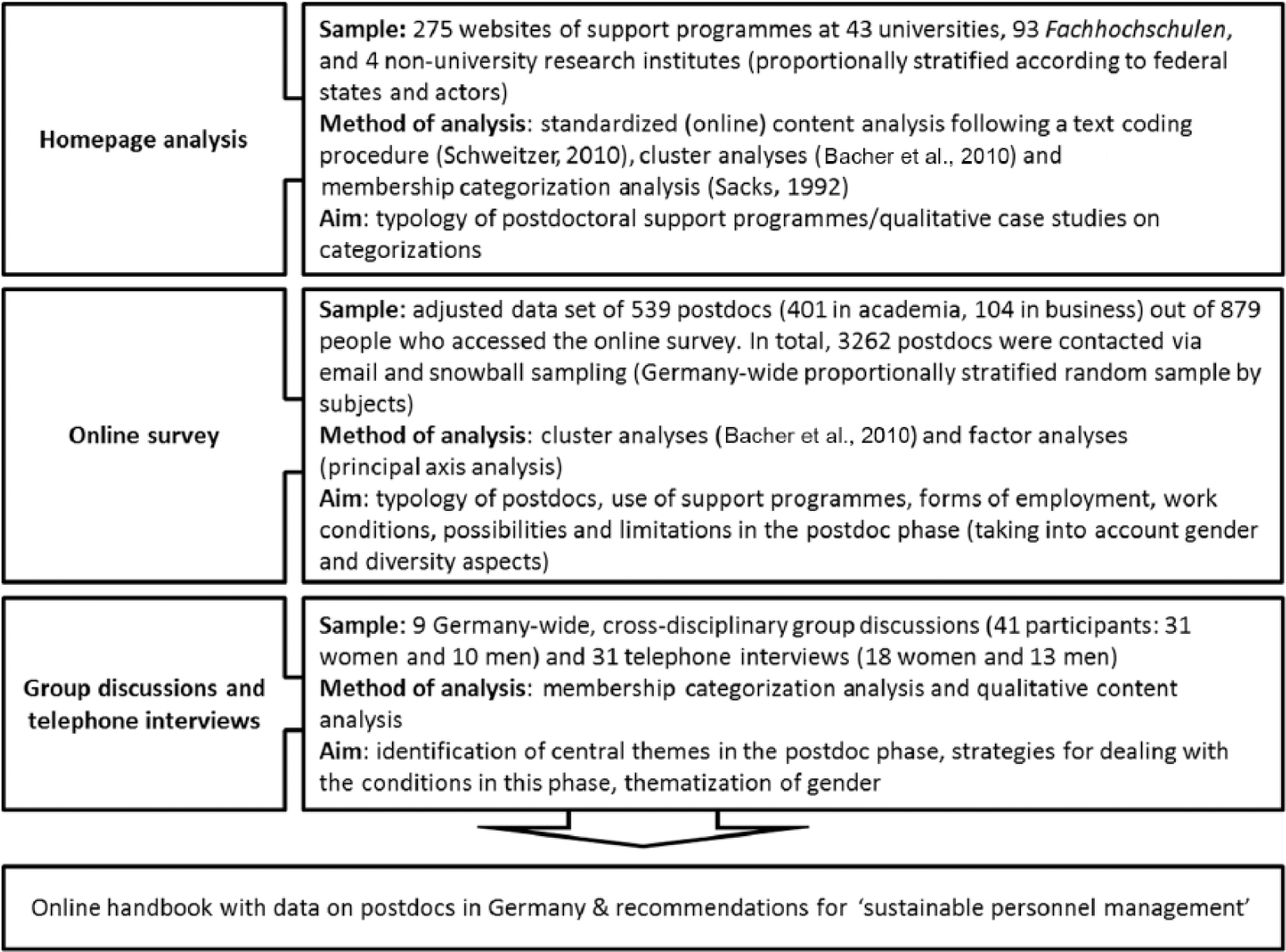
Study design of the project ‘Chance: postdocs’.
The German postdoc – descriptive results of the online survey
The data basis for the following analyses is our standardized Germany-wide and cross-disciplinary online survey of postdocs. 2 The focus of the survey was the living, working and employment conditions of postdocs in the German system of higher education and research. In addition to this, however, we were also able to give an overview of the group in Germany, something about which little is known so far.
In total, 879 people accessed the questionnaire, and 423 respondents completed it in full. For the subsequent analyses, however, we also accepted questionnaires that contained a small number of missing values, or had not been filled in quite to the end, thus allowing a somewhat larger sample. After adjusting the data, we ended up with an analytical data set of 539 cases, in which the number of missing values was still acceptable in statistical terms.
Table 1 shows the socio-structural information given by the postdocs surveyed.
Socio-structural information on the sample.
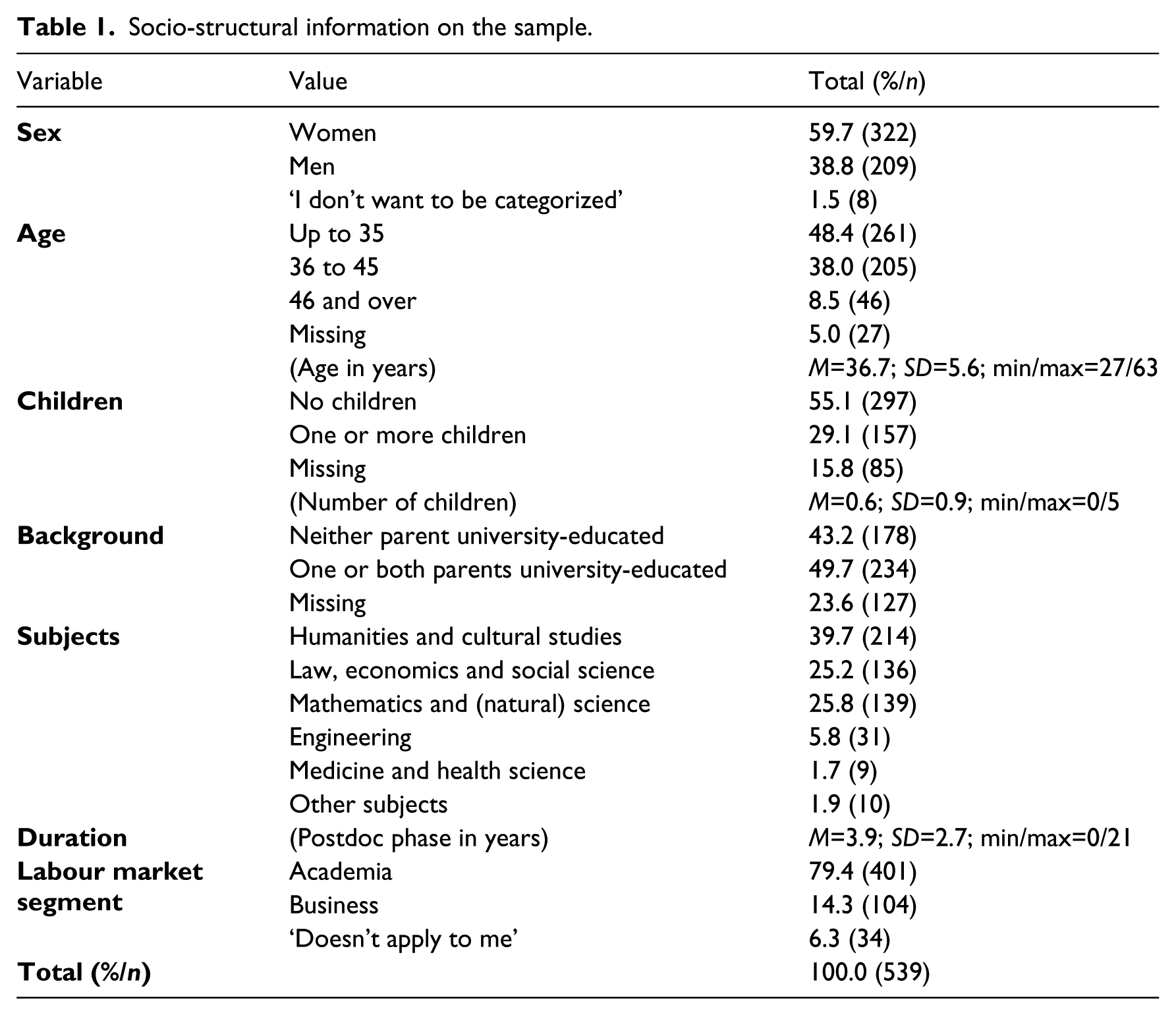
A first glance at the descriptive results of our survey shows that, percentage-wise, more women (59.7%, n=322) than men (38.8%, n=209) took part in the survey (see Table 1). The average age of the postdocs in our sample is 37 years (M=36.7; SD=5.6; min=27; max=63). On average, the postdocs have one child (M=0.6; SD=0.9; min=0, max=5), with a slightly higher proportion of ‘childless’ postdocs in academia (56.9%, n=228) than in business (51.9%, n=54). With regard to the social origins of the respondents, virtually no differences can be identified. The ratio of respondents with university-educated parents to those who have no parent with a university degree seems relatively balanced (43.2% and 49.7%).
The distribution of the survey participants over the different disciplines shows that nearly 40% identify with the humanities or cultural studies (39.7%, n=214). A further quarter stated that they had completed their doctorate in law, economics or social science (25.2%, n=136) and another quarter in mathematics and the natural sciences (25.8%, n=139). Engineering accounts for around 6% (n=31) of our sample. The categories of medicine and health science (1.7%, n=9) and other disciplines (1.9%, n=10) are the least represented, with just under 2% each.
The descriptive results of our survey also show that the postdocs who responded had an average ‘length of stay’ in the postdoc phase of around four years (M=3.9; SD=2.7; min=0; max=21), but that a quarter of these postdocs had been in this ‘phase’ for far longer than four years.
The sample of 539 is made up of 401 postdocs from academia and 104 doctorate holders from the business world; 3 34 respondents could not be clearly categorized.
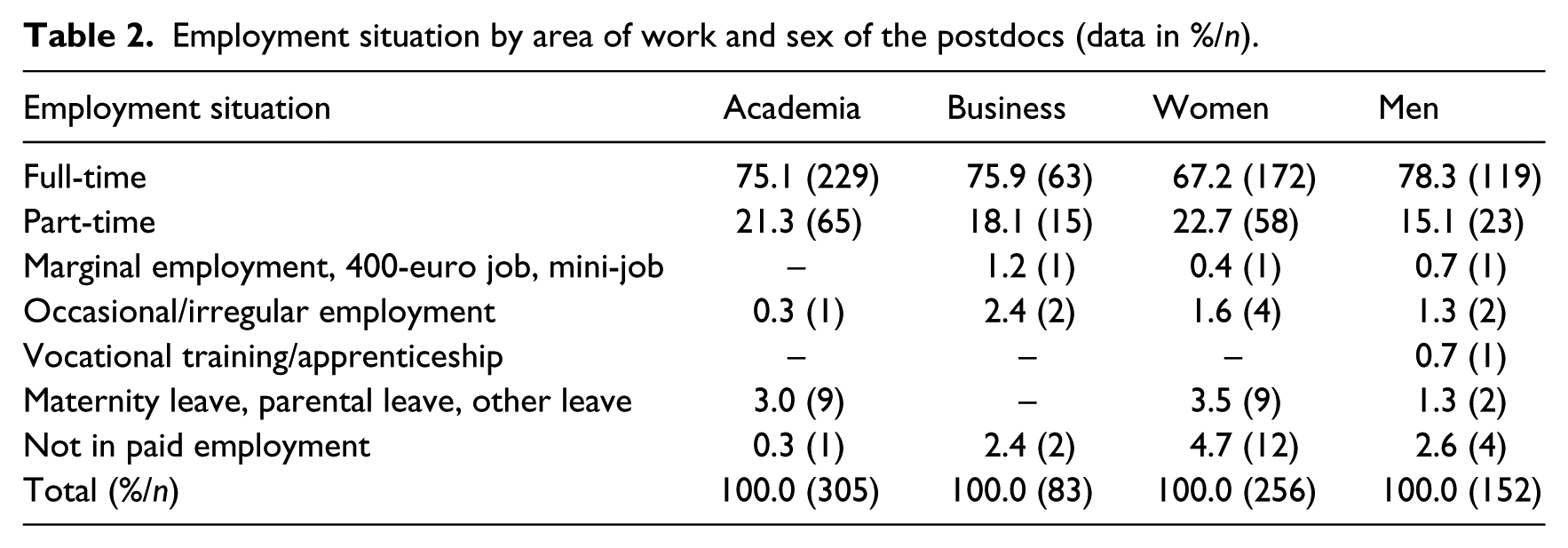
For further comparison, a distinction was made between these two fields of work and the employment situation of postdocs within them (see Table 2). In this respect, the results show that the employment situation for the majority of the postdocs, 75%, takes the form of full-time positions, followed by part-time positions at around 20%. Other types of employment situation make up only a marginal proportion. At the same time, a comparison between the sexes confirms findings from other studies, e.g. Lind (2006), in which it was observed that female academics are more likely to hold part-time positions (23%) than their male colleagues (15%).
Employment situation by area of work and sex of the postdocs (data in %/n).
A second important aspect of the standardized survey of postdocs was the question of how they perceived and utilized the support structure at their universities and research institutes. For this, the postdocs were asked in the online survey about support programmes that were known to them, used by them, or not offered (at their academic organization) (see Figures 2 and 3).
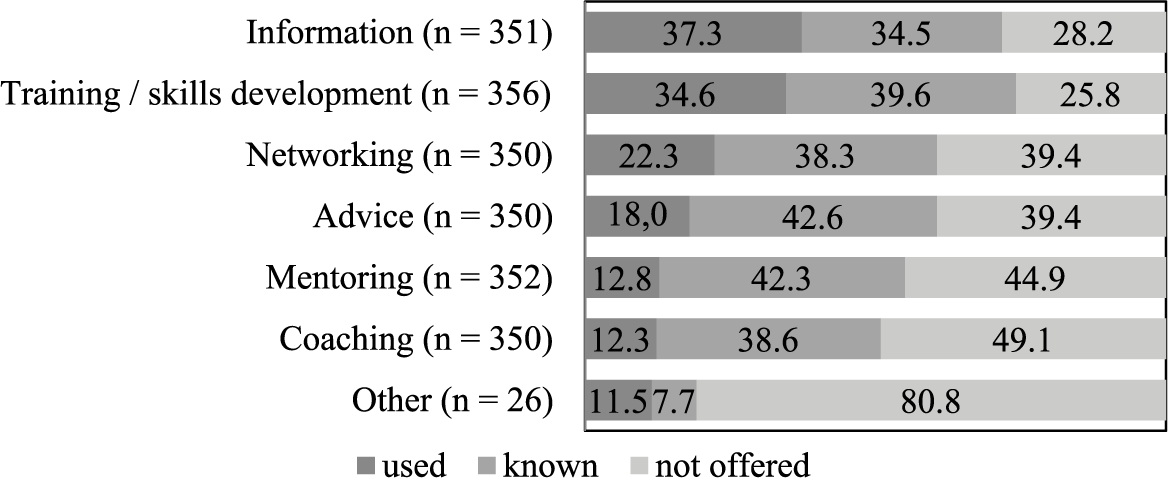
Non-financial support programmes for postdocs (%).
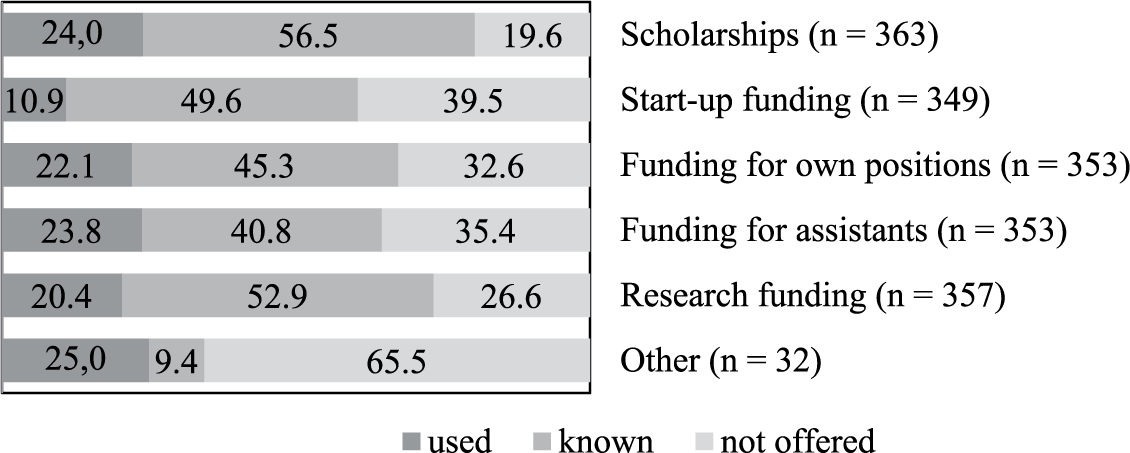
Financial support programmes for postdocs (%).
A first glance at the non-financial programmes (see Figure 2) shows, on the one hand, that a good third of the postdocs in the survey have made use of support measures such as ‘information’ (37.3%) or ‘training and (skills) development’ (34.6%). Around one quarter of the doctorate holders (22.3%) have used programmes offering ‘networking’, while advice services and mentoring or coaching programmes are used much less often. On the other hand, the results also show that certain programmes, particularly those offering direct support, such as ‘coaching’ (49.1%) and ‘mentoring’ (44.9%), or ‘networking’ and ‘advice’ (39.4%), are not offered at the respondents’ academic organizations. Thus, these postdocs do not have the option of utilizing this kind of support.
A similar picture emerges for the financial support programmes (see Figure 3). Here, too, it becomes clear that up to about a quarter of the postdocs surveyed have used the financial support offered, e.g. ‘scholarships’ (24.0%), ‘start-up funding’ (Anschubfinanzierung) (10.9%), ‘funding for positions’ (22.1%) or ‘research funding’ (20.4%). A large percentage of the respondents, however, stated for nearly all the categories that this type of financial support was not available at their academic organization.
We were also able to find indications of gender-specific use of support programmes. Table 3 presents the use of non-financial support programmes, comparing men and women. It becomes clear that in percentage terms, more female postdocs are making use of the services offered in the German support and funding landscape. The only significant difference, however, is in the use of mentoring programmes (Chi² (2, n=352) =9.09; p=.01; Cramer’s V=.16). This significant difference can be explained by the fact that mentoring programmes in Germany are usually a support measure targeted specifically at women (Böhringer et al., 2014). But information services and coaching programmes are also used more (almost significantly more) by women.
Utilization of non-financial support programmes (%/n).
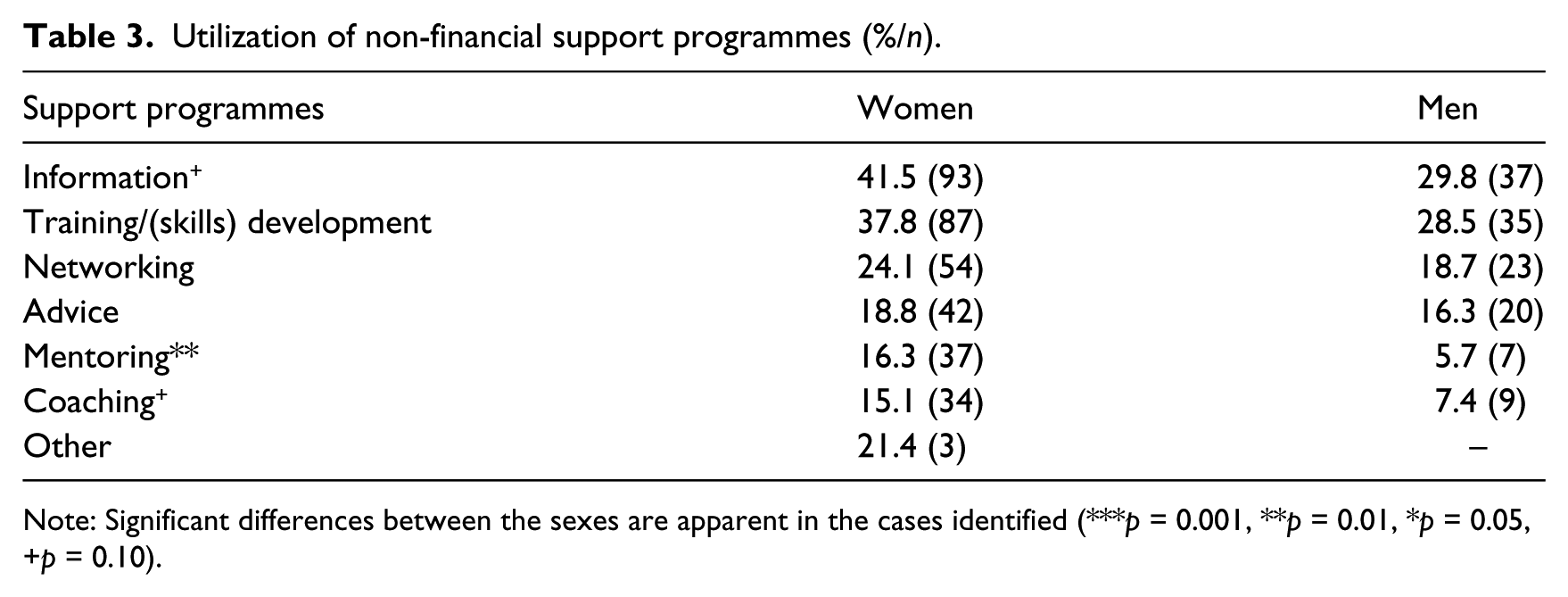
Note: Significant differences between the sexes are apparent in the cases identified (***p = 0.001, **p = 0.01, *p = 0.05, +p = 0.10).
When it comes to the utilization of financial support programmes (see Table 4), however, it can be observed that the percentage differences between women and men are less marked, and that the only significant difference that can be identified between men and women is in the funding of positions for assistants (Chi² (2, n=353) =6.23; p=.05; Cramer’s V=.13).
Utilization of financial support programmes (%/n).
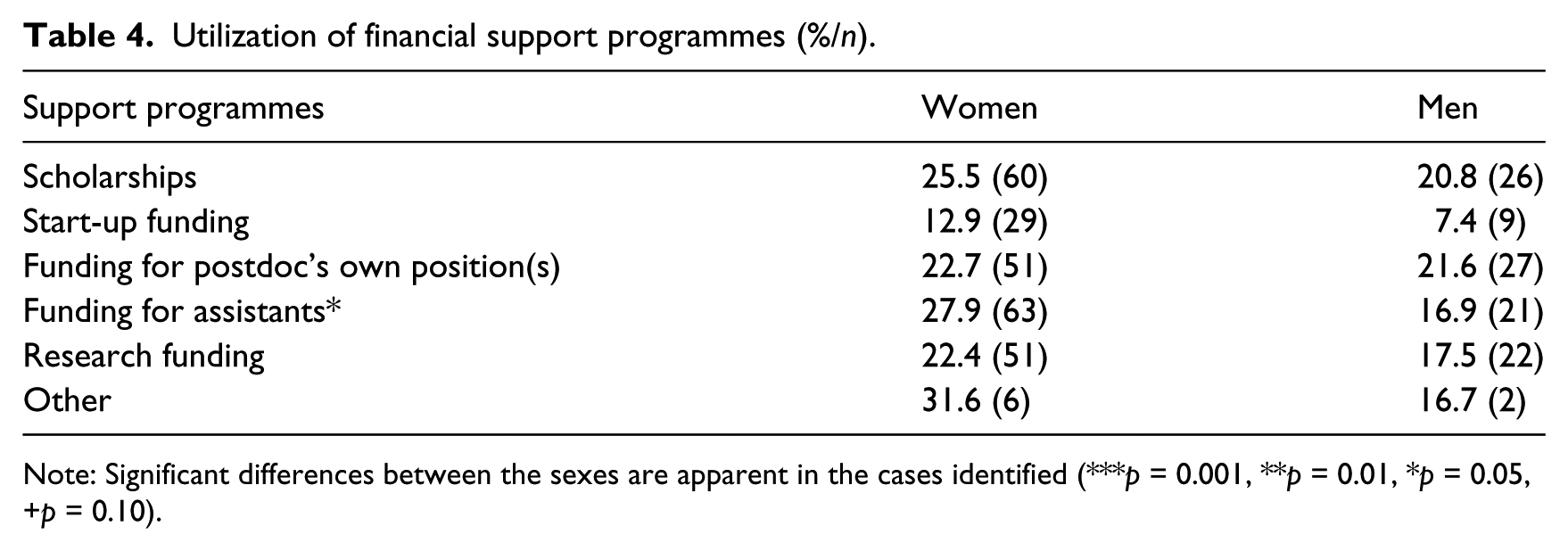
Note: Significant differences between the sexes are apparent in the cases identified (***p = 0.001, **p = 0.01, *p = 0.05, +p = 0.10).
It can be observed, then, that women seem to use the support and funding landscape differently to men. Overall, the percentages of female early-career researchers using support/funding programmes are higher than among their male colleagues. However, the men make greater use of financial support programmes than non-financial ones.
According to these findings, this is not simply a matter of a support or funding landscape that is ‘specifically aimed at women’, as shown by the mentoring services; instead what we see here is a ‘gendered’ usage of the German support landscape. This finding may certainly be viewed in a critical light. It is not particularly surprising that those support measures especially designed for women, such as mentoring (Böhringer et al., 2014), are in fact used by women. At the same time, one might ask whether it makes sense to maintain a special support pathway for women which is largely based on the voluntary work of female mentors, and is usually underfunded, as well as working on an assumption of deficits (women do not have adequate networks in the academic world). A further factor is that these programmes, contrary to public perception, are only actually available to a limited extent (Böhringer et al., 2014), but have a considerable symbolic impact. This may be a deliberate strategy of funding policy, but it means that all women have to be prepared to justify this ‘preferential treatment’.
Postdocs’ understanding of support
In the group discussions, the postdocs had the opportunity to formulate their own understanding of support. Asked whether they received support in their everyday lives, most were able to answer ‘yes’. As the group discussions continued, different forms of support came to light. Support provided by and at their particular academic organization in the sense described above is only one part of what the postdocs see as support.
Structural support offered by programmes at the individual institution
With this form of support, the postdocs focused on services available at their particular institution which they were able to access or utilize. These include, for example, forms of financial support for student assistants, or perhaps coaching or language courses. It is striking that these types of support are rated much more highly than reciprocal forms of support by colleagues and networks. Are they useful or not, and how much effort is required in order to access them? There are, firstly, programmes that can be quite superfluous (e.g. prizes for dissertations), because they may bring honour and public visibility, but do not give access to any (career) prospects and are underfunded. Programmes are also viewed critically if the administrative effort required is high, and the amount of funding that can be obtained is low. Financial assistance for conference attendance, on the other hand, is regarded as absolutely necessary by all the respondents, but is not guaranteed everywhere by adequate departmental or institutional funding. It is striking that there are specific programmes, most notably coaching and mentoring, which are missed if they are not available. It is mainly women who make this observation, or who universally rate them – if they are available – as positive, because they help to make the academic ‘rules of the game’ more transparent, or open up career options. At the same time, however, the postdocs realize that such programmes cannot remedy the structural problem – i.e. that there are too few permanent positions – and may actually exacerbate the problem, because they encourage people to stay in academia for longer. In the following extract Carolin and Mareike refer to a dilemma inherent in fostering postdocs. Support and fostering keeps more researchers in the academic system and therefore ensures that there are always enough candidates in the competition for a professorship. This might be good for the meritocratic system, but for those who are in the competition-based system it means that there are more and more (‘five more’) competitors.
CAROLIN: […] Or if you support postdocs, you foster young researchers on that level, which on the one hand is good for competition, and for the, well, [making sure] that really only the best are selected so to speak, to get professorships, so, on a macro-level, in terms of society, that may be good. [Laughing] I personally think to myself: Okay. But that does mean MAREIKE: five more. (Group discussion 1)
It also becomes clear that there are gaps which are poorly covered or difficult to cover with support programmes. In the area of mobility, for example, it is precisely the internationally mobile postdocs who observe that frequent relocations present major logistical, financial and social challenges, which the universities concerned do not provide sufficient help with – in the form of support programmes or financial assistance.
Support based on collegiality and networking
Firstly, a distinction is made between collegial support given in the everyday work context, and that which is available in inter-institutional networks. Here it is seen as important and helpful to be able to exchange information about practical questions of everyday work (for example in teaching), or about implicit skills required in academia (e.g. writing applications). But participants also mention the opportunity to talk with others in relation to ‘mental health’, especially in the light of the precarious working conditions for the Mittelbau (non-professorial academic staff). Collegial forms of support are rated as extremely valuable, necessary and helpful. In general, the question of competition (for the few permanent positions) tends to be played down, and associated with the phase of actually applying for professorships. Collegial communication and networking are very much based on personal initiative, and on the willingness to get involved oneself (reciprocity). This form of support, which is universally seen as positive and necessary, is only backed by institutionalized forms of support – if at all – when it comes to establishing formal networks.
Support from family, partners and friends
Support from friends, acquaintances, partners, parents and family is mentioned by all the postdocs, but the particular importance of this kind of support is mainly emphasized by those who have children. In these cases, it is regarded as absolutely essential. It fills in the gaps in other professional support services, but it also requires maintenance, and is based on reciprocity. The following extract from group discussion 1 makes clear that there are subtle differences within the private support system. The partner may be seen as someone who ‘keeps the kids busy’ without expecting anything in return, just because he/she is the partner. However, friendship ties need to be maintained; they are grounded in the reciprocity of help.
SABINE: In my case it’s just not possible without help and support. Well, even if it fell through again today, but if you want to do this as a mother, you need people around you who take the children off your hands once in a while. And whether it’s your partner, and I’m really glad that I have one who actually does that, who’s going to somehow keep the kids busy again in the weekend, so I can write a bit more, or a social circle, and I always find that difficult, because you have to invest time so that it works, you know? You can’t say: ‘Here are my kids, and I won’t do anything for you’, or something like that, you have to invest in those friendships too, so that the children get taken off your hands once in a while. (Group discussion 1)
Private support can take different forms: it can, for example, consist of financial assistance, or of conversations with one’s partner which help to relieve stress. Chatting about the experiences of others is also mentioned here. Support from family and friends can turn negative, however, if it leads to (financial) dependency, and is detrimental to one’s own autonomy.
Support from individuals
Not only institutionally based programmes, but also – primarily – individuals in the work environment are cited as (potential) sources of support. Here a distinction is made between two groups: line managers and mentors. Mentors, in particular, are only cited as sources of support by women; men do not mention this kind of support relationship. This, then, is further evidence of the above-mentioned phenomenon of a female support model. The support relationship with line managers is described as complex, and covers the following areas: provision of departmental funds for conference attendance; feedback on articles; discussion of career prospects and introduction to the nature of work in the academic world. The relationships with their line managers which the postdocs describe cover the whole spectrum. In particular, impending parenthood is an important transition point in their professional biography, in which line managers can prove to be supportive or obstructive. Managers are seen as supportive if they devise suitable arrangements for working hours, and look for and find follow-on funding. Conversely, of course, it is obstructive and unlawful if managers refuse to extend contracts because of pregnancy, or present pregnant postdocs with cancellation agreements. Overall, the line managers seen as supportive are those who allow professional and geographical continuity (by means of third-party funded projects) despite fixed-term positions.
Lack of support: work–life interferences in scientific careers
As well as an appreciation for support and support programmes, the statements of the postdocs also show that there is a fundamental gap which is not addressed by programmes or individual support: the organization of everyday life (‘alltägliche Lebensführung’, Voß and Weihrich, 2001) is a central problem in the postdoc phase (as well as in other phases). In this period, life constructs become more complicated due to parenthood, or in some cases couple relationships. As we know from dual-career research (Behnke and Meuser, 2003), it is usually women who have to bear the main burden of organizing everyday life. In the group discussions presented here, no couples were questioned, but statements from the female halves of dual-career couples make it clear that there is a broad area of life that is not addressed (and cannot be addressed) by formal support. In their work on the organization of everyday life, Voß and Weihrich (2001) point out that the ‘relationship between all a person’s activities in the different social spheres relevant for that person […]: paid employment, family and housework, leisure and recreation, educational activities’ (Voß and Weihrich, 2001: 10) requires its own kind of construction work. The result, the organization of everyday life, is a ‘construction that each person has to make for himself/herself’ (Voß and Weihrich, 2001: 11).
The statements of the postdoc respondents illustrate this very well, especially when it comes to the coordination of career and family: the two can be combined, and can be aligned in time and space, as described in the following statement by a female postdoc. Her partner is also an academic in the same discipline, and they have a daughter together, who is not yet of school age: NINA: And my daughter was at her first conference when she was three weeks old, and she just always comes with us. But that’s just what I have to do, and all the costs and so on, you just always cover them privately. And for the child, she’s still very, very small now, but of course, as soon as she goes to school […]. (Group discussion 4)
Her statement hints that the usual arrangement is ‘threatened’, because in future the daughter’s compulsory school attendance will mean that she has her own spatial structures, which will need to be taken into account when organizing their lives.
The problem of reconciling career and family is well known, but – as the following extract indicates – this constitutes work, and the organization of everyday life is a constant feat of construction: MAREIKE: […] I think, when you always have to organize everything yourself, organize your whole day-to-day working life and your whole day-to-day family life, then sometimes I think it would be nice if you could just sit down somewhere, and someone would support you, [laughs] without you having to organize it yourself. (Group discussion 1)
This work takes quite specific and sometimes unpleasant forms, as Nina describes with regard to her daughter’s conference attendance: NINA: […] so now in two weeks/ in three weeks I’ll be travelling to the USA for seven weeks, I still haven’t told the nursery, because they’re going to look at me, the child’s being taken out again and [laughing] put back in again, I’m really scared, [laughing] that I’ll look like a bad mother. (Group discussion 4)
Conversations must be had, the child’s absences must be explained and arranged, and, above all, the daughter’s re-entry into the nursery has to be ensured. Among the discussion participants, it is mainly the women who present ‘the caring about care’ 4 and the organization of everyday life as their work.
Voß and Weihrich (2001) point out that the organization of everyday life develops in a certain inner logic, and a certain unquestioned self-momentum, which makes things easier for the actors in their everyday life. This only partially applies to the postdocs questioned. In their self-representation, the women in particular are constantly adapting the organization of their everyday life to the inner logic of the academic system. They relocate, for example, if this is necessary for further career prospects. Thus, the organization of everyday life is something that is constantly being re-examined; this also applies to postdocs who do not yet have children. The topic of ‘moving’ is one that demands an especially large amount of time and energy: MARIA: There was no financial assistance when I moved to ‘[town Neustadt. Lots of other help, but it wasn’t that much use. I had help from the Welcome Centre, to find a place to live, a meeting with a student assistant once a week. But that isn’t enough, you have to look every day, not (laughing) every week, and it took six months before I found permanent accommodation, and until then I moved six times, from one sublet to another sublet, and in those six months I could hardly get anything done on my work. (Group discussion 4)
Maria describes her experiences after her move to ‘[town Neustadt’. The work–life interference seems to have been very strong at this point in her career. She had to manage two parallel tasks: working and finding accommodation. Though she had help from the university – a student assistant – while looking for accommodation, it was nearly impossible to manage this while working. Neither her work nor her search was very productive at this time. Her experiences draw attention to the fact that sometimes it is not possible to organize everyday life effectively while working, especially if people are alone. Moving seems to be a critical point in this regard. It is barely possible for an ‘established lifestyle’ to develop under these conditions (Voß and Weihrich, 2001: 11); any arrangements that do emerge become long-term makeshift solutions. Overall, the respondents focus more on the frictions of everyday life, not so much on the broader perspective of the division of labour between the sexes, with the question of its relevance for career options. The organization of everyday life is not an area addressed by support programmes, and is left to the inner life of social (couple) relationships. The respondents do not evoke this as a deficit; instead, the women in particular see the reconciliation of different areas of life as their task. This becomes particularly clear when they fantasize about being relieved of the burden of organizing everyday life, as in the following longer extract from a group discussion:’ in the quoted material and ‘Maria describes her experiences after her move to a new institution’ in the text.]
DOREN: Well I’d often talked with colleagues, male and female, and what we’ve always ended up with at some point is that what you actually need, in order to pull off an academic career fairly safely, what you’d ACTUALLY need, is a wife. MARIA: [Laughs] Yes. DOREN: Yes, and in this absolutely classic sense. SANDRA: Classic. LINDA: Exactly. DOREN: And the system is really based on you not having to do the things that a classic wife does. LINDA: Exactly. DOREN: So if you wanted to do this career as a woman, you’d actually need a wife. Maria: Yes. [Laughter] DOREN: And or, well I know, in your case of course, if you’re both doing it, you have to work it out some other way, don’t you? LINDA: No, but we do actually we have made jokes– DOREN: That you [unintelligible, simultaneous talking]. LINDA: It’s not politically correct, but we should look for a wife [unintelligible, simultaneous talking]. [Laughter] (Group discussion 4).
Here the postdocs express very clearly what is needed in order to further an academic career: someone who takes over the work of organizing everyday life. This is discussed jokingly here, but with a serious background – they do not see this as an option for themselves, otherwise it would not be a joke – what they are referring to here is a wife ‘in the classic sense’. This extract indicates that the postdocs see the competitive advantage which a gendered division of labour within personal couple relationships can give.
Self-positioning strategies of postdocs in a precarious academic system
On the one hand, it becomes apparent in our interviews that the concept of ‘scholarship as a way of life’ is a significant theme for the postdocs. There is also, however, another side to this – a movement away from this concept, and towards a life in academia which is not dedicated solely to the profession, but demands space for everyday things and duties – outside of academia. But how do postdocs deal with the fact that one has to show a high level of commitment and achievement, despite extremely slim chances of a long-term academic career? Despite their passion for scholarship, and their knowledge of the high standards they must meet, the participants in the group discussion (men and women) were able to assess their chances quite realistically, and could see the disparity between the number of potential applicants and that of advertised professorships. They regarded both their options for leaving academia and their chances of promotion within the academic organization – i.e. appointment to a permanent professorship – as problematic.
CAROLIN: Exactly. [laughing] Support [unintelligible] [laughs]. Here, it was all a bit more Darwinist, [laughing] whoever dominates wins the race? But it’s… Well, the problem is actually, when you as a postdoc turn 40 at some point and don’t get a professorship, then you really have the worst possible deal, I think, from an economic point of view. Because you can’t continue to be employed, the positions in academia or in management that can be made permanent are really rare. (Group discussion 4)
This quote from a female postdoc makes the situation of postdocs in Germany especially clear. The phase is defined by a structurally ambivalent position ‘between career prospects and tendencies to drop out (Abbruchtendenzen)’ (Grühn et al., 2009).
The result of this ambivalent position, which has been described as a ‘biographical balancing act’ (‘biographische Spreizung’, Dörre and Neis, 2008: 139), is also revealed in the subjective processing of the postdocs questioned. The work situation of many (most) postdocs in Germany meets virtually all the objective criteria for precarity; hence, early-career academics often limit their planning perspective to the current status passage (Baader and Korff, 2015; Krawietz et al., 2013: 671). Among other things, they set themselves time limits – ‘deadlines’ – as the following extract shows: CORINNA: […] And I also set myself a deadline, and said: if, within two years, I haven’t found some sort of job, or I don’t feel as though I’m getting anywhere, then I have to find a new direction. Because it’s just not possible. You can’t just slog away all the time, and not get anywhere. (Group discussion 6)
According to this extract, the planning perspective of this participant in a group discussion covers the next two years. She wants to use this time, which she has set herself as a ‘deadline’, to climb up the next step on the higher education career ladder. It also becomes clear, however, that this postdoc is considering the idea of a change in vocational direction, and will if necessary leave academia if, despite ‘slogging away’, she cannot survive ‘random hazard’. However, the negative factors of the work situation are partially cushioned by a slim hope of better prospects after crossing the next threshold, by interpreting the situation as a necessary developmental phase, and above all, by passion for and enjoyment of academic work: ELLEN: Yes. Somehow recently I’ve been thinking a lot about just giving it up, simply from sheer exhaustion, and then I’ve always thought, well, what else could I do? And I’ve always realized that I actually like doing it. I love teaching, I like writing texts, I like lecturing too, when I have the leisure and the time to do a reasonably good job of it. I really enjoy the job. And these surrounding circumstances REALLY get me down. [Laughs] I can’t put it any other way. And that’s a problem. And if the Mittelbau [sub-professorial level of academic staff] were still there, I don’t need the ‘professor’ sign on my front door. In terms of status, I don’t care about that. (Group discussion 5)
It becomes clear here that Ellen feels an enthusiasm for academic work, but that it is the circumstances that ‘get her down’ (German: ‘machen mich fertig’). What is being evoked here is the fact that the personnel and employment structures in the German academic system preclude any security within the system, given that permanent academic employment in the German higher education system is almost exclusively linked with the holding of a chair (Dörre and Neis, 2008: 128). Besides this, the numerical ratio of the sub-professorial level of academic staff (wissenschaftliche Mitarbeiter_innen) to professors is extremely unfavourable, especially in contrast to other industrialized countries (Kreckel, 2011). There is also the question of whether the postdocs actually want this, as the extract from the group discussion shows. Ellen, at least, states that she does not need a ‘“professor” sign on [her] front door’; she would prefer a position in the Mittelbau (i.e. as a non-professorial academic).
Postdocs find themselves in the ‘rush hour of life’. The ‘higher education’ career path, however, is difficult to reconcile with transitions in other areas of life, given that the stabilization of their professional role, and perhaps their advancement up further steps on the career ladder, often fall into the same stage of life as starting a family. Career conditions in higher education are very difficult to reconcile with parenthood. Studies show that young academics in Germany show a level of childlessness that is presented as dramatic – especially in comparison to other population groups with academic qualifications. Cases of ‘belated’ parenthood lower the rate of childlessness, but considerably more than half of all women over 42 working in higher education are childless, as are half of all men in this age group (Krawietz et al., 2013: 672). Yet this situation, which applies generally to all career phases in higher education, seems to be particularly pronounced and intense in the postdoctoral phase: ELLEN: And I believe that age also plays a role, because of course so many […] DICHTHEITSPHÄNOMENE [phenomena of intensification/compression] come together in this phase. Yeah well so then really the um ‘honeymoon is over’, but then (laughs) there’s the question, children or not, […] maybe some people already have parents who need care. So, there’s simply a completely different pressure, in the worst case a completely different family pressure, and all at the same time, when you’re really in a phase, where a six-year rule, a second one comes again, and then there’s time pressure again too. And I think that for many people […] that causes, more or less explicitly and strongly, that feeling of being in a race […] and also that feeling of no longer really being free to decide what you’re doing. […] I can imagine that that’s a problem that many people have. […] And strangely enough I also feel as though I’m in a race, [laughing] although I don’t have children or parents in need of care. But this […] it’s like another clock that’s ticking. It may not be so much the biological clock for women who absolutely want to have kids straight away, but it is nonetheless a sort of clock ticking away and where you think: ‘Okay, and once it’s run out, then I’m in my mid-forties, and if it hasn’t worked out by then, what do I actually do then?’ (Group discussion 5)
We can read these statements as clues to why women leave the system of higher education and research in greater numbers in the postdoc phase, even if they actually enjoy the job and see it as fulfilling their talents. When we look at the exodus of female academics, it becomes clear that the employment conditions at German universities are one of the reasons why women leave the academic career path, despite having sufficient potential to stay – women who are unwilling to submit to the demand for absolute dedication to scholarship (Jung, 2011; Metz-Göckel et al., 2010: 8). This would suggest, though, that issues around starting a family or reconciling academia and family are not the only reasons why more women not only think about leaving, but actually do leave the academic system in the postdoc phase, even though they now constitute a high proportion of those completing doctorates.
Summary and conclusion
Equal opportunities between women and men is not a core issue in the promotion of postdoctoral researchers in Germany. Instead, it tends to be addressed indirectly via a colourful array of compensatory programmes. By compensating for (female) obstacles, support programmes are supposed to ensure equal opportunities, and therefore equal outcomes, for career paths, thereby facilitating ‘initial equal opportunities’ en route to a professorship. They are supposed to remove obstacles to promotion based on, for example, resources (money, time, etc.). The principle is supported at the level of education policy by the prevailing perception of equal opportunities as equality of opportunities in competition and promotion. Ideally, resources are allocated according to individual performance (e.g. Flitner, 1985; Hopf, 2010; Jansen, 1994).
In relation to the question of ‘equal opportunities and gender at German universities’ in the postdoc phase, the following results of our study are relevant. One key finding was that certain support programmes, such as ‘coaching’, ‘networking’ or ‘mentoring’, are not offered everywhere; this is also true of financial support programmes. Many postdocs therefore do not have the opportunity to utilize this kind of support. Furthermore, we found evidence of a gender-specific demand for support programmes. It becomes clear that, in percentage terms, more female postdocs are making use of the services offered in the German support and funding landscape. The only significant differences, however, are in the use of mentoring programmes. These significant differences can be explained by the fact that mentoring programmes in Germany are usually a support measure targeted specifically at women (Böhringer et al., 2014). However, information services and coaching programmes are also used more (in fact, significantly more) by women. This finding may certainly be viewed in a critical light. It is not particularly surprising that those support measures especially designed for women, such as mentoring (Böhringer et al., 2014), are in fact used by women. At the same time, one might ask whether it makes sense to maintain a special support pathway for women which is largely based on the voluntary work of female mentors, and is usually underfunded – as well as working on an assumption of deficits (women do not have adequate networks in the academic world). A further factor is that these programmes, contrary to public perception, are only actually available to a limited extent (Böhringer et al., 2014). These findings in the standardized part of our study on patterns of usage among postdocs should be given critical consideration in the context of the qualitative results from the group discussions: the participants are missing aspects of everyday lives in formal programmes. It is therefore possible to say that support programmes possibly do represent a plus for career advancement, but at the same time participation in these programmes is generally in turn associated with additional work and time consumption. Financial support, in particular, generally involves a laborious application process (the outcome of which is not guaranteed), and participation in a mentoring programme means women have to make time for it. In this respect, we can justifiably ask whether support programmes without inherent career prospects actually create additional work that has to be integrated into everyday life. Once again, we come back to the (unspoken) demand in academia that individuals demonstrate a ‘particular inner attitude’ in committing to this path (Beaufaÿs, 2015: 50). One aspect of this is that ‘mundane’ elements of everyday life are treated as secondary to ‘higher’ academic tasks and academic social practice.
The theme of equal opportunities is hardly mentioned in this phase, although it is highly significant for the exodus of women from the academic system, as we know from the ‘leaky pipeline’ phenomenon. The absence of a discourse on equal opportunities distinguishes the discourse on the postdoc phase from the official discourse in education and research policy about the structured doctorate, which was linked with hopes that transparent structures would provide better support for women. The postdoc phase has, overall, very little structural underpinning; instead, it seems to be left to ‘random hazard’ or ‘random self-organization’ or ‘self-selection’. In the restructuring of the higher education and research system over the last few years, this phase has been ‘covered up’, and not endowed with prospects (Team Chance, 2013). So far there are only very gradual signs of a rethink about this. Programmes for supporting postdocs do exist, but these are utilized differently by men and women. The insight that the use of these programmes is ‘gendered’ is a further relevant finding of our study. It suggests that aspects of the ‘gendered university’ (Acker, 1990) are taking effect here too. Even beyond different forms of use of support programmes, the postdocs are not a homogeneous group, as our study shows, for example with regard to the length of their stay in the postdoc phase. However, research policy in Germany addresses them as if they were homogeneous. The heterogeneity of this group needs to be taken into account in current reflections on the reform of this phase.
Nor do the existing support programmes seem to take into account the heterogeneity of this group. Overall, our study offers indications of why more women leave the academic system, or think about leaving it, in this phase. This has much to do with the structures of the academic system, and not with the women’s qualifications and skills. An increased exodus cannot be explained solely by the problem of reconciling family and work, but is also linked with the construction of ‘scholarship as a way of life’ demanding a ‘particular inner attitude’ (Beaufaÿs, 2015: 50) on the part of the organization, with precarious fixed-term contracts that extend into the middle of life, and with increased pressure in a more competitively organized academic system. Exhaustion, ‘intensification’, ‘pressure’, ‘time pressure’ and an ongoing ‘feeling of being in a race’, as described by researchers in the postdoctoral phase, do not seem to be helping to make ‘academia as a career’ attractive for women, especially not if they see men more successfully negotiating the only remaining career path at German universities: the path to a professorship. If academia as a workplace is to be attractive for women, then we need to develop a ‘gender-fair higher education and academic culture’, addressing the diverse facets of gender inequality in current practice.
Footnotes
Declaration of Conflicting Interest
The author(s) declared no potential conflicts of interest with respect to the research, authorship, and/or publication of this article.
Funding
The author(s) disclosed receipt of the following financial support for the research, authorship and/or publication of this article: The project on which this publication is based, ‘Chancengleichheit in der Postdoc-Phase in Deutschland – Gender und Diversity’ (‘Equal opportunities in the postdoc phase in German – gender and diversity’), is supported by funds from the Federal Ministry for Education and Research (BMBF) and from the European Social Fund of the European Union, under the funding codes 01FP1207 and 01FP1208. The responsibility for the content of this publication lies with the authors.