




Abstract
The assumption that men are more likely to undertake and succeed in an academic career, because the requirements of professional success in this occupation are compatible with normative gender assumptions, particularly that of fulfilling a ‘male breadwinner’ or main household earner role, implying reduced domestic and care commitments, is discussed. It is suggested that Switzerland offers a particularly interesting case for this study, because of the combination of the specific structure of academic careers, the characteristics of the non-academic labour market and the dominant gender regime. It is shown that, in this particular context, the aspirations of postdocs to remain in academic employment or to look for non-academic jobs are directly related to their position within the domestic division of labour and to their personal and family circumstances. However, this does not necessarily lead to a clear-cut divide between work-committed men, who ‘succeed’ (and hence stay), and care-committed women who ‘fail’ to climb up the academic career ladder (and hence leave). The results suggest that the situation is more complex and requires a subtle distinction between different ideal-types of post-doctoral experiences that do not always cut neatly across gender lines.
Introduction
Much recent research on the academic profession from a gender perspective has been framed in relation to the dual notions of the so-called ‘glass ceiling’ and the ‘leaky pipeline’. The former term has been widely used in the literature on gender and academic careers to suggest that, ‘women are more likely than men to leave science at multiple time points from the beginning of college through academic tenure’ (Miller and Wai, 2015: 1). The leaky pipeline approach moves beyond analysis of inequalities in terms of academic career paths, productivity or gendered specialisms, in order to focus on the processes of inclusion/exclusion within a particular occupation or institution (Dubois-Shaik and Fusulier, 2015). Building on a previous tradition of looking at the ‘revolving door’ into and out of academic jobs (Tancred and Hook Czarnocki, 1998), ‘scholars from diverse fields have proposed how specific factors such as cognitive abilities, discrimination, and interests can explain these gender differences in opting out’ (Miller and Wai, 2015: 1).
Many explanations of the specific difficulties that women may face in academia focus on work–life balance issues (Le Feuvre, 2013). On the one hand, research focusing on the organisation of academic work has defined universities and research centres as particularly ‘greedy institutions’ (Coser, 1974; Currie et al., 2000) that are relatively insensitive to the potential family-care and domestic commitments of their research staff. According to this perspective, the androcentric character of academic organisations and a normative model of science as requiring ‘total commitment’ (Case and Richley, 2013: 329) are the main organisational factors that are said to keep women (and the minority of men with caring responsibilities) from reaching the pinnacle of the academic hierarchy (Beaufaÿs and Krais, 2005). This marginalisation often implies difficulties in accumulating the assets needed to obtain a tenured position, based on what some authors have called a ‘Mathilda effect’ (Rossiter, 1993), whereby minor differences – in commitment or research productivity – at strategic points at the beginning of the academic path translate into significant gender differences in terms of final career outcomes (Fassa and Kradolfer, 2010).
Other research has focused more on the subjective experiences of women in the academy and has stressed the difficulties they face in managing the potential cognitive dissonance between the high demands of an academic job and the emotional commitment to family members, including partners and children (del Río Carral and Fusulier, 2013). Some scholars have suggested that it is because women are more likely than men to aspire to a form of dual or combined commitment – to their families and their jobs – that they are disadvantaged in the highly competitive academic labour market (Marry and Jonas, 2005). This hypothesis is supported by another strong assumption – that men are more likely to undertake and succeed in an academic career because the requirements of professional success in this occupation are compatible with the normative gender assumptions associated with fulfilling the role of ‘male breadwinner’ or main household earner.
From this brief summary of the literature it can be seen that the leaky pipeline metaphor is usually based on at least three implicit assumptions.
First, that the exit of PhD holders from the academy is potentially to their disadvantage (i.e. ‘stayers’ have the opportunity to progress to the top of the academic employment hierarchy, whereas ‘leavers’ are deprived of such career opportunities and are ultimately disadvantaged in terms of pay, recognition and/or job satisfaction).
Second, that the potential for achieving a satisfactory level of work–life balance is higher in non-academic jobs than in the higher education and research sector.
Finally, third, that the spill-over effects of academic employment on personal life and family configurations (and vice versa) will have a greater impact on the occupational aspirations and outcomes of women than on those of men.
In this article, we propose to discuss and question these assumptions using the narratives of male and female postdocs in Switzerland. Our analysis is based on secondary analysis of national statistical data and on biographical interviews with a selection of men and women who have occupied a post-doctoral position in a particular Swiss university at some point in their career and who have since left the academy. 1
In the following sections we will study the leaky pipeline phenomenon in the light of several characteristics of the Swiss context, notably the academic career structure, the main features of the non-academic labour market and the dominant gender regime. We will then present an analysis of the postdocs’ aspirations regarding pay and working conditions. Finally, we will analyse in more depth the experiences of the so-called leavers, to identify the circumstances and experiences that led former postdocs to quit their academic jobs, in order to determine the role of work–life balance issues and of gender role assignations in these processes.
The ‘leaky pipeline’ in historical and comparative perspective
Towards a de-standardisation of the traditional academic career path
Given the massive over-representation of men at the top of the academic hierarchy across the globe, it is reasonably safe to conclude that this occupation is still a male bastion, despite increases in women’s share of professorships in many national contexts in recent years (European Commission, 2015; OECD, 2015). It is also clear that, in a wide range of countries, employment conditions for researchers in academic institutions have evolved considerably over the past decades, notably through the unprecedented development of part-time and fixed-term contracts (Ylijoki, 2010; Murgia and Poggio, 2014). These changes to the terms on which academics are recruited have led some authors to announce the emergence of a ‘post-Fordist precarious university’ (Casas-Cortés and Cobarrubias, 2007: 112), where fixed-term contracts and ‘episodic employment’ (Ylijoki, 2010) have replaced the more predictable and stable academic career paths of the (sometimes over-romanticised) past.
However, in their overview of the academic profession in comparative perspective, Christine Musselin and Jürgen Enders noted that academic careers have always been based on a combination of flexible and stable positions. Even in the past, in most national contexts such careers began with a period of ‘apprenticeship and fixed-term positions’ before selected individuals were admitted to the second stage of ‘permanent positions’, usually on the basis of satisfying given criteria for measuring professional performance or ‘excellence’ (Enders and Musselin, 2008: 134). Although the frequency of the transition from first to second stage varied significantly from one country to another (e.g. in terms of the expected duration of the first stage, or the criteria for access to the second stage), it was nevertheless possible to identify a common ‘two-stage pattern’ of academic careers across different national contexts (Enders and Musselin, 2008: 134). However, some authors suggest that an erosion of this two-stage career pattern is currently underway in many countries. Through the widespread adoption of new competitive research funding procedures and individualised performance evaluation criteria (Enders, 2001; Ferlie et al., 2008; Schultheis et al., 2008), it would appear that ‘…the career based on a two-stage pattern is no longer the only one available within the academic profession’ in Western universities (Enders and Musselin, 2008: 134).
The relationship between these changes to academic career structures and the dissemination of so-called new public management principles is open to debate, as is the degree to which the two-stage academic career model has been universally eroded. In some countries, ‘the proportion of traditional permanent positions has tended to diminish, whereas the number of non-tenure track positions has increased’ (Enders and Musselin, 2008: 134). This is the case in the USA, where the proportion of the academic labour force engaged on fixed-term contracts has increased from 43% in 1975 to 64% in 2003 (Ehrenberg, 2006). Similarly, in the UK it has been estimated that by the end of the 1990s, more than 50% of academic staff were employed on fixed-term contracts (Bryson and Barnes, 2000); and in Finland the number of contract researchers increased almost 2.5-fold between 1994 and 2004 (from 2205 in 1994 to 5106 in 2004: see Ylijoki, 2010).
Elsewhere, notably in countries where academics are still employed as civil servants, the erosion of the two-stage model has been less spectacular. In France, for example, the majority of those who ‘survive’ the years of intense competition that follow the awarding of their PhD can expect to progress relatively quickly onto a permanent tenured position, first as Senior Lecturer (in less than 5 years after the PhD), then as full professor (within 12 years). The internal structure of the French academic labour market has thus not changed significantly over the past 25 years (Bideault and Rossi, 2013, 2014; MENSR, 2014), although the duration of the first career stage has undoubtedly lengthened considerably. However, there are only limited opportunities for funding postdocs via a succession of fixed-term contracts within the same institution. According to data from the Ministry of Higher Education and Research, 23.6% of French academics were engaged on fixed term contracts in 2012, as against 19.8% in 1992 (MENSR, 2014). These fixed-term contracts mostly concern funded PhD students and early postdocs (Attachés temporaires d’enseignement et de recherche – ATER) and not those who are more advanced along the academic career path.
Despite variety in the speed and extent of these changes, it has been argued that ‘…the growing external constraints and demands have shaped the ideals, work conditions and practices into a similar mould across all university settings, creating common tensions and challenges in academic work’ (Ylijoki, 2010: 368). In national contexts where such changes have been particularly strong, one can observe that ‘fixed-term staff no longer form a marginal or exceptional phenomenon within academia, but rather the most common and continuously growing group of the personnel’ (Ylijoki, 2010: 368–369). Taking account of these evolutions in a large number of national academic labour markets, we argue that this trend towards the de-standardisation of academic career paths may make the leaky pipeline less of a feminine phenomenon, since some men may abandon any plans for an academic career simply because the entry conditions to this occupation are no longer compatible with a normative, ‘breadwinner’ model of masculinity.
The Swiss academic labour market: a growing PhD and postdoc ‘bubble’
Due to the structure of academic careers, the characteristics of the non-academic labour market and the dominant gender regime, Switzerland offers a particularly interesting case for analysing the implications of the erosion of the two-stage career model for the gendered characteristics of exits from the academic career path. The Swiss university system is based on the ‘Humboldt’ model of organisation, imported from Germany (Kopp, 2014). In line with this model, Swiss universities were traditionally organised around disciplinary faculties and Institutes (Lehrstuhl) chaired by a single full professor. Within this system, academic personnel were traditionally divided into two distinct categories. At the top of the academic hierarchy were the full professors or ‘chairs’, i.e. academics who were employed on a permanent (tenured) and usually full-time basis, to teach, carry out research and to manage the daily running of their Institute. At the relatively lower stages of the academic hierarchy stand the Mittelbau (or corps intermédiaire in French) – that is, PhD students hired as assistants, postdocs or junior academics who are also expected to teach and do research, but who are recruited on temporary, usually part-time, fixed-term contracts and who work under the authority and leadership of a full professor or chair (Musselin, 2009: 23). In order to progress to a permanent position, members of the upper Mittelbau had to wait – sometimes for a very long time – for a permanent position to become available, usually through the retirement – or untimely death – of their immediate hierarchical superior (Schultheis, 2000).
This so-called Humboldtian organisational model is associated with what some researchers have termed a ‘survivor career pattern’ (Enders and Musselin, 2008: 134–135). To reach a permanent position, intermediate level academics had to find the means to survive this long period of precariousness and dependency on their professor and had to accept the constant competition with their peers in the Mittelbau for the opportunity to move onto a permanent professorial position. As Franz Schultheis (2000) has argued, at the end of the 19th century the availability of inherited wealth (or even the financial support of a working wife) was the condition for maintaining what Durkheim had already referred to as the ‘academic proletariat’ of the German university system.
In a context of rapid expansion and internationalisation of its higher education sector since the beginning of the 2000s, Switzerland has started to move away from the Humboldtian model and to experiment with new kinds of junior and intermediate academic positions, whilst to a large extent maintaining their temporary nature. Innovative policies to support the PhD and postdoctoral careers of young researchers have been adopted, notably by the Swiss National Science Foundation (SNSF) (Fassa and Kradolfer, 2013). This foundation, created in 1952, is mandated by the federal government to support research in all academic disciplines, from anthropology to medicine or engineering. Although other research funding bodies exist in the country, the SNSF is the main source of funding for early stage academic careers in Swiss universities. Through the SNSF programmes, tenured academics can apply for project-based research funding (e.g. for buying laboratory equipment, hiring PhDs or postdocs, covering fieldwork expenses), usually for a period of 3–4 years at a time. The SNSF also supports other scientific activities, such as conferences, publications, etc. However, most of the funds provided by the SNSF are spent on scientific support staff (individually or as part of a project team). In 2013, 73% of the funds allocated by the SNSF were dedicated to ‘financing individual salaries and/or fellowships in the context of career funding or for the appointment of staff (including PhDs) to work on SNSF-funded research projects’ (SNSF, 2015: 13).
The (temporary) competitive funding opportunities provided by the SNSF – and other foundations or institutions – have undoubtedly increased the number of PhDs and Mittelbau who are able to undertake the kind of research that will enable them to apply for a professorship at some (distant) point in the future. However, since the number of permanent positions in Swiss universities has remained relatively stable over time (see Figure 1), the proactive support of young academics has led to the emergence of a large PhD and postdoc ‘bubble’ (Theodosiou et al., 2012).
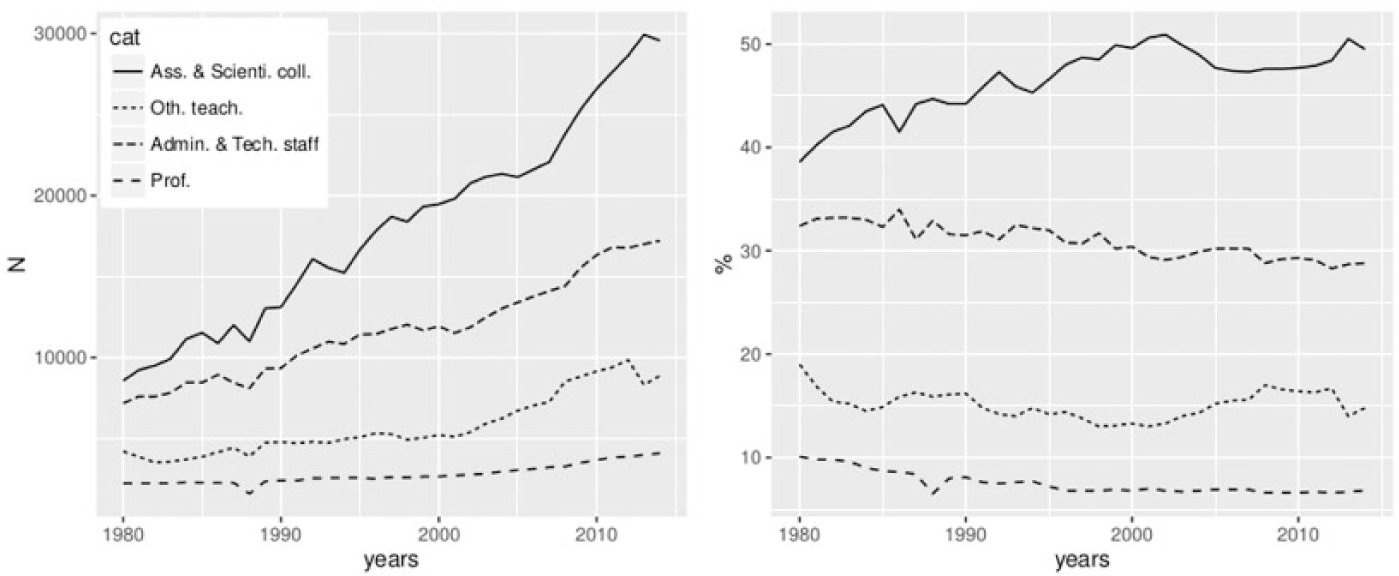
Evolution of Swiss academic staff (1980–2014).
The internal structure of the Swiss academic labour market shows that the number and relative weight of the Mittelbau (i.e. ‘Assistants and Scientific Collaborators’ and ‘Other Teachers’) increased considerably over the period under study. Growth was particularly rapid for the first category, where the chances of being engaged on a fixed-term contract are higher than in any other case. This group, which includes the doctoral students employed as teaching assistants and postdocs, represented almost half of the academic population in Swiss universities in 2014, as against 40% in 1980. This increase is partly due to the fact that the number of (funded) PhD positions has doubled since 1990 (SERI, 2014: 32). However, the number of fixed-term postdoc positions has also increased, to approximately 8000 in 2011 (SERI, 2014: 25). Over the same period, the more stable category of the Mittelbau (other teachers) decreased by 5%, as did the proportion of full professors. The academic career structure has thus become increasingly ‘bottom heavy’ over time. In 1980 there were 4 (temporary) assistantships or scientific collaborator positions for every full professorship: by 2014, this figure had doubled (to 8).
These changes suggest that competition for a permanent professorial position has intensified over the past 25 years. This is compounded by the undeniable attractiveness of Swiss universities for foreign academics, particularly those from the neighbouring countries of France, Germany and Italy. At present, over 45% of full professorships in Switzerland are held by foreigners (Goastellec and Pekari, 2013). For this reason, the country provides a particularly interesting case study for our analysis of the effects of the de-standardisation and increasingly competitive character of the academic labour market on the gendered career and family-care aspirations of young researchers.
The Swiss socio-economic context and gender contract
Because the national environment has a significant influence on the structure of academic labour markets (François and Musselin, 2015), it is important to analyse the wider socio-economic context and normative gender regime in Switzerland, in order to understand better the context in which young researchers construct their career aspirations and employment practices.
Full employment and frequent qualified labour shortages
In the current European climate of high unemployment and economic recession, Switzerland stands out as something of an exception. Indeed, with an unemployment rate below 5% since the end of the 1990s, the Swiss economic context can be described as healthy and stable, especially in comparison to its neighbouring countries such as France or Italy that have been badly hit by the post-2008 economic recession and subsequent public spending restrictions.
One other significant characteristic of the Swiss context is the relative shortage of skilled labour. In comparison to countries like Canada or France, there is a relatively small pool of tertiary-level graduates in Switzerland. In 2011, only 20% of 18 year olds had passed the national qualification providing direct access to higher education institutions, as compared to 68% of French and 51% of Canadians from the same generation (Kamanzi et al., 2014). This dearth of university-educated workers can be partly explained by the social prestige associated with vocational training in the Swiss context and by a highly segregated secondary school system, where selection to the higher education track is highly competitive and occurs relatively early within the educational trajectory, at about the age of 12 (Kamanzi et al., 2014: 174).
A direct consequence of this selective system is a long-term shortage of highly skilled workers in the Swiss labour market. According to a recent survey, 41% of Swiss employers declare that they are facing a ‘talent shortage’ and are struggling to find staff with skills adapted to their needs (ManpowerGroup, 2015). Among the difficulties faced by employers, the survey cites the lack of suitably qualified candidates (ManpowerGroup, 2015: 13). Because of this shortage, many Swiss companies tend to recruit their qualified staff members from abroad (Wanner, 2004). A study has shown that, in 2009, no fewer than 64% of the top managers from the 200 largest Swiss companies were foreigners, whereas this was the case for only 22% of the top managers in France and 27% in Germany (Davoine and Ravasi, 2013). As we have already seen, this is equivalent to the proportion of foreign professors in Swiss universities.
The Swiss ‘modified male breadwinner’ gender regime
In the wider context of (almost) full employment, Switzerland has evolved over the past twenty years towards the widespread adoption of a ‘modified male breadwinner’ (Crompton, 1999) or ‘neo-maternalist’ (Giraud and Lucas, 2013) normative model of gender relations. Swiss women now have relatively high economic activity rates and represent 45.5% of the labour force (UNECE, 2014). However, they tend to work part-time (at 62.2%, a rate second only in Europe to the Netherlands) and/or to take extended breaks from the labour market when their children are young (UNECE, 2014). The division of domestic labour is particularly unequal. In 2010, women spent 4 hours and 25 minutes on average a day on domestic activities, whilst men spent only 2 hours and 41 minutes (UNECE, 2014). Several recent studies have shown that this particular pattern of female activity rates and family organisation is explained by a combination of fiscal policies that are unfavourable to dual-earner households and the lack of affordable childcare, both for pre-school children and for extra-curricular activities for older children (most junior schools do not provide a canteen service at lunch-time, for example) (Bütler, 2006; Schwegler and Schultheiss, 2014). This modified male breadwinner gender regime is thus bolstered by a number of structural characteristics of Swiss society, such as the very low levels of childcare or elderly care provision, or the extremely expensive childcare costs, long working hours for full-timers and a low rate of male unemployment.
A more specific focus on this gender regime reveals the extent of the horizontal and vertical segregation in the labour market and a relatively large gender pay gap, particularly at the upper reaches of the occupational hierarchy. Although there has been a considerable improvement in women’s access to higher education over the past 15 years, the academy continues to demonstrate a glass ceiling (Fassa and Kradolfer, 2010). Women are well-represented amongst doctoral students and make up a significant proportion of temporary research positions, but they are much less likely than their male counterparts to reach permanent professorships (European Commission, 2015). In 1998, women represented only 7% of full professors. Largely thanks to a number of well-funded federal equal opportunity programmes (Fassa and Kradolfer, 2013), their numbers have increased significantly since 2000, however. Women now represent around 20% of full professors in Switzerland (Figure 2), but with large variations according to disciplinary field (Fassa et Kradolfer, 2010).
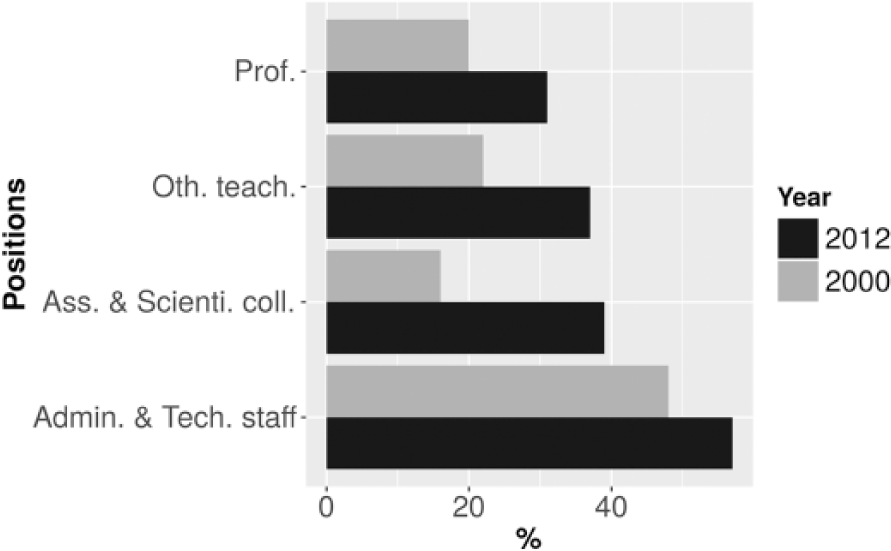
The evolution of women’s share of different types of academic employment, Switzerland, 2000–2012.
To summarise, we can see that Switzerland is characterised by a large PhD and postdoc bubble, a buoyant labour market, a significant skills shortage and a modified male breadwinner gender regime. This context shapes collective representations of what it means to become an academic for those who make up the potential recruitment pool.
Research questions and data
‘Leavers’ and ‘stayers’: the complexity of the leaky pipeline in the Swiss context
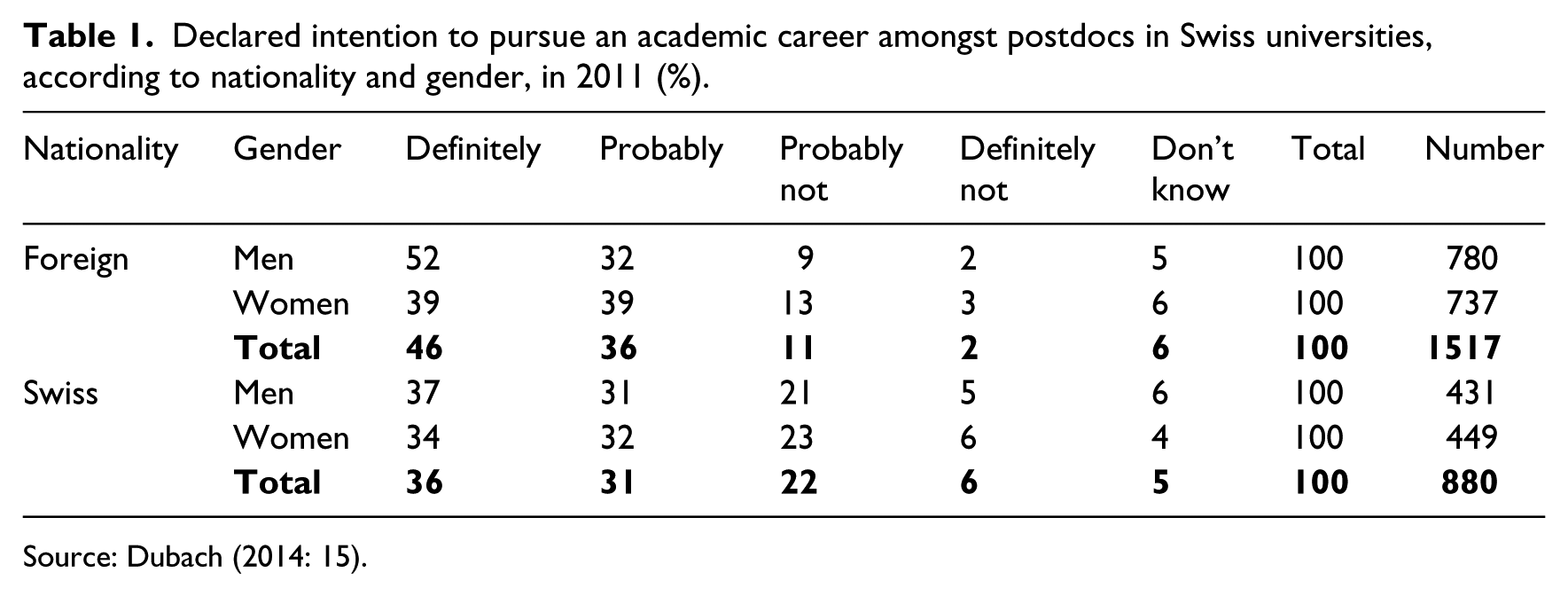
Table 1 presents the results of a survey among young academics (mostly postdocs), engaged in one of the Swiss universities, regarding their intention to pursue (or not) an academic career.
Declared intention to pursue an academic career amongst postdocs in Swiss universities, according to nationality and gender, in 2011 (%).
Source: Dubach (2014: 15).
Two main findings appear particularly interesting here. First of all, the Swiss postdocs are less likely than their foreign counterparts to envisage an academic career in the future. They are 11% more likely to declare that they probably will not pursue an academic career and 4% more likely to state that they definitely do not want to undertake an academic career. Second, amongst the foreign (i.e. non-Swiss) postdocs, men are more likely to aspire to a future academic career than women: 52% of the foreign male postdocs declared that they definitely intended to follow an academic career, as against only 39% of their female counterparts (a difference of 13 percentage points). Amongst the Swiss postdocs, however, the gender difference is remarkably smaller (a difference of 3 percentage points). In other words, Swiss men do not seem to be significantly more attracted to an academic career than their female colleagues.
As mentioned previously, Swiss women are more likely to be assigned to family-care tasks, which are rarely shared or externalised under the dominant gender regime, where most men are assigned to the ‘main breadwinner’ role (Giraud and Lucas, 2013). This unequal share of domestic labour has often been used to explain why women fail to reach stable professorial positions in Swiss academic institutions (Fassa and Kradolfer, 2010). However, we would argue that the recent changes to the academic career path that we have outlined above may explain why Swiss men are, today, no more likely than their female compatriots to aspire to an academic career. In the next sub-section, we will introduce life history and biographical data to illustrate a specifically male ‘up or out’ pattern of exit from the academy. Our data suggest that, compared to the alternative opportunities available to male PhDs on the Swiss labour market, the uncertainty surrounding the eventual outcome of a succession of fixed-term postdoc positions may make the prospect of an academic career rather unattractive to some men, particularly if they aspire to fulfilling rapidly a normative ‘main (male) breadwinner’ role. This suggests that those men who believe that they do not have the academic record (or support networks) required to reach a stable academic position within a reasonable length of time (e.g. up to 5 years after the PhD) will start looking for more stable and well-paid jobs, either in industry or in the Swiss administration. Formally, they are ‘leavers’, but their pathway out of the academy is very different to the one followed by those men (and women) who are less preoccupied with conformity or accountability to gender norms (Le Feuvre and Zinn, 2013) and by those women who are faced with the imperative to reconcile their work and family lives (Lapeyre and Le Feuvre, 2004).
Data and methodology
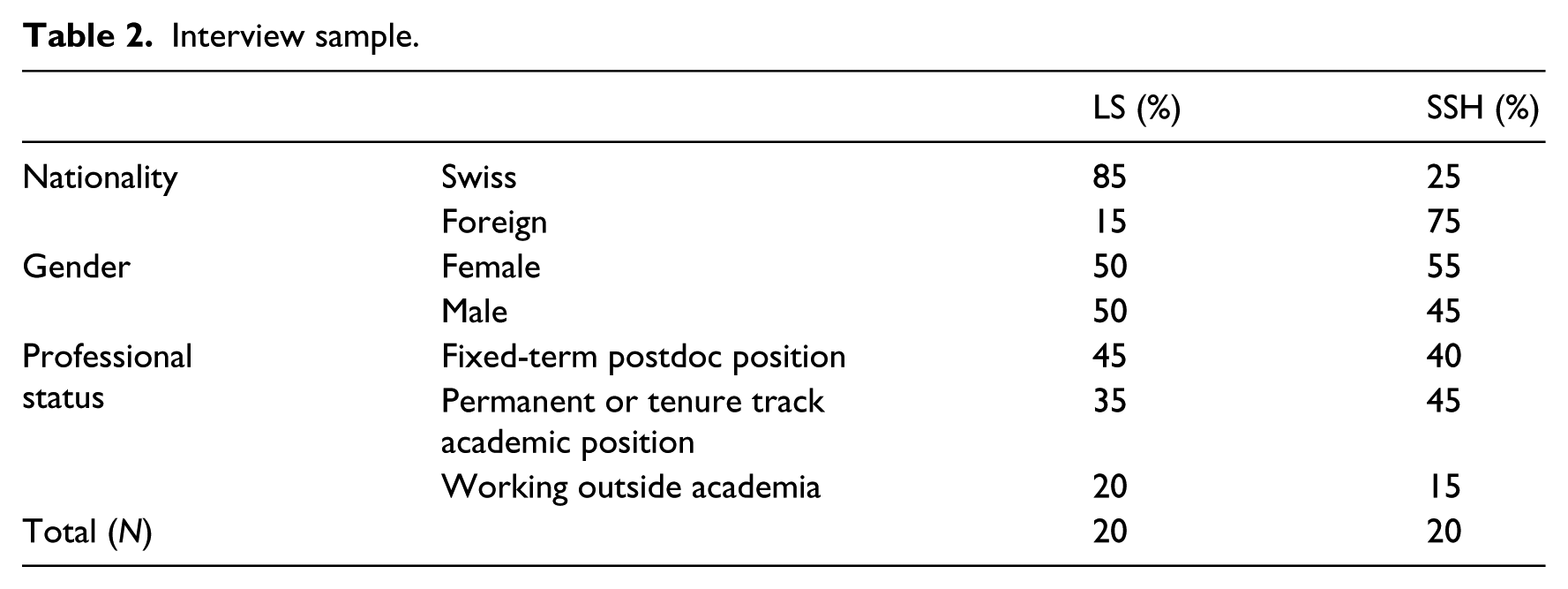
The analysis that we present in the following section is based on qualitative data collected in the context of a European research project focusing on gender inequalities during the early stages of academic careers. We conducted 40 interviews with postdocs who were working, or had been working previously, at a Swiss University, either in social sciences and humanities (SSH) or in the life sciences (LS).
We selected our interviewees in order to cover a diverse range of the postdoc population, with regard to their gender, their disciplinary field and the position they occupied at the time of the interview. The only factor that we did not control for during the interview recruitment drive was nationality. However, reflecting the unequal levels of internationalisation among the different academic disciplines, the SSH postdocs we interviewed are more likely to be Swiss, whereas LS postdocs are more likely to have been internationally recruited (see Table 2). The semi-structured interviews were carried out from a life history or biographical perspective. In order to understand better their vocational aspirations and choices, their expectations and their representation of an academic career, we invited the interviewees to reconstruct their academic, employment and family trajectories. Because our main focus was the analysis of gender inequalities at the early stages of the academic career, we also asked questions about their personal experiences of gender relations at work, and about their vision of work–life balance now and in the future.
Interview sample.
Three ways of leaving the academic career path: how gender shapes the leaky pipeline
In the following sub-sections, we will use biographical interview data on leavers to identify three distinct ideal-type models of the leaky pipeline. Among our seven interviewees who had left academic employment, we have chosen individual cases (Ragin and Becker, 1992; Passeron and Revel, 2005) that cover a relatively diverse panel of the ex-postdocs that we met during our study (in terms of age, social origin, family circumstances and nationality) in order to provide a global understanding of the way gender norms and practices can influence the nature of individual trajectories out of the academic career path.
As we will see through our case analysis, although almost all of our interviewees (men and women alike) mentioned the relative precariousness of an academic career at some point in the interview, the accounts provided by those who had left the academic career track were clearly shaped by their current family circumstances and by their gendered expectations for the future.
A ‘female carer’ account of leaving the academy: ‘wait and see’ regarding issues of work–life balance
In this sub-section we will present the cases of Maria and Jennifer. 2 At the time of the interview, Maria was working as a part-time secondary school teacher, whilst Jennifer was unemployed and thinking about training to be a Taï-chi instructor. Both of them justified their decision not to pursue an academic career with reference to the difficulties they experienced in finding the right ‘balance’ between their work commitment and their family duties during their postdoctoral years. In their narratives, the university and their families appear as equally ‘greedy’ – or demanding – institutions (Marry and Jonas, 2005). Their accounts of these difficulties echo those of a number of women who work outside the home in the Swiss context, particularly those with young children and a partner who is working full-time. 3
Maria was one of our oldest interviewees (48 years old). She is Swiss and has two children, aged 15 and 12 years at the time of the interview. Maria funded her PhD studies in the life sciences through a paid assistantship. After her PhD graduation, she was employed for almost 15 years in a series of fixed-term research jobs at our target university. In 2010, she decided to leave academia in order to re-train as a secondary school teacher. She claimed that her family duties played a decisive role in this decision. She presented being married to an engineer who works full-time in Switzerland as a major obstacle to the pursuit of her own academic career, because it had reduced the range of geographical locations open to her in an increasingly competitive international academic labour market. The issue of geographical mobility and location had been a difficulty for Maria for a long time. Immediately after her PhD, she took up a postdoc position in the USA; however, because she did not want to be separated from her then-to-be husband for too long, she decided to come back to Switzerland after just 18 months. With hindsight, she believes that coming back ‘too soon’ compromised her chances of ever having a successful academic career, because she did not have enough time to exploit the data collected during her US stay. Thus, she failed to publish anything as first-named author during these crucial years after the award of the PhD. However, despite this relatively weak academic record, on her return to Switzerland, Maria was offered a relatively long – 5-year – postdoctoral engagement at our target university. It was during this time that she gave birth to her two children. In 2005, she reduced her working hours (to 80%), because the crèche opening hours did not fit in with her previous schedule and because her husband had started to work very long hours. She claimed that reducing her hours had almost no effect on her academic performance record. Even when she was working full-time, she claimed that she was not able to build up the kind of portfolio she saw as necessary for getting a permanent academic position, since this involved commitment well beyond the limits of the official working week: ‘If a women has a family’, she said, ‘it can take a large amount of her time, and then she may have not enough energy to dedicate to an academic career’. She believes that secondary school teaching will limit the (often implicit) demands for ‘permanent availability’ that she perceived in the academic context.
In a similar vein, Jennifer (34 years old, Swiss, with two children) also presented her decision to leave the academic career track as a consequence of tensions between her work and family commitments. After the award of a PhD in the social sciences at our target university, during which time she also had her two children, Jennifer obtained an SNSF mobility grant in order to complete a two-year postdoctoral course in Berlin. Her husband, who was already a manager with a private Swiss firm, did not want to compromise his own career prospects by moving abroad with her, even though the SNSF would have paid for the whole family to move to Germany with Jennifer, under its ‘family friendly’ gender-equality measures (Fassa and Kradolfer, 2013). This refusal to accompany Jennifer abroad was based on at least two major considerations. First, the husband was effectively the ‘main breadwinner’ of the family, with a good salary and promising career prospects, whereas not only was Jennifer’s postdoctoral grant fixed-term, it also provided only minimal social security cover for herself or her family. Furthermore, the couple had already managed to secure places in a crèche for each of their young children (aged 1 and 3 years at the time) and this was considered to put them in an extremely privileged position, given the very limited childcare services generally available in Switzerland. In these circumstances, Jennifer decided to move to Berlin by herself, returning to Switzerland to visit her husband and children once a fortnight: ‘I was already exhausted before I left [after finishing her PhD with two young children present in the home], but this situation, doing round-trips, totally finished me off’, she said. After almost two years of commuting between her home and her host institution, she experienced what she describes as a ‘burn out’. She was put on sick leave for several months because she was unable even to ‘open [her] laptop’ or ‘get out of the bed’ in the morning. Before she decided to resign from her postdoc in Berlin, a tenure track position was advertised in her field at her home university. According to Jennifer, this promising academic career opportunity came ‘too late’, because her post-doctoral experience had ‘completely blunted [her] will to pursue an academic career’. Despite receiving support and encouragement from her colleagues, she did not apply for this tenure track position: she applied instead for a part-time (40%), fixed-term postdoc position at the same university. Even with these reduced hours, she found her workload too heavy to handle with, as she said, her ‘two children and full-time husband’. She finally decided to quit this new position after just a few months. At the time of the interview, Jennifer was registered as unemployed and was thinking about training to become a Taï-chi instructor. She was genuinely enthusiastic about this potential move: ‘I’ve been practising Taï-chi for years; I had never seen this activity from a professional point view; this was just something I really enjoyed doing’.
In both of these cases, it is interesting to note that work–life balance issues feature as central explanations for the decision to leave the academic career track, despite the fact that these women had accumulated several years of work experience in academic jobs. However, it is also important to note that both of them appeared to be committed to quite normative gender arrangements at home. Their stated preference for part-time and/or flexible jobs reflects the dominant normative expectations of mothers in the Swiss context (Giraud and Lucas, 2013) and also provides some compensation for the long working hours (and hence non-availability at home) of their respective husbands. Both declared that they were relatively satisfied with their succession of part-time postdocs positions, apart from the fact that their institution obviously expected them to be available to work beyond the limits of their formal employment contracts. In some cases (as for Jennifer), it was understood that any overtime would be paid, although this was clearly not always the case. Both interviewees suggested that they would have been willing to continue working in the academy, albeit in ‘research support services’ rather than in a professorial capacity, had the opportunity to accommodate better their family and domestic commitments been available. The jobs they envisaged for the future offer surprisingly similar characteristics to the ones they had held for many years at our target university, but they do not involve so much ambiguity (and associated tricky negotiations) regarding the level of availability and performance that should/could be expected from part-time workers on fixed-term contracts.
As we will see below, the fact that academic institutions expect more than they are willing to recognise from their postdocs is also a recurrent theme in the interviews carried out with those male ‘leavers’ who were also living in quite conventional family arrangements.
A ‘male breadwinner’ account of leaving the academy: ‘up or out’ regarding issues of recognition and reward
The narratives of men who leave the academic labour market are often very different from those of their female counterparts. The two men we will study in this section (Miguel and Tobias), had been working outside academia for a number of years at the time of the interview. Miguel is a manager in a biomedical firm: Tobias is working for the Swiss federal administration in Bern. For both of them, the decision to leave the academy was motivated by the relatively poor employment conditions offered to PhD graduates in Swiss universities, in comparison to other sectors of the national labour market. Their narratives suggest that the decision to leave was related to a desire to maintain a normative masculine identity which they considered to the threatened by the conditions associated with the early stages of an academic career in the contemporary context.
Miguel, who was born in Latin America, came to Switzerland after two postdoctoral experiences in different European countries, mainly because his partner was already settled in Switzerland. At the time of the interview he was 30 years old, in a stable relationship with a Swiss female lawyer, with no children. He decided to quit the academic career path a year and a half after joining our target university. His decision was motivated by the fact that, over time, he came to realise that he ‘…didn’t really like the job of group leader in academia that much: it’s all about writing research proposals and managing budgets and research teams, not much about research, really’. From his point of view, the job required too much commitment considering the very limited medium-term career perspectives he could expect to receive in return: ‘I didn’t want to end up being over forty and still with a fixed term contract’ he said. To him, the lack of career prospects in the Swiss academy is due to a demographic imbalance between the high number of PhDs and the limited number of permanent positions. This means that competition for permanent academic positions in his particular research field is very high. Given the limited career prospects and job security in the academy, Miguel started to think about looking for a job in industry during his first year in Switzerland.
Tobias tells a similar story about his decision to leave the academy after his first postdoc in North America. He is 35, Swiss, has one child and his partner was expecting a second baby at the time of the interview. After his PhD award in Switzerland, he spent two years, with his partner, as a postdoc at a prestigious university in the USA. When he came back to Switzerland, he continued to invest in his academic career, even though he did not have a formal position to return to immediately. He took on a temporary teaching-only position at his home university and published some articles with his former PhD supervisor. However, since the couple were planning to have a baby, he also applied for a managerial position with the Swiss federal administration. He got the job and his first child was born later that year. Although Tobias sometimes misses the intellectual stimulation of academic work, he doesn’t have any regrets about his decision to leave the university. He says that his current job provides him with a better salary and, above all, ‘more stability’. This is important because Tobias is the main earner in his household; his partner works as a self-employed designer, with an irregular income.
It is interesting to note that work–life balance issues are mentioned in both of these interviews, but they are addressed from a very different perspective to the one developed by Maria and Jennifer. For example, Miguel believes that one of the main disadvantages of being an academic is the fact that work tends to ‘spill over’ to other areas of life. However, unlike his female counterparts, Miguel was not concerned about the implications of this overlap with regard to his work–life balance but, rather, with issues of symbolic recognition and material reward. He believes that academic institutions expect people to work more than their official employment contract requires, whilst being unable to provide the necessary compensations to ensure lasting commitment and loyalty from their staff. Indeed, neither Miguel nor Tobias had any problem with the idea of working long hours; both of them agreed that ‘being flexible’ is vital to success in any field. What really matters to them is not how they will manage their family lives in conjunction to their ‘elastic’ (i.e. infinitely extendable) working hours (this theme rarely comes up in the course of the interviews, except in reference to their partners), but rather how they will meet the normative expectations associated with university-educated men in the Swiss context. Their main concern was to avoid accumulating a series of (relatively) poorly paid, fixed-term academic contracts, with no guarantee of ever reaching a permanent academic position. In this case, the male interviewees’ (projected) role as main breadwinner played a major part in rendering the academic career path ultimately unattractive, in comparison to the alternative career opportunities on offer in the relatively buoyant Swiss labour market. On the very rare occasions when work–life balance issues were mentioned by this category of male leavers, they referred exclusively to the personal leisure activities that they had had been able to take up again once they had been relieved of the pressures and uncertainties associated with the academic career track.
It could be argued that, particularly when they are involved in family configurations that conform to the dominant Swiss gender regime, men and women leavers identify the same features of academic employment as the main source of their discontent. Not only are universities seen as greedy (i.e. demanding) institutions, they are also seen as being increasingly and structurally ungrateful to those in the early stages of an academic career. However, this shared diagnosis does not mean that men and women leave the academic career track for the same reasons. At the risk of over-simplification, we could say that the women leavers we interviewed, who were married, with children and living in households where they were expected to bear the brunt of domestic labour, tend to leave the academy in order to escape from the greediness of the institution. They moved into jobs where the amount of time they are expected to invest in their work was equivalent to their official working hours, with little regard for the stability, prestige or career prospects associated with their alternative occupational choices. In contrast, the male leavers we interviewed, who were also married and living in households where they were expected to conform to the normative masculine figure of the main (or sole) breadwinner, tended to leave the academy in search of gratitude (in the form of symbolic recognition and material rewards), with no concern for reducing the amount of time commitment or flexible availability they had previously shown to their academic employer.
A ‘gender egalitarian’ account of leaving the academy: when the price of staying is considered too high
Although we do not intend to develop this ideal-type in as much detail as the previous ones, it is interesting to note that the decision to leave the academic career track does not only concern men and women who are living (or aspiring to live) according to the dominant Swiss gender regime. We can also cite the example of one male postdoc – Simon – who rejected the idea of pursuing an academic career precisely because this would imply the need for him to adopt a typically male breadwinner form of investment in his career, to the detriment of his active involvement in his home and family life and to the detriment of his partner’s own professional career. 4 At the time of the interview, Simon, who is Swiss, was aged 35 and was living with a partner and her two children (aged 9 and 15 years) from a previous relationship. He was working as a part-time lecturer (40% contract) at the target university, but was also working part-time (60%) for an international organisation located in the French-speaking part of Switzerland. In a similar vein to Miguel and Tobias, Simon mentioned the psychological stress he was then experiencing, due to the uncertainty of ever being able to get a stable position within the Swiss academy. However, in the course of the interview, it became clear that his aspirations for stability were not framed in accordance with the dominant gender regime to which the other male interviewees referred. On the contrary, Simon explained that in order to have any chance of continuing along (and ultimately up) the academic career path, he should then be thinking of applying for another postdoc mobility grant. In fact, in his field of research, he would probably need to move to several locations across the globe over the coming years, in order to gain experience and build up his academic networks. The obligation to be internationally mobile that he sees as a prerequisite for a successful academic career in Switzerland is very problematic for Simon. Not only are the potential rewards for this mobility too uncertain or distant, this requirement also rests on a particular vision of the ‘ideal academic’ with which he finds it hard to identify: ‘People are not trees that one can transplant from one place to another too often’, he says. ‘They have friends, family, or other ties (…) to the place where they live.’ He refuses to accept the idea of leaving his partner and stepchildren behind in order to satisfy this ‘sociologically unrealistic’ demand to be more or less permanently on the move, whilst also stressing that taking them with him would require his partner to sacrifice her own career prospects, which in the first place he would not find ethically acceptable and which, second, would also be totally unreasonable, given the ‘pie in the sky’ (that is, very unlikely) chances of him ever getting a permanent academic job in Switzerland anyway.
Conclusions
In this article we have attempted to approach the leaky pipeline question from a new angle. We argue that the partial erosion of the traditional academic career path is particularly relevant to the leaky pipeline debate. As noted in previous studies on the Swiss academic labour market (Studer, 2012), early-stage academic jobs appear to be far more precarious and unpredictable than those available in many other sectors of the Swiss labour market. The widespread development of intermediary, fixed-term, often part-time, research and teaching positions in Swiss universities has undoubtedly modified the gendered logics that underpinned the decisions of male and female postdocs in the past either to remain in the academic career pipeline or to quit in favour of alternative employment opportunities. We have shown that, in the Swiss context, the aspirations of postdocs to remain in academic employment or to look for non-academic jobs are directly related to their position within the domestic division of labour and to their combined employment and family-care aspirations. However, this does not imply that a clear divide exists between work-committed men who stay and succeed in the academy and care-committed women who leave and ‘leak’.
Our research shows that men may decide to leave the academic career path during their postdoc phase for very contrasting reasons. On the one hand, we have identified the case of those men who are strongly committed to a traditional ‘main breadwinner’ model of masculinity. As illustrated here by the cases of Miguel and Tobias, they adhere to a very clear ‘up or out’ logic of behaviour. When faced with the impossibility of achieving a relatively stable and comfortably paid position within an acceptable period of time after their PhD submission, this first group of men will leave the academy in search of more rewarding career opportunities in other fields, without any consideration of the implications of this decision for their investment in their home and family life. They may occasionally return to academic jobs in the future, but only if these jobs are stable and well paid enough to support the ‘modified male breadwinner’ model of family life that they have become accustomed to.
A second type of male leaver shares the aspirations and practices of many of the female postdocs we interviewed. As in the case of Simon, they are not without ambition and commitment to their jobs, but they believe that the pressures that now weigh on young researchers, notably in terms of academic productivity and international mobility, are not compatible with a balanced and healthy personal life. Just like some of their female counterparts, they drop out of an academic career not because they lack ambition and drive but simply because they believe that the potential returns on the sacrifices they are expected to make in pursuing an academic career (Currie et al., 2000) are too costly for their own health or for the well-being of their loved-ones. Unlike the first group of men, the family aspirations and practices of this second type of male leavers tend to be more egalitarian, with as much consideration being given to the professional success and material comfort of the partner as to the postdocs’ own career advancement. These egalitarian objectives are generally seen as more difficult to reach in academic institutions than in other sectors of the labour market (Glass et al., 2013).
Finally, we have been able to identify a third group of leavers, composed exclusively of women who – by choice or circumstance – adhere to a relatively normative model of femininity. In fact, it would probably be more appropriate to talk here about ‘stayers’ than ‘leavers’, although, as in the case of Maria and Jennifer, they may end up leaving academic employment. These are women, usually living with men who have already achieved main breadwinner status, who are able to accept a series of precarious, usually part-time, postdoc positions that are organised in such a way as to preclude any progression to full professorial status. Contrary to the first group of male leavers, these women adopt a wait and see attitude to their academic careers. Not only does the unequal share of domestic labour at home make in objectively difficult for them to conform to the normative expectations of the geographically mobile, highly committed, very productive postdoc, their family circumstances also reduce the imperative for them to develop strong, upwardly mobile career aspirations for themselves, be it inside or outside the academy. They are generally forced to leave their prolonged postdoc status solely by the employment rules of the target university which prevent them from working for more the five consecutive years on each of the fixed-term, non tenure-track teaching or research positions they have been offered. Unlike the egalitarian type, when these women leave the academy (often up to 10 or 15 years after they were awarded their PhD) they frequently undertake some form of retraining, and continue to work part-time or episodically in areas that are far removed from their research expertise, whilst devoting more time to their home and family. Here, we would seem to have the makings of a new (highly feminised) ‘academic proletariat’, which has been able to develop quite considerably in recent years, precisely because of its conformity to the normative ‘gender scripts’ (Le Feuvre and Lapeyre, 2005) or ‘master status’ (Krüger and Levy, 2001) that continue to influence all aspects of Swiss society.
We argue, therefore, that the gender significance of the leaky pipeline is potentially diverse and even contradictory. Whilst it is important to measure the relative chances of men and women becoming academic stayers or leavers, the implications of these attrition rates for their future progression to the most prestigious positions – in the academic hierarchy, but also in the non-academic labour market – are potentially diverse. More attention needs to be paid to the socio-economic environment into which the postdoc pipeline may leak. We suggest that the final destination of male and female leavers may not necessarily be less attractive or rewarding than the uncertainty and precariousness they currently face within the increasingly greedy and structurally ungrateful or unrewarding higher education and research institutions.
Footnotes
Acknowledgements
The authors would like to thank participants of the first LACCUS seminar session, at which a previous version of this paper was presented. They also would like to thank the anonymous reviewers of the EERJ for their comments.
Declaration of Conflicting Interest
The author(s) declared no potential conflicts of interest with respect to the research, authorship, and/or publication of this article.
Funding
The author(s) disclosed receipt of the following financial support for the research, authorship and/or publication of this article: The research leading to these results has received funding from the European Union’s Seventh Framework Programme (FP7/2007–2013) under grant agreement Number 611737. This article is also based on research conducted at the Swiss National Centre of Competence in Research LIVES – Overcoming Vulnerability.
Notes
Author biographies
 ).
).
). Her scientific
profile is broad based, covering areas such as race and ethnicity, indigenous peoples of
Latin America, intersections between social inequalities (sex, race, class) and science
policies. She also is a specialist of equality between men and women in academic
careers.