




Abstract
This paper focuses on the dynamics that animate the situation of women inside academia and the social world of science. Based on a long-term ethnographic study we chose specific cases (scientists educated in Poland) to illustrate the complexity of the career-making process in the 21st century. In this country, in a social and professional environment that has belonged to the European Union for 12 years, we observed several particularities. In order to demonstrate the process of ‘reverse dynamic of equality construction’ we adapted a longue durée perspective. Our article shows how so-called ‘democratization’ dynamics (after the political changes of 1989) influenced the professional trajectories of women in Poland. The data suggest a progressive deterioration of the situation for Polish female scientists – a process that is ignored by the majority of Polish scholars.
Keywords
“Have no fear of perfection; you'll never reach it.”
Introduction
In 1976, Pierre Bourdieu still used the expression ‘man of science’ in his theory of the scientific field (Bourdieu, 1976). At the same time, in Poland, for almost a century, the iconic scientist has remained feminine: Marie Skłodowska-Curie. She was the first Pole 1 to win a Nobel Prize in science. She has been a model to follow for many generations of Polish students throughout their entire education process, from primary school onwards. Many students around the world, especially women, have decided to become scientists after reading the biography written by her second daughter, Ève Curie. 2 In Poland, Skłodowska-Curie has been a vital part of general school education from the very beginning. She was one of the principal personages employed in the construction of the Polish national identity in the 20th century. Skłodowska-Curie has been a national hero since the first years of Poland’s independence (1918) – not as the spouse of a famous male scientist, but as a strong woman, a prominent scientist and a political figure in her own right. She contributed to the creation of the first cancer research institute in Poland (1932) and brought to her country of origin the knowledge, the instruments and the money necessary for conducting advanced research. The fact that Skłodowska-Curie was an important figure of patriotic education and a national icon is not surprising in the light of the history of the country, which had been under occupation for over 100 years with limited freedom of use of the Polish language and practising of the national culture.
Women professionals (physicians, scientists, specialists in social sciences and humanities) were sought after in the newly recreated country. As a lot of men had fallen victims of the war or were simply missing, equality of the sexes was the sine qua non to build a modern state on the ruins (this equality strategy is typical of all liberation movements; Walzer, 2015). Polish women obtained the right to vote in 1918, and a year later the first women were elected to the parliament. 3 In the same period, the educational system of the new country adopted new pedagogy strategies (mixed classes, active methods, artistic education, a child considered as a person, etc.; Osiński, 2007).
This wind of equality was perceptible in various areas of professional activity. In Lviv University, one of the best Polish Higher Education institutions before World War Two (WW2), in the academic year 1934/35 women comprised almost 30% of the total number of students (15% at the Law and Medicine faculties, 45% at the Mathematical-physical faculty and 65% at the Humanistic faculty). 4 These data are also supported by historical material (books, biographies of Polish scientists) – we note an important presence of women crystallographers or microbiologists (Allen, 2014; Hnatiuk, 2015; Kryński, 1997; Wójcik, 2015). 5 Before WW2, women in Poland had much easier access to professional positions than those in many other European countries (on the condition of being a Catholic and not originating from an ‘ethnic minority’; Aleksiun, 2016 6 ). For example, married women could work with no need for their husbands’ consent (whereas in France such consent was required up to the 1980s!). Of course, there were still many obstacles for women in science (Szwarc and Żarnowska, 2000; see for example the case of Zofia Daszyńska-Golińska), but the overall picture was rather promising compared with the academic systems in other countries at the time.
Considering these dynamics, we might expect that at the end of the 20th century and the beginning of the 21st century there should be a proportional balance (specific for each discipline and speciality) between males’ and females’ careers. Indeed, official statistics show that this is actually the case for students and PhD students (similarly to other EU countries). Yet, to be exact, the number of female students surpasses the number of male students (58% in 2014; Central Statistical Office, 2015). Both tendencies – a substantial increase in the overall number and a progressive feminization – seem to be relevant to PhD students at the University of Warsaw (the proportion of female PhD students went up from 54% in 2005 to 59% in 2014 7 ).
At the same time, however, in 2015, in the prestigious Polish Academy of Science, among the 310 honorary members (the membership is attributed through a system of insider elections and co-optations) there are only six women (less than 2%). Even though such a phenomenon is present also in other European countries, the Polish case is, in fact, special, because of social, economic, structural and political aspects: (1) young researchers’ extremely low salaries (in today’s Poland, a post-doc’s monthly salary amounts to 700 euros – without real social security plans, fringe benefits etc.); (2) the precarious employment situation (as it is almost impossible to obtain a long-term contract); (3) discrimination regarding working conditions and salary level (Polish scientists even in EU projects, such as H2020, earn much less than their occidental colleagues with the same tasks of work); (4) extreme disproportion between the cost of living and income (Warsaw or other Polish big cities that host the institutions of research are more expensive than cities in Portugal, some cities in Italy, Spain and even, for example, Berlin); (5) the lack of State’s financial support for families with modest incomes (Polish scientists with families receive no financial support comparable to that in Scandinavia or France); (6) the State’s childcare system being progressively devastated for over 20 years (now, only a private system is available, with pre-schools being too few and unaffordable (monthly fees equal to a post-doc’s salary); (7) the longest career plan for academics (the average age of obtaining full professorship is 57, and only 16% of teaching staff have a chance of reaching that stage; moreover, the acceptance of the promotion – proposed by the professional commission – depends on the President of Poland); (8) a significant decrease of academic freedom due to the political situation (especially in social sciences and some sensitive areas of study); (9) poor intergenerational understanding (scientists of the older generation show little interest in the situation of their younger colleagues with children); (10) a dramatic limitation of women’s rights (EU-wise, abortion rights and pre-natal care rights are the worst in Poland at the moment). To sum up, in the larger frame of liberal changes which can be seen in several European countries, the Polish case is extreme in terms of the difficult situation of female scientists, both because they are researchers and because they are women. The most (sociologically) poignant point is that concerning the dynamics of the changes: in today’s Poland, we are observing a process opposite to the one which occurred in the first part of the 20th century; instead of gender equality improvement, there is now a growing discrimination within the aforementioned dimensions. This explains our interest in a large historical perspective.
Several questions arise. How is it possible that the pipeline phenomenon is occurring with such intensity in a country with such a strong tradition of female presence in science? Why do so few women reach the top level in their careers? What kind of professional trajectory are Polish female scientists experiencing? What is so specific in their biographical accounts? How does this specific historical frame (the 20th century with wars and conflicts as well as the Transformation Period) influence the scientific careers of women? Finally, how do they survive in a professional world which apparently denies them access to the top positions? What kind of problems have they faced and what strategies must they elaborate to stay active in such a ‘hostile’ universe and to dare (as at least some of them do) to balance their private/family life with career expectations constructed both by politicians of science (imposed by the bureaucratic system) and by the scientific community (maintained through a system of professional control and with use of formal and informal selection criteria)?
This article aims to give the possibility of understanding the specificity of the Polish case. We believe that the present is the effect of a long, dynamic, social process; therefore, we need to take a longue durée perspective to analyse it (Braudel, 1982). Thus, the socio-historical approach employed here is the most suitable for our objectives. In the first section of the article, we will start by describing the historical trajectory (interwar and 1945–1989 period) and elements of a cultural background which drive activity in the scientific universe. Then, we will present its contemporary institutional frame (after the 1989 political change and the last higher education (HE) reforms, 2011–2013) as a context of career construction. That part will be mainly focused on political tendencies and institutional barriers, as well as the role of gender-based stereotypes. In the second section, we will employ field data to answer the questions formulated above. We will concentrate on the problems women face in the academic milieu (with strong emphasis in Science, Technology, Engineering and Mathematics (STEM) specialities) and show how personal biographies interact with the demands of the (in)formal, contemporary Polish HE system. In this part, a more private sphere will be explained. We will elaborate on two particular phenomena observed in the field – vampirization and the hidden career (Wagner, 2011a, 2011b, 2015a). In conclusion, we will present a partial explanation of the present situation as well as some directions for further steps in the study of women’s scientific careers. This part may be considered as public sociology (Burawoy, 2005). Such involvement is linked directly with the employed methodology of long-lasting ethnographical study.
Methodology: From ethnography of a life science laboratory to biographies of scientists
This paper is based mainly on an ethnographical study conducted in several life science laboratories in four countries (France, Poland, USA and Germany) during a period of 12 years and conducted by Wagner (2011a, 2014, 2015a). The specificity of the ethnographical method stems from the lack of an a priori theoretical approach (before the start of data collection process); it requires elaborating working concepts during the observation and choosing research problems to focus on during the development of the investigation. One of the main topics of the research was processes of career construction. In each case, the focus was on an international team of workers. The conducted fieldwork constituted the basis for a comparative analysis (organizational structures, cultural, political and economic frame of the country of observation, institutional context). Yet, it was performed in similar (to some extent) work cultures that relate to the specificity of ordinary research work and the dynamics present in international teams of scientists who build their careers in the highly internationalized, contemporary scientific universe (more in Wagner, 2014).
The theoretical background employed in the analysis of the collected data comes principally from the Chicago Tradition (Chapoulie, 2001), especially from occupational career studies (Hughes, Becker, Strauss, Hall, Glaser, Hermanowicz). As a result of the first fieldwork, there emerged the concepts of career coupling (Wagner, 2006) and of transmobility (Wagner, 2011a, 2015a); both have become pertinent tools in the analysis of scientific careers. The second stage of this ethnographic investigation took place in a Polish laboratory (from 2006 to 2010). After that, the observation was led periodically, i.e. during short periods of going back to the field in order to interview the people who were part of Wagner’s first intensive observation period.
Four years of the first part of this fieldwork were completed with interviews with researchers from outside STEM specialities and with short-term observations conducted in German and US laboratories. For the majority of the participants cited in this paper, the interview was not conducted at the first meeting but usually after several months of work in the same place. In this way the cited examples were gathered on the basis of a long working relationship, which had built participants’ trust and prompted their cooperative attitude towards the researcher. By the same token, this increased the quality and reliability of the collected data.
The third important part of the ethnographical research was conducted in a leading US research institute (2010–2011). At that point, the preliminary concepts of women’s career models in the sciences had already been elaborated on. Notions such as a hidden career or a vampirization process had been discussed with American scholars. 8 A deep ethnographical 6-month study was subsequently continued through regular meetings with the participants. These meetings have been periodically taking place to date. The distinctive approach of Wagner’s work relies on maintaining privileged contacts with some of the participants, as this allows people’s trajectories to be followed over long periods, therefore detecting long-term dynamics that escape other types of research. The additional data were obtained from the study based on semi-directed interviews that Wagner and Finkielsztein conducted in 2013 with awardees of Polish–Swiss research programmes (Wagner and Finkielsztein, 2014).
Along with the ethnographic research, a considerable source of data comprises recorded biographical interviews (over 400) with researchers at each stage of their career (from MA students to over 90-year-old active or retired scientists). The majority of participants were laboratory scientists. However, about 25% of the data concerns specialists from disciplines other than the life sciences.
Our data were completed with readings of biographies and autobiographies of scientists, as well as historical books describing the activity of scientists during periods of war. In view of the fact that Polish science was an important element of the post-1945 history (as a continuation of the dynamic traditions in the fields such as microbiology, mathematics, anthropology and crystallography) and an important factor in political struggles (philosophy, history and sociology traditions), the number of available biographies is considerable. This abundance is in contrast with the scarcity of studies concerning sociological aspects of scientific and scholarly activity in Poland in the 20th century. Rare sociological studies (Cichomski 1976; Siemieńska 2000, 2007) lack a long-term perspective or broader view, since they focus mostly on researchers’ contemporary situations. All those studies were conducted with in-depth interview (IDI) or questionnaires and did not use (to our knowledge) the ethnographical method which, in our opinion, remains the best investigative method for our purposes of understanding complex and often invisible phenomena such as discrimination (both explicit and hidden), unseen aspects of unequal treatment, self-discrimination and participants’ own blindness towards negative practices and their consequences.
Women in Polish science (1918–2016): Politics of science, history of gender stereotypes
Beginning of the 20th century – New state and new challenges for a young society
As mentioned in the introduction, Marie Skłodowska-Curie (MSC) remains an iconic scientist in Poland. However, her example is not interpreted in the same way as it is in other countries. In Poland, MSC is not an example of a woman successful in science proving that being a scientist is not limited to men. Instead, she is a Polish scientist, not a woman scientist, and her image is used as a powerful tool for the construction of the Polish collective memory. What is noteworthy in numerous accounts about her life is that her political orientation, her cosmopolitan and communist opinions are missing. An interesting consequence of this image construction is also the elimination of all aspects of femininity. Her private life was severely criticized in the French press of the time. 9 Nevertheless in Poland, MSC has always been an object of veneration (birthday celebration, museum, media and books, history and science manuals). A national hero, sponsor, fund-raiser, science politician and a great scientist, MSC achieved more than many other people (including men) ever did. With such an example in mind, one would expect that discrimination and self-discrimination of young female scientists in the Polish society should be out of the question, especially as MSC is still regarded as a model to follow today (the Polish Parliament proclaimed the year 2011 as the year of MSC). And yet, as we will see later, one would be mistaken.
The second important aspect of the presence of women in scientific fields was related to an openness of the new state and an ideology emphasizing equal rights of access to education (a phenomenon typical of new states; see Walzer, 2015). Indeed, the presence of women at university was important, especially in new disciplines which had not yet been well established (i.e. with no fixed hierarchy yet). We should note that the number of female students was significant. However, their life trajectory depended on their social class and the cultural capital of their family. Among those who continued in science there were a considerable number of ‘heiresses’ (daughters of academics and scientists) and spouses, as recorded in biographies and books devoted to scientific activity in 1918–1945. For example, in the lab of a famous microbiologist, Rudolf Weigl (the creator of the typhus vaccine; see Allen, 2014) several women were hired and they followed career paths similar to those of men. Frequently, those microbiologists were married to other scientists (commonly within the same speciality) and worked together with their spouses in laboratories (Allen, 2014; Kryński, 1997; Wójcik, 2015). However, daughters from upper-bourgeois milieus encountered particular difficulties on their path in science. A Polish-American scientist Wacław Szybalski, 10 in his biographical interview, recounted that his mother studied chemistry and was a gifted crystallographer. Yet, one day her professor mentioned: ‘It is really a pity that you are a woman, since you are a gifted scientist. You will meet a man and you will marry him and have children and you will be lost for science’. It was a situation typical of women from bourgeois families – after marriage, and especially having given birth to a child, even educated women were supposed to retire and to concentrate on their households.
Such career models were common before WW2: either women aborted their professional activity after marriage or pursued their work (most frequently as a spouse of a scientist). After 1939 the situation changed and many women went back to work. Several accounts and testimonies provide examples of scientists who worked in the harsh conditions of concentration camps (for some, their work was a way to escape death; see Allen, 2014). The knowledge of scientists – specialists in chemistry, biology, etc. – was particularly cherished in times of penury and persecutions. Homemade alcohol and explosives, as well as all kinds of medicines (from vaccines to cyanide pills), were products of the highest need. It provided means to fight the occupier, but it was also the basis of a survival strategy and a source of money. It is impossible to provide statistics on women involved in the production of such items; however, we can infer their presence from testimonies and other types of writing.
PRL 11 – the post-war reconstruction of Poland
Women in science in PRL
Poland’s political situation after WW2 was determined by the influence of the Soviet Union. In consequence, the position of women in Eastern European countries at that time was claimed to be equal to that of men. To that influence we should add the typical post-war situation in which women were welcome to take up vacated ‘male’ jobs in factories and other institutions in the classic ‘Rosie the Riveter’ pattern. New universities were created in place of the old ones; as the Polish territory changed after 1944–45, Polish universities in the lost territories in the east – for example, the Lviv University – were closed. The professors and scientists who survived found jobs in newly created universities in Lublin, 12 Wrocław (formerly Breslau) and Łódź.
Meanwhile, the general situation for women in Poland was improving. 13 As in the other Eastern bloc countries, the majority of employment consisted of public sector jobs with salary charts that prevented huge differences in salary between men and women. 14 All the same, both salaries were usually modest and neither alone would suffice to support a family. Women’s salaries were therefore an important contribution to household budgets. Yet, as the gender–work division remained traditional, the double burden was bearable only where state provisions existed; that is, in cities and near larger state-owned enterprises that founded crèches, pre-schools and workers’ canteens, which permitted the mobilization of the female workforce by alleviating the burden of the ‘second shift’ of domestic tasks (Stenning et al., 2012: 175–218). Elsewhere, such as in the countryside, women performed traditional roles, taking care of the family and farm. 15 It was then possible to have a family life and a professional career, and Polish women living in cities rarely stayed ‘at home’. The majority of the population of middle-class and working-class women were involved in their occupational activity 16 (working mothers in smaller families were considered ‘normal’, see Hardy, 2009).
Universities and scientific institutions were an important part of that social change. According to the data gathered by Renata Siemieńska (2003: 40), in the 1980s the number of female students at the university surpassed the number of male students. In those years the net enrolment rate amounted only to 7%, and the candidates went through tough selection processes (entrance examinations). On top of that, male candidates were under pressure of military conscription. For young men, therefore, enrolment meant a partial escape from widely disliked military service, and yet the proportion of female students remained important. In post-war Poland, until 1989, there existed affirmative action practices to combat class inequalities, the so-called ‘points for origin’: students from rural areas or working-class families obtained additional points in the selection process. On the other hand, there were no positive discrimination measures for gender issues. Despite these measures, careers in academia were not equally accessible to all classes or genders (the highest positions were mostly occupied by men). Scientists’ social capital played a crucial role in the selection process. As Siemieńska stated: Scientific work has traditionally been considered men's work, even though by the close of the nineteenth century and the beginning of the twentieth, a certain number of women had been successful in science. For this reason, we may assume that women from families in which not only the fathers but also the mothers are university educated will more frequently be willing to embark on scientific and academic careers. (Siemieńska, 2003: 40)
In order to grasp the particularities and changes of social position of scientists in Polish post-war society, we should stress that the privilege of this particular occupational group did not come from a significant level of income. The scientific and academic elite members had the rare privilege to travel abroad while obtaining travel documents (passports for single or multiple use, permissions to leave the country etc.) was difficult. There existed also a possibility to be allocated a ‘professional apartment’ which, in times of housing penury, was very important, especially for young families. The prestige of an intellectual profession translated directly into raising one’s quality of life. Finally, according to the study conducted by Wagner on several generations of scientists who emigrated from Poland (despite numerous restrictions imposed by different regimes and governments), the number of emigrated scientists was so high that, in the 1980s, becoming a scientist appeared to be a good strategy to emigrate without losing the possibility to pursue one’s professional activity or downgrading one’s social standing (Wagner, 2011a). Thanks to the currency exchange rates in that period, those who stayed abroad just for post-doctoral training (USA and Western European countries) were able to save enough to buy an apartment and a car – true signs of exceptional prosperity in Poland of the 1970s and 80s. To sum up: being a scientist was a good job in PRL. 17
Transformation – a change of the dynamics for women in science
In 1989 in Poland, along with the first free post-war elections the Transformation 18 began. Poland was progressively changing into ‘a democratic and capitalistic country’ (Stenning et al., 2012). Several elements of that new context profoundly impacted the situation of Polish women. First and foremost, all strata of Polish society experienced the situation of unemployment. Downsizing enterprises started restructuring and – as a consequence – made many lower-qualified employees, who were typically female, redundant; the new employers were reluctant to hire women for fear of pregnancies. On top of that, subsequent conservative governments tried to promote family models with stay-at-home mothers to push women out from the ranks of the workforce (Hardy, 2009). An ageing society, and lack of institutional care for children, seniors and disabled people required resources for domestic care (Charkiewicz and Zachorowska-Mazurkiewicz, 2009). These dynamics were reinforced by the Catholic backlash (being a good mother and care-taker). The growing power of the Catholic Church in Polish politics translated into restricting the abortion law in 1993 (Desperak, 2013). Despite social protests and some attempts to change the legislation in 1996, the so-called ‘Polish compromise on abortion’ 19 is still in place (see Szczuka, 2004). One of the major effects of the Transformation process is economic migration, not only by men or entire families but also by women (Urbańska, 2015).
The economic crisis and political changes created conditions of a risk society (Beck, 1992) and acute social insecurity (Castel, 2003, 2009). One of the aspects of ‘Poland’s new capitalism’ and neoliberal policies was deterioration of social security, the health insurance system and childcare (Hardy, 2009). Many public crèches and nurseries were closed. For low-income professional women – such as young scientists and academics – this added up to difficulties in maintaining work/family life balance.
The years 1990–2014 were a period of profound changes in HE. In this paper we will not elaborate on the influence of new managerial policy and other neoliberal modifications that were observed at the international level (Shore, 2010). Instead, we will limit our analysis to those particularities studied in Poland and perceptible in other Eastern European countries.
New private or semi-private educational institutions emerged at the origin of ‘the success of democratization of HE’. Contemporary Poland is among the countries with the highest net HE enrolment rates (about 40%). However, although the number of students grew in a significant way (from about 400,000 in 1989 to 1,470,0000 in 2014, an increase of about 250%), the number of teachers increased only by 50% (from about 61,000 in 1990 to 93,000 in 2014; Hermanowicz, 2013; Central Statistical Office, 2015). These data show changes in university teachers’ working time structure. With modest salaries, instead of managing time for both research and teaching, they take several teaching positions at a time in order to earn a decent income. In research institutions which started benefiting from European and other granting programmes, for example to modernize equipment, maintaining stable research teams was difficult due to common salary levels. However, academics and researchers were needed in the new institutions and firms that were animating the new Polish economy (banks, private enterprises, service sector, rarely industry, national and EU institutions). Many Polish scientists, especially men, have changed their professional paths by partially or completely leaving academia. Their places have been taken by their female colleagues, who have decided to continue their university or scientific career despite the poor salary. This phenomenon is called by Siemieńska (2000) ‘the winners among losers’. Compared with other EU countries, the situation of Polish women pursuing careers inside academia looks very good as the percentage of women in top positions is above the EU average. Nevertheless, from a financial point of view, the position of scientist or academic is less attractive than in the past, when fringe benefits and other privileges used to make up for modest salaries.
This is a very particular phenomenon; while in the case of Western European scientists and academics, gender inequality is due to stereotypes and organizational culture, 20 in Poland it was a structural and economic frame that produced the phenomenon of winners among the losers. This is why, even if statistics show that Polish female academics and scientists have the access to leaderships positions, it is due to the absence of males rather than to increasing gender equality.
Another important process related to cultural change concerns only female scientists and academics. Maria Janion, a Polish feminist and literature historian, talks in a press interview about the Transformation and explains its impact on women in academia, especially in humanities and social sciences: Several years later [after the Transformation]… it has turned out that in free Poland a woman is not a human being, but a “family being”, who instead of [being in] politics, should look after the home… I personally never had any illusions regarding “equal rights.” I believe that attaining my present position cost me a lot more than it would [have] cost a man …. Among others, this happens because the so-called universal subject is in the long run constructed according to the male models. Men find it easier to adapt to the standards in force in the academic humanities. A woman must be several times better to be appreciated. These things are obvious to me – that’s why I am always surprised by those successful women who claim that on their way to success they never encountered any signs of discrimination”. (Janion, 1999: 25)
Our studies confirm that Janion’s evaluation is accurate. The career path of Polish scientists and academics is built according to a model that is suitable mostly for men. New expectations that appeared in Poland with the Transformation and afterwards, as a consequence of Poland entering the EU or adopting the Bologna process in HE system, make the situation for women in science more difficult than it was in the past of the centrally planned economy. The Polish version of capitalism is not favourable to women.
Women’s situation in Polish science (present context): Between institutional system and biography
Scientific careers at the time of globalization: A view from a peripheral country
In addition to the general deterioration of social factors (risk society, precarity, lack of social security, and health insurance as a rare good) which affects the population as a whole, women in academia and science experience extra difficulties in combining private/family life with professional expectations. The most important aspect, closely related to the internationalization of the scientific world, is transmobility – a core mechanism impacting today’s scientific careers.
The concept of transmobility relates to a complex processual phenomenon which shows that mobility is built as a continuity of a relationship. It is a generator of information and knowledge and a source of other resources, which guarantees possession of an ensemble of techniques and know-how or of the ‘international professional culture’. In other words, transmobility is both a process in which the participants acquire knowledge and skills, which makes them part of the activity of their professional universe at international level (an ordinary one in life sciences), and a context, which is the consequence of the technological progress (Wagner, 2011a, 2015a). This process is illustrated by Figure 1:
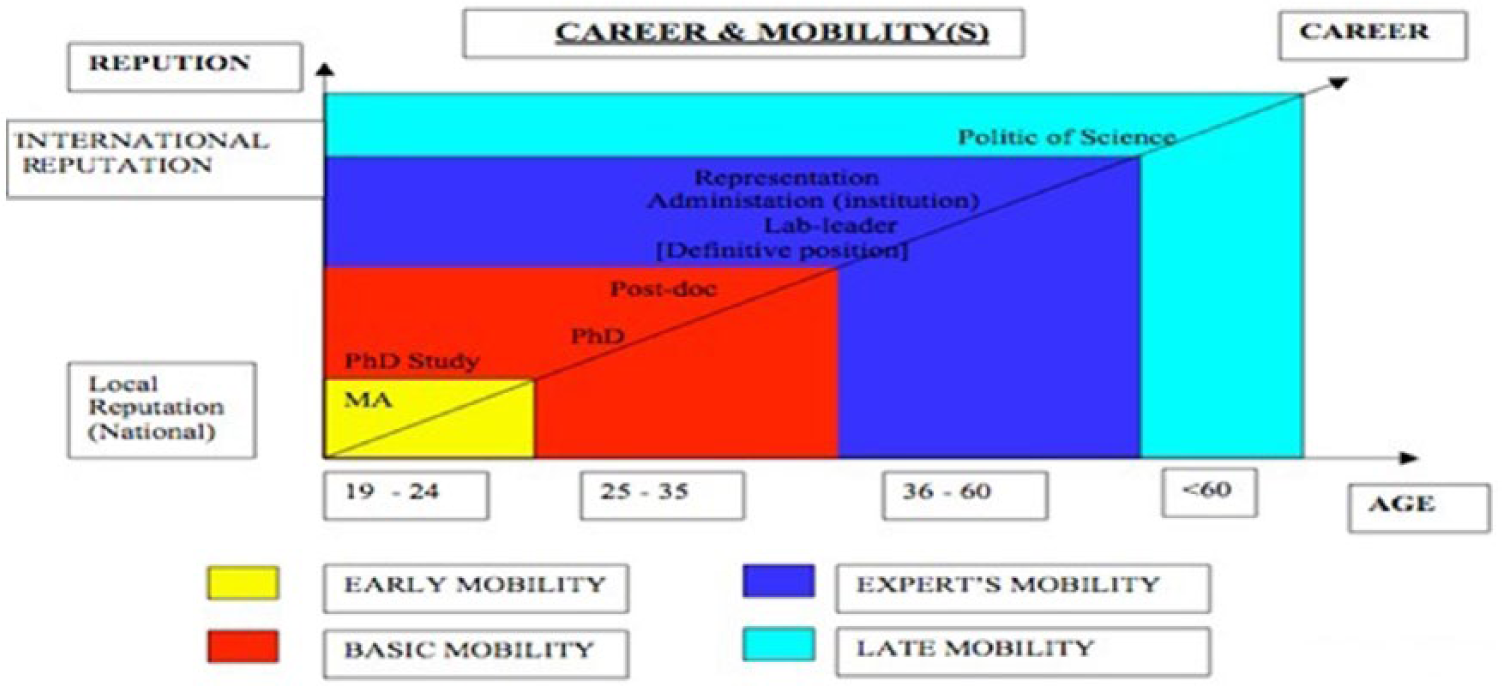
Career and mobility interdependence (Wagner, 2011a: 280).
Transmobility as a social process consists of four stages related to a form of mobility and reputation (early, basic, expert and late mobility). 21 The above model reflects an ideal type. For example, European institutions have adopted age limits for the purposes of recruitment and categorizations; this, in fact, is a ‘masculine’ version of a scientific career which does not take into account the years spent on parenting. 22 This is an important and yet rarely recognized factor of gender inequality/discrimination. The requirements of such a path are difficult to combine with one’s family life, especially with the obligations coming from raising children, which are still far from being fairly shared by both parents.
In other professions this kind of mobility has been expected or even required for decades (diplomats, high-level international managers; see Wagner, 1995). However, these populations are masculinized and usually enjoy a much better financial standing. High salaries, comfortable lifestyles and additional benefits compensate for mobility requirements and a particular temporality of contracts. Career tracking in diplomacy ensures certain security. In business, important incomes cover the needs of larger families (international school fees, etc.). Considering expatriates in corporations or diplomacy, the living situations of scientists are not at all comparable. Post-doc salaries in the case of a scientist couple working in the US often do not cover daycare for one child.
When we analyse the situation of scientists of both genders (as well as scientist couples), we should take into account their economic status, the precarious situation of short contracts and transmobility requirements (the sine qua non for scientists from the majority of countries). This is exacerbated for scientists from peripheral countries, such as Poland 23 (to apply the Wallerstein’s division), where internationalization of one’s scientific career is strongly expected both structurally and culturally; structurally, as many universities and research institutions require long-term international experience for contracts beyond post-doctoral level. There are also limited resources for research, and modest equipment, especially in experimental research. The cultural element is related to the opinion largely shared by scholars and supported by the Ministry of HE and the national granting agency (National Science Centre, NCN), favouring the learning of skills abroad and ‘foreign’ expertise. In this phenomenon we may recognize typical patterns of a post-colonial attitude (Leder, 2014; Popow, 2015).
Poor financial support by the Polish state contrasts with the high quality of HE (thanks to a long tradition of university teaching in several scientific disciplines, high-level theoretical knowledge was transmitted, however only in some specialities; this quality has then translated in the practice of research 24 ). To sum up, a professional trajectory of any well-educated graduate becoming a scientist necessarily includes scientific experience abroad. The career of a ‘local scientist’ (as was the case in France) is impossible in Poland. Today, to apply for a position in a research field (beyond post-doc), and according to rules implemented by the last reforms in Poland imposed by the Minister of Higher Education and Science in 2011, experience of scientific work abroad is required (especially for STEM subjects, which were the main focus of the conducted research).
Concluding the context part of the article, we should emphasize the unique nature of the situation of Polish women scientists as compared with all scientists and academics in Poland who pursue their occupations. We need a detailed explanation of their environment to understand why so many of them decide to have a family and raise children (we have no statistics about it, though – our data are provided by an ethnographical study). Those who have decided to combine their professional life with family life encounter grave difficulties in following the transmobility process. When they choose to stay in Poland, they, perforce, limit their mobility (internal mobility is very low in Poland) and, in further consequence, risk impeding their career advancement.
We can also suppose that failures result from either unofficial criteria of selection or simply poor publication lists (caused by the requirements of their family life and lack of time for other time-consuming activities). This is not limited to Poland, but it is clearly visible in this country as the reform of HE officially imposed a career calendar and its model, which are difficult to follow for women with children or even for men with children. Scientists and academics are tacitly expected not to take care of either children or seniors. 25 This is a model for a single person who devotes all his/her life to scientific activity and is able to move frequently following the next opportunity to be hired on a short-term contract.
The above-mentioned major reform implemented by a neoliberal government (see Wagner, 2011b) imposes strict deadlines for every subsequent career stage. After accomplishing his/her PhD, a Polish academic teacher has 8 years to achieve habilitation. 26 While for some disciplines this period seems sufficient, for several specialities (fieldwork and experimental work-based research) the deadline is too short. It should be noted that for humanities and social sciences the habilitation process requires publication of a monograph or a series of highly evaluated articles – the process of publication is often very long. In practice, the time to finish the writing and for the whole habilitation process is 6 years. The birth of a child permits a postponement of the deadline by 1 year. However, for several specialities, particularly in life sciences, this is not sufficient, as pregnancy and breastfeeding make it impossible, for instance, to manipulate some dangerous products or toxic substances. However, this is only one technical specificity for exclusion from a scientific career. The general rule constitutes a criterion of selection that openly discriminates against women with children, and no efforts seem to have been made to ensure some balance between family and professional life, or even to guarantee a possibility of coexistence of both. Imposing such deadlines means exclusion of a major part of female researchers from advancement in their scientific careers. Siemieńska indicated a particularity regarding women’s publication activity: while men start to decrease their ‘production’ after turning 50, women, on the contrary, become more active in publishing than they were before (Siemieńska, 2007). The curves for masculine and feminine scientific production differ not so much in the productivity but in temporal shape. Women get their habilitation later, and they have a lower publication score before the age of 50. Approaching this age, women start to have impressive curves showing intense scientific activity, and when their masculine colleagues slow down, women are at the peak of their performance. This scientific fact was not taken into account at all during the construction of career time-frame by politicians.
These aspects are present not only in Poland. The specificity of our case study resides in a certain ‘allergic effect’ against social protection measures, dissolution of stable employment and a lack of a representative organization to fight for improvement of work conditions. With such an approach by the workers themselves, the implementation of new neoliberal rules (such as imposing competition as the main model of existence in the scientific world, payment on results, short-time perspectives and a largely spread granting system 27 ) came into being without much resistance. This capitalist model of financing and organizing the work in HE and scientific institutions is largely supported by the older generation of scientists who underline various negative influences of the security model implemented in socialist states. The politicians of science (usually former scientists who were educated and who conducted the first part of their career under the social system before 1989) have decided that competition and the American model of organizing science are more beneficial than the previous model (called ‘communist’) and claim that, in their new system, ‘the excellence wins’. 28 This kind of attitude is common among scientists educated and working in former Central and Eastern European countries. These politicians do not realize the extent to which the previous system facilitated access to scientific occupations for those groups that today have no possibility of pursuing those professions (especially lower-class people, and, with numerous above-mentioned reservations, women blocked in teaching positions).
The struggle for coexistence of professional and family life: Survival strategies of women scientists
The major factor affecting the presence of women in scientific positions at higher career levels (after post-doc) is their family situation. Both parents and partners play a decisive role in such a career orientation; parents, because of the position of the heirs (Becker and Carpenter, 1956; Bourdieu and Passeron, 1979). They transmit their professional and social capital as they socialize their children within the academic world. The presence of ‘dynasties’ and ‘scientific families’ in Poland is noticeable. These parents also create favourable conditions while their children are studying towards their PhD and post-doc, a period which is very difficult in the life of young scholars. 29 Finally, the children of academics share values with their parents and, therefore, they can benefit from their support (financially and otherwise: conferences, acquisition of books, workshop participation, coverage of study fees or supplementary courses), as well as from simple yet crucial help in covering the costs of living. Such parents support their children during doctoral studies. It is worth emphasizing here that in Poland the majority of PhD students are not able to afford an independent life because only very few receive a scholarship (which, by itself, in many cases is not sufficient for a family with children). Another important factor is that the necessity of being ‘away from home’ because of doctoral training or a post-doc contract abroad is well understood among scientific families. In other words, these young Polish scholars need parents who are not only able to afford to support them, but who also value their children’s academic career highly.
A similar dependence is noted in relationships with partners. Understanding and acceptance for a specific work engagement and a ‘style of life’ (including mobility) is indispensable. The partner should follow the scientist and should share the same values in order to understand and support their passionate involvement in work. This is probably the reason why the majority of non-single people among those whom Wagner observed in life science laboratories (not only in Poland) were partners of other scientists (Wagner, 2011a). 30
Analysing their career paths on the basis of Wagner’s data, we see that up to obtaining a PhD both partners’ careers usually evolve at a similar pace. After that, the choice of the next career step starts to differ with respect to gender. In the majority of the observed cases, a post-doc contract is a struggle that mobilizes several strategies. For couples without children, a temporary separation is taken into account. For Polish post-docs in numerous disciplines, the countries of destination are the USA, the UK and, after 2004, various EU countries. Some of the observed scientists had already gone abroad for long periods of time during their PhD training. The most common situation is to go for a post-doc position in the US – giving priority to the man while the woman would follow him with the plan of having a baby during the post-doc period. Several elements contribute to this choice: social security coverage (in Massachusetts, for example, it is much better than in Poland) and the American nationality given to children born on US soil (for historical reasons, a ‘Western’ passport has important value in Poland). Until the departure, the women and their partners (husbands, in the majority of cases) were usually equally advanced in their careers. However, the women usually stop their professional advancement by staying at home and raising children. Daycare costs in the US are too high to be covered by a post-doc salary.
In the case of both partners going on post-doc contracts, having a child abroad is really difficult (women have to obtain maternity leave as they need to take care of their newborns). One solution is to invite grandparents to take care of the children. However, if we consider that the majority of post-docs originate from academic families (or the so-called ‘intelligentsia’), it is rare to see such a solution in practice – sometimes, the parents send a person to stay at home with the children. This solution is opted for by numerous Chinese couples (in China the retirement age is 55 for women and 60 for men, and the one-child policy means there is huge pressure on grandchildren’s education). However, all things considered, this solution is rarely pursued by Polish scientists.
The following example of a biologist couple (different specialities) illustrates the typical case of career development before and after the children are born during post-doc training. Alina and Jan had been a couple since the last year of their MA. After the first year of doctorate studies, Jan decided to go abroad to do his PhD in one of the best places in his field (Asia). The couple had a long-distance relationship for 2 years (with several short-term visits) and then Alina came for several months to join Jan but without professional grounds. After Jan got his PhD, the couple moved to the US (Alina finished her PhD in Poland a couple of months later). In the US, they stayed for two post-doc contracts (over 8 years) and Alina gave birth to their daughter there. After 6 months spent at home, Alina came back to work and had good conditions for combining motherhood with research work. Her boss (a woman at the last stage of her career) always understood the family obligations – she was an active feminist and fought to improve the quality of life of women scientists. Alina needed more time than her husband to finish her project, to publish. Jan advanced fast and was successful in obtaining an important grant and professorship position in Poland. They decided to come back. He promised to make efforts regarding her career advancement. He negotiated for her a position of an academic teacher and scientist at the same university (he was a son of a professor there), but she was not so successful in the game of getting grants and it took her as much as 6 years to start her own research group. At that time, Jan was almost at the top of his academic career and his position of a researcher at the international level was very strong. Then, they decided to have another child. When Alina was on a maternity leave again her work slowed down, even if she never really stopped working (while officially staying at home, she continued to read recent subject matter literature and wrote papers). Despite Jan’s declarations about their equality in sharing the familial tasks and the responsibility of taking care of the children, as she said: You know, when a kid has the flu and you should take him to a physician and then take some days off it is always me, while his projects and his publications are more important. Sure! He has this big grant and a huge project, important dates and my work is much smaller than his – all can wait… this is always like this. (formal interview; however, Alina and Jan have known Wagner for 7 years and have a good friend in common; this explains the trust and close relationship)
This example indicates the most frequent dynamics which drive a couple’s careers forward – the man’s path is not really affected by having children or by the necessity of following the wife in her post-doc training, whereas the woman’s professional advancement slows down. When both parents are doing their post-docs (or sometimes earlier training) in countries with a good welfare system and efficient family policy, the effects of slowing down are less pronounced in the careers of women. Not surprisingly then, a good childcare system is the primary reason for Poles to choose another European country as a destination. For instance, a scientist couple (a historian and a biologist) chose France for their post-docs because of a system of free kindergartens. Another example is of a woman scientist who chose the UK, as she decided to work there when her two children were of pre-school age. The financial and structural state support in those countries makes scientific work possible (in vivid contrast to Poland).
Sometimes, after a period of time spent giving birth to one or two children and rearing them through their first years (or months), young mothers come back to work. In the interviews, they all complained about the difficulties in combining work and its intensity with their involvement in family life. The main problem for all the female respondents is transmobility (perceived as the main obligation, especially in STEM specialities), in terms of the challenge of maintaining personal life relationships despite frequent moves and home changes. Their temporary absence from the rest of their family (the partner and children) is perceived as a potential issue, especially if they do not work in academia. In such cases, women scientists reduce their international mobility to the minimum extent (short-term contracts) in order to fulfil the gender obligations imposed by the implicit hierarchy. Yet, such a solution also perturbs their family life, as illustrated in the following excerpt from an interview with a specialist in experimental physics who worked at a major (and rare) laboratory with full equipment in Western Europe: I had this style of life for years: 2–3 weeks of working abroad and 1–2 weeks back at home, but at this time I should teach and do all the bureaucracy work I could not do during my absence. I was completely starved and when our daughter was 6 years old, just 1 year before her getting enrolled in primary school, my husband said: OK it is without any sense that you are travelling like this all the time. You take 1 year of contract and we will go with you’ And we went to the US and it was the best professional time in my life.
Men’s testimonies concerning their international mobility, according to which it is usually their partner (and sometimes the children) who follow them for post-doc training, show a sharp contrast. The men take for granted the fact that their spouse will quit her job in Poland or postpone her professional plans in order to follow the husband. Even if some respondents do acknowledge that their partner ‘did sacrifice’, they rarely reciprocate. Reciprocity in this context would mean, for example, that after his contract the man would follow his wife, had opportunities arisen for her career. The situation of a wife being ‘a shadow’ of the husband is so common that is generally deemed ‘natural’. The strategies are chosen according to men’s priorities and their career development. Examples to the contrary, that is, when the woman’s career is more advanced than the man’s, are extremely rare.
Vampirization: Hidden careers of spouses of male scientists
When a highly specialized female scientist stays at home (because she is taking care of the children or because she has not obtained a post-doc contract in the same city as her husband), she has the time and knowledge to help her husband in his work. Such assistance takes various forms depending on the proximity of their specialities or disciplines. However, these ‘household collaborations’ are frequent as people find their matches and form couples during their university training and, in experimental sciences, they are frequently laboratory mates. These couples share specific knowledge that allows for long scientific talks and professional conversations at home. One of the physics specialists talked about his wife staying at home during his US post-doc and afterwards, when he got a permanent position in the EU (interview): Nobody helps me at such level as my wife. We studied together and she is very good in my field. After my work I come home, and I tell her all what I did, I discussed with my colleagues, I thought. She reads new papers at my place, because I have not enough time for it. She listens to me – you know even the craziest ideas. She discusses each of my thoughts and plans. I can trust only her because she is very smart and because… I have trust. She will not betray me – with my colleagues in the laboratory you are never sure what will happen. With my wife we are never in competition – she is the part of my brain. I am lucky.
As sociologists of work we will focus here on the division of tasks that the above-cited spouse fulfils: reading, listening, advising, counselling, discussing, organizing, thinking. Other interviews gave us the basis for completing this list: writing publications, editing texts, preparing grant applications, responding to letters, planning activities, correcting students’ work, managing the calendar. All these tasks, in several cases, amount to a full-time job, and a very important job at that, since it requires as high a level of knowledge as the person who is ‘doing the career’; everything that those partners do requires a lot of skill and mutual trust. The spouse’s job is not remunerated, and it is hidden, as only exceptional scientists acknowledge this kind of contribution to their work. We have found only one example of such acknowledgement – a French couple, who were physics specialists, worked in the same domain and published manuals and papers under both authorships. At the summit of their career they had their first child, then a second one. For health reasons the wife stayed at home, withdrawing from her experimental work (she kept teaching), but the authorship rule established in the past by both spouses did not change. Her husband explained that he alone works scientifically, but the wife checks, corrects his writing, discusses, and takes care of the family almost all by herself; this peaceful relationship is the origin of his enormous work capacity and creativity. This is why he maintained this double authorship – in recognition of those ordinary domestic tasks and hidden professional support for his career.
Vampirization (Wagner, 2011b) is the term that describes this contribution of women to their husbands’ careers. Theoretically we could suppose the inverse situation, but Wagner has never encountered such a case. All the situations were as follows: the men used their wives’ work without attribution (even symbolic, such as acknowledgements); such practice lasts for years and the man keeps pretending that he is the sole creator of his own career. The hidden career that shadows his career is not visible to other people; they perceive the effects of the contributions of two high-level scientists as the work of a single, outstanding specialist. We should not confuse vampirization with the Mathilda effect (Rossiter, 1993), as it is not directly a question of reputation construction. The first and main problem here is no recognition of the wives’ hidden work, whereas in the Mathilda effect the names of female contributors are known. The reputation could be built (or not – as in the Mathilda effect) based on work that is signed. Vampirization is the phenomenon of using others’ work and attributing it to oneself. Plagiarism is a different phenomenon, as the original work was published. In the discussed case, the author of the work stays anonymous. However, both partners frequently see ‘nothing wrong’ in that. The woman does not realize that she is employed without attribution or recognition, and her partner does not recognize that he exploits her work and knowledge. 31
This is not a new phenomenon (see Deegan, 1988) and, for example, in previous generations of sociologists we note important contributions (more or less hidden) of their wives – they rarely had a chance to develop their own careers parallel to their husbands’ careers. 32 We would like to underline this important phenomenon, for – according to our data – this situation concerns a significant proportion of Polish women in science and reflects their own way of finding some balance between the family life and the scientific activity. As they stay at home, the family benefits from privileged support. On top of that, helping the husband, even anonymously, is a way to stay active as a scientist – even if in a position similar to ghost-writing. This kind of ‘sacrifice’ is commonly accepted – for the sake of the family’s wellbeing and the husband’s career. To complete the section devoted to the vampirization process, it is important to note that this is a dynamic process and can occur to different degrees and in various forms: from loose discussions about unconventional ideas and reading of new literature to a full-time job of checking students’ work, reviewing articles, grant evaluations, writing grant proposals, etc. This practice of being a scientist couple working for one single career is one of the most common traits of the studied population. It is also possible to see (in case of couples without children) hidden collaborations, that is, exchanges of knowledge, skills and information concerning career making and ‘tricks of the trade’ without putting an unequal burden of tasks on one of the partners. However, Wagner’s work shows how this phenomenon is gender-determined, and to what extent similar processes of dependency and partial (not scientific but economic) exploitation that go in the reverse direction (men following women and putting their career on the second plan) are widely perceived as ‘the world upside down’.
Men’s ‘sacrifices’
In rare situations in which men follow their partners, female scientists abundantly praise their case, underlining ‘the husband’s exceptional sacrifices’. It is interesting to notice that the term ‘sacrifice’ is rarely employed by men who describe the situation in which their spouses drop their jobs or interrupt their projects to follow them. By contrast, all women who experienced the situation in which their husbands followed them in their post-doc mobility employed this term. This observation constitutes an important point about gender division of roles in the construction of the career of the partner who is in the priority position as a breadwinner. If he is not a scientist, her work as a researcher is considered as a nice and extravagant hobby; in Poland, one can find multiple jokes and anecdotes illustrating this opinion. One of the privileged informants (female chemistry specialist) explains this phenomenon (interview): Time and again, the problem of a woman doing science. A colleague of mine is going to a post-doc and as she will gain money there, her boyfriend doesn’t want to go as her dependent. There is such a problem. So they aren’t checking all visa possibilities for this country because they don’t quite know what they would do if this [a long-term visa for the boyfriend] was possible… [The respondent continues about her own situation.] Well, after that few-months stay [her former scholarship of several months] I just knew that staying without my husband doesn’t make sense. On the other hand, it is a burden when a husband goes with his wife or partner and for some time he depends on her. Even if he himself can deal with it, the surrounding will never cease to remind him. I.W.: Who would it be? - The acquaintances… sometimes it pops up in the talks. Maybe not so much with us but it does pop up. My husband may not have admitted it but he… besides, he has always wanted to be a scientist and he cherishes what I do. Sometimes it’s really an overdo, like when he somehow did everything to help my career and – well, I can see it now – when he is completely on his own he’s doing very well but it was a burden to him that he was financially depending on me, to a degree. And he didn’t really have any professional successes of his own. (Wagner, 2011a: 135–136).
In another case the husband’s ‘sacrifice’ was not only to travel on his wife’s visa but also to experience an important ‘professional downgrading’ of the husband. The above case is exceptional as the husband was an attorney in Poland and could not work as a lawyer in the US. He took a manual job and took care of the couple’s daughter after kindergarten. Whereas in many cultures such provisional solutions are not perceived as negative, in Poland manual work is often associated with shame and personal failure. This explains why the respondent was so grateful to her husband. Asked by Wagner if after that period of mobility she had other contracts abroad, she responded that it was the only contract in her life for such a long time (12 months) and it is impossible to repeat this situation. This means that the woman will not be able to fulfil expectations of transmobility, and as a married woman with a child she will not be able to compete on equal terms with her male colleagues (or with women who are single or in a couple with another scientist). The situation of being a caregiver (of the children as well as of older parents) or having a partner who refuses a long-term separation almost immediately puts the career of a woman scientist in jeopardy, which can be associated with discriminatory policies and career models. The second element of this discrimination, as well as the inability to improve this situation in Poland, is a general insensitivity and ignorance about gender discrimination and the difficulties that women scientists experience when building their careers within academia.
A life of blissful unawareness
In 2014, the Polish Academy of Science organized a conference about careers in science. There were 18 participants (not all of them researchers in connection with the institution), none of whom was a woman. 33 The conference took place in the centre of Warsaw – the event was presented by a famous journalist and attracted numerous PhD students and young scientists. That missing presence of women was remarked on by only a few people from among those who had known about the conference beforehand (as the conference discussed new law regulations, the information was widespread). The critical remarks about the absence of female speakers (more to the point, none of the renowned scientific careers specialists had been invited) were noticed only by female guests, social scientists who are specialists in gender research or are feminist activists. Some of them boycotted the event, some found it scandalous. Nevertheless, no follow-up was organized to inform the public about this imbalance.
This story reflects the state and level of awareness about gender discrimination and fair practices (such as adopting a gender-balanced perspective in inviting key speakers to a conference). One sociologist expressed her opinion in an informal conversation, saying that when she is invited to a panel with male colleagues it is very difficult for her to have an equal place in the discussion (time allocation) and she is frequently treated as a decoration, additional ‘furniture’ to the circle of male experts. In many situations it is really difficult to play the role of an expert when the expert is female.
Disobliging comments are frequent and made by both male and female colleagues, such as in the following situation observed during the fieldwork: a female laboratory leader is commenting on her PhD student getting invited to a conference in Germany: ‘I cannot understand why they are inviting her – probably they have seen a picture of her’. In Poland, so far we have not observed the practice of supporting young female scientists by their advanced colleagues (the exception could be the PhD mentor–mentee relationship). Non-official or unofficial rules help young women in their scientific career construction.
The following example illustrates a widespread opinion about women in science and their professional activity. At the Women’s Congress that took place in 2012 in Warsaw, the Minister of HE and Science was invited (she sent her deputy instead; both politicians happened to be women) to the panel devoted to women in science. A young biologist asked a question about children and access to childcare institutions as, in her opinion, in the conjunction with low salaries, a family of scientists was not able to cover the fees of such care and at the same time pursue career advancement. The Deputy Minister responded that if someone is good at and passionate about science, nothing is an obstacle. She added that she herself had a daughter, who was a scientist and whose husband was also a scientist (both were historians), and that they educated their child without any negative impact on their scientific careers.
How can we imagine positive discrimination measures or political decisions being implemented to improve the gender balance in academia when the Deputy Minister of HE and Science takes such a stand in front of the public? This situation illustrates that not only public opinion or the scientific world are unaware about difficulties in pursuing a career in science in parallel with a family life. Politicians in charge of creating good conditions for scientific work are ignorant not only about gender imbalances, they also are not familiar with a widespread literature about professional women’s situation in the contemporary societies. How is such a situation possible in the country that claims to follow in Skłodowska-Curie’s footsteps?
Generational misunderstanding
The observed situation above is a perfect example of a common attitude among Polish women scientists. The older generation (the Deputy Minister was born in 1951) built their scientific careers before the profound systemic changes in Poland. This means that they benefited from state-provided care and their children had full access to kindergartens, pre-schools and other kinds of institutions that assisted working parents in caring for and educating their children. The entire system progressively collapsed with the introduction of neoliberal capitalism. Ever since 1989, successive governments (left and right wing) have claimed that this was an indispensable part of the democratization process and the way for Poland to cease to be an underdeveloped country and to catch up with Western countries. The Deputy Minister and many other women of that generation did not realize to what extent the care institutions were important for the development of women’s careers, and how the life of young academics in charge of their families is nowadays difficult.
The story below illustrates this profound lack of sensitivity and imagination (as well as empathy) towards younger colleagues. A female professor of biology was well known for mentoring women in a hard way, in particular not understanding their problems as young mothers nor the difficulties with involvement in their laboratory work. Young scientists avoided collaborating with her and a lot of PhD students were scared off because of her attitude. She always claimed that if a researcher is ‘good’, 34 children will not be an obstacle in their career building. She underlined that she herself had a daughter and she had worked all the time when her child was little. However, the same woman totally changed her attitude when her own daughter (also a young scientist) became a mother. Then, she became very sensitive about childcare problems and the inefficiency of help directed to young parent-scientists. She became an expert in all problems related to balancing family and scientific work. She said to her post-doc, during a coffee break taken in the lab: ‘I did not realize how things have changed these last years’.
This is a crucial problem in career perception: even the people who do reflect on career issues only take into account, as a model to think about, their own experiences, which took place 20, 30 or 40 years ago. For some countries this is less of a problem (the situation is stable and the institutions are conservative). But in Poland, the entire social and working environment has changed. The experiences of previous generations are now irrelevant. It is impossible to think about, analyse and pretend to understand the professional problems of new generations simply by one’s own experience. However, in Poland, the majority of politicians in the scientific world proceed without professional support (such as field advisers, or even properly conducted research providing deeper understanding and the larger perspective that we have developed in this paper). This unprofessionalism in career modelling and strategizing coupled with the lack of positive discrimination measures marks the particularity of our case. If we observe in Poland a series of actions undertaken to attract women to the sciences, the actions are copy-pasted from Western practices and have nothing in common either with Polish culture or with the current situation. At the same time, whereas the local context remains unresearched, a lot of money is spent on advertising. No efforts are made towards creating real measures that would help women to pursue their scientific careers without pushing them into a single lifestyle.
This double specificity (i.e. copy-pasting from countries perceived as ‘developed’ and the lack of local measures which disappeared during the transformation process) is reinforced with what we may call an allergy to social solutions. Practices of welfare, social mutual help and cooperation gave room to competition, commercial solutions and acute individualism. We should see this allergy-like attitude as a backlash reaction to the ‘communist’ times when positive social measures were implemented to help students originating from lower classes (working-class or rural areas). Such attitudes are perceived today in Poland as unjust, obsolete and simply wrong, which by consequence spreads to all kinds of social measures such as welfare-state provisions or positive discrimination.
The slogan ‘if you are good, you will succeed in your career’ is so deeply incorporated by new generations that small initiatives of PhD students cannot attract the support or even interest of their older colleagues. 35 Each person is an isolated particle, and in such social un-cohesion each action aiming at improving work conditions among scholars is destined to failure. The conviction about the power of a human genius (in the sense of professional performance) completely eclipses the issue of decent work conditions. The blame for failure is on an individual, not on social or political structures and institutions. This situation makes any progress impossible. Young scholars who decide to stay permanently in Poland will struggle to pursue their scientific careers in parallel with family life. They cannot work in academia and have children without external financial support (family, grandparents). This is not ‘difficult for them’; this is a mission impossible.
Conclusions and recommendations
The longue durée perspective helps us to observe an important (and probably typical of the so-called ‘post-communist’ societies) regress in women’s rights; it also highlights persisting misconceptions about gender equality. When we think about women’s rights, we usually consider an upward movement: women obtain more and more rights and are confident about a bright future of full equality to men. Meanwhile, the case study conducted among a highly educated population in Poland shows the impact that rights-stripping processes and dismantling of social achievements has on people’s careers and lives. In our case, an important step back, especially in the field of institutional care, made the situation of Polish women scientists very difficult. This dark picture requires reaction in the form of implementing some positive measures.
The first step to an improvement would be a large push for information in order to end the blissful unawareness. The next step would be an affirmative action: the implementation of proportional quotas which makes women’s participation obligatory in both events and selections (at each level of scientific activity). The third step is related to the creation of positive measures (institutional and organizational) to assist women in pursuing not only their scientific careers but also their family lives: the construction and implementation of gendered career calendar that would take into consideration childbearing and rearing, call for sharing the parenting burden by both parents, support the children’s education and envisage solutions for other life events and processes. This will enable female scientists to reconcile both sides of women’s life: private and professional. The lack of such support may be one of the main reasons why women drop their careers in science and academia (Smith-Doerr, 2004).
Certainly, transmobility expectations should be more flexible and extra funding should be guaranteed to women who are moving (in order to make the geographical move possible to the whole family). It is no longer possible to pretend that, with only 24 hours per day, women in charge of their families 36 are able to be as involved in professional performance as are their colleagues who are single. For instance, this fact is not taken into consideration in the majority of selection processes (for example, in grant attribution when juries proceed to evaluate publications). Such a system heavily nourishes the Matthew effect (Merton’s and Zuckerman’s concept; Merton 1968, 1988) and class discrimination.
Whereas in the case of the Matthew effect there is no need to elaborate on the issue (for those who already have a long list of publications the selection plays to their advantage, meaning the more you did, the more you will obtain), class discrimination is less clear, especially when we consider that a major part of the scientific population originates from similar social environments (middle-class parents, usually teachers, physicians and highly skilled employees). However, women with children who are involved in scientific activities frequently stay on track in their careers thanks to their husbands who, being high-level managers, businessmen or private physicians, are able to cover the expense of caretakers for their children and household. This situation strikingly resembles the reality of the 19th century, when a scholar or scientist (usually male) came from a bourgeois or aristocratic family and was not under obligation to earn a living for himself and his household.
The situation of Polish women in science is particularly difficult, as this is a job with an important symbolic value that comes with expectations of outstanding personal involvement. At the same time, an important hostility within the environment is generated by neoliberal so-called ‘productivity incentives’, such as competition, huge pressure on fast career advancement and disproportionally low income in addition to a fixed and unjust age frame. In conclusion, this is a perfect example of intersectional discrimination when different aspects, such as gender, age, class, origin, parental profession, family situation (being a parent) together produce a certain discriminative synergy and punish those courageous women who just dared to try to pursue their scientific career – which in Poland is, basically, a professional path created for monks.
Footnotes
Acknowledgements
We would like to thank Julia Kubisa for precious advice and comments of the first draft of this paper.
Declaration of Conflicting Interest
None declared.
Funding
This research received no specific grant from any funding agency in the public, commercial, or not-for-profit sectors.