




Abstract
This analysis focuses on changes in higher education governance in Poland and Romania in the post-communist era. The author applies a theoretical framework based on institutional isomorphism and historical institutionalism and maps the policy trajectories of both systems on the basis of three governance ideal-types. The public higher education systems of both countries initially took a markedly different reform path after 1989. Polish higher education by and large returned to its historical model of ‘academic self-rule’ and has resisted pressures for stronger marketization, even during the Bologna Process, while Romania has been characterized by an early and strong isomorphic orientation towards higher education models primarily of Anglo-American inspiration. The main argument of the paper is that – after a period of marked divergence – both systems are visibly ‘re-converging’ towards a new hybrid governance model. The new governance model aims to (re-)embed the research mission of universities to foster homegrown research and innovations. These new hybrid constellations enable both countries to simultaneously deal with global pressures for change and liberate themselves from economic dependence on the West, while not throwing historical institutions entirely overboard.
Keywords
Introduction
The higher education (HE) systems of Central and Eastern Europe (CEE) have been influenced by a bewildering array of internal and external forces of change in the past 25 years: the introduction of market economies and democracy, the renewal of the academic profession, public sector reforms and, not least, the Europeanization and internationalization of HE have penetrated to the core of pre-existing governance arrangements and regulatory frameworks. Throughout the process of change and adaptation, post-communist HE systems have oscillated between reinvigorated traditions and modern-day policy models. The result has been a heterogeneous patchwork of policies and institutions, which reflect both the historical roots of CEE universities – in some cases spanning back to the 13th or 14th century – and the accommodation or fully fledged implementation of market-oriented mechanisms often inspired by Western practice (Dobbins, 2011; Kwiek, 2012).
This analysis focuses on two large post-communist countries – Poland and Romania – whose public HE systems initially took a markedly different reform trajectory after 1989. Polish public HE by and large returned to its historical model of ‘academic self-rule’ (Leja, 2012) and has generally resisted pressures for stronger marketization, even during the Bologna Process. The Romanian reform pathway, by contrast, has been characterized by an early and strong isomorphic orientation towards HE models primarily of Anglo-American inspiration. In contrast to Poland, Romania quickly implemented a wide range of market-oriented policy instruments after shrugging off its historical pattern of state-centred control. Thus, Romania and Poland initially represented a case of policy divergence in an era of perceived policy convergence (Holzinger and Knill, 2005).
This paper builds on previous findings regarding the governance of public HE in Romania and Poland by taking a longer chronological perspective of 25 years (1990–2015), which enables us to reassess the convergence/divergence hypothesis. This approach can be justified by various factors rooted in the changing nature of the European integration process, both in HE as well as in the broader political economy of CEE. First, it is legitimate to argue that policy areas other than HE were given precedence in the early and mid-2000s during the European Union accession process. Regulatory alignment in areas directly affected by the common market (e.g. consumer protection, trade liberalization, etc.) was prioritized in order to accelerate the implementation of the acquis communautaire (Sedelmeier, 2005). Successful accession to the EU has, however, liberated the new member states from these constraints, and potentially enabled them to focus on new priorities such as education.
Second and most importantly, the integration of post-communist economies into the European common market has led to notable changes in the political economy of CEE. Here, I draw on Nölke und Vliegenthart’s (2009) argument that the accession process has reinforced the economic hierarchy in Europe, and turned the political economies of CEE into what they define as ‘dependent market economies’. Post-communist economies underwent a significant process of deindustrialization after 1989, making them extremely dependent on foreign direct investment. Many large- and medium-sized businesses operating in CEE are essentially ‘eastern outposts’ of transnational enterprises and thus find themselves at the bottom of transnational interfirm hierarchies (Nölke and Vliegenthart, 2009). Instead, the competitive advantage of CEE economies lies in their function as ‘assembly platforms for semi-standardized goods’ based on intense low-cost labour, whereby technological innovations are frequently simply imported from the West (Jasiecki, 2014). Their reliance on cheap labour has forced CEE countries to maintain low tax rates – to the detriment of public education (see Tarlea, 2015). As a result, top-class research and development activities are generally conducted in the West, while the CEE countries lag severely behind their Western counterparts with regard to patents issued (Eurostat, 2015; Jasiecki, 2014).
This political economic reality has become ever more blatant since the accession process (Nölke and Vliegenthart, 2009) and provides strong incentives for CEE policy-makers to use education as a lever to liberate themselves from the shackles of economic dependence. Along these lines, the emergence of international HE rankings (Hazelkorn, 2011) has played into the narrative of CEE universities as laggards in top-class research and development (see Boyadjieva and Tarlea in this issue) and thus compounded fears that these universities lack capacity to promote economic viability. This narrative dovetails with the European Union’s Lisbon Strategy (European Council, 2000), which defines university research as a major catalyst of economic growth and development in Europe.
Given the widespread perception of economic and educational inferiority in CEE, policy-makers may seek to recalibrate existing HE governance models to engender top-class research. In this process, Western policy models may continue to provide a source of inspiration and reform anchor to post-communist policy-makers. After all, the late 2000s and early 2010s have proved to be a period of intense HE reform activity in Western Europe, spanning from the Pécresse reforms in France (2007) (Dobbins and Knill, 2014), to the reform of German federalism and the Exzellenzinitiative (2006) (Toens, 2009) and the Gelmini reforms in Italy (2010) (Donina, 2015). As a result, new potential reference models have recently emerged in systems that have historically provided reference points for CEE HE.
The article is structured as follows: I first discuss a theoretical framework to conceptualize policy change and inertia in post-communist HE. I then present three ideal-types of HE governance as an overarching analytical framework for tracing policy changes. After a very brief discussion of pre-communist and communist historical legacies, I highlight early post-communist developments up to EU accession (2004 in Poland, 2007 in Romania). The main thrust of analysis focuses on developments in the past 10 years (c.2005–2015) and whether both systems have ‘re-converged’ in view of the altered HE playing field, which has resulted from the deeper institutionalization of the Bologna and Lisbon Processes, the completion of EU accession and the increasingly perceived reality of economic overdependence.
Theoretical considerations and analytical framework
In the past 25 years, post-communist HE systems have not only struggled with similar issues to Western systems, such as financial shortfalls, the lack of transparency and international competitiveness, but have also been burdened with numerous additional challenges. In the early 1990s, post-communist HE institutions first struggled to liberate themselves from communist ideology and restore academic self-administration. In the mid-1990s, governments became increasingly concerned with counterbalancing institutional autonomy and, in some cases, ‘academic anarchy’ (for Bulgaria see Georgieva, 2002: 30) with new forms of state regulation. Policy-makers were subject to increasing pressures to ensure the quality and transparency of rapidly expanding private HE sectors, while public institutions were often preoccupied with their very survival amid drastic financial shortfalls.
While domestic exigencies dominated the policy trajectories of the early and mid-1990s, the Bologna Process, in particular, has increased pressure on HE policy-makers to assess critically the effectiveness and quality of university output. Although the main lines of action of Bologna affected study structure harmonization and quality assurance, the process has also exposed the vulnerability of existing governance models. Bologna has been framed by a transnational discourse on making universities more globally competitive, attractive and efficient. As a result, market-oriented policy instruments, primarily of Anglo-American inspiration, have been explicitly promoted. The European Commission, which assumed a more central role in the 2000s, consistently advocated university autonomy, entrepreneurial governance approaches and closer synergies with the business world. Along the same lines, the transnationalization of HE has engendered a new culture of ‘international comparison’ and rankings, thus making HE systems more aware of their position amid global competition (Hazelkorn, 2011; Martens et al., 2010).
Against this background there appeared to be viable prospects for the convergence of policies in line with rapidly spreading liberal market ideology. Convergence is generally understood as the ‘tendency of societies to grow more alike, to develop similarities in structures, processes and performances’ (Kerr, 1983) due to greater economic and institutional interlinkages. In theoretical terms, the pressures stemming from socio-economic transformation, transnational scrutiny and HE expansion amid underfunding may prompt policy-makers to emulate external policy models perceived as successful. According to the theory of isomorphism, organizations strive to assert their legitimacy by means of imitation instead of developing their own solutions to emerging problems (DiMaggio and Powell, 1991). Isomorphism is particularly virulent when organizations are plagued by uncertainty and ambiguous goals. Against this background, one can justifiably argue that post-communist HE is extremely prone to isomorphic effects due to the daunting challenges of HE expansion amid severe underfunding. This uncertainty has been compounded by the emergence of new technologies, the reality of ‘brain drain’ and competition from private providers. This is particularly true in Romania and Poland, which quickly lifted restrictions on both private and public HE institutions to even greater competition.
However, a frequent critique of institutional isomorphism and the ‘convergence hypothesis’ is their determinism and, more specifically, their neglect of embedded historical institutions and pre-existing policy pathways (Perrow, 1986). A competing theoretical paradigm based on historical institutionalism may help explain unique country-specific reform trajectories. Historical institutionalists contend that national and local politics, economy and culture metabolize, translate and reshape global trends in the face of their cultures, needs, practices and institutional framework (Hall and Taylor, 1996; Vaira, 2004). The pre-existing functional logic of European universities may, therefore, make them highly change resistant, as external models and practices may pose undesired challenges to national institutions and beliefs. Thus, path dependencies and vested interests in upholding existing institutions and policies may frustrate any efforts at policy change.
As previously argued, historical institutions in CEE may be derived from both the pre-communist and communist phase. On the one hand, policy-makers may draw inspiration and legitimacy from historical models – e.g. Humboldtism and renaissance nationalism. A typical guiding principle of policy-makers in CEE has been to restore ‘continuity of history’ after the communist aberration (Radó, 2001: 14). Scholars have frequently distinguished pre-war HE systems based on the Humboldtian ideal of freedom of the search for knowledge through non-utilitarian research and teaching (e.g. Poland, Czech Republic) from those that leaned towards the French or Napoleonic concept of stronger state coordination of HE (e.g. Romania, Russia) (Sadlak, 1995: 46). On the other hand, the radical transformation and reorganization of society after communism did not necessarily mean that universities would automatically re-embrace pre-existing structures or isomorphically align themselves with external models. It may take years or even decades to uproot historically entrenched structures and norms. Thus, institutions and patterns of action inherited from communism may continue to impact HE systems (File and Goedegebuure, 2003: 218) and be combined with what is perceived as modern-day HE policy.
Three ideal-types of HE governance
How can we trace changes and inertia in HE? I suggest a classification into three broader, historically rooted and still-relevant ideal-types of HE governance: a state-centred model, a model of academic self-governance and a ‘marketized’ model. These classifications integrate key insights and categorizations from previous studies, most notably Clark (1983), Neave and Van Vught (1994), Braun and Merrien (1999), Olsen (2007) and Jongbloed (2003). Although all HE systems combine and integrate components of each ideal-type, identifying three broader poles towards which systems may converge enables us to better contrast the status quo ante with present trends and identify historically rooted path dependencies amid recent developments.
Let us begin with the state-centred model, which constituted the pre-war HE tradition in Romania, and was taken to an extreme form under communist rule. Here, the state bureaucratically regulates university affairs such as admissions, academic profiles, quality assurance and personnel, as well as university–business relations (Clark, 1983). Subsequently, the role of both the ‘academic oligarchy’ and the market are limited (see below) and universities are granted relatively little autonomy. Universities are rational instruments employed to meet national priorities (Olsen, 2007). The state exercises process control by defining the curriculum, duration of studies, access conditions and expended resources. The state also tends to take an input-based funding approach, linking expenditure with indicators such as staff and student numbers. Institutions, therefore, have little freedom to use funds at discretion, as they are frequently itemized for state-specified objects (Jongbloed, 2003: 122). Quality assurance is also generally conducted within the the ministry higher education, which focuses on the ex ante plausibility that an institution has the capacity to carry out a programme. All in all, the government exerts a high degree of hierarchical oversight, while universities are often conceived as a vehicle for national cohesion, socio-economic transition and nation (re-)building.
The model of academic self-governance or ‘academic oligarchy’ (Clark, 1983) is characterized by the dominance of the professoriate in governance bodies (De Boer and Goedegebuure, 2003: 215). Founded upon Humboldt’s principles of intellectual freedom and the primacy of unfettered research, the model is based on a state–university partnership, in which academic and governmental policy-makers collectively negotiate policy frameworks. The state remains a potent actor through planning and funding regulations, but exerts little or no authority over teaching and research. Socio-economic demands are generally not reflected in academic profiles and student placement. Instead, universities are committed to the search for truth through intellectual freedom and fundamental research – regardless of its immediate utility or political convenience. Hence, the advancement of non-utilitarian research is the raison d’être of the university. Another crucial characteristic is the professorial chair system, in which powerful chair-holders engage in collegial academic governance as a ‘federation of chairs’ (Clark, 1983: 140) and can block initiatives of the government or university management.
In view of the change-promoting forces described above, there are strong grounds to assume that HE systems will converge on the ‘marketized’ model. Such systems are based on the idea that universities function more effectively when operating as economic enterprises within and for regional or global markets (Marginson and Considine, 2000). Academic institutions are in a state of permanent competition for human capital and financial resources (Braun and Merrien, 1999). Unlike the academic self-rule model, they are characterized by strong entrepreneurial institutional leadership, which enables university management to strategically design their structures and study programmes in line with socio-economic demands, whereby non-utilitarian research may also be seen as critical to the university mission. Marketization may also embolden the state to take a more prominent role in ensuring teaching and research quality, often through quasi-governmental accreditation or evaluation bodies (Dill, 1997; Neave, 2003). Instead of bureaucratically ‘designing’ the system, the state generally promotes competition, e.g. through performance-based funding and transparency for HE consumers. When public HE systems become ‘marketized’, the state usually provides lump sum funding, often at a reduced level. This increases the budgetary flexibility of university management, but also compels universities to acquire external funding, e.g. through student tuition and contract-based research. External stakeholders often act as ‘co-agenda setters’ along with the academic community, which affords academics greater opportunities to engage in entrepreneurial activities with the private sector.
The empirical analysis now traces HE policy developments in the two largest new EU members – Romania and Poland – based on this framework. Previous research revealed an initial marked divergence in the policy trajectories of both countries, as Polish public HE – at least structurally – re-aligned largely with the academic self-rule tradition (see Antonowicz et al. in this issue), while Romania was quicker to embrace the ‘marketized’ paradigm. My argument, however, is that the ever more visible realities of the transformed political economy and global competition in HE are now pushing the governance model of both countries in multiple directions simultaneously. This is resulting in a novel hybrid governance model, which strategically combines features of all three ideal-types to increase national research and development capacities. In other words, the forces of Europeanization are still virulent, but are visibly producing different outcomes for post-communist HE governance than those which resulted 10–15 years ago.
Case study: Poland
The Jagiellonian University in Cracow (Uniwersytet Jagielloński) is the second-oldest CEE university after the Charles University in Prague and has a longstanding tradition of scientific excellence. Several other (originally) Polish universities were established during the Polish–Lithuanian Union, including Wrocław (Breslau) (1702), Lwów (Lviv) (1661) and Vilnius (1578), and enjoyed considerable autonomy from the political authorities. However, the partitions of Poland radically fragmented the Polish university landscape. Originally founded as the Royal University of Warsaw in 1816, the University of Warsaw came under Russian control, while the University of Wrocław was incorporated into Prussia. 1 A bastion of the Polish renaissance in the 15th century, the Cracow Academy initially remained a Polish institution in the Free City of Cracow, before being incorporated into the Austrian Empire in 1846. The Jagiellonian University became bilingual (German and Polish), and entered a second golden age of scientific productivity and research in the late 19th century based largely on the Humboldtian model (Uniwerystet Jagielloński, 2016).
Upon the territorial reconstitution of Poland in the early 1900s, Polish universities reinstated Humboldtian principles of scholarly freedom and non-utilitarian research (Scott, 2002). However, the Nazi invaders deliberately eliminated Polish language education, demolished most university buildings and killed scores of Polish academics after the Warsaw uprising (Duczmal, 2006: 935). The hardships continued under Soviet occupation, as much of the remaining Polish intelligentsia was murdered in the Katyń massacre. Soviet dominance resulted in the conversion of Polish universities to instruments of indoctrination and political repression. Although bureaucratic control based on Marxism–Leninism was the primary coordination mechanism, Humboldtian traditions were partially preserved, as Polish academics had somewhat greater autonomy in teaching and research (Van Beek, 1995) and contacts with Western science communities were also partially tolerated.
After 1989, Polish public HE was strongly characterized by a return to history logic, resulting in the restoration of the main tenets of the academic self-governance model almost overnight (see Antonowicz et al. in this issue). The first post-communist HE act (1990) strongly enhanced the autonomy of universities to define their organizational structures and regulate their own personnel and funding policies. It also decentralized decision-making to the faculties and professorial chairs (World Bank, 2004: 5). This weakened university management and the state’s regulatory capacity. Drawing on the pre-war tradition of academic self-rule, high-ranking academics governed university affairs through academic senates. The fragmented chair and faculty structures left few intervention mechanisms for university management, and university-level decisions essentially resulted from the professoriate’s aggregated preferences. Structural decentralization enabled universities to embrace the Humboldtian notion of an ‘isolated community of scholars’ without any significant means of intervention for the state and external stakeholders.
However, extreme underfunding of Polish HE and the struggle for mere survival severely limited public universities’ capacity to live up to Humboldt’s vision of unfettered scholarly research. HE funding remained around 1% of the GDP in the 1990s (Główny Urząd Statystyczny, 2007), far below most other European HE systems. To cope with increasing demands for access to HE and facilitate educational expansion amid the enormous funding shortfall, the state introduced very liberal relations regarding the establishment of private providers (Duczmal, 2006). This created a new HE playing field that was increasingly driven by supply-and-demand dynamics, while private institutions imported distinctly Anglo-American management methods and degree structures.
The question arises, therefore, whether the changing environment for public institutions would foster convergence towards the ‘marketized’ model. Evidence shows that reinvigorated historical institutions prevailed over marketization pressures, as most structural features typical of the academic self-rule model were upheld in the public system (Kwiek, 2015). This applies in particular to funding, which was allocated based on itemized formulas consisting of the weighted number of students and teaching staff with scientific degrees (OECD, 2006: 81). 2 National legislation also prohibited tuition fees for full-time students, but public institutions were authorized to charge tuition from ‘non-traditional students’, primarily part-time and weekend students or those who failed entrance exams (OECD, 2006: 14; World Bank, 2004: 5). 3 The expansion of part-time programmes led to an increasing focus on fields such as business and economics (Duczmal, 2006: 462), which – combined with severe underfunding – undermined universities’ capacity for top-class research in the humanities and social sciences in particular.
Although internally fragmented, Polish academics did pursue an outward strategy to defend their collective interests and protect themselves from state intervention. For example, the General Council for Higher Education (Rada Glówna Szkolnictwa Wyższego) was a new, academic-dominated consulting body that enabled the academic community to maintain a tight grip over policy-making. 4 To further cement their collective interests, Polish rectors ‘isomorphically’ borrowed an additional institution from neighbouring Germany known as CRASP (Conference of Rectors of Academic Schools in Poland). 5 Although both bodies did not have formal veto power, they forced the government to operate with great caution towards the HE community. Thus, policy change, and in particular marketization, was decelerated by the insufficient leverage of the government and university management over the well-consolidated academic community. Consequently, there were no formal governmental instruments to balance high institutional autonomy with public accountability, as essentially no quality assurance system existed.
However, instead of contenting themselves with low public budget salaries, many professors actively expanded the private HE sector. After fulfilling daytime teaching obligations at public institutions, they delivered similar evening lectures at private institutions. Due to new external financial sources, most professors had few incentives to introduce new market- and performance-based instruments at public institutions. This had a substantial impact on the research capacities of public universities: from a structural perspective, most public universities had reinstated the pre-war regulatory model based on Humboldtism. However, the heavy teaching load, combined with chronic underfunding, hindered the emergence of research-focused universities in the true Humboldtian sense. In other words, Polish public universities had revoked their Humboldtian ‘skeleton’, i.e. in terms of administrative structures, without reviving their Humboldtian ‘spirit’, i.e. the capacity for top-class fundamental research.
To what extent did the Bologna Process and intensified transnational interlinkages influence the development of Polish HE? The evidence suggests that the external policy-making arena initially only weakly to moderately impacted the direction of change. Internal management structures remained bottom heavy and decentralized in the 2000s, while overarching university management still lacked the capacity to set strategic goals and introduce performance criteria (De Boer and Goedegebuure, 2003: 224). The funding scheme also essentially remained a case of non-reform, as performance-related criteria were not applied. Lump sums received from the state were distributed evenly among individual faculties without an output-based component. In other words, despite their immersion into a more competitive playing field of private colleges and the European HE space, public institutions remained rooted in the academic self-rule paradigm.
Along these lines, university rectors were generally still recruited based on academic achievement (Polish Law on Higher Education, 2005). Contrary to other Humboldt-oriented HE systems, Polish public universities also did not explicitly separate academic and administrative management (for the new German Hochschulräte, see Mayntz, 2002). However, the Bologna Process prompted one very major shift in Poland (and Romania). In line with a global trend towards autonomy in return for accountability, it inspired the creation of a State Accreditation Commission in 2001, a body which evaluates the quality of study programmes ex ante and ex post. 6 Pre-empting this, Polish public HE had at least accommodated a series of transparency-promoting instruments within restored pre-communist HE legacies during the Bologna Process phase. The downward devolution of power (to chairs and faculties) with new and restored institutions of academic self-rule hindered far-reaching policy change.
A new direction in Polish HE policy?
The tables began to turn around 2010, as a series of new, virulent forces of change began to impact not only the national rhetoric surrounding HE in Poland (Ministry of Science and Higher Education, 2013), but also concrete policies (see also Dakowska, 2013). I argue that the new economic dependencies resulting from European integration have again increased pressures for change on Polish HE policy-makers.
It is important to note that Poland underwent a process of large-scale deindustrialization in the post-communist phase. The transition to a market economy and return to economic growth was largely facilitated by the expansion of the service sector and the transfer of Western industrial infrastructure. This led to a high degree of foreign-owned industry, which fed into a perception that the Polish economy was merely an assembly plant for more developed Western countries (see Miller et al., 2014). The omnipresence of foreign businesses, which thrive on research and development conducted abroad, has more recently contributed to a consensus that Poland must shift away from labour-intensive to knowledge-intensive industries in order to overcome its perceived technology lag (Board of Strategic Advisers to the Prime Minister of Poland, 2010; Jasiecki, 2014; Miller et al., 2014; Science in Poland 2016). Combined with the poor results of Polish universities in international university rankings (see Boyadjieva in this issue), these unfavourable long-term political economic framework conditions have facilitated a broader societal perception that Poland is overly dependent on foreign innovation and capital. This sense of being a laggard was reinforced by the poor performance of Poland in EU research programmes (see Antonowicz et al. in this issue).
These combined factors have triggered a new push for Poland to align itself with Western HE policies, albeit with a new twist. While DiMaggio and Powell assert that uncertainty is a primary driving force for isomorphism, I argue that a more emancipatory isomorphism is taking place in Polish HE, resulting in a recalibrated governance model aimed at fostering greater economic independence by doubling down on the research mission of the university. Subsequently, the public university system has taken centre stage in large-scale governmental efforts to reindustrialize Poland and establish it as a regional and global leader in knowledge-based industries through local research (Ministry of Interior and Administration 2008; Polish Press Agency, 2015). To do so, the Polish government has drawn on and strategically allocated EU structural funds to breathe new life into the research landscape by means of new competitive mechanisms and a restructured institutional framework (Ministry of Science and Higher Education, 2009).
Driven by rhetoric centred on competition, international visibility and human capital formation to increase economic independence (Polish Press Agency, 2015; Science in Poland, 2015), the 2011 HE law to some extent pushes the public HE system towards all three governance ideal-types outlined above. First, the law seeks to better align Polish public universities with the original intentions of Humboldt’s vision for universities, namely research excellence (see also Kwiek, 2012). The state-driven efforts to upgrade the research function of universities are reflected, in particular, in the funding scheme. While the lion’s share of funding is still drawn from the public budget and fees from ‘non-typical students’ (i.e. part-time students or those who fail entry exams), the 2011 amendments significantly increased the performance-based funding component. The government now allocates extra funds to a selected group of 25 leading faculties designated as ‘National Scientific Leading-Edge Centres’ (Krajowe Naukowe Ośrodki Wiodące (KNOW)) based on evaluation and quantitative indicators of scientific output for five-year periods (Dakowska, 2015). While there is no explicit evidence that new policy innovations in Germany and France were deliberately copied, the KNOW appear to be a ‘hybrid’ of recent reforms in Germany and France, in particular, the German Exzellenzinitiative (Hartmann, 2011), and the French legislation aiming to ‘re-Humboldtize’ universities (Dobbins and Knill, 2014) and create local conglomerates of research-focused HE institutions (pôles de recherche et d’enseignement supérieur). What is noteworthy, however, is that the KNOW initiative – unlike the German Exzellenzinitiative – considers individual faculties, and not universities, to be the overarching institutions. Thus, in terms of their elitist nature, the Polish KNOW faculties are structurally similar to the German elite institutions, although Germany places a stronger focus on entire institutions, graduate schools and research projects. What is apparent in each case, however, is that there are state-driven efforts to financially, structurally and institutionally reward top-class research through market mechanisms.
This state-driven push for research excellence was reinforced by the establishment of a National Science Centre (Narodowe Centrum Nauki) in 2011 to support fundamental research in Poland on the basis of 11 types of funding schemes targeting both aspiring and well-established researchers. One additional effort to strengthen the research mission of universities is the so-called Diamond Grant system, which rewards students for conducting research during their university studies and opens the way to faster doctorates (Science in Poland, 2015).
However, it would be imprudent to describe this development solely as the ‘re-Humboldtization’ of Polish universities. We can indeed observe large-scale efforts to enhance the research mission within the Humboldtian administrative structures that were reinvigorated after 1990. Yet, we are also simultaneously witnessing a substantive de-Humboldtization, as the notion of isolated communities of scholars dedicated to non-utilitarian inquiry has begun to give way to more utilitarian governmental target setting. For example, the state now devises National Research Programmes, which define priority research areas, in consultation with the Academy of Sciences, CRASP, the General Council and other interested parties. These aim to foster not only research of high cognitive value, but also of high social, economic and technological usefulness (Government of Poland (2011)). While the National Science Centre is tasked with administering projects involving university researchers that are related to fundamental research, the National Centre for Research and Development bears responsibility for applied research. The latter includes, for example, energy-related technology (e.g. clean coal), state security and defence, as well as social science projects related to Poland’s position in globalizing markets (National Research Program, 2010: 6).
Unlike Humboldt’s university vision, the reforms also reinforce the principle of external stakeholdership. For example, during the 2000s, the ministry of science and higher education was already pushing for modernized university management systems incorporating employer representatives into curriculum design. The 2011 HE Act, however, mandates the inclusion of employer stakeholders in university management and consultative bodies such as the General Council, while also requiring the establishment of professional career follow-up systems for university graduates (Art. 46). In line with similar attempts in France, the government is creating databases consisting of information from the national social security office regarding the employment history of former students.
This more assertive stance of the state to better link universities with the labour market is also reflected in the newly configured State Accreditation Commission. The new HE law mandates a minimum degree of external stakeholder participation of c.10% (Art. 46), thus enabling influence over study programmes. Moreover, we are also witnessing a shift towards ex post accreditation mechanisms, meaning that focus is placed on concrete institutional performance and output during re-accreditation procedures. Similar to the British Research Assessment Exercise, research and, increasingly, HE institutions are subject to evaluation based on publications, patents, registered contacts with industrial partners and awarded degrees. Thus, the emergence of the ‘evaluative state’ in Polish HE (Neave, 1998) serves to further institutionalize both fundamental research in the true Humboldtian sense as well as research of a more utilitarian nature aimed at fostering greater economic independence (Science in Poland, 2016).
Regarding personnel matters, the state has also begun chip away at some of the privileges of the academic profession. Reminiscent of recent changes in France and Germany, the 2011 HE law enables universities to now employ academic teachers temporarily and subject them to performance evaluations, generally every two years. This applies to students pursuing a PhD or post-doctoral habilitacja. These modifications create the legal foundations for universities to terminate contracts of academic staff members based on their own performance-based regulations. In fact, the law goes so far as to introduce evaluations every four years for those holding the title of ‘professor’ (Art. 132, see also Dakowska 2015). Importantly, the 2011 legislation also empowers university rectors to reject affiliations of academic staff with multiple HE institutions (Art. 129), which in the past was a significant practical impediment to effectively balancing teaching and research responsibilities.
Altogether, the reform script mirrors an isomorphic shift towards current trends in other parts of the world, most notably in Germany and France (see Dobbins and Knill, 2014), including expanded state mechanisms to evaluate institutions and individual researchers, the clustering of resources into institutions deemed as excellent, and vertical differentiation. However, the newly emerging policies are not necessarily mere emulation, rather they can be seen as tailor-made solutions to enhance Poland’s economic and geopolitical viability and liberate itself from economic overdependence (Board of Strategic Advisers to the Prime Minister of Poland, 2009; Morawiecki, 2016). These shifts are guided by a widespread leitmotiv that ‘Poland should be innovative and not imitative’ (see Science in Poland, 2016, Interview with Minister of Science and Higher Education Gowin) and that universities must become bastions of economic innovation to facilitate the growth of high-tech industries.
Hence, the pre-existing Humboldtian notion of universities as secluded ivory towers operating exclusively in the service of the academic profession has been gradually replaced with the idea of universities as service providers operating in the interests of both science and society as a whole. Measures to promote external stakeholdership and compatibility with labour market demands have been further cemented by the state, while the newly introduced output-based funding mechanisms (e.g. KNOW, bibliometric evaluations, competitive grants, etc.) have reinforced competition for state research funds and prompted individual institutions to reflect critically on their development strategies. The result has been a new hybrid academic landscape in which the state is more assertively designing a framework for research innovation with a heavier accent on economic utility.
Case study: Romania
The history of Romanian universities essentially began with the opening of the universities of Iaşi (1860) and Bucharest (1864), which were viewed as a crucial step in the Romanian nation-building process. Many of the ‘founding fathers’ of Romanian universities were educated in France, so that the state-centred French system provided inspiration for the structure of Romanian HE (Scott, 2002: 140–141). For example, all substantive and personnel issues were presided over by the state. The proximity to the French model, in particular the grandes écoles, was also reflected in the elitist nature of Romanian HE, the traditional role of which was to train elites for high-level positions in state bureaucracy. However, Humboldtism became more prominent between 1920 and 1950, as academic freedom in teaching and research, as well as the rights of academic senates, were strengthened. The late 1930s and early 1940s thus heralded disputes between those who viewed universities’ main responsibility to be the cultivation of science and those who viewed them as instruments for professional training and national economic development (Sadlak, 1990: 16). However, the remaining traces of academic autonomy were completely abolished under communism, as universities were transformed into state-controlled industrial breeding units (Mihailescu and Vlasceanu, 1994: 76). Yet, after Ceauçescu’s ‘divorce’ from Moscow in the late 1960s, some liberalization did occur. Academic cooperation with the West took root, enabling academics to participate in international activities and technology transfer.
Immediately after 1990 Romania did not pursue any extensive reforms aimed at uprooting the state-centred governance logic (Nicolescu, 2002: 92–93). Most substantive matters, e.g. curricula, remained highly bureaucratized. The ministry of education continued to design the overarching framework for HE, while the academic community was unable to mobilize and push for self-management powers. Public HE was still fully state funded, while individual institutions functioned under the pressure of corruption, instead of accountability, competition and transparency (Marga, 1998).
At this point, however, Romania began to follow a remarkably different trajectory from that of Poland, as the forces of isomorphism rapidly began to topple historically embedded institutions. Starting in 1997, a combination of pressure due to domestic problems, lessons drawn from the European platform, and ministerial activism resulted in an unprecedented reform package under the leadership of Education Minister Andrei Marga. The starting point was the broad perception of crisis and stagnation and the perceived necessity of education reform as a stepping stone and stimulus for Romania’s integration into the global economy (Marga, 2002). Subsequently, Romania strived to implement what it perceived to be a ‘European’ concept of education reform, largely based on the ‘marketized’ model. The speed of change was facilitated by the ministry of education ability to exert its executive capacity over the weakly consolidated academic community (Interview with the Deputy Director of UNESCO-CEPES. December 2006. Bucharest.). Thus, unlike in Poland, the ministry of education was able to draw on its historical tradition of strong executive leverage over HE matters.
Specifically, the state abandoned its role as a ‘system designer’ and introduced a series of isomorphically inspired performance-based and entrepreneurial mechanisms (Marga, 2002: 130). For example, the reform package introduced global lump sum funding based on the British model, which increased university managers’ capacity for autonomous action. The ministry of education also encouraged HE institutions to attract additional private sector funds and introduce tuition fees. Again, in contrast to Poland, historical legacies were actually somewhat conducive to market-based governance in Romania. For example, the forced collaboration between universities and industry under Ceauçescu provided a template for closer collaboration between universities and external partners. Drawing on its historically privileged position, the state also aimed to instil more competitiveness and entrepreneurialism in Romanian universities. This was reflected, for example, in the abolition of the state salary system and giving complete autonomy over personnel and salaries to university management, which in turn was able to draw on external non-state funds to adjust salaries to performance-related criteria (Marga, 2002: 129).
During negotiations, Romanian HE policy-makers feared looking like laggards under European scrutiny and thus continuously referred to international ‘best practice’ (Interview with the Former Romanian Minister of Education. December 2006. Cluj-Napoca.). Here, the ministry of education drew on its historically strong position to ‘lure’ universities to support the reforms with the promise of greater autonomy and new financial resources (e.g. tuition, research grants). Analogously to Poland, however, a sort of ‘academic oligarchy’ did emerge in the late 1990s. Yet, it was not as organizationally consolidated as the Polish academic community and has by no means exerted the same level of influence. In fact, the academic community was simply too late in mobilizing, as the universities were quicker to establish overarching management structures based on strategic leadership to counterbalance the professorial lobby (Interview with the Director of UNESCO-CEPES. December 2006. Bucharest.). Nevertheless, the academic community did succeed in promoting the establishment of professorial chairs at many large universities and has traditionally resisted policies to increase external economic stakeholdership and abolish tenure privileges for professors.
By and large, the evidence shows that Romania imported distinctly Anglo-American governance instruments in the 1990s, even before the Bologna Process, but – like Poland – severely lacked capacity for top-class research. To what extent did the Bologna Process reinforce the market-oriented trend? Romanian governmental policy-makers largely saw the Bologna Process as a means of preparing Romanian universities for globalization and the knowledge economy – and not as a framework for merely cosmetic changes to the system (Interview with the Director of the Unit of Higher Education, Ministry of Education. December 2006. Bucharest.). During the 2000s, Romania enhanced universities’ autonomy with regard to substantive, procedural and funding issues, thus bringing them in line with the Polish system. The government relinquished control over accession criteria, size, personnel affairs and research profiles, while an accreditation body (ARACIS) was established in 2006. This carried out university evaluations based on an all-encompassing catalogue of performance indicators, including a combination of self-evaluation, external assessment and peer review, as well as student evaluations.
Following a Western trend, the entrepreneurial capacities of university rectors were also strengthened, allowing for the internal allocation of funds on a performance basis. Forced by the ministry of education to attract external funding and compete for complementary state funding, universities were compelled to build up the managerial abilities of their governing bodies in order to secure and manage adequate funding for sustaining and expanding operations. One additional symptom of marketization was the active incorporation of external stakeholders into university programme design. Here, numerous Romanian universities followed the models that emerged at the Babeş-Bolyai University in Cluj-Napoca and the University of Iaşi, which involved employers’ representatives in designing strategic university plans based on anticipated economic and administrative developments in Romania (Marga, 2000: 252).
However, the 2000s also heralded to some extent the reawakening of the academic profession, which attempted to more effectively assert its collective interests. For example, the Bologna Process was referenced by leading Romanian academics as an argument against the marketization of HE and as a justification for Humboldtian notions of academic freedom (Deca, 2015). With this in mind, the government was increasingly perceived by leading academics as an enforcement agency, which was instilling a neo-liberal educational paradigm incompatible with the historical traditions of the country and the notion of academic autonomy (Interview with the Deputy Director of UNESCO-CEPES. December 2006. Bucharest.).
A new direction in Romanian HE?
As for the most recent phase, I argue that Romania is following a similar policy trajectory to Poland, albeit from a different starting point. While Polish HE until recently essentially pursued a model of structural Humboldtism without the capacity for world-class research, Romania rapidly embraced numerous market-oriented instruments, but also lacked a strong research component. To an even greater extent than Poland, Romania has struggled economically both before and after EU accession in 2007. Despite the emergence of a vibrant service sector, it has proved unable to establish domestically owned high-tech industries based on Romanian human capital.
In this regard, recent observers have argued that Romania has increasingly demonstrated core features of the dependent market economy paradigm in the 2000s (Ban, 2013; Tarlea, 2015). This is reflected in an increasingly large share of inward foreign direct investment as a percentage of GDP, the sell-off of domestic industry to foreign enterprises and a focus on labour-intensive, low-scale commodities instead of upgrading domestic research, development and industrial innovation (Ban, 2013; Ioan and Ioan 2015). Despite this, the Romanian economy grew even more rapidly than that of Poland in the 2000s and deindustrialization was essentially halted. Thus, the dependent market economy model initially seemed vindicated. However, the financial crisis after EU accession shed severe doubts on the competitive viability of this model. These existential fears were compounded by the extremely weak performance of Romanian universities in essentially all international HE rankings (see Boyadjieva in this issue) as well as EU research programmes.
Against this background, policy-makers are currently focusing on the HE system as a means of shrugging off Romania’s status as a new market economy excessively dependent on Western technology, innovation and investment capital (Bacila, 2015; National Research and Development Strategy 2007–2013, 2007). Like in Poland, we are witnessing a multi-directional strategy, which is specifically aimed at reviving the research capacities of universities and enhancing scientific production for the sake of greater economic independence through re-industrialization. This reform catalyst is explicitly referenced in the National Pact for Education from 2008, which was signed by the leaders of all the larger political parties and then President Băsescu: ‘Convinced that without a firm and coherent intervention, without a permanent effort, we are risking a stagnating economy, and that our dependence on innovations that come from outside the country will grow’ (National Pact for Education, 2008: 1).
Nearly simultaneously, Romania laid out a strategy for advancing national developments and innovation through research. Here, the government bemoaned the fragmented and underfunded research and development system, the high average age of researchers, the low scientific public output and, in particular, the weak synergies between the research profession, its socio-economic environment and technological enterprises. The lack of domestic risk capital and technology transfer was viewed as a major impediment to research productivity (National Research and Development Strategy 2007–2013, 2007; see also Bacila, 2015). Explicitly referencing the EU’s Lisbon strategy (National Research and Development Strategy 2007–2013, 2007) the paper calls for a substantial increase in Romania’s research and development capacities and increased international visibility of Romanian science, as well as the application of knowledge for the sake of socio-economic development (National Research and Development Strategy 2007–2013, 200; Sandu, 2013).
How is this discursive turn reflected in the HE governance model? Like its Polish counterpart, the 2011 Romanian HE Act aims to further embed the research mission of the universities according to the lines of action addressed above. Driven by the new discourse centred on notions of knowledge transfer and capitalization, reforms not only aim to enhance scientific production per se, but also explicitly push for a stronger orientation towards the economic utility of research output. Specifically, the law pursues a policy of explicit structural differentiation by developing three separate categories for Romanian public HE institutions: advanced research universities, teaching and research universities and teaching-oriented universities. Hence, each university is called upon to draw up a mission statement and consolidate internally along the proposed lines.
As with the case of France (Dobbins and Knill, 2014) and Poland, the government is also relying on new financial incentives to expand both the utility-oriented and fundamental research mission of universities. Specifically, it is pushing for multiple HE institutions to merge into university consortia, in order to not only combine their fundamental research capacities, but also better cater to the needs of external stakeholders (Curaj et al., 2015). With this in mind, the state is providing new funds for universities and university consortia to create business start-ups.
At the same time, Romania has introduced several pilot projects for doctoral education which are roughly aligned with individual components of the German Exzellenzinitiative. The perceived need for excellence in HE has led to an increasing focus on doctoral research in universities based on a new set of indicators to evaluate the progress of dissertation projects. As a result, the government is promoting thematically distinct doctoral schools affiliated with individual universities to enhance scientific production (Curaj et al., 2015).
Like Poland, however, Romania is also experiencing multi-directional development. For example, the 2011 law brings Romania somewhat more in line with the academic self-rule model. While in the 1990s and 2000s the managerialization of university administration was promoted, leading to the formal separation of academic and administrative management, the new law introduces various administrative modifications which strengthen the academic research profession and increase its means for self-governance. Importantly, the academic senate, which generally consists of 75% teachers and researchers and 25% students ( Law of National Education 2011, Art. 208), is elevated to the highest decision-making and deliberation forum at university level (Law of National Education 2011, Art. 213). As a result, universities are now de facto given the opportunity to choose their own internal governance model and, in most cases, have opted for a more collegial leadership system and thus ‘structural Humboldtism’ (Curaj et al., 2015). Importantly, and contrary to a previous focus on managerial skills (Dobbins, 2011), the new law stresses the academic qualifications of the rector as a prerequisite for employment. Moreover, the academic senate is given new means of controlling and auditing executive management and, interestingly, is even given powers to reorganize or dissolve poorly performing departments or university institutions (Law of National Education 2011, Art. 195). As a result, senates are encouraged to draw on the university budget to create new independent research units within the university (Law of National Education 2011, Art. 131). Hence, by strengthening the position of the academic community there are visible efforts to structurally reinforce the Humboldtian character of universities, with a focus on both instrumental research and knowledge (i.e. substantive de-Humboldtization) as well as non-utilitarian research (i.e. substantive re-Humboldtization). Simultaneously, we can also observe a re-emergence of the state as a ‘designer’ and ‘evaluator’ (Neave, 1998) of the university system, leading to the perceived state-imposed overzealous marketization of the university and research system. Specifically, the Romanian government has doubled down on the use of bibliometric data (Sandu, 2013) and expanded domestic ranking systems not only for entire HE institutions, but also study programmes and individual university researchers.
Subsequently, the relationship between the state and the academic profession has become more antagonistic. This was reflected, in particular, in newly embraced and then revoked meritocratic practices of the National Research Council, which aimed to attract émigré researchers back to Romania. In 2011 the research budget was increased by 50% and allocated for the first time based on performance under Minister Funeriu. At the same time, the Council introduced strict minimal qualifications for researchers competing for grants and incorporated foreign peers into the proposal review process. However, the subsequent government partially reversed this policy and imposed deep retroactive cuts to the grants already awarded in 2011 (Abbott, 2013), leading to the mass resignation of all 19 members of the National Research Council (Laursen, 2013). In addition, the government again sought to gain a grip over university governance structures by reversing a ban on members of parliament holding positions as university rectors. The widespread outrage among the academic community was compounded by the fact that the government also revoked the previous requirement for international peer review of grant proposals, which was largely seen as a concession to crony, non-meritocratic academic circles in Romania. However, the grant competition held in 2013 attempted to appease the academic community by focusing on research which catered to ‘real socio-economic needs’ and incorporated private sector capital (Laursen, 2013).
Comparative conclusions
As shown above, the HE policy trajectories of both countries provide an interesting case for assessing and reassessing the phenomenon of policy convergence in the age of globalization, Europeanization and rapidly changing economic dynamics. While the Polish economy underwent a phase of shock therapy and liberalization in the 1990s, its public HE system proved relatively immune to pressures for stronger marketization. Instead, the academic community quickly reconsolidated to reinstate a pre-communist Humboldtian ‘skeleton’, i.e. a structural framework largely in line with academic self-rule without strong capacities for research excellence. By contrast, Romania, a country which initially stood out with its slowly developing market economy, essentially implemented a form of shock therapy in public HE. This resulted in the introduction of a myriad of market-oriented steering mechanisms at governmental and university level. In other words, the Romanian government drew on its historical tradition of all-embracing control and imposed a series of isomorphically inspired Western policies with regard to universities, while the Polish government took a more restrained stance and only injected market mechanisms into the academic heartland in small doses.
As argued above, neither of these countries significantly departed from the policy frameworks chosen in the 1990s during the Bologna Process. However, what both governance models had in common was that they proved inept in channelling academic outputs and scientific production into global economic competitiveness based on domestic human and industrial capital. I argued that new economic hierarchies reinforced by EU accession, combined with the weak performance of CEE universities in international rankings, have blatantly exposed the vulnerabilities of both countries and – at least on paper – have to a degree triggered the re-convergence towards a similar mixed model. Put simply, we can essentially observe ‘more state’, ‘more market’ and ‘more Humboldt’ in both systems. Romania is visibly converging towards the (previously weakly institutionalized) Humboldtian ideal of the research university, while Poland, whose research capacities were hollowed out in the early post-communist phase, is re-converging towards the same ideal. In both systems, we are simultaneously witnessing an assertive re-emergence of the state, after it largely retreated from the inner workings of universities in 1989 in Poland and the late 1990s in Romania. In both Poland and Romania, the state has taken a more assertive stance to the extent that it is imposing new competitive, market-oriented mechanisms to boost university output and ensure more utilitarian linkages with the business community. Thus, the state is increasingly functioning as the ‘market engineer’ of autonomous universities geared towards both fundamental and utilitarian research.
Figures 1 and 2 now offer a simplified overview of the market-oriented and Humboldtian structures as well as policy instruments implemented in the first phase (c.1990–2005) and in the more recent period (c.2005–2015). For the sake of simplicity, the state-centred model is omitted, as traces of it largely vanished in the post-communist period – in Poland immediately in 1990 and in Romania with Marga’s large-scale reform package (1997). As for the present phase, we observe a new form of state steering to the extent that the state – in contrast to the traditional ‘process control’ model – is increasingly becoming the ‘enforcer’ of the new hybrid model and ‘evaluator’ (Neave, 1998) of university output. In Poland, which was previously largely in line with the Humboldtian model, the state is now adding more ‘market’ to the mix while also (re-)institutionalizing both the fundamental and utilitarian research mission of universities. Romania, which rapidly shifted from the state-centred model to the ‘marketized’ model in the late 1990s, is now adding an extra dosage of both Humboldtization (i.e. strengthening the research mission of universities, more academic self-rule) and state-enforced market measures (i.e. bibliographic data, performance-based research funding) to boost research capacities.
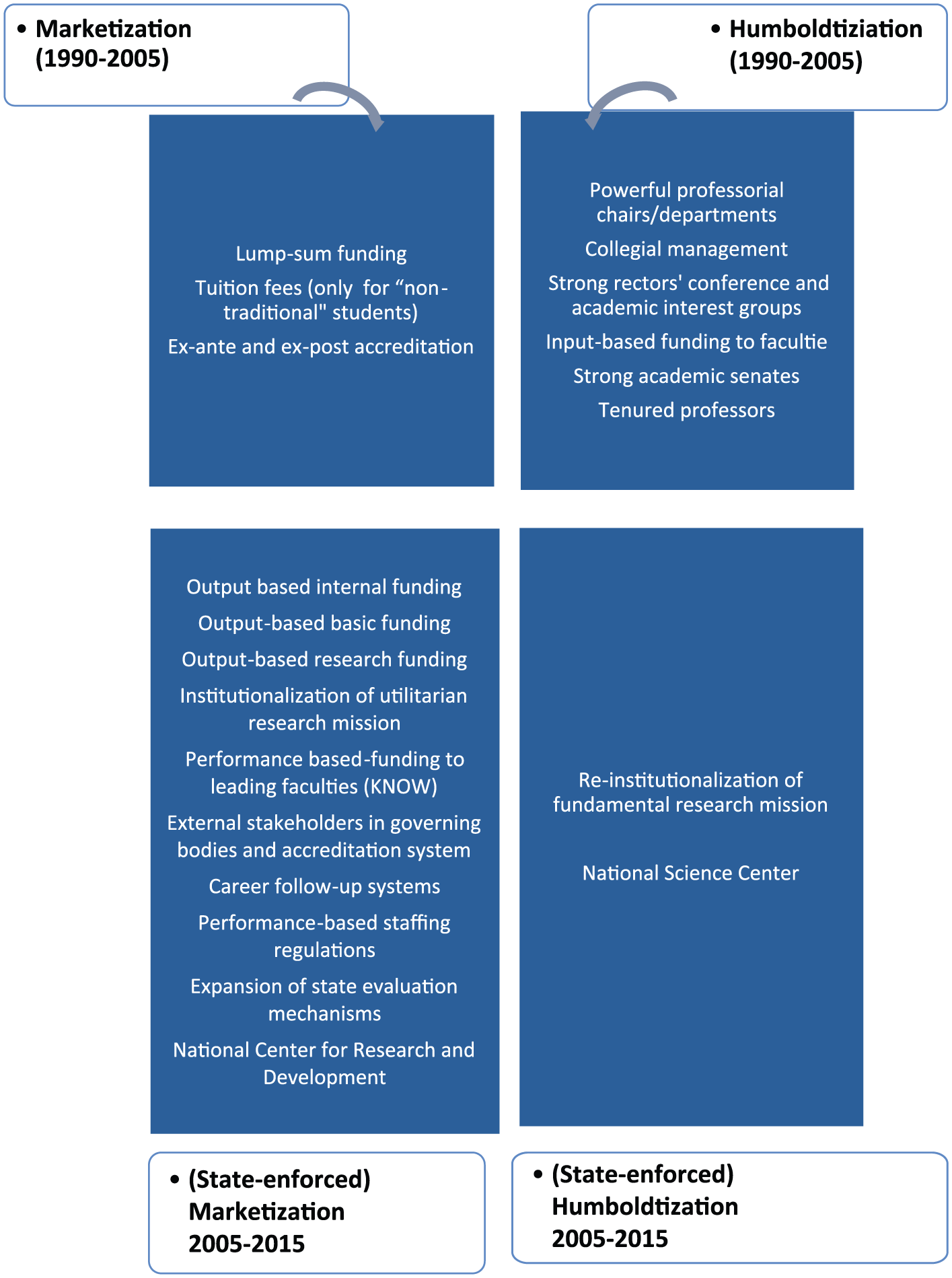
Signs and symptoms of (state-enforced) marketization and Humboldtization in Polish public HE.
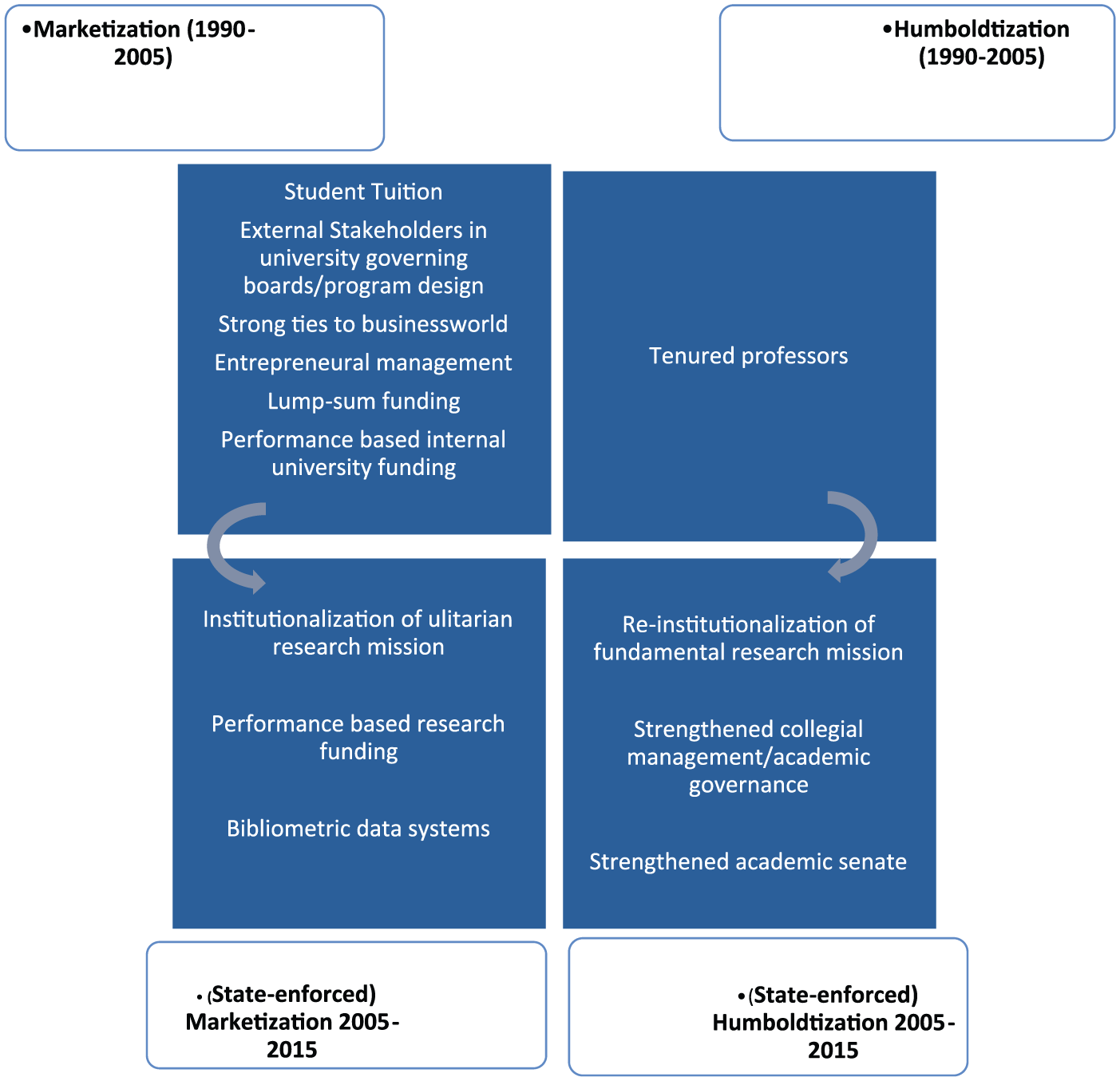
Signs and symptoms of (state-enforced) marketization and Humboldtization in Romanian public HE.
As outlined above, the forces of isomorphism and historical institutionalism are still visibly at play in CEE, but have more recently produced a different outcome, as both systems are ‘re-converging’ towards a new hybrid governance model which could be defined as ‘state-enforced competitive Humboldtism’ with a stronger fundamental and applied research mission. On the one hand, the new hybrid steering strategy reinvigorates the historical ideal of the research university with new competitive incentives for the academic community. Thus, it caters to historical sensitivities by enabling academics to reclaim the ‘research university’ (see also Dakowska in this issue). On the other hand, isomorphism, i.e. the implicit or explicit alignment with what is perceived as best practice, appears to still be a virulent force, as the institutional modifications in both countries are visibly reminiscent of the reform trajectory of France and Germany. Unlike in the 1990s and 2000s, however, the main reform driver is no longer that of coping with uncertainty, rather it is emancipation from the economic hierarchies that European integration has reinforced.
These observations will, hopefully, inspire future researchers to assess how this new governance paradigm has enhanced the innovative and industrial capacities of both countries and bolstered their standing in the global political economy. Scholars should focus, on the one hand, on actors’ responses and responsiveness to the new governance structures, in particular whether universities acquiesce to new state demands and incentives for more industrial collaboration and applied research, and whether national businesses systematically invest in education. On the other hand, scholars may draw on concrete indicators of the success of the new governance model, for example potential increases in the number of patents, the number of domestically owned firms, and public and private expenditure on research and development. Finally, researchers should assess whether the aspired strengthening of the Humboldtian fundamental research mission is reflected in enhanced publication output, thus increasing standing in international (research-based) HE rankings and EU research funding programmes.
Footnotes
Declaration of conflicting interests
The author(s) declared no potential conflicts of interest with respect to the research, authorship, and/or publication of this article.
Funding
The author(s) received no financial support for the research, authorship, and/or publication of this article.
