




Abstract
Through an ethnographic exploration of policy documents, this paper aims to expose how outcome-oriented education standards gained international hegemonic status in the Bologna Process. Taking inspiration in the concept of hegemony and by connecting the invisible power of hegemony to soft governance, the paper shows how the outcome-based modular curriculum gained hegemonic power by means of the infrastructure of the reform. Centring on the movement from political agendas within the Bologna Process to the implementation in a national context using Denmark as a case, the paper tracks the transformation from an input- and content-driven curriculum to an outcome- and objectives-driven curriculum and the transition from a semestrial timeframe structure to a modular block structure. The paper shows how consent and legitimisation is manufactured through the infrastructure of the Bologna Process consisting of communication paths, standardisation and follow-up mechanisms such as benchmarking through graphs and frameworks for reporting.
Keywords
Introduction
Standards, hegemony and consent
In 1999, it was not possible to predict the ‘future proportions’ of the Bologna Process or to anticipate its effects; nor was it possible to imagine that a European education area would essentially be brought into being by introducing a host of new education standards that the signatory states chose to implement voluntarily through the Open Method of Coordination (OMC). Today the Bologna Process is ratified by 48 nations and in many ways, the initial ambition – to create a European Higher Education Area (EHEA) through educational comparability, mobility, flexibility, employability and qualification frameworks – has been implemented. The process has significantly transformed the European curriculum through an extensive standardisation. Meanwhile, contrary to expectation, standardisation does not necessarily lead to uniformity (Brunsson and Jacobsson, 2000: 15; Waldow, 2012). ‘Standardisation’ is a term that suggests a standardising process has taken place, but it does not necessarily mean that this process has contributed uniformity. Standardisation and uniformity should not be conflated (Brunsson, 2000; Mennicken, 2008; Timmermans and Epstein, 2010). Governing through these calculative practices may not necessarily lead to an increased manageability of the agents involved (Rose, 1988). However, the infrastructure of the Bologna Process has ensured that the Bologna objectives, including generic outcome-oriented education standards, have been implemented to a great extent. According to the Bologna Implementation reports and country-specific case studies, formal compliance with most aspects of the Bologna goals at national level are well established across the EHEA despite profound diversity at the level of national and local implementation, pace and connections to domestic reform agendas (Brøgger, 2014, 2018b (forthcoming); European Commission, EACEA and Eurydice, 2018; Karseth, 2008; Karseth and Solbrekke, 2010; Kehm, Michelsen and Vabo, 2010; Neave and Veiga, 2013; Veiga and Amaral, 2009; Veiga et al., 2015; Westerheijden et al., 2010).
In this article, standardisation is being viewed as a steering technology designed to produce change in transnational reforms because standardisation makes it possible to govern at a distance without the use of legal competence. In particular, it is examined with regard to reforms that are being governed through voluntary processes such as the Bologna Process and therefore is characterised by the absence of a legal centre of authority (Borraz, 2007; Brøgger, 2016b). Four main characteristics seem to tune the new education standards in certain ways.
They are all characterised as performance standards. This means that their purpose is to achieve certain goals, such as specified learning outcomes.
They are all designed as generic standards detached from any specific content. This means that, despite the specific character of a degree programme, it should be regulated by the qualifications frameworks (QFs) and be based on learning outcomes.
They are all interlocked. This means that they are not merely linked in the sense that there is a relation or connection between them; rather, they are interlocked in the sense that if you adopt one standard, you inevitably adopt them all.
They are designed to transgress nation states and individual higher education institutions (Brøgger, 2016a).
The extensive stitching together of standards is a major factor in the ongoing processes of standardising European education (Lawn and Grek, 2012: 78). This interdependency and interlocked character of the standards is also referred to in the Bologna Stocktaking Report from 2007 in which it is emphasised that all countries need to use learning outcomes as a basis for their national QFs, systems for credit transfer and accumulation, and quality assurance (BFUG, 2007: 3). However, the interlocking character is even more extensive. Through the European Credit Transfer and Accumulation System (ECTS) in higher education, a common standard – the credit – has been created, which measures workload and work as a ‘currency’ of exchange with other institutions, supposedly increasing mobility in Europe. The credit is interlocked with the design of modules, which are each measured in a certain number of credits. Each module has its own specified learning outcomes, which are based on the generic learning outcomes in the national QFs. These learning outcomes are, in turn, based on the international QFs designed within the Bologna Process and the European Union. Moreover, in order to assess learning outcomes consistently, some Nordic countries, Denmark included in 2006 and 2007, have introduced new grading scales that follow the ECTS equivalent from A to F and are designed to measure and assess learning outcomes and thus ensure the full implementation of an objectives- and outcome-driven curriculum. The student’s grade should express the degree to which the student meets the intended learning outcomes of a module (Dahl, Lien and Lindberg-Sand, 2009: 51). The outcome-based curriculum and the modular structure, which is at the centre of this examination, are two interlocking standards that indicate a shift from subject-based teaching to transdisciplinary teaching. Constituting one coherent structure, it is possible to refer to this as the introduction of the outcome-based modular curriculum in which the curriculum is modularised and each (portable) module is described in terms of learning outcomes.
Through an ethnographic exploration of policy documents, this paper examines how outcome-oriented education standards are introduced as part of the Bologna Process and how they gain a hegemonic status by means of the follow-up mechanisms of the reform process. Centring on the movement from political agendas within the Bologna process to the implementation in a national context using Denmark as a case, the paper tracks the transformation from an input- and content-driven curriculum to an outcome- and objectives-driven curriculum and the transition from a semestrial timeframe structure to a modular block structure. By connecting the invisible power of hegemony to soft governance, the paper investigates how the outcome-based modular curriculum gained hegemonic power by means of the infrastructure of the Bologna Process. The paper further shows how consent and legitimisation is manufactured through this infrastructure consisting of communication paths, standardisation and follow-up mechanisms such as benchmarking through graphs and frameworks for reporting.
Follow-up mechanisms, including evaluations, constitute a vital part of a reform. It is not something exterior to a reform but must be seen as integral to a reform (Brøgger, 2016a, 2018a, 2018b (forthcoming)). Or, put differently, what and how something is being measured is decisive in terms of which realities may be produced through a reform. How one chooses to measure progression and implementation co-constitutes the very DNA of a reform (Brøgger, 2016a, 2018a). I will elaborate on the follow-up mechanisms in the following section. In order to explore the hegemonic status of the standards, I take inspiration in Gramsci’s conceptualisation of hegemony. Gramsci’s concept on hegemony is not about domination but about the exercise of ‘direction’, how something or someone is moved in a particular direction (Gramsci, Hoare, and Smith, 1971). In this way, the concept of hegemony closely connects to concepts of ‘soft governance’. In recent years, so-called ‘soft governance’ has played a major role in governing education. This type of governance differs from the hierarchical parliamentary steering chain because it expands the nature of governance to include not only the force of law but also, and not least, the force of persuasion. It includes technologies such as benchmarking, measurements, comparisons and standardisations to govern performance and monitor implementation and progression of established goals (Brøgger, 2016b, 2018a; Dale, 2004; Gornitzka, 2005). In this way, this soft mode of governance, executed through the OMC, is a way to make education governable without the use of government. Or in other words, it is a governing that not only entails the consent of the governed (Gramsci et al., 1971: 186–187) but is designed to enable voluntary co-option and make agents want what they have to do (Brøgger, 2016a, 2018a; Rhodes, 1996; Staunæs, Brøgger, and Krejsler, 2018). Whereas Gramsci examined the ways in which bourgeois ‘hegemony’ was shaped and reproduced in cultural life, I take an interest in the ways in which the outcome-based modular curriculum gained a hegemonic status as part of the Bologna Process. In order to understand how a particular standard, and along with it a particular way of understanding the higher education curriculum, gains a hegemonic status the article explores how consent and legitimisation is manufactured through the follow-up mechanisms of the Bologna Process. I call these follow-up mechanisms the infrastructure of the Bologna Process. In many ways, the infrastructure of the Bologna Process can be seen as the source of the invisible power of the process. The infrastructure is constitutive of what gains hegemony. This is not about domination but about convincing, repeating and supporting the implementation of new standards. Hegemonic power is invisible in the sense that it is based on consent. In this case, the infrastructure seems to be the manufacturer of consent across Europe and beyond.
Infrastructures of education reform
In order to gain hegemonic status, standards are sensitive to and perhaps even dependent on the infrastructure of a reform. In the case of higher education reform, infrastructure is that which runs underneath structures. Infrastructure is that upon which something else works – therefore, the phenomenon of infrastructure can also be referred to as a type of ‘path-dependence’ (Busch, 2011; Brøgger and Staunæs, 2016; Star and Bowker, 2006). In the case of standardising processes within higher education, the infrastructures are essentially composed of practices, such as communication paths, channels and frameworks for reporting. The concept of infrastructure describes the mechanisms that the reform comprises for generating change. Or, in other words, in order to ‘work’, governance needs an infrastructure (Lawn and Segerholm, 2011). In relation to the Bologna Process, the infrastructures are present as part of the dynamics of the OMC and the way in which this coordination is scaffolded by certain frameworks for reporting.
The infrastructure of the Bologna Process consists of communication paths and follow-up mechanisms. The follow-up mechanisms can be identified as a follow-up structure; that is, the steering structure of the process, which consists of the Bologna Follow-Up Group, interconnected steering groups and secretarial backup, and the tools and instruments used to steer (for instance, monitoring of progress and benchmarking through national reports and Bologna stocktaking reports). This article centres on the tools and instruments. The monitoring instruments are designed to produce and gather information on progress regarding the implementation of the Bologna objectives in the signatory states (Brøgger and Staunæs, 2016). The follow-up mechanisms promote the idea that educational outputs are measurable, both at the individual level (regarding the interlocking between ECTS credits and learning outcomes) and at the national level through the stocktaking procedures (Keeling, 2006: 209).
Policy instruments are never neutral devices, in the sense that they always produce specific effects and seem to bring about certain kinds of social and professional control (Brøgger, 2018a; Lascoumes and Gales, 2007: 3). Following the instrumentation approach allows us to address aspects of the policy processes that otherwise remain invisible (Lascoumes and Gales, 2007: 4). By following how the new standards gain power by being circulated through the infrastructure, it allows us to make hegemonic power visible. It also helps us understand the efficiency of this soft mode of governance. This exploration of the ways in which two education standards achieved curricular hegemony is based on extensive investigative work on the follow-up mechanisms. This investigative work takes methodological inspiration in policy anthropology, which I will address in the following section.
Follow the standard
The examination of the follow-up mechanisms of the Bologna Process was conducted between 2012 and 2015. This work included a study on how the education standards of this process have spread across borders in Europe and beyond. The study took inspiration in policy anthropology. Meanwhile, studying a reform process as extensive as the Bologna Process made it difficult to ‘follow the policy’, as suggested by Shore and Wright (2011), because the Bologna Process consists of a vast number of policies and objectives. However, the Bologna mode of governance is constituted by the setting in motion of standardising processes that distribute new educational standards to be implemented both nationally and locally. So, ‘following the policy’ became ‘following the new standards’. I decided to focus on two new educational standards: the modularisation and out-put orientation of the curriculum. I tracked these standards and their way to hegemony through the follow-up mechanisms of the Bologna Process. As Shore and Wright claim, policy brings together humans, organisations, technologies and discourses (Shore and Wright, 2011: 11). In the tracking of the standards, I focus on the agency of the monitoring technologies and instruments. As part of my investigation I included the research of other academics; I studied websites and policy documents relating to the Bologna Process, the EU education strategies, and the national ministerial level. By exploring various follow-up mechanisms, the investigation shows how the outcome-based modular curriculum gains hegemonic power through an infrastructure consisting of benchmarking through scorecards, graphs and numbers and best-practice exercises through models and templates. I understand the documents and measuring technologies that I examine, such as the Bologna stocktaking scorecards, as artefacts of the knowledge practices that constitute the Bologna Process (Riles, 2006: 7). Understanding documents and technologies such as graphs and scorecards as artefacts of knowledge practices is a way of understanding them as non-human agents. The object of my examination is an investigation into the ways in which documents and measuring technologies constitute an agentic infrastructure allowing certain standards to gain hegemonic power. In this way, the article aims to display how the infrastructure of a reform plays a crucial role in terms of carrying forward particular standards and by repeating and supporting these standards, the infrastructure seem to manufacture consent across Europe and beyond.
Outcome-based education: A new standard for designing the curriculum
According to Michael Young, the idea of defining qualifications in terms of outcomes originated from early developments in occupational psychology in the United States of America (Young, 2003). Within the education system, the development of national qualifications frameworks (NQFs) that focus on learning outcomes precedes the introduction of international QFs in Europe. Already during the 1980s and 1990s, NQFs were developed in the UK, New Zealand, Australia and South Africa (Allais, 2011; Ensor, 2003; Strathdee, 2003, 2011; Wheelahan, 2011; Young, 2003, 2011). These early developments were often linked to one or two levels of the education system, such as the development of an NQF for vocational studies in the UK. According to Young, at this early stage, the outcome-based approach to the QFs were primarily associated with Anglophone countries (Young, 2003). However, it is precisely this orientation towards learning outcomes that will later constitute the major transition of the curriculum in continental Europe through the international QFs initiated by the Bologna Process and the EU.
According to Young, the outcome-based QFs work on the assumptions that all qualifications can be described in terms of a single set of criteria and that all qualifications can be described and assessed in terms of learning outcomes. Young believes that these assumptions are radical and have far-reaching implications – partly because they shift the basis of assessment from the professional judgment of teachers to standardised formal criteria and partly because the frameworks stipulate that all qualifications have similar features and that ‘outcomes can be separated from the way in which they are achieved’; in other words, that outcomes are independent from the site and the curriculum (Young, 2003: 225; 2008: 128–129). Wheelahan expands on the idea and criticises the notion that learning outcomes can be defined independently of when, how or where learning takes place (Wheelahan, 2011).
In many ways, the classification of higher education into two cycles in the Bologna Declaration – which later became three cycles (BA, MA and PhD) – can be viewed as an organising of higher education that laid the foundations for what later became the overarching QF of the EHEA (Brøgger, 2018b (forthcoming)). At a 2003 Bologna seminar to discuss qualification structures in higher education in Europe (held in March 2003 in Copenhagen), participants recommended that public authorities responsible for higher education should elaborate NQFs with due consideration to the QF to be elaborated within the Bologna Process (Bologna Working Group on Qualifications Frameworks, 2004: 56, Appendix 53). In the Berlin Communiqué, which was released a few months later, the European ministers explicitly call for a common framework.
Ministers encourage the Member States to elaborate a framework of comparable and compatible qualifications for their higher education systems, which should seek to describe qualifications in terms of workload, level, learning outcomes, competences and profile. They also undertake to elaborate an overarching framework of qualifications for the European Higher Education Area (EHEA Ministers, 2003: 4).
In the wake of the ministerial conference in Berlin in 2003, the Bologna Follow-Up Group established a working group whose task was to identify reference points for national frameworks of qualifications (in terms of workload, level, learning outcomes, competences and profile), elaborate on an overarching framework of qualifications for the EHEA, and establish key principles for frameworks of qualifications, both at national and European levels (Bologna Working Group on Qualifications Frameworks, 2004: 54, Appendix 52). The working group delivered its first report in 2004 and a final version in 2005, which was presented at the Bergen ministerial conference the same year (Karseth, 2008). The report outlined that the framework for qualifications of the EHEA should be regarded as an overarching framework, that is, a meta-framework within which to develop national frameworks (Bologna Working Group on Qualifications Frameworks, 2005: 58). Learning outcomes were a key element in the QF, and the report outlined the following understanding of learning outcomes.
With ‘outcomes-based approaches’, they [learning outcomes, KB] have implications for qualifications, curriculum design, teaching, learning and assessment, as well as quality assurance. They are thus likely to form an important part of 21st century approaches to higher education […] In terms of curriculum design and development, learning outcomes are at the forefront of educational change […] They represent a change in emphasis from ‘teaching’ to ‘learning’ typified by what is known as the adoption of a student-centred approach, as opposed to the more traditional, teacher-centred viewpoint (Bologna Working Group on Qualifications Frameworks, 2005: 37–38)
The working group recommended that the so-called ‘Dublin descriptors’ be adopted as the cycle descriptors for the framework, because they offered generic statements of typical expectations of achievements and abilities associated with the completion of each of the cycles (Bologna Working Group on Qualifications Frameworks, 2005: 101). The outcomes are interlocked with the credit system. The credit is defined as ‘a quantified means of expressing the volume of learning based on the achievement of learning outcomes and their associated workloads’ (Bologna Working Group on Qualifications Frameworks, 2005: 29). The interlocking and interdependence of these standards are confirmed in the London Communiqué from 2007, which encourages compatibility with the European Qualifications Framework for Lifelong Learning and thereby increasingly connects the process with the EU strategies. The Communiqué’s connection to the EU growth strategies – including education as a core economic factor – is highlighted by it awarding the EHEA QF a central role in the promotion of European higher education in a global context. This corresponds with the 2007 strategy on higher education in a global setting, which recommends the promotion of European higher education in an attempt to enhance its worldwide attractiveness and competitiveness (EHEA Ministers, 2007b: 3–4).
Qualifications frameworks are important instruments in achieving comparability and transparency within the EHEA and facilitating the movement of learners within, as well as between, higher education systems. They should also help HEIs [higher education institutions] to develop modules and study programmes based on learning outcomes and credits, and improve the recognition of qualifications as well as all forms of prior learning […] We are satisfied that national qualifications frameworks compatible with the overarching Framework for Qualifications of the EHEA will also be compatible with the proposal from the European Commission on a European Qualifications Framework for Lifelong Learning. We see the overarching Framework for Qualifications of the EHEA, which we agreed in Bergen, as a central element of the promotion of European higher education in a global context (EHEA Ministers, 2007a: 3).
As the communiqués and background reports show, QFs were described as the means to provide comparability and compatibility between European higher education systems and institutions. The working group’s original task was to develop reference points for national frameworks in terms of workload, level, learning outcomes, competences and profile in order to assist Member States in establishing their frameworks. In addition, the working group identified learning outcomes as the key element of the QF As outlined above (Bologna Working Group on Qualifications Frameworks, 2005: 37–38). The 2007 and 2012 communiqués further underlined the interdependency between learning outcomes and credits and highlighted the importance of implementing learning outcomes as part of a QF. In this way, the QF, including learning outcomes as the key design element, was described not only in a neutral manner – as a means of providing comparability – but as something very ‘21st century’; something at the forefront of educational change (in contrast to something ‘more traditional’). However, these communiqués also stress that the reference points only exist to assist Member States to develop their own national frameworks. The communiqués adopt a language and rhetoric of encouragement and incentives. Through the communiqués and background reports, the monitored coordination emerges characterised by its combination of incentives and the initiation of standardising processes. Through encouragement and incentives, the monitored coordination produces and sustains the Bologna Process as something built on shared goals and thus consent. Member States voluntarily coopts into the implementation of the shared Bologna goals. As we will see in the following sections, what began at the international level as mere ‘reference points’ – as the initial working group called them – soon altered the design of national curricula fundamentally.
Outcome-based education transitioning Danish curricula
In the 2005 Bergen Communiqué, ministers committed themselves to elaborating NQFs based on the overarching European framework. They agreed to adopt the generic descriptors for each cycle based on learning outcomes and competences (EHEA Ministers, 2005a, 2005b; Karseth, 2008). The working group was asked to monitor the progress of the European Qualifications Framework for Lifelong Learning, which was in development under the auspices of the EU. They were keen to ensure complementarity, which again highlighted the convergence of the two processes (Karseth, 2008). The European Qualifications Frameworks for Lifelong Learning was formally adopted by the EU in April 2008. The framework covered all levels of education but was only valid for EU member countries, whereas the Qualifications Framework for Higher Education was valid for all countries that had ratified the Bologna Process.
The Bologna QF was interlocked with the European QFs at both a European and a national level. In 2006, it was decided that the Danish NQF for higher education should be revised to bring it into line with the QF for the EHEA. The new NQF for higher education came into force in 2008. The Danish Evaluation Institute summarises it as follows.
It contains both a systematic description of the different qualification levels at an aggregated level and the underlying descriptions of the individual Danish degree types. Qualification levels and degree types are described in terms of the learning outcomes that students are intended to have when they finish a study programme. The learning outcomes are divided into three categories: knowledge, skills and competences ( The Danish Evaluation Institute, 2009: 20).
The higher education framework is interlocked with the Danish framework for lifelong learning based on the European Qualifications Framework for Lifelong Learning in that the descriptions of the levels of higher education (levels 5–8) are identical with those of the NQF for higher education.
The Danish NQF follows the Bologna framework but with a few adjustments. For example, ‘critical analysis’ is not mentioned in the third cycle descriptors because, due to the Self-Certification report, ‘the student’s ability to think critically and engage independently with the curriculum is already sought in secondary education’ (The Danish Evaluation Institute, 2009: 23). In their important contribution from 2010, Karseth and Solbrekke consider these national modifications so significant that they question whether the NQF can be said to meet the Bologna requirements (Karseth and Solbrekke, 2010). However, despite these small adjustments, the NQF can be said to follow the Bologna rationality. This is because the NQF has drastically changed both the design and organisation of the curriculum in a way that prioritises learning outcomes and the inclusion of ECTS credits and thereby reflects the Bologna logic. In terms of design and the design’s impact on everyday educational practice, the adjustments seem relatively minor. The major change is not found in the details of individual descriptors but rather in the adaptation of the design as such. The design of the curriculum as outcome-based is a major game-changer despite national adjustments. By imposing the concept of learning outcomes, the frameworks do not work as a neutral register or objective operation but actively prescribe a design for national curricula (Cort, 2010: 307). The frameworks seem to constitute both a social and political goal, because it is a regulative standard designed to influence the behaviours of the actors involved (Bouder, 2003: 348). As Young argues, the new outcome-based curriculum undoubtedly stimulates the demand for learning and its assessment by users and employers and thus relies less on the interests of the providers – the colleges and universities (Young, 2007: 448). With this in mind, Cort claims that the introduction of QFs is a marketisation of education. The frameworks do not only work as a standardisation of qualifications but also turn learners into consumers (Cort, 2010: 306).
Between 2001 and 2003, Denmark was already experimenting with the implementation of a QF for higher education. It was positioning itself as capable of chairing the next working group, which was established by the Bologna Follow-up Group (BFUG) following the ministerial conference in Berlin in 2003. As mentioned above, the main task of the working group was to identify reference points for national frameworks of qualifications. The first QF was characterised by the outlining of various competency goals; however, in 2007, the Danish government already wished to revise the QF in line with the 2005 Bologna Qualifications Framework for Higher Education, to which Denmark had contributed by chairing the working group and developing and designing the framework. Moreover, the new QF gained inspiration from the European QF developed under the auspices of the EU. The new QF was designed to be based on outcomes divided into three subcategories: knowledge, skills and competencies. It was thought that the new QF would interlock closely with the new accreditation procedures (the assessment procedure for all educational programmes subsequently implemented in Denmark; Ministry of Higher Education and Science, 2008). The new QF came into force in 2008 (Ministry of Higher Education and Science, 2008). Following this framework, the new curricula design – which focused on learning outcomes and was divided into knowledge, skills and competencies – was to be implemented within all existing curricula and future ministerial orders. The so-called ‘reference points’ at international level quickly emerged as an efficient way of governing that prescribed and hence fundamentally altered the design of national curricula. Due to a multilayered infrastructure, the spread and impact of this standard was extensive.
The infrastructure: Paving the way to hegemony
Standards travel and move via infrastructures. In order to show this, I will provide the reader with examples of the follow-up mechanisms. Core mechanisms include the communiqués (2001, 2003, 2005, 2007, 2009, 2010, 2012), the Bologna stocktaking reports (2005, 2007, 2009, 2012), the national reports (2003, 2005, 2007, 2009, 2012), and the Bologna working group reports on QFs (2004, 2005, 2007, 2009, 2012). The publication years indicate that, to a large extent, the reports follow the cadence of the ministerial conferences (and hence the Communiqués). The various follow-up reports must be seen in close connection with the establishment of the EHEA website, which displays the reports (as key instruments to push forward the implementation process) and thus makes it much easier to compare across countries. The website was launched in 2010 in connection with the Budapest-Vienna Ministerial Conference, which officially launched the EHEA.
In the national reports from 2009 to 2012, countries are required to report extensively on the implementation of the NQFs. They are asked to elaborate on and provide documentation in relation to questions such as:
Has the NQF been prepared?
Does the framework or proposed framework include generic descriptors for each cycle based on learning outcomes and competences?
Does it include ECTS credit ranges for the first and second cycle? (Ministry of Higher Education and Science, 2009: 11).
In the 2012 national report, the questions are very specific and demand a high level of detail; for example:
Please provide a reference for the decision to start developing a NQF.
Please provide a reference for the redesign of study programmes based on learning outcomes.
Please provide a reference for the self-certification report.
Because of this remarkable level of detail, the reports work as a kind of micro-management of the implementations. The stocktaking reports (which I will address in the following paragraphs) present a summary of the national reports, so, in this sense, the national reports are integral to the stocktaking report’s scorecard positioning (which is subsequently exposed on the official website). The introduction of the QFs transforms the development of curricula – which used to be performed within higher education institutions – into a major national and supranational political issue (Karseth, 2008: 52).
The incentives already created by the stocktaking reports and the national reports are further enhanced by the ‘Lessons learned’ chapters in the Bologna working group on QFs, which promote a ‘best-practice exercise’ highlighting ‘exemplary’ solutions provided by selected countries; for instance, by Scotland and Ireland in the 2007 report (Bologna Working Group on Qualifications Frameworks, 2007). The best-practice strategies offer a relatively direct form of ‘encouragement’; for example, its claim that non-performing countries ‘need to redouble their efforts’ (EHEA Ministers, 2012: 3).
Two years after the implementation of the QF for the EHEA, ministers registered their dissatisfaction with the degree of implementation of NQFs based on the 2005 Bologna framework. They called for countries to increase their efforts (EHEA Ministers, 2007a: 3). This discontent is most likely based on the results of the 2007 stocktaking report, which was presented at the London Ministerial Conference and prepared by a working group under the BFUG. The stocktaking report’s scorecard showed that seven countries had implemented an NQF in line with the overarching QF for EHEA (dark green), and six countries had discussed a proposal for a national QF in line with the overarching QF for EHEA with all relevant stakeholders at the national level and a timetable for implementation had been agreed upon (light green). However, the vast majority of countries obtained undesirable scores (depicted as the reddish shades yellow, orange and red in Figure 1), meaning that their implementation of national QF remained unsatisfying. Figure 1 displays how the statement was presented in the stocktaking report.

Stocktaking report 2007.
The stocktaking reports (see figure 2) also contain the (in)famous multicoloured Bologna scorecards, which use the same colour code as the indicator above. Below in figure 2 is the scorecard from the 2009 stocktaking report. It is interesting to see how the implementation of the NQFs still presents a challenge for the signatory states; this column (NQF) is mostly yellow and red.
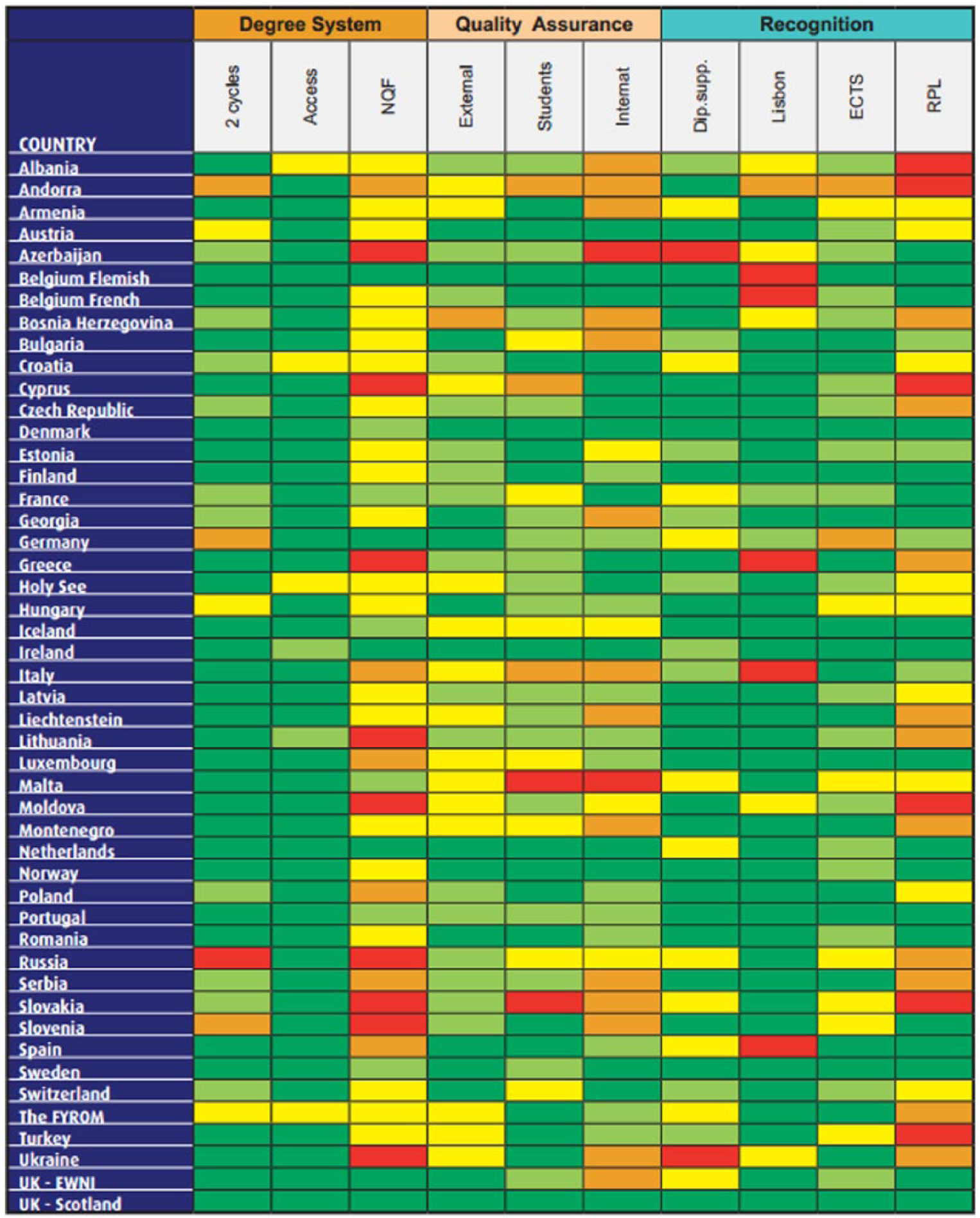
Bologna scorecard from 2009.
The exposure and visibility of the reports increases their significance (Brøgger, 2016b; Ravinet, 2008). The visibility of the performance is an integral part of propelling the implementation process forward. The extended use of visuals to display big data has the capacity to transgress nation states because it no longer depends on text. The use of these visuals seems crucial in establishing transnational policy processes. Being able to compare countries gives rise to extensive peer pressure through naming-shaming mechanisms (Brøgger, 2016b; Brøgger and Staunæs, 2016). By 2012, it appears as though some progress has been made. This is mirrored in the 2012 Bucharest Communiqué from the ministerial conference in which the interdependence of the standards is once again underlined. However, countries that have not yet finalised the implementation and achieved a self-certified compatibility with the QF for the European Higher education Area are asked to ‘redouble their efforts in order to achieve this goal’ (EHEA Ministers, 2012: 3).
These stocktaking reports work as artefacts of the knowledge practices that constitute the Bologna Process. They use the mechanism of ‘governing by numbers’ (Brøgger, 2016b; Grek, 2009; Rose, 1991), using the colour-coded scorecards to compare the progress of the participating countries. Moreover, these scorecards are supplemented and expanded with a remarkable increase in creative benchmarking exercises, which are materialised through graphs, numbers and indicators in the reports. The naming exercise and the exposure of performance data in itself gives rise to a certain anxiousness among governments causing them to perform accordingly (Brøgger, 2016b; Lingard and Sellar, 2013). This type of so-called soft governance uses the force of persuasion through strong encouragements, shaming procedures and exposure of performance as outlined above. Member States are made to voluntarily co-opt themselves into this governance; and this is what constitutes the DNA of this form of governance. On the website for the Danish Ministry of Higher Education and Science, it is possible to find what could be considered a prototypical example of these mechanisms; the ministry highlights that Denmark is at the very forefront regarding the implementation of the Bologna objectives. In 2009, Denmark came in second on the Bologna Scorecard. In 2012, Denmark seized the top spot. This (self)promotion on the website is followed by a recital of (impressive) current policy achievements (Ministry of Higher Education and Science, 2014). Because of its encouraging nature, the power executed through the infrastructure seems almost invisible. It does not manifest as domination but as exercising a direction, a governing that entails the consent of the governed (Gramsci et al., 1971). The governed is encouraged through peer pressure and thus volunteers data, and in this way engages in monitoring practices. Because of this multilayered infrastructure the standards spread and gain hegemonic power, and because they are all interlocked, once a country adopts a standard, it is very difficult to deselect it.
Modules: A new standard for organising the curriculum
The infrastructure consists of various instruments that facilitate the extensive monitoring of progress. The follow-up mechanisms and all their various instruments facilitate the travelling of the standards. The following paragraphs examine how modules have become a popular way of structuring the curriculum. I will show how slightly different mechanisms are at play here because part of the infrastructure seems to work through templates, models and best-practice exercises (Brøgger, 2018b (forthcoming)).
The implementation of the three-cycle system (BA, MA, PhD) in itself is a modularisation of higher education. In Denmark, the three-cycle system was implemented in 1993 before the Bologna Process and substituted for the traditional continental one-cycle system, in which the student completed his/her final university examination after 5–6 years of consecutive study. The Anglo-Saxon modular structure of higher education was originally adopted as an attempt to reduce the drop-out rates at universities at the time. However, today, modularisation of higher education is far more extensive and encompasses the design of the curriculum.
In the UK, the modular structure of the curriculum from secondary to higher education was already being developed in the 1980s and early 1990s (Betts and Smith, 1998; Bridges, 2000; Burke and Carey, 1994; Leask, 1994). The advocates of this curricular transformation viewed modularisation as an effective way of managing learning to the advantage of the students, because it introduced flexibility based on student choice and shifted the entire system from being tutor/teaching-centred to being student-centred (Betts and Smith, 1998: 2; Bridges, 2000: 43; Burke and Carey, 1994: 44). A module was soon defined as a short unit of learning and connected to the ‘logic’ that it should be followed by clearly defined learning outcomes based on knowledge, skills and understanding – the latter subsequently being replaced with the notion of competence in the European frameworks. The module is further scaffolded by a credit system in which credits can be accumulated and transferred between courses and institutions (Betts and Smith, 1998: 49; Burke and Carey, 1994: 46; Pilz, 2002: 164). The number of credits refers to the student workload, which strengthens the student-centred approach even further (as is also the case in the European ECTS credit system).
Modularisation can be defined and implemented in various ways and forms (Pilz, 2002). One of the most ‘radical’ forms is the transition from longitudinal structures (semestrial timeframe structures) to block structures, in which modules are divided into smaller, delimited units that are completed by a test and correspond to an allocated number of (accumulated) credits. The block structure requires the student to complete one module before moving on to the next (at the same or a different institution); in this sense, the structure functions almost as building blocks. Ideally, students can combine and ‘build’ their own education across institutions and countries. Inspired by Bridges’ critical approach to these curricular changes, it is possible to argue that the ‘module and credit revolution’ – especially in its radical form as ‘block modules’ – transforms the epistemological unit of study from subject to module, which is often based on transdisciplinarity (Brøgger, 2014). It could also be argued that it transforms the chronological order of the educational programmes scaffolded by the semestrial timeframe structure and, not least, that it transforms the topographical location of the unit of study, because the student can no longer expect to complete a higher education programme at a single higher education institution (Bridges, 2000: 42). In 2000, Bridges anticipated two major consequences of modularisation: modularisation renders it possible to serve the need of employers more directly and one of the features of modularisation is a feeling of alienation – or perhaps even dispossession – among staff (Bridges, 2000: 43). This marketisation perspective accords with Naidoo’s equally critical research, which claims that marketisation has reinforced the movement towards modularisation. She argues that these curriculum changes are organised ‘around the principles of market need and the desire to attract students’ (Naidoo, Shankar and Veer, 2011: 1153; Naidoo and Jamieson, 2005). Naidoo et al. warn that modularisation may lead to the loss of coherence usually associated with disciplinary study (Naidoo et al., 2011: 1154; Naidoo and Williams, 2014: 12). However, according to Naidoo, modularisation as such predates the advent of consumerism. It seems as though modularisation was originally connected to an almost idealist notion to focus on the student’s learning process and a strong equity dimension to make higher education accessible to ‘non-traditional students’ (Naidoo and Jamieson, 2005). It was only later – particularly after 2000 – that modularisation became increasingly interlocked with other educational standards that commoditised higher education.
The transformation of the higher education architecture in the Bologna Process introduced the credit system before it considered modularisation. The ambition to establish a system of credits based on the ECTS scale can be found in the Bologna Declaration, where it is connected to the ambition to increase student mobility (EHEA Ministers, 1999: 3; Naidoo et al., 2011: 1148). Already in the Prague and Berlin communiqués in 2001 and 2003, the responsible ministers claimed that the implementation of the ECTS credit system should not merely serve as a transfer system but also as an accumulation system (EHEA Ministers, 2003: 4). This had major implications, because the ECTS credit system rapidly moved from a means to recognise academic skills across countries and institutions to an accumulation system that constituted the organising principle of higher education. It seems as though the introduction of the modular curriculum as part of the Bologna Process provided an answer to the ECTS credit system as an accumulation system. The modules present themselves as a way to divide the educational programmes into manageable chunks and thereby turn the accumulation of credits into a relatively transparent accounting system – a student accumulates a certain number of credits on the completion of each (block) module.
In the London Communiqué, the ministers promote the QFs as important instruments in developing modules and study programmes based on learning outcomes and credits. The standards become increasingly interlocked, as is also the case in relation to the learning outcomes (EHEA Ministers, 2007a: 3). As we saw earlier, this interlocking and increased interdependence of standards continues to emerge as an increasingly clear feature of the Bologna Process. And as we will see in the following sections, already at an early stage it is possible to identify an accelerated production of new ministerial orders that promote the outcomes-based modular curriculum in Denmark.
Modules transitioning Danish curricula
With only a few exceptions, the Danish policy documents do not seem to promote modularisation. Modularisation is mentioned at an early stage as part of the preparatory work to pass the bill on universities at the beginning of 2003. Here it is stated that the bill complies with the Bologna principles on the design of the education systems and that, in continuation of this, the bill institutes a modular design for the Bachelor’s and Master’s degrees (Ministry for Science Technology and Development, 2003). Following the implementation of the University Act in 2003, a new ministerial order on education (Bachelor and Master degrees at the universities) introduced the modular design of the Danish curriculum in 2004 (Ministry for Science Technology and Development, 2004). According to the ministerial order, the modular design is supposed to ensure the free educational choice of the student as well as a customised competency profile targeting various professions. The design clearly supports the idea that the student can compose his/her own individual educational programme and, hence, the description seems to anticipate the idea of modules as building blocks. This modular design is interlocked with the ECTS credit system as well as the focus on learning outcomes and is sustained in the current ministerial order (Ministry of Higher Education and Science, 2016). This common ministerial order for all BA and MA university degrees is implemented through curricula designed by each educational programme.
The increased production of new ministerial orders that promote the outcomes-based modular curriculum is a strong indication of the shift in the design of the curriculum. However, it is important to remember that the experimentation with modularisation as part of an increased conceptualisation of the student as a consumer was part of Danish higher education policy even before the Bologna Process. In fact, it can be traced back to the 1980s and 1990s, albeit in a more fragmented and non-coherent form (Nielsen, 2010). This suggests that, from a policy point of view, Denmark was ready for the Bologna objectives. This probably explains why the Danish right-wing government was so keen to comply with the Bologna objectives that they began implementing NQFs before the first European framework was completed in 2005 (Sarauw, 2011). As mentioned earlier, this undoubtedly made Denmark a suitable core player in the formulation of the Bologna framework (Bologna Working Group on Qualifications Frameworks, 2004).
In the 2009 self-certification report on the Danish National Qualifications Framework for Higher Education, the Danish Evaluation Institute describes modules in relation to learning outcomes as the obvious way to organise a curriculum.
Thus, the reference group suggested that it would be useful for the institutions to have a “toolbox” available with templates, inspirational tools, etc., to make the process of formulating specific learning outcomes for individual modules easier [stipulation, KB] (The Danish Evaluation Institute, 2009: 30).
Perhaps even more importantly, they suggest that institutions use a toolbox with templates to further the process of formulating the learning outcomes for individual modules. In fact, this idea of a toolbox with templates proves to be a major factor of the infrastructure of modularisation. This infrastructure does not follow the same paths as the learning outcomes, but, to a large extent, modularisation is infrastructured through best-practice exercises through the TRENDS reports and the TUNING project.
The infrastructure: Paving the way to hegemony
Alongside stocktaking and national reports, there are other instruments that form part of the follow-up mechanisms of the Bologna Process and encourage signatory states and their higher education institutions to comply with the Bologna objectives. The ‘TUNING Educational Structures in Europe’ was initiated as a university-driven project funded by the European Commission and coordinated by the University of Deusto in Spain and the University of Groningen in the Netherlands. The concept of ‘TUNING’ connotes the tuning of an engine; tuning it to run faster and perform better.
According to TUNING’s introduction brochure, its ambition is to offer concrete approaches to the implementation of the Bologna process at the level of higher education institutions and subject areas within all three cycles (BA, MA, PhD) (TUNING, 2007; Moutsios, 2013). TUNING offers a re-design of the curriculum in all academic subject areas in order to make studies comparable, compatible and transparent. The TUNING project reaches far beyond Europe and works by producing models and templates for higher education institutions to use for the implementation of the Bologna objectives in the curriculum. Each TUNING report, which outlines reference points for the design and delivery of study programmes within a specific subject area (e.g. education), is produced by a working group related to the subject area in question. The working group consists of members from various higher education institutions across the participating countries. During the process, the working group consults a ‘validation panel’, which consists of a small group of ‘internationally recognised experts’.
The TUNING website exposes the TUNING reports, displays best-practice cases, and advertises the ‘Tuning Methodology’. The curriculum design promoted by TUNING interlocks the educational standards of learning outcomes, the ECTS credit system and modularisation: ‘Study programmes which have been set up according to the Tuning methodology are output-oriented and, preferably, modularised’ (TUNING, 2014a). The website for TUNING reads that ‘one of the main innovations of Tuning has been to link learning outcomes, competences and ECTS workload[-]based credits’ (TUNING, 2014b). The Tuning project claims to have highlighted the importance of competences as the basis for curriculum design and the necessary links between competences, learning outcomes and a credit system (TUNING, 2014a). With this approach to the re-design of the higher education curriculum, the transition from input to output is considerably strengthened.
The special feature of this particular follow-up mechanism, which TUNING facilitates, is the production of templates. These relatively detailed templates are produced to enable higher education institutions to implement the Bologna objectives in alignment with institutions from other countries. Higher education institutions are encouraged to download and use these templates. On the TUNING website, it is possible to find a relevant template to function as a prototype for the institution in question. Below is an example. It is a planning form for an educational module. This template, seen in Figure 3, promotes the modular structure of the curriculum, the credit system and learning outcomes.

Planning form for an educational module.
The TUNING project expands on these new educational standards and propels the translating processes by inviting agents from higher education intuitions to contribute their knowledge and expertise to the templates. In this way, higher education research and teaching experts become active participants in standardising processes. By contributing to the production of templates, they become standardisers themselves and increase the pressure on their peers. The TUNING project is an example of how the modular block structure of the curriculum is promoted through both the TUNING approach and the production of related templates. Due to their participation in the working groups, these templates are then distributed by the agents of higher education institutions themselves. The TUNING project develops a common language and common ways of implementing the Bologna objectives operated by the higher education institutions. However, templates are only one of the paths constituting the infrastructure that leads to the hegemonic status of modularisation as the organising principle of the new outcome-based curriculum; another path is best-practice exercises, which are also cultivated in the TRENDS reports.
Since 1999, the European University Association (EUA), which is also a consultative member of the BFUG, has published the TRENDS reports, thus providing the European higher education policy processes with an institutional perspective (EUA, 2014). The reports were published in 1999, 2001, 2003, 2005, 2007, and 2010 (TRENDS I-VI) and were produced with financial support from the European Commission. The information was collected through a combination of questionnaires - sent to rectors’ conferences and European higher education institutions - focus groups, visits to universities, and interviews (EUA, 2014; EUA, 2010).
The TRENDS reports aim to present longitudinal information on how the European higher education area is developed across countries. EUA understands the reports as reference points for policy makers and the higher education community as such (EUA, 2014). The reports are produced as preparation for the Bologna ministerial meetings and they compare different practices between countries. This EUA-driven project also supports the implementation of the Bologna objectives in order to ensure the progress towards a EHEA. Although the EUA project is generally descriptive – and thus less prescriptive than the TUNING project, which produces templates to follow – there is no doubt that the project is laid out as an ongoing presentation of the ‘progress towards the European Higher Education Area’, as suggested by the TRENDS III title.
Modularisation is already mentioned in the 1999 report, but, at this stage, it is seemingly only the UK that is modularising the curriculum in a coherent manner: ‘[In the UK] courses are increasingly being offered on a modular and credit accumulation basis’ (EUA, 1999: 49). In 2003, the TREND report describes the modular structure in a commendable tone, which helps to overcome an ‘artificially high risk of failure for students’.
Moreover, the use of an accumulation system in a modularised study structure allows final degrees to be awarded on the basis of continuous assessments and accumulated credits, rather than traditional final exams that can pose an artificially high risk of failure for students (EUA, 2003: 69).
Furthermore, in line with the TUNING project, the 2003 report emphasises the interlocking of the educational standards. It even provides this ‘interrelatedness’ of the standards with a name: the ‘holistic Bologna’ (EUA, 2003: 106). The report recommends implementing the Bologna objectives as a package that interlocks the credit system with the modular structure, QFs and learning outcomes. In the 2005 report, it is stated that this interlocking of the standards and the pedagogical changes that accompany it are now ‘utilised in practically all countries’ (EUA, 2005: 10). Although there are various interpretations of how to ‘modularise’ the curriculum, the 2005 report clearly promotes the view that a full-fledged modularisation equals the implementation of a modular system with interdisciplinary elements (and not merely as a synonymous description of a lecture or a seminar). The report argues that this concept is often poorly understood, and it encourages higher education institutions to coordinate their approach (EUA, 2005: 18). The 2009 Stocktaking report further supports the modularisation in order to increase flexibility for learners (BFUG, 2009: 85).
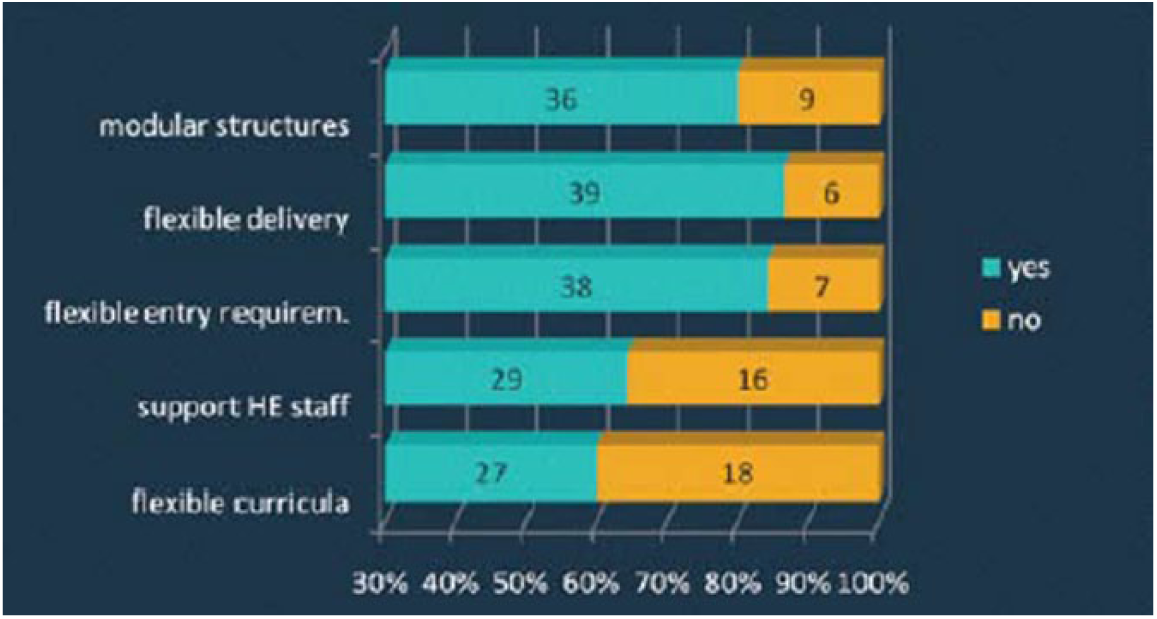
The stocktaking report follows its usual logic and displays the support for flexible learning paths in a colour-coded chart. In Figure 4, the blue ‘yes’ area depicts the countries that support a ‘more flexible delivery’ of higher education study programmes, and the yellow ‘no’ area depicts countries that do not support flexibility (and are therefore regarded as ‘rigid’ in opposition to ‘flexible’).
Support for more flexible delivery.
By asking questions that scaffold the interlocking of standards and by comparing best-practices, the EUA reports incentivise higher education organisations to implement the Bologna objectives. The TRENDS reports reveal that the number of countries implementing curriculum modularisation – together with other key educational standards – increases dramatically during the years of the Bologna implementation. The 2009 stocktaking report confirms this. It seems that, in 10 years – from the 1999 TRENDS report, in which the UK was the only country to stand out as an implementer of modules, to the 2009 stocktaking report, which states that 75% of the member countries have established a modular structure – three-thirds of the signatory states confirm that they are actively implementing a modularisation of the curriculum. This sudden increase is also reflected in the 2010 TRENDS report, in which 69% of the member countries confirm they have either partially or fully changed the organisation of study programmes from a system based on the academic year to a system based on study units or modules (EUA, 2010: 46). The reports acquire an increasingly ‘educative’ tone (here is an example: ‘As with any approach to learning and teaching, it can be done well or badly’ (EUA, 2010: 32) and strongly encourage modularisation (EUA, 2010: 58).
As opposed to many of the other educational standards, such as learning outcomes, there are no specific, formal guidelines supporting the implementation of the modular structure. However, through an infrastructure consisting of instruments such as templates, best-practice exercises, questionnaires, diagrams, and the encouragement to be one of the countries supporting ‘flexibility’, the implementation is nevertheless pushed forward efficiently with the consent and active engagement from the governed, in this case the universities. Because of the inclusion of the actors involved and how they are made to coopt themselves into the implementation processes, the infrastructure facilitates an almost invisible power. The encouragement, repetition and monitoring of implementation progress is constitutive of which standards spread and gain hegemonic power.
The hegemonic power of ‘international’ standards: concluding remarks
The preceding ethnographically inspired studies on the travelling paths of two standards – learning outcomes and modules – work as an empirical tracing of the spread of standards. This examination carves out details from the bundle of infinite connections that characterise the Bologna Process and meticulously disentangles some of the mechanisms that constitute its infrastructure. This carving-out is a movement through which I have been closing in empirically and analytically on the ‘how’ of the spread, including under which conditions and circumstances standards are spread as part of the Bologna mode of governance. Tracing the standards and how they are circulated through the infrastructure challenges the naturalised versions of ‘international standards’ because it centres on the processual character of how they become international. Standards do not travel because they are powerful but become powerful as they travel. The standards are not international but they become international. They gain a hegemonic status by being circulated through the infrastructure. This also accentuates the processual character of the international as something implying the involvement of human as well as non-human agents.
Part of the regulation within the Bologna Process consists in the interlocking of standards. This interlocking ensures that adopting one standard entails adopting all the accompanying standards. This interlocking increases as more measurements and comparisons intensify the circulation. Based on the examinations above, it appears as though the standards have been borrowed from Anglophone countries and used to change continental European education. The design of the modular outcome-based curriculum seems to institute an international educational currency that can be exchanged on the (European) qualifications market structured and regulated by the QFs as part of the process of accumulating credits, which inevitably invokes a commercial stance (Karseth, 2008: 63; Strathdee, 2011; Wheelahan, 2011: 326). Wheelahan argues that QFs have been used by governments to support a shift from the ‘provider-culture’ of education to a ‘user-led’ marketised system, which he – in a European context – relates to the ways in which the Bologna Process has borrowed policies from the outcome-oriented Anglophone countries (Wheelahan, 2011: 327). At any rate, the modular outcome-based curriculum indicates a utilitarian ethos. The standards have been borrowed into the Bologna Process and, as part of this process, they have been offered paths to travel through the infrastructure.
The infrastructure works through persuasion, repetition and benchmarking, and best-practice exercises such as scorecards, graphs, indicators and templates. These policy instruments give rise to standardisations to govern performance and monitor implementation and progression of established goals. Meanwhile, they are never neutral devices in the sense that they bring about social and professional control. This type of governance does not work through the force of law or domination but the force of persuasion and the subtle exercise of direction. In this way, the governing not only entails the consent of the governed but also, due to comparative measuring of results, makes the governed want what they have to do. Through the Bologna Process, the implementation of the outcome-based modular curriculum has altered the continental higher education curriculum. And, even though transnational reforms never work as they are portrayed (Karseth, 2008) because of diversity at national and local levels of implementation, the Bologna Process has proved to be a major game changer with regard to the transformation of the underlying education policy, the purpose and content of the curriculum. The major changes are not found in the details of national adjustments but rather in the adaptation of new designs as such. The implementation of the outcome-based modular curriculum actively prescribes a binding design for national curricula. The consent and the legitimisation of these changes are manufactured through the infrastructure of the reform. The hegemonic power of the Bologna Process, including how standards are singled out and carried forward, seems invisible because it relies on consent. Individual nations and universities volunteer data, exchange templates and become standardisers themselves and thus active contributors to the hegemonic power of the reform and the international character of the new curricular standards.
Footnotes
Declaration of conflicting interests
The author(s) declared no potential conflicts of interest with respect to the research, authorship, and/or publication of this article.
Funding
The author(s) received no financial support for the research, authorship, and/or publication of this article.
