




Abstract
Using a qualitative interview approach, this study analyzes the experiences of women in academic leadership positions in post-Soviet Kazakhstan. An exploration of the extent of the relevance of Western research on female academic leadership is used to explain the experiences of female leaders in Kazakhstan. The results of the study are consistent with the results of prior studies conducted in other countries and can be largely explained by existing theories. One distinctive feature of the experiences of female leaders in Kazakhstan is the superimposition of three dominant cultures – traditional, Soviet, and Westernized neo-liberal, which impose multiple conflicting expectations. Kazakhstani women are obliged to maintain multiple identities when communicating with their colleagues, superiors and extended family members. The exact outcome of the work–life balance negotiation depends, among other factors, on the type of ownership and geographic region of a university. The study also reveals that neo-institutional theory, not conventionally used in the analysis of female leadership in academia in the West, may be particularly relevant for explaining female experiences in transitional and developing contexts; specifically, in explaining the constraints imposed by informal policy networks and corruption.
Introduction
Higher education is believed to be a gender-friendly working environment because of the relative flexibility of working hours (Bain and Cummings, 2000), and the options of greater freedom and autonomy (Bailyn, 2003). However, universities still appear to be gendered (Townsend and Twombly, 2006). Existing traditional structures of the university, despite claims of neutrality (Acker, 1990; Eddy and Cox, 2008), continue to favor men (Jones and Taylor, 2012). Females are still under-represented in university leadership around the world (Aiston, 2014; Catalyst, 2015; Jones et al., 2015).
The situation in Kazakhstan is consistent with this pattern. In 2014, only 16 (14%) of 115 university presidents, and only 144 (31%) of 467 vice-rectors were females (Sagintayeva, 2015). Female under-representation was more pronounced in public universities. While in public universities 3 (9%) of 31 presidents were women, in private universities 7 (16%) of 57 presidents were women. The difference is greater at the level of vice-president, which indicates that women hit the ‘glass ceiling’ at lower levels in public universities in comparison with women employed in private providers. In public universities 36 (19%) of 190 vice-presidents are females, while in private universities 69 (43 %) of 158 vice-presidents are females.
To achieve greater gender equality in university leadership, it is important to understand better how females in academia progress towards leadership and what their experiences as leaders are. While many studies have recently been conducted on the topic (see, for example, Acker, 2012, 2014; Airini et al., 2011; Aiston, 2014; Morley, 2014; Morley and Crossouard, 2016; McNae and Vali, 2015; Obers, 2015; Wallace and Marchant, 2009), most of the prior research has been ‘constructed, classified, and theorized from a white hegemonic perspective’ (McNae and Vali, 2015: 289), which has led to homogenization, marginalization and silencing of women educational leaders from non-Western countries (Fitzgerald, 2006). More studies of female experiences as academic leaders in various cultural contexts are necessary to explain women’s leadership experiences in non-Western contexts (Fitzgerald, 2006).
Kazakhstan presents an interesting case for comparative analysis because it has experienced, on the one hand, a rapid transition from a socialist society to a neoliberal value system with their respectively distinctive views about the social and professional roles of a woman, as well as about women and leadership; and, on the other hand, a simultaneous resurgence of traditional norms and gender expectations (Kandiyoti, 2007). Females find themselves in the context of conflicting societal norms and expectations about their roles in the family and at work. The study of the experiences of Kazakhstani female leaders would allow for the adjustment of existing Western research findings to the context of post-Soviet and transitional countries.
Background information on the position of females in Kazakhstani society and academia
Formerly a backyard colony of the Russian Empire, Kazakhstan underwent an impressive change on a grand scale with regard to female emancipation during the times of Soviet rule (Kandiyoti, 2007). Viewing the female as an important contributor to economic growth, the Soviet government used the gender equality argument to ensure broader participation of females in the labor force. The Soviet state guaranteed access to free and universal school education, to free medical care, and to publicly-subsidized childcare for families with children (Pascall and Manning, 2000). However, and importantly, even after more than 70 years of Soviet rule, females continued to be underpaid, underemployed as well as underrepresented in leadership when compared to males (Katz, 2001).
After gaining independence in 1991, Kazakhstan experienced economic decline, which was followed by an impressive period of economic growth due to oil and mineral ore extraction. Striving to create an internationally competitive economy under conditions of deficit of a highly qualified cadre, the government has started to view females not only as important participants of the labor force but also as important contributors in decision making. Hence, it actively pursues the gender equality argument of the democratization agenda, which is largely promoted by international development agencies (Kandiyoti, 2007).
While the neoliberal reforms orient females to play an active role as economic players outside the family, the concurrent process of national identity formation leads to a revival of the pre-Soviet expectations about the role of a female in the family (Kandiyoti, 2007). Whereas the pre-colonial nomadic life of Kazakhs was based on the principles of gender equality, which was organically intertwined with a moderate version of Islam, the penetration of radical Islamic values during colonial times has introduced the male-centric view of the family which requires a woman to be subordinate to her husband and to be primarily responsible for care-providing (Kandiyoti, 2007). These traditional norms have re-emerged in modern-day Kazakhstan and co-exist in complex arrangements together with the views formed during the Soviet period and the Western-style values imposed by democratization and economic liberalization reforms. To the extent that the revived pre-Soviet social norms, developed under the influence of Islam and pre-colonial 18th century nomadic society, continue to exert influence on the life of the female, Kazakhstan is a very traditional society.
In terms of the higher education organizational context in Kazakhstan it should be noted that, unlike in many Western countries, the academic profession has been dominated by women in the Soviet Union. University faculty in the Soviet Union and, as a legacy, in modern Kazakhstan, have been predominantly teachers rather than researchers, with most research personnel being concentrated in the system of the Academy of Science laboratories and industrial enterprise research centers. The university faculty job has always been modestly paid and remains attractive to females mostly for the flexibility that it offers and the lack of comparable employment options elsewhere. At the same time, promotion to university leadership positions (such as Rector or Vice-Rector) was somewhat problematic for women in the Soviet Union, largely due to the political nature of the appointment, which involved close interaction with the headquarters of the Communist Party and KGB.
Review of the Western research on females in academic leadership
While there is extensive literature on the experiences of female leaders in various fields, including, most notably, business and public policy, this literature review is limited to articles in the field of higher education, which are more directly related to the topic of the study. In general, our review has revealed that most of the previous studies were based on data from Western countries (e.g., Acker, 2012, 2014; Airini et al., 2011; Sánchez-Moreno et al., 2015; Peterson, 2016; Read and Kehm, 2016; Savigny, 2014; Wallace and Marchant, 2009; Wallace and Wallin, 2015; Wilkinson, 2009). Moreover, their participants were frequently representatives of the white middle-class (Wilkinson, 2009). Only recently has the field been enriched with studies shedding light on the East Asian (e.g., McNae and Vali, 2015; Morley, 2014; Morley and Crossouard, 2016; Nguyen et al., 2012), the South African (e.g., Obers, 2015) and the Middle Eastern experiences (e.g., Arar and Oplatka, 2016; Morley, 2014; Samier, 2015). To our knowledge, no studies have yet been conducted on women in Central Asian academia.
It is important to note that most of the studies identified involved female participants who had already achieved leadership positions. While this type of sampling does not provide for obtaining valuable insights into barriers from females who failed to achieve leadership positions, the approach is justifiable because (1) it is difficult to identify females, who failed to become leaders despite their aspirations; and (2) even those females who achieved leadership positions had to overcome challenges and have something to say in this regard.
Acknowledging that there are many other approaches to classifying the existing body of literature, we identified the following key theoretical perspectives in the order of their emergence:
(1) Human capital theory;
(2) Psycho-social or gender–role theory;
(3) Gendered organization theory;
(4) Performative leadership theory; and
(5) Professionalization theory.
Human capital theory
The earliest explanations of the failure of females to advance to leadership positions were provided by the human capital theory, which attributed the inability of females to advance to their lower propensity to invest in intellectual capital (Naff, 1994; Hakim, 1996, as cited in Choi and Park, 2014). In the West, as women started to invest more in their education and training, the human capital theory became irrelevant (Choi and Park, 2014); however, the framework continues to be useful for developing countries where girls still have less access to education (Zafarullah, 2000; Bawa and Sanyare, 2013).
Gender role theory
The human capital theory cannot explain why females with the levels of education and experience identical to those of males have more difficulties in advancement to leadership. Eagly’s (1987) gender–role theory provides one possible explanation with the idea of gendered division of labor and associated gender role expectations. From their early years women ‘are exposed to persuasive messages that their lives should revolve around taking care of others and their career plans are somehow superimposed on this primary obligation’ (Betz, 1994: 298; Eagly and Carli, 2007). As a result of such early gender orientation, girls become less ambitious than boys, limiting themselves to traditional female occupations (Caceres-Rodrigues, 2013; Coogan and Chen, 2007).
Even grown-up females have reduced levels of motivation, self-esteem and career aspirations compared to men, in addition to avoidance of leadership responsibilities (e.g., Heilman et al., 1987; Lenney, 1977; Newman, 1993; Powell, 1993). When performing leadership responsibilities, they struggle with balancing family responsibilities and demanding responsibilities as an academic leader (Wilson et al. 2003; Luke, 2001; Beddoes and Pawley, 2013), especially in countries with a traditional male breadwinner/female care-giver model (Kim, 2008; Choi and Park, 2014). In addition, they are evaluated less favorably than males with regard to their leadership abilities (Heilman et al., 1989; Schein, 1973) and experience role-conflict and cognitive dissonance when performing leadership roles (Bass, 1990; Bayes and Newton, 1978).
Associated with the gender–role literature are studies which propose that women use different leadership styles to overcome role-incongruence. Earlier research on leadership-style differentiation has shown various results about the extent to which different genders exercise task-oriented or interpersonally-oriented leadership styles, and participative (democratic) or directive (autocratic) styles (Eagly and Johnson, 1990; Eagly et al., 2000; Van Engen, 2001; Wagner and Berger, 1997; Eagly and Karau, 2002). Later research indicated that women are more likely to use, and are more favorably perceived if they demonstrate, transformational style; whereas males favor, and are perceived as being better at, the transactional style of leadership (Eagly et al., 2003). A transformational leader is understood in the studies as one who ‘acts as a role model by gaining the trust and confidence of followers…by mentoring and empowering their followers’ (Eagly et al., 2003: 570). Transactional leaders ‘appeal to subordinates’ self-interest by establishing exchange relationships with them,… by clarifying subordinates’ responsibilities and rewarding them for meeting objectives’ (Eagly et al., 2003: 571).
Gendered organization theory
Studies using gendered organization theory (Acker, 1990; Aiston, 2014; Bain and Cummings, 2000; Jones et al., 2015; Luke, 2001, 2002; Morley, 1999; Stivers, 2002) claim that ‘a manager is located in an organization that typically has a structure (such as a hierarchy of positions or a gendered division of labor), as well as a culture (a ‘way of life’)’ (Acker, 2012: 412), which historically favors males. In most societies, top positions in organizational hierarchies are occupied by males who often act as ‘gatekeepers’ to career advancement (Aiston, 2014). According to Bain and Cummings (2000), the ‘old boys’ club’ promotes the male-friendly rules and becomes the principal mechanism of decision-making processes at the university (Luke, 2001). In addition, masculine organizational culture keeps women out of ‘informal networks of male bonding and information sharing’ (Luke, 2001: 58).
Women leaders confront the negative perceptions of female and male colleagues, as well as of superiors, of women’s achievements. In many countries, male colleagues regard female promotion as a threat and do not feel comfortable having to take orders from females, perceiving women as less capable both physically and mentally (Choi and Park, 2014). In addition, leadership in academia is often associated with masculine traits such as self-confidence, independence and ambition (Madera et al., 2009). Those female leaders who seem to possess these traits are often seen as ‘difficult’ and ‘unfeminine’ (Luke, 2001) and this perception also hinders women from being promoted to top positions.
Performative leadership theory
A more recent performative leadership theory, which emerged in the 1980s, criticizes earlier approaches to the analysis of gender and education, which viewed woman as a unitary category, largely reflecting the identity of white middle-class girls and women (Acker, 2002). Recent studies in gender and education have been concerned with differences and subjective experiences shaped by intersections of biological sex and socially constructed gender, race, socio-economic background, and so on (Fuller, 2014: 321). They draw on a post-structuralist perspective, which views gender as a fluid category, which is socially constructed and performed, rather than as a binary sex category, and which is pre-determined by nature (Raphael Reed, 2001; Fuller, 2013, 2014).
Some of the important insights in performative leadership theory include the concepts of gender heteroglossia (Francis, 2010). Bakhtin (1981) used the term ‘monoglossia’ to refer to ‘forms of language reflecting the interests of dominant social groups’ and ‘heteroglossia’ to mean ‘the many potentially contradictory and subversive ways language is used at the micro-level’ (Acker, 2012: 414). Francis (2010) indicated that while society was largely influenced by the dominant monoglossic interpretation of gender difference, which draws the line between two genders, consistent with two biological sexes, there are many examples of gender heteroglossia whereby individuals may assume not only gender-appropriate characteristics and behaviors but also, in some circumstances, the characteristics of a gender which is not consistent with their biological sex, such as masculine females and feminine males.
The key idea about female academic leadership that emerged from the performative leadership theory is that in the same way as gender is performed, leadership is also performative (Acker, 2012). Female leaders may assume a monoglossic façade, enacting ‘traditional femininity’, but beneath the surface may be doing ‘translanguaging’ by ‘drawing on a combination of “masculine” and “feminine” behaviors and by switching from one identity to another’ (Fuller, 2014: 324). This concept is very relevant in explaining strategies that females use to overcome challenges in leadership.
Professionalization theory
Most recently, Blackmore (2014) attempted to explain challenges to females’ advancement to leadership from the point of view of professionalization theory. Blackmore (2014) argued that academic capitalism has introduced major changes into the academic profession, has resulted in an emphasis on quality and accountability and has expanded all types of professional responsibilities – those related to teaching, research and service. This expansion of responsibilities has led to a division of academic labor and the emergence of separate career paths – those of a teacher, of a researcher, and of an administrator – as well as to greater reliance on part-time academics. The de-professionalization of an academic career has occurred with the concurrent professionalization of academic management (Witchurch and Gordon, 2011).
Blackmore (2014) pointed out that the increasing pressures of the profession have discouraged some women to pursue the academic profession altogether or have marginalized them to part-time or assistant/associate level positions. These developments have excluded many potential female leaders from the leadership pool (Blackmore, 2014: 90). In addition, the knowledge economy’s emphasis on innovation and technology has made research and technology-related administrative positions more attainable for faculty specializing in natural sciences and engineering (Blackmore, 2014). Given that females are under-represented in science and engineering, they are now increasingly under-represented in top management. Meanwhile, accountability and quality pressures have multiplied lower-level, seemingly dead-end administrative positions (associate deans, associate chairs, project managers, etc), which are frequently assigned to females.
Some frequently used metaphors in describing female leaders’ experiences
Several metaphors are used in earlier research to describe the process of female advancement to leadership. The most powerful of them is the concept of ‘the glass ceiling’ (Bain and Cummings, 2000; Connell, 2006), which describes invisible barriers to women’s advancement to top level positions in academia, when they have already achieved middle-management positions. Another related metaphor is that of the ‘sticky floor’, which is used as an explanation for why women are not promoted to the top levels of an organizational hierarchy – that they have less access to institutional resources and growth opportunities at the beginning of their careers (Tesch and Nattinger, 1997). The ‘glass cliff’ metaphor (Ryan and Haslam, 2005) refers to the inability of females to advance to leadership positions because they are disproportionately assigned to unpopular and precarious management areas associated with unrewarding organizational tasks and an increased risk of negative consequences.
This section has provided a brief overview of the main theories used to explain the experiences of women in academic leadership. Whilst the review revealed the presence of a wealth of such theories, most of the theories were developed using data from participants in the West. A combination of these theories will be used in this paper to explore the extent to which they are relevant in explaining female experiences in Kazakhstan.
Method
To answer the research question we used a qualitative approach which stresses the socially constructed nature of reality, the intimate relationship between the researcher and what is studied, and the situational constraints that shape inquiry (Denzin and Lincoln, 2000). The main method of data collection using this approach was semi-structured interviews conducted face-to-face or by Skype. The interviews were conducted with the consent of the participants, lasted an hour, were administered by two female interviewees at a time and place convenient to the participant and, with the participant’s permission, were tape-recorded. The interview questionnaire included questions about how the participant became a leader, how she understood the advantages and disadvantages of being a female leader, how her leadership style compared with that of males, what kind of challenges and opportunities she faced as a female leader, how she balanced her family–work demands and what kind of strategies she used to achieve success.
The study utilized maximal variation sampling, which provided for the achievement of a greater variation in the experiences of the participants − 13 female academic leaders. Such a variation was expected to generate a more detailed and broader-based understanding of the central phenomenon – the experiences of female academic leaders. The participants were varied according to the following characteristics: (1) age; (2) marital and parental status; (3) ethnicity; (4) type of institutional ownership; (5) geographic location of the participant; (6) level of leadership occupied; (7) disciplinary affiliation; and (8) leadership and higher education experience.
To select participants, we identified two institutions in each of the four regions across Kazakhstan which provided profiles and contact information of employees on their websites. The list of potential participants (females occupying leadership positions) from eight institutions was then created from information on the websites. A letter of invitation was sent to the individuals on the list explaining the purpose and the process of the study and inviting them to participate in an interview. The final participants were selected from the list of volunteers after an additional background search using the Internet and clarifying emails. The list was created in a way that allowed for achieving maximum variability in terms of the pre-defined characteristics. Table 1 provides a summary of demographic characteristics of the participants.
Demographic characteristics of the study participants.
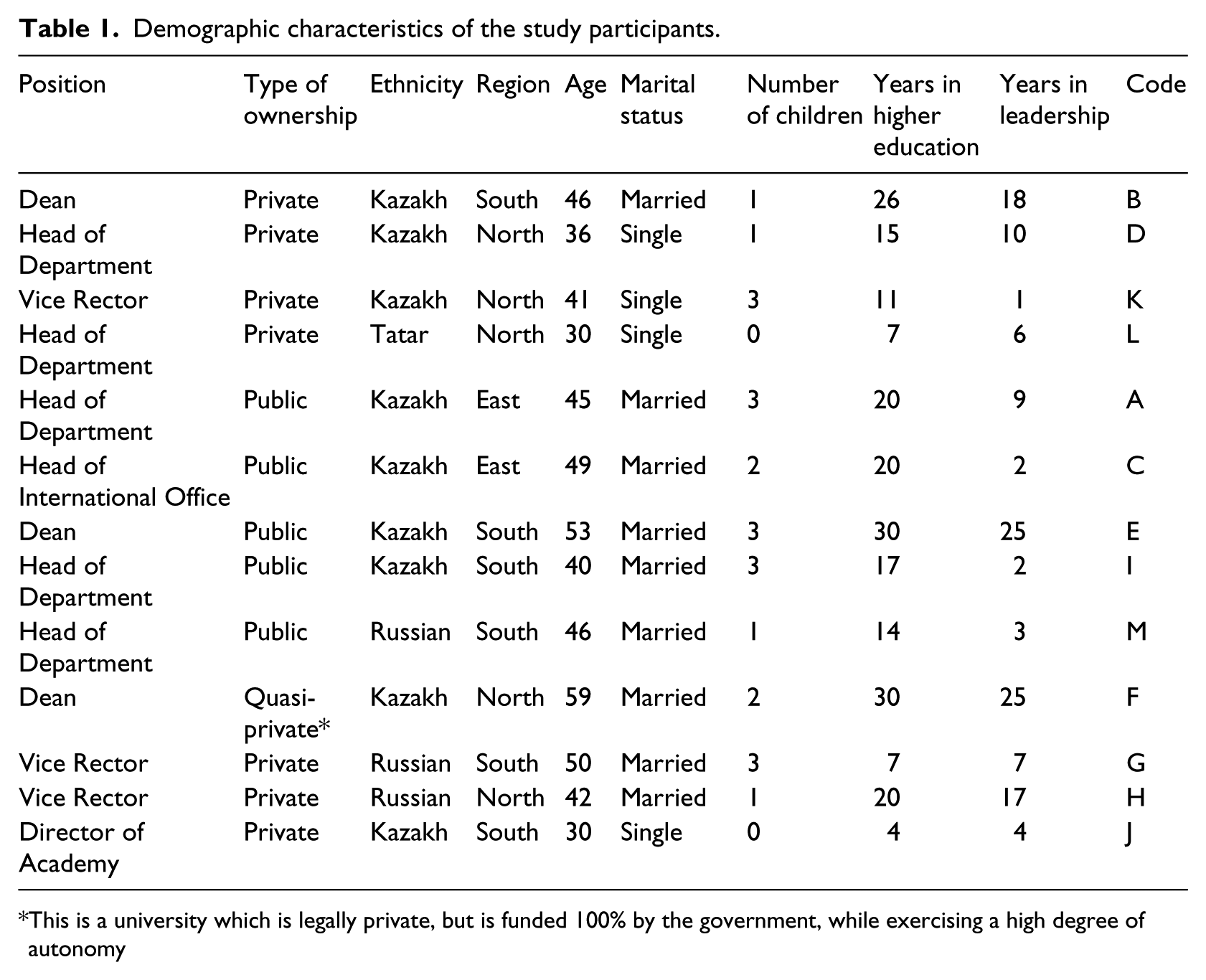
This is a university which is legally private, but is funded 100% by the government, while exercising a high degree of autonomy
Results
The results of our study are presented in this section on the basis of six main themes:
(1) A woman’s pathway to academic leadership;
(2) A woman’s experience of leadership;
(3) Women’s perceptions of societal expectations and strategies to meet them;
(4) Organizational influences on the variation in female leaders’ experiences; and
(5) Institutional factors affecting female experience.
A woman’s pathway to academic leadership
Our participants’ accounts of their pathways to academic leadership are best interpreted using the frame of gender–role theory (Eagly, 1987). The challenges that females face on their way to leadership are mostly related to the conflict between societal expectations about professional and family roles. Like women in other countries, females in Kazakhstan seem to lack aspirations for leadership, do not strategize their leadership career development, and find themselves in leadership positions by accident, frequently being forced into this position by their superiors.
A dean of a quasi-private university in Northern Kazakhstan, Participant J, is very representative of many women in terms of lacking leadership aspirations and self-confidence to be considered for promotion: I do not want to be a rector. You have to be able to handle many things at a time as a rector. … I cannot do this. I am afraid of responsibility for the whole university.
A 45-year-old head of department from a public university, Participant F, described how she became a leader against her will: I did not want to be a dean, but the rector wanted to appoint me to the position… I was crying because I thought I was not ready – I had not been even a chair before that. I said the reason I did not want the position was because I had two little kids. The School of Education at the time offered only programs in primary and preschool education. The rector said: ‘You will just learn all the problems of preschool education from your kids’.
Younger females are expected to start a family and have children before the age of 30. Hence, participants around that age reported that they sometimes feel discriminated against due to the employer’s fear that she may leave the workplace for pregnancy and childcare leave soon after promotion: Some people would say: ‘Why are you taking her? She is almost 26 years old. She will soon get married and will go on a pregnancy leave. She will not be working and you will have to employ a replacement. She may never come back after having a child’. (Participant J)
An older woman without a husband and children is perceived as having a lower level of emotional stability, and lacking the ability both to understand subordinates’ needs and to prioritize and manage their time. Some participants reported that they themselves would never promote a single childless female over thirty because …she becomes bitchy if she does not perform her primary caretaking role, they envy other women. (Participant B)
When a woman has young children she is less likely to be offered a promotion and is more likely to decline the offer because combining childcare and leadership responsibilities is viewed as very difficult at that age. This is what Participant C said about her decision to decline a promotion early in her career: I was offered this position before, but I refused as I thought that I need to spend more time with my children. The role of a wife and a mother was a priority for me.
For most participants, higher level leadership positions became possible after their children reached middle and high school levels: I got this job offer and I had some time to think. I thought that my children are grown ups and now I am a mature person. I have realized some essential programs of my life, that’s why I agreed. Before that I needed more time to take care of my children and that was my priority. (Participant C)
A woman’s experience of leadership
Gender–role theory is also very useful in understanding some of the challenges that females experience when performing leadership responsibilities as compared to males. Gender stereotypes about female characteristics and leadership abilities explain many of the hurdles that females face as academic leaders.
Participants of the study uniformly reported that they were assigned more work than males and had to accept extra responsibilities in order to be perceived as being as productive as males. Women also cover up for underperforming males because there is a belief that gender balance is important for the educational process and that a few available males must be cherished and ‘kept for decorative purposes’ (Participant G). Participant A made a joke in this regard: We have two males in our department, who are not willing to do their share of paperwork. So, I said to my female colleagues: ‘ladies, these are the only gentlemen in our department, let’s carry them in our arms’.
Many participants of the study noted that females tend to be more caring in their approach to leadership as compared to males, who are more impersonal and hands-off. According to Participant L, females …treat their colleagues as a family, are concerned about the well-being of the employees, and take into consideration challenges in personal or family life in setting expectations, assigning tasks, and in evaluating performance. (Participant L)
They are also ‘more likely to provide guidance and advice to subordinates’ (Participant B).
The caring leadership style seems to be less common among female leaders in top management, in male-dominated disciplines, and in circumstances with poor advancement opportunities. This finding is predicted by the gendered organization theory. It seems that fiercer competition with males in organizational structures that favor males makes females switch from a transformational to a transactional leadership style. In addition, women become less collaborative with other females and are reported to be more likely ‘to get involved in intrigues’ (Participant K). Females in male-dominated disciplines need to adopt a more male-like leadership style in order to succeed in tough competition with males. A 30-year leader, Participant D, who is the head of a department, mentioned that she played football with other male deans on the weekends and this allowed her to become a member of the ‘guys’ club’.
Women’s perceptions of societal expectations and strategies to meet them
Conflicting societal expectations were a salient theme in the interviews with female leaders. Three sets of expectations were mentioned directly or assumed by the participants: those associated with traditional society and Islam, those associated with the Soviet society, and those associated with the ‘neoliberal West’.
Traditional society puts family interests above the interests of an individual and assigns distinct, mutually exclusive and non-exchangeable roles to the husband and wife in the family. Males are believed to be physically superior to females and are perceived as heads of the family. They play the role of the primary earner and are expected to support their wives and children. The primary role of a female is care-giving for her children and spouse. The role cannot be delegated or shared with anyone else: only a mother is believed to be capable of providing appropriate emotional support for her children. Working outside the house is viewed as abandonment of the primary care-providing responsibility. Traditional expectations are often attributed to elders in the extended family, as well as to mothers- and fathers-in-law.
The set of expectations which was imposed by the Soviet ideology is more liberal with regard to the extent to which a female can participate in the labor force. A woman is encouraged to work. However, she is not expected and, in fact, is discouraged from earning as much as her husband because this is viewed as being destructive with regard to the masculinity of a man. She is still viewed as ‘a weak gender’, whose primary role is caring for her husband and family. Delegation of child-care responsibilities is permitted, to either another female (for instance, grandmother, sister or friend) or to daycare. Soviet-values are often attributed to older and senior level male and female employees of public universities, and to relatives who were educated and employed in the Soviet Union.
Western society is believed to impose a new set of norms which are perceived as threatening to the much cherished family-orientation of traditional society. In the understanding of Kazakhstani females, Western women value career more than family and the interests of their husbands. The female ability to advance in a career is attributed to the willingness of males to abandon their primary earning responsibility and to accept the role of care-provider. The unnatural distribution of family responsibilities was viewed as contributing to …a high rate of divorce, failures in child upbringing resulting in a high suicide rate, school-shootings, and disrespect to the elderly and the authority, as well as to the overall dissipation of the family as a social institution. (Participant D)
These values are attributed to the younger generation of highly ambitious males and females.
These conflicting societal expectations impose a great deal of stress on women in leadership positions. On the one hand, under the influence of neoliberal ideology, they feel pressured to work, to earn good salaries, and to demonstrate career progression. They view themselves as being as capable in leadership as males and attribute failure to advance to personal incapacities rather than to societal barriers. At the same time, all the women interviewed continue to be influenced by the traditional society belief in the primary role of the female as care-provider. They view their role of mother as being more important than the role of leader and push themselves to perform equally in both leadership and motherhood roles.
Peers, colleagues, superiors, spouses and/or extended family members may hold any of the described set of beliefs and a woman has to satisfy all of them simultaneously. How Kazakhstani females meet these expectations is very consistent with the predictions of performative leadership theory. Some participants stated that they perform differently at work to when they return home. They have to act as progressive and aggressive leaders at work, where they have to be respected by male colleagues; but they have to assume a soft and subordinate position at home, removing her make-up, replacing pants [trousers] with a skirt, and covering her modern haircut with a head scarf, as they are patiently and silently serving endless rounds of tea to her husband and his relatives. (Participant L)
Organizational influences on female experiences
Type and location of the university
Our analysis of the interviews revealed a differentiation in the ways females balanced their work and family lives in their experiences as leaders across university types and geographic regions in Kazakhstan.
First, the environment in private universities is more neoliberal in orientation, as compared to the environment of public universities. To be able to survive in the competitive market private universities are ‘more concerned about profit and quality and are interested in promoting talented employees regardless of their gender’ (Participant G). Meanwhile, in publicly-funded universities, rectors are appointed by the President and there is a greater incidence of protectionism. As a result, females in such universities find themselves stuck in lower-level academic positions, where they are overloaded with bureaucratic responsibilities which make it more difficult to balance work and family lives. Males in public university administrations are still ‘a rare species’ and they are frequently favored over females in selection for and promotion to leadership positions. The lack of advancement opportunities makes the relationships among females in the organizations less collegial and less mutually supportive.
Second, participants believed that the southern and western regions of the country, as well as regions located on the periphery, tend to be more traditional in terms of gender expectations. In these regions, Islamic and pre-colonial nomadic cultural norms have experienced greater revival. This has made female advancement to and experiences in leadership more problematic because it has increased the pressure from the family to be a full-time mother, and has made female advancement less tolerated in male-dominated organizations.
Gendered division of labor
Organizational factors affect female experiences in leadership in another important way. In Kazakhstani academia there seems to be division of labor between male and female leaders. The responsibilities of a department chair or their deputies tend to be transactional, oriented to the internal day-to-day operation of the university. This type of position requires constant interaction with government agencies in terms of reporting and producing paperwork. As Participant B noted: We have to file a huge amount of documentation for the Ministry. Every day we have to draft 5–6 letters and each of them has to be completed urgently. In addition to that, we need to send official correspondence to the administration of the city and the Department of Youth Policy. You are turning into a robot, which is stuck processing correspondence.
Women are perceived as being better at these positions due to their diligence and detail-orientation and they comprise a majority as chairs and deputies. Meanwhile, these positions do not involve a significant pay differential in comparison with being a member of faculty, while requiring long working hours, limiting opportunities for research, and bringing a high potential to become involved in conflict with colleagues.
At the top of the promotion ladder is the position of rector, which is strategic in orientation. The key task of the President is to secure funding and political support for the institution. Participant G, who is a dean at a public university, observed that such a position is viewed as suiting males better, because they are ‘better strategic and global thinkers’, who are not ‘subject to the influence of emotions’ and who are ‘more appropriate as a representative of the organization in external circles’.
In general, the findings described in this subsection are very consistent with the predictions of professionalization theory (Blackmore, 2014). As in many other places, in Kazakhstan the work of academic leaders at the lower levels has become more bureaucratized and offers fewer opportunities for combining teaching, scholarly and administrative responsibilities, while the work of academic leaders at higher levels has become mostly managerial and requires external management experiences. Female academic leaders seem to be unable to overcome ‘the glass cliff’, being assigned to seemingly dead-end administrative positions.
Institutional factors affecting female experience
A finding of the study, which was not predictable from the available literature, was related to the influence of informal institutions on female leaders’ experiences. Many participants pointed to the ‘team-approach to leadership’ and corruption as the main barriers to their advancement. In Kazakhstan the position of a university rector is very important from the point of view of national-level politics. Having experience as a successful rector increases the opportunities for being promoted to a national-level decision-making position and becoming a part of the President’s team. Individuals are appointed to be rectors of public universities by the President for testing purposes and their performance is carefully observed. Rectors do not perform their responsibilities alone. They start and leave the position with their teams, which frequently include most of the vice-rectors and heads of key departments at the university. As a result the top positions at the universities are not easily attainable for outsiders. It is possible to be promoted, to become a member of a rector’s team, but such an appointment assumes a long-term commitment to the team versus the institution and academia in general. An individual should be ready to move with the team to another appointment, including an appointment in another city and outside academia. In addition, top level positons are associated with the necessity to engage in corruption and higher risks of losing jobs and freedom in case of exposure. Few females are willing to take these risks and to sacrifice the career of their spouses, as well as the well-being of their children, in order to commit to a team: thus they have few opportunities to achieve promotion to top level academic positions.
The available Western theories explaining the experiences of female academic leaders do not account for the importance of the informal institutional influences. They tend to focus on individual socio-psychological and organizational levels. While professionalization theory takes an institutional stance in explaining the influence of profession as a supra-organizational structure, it does not explain the role of informal institutional norms, including those regulating nepotism and corruption, as well as operation of informal policy networks. Meanwhile, such structures are very influential in the contexts of developing and transitional economies. Neo-institutional theory (e.g., Blom-Hansen, 1997; DiMaggio and Powell, 1991) provides a good framework for analyzing the influence of such inter- and supra-organizational structures and might be considered as a framework for researchers of female experiences in academic leadership. While this framework is increasingly used by feminist political scientists under the name of feminist institutionalism (eg.: Krook and Mackay, 2011; Kenny 2007), it has not been actively used in the studies of female academic leaders.
Discussion
The purpose of the study was to explore how females advance to and perform in academic leadership positions in Kazakhstan and to test the relevance of Western theories in explaining their experiences in the post-Soviet context. Most of the results of the qualitative study are consistent with the findings of studies conducted in other contexts and can be interpreted using the theories, models and concepts discovered from the analysis of international experiences.
The experiences of female leaders in Kazakhstan are, to a large extent, similar to the experiences of females in other countries. Two features make the experiences distinctive, however. First, the transitional context puts women under pressure of more numerous and conflicting social expectations than can be expected in the case of a female representing the majority in a relatively stabilized Western society. In Kazakhstan, a woman is trapped in the overlap of three co-existing dominant cultures – the revived traditional, the strongly-persisting Soviet, and the increasingly influential Western. Under these circumstances females have both more challenges and more opportunities as leaders. Second, unlike females in Western societies, female experiences in Kazakhstani academia are influenced much more by informal institutional structures, which underlie corruption, nepotism and the operation of informal policy networks. These structures significantly limit female advancement opportunities.
Existing Western theories are able to explain most of the experiences of female leaders in Kazakhstan. Gender–role theory helps to explain why the ‘sticky floor’, or a set of barriers, inhibits the launch of a leadership career for a female. Our findings clearly show that younger females in Kazakhstani academia lack aspirations for leadership, have a low level of confidence, and are afraid of responsibility. The results of the study also reveal that females experience role-incongruity when performing leadership responsibilities and find it hard to balance their work and life. As with women in academia in many other countries (see, for example, Thompson and Day, 1998; Wilson, 2003; Luke, 2001; Beddoes and Pawley, 2014), Kazakhstani women sacrifice more and struggle more than their male colleagues because of the need to perform the dual roles of care-provider at home and professional academic employee.
Gendered organization theory helps to explain the external barriers, which create the ‘glass ceiling’ and the ‘glass cliff’ effects, whereby females fail to move above a certain leadership level in academic organizations due to prohibitive social norms and expectations, masculine stereotypes about leadership and typical characteristics of females, as well as gendered promotion practices. In many other cultures, females are stereotypically viewed as being helpful, kind, sympathetic and sensitive (Eagly and Carli, 2007) and face a ‘psychological barrier to women’s choice, performance and persistence in career decision making’ (Sullivan and Mahalik, 2000: 55). The results of this study are very similar: women in Kazakhstan are also stereotyped as caring, emotional and more diligent. As a result they strive to pursue and are frequently assigned to positions at a lower level, associated with a lower likelihood of further advancement.
Some of the experiences of female leaders revealed in the study can be interpreted from the point of view of performative leadership theory (Reed, 2001; Fuller, 2013, 2014; Acker, 2012). When faced with multiple contradictory social expectations, females use translanguaging (Fuller, 2014), displaying different socially expected behaviors in a variety of work and family settings depending on the social expectations imposed on them by the ‘audience’. They can be submissive, caring and empathetic at home, while being authoritative and rational at work.
Professionalization theory (Blackmore, 2014) helped to reveal the existence of division of academic labor among different genders in Kazakhstan, and this explained the lack of females in top level academic leadership positions. Kazakhstani females tend to be over-represented in the lower-level positions, of academic chairs and their deputies, which are associated with heavy work loads and few opportunities for career advancement. Meanwhile, they experience difficulties in accessing top level vice-rector and rector positions which require greater political acumen and strategic thinking, and which are stereotypically viewed as being more greatly represented in males.
However, the existing theories fall short in providing an explanation of the role of informal institutional structures in female promotion to leadership in Kazakhstan. For example, none of the existing theories can explain why corruption, nepotism and the ‘team approach to leadership’ hamper female advancement to top level academic leadership positions. However, neo-institutional theory, including feminist neo-institutionalism, can be used to frame the influence of the phenomena on female advancement and it is recommended that it should be incorporated in the analysis of female experiences as academic leaders in other developing and transitional contexts.
Footnotes
Declaration of Conflicting Interests
The author(s) declared no potential conflicts of interest with respect to the research, authorship, and/or publication of this article.
Funding
The author(s) received no financial support for the research, authorship, and/or publication of this article.