




Abstract
Studies suggest the COVID-19 pandemic disproportionately impacted women. Related research and literature suggest leadership approaches commonly associated with women are more effective during crises, a notion that we sought to explore in this study. This investigation explored how senior women leaders in the UK Higher Education exhibited leadership during the pandemic, whether their approaches had changed during this time and the impact leading during this period had on them. The research used semi-structured interviews with six women senior leaders to uncover insights into their lived experiences. Findings show while their fundamental leadership styles did not change, all participants exhibited situational approaches with higher levels of distributed leadership than pre-pandemic. In several instances, their perception was this was based on gendered differences in their leadership approaches, probably developed because of their socialisation as women. The pressures on participants during the pandemic had a significant personal toll, with this period being articulated as the most difficult in their careers. Peer-to-peer networks functioned as critical support mechanisms for these women leaders. The greatest emergent stressor, however, was government policy changes unrelated to COVID-19 which participants considered would have greater long-term impact and served to destabilise higher education at an already difficult time.
Introduction
This study explored how women senior leaders in the UK Higher Education (HE) exhibited leadership during the COVID-19 pandemic from 2020 to 2021. In HE, senior leaders faced unprecedented challenges as policy and guidance changed at pace, with institutions having to rapidly adapt their approaches to ensure student and staff safety. Women make up a small proportion of senior leaders and several studies have shown the pandemic to have disproportionately impacted women. This article explores how women senior leaders in HE exhibited leadership during the pandemic, whether their leadership approach changed during this time and the impact leading during this period had on them personally and professionally.
The research consisted of semi-structured interviews with six women senior leaders in different universities to uncover insights into their lived experiences during the pandemic. An analysis of HE websites undertaken in March 2021 revealed a total of 53 women vice chancellors, with a further 58 women designated as deputy vice chancellors. The six involved in this research (5% of total population) were a purposive sample identified either opportunistically or via the snowball technique. Patton (1990) indicates a purposive sample is an appropriate method for gaining information-rich cases, particularly in an interpretivist paradigm. We acknowledge this cannot be considered a representative sample, but consider it an appropriate way to gain access to women senior leaders at a busy time. It is also acknowledged that there are many intersecting features associated with senior leaders in HE. The only common feature of our selection of participants was gender, biologically defined, specifically to explore truisms relating to women's leadership approaches. No distinction is made between the institutions in relation to ranking or reputation, with all considered as facing similar issues with the pandemic.
The context
HE is a market-facing sector (Corver, 2019), meaning the external environment directly impacts internal operation. Central to that is the generation of funds and this has tended to drive institutions to be market-oriented, prioritising students as consumers over internal-facing collegiality and autonomous research (Ferlie et al., 2008). Subsequent policy reforms impacting student numbers – particularly the increase in domestic tuition fees in 2012 and student number cap removal in 2015 – alongside increasing external accountability measures (Department for Education & Office for Students, 2017), have meant universities must compete harder for students to ensure financial sustainability (Harris, 2017).
Consequently, this ever-shifting policy context has rendered HE leadership roles increasingly challenging and has directly impacted strategic planning, while threatening to reduce financial sustainability and destabilise the sector (Boliver, 2015). A mixed methods study on the characteristics and recruitment of the UK vice chancellors uncovered extensive expectations on aspiring senior leaders (Breakwell and Tytherleigh 2008). Comprising primary and secondary data, fifteen essential characteristics were identified from being inspirational and collegial, financially aware and business-headed to socially skilled, academically credible and possessing high levels of stamina. These findings were echoed by Green and Eckel (2010) and Shepherd (2017), reinforcing the multifaceted nature of HE leadership where senior leaders have responsibility for complex systems.
The pandemic tested senior leaders in unprecedented ways, forcing them to adapt in the face of constant external change while changing how organisations functioned. Central to these challenges was the need to make difficult decisions, such as moving to remote teaching and learning, permitting access to campus and making changes to staff remuneration. A key feature of the pandemic was constantly evolving government mandates. Within this scenario leaders had to balance staff and student well-being with financial risk, navigating an uncharted course.
While some argued relational leadership, traditionally considered feminine, is more effective during crises (Eagly and Chin, 2010; Zenger and Folkman, 2020), others argue agentic styles, conceptualised as masculine, more impactful (Pew Research Centre, 2015; Post et al., 2019). Regardless of leadership perspective the pandemic has proven highly challenging for leaders and institutions, which formed the basis for the research reported here.
Gender and leadership
There is literature examining gendered leadership approaches, particularly in times of crisis (Alimo-Metcalfe, 2010; Morgenroth et al., 2020; Post et al., 2019), which we explore here to evaluate whether there are differences caused by gender. Leadership theory continues to evolve since earlier scholars argued that masculinity, dominance and extraversion were essential features (Lord et al., 1986; Mann, 1959), thus excluding women and perpetuating societal norms (Eddy and VanDerLindin, 2006). One facet is the hero leader, a concept defined as ‘the belief that every corporation owes its existence or pre-eminence to a single leader, who was instrumental in its success’ (Kurian, 2013: 130), with Kelan and Wratil (2018: 8) concluding ‘traits that are ascribed to men in society such as control, assertiveness and domination are central for this kind of [heroic] leadership’. Conversely, theories such as authentic leadership propose feminine relational approaches to leadership may be more effective in the knowledge economy where HE is situated (George, 2003; Scott, 2009).
It is argued, however, that gendered approaches to leadership are based on stereotypes derived from women's socialisation in western society (Mavin and Yusupova, 2020; Morgenroth et al., 2020). Gender is a social construct, aligned with assigned biological sex and laden with societal expectations. While there are no fundamental biological differences that predispose men or women to be more effective leaders, the socialisation experienced may alter cognitive development, impacting their approach to leadership (Steel and Chesterton, 2021) and result in generalisations.
A common perception in the related literature is that women are naturally predisposed to collaborative approaches, displaying communicative and relational attributes, while men are more likely to display agentic styles including dominance and assertiveness (Post et al., 2019; Simon and Hoyt, 2019). While these stereotypes continue to pervade society, van Engen and Willemsen’s (2004) research on this topic found although some leadership approaches were more often displayed by women, generally there was no measurable difference between genders for the vast majority; instead context and organisational culture were more significant mediators of leadership approach.
Several other studies have considered perceived differences in gendered approaches to leadership, with differing outcomes. Rosener (1990) undertook interviews with women and concluded while women more often display the stereotypical attributes associated with communicative or relational leadership this is because they have been socialised this way. Consequently, she concludes, because of their socialisation they are successful in fast-changing external environments. Similarly, Grogan and Shakeshaft's (2011) work posits while men and women do not fundamentally lead differently, women emerged as more open to distributed leadership, building teams with diverse perspectives which support trust and innovation, thus directly aligning with the arguments relating to women's socialisation.
While the distinction between masculine and feminine leadership behaviours should avoid applying stereotypes, there is evidence of gender disparities between the perceived approaches associated with great leaders, with a Pew Research Centre (2015) study in the United States suggesting women were better at being honest, ethical and making compromises, while men were better at taking risks and negotiating profitable deals. Another question uncovered perceptions of women as being more compassionate and organised, while men were considered more decisive and ambitious.
Desvaux et al.’s (2009) survey of business leaders during and after the 2008 economic crisis determined, however, leadership approaches more frequently displayed by women were critical to navigating successfully through crises. Using Bass and Stodgill's (1990) nine leadership behaviours that improve organisational performance, participants felt women demonstrated five more often than men, while men demonstrated two more often than women and two were perceived as equally displayed. Aligned with other findings, individual decision-making and control were seen as masculine behaviours, while people development, role modelling, expectations and rewards, inspiration and participative decision-making were considered feminine approaches. When applying this to behaviours deemed essential in addressing global challenges, three of the top four were more often associated with women. Equally, the two top ranked leadership behaviours during crisis (expectations and rewards and inspiration) were demonstrated more by women, with nearly half the participants agreeing: ‘The ability to present an inspiring vision of the future and create optimism around its implementation is the most important behavior type to navigate through the crisis’ (p. 14). This links closely to concepts of trust and authenticity, in that by having a clear vision leaders built trust by articulating a way out of the crisis. Control, conceived in this study as a masculine trait, was considered the most prevalent, but least important behaviour during crisis.
These findings were replicated by Zenger and Folkman (2020) who collected data on 454 men and 366 women's perceived leadership skills at the start of the COVID-19 pandemic (March to June 2020) and found women rated more highly than men, with the difference in ratings between genders being greater during the pandemic. Of the 19 leadership approaches included, women ranked higher on 13 and the difference was statistically significant, while where men ranked higher the difference was not statistically significant. Interestingly, aligned to stereotypical views, women ranked most highly in:
taking initiative, learning agility, inspiring and motivating others, developing others, building relationships, displaying high integrity and honesty and communicating powerfully and prolifically.
The questionnaire also included employee engagement scores, where women ranked more highly due to placing greater emphasis on interpersonal approaches such as motivation, communication, collaboration and relationship building.
Women HE leaders during the pandemic
Due to the ongoing nature of the pandemic, little has been written about the experience of HE leaders to date. There are, however, two published articles providing insights into the experiences of women leaders in this context and have inspired this research. These are Mavin and Yusupova (2020) and Gedro et al.’s (2020) personal reflections on the gendered experiences and challenges of leading HE currently. While both are descriptive and reflective there are common themes.
Gedro et al. (2020) examined five women leaders in a non-traditional higher education institute in the United States, where many staff and students were in groups disproportionately impacted by COVID-19. Through narratives of participants, challenges emerged spanning the digitisation of teaching and learning, well-being, financial worries, childcare, bereavement, fatigue and burnout. To support staff the main leadership approaches employed were: communication and making space for informal conversations; showing courage and compassion, including being empathetic to staff and students’ home situations; being realistic and emotionally resilient, including taking time for self-care; facilitating staff to feel they have power and control of their own situation; focussing on the big picture and providing hope that there is light at the end of the tunnel. Gedro et al. (2020) conclude: …a combination of direction setting, organizing, and evaluating along with collaboration, communication, supportive and nurturing are optimal leadership styles.
The findings note necessary switching between directive and collaborative leadership styles, indicating these leaders’ ability to synthesise multiple approaches, demonstrating dynamic, rather than static, leadership.
Mavin and Yusupova (2020), while identifying similar challenges, offer more insight into the personal challenges of women leaders during the pandemic: …the overwhelming feelings were around inadequacy in ambiguity; not having the answers at work or at home. I was involving as many people as possible in decisions, then struggling with whether to share the ambiguity with colleagues who were becoming increasingly anxious…There were no boundaries at all between work-and-life; they permeated each other in ways never experienced before. (p. 738)
While not indicative of wider trends, this reflects the experiences of leaders in situations of uncertainty or crisis (Mowles et al., 2018), with the burden of home life, ambiguity and anxiety. Another sentiment expressed here is guilt for not performing roles fully, reflected in Gedro et al. (2020). As studies mention (Granville-Chapman and Bidston, 2020; Koehn, 2020), finding time for self-care is essential to leading successfully, but is something many women have not had time for during the pandemic (Madgavkar et al., 2020). Reflecting experiences of the pandemic's regressive effect on women leaders in HE, Mavin and Yusupova (2020) state: COVID-19 may personify the misfit of woman and leader. The resilience required to lead as a woman in extreme contexts can be debilitating and sometimes fatal … Our personal reflections of our gendered experiences during COVID-19 have surfaced responsibility, ambiguity, resilience, emotion work, vulnerability, abjection, anxiety, guilt, precarity and have provoked reflexivity. In some ways it does feel like our societal clock just sped backwards. (p. 742)
While these studies reinforce the argument that gendered leadership approaches considered feminine have been key to business continuity during the pandemic, it would be unrealistic to assume this approach has been universally adopted by women leaders in HE. The media reported, for example, a high-profile case focussing on alleged mishandling of the pandemic by a female vice chancellor in March 2021 prompted by lack of student consultation (BBC, 2021). This demonstrates a less relational approach where lack of communication drove dissatisfaction. While it is unclear whether the expected relational approach of a woman senior leader played a part in this, it reinforces the argument that women are not a homogenous group, leadership approaches are not static and development and maintenance of trust are critical during times of crisis.
The research design
Five key themes emerge from the discussion conducted above which subsequently became a priori codes in the data analysis:
the impact of the external policy environment, perceptions of gender in leadership, changing leadership approaches during crisis, trust, relationships, communication and blurred lines between home and work and networks. ‘Have women senior leaders in HE altered their leadership styles during the COVID-19 pandemic to navigate the ever-changing environment?’ and ‘What personal impact has leading during the COVID-19 pandemic had on these women senior leaders?’
This led us to identify two research questions:
The research consisted of interviews with women leaders to uncover insights into their lived experiences during the pandemic. Three major emergent themes from the literature were trust, change and relationships, each of which was used when designing the interviews, the aim being to uncover insights into their experiences during the pandemic, discussing both their evolving leadership approaches and any personal impact on them.
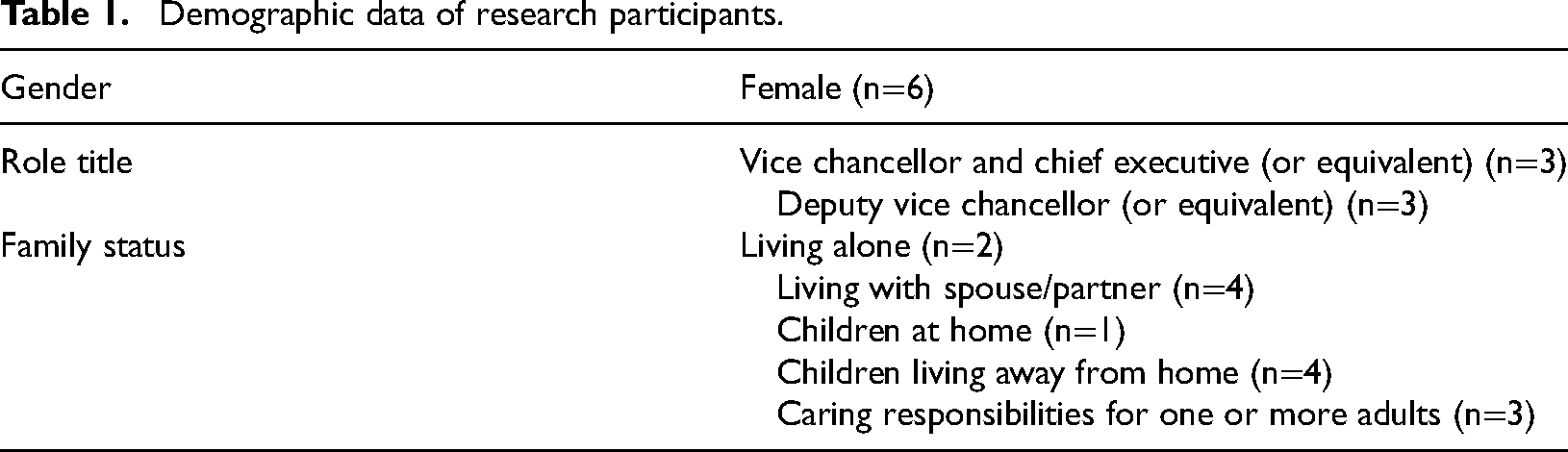
Interviews were conducted online over a 6-week period in summer 2021 with three vice chancellors and three deputy vice chancellors from separate universities (see Table 1). This was a key period in UK policy during the pandemic, as it encompassed the period where an extension of legal restrictions went past the original planned end date, directly impacting those interviewed and their preparation for reopening of campuses.
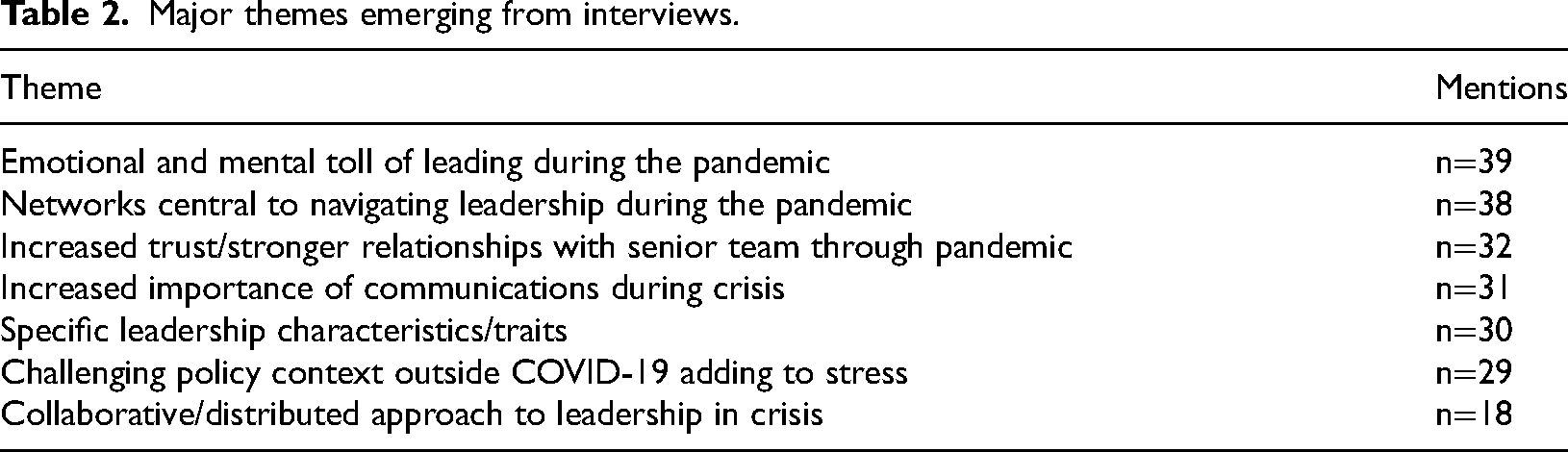
Data were analysed using the constant comparative method in a content analysis tradition. Emergent codes are shown in Table 2. As a new area of research, this combination of conceptual approaches was chosen to ensure themes were not omitted. Data verification was undertaken via full transcripts, notes on interpretation and initial thematic analysis being shared with participants to confirm they had been correctly understood.
Demographic data of research participants.
Major themes emerging from interviews.
Findings
Demographic data was minimal to ensure anonymity. Aside from identifying gender and role title, the remaining question was family status to understand participants’ home situations which impacted gender equality during the pandemic (Gedro et al. 2020; Madgavkar et al., 2020; Mavin and Yusupova, 2020).
Major themes emerging from interviews are shown in Table 2, togeher with the number of mentions each received.
The findings indicate participants’ approaches to leadership did not change fundamentally, generally adopting a situational approach that allowed them to shift between relational and agentic approaches in fast-changing circumstances. There was also an increase in distributed leadership, with relationships, trust and communication taking on increased importance during the crisis.
The findings also highlight the personal cost of leading during the pandemic while navigating challenges at home, with participants experiencing elevated levels of anxiety, loss of confidence, reduced resilience and exhaustion. Despite this, several were positive about opportunities for this crisis to function as a catalyst for change, including the reimagining of universities’ approach and social function.
While it was expected there would be discussion of external policy changes and government responses to universities during the pandemic, an unexpected finding was this was the most highly cited theme. It was notable the policy context and upcoming changes were considered potentially more damaging than the pandemic and, although it may have been challenging navigating this crisis, participants were preparing for an uncertain future. Another important finding was the criticality of networks to participants, identified as central to navigating leadership during the pandemic and one of the most valuable support mechanisms.
Finally, the importance of trust emerged throughout interviews, intertwined with discussions on relationships, networks, communication and teamwork. As anticipated from literature on crisis leadership (Granville-Chapman and Bidston, 2020; Mowles et al., 2018), inspiring trust amongst stakeholders was important to driving strategy forward, while having trusting relationships with sector peers emerged as central to navigating the stress of leadership during the pandemic.
Discussion
This discussion is structured around four thematic areas:
The policy context; Leadership approaches; The personal impact of leading during the pandemic; and The future of HE leadership.
In line with relevant theory, trust is discussed throughout as an overarching issue permeating most themes (Buller, 2015).
Policy context
The volatile policy context of HE during the pandemic came across strongly in interviews. The major emerging themes were:
lack of government understanding of HEIs’ complexity, leading to insufficient support/guidance during the pandemic and the unstable/ever-changing policy context outside COVID-19 presenting unprecedented levels of challenge.
Of the participants, only four mentioned policy in relation to the pandemic, while all discussed government-driven agendas which negatively impacted stability. This is significant as it situates the pandemic crisis as one of many.
In the pandemic, the most pressing challenge identified was minimal government guidance, the nature of information when it was provided, described as ‘woolly’ by one participant, and lack of time to plan and implement changes. There was a sense that government did not understand HE complexity, meaning when guidance was released there was insufficient time to implement it effectively. Two participants cited practical aspects such as timetabling, with frustration evident: The government thinks you can plan on Thursday and open it all up on Monday, and they don't understand the complexities of timetabling and staffing.
Two participants indicated this impacted student experience, while from a financial perspective, this had knock-on effects with potential reputational damage and associated longer-term loss of income (BBC, 2021).
The timing of guidance was also discussed, with participants recalling desired updates being released ‘late on a Saturday night’, directly impacting work-life balance. One example was the release of guidance on New Year's Eve, 2020 regarding teaching in January. After bringing staff back from leave to implement the changes needed, the guidance was altered again on 4 January. In context of the broader pandemic challenges and trying to maintain staff well-being this was unhelpful and damaging: …trying to manage a large organisation where things could change daily with no prior notice is challenging enough without trying to work in that sort of landscape where we can't predict what's coming.
A factor that could have mitigated this, mentioned by two participants, was better government engagement with sector bodies such as Universities UK to support scenario planning. Both had been involved in working groups with government during the pandemic, but found ‘the lack of engagement and understanding … [from] the government is just appalling’.
A major frustration was the lack of evidence apparent behind several proposed changes and in media narratives. All considered policies were coming from a narrow interpretation of HE, described by one of the participants as being ‘guided by dinner party speak’, meaning implementing these changes could have major consequences for financial sustainability and widening access which would impact the most disadvantaged in society. I’m disappointed by lack of evidence, lack of consultation and an unwillingness to engage and understand the repercussions of the policies that they’re putting in place. I don't think there's any long-term thinking.
Juggling the multifaceted priorities of a sustainable business during crisis, ensuring excellent student experience and managing challenges of staff well-being in the pandemic alongside navigating uncertainty in the broader policy context put significant strain on participants. As one reflected: ‘[I] wonder why they are doing it at this point in time when things are so difficult.’
Leadership approaches
Most participants identified approaches they felt were evident, rather than overall strategies. Reflecting on the Pew Research Centre (2015) study, this suggests participants were aware of characteristics that allowed them to flex their conceptual approach in line with situational leadership theory. Two participants identified the need for agility, reflecting other scholarship on situational approaches of leaders during the pandemic (Gedro et al., 2020; Mavin and Yusupova, 2020). The traits most often cited were:
collaborative and distributed approach (n=18), authenticity, transparency and visibility, including leading from the front and making difficult decisions (n=16), people-centred and coaching style (n=10) and data-driven, risk-based approach with finances underpinning decisions (n=9).
When applying these to the leadership approaches identified by Desvaux et al. (2009), it is evident most are aligned with characteristics commonly associated with women (Pew Research Centre, 2015; Zenger and Folkman, 2020).
Distributed leadership emerged as the most common approach. While for most participants this formed part of their approach pre-pandemic, it became more marked during the crisis. Key areas of distributed approaches were inclusivity, delegation of power and decision-making, teamwork, shared responsibility and the importance of engaging the broader staff body in change projects to gain support. While all participants discussed the need for the distribution of decision-making authority to support operational effectiveness, four also highlighted the importance of being action-focused and able to make difficult executive decisions when needed. This was exemplified by two participants stating they preferred to lead institutional decision-making, while one noted ‘I can take the tough decisions, and quickly … but I would want to do it in a more consultative, collegiate way.’ This latter approach was reflected by two other participants and is reminiscent of work on gendered leadership (Alimo-Metcalfe, 2010) where agentic approaches have been learned for application where required, despite a socialised pre-disposition to collaborative decision-making.
One participant asserted ‘my experience of women leaders is that they’re more likely to test out ideas on colleagues before the ideas get announced’, an approach repeated by all other participants. Although there was one mention of the need to navigate contradictions around delegating authority, ultimately through distributing leadership, participants considered they were able to harness teams’ collective creativity/expertise to ensure the best outcomes for stakeholders.
Authenticity and transparency have been shown as central to building trust which is critical for successful crisis leadership (George, 2003; Mowles et al., 2018). Echoing Timmins’ (2015) conceptualisation of successful leaders in the title of his work as needing to be ‘comfortable with chaos’, participants expressed the need to balance transparency around their own uncertainty with staff and students’ desire for clarity: You’re balancing on a bit of a pin head the whole time, trying to give clarity and direction as you can while recognising that some people can cope with that sense of flexibility and nuance and other people it makes them feel really, really stressed.
This theme of authenticity fed into more people-centred approaches to leadership, shifting relationships with team members and other stakeholders and changing communication, which served to build trust, seen as central to crisis leadership (Zenger and Folkman, 2020).
While four participants mentioned having a people-centred approach prior to the pandemic, two adapted their leadership style during the crisis to be even more people-focused. This is indicative of transformational leadership where people-centred approaches inspire followership, particularly in crisis situations (Granville-Chapman and Bidston, 2020). Participants articulated people-centred leadership most often in relation to distributed approaches, but also in engaging directly with staff to gather feedback and respond appropriately. Two participants discussed how they had previously been more externally facing in their work, operating as an ambassador for the institution (Mowles et al., 2018). During the pandemic, however, they became more inward-focused and people-centred. While one saw this positively ‘it's changed me to be more people-orientated and less business-orientated’, another found it caused internal challenges with ‘tensions around control’ derived from changing responsibilities.
As illustrated above, Breakwell and Tytherleigh (2008) suggested leadership approaches required for HE senior leaders are extensive. Here, participants were conscious they needed strong senior teams to delegate responsibility and build leadership capacity to ensure operational effectiveness and sustainability. Five participants discussed having diverse expertise on the senior leadership team to fill the gaps in their own knowledge ‘like different pieces of a jigsaw puzzle’. Teamwork was deemed essential and five participants noted positive changing relationships with their senior teams during the pandemic. While most mentioned the importance of formally having strong teams, they felt the shared experience of managing the crisis had increased trust levels and brought senior teams closer, improving productivity. This was reflected in their distributed leadership approaches which sought to ensure senior teams had breadth of experience, allowing long-term stewardship of their institutions. While not universally positive (two participants discussed staff who had ‘drifted’ or ‘switched off’), having a strong senior team with high levels of trust was considered essential to navigating the challenges of the pandemic. One participant stated: ‘I don't check [their work] anymore, partly because it's hard to check remotely. I trust them totally.’
Another five participants described their relationship with their governing bodies had changed (n=12). Three participants noted the relationship had become one of managing anxieties and using institutional expertise to justify decisions and provide reassurance. While not a degeneration of the relationship, it was generally deemed harder work. Two participants noted, however, during the pandemic their relationships had improved through more regular contact. There is no identifiable pattern to mediate this split, therefore it is concluded first-hand experiences and approaches to navigating the pandemic on both senior leader and governor sides has driven these changing relationships. One participant also noted positive changes in relationships with external partners and concluded this would provide positive future opportunities.
Perceptions of approaches needed to succeed in leadership also emerged during the crisis. Two vice chancellors mentioned the importance of business acumen to navigate successfully through this period, rather than solely academic expertise, an outcome reflecting findings elsewhere (e.g. Breakwell and Tytherleigh, 2008). Participants identified HE holistic business awareness was central to weathering crises, whether COVID-19, external policy changes or other difficulties. This was echoed by another vice chancellor who stated: ‘leadership needs that business understanding, rather than just being academic’, an outcome summarised by a different vice chancellor: My VC role is lovely, providing mission and vision and thinking about academic shape. The CEO role is where my headaches start and end and that's tough, but most people rising through the ranks in universities have not been exposed to that, and that's where the risks lie.
The final unexpected finding was the importance of driving forward strategy during the pandemic (n=8). There was consciousness of the changing external environment, with future policy changes likely to have greater impact than the pandemic. All three vice chancellors and one deputy vice chancellor discussed other projects undertaken during the pandemic to ensure their broader institutional strategies were driven forward. For these leaders, strategic progress was deemed critical to future proof their institutions.
Communication
Literature on crisis leadership lauds communication as critical (Koehn, 2020). Communication was the most mentioned subtheme and discussed both with external stakeholders and internally within teams to engage individuals to whom leadership could be distributed. One common issue was changing communication methods during the pandemic, with new tools being harnessed to reach wide groups. Four participants discussed holding online fora for stakeholders to ask anything relating to leadership responses to the pandemic. For all but one this was new. One participant noted: At the beginning I used to laugh and say to people I felt like I was Lara Croft with [quick-fire questions], and goodness me, that's a leadership challenge … but we committed to that. I really believed in it and it's calmed down now … people are reporting back now that they think the comms has been good during Covid even though they haven't always heard messages they wanted to hear.
This exemplified how visibility and transparency of senior leaders led to overall positive outcomes, despite not always providing optimistic messaging.
Other new communication methods during the pandemic included videos, website items and social media intended to increase stakeholder engagement. Alongside formal messaging, these tools were used to engage staff in informal communications, building relationships and ensuring maintenance of communities. One participant noted ‘staff communicate directly and I will always answer them’. This intensification of direct communication was discussed by five participants which, during the crisis, became a priority.
Tone of the communications was also emphasised, with it being important to portray their authentic voices: I have spent much time editing and signing off email comms, something I’ve never done before … but, when they come from me, I want to make sure that my voice comes through.
Participants were conscious of more space for misinterpretation in written communications, therefore ‘watching really carefully to make sure people are not picking up the wrong messages’. Koehn (2020) argues acknowledging fears and providing honesty through clear communication are essential during crisis situations and this was reflected here, where sharing their experiences and authentic voices supported the development of community, trust and relationships across their institutions.
Five participants also cited increasing the regularity of communications, to manage anxiety and ensure transparency. There was consciousness of not sending information out prematurely, as backtracking could undermine trust: … [the] challenge there was not putting things out too quickly; so, one day I got a message … saying ‘you’ve got to say something, let people start getting prepared’ but I said ‘no you can't, we’ve just got to wait, we’ve got to hold our line’ and that's a difficult line to tread.
While overall communications were considered positive, there were discussions around the challenges of sharing bad news remotely. During the pandemic several universities had financial difficulties leading to redundancies or furloughs (Fazackerley, 2021) and, while not applicable to all those interviewed, two participants did discuss the challenges of managing consultations remotely. One discussed a voluntary severance scheme during which ‘we got absolutely bombarded’, while another mentioned having ‘complaints coming out of our ears … trust was absolutely key’. While this led to challenges that would have been easier to manage in person, having strong relationships and open communication with colleagues internally helped them to navigate this.
Outside formal communications participants acknowledged the need to understand how team members responded to working online and tailor their approach: ‘some people are sick of being in meetings whilst others seem to relish them’. Informal conversations also emerged as important ‘there's been more chats with people that are not necessarily about work’ and three participants mentioned getting to know their colleagues better: One of the weird things is that you’re seeing people in their houses, you get to know more about them.
There were also challenges: two participants mentioned not being in the same physical space reduced creativity within the team, while three cited bad behaviour in virtual meetings. All participants concluded while there had been communication successes in the virtual space, a balance was important to ensure maximum impact with their teams.
Networks
The importance of networks recurred. While networks were considered important pre-pandemic, they took on greater significance during the crisis as sounding boards, support networks, spaces for advice and reassurance on both policy uncertainties and personal struggles. Participants described them as ‘brilliant’, ‘critical’, ‘absolutely fantastic’ and ‘a lifeline’. One participant discussed using networks to manage their own anxieties, thus allowing them to maintain a persona of control at work ‘your colleagues need you to be the leader … they need me to be strong’, but within networks they could be their authentic self.
A key feature was the mix of formal and informal networks. On the formal side, sector bodies and mission groups were identified as important spaces for networking. On the informal side, four participants mentioned being in relevant WhatsApp groups, five discussed informal catch ups with sector peers and four had regular phone calls with counterparts. While formal networks provided support, informal networks were more impactful in providing reassurance, bolstering confidence and reducing anxiety and loneliness.
While one participant identified formal women's networks, it is notable that four participants cited one-to-one informal relationships with other women leaders as important during the pandemic. While it may not have been a conscious decision to seek out others, this approach is consistent with literature where women's networks are identified as spaces to draw strength and support to ultimately drive change (Fitzgerald, 2020). While networks perform a critical role within crisis situations, participants noted the broader benefits, therefore once the pandemic is over ensuring adequate space for networking and peer-to-peer relationship, development was considered likely to have lasting positive impacts on individual leaders and the wider sector.
Gender and leadership
Most participants did not see gender as directly relevant to their leadership approach, although all deputy vice chancellors cited their socialisation as female through which they surmised they had been encouraged to develop some skills more than their male counterparts. These included emotional intelligence, relationship building and observing people's reactions. Echoing literature on gendered leadership (Grogan and Shakeshaft, 2011; Rosener, 1990) it is interesting they raised this, particularly in the crisis leadership context where these approaches have been cited as critical to success (Desvaux et al., 2009; Zenger and Folkman, 2020). Two participants also discussed consciousness of their gendered personas, including moderating their clothing, hairstyle and make-up to impact colleagues’ responses to them.
While there was minimal discussion of gender relating to the pandemic, one participant noted: I did have the sense that everyone was seeing me as their mum … I had colleagues crying on me … it might be an ungendered thing, but I suspect that people might feel more comfortable doing that with a woman than they do with a man.
This was reflected elsewhere where participants mentioned being seen as ‘caring’ during the pandemic or having people share information with them that may not have happened if they were men. Significantly, while participants did not cite gender as a defining feature of their leadership during the pandemic, characteristics identified above suggest the people-centred approaches were more strongly implemented by participants throughout this period.
The personal impact of leading during the pandemic
Clearly, the pandemic has been one of the most challenging periods within participants’ careers. The combined challenges of competing home and work priorities were identified by all participants, with an unexpected finding relating to children. Based on literature (Diack et al., 2019; Gedro et al., 2020), it was anticipated participants with children living at home would have higher levels of stress relating to home and work life. Findings, however, demonstrated the opposite. The four participants with adult children living away from home expressed higher levels of anxiety and stress compared to the participant with children at home. This was perceived by participants as due to the control associated with them being together as a family, with any children at home being teenagers and relatively self-sufficient: The kids have had to get on with a lot more themselves, I’ve been slightly less engaged with what they’ve been doing.
There was little discussion of children, although it was suggested that if they were younger the findings would have been significantly different. Due to the age profile of most HE senior leaders, it is unlikely there are many women at this level with young children. On this note, one participant stated: ‘I don’t know many women who’ve got young kids who are able to cope with a job like this.’ Conversely, those with adult children spoke more about them, including ongoing worry and anxiety around their safety and the mental toll this had outside work. One participant said, ‘you’re always a mother or a parent even if they’re older, so a lot of quiet worry’, while another noted: I just felt like there were layers and layers of worry. So, the pandemic had the potential to affect my family and was also affecting me personally. I got a high level of anxiety at that point, and I haven't got rid of it.
This heightened concern was also extended to other family members and was particularly marked when they were vulnerable or there were caring responsibilities. Stories were recounted of hospitalisations, devastating medical diagnoses and bereavements which added to the emotional toll of the pandemic. Three participants identified the need to manage colleagues’ anxieties, offer support and provide reassurance despite their own struggles. Five participants discussed colleagues sharing their own personal struggles and emotions, adding an extra burden of care: It's not just a mental exhaustion, there's an element of emotional exhaustion in there as well, an emotional drainage because … we’ve got a problem, but I can't do anything about it.
Another participant reflected ‘[it] reminds me of stages of grief and I can see people going through different stages.’ This refers to the Kübler-Ross (1969) change curve and neatly ties together personal struggles with organisational change, exemplifying the intertwining of professional and personal lives during the pandemic.
A factor three participants mentioned was heightened anxiety levels never felt before, with stress, loss of self-confidence, reduced resilience, loneliness and exhaustion being discussed across all interviews. Three participants also discussed they no longer enjoyed their roles due to the unrelenting pressure and changing nature of the job, which stripped away the aspects they thrived on: I feel as if I’ve changed into much more of an administrator than I was previously. I don't enjoy the job at all, and that was completely different to how it was before the pandemic.
Two leaders revealed the stress of the pandemic had led them to reconsider their future careers. Contributing to these challenges were changing physical expectations of their roles which were differentiated along home situation lines, with those participants living alone finding a greater blurring of lines between home and work life. The major drivers included: longer working hours; expectations of being constantly available; inability to take breaks; home working environment; and the pressure of being in charge.
While four participants discussed challenges associated with working from home, two deputy vice chancellors and both participants who live alone reported longer working hours and working harder to be available to their teams. One participant recalled cancelling leave to allow stressed colleagues time off, only to reach breaking point themselves: ‘I was on my knees with exhaustion, I was really tired.’ This appears to have been exacerbated by media used for online working. All participants considered online meetings to be more tiring, with the loss of non-verbal cues meaning it was harder to read emotions: ‘every meeting does require that much more attention and energy and is more exhausting’. Two participants also reflected on the challenges associated with managing difficult conversations online: ‘the absence of being able to go and get them a cup of tea and that sort of thing, it's just bald.’ This was reiterated by the two participants whose institutions had made staffing changes, with managing this remotely contributing to elevated stress levels.
For two of the vice chancellors, there was an additional pressure derived from being at the top. One stated simply: ‘in the end you’re it. You’re the VC.’ While another noted: ‘I really felt the pressure of being it. I really felt that it sat on my head … I have never felt as exposed as I have during the pandemic.’ The third vice chancellor however had a different insight: Imagine being somebody junior in the organisation who's praying that they’re not about to lose their job because they’ve got absolutely no idea what's going on and are more anxious. I think being at the top means that I know and can control what we’re doing.
It is notable these insights were identified only by the vice chancellors interviewed, which indicates a clear differentiation in role and personal impact of being at the top of the institution; while these vice chancellors purported to have collaborative and distributed leadership styles, they acknowledged that final decision-making rested with them.
Conclusion
While participants did not feel they had changed their fundamental leadership approaches during the pandemic, all cited areas where they had generally become more inward-facing, people-focused and situational. Typically, this was demonstrated through closer alliance to distributed leadership, with staff given more autonomy. This supported both operational effectiveness and development of leadership capacity where there were more decisions to make. Thus, there was evidence to suggest these leaders did implement more feminine approaches to leadership relating to collaboration and teamwork, enhancing trust through greater direct communication.
The personal cost of leadership during the pandemic has been high for these leaders. For many the challenges faced were not specifically domestic, however caring responsibilities, worry and anxiety over family members and navigating the blurred lines between work and home added additional challenges to the difficult circumstances of leading a people-centred institution. Increased levels of anxiety appear to have been not only due to the pandemic and intensified home lives, but the broader policy context in which HE currently resides combined with the loneliness and pressure of being responsible for such complex institutions. Peer-to-peer networks and excellent teams helped participants navigate this by providing reassurance and functioning as support mechanisms. Networking, mentoring and coaching were considered approaches to support future generations of leaders to manage crises.
The overall conclusion emerging from this research is the central principle behind leadership success in this small sample throughout the pandemic has been trust. This is evidenced through increased collaboration and communication, distribution of leadership across senior teams and development of direct relationships across stakeholder groups. In this context principles associated with change leadership theory emerged as useful models for crises, with clear communication, transparency and honesty being central to ensuring stakeholder engagement. The pressures placed on senior leaders interviewed during the pandemic have had a significant personal toll, with this period being articulated by participants as the most difficult in their careers. For some, it has led them to reconsider their future career, while for others, it has sparked inspiration for a reimagining of HE. For all, networks have been critical, showing HEIs can be stronger when working together than when purely competing.
A final note
The pandemic has challenged leaders. While women make up only a small proportion of senior leaders in HE, those interviewed have weathered the pandemic with professional and personal strength and an eye on the future. Impressively, their biggest concern was what comes next in the ever-changing policy environment, which seems to remain their central concern when the immediate threat of the pandemic has gone.
Footnotes
Declaration of conflicting interests
The author(s) declared no potential conflicts of interest with respect to the research, authorship, and/or publication of this article.
Funding
The author(s) received no financial support for the research, authorship, and/or publication of this article.
