



Abstract
Mexico, the second-largest economy in Latin America after Brazil, has a gender gap index score of 76.4% in 2022 compared to 75.7% in 2021 and is ranked 31 out of 146 countries for 2022. Mexico has become one of the world's leaders in gender-political equality, which shows that the gender ceiling is cracking, and it is yet to see if gender parity is achieved in other sectors as well. The women's leadership topic has been widely researched in many countries, but with this changing dimension in the political sector, it is important to know if any changes are happening in the education sector as well. This exploratory research aims to identify what motivates women to take up leadership roles and whether they still experience barriers in higher education institutions (HEIs). This study was conducted with 22 women participants from Mexico's HEIs. The study used a qualitative narrative research design to understand what enablers and barriers are experienced by Mexican female academics. The study identified four key barriers and four enablers that affected women's career and leadership development. Gaining a deeper understanding of the barriers and enablers that affect women's career and leadership development can be used to investigate how culturally appropriate developmental relationships can create ways to overcome the barriers they experience. Further, the study's implications can support human resource development initiatives.
Introduction
Mexico is the second-largest economy in Latin America after Brazil; that was the site of two of the three more sophisticated and powerful pre-Hispanic Meso-American civilisations. In the early 16th century, it was colonised and ruled by Spain and had a diverse ethnic mix, mostly mestizo (Indian/Spanish mix). This led Mexico to fuse European and non-European cultural influences, making the Hispanic legacy an essential part of its official culture (CIA, 2022; Standish and Bell, 2004). Another significant influence on the culture of Mexico is its proximity to the United States and the political, economic and cultural influence that this brings. Thus, the proximity to the United States and the mix of Indian and European references have led to the relatively harmonious integration of different cultural elements (Standish and Bell, 2004).
In line with the fifth goal of the United Nations Sustainable Development Goals, governments across the world are trying to achieve gender equality by providing equal opportunities to women. Women have been proven to be successful leaders, and leadership is considered gender-neutral (Gandhi and Sen, 2021; Knipfer et al., 2017; Slater et al., 2017; United Nations Development Program, Human Development Reports, 2020). However, culture and societal values affect women's career and leadership development opportunities. Cultural context refers to the social and cultural norms present among a cohesive and homogeneous ethnic group (Manh Hung and Katsioloudes, 2005), setting implicit expectations on how women and men should act (Bierema, 2016). Representations of the ideal leader have dominated leadership literature as an individual who operates within a culture and possesses masculine traits, and is, ideally, male (Bierema, 2016), given that the rate of paid work is still dominated by men (70% men, 45.3% women). However, 70% of women would prefer to be in paid work (Beghini et al., 2019), indicating that the patriarchal culture that has been shaped by geography, politics, and history (Bierema, 2016) is changing.
There are a minority of women in leadership roles despite making a prominent share in the workforce (Times Higher Education, 2021). Gender discrimination in managerial roles is visible in various regions, including the US, UK, Europe, Asia and other parts of the world (Maheshwari, 2022). As per the catalyst report, women are in the minority in senior academic positions, which includes 26.4% in the UK, 19.4% in Germany, 18.7% in the Netherlands, 21.9% in France and 23.3% in Switzerland (Maheshwari, 2022). A similar representation of women is found in Canada, where only 28% of women work at a professor level (Catalyst, 2020). In Australia also, academia is dominated by men at the professor and associate professor levels (Devlin, 2021). The representation of women in Asian regions is also similar to other parts of the world (Maheshwari, 2022).
Fernandez-Kelly (2008) mentions that the Mexican revolution in 1910 gave rise to a populist state that was based on the premise of public health, social security, minimum wages for workers of both sexes, subsidised daycare centres, maternity leave with full pay, and breastfeeding periods during working hours, making Mexican labour law among the most progressive in the world. However, unfortunately, it has never been fully enforced, either because of limited government resources or because employers are unwilling to comply with costly legal requirements. Regarding rights, it was not until 1955 that Mexican women voted for the first time in a federal election, even though its constitution that established that the government regime as a federal republic was created in 1824, and not until 1979 Mexico had its first female state governor (Government of ||Mexico, 2013, 2019). However, despite advances in mainly legislative terms, according to data, the inequality faced by women in Mexico begins when they are children: 1 of 5 women gets married before the age of 18; 47.9% of working girls are not paid as compared to 40.4% of boys; 29.7% of women spend more than 28 hours a week doing domestic work, while only 4.7% boys did the same. 44.1% of girls have only completed primary school, as opposed to only 39.8% of boys. Forty-six per cent of the girls began their sexual life without using contraceptives because the educational model does not consider free and open sexual education a priority (Government of Mexico, 2018; INEGI, 2021). Regarding women's role in history, most Mexican historiography has neglected women (Fernández-Aceves, 2007). According to Fernández-Kelly (2008), patriarchal ideologies have been common in Mexico since pre-colonial times, but they are difficult to sustain for various reasons. Among the most vulnerable sectors, the extreme need has always pushed women to work, often in the domestic sphere. In the middle class, men were considered sole breadwinners and women as housewives.
Mexico is considered important for this exploratory study for several reasons. First, its large population, geographic location, history and strategic trade partnerships with its neighbours make it one of the most important countries in Latin America (CIA, 2022). Second, it has a history of traditional socio-cultural practices, often limiting women's ability to become leaders (Moreno and McLean, 2016). Third, due to institutional reforms, women in the country have started to break traditional glass ceilings and assume management positions in critical sectors related to the economy, politics, education, science and technology (Gonzalez, 2020). These rationales justify an exploratory study in the context of this low-middle-income country. Given the situation of women in Mexico, this study aims to gain insight into the issues women face in leadership positions in higher education institutions (HEIs) in Mexico. Accordingly, this research aims to explore whether gender equity prevails in leadership roles in HEIs, particularly in the low-middle-income economy such as Mexico. In order to achieve this objective, our study addressed two research questions:
Background
Gender equity in Mexico
Mexico is located on different continents, with diverse economies, social dynamics, and government systems (Table 1). Mexico is making good progress in the gender gap and ranked 31st out of 146 economics with a global gap index score (GGIS) of 76.4% in 2022 compared to 34th rank with a GGIS of 75.7% in 2021 (Global Gender Gap Report, 2022). However, when the subindex of GGIS is analysed, it is found that in the economic participation and opportunity subindex, Mexico is ranked 122nd. In the educational attainment subindex, Mexico is ranked 56th, while in health and survival index Mexico is at rank 58, and in the political empowerment subindex, Mexico is ranked 18th (World Economic Forum, 2021).
Data for Mexico.
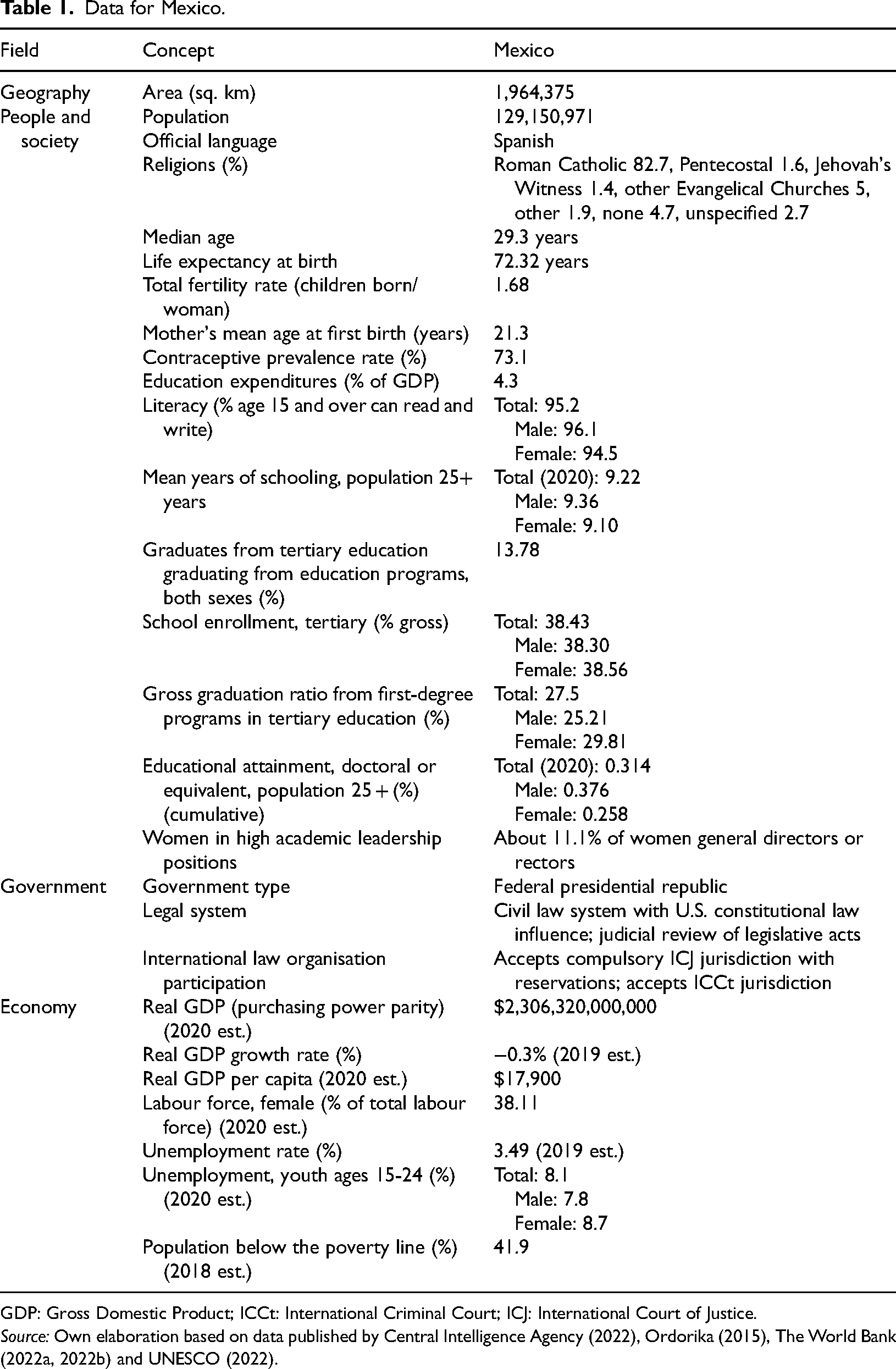
GDP: Gross Domestic Product; ICCt: International Criminal Court; ICJ: International Court of Justice.
Source: Own elaboration based on data published by Central Intelligence Agency (2022), Ordorika (2015), The World Bank (2022a, 2022b) and UNESCO (2022).
Mexico is considered a high human development country in the gender equality index (United Nations Development Program, Human Development Reports, 2020). Mexico occupies the 74th position, with 62.2% of the female population with at least some secondary education, 44.2% of the female labour force participation rate, and a percentage of seats in parliament held by women in Mexico is 48.4%. In Mexico, the government seeks to guarantee the rights of women through instruments that constitute the Mexican legal framework, standing out Federal Law to Prevent and Eradicate Discrimination (2003), General Law on Women's Access to a Life Free of Violence (2007) and General Law for Equality between Women and Men (2006) (Government of Mexico, 2012). Mexico has become one of the world's leaders in gender-political equality (NPR, 2022), which shows that the gender ceiling is cracking, and it is yet to see if gender parity is achieved in other sectors. The women's leadership topic has been widely researched in many countries. However, with this changing dimension in the political sector, it is essential to know if any changes are happening in the education sector (Bush, 2022). Despite many efforts, it is observed that the representation of women in high-level positions is still deficient in Mexico (Moreno and McLean, 2016; Zabludovsky Kuper, 2015). This denotes that there is still a need to understand the factors preventing women from reaching leadership roles.
Women's leadership in Mexico
Mexico is a predominantly male-dominated culture where machismo is prevalent, and democratic, paternalistic leadership is common (Ruiz et al., 2013). There have been changes in the last 40 years wherein Mexican women have accessed and excelled in different areas, overcoming stereotypes, prejudices, a paternalistic society, and gender roles determined by a conservative society (Moreno and McLean, 2016; Ortiz-Ortega and Barquet, 2010). However, it is still common for women to work while bearing a disproportionate share of family and domestic responsibilities (Guzmán-Raya et al., 2019).
In the education sector also, this problem is evident. In Mexico, the entity that regulates education in the country is the Ministry of Public Education, which a woman chairs. However, gender equality is not yet generalised, with little female representation in positions with greater responsibility in the 3100 Mexican HEIs (Cultural Information System, 2021; Federation of Private Mexican Institutions of Higher Education, 2018). Mexico does not have official data based on gender as to who occupies high academic positions. However, analysing the 14 largest public higher HEIs in the country, which concentrates 37% of the undergraduate enrollment at the national level, it was identified that men have a clear dominance occupying 75.4% of high academic leadership positions (De Garay and Del ValleDíaz, 2012). Moreover, among 180 institutions affiliated with the National Association of Universities and Institutions of Higher Education, 11.1% had women general directors or rectors roles (Ordorika, 2015), below the average (18%) of Latin American universities that have women as rectors (International Institute for Higher Education in Latin America and the Caribbean, 2020).
Although women have proven to be successful leaders (Slater et al., 2017) in Latin American countries, it is still a common consensus that women's primary role is as mothers or homemakers (Benson and Yukongdi, 2005). Women leaders often face cultural obligations when assuming leadership positions (Maheshwari and Nayak, 2022). The obstacles related to cultural traditions were identified in the study by Eagly (2007) in the USA. Eagly (2007) further found that although women required competency, men were preferred for leadership roles, which indicated gender inequality. Eddy and VanDerLinden's (2006) study in the USA found that the male leadership style was favoured compared to the female leadership style. Morley's (2013) study in the UK also had a similar notion of whether women were dismissed or undesired for leadership positions due to few women in leadership roles. Burkinshaw et al. (2018) even mentioned that women leaders in UK universities were discriminated against during appraisals and academic promotions. Another study conducted in the USA also mentioned facing the issues of sexism in the universities in the USA (Grant, 2015). There was an under-presentation of women leaders across the globe, including various developed countries in Europe (Germany, Sweden), the UK, and the USA (Maheshwari et al., 2021; Muhonen, 2016; Parker, 2015). Hence, it is clear that despite the participation of women in the labour force is increasing; they are still disproportionately represented in the top leadership positions (Bierema, 2016; Slater et al., 2017). Hence, this study's premise is laid on the foundation of what kind of enablers and barriers women face while taking up leadership positions in HEIs in Mexico.
Research methodology
The research approach used in this study is a qualitative research methodology, and the data for this study has been collected by using the purposive sampling method. The qualitative research methodology enables a deeper understanding of the investigation topic; hence, this approach was deemed to be best for this study. Further, purposive sampling is the most used sampling technique in social science studies when participants are chosen. In this study, we also have a particular group of participants, including female leaders and female lecturers aspiring to become leaders. Hence, this sampling technique was found to be appropriate for our study.
Data collection
The data for this study were collected by contacting the female participants (women leaders and lecturers) from Mexico. The women participants who agreed to participate were further approached, wherein they were informed as to what would be the next steps in the interview process for our research. There were 22 female participants in total for this study, which included 14 women working as a leader, while rest eight participants were lecturers who were aspiring to become leaders in the future. The women working in top management or middle management level were defined as leaders. At the same time, females who were only responsible for teaching were considered other female participants (women aspiring to become leaders) for this study. Data were collected using semi-structured interviews, which lasted 45 minutes to 1 hour. These interviews were recorded, transcribed, and translated for analysis purposes. The written notes were taken for those participants who did not wish to get recorded. The participants’ information related to personal and professional details was anonymised and was not disclosed to anyone except the research team.
Participants demographics
The data were analysed using thematic analysis, and each participant was given the code. For example, participant #1, who was a leader working in top management from Mexico, was coded as TM1. Similarly, the first participant, as a leader working in middle management and as a lecturer, respectively, was coded as MM1 and L1. There were 13 women working at the director or associate director level identified in the top management, while only one woman was working at the middle management level. Most participants (19) were between 30 and 50 years old, and 3 participants were above 50 years old. The majority of the participants were married (13), while three participants were single, and 5 identified themselves as widowed or divorced. Approximately 45% of the participants hold a PhD degree and the rest had a master's degree.
We analysed the data using thematic analysis (Braun and Clarke, 2012), which included six steps: reading the transcripts, coding, theme generation, reviewing the themes, naming the themes and finally presenting the identified themes. Based on the thematic analysis, our study identified eight themes (four barriers and four enablers) after analysing the data using NVivo software.
Research findings and discussions
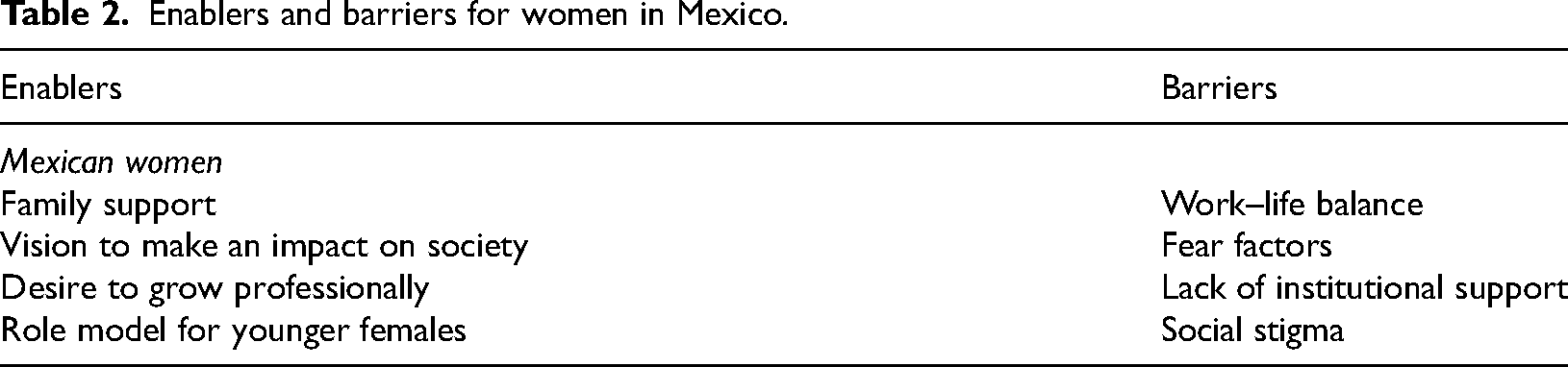
To answer the two research questions of this study, the narratives of the women participants are analysed (Table 2). They indicate that women working in higher education face several challenges for their career advancement. Furthermore, some enablers motivate women to take up leadership roles (Table 2).
Enablers and barriers for women in Mexico.
Enablers for women leaders
Family support
Numerous studies on women's leadership observed family support as a fundamental mutual enabler. In this study, family support was also found to be the first motivator that was a decisive factor in women's career advancement in Mexico. The women participants cited their fathers as the biggest influence on their success and considered them as role models, as mentioned by participant L3 “A person who influenced me in a very positive way to dedicate me to study and have social mobility was my father” and “My dad was a man who empowered me” (Participant L4). The women participants also mentioned receiving support from their husbands towards their career enhancement as shared by various participants. “I believe that the support you receive from your family is essential. In my case, my husband and I do 50/50 in everything, which has allowed me to dedicate more time to academic or work activities” (Participant TM3). “I have much support from my partner” (Participant L6). This enabler was in line with other studies from Latin America wherein family support, alongside tangible support, was considered a dominant enabler for Hispanic women in higher education in specific (Montas-Hunter, 2012). Similar views were also shared by another study wherein, due to family support, Muslim women in higher education remarkably progressed in their careers compared to previous circumstances where they were heavily constrained by their Muslim identity (Abalkhail, 2017).
For women leaders in higher education, this phenomenon was observed across all regional borders, such as in African American (Davis and Maldonado, 2015), Asian (Abalkhail, 2017) and Latin American (Montas-Hunter, 2012) women administrators. Family encouragement was vital in nurturing success, integrity, confidence, resilience and desire for leadership as the earliest and most solid fundamental root in their lives (Davis and Maldonado, 2015). Family support, alongside tangible support, has a dominant power as a primary source of verbal persuasion, impacting the Hispanic culture and Hispanic women in higher education in particular (Montas-Hunter, 2012).
Vision to make an impact on society
In a broader context, women leaders in education are dedicated and aspire to serve as a catalyst towards the success of their institutions and help towards community development which further leads to national development (Hassan and Silong, 2008; Jones and Rolls, 1982). The women are seen using their strength of democratic and participative leadership style to dedicate themselves to the curriculum and teaching issues, as well as change initiation and implementation (Oplatka, 2006). Resonating with this notion, the next motivational factor found in this study to become leaders was the participant's wish to impact society. They wanted to help society and the younger generation, which can benefit society and build a better nation. They also looked at the holistic picture of improving the country's overall economic conditions. They felt that the only way to change the world was by bringing awareness to the younger people, which they could only achieve if they held some leadership positions. This can be deducted from the views shared by the participants: “I am very motivated to help society, to help young people, to change the conditions in Mexico” (L3); I have discovered in college life a means to achieve my life purpose, which is to help young people develop their highest potential, and that I understand that I can multiply this effect from a leadership position much more than a position without leadership role (TM12).
The women found satisfaction in giving back to society, and this encouraged them to become leaders, as stated by participant TM11 “The satisfaction of seeing the direct or indirect impact on the development of the country, of society, and this is something that gives me satisfaction and motivates me.”
Desire to grow professionally
The desire to grow professionally was found to be an important factor in taking up leadership roles for Mexican women in this study. The women demonstrated resilience and were willing to take challenges in order to move up the ladder in their professional lives, as stated by respondent TM12 “In terms of growth within the organisation, I would like to have a bigger challenge, which is about having some higher position within the hierarchy, such as a regional department director.” Participant MM1 emphasised how important it is for her to continue professional development with a desire to grow when asked about her motivation to become a leader. She stated, “I believe that it is a desire for improvement and a desire to grow.” The views shared by the participants of this study are similar to those conducted by Vazquez-Cupeiro and Elston (2006), where the women leaders desired career advancement in higher education to become academic leaders. Airini et al. (2011) indicated that the proactivity for the career development of female academics in HEIs nurtured leadership abilities for priority management, diverse problem-solving, and increased opportunities for securing research grants. In the study by Hertneky (2012), the women were interested in learning and developing and made their career choices while sharing their understanding as leaders. Similar stories have been shared by the respondents in this study as well.
Role model for younger females
Colleagues, subordinates or students of women leaders in higher education are likely to gain more positive transformational experiences compared to gender-homogeneous leadership from male seniors (Madsen, 2012b). The study done in Latin America on Hispanic women leaders in higher education stated that they associated their identity with being a role model. Most participants indicated some sense of responsibility to act as a role model (Montas-Hunter, 2012). In this study, this notion is validated wherein the respondents stated that their wish to become leaders was their wish to support the younger females as they felt that the younger women would be motivated to become leaders in the future if they saw some women already in the leadership roles as narrated: “I see that women are role models for female students, showing them that they have not only training positions, but also leadership positions, demonstrating that a woman can also occupy these positions and can also do a good job” (TM1). The participants shared that women have the capability to become leaders, but they are not confident to become leaders and hence seeing other women leaders might give them enough confidence to be leaders in the future; “I think that one of the advantages is that you can be an example for many women who are being able to help other women to see their abilities” (TM1). Therefore, the desire to inspire young women has motivated women leaders to occupy and curate a positive impact on the future generation (Madsen, 2012a). Hispanic women leaders in higher education associated their identity with being a role model for the younger generation in the study (Montas-Hunter, 2012), which shows similar findings to this study.
Barriers to women leaders
The stories shared by women leaders suggested that they still face several challenges in overcoming gender-related issues. The four barriers found in this study are work–life balance, fear factors, discriminatory practices and social stigma.
Work–life balance
Work–life balance has been the most remarkable barrier women leaders face in all sectors, and especially it has been longitudinally recognised within the higher education sector (Cortina, 1989; Gonzalez, 2020; Luke, 2002; Smidt et al., 2017; Tomas et al., 2010; Truong, 2014). Most of the women in the study were unwilling to sacrifice their family life to pursue leadership roles, which acted as a barrier to their career enhancement. Women respondents were feeling guilty of not being able to fulfil their home responsibilities due to strong cultural influence and had pressure to succeed at work and at home. The participants faced issues with balancing work and life, as shared, Before deciding to take on a more important role in the organisation, I have to think about the time that I am going to dedicate to that professional activity and the time that I have to dedicate to my family (L1).
The women also showed concern about their time being used during non-working hours, which impacts their work–life balance: “Leadership positions take away more hours. Here in Latin America, leadership positions demand too much interference in non-working hours. So, of course, that influences the decision of taking the position or not” (L4). The respondents felt too much pressure to handle work and everything at the same time, “You have to be a ‘superwoman’ to be able to handle all at the same time” (L5). Similar views have been shared by Gonzalez (2020), wherein Mexican women leaders, especially mothers–leaders in higher education, became highly concerned with balancing work-related responsibilities without failing either duty. This clearly shows how women suffer from formal and informal duties at work and at home. The work–life double burden challenges women's performance and outcomes for professional and domestic work and causes emotional and mental burdens in the minds of women professionals in higher education. The primary burden of family and childcare requires extra physical and emotional maturity to balance personal and professional roles, especially when the most important period for both building a family foundation and advancing career “generally coincides” for women in university administration positions (Tomas et al., 2010).
Fear factors
Interiorised fear has become a central problem of women leaders in their leadership journeys, stemming from self-perceived limitations women were imposed by gender “default” roles and expression of different values that went against their desire to professionally take managerial roles (Tomas et al., 2010). The respondents of this study demonstrated signs of fear and lacking self-confidence in their capabilities, which had acted as a barrier to their careers. These fear factors challenged them not to be able to cope with stereotypes, and they doubted their potential and felt they lacked specific strengths to fit into the leadership positions. The participants’ narratives show the fear instilled in them as stated: “I don’t think I’m ready, I don’t think I meet all the requirements, I think there is still low self-esteem in the workplace to apply” (L2); “I am not going to apply for that position because I think I do not have the necessary skills” (TM3). Being constrained by internal fear factors, Mexican top women leaders in higher education were worried about speaking up for a problem, which stemmed from the fear of consequences when doing so, or the fear that they lacked “the character” to stand for their beliefs and this study found the similar results (Gonzalez, 2020). The participants also felt that due to their motherly duties, they could not fulfil the expectations as stated by TM5 “The expectation from three aspects (mom, position, research) makes me afraid that I may not fulfil my role as mom and at work.” A similar view has been shared in the study by Gonzalez (2020) where Mexican women in academics fear that their domestic capabilities will be affected when working professionally, which negatively resulted in a dichotomous worry, “if women work, families will fail.” Researchers also highlighted the masculine culture in university environments, and women's alienation from certain occupations or responsibilities that kept enlarging the women's mentioned interiorised fear (Tomas et al., 2010). This is similar to the views shared by respondents in our study as well.
Lack of institutional support
The challenges women leaders have faced arose from the lack of institutional support that led to a pessimistic perception of women's academic career journey (Diehl, 2014). The damage from the absence of supervisors and institutional leaders’ support had a broader imprint on not just the professional career of women academics but rather impacted women's lives in general (Diehl, 2014). This was also faced by the women participants in this study, wherein the respondents highlighted the lack of support they received from their institutions. One of the participants mentioned, “I don’t know if the institution is willing me to achieve a leadership role. I also think about the organisation of time, although it is something personal, how much flexibility there is in the institution for women” (L2). Other studies have reported similar views wherein it was found that for women working at universities, only a few institutions provided on-site daycare facilities and care facilities, limiting women's opportunities. The participants in the study also reported that they faced discrimination related to promotion and mentioned that in theory, as per university policies, gender equality exists but in practice, women are less favoured than men. This notion was supported by the view shared “They select the men first [for managerial positions], and the men have a better salary than we do” (TM2). These views were echoed in the study by Neale and Özkanli (2010), wherein the standard masculine model has been widely accepted and universalised by male-based systems that were endorsed by male academics, and they used different standards to evaluate the works of women managers.
Social stigma
For years women's roles have been devalued around the common discourses with social stigma wherein women are seen as lacking experiences, knowledge, unable to take a risk, indecisive, and having caring-based characteristics rather than competitive. Hence, rather than acknowledging the diversity of women's attributes, these discourses served to blame women academics and advocate remediation, leading to the unequal exacerbation in higher education (Twombly, 1998). In Mexico, women are also bound by social stigma and societal expectations, creating a barrier towards their career enhancement. Society still views women's primary role as to take care of the family, such as shared by L2 “It is expected that you are responsible for taking care of children and home.” Hence, domestic care duties have been stigmatised in the macho Mexican culture as “women's work” and women academic leaders also addressed their husbands helping with the chores as “doing a favour” rather than equitizing responsibilities, which led to a tremendous amount of unspoken guilt and pressure to not fulfil social expectations both at work and at home (Gonzalez, 2020). There is another type of stigma around women, which leads to wrong perceptions, such as women lacking the required determination and inability to do justice to the job. The women shared different stigmas of being married, such as “She is going to get pregnant; She will not work late because she has her husband, her children, her parents” (TM2). A similar notion was found around a single woman, but in a different context, wherein it was stated that “Since she is the daughter of a family, she has to take care of her parents” (TM2). Hence due to these social stigmas, women are doubted for their competencies. Hence, barriers to women's leadership in general mostly stemmed from the same root cause – the significant impact of (mainly masculine) cultures and its social stigma towards women in management, which the normative socialisation from those standards of masculine cultures has been identified to potentially enlarge organisational sex segregation (Twombly, 1998).
After analysing further, we found that women working at a lecturer level faced higher societal barriers, which included work–life balance. In contrast, other barriers (fear factors, lack of institutional support and social stigma) were more prominent in women leaders working at the top management level. Regarding support, the women lectures appreciated much about the family support. In contrast, the motivators for women already working as leaders were found to be among the other three enablers (vision to make an impact on society, desire to grow professionally and role model for younger females). Hence, there were apparent differences in barriers and enablers between the aspiring leaders, and the women who were already leaders and this is an important contribution to the literature from our study.
Conclusion, discussion and implications
The purpose of this study was to explore barriers and enablers of women working or aspiring to become leaders in HEIs. This phenomenon is germane due to calls for a more diverse, equal and inclusive workforce (Beghini et al., 2019; World Economic Forum, 2021). For decades, women have been at the receiving end of discriminatory practices, often marginalised and underrepresented in leadership positions (Davis and Maldonado, 2015). Additionally, the importance of this research is further underscored by SDG5, which emphasises the need to achieve gender equality and empower girls and women to assume leadership positions in all spheres of life (United Nations Development Program, Human Development Reports, 2020).
As found in this study, the enablers for women assuming leadership positions were family support, a vision to make an impact on society, a desire to grow professionally and being a role model for the younger females. Particularly, family support proved to be a fundamental enabler for women's leadership aspirations considering Mexico's history as a patriarchal society. Women with support from their husbands and immediate family members such as fathers, brothers and parents-in-law are more likely to become leaders in their chosen professions than women without such relational support. Conversely, our study found that factors such as work–life balance, fear factors, lack of institutional support and social stigma largely constrain women from attaining their aspirational leadership goals. Specifically, factors like work–life balance and social stigma appeared to have the most adverse effect on women, similar to various global studies (Maheshwari, 2022; Smidt et al., 2017; Tomas et al., 2010). The thematic analysis showed that women were significantly inhibited by prevalent socio-cultural practices and stereotypes related to women's position in society. Conservative stereotyping is concerned with women being ignored based on cultural norms rather than consideration for their professional capabilities. The findings presented in this paper clearly show the interplay of several micro and macro factors affecting women from taking up leadership roles at HEIs.
The study by Maheshwari et al. (2021) highlights the difference in enablers and barriers women leaders face in Western countries (UK, USA, Canada, Europe, Australia and New Zealand) and Asian countries. The results from the study indicated that in western countries, the enablers found were family support, mentor support and personal factors (Maheshwari et al., 2021). In this study, all the enablers were identified except the mentor support, as none of the women in Mexico mentioned receiving the mentor support. The rest of the enablers identified in this study (vision to make an impact on society and role model for younger females) were something unique which was not identified in other studies. Next, regarding barriers, women leaders in western countries face challenges due to leadership style differences between men and women, the double burden due to family responsibilities, male-dominant culture, poor institutional support and personal factors (Maheshwari et al., 2021). Similar barriers have been found in this study as well, which indicates that women across all regions face similar barriers in leadership positions.
Implications
More studies and investment in higher education research are promising towards the gender-related factors and issues for macro, and organisational level solutions. Hence, as a theoretical contribution, this study contributes to the growing literature on women in higher education regarding the enablers and barriers they face for career advancement and leadership and whether there are any changes from the past and the reasons behind those hindrances in the current era. The study also contributed towards identifying the differences in barriers and enablers found in different roles (lecturer or leader).
As a practical implication, the changes must be made across different levels, from the government to organisational to societal. With the acknowledgement of women's contribution to university leadership on a comprehensive scale of impact on the tertiary education sector, all of the universities’ stakeholders, including staff, students, and all other beneficiaries of the institutions’ services, require greater understanding and responsiveness at an organisational level to support the women. As educational institutions have a pivotal role in social change facilitation, there needs to be an increase in fostering gender equality initiatives across organisations, with a focus on HEIs (Karam and Afiouni, 2014). The institutions can implement practical programmes for professional mentorship, career advancement, and family-friendly experiences at institutions, which will help to fix the dominant masculine culture.
At a societal level, women should be encouraged and provided more significant support to break this societal stigma, which can transform current women's self-fear and perception. Hence, there is a need to solve the problem from its roots, and this can only be done if people can be educated towards gender equality. Hence investment by the government in arranging such programmes might eradicate this problem from its roots gradually. Further changes at the governmental level to advocate women's empowerment policies might support women towards their career enhancement and this can help to achieve SDG5, gender equality. Mexico has bridged the gender gap by achieving a GGIS of 76.4% in 2022 compared to the global average of 68.1% and also moving three places up (from 34th to 31st) from 2021 to 2022 (Global Gender Gap Report, 2022). The female labour participation rate is still low at 44% (15+ years) of women in labour in 2022, and it is crucial to encourage women to participate in the labour force (World Bank Data, 2022). The country will only advance and grow economically when women's talent is equally utilised.
Limitations and future studies
The study has a few limitations; first, this study has focused solely on understanding the subject matter in Mexico alone. This only permitted in-depth comprehension of the institutional peculiarities associated with leadership positions among women; however, future studies may consider having comparative studies between regions and countries of different economic statuses. Next, Mexico is the second-largest economy in Latin America. It presents compelling arguments to determine whether the barriers and enablers are the same for other emerging and transition economies in other continents. Thirdly, the future study can also include males as participants to understand their views on what barriers female leaders might face, which will help get a broader overview of the topic. Finally, the emphasis in this study was on HEIs, which may not reveal the complete phenomena in other industries or sectors of the Mexican economy. Sectoral analysis in the context of other Latin American countries, therefore, presents an avenue for further studies.
Footnotes
Declaration of conflicting interests
The author(s) declared no potential conflicts of interest with respect to the research, authorship, and/or publication of this article.
Funding
The author(s) received no financial support for the research, authorship, and/or publication of this article.
