




Abstract
The European Framework for Key Competences (2006) promotes a shared European identity as a priority for assuring a cohesive future for the European Union (EU), yet the development of a discrete European identity remains acutely contentious, with critics claiming it is too shallow to support the bonds of solidarity needed to engender and support a shared ‘future together’. Most EU member states now have some sort of citizenship curriculum within their state education systems and most are aware that such programmes are difficult to introduce, to teach and to assess within conventional school curricula. However, much of the citizenship education literature tells us that educators are conscious of the problematic nature of exploring citizenship identities. Drawing on both philosophical perspectives and an empirical investigation undertaken by one of the authors, this paper argues that issues of belonging may prove a useful way to explore wider conceptions of citizenship. The research was designed to examine how visual art and citizenship education could be combined to explore and extend children’s notions of European identity, using data from Images & Identity, an EU-funded 2-year curriculum development project on citizenship and art education in the Czech Republic, England, Ireland, Germany, Malta and Portugal.
Introduction
The notion of ‘citizen identity’ in the 21st century is increasingly viewed as being in some way fractured or scattered and can no longer be understood as confined or fixed by the boundaries of the state (Lehning, 2001). Such arguments are not new and have become a regular feature of academic literatures from cosmopolitanism in philosophy (Enslin et al., 2001) to social geography (Antonsich, 2010). It is generally accepted within these domains that the transition from traditional modes of belonging based on territory and/or the nation-state to wider sub- and supra-national levels has resulted in models that often fail to account for the increased global mobility of individuals, where people then ascribe their sense of belonging or the depth/rootedness of possibly serial attachments. Predictably, governmental policy agendas in both the UK and across Europe have struggled to define what it is to ‘belong together’ in this constantly changing landscape.
Several recent events 1 have brought this issue to the fore yet again; firstly, the further opening of borders across Europe has reminded us that being a member of the state no longer simply means being a member of the nation: this comes with considerable difficulties that current models of citizenship have yet to fully address. Secondly, concerns voiced by some European Union (EU) member states over ‘benefit tourism’ being a major draw in patterns of migration, and the subsequent debates surrounding the access and rights to welfare benefits for ‘citizens’, have become hotly contested within ‘host’ countries. Thirdly, attempts to build cross-national bonds that typify or identify a ‘citizen’ are under assault at a time of international instability, global recession and the re-emergence of tribalistic, notably right-wing, political attachments. 2 The answers to such difficulties are then frequently voiced at political levels as a need to promote a greater sense of unique national identity in those joining the ‘national story’ (for example, current initiatives in the UK to promote ‘British values’ in schools 3 ).
A discrete European identity is an acutely contentious notion. Yet, the recent referendum in the UK on membership of the EU, and the reactions to the result, have revealed that for many being European now forms a distinct and valued part of their birth right. This was particularly evident amongst the young. 4 Nevertheless, the existing literature on this has often been polarised by concerns around the need for (and potential desirability of) the creation of a common sense of Europeanness (Educational Audiovisual Culture Executive Agency, 2012). There is currently no shared definition or accepted conditions that must be met for citizenship (as a legal definition) for all member states across Europe, yet the European Framework for Key Competences promotes a shared European identity as a priority for assuring a cohesive future for the EU (European Parliament, 2006). In an attempt to address the Framework for Key Competences, most member states now have some sort of citizenship curriculum within their state education systems. However, European studies such as the International Civic and Citizenship Education Study (ICCS) continue to reveal a continuing lack of common understanding about European citizen identity and a low level of enthusiasm for evolving a ‘European dimension’ within education systems across member states (Kerr et al., 2010).
Citizens, as Callan (1997) reminds us, are ‘created’. Building the nation-state has always been seen as an important function of publicly funded education, helping to shift personal loyalties outwards from the family to local communities and eventually larger national bodies (Callan, 1997; Levinson, 1999). Historically, publically provided education systems have been accredited a major role in achieving this and are often expected to provide a basis for promoting a form of social solidarity amongst citizens (Guibernau, 2013; Gutmann, 1987; Mason, 2000). The need for a specific form of education in the development of citizen identity to ensure the right kind of ‘future citizens’ (ones committed to the shared aims of the polis) has become a central focus within many international citizenship curricula (Kerr et al., 2010). Whilst at one level, this achievement is laudable, much of the citizenship education research tells us that educators are conscious of the problematic nature of exploring citizenship identities and often avoid such discussions for fear of promoting stereotypes or being accused of indoctrination (Richardson, 2010). 5 The success of such programmes has also been mixed: Alexander (2008: 192) argues that young people are often not clear about the relevance of citizenship/citizen status to their everyday lives but can negotiate ‘different articulations of identity’ in their locale. Such claims (if valid) suggest an on-going need to address such tensions is becoming more critical rather than less so.
Osler and Starkey (2003) remind us that citizenship itself entails what is commonly called ‘a sense of belonging’ and that a primary task of education is to enable learners to develop new identities, including wider attachments, such as that of being a European citizen. As yet, there are few empirical studies that examine the ways in which children might reflect on their own perceptions of belonging in wider social or civic groupings. Drawing on both philosophical perspectives and an empirical investigation undertaken by one of the authors, 6 this paper argues that explorations of belonging may prove useful in helping young children to articulate their emerging senses of identity and thus explore wider conceptions of citizenship. Using a project unique to one of the case study schools in the UK, we analyse some of the children’s artworks presented and discussed with their peers and teachers at the end of their project.
Belonging
The belief that human beings are motivated to form and maintain relationships and bonds with others has a long history in philosophy, psychology and the human sciences (Ainsworth, 1988; Aristotle, nd; Baumeister and Leary, 1995; Bowlby, 1969). The hypothesis that people need to ‘belong’ underpins much of our empirical understanding of human motivation and behaviour (Baumeister and Leary, 1995). It is thought that the resulting cooperative behaviour has adaptive advantages: it encourages both the development of self-identity and group identity. The group ties we profess, and the group loyalties we are bound by, can indicate where we feel we belong as we take aspects of this shared identity as part of our own identity (Fletcher, 1993; Guibernau, 2013).
Traditionally, the sense of national identity required to engender a sense of belonging together amongst citizens was provided by the nation-state (based on a 19th century construction of a single nation/culture) (Fletcher, 1993). The sense of belonging together within such ‘citizen identities’ was believed to be crucial for underpinning the ties of solidarity on which the shared reciprocities needed to support communal living rested (Brodie, 2002; Mason, 2000). The basic premise is that we are more likely to discharge our obligations and develop shared virtues of trust and mutual respect when we have a shared sense of group identification (Healy, 2013; Leydet, 2006; Tajfel, 1979, 1982). Nevertheless, such arguments are increasingly challenged and reinterpreted from a variety of perspectives. It is generally accepted that being a member of the state no longer implies being a member of the nation, as repeatedly pointed out by social geographers (for example, Antonsich, 2009); hence, these deeply held identities built on national, ethnic or cultural definitions have themselves become subject to revision. 7 In other words, ‘the normal transmission of national identity from generation to generation has been thrown into crisis’ (Kundnani, 2012: 163).
Questions arising from belonging have come to frame numerous discussions in contemporary theory. Indeed, theorists such as Nordberg (2006: 537) suggest that belonging may turn out to be ‘a “thicker” concept than that of citizenship’. A more nuanced understanding of the concept has started to emerge whereby it is no longer understood as a unitary factor but includes the possibility of multiple belongings (see, for example, Antonsich, 2010; Christiansen and Hedetoft, 2004; Clark, 2009; Vasta, 2013). Within this new fast-growing literature, two particular strands tend to be highlighted: membership belonging and a sense of belonging. Whilst the former is generically defined by legal definitions, rights and responsibilities, there is little agreement on precisely how a sense of belonging might be defined, despite its wide usage across a multiplicity of fields of study from citizenship to attachment theory, from personal identity to political philosophy. At one end of the spectrum, it can be examined as place-belongingness: as the emotional attachment of an individual to a particular place, built up and developed from everyday practices and experiences (Lin and Lockwood, 2014). At the other end of the spectrum a wider dimension to belonging can include a more social component: being welcomed or rejected by the community (marking the boundaries of inclusion and exclusion; Buonfino and Thomson, 2007). More recently, Antonsich (2010: 644) argued that belonging has to be examined as both ‘a personal, intimate, feeling of being “at home” in a place (place-belongingness) and as a discursive resource that constructs, claims, justifies, or resists forms of socio-spatial inclusion ⁄ exclusion (politics of belonging)’.
Understanding how we come to develop a wider sense of belonging may help us re-conceptualise ‘citizen identity’ in a time of flux. The first point to note here is that some of the ways in which we might belong are non-exclusionary – we can belong in different ways to different things at the same time (Keller, 2007). Most of us will remember as children learning to write our addresses and the ways in which this lengthened as we recognised our place-belonging went beyond our street, our town, our country, our continent, our planet to our universe: we expanded our sense of where ‘here’ might be and our place in it. Some political belongings might be more exclusionary – for example, some countries only allow a person to have exclusive citizenship of one place; others allow joint citizenship. Other ways in which we belong can affect, restrict or direct our life choices: for example, social class/caste, gender, ethnicity, etc. (Guibernau, 2013). These identity markers might even serve to bind us to other like-minded people on the basis of shared activities (for example, fan clubs, gardening enthusiasts or sports supporters; Fletcher, 1993). For this identity to be coherent, we are required to be loyal to the source of that identity, even to the extent of acting in such a way as to protect it (Fletcher, 1993). Some group identities might express this through participation in a ritualised behaviour: for example, participating in religious life, patriotic behaviour or attending group activities that require pledges of allegiance in some way (Keller, 2007). The way we dress, the symbols we choose to make use of, can be an outward sign of our belonging and form part of our personal identity: to include and equally to exclude (Gereluk, 2006; Guibernau, 2013). Such ‘boundary discourses’ are often at the heart of what it is to belong. Yuval-Davis (2006) reminds us that identities are essentially ‘narratives’ that enable people to say who they are (and equally, who they are not); as such, the ‘stories’ can be individual or collective; they can shift and change; be added to or reduced.
People can belong to many different places, things and groupings in different ways (see Guibernau, 2013; Keller, 2007). However, some combinations can be politically controversial, particularly where one group sees the bond as being exclusionary. Take, for example, Cathy Freeman’s lap of honour on winning the 400 metre sprint final at the 1994 Commonwealth Games in Canada. The sprinter carried two flags: that of Australia and the Aboriginal flag, symbolising two important identity attachments. Her detractors, claiming that her loyalty should be ‘singular and exclusive’ (Devetak, 2003: 27), contended that she should have shown exclusive allegiance to Australia.
The second point to note is that people may not be as ‘indelibly marked’ as previous models have supposed: factors such as globalisation and subsequent high levels of migration can result in people adapting and changing or even rejecting some of these signifiers over time (Brettell, 2006). It is no longer easy to untangle who counts as a fellow citizen, and at what level where political loyalties are frequently spread across national boundaries (Anderson, 1991; Antonsich, 2009; Healy, 2013). In such circumstances, Clark (2009) argues that migrants are more likely to develop multiple attachments and allegiances beyond the boundaries of the state.
Within the discourse on European identity, this sense of belonging becomes particularly problematic to achieve. Whilst on the one hand, the Council of Europe has urged, ‘…the creation of a climate of tolerance and dialogue is necessary to enable cultural diversity to be a source and a factor, not of division, but of enrichment for each society’ (Council of Europe, 1995: 2), on the other hand, attempts to promote this have been strongly opposed by existing residents amidst the recent mass movement of migrants and refugees across Europe. 8 What becomes clear in this is that the complicated nature of belonging at theoretical levels often fails to neatly fit into the lived experiences of individuals, particularly where belonging becomes disconnected from the roots that give it meaning. All in all, the tensions inherent in the current understanding of multiple citizen identities would suggest that an inclusive shared understanding of ‘belonging’ in Europe may indeed be a chimera (Edye, 2003; Smith, 1992). It is then of little wonder that politicians turn to a more civic vocabulary of belonging to define ‘the ties that bind us together’ and away from previous national, ethnic or cultural definitions that might have been called on in times past.
Citizenship identity
The way in which we conceptualise belonging comes to form part of how we articulate our citizen identities in powerful ways. Benhabib (2004), for example, suggests that the development of a European identity enables citizens to encompass a much richer sense of solidarity with broader groups. Nevertheless, the image of ‘the citizen’ has come under considerable scrutiny as all too often relying on definitions that are situated in highly territorial ways (Antonsich, 2009; Keating, 2009). However, the perceived disconnect to the EU by its citizens has led many scholars to speculate as to why the emergence of a sense of European identity has yet to fully emerge (Agirdag et al., 2012). As previous researchers have acknowledged, we still know very little as to why some feel more attached to Europe than others (Agirdag et al., 2012).
Most previous studies on the formation of a European identity have tended to concentrate on adult participants; however, a small number of studies have focused on children, considering the effects that age might have on construction of this European identity (Agirdag et al., 2012; Jamieson, 2005). As yet, much of this is contradictory or confusing. Green (2007), for example, suggests that younger cohorts are less likely to feel European (as compared to older people), whereas Fligstein (2009) suggests that young people are more likely to see themselves as European. Indeed, the recent referendum in the UK (Brexit) found that 75% of those between the ages of 18 and 24 voted to remain in the EU. In other words, the strongest sense of European identity was found in the young and this affinity weakened through the ages. 9 In other studies, Barratt (1996), for example, found that a distinct sense of European identity tended to emerge between the ages of six and 10. Pertinent to our study, Agirdag et al. (2012) found a lower level of European identification amongst non-European immigrant children and postulated that a perceived lack of welcome to immigrants as Europeans was being internalised by the children, particularly when ‘European identity’ was being formulated in racial or ethnic terms. As yet, few studies consider it from the sense of promoting a sense of belonging and citizenship with young children through the creative arts. In a European context this is of particular interest because too often it is the differences in national context, tradition and cultural background that make the goal of a shared identity so problematic (Richardson, 2010).
Whilst it is still an educational goal of the European Parliament to develop a deeper understanding of a European citizen identity (European Parliament, 2010), in schools across member states, there is little evidence that this is actually happening. Yet, we commonly accept that schools and education systems are the most systematic way to impart these citizenship values and commitments, being the only institutions with both the capacity and mandate to reach most children in a country (Gibson and Levine, 2003; Levinson, 1999; Mason, 2000).
Whilst creating an ‘over-arching’ European identity has proven politically unpopular, the very fact of migration requires individuals to develop multiple identities and loyalties (Osler and Starkey, 2003) and this weakens long-held arguments that being a citizen requires an exclusive attachment to one state. In other words, a European identity need not exclude other identities and can be combined with national identities (Quintelier and Dejaeghere, 2008): one can be European and British. Indeed, Olausson (2010) suggests that rather than depicting the struggle between various identity positions as ‘a matter of life and death’, we should instead reframe it as a creative process that enables transformation and scaffolds our sense of belonging. Reconfigurations of citizenship in such circumstances still suggest that feelings of belonging to a community (whatever form that might take) are essential for citizenship and, consequently, a widening sense of belonging and its exploration is situated at the heart of education for citizenship (Antonsich, 2010; Maylor, 2010; Osler and Starkey, 1999).
Exploring ‘the ties’ with art
The research we draw on here was designed to examine how visual art and citizenship education could be combined to explore and extend children’s notions of European identity, as described in the preceding section. Whilst personal narratives have traditionally been the chosen methodology with which to explore themes of belonging, this research set out to investigate the specific contribution that the creative arts can make to citizenship, using digital art techniques as the medium of exploration. Contemporary school curricula in England include citizenship as a popular theme in the discourse of art practice (Mason, 2015). This is not a new practice: teaching and immersion into a common culture through arts and citizenship has often been argued to play a crucial role in constructing a national group identity: the shared heroes, the shared stories, the shared language (for example, see Fletcher, 1993). Richardson and Granville (2013) note that when art is used as a means of promoting meaningful dialogue and/or participatory practice, it can provide a unique space in which to explore the wider dimensions of citizenship. The development of skills required to explore new and/or ‘difficult’ issues can be fostered in art education and also applied to citizenship learning with the aim of challenging perceptions and stereotypes (Mason, 2015). Similarly, art can offer children an alternative way to articulate their thoughts, feelings and responses in this area.
Method
The research design used Action Research (Mason, 2005) and began with a survey of school children’s visual representations of Europe conducted to explore children’s ideas about being European. Over two months, a team (composed of a researcher, an artist and two teachers) worked in a London primary school 10 with one class of Year 5 children (comprising 27 children aged 9/10: 15 boys and 12 girls). The team developed schemes of work and lesson plans to examine children’s perceptions of being European. Three research questions guided the action research phase as follows.
How do primary aged children engage with European identity?
How do primary aged children express ideas about European identity?
What do their images tell us about their sense of belonging?
All teachers, children and their parents signed ethical consent forms allowing the researchers to use their words, names and images both online and in print for the purposes of research. The project comprised weekly 2-hour sessions when the researcher and the artist visited the school to work with the class. Each week, the researcher led a short lesson focusing on the key themes of the research, followed by creation of images using sketchbooks, photography and filming. Every session ended with a teacher-led discussion for the whole class – pupils shared their work and discussed their creative choices and decisions.
The scheme of work entailed creating a personal identity card, 11 commonly understood as demonstrating membership belonging in many EU states, but for our purposes, it facilitated a way in which children might explore their sense of belonging. In the second lesson, the artist presented pupils with an identity card template (see Figure 1) with two design criteria: include a picture of your head and include your name.
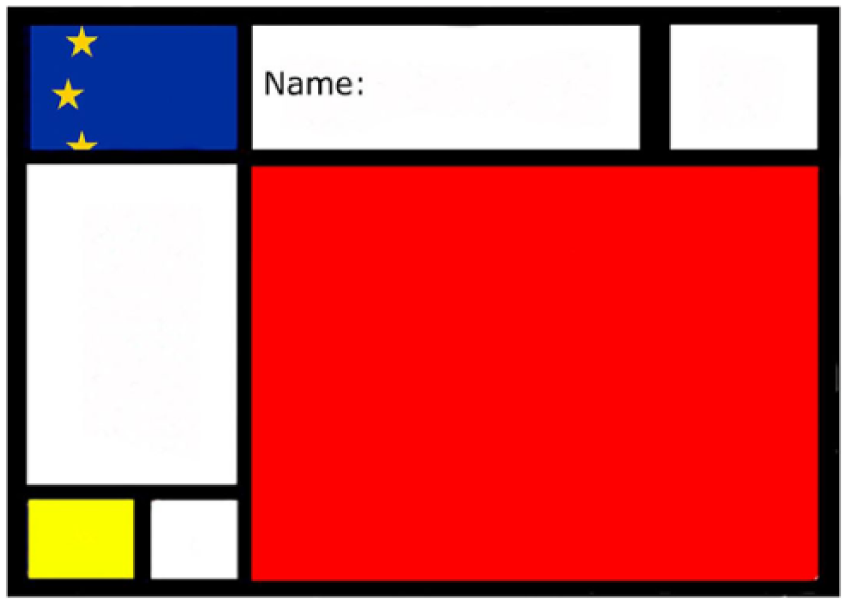
Identity card template.
For the third lesson, pupils were encouraged to bring in artefacts from home that were important to them and that they believed said something important about them (for example, clothing or toys). Pupils’ compared their choices to items belonging to UK-based refugees exhibited as part of an art installation by Wendy Ewald in 2006. They discussed, as a class, the objects that the refugee children had chosen and also considered all the things that they had left behind. Pupils then explained why their artefact was important to them. The pupils’ photographed each other and their artefacts and selected the photographs they would include in their card design. In the concluding weeks of the project, final designs were drawn on computers and edited using drawing-specific software. In the final lesson the teacher showed a PowerPoint presentation of the completed cards. Each child presented their card to the rest of the class and their peers commented on each others’ designs: ‘That’s you, because it shows you’re football mad’ (Kenya commenting on Kasia) – ‘We know the different places you have lived because of the flags’ (Sara commenting on Sanan). Their comments were largely focused on individual interests or how the portraits they had created were a ‘true’ representation of the individual’s personality, for example ‘You’re shy’ or ‘You’re always smiling’. At the end of the project all of the children completed a simple survey reflecting on their experiences of participating in the research. 12
Results
Once all of the cards 13 were complete and the class review undertaken, the research team used a thematic analysis approach that was adapted using Penn’s (2000) suggestions for finding semiotic anchors that create key iconic themes and references. We analysed each card and, as Table 1 shows, inclusions and adaptations were noted.
Identity card themes.
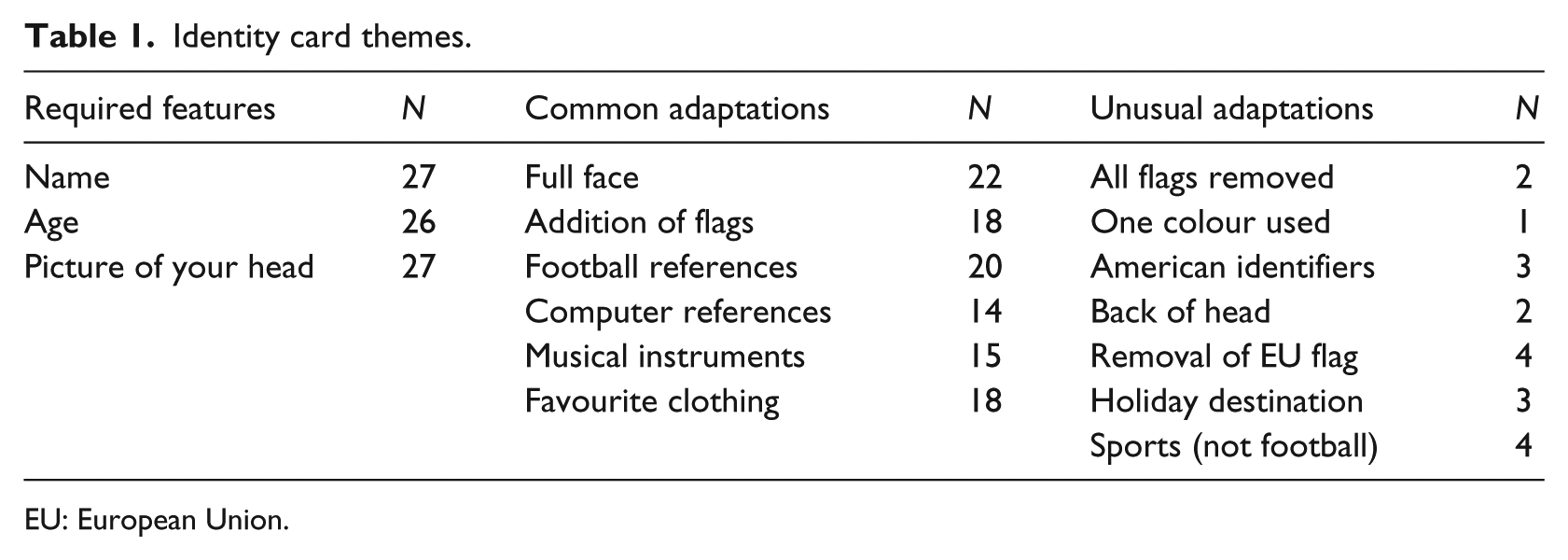
EU: European Union.
As Table 1 shows, most pupils included the three required features on their cards. Many also included photographs, drawings or downloaded imagery of common symbols such as national flags, football teams, computer games and hobbies. There were some pupils who made more unusual adaptations to their cards, as the table shows, for example, removing all references to the EU flag (n = 4) and including symbols that were not directly connected to Europe (n = 3). Pupils tended to blend and adapt their cards in ways that followed no specific pattern. To illustrate the ‘random’ nature of their use of symbols in the cards, five were selected for further discussion here. These illustrate some of the ways in which the children represented their often complex perceptions of belonging; they are presented in no particular order.
Kasia was the only student who did not include what we have termed ‘unusual adapations’ to her card. She did make changes to the design and these showed a strong identification with both the UK and Poland, her country of birth; her family were recent immigrants to the UK (approx 2–3 years). She retained the EU flag and added a blended flag image of the Union Flag/St George’s Cross and a section of the Polish flag. Her card focused strongly on football as she was a keen player and, as a final touch, she added another flag – for Real Madrid FC, her favourite club.
Sanan was born in Sri Lanka – he lived in Germany for several years and was a fluent German speaker (although, until we began the proejct, no staff at school were aware of his multilingual competency). His card showed his support for Manchester United FC, cricket and for his favourite subject, maths. Sanan was just one of four pupils who deleted all references to the UK and the EU from his card, but he added two flags – Germany, his former country of residence, and Spain, his favourite holiday destination.
Sophie was the only pupil who took the template and changed the entire design; she deleted the box template and removed the EU flag. She coloured the entire card pink/purple, squeezing her own portrait into the top corner of the card and giving ‘centre stage’to her (American) heroine, Hannah Montana. In the classroom feedback activity, Sophie explained that she wanted to ‘be Hannah’ in the future. Her one identifiable reference to national belonging was her England football shirt.
Jonathan deleted all references to Europe or being European and included American and Jamaican flags. He had come to the UK (about 5 years earlier) from the USA, and had family in Jamaica and the UK. Jonathan included three references to football and additional images of sports/hobbies. He explained, during the class activity, that it was his dream to return to the USA to play professional football. 14
Dylan was born in the UK and has Irish heritage. He was unique in that he added two more EU flags to his card and also five other flags (three of which were places he had visited on holidays). Dylan was the only student who did not put his age (a required component) on his card.
Discussion
In this paper, we are primarily concerned with citizenship within the European context and how this might be developed with young children; in both contexts, the sense of identity and citizenship require the individual to be prepared ‘to adopt a European identity alongside their existing local, regional and national identities’ (Osler and Starkey, 1999: 212). Where this research differs from previous research (such as Barrett, 1996; Jamieson, 2005) is in the age of the children and that the majority of pupil participants were first-generation residents, for example, British/Bangladeshi or British/Ghanaian, but only three of them described themselves as solely British (three out of 27). Eight children were originally born overseas (in Poland, Germany, India, Kenya or the USA). This implies that the children are from a generation that has little knowledge of anything but a connection to Europe 15 : many are from families who have exercised the free movement of labour across the EU, or from families drawn to the UK through work or family connections.
The first point to make is that given these backgrounds, one might initially assume that, as such, we would find a sense of dislocation or identity confusion, but this was not the case. The children demonstrated a developing sense of self (at 9–10 years) that stretched beyond their immediate family, their locale and their country of residence (in line with Osler and Starkey, 1999). Nevertheless, despite six weeks of focused lessons and discussions, some pupils seemed to ignore the notion of a European self. However, this should not lead us to conclude that they had no sense of belonging. As Mason (2015) reminds us, feelings of national identity are socially acquired, built up over time from the symbolic images and points of reference children may come in contact with; thus, schools inevitably play a role in extending and explaining the personal narratives that children construct.
As Figures 2–6 illustrate, the children commonly edited or sometimes deleted references to the EU, the UK or England and often highlighted their other heritage(s). This is not unexpected and reflects the argument that ‘Feelings of citizenship are likely to be based on local experience and therefore draw initially on individuals’ own knowledge’ (Osler and Starkey, 1999: 202). The sense of a specifically European belonging undoubtedly takes time to fully develop and previous research has surmised that childhood and adolescence are crucial periods during which such a (supra)national identity may emerge (e.g. Agirdag et al., 2012). It is perhaps a fault of policy-makers in education that they expect fast change and adaptation, but such expectations can be unrealistic; this particular conception of a citizen identity is a fundamental aspect of an individual’s being, and change needs dedication, understanding and time.
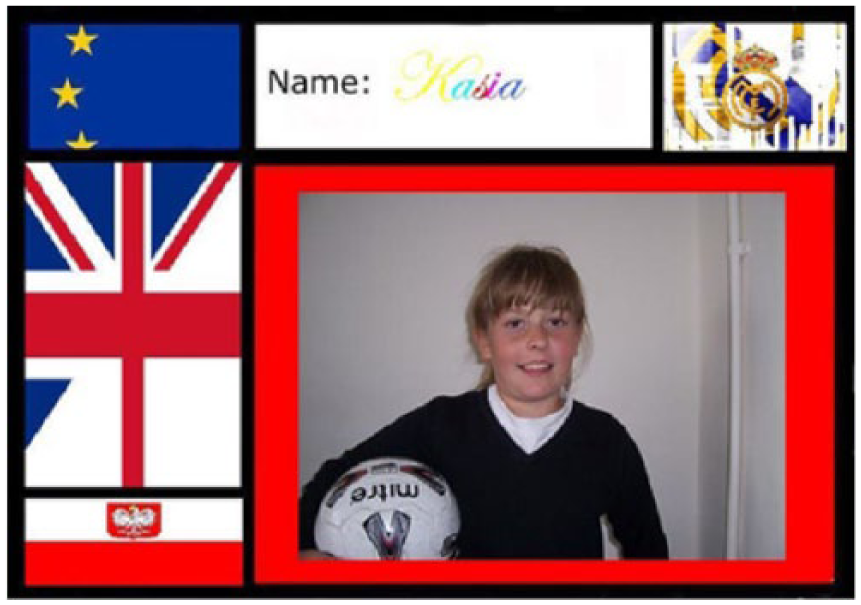
Kasia.
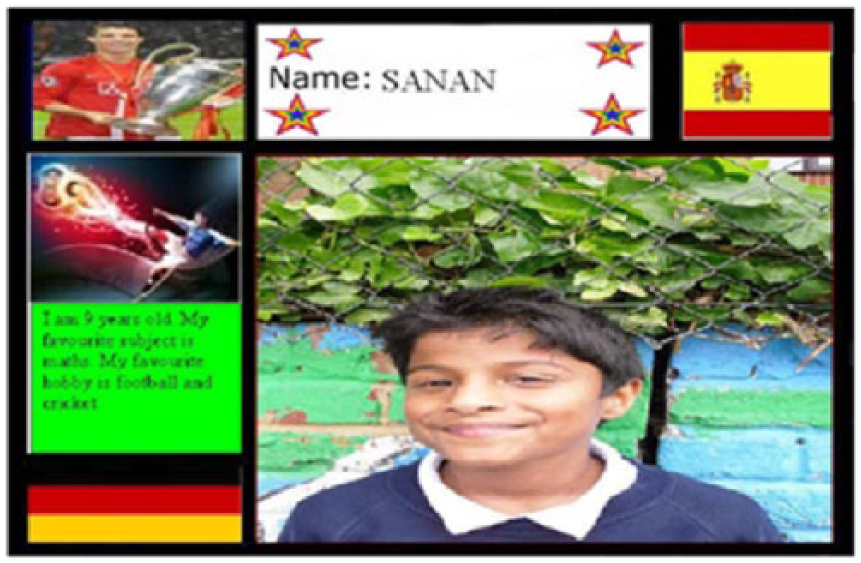
Sanan.
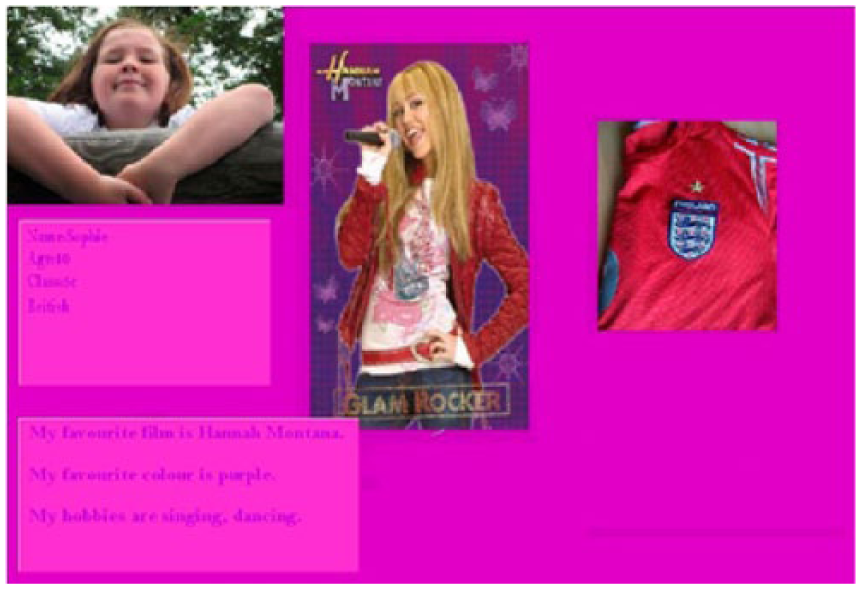
Sophie.
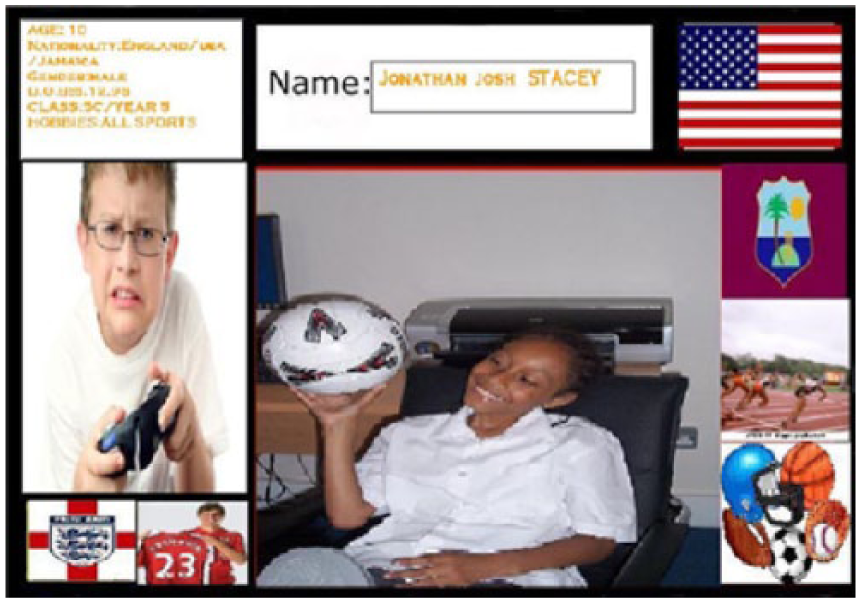
Jonathan.
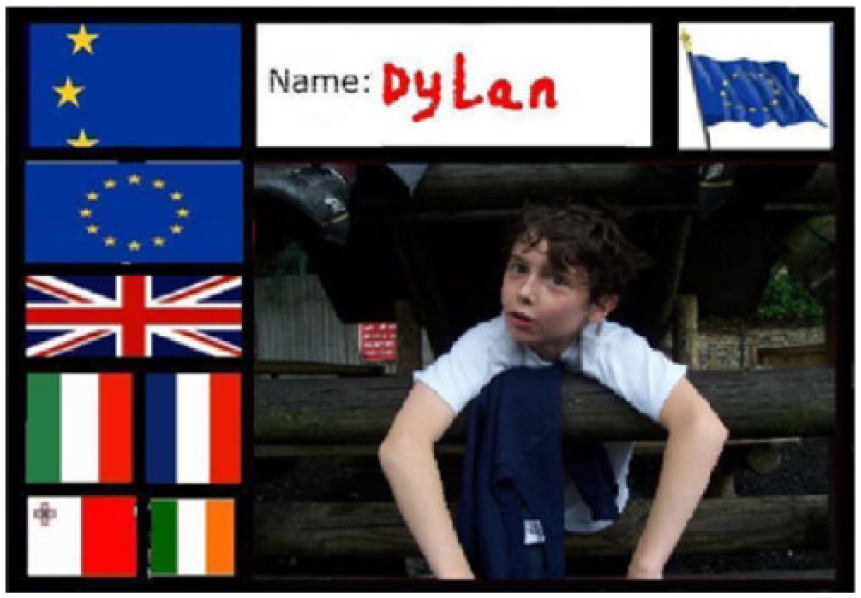
Dylan.
The children certainly showed that they could construct a sense of belonging to Europe – but not always the one expected: many children ignored, in the main, the political symbolism associated with the EU and utilised the (often stereotypical) links closest to them. To some extent, this can be explained by the fact that they relate to experiences that differ from ours, perhaps demonstrating the need to expand our understanding of ‘local’ and ‘own knowledge’ as utilised above by Osler and Starkey (1999). Therefore, it is plausible to posit that, in the context of this research, we were working with a generation for whom geographical mobility and the wide dependence on internet usage are the norm. Their particular environment would most likely impact on a range of aspects chosen to define citizen identity.
The second thing to note concerns the use of art as a means of exploring citizenship. By taking a format commonly associated with membership belonging (the identity card) and superimposing a content associated with a sense of belonging, the activity engaged the pupils in creating and editing ‘narratives’ of who they are, and equally of editing out who they are not (Yuval-Davis, 2006). The use of national symbols can be an obvious (albeit stereotypical) springboard from which to do this. For example, the EU flag (a popular totemic symbol used by children when asked to think of images that remind them of Europe) lends itself to deconstruction and semiotic interpretation in ways that children can easily access. The circle of gold stars on the EU flag represents solidarity and harmony between the peoples of Europe (Fornas, 2012). Whilst the flag was designed to symbolise unity, its meaning appears to have had varied significance for the children who created the identity cards, as shown in the examples above. Whilst the pupils were editing their artworks, they were identifying their sense of Europeanness, trying to ‘narrate’ what this means to them.
Doubtlessly the critique might be that if repeated in another part of the UK, the ‘findings’ would probably be different. London is widely accepted as a uniquely culturally diverse city – accredited with having the largest number of community languages spoken in Europe (with over 300 spoken in schools; Von Ahn et al., 2010). However, this would be to miss the point in the very particular context of this research: where children lack a common history, the need for them to understand both where they are situated in the present and their ability to forge a common future together becomes crucial. Indeed, as Antonsich (2014) states, learning to live together in diversity requires us to seek the glue that binds us together.
Conclusion
In exploring issues of European identity through visual media, the Images and Identity project enabled young people to communicate feelings and ideas in different ways, thus providing insights into where they see themselves as belonging. We want to draw out three important themes arising from our research.
Firstly, whilst the majority of pupils’ images of identity were stereotypes, this was a valuable educational finding in its own right. Strengths of stereotypes lie in their simplicity, their recognisability and the way in which they can reference ‘an assumed consensus about some attribute or complex social relationships’ (Perkins cited in Kitch, 2001: 3). We suggest that the use of visual stereotypes proved a potentially useful ‘launch-pad’ for children to engage with whilst developing that ‘wider’ vocabulary. Given their ages, the children appeared to be navigating multiple categories of belonging whilst also attempting to articulate important accounts of their emerging citizenship.
Secondly, moving children on from a localised construct to a wider sense of citizen identity is notoriously no easy matter. Some of our examples demonstrate that creating a sense of ‘we’ attachments across diverse backgrounds remains a significant challenge and perhaps it is unrealistic to expect significant differences to emerge in so short a time span. Even for adults, any relationship with Europe often remains strictly utilitarian and desires to create a specific ‘European’ identity are often seen as remote and bureaucratic. Indeed, so wide is the disconnect between our principles and the actuality, that many authors, such as Olausson (2010), conclude that a shared European identity may turn out to be a rather unrealistic aim.
Thirdly, despite a range of curriculum resources now available to teachers, European citizenship continues to be a challenging topic in schools, but it is an important one to address, to explore and to encourage children to debate. However, such education needs to be carefully focused because, as the examples in this paper demonstrate, children do not necessarily engage easily with a notion of European identity; their foci can remain fixed on their own historical nationality or they can be overly influenced by other cultures. As Cullingford (2003) argues, this is where education can play a part. It is vital that teachers help pupils to explore the complexities of identity/belonging in a meaningful way and also ensure that they address the challenges such explorations present. It is also important to note the influence of the media on children’s perceptions of identity and belonging, as Giroux and Pollock (1999: 18) argues, ‘…the educational field’ is a place that can be reconstructed and transformed and within its confines, children could ‘… learn, make affective investments, and reconstruct their identities’ (Giroux and Pollock, 1999: 18).
Enabling children to develop and widen their sense of belonging through projects such as Images and Identity could be a useful means of promoting the tolerance and understanding needed in a highly mobile world. In this regard, the research seems to uphold Osler and Starkey’s (2005: 21) suggestion that ‘globalization has enabled the development of consciousness that identity is multiply situated’. In other words, we are (nearly) all hyphenated citizens. In a post-Brexit world we will have to start anther process of reconstruction which acknowledges that the community (EU) is not the entirety of our Europeanness: geographically, it will always be part of Europe and there will always be children, such as in our sample, that have deep ‘citizen’ connections with Europe. Our construction of our increasingly complex citizen identities requires creativity and thought so that rather than creating tribalistic attachments, we have the tools to usefully explore and reflect upon our sense of who we are and where we belong. Ensuring that there is distinct space for citizenship within and across school curricula would be a good place to start.
Footnotes
Declaration of conflicting interest
The authors declare that there is no conflict of interest.
Funding
The author(s) disclosed receipt of the following financial support for the research, authorship, and/or publication of this article: The data for this research was from a study supported by the [EACEA: EU Comenius Fund] under Grant [142345 LLP-1-2008-1-UK- COMENIUS-CMP].
Note from the authors
Mary Healy was born in the UK and is of Irish parentage. Mary Richardson belongs to the most recent UK ethnic minority, the Cornish; she was also the researcher who conducted the Citizenship Education study described in this paper.