



Abstract
Since the inception of UNCRC, a considerable body of scholarship has developed to consider what the rights of children are and how they can be enacted in everyday life. In this paper we re-visit the framing of children and young people and their rights, from the nascent endeavours in the 20th century to the present day, and argue that we still need to better understand the conditions by which children’s rights and their participation in their communities can be supported and amplified. To do this we draw on research with young people, growing up in some of Aotearoa New Zealand’s most culturally diverse neighbourhoods. Using a mix of self-directed focus groups and visual methods, young people described their experiences of belonging and how and where they felt most able to participate as citizens. This analysis highlighted the significance of intergenerational connections within community, educational, cultural and religious spaces, where young people could express the right to be represented and realise the possibility for participation. We argue that children’s rights and agency need to be understood as part of relational interactions in the context of families and communities where children feel they belong and are given opportunities for participation.
Introduction
The marking of 30 years since the publication of the United Nations Convention on the Rights of the Child (UNCRC, 1989) has drawn our attention to the history of its development and critical debates about its application and the nature of the child. While Woodhead (2010: xx) has referred to UNCRC as ‘unquestionably the most significant milestone for the development of current child policies’, it is clear that actualising these rights is still far from established and that children’s participation continues to face both practical and conceptual challenges (Lansdown, 2014; McMellon and Tisdall, 2020). In this paper, we are interested in gaining better understandings of the conditions by which children’s rights and their participation in their communities can be supported and amplified. In particular, we tum our attention to how different conceptions of the child, 1 their rights and how they are positioned in society has shaped the ways that UNCRC has been enacted.
To examine this, we take a two-pronged approach. First, we begin with an examination of the historical development of UNCRC, analysing changes from the initial documents and how perceptions of the child and children’s rights have evolved. We argue that this began with collectivist notions of human rights, but through time has become more individualistic. Second, we draw on a study of young people (aged 13–18) growing up in superdiverse neighbourhoods in Aotearoa New Zealand designed to understand the multi-dimensional experiences of their rights, belonging and participation in society (Wood, 2023). We use data generated with these young people to argue for a deeply contextual, relational and intergenerational understanding of citizenship rights and participation. We argue that the prevalent vision in Western educational discourse and practice of the child as autonomous and agentic is only a narrow understanding of children as citizens, and ignores the roles adults play to position children as members of communities with capacity to act in intergenerational and inter-relational ways. We begin in the following section by undertaking a brief examination of the history of children’s rights and how these have changed through time, before looking at some of the emerging critiques of the Convention.
A brief history of children’s rights – from collectivism to individualism?
Work on policy related to children’s rights started in the 19th century in Europe as social reformers advocated for legal protections for children in response to the hazardous and arduous conditions in which they worked for little pay, and to combat the trafficking of children. Initially these issues were addressed in documents relating to men, women and children but in 1889 the British government wrote the Prevention of Cruelty to, and Protection of Children Act and in 1902 the first laws were enacted in Britain to govern child labour. During World War 1, policy attention again turned to the plight of children as the conflict and British economic blockades contributed to a humanitarian crisis and material deprivation for children. At this time Eglantyne Jebb, a social reformer, worked to establish a relief effort, Save the Children Fund, to deliver food and medicine to children. She believed that children had a role in establishing a new world order and this required protecting their rights; in 1922 she drafted a five points Charter for Children. The Charter differed from previous policy documents in that it saw children as subjects of rights, rather than as objects of concern requiring protection (Becker, 2020). The Charter was adopted by the League of Nations in 1924 and became known as Declaration of the Rights of the Child consisting of five points including their rights to food, health care, shelter, education. It set out rights relating to all children’s access to that which they required, ‘both materially and spiritually’, for their normal development. It stated that they should have priority to these rights in times of crisis and that they should be supported to be able to earn a livelihood and be protected from exploitation; and that they should learn to help and serve other people. In 1959 these five points were elaborated more fully by the United Nations when it proclaimed a new Declaration on the Rights of the Child based on 10 principles.
In both documents the focus in the main was on rights of the child to protection and provision for their welfare and for the good of society. Of interest, in terms of the focus of this paper, is the construction of children in both the Charter and the Declaration as rights holders in a society in which they served others. In the Charter this was expressed as ‘Point 5 the child should be brought up in the consciousness that its talents must be devoted to the service of its fellow men’ and further elaborated in the Declaration as ‘Principle 10 The children shall be protected from practices which may foster racial, religious and other forms of discrimination. He [sic] shall be brought up in a spirit of understanding, tolerance, friendship among people, peace and universal brotherhood, and in full consciousness that his energy and talents should be devoted to the service of his fellow men’ (Office of the United Nations High Commissioner for Human Rights, 2007: 3, 25).
In 1978 the Government of Poland argued it was timely to take steps to turn the Declaration into an internationally binding instrument and proposed a Convention for the care and rights of the child. It was also seen as a timely initiative in anticipation of the United Nations’ proposed programme of work for the International Year of the Child in 1979. Adam Loptka, who was Chair of the Working group that drafted the Convention, argues that between the First and Second World War a different concept of childhood emerged, one which saw the child as an autonomous person with their own needs, interests, and rights (Office of the United Nations High Commissioner for Human Rights, 2007). Furthermore, he attributes the origins of this conception to Korczak, a Polish paediatrician and educator, who cared for Jewish children in an orphanage he founded in 1911. Korczak expressed the idea that at a certain point in their development children are able construct and express their own opinions and these should be taken into consideration. Cohen (2006) who was also involved with drafting the Convention argues this provision was a turning point in establishing the rights of children as in contrast to the previous focus on care and protection, children were seen as have the power to exercise right and have participatory rights.
The drafting of the Convention took 10 years and with support from UNICEF and various international and non-governmental organisation the draft was finalised by 1989, the 30th anniversary of the Declaration on the Rights of the Child and the 10th anniversary of the International Year of the Child. Put simply, the Convention is seen as a balance between articles that positioned children as objects requiring protection and care from adults and those that positioned them as subjects and agentic, able to act fully in their capacity as persons and to contribute to decisions about their lives (Fass, 2011). The Convention was ratified by 192 States in a relatively short time; although the United States has signed the Convention it is the only member of the United Nations which has not ratified the Convention through its Senate. The Convention has had considerable influence on States’ legislation about children and has also substantially influenced the activities of States and international and national non-governmental organisations (McMellon and Tisdall, 2020; Quennerstedt et al., 2018; Woodhead, 2010). However, while UNCRC has widespread consensus and is largely accepted and unproblematised (Quennerstedt et al., 2018), as we explore in the following section, UNCRC itself has been critiqued from several angles.
Critiques of UNCRC
The UNCRC’s aims to create a universal dialogue on children’s rights has been a catalyst for considerable gains for children rights and participation, but it has increasingly been critiqued for its reliance on Western knowledge and its lack of Indigenous perspectives and values about children and their families that do not reflect cross-cultural variations (Cleland, 2022; Hanson et al., 2018; Nieuwenhuys, 1998; Quennerstedt et al., 2018; Stalford and Lundy, 2020). Much of the research in the field of children’s rights and childhood experiences has been conducted by white, predominantly male, western scholars which has the effect of overlooking broader, global perspectives of children’s lives, experiences and interests (Stalford and Lundy, 2020). In addition, these western notions of individualistic children’s rights and aspects of childhood (schooling, leisure, domesticity) are stated with superiority as if they are the norm for all children (Hanson et al., 2018; Wood, 2023) which has the effect of pathologizing and deeming deficient, Southern and Indigenous childhoods and childrearing practices, forms of play, school and work (Imoh and Ame, 2012). For example, in the New Zealand context, Cleland (2022) has argued that ‘Māori conceptualisations of children and families are not reflected in the Convention on the Rights of the Child . . . the principles in the CRC are at best, unimportant to realisation of Māori children’s rights and at worst, barriers to realisation of those rights’ (p. 31). She proposes that the Declaration on the Rights of Indigenous Peoples and Te Tiriti o Waitangi provide more relevant analytical frameworks as a starting point for considering Māori children’s rights. Cleland and other children’s rights, scholars and activists challenge the colonialism of the Convention and highlight the need to de-emphasise Western knowledge, conceptions, and values and open up the field of children’s rights to wider conceptualisations. 2
A further dimension of critique has been assumptions about the construction of ‘the child’ in UNCRC and there are ongoing debates about the agency, status, capacity of the child and how this plays out in contexts of children’s rights (Lansdown, 2014). The initial endeavours regarding children’s rights were based on the view of the child has having rights, and having a role in establishing a new world order and a responsibility to help and serve others resulting in quite a relational vision of the child as a citizen (Becker, 2020). Subsequently there was a greater focus on the child as an autonomous, agentic individual and this focus has remained dominant in Western contexts, see for example, the work in the ‘New Studies of Childhood’ (James et al., 1998). More recently the need to acknowledge the relational and intergenerational nature of children’s lives and to recontextualise discourse about their rights in the cultural contexts in which children are located (Bartos, 2016).
Our argument in this paper is that the current vision of the child as autonomous and agentic which is dominant in Western educational discourse and practice is a occludes full understanding of the child as citizen. It fails to see the child as a member of communities, with a capacity to act in intergenerational and inter-relational ways (Mannion, 2016), with a responsibility to help and serve other people. We suggest that the current prevalent agentic and individualising discourse on children’s rights, (including the neoliberal progressive co-opting of student voice, Fraser, 2017) has viewed agency as something children own independently, has ignored the significance of adults, families and communities and how they hold open space for children’s participation as part of the relationally connected experience of living and being a young citizen (McMellon and Tisdall, 2020; Mannion, 2016; Wood, 2022). We outline in the following section how we have explored this in the context of superdiverse communities in Aotearoa New Zealand.
Methodology
Our analysis draws from a multiple case study of four superdiverse schools in New Zealand (three in Auckland and one in Wellington, New Zealand). The purposive selection of these schools involved gathering census and school demographic data from sites such as Education Counts (Ministry of Education, 2018) and the Education Review Office (2007–2010) in order to identify the most ethnically diverse schools in the country. Four such schools, all with fewer than 50% of NZ European Pākehā 3 students, were invited and agreed to participate in a study that involved classroom observations, focus groups with students and an optional Photovoice activity. Two schools had historic patterns of migration from the Pacific and South East Asia (South and West College) and two had more recent influxes of migrants (from South and South East Asia in particular). The principals in each school assigned one contact teacher for the researcher (the first author) to work with closely, and through this teacher she gained access to several classes (Years 9–13, ages 13–18). Students were invited to participate and were explained that the research was interested in diversity, inclusion and cross-cultural interactions and the experiences of ‘ordinary’ students, rather than an elite selected few. Ethical consent from all youth participants was obtained and from students’ parents if participants were under 16 in keeping with the ethical requirements for the study ([Victoria University of Wellington, NZ HEC#25149, 24 August 2017]).
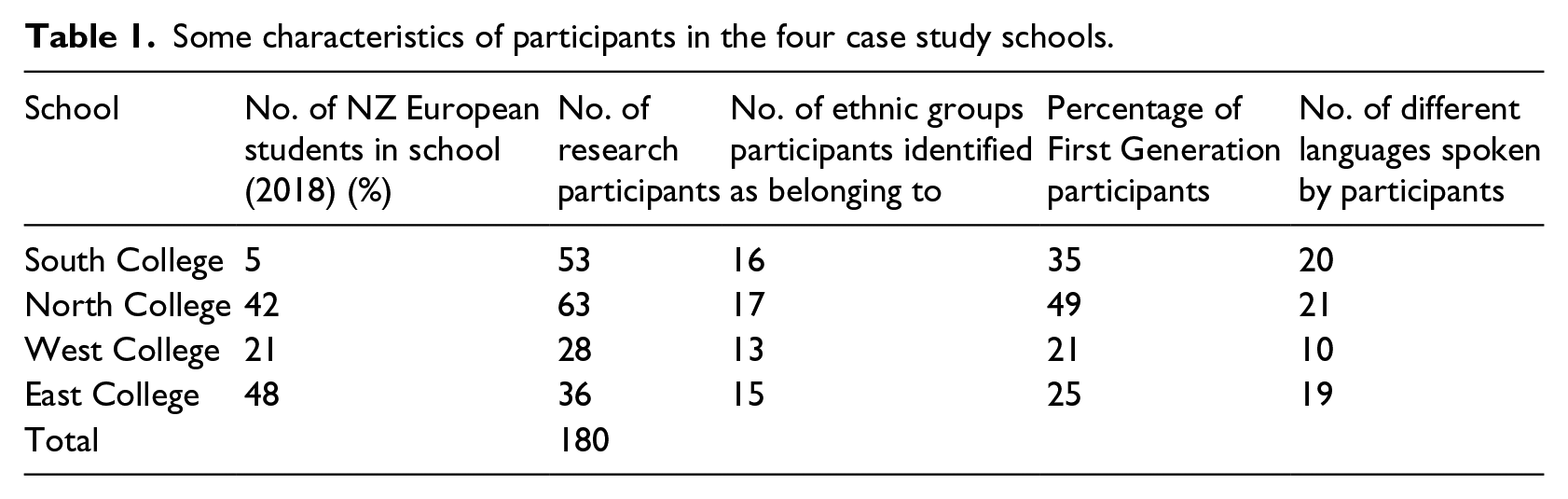
A total of 180 diverse young people participated in the study across the four schools. To illustrate the nature of the ‘superdiverse’ classes involved, Table 1 shows the number of ethnic groups, languages spoken and number of First Generation (foreign-born) students in classes in each school. The schools exhibited considerable levels of cultural, linguistic and religious diversity. For example, in one class at South College, 18 different languages were spoken, and 25/27 students spoke more than one language (only two spoke just one language and that was English). Students also were religiously diverse and about 20% of participants described themselves with ‘mixed’ ethnicity.
Some characteristics of participants in the four case study schools.
In order to explore ‘everyday’ nuanced understandings of living as young diverse citizens, several qualitative dialogical methodologies that intended to provide a relational approach and a chance to ‘leave people to their own devices’ (Fox, 2017: 556) were used. In addition, the focus on the everyday required methods that would pay close attention to questions of difference amongst the ‘interactions, relationships and spatial practices that are configured by the everyday’ (Hall, 2019: 770). This led to two strategies – self-directed focus groups and a Photovoice activity that both prioritised naturalistic, dialogical and relational forms of data collection. The self-directed focus groups were undertaken during classroom settings (at a time convenient to the teacher) and involved young people forming groups with people of their choice. They were given posters to complete with questions posed, such as, what is a ‘real’ Kiwi? How do you get involved in your community? Which issues need attention? They also completed several activities such as a continuum on their sense of belonging in school, their neighbourhood and New Zealand. Their discussions – which were quite wide ranging – were recorded by an audio device with the researchers occasionally prompting them to move on to another questions (Wood & Ristow, 2024). Following this, participants were invited to participate in an additional Photovoice activity which involved taking cameras home to take photographs of places they felt they belonged or were excluded. The participants debriefed their photos orally with the lead researcher to provide details about them.
Data were analysed across the multiple data sources to identify themes using both inductive coding, to engage with meaning, and deductive coding (Braun and Clarke, 2021), drawing from the research focus and questions and the theoretical critical feminist lens. This enabled the researchers to develop themes unique to the case study schools and others which could be found across all the four cases and participants.
Belonging and participating as young citizens
In this section we draw on data from young people at the four case study schools to consider in particular the spaces they felt they belonged and where and how they could experience and express their rights, participate as citizens and enjoy representation. Drawing on prior studies of belonging, we understood this as a complex experience relating to the relations individuals have with other people, as well as circulating objects, and changing social, cultural and political landscapes (Youkhana, 2015).
‘At school . . . there’s more opportunities’
In line with UNCRC’s promotion of children as capable and agentic, the dominant vein of work in citizenship and rights studies has been to emphasise the active involvement of children as young social agents (Bartos, 2016; James et al., 1998; Percy-Smith and Taylor, 2008). Such research has prioritised young activists and public performances of citizenship participation and rights. However, one of the outcomes of this important work has been that children’s agency has increasingly been viewed as something that children own, independent than from others (Gallagher, 2019; McMellon and Tisdall, 2020). However, children do not participate in a vacuum devoid of adults. As Gallagher points out, children’s agency arises through the assemblages and relationships with others – peers, adults, families and even non-material matter. In this study with diverse young people, the sense of being welcome in community or school was integral to being able to participate. Indeed, it was often adults who opened up spaces for young people’s participation. The intergenerational contribution of teachers and the opportunities offered within schools were highly valued by participants who saw schools as a great place to get involved and participate in holding community events, fundraising, volunteering, cultural festivals, and take social action on issues through school. For example, in this discussion at East College, Isabella and friends (all 13 years) describe how school was easier to become active as young citizens: Interviewer: Where do you feel most involved? Isabella: I feel like kind of like at school – you get more involved because there’s more opportunities and more things to do, more organised . . . [Later] Yeah; School is basically the only place [young people can get involved]
These young teens commented that age made some difference, as Maya, a 13 year old (East College) explained: ‘As you get older in a school, you get more opportunities . . . .’ Others expressed how school was more welcoming than their neighbourhoods, such as two recent young participants, Dilipa (thirteen-year-old, immigrated from Sri Lanka seven years earlier) and Marika (arrived from Japan four years earlier) both from North College: Dilipa: Every country kind of gives a vibe and New Zealand just seems very friendly and like nice if you see someone walking and you walk past them, they kind of nod at you and smile you know. Like obviously they wouldn’t talk to you like how are you but they’re very friendly. I would say my school is 100% because everyone is so nice I mean this school in particular. Marika: My neighbourhood. I kind of feel bad saying this but I don’t really know anyone. I don’t go door to doors and say with cookies and say welcome to the neighbourhood. I don’t do that. Dilipa: If I walk home they would smile and nod, [but] school is the place I feel really comfortable. Literally everywhere I go, I feel fine I feel like no one’s going to judge you.
While this feeling of inclusion certainly wasn’t the experience for everyone, for Dilipa, this strong feeling of being welcome had led her to join multiple clubs at school, and to feel confident enough to take up leadership opportunities (class rep).
Opportunities provided by school also were identified as a way to start getting involved in community issues as young citizens, as discussed by these young women in a group at South College: Jessica (17 years): I get more involved during school. Farha (18 years): Same yeah, I feel school is really great source for us. Jessica: There’s a lot of groups like Shakti
4
and Student Council and Pink Shirt Day
5
and they raise awareness . . . Amy (18 years): They tend to make you want to participate and it’s always advertised around school
School undoubtedly played a role is setting up the conditions for greater participation for young citizens (Annette, 2009). Yet in every school, participants still said there was considerable space for improvements in their representation and voice – especially young people from ethnic minority communities. For some participants, their communities were where they found the most potential for involvement.
‘We are very together’: Young people and community participation
Citizens are encouraged, exhorted and indeed, expected to do something as part of their role as members of society and it is the community. However, while such roles are expected of adults, children and young people are much less commonly included in these expectations and there is relatively little empirical research about their community interactions (Davies et al., 2013). Where young people are noted for community involvement, it is often in the form of volunteering, especially in sports and exercise and hobbies (Annette, 2009; Davies et al., 2013). However, this focus frequently obscures the more active and political forms of community citizenship action that young people may be involved in (Westheimer and Kahne, 2004) and the inequalities of access that may sit within communities that relate to socio-economic status, gender and race (Bartos, 2016; Davies et al., 2013; Wood, 2023). In our study, young people voiced how important communities and neighbours were to them, but relayed different experiences as the following quotes reveal: Shanti: I think it’s pretty close to here . . . I don’t know about my neighbourhood. I don’t even talk to my neighbours. I say good morning or hi occasionally. (Age 13, female, North College). Fatima: It’s pretty open but just sometimes you’d face people. It’s a mix. My neighbourhood’s pretty cool. I feel most welcome in my neighbourhood. I feel comfortable. It’s because it’s through the people that I live, they’re just like me - they’re Indians. (18 years, female, South College)
Fatima, an 18 year old Fijian Indian Muslim, highlights an important point when discussing young people’s inclusion and involvement in communities when she says ‘they’re just like me – they’re Indians’. She continues to discuss this with her group and concludes ‘But as for other places [beyond my own community], I don’t feel comfortable other than that. I really don’t’. Fatima’s comments describe the tensions between feeing included/excluded that many ethnic monitory young people find themselves in (Visser, 2016; Wang, 2016).
Young people that did have more positive experiences of involvement in community tended to have a few characteristics. First, their families were often part of immediate communities through involvement in clubs and/or religious groups (churches, temples and mosques); and second, they were deeply involved themselves in aspects of leadership in these groups. Rangimarie (14 years, East College), a young Māori female, illustrated this well with a strong sense of commitment to community. In her focus group of four girls (all aged 13 or 14 years), the first example of involvement they gave related to the community: Rangimarie: We get involved by helping out others in the community . . . Ishya (Indonesia-born, 13 years): . . . We help others like our neighbours. Rangimarie: I know down in [local beachside suburb] we do a beach clean-up as a community. Ishya: If we help others, we can do more as youth a community if we help others. Samantha (NZ born Pākehā, 13 years): We can do more as youth in a community if we got together.
In the later photo elicitation activity, Rangimarie gave more detail about her beachside suburb where she lived (see Figure 1) and how much the closeknit community meant to her: . . . and then this one [a photo, Figure 2], is what makes you proud. It is my street, the street I live on. So, our street is a Crescent, and we’re very together. So, like at Halloween, all the houses do Halloween, all the houses dress up for Christmas, and we just really one big community that way.

Rangimarie’s photograph about her close-knit, family-like community. Photographer: Rangimarie, East College.
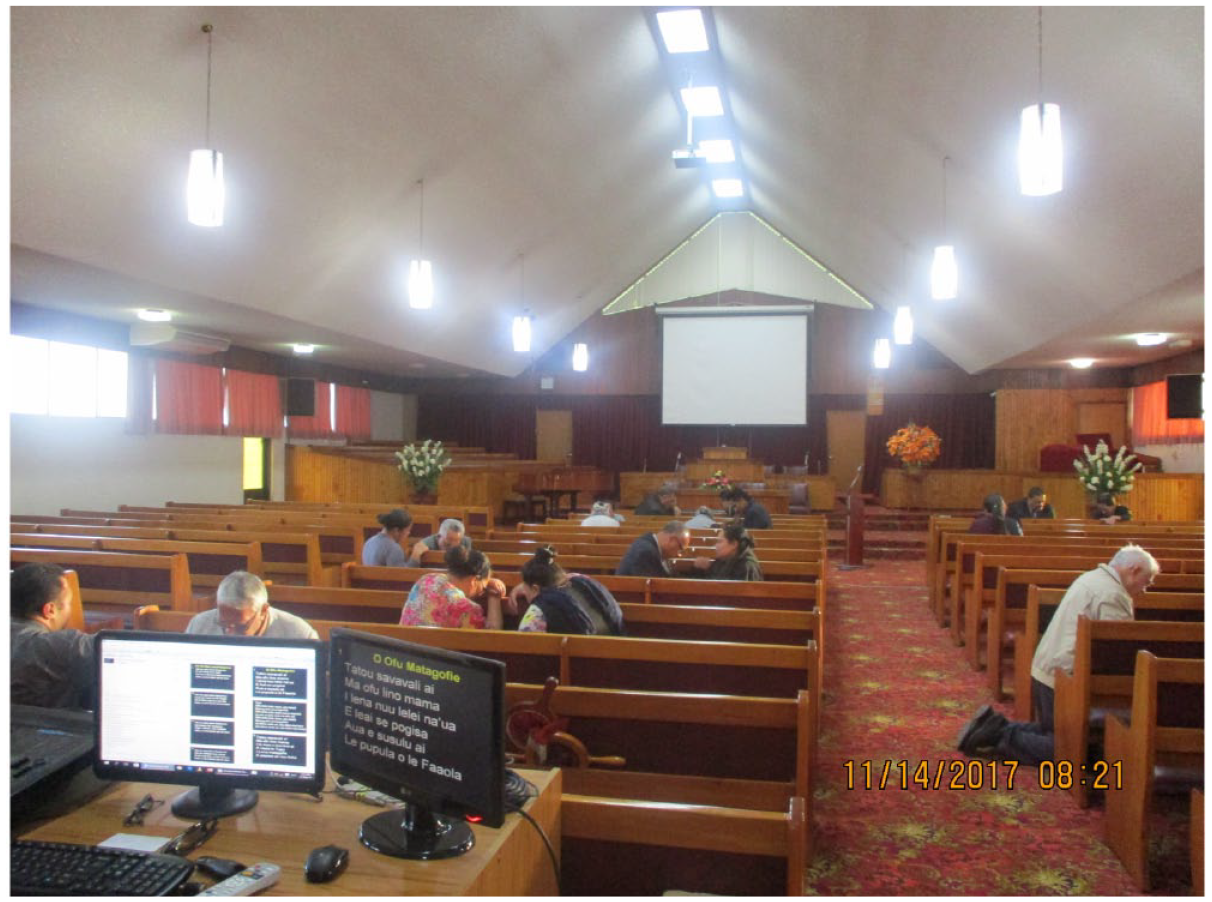
That’s the inside of my church. Photographer: Leena, West College.
She described some of the activities her street did together that made her ‘connected to your community’ – such as attending events at the local Bowling Club where the club had invited residents to turn up any time and join in their parties and events. She went on to say that at a recent Christmas event, families competed against each other and ‘yeah we made friends around the neighbourhood because everyone in the neighbourhood usually goes’. Her example highlights the strong intergenerational relationships that underpin Rangimarie’s sense of belonging and community and how in turn, these supported more active citizenship involvement – such as the beach clean ups.
One further example of the complexity of belonging, rights and citizenship participation was discussed by a 15-year-old participant Leena from West College. Leena was born in Apia, Samoa and had moved to New Zealand about 8 years earlier. In the photography elicitation activity, she photographed her class with the chairs up at the end of the day, and described a half-in/half-out sense of belonging: Leena: Yeah, that’s the in the classroom. That is another place where . . . I am half connected and also on edge in the classroom. Interviewer: Yeah, because of the academic stuff or the social stuff? Leena: Academic stuff, but socially I feel really connected to my classmates.
In contrast, she stated in a groups discussion that it was her church where she felt most at home and a sense of ability to lead and participate: ‘In my church, they set out different days for youth to lead – like the ceremonies. And once a month youth lead the service. Yeah, even at my age (15) we do it’. She described her photograph (Figure 2), the inside of her church, as her ‘home away from home’: Leena: That’s the inside of my church. It is not just a church the building itself, but it’s the people inside the church as well and that makes me feel really connected because in my culture, we always put God in the centre of everything. This is mostly the elders, because youth don’t really go to the Wednesday night churches but whenever I go, they are always there to remind me to put God first.
She described how she had taken the photograph on a Wednesday night which wasn’t specifically for youth – but when she turned up, she was warmly greeted by the older church members for making the effort to get there. Her other photos were almost entirely of her family and her church friends who she had grown up with and now led the youth group with. In this strongly embedded community, she had confidence and the ability to lead and serve others – unlike school where she felt ‘on the edge’ and ‘half connected’. Her narrative highlights how cultural and religious sites (in this case the Pacific church) were a site of citizenship and human rights formation and how adults, who were leaders in from her community, provided opportunities to amplify her own leadership as they opened up potential for her and others to develop as leaders both now and in the future.
Discussion and conclusion
We have used the 30-year anniversary of UNCRC as a moment for critical reflection on how well we understand children and their rights. In tracing the trajectory of the development of UNCRC, we have noted that discourse on children’s rights have become increasingly focused on the rights and empowerment of the individual child, reflecting narrow but dominant Western understandings of children and family and hence occluding the experiences of children and families from other cultures. The priority toward individualising tendencies in children’s rights and citizenship in recent years has thus overlooked the importance of collective strategies and intergenerational connections. As our study has shown, children and young people’s rights and political experiences of citizenship are ‘structured, practised, and enacted’ (Staeheli et al., 2012: 640) through embodied and relational interactions with others within their everyday landscapes (Kallio, Wood & Häkli, 2020). We could see how children live, learn and express citizenship and participation richly in the context of their communities and through their embodied experience of engaging with other in social and environmental issues. Moreover, while adults do not always amplify Young people’s participation (see for example Hickey and Pauli-Myler, 2019 where adults in local government curtailed youth voice) we could see in this study that adults were significantly involved in creating opportunities and conditions by which children’s involvement in their communities and rights could be supported and amplified.
School is a significant site for both learning about and living as citizens. As the study showed, adults, including teachers, played a significant role in opening up opportunities for participation and expression of rights. As participants in this study attested, schools could provide spaces of inclusion and multiple opportunities for participation – in sporting, cultural, social and political contexts. Importantly, such experiences for this diverse group of young people were not all the same – and some (especially the Pacific young people) found greater opportunities in their church and communities, while others enjoyed higher involvement in schools. Many young people in this study were ‘empowered’ to act on social and community issues that they saw to be important, however, they were not acting in a space devoid of adults – but instead, teachers, church and youth leaders and community members opened up space for them to participate. Many of the experiences where young people gained skills, knowledge and experiences were in spaces and communities where they felt a deep sense of connection and belonging (Youkhana, 2015). Through living and working alongside others in intergenerational contexts, children gained a citizenship imagination to see what is possible and how it can be enacted. Much of this was caught not taught – through opportunities for leadership and helping and serving others both in formal and informal settings that reflected the democratic and inclusive culture in these superdiverse schools (Wood, 2024).
Today we know much more about children’s rights, belonging and participation than we did thirty years ago; the scholarship through recent times and our own study reported here has provided rich and nuanced insights about children and young people’s rights, belonging and citizenship participation. They have helped to show how unhelpful binaries are that position children as either vulnerable and apathetic, or on the other hand, agentic and autonomous. Both of these positions fail to recognise the complex, liminal and temporal state of children, and the deep significance of their experiences of family, communities, spaces and intergenerational interactions. Understanding the intergenerational and inter-relational nature of these experiences takes us beyond narrow psychological notions of political agency (Hayward, 2012) or thin experiences of citizenship co-opted through ‘progressive neoliberalism’ (Fraser, 2017).
Along with other researchers, we argue that children’s rights and agency need to be understood as part of relational interactions in the context of families and communities where children feel they belong and are given opportunities for participation (Bartos, 2016; Gallagher, 2019; Lansdown, 2014; McMellon and Tisdall, 2020; Stalford and Lundy, 2020). As Bartos states, we need to think about . . . the interconnectedness of children’s participation as social and performed collectively not only with other children but also (and significantly) with adults. This in turn not only opens up new ways of thinking about political participation within childhood but also has the potential to inform how we think of political participation within adulthood (p. 124).
While this is one small study situated in one place and time, we look forward to seeing more research which reveals how these intergenerational interactions play out in other cultural contexts as children are inducted, seize and create opportunities for belonging and citizenship participation.
Footnotes
Funding
The work was supported by the New Zealand Royal Society Marsden Fund [E3012/3648].
