




Abstract
This article examines the equality agenda in the context of Finnish university reform in the 21st century. In Finland, the academic regime went through an organizational transformation after the Universities Act in 2009. However, little attention has been paid to the questions of sex or equality. Since the policy influences on equality in education and work are increasingly transnational, this article also observes the role of gender mainstreaming in universities’ equality agenda. The appearance of sex equality is analysed through a variety of documentary materials. The findings indicate the balance between higher educational demands and tightening requirements on equality promotion. Equality work, as a part of human resources, is seen through legislation and provides common good and market advantages. The aims seek to ensure similar treatment between individuals and case-specific anti-discrimination, separating spheres of academic work and private life. The focus is on subjective rights on economic rewards and career opportunities. Yet, confused by the abstract principle of gender mainstreaming, the individually oriented view diverges from the traditional Nordic equality model. The study suggests an evaluation of key concepts and assumptions of equality politics in higher education institutions.
Introduction
The ideal of equality has a strong tradition in Finland, especially in terms of education and work. Along with Finland’s Nordic neighbours, equality has been the cornerstone of the welfare state and a part of mainstream education and employment policies since the 1960s. However, educational policies are claimed to increasingly follow the incentives of efficiency and profitability at the expense of equality. Yet, the institutional requirements to promote equality have even tightened as a result of amendments to equality legislation and transnational recommendations. Equality as a political ambition has not vanished, but its meanings and aims rather fluctuate along with other educational and economic demands.
In this article, I analyse the appearance of sex 1 equality in the official equality agenda guiding Finnish academia. The aim is to describe equality promoted in universities in the 21st century by asking how equality and sex distinctions are understood. The focus is on the conceptions and aims of equality expressed in the policy documents. Universities’ equality planning, as an institutionally applied and obliged policy tool, is related to the selected higher education policy documents.
This approach is supported by two indications of the change in the view of sex equality. Firstly, the Universities Act of 2009, and the consequent organizational reforms, transformed the position of universities and personnel in Finland. Due to comprehensive structural and cultural changes, academia is a topical subject of research and universities have been widely explored. However, the perspective of equality politics has been relatively marginal in recent studies, although the organizational changes in universities influence the understanding of justice and equality (Bacchi, 2001). Despite the comments of the national Ombudsman for Equality and some professors (e.g. Naskali, 2009a; Niemi, 2009), questions of sex equality were mainly ignored in pursuance of structural reform as well as in public discussion. Persistent horizontal and vertical sex distinctions 2 in Finnish universities have gained also international attention (UN, 2008).
Secondly, national and organizational equality politics are increasingly transnational. In Finland, the role of international agreements and recommendations in institutionalizing equality and developing equality legislation has been remarkable (Pentikäinen, 2002). Gender mainstreaming, as the latest equality strategy promoted by transnational organizations, targets mainstream gender aspects at all levels and in all fields of education and work. It has, since the 1990s, been on the agendas of the International Labor Organization (ILO), the United Nations Educational, Scientific, and Cultural Organization (UNESCO; Beijing conference, 1995) and the European Union and its member states. It is defined as ‘The (re)organisation, improvement, development and evaluation of policy processes, so that a gender equality perspective is incorporated in all policies at all levels and at all stages, by the actors normally involved in policy-making’ (Council of Europe, 1998). Besides tightening obligations and practices in the promotion, transnational impacts on vocabulary have revised the cultural interpretations of key concepts. The impact of transnational equality politics in the Finnish university context has not yet been explored.
I begin with conceptual starting points, followed by the current research on equality politics in the context of universities and on gender mainstreaming. The theoretical approach concludes with my research questions. The third section introduces the data and the way in which the content analysis of documentary data is conducted. The analysis describes the ideals, aims and indicators of equality, as well as the appearance of sex in the documents. The fifth section reflects the findings in terms of conceptual shifts and the balance between different demands concerning academia. Finally, I discuss some conceptual and institutional assumptions of equality politics based on the Finnish case.
Conceptual perspectives
Fluctuating equality
The findings are reflected against the conceptual shifts in equality. In the Finnish education policies of the 1960s–1980s, equality was seen as collective ‘equality for all’ attached to societal, regional and educational equality. Equality between men and women was considered as part of a wider democratization. While the membership of the European Union in 1995 and increasing transnational influences changed the focus towards sex equality, the traditional Nordic idea of collective equality has turned into an individually oriented view (Simola et al., 2002) with anti-discrimination measures (Svensson, 2006). Fraser (2013) describes the shift from economics and politics to questions of identity and difference as an individualization of equality. In her study on the Finnish equality debate, Holli (2003) also points out that the current debate often concentrates on cultural equality – namely, the politics of recognition. This transformation can also be seen as a shift from societal structures towards the inner experience of the individual.
Equality, used as a pervasive concept, is thus approached by recognizing its contested and ambiguous nature. Historically, various meanings have been given to sex equality, which has served to justify even opposing social goals and political decisions (Holli, 2003; Kuusipalo, 2002). Different understandings of basic concepts have an influence on the aims of equality politics (Julkunen, 2009; Laiho, 2013; Rees, 2001). A common way to approach equality in education is to divide its motives into equal resources, outcomes, rights and opportunities (e.g. Aikman and Rao, 2012; Unterhalter, 2005). With regard to the understanding of sex differences behind the policies, the ideological arguments between the sameness and the difference of sexes have been accompanied by the variations of pluralism and intersectionality (Morley, 2010; Svensson, 2006; Timmers et al., 2010).
In Finnish separate legislation for equality and non-discrimination, 3 ‘equality’, the common translation of the word tasa-arvo, refers to equality between men and women. Instead, ‘non-discrimination’, the official translation of yhdenvertaisuus, refers to the principle stating that people are equal despite their personal attributes, such as age, sexual orientation, ethnic background or physical disabilities. 4 While the transnational influences on national and local equality politics have increased, policy implementation and its research have adopted certain terminology that does not translate the same in most other languages. The core concepts, such as gender and equality, are rather controversial among policymakers, transnational actors and organizations. Of the concepts used in transnational politics, equality refers to similar treatment, and even the distribution of resources, while equity includes the ideas of justice and cultural values. Transnational actors, such as the United Nations and the European Union, promote the concept of equality in order to exceed cultural definitions (Laiho, 2013). Gender Parity, on the other hand, is in use in international equality reports, for example the GPI (Gender Parity Index), to measure distributions of men and women.
Equality politics encountering the transforming academia
The position of Finnish universities was changed remarkably by the Universities Act of 2009. Most of the organizational reforms were in line with transnational directions (e.g. Clark, 2004; Enders and de Weert, 2009; Van den Brink and Benschop, 2012), whose influences have been explicit in Finnish university and science policies since the 1990s. From the perspective of equality aims and promotion, few transformations are under closer observation.
The Act altered the juridical status of Finnish universities, with each university becoming either a public corporation or foundation. This changed the universities’ economic situation, confirming the dominance of entrepreneurship and market orientation (e.g. Nevala and Rinne, 2012). Management by results was established by ‘ideological change’, where universities are seen as centres of innovation and excellence and where the discourse of efficiency, productivity and international rankings has penetrated all of academia (Koski, 2009; National Innovation Strategy, 2008). ‘In recent years, universities have been reformed to enable them to achieve the highest international level in scientific research’ (Research and Innovation Policy Guidelines, 2011). Productization and the economic pressure on universities have altered the management of human resources (Ylijoki, 2010). The reform transformed the management system and the position of the personnel from the holders of offices to employees. The equality work, on the other hand, is closely attached to human resources.
Equality is not often prioritized during organizational reforms (e.g. Skjeie and Teigen, 2003); conceptions of equality and justice rather adjust along with the transformations (Bacchi, 2001). This indicates the tendency of equality issues to be adapted to other demands that are considered more important (Julkunen, 2009). In addition, the interest in equality in organizations often increases when the rhetoric focuses on benefits and resources (Brunila, 2009). This is seen as opposing arguments based on rights, justice and democratic participation (Squires, 2007). In his analysis of equality statements at different Scandinavian universities, Nielsen (2014) discovered rhetorical differences in the policy documents based on the understanding of equality as a value in itself or as an instrumental tool. At all universities, the promotion of equality was justified by the utility-based arguments and benefits it offers to universities, while other documents draw also on justice-oriented arguments.
As public corporations, 5 employers and educational institutions, Finnish universities are obliged to implement equality legislation. The promotion of equality is regulated by the Equality Act, the Constitution of Finland, labour legislation and, increasingly, by transnational guidelines. Sex equality, in particular, is under close scrutiny; equality plans must be made every few years and sex-related statistics have become more detailed. Amendments to equality legislation have increased obligations to plan, evaluate, measure and report equality. Equality plans must include the following: (1) an assessment of the gender-equality situation in the workplace, including details of the employment of women and men in different jobs and a survey of their pay; (2) necessary measures with the purpose of promoting gender equality and achieving equality in pay; (3) a review of the extent to which measures previously included in the gender-equality plan have been implemented and of the results achieved (Act on Equality, 6§, 15.4.2005/232). Increasingly, equality plans concentrated on sex are being widened along the lines of non-discrimination to include a ban on discrimination based on other traits.
Gender mainstreaming as a transnationalizing strategy
Gender Mainstreaming is a globally accepted strategy for promoting gender equality. Mainstreaming is not an end in itself but a strategy, an approach, a means to achieve the goal of gender equality. Mainstreaming involves ensuring that gender perspectives and attention to the goal of gender equality are central to all activities – policy development, research, advocacy/dialogue, legislation, resource allocation, and planning, implementation and monitoring of programmes and projects. (UN OSAGI, 2009)
In addition to the above principle of gender mainstreaming for institutions, the goals, specifically for higher education and science, are as follows: (1) equal participation of men and women to reduce gender gaps; (2) equal access to education; (3) equal representation of female and male leaders; (4) promotion of women’s empowerment, especially in developing a scientific career (ADBG, 2009; UNESCO, 2010, 2013). The original idea behind the gender mainstreaming strategy is to take a different approach to solving gender discrimination in the organization, paying attention to the entire work and structures, based on an analysis of the current organizational situation.
In Finland, the implementation of gender mainstreaming in the university context has not yet been studied. Elsewhere, though, studies have targeted higher education nationally (Gruber and Bauer, 2008; Søyland et al., 2000) using cross-cultural comparisons (Morley, 2007, 2010) and at the level of the European Union (Rees, 2001). In addition, the principles of gender mainstreaming have been observed from the perspective of higher education management, career development (Berggren, 2011) and curricula (Morley, 2007). Overall, studies have widely criticized the effectiveness of the strategy, which is mainly seen as a result of unsuccessful implementation or insufficient understanding of the aims (Daly, 2005; Lombardo and Meier, 2006; Verloo, 2005; Walby, 2005). Countries have been accused of shallow implementation of the policy, as a mere rhetorical change to describe the equality politics already existing.
Conceptual problems have correspondingly gained some attention (Grenz et al., 2008; Squires, 2007), since the ambiguity of the concepts and aims has resulted in weak practical implementation (Morley, 2010). In addition, different understandings of gender have led to different reform approaches (Eveline and Bacchi, 2005). At the same time, gender mainstreaming itself has remained a ‘fuzzy’ concept, while the lack of its conceptualization has caused confusion and misunderstanding (Booth and Bennett, 2002) and a need to reconceptualize it in respect of gender equality (Bendl and Schmidt, 2013). According to Squires (2007), gender mainstreaming would require reflections on gender, on equality and on mainstreaming itself. In the European Union, for instance, the focus is in mainstreaming equal opportunities rather than a gender perspective (see also UNESCO, 2013).
Neither linguistic nor cultural differences have gained much attention; the common idea seems to be the universal usage of gender and equality across different cultures. The adoption of the Anglo-American interpretation of the policy and its core concepts in another cultural context is a challenge for research (e.g. Grenz et al., 2008). Gender mainstreaming as an equality strategy, after indicating the concrete and political goals, appears rather societally, culturally and historically situated. I bring the ideas of Narotzky (2007) concerning the (hidden) political projects behind the usage of abstract concepts in the context of an institutional equality agenda. The underlying premise is that sex and equality cannot be studied as unrelated factors, but interface with the organizational setting.
Following on from these starting points and theoretical frames, my research questions are as follows.
How does sex equality appear in the equality agenda guiding Finnish universities?
(a) How are the equality aims presented in relation to equality-related statements in higher education policies?
(b) How is the principle of gender mainstreaming translated into equality agenda?
Universities’ equality agenda as the object of study
In Finland, equality politics is understood as being a part of socio-policies, which are obliged to promote equality in institutions. In universities, this is realized as an official equality agenda based on a variety of equality-related administrative documents. The main documentary data consists of equality plans of all Finnish multidisciplinary universities as the main guidelines for equality promotion, 6 provided by legislation every second year and produced by equality boards. These are related to gender mainstreaming guidelines and to national higher education, university and research policy documents, which are restricted to central reports produced during or after university reform, describing the visions for the development of universities, research and science. These documents are published by the main actors: the Ministry of Education and Culture, the Research and Innovation Council and the Finnish Higher Education Evaluation Council (see the detailed list of data in the Appendix).
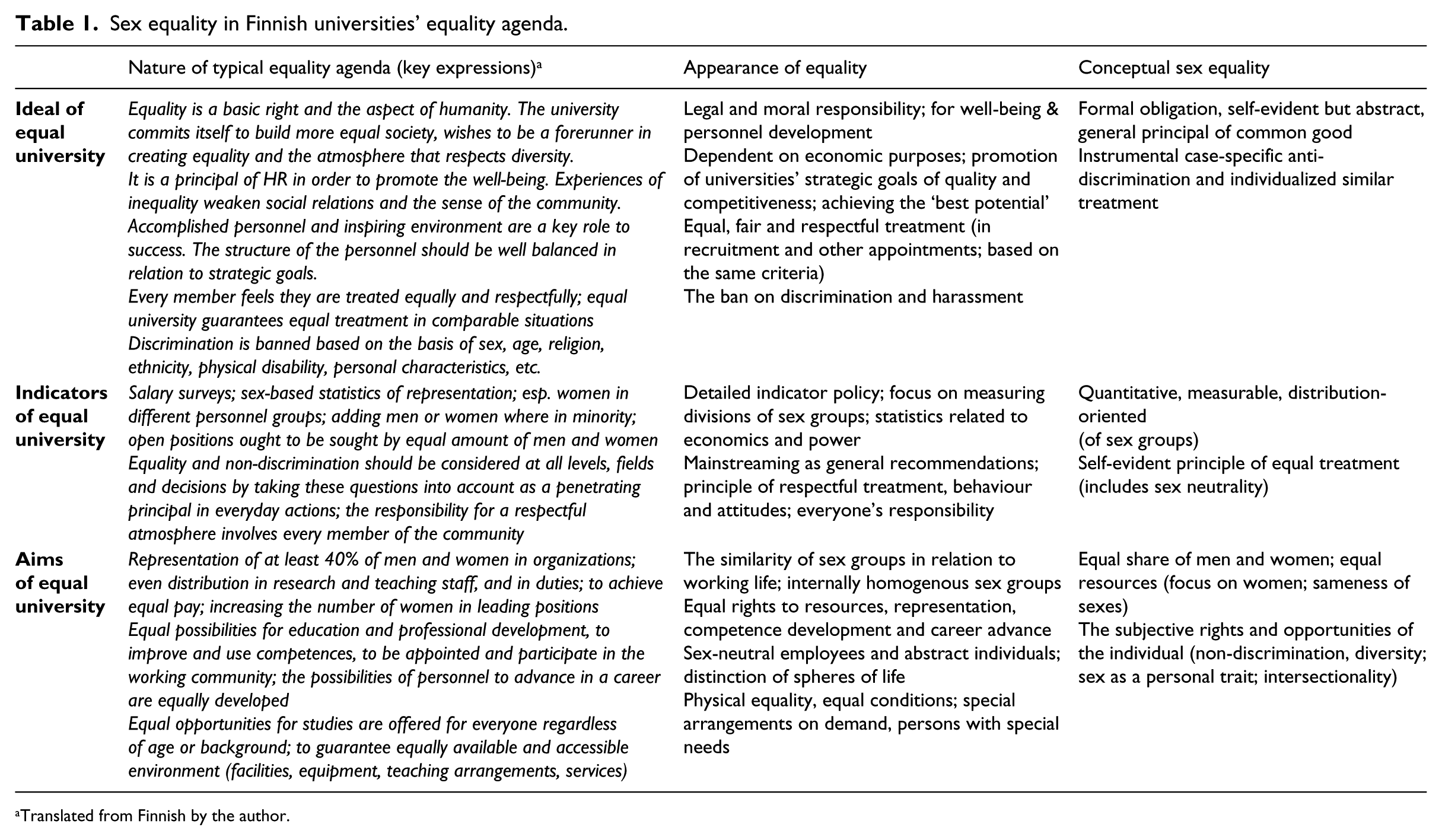
Since the purpose is to create a macro-level overview, a typical example, the data is treated and interpreted as a whole and the comparison between individual universities conducted only for apparent differences. Single-equality plans serve as the observational unit, but the unit of analysis is the collection of equality-related documents formulating the common official equality agenda with its expressions, sentences or larger entities. This solution is supported by the observation that equality plans remain substantially similar according to the requirements of the legislation, with the differences mainly arising from the length and particularity. Citations are included in the text (and in Table 1) in order to illustrate the nature of the data.
Sex equality in Finnish universities’ equality agenda.
Translated from Finnish by the author.
Policy documents are interpreted as ‘naturally’ occurring legal-administrative textual data, materializing the official conception of universities’ equality. I understand them the same as Saarinen (2008) in her analysis of educational policy documents. The documents are approached not only as describing something ‘really’ existing, rather than ‘mere rhetoric’, but as something for political action and interventions in practice (Ball, 1993, in Saarinen, 2008). In doing so, they create and maintain certain versions and conceptions of equality and justify and direct policy actions. The official equality agenda obliges universities, delimits the interpretation of equality and the space for alternative visions and, by describing the vocabulary and focus of equality promotion, it defines the territory of in/equality. As previous studies have shown, alternative interpretations, based on different starting points and purposes, do exist and lead to different political outcomes in practice.
In order to describe and conceptualize equality promoted in universities, the data was analysed by means of content analysis, focusing on the characteristics of language with attention to the content and/or contextual meaning of the text (e.g. Lindkvist, 1981). Even though the study does not follow discourse analysis as a method, it shares basic assumptions of the language and its consequences on social reality. The purpose of content analysis is to systematically describe and classify the data into categories, in order to provide an understanding of the phenomenon under study (Downe-Wamboldt, 1992). In this study, content analysis is defined as a text-based analytical approach and a tool for systematic reading and interpretation of policy documents. The intent is to restructure the phenomenon and construct the conception of equality in universities. This is based on the coding and classification of text sections, to identify thematic recurrences and by reflecting them on theoretical perspectives, to conceptualize the appearance of equality in the university context.
I proceeded by identifying recurrent expressions and contents in documents. Texts were coded 7 and classified into sections describing the ideal, equal university, what the aims are and for whom, how the equality situation is followed and how sex in/equality is expressed. This was done by data-based identification of the key terms and references, both explicit 8 and implicit. The latter included, for example, mentions of the university as an employer or educational institution, with an assumption of the responsibility of this role, or the opposite arguments (e.g. ‘the experiences of inequality weaken the sense of community’). Correspondingly, alternative terms (equality/non-discrimination/diversity), synonymous usage of key concepts (equal/similar, even; inequality/unfair, disrespectful, unjust), opposites and negations 9 were searched. The references to the target of equality actions were scanned from the sex perspective: how academic employers are seen in documents and on which occasions the sex-related expressions are relevant.
Based on the re-organization of the key expressions and recurrences, I formulated a general type, or ‘an average’, equality agenda (see Table 1). The analysis was then continued thematically by classifying each of the main themes further. While a great part of the expressions remained abstract, the process of contextualizing and relating them to the implicit assumptions, oppositions and concrete statements, 10 as well as identifying their situational usage, enabled the identification of patterns (Morgan, 1993) and an inference of the underlying meaning of equality and the assumptions behind it.
In order to conceptualize the data and to explore how equality appears and is made comprehensible in the current educational context, themes were analysed in relation to each other and interpreted through conceptual frames of individualization of the Nordic equality model, equality-related definitions of higher education reform and transnational gender mainstreaming. Higher education policy documents were sought for references to equality (or near concepts), which were then identified as to which academic theme they were attached to. I structured the expressions within the formulated equality agenda and compared the classifications. Finally, I outlined the main principles of gender mainstreaming and observed how they appear and are translated at the organizational level.
The approach could be described as abductive, since the focus is on data-based classification developed through conceptual starting points as guiding principles (Cohen and Manion, 1994). By contextualizing the documents into wider transformations of academia, I wished to discover, in the name of equality, what is considered important in organizations. In Finland, equality is commonly considered a self-evident good, but little discussion is made concerning the actual goals of equality, whose equality is promoted, what results are wanted and what the underlying values are. In universities, this means paying attention to the officially produced conceptions of equality – how it is understood and justified – to identify the different policy agendas and ideologies embedded.
The present study is a cross-section into the appearance of equality policy aims in the course of university reform in the 2010s. It focuses on the content and the relationships between the interacting policy agendas based on policy documents, rather than the actual formation of these policy processes or discourses. The article remains on a textual-policy level, aiming to define and construct a common equality agenda for academia. In doing so, the analysis does not cover the rigorous comparison between universities. The frictions between the policy documents and the actual implementation practices in equality work, probably with different solutions between universities, must, however, be acknowledged.
The appearance of sex equality in universities’ equality agenda
The equality agenda can be divided into three main sections: the first describes the ideal, equal university and what is regarded as unequal. The second expresses the indicators and actions following the equality situation and the third presents the aims of equality, what is being equalized, especially in terms of sex distinctions. Table 1 summarizes the nature of the documents, characterizing the typical agenda, reduced expressions and interpretations prefacing the reflection. The following quotes are taken from the equality-related documents of universities (translated from Finnish by the author).
Equality as formal, common good and anti-discrimination
This section describes how the equal university and the ideal situation are presented in the equality agenda. Equality work in universities is closely tied to the management of human resources and personnel development. An equal university is seen as ‘the best possible working environment for all’, emphasizing the common good and equality as a generally supported principle. Equal treatment improves well-being, while ‘inappropriate behaviour weakens the functionality of the community and increases the risk of sick leave’. The better working capacity of personnel is important, since an equal environment enables the ‘improvement of different talents for the community’. The equality plans highlight the importance of equality actions in achieving the best possible and appropriate workforce for organizational success. Equality ensures the ‘high quality and competence of the personnel’, while coping in work improves efficiency and productivity. The equality situation is used as one indicator in auditing: ‘through the equality plan, we can guarantee the quality of the university’. These quotations indicate the tendency to adapt equality work to the achievement of strategic goals, emphasizing instrumental approach.
Equality appears as a self-evident principle, required by law, but is also considered as a basic societal right. As a visible actor in society, universities take seriously their legal responsibilities and fulfilling formalities, especially in recruitment. In this respect, equality work functions also as image building, especially towards an international audience. On the other hand, universities commit themselves to promoting a respectful atmosphere in society and reducing sex segregation in working life. Equality is seen as a human dignity, claiming the possibilities of development for every community member, but also more widely attached to principles commonly supported in society, such as pluralism.
Equality-related documents emphasize the requirement of equal treatment to ensure that ‘every member of the work community feels they are being treated fairly’. The last quote also includes the idea of fairness as a subjective experience. In recruiting, equal treatment is comparable to similar treatment, since the applicants ought to be compared and evaluated with the same criteria and emphasis based on the merits of their work. Equality as equal treatment is elaborated with the specifications of ‘equal treatment in comparable situations’. The situational understanding of equality also appears in the statement ‘the equal university does not discriminate against anyone’, attached to recruitments or other appointments.
The descriptions of equality problems concentrate on discrimination and (sexual) harassment as well as disrespectful attitudes, treatment and behaviour, such as bullying and favouritism. Following the logic of equal treatment, inequality exists in single-problem situations when a person is mistreated based on his/her characteristics, and is solved case-specifically. Through the amendment of non-discrimination legislation, the equality plans have increasingly widened to include mentions of other bans on discrimination, typically based on age, language and ethnic background or physical disabilities. While ‘no one is put in an unequal position according to sex, etc., [or] personal traits’, universities should also acknowledge other individual factors, such as learning problems, personal circumstances and motivation.
Gender mainstreaming through indicator policy
Here, I explore how equality aims are materialized and how the equality situation is followed. Since the equality legislation is influenced by the gender mainstreaming strategy and provides a detailed account of the equality situation in universities, this part serves as an analysis of its translation into universities’ equality agendas.
Literal to the mainstreaming strategy, equality plans suggest taking ‘equality and diversity questions into account as a penetrating and central principle’ at all levels and in all fields and actions, claiming up-front evaluation and planning. ‘The practices and structures of the administration ought to be developed in a way that the target of sex equality is included in all decision making’. Sex equality is specified to denote that one should be able to develop competencies and make choices without any restrictions of sex. The principle of mainstreaming is thus acknowledged but is presented on a very general level and as a recommendation.
Equality plans relate mainstreaming to the ethical commitment to promote a respectful atmosphere, added to the notion of the responsibility of every community member. Equality as a generally supported moral value is attached to the idea of integrating it into everyday activities, where the principle of common similar treatment is highlighted. This is translated into situational, case-specific resolving rather than ‘pre-evaluating gender/equality impact in all policymaking and decisions’. It is noteworthy that here no special importance is given to sex, but to treat everyone respectfully. Thus, mainstreaming does not appear as situating gender equality issues at the centre of policy decisions or as a process framing policies in order to change institutional structures and processes, which contribute to, or sustain, discrimination and disadvantage (UNESCO, 2010, 2013), but rather on attitudes, behaviour and treatment. Higher education policy documents focus primarily on this dimension and interpretation of mainstreaming where equality appears to be self-evident and everybody’s responsibility.
The other dimension of gender mainstreaming materializes as detailed requirements for compiling mainly sex-based statistics on distributions and representation. Every amendment of the Equality Act has increased universities’ requirements to follow, evaluate and report equality, with equal pay as a central goal. Provided by legislation, universities describe and report their equality situation by quantitative indicators: ‘The equality plan includes the report of the university’s equality situation provided by the legislation. The report contains the statistical divisions of men and women in different duties as well as the salary survey of wages, pay differences and job classifications’. Indicators include the usage of parental leave, data on the participants in personnel training and grade distributions. In some universities, the level of equality is also followed by surveys on the workplace atmosphere and well-being that include experiences of equality, especially satisfaction with the salary system.
The indicators measuring equality in universities can be classified into the following categories.
Sex-based salary surveys: reports of job classifications, wages and pay differences; impact assessments of the university salary system; sex-based distributions of the level of demands and personal performances.
Sex-based statistics of duties: recruitment, applicants and appointments to professorships and other positions; temporary employment; research groups; the proportion of women in different personnel groups in particular.
Statistics on female and male students: applicants, graduates and the distribution of the sexes in different fields.
Equality, as a measurable and statistically addressable phenomenon, reflects the idea that the degree of equality can be proved by the division of resources and representation. The statistics are added to existing administration reports, usually as a separate section. Here, mainstreaming appears as an indicator policy, requiring comparative measuring between sex groups. According to the numeric understanding of equality, the goal is to achieve more even numbers of men and women, ‘at least 40% in governing bodies, committees and working groups’, with the special interest to increase ‘the amount of women in the leading positions’. The sex is attached to particular questions, especially regarding pay and representation in different committees.
Sex equality as subjective rights for free individuals
This section identifies what and who is being equalized in universities in terms of sex distinction and how personnel are understood in relation to life outside academia.
In equality agenda, sex-related questions appear through sexual harassment and various statistics based on groups of men and women in recruitment, career advancement and salary. Women and men are presented as comparable, categorically homogenous groups, whose inequality is described with the notions of sex groups working in the different fields and hierarchies. The number of women is lower in the leading positions and higher in administration; they are the majority of students and staff but receive lower pay. The solutions offered a focus on encouraging men to enter female-dominated fields and vice versa, paying attention to women’s academic careers by encouraging them to top positions and ensuring that ‘women have the opportunity to accept more demanding jobs in every life situation’. Conversely, men should be encouraged to use more parental leave. Other target groups mentioned as vulnerable to discrimination are especially those related to accessibility and physical availability.
The equality plans emphasize the same rights and opportunities for men and women in terms of equal pay, professional development, access to positions and duties, an equal career ladder, the use of skills and expertise, to be respected and to participate in the work community. The vast majority of the requirements for equal opportunities focus on resources and success in academic careers. Equal pay, in particular, has been a central goal of the Equality Act and Equality Programme of the Finnish Government (2012–2015).
In balancing work and private life, the universities differ from one another: some cover it in equality plans while some hardly mention it. Where covered, documents suggest universities consider ‘different life situations if possible’ – for students, in reference to motivation and flexible arrangements, and for personnel, equal possibilities for parenthood and to act in working life. The recognition of private life is materialized through recommendations: ‘Parental leave should be taken into account in the evaluation of the career ladder and working conditions’ and ‘Employees should not be put in an unequal position in regard to career advance, reward or continuation of employment’. These are followed by the usage of parental leave. Care obligations ought to be supported by flexible working hours and positive attitudes towards different arrangements. With regard to international staff, the integration of their family into the new country is mentioned.
Otherwise, the references to sex are diminished rather than highlighted in documents where the actors are managers, personnel and students described in terms of professional development and accomplished and motivated employees. Sex-neutral language indicates the idea of the similarity of men and women, at least with regard to working life. 11 While work and private life are being separated, equality agendas target the hypothetically abstract individual and employer free from his/her sex and care obligations. The same explicit and transparent criteria guarantee the even-handed and neutral comparison of merits in evaluation and recruitment. The increasing attention to anti-discrimination has shifted the tendency towards joint equality and non-discrimination or diversity plans, where sex appears as one (personal) characteristic among others grounds for a ban on discrimination.
Many equality plans particularize equal study and working conditions as an environment equally available to many kinds of students and from all cultural backgrounds, with regard to facilities, equipment and teaching arrangements. The focus is mainly on physical accessibility and the availability of services, mainly concerning the physical environment but also related to language issues and providing comprehensible information. Here, equal opportunities are defined in terms of organizing services and arrangements for people with special needs (usually with physical disability, e.g. dyslexia). The other case in which affirmative actions, as exceptions to similar treatment, are allowed is the possibility of positive discrimination or favouring male or female candidates in order to balance an uneven sex-distribution (where a minority group is underrepresented with less than 40% and the candidates have similar merits).
Reflection
Above, I have analysed the aims and conceptions of sex equality in the universities’ equality agenda, using documentary material. Next, I gather the main findings and reflect them in the light of conceptual frames. I first answer the sub-questions, as they preface the main analytical question and help to contextualize and comprehend equality promoted in academia in the 2010s within the interacting and even contradicting demands.
Balancing out sex equality
The first sub-question asked was how the equality aims appear in relation to equality-related statements in higher education policies. Institutional requirements to measure and report the equality situation are tight and equality work, as part of universities’ human resources, seems to be accepted through established equality boards and planning. The idea of equality, however, does not easily match the discourses of freedom of choice, individual responsibility, excellence and competitiveness increase in education policies (Naskali, 2009b). In universities, this contradiction is solved by integrating equality into quality assurance with indicator policy and claiming similar treatment with the same criteria. In equality agenda, equality promotion seems to be balanced between ethical, right-based principles, strict legislation-based formalities and an instrumental approach. Equality is presented as a moral and legal obligation, connected to general welfare and to the ‘common good’ of the community, but left abstract. For individual employees, on the other hand, legislation guarantees the ban on discrimination and the right to equal treatment in working life situations.
Equality planning appears in an interesting light given higher education policies’ broad reliance on the market economy (Hauhia, 2015) and the repeated vocabulary of quality, effectiveness and international competition. Similar to other organizations, equality promotion in academia is strongly argued to bring benefits and organizational advantages (cf. Brunila, 2009; Nielsen 2014). This was especially the case in higher education policy documents, which unanimously emphasized instrumental aims. In them, equality appears mainly self-evident and achieved as a valuable national advantage and one of the strengths of the Finnish innovation system. The aims focus on improving individual capacities and skills, seeking experts and developing creativity. Documents link sex equality to career development, with the emphasis on international competitiveness and the desire to attract the best workforce to Finnish universities. In the Research and Innovation Policy Guidelines for 2011–2015, equality between men and women – as well as the reconciliation of work and family – is mentioned as the biggest problem in the development of successful and international research careers. The same document highlights that ‘women have good opportunities to establish a research career in Finland. Practices must be changed to enable new kinds of recruitment models for researcher couples and their families, as well as other people’.
National higher education policy documents present equality similarly to equal treatment and banning discrimination based on different personal traits. The development plan for education and research (Ministry of Education and Culture, 2012) mentions that ‘qualitatively equal conditions for education must be provided for every student despite the location of the institution’. The understanding of equality as more of an individualized phenomenon is seen in these demands for accessibility and availability relating to physical conditions, individual situations and personal circumstances. These documents hardly consider the sexes at all; personnel are seen as workers, experts and talented individuals.
I also asked how the principle of gender mainstreaming is translated into universities’ equality agenda. Two remarks are made on the appearance of strategy and its goals for higher education: firstly, claims of gender mainstreaming are realized as separate mentions and recommendations to take equality into account in all actions. This turns into fair treatment and behaviour, which is everyone’s responsibility in everyday actions, without a specific sex-reference. Secondly, through strict obedience to the law, gender mainstreaming materializes as detailed statistical indicators. The focus is on measuring divisions and representation of sex groups, prioritizing the even distribution of men and women, the equal representation of female and male leaders and the promotion of women’s career development.
Neither of these dimensions follows the expressed principle in gender mainstreaming strategy, since the first is mainstreaming without the sex/gender perspective in policymaking and structural development but at the level of attitudes and behaviour, and the second focuses on sex in particular issues and comparing the sex groups as separate indicators and reporting. In this sense, adopting the applicable rhetoric of the strategy, gender mainstreaming exemplifies the ‘weak concept’ (cf. Narotzky, 2007). It expresses the tension between specificity and abstraction of concepts, whose descriptive force lies in their cultural and local specificity. In universities’ equality agendas, the definition of mainstreaming and its aims are left abstract and ambiguous. While the policy emphasis also differs between transnational organizations (Squires, 2007), adopting the vague idea of mainstreaming might serve as an easy strategy for institutions.
Conceptual emphasis on individual equality
Finally, I asked how sex equality appears in the equality agenda guiding universities. Equality promotion is attached to fair treatment, behaviour and attitudes, while equal treatment and opportunities are founded on requirements of the same criteria applied to everyone, mainly in recruitment. The emphasis is on anti-discrimination, with equality seen as a subjective right in competence development and career advancement. Claims for anti-discrimination have transcended sex equality to some extent, emphasizing personal differences, thus indicating an individually oriented view on equality. The focus is on cases of harassment and discrimination, whose prevention is highlighted also in equality legislation. The ban on discrimination is mainly attached to physical accessibility and the availability of services.
The findings reveal distinctive understanding of equality at different levels of where equality aims to operate: at the organizational level, equality is harnessed for instrumental advantage and with the support of legislation, followed by quantitative indicators of sex groups. Here, the sameness of sexes is the dominant view. At the level of personnel equality, it is regarded as a subjective right and opportunities focusing on case-specific anti-discrimination between abstract individuals. This view sees sex as one personal trait among others and is thus close to an intersectional approach. Implications for work/life interferences, however, are quite similar in both approaches.
In the first dimension, comparing men and women emphasizes equality as the same share, while equality is understood more as an even resource distribution and as increasing the proportion of men or women in positions or fields where one or the other is in the minority. The focus is especially on increasing the number of women in leading positions. This could be seen as a type of equality of outcomes, if understood as a measurable situation. Morley (2010) pays attention to the tendency of gender mainstreaming to treat gender as universal and men and women as dichotomist, homogenous groups. The differences and tensions inside the groups remain invisible and un-problematized, in relation also to transforming family relations. According to Radcliffe-Richards (2014), the ‘only X%’ arguments are commonly used as evidence of discriminatory treatment, but it may also depend on actual differences between the groups and their situations.
In the second dimension, the documents tend to obscure sex rather than reflect it, and individual differences transcend the sex-related questions. For Bacchi (2001), this represents the negotiation of the image of equality, where diversity discourse displaces affirmative actions and the attention is moved from the structures and practices affecting the position of certain target groups to the personal rights of abstract and sex-neutral individuals (Naskali, 2009b). These persons are not defined by sex distinctions, different life conditions or responsibilities of care, but should be evaluated with the same work-related criteria, regarded as neutral and objective. Sex distinctions, however, are not only about the individual, if seen as having a concrete form and consequences related to reproduction and care, for instance. The focus on individual differences in the search for maximum potential leaves group distinctions aside. Thus, the rhetorical shifts from equality to diversity might also indicate a perspective favouring the utilitarian viewpoint (Nielsen, 2014).
With the boost from the Equality Act, the equality agenda aims at furthering women’s careers and increasing the proportion of women in leading positions. According to the documents, this should be done by encouraging women and promoting their self-esteem. Focusing on individual women’s characteristics and their assumed lack of ambition turns the attention away from the positions as well as the uneven distribution of private life obligations. Separating the private life from the working life places everyone in a situation where using the available opportunities is seen to be dependent only on him/herself. These characteristics, with equal opportunities and similar treatment, are usually emphasized in the liberal view on equality (e.g. Svensson, 2006), guaranteeing a formal equality between the members belonging to the same category. This conception might be more compatible with the search for success and excellence in higher education policies than the equality of outcome.
Remarks from the Finnish case
With the example from Finland, I wish to question some basic assumptions and the appropriateness of current sex equality aims in the transforming academic context and, finally, I suggest some alternative conceptual and practical approaches. Finnish universities’ equality planning has witnessed a transformation in the conception and aims of equality in recent decades. This operates in equality agendas, firstly through the strict reliance on legislation, which defines the actions and indicators and thus also the boundaries of in/equality. Gender mainstreaming materializes in amendments and tightening regulations by increasing the indicator policy on sex groups in order to achieve more even numbers of men and women. These aims, however, are somewhat contradictory to the emerging demands of non-discrimination or diversity with the focus on personal characteristics and case-specificity.
Secondly, the Finnish view of equality, combined with social justice, aiming for even, good and equal outcomes in terms of economics and political participation, forms the background for the shifting equality aims and conceptions. The marketization of educational policies, with the emphasis on individual anti-discrimination in work life, has composed a liberal and individualized view but in relation to personal development and top positions, on which the abstract that equal Employees should have similar subjective rights and opportunities. This differs from the traditional ‘Nordic model’ and collective understanding of equality in terms of economics and participation, which are still not abandoned compared to identity politics (cf. Fraser, 2013). Distributive aims of even share are targeted at resources and representation, while the politics of recognition appear only in expressions of equality as a subjective feeling of being fairly treated and appreciated (cf. Holli, 2003).
The findings also suggest paying attention to conceptual questions when implementing transnational equality strategies in an organizational context. In Finland, the transnationalization in equality politics is present already in the adoption of Anglo-American terms, which in the 1990s, at the latest, started to replace vocabulary in policymaking. This is seen in the term ‘gender’, which has no specific equivalent in Finnish, and although the word ‘sukupuoli’ (half of a kin) does not refer to ‘social sex’, it is increasingly made identical. Yet, the indicators and statistics measure formal and quantitative equality between the biological sexes, not of gender. As Narotzky (2007) points out, transnationalizing research and policy discourses may lead to them going astray if they are not analysed culturally, while historicizing concepts and indicating concrete goals reveals their situatedness. In this respect, does the implementation of gender mainstreaming with the assumed universal notions lead to deepening confusion, while the actual aims are left abstract? Does it offer an easy strategy to adopt the rhetoric and escape from the reflections of what are the concrete mechanisms that create inequalities between different kinds of females and males in certain organizational contexts?
Despite various equality agendas, sex-based segregation in Finnish universities remains persistent. The example from academia also poses some further questions to policymakers and researchers. Do the changes in work and gendering renew the need to study the appropriateness of current aims and indicators promoted in equality politics (cf. Radcliffe-Richards, 2014)? While equality goals tend to be separated from academic values and virtues (Jenkins and Hutchison, 2013), they also seem to rely on the expiring view of inequality, distinctive to the academic regime. Even though the impacts of the Finnish university reform could be fully researched, new forms of segregations can be seen (see also Berggren, 2011) due to the casualization and disintegration of employment. Recent statistics indicate that increasingly temporary and less stable positions and periods of unemployment concern women more than men, noticed elsewhere as well (Bagilhole and White, 2013). The equality agenda in academia could apply to any organization, but we can ask whether the legislation-based indicators are capable of recognizing the nature and demands of academic work and related gendering, especially in terms of private life.
Women’s underrepresentation in certain fields or positions is regarded as a ‘pipeline problem’ to be fixed by adding more women. This model is widely challenged by the evidence that it fails to represent the problem (Dodds and Goddard, 2013; Schiebinger, 1999). Instead, studies indicate that conditions differ among and inside the groups of men and women (Currie and Thiele, 2001; Heikkinen et al., 2012), and for most women, their still tighter ties to children put them in a different situation to men (Pritchard, 2010; Radcliffe-Richards, 2014). In universities, as elsewhere in society, women also take more and longer parental leave than do men, thus investing in the domestic sphere. Furthermore, while the emergence of ‘caring fatherhood’ in Nordic countries inevitably transforms these dynamics, it does not remove the challenges of the private care of dependents. In order to solve the problems concerning the relationship of the sexes, Radcliffe-Richards (2014) called for different approaches and the recognition of the issues that are difficult to characterize in terms of justice and equality. There is a need to pay attention not only to the nature of work, but also to family structures and other societal institutions.
This article targets the policy level and examines the official equality agenda of Finnish academia in the context of the latest university reform. Policy texts form the way of viewing the phenomenon, provide vocabularies and assist universities and, thus, what kind of equality is constructed in documents is not insignificant. The definitions of key concepts and the choice of indicators inform how equality should be used and for what, which goals and problems are foregrounded and which are left aside. The conceptual emphasis, for example between equality and diversity as being more compatible for market orientation and internalization, is a political question that analysis reveals what is considered important in universities. This article asked how sex equality is conceptualized and how its aims are balanced on different, even competing, policy agendas. The surface where these frictions meet is the implementation, the receiving in practice, where the solutions inevitably differ between universities. A suggestion for further study is the ‘material turn’ (Saarinen, 2008), a dialogue between interacting policy texts and actual practices.
Footnotes
Appendix
Declaration of Conflicting Interest
The author declares that there is no conflict of interest.
Funding
This research received no specific grant from any funding agency in the public, commercial or not-for-profit sectors.