




Abstract
This study examines university-industry collaboration (UIC) in Kazakhstan’s public universities, focusing on the challenges and opportunities that shape its potential to enhance university governance and diversify financial sustainability. Adopting a case study approach, the research involved elite interviews with 30 stakeholders, such as ministerial officials, senior management of universities, board members, and experts in higher education (HE). Unlike other studies that link weak UIC to low research capacity, this study finds that limited managerial experience impede collaboration even in a flagship national university with high research capacity, while teaching-oriented regional universities achieve comparatively greater success. However, the primary factor influencing these collaborations is regulatory compliance rather than genuine mutual interest, as legal mandates require subsoil companies to allocate funds to universities. Moreover, these obligations are often evaded by many companies, and local authorities lack the authority to enforce them. The study also revealed four key barriers to effective UIC: economic constraints, legal gaps in corporate regulation, the passive involvement of university board members, and insufficient leadership experience in stakeholder engagement.
Keywords
Introduction
Collaboration between universities and industry plays a pivotal role in promoting innovation, economic growth, and societal advancement. Such partnerships offer universities essential opportunities to diversify funding, improve graduate employability, and engage in collaborative research initiatives, while industries benefit from access to a skilled workforce, innovative solutions, and expanded networks encompassing alumni, entrepreneurs, and policymakers (Amicarelli et al., 2022; Gornitzka et al., 2017; Kuchumova et al., 2023). Recognizing the value of these collaborations, international organizations such as the OECD emphasize the importance of integrating industry representatives into university governance structures to stimulate entrepreneurship and facilitate the development of knowledge-driven societies (Cai and Etzkowitz, 2020; OECD, 2019). OECD (2019) experts report that in 25 of the 34 member-countries, business, industry, and community representatives actively participate on university governing boards. Such partnerships, often facilitated by government initiatives, are theorized under the Triple Helix model, which emphasizes collaboration among universities, industry, and government to drive entrepreneurship, innovation, and the creation of a knowledge-based society (Cai and Etzkowitz, 2020; Etzkowitz, 2008). Within this context, universities typically function as independent legal entities involved in economic, financial, and organizational relationships. However, despite its potential, the implementation and sustainability of effective UIC remain challenging, particularly in developing and transitional economies.
In Kazakhstan, UIC has been influenced by broader HE reforms associated with the Bologna Process, national accreditation requirements, and the growing influence of globalization and internationalization (Bayanbayeva et al., 2023). These frameworks emphasize the need for closer engagement between higher education institutions (HEIs) and industry to enhance the commercialization of research, foster innovation, and strengthen the practical application of academic knowledge. As a result, universities are encouraged to establish formal partnerships with industry through advisory boards, internship programs, and joint educational initiatives. However, in the context of Kazakhstan, only a few studies have been conducted on issues related to UIC. Studies indicate that Kazakhstani universities are still evolving toward the entrepreneurial university model, with teaching as the primary focus and limited emphasis on research and industry collaboration (Jonbekova et al., 2020, 2025; Kuchumova et al., 2023; Moldashev et al., 2025). Kozhakhmetov (2016) highlights the need for Kazakhstan to build a sustainable knowledge economy by enhancing the entrepreneurial capabilities of its universities, advocating for policies that leverage the Triple Helix model (Cai and Etzkowitz, 2020). Similarly, Jumakulov et al. (2019) found that research has not been a central part of the university’s mission in Kazakhstan, and they recommended that universities rethink their missions to include teaching, research, and contributions to the industry. More recently, Kuchumova et al. (2023) identified some barriers to UIC in Kazakhstan, such as pervasive corruption, insufficient research capacity, a lack of adequate investment in research initiatives. Meanwhile, Jonbekova et al. (2025) revealed that that while UIC in Kazakhstan have advanced human capital development and strengthened educational programs, their potential for fostering research, innovation, and commercialization remains limited due to resource constraints, weak institutional capacity, low industry engagement, and the predominance of a state-driven model of collaboration. In a similar way, Moldashev et al. (2025) found that research commercialization in Kazakhstan is constrained by competing institutional logics and structural misalignments, resulting in largely symbolic rather than substantive UIC. Further studies have revealed promising opportunities for Kazakhstan’s universities to collaborate with the tourism industry, yet legal and tax constraints continue to impede the establishment of international campuses that could significantly strengthen UIC (Altynbassov et al., 2021, 2022; Bayanbayeva et al., 2023).
Despite these insights, significant gaps remain in understanding the systemic challenges and opportunities shaping the effectiveness of UIC in Kazakhstan. Existing studies primarily focus on the broader objectives of UIC such as research commercialization, improving research capacity, faculty participation in industry-research partnerships, motivations, and challenges of such collaborations (Jonbekova et al., 2025; Kuchumova et al., 2023; Moldashev et al., 2025), but lack a targeted exploration of how these partnerships could support university governance and funding structure within the Kazakhstani HE context. This study addresses this gap by examining the systemic challenges and opportunities influencing the effectiveness of UIC in Kazakhstan’s public universities, drawing upon empirical data from multiple case studies. Specifically, it explores the potential of UIC to diversify universities’ funding sources and strengthen institutional governance by fostering more autonomous, entrepreneurial, and stakeholder-engaged management practices. The study focuses on these challenges and opportunities because understanding the institutional and governance-level factors that shape UIC is crucial for enhancing the sustainability and autonomy of Kazakhstan’s public universities. By identifying how institutional barriers, governance structures, and partnership mechanisms influence collaboration outcomes, the research aims to inform policy and managerial strategies that can leverage UIC as a driver for diversified funding, improved accountability, and more entrepreneurial governance models within public universities. The study is guided by the following research questions: (1) What institutional and governance-level factors facilitate or constrain UIC in Kazakhstan? (2) How do universities, industry, and government actors interact within this governance framework?
Literature review
There are differing perspectives on collaboration between universities and external stakeholders, especially with industrial and business sectors. For universities, such partnerships foster research commercialization, greater staff mobility, recruitment of diverse talent, and networks connecting alumni, entrepreneurs, and government entities, promoting a mutually beneficial ecosystem of knowledge exchange and innovation (OECD, 2019; Orazbayeva and Plewa, 2020; Taxt, 2024). Meanwhile, Azagra-Caro et al. (2017) state that industry also gains from such cooperation due to the spread of technology that comes from universities, which has a significant impact on boosting economic activity. Similarly, Chang (2019) found that such a collaboration serves as a catalyst for the industrialization of research and development outputs originating from universities and the creation of technologies that are inherently demanded by industry. Taken together, these studies conceptualize UIC as a mutually reinforcing relationship in which both parties benefit through knowledge transfer, innovation, and human capital development.
Within this context, the role of business and industry is crucial in promoting such collaboration, particularly when examined through the lens of the Triple Helix framework, where partnerships among universities, industries, and governments are shaped by governance structures and the national context. The Triple Helix model of university interaction requires cooperation between industry, government, and universities, which can lead to the development of entrepreneurship and innovation and a knowledge society (Cai and Etzkowitz, 2020; Etzkowitz, 2008). Within this interaction model, the universities may act as autonomous legal entities which participate in various economic, financial, and organisational relationships.
In settings where universities are relatively autonomous, collaboration often occurs directly, allowing for a more flexible and responsive partnership. Notable examples include institutions such as MIT and Stanford, where industry partnerships are robust, generating measurable outcomes through patents, inventions, and regional economic development. This model, exemplified by the high-tech ecosystem of Silicon Valley, illustrates how university autonomy can lead to impactful industry linkages. For example, Zasopina (2013) and Etzkowitz (2008) found that world-class universities, such as MIT and Stanford University collaborate directly with many companies and that their performance is measured by specific metrics (through the number of inventions, patents obtained, open companies, etc.). Similarly, Tijssen et al. (2019) examined the university-business research interaction at 48 of the UK’s top universities. Their findings highlight that British universities engage in partnerships with industrial companies both locally and globally. Notably, five major UK research universities maintain global collaborations with partners located more than 4999 km away, while many other universities focus on partnerships with local industry stakeholders within a 500-km radius. Laursen et al. (2011) observed that businesses generally choose to work with prestigious, top-tier universities that are located far away rather than partnering with lower-ranked institutions in closer proximity, emphasizing that quality is more important than geographical convenience in innovation-driven projects. The findings demonstrate that university reputation and autonomy play a vital role in shaping efficient UIC. Ultimately, promoting such partnerships demands a strategic alignment of institutional governance, research capabilities, and a commitment to innovation, which must be tailored to both local and international contexts. These examples indicate that the success of UIC depends not only on proximity or resources but also on effective governance and institutional strategy.
By contrast, in more centralized governance systems – typical of post-communist and developing contexts – government plays a significant role in fostering university-industry partnerships. For instance, Fang et al. (2023) examined the university-industry-government relationship through the lens of the Triple Helix model in China. They found that the government plays a crucial role in establishing UIC through its special policy programs and legal instruments. Similarly, Jonbekova et al. (2025) observed that in Kazakhstan, the government leads UIC efforts by creating regulatory frameworks and funding programs. In line with the global knowledge economy agenda, Kazakhstan has prioritized UIC to enhance innovation and align HE with labor market needs; however, strong government control continues to limit universities’ autonomy and entrepreneurial engagement. This pattern of state-facilitated collaboration is similarly observed in Russia, where institutions such as Moscow State University engage in government-backed partnerships with large industries (Bychkova, 2016; Rios-Campos et al., 2021).
Nevertheless, some studies stress the importance of pragmatic considerations, entrepreneurial activity, and institutional autonomy in the effectiveness of UIC. Fitjar and Gjelsvik (2018) revealed that industrial companies frequently place more importance on pragmatic considerations including manageable collaborations, pre-existing relationships, and community involvement than research quality or proximity. They also pointed out that by reducing knowledge transfer costs, local universities improve community development and regional research capabilities. Furthermore, research income is generally higher at institutions with a high level of entrepreneurial activity, such as licensing, start-ups, and patents, and financing is positively impacted by business engagement regardless of strategic direction (Johnston et al., 2023). Orazbayeva and Plewa (2020) analyzed the impact of academic motivations on collaboration with businesses in Australia and revealed that the government should grant certain tax advantages to companies that cooperate with universities. Similarly, in the USA, the tax reforms facilitated discounts that ranged from 20% to 50%, leading to an increase in UIC and the establishment of charitable and endowment funds (Hackney, 2020; Mozumi and Mozumi, 2022). These studies demonstrate that meaningful cooperation between universities and external stakeholders is more likely to thrive in institutions that enjoy genuine autonomy and independence.
Despite its potential, there are several barriers that hinder effective UIC, especially in developing countries. Zhuang and Shi (2024) pinpoint important challenges, such as differences in academic and industry interests, insufficient incentive mechanisms, and content mismatches, that make it difficult to align academic programs with industry needs. Furthermore, the collaboration process is made more complicated by lengthy negotiations regarding course compatibility. Similarly, Littleton et al. (2023) stress the importance of overcoming barriers such as trust issues, divergent expectations, and organizational mismatches for successful collaboration. Success requires institutional reforms, enhanced communication, and better alignment between academic and industrial objectives. Azman et al. (2019) further reveal additional obstacles, including cultural differences, perceived gaps in academic expertise and reputation, inadequate institutional policies, intellectual property issues, and lack of appropriate reward systems. Thus, the establishment of more effective and mutually beneficial UIC depends on addressing these barriers through targeted institutional reforms, enhanced communication, and goal alignment.
In the context of Kazakhstan, Jonbekova et al. (2020) found that weak research capacity, limited resources, and top-down management restrict UIC to basic forms of collaboration, such as teaching support, student internships, and technical consulting. Similarly, Smirnova (2016) revealed that UIC in Kazakhstan are characterized by mismatches between preferred and actual collaboration channels, differing perceptions of obstacles, and a focus on short-term, production-oriented benefits. Despite efforts toward modernization, institutional legacies, cultural norms, and weak commercialization structures continue to constrain innovation and effective knowledge transfer. More recently, Jonbekova et al. (2025) revealed that while UIC has improved graduate employability and educational quality, sustainable and innovation-driven collaboration requires stronger institutional support and greater university autonomy. Yembergenova et al. (2021) also highlighted that excessive government regulation in Kazakhstan’s HE system limits universities’ innovative capacity and, consequently, their contribution to economic development. Rigid control mechanisms create agency problems that hinder institutional autonomy and innovation.
Comparative perspectives from other post-Soviet systems further contextualize Kazakhstan’s experience. Studies across the region reveal the enduring influence of hierarchical governance, path dependency, and weak innovation intermediaries across the region, that constrain UIC (Balzer and Askonas, 2016; Bychkova et al., 2015; Khachatryan et al., 2024). For instance, Balzer and Askonas (2016) revealed that while both Russia and China aim to transform their Soviet-style R&D systems through the Triple Helix model, China has been far more successful. This success stems from effective state policies that incentivize collaboration and innovation, whereas Russia’s efforts are limited by weaker policy implementation and institutional rigidity. Similarly, Bychkova et al. (2015) found that Russia’s “innovation enforcement” policy largely failed to foster genuine UIC, resulting mostly in superficial partnerships. However, shared-use research equipment helped build limited trust and cooperation, showing that “innovation by coercion” can yield some positive side effects. In the Armenian context, Khachatryan et al. (2024) identified that UIC remains weak, as existing institutional structures and collaboration channels are largely ineffective. Limited funding and inadequate entrepreneurial support systems further constrain partnership development, reflecting broader challenges typical of post-Soviet HE systems. This also reflects the enduring influence of path dependence and institutional legacies, which continue to pose central barriers to the development of effective innovation systems in the post-Soviet space (Landoni and Muradzada, 2024; Mussagulova, 2021; Radosevic, 2022). As Landoni and Muradzada (2024) argue, in Azerbaijan, interaction barriers among universities, industry, and government stem from entrenched intra-organizational cultures inherited from the Soviet era. This results in weak communication, systemic failures, and a cycle of continued state intervention. Similarly, Mussagulova (2021) highlights that the varying innovation performance among post-Soviet states can be explained by path dependency in their R&D institutions. Countries that retained Soviet-era institutional models, such as Kazakhstan and Ukraine, show weaker innovation outcomes, while those that undertook active reforms, such as Estonia, achieved stronger performance. This demonstrates that the legacy of Soviet institutional structures continues to shape and constrain innovation in the region. Radosevic (2022) further shows that post-socialist transformation in Eastern Europe and the former Soviet Union is an ongoing evolutionary process marked by misaligned innovation systems and weak interactive capabilities. Limited technological progress stems from the failure to develop hybrid systems balancing state and market roles essential for sustainable innovation and catch-up. Overall, these studies highlight that across post-Soviet contexts, UIC remains constrained by institutional rigidity, weak policy implementation, and limited financial and organizational support, highlighting the need for more enabling governance and innovation ecosystems.
To sum up, although UIC has significant benefits, including innovation and economic growth, there are multiple barriers, such as divergent interests, trust issues, and cultural differences, that hinder its effectiveness. To achieve success in collaboration, it is necessary to have strategic alignment, more effective governance, and clearer frameworks, particularly when there is significant government involvement. In Kazakhstan, the state plays a central role in shaping UIC through the creation of enabling regulatory frameworks and the determination of partnership types and purposes (Jonbekova et al., 2025; Yembergenova et al., 2021). However, strong state influence can also impose rigid compliance requirements and limit institutional flexibility, thereby both facilitating and constraining UIC. Understanding the effective approach to addressing these barriers remains a significant research gap, particularly in developing countries where institutional frameworks and governance structures may differ. The aim of this study is to bridge the research gap by providing empirical evidence on the challenges and opportunities in the development of UIC in Kazakhstan.
Methodology
This study employed a multiple case study approach, focusing on one national flagship university and two regional public universities. This design was chosen for its ability to facilitate comparative analysis, enhance the robustness of findings, incorporate diverse perspectives, and provide a richer contextual understanding (Yin, 2014). While all three universities are state-funded, they differ in mission and scope, offering a meaningful basis for comparison. One national flagship university represents a large, research-intensive institution with strong international visibility, while the two regional universities are medium-sized, primarily teaching-oriented institutions with emerging research activities. These distinctions were intentionally chosen to examine how institutional mission and scope shape the dynamics of UIC. Public universities were selected because they dominate Kazakhstan’s HE landscape, play a pivotal role in implementing national reform agendas, and are directly influenced by state policies regulating UIC. To ensure confidentiality, the universities were assigned pseudonyms: the national university was referred to as Jupiter University, while the two regional universities were named Venus University and Mars University.
Profile of interview participants.
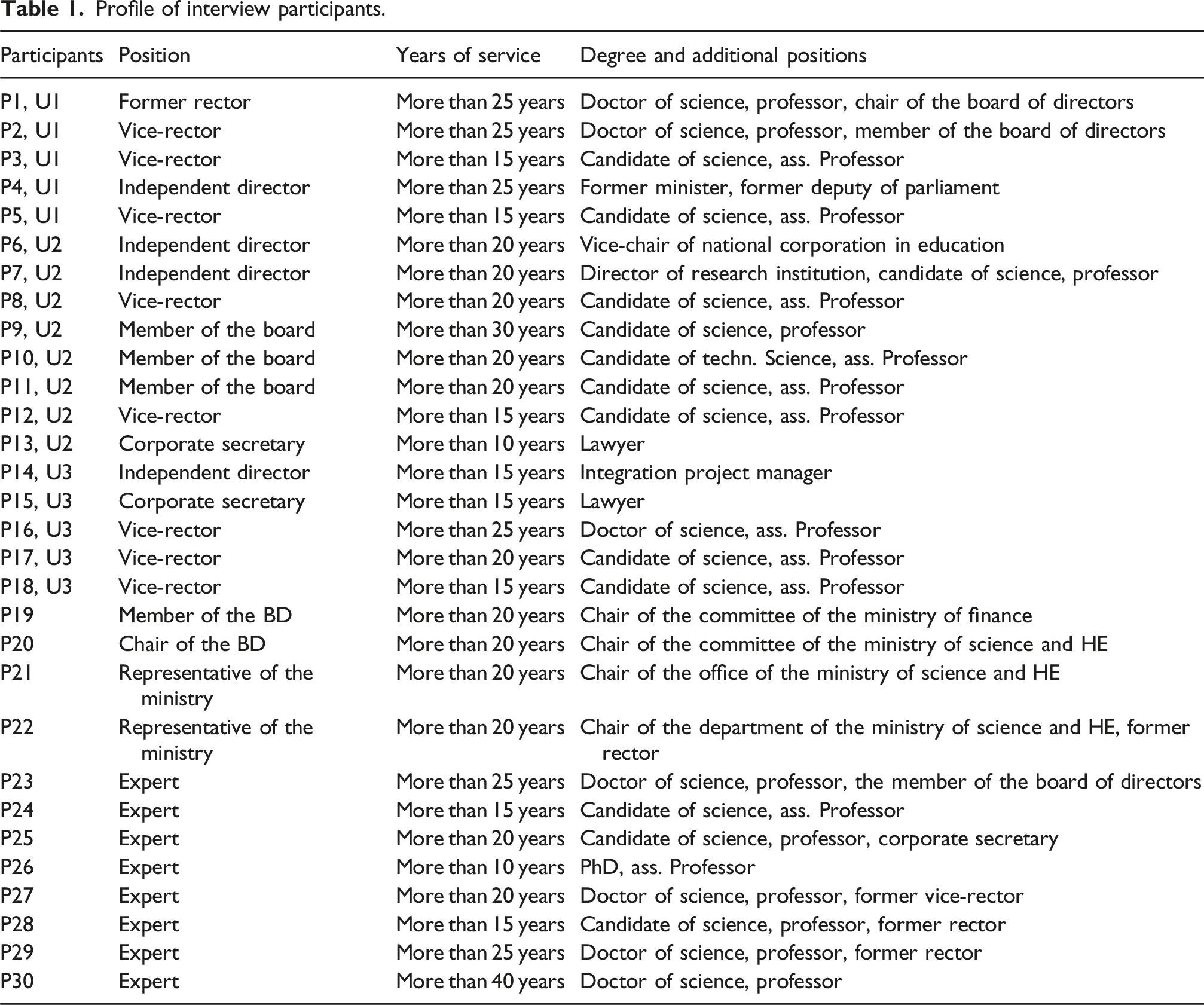
The interviews were semi-structured and guided by a protocol developed based on existing literature on UIC, HE governance, and the Kazakhstani regulatory framework. The protocol consisted of a set of core questions common to all participant groups, focusing on the drivers, barriers, and governance mechanisms of UIC. To capture diverse perspectives, additional tailored questions were asked depending on the participant category. For instance, board members were asked about their role in fostering external engagement, ministry officials were asked about relevant policy instruments and regulatory support, and university leaders were asked about institutional strategies and challenges in developing partnerships with industry. This approach ensured both comparability across cases and the inclusion of role-specific insights, thereby enhancing the depth and validity of the data collected.
Participants were identified through a combination of purposive sampling, to ensure relevance to the research objectives, and snowball sampling, which facilitated the inclusion of additional experts recommended during the research process. To maintain participant anonymity, they were labelled sequentially as P1, P2, P3, etc.
In addition to interview data, the study incorporated a qualitative analysis of several key documents to contextualize and triangulate the findings (Briggs et al., 2016). These included the Code on Subsoil and Subsoil Use as well as institutional documents including strategic plans and board reports. The documents were selected for their relevance to the governance and regulatory environment of UIC in Kazakhstan. Each document was examined to identify references to governance structures, financial mechanisms, and state-university-industry relations. Insights from the document analysis complemented the interview data by illustrating how national policies are operationalized at the institutional level and by helping to interpret variations in governance practices across universities.
Data were analyzed using thematic analysis, following a systematic and iterative approach to identify key patterns and meanings within the dataset (Braun and Clarke, 2021). Data analysis began with familiarization through repeated reading of the dataset, followed by systematic coding to identify text segments relevant to the research objectives. The analysis began with coding, during which initial codes such as research funding, student employability, bureaucratic barriers, board engagement, and legal obligations of subsoil users were identified across transcripts. The initial codes were subsequently organized into broader categories and synthesized into four overarching themes through thematic analysis, which required higher-level abstraction and interpretation (Braun and Clarke, 2021). These themes included: (1) Mutual but uneven benefits of the university-industry collaboration
Findings and discussion
This section is organized around four main themes that emerged from the data analysis: (1) Mutual but uneven benefits of the university-industry collaboration
Mutual but uneven benefits of the university-industry collaboration
The findings indicate that regional universities in Kazakhstan are actively engaging in UIC, albeit at an early stage. Interview participants stated that UIC had been mutually beneficial to both parties. In particular, in terms of research, a vice-rector of Venus University said, “This year we attracted 465 million tenges (around $1 million) in external funding within just 9 months” (P12, U2). It is a great achievement for that regional university, while its annual budget consists of 6,5 billion tenges. He also expressed his perspective on working with industrial companies, Our university has become attractive for local industrial companies. Their interest in our advanced equipment, including Japanese microscopes, increased, leading to joint projects. Also, Kazphosphate proposed the opening of a Russian chemistry university here, which would cover all expenses (P12, U2).
Similarly, another senior official of Venus University noted that their department has completed the first seven million tenges mining science project (P10, U2). He believes that this was a close bilateral collaboration, where university researchers demonstrate their knowledge and receive funding for their research. Meanwhile, the company can tackle certain issues related to industrial processes to generate more innovative products. However, this collaboration is still in its early stages, and the allocation of financial resources is very low in comparison with international practice.
The next dimension of collaboration concerns the training of personnel and training ordered by industrial companies. All interviewees from regional universities reported that their institutions offer individualized curricula and even specialized degree programs tailored to the needs of company employees. Participants from Mars University shared their experiences in this respect: There are multiple oil and gas industry companies in our region. That is why there is a great demand for technical majors. For instance, production companies order and transfer funds to us for the training of specialists. Last year, local companies paid tuition fees of 320 students (P18, U3). Sometimes industrial companies instruct us to train specialists in a certain educational program. For example, one company ordered us to train ten masters in “Production Management”, for which we developed a tailored curriculum. Similarly, a local factory asked us to deliver advanced training courses in Kazakh for clerks (P17, U3).
This collaboration is mutually beneficial, as it enables students to acquire practical production skills while providing companies with qualified specialists tailored to their specific needs. Similar data were obtained from Venus University. Meanwhile, there are no records of similar cooperation between Jupiter university and industrial companies.
Another area that nearly all participants emphasized in terms of collaboration was student internships and graduate employment placements. Although this aspect of collaboration has only just begun, it has significant potential from the perspective of academic leaders. It was a focal point for both regional universities and examples of their responses included: The “Kazchrome” company educates employees’ children at the company's expense and provide other grants. KazakhOil also trains its employees and provides grants. Kaztransgaz regularly hosts our students for industrial practice, offering them a monthly stipend of 120,000 tenge, and then hires the best of them. Thus, we are addressing the problem of student internships and graduate employment (P16, U3) Our departments have branches in major industrial enterprises, where students undertake practical training. The employees of these production companies teach our students. They are appointed as part-time faculty members (at 0.5 or 0.25 rates) and receive corresponding remuneration (P10, U2).
The findings show that UIC on student placements and graduate employment is quite promising. This is consistent with the literature, which highlights that student internships and graduate work placements are among the primary reasons for UIC (Amicarelli et al., 2022; Gornitzka et al., 2017; Zasopina, 2013). The success of regional universities in fostering UIC seems to depend on their proximity to industrial companies within the region. Meanwhile, senior officials at the national university (Jupiter) could not confirm such cooperation with industrial companies.
On the other hand, regional academic leaders noted that cooperation with industry remains below their expectations. They believe that many local businesses, especially industrial companies, are very wealthy and have financial opportunities to fund universities much more than they currently do. Meanwhile, the participants from the national university contend that this objective is determined by the university’s development strategy, but their efforts to date have failed. According to the senior managers, the lack of interest from these corporations in engaging in any collaborative ventures can be attributed to the absence of support from both the ministry and local authorities. Furthermore, the management of the national university clarified this situation in light of the geographical location of the university, which is deprived of any major industrial enterprise. However, the study of UK universities regarding ollaboration with industrial firms revealed that all universities cooperate with industrial companies within 500 km, while five top research universities collaborate on a global scale over at least 500 km, even more 4999 km (Tijssen et al., 2019). It is worth noting that the national university is one of the top universities in Kazakhstan and ranks among the top 300 in the world according to QS WUR. An important question arises at this moment. What are the underlying factors that have affected the ability of a globally recognized university to forge strategic alliances with key stakeholders, such as industrial companies? It appears, as the experts have noted, that the management of the national university has insufficient experience in cooperating with external stakeholders.
Overall, these findings indicate that UIC in Kazakhstan presents substantial scope for development. Although literature and practical evidence highlight the potential benefits of these collaborations, it is vital to recognize that perceptions of these benefits may vary. This nuanced view suggests that while national policies in Kazakhstan are focused on the innovative development of HEIs, it is essential to explore and enhance the collaboration between HEIs and the industry.
Challenges in the partnership with industrial companies
The analysis identifies that there are some key barriers to adequate UIC. The first reason was the economic constraints as a barrier to UIC. This was a focal point for all participants, and examples of their responses included: The fact that our government is only engaged in the production of raw materials and does not develop national production is an obstacle for us. Incomes from raw materials are very low. The country's economy is thus very weak and unable to adequately support HE and science (P2,U1). Our economy is in a state of trouble, with graduates unable to find jobs. Only a small number of professionals, such as teachers and graduates from vocational schools, are employed. We’re training mechanics and welders, but companies, like “Kozhkombinat”, have closed. Without economic improvement, the academic situation won’t change. If the economy recovers, there will be demand for our graduates, but there is no link between education and the local economy (P9,U2)
Participants, who worked at Venus University during the Soviet period, mentioned that their university was the main provider of education in the region and that it had stable collaboration and partnerships with all local industrial enterprises at that time. The university deliberately trained specialists, such as engineers in the chemical, textile, water, and leather manufacturing industries for those companies. However, after the collapse of the 1990s, all those industrial enterprises went through a profound economic crisis, and most of them closed, which still has a negative reflection on university life. That also confirmed our expert saying, “After the collapse of the Soviet Union, a profound crisis began, and we still feel it” (P30, Expert). Similarly, Huisman (2019) found that during the first 5 years of its independence, Kazakhstan’s gross domestic product fell by 39% leading to the collapse of most industrial enterprises and factories. As a result, industrial companies and businesses have been unable to collaborate with universities and fulfil their obligations in terms of graduate employment, internships, etc. Overall, participants’ repeated emphasis on economic constraints demonstrates that universities suffer particularly from the loss of economic infrastructure, which has led to failure in graduate employment, training, and mentoring.
The second reason is the legal gap in corporate regulation with respect to legal bodies’ obligations to engage with external stakeholders. As the findings indicate, universities are trying to attract funds from external organizations, ask for assistance from alumni, and open endowment funds. However, it remains unclear who should be responsible for partnering with external stakeholders at the university level. In this regard, the views of the university’s senior management and board members differ. University senior executives, for instance, reported that they receive little assistance from the board of directors in establishing connections with external stakeholders: I believe that the board has not yet reached this level and is not involved in setting partnerships and diversifying financial sources. The board of directors mainly acts as the supervisory body of the university. All responsibility for engaging with external stakeholders lies with the senior management, and the board is not involved in that at all (P8, U2). The board has absolutely no involvement in collaboration with external stakeholders or in attracting additional funding. Now, this is the responsibility of the executive board. For example, I participated in establishing the university’s endowment fund and attracted our alumni to it. This should not only be the responsibility of senior management but also the responsibility of the board of directors (P3, U1). Board members are random people, they occasionally attend board meetings through Zoom, and that is it. All responsibility lies with the rector and vice-rectors (P9, U2).
On the other hand, board members contended that this issue should not be a cause for concern, positing that the responsibility for addressing it lies with the university’s senior management. The board members provided the following rationales: Since the principal job of the management team is the university, they should fulfil that duty. The board members work mainly for free. It is a place for them to visit occasionally. Furthermore, the management team receives a good salary for their work, so they should be responsible for that (P4, U1). This is probably because such a task has not been assigned to us. For example, if the university executives asked for that kind of help, we could help them. On the other hand, we may be very busy with our main work (P29, Expert). Compared to the salary received by executive board members, our remuneration is not worthy of mention. It is blasphemous to say that we receive rewards, although we make decisions on very important strategic issues of the university and billions of transactions (P14, U3).
The data indicate that no member of the executive board has direct responsibility for establishing cooperation with external stakeholders at the institutional level. This is even reflected in the titles of vice-rectors, which are divided into vice-rector for academic work, vice-rector for research, vice-rector for ideological work, etc. Such a division of responsibilities among the vice-rectors existed in Soviet times and is still preserved. As a result, there is no vice-rector responsible for establishing cooperation and partnership with external stakeholders. For instance, at the national university, the vice-rector of strategic affairs attempted to collaborate with external stakeholders. At Venus University, the vice-rector of research was responsible for that, whereas at Mars University, nobody was specifically responsible for this. Therefore, there is no specific person on the executive board who is responsible for promoting UIC. However, it should be noted that the university executive board’s duties in working with external stakeholders have never been raised by previous researchers in the context of Kazakhstan. Furthermore, so far, public universities have been entirely funded by the state budget and have never relied on external stakeholders. Consequently, academic leaders still seem to be unaware of the importance of working with external stakeholders.
In turn, board members’ lack of proactive engagement represents a third factor that impedes collaboration with industrial companies. This can be attributed to the absence of remuneration for board members, significantly influencing their work productivity and commitment levels.
As discussed above, most members of the board of directors are public servants and managers of public organizations who are not eligible for compensation. Given their status as civil servants, if they receive remuneration, they will be punished according to the criminal and administrative legislation of Kazakhstan for corruption offences. In fact, only one independent board member, working in the private sector, acknowledged receiving remuneration of around 60,000 tenges (approximately $100) for each board meeting. He was really dissatisfied having said, “The board members of private companies receive several million tenges for the same work” (P14, U3). Therefore, there is no incentive for university board members to be productive. In this regard, Christopher (2014) fairly asserts that since university board members are not eligible for remuneration in the same way as their counterparts in private corporations, they are not interested in the effectiveness of their work. Interview participants confirmed that in such relationships, board members are often missing and not even attending board meetings. Hence, lack of remuneration appears to be one of the reasons why board members are so passive in establishing cooperation with external stakeholders.
The final reason is the lack of university leadership experience in engaging with external stakeholders. As the participant said, “In our universities the senior leadership lacks the skills to collaborate with external stakeholders, this work is only developing” (P27, Expert). As mentioned by the interviewees above, some board members noted a lack of knowledge and skills among the university’s senior management, while academic leaders noted a lack of awareness of HE issues among board members. For example, the vice-rector of the regional university mentioned that when he showed Japanese microscopes, chemical and engineering laboratories to representatives of industrial companies they were surprised, as such facilities had never been presented to them before (P12, U2). This incident illustrates that university executives have not been sufficiently aware of the importance of collaboration with industry. The literature review shows that in the context of a market-driven dynamic characterized by significant reductions in government funding, academic institutions are forced to forge alliances with external stakeholders and seek resources, which calls for the creation of professional executive and governing bodies and entrepreneurial structures within universities (Alves et al., 2010; Brennan, 2010). Moreover, the lack of entrepreneurial skills and abilities among university managers may lead to the decline in institutional effectiveness (Shattock, 2006). However, as participants noted, there is still a deficit in a qualified management team that can partner with universities and external stakeholders. Furthermore, it is important to keep in mind that set collaboration with external stakeholders is a new and unknown activity for both categories of participants. Meanwhile, some participants believe that attracting industry and business representatives to the board can have a positive impact on meeting these challenges. Given its significance, this suggestion will be discussed separately in the next section.
Attracting industry and business representatives to the board of directors
One of the main themes that emerged from the interviews was the perception that a key function of boards of directors is to facilitate collaboration between universities and business and industry partners. Most participants stressed the importance of involving industry and business representatives on the university boards of directors. Each interviewee sought to justify the benefits of such cooperation. It was a priority for all participants, and here are a few examples of their answers: Business and industry representatives possess strong financial expertise and can offer valuable advice and training. Since they run big businesses, they know exactly what skills and specializations demanded by the economy. Therefore, their involvement in the board of directors can have a positive impact (P1, U1) I strongly support these OECD recommendations because HE should be tied to the labor market. We should not train the future unemployed graduates, but rather specialists who are in demand in the labor market. To achieve this, potential employers should have opportunities to engage with students and provide career guidance and mentorship (P7, U2) We have business representatives as independent members on the board of directors. They help us with employment and funding. We also create our own endowment fund and attract our graduates who run large businesses to the fund's board (P25, Expert).
Other participants also confirmed the advantages of such cooperation, especially when universities are experiencing financial difficulties. They believe that universities now need to develop entrepreneurial activity and become entrepreneurial universities, and partnerships with large companies are necessary: Such initiatives can only be effectively advanced by representatives of large companies or by individuals who have personal experience in running a business. The presence of representatives of large companies as board members is very important, people who have succeeded in business can open new doors to the university and give advice and recommendations for raising funds from outside (P3, U1).
The next participant, who is currently the chair of the university board, added: For example, the former official and top manager of oil and gas industry became an independent member of the board of directors of one of the oil and gas universities. His experience, status and connections have affected the development of this university very well (P20, Official).
The former ministerial official, who is currently a rector of a public university, elaborated on the collaboration issue, saying, I believe that including representatives from large businesses and industrial companies on the board of directors would be beneficial. Their involvement would promote the training of specialists for their needs, ensuring the university's academic quality, equipment, and staff meet industry standards (P22, Official).
A similar view was expressed by the regional university executive board member, In my opinion, representatives of major local companies should be on the university's board of directors. If large companies give us grants and fund research projects, they have the right to order the training of the specialists they need (P12, U2)
However, all university leadership members recognized that currently, they do not have a stable partnership with business and industry companies. The current collaboration is occurring randomly due to their legal responsibility to allocate some funds to universities, according to the law. As noted by the vice-rector, “It is difficult to say that our university has permanent stakeholders” (P18, U3). This might be one of the reasons for the lack of business representatives in the board composition.
Most university senior managers described their board members as temporary, not interested, and not qualified in academic affairs. While board members do not necessarily need to be qualified in academic affairs, a basic understanding of HE governance and research processes is beneficial for promoting effective UIC. Their primary contribution lies in providing industry expertise, professional networks, and financial knowledge; however, without at least some familiarity with academic structures, their ability to engage meaningfully with universities and contribute to strategic decision-making may be limited. According to the university’s senior management, the board of directors should not only monitor and audit but also develop interesting investment projects, open new horizons, and provide direction. Similarly, Li (2015) found that university boards should be used as a platform to link universities to the different industry sectors that board members represent. This approach has also been recommended by OECD experts as a key factor to successful university development (OECD, 2019). Overall, the literature review and interview results suggest that incorporating industry representatives into university boards of directors enhances UIC. Moreover, academic leaders believe that the involvement of business representatives on the board of directors would be mutually beneficial for both parties. However, as indicated by the composition of the boards of directors, only a few representatives of small business companies currently sit on the sampled university boards. It can be argued that state universities are not yet in a position to attract industrial representatives to the university’s board of directors. As mentioned by academic leaders, the composition of public university boards is still dominated by representatives of state bodies since the ministry has solely appointed them. This reflects the enduring influence of the Soviet legacy, characterized by a state-centralized governance system (Bayanbayeva, 2025; Huisman, 2019; Sarinzhipov, 2013). This finding has significant implications because it suggests that the ministry remains a powerful player in both the establishment and functioning of these boards, thereby hindering their efficacy as platforms for facilitating UIC and value creation. Furthermore, this finding highlights the imperative for academic leaders to actively participate in the formulation of their respective boards of directors, enabling a rational and comprehensive identification of key stakeholders.
These challenges also relate to the broader issue of institutional autonomy and the interaction of state, university, and industry actors within Kazakhstan’s emerging Triple Helix system. Despite the government’s reform efforts to enhance institutional autonomy in 2018, the findings suggest that this autonomy remains largely formal and underutilized in the context of UIC. The sampled universities demonstrated limited capacity to exercise their new legal and financial independence to attract or negotiate with industrial partners. Through the lens of the Triple Helix model, these dynamics reveal a persistent imbalance among the three actors: while the state has taken on an entrepreneurial role by creating regulatory and financial frameworks for UIC, universities and industry actors have yet to assume equally proactive positions. The blurring of boundaries envisioned by the Triple Helix remains incomplete, as universities lack the managerial and organizational capacity to translate autonomy into genuine innovation partnerships.
Legal pathways to revenue generation
As mentioned above, industrial companies fund training and research projects at regional universities. This trend has emerged in recent years because industrial companies engaged in subsurface use have become legally obligated to allocate funds. Under the law, foreign and national companies that produce mineral resources in the regions should allocate 2% of the total of their contract directly to universities. For example, Articles 36, 129, 178 and 212 of the Code of the Republic of Kazakhstan on Subsoil and Subsoil Use provide that investors must allocate funds for the training of staff and for research (Code, 2017). In practice, these funds can be transferred either directly to universities through contractual agreements or, in some cases, through coordination with the Ministry of Energy or regional authorities. However, as several participants noted, the mechanism remains inconsistently implemented, and the lack of transparent procedures often limits universities’ access to these resources.
This Act only came into force last year, and there are already the first funding streams. For example, a senior official of Venus university pointed out: “A company from Atyrau region transferred 28 million tenges (around $58,000) and ordered us for the specialities they needed, and thanks to this money, we are training 32 students” (P12, U2). Another participant from Mars university also confirmed having received financial assistance, “Last year we received 80 million tenges from external companies, but they did not ask exactly which specialities we should train” (P17, U3). However, some participants assume that industrial companies funded universities because they were legally required to invest a certain amount in research and development. The ministerial official claimed that “This work is still at an early stage, and in a few years, we may be able to draw some conclusions” (P20, Official).
On the other hand, academic leaders argue that industrial companies avoid cooperating with universities and are unwilling to allocate this money and even seek ways of circumventing the law. This is clearly seen in the following quotations: I recently heard that large companies have their own research institutes and laboratories attached to them and they are not interested in UIC (P17, U3). The mechanism of external funding is still not working. The reason is that large transnational companies work in the field of subsoil use, but the local authorities and the rector are powerless to contact them (P22, Official). Kazchrom and the Chinese oil and gas company have opened own research institutes. Legally, they are right, but we have no benefit (P16, U3).
As these quotes indicate, although a legal obligation exists, funds from subsoil users rarely reach public universities, as local authorities lack the leverage to influence large industrial companies and government oversight remains weak, resulting in insufficient financial support for universities. Another important factor behind the industry’s reluctance to allocate funding to universities is the perceived low research and innovation capacity of HEIs. As noted in previous studies, many Kazakhstani universities still face challenges related to limited infrastructure, weak commercialization mechanisms, and insufficient experience in collaborative research (Jonbekova et al., 2025; Kuchumova et al., 2023; Moldashev et al., 2025). Consequently, industrial companies often question the practical benefits of partnering with universities, opting instead to establish their own research units or channel resources into social and community projects that yield more visible and immediate outcomes. This dynamic reinforces a cycle in which the lack of trust and confidence in universities’ research potential further constrains the implementation of the Code’s provisions on industry-funded research. Therefore, introducing tax incentives and related measures specifically targeting investments in universities could encourage greater industry participation in funding HE and research. For example, in the USA, philanthropic organizations and charitable foundations have significant tax benefits ranging from 20% to 50%. As a result, leading companies have actively engaged in philanthropy initiatives to improve their brand reputation and increase their market attractiveness. Thus, the government, as the sole shareholder, should represent tax incentives for industrial companies and philanthropists. Overall, the findings indicate that there are legal opportunities to attract funding from industrial companies in subsoil and subsoil use. However, these companies have not provided sufficient funding because of legal deficiencies and the impotence of government authorities. It seems that the government should pass additional regulatory acts to ensure transparent relations in the activities of these industrial companies.
Conclusion
The purpose of this study was to analyze the current state of UIC in Kazakhstan’s public universities, and to identify the systemic challenges and opportunities. The findings revealed that while UIC contributes to innovation, economic growth, and the modernization of HE, its progress in Kazakhstan remains constrained by several interrelated issues – including weak institutional capacity, fragmented governance structures, limited managerial expertise, and the predominance of state-driven, compliance-based partnerships. These structural and governance barriers prevent universities from fully engaging with industry and hinder the development of trust-based, mutually beneficial collaboration. Addressing these challenges is crucial to unlocking the transformative potential of UIC in Kazakhstan and in other developing nations seeking to build innovation oriented HE systems.
This study makes a valuable contribution to the literature by being the first to explore HE governance issues in UIC in the context of Kazakhstan. It provides a comprehensive understanding of the institutional and governance-level barriers as well as opportunities that shape UIC. By situating the discussion within the broader framework of HE modernization in developing nations, the study advances understanding of the complex interplay between governance structures, economic constraints, and stakeholder dynamics in fostering or impeding UIC.
The study identified several key challenges that hinder UIC in Kazakhstan’s public universities. First, the post-Soviet economic collapse disrupted the country’s economic infrastructure, leaving long-lasting consequences that are critical to the establishment of robust UIC. As a result of this collapse, many state-owned factories and plants that had collaborated with regional universities either went bankrupt or were privatized. Consequently, the connection between universities and industry was severed. Second, there were significant shortcomings in governance structures, such as the lack of clear responsibilities for governing boards and executive leadership to interact with external stakeholders. The perception of UIC as outside their responsibilities and unpaid service is affecting the productivity and commitment of the governing board members. The executive board members have reported that their capacity to foster external partnerships is limited due to the absence of support and engagement from the governing boards. Furthermore, the lack of expertise among university senior managers and outdated governance structures further hinders effective collaboration. Third, the study revealed that UIC at two regional universities achieved some success, including receiving research funding, academic training programs, internships, and graduate employment opportunities. Meanwhile, the central national university demonstrated limited industry engagement. The two regional universities are located in areas where large international and industrial companies operate. Thus, in the context of Kazakhstan, regional universities demonstrate greater potential for effective collaboration with industrial companies compared to larger, centrally located universities. However, the limited collaboration of the central, research-oriented university cannot be attributed solely to its geographical distance from major extraction sites. The findings of this study suggest that weak institutional mechanisms for external engagement, bureaucratic governance culture, and limited managerial experience in building strategic partnerships also constrain collaboration. These findings challenge earlier studies that primarily attributed weak UIC to universities’ low research capacity (Jonbekova et al., 2025; Kuchumova et al., 2023). In contrast, this study reveals that even a flagship national university with high research capacity faces difficulties in engaging with industry, while two teaching-oriented regional universities demonstrate comparatively greater success in building UIC. Finally, it was further revealed that these partnerships were mostly based on compliance, as legislative mandates required subsoil companies to allocate 2% of their investment budgets to training and research. So, there were no genuine, mutually beneficial partnerships. The study also found that many large industrial companies avoid legal obligations and neglect to pay the necessary sums to universities. While local authorities are unable to enforce these payments due to their lack of authority and power. Therefore, this situation demonstrates that regional university-industry collaborations are largely coerced by legislative requirements, lacking the foundation of true, mutually beneficial partnerships between the two parties.
The practical implications of this study are significant and present opportunities to transform UIC in public universities of Kazakhstan. First, the study demonstrates the necessity of restructuring university governance to ensure active representation from industry on governing boards. This could involve redefining the roles and responsibilities of both governing and executive boards to prioritize engagement with external stakeholders. By embedding representatives from large industrial companies into strategic decision-making processes, universities can foster mutually beneficial relationships that align more closely with national innovation and development goals. Second, it is crucial to encourage industry participation through regulatory and financial mechanisms. Clear policies that encourage companies to collaborate with universities meaningfully, such as tax incentives or public recognition, can create long-term partnerships. At the same time, requiring subsoil companies to fulfill their financial obligations toward research and education would ensure compliance and enhance the financial sustainability of UIC. The third point of this research is that Kazakhstan’s universities should be transformed into entrepreneurial institutions that can form meaningful partnerships with industry. To address governance inefficiencies, clarify stakeholder roles, and provide greater autonomy and accountability to university boards, systemic reforms are needed. Universities should adopt international best practices for governance and collaboration to boost their contributions to innovation, workforce development, and economic progress. The achievement of these goals will require the coordination of efforts by policymakers, university leaders, and industry stakeholders.
Footnotes

Ethical considerations
The study was approved by the School of Education Research Ethics Committee with a reference number of 10837.
Funding
The author received no financial support for the research, authorship, and/or publication of this article.
Declaration of conflicting interests
The author declared no potential conflicts of interest with respect to the research, authorship, and/or publication of this article.