



Abstract
The year 2018 marked the 10th anniversary of the global economic crisis of 2008. In Europe, austerity has been a constant ever since the crisis. This article critically engages with recent institutional and ideological developments in the small Baltic state of Estonia. The article investigates the structural reforms and prevailing ideology in Estonian universities under conditions of the post-2008 economic crisis austerity regime. How has austerity impacted academia and what have been the responses to it? How has the university been approached in the context of post-crisis socio-economic challenges? Structural reforms and business ethos coupled with decreased public funding have been part and parcel of the European higher education landscape, from Greece to the British Isles. Expanding the research done on this subject, I explore these issues in the Estonian context with a particular focus on the political economy and institutional governance. I seek to show how Estonia’s consolidation politics in the field of higher education governance has led to a decline of the university as a public (sector) institution and limited the opportunities to undertake independent, critical research. I conclude with recent attempts to contest austerity in universities at a time of a conservative turn in Estonian politics.
Introduction
Non-capitalist organizations provide a fertile soil for capitalism: capital feeds on the ruins of such organizations, and although this non-capitalist milieu is indispensable for accumulation, the latter proceeds at the cost of this medium nevertheless, by eating it up. (Rosa Luxemburg, 1961: 416)
The year 2018 marked the 10th anniversary of the global economic crisis of 2008. Being the worst crisis of capitalist economies since of the Great Depression of the 1930s, it raised doubts about the adequacy of an economic model based on competition, deregulation and financialization. In the heat of the collapse of the Lehman Brothers investment bank in the autumn of 2008, hopes of a better, more fair economic order emerged both in the US and in Europe. Lessons could be learned from the economic mismanagement that led to the crisis. An economic model more hospitable to human welfare and ecology was hoped to replace the neoliberal or market fundamentalist phase of capitalism that, so it appeared, had subjugated societies detrimentally to the (mal)functioning of the economy. Its inevitability, if not feasibility, had disappeared.
In hindsight, the alternatives failed to gain traction. Instead, the status quo has been consolidated in the decade that has followed. In Europe, in particular, austerity has been a constant ever since the debt crisis of 2009/2010 which followed the financial crisis of 2008 (Frangakis, 2018: 111–121). The European Union and its strongest member state, Germany, have been persistent in their endorsement of austerity as a solution to the debt crisis in the Eurozone. Although Europe’s current troubles are and have been complex and irreducible to one issue, it is hard to overestimate the role that austerity has played in undermining the European societies and institutions. Consequently, Europe can no longer be regarded a welfare continent or a continent that prioritizes social security; the last decade has seen the undermining of Europe’s historical pillars. As Jan Kavan, former President of the United Nations General Assembly, has recently argued ‘[t]he vision of Delor and other fathers of the European model, that is, of a peaceful, integrated, democratic, ecologically responsible, and socially just Europe, has long been no more than a rapidly fading dream’ (Kavan, 2018: 36). Commenting on the EU politics of austerity, Czech economist Ilona Švihlikova has claimed that: [a]usterity policy has had very negative impact on the whole euro area, not only countries hit by the crisis. The social impact is disastrous in terms of wages, unemployment, youth unemployment in particular, precarisation of work, and the phenomena of hysteresis, which leads to permanent loss of potential output (Švihlikova, 2018: 74).
The socio-economically difficult aftermath of the economic downturn 10 years ago did not change Estonia’s political orientation (Aidnik and Rikmann, 2018). Comparatively radical austerity was introduced as a sound, necessary logic and a return to ‘living within one’s means’. Since then, the gains of austerity such as economic growth have received much more attention than the downsides—namely suppressed level of income for a large population of the society. This neglect is also true regarding the realm of higher education and universities in particular. Critical studies focusing on the state and problems of Estonian universities remain scarce (see for example Aavik, 2019; Aavik and Marling, 2017).
The reason this subject matter is important is because it helps to understand the wider context and consequences of the structural reforms and business ethos in universities under an austerity regime in Europe’s northeastern periphery. I intend to approach these reforms (or rather ‘reforms’) critically because, in my understanding, their implementation and the new structures are not compatible with the university as a public institution. Structural reforms and business ethos coupled with decreased public funding have been part and parcel of the European higher education landscape, from Greece to the British Isles (Gounari, 2012; Mercille and Murphy, 2017; Holmwood, 2016). The commercialization of universities in Europe commenced under the auspices of political authorities (including the Bologna process) but proceeds now through the voluntary choices of university directorates for the creation of narrowly utilitarian knowledge (Tomicic, 2019: 18).
Expanding the research done on this subject matter, I explore these issues in post-2008 Estonia with a particular focus on the political economy and institutional governance. Such a focus enables us to grasp the universities in a wider constellation of political–economic forces. I inquire into the crisis management in the form of fiscal consolidation in Estonia. Thereafter, I focus on the structural reforms and ideology in universities, which is the main concern of this article. I seek to show how Estonia’s consolidation politics in the field of higher education governance has led to a decline of the university as a public (sector) institution and limited the opportunities to undertake independent, critical research. I conclude with recent attempts to contest austerity in universities at a time of a conservative turn in Estonian politics. The article will further a critical understanding of the changes that universities have been undergoing in northeast Europe in terms of both policies and ideology. In addition, the assessment of the changes that I undertake will advance research on the state of universities under conditions of (neoliberal) austerity regime and public sector structural reforms, key aspects of the post-2008 economic crisis fiscal consolidation strategy in Europe.
Methodologically, the article stands within the tradition of Frankfurt School of critical theory. Critical theory is characterized by a normative critique of society and its institutions. Critique of ideology, which unmasks ideology in relation to the (material) interests that motivate it, is at the core of critical theory. Instead of explanations of social reality that convey it as harmonious and rational, critical theory is keen to reveal the tensions and injustice inherent in capitalist societies (Adorno, 1976). Importantly for this article, critical theory maintains that the economic and non-economic realms are separate, but at the same time dialectically intertwined (Rothe and Ronge, 2016). The aim of the article, therefore, is to critically theorize the issues under consideration; and bring to the fore the dialectic between the realm of economy and the realm of universities. In the spirit of critical theory, I also endeavour to envision an alternative to the status quo – universities that are free from material and ideological pressures and committed to democracy and social equality.
The mission of the university, as I understand it, is to stand for ‘democratic and humane principles, to develop bonds across national boundaries, and to develop forms of life together that honour human dignity’ and ‘to establish forms of enquiry that have as their central aim the understanding of the principles of freedom, justice, human dignity and solidarity’ (Butler, 2017: 859). 1 It is only then that the university can live up to its potential as a public institution that makes a broad, transformative social contribution.
Neoliberalization and marketization of the university: An overview
In order to contextualize my study of the Estonian universities and better theoretically grasp the transformations that are at the core of my paper, I now provide a brief overview of the academic accounts of neoliberalization and marketization.
Neoliberalism has succeeded in marginalizing university education that has no market value. Previously a public good or a public service, university education is being transformed into a tradable service for the homo economicus (Lynch, 2006: 4). The key aspects of neoliberalism are value-for-money, the rise of managerialism, consumerism, accountability and strictly controlled performance audit culture. In the university – as in other institutions – neoliberal governance aims to create and protect competition as the organizing principle for societal decision-making (Canella and Koro-Ljungberg, 2017: 156). Competition as a guiding rationale is individualizing: it leaves little room for solidarity or academic staff as a collective. Consequently, the neoliberal university is characterized by individualism and a pervasive sense of insecurity. Competitive project-based funding is increasingly the order of the day, and a great deal of teaching is done by low-paid adjunct lecturers on short-term contracts. 2 Ricardo D Rosa speaks of de-professionalization through adjunct appointments (Rosa, 2013: 219). 3 Neoliberalism subordinates the status of the faculty through forms of appointment which are adjunct, short term or part time. Such academic staff lacks what can be called a basic income, sufficient to ensure basic income security. Furthermore, neoliberal governance subordinates the faculty to management, removing academic staff from positions of decision-making (see for example Ginsberg, 2011).
As the aim of education and employment conditions undergo significant changes under neoliberalism, the university is also transformed as an institution. First and foremost, its autonomy (or relative autonomy) vis-à-vis the economy and political administration is eroded. The private sector becomes a model for the university with its flexibility, cost-effectiveness and dynamism. The Bologna Process initiated by the EU has brought together 48 countries through the mechanism of the European Higher Education Area (EHEA) to facilitate the mobility of students, faculty between countries, harmonize qualifications and provide quality assurance (European Commission, 2019). Although the Bologna process has partly humanistic aspirations such as the personal growth of students through new experiences, the EU perceives higher education as a means for economic innovation and growth. To better serve such a purpose, universities have been transformed according to the same logic of management principles and discourse (Tomicic, 2019: 5; Sosteric et al., 1998).
Lastly, universities that are wedded to market economy and oriented to the creation of human capital do not support or strengthen democracy or give rise to critical engagement with the status quo. Belonging to the heritage of Enlightenment, the university no longer represents the aspirations of Enlightenment, including emancipation from heteronomy, as Kant famously described the meaning of Enlightenment. Kant’s conception of Enlightenment is the task that Adorno considered imperative for (higher) education (see Adorno, 1971).
Having sketched the central contours of the neoliberal university, I now proceed with the case of Estonia.
The politics of austerity in Estonia since 2008
The governance strategy chosen in Estonian politics in the aftermath of the 2008 crisis has had lasting consequences for the society and its institutions, including institutions of higher learning. The financial hardship that Estonian higher education has had to endure in the last decade is a consequence of an overarching austerity programme.
As the global economic crisis reached Eastern Europe in 2008, it was the three Baltic countries with their liberal and open economies that were hit the hardest. Economic contraction was the reality in all three countries, property prices fell rapidly, average incomes declined and unemployment went up. Both real and nominal wages declined in all three countries. The public sector in all countries absorbed the crisis mainly through wage cuts, while the declining number of jobs was the reality in the rest of economy (Sommers et al., 2014: 407). Unlike in Latvia and in the Anglo-American countries, a banking crisis did not occur in Estonia because the main banks belong to Swedish banks, which held 92% of the market in 2007. The Estonian government decided on fiscal consolidation earlier than most OECD governments. Several consolidation measures were applied across three negative supplementary budgets (the first in 2008; two more in 2009). The third negative supplementary budget introduced several tax increases (the rise of value-added tax, for example) and a sharp increase in social security contributions. At the same time, progressive taxes such as progressive income or corporate income tax, which still do not exist in Estonia, were not even considered. From 2010 onwards, the revenue side of consolidation measures has been driven mainly by the tax rate increases decided in 2009 (Savi and Randma-Liiv, 2015: 418).
The aim of joining the Eurozone was a key reason in tackling the crisis through applying austerity measures. Eurozone access criteria enshrined in the Maastricht Treaty tied the government to keep the deficit below 3 percent of GDP and the government debt under 60 percent of GDP (Caporaso and Kim, 2013: 92). Commenting on the scale of government cuts led by the Reform Party, Bohle and Greskovits (2012: 233–234) have noted that these were more expansive in 1 year, than the cuts the British government made in 5 years. Social security and old age pensions were cut, local government spending was restricted to 60 percent of expected revenues. Writing in the German newspaper Die Zeit, Josephine Pabst (2013) called the cuts ‘draconian’ and socially immiserating. Estonia opted for a controversial and rare strategy of internal devaluation, an approach that seeks to restore competitiveness through lowering the cost of labour force (Feldmann, 2013). This Chicago School crisis management strategy has been entertained in theory in the West but rejected in practice because of the pain it inflicts on society (Feldmann, 2017). Austerity continued relatively unscathed well into the 2010s.
A considerable change in the Estonian political landscape took place only in the late autumn of 2016. After rising political discontent in the face of social and economic stagnation, a change of government eventually happened. Consequently, the centrist Central Party replaced the Reform Party in the coalition and Jüri Ratas, Chairman of the Central Party, became the new Prime Minister. There has been a gradual thaw in the politics of austerity ever since. Social investments have increased, and the new coalition has taken measures to address the well-being of low-income earners, exemplified by the rise of tax-free minimum income and changes in income tax rate for low-income earners in 2017. The state took a more proactive role in improving the well-being of its citizens. It would, however, be an overstatement to speak of a paradigm shift in Estonian politics; the coalition of 2016–2019 engaged in long-overdue austerity alleviation and, in spring 2019, a new conservative government coalition was formed after general elections. The new coalition, based on preliminary budget strategy, is returning to strong fiscal discipline. I will discuss this issue in the Discussion and conclusion section.
This section has outlined the contours of Estonian austerity politics after the economic crisis of 2008 and explained the motivation behind the strategy. The country is similar to the rest of Europe in terms of the path chosen after the crisis hit the Baltic region. On the other hand, it does stand out for the severity and speed of the cuts undertaken without much consideration of their social or institutional impact. Furthermore, it stands out for the fact that austerity was imposed independently of the EU’s interference, even if the decision was mediated by the concern to become part of the single currency area.
Estonian universities: Three case studies
I will now turn to the main concern of this inquiry – Estonian universities. In terms of study materials, I mainly rely on strategic development plans, reports on higher education and existing academic research. I focus on three key developments in Estonian universities that serve to illuminate institutional governance and ideology under conditions of austerity in the last decade. They mark the period when the public sector consolidation and modernization efforts reached higher education after the immediate post-crisis years. First, I probe into issue of funding in Estonian universities to investigate the general austerity policy in a concrete realm. Second, I discuss the structural reforms in the period between 2014 and 2016 as a particular recent institutional reform with wide-ranging consequences. Third, I examine an influential report known as ‘The Report of Gunnar Okk’, published in 2015, that assessed the situation and challenges of higher education and research institutions, in order to shed light on the ideology in higher education governance. Taken together, these three case studies enable one to critically theorize the realm of universities and the governance constellation in Estonia in the decade after 2008.
Before proceeding with the case studies, I will describe the Estonian higher education system briefly. There are two types of higher education institutions in Estonia: universities and professional higher education institutions. There are six public universities and one private university in Estonia. There are eight state-owned institutions of professional higher learning and five privately owned institutions of professional higher learning. 4 Public universities and state professional institutions of higher education receive performance support from the state budget for providing higher education. Institutions of higher education that receive state funding will make decisions regarding the number of student places created for each field based on the institution's profile and function. Should the state have a specific shortage of graduates in a certain field, it can establish its needs through performance contracts. Private institutions may also apply for state support, but if the state grants their requests, they will lose the right to charge their students full tuition fees. Since the 2012/2013 academic year, higher education has been free of charge in Estonia for those studying full time and in Estonian at public universities and at state-owned institutions of professional higher learning. In the following sections, I focus primarily on public universities.
The issue of funding
Estonian universities and science and research development have had to endure a decade of austerity in the post-2008 austerity regime. For much of this period, the issue of underfunding has received little attention. Successive post-crisis government coalitions led by the pro-austerity Reform Party had no place in their agenda for investing in institutions of higher learning or increasing public funding available for research. One can argue that the underlying reason for structural reforms was the underfunding of universities. The link between austerity and structural reforms is well documented (see Gualerzi, 2017; Stieglitz, 2016). As increased investments are not an option, financial difficulties in public sector institutions have been supposed to be addressed by finding resources from within (Aidnik, 2016). Estonian sociologist Kadri Aavik argues that the underfunding of science and higher education in Estonia is due to the neoliberal governance paradigm that continues to be influential in higher education policy (Aavik, 2018: 6). Its point of departure is the self-sufficiency of human beings and institutions. Their value is determined by the market. Scientists and universities need to be proactive in finding research funding; the failure to succeed implies that they might not deserve it.
Academic freedom has unmistakeably deteriorated in such conditions. A 2017 University of Lincoln study concluded that Estonian universities have the least academic freedom of all EU member states (Karran and Mallinson, 2017). The study analysed (a) Academic Freedom in Legislation, (b) Institutional Autonomy in Legislation, (c) Self-Governance in Legislation, (d) Job Security and (e) Constitution & International Agreement. Estonia ranks last with Slovakia in the category of job security and performs poorly in other categories as well. While is true that academic freedom can be assessed in more than one way, and that the study focuses primarily on the United Kingdom, the result is still significant. It reveals the deterioration of academic freedom under conditions of inadequate job security, where academic staff members depend on their success in securing their income, mostly in the form of competitive research project funding. 5
Estonian scientists have shown considerable success in obtaining research funding from the European Union´s ‘Horizon 2020’ programme: since 2014 the country has ranked third after Cyprus and Slovenia in the EU in terms of the ‘Horizon 2020’ funding received in relation to state GDP (Estonian Ministry of Education, 2017). Since the academic year 2012/2013, higher education has been Estonia is free for students studying full time and in programmes in Estonian. Lack of tuition fee revenues has left universities finding alternative sources of income such as increasing the number of study programmes in English (where tuition fees exist), hosting conferences and training events and cooperating with the private sector.
In September 2017, the Estonian Ministry of Education and Research passed a regulation titled ‘The conditions and rules of allocating basic funding to Development and Research Institutions’. The regulation changed the way basic funding is allocated to research and development institutions. Starting in 2018, revenues received from business contracts will be doubled in allocating basic funding – contracts with private legal persons will count twice as much as contracts with other parties. Fifty percent of basic funding is allocated based on research and development revenues. Different types of contracts had previously the same significance in basic funding allocation – revenues generated from cooperation with public sector, private sector and non-profit sector had the same weight in allocation calculation for research and development institutions. The Ministry of Education and Research has sent a clear signal about which type of cooperation and research is a priority for universities and other research institutions. The regulation shows that business orientation dominates not only the ideology of higher education but also the policy. The policy was passed with very limited notice and attracted criticism from Tallinn University, as well as from smaller arts universities, such as the Academy of Arts and the Estonian Academy of Music and Theatre. These universities have the weakest connections with the private sector and are the most disadvantaged under the new framework. However, the regulation was passed, as the two largest universities – Tartu University and Tallinn University of Technology – were in favour of it. I will discuss its implications in the Discussion and conclusion section of this article.
There have finally been positive developments in contesting the austerity regime at universities. April 2018 saw the first March for Science in Estonia. The first march of such kind took place in 2017 in the United States in order to draw attention to the importance of science and research in society and politics. The march in Estonia primarily sought to draw attention to the public sector underfunding of research and development. The research, development and innovation strategy of 2014, titled ‘Knowledge Based Estonia 2014–2020’, crafted by the Ministry of Education and Research, had stated that the amount of state funding for research and development would be 1% of GDP by 2015 (Ministry of Education and Research, 2014). In 2017, the percentage of public sector funding for research and development was only 0.53% of GDP. There is a broad agreement that a lack of stable funding jeopardizes the future of Estonian science and universities. In 2017, the overall Research and Development expenditure was 1.29% of GDP in Estonia. Public funding (as opposed to private sector and external funding) amounted to less than half this amount – 0.53%. According to the most recent Eurostat statistics, available from 2016, the average Research and Development expenditure as percentage of GDP is 2.04%. Looking at Estonia in the Eurostat statistics, the expenditure has been in steep decline since 2012, when it was around 2% of GDP (Eurostat, 2016) (Figure 1).
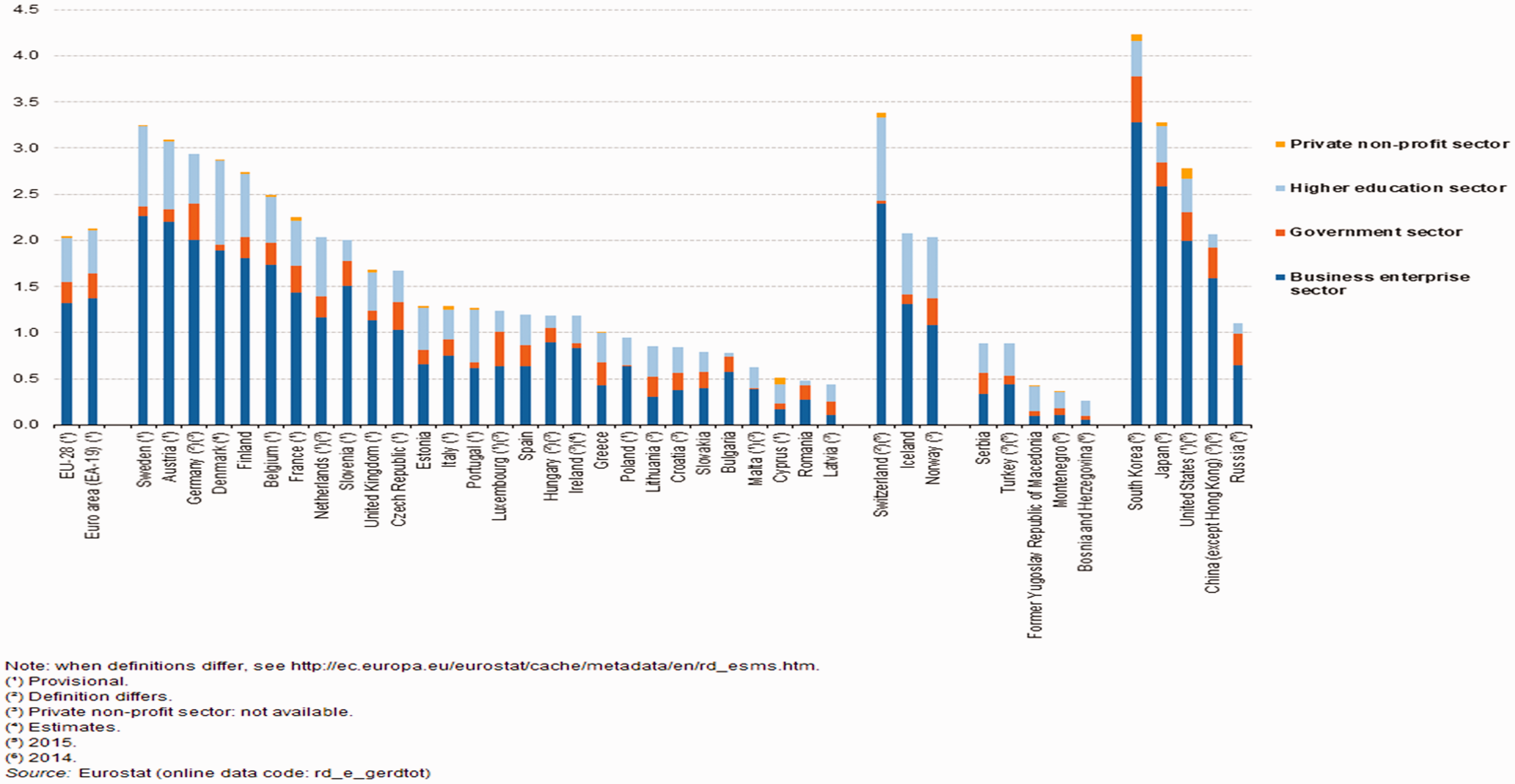
Gross domestic expenditure on R & D by sector, 2016 (percent, relative to GDP (Eurostat, 2016)).
In November 2018, the Estonian Chamber of Science was founded in order to represent the interests of scientists: achieving adequate research and development funding and working towards a more science-based economy, society and politics in Estonia. The Chamber includes members from all major Estonian universities. The most recent development, in December 2018, was a political agreement to raise the public funding for research and development to 1% of GDP within 3 years. All the parliamentary parties, except for the Estonian Conservative Peoples´ Party, signed the treaty, together with the Estonian Academy of Sciences, the Estonian Employers´ Confederation and the Estonian Chamber of Commerce and Industry (Randlaid, 2018). The agreement would have been unlikely were it not for the mobilization of Estonian academics and scientists. The state of universities and research is already critical. Natural scientist Aveliina Helm (2018: 5) has for example argued cogently that if the status quo does not change, a whole generation of scientists will have to terminate their research activities. In the years 2018 and 2019, a change in the mentality among academics has become palpable.
Structural reforms
University of Tartu, Tallinn University, and Tallinn University of Technology—the three Estonian main public universities that are the focus in this article, underwent structural reforms in 2014–2016: These reforms merged and reduced the number of institutes, set up new modes of governance and redesigned curriculums. At Tartu University, the biggest and oldest Estonian university, four academic fields were created instead of the previous nine faculties and four colleges. At Tallinn University, the university of mainly social sciences and humanities created as recently as in 2005, six institutes emerged as a result of merging more than twenty previously independent institutes. At Tallinn University of Technology, the predominantly applied and natural sciences university four faculties were created instead of the previous eight faculties and twelve research institutions.
The official explanations behind the reforms were as follows: Tallinn University of Technology declared that the reforms were necessary in order to be flexible to the needs of society. They were supposed to make the university more dynamic. The university aspired to be a stronger partner for society. The reforms were expected to make the management of the university more transparent and efficient (Nõges, 2017). The explanation given by the University of Tartu declared that the reforms were undertaken in order to achieve greater accountability of faculties to the university as a whole; and to raise the academic level (Seletuskiri Tartu Ülikooli põhikirja kavandi juurde (Letter of explanation to the University of Tartu Statute Draft), 2014). Developments in global higher education, whereby similar reforms are made for purposes of accountability and sustainability, were cited as a motivating reason. Strategic aims of the university, it was stated, require greater balance between different fields – the previous structure was perceived as too scattered, making it difficult to guarantee equal rights, responsibility and duties. Tallinn University similarly endeavoured to reduce differences in different institutes, to achieve greater economic sustainability and management efficiency (Land, 2016).
Structural reforms in Estonian universities have hitherto not been studied in Estonian social sciences. Public sector reforms outside of the university have, however, been studied, and can be used to inform understanding of the university context. Analysing two major public sector structural reforms in Estonia – administrative reform and public service reform – Tammiste and Kalev (2017) concluded that there is a discrepancy between reform policy in documentation and in practice. Whereas reform policy theory in Estonia normatively declares participation and understanding of different possibilities, practice is influenced by new public management´s emphasis on efficiency and functional division of labour. The inquiry revealed that officials are more afraid of being unproductive and wasting time than they are of lesser legitimation; of not proceeding quickly enough and being inefficient. Both reforms were transparent and formally open to participation to different interest groups but in practice only a small circle of select participants were included (Tammiste and Kalev, 2017: 52). It is further stated that in the cases analysed, the main legitimation and involvement took place when the draft law was at the stage of coordination. The interviewed officials considered this stage early enough and spoke of the inefficiency that comes with involving participants too early. Therefore, neither of the reform processes were favourable towards horizontal cooperation networks in which different parties could have given input with their opinions and proposals (Tammiste and Kalev, 2017: 53).
Fritz Scharpf distinguishes input- and output-based legitimation (Scharpf, 1999). Input-based legitimation starts at an early stage of policymaking; political communication is open to different arguments based on which different parties can develop their opinion. It is inclusive and encourages participation. Output-based legitimation focuses on results. This form of legitimation presupposes preconceived solutions and expert knowledge strong enough to send convincing, legitimizing messages to those impacted by the reforms. Output-based legitimation can be argued to apply to the structural reforms and partly explain their swiftness and lack of opposition. In addition, the reforms were met with acquiescence because no alternatives were conceived to them. They meant adaptation, especially for the academic staff, and were entirely marked by what the late sociologist Zygmunt Bauman (2017) called the TINA (‘there is no alternative’) syndrome.
A key governance consequence of the reforms has been shifting the power of decision-making from academic staff to administrative staff. The new structures are more centralized, with their own institutional elite. The academic staff under new circumstances participates in or influences decision-making but has very limited autonomy of its own (Aavik et al., 2017). The implication of the structural reforms and new structures is that universities are in principle not different from other (private sector) organizations, and that governance principles not intrinsic to universities nevertheless can and should be applied to them. While the structural reforms were approved by the Senates (the highest academic governing body) of the three universities, democracy has been circumscribed. The new structure favours top-down management and not bottom-up initiatives. Instead of deliberative or grassroots democracy, which are in theory suitable for the university as an institution and have historically been partially realized, the actually existing democracy is for the academic staff mostly limited to receiving information about decision-making or having the opportunity to provide input.
The report of Gunnar Okk
While the structural reforms were nearing completion, in August 2015, a report was published, titled ‘Report on the network and policies of Estonian universities, research institutions and institutions of professional higher education’. The main author, Gunnar Okk, is former CEO of the Estonian Energy Company and Statoil Estonia and now Chairman of Tallinn University of Technology Board of Governors. The report became known after its author as ‘The report of Gunnar Okk’ or ‘the Okk report’ (Okk, 2015). I have chosen to study this report because it exemplifies the rise of managerialism in Estonian universities. In addition, the tendency towards private-sector inspired and oriented solutions comes clearly to the fore in this report.
The Estonian Research and Development and Innovation Strategy ‘Knowledge-based Estonia 2014–2020’ (Ministry of Education and Research, 2014) approved by the Riigikogu (Parliament of Estonia) on 22 January 2014, establishes the target to ‘support the development of areas of responsibility of institutions of higher education and research and development institutions, also their structural changes, focusing on strategic fundamental activities and the re-organization of the network of institutions; increase the responsibility of research institutions for the effectiveness of their activities.’ On 25 February 2014, the Research and Development Council (RDC) decided to commission a report on the network and policies of Estonian universities and other research institutions, including institutions of professional higher education. The Council appointed RDC member Gunnar Okk as head of the working group responsible for preparing the report (Okk, 2015).
The report was based on 32 interviews with members of the Research and Development Council as well as with external experts such as current and former university chancellors and secretary generals from ministries, from Estonia and abroad (mainly the neighbouring country, Finland). Only four interviewees were women, and only four had a background in humanities, arts or social sciences.
There are two focus areas in the report: the financial competitiveness and the financial sustainability of institutions. It is argued in the conclusion that a significant increase in public funding of research and development is not likely in the next few years. This is claimed to mean that the structure and principles of funding will be more important for research and development than the total volume of funding. Such a foreseeable future entails making strategic choices (Okk, 2015: 2).
An analysis of the current state of higher universities and a large number of recommendations are made in the report, and whilst it is not possible to outline these in their entirety in this article, some key recommendations can be addressed. The two claims mentioned above about the scarcity of resources and limited time left to make ‘the right’ decisions prepare the ground for the recommendations of the report. Some of the key recommendations are:
Reduce the number of curricula and unnecessary duplication between curricula; Redesign and consolidate the network of Estonian universities, institutions of higher education and research institutions to boost their international competitiveness and financial sustainability by merging currently independent institutions; Raise the level of professional competence for the (top-level) management of universities to a significant extent, streamline decision-making processes and make them more transparent, and establish a specific division of responsibilities between members of top management teams; Establish a shared technology transfer company for all universities to transfer innovation and technological developments to businesses and industries and appoint a professional with previous successful experience of managing a similar company as the first manager of this company. (Okk, 2015: 4–6)
Returning once more to the conclusion of the report, it is interesting to note that radical ‘top down’ reforms which are purposefully implemented in a relatively short time frame, are suggested as a way forward in higher education and science management (Okk, 2015: 23).
Looking at these recommendations, they all embody a certain private sector radicalism – a free market fundamentalism that one would expect from a former CEO of business companies in the field of higher education. The symbolism of such an innovator should be underscored. Okk´s vision is a definite one – branding, further structural reforms and increasing competition. In spite of his private sector background and the obvious private sector substance of the recommendations, Okk´s report has been considered an authoritative document in the upper echelons of Estonia’s higher education. It has not remained a study but influenced policymaking in the field of higher education. Reduction in the number of curricula and ‘unnecessary duplication’ between curricula, for example, has already become the standard practice (this will be discussed further in the next section). What this ‘consolidation’ entails, is programme closures.
Unlike the structural reforms which were accepted without resistance, the report was met with a public appeal by the Estonian Cultural Chamber, artistic associations and partner organizations. The appeal declared that the report should not become the basis of an educational reform and that, instead, its ideas should be the subject of a public discussion.
The appeal concludes that arts and culture deserve equal standing with applied and natural sciences. They are indispensable for creativity which in the contemporary world is ever more important across different fields. A small country and culture such as Estonia cannot neglect this and still prosper (Address of the Estonian Cultural Chamber, 2015). In sum, the conception of education in the appeal is much broader and more humanistic compared to the Okk report.
Discussion and conclusion
There is a distinct disparity in how the Estonian state manages the public and the private sector. The public sector experiences frequent interference and top-down structural reforms, whereas the private sector can have its way with little interference from the state. The state is, in other words, weak towards the private sector and strong towards the public sector. This is precisely how the dual character of the historical ordoliberal and contemporary neoliberal state has been theorized by the German sociologist Wolfgang Streeck who in his work combines Frankfurt School critical theory with Max Planck Institute empirical research (Streeck, 2016: 151–163). The economy and private sector are depoliticized and defended against democratic intervention by state power. The last decade which has seen fiscal consolidation under the austerity regime in Estonia provides an object lesson in the intricate dialectic of the state strength and weakness in liberal order. In Estonia, the state mismanagement of economy, the lack of revenues due to non-existent business taxes and loopholes which enable businesses to disguise profits, is turned into a critique of public sector and universities in particular. (see for example Streeck 2014, 2016).
The expertise of universities is still sought after in Estonia in matters such as youth research, gender wage cap or the integration of ethnic minorities. However, we are told in Estonia that universities are not competitive enough and do not cooperate with the private sector enough. The private sector management approach is exemplary for universities. It is for this reason that the modernization of universities ought to be led by ‘experts’ with a background in business or top -level administration. According to the prevailing ideology and its leading exponents (such as former CEO Gunnar Okk, whose report set out to scrutinise ideology in higher education governance) universities need to be shaken out of their all-too-academic torpor (Aidnik, 2015b). This rhetorical gesture skilfully obfuscates a state of affairs where higher education has been receptive of labour market needs and devoid of anti-capitalist sentiments or left-wing aspirations. In practice this amounts to playing second fiddle to private companies and ministries. Under the new funding regulation in place from autumn 2017 that prioritizes business cooperation, marketizing research (and commodifying it), is not an option but rather an existential necessity. In the realm of teaching, programme closures continue unabated in order to achieve the ‘consolidation’ of curricula and end unnecessary duplication of curricula, as recommended by the investigated report. Instead, the suitability of a curricula to labour market needs and to employers’ expectations is what makes curricula ‘up to date’, now. There is a movement towards a narrow, restricted curricula .
Analytically, looking at the particular case of Estonia, the results of this article are in agreement with much of the recent critical research that I have outlined in my overview in terms of disenfranchisement of the faculty, lack of job security under competitive circumstances and a narrow, utilitarian understanding of knowledge. 6 Thus, the difference between universities and applied universities (or between foundational research and applied research) is strongly jeopardized by the three developments that form the main concern of this paper. Knowledge without applicability appears to have little room on the agenda of higher learning. The decline of the university as a public and non-utilitarian institution is taking place under the auspices of the reform, development and innovation strategy of ‘Knowledge-based Estonia 2014–2020’ (Ministry of Education and Research, 2014). An important strategic document, it sets the goals to make research and development function in the interests of Estonia’s society and economy and ensure that research and development in Estonia are of a high level and diverse. Contrary to the declared goals of the document, it is precisely the diversity of research which is being, with private sector favouring funding allocation and the expectation to be able to sell one’s research results. At the root of the problem is the one-sided conception of knowledge that governs reforms and regulation, however purportedly in accordance with the common goals of the European Union or even in the interest of Estonian society. What is at stake here – and this is relevant in all cases where similar movement towards having to sell one’s research results has become an imperative – is the extent to which critical research in universities remains practically feasible. Why would private companies be interested in funding research that does not serve their narrow business interests or research that is critical of their own practices or capitalism more broadly? (Aavik, 2019: 9).
After years of acquiescence, the mobilization of Estonian academics and researchers in 2018 and 2019 is definitely laudable. Several changes, such as the gradual awakening of universities´ trade unions, visibility in public discussion and the first March for Science, indicate a change in disposition. I have argued that it was the continuing neglect of different government coalitions that led to this; and it has happened at a time when neglect has left Estonian universities in a state of crisis. The funding agreement in December 2018, which promises to raise public funding for research and development to 1% of GDP, is the first achievement of this mobilization. I note that, looking at the public funding available in 2018, that 1% amounts to doubling the public funding. The agreement, however, is as binding as the pressure groups such as the Academy of Sciences, the Academy of Young Scientists, trade unions and university boards are strong in demanding the fulfilment of the agreement. In other words, there is still a long way to go in overcoming austerity and achieving adequate funding for Estonian universities.
In late May 2019, the new state budget strategy was made public. Once again, universities and science have been failed by the new government coalition consisting of the centrist Central Party, conservative Fatherland and ultraconservative Estonian Conservative People’s Party. Similarly to the rest of Europe, right-wing populism is on the rise in Estonia – 2019 marks the first time that a right-wing populist party has entered government coalition. On 5 June 2019, warning strikes took place in Tartu and Tallinn, the two centres of Estonian higher learning and scientific research. This shows that academics in Estonian universities have the determination to fight for the long overdue increase in funding. The strikes were a direct response to the state budget strategy announcement in which the higher education sector is once again side-lined. Financial constraints were claimed to be the reason behind the surprising and disconcerting decision. Estonia stands out in the European Union with its minimal state debt – 8.4% of GDP, the lowest of the 28 member states. Fiscal concerns were once again the top priority. 7 Honouring the agreement to provide 1% of GDP to science and development would require a modest investment of €47m each year in the time period 2020–2022. Disregard shown towards research and higher learning is a symbolic failure for the new coalition – it damaged even the limited credibility which it had and made earlier promises look hollow (Aidnik, 2019a; 2019b).
The Chamber of Science, founded in late 2018 and promoting the interests of researchers from different universities, is another instance of organizing for common causes. Among these (in addition to an increase in public funding) is greater cooperation between science and entrepreneurship. In practical (financial) terms, such a cooperation can be mutually beneficial for both parties. When aspiring towards common causes of which ending the neglect towards science and universities remains a key, unity is important and ideological divisions need to be avoided. However, looking at the call for greater cooperation between science and entrepreneurship from the perspective of critical theory, it does remain problematic. For universities to reduce their contribution to innovation or cooperation with businesses in the knowledge economy is reductive. Frankfurt School critical theory posits (political) maturity (Mündigkeit) as the aim of education (Adorno, 1971). Political maturity entails the ability to discern issues of epochal relevance and participate in determining the course that society takes instead of leaving these to ‘informed elites’, as is the case with much of the ideology in Estonia’s higher education. It envisions an egalitarian society of autonomous individuals, instead of a society of leaders and their followers. The last decade of consolidation of free market economy in Estonia has seen the increase of the heteronomy of business interests, argued to be in the benefit of society at large. The conservative turn in Estonian politics in 2019 is likely to preserve the status quo. Universities, in particular, have been and remain subject to this heteronomy. Countering this requires that the university remains an institution that does not give up on its relative freedom vis-à-vis economy. Restoring the status of science and scholarly pursuits points in the same direction. From the perspective of critical theory, the overcoming of heteronomy presupposes the recognition of its worth outside externally prescribed aims. After all, this worth is irreducible to innovation and economy, however broadly understood. To return once more to the issue of the self-orientation of society, as the contemporary critical theorist Judith Butler has aptly argued, the self-orientation of universities normatively means that in universities we develop new accounts of justice and freedom in response to historical realities that compel our thinking. When we develop forms of thought in relation to an historical crisis, our thinking becomes critical – critical in the sense that it is a form of questioning presuppositions, tracking forms of power, but also imagining possibilities for transformation (Butler, 2017: 858).
Footnotes
Author’s note
Martin Aidnik is now affiliated with Nottingham University, UK.
Declaration of conflicting interests
The author(s) declared no potential conflicts of interest with respect to the research, authorship, and/or publication of this article.
Funding
The author(s) received no financial support for the research, authorship, and/or publication of this article.
