




Abstract
In this paper we will address the impact of Europeanisation on national curriculum reforms with empirical reference to the Swedish compulsory school, and based on the concept of competence discuss the question of transnational curriculum convergence. The main interest is directed towards how the answers to the question of what counts as knowledge and skills are changing in national curricula. The analysis shows that the recent Swedish compulsory school reform converges to the broader European knowledge discourse on the underlying level of philosophical ideas, but also that several core concepts used in European policy texts are being reconceptualised and given a different meaning when recontextualised in the national arena.
Keywords
Introduction
In this paper we will address the impact of Europeanisation on national curriculum reforms with empirical reference to the Swedish case, and based on that case discuss the question of transnational curriculum convergence. For several decades now there has been ongoing co-operation on education policy in Europe. Gradually the process of Europeanisation in the area of education has involved more actors and agencies in the national, as well as the transnational arena, and the interplay between them has become an extensive and complex practice of trading and negotiation. The present period has been described as a “golden era of regulation” (Djelic and Sahlin-Andersson, 2006). The multiplication of regulatory activities, actors, networks and constellations in the education policy sector have changed the premises for national curriculum-making.
We would argue that an increasing share of state policy formation is not bound to national boundaries but takes place in complex, dense and multidirectional transnational exchange. Not least the emergence of transnational soft governance devices, benchmarking, indicators, recommendations and guidelines, has changed the field of curriculum-making and it is a major challenge for curriculum researchers to make sense of this complex and dynamic topography of governance and curriculum.
The main interest in the paper is directed towards the question of transnational curriculum convergence, i.e. the impact of European policy on national curriculum policy-making, using Sweden as an empirical example. The article sets out to answer two questions where the first one focuses on theoretical aspects, whereas the second one is empirical. The research questions are: (a) what explanatory frameworks are plausible to make sense of processes of curriculum transfer and translation by analysing transnational curriculum convergence? (b) to what extent and in what ways are transnational elements re-interpreted and translated into the Swedish compulsory school reform in 2011?
The paper consists of two parts following the order of the research questions above. In the first part we address the theoretical and methodological issue of how to describe, analyse and explain the changing topography of curriculum-making by highlighting some major research strands in contemporary comparative curriculum analysis. When arguing for a ‘discursive institutionalism’ the policy shifts towards competencies in recent policy-making of the EU and OECD, are then explored in the second part in relation to the Swedish case. Policy texts that are included in the empirical analysis contain Education and training 2010, which is part of the Lisbon strategy (Council of the European Union 2001, 2002), the Commission’s recommendations on key competencies (European Parliament, 2006) and Education and training 2020 (Council of the European Union, 2009), which is the successor of the framework for strategic collaboration on education, Education and training 2010. National policy texts that have been analysed contain the Swedish government official report SOU 1992:94 and 2007:28 and the two most recent Swedish national curriculums for the compulsory school Lpo 94 and Lgr 11. By using the analytical concepts, coordinative and communicative discourses, the empirical investigation describes how the concept of key competencies has travelled into Swedish curricula, generally and more specifically in the case of entrepreneurship. The focus on such “travelling concepts” can provide in-depth analysis of emergent tendencies that is of special interest in comparative curriculum analysis, which, historically, has been preoccupied with more superficial system features. The approach is, however, not new. In the field of lifelong learning for example, it has been elaborated in relation to the use and spread of policy concepts in policy networks (Seddon and Bohren, 2012). The paper aims, by elaborating the concept to draw conclusions on curriculum convergence (e.g. Europeanisation) based on the Swedish case on competencies.
Curriculum convergence in comparative curriculum analysis
The question of the major drivers in curriculum change has been an issue among education scholars in the field of curriculum studies for decades. One of the major discussions today in the research field is how to address, understand and explain the transnational forces and drivers in the analysis of national curriculum-making, and in what way divergences and convergences can be identified (Anderson-Levitt, 2008). We argue that a contemporary frontier for curriculum research today is to reinvent our analytical tools for understanding and explaining curriculum-making in the complex interconnection to global (or transnational as we prefer to refer to), national contexts and its endogenous as well as exogenous forces and determinants (Nordin, 2012).
In this paper we will elaborate on such a framework by examining discourse in an institutional context based on an empirical case of curriculum policies in Sweden, a discourse consisting of both a set of ideas containing cognitive and normative elements and an interactive process. Schmidt discusses both these aspects as a coordinative discourse where different policy-actors form cognitive communities of understanding and a communicative discourse where these agreements are communicated in different ways in order to gain public legitimacy. But, before moving into the analytical framework of this paper we will first of all define our use of the term ‘curriculum’. Then we will briefly examine some of the major research strands within comparative curriculum research and the perspective offered by them to understand curriculum change.
Defining curriculum as what is to be taught, and how, we propose a three-part differentiation of curriculum as text, curriculum as discursive practice (‘programmatic curriculum’) and institutional curriculum referring to the philosophical ideas and culturally embedded norms, values, and interpretive horizons. Generally speaking, curriculum texts are seen as changing much more rapidly than programmatic ideas and both much more quickly than the philosophical ideas, cultural norms and ideological discourses underpinning them. A differentiation as proposed is necessary, we argue, to capture the complex dynamics of content layers of contemporary curriculum change that has largely been ignored by traditional, modernist curriculum outlook.
The problems with previous comparative curriculum analysis are becoming more and more apparent. The traditional mode of curriculum comparisons has been set within the framework of descriptions (often quantitative) of similarities and differences of surface system features (curriculum as text), such as frame factors, subject categories, time allocation, resources, etc. By reference to the Swedish case we will argue that major policy transformations taking place in national curriculum-making (curriculum as a discursive practice and institution) have largely gone unrecognised (and thus underconceptualised). Yet, it is becoming more evident that education policy discourses and imperatives are highly influential also in current Swedish curriculum-making, not least in agenda-setting competencies and/or skills as key curriculum concepts (Nordin, 2012; Sundberg and Wahlström, 2012).
What previous “traditional” modernist comparative curriculum analysis (i.e. The Eurydice Network) tends to take for granted are the underlying premises emphasising continuity by positing institutions as in stable equilibrium, whether because of the fixed preferences of ‘rational’ actors in stable institutions, the self-reinforcing path-dependencies of historically developing institutions, or the cultural frames and norms of ‘social’ agents. The Eurydice network is one prominent example. As from 2013 it includes 36 countries participating in the EU’s Lifelong Learning Programme. The comparisons of Eurydice provide important system features, but leave current trends towards convergence unrecognised. However, in the last decades, a number of different theoretical/methodological approaches have been challenging this modernist line of thought. These theoretical innovations have been developed with different foci and have emphasised different aspects of curriculum-making. Table 1 highlights some major focus points in present comparative curriculum research.
Examples of explanatory emphases in recent research on curriculum change and convergence a .
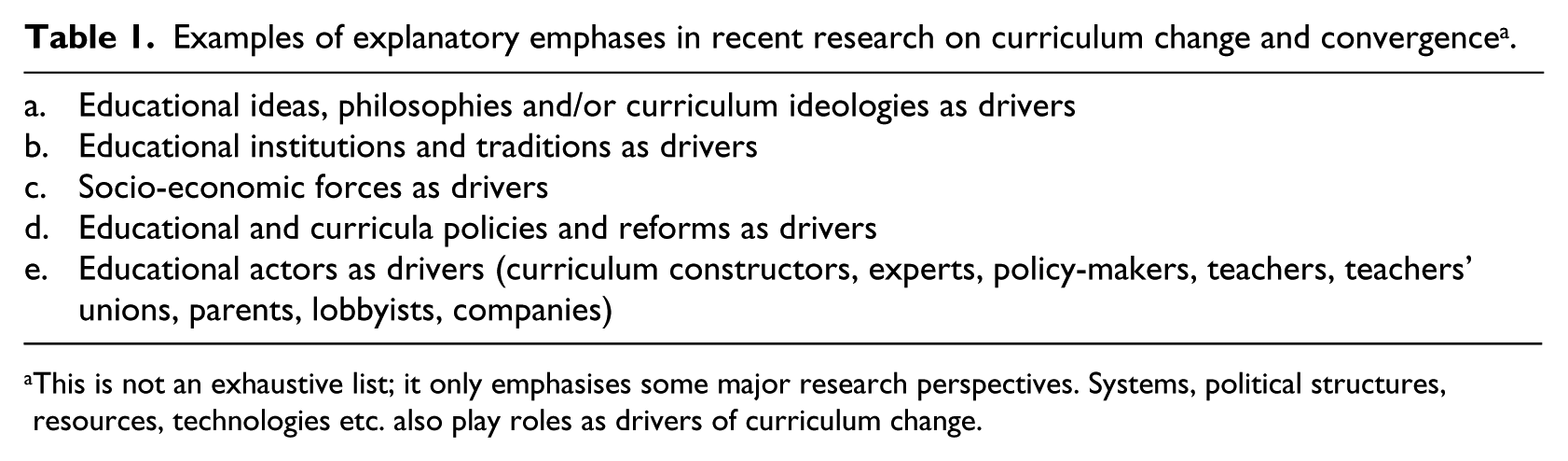
This is not an exhaustive list; it only emphasises some major research perspectives. Systems, political structures, resources, technologies etc. also play roles as drivers of curriculum change.
In contemporary curriculum research these emphases and foci points are represented by different strands of theoretical perspectives. What is referred to in the previous section as traditional modernist comparative curriculum analysis has its shared premises with policy implementation research. Generally speaking, the point of departure is that curriculum change is about presenting convincing ideas (a or d in Table 1, philosophies, ideologies and/or curriculum policies) and organisational implementation (d). The underlying (neo-)positivist assumption of a simple relation of linear causation (i.e. the construction of the policy and implementation determines the outcome) has been radically undermined in contemporary curriculum studies (Anderson-Levitt, 2008).
If we examine the vast literature on neo-institutionalism and education, two of the most important concepts point in the direction of educational institutions path dependency and isomorphism (e.g. spreading ‘world models’) as the main driver and determinants for curriculum change (b, in Table 1). The latter concept also highlights how ‘world model scripts’ are inscribed in policies that propagate institutional norms and rules. This line of thought has rightly redirected focus from rational (and national) policy-making to the logic of institutional rules and norms.
To explain national educational developments one must go beyond “national traditions” and situate nation-states within a broader nation-state system. Only then does the world institutionalisation of education emerge as a major dynamic to be analysed. (Meyer and Ramirez, 2003, 112)
A special strand of neo-institutionalism in education is comparative research on policy lending and borrowing (Steiner-Khamsi, 2012; Waldow, 2009). It has included more differentiated analytical lenses for examining the content of policy (or curriculum) exchange (a), emphasising the power of ideas themselves. What is attractive about this research approach is that it takes the neo-institutionalism a step further and clearly addresses the role of policy-making (e.g. through the concept of externalisation) and the roles of the educational actors as lenders and borrowers. However, power relations and questions of translation are not addressed as such. Important questions on processes of curriculum-construction and negotiation remain unanswered.
If we consider another theoretical strand in comparative curriculum analysis, discourse analysis, it is obvious that institutions (so far) have not played the role of the main driver for curriculum change. Rather, the socio-political-economical forces and interests (c) are generally addressed as the major constituent that is expressed and carried by educational reforms and policies (e.g. curriculum scripts underpinned by neo-liberalism). Moreover, different educational actors and organisations (e) are addressed as discourse producers and agenda-setters (Nozaki et al., 2005).
As a closely related theoretical approach to discourse analysis, policy network analysis has attracted wide scholarly interest. Emerging from deconstructionism and post-structuralism (e.g. Edwards and Fenwick, 2012; Latour, 2005,) we argue that analytical focus is directed onto socio-political-economical forces and interest that are translated into powerful networks (c and e in Table 1). The force of actors in discourse coalitions and stabilised networks are the power relations behind curriculum change. The tools that are used in the representation of this line of thought are analysed, as well as the actors, in dominant policy chains. The illumination of silent agreements in such powerful networks provides fruitful and important analysis of curriculum change and convergences. This strand of research has revealed how the knowledge claims and the various forms of expertise shape the authority of governing actors and the legitimacy of governing activities. However, the content (a, in Table 1) processes of institutionalisation (b, in Table 1) tend to disappear from sight (e.g. Rhodes, 2006).
In this paper we will suggest that the aforementioned approaches in comparative curriculum analysis are valid although their respective merits are unsatisfying in some respects when it comes to understanding the travelling of key curriculum concepts. That is, they focus and provide valuable knowledge on specific “drivers”, but fail to conceptualise the interconnections between them and how concepts are transformed and translated when travelling within and between different policy arenas. Through the empirical case we will explore the theoretical/analytical as well as the methodological potentials of what has been labelled discursive institutionalism (Schmidt, 2008). Discursive institutionalism takes a more dynamic view of change (and continuity) by concentrating on the substantive ideas developed and conveyed by ‘sentient’ agents in discursive interactions that inform their policy-oriented actions which in turn serve to alter (or maintain) institutions (Schmidt, 2008). We argue that this institutional contextualisation is necessary in order to explain curriculum changes in the nexus of the transnational and the national.
The policy shifts towards competencies
Although historically international influences on national curricula have been far more pervasive than has generally been acknowledged, the national bias in curriculum thinking has been considerable. It has been the “natural” frame of reference. Alexander’s (2001) comparative analysis on curriculum and instruction in five countries demonstrates that underlying educational ideas/philosophies and curriculum ideologies are not restricted to national/cultural boundaries, but vary locally, regionally as well as in transnational patterns. In order to develop an analytical framework for the empirical case study we first have to differentiate between different models or types of curricula (Kelly, 2009).
The conception of curriculum as content has a rich continental European tradition and has a special Anglo-American offspring. It includes a detailed description of the contents of teaching (syllabi) that teachers should deliver to their students through teaching. In the US it has been associated with a linear delivery version of teaching (e.g. in the classical Tylerian rationale). 1 Its basic premise is an assumed causal correlation between what is taught and what is learned. The increasing agenda-setting role of standardised international achievement tests has pushed this conception of the curriculum content as given in fixed subjects and disciplinary content (e.g. Karseth and Sivesind, 2010). This type of content-based curriculum has a resonance in institutionalised public understandings of education and in the cultural context of Swedish curriculum-making.
As a major counterpart curriculum as experience (process-focused) has been the opposite pole, focusing on teaching as facilitation and responsive to developmental readiness. It thus conceptualises the curriculum as process-oriented rather than content- or outcomes-oriented. Alexander (2001) traces some of its basic features to John Dewey’s educational philosophy. Although pedagogical progressivism has been widely promoted in educational policy circles historically it has become apparent that it provides weaker organisational power and is thus more difficult for external stakeholders to evaluate and adapt to standardised assessment systems. In Sweden an administrative rather than substantial progressivism (Carlgren and Kallos, 1997) has been influential, not least in policy networks of state officials, experts and professionals in educational reforms.
In contrast to content and experience, as different forms of understanding curricula, ways of constructing curriculum centred on key competencies have emerged during the past decade, which set objectives and provide broad guidelines for curriculum planning and organising. They are developed as overall aims of schooling, objectives of teaching subjects or integrated subject groups. Within the EU a special working group was assigned the task of identifying and defining such competencies. “The main objectives of the working group are to identify and define what the new skills are and how these skills could be better integrated into curricula, maintained and learned through life” (European Commission, 2004, 1).
In May, 2012 the OECD launched the OECD Skills Strategy (OECD, 2011) that marked the policy shift as to how transnational education actors such as the OECD and the EU are becoming more offensive and prescriptive in curriculum-making. Increasingly national curricula policies emphasise twenty-first century key competencies for lifelong learning (Sinnema and Aitken, 2013). The strategy includes defining, promoting and evaluating national efforts in making curricula centred on competencies (such as for example entrepreneurial skills).
Processes of transnational curriculum reform convergence
Among comparativist scholars in curriculum and pedagogy the question of convergence has been addressed as one of the key contemporary topics in the field (Andersson-Levitt, 2008). There are, however, no agreements between the research camps on why, how, what, or with what results educational ideas are flowing at an increasing rate. Just that they are. The modernist conception that present curriculum change represents the (more or less) given rule of progress on a single scale ‘one best curriculum’ is underpinned by influential theoretical functionalism and human capital theory.
Taking up a discursive institutionalist perspective it is obvious that such premises need to be critically examined. The somewhat official education improvement orthodoxy where “technical experts teach countries how to be modern states” (Andersson- Levitt, 2008, 350) cannot be regarded as natural and inevitable.
The increasing transnational policy pressure in the aforementioned direction is not to say that all reforms are moving in the same way, or that national curriculum reforms are internally consistent. However, it demonstrates that it is paramount that curriculum reformers understand where the transnational external impulses for curriculum change are coming from, how mechanisms of curriculum change are operating and what possible outcomes they are producing. The naïve policy conception that you can improve the quality of education by transferring solutions developed elsewhere directly to solve national or local educational problems needs to be challenged. Comparative curriculum theorists need to scrutinise dominant, powerful policy discourses, actors and processes in what Bernstein (2000) calls the “official re-contextualising field”. 2 Linking the argumentation of Schmidt (2008) to the educational field one could say that the objective in the education policy process is to coordinate agreement among themselves on policy areas within the public sphere. So, in order to explain curriculum convergence, it is crucial to understand these processes of coordinative discourse. Schmidt makes a distinction between such coordinative discourse and a communicative discourse in the policy process and argues that in the public sphere the objective in the education policy process is to communicate the discourse, which involves “the presentation, deliberation and legitimation of political ideas to the general public” (Schmidt, 2008, 310). Discourse matters because it elaborates ideas and persuades others of the necessity and/or the appropriateness of a given course of action (Schmidt, 2008, 312). Exploring how curriculum policy ideas are moving into the pedagogical recontextualising field (to use Bernstein’s term) shows how communicative discourse and discourse coalitions among various education actors are of crucial importance.
Following Schmidt, the policy actors involved in coordinative discourse are mainly policymakers or government officials, policy consultants, experts, lobbyist, business and union leaders etc. They coordinate curriculum policy ideas as members of transnational epistemic communities sharing a set of cognitive and normative ideas of curriculum (curriculum codes). They are also part of trans-governmental networks of state officials who construct legitimate and diffuse knowledge (borrowing and lending) across national policies. But ultimately, influential policy actors and their networks are part of discourse coalitions of actors that ‘speak the same language’, reinforcing policy directions not always necessarily explicit and deliberate.
Numerous lines of research lead to the suggestion that there is an abstract universalism of trans-nationally disseminated models, which fans out into multiform structural patterns wherever such models interact, in the course of their intellectual adoption and/or institutional implementation with different state-defined networks, legal and administrative regulations, forms of division of labour in society, national academic cultures, context-bound social meanings, and religious world-views. (Schriewer, 2003, 30)
Schriewer stresses the interplay between the drivers of curriculum change (see Table 1) and captures this dynamic in an informative way. Focusing on discourse formation in comparative curriculum analysis has the merit of bringing internal ‘ideas’ and external institutional contexts into play. The discursive interactions are both part of a coordinative discourse of curriculum construction among various policy actors and the communicative discourse of deliberation, contestation and legitimisation of the policies developed in the coordinative discourse. This is not to say that it only comes this way round (i.e. top-down from supra-national policy actors). Communicative discourses of local civil society, social movements etc. also influence coordinative discourses.
In this paper on the topic of competence-based curricula the Swedish case is of special interest in exploring how European policy pressures, as coordinative and communicative discourses on future key competencies, despite contradictory premises, are incorporated into the curriculum reform of 2011.
The Swedish case through the lens of Discursive Institutionalism
In exploring and explaining curriculum convergence and standardisation we have so far argued that previous research has not sufficiently taken the various ‘drivers’ of curriculum change into full consideration. In this second part of the paper we will make use of Vivien Schmidt’s (2008, 2011, 2012) discursive institutionalism in order to capture the dynamic interplay in the nexus of transnational and national curriculum policy-making and to challenge the state-centred perspective of modernist comparative curriculum analysis. Following Schmidt, we see institutional change as a process depending both on the extent to which an idea is transformed into policy in policy-making and also the extent to which an idea gains legitimacy in public debate, with differences in implementation depending on institutional and contextual variables. The coordinative discourse has to do with central policy actors forming cognitive alliances, in the following examination exemplified by the EU, the OECD and the Swedish government. The coordinative discourse in this paper highlights the transnational character of contemporary curriculum policy-making allowing for an analysis of actors in different policy arenas (national as well as transnational) acting together along the same set of policy ideas. The communicative discourse focuses on the strategies used by the central policy actors to gain legitimacy among politicians, educators and the public in general, but also on processes of translation taking place when policy travels between different arenas. Using coordinative and communicative discourse as analytical concepts thus enables analyses, both of the ideational cooperation among powerful actors such as the EU and the OECD forming different kinds of discursive coalitions, and the translation-processes taking place when these transnational discourses are being recontextualised into the national and/or local context with its specific historical, political and societal conditions.
The OECD and the EU in coordinative cooperation on key competencies
In 1998 the OECD initiated a project called “Definition and Selection of Key Competencies” (DeSeCo) led by the Swiss researcher Dominique Simone Rychen. The task was to identify and define key competencies necessary for future generations and their capability of handling a rapidly changing world. “The programme for international student assessment” (PISA) launched by the OECD in 1997 became an important source of information as it sought to “…monitor(ing) the extent to which students near the end of compulsory schooling have acquired the knowledge and skills essential for full participation in society” (OECD, 2001, 3). Although the DeSeCo project aimed at defining competencies in a context of lifelong learning and not just in compulsory schooling, a broader conception of knowledge than the one PISA offered was necessary. “The OECD’s project Definition and Selection of Competences (DeSeCo) looked at what the key competencies for a successful life and well functioning society would be” (European Commission, 2004, 2). It is a broad definition of what the competencies should aim at that embraces aspects of both working-life and leisure-time. General competencies are thought to support a well-functioning life in general. Shortly after the OECD had begun their work on key competencies the EU also initiated a process of defining key competencies. 3 While the Rychen-group provided a lot of material on how to understand their key competencies, the EU was less informative. Without any explanation of their theoretical basis or how they were meant to be understood, or how they relate to each other the EU lists eight competencies.
The EU competencies were more specified than the ones defined by OECD which contained a higher level of complexity. While the EU (European Parliament, 2006) speak about “Communication in the mother tongue” and “Communication in foreign languages” as two competencies related to language use, the OECD (OECD, 2001) speak about “the ability to use language, symbols and text interactively”. Regardless of differences in the selection and definition of key competencies the processes are parallel and highly inter-discursive at the level of programmatic ideas. Through recommendations and guidelines, the OECD and the EU form a powerful coalition promoting the need for competence-based curriculums at all school-levels. The EU argue that developing these kinds of general competencies is “necessary for all in the knowledge society (European Commission, 2004, 3), whereas the OECD in a similar way argue that “Sustainable development and social cohesion depend critically on the competencies of all of our population” (OECD, 2001, 4). The development of competencies can be seen as a programmatic idea striving to create a de-contextualised conception of knowledge and a more uniform language for education that can grasp both informal, non-formal and formal education as well as learning throughout the entire life span (e.g. Sundberg and Wahlström, 2012). The OECD and the EU share the same problem description with an increased societal complexity caused by globalisation as a major reason for the development of key competencies. Although the EU had a narrower definition of its competencies, both actors define them in terms of general competencies described as multifunctional packages useful in different settings.
Key competencies represent a transferable, multifunctional package of knowledge, skills and attitudes that all individuals need for personal fulfilment and development, inclusion and employment. These should have been developed by the end of compulsory schooling or training, and should act as a foundation for further learning as part of lifelong learning. (European Commission, 2004, 6)
Despite the high level of inter-discursivity in terms of concepts and ideas the number of explicit references is limited in the official documents. Neither Education and training 2010 nor Education and training 2020 contain any references to the DeSeCo project, although it had been of major importance for the work within the EU. In Europe 2020 the OECD is referred to twice and in Education and training 2010 three times. Despite the lack of references in the final texts the report by the working group on key competencies shows the importance of the OECD for the EU process.
The mandate for defining basic skills was given at the same time as substantial work on competences was underway in other international fora. The OECD’s project Definition and Selection of Competencies (DeSeCo) looked at what the key competences for a successful life and well functioning society would be. (European Commission, 2004, 2)
Put differently, the OECD and the EU together form a powerful coalition in the transnational arena coordinating the programmatic idea on general competencies as a guiding principle for national standards-based curriculum reforms.
There is a clear trend across the EU towards competence-based teaching and learning, and a learning outcomes approach. The European Framework of Key Competences has contributed considerably to this. In some countries, it has been key in policy reform. (Council of the European Union, 2010, 6)
The OECD also highlights this development in its Skills strategy supporting the strategic work of its member states in their understanding of the potential of skills. The OECD Skills strategy provides a strategic framework to help member countries to understand more about skills and how to invest in them in terms of national reforms. Skills are said to be a force transforming people’s lives and drive economies. Skills are talked about as the most influential currency in today’s society enabling people and nations to prosper (OECD, 2012). At the transnational level there is thus a widespread consensus about the need for a conceptual turn from a content-based to a competence-based understanding when it comes to what should be thought and learned in schools and communicated and legitimised in a very normative way as if there were no other alternatives. Leaving the old idea of knowledge as content is described as a necessity if the EU idea to become the most powerful knowledge-based economy in the world is to be fulfilled. Put in another way, according to the EU as well as the OECD there is no other option for the member-states than to adapt to this conceptual turn.
Competencies in Swedish compulsory school reform
As mentioned above competencies in the way they are treated within the OECD and the EU are general and action-oriented. Although it has been argued that the concept of skills is somewhat more discrete than the concept of competencies (e.g. Sinnema and Aitken, 2013) this study gives no evidence for such a conclusion, instead they are used in a similar way, both of them described as having transformative potential. Being competent has to do with some kind of activity where the activity is what determines whether pupils are to be considered competent or not. In the Swedish context there has also been a move towards a more competence-oriented understanding of knowledge. In the curriculum for the compulsory school launched in 1994 (Lpo 94) the question of knowledge was examined in a more profound way for the first time and a more complex and multi-dimensional understanding of knowledge was introduced. Knowledge was discussed in terms of “fact”, “ability”, “understanding” and “skill”. This complexity was also followed up in the curriculum with a two-dimensional goal-system, with “goals to achieve” and “goals to strive for”. The first dimension referred to the knowledge that the pupils should have acquired by the end of the school year. The second dimension had more to do with a general orientation and focused upon learning as an endless process rather than its specific goal. So, already before the EU had launched its eight key competencies the Swedish compulsory school had an orientation towards a general conception of knowledge and most of the EU competencies were visible in the 1994 curriculum although not talked about in terms of competencies.
In conjunction with the latest curriculum for the compulsory school launched in 2011 the complex concept of knowledge and the two goal-levels were strongly questioned. The right-wing government argued that Lpo 94 was too ideological and fuzzy and had contributed to an impairment of the Swedish results in the PISA and TIMSS measurements. It was argued that the long tradition of social democratic government in Sweden had led to a weakening of subject knowledge among the pupils in a way that had led to a crisis situation in the Swedish school system. It was also said that the teachers were confused with the parallel goal system and that they no longer fulfilled their obligation to uphold an equivalent school. The curriculum left too much space for teachers’ own interpretations and therefore had to be simplified the politicians argued. In response to this criticism the main goal in the Lgr 11 curriculum reform had to do with reducing the troublesome space of interpretation.
As a result, the two goal-levels were reduced to one focusing specified knowledge goals related to each school subject. Lgr 11 also talked about skills but in a narrower and subject-oriented way than Lpo 94 and the EU did. The skills that Lgr 11 discussed were no longer of the general kind as before, instead they were now mentioned as related to, and developed within, specific school subjects. Put differently, the knowledge progression within a specific subject is also supposed to support the development of specific subject-related skills. Between Lpo 94 and Lgr11 there is thus a significant discursive shift owing to the political context at the time, both when it comes to the use of concepts and the understanding of competencies and skills. Since the right-wing government had strongly criticised the development of the Swedish school, blaming the ‘fuzzy’ reforms of Lpo 94 for having lost sight of ‘real knowledge’ in favour of a more general orientation towards general competencies and/or skills, similar to the ones promoted by the EU and the OECD, there was no political space left for further reforms in favour of general competencies. In order to maintain its political legitimacy, the Swedish right-wing government therefore combines the use of concepts proposed by the EU and OECD with a national interpretation in order to balance between external pressure from transnational actors and internal pressure caused by previous political actions and the public opinion. This shows how travelling ideas sometimes are reinterpreted when re-contextualised in national and/or local contexts. Discourse institutionalism then helps us to understand the complex process of policy transfer as not just a matter of cognitive justification within the coordinative discourse but also a matter of legitimisation within the communicative discourse, adding a normative element of persuasive argumentation to the process of curriculum policy. As a result of this national interpretation the competence and skills discourse in Sweden is not representative for the general development described by the Council of the European Union.
Significant progress has been achieved particularly in school curricula. Traditional subject areas such as mother tongue, foreign languages or mathematics and science are being treated in a more cross-curricular way, with more emphasis on developing skills and positive attitudes alongside knowledge, and with more ‘real-life’ applications. The transversal key competences are becoming more prominent and more explicit in curricula. (Council of the European Union, 2010, 6)
Unlike many other countries in Europe, and in direct contrast to the guidance given by the EU, subjects once again become the organising idea in the reformation of the Swedish compulsory school although using concepts like skills. Expressed in more political terms one could say that a transnational neoliberal discourse focused on competition and labour market becomes mixed up and reinterpreted when meeting a renascent national neoconservative agenda, in both cases accompanied by a strong desire to follow up and measure educational achievements. The example of entrepreneurship in 2011 Swedish compulsory school reform, to which we will turn now, is of special interest since it has been communicated there as the core principle that should permeate the entire Swedish school system at all levels. As a curriculum concept it has been travelling fast and unhindered into national curriculum-making setting the agenda for what counts as valid and valuable knowledge.
Entrepreneurship: a travelling concept in Swedish compulsory school reform
There has been a continuous exchange of discursive elements between the transnational and the Swedish policy arena in terms of education over several decades (Pettersson, 2008; Waldow, 2009). Since the launch of the Lisbon strategy, however, the transnational influence over Swedish curriculum policy has increased and has become even more evident than before (Nordin, 2012), not in terms of explicit references, as mentioned above, but rather in terms of policy ideas and more general sets of programmatic ideas. Owing to the lack of explicit references the process of Europeanisation taking place in Swedish curriculum policy is a silent one. Waldow (2009) talks about silent borrowing and undeclared import to explain the Swedish import of transnational elements, but from the launch of the Lisbon strategy and onwards it is not just a question of import and export of single policy ideas but of a process where the transnational becomes part of the national in a more profound way.
When working with the latest curriculum reform for the Swedish compulsory school (Lgr 11) entrepreneurship became an important concept, just to illustrate the process of travelling undeclared imports in Swedish curriculum policy-making. In 2009 the Swedish government launched a strategy for entrepreneurship within the educational sector. It should run like a thread through the whole educational system it was said. The Swedish national agency for education was commissioned to develop a structure that would facilitate the work of promoting entrepreneurship in schools. As a manifestation of the commitment to entrepreneurship it was also stated by the government that the upcoming curriculum policy reform for the compulsory school (Lgr 11) should be permeated by the idea of entrepreneurship. Despite the importance given to the concept in the EU texts and the fact that entrepreneurship is the label of one the EU’s key competencies, almost no references are made to the EU in the official Swedish policy texts. In the national curriculum text for the compulsory school (Lgr 11) entrepreneurship is mentioned twice incidentally. In spite of the importance of the concept nothing is said about what it is, how it should be understood or how it is to be developed within the different school subjects. Even if the explicit use of the concept of entrepreneurship is small in terms of frequency in the curriculum text, it plays a major role as one of the core programmatic concepts in Swedish curriculum reform. But nonetheless, almost nowhere is the connection to the EU policy agenda visible or discussed, neither in the public debate nor among politicians. Instead the focus on entrepreneurship is brought forward as a national initiative. Excluding references to transnational actors such as the EU and the OECD thus becomes a strategy for politicians at the national level to appear as drivers of change although the original initiative is taken elsewhere. Gradually the concept of entrepreneurship then becomes institutionalised at all levels of the educational sector with courses given at the universities in entrepreneurial learning, conferences held by the Swedish national agency for education and training courses for teachers on how to promote entrepreneurship in schools. Just like the example of competencies and skills above the example of entrepreneurship shows the complexity of the practice of policy transfer and travelling concepts entering new contexts. In the case of Sweden, having been a prominent and progressive country in terms of education, borrowing ideas, concepts or solutions from others is a politically risky business in terms of public legitimacy. As the examples from the Swedish context show, a pragmatic approach at the national level often is an act of balancing external and internal pressure in order for the national government to uphold public legitimacy. In the communicative discourse the issue of legitimacy thus becomes essential to understanding transnational policy flows between different arenas and the processes of reinterpretation taking place within them.
Conclusions
In order to understand the policy flows between the transnational and national arenas we need different theoretical concepts and methodologies. In this paper we have tried to understand the conceptual changes taking place in Swedish curriculum policy owing to the impact of Europeanisation (Lawn, 2011) by taking a discourse institutional perspective.
The first question we asked was (a) what explanatory frameworks are plausible to make sense to processes of curriculum change in the interface between transnational and national arenas? Here we have argued that Discourse Institutionalism offers a more dynamic approach to the examination of curriculum change than earlier modernist approaches. An overall conclusion when looking at the Swedish case from a Discourse Institutional approach is that the communicative discourse that emerged during the 1990s in Sweden owing to a decentralised curriculum, has replaced the decision-making in current policy development by a more coordinative discourse to secure agreement behind the scenes and ensure that compromises do not unravel, and only relying on broader public discourse when necessary (Schmidt, 2008). States are in a double bind: the need for coordinating among numerous interests (curriculum stakeholders) but at the same time communicating policy details effectively to the public (voters) and the education sector. Standardising curricula, owing to transnational policy imperatives, needs to gain legitimacy in both national policy coordination and in policy deliberation. Here discursive institutionalism provides explanations for the opportunities for educational reforms because it incorporates both different driving forces in curriculum change (agency, convincing ideas), structures (discourse is governed by existing institutional structures in place) and time (core concepts travel at different paces). The Swedish case on entrepreneurship could be characterised as a Trojan horse that remains unrecognised by lenses of policy lending or policy borrowing. Curriculum change is not only about political systems, historical and cultural traditions, but also about how agents create, maintain and interact with educational institutions. The advance of discursive institutionalism with its different repertoires, we argue, takes into account both endogenous and exogenous forces. The explanations thus offer a more dynamic account for curriculum change.
The second question was (b) to what extent and in what ways are transnational elements reinterpreted and translated into the Swedish compulsory school reform in 2011? The examination shows that the programmatic idea of organising school knowledge in terms of competencies has become more influential in the Swedish curriculum as an organising principle. But unlike most European countries competences in the Swedish context has become synonymous with a strong subject-content orientation (e.g. neo-conservative). The analysis shows that the Swedish example in many ways differs from the European trend towards a generic conception of competencies. When it comes to the levels of philosophical (i.e. curriculum as institution) and programmatic ideas the analysis shows a strong influence of Europeanisation in the Swedish compulsory curriculum policy. International competitiveness and labour-market orientation are cornerstones in the EU texts as well as in the Swedish texts. When it comes to competencies the Swedish interpretation is quite the opposite of the EU interpretation. Although competencies are superior to subject knowledge in the EU texts, subject knowledge is superior in the Swedish texts. At the level of policy ideas, the picture becomes more complex showing the importance of legitimisation. In the case of Sweden, the self-identity of being a leading (and self-sufficient) nation in terms of education and the political landscape led to a situation where politicians had to silence the influence from exogenous actors in order to gain public legitimacy. Put differently, there is considerable Europeanisation going on in the Swedish curriculum policy for the compulsory school, but at the level of policy solutions, concepts like competencies, have been reinterpreted owing to the specific frames and criteria of the Swedish educational context.
Finally, our investigation confirms what many others have already stated, that there is no linear way of implementation from one policy arena to another. The discourse institutionalism approach has helped us to grasp the complex process of recontextualisation and re-interpretation by offering an analytical model working at different levels, focusing both the coordinative and the communicative discourse in the ever increasing and intensified travelling of curriculum ideas and concepts. As a new theoretical strand in the field of comparative curriculum analysis it challenges assumptions of curriculum as a means for direct policy control, and secondly, it also challenges the assumption that larger global macro-social contexts have unmediated impact on the national and local context. One of its merits is that Discursive Institutionalism brings the philosophical ideas and culturally embedded norms, values, and interpretive horizons that frame curriculum programs and texts into play in understanding and explaining processes of curriculum divergences and convergences.
Footnotes
Acknowledgements
We would like to thank the editors and the two anonymous reviewers for their invaluable comments and feedback on this article
Declaration of conflicting interests
The author(s) declared no potential conflicts of interest with respect to the research, authorship, and/or publication of this article.
Funding
The author(s) received no financial support for the research, authorship, and/or publication of this article.