




Abstract
The aim of this article is to examine how transnational concepts within educational policies influence national curricula in the reconceptualisation of educational policy into concrete curriculum texts. Based on a critical discourse analysis and the concepts of recontextualisation, convergence and divergence, a third wave of European policy discourse has been identified, emphasising an increasing interest in compulsory school and curriculum. Analyses of policies and pedagogical texts show a convergence between a European and a Swedish knowledge discourse concerning standards, basic skills and a performance-based curriculum; however, there is a divergence in terms of transversal skills in transnational policy documents compared to an emphasis on school subjects in the Swedish curriculum. In the transnational arena, the concept of knowledge is mainly interpreted in terms of competencies, while in the Swedish curriculum – the Curriculum for the Compulsory School, Preschool Class and the Leisure-Time Centre 2011 – knowledge is understood in more traditional terms and includes abilities within subjects.
Introduction
The Programme for International Student Assessment (PISA) surveys play an important role for the European Union (EU) in their efforts to improve the Member States’ education systems. By using international tests such as PISA, it is possible to make comparisons between different countries over time. For example, the PISA surveys are used to evaluate progress made towards benchmarks in the EU, such as the benchmark that by 2020, less than 15% of 15-year-olds should have low achievements in reading, mathematics and science (European Commission, 2013). The results of the 2006 PISA led the Swedish government to make an announcement stating that poor results in the PISA surveys are ‘troubling for Sweden’ and that the PISA results, therefore, ‘…stress the importance of a substantial shift in Swedish educational policy’ (The Swedish Ministry of Education, 2007). The reform package included new programmes for teacher training, the Education Act of 2010 and a new compulsory school curriculum, the Curriculum for the Compulsory School, Preschool Class and the Leisure-Time Centre 2011 (Lgr 11), which was implemented in 2011. The relationship between the Organisation of Economic Cooperation and Development’s (OECD) PISA surveys and Sweden’s education policy is bidirectional; it can be used both as a directive from the OECD and the EU that Sweden needs to take action regarding its school system, and it provides the Swedish government with a reason to put forward a package of reforms based on evidence from the PISA survey results. The central position of the PISA surveys and their implications for both Swedish policies and EU policies are apparent in the EU strategy document ‘Education 2020’, the results of which are accounted for in the Swedish Budget Bill (Budget Bill 2011/12, 2011: 42).
From these examples, it is clear that the government uses OECD PISA surveys to argue for certain educational reforms. The EU also makes use of the surveys when evaluating the extent to which common quantitative targets are achieved by the different national school systems. It is also obvious that transnational and national educational policies are becoming more interdependent, although how this is manifested in the different national and local arenas remains an open question and a subject for research. As Karseth and Sivesind (2010) argue, globalisation transforms curriculum policy, but national cultures of schooling and professional cultures contribute to different forms of selection and the organisation of knowledge in different national curricula and school systems.
Purpose and research questions
The aim of this article is to examine how transnational concepts used in educational policies within intergovernmental cooperation interact with national curricula traditions in the re-contextualisation of educational policies into concrete curriculum texts. International policy promotion is driven by the active role of international institutions that stimulate cross-national policy transfer by non-binding international agreements on goals and standards that national policies should aim to achieve. In this paper, it is understood that there is a convergence between international organisations and national policy arenas when there is a growing cross-national similarity in these policies over time. When countries deviate either entirely or in part from recommended policy models, the country or the specific policy is understood to have diverged (see Holzinger and Knill, 2005). In light of this, the following research questions have guided this investigation. How can transnational education policies with implications for curricula that are expressed through EU documents in the beginning of the 21st century be characterised? How can the two most recent curricula in Sweden be understood in relation to transnational policy concepts, such as competencies and standards, using the examples of Swedish language and literacy skills?
The aim of this article is introduced in the first section. In the next section, current educational policy documents within the EU (from 2003 to 2010) are analysed. The documents mostly represent communication from the European Commission selected on the basis that they include texts related to compulsory schooling. 1 In the third section, the focus is on the Swedish curriculum for nine-year compulsory schooling, Lgr 11 and its predecessor, the Curriculum for the Compulsory School System, the Pre-School Class and the Leisure-time Centre (Lpo 94). These analyses are based on the teaching of Swedish language and literacy skills, and further contextualisation is, therefore, made through the analysis of the PISA 2009 Reading Framework. In the fourth and final section, the re-contextualisation processes in the national policies and curricula texts are presented and discussed.
Methodological considerations
From a critical social theory perspective, Beck (2006) argued that ‘reality’ has become cosmopolitan in terms of ‘global risks’ accompanied by global publics. Due to the emergence of post-national politics in which states and nations are not the only actors, there is an increase in global inequality and the cosmopolitanism of everyday life. Beck, therefore, suggests applying ‘methodological cosmopolitanism’ (as opposed to ‘methodological nationalism’) in social studies that include a national project in addition to extending it. This paper is inspired by the concept of methodological cosmopolitanism in the sense that the units of analysis are understood as transnational processes, which are incorporated or embedded in national processes, rather than taking the nation-state as a given unit of analysis. Thus, for this paper, national education documents, including curricula, have been analysed with the understanding that they are intertwined with transnational policy forces.
Following Fairclough (2010), the textual analyses of policy documents and curricula have been divided into four parts: analysis of text, discourse practice (text production), social practice and re-contextualisation. Chouliaraki and Fairclough (1999) referred to the concept of re-contextualisation in the sense of Basil Bernstein’s understanding of the concept: a discourse practice that is moved from its original material context and, thus, is relocated from its original social base into an imagined practice where discourse elements and relations are subject to selection, reordering and focusing. When a discourse is transformed from the policy field to pedagogic discourse, the principle of re-contextualisation requires that the elements within the discourse are selectively appropriated, relocated and refocused so that the discourse has its own order. The reordered discourse cannot be identical to any of the discourses it re-contextualised (Bernstein, 2000). Thus, the concept of re-contextualisation is essential for understanding how education policy discourses are influencing different forms of educational arenas; however, each pedagogical arena relates to educational discourses in its own distinctive way through its specific re-contextualisation processes. The concept of re-contextualisation is crucial for conceptualising the transitions of policy discourses from the policy field to pedagogic discourses of the curricula.
The first step in a discourse analysis is the description of the language text and its context. This is done by using examples from the texts and anchoring them to a relevant frame of reference. The second step is the interpretation of the relationship between the text and the discursive practices. In other words, this step involves the interpretation of policy texts and the re-contextualisation of policies to national policy arenas as well as to national pedagogical arenas, such as the curriculum, while identifying the normative elements of the discourse. Finally, the analysis should offer an explanation of the relationship between discursive processes and social processes. For this purpose, the analyses of the curricula are related to two main pedagogic models: the competence model and the performance model (Bernstein, 2000).
Between the 1960s and early 1970s, and throughout the 1990s, there were noticeable convergences in the fields of social and psychological sciences concerning the knowledge concept of competence. Despite opposed epistemologies, which are principles and methods involved in disparate fields of research drawing on different epistemologies, the concept of knowledge has travelled across the social sciences and has partly been re-contextualised in terms of competencies in a pedagogical context (Bernstein, 2000). The concept of competence refers to ‘procedures for engaging with, and constructing, the world’ (Bernstein, 2000: 42). The convergence of an understanding of the concept of competence as an important aspect of knowledge leads to a complex classification of different pedagogical modes developed from two fundamental pedagogic models: the competence model and the performance model. According to Bernstein (1990), competence arises from two conditions: an intrinsic condition and an interactional condition. Thus, competence theories integrate the biological with the social context but exclude the cultural context, which implies a de-contextualised understanding of the concept and its acquisition. Competence acquisition is a social act, presupposing an active participation of the one who learns without being linked to a specific societal or cultural context. The formation of the concept of competence in the intellectual discourse arena had no clear relation to education. Rather, competence is tacitly and informally acquired. When the concept of competence was re-contextualised to a specific pedagogic practice, it was based on an assumption of ‘built-in’ procedural democracy, creativity and self-regulation (Bernstein, 2000). As a consequence, the individual and the educational micro-processes became central, while the macro-processes of the distribution of power and the principles of control in educational systems become indistinct. These macro-processes are instead more transparent in the performance model in which the boundaries between different subjects as well as the differences in significance between different subjects are clear. Moreover, communication regarding the school’s mission and demands on the students is distinct, both in the curriculum and in school practices. Bernstein denoted this form of explicit regulations and discursive order as ‘visible pedagogies’, which emphasise the performance of the child and the extent to which the text the child is creating is meeting the pre-formulated criteria. In short, visible performance pedagogy ‘puts the emphasis on the external product of the child’ (Bernstein, 1990: 70). Consequently, the competence model is a pedagogical model based on competences that are intrinsically creative and acquired through informal interactions in potentially productive social practices, while the performance model has its pedagogical focus on education with predetermined and specified texts, skills and outcomes (Bernstein, 2000). To distinguish the two models, the result of this analysis is presented in reference to six features that both models share: space, time, evaluation, control, pedagogic text and autonomy.
By analysing transnational documents from the EU and the OECD (the PISA 2009 Framework), it is possible to discern signs of ‘voluntary convergence’ in relation to transnational cooperation within the two international governmental organisations (cf. Bieber and Martens, 2011). Transnational communication refers to the information exchange among domestic actors in transnational expert networks. This is an effective way to produce convergences of structures, governance modes and policy styles within a context of soft governance. Inter-governmental organisations can also encourage monitoring of competition through the benchmarking of functional and effective domestic institutional structures. According to Bieber and Martens, ‘the higher the country-specific problem pressure, the more likely the convergence towards a recognized international model’ (2011: 103). In this article, transnational policy is understood as policy discourses formed by international institutions through transnational communication, comparison and benchmarking.
International comparisons and cooperation
Comparative studies on different national school systems are not a new phenomenon. There has long been interest in studying other countries’ approaches to organising their education to learn from their results. After World War II, the reconstruction of national school systems created consensus among countries that there was a need for comparative studies (Pettersson, 2008). Based on the newly established UNESCO Institute in Hamburg, the International Association for the Evaluation of Educational Achievement was founded in 1958. The vision of the founders of this organisation for comparative studies, which was built on psychometric methods, was to create an ‘educational laboratory’ for experts with the world as its arena and with national research centres undertaking the tests (Lawn, 2014). In the last few decades, the OECD, which was created in 1961, has become an important actor in these studies, especially in the policy arena for comparing and measuring students’ achievements across nations as indicators of the effectiveness of national school systems. In the displacement from government to governance, comparative data has become essential at both a global and national level (Sellar and Lingard, 2013). In addition to the OECD, the EU has become a vital arena for collaboration and comparison (Lawn and Grek, 2012).
What has been termed the ‘Europeanisation’ of education policy, which is a discursive space in terms of a European network, as well as an actual cooperation between countries with the EU as an influential part of transnational education policy, operates simultaneously in three interdependent arenas. Collaboration within the EU takes place both within the formal structures of the European Parliament and the European Council, and within informal networks of experts and more temporary groups. A third arena is constituted by the different Member States’ national policy arenas, which both influences and is influenced by the transnational policy arenas within the EU. European education policy can thus be seen as a two-way process in which national policies move into the transnational arena and transnational policies move into the national arena through policy methods, such as the Open Method of Coordination (OMC) and policy agreements within the EU (see Dale, 2009). In the next section, the transnational education policy within the EU during the 2000s is analysed with a focus on compulsory education. The aim of the analysis is to illustrate a transnational context by which the national Swedish education policy is partly affected.
A European transnational perspective on educational policy
The signing of the EU Lisbon Strategy in 2000 (European Council, 2000) signalled a shift away from viewing education as only a national responsibility; however, it was still principally a policy activity in the ‘national’ sphere of governance. A second-wave policy took shape when the Lisbon Strategy was implemented, which was characterised by a view of education as one of the main ways of achieving the strategy’s knowledge economy goals (Lawn and Grek, 2012). The concept of lifelong learning and its associated competencies are the hallmarks of a knowledge economy. This has meant a shift in focus from teaching to learning and from schools as institutions for citizenship learning to schools as ‘delivery agencies’ for students, who are now perceived as customers in a specific market (Biesta, 2004; Wahlström, 2009; Young, 2008). Emphasis on different measured aspects of school systems also became the main theme of the OMC. The OMC was developed as a system for monitoring the Lisbon Strategy, and it is involved in the construction of indicators to evaluate the progress made by the Member States (Gornitzka, 2005). Indicators chosen for this form of evaluation are always a consequence of selection and priorities, and thus, need to be considered based on certain values or dominant discourses; however, in the case of OMC indicators, as well as their resulting quantitative data, they are mostly perceived as ‘objective knowledge’ by the Member States. Thus, politicians tend to refer to their decisions as ‘evidence’ and ‘reality’, rather than based on different ideological viewpoints (Lawn and Grek, 2012; Wahlström, 2010).
EU education policy from 2000 onwards
Education and Training 2010 2 was a detailed work programme developed with the intention of creating measurable effects in practice. Within its implementation, there was an agreement that the EU key competences should be acquired before the end of the period of compulsory secondary-level schooling to serve as a platform for further learning. 3 In particular, the competence ‘learn to learn’ was considered to be fundamental to everyone’s continued learning and adaptation to the rapid changes taking place in society and in the workplace. In addition to making the national school systems more effective and improving their quality by ensuring that all citizens develop the key competencies and have access to Information and communications technology (ICT), the Member States are also required to improve their teacher education and training. Five European benchmarks 4 were accepted, and all of them set quantified targets to be achieved in certain key areas towards improving the quality and effectiveness of national school systems. The programme stressed the importance of voluntary and transnational cooperation, and these benchmarks were said to be ‘…challenges to be faced collectively, with each country contributing as a function of its resources and own priorities’ (European Commission, 2003a: 36). Twenty-nine measurement indicators were enacted as a first step in the establishment of a common framework of statistical indicators to regularly monitor each country’s progress in the programme and to identify the best practices (European Commission, 2003a). The commission proposed that each country should report on its educational reforms and describe how these reforms contributed to the fulfilment of the objectives formulated in the 2010 programme (European Commission, 2003b).
In 2007, a new educational policy programme, Schools for the 21st Century, was introduced (European Commission, 2007). The commission noted that prior to this, the EU had tended to focus on vocational training and higher education. As a result, the European Commission decided to launch a consultation to directly address school education. The key competencies, adopted as a European Reference Framework in 2006, are separated into ‘traditional’ competencies, such as mother tongue skills, foreign language skills, basic competences in mathematics and science and digital competence, and ‘transversal’ competencies, such as learning to learn, social and civic competence, initiative and entrepreneurship and cultural awareness. The framework of key competencies: builds on the fact that a number of Member States are redefining school curricula so that instead of listing inputs (the knowledge that schools are to impart), they specify outcomes (the skills and attitudes that pupils are expected to have developed at different stages of their education). (European Commission, 2007: 5)
The four competences that are defined as transversal raise questions regarding how they fit into a curriculum based on subjects and expected outcomes (European Commission, 2007). To address this challenge, the commission recommended a ‘flexible learning environment that helps students develop a range of competencies, while retaining a grounding in basic skills’ (European Commission, 2008: 5). This approach includes a combination of single-subject and cross-curricular teaching as well as a more individualised design of student learning based on their own active involvement. The European Commission (2007) maintains that this type of classroom practice will support students with ‘special needs’ and students who are particularly gifted or talented. According to the commission, cooperative teaching, cooperative learning, collaborative problem-solving, heterogeneous groups and a balanced use of formative and summative assessments are recommendations that would benefit all students. In their national action plans, the Member States are asked to set specific targets for increasing achievement levels in reading literacy and numeracy (European Commission, 2008).
A focus on compulsory schooling, curriculum and assessment
The Europe 2020 Programme, which succeeded Education and Schooling 2010 and Schools for the 21st Century 2007, marked a new step in EU cooperation with stronger governance in terms of country surveillance and quantitative targets (European Commission, 2010). The concept of lifelong learning constitutes the basic principle of the entire framework of European cooperation in education for the period up to 2020, and the provision of periodic monitoring of a set of objectives forms ‘an essential contribution towards evidence-based policy making’ (European Council, 2009: 3).
The country analysis for Sweden shows that Swedish 15-year-olds performed better in the PISA tests than the EU average in reading and writing, but they performed below the EU average in science. Sweden has not yet reached the long-term goal (by 2020) of having less than 15% of students being low achievers in any of the three areas of reading, mathematics and science (European Commission, 2012b).
In the EU initiative of 2012, Rethinking Education, the assessment of all key competencies is placed at the top of the agenda. The reason for this is that a focus on certain learning outcomes clearly signals that these specific competencies should be prioritised. The commission has argued that a focus on assessing the transversal key competencies helps to adapt teaching to learners’ needs more effectively. A mapping of national evaluation systems shows that only four of the competencies are assessed by the Member States (mother tongue, mathematics, science and foreign language
5
). Therefore, the commission has developed a common assessment system that covers all of the key competencies: Education and Training Monitor 2012 (European Commission, 2012c). The commission linked assessment to socio-economic and gender inequalities as well as to personal development: …assessment has important consequences for our educational paths. It not only affects how others see us but also how we see ourselves. More specifically, it affects how we think about ourselves, what we feel about ourselves and how we behave in response. Ultimately, it impacts whether or not we become lifelong learners. Assessment policy – and its implementation in schools – therefore needs to be handled carefully and informed by evidence. This document is for policy makers grappling with this responsibility. (European Commission, 2012c: 8)
The commission has argued that the EU reforms have ‘streamlined curricula’. This streamlining includes developing infrastructure centres for literacy, mathematics and science, and intensified actions to improve digital and media literacy. The commission has urged the Member States to introduce new systemic reforms ‘…to strengthen early screening and intervention for learning difficulties and to replace repetition or ability grouping with increased learning support’ (European Commission, 2012d: 4). The European Commission has emphasised that it works closely with national policymakers to help them develop their national educational policies by producing evaluations and analyses, and encouraging the exchange of ‘good policy practices’ (European Commission, 2012a).
As a Member State, Sweden is one of the countries that has been helped in developing its education policy. In the following section, the subject of Swedish in the Lgr 11 curriculum for compulsory schooling is analysed in relation to the curriculum’s predecessor Lpo 94, as well as in relation to the PISA 2009 Reading Framework, to examine the displacement of the Swedish curriculum discourse at a national level as part of a transnational policy movement in terms of national convergences and divergences.
National convergences and divergences in relation to transnational cooperation
In this section, the meaning of knowledge in the subject of Swedish in the Swedish Lpo 94 and Lgr 11 curricula is analysed based on the attainment levels in Year 5 (11-year-olds) in Lpo 94 and in Year 6 in Lgr 11 (12-year-olds). 6 The analysis is related to the two pedagogic models using the common features of the models to illustrate the possible different consequences for education as a social practice. In a second step, the models are linked to the PISA 2009 Framework to examine national convergences or divergences in relation to transnational pedagogical policy trends.
The subject of Swedish in the Lpo 94 curriculum
According to the Lpo 94 curriculum, the subject of Swedish is ‘designed to give students opportunities to use and develop their ability to speak, listen, see, read and write in Swedish and to experience and learn from literature, film and theatre’ (NAE, 2000). 7 One of the most important tasks for the school is to create effective opportunities for language development, which is expected to have a major impact on students’ future lives and activities. The curriculum for Swedish aims to develop the students’ communication skills, thinking and creativity, and includes developing qualities such as ‘culture’ and ‘values’. In a text of about 300 words, the term ‘ability’ is mentioned six times.
In the section ‘goals to strive for’ in the syllabus, it is emphasised that the school should encourage the student to ‘develop his/her imagination and desire to learn by reading literature as well as reading on their own and of their own interest’ (NAE, 2000). The key term in this section is ‘develop’. Among other things, students are expected to develop their ability to read, comprehend, interpret and experience different types of texts and to understand cultural diversity. They should also acquire knowledge about the Swedish language and its ongoing development, structure and history.
In terms of the structure and nature of the subject, it is emphasised that in the subject of Swedish, language and literature should be presented as a whole. This means that the subject cannot be divided into different elements that build on one another in specific sequences. A child can argue and discuss and take part in a dialogue about literary experiences, and a teenager can imagine and tell stories, albeit in different ways. In other words, studying the subject of Swedish enables the development of students’ language skills and promotes an ‘expanded concept of text’ that comprises images as well as written and spoken texts.
In the Lpo 94 curriculum, the goals to attain in Year 5 are not related to grades in the various subjects. Students are not graded until Year 8. The goals, therefore, represent more of a ‘knowledge check’ for the teachers and the school as an indication that they have fulfilled their obligations. At the end of Year 5, the student should be able to read with fluency and comprehension, be able to produce texts for different purposes, be able to discuss an occurrence or orally narrate understandable content and be able to apply the most common rules of written language. As such, assessment for the subject of Swedish is not linked to any specific school year or grade level. The assessment concerns ‘how far students have come in their language development and their literary awareness’. Thus, the assessment is about ‘the students’ abilities to express their own opinions, feelings, knowledge and ideas in a nuanced and precise way with different linguistic means’ (NAE, 2000). A starting point for the assessment is the student’s linguistic and literary competence and the degree of independence in using different tools to express oneself.
In Table 1, Lpo 94 is shown in relation to Bernstein’s (2000) typology of pedagogic models.
The Lpo 94 curriculum is analysed and related to the typology of two pedagogic models.
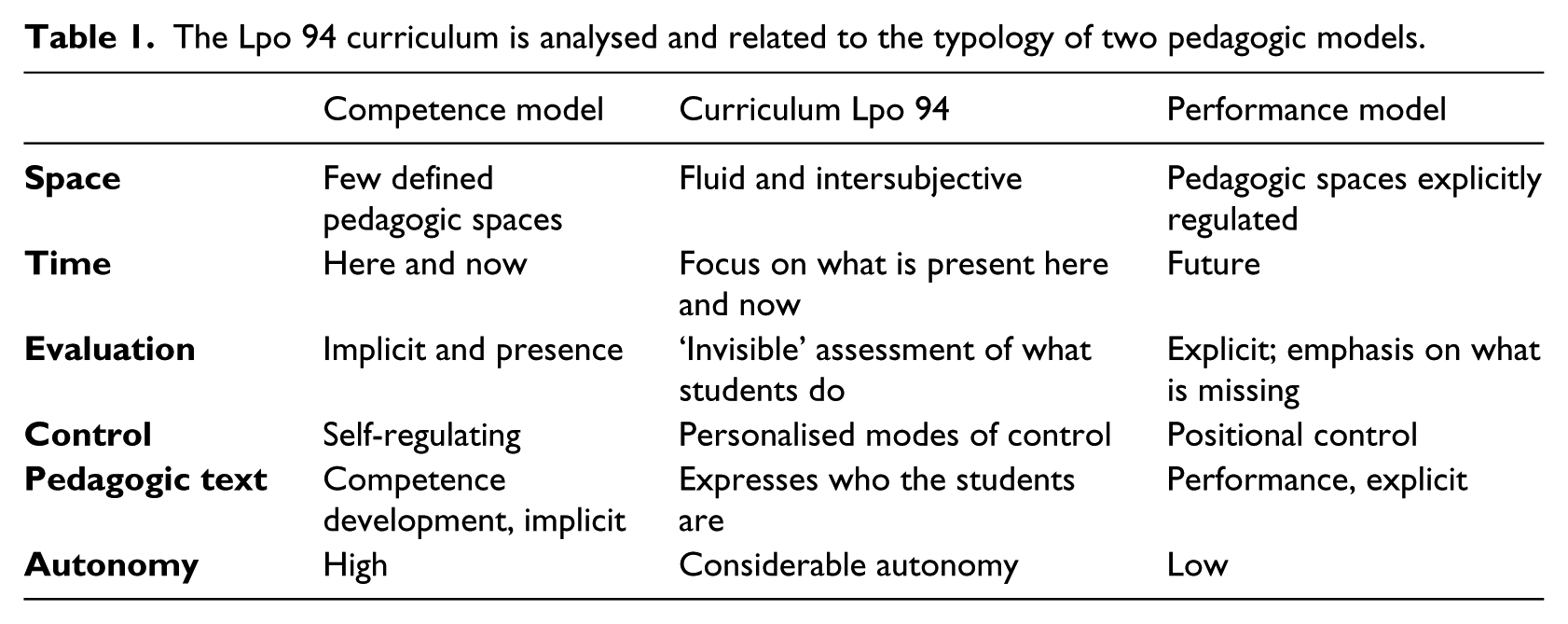
In Lpo 94, the pedagogic space is not specified; instead, the fluid and intersubjective character of the subject is stressed. The space has a weak classification, and it is the present time that counts, rather than what should be achieved in the future. During evaluation, it is the present that is of interest, such as when assessing whether or not the student can express his or her own opinions, feelings, knowledge and ideas in an understandable and precise way. Control in this model is based on the assumption of the self-regulated student and the teacher as a facilitator. The pedagogic texts address aspects such as the student’s feelings, expressions and arguments, which reflect who the students are and how they express themselves within a community. The structure of this curriculum allows for considerable autonomy for both students and teachers. External controls in terms of national tests and school inspections are moderate, at least during the initial part of the Lpo 94 curriculum. An analysis of Lpo 94, both in relation to a pedagogical competence and a performance model, shows that it is has the most in common with the competence model (see Table 1).
The subject of Swedish in the Lgr 11 curriculum
According the Lgr 11 curriculum, teaching Swedish ‘should aim at helping the pupils to develop knowledge in and about the Swedish language’ (Lgr 11, 2011: 211). The emphasis is on ‘develop’. The students are expected to ‘develop knowledge’, ‘develop their language’, ‘develop skills’ and ‘develop their ability’. When students leave school, they should be able to express themselves and communicate well in speech and writing. They should know how to read and analyse literature and other texts for different purposes, how to adapt their language to different purposes, and to identify language structures and norms. Furthermore, they should know how to search for information from different sources and be able to evaluate them. In a text of about 300 words, the term ‘knowledge’ is mentioned six times.
The description of the content is a mandatory set of teaching elements rather than any specific subject content. A key word in this section is ‘strategy’. The core content includes: ‘reading strategies to understand and interpret texts from various media and to distinguish between explicit and implicit messages in texts’; ‘strategies for writing different types of texts adapted to their typical structures and language features’; and ‘language strategies for remembering and learning, such as using mind maps and key words’. The main section is titled ‘Narrative texts and non-fiction texts’, which includes a list of the types of texts to use and what they should address. The different types of texts that students should encounter in years 4–6 are ‘narrative texts and poetic texts for children and youth from different epochs, Sweden, the Nordic area and other parts of the world. These include texts in the form of fiction, lyrics, drama, sagas and myths that illustrate the human condition and questions of identity and life’ as well as ‘descriptive, explanatory, instructional and argumentative texts, including factual texts, task descriptions, advertisements and letters to the press’ (Lgr 11, 2011: 213). In these texts, the students are expected to examine the meanings of texts, language characteristics and specific text structures. Digital techniques are used in the formulations concerning reading and writing, such as: ‘[c]reating texts where words, pictures and sound interact’ and in searching for information (Lgr 11, 2011: 213–214).
The final part of each subject syllabus, the ‘Knowledge requirements’, is kept in close alignment with the structure, aim and content. The language that is used emphasises what the student can do, or what the student has shown that she/he can perform or achieve. In this section, the proportions are different to those in the content section so that during grading, the students’ own writings and texts are highlighted, while the students’ skills in reading different types of texts are described in more general terms.
The students are graded from F (fail) and E (pass) up to A on a six-point grading scale. The grading levels reflect how and with what complexity the student can demonstrate different types of skills and the quality of the knowledge acquired. For grade E in Swedish, the student should be able to apply skills such as ‘basic functional’ reading strategies, show ‘basic’ reading comprehension, apply ‘simple and to some extent’ informed reasoning, write texts with ‘understandable’ content and ‘basic’ functional structures, and write narratives with ‘simple’ descriptions and plots. These value words have their counterparts at levels C and A. For example, ‘basic functional structure’ for grade E is formulated as ‘relatively well-functioning’ for grade C and as ‘well-functioning’ for grade A. In Table 2, Lgr 11 is shown in relation to Bernstein’s (2000) typology of pedagogic models.
The Lgr 11 curriculum is analysed and related to the typology of two pedagogic models.
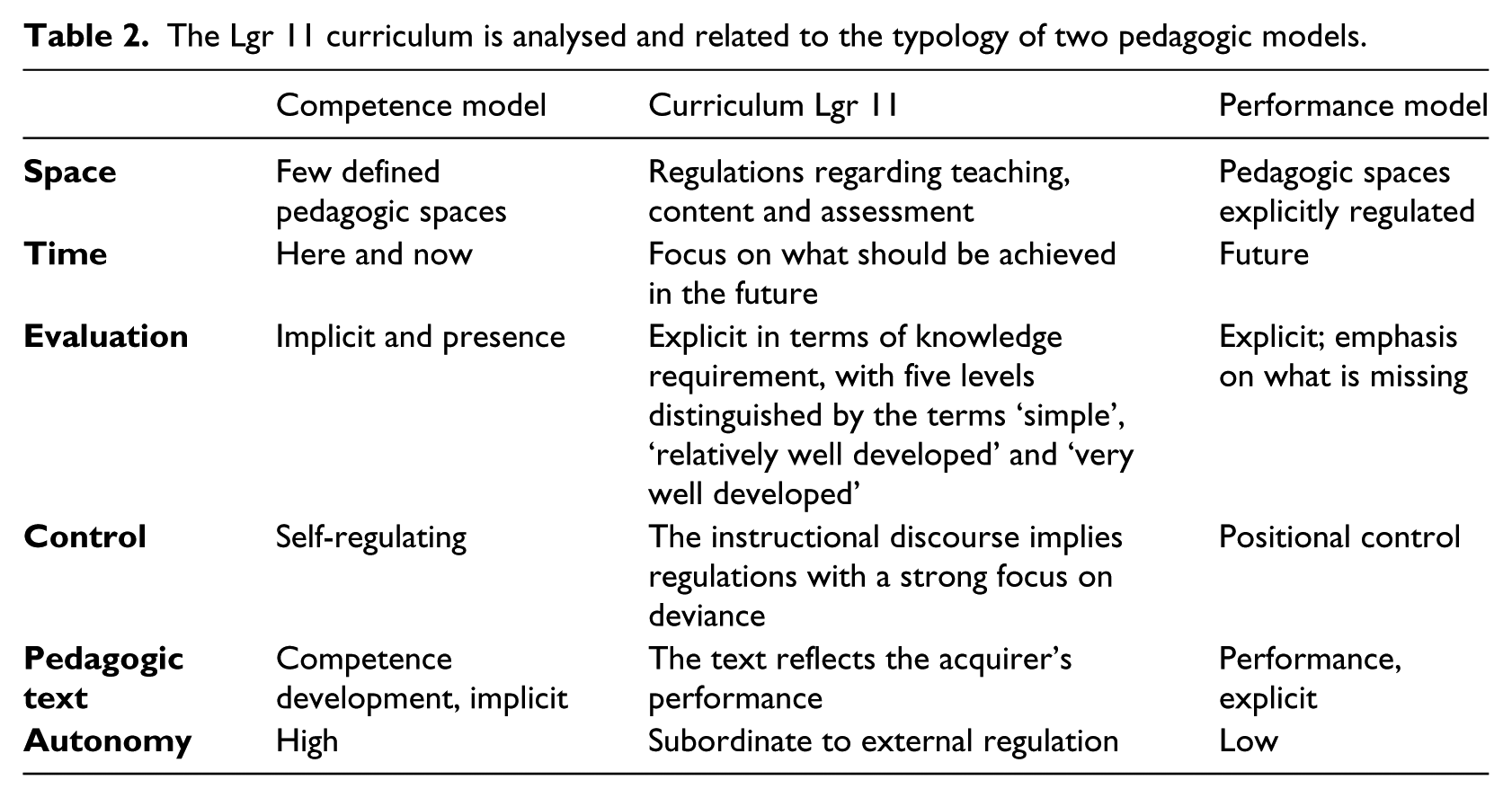
The pedagogic space is explicitly regulated; for example, ‘the school should provide pupils with structured teaching under the teacher’s supervision, both as a whole class and on an individual basis’ (Lgr 11, 2011: 15). The knowledge requirements and the grades represent the extent to which the student has achieved the national knowledge requirements for each subject at a specific time. For grades E, C and A, a student’s level of knowledge is equivalent to the requirements ‘in full’. The knowledge requirements describe the minimum acceptable knowledge, and the expressions of the required knowledge are focused on each student’s abilities (NAE, 2010). The mode of the instructional discourse, particularly through assessment, makes deviations from these requirements visible. It is clear to the students how and when their performances will be evaluated, and the pedagogic text can also be viewed as the student’s performance objectified by grades. The performance of students, teachers and schools are more clearly monitored by curriculum regulations and assessment procedures compared to the previous curriculum, and in this sense, student autonomy is restrained by external structures. Using different aspects of Bernstein’s typology, the Lgr 11 curriculum is most consistent with a pedagogic performance model (see Table 2).
How does this displacement correspond with transnational policy as it is expressed by the OECD through the PISA surveys? In the next section, the PISA 2009 Reading Framework is analysed with a focus on convergences and divergences in conceptualisations of knowledge between the PISA Framework and the subject of Swedish in the current Lgr 11 curriculum.
The PISA 2009 Reading Framework
The PISA Assessment is described as measuring broad knowledge and going beyond school-based knowledge towards its use in everyday life as an adult. It is based on a ‘dynamic model of lifelong learning’, which implies that it teaches knowledge and skills for the ‘successful adaptation to a changing world’ and concerns continuous learning throughout life. This broad approach to knowledge and skills is summarised in the concept of ‘literacy’. The PISA 2009 Reading Framework 8 argues for cross-disciplinary competencies for directing the focus on reading capacities needed for adult professional, civic and private life, and for avoiding assessments of curriculum elements that are too narrow. The framework aims to promote general cross-curricular skills, such as communication, adaptability, flexibility, problem-solving and the use of information technologies. According to the framework, the PISA Assessment is closely related to policies. One of the main features of PISA is its policy orientation, with the aim of identifying characteristics of education systems with high performance standards; it is, therefore, important that PISA includes variables that are responsive to policy decisions (OECD, 2009).
The understanding of reading literacy has been expanded by the concept of lifelong learning. The texts used in the PISA Assessments are continuous texts, such as newspaper reports, essays, novels and letters, and non-continuous texts, such as lists, tables, graphs and diagrams. Reading literacy is defined as: ‘An individual’s capacity to: understand, use, reflect on and engage with written texts, in order to achieve one’s goals, to develop one’s knowledge and potential, and to participate in society’ (OECD, 2009: 14). The PISA 2009 Reading Framework contains three new emphases: the reading of electronic texts, elaborations on aspects of metacognition and engagement with written texts. Electronic text is synonymous with hypertext, which is characterised as unfixed and dynamic. It is stressed that the ability to navigate the text with computer tools plays an important role in reading proficiency. The navigation tools needed determine the difficulty of the task (OECD, 2009).
In reference to current research, the metacognition aspect is given prominence based on its connection to both reading proficiency and learning. Explicit and formal instruction in reading and writing strategies is expected to lead to a better understanding of the content and to better information use, as well as to an increased independence of the reader from the teacher. The aim is that the reader should understand reading as a problem-solving task that uses certain strategies to solve reading comprehension problems.
The third new emphasis in the PISA 2009 Reading Framework is engagement with the text. This emphasis also incorporates research, and the framework claims that motivation, attitude and behaviour are key factors related to reading achievement. The keyword for engagement is ‘self-determination’. The self-determined reader reads for his or her own sake and for a variety of purposes. Thus, autonomy and influence are important aspects of reading engagement. The PISA Framework emphasises that the most significant person supporting the readers’ sense of ownership and competence in reading in the classroom is the teacher, who is also responsible for creating a reading environment that allows the students to take their own reading initiatives and make their own selection of texts (OECD, 2009).
When examining the re-contextualisation process outlined in the PISA 2009 Reading Framework in relation to the subject of Swedish in Lgr 11, the ability to read and understand the different purposes for using different types of texts converges significantly with the core content for years 4–6. 9 The re-contextualisation of metacognition in terms of reading strategies also more explicitly converges into reading and writing strategies in the Swedish syllabus in Lgr 11. This is in line with the essential knowledge formulated in the first of the EU’s eight key competencies, ‘Communication in the mother tongue’ (European Communities, 2007); however, considering that this competency is emphasised in the PISA Framework, there are no graphs or other forms of non-continuous texts in the aims, content or knowledge requirements in the subject of Swedish in Lgr 11. The lack of goals in cultivating proficiency and engagement in reading, which implies an interest in and an enjoyment of reading, represents a national divergence in the Swedish syllabus in Lgr 11 in contrast to that in Lpo 94.
The re-contextualisation processes in a third wave of European education policy
One conclusion that can be drawn from the overview of initiatives taken by the EU is that we can discuss ‘a third wave’ in the EU education policy that was set in 2007 when Schools for the 21st Century was firmly established in the European policy agenda.
The third wave in EU education policy is characterised by an increasing interest in and acceptance of the EU’s involvement in the national systems for compulsory and secondary school, school curricula and national assessment systems. The underlying assumption is that there is a direct relation between low achievement and leaving school prematurely on the one hand, and unemployment and social exclusion on the other. This is why the EU Commission now directly addresses the designs of the curricula, learning environments and assessments in school. The EU makes detailed recommendations about teaching, student learning and types of assessments (European Commission, 2008). The monitoring and evaluation of the individual Member States’ actions and outcomes have been strengthened and intensified by national monitoring in relation to the EU’s common quantitative targets. The discourse practice in this third wave of the policy can be characterised by a transnational interest in and monitoring of national compulsory school systems and national curricula, which is expressed by the intention to implement key competencies of lifelong learning in national curricula across the EU.
The implementation, as a social practice, is monitored by a programme of assessment that measures all eight of the key competencies. From this analysis, it can be expected that the alignment between the European space, European policy and Member State policies has become more closely related as a result of the third wave of European policy that also includes a convergence in compulsory school systems through the monitoring of national assessments in the eight key competencies.
Convergent and divergent policy concepts in the Swedish curricula
The EU framework of key competencies in itself represents a tension between the meanings of ‘knowledge’ and ‘competence’. While the first four competencies emphasise basic skills that can be compared with more traditional school knowledge, the last four competences stress transversal competencies. In the Lgr 11 regarding the subject of Swedish, the convergences of some of the EU and OECD (through PISA) concepts are clear. The notions of standards and basic skills are reconceptualised in the Lgr 11 curriculum in terms of ‘knowledge requirements’ for year 3 and in a six-point grading scale for years 6 and 9, including the grade ‘fail’. To ensure that no student falls behind and that the requirements are equivalent (i.e. uniform), the state provides compulsory national tests in years 3, 6 and 9. In addition, the School Inspectorate investigates how individual schools and local authorities monitor students’ learning outcomes internally; however, little attention is paid to cross-curricular competencies in Lgr 11. On the whole, the transversal competencies have a weaker position in Lgr 11 in contrast to Lpo 94, while standards have a strong position due to the close alignment of knowledge requirements, aims and content (cf. Sundberg and Wahlström, 2012). 10
The PISA 2009 Reading Framework is mainly situated in a policy discourse of competence and aims to move beyond curricula and a ‘narrow’ view of schooling by including the competencies that students need as adults. Similarly to four of the EU key competences, the PISA framework promotes general cross-curricular skills. Although there is a rather strong emphasis on competencies in terms of general abilities represented in the transnational policy, Sweden is partly moving in another direction by abandoning its former competence-based curriculum in favour of a performance-based model for curriculum and pedagogic practice.
Sweden converges with the European transnational discourse of what counts as knowledge in the conceptualisation of basic skills and standards, but diverges in relation to transversal skills. According to Bernstein, one explanation is that the national curriculum is structured as a collection of school subjects with strong boundaries. This type of curriculum does not facilitate learning spaces for transversal subject competencies; instead, the strong classification of subject matter is supported by state monitoring through national testing (Bernstein, 2000).
A concluding discussion
In this paper, policy documents and curriculum texts have been understood to be discourse practices and pedagogic models as social practices for comprehending the implications of the re-contextualisation processes between different policy arenas, between policy arenas and curricula, and between curricula and an imagined social practice. This is a useful way to trace the meaning of terms such as knowledge and competencies across different arenas and also to determine the consequences that can be expected; however, the link between transnational and national education policy is ambiguous. Transnational and national policies are closely related, although the links between them remain indistinct. The notions of convergence and divergence are helpful for illustrating overlapping policy ideas and national deviations in the transformation from policy to curricula. This is important because it demonstrates that influences on policies passed down from international institutions to national levels should not be understood as a linear relationship from one level to another but rather as complex movements between transnational and national and formal and informal policy arenas. In this transnational landscape, it is clear that international organisations, such as the EU, are now key players in compulsory schools and curricula with the assistance of the OECD PISA studies.
A final reflection is that the impact of underlying policy ideas, such as standards, followed by a corresponding curriculum construction must be viewed as having a considerable impact. As illustrated in the analysis of Lgr 11, subjects within the humanities, such as Swedish, can be forced into a very instrumental understanding of knowledge in relation to predetermined standards without leaving any room for the reasonable aim that students should ‘enjoy reading’.
Footnotes
Declaration of conflicting interests
The author(s) declared no potential conflicts of interest with respect to the research, authorship, and/or publication of this article.
Funding
The author(s) disclosed receipt of the following financial support for the research, authorship, and/or publication of this article: This study is part of the research project ‘Theory-based evaluation of the curriculum Lgr 11’, financed by the Swedish Institute for the Evaluation of the Labour Market and Education Policy.