




Abstract
This paper outlines actions that educational change leaders can take to better meet their curriculum change obligations and responsibilities. In order to do this we extend Vygotsky’s (1978) zonal theory and its many extensions and elaborations by positioning educational change leadership within this theory. We rename the zones to Zone of Principal Responsibilities, Zone of Principal Support, Zone of Professional Learning, Zone of Teacher Resistance and Zone of Principal Illusion, and we introduce the Zone of Curriculum Change and represent these zones in diagrammatical form. We use our research on mathematics curriculum change in one school as an example of how our new zonal theory lens supports educational change leadership. Our findings illuminate possible actions and reactions of the principal and the teacher that ultimately suggest a way forward for turning around unsuccessful curriculum change. Our new zonal theory provides opportunities for change leaders to reduce teacher resistance with evidence that the action and reaction of the principal and the teacher are not independent of each other but are, in fact, co-constructed.
Introduction
Much of the educational change literature positions the commencement of deliberately focused and organised educational change in the early 1960s, but also acknowledges the regularity of failure in these endeavours. For example, Fullan (2005) declares that while some progress has been made in knowing how to better lead educational reform processes, invariably they remain: ‘neither deep nor sustainable’ (Fullan, 2005: 1). Similarly, Hargreaves and Goodson (2006) lament: ‘producing deep improvement that lasts and spreads remains an elusive goal of most educational change efforts’ (Hargreaves and Goodson, 2006: 5). Moreover, Hargreaves (2005) himself, argues that even with all the knowledge we have gained over the past 50 years about how to effectively lead change: ‘too many change efforts remain disappointing and ineffective [and] successful school change on a widespread basis continues to be infuriatingly elusive’ (Hargreaves, 2005: 282). Despite all our theories and all our efforts, deeply effective and sustainable educational change remains indefinable. Finding the correct way to properly lead educational change is not just about ensuring that our schools will be able to achieve what they are meant to but also to ensure that all involved in the change process are better prepared to meet their obligations and responsibilities.
Many who have experienced deliberate educational change, either as leaders or participants, may well acknowledge it as being a time of tension and uncertainty. Despite the abundance of literature prescribing how such change can be best implemented and managed, the reality rarely mirrors the ideal. Often, people are troubled by the transition asked of them by the change and so amend, resist or undermine the change (Bridges, 2002). As a result, tension and uncertainty arises and important obligations and responsibilities become confused, if not avoided. In this circumstance, achieving successful and sustainable change becomes far more difficult.
This paper, and the research which it draws upon, reflects that educational change theory has overemphasised the functional learning associated with the change process at the expense of social learning. Every change mandates new ways to function for those involved; those bringing about the change will be required to learn new ways to act. But within an organisation every change also mandates new ways to socialise for those involved; those bringing about the change will be required to learn new ways to relate, cooperate and work together.
For the leader of the change, this awareness is paramount yet little theoretical or research attention has been offered for guidance. Much has been written about how the leader should function in order to implement successful and sustainable change (see for example Fullan, 2006; Hallinger, 2003; Hargreaves and Fink, 2006; Snowdon and Gorton, 1998). A diligent leader can readily learn the functionalities of leading educational change from these and other sources. However, from a social learning perspective there is much less guidance. Certainly the emotional consequences associated with change have been highlighted (see Blenkin et al., 1997; Branson, 2010; Bridges, 2002; Hargreaves, 2005). Here the leader is urged to suitably attend to the likely existence of resistance to change caused by the emotional response to it from those being asked to implement it. Also, more recent educational change literature has emphasised the need for the leader to be an integral participator and contributor to the change process (e.g. Dinham, 2009; Leithwood and Day, 2007; Robinson, 2007). Moreover, Haslam et al. (2011) argue that it is not only within the confines of the educational change process that the leader needs to be clearly seen as an integral and active member. These authors argue that the essence of leadership is about instinctively and authentically being a part of the group and advocating on behalf of the group.
The departure point for this paper is its recognition of the limitations of this current guidance for the leader with respect to the social learning aspect of change implementation. This paper is informed by research that draws on one primary school’s implementation of a new mathematics curriculum at a time when many different curriculum changes were expected across each subject area. In doing this, the principal’s actions as leader and the teachers actions as members of the professional learning community provide insights into how curriculum change in mathematics was implemented in this particular primary school. In order to develop these insights, an extension of Vygotsky’s (1978) zonal theory is provided as a way to present an illustration and description of some of the essential obligations and responsibilities inherent within every educational change process. In this way, this paper not only highlights the pivotal social learning manifest in educational change but, by doing so, it simultaneously provides guidance for how these can be readily addressed. Thus, this paper provides a unique contribution to the educational change leadership literature and, thereby, offers increased optimism for the achievement of successful educational change implementation in future.
The conceptual foundation
Vygotsky (1978) first introduced the concept of the Zone of Proximal Development (ZPD) to more fully describe the relational or social interplay that occurs between a teacher and a student’s learning during times of guided learning. He described the ZPD as the: ‘distance between the actual developmental level as determined by independent problem solving and the level of potential development under adult guidance or in collaboration with more capable peers’ (Vygotsky, 1978: 86). He saw this zone as the space in which learning takes place. This theory stimulated considerable debate and research being further developed by many researchers (e.g. Blanton et al., 2001; Blanton et al., 2005; Cazden, 1983; Oerter, 1992; Valsiner 1987, 1997). The argument presented in this paper is that the educational change literature, with its emphasis on the principal being the leader of the required new professional learning, positions the principal as akin to that of the teacher in Vygotsky’s (1978) theory. Simply, in the Vygotsky (1978) conceptual model, the relationship of teacher to the student is the same as that of the principal to the teacher. The expectation is that the principal will be guiding the teacher’s learning of the required new professional skills and knowledge, which will bring about the desired change.
To make this application of Vygotsky’s (1978) theory more explicit to this research, the ZPD has been renamed the Zone of Professional Learning (ZPL). The ZPL is the professional and personal interplay that occurs between the principal and a teacher’s professional learning as, together, they seek to provide quality student learning in the school.
Our research also draws on Valsiner’s (1987) research that identified a further two zones, which he called the Zone of Free Movement (ZFM) and the Zone of Promoted Action (ZPA). Within our research, the ZFM is referred to as the Zone of Principal Responsibilities (ZPR), which is the total educational environment that is established by the principal and which establishes the fundamental professional parameters for the actions and thinking the teacher is permitted to undertake. Valsiner (1987) describes this zone as characterising ‘the set of what is available … to the [teacher] at a given time’ (Valsiner, 1987: 232). He argues that the boundaries of the ZPR are constantly being reorganised such that the: ‘reorganization may be initiated by either the [teacher] or [principal] or by both of them at the same time’ (Valsiner, 1987: 232). This could lead to, for example, the principal constraining the teacher’s choice of actions or thinking and can therefore direct the future development of the educational environment experienced in the school. For example, in the current climate where many curriculum changes at the same time is the norm, the ZPR would encompass each required curriculum change.
Valsiner (1987) goes on to describe the ZPA, but in this instance called the Zone of Principal Support (ZPS), as a: ‘set of activities, objects, or areas in the environment, in respect of which the [teacher’s] actions are promoted’ (Valsiner, 1987: 99–100) that can be used to encourage the teacher to perform positively, constructively and confidently in all of their teaching endeavours. In other words, the ZPR describes the principal’s entire set of professional responsibilities, as well as their values, principles, processes, attitudes and expectations, which combine to establish the school’s educational environment. The principal’s responsibilities are so wide it is not possible for the principal to be explicitly supporting each aspect of this environment at each and every moment. Thus, the principal will select particular aspects of this environment based upon a personal sense of what might be more influential and important and provide tangible support for these aspects. This may mean for example, that the principal might engage the services of an external consultant to provide a professional learning opportunity aligned with a perceived new requirement of the change. This could involve the provision of professional readings about new initiatives, additional resources or some release time to encourage the teacher to be continually consolidating and enhancing their professional skills and knowledge.
The interaction of these zones is such that the action that is supported must be allowed and therefore the ZPS is within the ZPR. Nonetheless, the ZPR and the ZPS are interrelated and constantly undergoing change as the principal and teacher interact resulting in negotiated professional learning within the zones. This negotiation occurs as the ZPS will not cover all the principal’s responsibilities and as pressures within the sociocultural environment of the school changes, the ZPS will change.
Making the interactions of these zones more complex is that for optimal teacher professional learning, Valsiner (1987) argues that actions that are supported must be within the teacher’s ZPD, or in this instance their ZPL. The principal cannot ask more of the teacher than the teacher feels capable of doing and relevant to their perceived professional requirements. Moreover, Oerter’s (1992) later research identified that in situations of deliberate learning, for example in the situation of intentional professional learning during implementation of a desired educational change: ‘it is the [teacher] who constructs – with help – his or her [professional] learning, sometimes with unexpected results’ (Oerter, 1992: 188). He makes the point that any analysis of the ZPL must include a description of the object of the learning and the: ‘kinds of actions that have to be performed on that object’ (Oerter, 1992: 196) and that these objects can be physical or verbal labels for objects or situations. For instance, where the principal wishes to create a prescribed change to a teacher’s professional performance so as to support an educational change, they may consider using specific professional readings, relevant videos or providing classroom observations as an avenue for professional reflection in dialogue with a mentor. However, despite the teacher’s direct involvement in such professional learning activities, these in themselves do not guarantee that the teacher will immediately apply the learning and change their professional performance.
An application of both Valsiner (1987) and Oerter (1992) to the role of the leader of educational change would posit both that the full potential of the teacher will not be realised at any one time, as some part of the teacher’s ZPL will always be outside the ZPR as not all possibilities can be provided. For teacher learning, Valsiner’s (1987) theory is used to argue that the ZPS is socioculturally constructed and, as a consequence, can only develop those aspects of the ZPL that are within the established social norms. The overlap in actions that are within the ZPR and the ZPS is where the teacher’s ZPL is realised; as it is at this point that the teacher, through active engagement, appropriates social interaction. Oerter (1992) calls this ‘canalization’ (Oerter, 1992: 193) meaning a secured section of possibilities within defined boundaries of what is allowable.
Advancing this theory further, Oerter (1992) expands on the notion that not every potential for enhancing the teacher’s ZPL can be provided and therefore there are actions that are not available to the teacher. He argues that the ZPR is limited by the professional learning opportunities that are offered by the principal and the ZPS is limited by the principal’s vision and description of the desired change. In arguing this case for unfulfilled potential, an interpretation of his thoughts are provided in the following model, displayed as Figure 1, that has been adapted in accordance with the adjustments previously described in order to apply its precepts to the context of a school’s professional learning environment.
The proposed reconstruction of Oerter’s (1992) model for use in a school’s professional learning environment.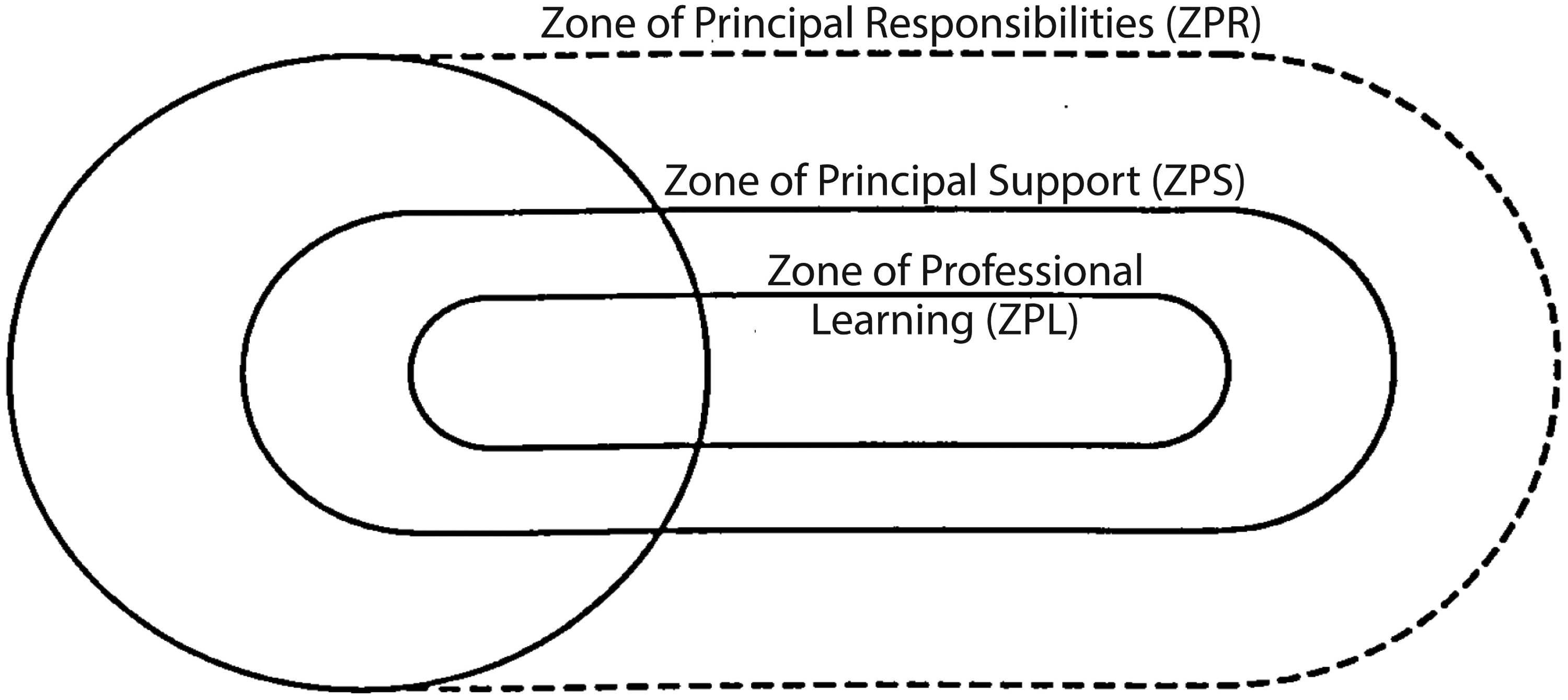
A final extension of Valsiner’s (1987) zones theory proposed by Blanton et al. (2005) is also applicable to this discussion. In their analysis of experienced teachers’ responses to professional development they identified a further zone, which they called the Illusionary Zone (IZ) of promoted action. This is a zone of permissibility that the principal appears to establish through behaviours and routines, but in reality does not support. They see the IZ as being separate from the ZPS in that the ZPS is within the ZPR, while the IZ is outside these zones. Again, applying this refinement to the context of a school’s professional learning environment, the Zone of Principal Illusion (ZPI) would be the aspect of this environment, which the principal publicly proclaims to support but, in reality, does not support. This understanding comes to the fore when some significant influence, external to the school and independent of the principal’s involvement and agreement, creates the need for professional learning in the school. For example, when a governing or legislative body mandates a curriculum change, which the principal is either not entirely in agreement with or senses a personal deficiency in the specific new knowledge or skills inherent in the required change, or has so many other changes underway that they are not able to commit to the new change at this time and therefore creates the illusion that change is occurring.
Also, we argue that in the context of a school’s professional learning environment, another IZ exists. This is the illusion presented by the teacher whereby they generally present as loyal, positive and committed; in reality there are some aspects of the professional learning environment that they do not accept or practise. This zone is referred to as the Zone of Teacher Resistance (ZTR). Since it is created in response to the expected ZPL, it is proposed that it sits inside this zone. The more resistance the teacher feels towards what is being expected of them, the more the ZTR equates to the ZPL, and vice versa.
All of what has been described in this section with respect to not only the application of Vygotsky’s (1978) zonal theory and its subsequent extensions and elaborations but also when it is interpreted so as to apply to the introduction of a desired curriculum change within a school’s existing professional learning environment, can be illustrated as shown in Figure 2.
An interpretation of the extension to zonal theory as applied to the situation of commencing the introduction of a curriculum change in a school.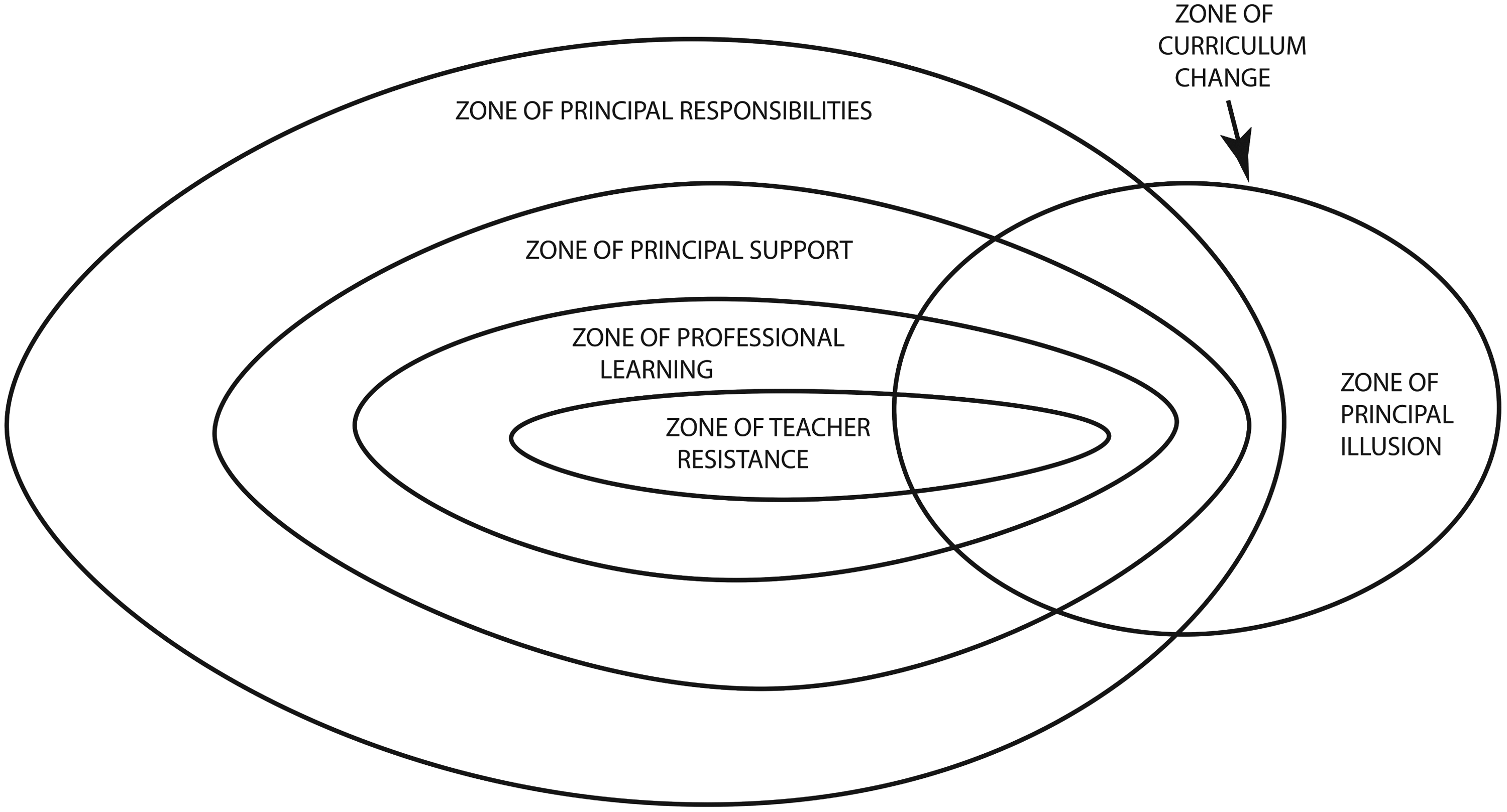
Essentially, Figure 2 has two fundamental intersecting components that need to be further highlighted. The first fundamental component is that of the ZPR, while the second fundamental component is the Zone of Curriculum Change (ZCC). This zone represents the sum total of all the relevant professional knowledge and skills required by all within a school that is wishing to completely imbed a particular new enhancement into its curriculum. The understanding that the current research literature unequivocally aligns responsibility for the successful institutionalisation of any curriculum change at the foot of the principal is indicated in Figure 2 by the intersection of the two fundamental components. In this way, part of the ZPR, and hence parts of the ZPS, ZPL and ZTR, lie within the ZCC. This illustrates that some of the principal’s educational responsibility is directed towards the curriculum change and, thereby, the principal will choose to explicitly support certain professional learning initiatives specific to the development of the curriculum enhancement’s required professional knowledge and skills. In this way, a portion of the teacher’s professional learning will be commensurate with this curriculum enhancement but, at the same time, some of their resistance will also be aligned with it. However, it can be noticed in Figure 2 that not all of the ZCC is included in the ZPR. This is to recognise the likelihood that the principal will not completely and wholeheartedly support the proposed curriculum change. Thus, this area of the ZCC that is outside of the ZPR can be labelled as the ZPI, because this segment represents those parts of the curriculum change that the principal indicates public and outward support for, but privately and inwardly does not wish to support at the time shown by Figure 2.
This paper will now proceed to apply this further refinement of Vygotsky’s (1978) zonal theory to the study of particular curriculum change. Although this refinement provides an explicit depiction of the socio-political environment, which invariably arises whenever a new curriculum enhancement is attempted, its illustrative power comes to the fore when it is applied to specific curriculum change projects. In this way, it can highlight the likely success detractors and, thereby, point to ways in which the ultimate institutionalisation of the change can be achieved.
The research design
This study relied on a mixed methods approach to the various moments of data collection, analysis and interpretation where it took a sequential approach so that qualitative and quantitative data collection and analysis occurred in stages rather than concurrently. The two stages were exploration and inspection. During the exploration stage, the principal was interviewed to develop a broad understanding of the research site. These qualitative data were then combined with the literature to develop and validate a theoretically-based and construct-specific questionnaire (quantitative approach). The inspection stage of the study then involved further qualitative data collection through focus group and individual interviews. These interviews provided an avenue by which to further interrogate the qualitative and quantitative data collected during the first stage of this study.
Participants
The participant selection was guided by the boundary of the participating primary school. Within this research site, key personnel, including the members of administrative team (i.e. the principal, deputy principal, head of curriculum and head of special education unit) and 26 classroom teachers from Years 1–7, participated in the study.
Data collection and analysis
Interviews were conducted with the principal and head of curriculum during the exploration stage, which led to the development of a questionnaire that was administered to 25 of the 26 classroom teachers, validated and the data analysed. This analysis raised a number of unresolved issues that led the investigation in the inspection stage of the study. Here, focus group interviews were conducted with each year level of teachers. This was followed by further clarification of the issues with individual interviews involving each of the four members of the administrative team. This two-stage data collection process was supported by a three-step iterative process of data analysis termed as first-, second- and third-order interpretation (Neuman, 2007: 160). The first-order interpretation is from the perspective of the participants being studied. The second-order interpretation stems from the perspective of the researcher and involves eliciting the underlying coherence or sense of meaning in the data. Third-order interpretation involves the researcher assigning general theoretical significance to the data. This theoretical significance is being presented in this paper.
Discussion informed by the enhanced zonal theory
ZPR
This study is set in the context of an avalanche of curriculum change. Change has been required of principals and teachers across every subject area in the years leading up to the study. Moreover, in some subject areas more than one change was required. For primary school teachers, who are generalist teachers, this has meant that curriculum change was required in each subject they were teaching. In this context the principal’s ZPR encompasses all these curriculum changes and he found this to be a daunting task as he described the situation: ‘We used to have one syllabus document change every couple of years. Recently we have had every KLA [Key Learning Area] change’.
ZPS
This study was interested in curriculum change in mathematics and, therefore, data collection was specifically around the supports provided by the principal to promote curriculum change in mathematics. During his interview, the principal indicated that he had been very proactive in putting in place supports for teachers during this time of many curriculum changes. He discussed staff meetings and the quarterly curriculum forum as well as the year level coordinators’ meeting. He went on to explain that: ‘every other Monday we have a staff meeting which has a clearly set professional agenda … put together as an admin team with input from our year level coordinators’. In addition he had appointed year level coordinators who organised fortnightly year level meetings that benefit from the attendance of a member of the administration team. The year level coordinators need to email various members of the admin team their agenda. We also then have specific input into those agendas to insure that we are talking curriculum issues through, such as mathematics or English or whatever, so that we have a conduit or forum as well to come down to year level specific activities.
The principal also discussed two new structures – a year level planning day to plan integrated units of work in a school matrix across each of the key learning areas, and two half-days of moderation across each year level. We have now established another set of release times for teachers with advanced organisers for moderation… So that is part of the planning processes across the whole school, and obviously those planning processes will be even more developed with the mathematics as well.
The principal also discussed that he provided all teachers with the school mathematics program and a mathematics textbook that he considered to be a very supportive resource. The reform textbook was considered particularly helpful as it mirrored the most recent change to the mathematics curriculum.
Following this interview with the principal it was evident that he had indeed instigated a number of initiatives to support teachers indicating a large ZPS as he attempted to meet the requirements of the ZPR. These data were used to develop and validate a survey that was administered to the teachers in the school.
ZPL
Teachers’ survey and interview data were analysed in an effort to develop a sophisticated understanding of the effectiveness of the ZPS for supporting each teacher’s ZPL necessary to meet the demands of the ZPR. The gap between the principal’s intention and reality of supporting curriculum change in mathematics was identified making it difficult for teachers to change their instructional practices in line with the intent of the new mathematics curriculum.
The teachers were clear that whole school staff meetings and quarterly forums were not structures for supporting curriculum change. Typical of the teachers’ responses was: You especially find out new information because, I think that the meetings are an opportunity for a lot of examination of [Education] Department documentation, and I think that sort of seems to be the main purpose of these meetings (I3P7T3). I think, really, the position of Year Level Coordinator, you don’t really have any [authority], you’re just a coordinator… It’s more organisational things. When we have these moderation days or we have planning days, we go through all the writing tasks and the science etc.; it’s really supposed to be the units we’ve already been planning with the HOC, we really don’t give maths much thought (I1P25T1). I have just been keeping my head above water this year getting used to the new content, so I’m probably not a good one to answer that question, or not very well anyway (I4P28T1). I don’t think we ever really got our head around investigations … an activity that we do in the room might accidentally be an investigation but because I’m a bit wishy-washy about what investigations are … it could accidentally happen to be there and it could be called an investigation (I1P27T2). It was just kind of, you know, as we introduced [the textbook] and all the rest of it – investigations were kind of encouraged, but there wasn’t any guide as far as kind of training and how to do it (I1P33T2).
ZCC
For this principal, his ZPR is large. He has many competing interests for his attention. The data gathered from his teachers would suggest that the ZPS for mathematics is very small and would therefore only support a small ZCC. It appears that the only supports provided to teachers for curriculum change in mathematics were the textbook and the school program.
ZPI
Interview data collected during the inspection stage of the study highlighted a gap between the principal’s espoused set of activities that create the ZPS for curriculum change in mathematics. The principal had created an illusion for the researchers, and possibly even for himself, as he presented the picture that a full set of activities was in place to support curriculum change efforts in mathematics.
Despite claims by the principal that professional development was a feature of this school, when the head of curriculum was asked to comment specifically on the external professional development provided during the implementing of the new mathematics curriculum she said: ‘At the moment no, no, it’s not the same amount [as it is for English] at this stage; it’s sort of dried up’.
Later the head of curriculum agreed that there had been no year level planning in mathematics and, justifying this omission, she argued that it was impossible to work on every key learning area at any one time. Faced with widespread curriculum reform across each key learning area, her role was to ensure that the documentation was correct. She did this by providing the school mathematics program.
ZTR
As teachers struggled with implementing the new mathematics curriculum, evidence of resistance became apparent. One teacher explained how she was exhausted by all the change and the requirements that go hand in hand with it. She went on to say: ‘I’m just trying to keep a low profile’ (I4P28T1).
Teachers were also critical of the reform textbook series, this time because it was ‘so prescriptive’, preventing them from incorporating some of their existing practices. In contrast, they were very positive about the recent introduction of the school program in mathematics that only listed content to be taught each term. This provided them with the freedom to incorporate their ‘tried and tested’ practices. This teacher explains: I found last year that teaching [from the textbook] was very challenging because every single lesson was a brand new lesson. Five days a week you were doing brand new stuff, and I found that was hard. Now I’ve gone back. There seems to be a lot of practice – once they get the understanding, they listen to me and practice a lot. It’s much better (I7P2T1). Investigations did sort of get put in the “too hard box” because there’s so many other things to cover, and that’s going to take all this extra time and resources, and I don’t probably know enough about it to really make it as effective as I could … therefore I was concentrating on what I already know (I6P22T4).
These examples present the case of limited supports that are directly aligned with the change in mathematics resulting in a reduced ZPL and increased ZTR to the curriculum change. At the same time the principal has created an illusion, the ZPI, that curriculum change was happening (see Figure 3).
An interpretation and enhancement of zonal theory as applied to the situation of unsuccessful or tentative implementation of a curriculum change into a school.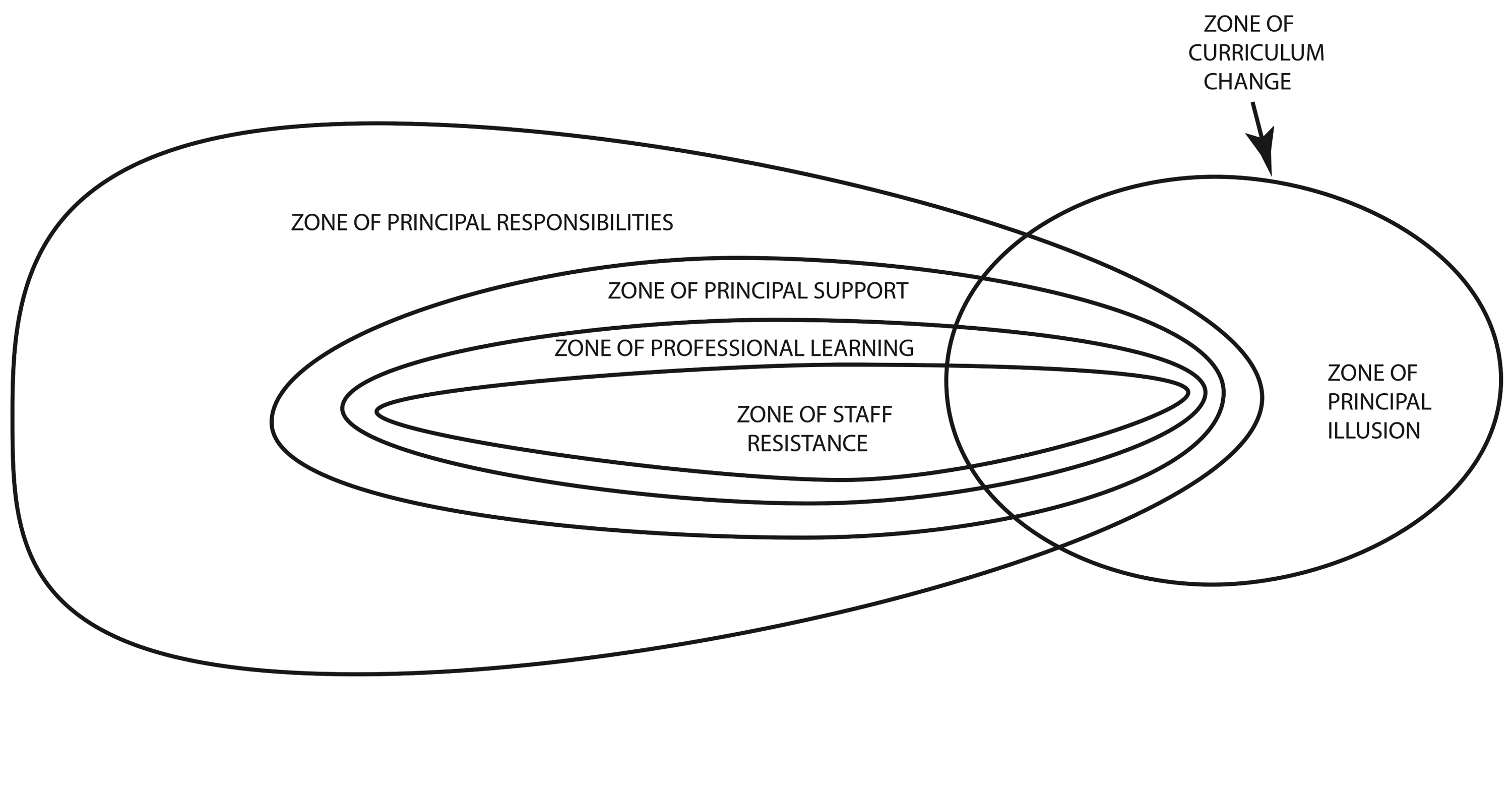
What is happening in this situation?
What Figure 3 explicitly illustrates are the most likely sources of emotion and tension, which not only regularly accompany educational change processes but also significantly contribute to its lack of success (Branson, 2010; Bridges, 2002; Fullan, 2001; Hargreaves, 2005). From Figure 3 it can be seen how much of the principal’s personal involvement in the curriculum change is illusionary or inauthentic. The principal is masquerading as a supporter of the curriculum change. But this is neither an easy nor a satisfying place in which to be. In such circumstances, one’s professional and personal reputation and credibility are constantly on the line as the potential for being discovered as being a ‘fake’ and, thus, untrustworthy, is ever present. To be considered untrustworthy is the unmaking of leadership (Branson, 2010; Hargreaves and Fink, 2006; Haslam et al., 2011; Lyman et al., 2012).
In response to such potential reputational and credibility threats, Figure 3 shows how the principal is likely to enact avoidance and minimalisation strategies. Such strategies seek to reduce the opportunities for the principal’s true knowledge, skills and commitment specific to the particular curriculum change to become known. Avoidance is achieved when the principal intentionally preoccupies their time with as many other responsibilities as practicable and the skewed shape of the ZPR illustrates this. Minimalisation occurs when the principal chooses to restrict the amount of support provided to the implementation of the curriculum change, which is shown as a smaller ZPS area in Figure 3. Quite possibly, what the principal supports is directly aligned to their own limited knowledge and skills, thereby enabling the appearance of credibility to exist.
However, such minimalisation of support by the principal only heightens the development of a discrepancy between what new professional knowledge and skills the teachers really require in order to successfully implement the curriculum change and what professional support they are actually receiving. Figure 3 illustrates these discrepancies in a number of ways. First, it illustrates how little of the ZCC is taken up by the ZPR, ZPS and, thus, ZPL. This implies that there is so much required new professional knowledge and skills embedded within the curriculum change that will not be accessible to the teacher under normal circumstances within the school. As a result, a teacher’s sense of competence and confidence in implementing the necessary changes will be compromised and their resistance towards implementing the change will grow.
Moreover, this resistance can be enhanced because the principal is likely to be providing additional professional learning support for new teacher responsibilities other than those aligned with the curriculum change. As the principal avoids the professional demands of the curriculum change by preoccupying their time with other responsibilities, they will develop the ZPS and, thus, ZPL into these areas, too. Although well intentioned, for the teacher this becomes a significant distraction from the curriculum change and invokes a sense of being overwhelmed by change. Too many changes and nothing seeming to be done thoroughly and so the temptation is to resist as much as possible, as shown by the enlarged ZTR. Where there is strong resistance to educational change, there is strong emotional tension and uncertainty (Bridges, 2002; Deal and Peterson, 1999; Fullan, 2001; Heifetz, 1994; Wheatley, 2006). Under such unhelpful conditions, there is little chance that the implementation of any educational change, least being the desired curriculum change, will succeed.
Turning this unhelpful situation around
For the principal, the first step towards redressing such an unhelpful and, ultimately, unsuccessful educational change situation is to accept and own the pivotal components of the reality. Once these are owned, improving the school’s educational change culture becomes far more likely. To this end, Figure 4 provides a guideline for not only what is required to improve a school’s educational change culture but also illustrates what are the explicit outcomes of this improvement.
An interpretation and extension of zonal theory as applied to the situation of successful implementation of a curriculum change into a school.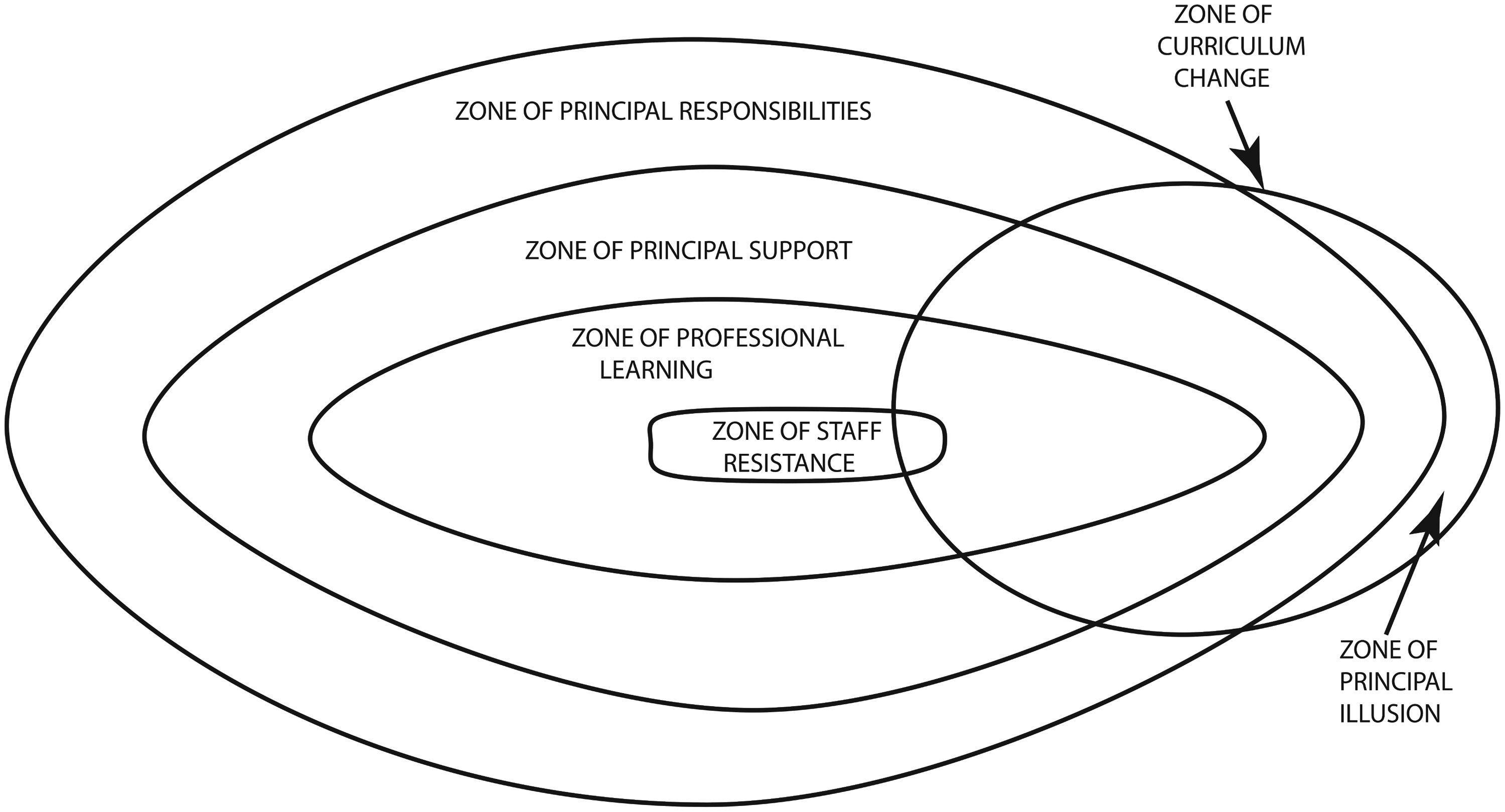
The first step to be taken by the principal is to greatly reduce the ZPI – an obvious and vital, but often ignored, step. In other words, much, much more of the ZPR must occupy the ZCC. The principal must authentically absorb into their ZPR as much of the relevant professional knowledge and skills required to successfully implement the desired curriculum change. To achieve this outcome, the principal must begin by privately acknowledging the limitations of their current professional knowledge and skills in the relevant curriculum area and then to proactively seek ways to overcome these limitations. Overcoming these limitations can be achieved either directly or indirectly. Acting directly would involve the principal seeking the support of a specialist curriculum adviser or a more expert colleague to significantly increase their professional knowledge and skills. On the other hand, acting indirectly would involve the principal in publicly acknowledging their current lack of some of the required new knowledge and skills, but then supporting another more expert staff member to lead the curriculum change. However, it is essential for the principal to still be involved in the curriculum change and to be seen to be having their own professional knowledge and skills enhanced by this lead teacher. This is illustrated in Figure 4 by means of the much larger proportion of the ZPS occupying the ZPR within the ZCC.
In this way, the principal is not only explicitly showing how important the desired curriculum change is to the school community by the amount of personal time and effort they are publicly committing to it but also they are modelling the required learning and becoming intimately familiar with its inherent demands. From this commitment, modelling and familiarity, the principal is more inclined to become quickly aware of any unexpected deficiencies in how the curriculum change is being supported and make prompt adjustment to this support as necessary. This is shown by the much larger ZPS. In addition, due to the principal’s intimate knowledge of the demands of the curriculum change, the potential for the teachers’ professional learning to be far more strategic and specific is enhanced. The principal does not have to be convinced that a particular avenue of teacher professional learning is required to progress the curriculum change, rather they are likely to have already foreseen the need and have considered ways for enabling it to happen. This is indicated by the increased size of the ZPL. Indeed, in a truly effective educational change strategy, the ZPL would be an expanding, rather than a static, feature.
Within such a strategic, flexible and rich professional learning environment it is far less likely that the teachers will harbour deep-seated resistance. Although nil resistance might be an improbable ideal, any reduction in teacher resistance is a valuable and beneficial outcome for the educational change leader. As Hargreaves and Fullan (2012) posit, well-supported teachers will overcome any residual feelings of doubt and uncertainty about educational changes, because they truly want to make a difference in the learning of their students. In other words, the natural tendency for resistance towards any proposed educational change is minimised where the teacher feels appreciated, supported, encouraged and affirmed by the principal. An intimately involved principal, as indicated in Figure 4 by much of the ZCC being occupied by part of the ZPR, is far more able to regularly and sincerely provide these essential outcomes to each teacher. All of this is shown in Figure 4 by the reduction in size of the ZTR.
Conclusion
This paper began by acknowledging the widely held perception of ineffectiveness of many intended educational change processes. Hence, we proposed that finding the correct way to properly lead educational change is not just about ensuring that our schools will be able to achieve what they are meant to but also to ensure that all involved in the change process are better prepared to meet their obligations and responsibilities. It is this latter requirement that has been the focus of this paper. Specifically, this theoretical and conceptual discussion presents a visual illustration of both the necessary and the possible roles for key persons in a school reform. In this way, it brings into explicit focus the inherent obligations and responsibilities associated with each of these roles. Our argument is that avoidance or minimisation of personal obligations and responsibilities is far more difficult when everyone knows what these are meant to be and especially when these are visually displayed.
To this end, Vygotsky’s (1978) zonal theory was chosen as the cornerstone in this process since it makes manifest the essential relationship between the principal and the teacher in the achievement of effective and sustainable educational change. Then, through the application and extension of subsequent enhancements to Vygotsky’s (1978) original theory and the presentation of these in diagrammatical form, this paper disunites this essential relationship in order to illustrate its inherent interrelational and interdependent features. In this way, the possible actions and reactions of the principal and the teacher are presented and described. The most important feature of these illustrations is the realisation that the action and reaction of the principal and the teacher are not independent of each other but are, in fact, co-constructed. The actions and reactions of the teacher will be influenced by the actions and reactions of the principal and vice versa. The achievement of effective and sustainable educational change requires the establishment of a close professional partnership between the principal and each teacher involved in the change process.
Specific to the role of the principal in an educational change process, the extended zonal model developed in this paper illustrates why the principal cannot avoid, abate or discriminate their personal involvement. Uncertainty or a lack of self-efficacy cannot justify diminished or non-involvement. Rather, this extended model clearly exemplifies the likely negative consequences of such action, and the accompanying discussion places the responsibility squarely upon the principal to seek whatever means possible for overcoming any feelings of uncertainty or a lack of confidence and efficacy. The principal must undertake opportunities for strategic professional learning so that they are readily able to be a close professional partner with each teacher involved in the change. Strategic professional learning enables the principal to maximise their professional support to each teacher and, thereby, greatly increase the opportunities for the teacher to gain the necessary professional learning, which will make them far more positive about the change. In this way, the desired educational change is most likely to be effective, successful and sustainable.
Footnotes
Funding
This research received no specific grant from any funding agency in the public, commercial, or not-for-profit sectors.