




Abstract
The core curricular category of learning outcomes has entered the educational policy scene in Europe. While content-oriented curricula have dominated the Nordic countries, a shift towards outcomes can also be observed. In this article, we describe the fundamental distinctions between Didaktik and learning outcomes and examine how learning outcomes are incorporated into written national curricula for compulsory schooling in Norway and Finland. We find that learning outcomes are integrated in both countries; however, the Norwegian curriculum is positioned further away from a Didaktik-based model than that of Finland. The Norwegian approach neglects an essential distinction between matter and meaning by employing an outcome-oriented curriculum.
Introduction
In recent years, the term learning outcomes has emerged as a core concept in European educational policy. National qualification frameworks in many countries, such as Scotland, South Africa and New Zealand, have used the concept for some time (Young, 2003). The Bologna Process and the European Union’s establishment of the European Qualifications Framework for lifelong learning have been the driving forces for the use of learning outcomes within Europe (Young, 2007).
Though various definitions exist (Prøitz, 2010), learning outcomes can be described as what pupils or students can actually do with what they know and have learned. This definition implies that outcomes are actions and performances that contain and reflect the learner’s competence in successfully using content, information, ideas and tools (Melton, 1996; Spady, 1994). We therefore define learning outcomes as the competences and skills that pupils will have after a period of learning.
While the curriculum approach has been highly content- and input-oriented in Northern Europe (Karseth and Sivesind, 2010; Vitikka et al., 2012) as well as in Anglophone education systems (Priestly and Sinnema, 2014), the supporters of the new curriculum discourse call for a shift towards an output orientation, where students’ mastery of learning is prioritised. The centrality of the learner and assessable learning outcomes through statements of competence are placed to the fore (James, 2005), and in the curriculum knowledge becomes subordinate to learning outcomes (Allais et al., 2009). According to Shay (2013), education systems face great global pressure to respond to agendas other than those of the knowledge disciplines themselves. Shay uses the term ‘contextual turn’ to capture how knowledge is transformed to meet these agendas (Shay, 2013).
Hence, this shift in focus, at least rhetorically, represents a new way to define a curriculum that is legitimated and placed within an accountability system. Not only does the curriculum emphasise measurable descriptions of learning outcomes and expected qualifications (Sivesind, 2013), but it also sets national test-based standards for assessing students’ performances. Such standard-setting has become a core strategy of a new quality management system, in order to monitor and improve students’ achievements (Fend, 2011).
Although researchers have pointed to the importance of policy borrowing in ongoing national education reforms (Exley et al., 2011; Nordin and Sundberg, 2014; Sundberg and Wahlström, 2012), research has also underlined that ‘global manuscripts’ on curriculum policy are understood and handled differently by national states, who adjust their own policy to meet global requests and demands (Karseth and Sivesind, 2010; Sivesind, Afsar and Bachmann (in this issue). For instance, Nordin and Sundberg (in this issue), note that the Swedish compulsory schooling reform converges on a broader European knowledge discourse, but at the same time several core concepts used in European policy texts are being reconceptualised and given a different meaning when re-contextualised in the national arena.
In this paper, we examine how learning outcomes have been incorporated into the written national curricula for compulsory schooling in Norway and Finland. We address this issue with the question: Do subject curricula reflect the current international and national policy agendas by placing a strong emphasis on learning outcomes? In order to answer this, we analyse the composition of subject curricula in Norway and Finland in terms of the content of selected subjects, as well as the relationships between purposes, objectives and assessment criteria. Our contribution illustrates that nations respond differently to perceived global trends, such as a focus on learning outcomes. This analysis reveals variations among countries within Europe and even Nordic countries, which are often treated as a single unity. As such, our contribution shows that European, and specifically Nordic European, countries exhibit important differences in the integration of learning outcomes into their respective national curricula, despite their shared reference to Didaktik (Gundem, 1992; Hopmann and Gundem, 1998). The countries selected for this study, Norway and Finland, have long traditions in national curricula (Mølstad and Hansén, 2013). Furthermore, there are several socioeconomic similarities between the two countries and their education systems utilise national curricula based on a language of Didaktik that is bound to certain structures of schooling and teacher education (Hopmann, 2007; Hopmann and Gundem, 1998; Kansanen, 1995; Vitikka et al., 2012). Didaktik concerns a theory of professions, or a professional semantics, and as such frames interpretations and understanding of teaching and learning (Karseth and Sivesind, 2010).
Although disputes have arisen with regard to the content of Didaktik throughout history, some central conceptions of Didaktik still underpin professional discourse in the Nordic countries. These conceptions include the position of the concept of Bildung (Willbergh, 2015) and the distinctiveness of the Didaktik of different school subjects (Gundem, 1992). However, the countries also exhibit cultural and political differences that are reflected in their education systems and educational policies (Afdal, 2012). Finland’s success in the international testing of students’ school achievements contributed to our interest in a comparative approach, in which we can explore similarities and differences in curricula. We chose Norway because the present curriculum reform in the country emphasises competences and outcomes. Our comparison provides new insight into how two fairly similar countries that have traditionally based their curricula on a Didaktik model are adjusting to a focus on learning outcomes.
In our inquiry, we begin by presenting the curricula contexts for the two countries. Then we present perspectives on curriculum with the main features of the continental curriculum tradition and its core concept, Didaktik, constituting a model for how to teach and highlighting the difference of meaning and matter. In addition, we also present perspectives on learning outcomes as a cornerstone in the objective-driven curriculum model. Following this, we describe our research approach and methodology before addressing the analysis of curricula subjects in Norway and Finland. Finally, we compare and discuss how the learning outcomes category is manifested and legitimated in the different curricula.
Curricula contexts in Norway and Finland
With a long tradition of a comprehensive educational system with national curricula, the Nordic countries have some shared history and practices. From the first decade of the twentieth century, subject plans in the Nordic countries were in many respects developed in similar ways (Klette and Carlgren, 2000). Curricula for basic education in these countries are determined by national and regional agencies and defined by acts of parliament, constituting written texts from the government directed at school activities (Gundem, 2008).
Curriculum in Norway
Building upon a long tradition of state-based curriculum, the government and parliament in Norway nationally determine and establish the curriculum (Westbury, 2008). In turn, each school is responsible for realising the values of Norwegian society: equality, justice, ‘Norwegianness’ and diligence. Consequently, the government found it important to be able to prescribe the content of teaching in certain ways through school legislation and curriculum guidelines (Gundem, 1993a). Traditionally, the teacher determined the teaching methods that were used. However, in the reforms of the 1970s, and more so in the 1980s, the choice of content also became an issue, and teachers or local-level educators were given more freedom to express their opinions and make decisions. In the period from 1990 to 1995, the influence of educational experts was reduced in favour of stronger political centralisation. This change was part of the establishment of the idea of a strong state, combining central management with social democratic confidence in the state (Telhaug et al., 2006).
The goal of the current reform in Norway, the Knowledge Promotion introduced in 2006, was to transfer much of the system back to a more decentralised structure, with a significant share of action and responsibility allocated to local school authorities and local schools (Engelsen, 2008). A core purpose described in the main documents underpinning the reform, as well as in the curriculum documents, was that competence aims 1 should be placed within the context of school subjects and fields of knowledge. The Knowledge Promotion described school subjects as the premise for competence aims (Det kongelige utdannings- og forskninsdepartement, 2004: 34). Furthermore, basic skills should be integrated into the aims and contribute to the development of competence in the subject, while also being part of this competence. According to the Norwegian Ministry of Education and Research, the new subject curricula should become simpler, clearer and more binding, and they should contain ‘distinct learning targets for each subject describing the desired competence’ (Det kongelige utdannings- og forskninsdepartement, 2004: 12). Hence, the political expectation was for the reform to represent a shift towards detailed content descriptions to emphasise students’ learning outcomes. In line with this focus on outcomes, national testing of basic skills was introduced in 2004. Although the authorities do not publish league tables, the media publish their ranking of schools on an annual basis (Tveit, 2014).
Curriculum in Finland
The curriculum system in Finland has hovered between centralised and decentralised governing structures since the comprehensive school system was established in the 1970s. The arguments in favour of centralised structures have emphasised the demands of equality of basic educational opportunities for each child, regardless of geografic location and economic status (Mølstad and Hansén, 2013). The curriculum of 1985 gave contents and objectives in the form of shortlists (Lampiselkä et al., 2007). The reform of 1994 witnessed an increase in decentralisation, the centrally formulated parts contained only general guidelines or a curriculum framework, which had to be concretised in schools and local communities (Mølstad and Hansén, 2013). Moreover, reform gave teaching staff increased responsibilities for developing and deciding on curriculum content on the basis of provided guidelines (Hansén, 1998).
The Finnish curriculum of 2004, the National Core Curriculum for Basic Education (Finnish National Board of Education, 2004), is the object of this study. Compared to the previous curriculum, the National Core Curriculum is more detailed, with clearly prescribed requirements. In addition to the description of objectives 2 and the core contents of the different subjects, the National Core Curriculum also devotes attention to the principles of pupil assessment, special needs education, pupil welfare and educational guidance. Furthermore, this curriculum framework explains the principles of an effective learning environment, teaching approaches and the concept of learning. Under this curriculum, the government increasingly hold schools accountable for the outcomes they are expected to produce (Mølstad and Hansén, 2013). However, Finland has no national testing nor school ranking lists (Varjo et al., 2013), and Finnish teachers are highly trusted (Vitikka et al., 2012). Researchers have also found that newer approaches to education, such as New Public Management, are also present in the Finnish education system (Varjo et al., 2013).
Perspectives on curriculum
How a curriculum is conceptualised and defined by researchers depends on the theories they employ, as well as the context of their analysis (Gundem and Hopmann, 1998a; Sivesind, 2008, 2013). Hence, the distinctiveness of a national educational system and the geographical identity of researchers are important in order to understand the meaning of a curriculum as well as what it includes and excludes. Although, as pointed to in the introduction, recent research has shown that curriculum reform worldwide seems to follow common general ideas (Meyer, 2007), institutional differences and distinctive national cultures influence diverse frames of reference in the field of curriculum.
As already mentioned, research has identified a shift from content-oriented models of education to learning outcomes as statements of competences (James, 2005). Central and Northern European curricula have traditionally been dominated by a core reference to the concept of Didaktik, which is defined as the art or study of teaching (Gundem and Hopmann, 1998a). Hopmann and Riquarts (2000: 3) stated that ‘since the days of Comenius and Ratke, Didaktik has been the most important tool for planning, enacting, and thinking about teaching in most of northern and central Europe. Indeed, it is impossible to understand German, Nordic and central European schooling without appreciating the role and impact of Didaktik’.
An important aspect of Didaktik is the primacy of the content, illustrated by its position on top of the well-known Didaktik triangle (Figure 1), with the teacher on the bottom left and the learner on its right (see for example, Hopmann, 2007; Künzli, 1998, 2000). Simply stated, the Didaktik model deals with the following three questions: (1) What is to be taught? (2) How is content to be taught and learned? (3) Why is content to be taught and learned? While Didaktik addresses all of these questions, the first and third questions dominate within the model (Künzli, 2000). Further, the position of content is underpinned by the way ‘a didactician looks for a prospective object for learning and asks himself what this object can and should signify to the student and how the student can experience this significance’ (Künzli, 1998: 39-40). This position implies that the significance of learning content is the most important aspect in education. Künzli has argued that all other questions and problems, such as class management or individual and social learning, are subordinate. Content is not defined as a fixed body of knowledge to be learned, but as a range of possibilities to be explored through reasoning and interactions (Karseth and Sivesind, 2010). Moreover, curricula based on Didaktik have been oriented towards overall purposes and subject content, as opposed to curricula that are oriented towards an objective-driven model. This latter model is designed to develop specific capabilities directly connected to the needs of society (Hopmann, 2003a; Ross, 2000; Westbury, 1998).
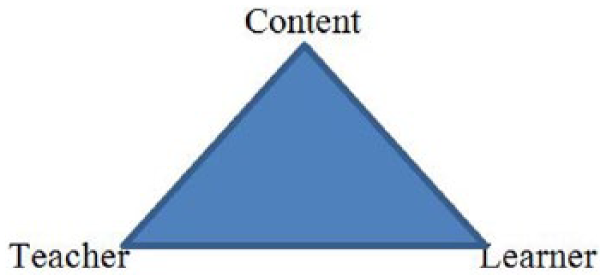
Didaktik triangle.
While content and purpose are the priority in the Didaktik model, objectives and expected learning outcomes are the cornerstones in an objective-driven curriculum model (Ross, 2000). Outcomes, as stated above, can be defined as learning results that students are able to demonstrate at the end of significant learning experiences; moreover, statements of desired outcomes of learning are expressed in terms that clearly point to how students’ achievement can be measured. By putting outcome descriptions or behavioural objectives to the fore, content is primarily seen as a means to achieve these outcomes (Andrich, 2002). This approach is based on the assumption of a direct and often linear relationship between objectives on one hand, and learning activities and performance on the other. This model directly contrasts the fundamental understanding of Didaktik and the educative difference between matter and meaning and the autonomy of teaching and learning (Hopmann, 2007: 109). Within this approach, the distinction between content as such and its ‘educative substance’ is essential. Hopmann (2007: 116) suggested that as ‘any given matter (Inhalt) can represent many different meanings (Gehalt), any given meaning (Gehalt) can be opened up by many different matters (Inhalt). But there is no matter without meaning, and no meaning without matter’. Thus, to orchestrate teaching in line with Didaktik implies a considerable amount of autonomy.
Curriculum, Didaktik and the role of education in the Nordic countries are tightly connected to the concept of licensing. Licensing is based on an explicit differentiation between the responsibilities of content and methods; in this view, a teacher has the methodological abilities to handle whatever content is required. In this case, the outcome is not measured (Hopmann, 1991). As Gundem (1993a) has elaborated, licensing represents an administrative mechanism where the responsibility for planning and control is separated from responsibility for practice. When a system of licensing provides for professional autonomy for teachers, tracking the impact of new curricula does not make much sense since the curricula are realised in a range of local activities and outcomes. Within this licensing system, the common core of professionalism, Didaktik, has the ability to relate the institutional frame (the curriculum) to local activities and outcomes by pedagogical arguments. Such a system involves weak control and evaluation of the processes and almost no external control of the outcomes of education. This model stands in contrast to the product-centred system of external controls as established in, for example, the USA (Hopmann, 2003b).
We have so far limited our presentation to two main curriculum models. This approach may seem too simple to capture the complexity of the field of curriculum, and education specialists have offered different overviews (Pinar et al., 1995; Ross, 2000; Young, 2008). Sundberg and Wahlström’s (2012) analysis of curriculum development in Swedish compulsory education from 1962 to 2011 illustrates how different models come into play. They state that ‘a denationalised and instrumental conception of education is characterised, at a general societal level, by a shift in the direction of internationalisation and privatisation, and, in the more concrete arena of governance and curriculum, by a shift towards management by requirements and control’ (Sundberg and Wahlström, 2012: 353). Sundberg and Wahlström (2012) further suggest that a combination of two basically contradictory concepts of knowledge is used, the technical-instrumental form of curriculum and a neo-conservative view of curriculum content. Likewise, Engelsen and Karseth (2007) describe how different types of models are visible in various parts of the current curriculum in Norway, illustrating how several models can be applied at the same time. Despite the contested approaches, some fundamental differences (described by the distinction between Didaktik and learning outcomes) exist that are relevant to our analyses of recent curriculum reforms in Nordic countries. One of the most important aspects is how the two approaches place various degrees of attention on content and objectives as distinctly separate elements. Therefore, these two concepts are essential in our analyses of subject curricula.
Research approach
We have chosen to analyse three different current subject curricula within Norwegian and Finnish compulsory schooling which all include learning outcomes. The Finnish curriculum is published in both Swedish and Finnish, and we have used the Swedish version of the following subjects: mother tongue, mathematics and music. We chose mother tongue and mathematics because they are often considered to be core subjects. However, we also wanted to include an art subject and found that the most comparable of the art subjects was music. Therefore, this subject was included. For the mother tongue subjects, we have selected Norwegian in the Norwegian curriculum and Finnish in the Finnish curriculum (Swedish version). The subject selection represents three highly different fields, thus providing us with various examples and a legitimate analysis of how learning outcomes are incorporated into subjects in Norway and Finland. The curriculum documents included in this research are: the National Core Curriculum for Basic Education (Finnish National Board of Education, 2004), the mathematics subject curriculum (Utdanningsdirektoratet, 2013a), the Norwegian mother tongue subject curriculum (Utdanningsdirektoratet, 2013b) and the music subject curriculum (Utdanningsdirektoratet, 2006).
Both the Norwegian and the Finnish curricula consist of more than the subject curricula. This means that the total curriculum includes statements about the aim of education as well as responsibilities of educators 3 . These parts of the curriculum have a clear reference to the educational acts in the two countries (for more details, see Mølstad and Hansén, 2013). However, this article concentrates on only subject curricula, as these are the most concrete parts of the curriculum where it is possible to analyse how learning outcomes are operationalised and presented with regard to Year groups as well as topics. We argue that research like this is needed in addition to policy analysis of shifts in curriculum models on a more general level, as school subject curricula are important manifestations of what is expected. Furthermore, subject curricula also remind us that subjects, as knowledge and content structures, play a major role in the design of a curriculum.
Our analysis is based on the theoretical perspectives described above; thus, we are interested in examining how the curricula reflect the different vocabularies of teaching in schools. We analyse how elements such as content, purpose, objectives, learning outcomes and assessment are presented in the curricula. Based on this analysis, we show how these components are linked, how they are positioned in relation to each other and how they are constituted in the curriculum. The analysis provides an empirical base for discussing the distinction between meaning and matter.
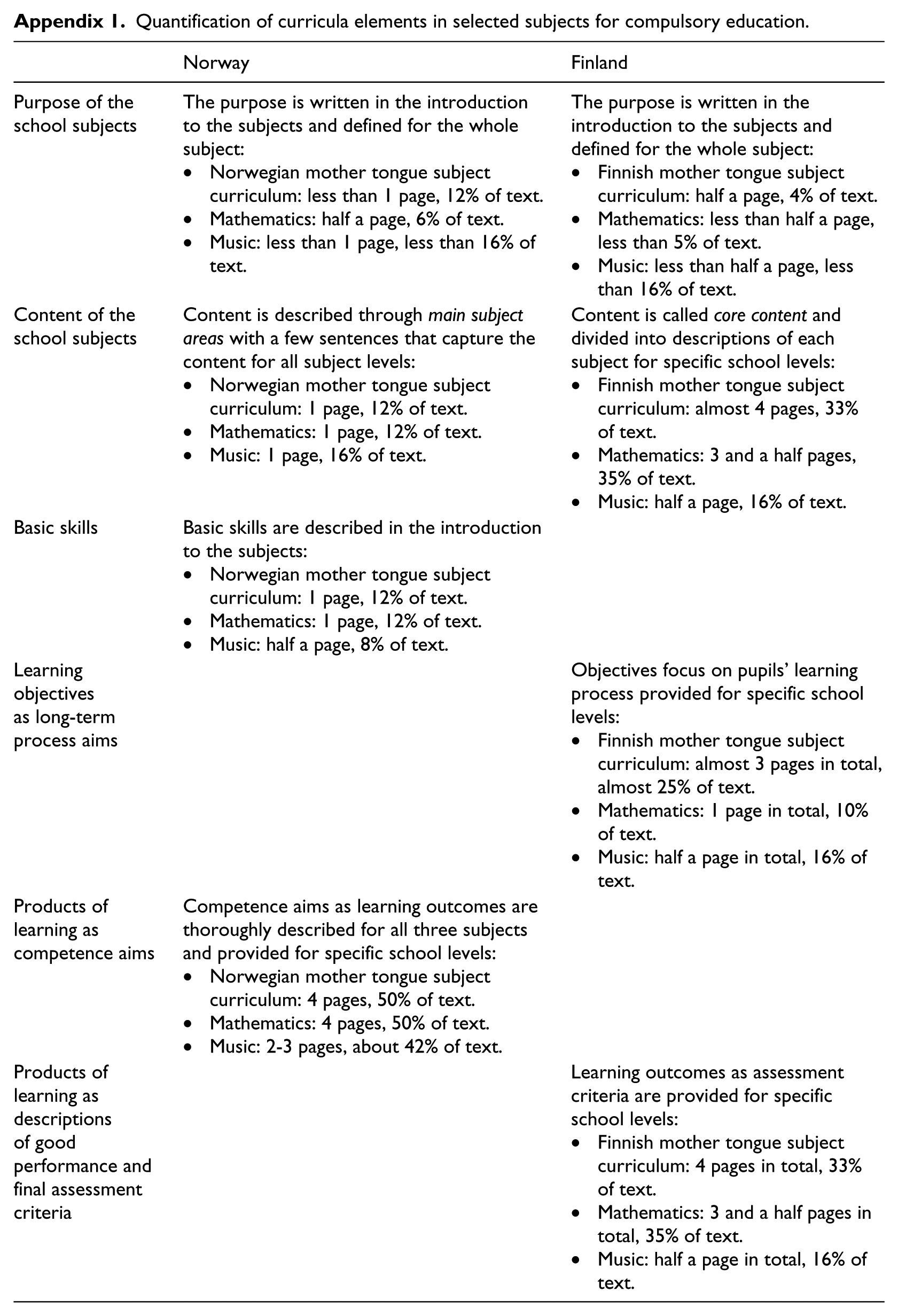
We started our analysis by counting the textual occurrences of each element presented in the curricula. Some of the information in the curricula is presented as fragments or sentences enumerated in a list of points. These points have been counted to establish how many content descriptions, objectives or learning outcomes are included in the curricula, in addition to full pages of text. This quantification provided us with information on the presence of the different categories (see Appendix 1 for a quantification of the curricula elements for compulsory education). Second, based on the two models outlined above, we investigated whether the language used in the curricula could be categorised as focused teaching methods, content-oriented (subject), development/process-oriented (learner) or focused on the product of learning (outcome). This enabled us to understand the position of different curricula elements and how learning outcomes as a category is manifested in different curricula.
The comparative research approach raises some methodological challenges. At least two aspects have to be taken into consideration when working comparatively to enhance the level of equivalence between the compared phenomena: linguistic equivalence and organisational equivalence (Backström-Widjeskog and Hansén, 2002). Linguistic equivalence concerns the question of how to understand each other when different languages are involved. The challenge here is to identify key notions and concepts that correspond and refer to the same phenomena. Striving for linguistic equivalence involves both translation and an adequate utilisation of notions and concepts. As already stated, we used the Swedish version of the Finnish core curriculum. We read the Norwegian curriculum in Norwegian. The use of documents in two languages and writing in a third posed a challenge. We dealt with the issue of translation by thoroughly discussing translations and consulting competent colleagues both in Norway and in Finland.
Organisational equivalence relates to the challenge of understanding how the organisation of the curricula establishes a frame that exposes prerequisites for comparison. The two countries share some common traditions and habits and, in many respects, have gone through similar kinds of reorganisations of their educational systems. Compulsory education is structured similarly; furthermore, teacher education is provided by higher educational institutions, and the teachers’ responsibility for educating young people is highlighted (Mølstad and Hansén, 2013). By investigating the organisational structures of the educational systems in the two countries, it is possible to establish a reasonable comparison in relation to organisational equivalence.
Profile and composition of the subject curricula in Norway
The curricula of the three selected school subjects from the Knowledge Promotion reform start with a few paragraphs that explain the purpose of the subject, followed by descriptions of main subject areas and teaching hours. Next, the curricula briefly present basic skills. Thereafter, the documents describe the competence aims of the subject for years 2, 4, 7 and 10 and after each level in upper secondary education. The last topic in each curriculum deals with provisions for final assessment.
The purposes point to how these subjects contribute to the wellbeing of society and individuals. These paragraphs are important in examining how school subjects are legitimated within basic education. A few sentences concisely describe the subject content (main subject areas) as a distinct element in the curriculum that encompasses all levels. For instance, the curriculum for mathematics describes six subject areas (including one area that is relevant only for upper secondary education). The text for one of them reads:
Measuring means comparing and often assigning a size in numbers to an object or amount. This process requires the use of measurement units and suitable techniques, measuring tools and formulas. Assessing results and discussing measurement uncertainty are important elements of the measuring process (Utdanningsdirektoratet (2013c), Curriculum for the common core subjects of mathematics, 2013, p.3 English version)
With reference to the Didaktik tradition described above, content is not a central element in these written texts. Rather, the focus is on objectives and basic skills.
The curriculum emphasises basic skills. All three subject curricula describe five basic skills that should be adapted to each subject and integrated into competence aims. These skills are the ability to express oneself orally, the ability to read, numeracy, the ability to express oneself in writing and the ability to use digital tools. The text on basic skills in the Norwegian mother tongue subject curriculum is the most extensive of the three, which indicates the central position of reading and writing, as well as the other skills in the subject (Utdanningsdirektoratet (2013b) Læreplan i norsk, 2013: 5
4
). The music subject curriculum states that ‘being able to read’ in music means: being able to interpret and understand various musical expressions, symbols, signs and types of notation. The ability to concentrate over time is an important requirement for reading. The music subject gives important contributions to this end through listening, making music and interpreting of musical expressions and symbols. Reading texts will be important as the basis for one’s own composing and as a source of reflection (Utdanningsdirektoratet (2007) Music subject curriculum, p.3 English version)
The main component of the subject curricula in Norway is the presentation of competence aims. The different aims are introduced by the clause: ‘The aims for the education are that the pupil shall be able to….” Hence, the curricula establish an expectation of certain learning outcomes or the students’ acquisition of a particular competence. The way competence aims are formulated varies across subjects. Some are defined precisely and are related to basic skills, for example, ‘The students should be able to count to 100’ by the end of grade 2 (Utdanningsdirektoratet (2013c) Curriculum for the common core subjects of mathematics, 2013: 5). Other aims are more general and therefore have learning outcomes that are more difficult to measure. For instance, students at the end of grade 2 should be able to talk about how words and pictures interact in picture books for one’s own reading in the library (Norwegian). Although it is evident that, at lower levels (grades 2 and 4), we find competence aims that represent a combination of what we have categorised as an orientation towards the teaching and learning process and an orientation towards the products of learning, the overall picture is that the language used points to expected outcomes.
Let us give two examples to illustrate. The Norwegian mother tongue subject curriculum for grade 10 consists of 27 aims divided among three areas (Utdanningsdirektoratet (2013b) Læreplan i norsk, 2013: 8–9). Competence is described with verbs such as explain, assess, give examples, recall and present. Furthermore, some of them also point to certain activities and hence are characterised as being process-oriented. Likewise, the mathematics subject curriculum for grade 10 consists of 25 aims divided among five areas (mostly about numbers, with eight aims for algebra). Similar to the Norwegian mother tongue subject curriculum, the mathematics curriculum describes the competence aims with verbs such as be able to compare, use, analyse, make estimates and demonstrate. The aims also refer to specific concepts, relations and activities (Utdanningsdirektoratet (2013c), Curriculum for the common core subjects of mathematics, 2013).
Taken together (see also Appendix 1), the composition of the subject curricula in Norway underpins an outcome-oriented model. Competence is at the core and represents the main element in the curricula. The language of the aims’ descriptions underlines an aspiration to guide students’ actions and performances. However, competence at the core does not mean that there is no reference to the subject content (the subject areas), but the descriptions of outcomes in terms of objectives have been prioritised and define the position of the other elements. Furthermore, the way competence aims are presented differs at different year groups. Some interesting differences also exist among the three subjects that reflect certain features of their respective fields of knowledge.
As mentioned previously, the subject curricula describe provisions for final assessment. However, the subject curricula were introduced without accompanying assessment criteria and standards (Tveit, 2014). Hence, although curriculum reform represents an orientation towards learning outcomes, the subject curricula do not include any mandatory criteria for assessing levels of competence in different subjects. While the documents describe the competence aims as something the students should be able to do, they scarcely point to the quality of the level of achievement. Hence, the development of criteria and the selection of content are handed over to the local authorities, school leaders and teachers.
Profile and composition of the subject curricula in Finland
In this section, we present our analysis of the subjects in the Finnish National Core Curriculum for Basic Education (Finnish National Board of Education, 2004). We used the Swedish version, which consists of 320 pages divided into nine chapters (identical to the Finnish version). Chapter seven covers the curricula for the subjects. We analysed the subjects of mother tongue and literature (Finnish as the mother tongue [Swedish version]), mathematics and music. Each of the subject curricula first presents the purpose and then the objectives and core content for Year groups 1–2, 3–5 and 6–9. Levels 2 and 5 also include descriptions of good performance, and level 8 has final assessment criteria for a grade (mark) of 8 on a scale from 5 (weak) to 10 (excellent).
The National Core Curriculum defines the purpose for all the levels of each chosen subject. The purpose is broadly defined with a focus on pupils’ development and knowledge gained on a specific subject. Additionally, the stated purpose of the subject is connected to socialisation and enabling the pupils to be part of society. The socialisation aspect is more emphasised for Finnish mother tongue subject curriculum and mathematics than for music.
Moreover, the document describes the core content of the three subjects for levels of compulsory schooling, as seen here in an example from mathematics grades 1–2: Core contents Numbers and calculations
number, numeral and number symbol
properties of numbers: with concrete means compare, classification, order, break down and assemble numbers
principle on which the decimal system is based
addition and subtraction, and connections between calculations, using natural numbers (Finnish National Board of Education, 2004: 158–159).
This text segment precedes five more lines on the topic of numbers and calculations. The document then specifies core content concerning algebra, geometry measurement and data processing and statistics. As such, this illustrates a curriculum text that is highly content-oriented. The descriptions of core content in the three subjects are oriented towards the school subject content; however, they sometimes also specify activities with words such as practice and listening. One example of prescribed content from the music subject is as follows: ‘exercises that develop voice control and vocal expression; single- and multiple-voiced repertoire representing different styles and genres, with part of the repertoire learned by heart’ (Finnish National Board of Education, 2004: 232). Here, content in music focuses both on subject content and activities. As such, the core content is both content-oriented and process-oriented. This example stands in contrast to the example from mathematics, where no activities are included in the identification of content. With some minor variations, it is possible to conclude that all three subject curricula are oriented towards content, with some descriptions of activities.
The objectives for the subjects are divided into Year groups of compulsory schooling and focus on the pupils’ learning process with the use of terms such as learn to, develop and improve. Teaching activities, as well as long-term goals, are highlighted. The broad objectives concentrate on the pupils, but more on their learning process than the learning outcomes. This approach is evident in the types of words used in the objectives, for example: practise, develop, strive, get used to and gain experience. The emphasis is not on the product, but on the process and activities and thereby has a focus on teaching and process-orientation. Another example is Year groups 6–9 of mathematics, where all the objectives start with learn to; in particular, most of them deal with general mathematical abilities and some with internal processes such as learn to trust oneself and take responsibility. All the nine objectives are formulated broadly and have a process orientation.
The subjects include descriptions of good performance, divided into the various levels of compulsory school, and final assessment criteria, which are provided only for the highest levels. These descriptions focus on pupils’ learning outcomes, evident in the Finnish mother tongue subject curriculum with the use of terms such as are able to, recognise, can, can produce and know. Another example of a criterion is from mathematics: ‘The pupils will know how to solve a first-degree equation.’ Since it specifies what the pupils will have learned, it is possible to assess if they have met this criterion. Thus, the criteria are formulated as learning outcomes or products of learning.
The subject curricula in Finland clearly show that learning outcomes are central in the description of good performance and final assessment criteria for grade 8. Here, the focus is mostly on expected results of learning at specific Year groups. However, some variations exist between levels and subjects. For the Finnish mother tongue subject curriculum, higher educational levels place a greater focus on learning outcomes, which also holds true for the other two subjects. Taken together, our analysis shows that the subject curricula consist of distinctive elements or categories as non-measurable learning objectives, content descriptions and expected learning outcomes (see Appendix 1).
Discussion and conclusion
Learning outcomes are competences and skills that the pupils are to have learned after a period of teaching. Our analysis (see also Appendix 1) shows that the Norwegian curricula for the different school subjects present competence aims as the core category. These aims are described as what the students should know, understand and be able to do; in other words, they are described as learning outcomes. In the Finnish curricula, content and criteria for good performance and final assessment seem to be given almost equal attention as descriptions of learning objectives and content. Furthermore, while the competence aims of the Norwegian curricula are formulated as predictable performances that could be measured after a certain time, the learning objectives in the Finnish curricula are more long-term oriented towards understanding and familiarisation with social values and norms. Hence, the Norwegian curriculum texts seem more limited in their orientation towards learning objectives. In contrast, the Finnish texts seem more oriented towards content and long-term aims and less directed towards certain anticipated outcomes than those found in the Norwegian material. This conclusion is in line with Sivesind and Afsar (in this issue), who argue that learning outcomes are not incorporated in the same way in the Norwegian and Finnish curricula.
Moreover, because separate content descriptions for the different year groups provide a broader scope in the subject curricula in Finland, it may also be argued that content selection is not only linked to the achievement of certain objectives or learning outcomes, but also opens up a more intrinsic justification of content. The lack of separate content descriptions for the Year groups in the Norwegian curriculum does not mean that there is no content in the curriculum since content can be found in the competence aims. However, this way of providing content as part of the description of competence aims is based on the assumption of a direct and often linear relationship between objectives, and learning activities and performance. As such, the distinction between matter and meaning disappears. This stands, as mentioned above, in contrast to the concept of Didaktik, where the educative difference between matter and meaning and the autonomy of teaching and learning are essential (Hopmann, 2007). Within Didaktik, the teachers’ autonomy is provided by the difference between meaning and matter, which seems to be absent from the Norwegian curriculum. We therefore question if the Norwegian curriculum, with its competence aims, may narrow the range of deliberation on what the school subject curricula should constitute and further reflection on what this matter can and should signify to the student. The curricular categories that we have used in our analysis of the orientation of the learning objectives/competences (oriented towards teaching, content, development/process-oriented, learning outcome) shows that the Finnish subject curricula represent a much broader representation with Didaktik as a major point of reference.
We recognise that what is prescribed in written documents does not necessarily represent what is undertaken. As a result, studies of prescriptions are important in order to capture the cultural and social context of education at the level above educational practice. Research on policy discourse has revealed that ‘policy words are not mere rhetoric; they are policy, or, at least, policies are textual interventions into practice’ (Ball, 1993: 12 quoted in Saarinen, 2008: 720). Hence, the text of the curriculum sets important parameters for professional as well as public discourse. We may therefore argue that the Norwegian school subject curricula as textual interventions overlook the importance of discussing content in its own right. We maintain that the Norwegian curriculum discourse is positioned further away from what we have described as the Didaktik model than the Finnish curriculum discourse. The Norwegian subject curricula thus represent a framework where learning outcomes replace the role of content as the main category. Content is given a subordinate position compared to learning outcomes. By using a more multiple orientation, the Finnish curriculum seems to uphold a stronger link to the Didaktik model by including the importance of long-term objectives with defined content. On the other hand, by focusing on criteria and descriptions of good performance, the Finnish curriculum signals an expectation that certain learning outcomes be achieved at different educational levels.
One of the major functions of national curricula is to steer and control education. Our analysis shows that the Norwegian subject curricula mostly provide directions through learning outcomes because subject curricula content are not separately specified and are thus entrusted to schools and teachers. This approach provides a licence for the teaching profession to select content in order to reach learning outcomes. Learning outcomes in the Finnish subject curricula are not the sole governing category, learning objectives focused on teaching, content and learning outcomes connected to assessment are equally important. At the same time, in Finland it is mandatory to produce a local curriculum based on the National Core Curriculum, whereas in Norway it is not mandatory to write up the local curricula to the same extent (Mølstad, 2015). The Finnish requirement of local curriculum and the composition of the subject curricula imply that trust in the teaching profession is based on the concept of licensing as described earlier (Gundem, 1993b; Hopmann, 1991). Thus, by placing trust in the teachers, both countries’ national curricula in a way support licensing of their educators. However, it is important to remember that curriculum is not the only document that governs education (Bachmann, 2005); for example, the Norwegian government provides materials for helping and guiding practitioners. If a narrow governing model, such as the one used in Norway, is complemented with a wide set of directives from the government, it might not allow as much trust for the teaching profession. In Norway, the curriculum is often supplemented with circular letters providing guidance for its interpretation (Mølstad and Hansén, 2013).
From the preceding discussion, it can be concluded that learning outcomes have a central position in the Norwegian and Finnish subject curricula for compulsory school. This result reflects international policy agenda advocating a shift towards learning outcomes. Based on this finding, it is possible to say that the curricula in Norway and Finland have integrated learning outcomes. However, the educational systems differ: the Norwegian curriculum is positioned further away from the Didaktik-based system than that of Finland, where the highly outcome-based curriculum is very much in line with the objective-driven model.
Footnotes
Appendix
Quantification of curricula elements in selected subjects for compulsory education.
| Norway | Finland | |
|---|---|---|
| Purpose of the school subjects | The purpose is written in the introduction to the subjects and defined for the whole subject: • Norwegian mother tongue subject curriculum: less than 1 page, 12% of text. • Mathematics: half a page, 6% of text. • Music: less than 1 page, less than 16% of text. |
The purpose is written in the introduction to the subjects and defined for the whole subject: • Finnish mother tongue subject curriculum: half a page, 4% of text. • Mathematics: less than half a page, less than 5% of text. • Music: less than half a page, less than 16% of text. |
| Content of the school subjects | Content is described through main subject areas with a few sentences that capture the content for all subject levels: • Norwegian mother tongue subject curriculum: 1 page, 12% of text. • Mathematics: 1 page, 12% of text. • Music: 1 page, 16% of text. |
Content is called core content and divided into descriptions of each subject for specific school levels: • Finnish mother tongue subject curriculum: almost 4 pages, 33% of text. • Mathematics: 3 and a half pages, 35% of text. • Music: half a page, 16% of text. |
| Basic skills | Basic skills are described in the introduction to the subjects: • Norwegian mother tongue subject curriculum: 1 page, 12% of text. • Mathematics: 1 page, 12% of text. • Music: half a page, 8% of text. |
|
| Learning objectives as long-term process aims | Objectives focus on pupils’ learning process provided for specific school levels: |
|
| Products of learning as competence aims | Competence aims as learning outcomes are thoroughly described for all three subjects and provided for specific school levels: |
|
| Products of learning as descriptions of good performance and final assessment criteria | Learning outcomes as assessment criteria are provided for specific school levels: |
Acknowledgements
We thank the Curriculum Studies, Educational Leadership and Governance (CLEG) research group at the University of Oslo, as well as Professor Helen Gunter and Professor Sven-Erik Hansén for their thorough comments and feedback.
Declaration of conflicting interests
The author(s) declared no potential conflicts of interest with respect to the research, authorship, and/or publication of this article.
Funding
The author(s) received no financial support for the research, authorship, and/or publication of this article.