




Abstract
This article stems from a curiosity for a broader, deeper, and more complex understanding of the concept of Bildung. It has two aims: to advance an innovative and complex methodological approach for studying Bildung, and to present empirical results related to bibliometric characteristics of literature on Bildung. The empirical results map the literature on Bildung published in English language during the set timespan of 1990–2020. Concomitantly, the main research question addressed is ‘What are the bibliometric characteristics of scholarship on Bildung in peer-reviewed educational research?’. Based on our inclusion and exclusion criteria and following the PRISMA methodology, 267 texts are included in the final sample, which are then coded following a two-part tailormade Coding Protocol. Results presented in this article show that most publications on Bildung in educational research are spatially bounded in German-speaking and Nordic Europe. Further, one of the findings indicates an increase in publications incorporating Bildung after 2010. It is argued that Bildung offers educative and instructive ways, educationally speaking, for addressing what it means to be human and a member of a larger society. Collective and collaborative contributions through education are needed to address persisting and growing local and global challenges and inequalities.
Keywords
Introduction, motivation, and research questions
In the difference opening between a ‘Promise of Bildung’ (Løvlie, 2002) and ‘Do we (still) need the concept of Bildung?’ (Masschelein and Ricken, 2003) lies a curiosity for a broader, deeper, and more complex understanding of the concept of Bildung, historically and in the present. Why Bildung? And why Bildung again? Because Bildung is relevant in the present-day schooling and policy contexts, especially in Continental and Nordic Europe. In the Norwegian context for example, the dual mission of education is clearly and specifically stated to include education and Bildung (Kunnskapsdepartementet, 2017). To address these initial points, we 1 set up a systematic research review project to get an overview of and engage analytically, critically, and interpretatively with the scholarship on Bildung in educational research covering the time span from 1990 to 2020. This is the span of the previous generation. We see this as an answer to the question: How can we understand Bildung and education in our time? This positioning reflects a dynamic, constructionist and interpretivist view that each generation of scholars reads and interprets Bildung from their vantage point. It also reflects an ongoing deliberation on Bildung that is both temporally and spatially bounded. The present article has two aims: to share a detailed account of the innovative and complex methodology of the research project in which the results presented herein are embedded, and second, to present empirical results on bibliometric characteristics of texts on Bildung. The two-part structure of the text is needed for the present article as it makes visible the underlying methodological approach and corresponding results of the research question addressed herein.
Education is a young institution of modernity. In the Middle Ages, education in Europe was mainly Christian. That is: teaching how to read the Bible. The Enlightenment opened society for an understanding of knowledge as another relevant guidance for life and society. Education became an institution for knowledge in society. Education, and by extension the appearance of Bildung in the education discourse, is thus to be understood as part of larger and longer political, social, cultural, and economic changes that emerged in Europe during the Enlightenment, broadly construed. Within the context of modern education in Europe, the development of knowledge was the expression of human superiority (e.g. over nature; Adorno, 1997), and the developmental institutions were, and still are, universities and schools.
Linguistically, Bildung is a German term that despite different efforts has not found a corresponding translatable term in English. Often, several other terms are used in attempts to capture its connotations such as ‘formation’, ‘self-formation’, ’self-cultivation’ or ‘being educated’ (c.f. Hopmann, 2007; Westbury et al., 2000). The term carries many of its core ideas and meanings from the German education tradition, starting from the Enlightenment era, but also from the post-Second World War period in relation to the ‘Frankfurt School’. To exemplify, we turn to Wilhelm von Humboldt, as a representative of the Enlightenment, and Wolfgang Klafki, as an educational scholar connected to the Frankfurt School, for two definitions of Bildung that our project builds on: It is the ultimate task of our existence to achieve as much substance as possible for the concept of humanity in our person, both during the span of our life and beyond it, through the traces we leave by means of our vital activity. This can only be fulfilled by the linking of the self to the world to achieve the most general, most animated, and most unrestrained interplay. (Humboldt, 1793/2000, p. 58) Bildung is understood as a qualification for reasonable self-determination, which presupposes and includes emancipation from determination by others. It is a qualification for autonomy, for freedom for individual thought, and for individual moral decisions. Precisely because of this, creative self-activity is the central form in which the process of Bildung is carried out. (Klafki, 2000a, p. 87)
We find the two definitions above relevant for our project for two main reasons. First, they capture many ideas and ideals promoted during the Enlightenment as a break between past conceptions of what it meant to be a human being in the world, as promoted by religious dogma, and the ‘modern’ ‘enlightened’ conceptions of how one can be in the world autonomously. Second, the two definitions were part of a series of publications that aimed to capture the conception of curriculum and didaktik traditions during the 1990s (c.f. Gundem and Hopmann, 1998; Westbury et al., 2000). Humboldt and Klafki were included in these publications as central readings to get an understanding of how the Didaktik tradition is framed and what role Bildung plays in it. These referred publications in the English language created access to the Bildung/Didaktik tradition to larger English-speaking audiences. It might not have been a goal of the Didaktik-Curriculum dialogue but publications that came out of it shaped how Didaktik and Bildung are viewed and studied from non-German language contexts. As we will show later in this article, there were only a few publications in English related to Bildung during the 1990s, more references started to grow during the 2000s, and the scholarship grew significantly during the 2010s. In that regard, the Didaktik-Curriculum (DC) dialogue might have opened possibilities for a comparative study of Didaktik and curriculum traditions and it has influenced the perspectives through which English-speaking scholars engage with the Didaktik tradition. Also, to further substantiate this point, we present illustrative results to show that Humboldt (1793/2000), a reference found in one of the DC dialogue publications (Westbury et al., 2000), is the most mentioned scholar in relation to definitions of Bildung (see Figure 8 under Results for details).
To return to the definitions above, and the one from Humboldt in particular, we interpret Humboldt’s definition of Bildung, which is task-centred, as a response to the problem that Humboldt identified in his Theory of Bildung as the problem of absence of purpose and direction in our lives (Humboldt, 1793/2000). Thus, Bildung emerged during the Enlightenment era to emphasize using reason for developing individual autonomy and freeing individuals from the control of others, being either powerful individuals or powerful institutions, such as the Church. Humboldt set a high standard on what it means to become an educated human being, and how to overcome the problem of absence of purpose and direction. Humboldt says that it is each and everyone’s task to develop humanity in our own person, both during the span of our life and beyond it, through the traces we leave by means of our actions. According to Humboldt, this can be fulfilled only by the linking of the self to the world to achieve the most general, most animated, and most unrestrained interplay (Humboldt, 1793/2000). Humboldt considered that individuals needed to be cultivated and elevated into higher beings so they can transform themselves and the world around them. According to him, to fully achieve the goals of Bildung meant grasping a completely fresh view of the world and contributing to humankind by the development of one’s own unique and creative self. This is achieved through inner Bildung and awareness of greater significance in ourselves. In the process of acquiring Bildung, Humboldt argued, two sources of influence try to interrupt it – the times when we live and the nation where one is situated. To him, the geniuses, the ones who manage to overcome these two interruptions, are viewed as disturbances in society but are the true transformers, the ones who move their nations in new positive directions. In a Humboldtian view, Bildung is more than mastery of contents, or development of competences or skills; more than knowing something or being able to use that knowledge – it is about becoming a unique subject in the world. Bildung is about placing ourselves in the world, connecting deeply with ourselves as well as the world around us, and transforming ourselves, our profession, and humankind with our ‘vital activity’ (Humboldt, 1793/2000: 58). In sum, from Humboldt’s perspective, Bildung helps us understand the problems we need to face and the tasks we need to tackle in relation to the capabilities we have. Further, Bildung points to what we need and what the world needs from us, what goals we need to achieve, and what influences we need to overcome to ultimately advance the transformative potential of our inner Bildung. As such, Bildung is both a process and an outcome - a lifelong process of shaping ourselves and unfolding our own individuality and an ongoing outcome of becoming a unique self along the way.
Klafki’s definition of Bildung builds on the core ideas initially developed during the Enlightenment, but his definition also has to be understood in terms of the historical context Klafki was part of. Klafki wrote about Bildung and developed his conception of the critical-constructive Didaktik (Klafki, 1998) in the aftermath of the Second World War. His conception of Bildung as a qualification for reasonable self-determination, as well as his operationalization of Bildung as an individual’s capacity for self-determination (being able to make decisions autonomously), co-determination (being able to connect with others in collective projects), and solidarity (being able to contribute to addressing social inequalities) are all framed within the larger project of the Frankfurt School towards the emancipation of humanity (Klafki, 1998, 2000a). In turn, by integrating Bildung into his critical constructive Didaktik, Klafki’s contribution lies in his effort to bring Bildung closer to the teaching practice. In other words, his Bildung-oriented Didaktik makes Bildung an educational concept, rather than only a philosophical and political one. Arguably, therein lies also the influence that Klafki had and continues to have as a Didaktik scholar within the Didaktik education tradition since he ‘translated’ a highly sophisticated and abstract idea of Bildung into a practical task to be promoted through education in school practices, most notably through his ‘didaktik analysis’ (Klafki, 2000b). Klafki’s didaktik analysis constitutes a model for integrating the educational idea of Bildung into school curricula to promote an advanced and sophisticated interaction between the individual and the world, upon successful mastery and embrace of the given content by the pupil/student.
In sum, in our research project and by way of theoretical framing for the present article, we want to argue that Humboldt’s and Klafki’s conceptions of Bildung are not only relevant, but central, to the educational processes that millions of teachers and students around the world engage in. Bildung, it can be argued, is what makes education educational (Hoveid and Hoveid, 2019). As such, conducting this comprehensive review of the concept of Bildung enables us to point to numerous varied ways in which scholars have brought Bildung into their educational research work. Our goal is to unpack complexities in which Bildung contributes to present-day discussions – be them modernist, post-modernist, or post-humanist – on education. To be able to partially advance such claims, the present article takes a snapshot of literature on Bildung for the given period of time it covers. In so doing, the article’s empirical results are relevant not only for our research project but also to map the field in ways that it has never been done before. Further, the empirical results reported here advance the knowledge in the field by capturing the amount of research, temporally and spatially distributed, and by showing general trends in the development of the field.
This brief elaboration of Bildung from Humboldt’s and Klafki’s perspectives, and on how Løvlie (2002) and Masschelein and Ricken (2003) texts serve both to exemplify the diversity of the field and to position our own research approach. However, our study sample only partially covers the vast and growing literature on Bildung published in English. As we acknowledge under the Methodology section, our sample is limited as per the inclusion and exclusion criteria applied. Further, as we show under Methodology, our group work with the identified and included research in our study was framed by the Coding Protocol that the research group developed for the purposes of the project. In line with our aims, the present study addresses one overarching research questions (RQ): What are the bibliometric characteristics of scholarship on Bildung in peer-reviewed educational research? Because of the volume of articles included in the final sample (n = 267) and the comprehensive approach applied to the data material, the RQ addressed herein primarily corresponds to Part A in the Coding Protocol (see Table 1 below and Supplemental Appendix 1 for details) and partially Part B/B9. Our RQ is further sub-divided in several sub questions, including,
1.1. How much, and in which years, scholarship related to Bildung is published during 1990–2020?
1.2. Where are authors publishing on Bildung from?
1.3. What are research methodologies in Bildung-related scholarships?
1.4. What education level is Bildung scholarship focussed on? and
1.5. What educational actions are identified in relation to Bildung scholarship?
Abridged coding protocol for Bildung systematic review project 1990–2020.

Source: Integrated Education Studies (InEdS) research group, Department of Teacher Education, NTNU (adopted April 2022).
Only results from entries in bold in Part A are presented in this article as well as partial results related to Part B/B9.
The empirical findings related to the RQ are presented in a more descriptive fashion, however the findings and interpretations are based on a collective and thorough analysis and synthesis that followed a complex and laborious process (as we detail under Methodology). While five texts coded as reviews are included in our study (Buttigieg and Calleja, 2021; Meyer and Rakhkochkine, 2018; Sjöström et al., 2017; van Oers, 2010; Wickman et al., 2012), our work here focuses on several key bibliometric characteristics of the texts and it presents the most comprehensive overview of published research on Bildung in educational research to date.
Research review methodology
Our research group engaged in a substantial discussion to define the methodological design of the larger study, from which the results presented in this article are drawn. In the following, we document the decisions we made to conduct the review in a coherent fashion. Here we provide details regarding our review design, identification, screening, and inclusion of studies, as well as our self-developed Coding Protocol that guided the analysis to address the RQ in the present article.
Overall, to address our research question, a constructionist epistemology and interpretivist theoretical perspective (Crotty, 1998) have been helpful. A constructionist epistemology fits with the focus of our study on Bildung through a systematic research review as a methodology since Bildung is a socially-constructed concept. From the constructionism perspective, an objectivist view of human knowledge is rejected, and a position that the meaning of concepts and phenomena is extracted in our engagement with natural and social realities is supported (Crotty, 1998). In other words, the meaning is (socially-) constructed and not discovered. We apply constructionism as an epistemological position that shapes how humans construct meaning of the world around them. Constructionism emerged from the sociology of knowledge advanced by Berger and Luckmann (1966) who posit that reality is socially constructed in a dialectic manner involving the individual and the society and ‘[. . .] the dialectical relation between the structural realities and the human enterprise of constructing reality – in history’ (p. 208). For the present study, the constructionist approach is applied in the design of the Coding Protocol as a socially-constructed analytical tool through shared knowledge in the research group. Next, the entries in the Coding Protocol affect what information and knowledge is extracted from the texts included in the review, and also constitute main findings for analysis and interpretation of the included texts. Further, our own understanding and interpretation of Bildung is socially-constructed and interpretivist, as it builds on our own prior individual academic experiences. Collectively as a group, we are situated in a Bildung-oriented Didatik education context that has shaped and continues to shape our own insights into Bildung. The study also follows Klafki’s (1998) conception of methods for conducting research following his critical-constructive Didaktik, where he suggested, among other things, the use of eclectic research approaches applying empirical and historical-hermeneutical methods (Hudson, 2003). Our group, as Klafki also argued, recognizes the strengths and limitations of any research approach. Consequently, in our research process the empirical and hermeneutical perspectives fed into one another, in our research questions as well as in all subsequent research stages, starting with the development of the Coding Protocol, and following with searching, and reading and interpreting the texts in the final sample.
Review design
We initiated our project aiming at conducting a systematic review of Bildung in Educational Research 1990-2020, and we followed the PRISMA statement (Preferred Reporting Items for Systematic Reviews and Meta-Analyses) as a guide for systematizing our review (Page et al., 2021). The PRISMA statement provides a checklist and flow diagram to encompass four stages in the review process: identification, screening, eligibility, and inclusion of texts. However, some aspects exclude our study from being a systematic review: we have a broad topic, multiple research questions, and we have not conducted quality appraisal.
Our methodology is complex, and it is crucial for us to be transparent about how we have conducted our study. The Coding Protocol (see Table 1 and Supplemental Appendix 1 for details) that we developed for this project is our overall methodology. In this current study, we have worked systematically to understand the breadth, purpose, and extent of the research activity on Bildung. Hence, the closest label fitting our study is a systematic research review which shares similarities with a systematic map or a ‘mapping’ approach (Booth et al., 2016; Zawacki-Richter et al., 2020). A mapping approach is suitable when the aim is to map a broad range of information that can provide an overview of the field of research, for example topic focus, conceptual approach, method, aims, authors, location, and context (Zawacki-Richter et al., 2020). The mapping review describes the bibliometric characteristics of the relevant texts identified within our project following the information extracted based on Part A entries of the Coding Protocol.
Inclusion criteria
Our focus in this systematic research review is Research on Bildung in Education broadly defined. The study encompasses both conceptual/theoretical studies on Bildung not related specifically to any education level and in addition studies that address Bildung in K-12 education, vocational education and training (VET), Teacher Education/Higher education, or Adult Education. Only texts in English were included in the study and the types of publications relevant were peer-reviewed journal articles, books, and book chapters accessible online. The timeframe for the study was texts published during 1990–2020 (Jan 1st, 1990–May 3rd, 2021). Results also show texts with 2021 date, which are texts captured within our timeframe accessible online ahead of print.
Literature search
A systematic search process was conducted based on mapping review techniques. The search was conducted in four databases, namely ERIC (Proquest), Education Source (Ebsco), Scopus and Web of Science. The first two databases are educational research databases, while the latter two are interdisciplinary databases with good coverage of educational research. The only term used in the search string was the word Bildung, and the search fields covered title, abstracts, and keywords. 4702 records (Education Source – 917; ERIC – 253; Scopus – 2715; and Web of Science − 817) were identified in the four databases in the search conducted on May 3rd, 2021. We used Endnote software for the removal of duplicate records. After removal of duplicates, 3884 records were uploaded in Rayyan – an online platform for organizing review studies – for screening of abstracts by the review team. Figure 1 provides a flow diagram of the review process. In the flow diagram we have used the term records, but in the rest of the article the term text is used to refer to the articles and book chapters included in the final sample.
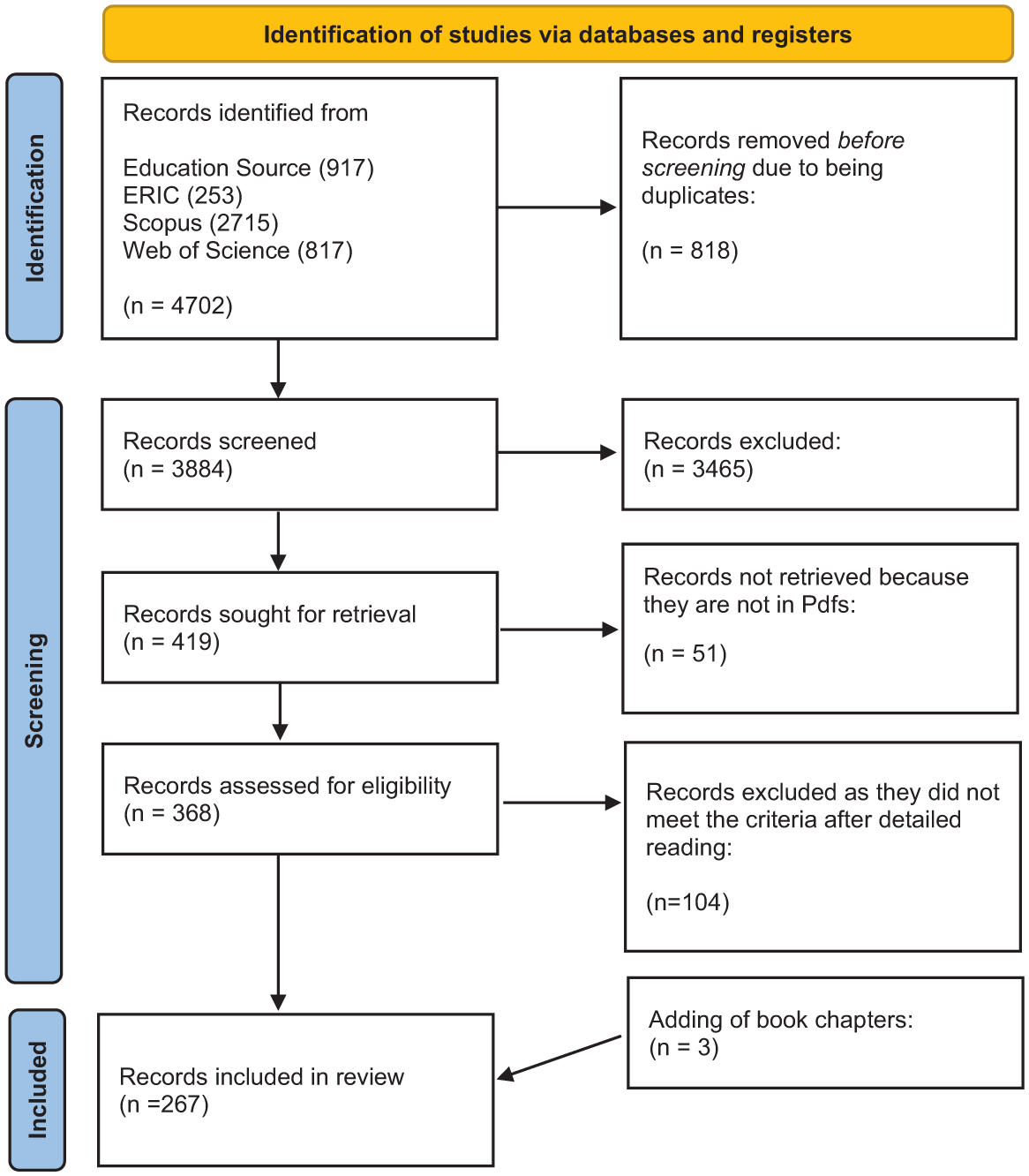
Flow diagram of the literature search and selection of records for eligibility.
Study selection: exclusion criteria
All the texts were double screened and throughout the screening process the team met regularly to discuss issues related to the screening. When all the texts had been double screened, all the conflicts were then addressed by the first and fifth author of this review. The reviewers had the opportunity to flag articles as ‘include’, ‘maybe’ or ‘exclude’. The screening followed a screening guide with inclusion criteria (see previous section) and exclusion criteria (following). The first 100 texts were screened by the whole team and then reviewed and discussed to make sure the reviewers had the same understanding and perception of the screening guide.
Texts in languages other than English, grey literature and conference proceedings, literary-focussed articles (e.g. Bildungsroman), and texts published before January 1st, 1990 were excluded from the study. So were non-education articles (e.g. management/industry articles on employee performance; biology (e.g. studies on animal testing); pure chemistry; pure medicine; political science; travel and tourism; engineering; general history articles not related to education) and articles where Bildung were used in general sense, where Bildung is used to mean general education and not Bildung in the narrower sense. We understand that this last exclusion criteria, added based on screening of a sample of records/texts, belongs to our own interpretation of Bildung in line with the definitions of Bildung by Humboldt and Klafki as elaborated under Introduction above. Texts in languages other than English constituted the largest number of texts among the total excluded during the first screening stage (n = 3465).
After the screening the review team decided to only include full text readings of articles accessed from the NTNU Library. Hence, interlibrary loan was avoided as it is time consuming, requires extra library staff, and is expensive. As 51 documents were not available in PDF, they were excluded from the study. In April 2022, we added two new exclusion criteria: (1) if article/publication is shorter than 5 pages and (2) if article/publication is an Editorial and/or Introduction to a Special issue. From the detailed reading of the texts assessed for eligibility (n = 368), another 104 references were excluded from the study due to them being conference proceedings, editorials, and introductions to special issues. Some references were still in the pool but were excluded as they were non-education articles (management, literature, etc.). Three book chapters to replace two book titles initially included were added to the final sample of 267 texts.
Tailor-made coding protocol for text analysis
To address our research aims, we developed a Coding Protocol, which guided our coding and analytical work conducted using NVivo software. Table 1 presents an Abridged version of the Coding Protocol, while the complete version is provided in Supplemental Appendix 1.
The Coding Protocol consists of two parts: Part A covers broad entries that apply to the entire text (Attribute values in NVivo language), and Part B covers entries related to specific section(s) within the text (Code selection in NVivo language). Part A was developed to capture bibliometric characteristics of the texts to address the RQ of the present study. Under Part A we also tried to code for different aspects of the texts (e.g. A5, A12, A17, A18, A19 under Coding Protocol Part A) that the research group was curious about and thus interested in learning more about. In the present article we only present the results of the entries in
Results: mapping scholarship on Bildung in education
To address the research question on ‘What are bibliometric characteristics of scholarship on Bildung in peer-reviewed educational research?’, detailed results are offered in the following, covering Part A entries in
A2 year of publication
To start with, in A1 the reference in APA 7th reference style for each of the texts included in the final sample was captured, and the complete list is presented in Supplemental Appendix 2. A2 presents the exact year of the 267 texts included in the final sample, as shown in Figure 2.
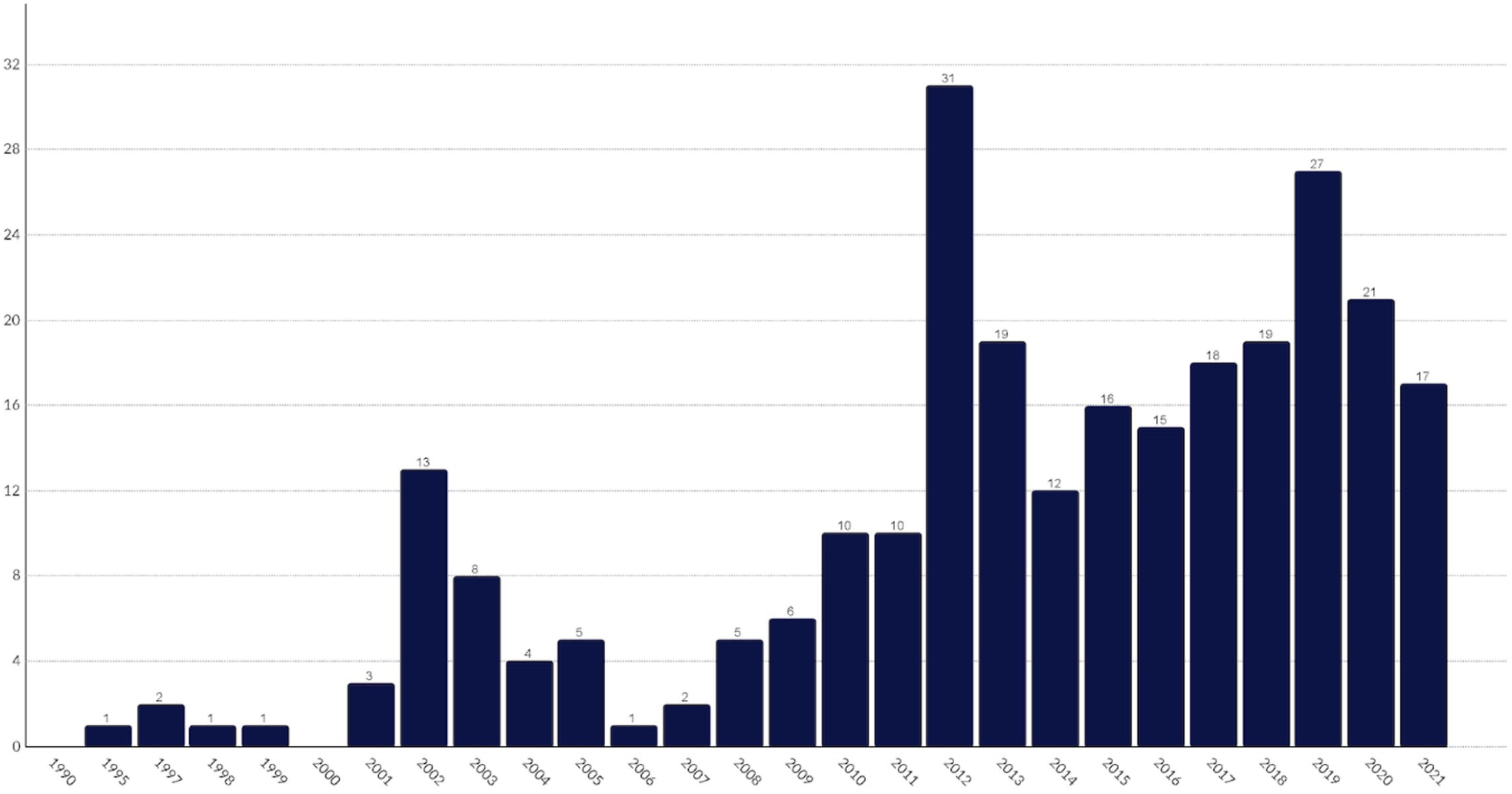
Year of publication of texts included in the final sample (total n = 267).
As shown in Figure 2, our search didn’t result in any publications prior to 1995. There are only five texts included over the entire 1990s. During the 2000s, there is a spike in the number of texts in 2002 because of a special issue on Bildung published in the Journal of Philosophy of Education edited by Lars Løvlie and Paul Standish (c.f. Løvlie and Standish, 2002). However, the consistent increase in texts is only observed after 2010. 2012 is another outlier. For our final sample we decided to exclude books as a whole and retain only individual chapters within the books that met our inclusion and exclusion criteria. Two books published in 2012 were ‘converted’ into book chapters: Becoming Oneself: Dimensions of ‘Bildung’ and the Facilitation of Personality Development (Schneider, 2012) and Theories of Bildung and Growth (Kivelä et al., 2012). This explains the larger number of references in 2012 since from the two books we removed, 3 chapters from Schneider (2012) and 13 chapters from Kivelä et al. (2012) were retained. In our interpretation, the growth in the number of publications in English focussing on Bildung in educational research may be partially attributed to the time it might have taken for the Didaktik-Curriculum dialogue publications of late 1990s and early 2000s to take hold and for other researchers to connect with and integrate them in their research work. However, we are cognizant that there are other confounding factors at play here. For example, the requirements for international publications as part of academic promotion processes in numerous European countries where English is not an official language (such as in Nordic countries) might have also contributed to the increased number of publications on Bildung in English. If we are to assume that the trend identified in Figure 1 will hold for the years to come, it can be reasonably expected that the number of publications on Bildung will continue to steadily increase. The decrease in the number of publications in 2021 is misleading since our search was conducted on May 3rd, 2021, thus showing incomplete results covering 2021 publications accessible online ahead of print.
A3 type of text
Under A3, we coded for the distribution of types of texts included in the final sample. In total, 233 (87%) journal articles and 34 (13%) book chapters met our inclusion and exclusion criteria and as per our search strategy. Sixteen book chapters were from two books referred to above (Kivelä et al., 2012; Schneider, 2012). We are aware that our decision to only include texts that were digitally available and accessible to us has left out other significant print publications, most notably the books that emerged from the Didaktik-Curriculum dialogue (c.f. Gundem and Hopmann, 1998; Westbury et al., 2000). Still, based on the texts included in our sample, the results show that journal articles are the most common type of publications on Bildung.
A6 type of authorship
Under A6, we coded texts for authorship type, whether they were single-, double-, or multiple-authored. Out of 267 texts, 194 (72.7%) were single authored, 46 (17.2%) double authored, and 27 (10.1%) were multiple authored with 3+ authors. While the single authored articles dominate, when we cross-tabulate the data with the year of publication, we find that the number of double- and multiple-authored articles has been steadily increasing since the early 2000s.
A8 gender of author(s)
Under A8, we coded for gender of the authors, whether male-, female-, or mixed gender authored (i.e. a combination of male and female authors; Figure 3).
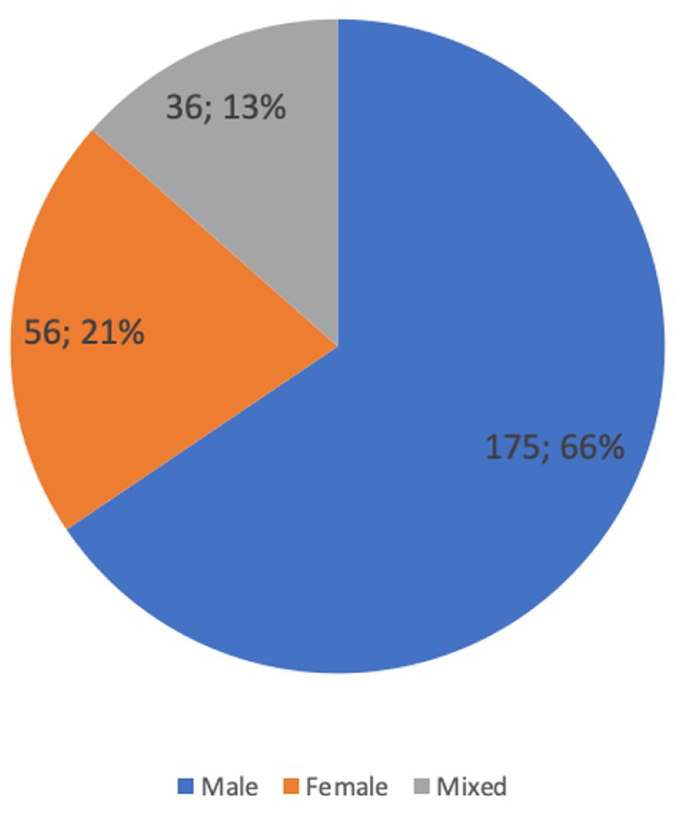
Gender of texts’ authors (total n = 267).
Our coding of texts by the gender of the authors shows that 175 texts (66%) were male authored, 56 (21%) were female authored, and 36 (13%) were mixed gender authored. When cross-tabulated with the year of publication, we observe that with the increase of the number of publications after the 2000s, the number of texts authored by female as well as by mixed authors is steadily increasing. The skewness towards the male overrepresentation in authorship in our sample might capture overrepresentation of males in the academic and research communities in higher education institutions (c.f. European Commission, 2021).
A9 type of author’s affiliation
Under A9, we coded for author’s affiliation type, whether university or non-university. Out of total number of texts, only 4 were from authors with a non-university affiliation. Of those, two were independent researchers; one from a non-governmental organization (NGO); and one from a non-university research institute. Thus, the results show that authors that engage with Bildung predominately have a university affiliation.
A11 country of authors
Under A11, we coded for country of the authors, based on the affiliations of the authors, and in Figure 4, we only show countries with three or more texts, but it still captures results from 221 texts, thus leaving only 46 out, which included countries with one or two texts, and in 14 cases the publication included authors from two or more countries.
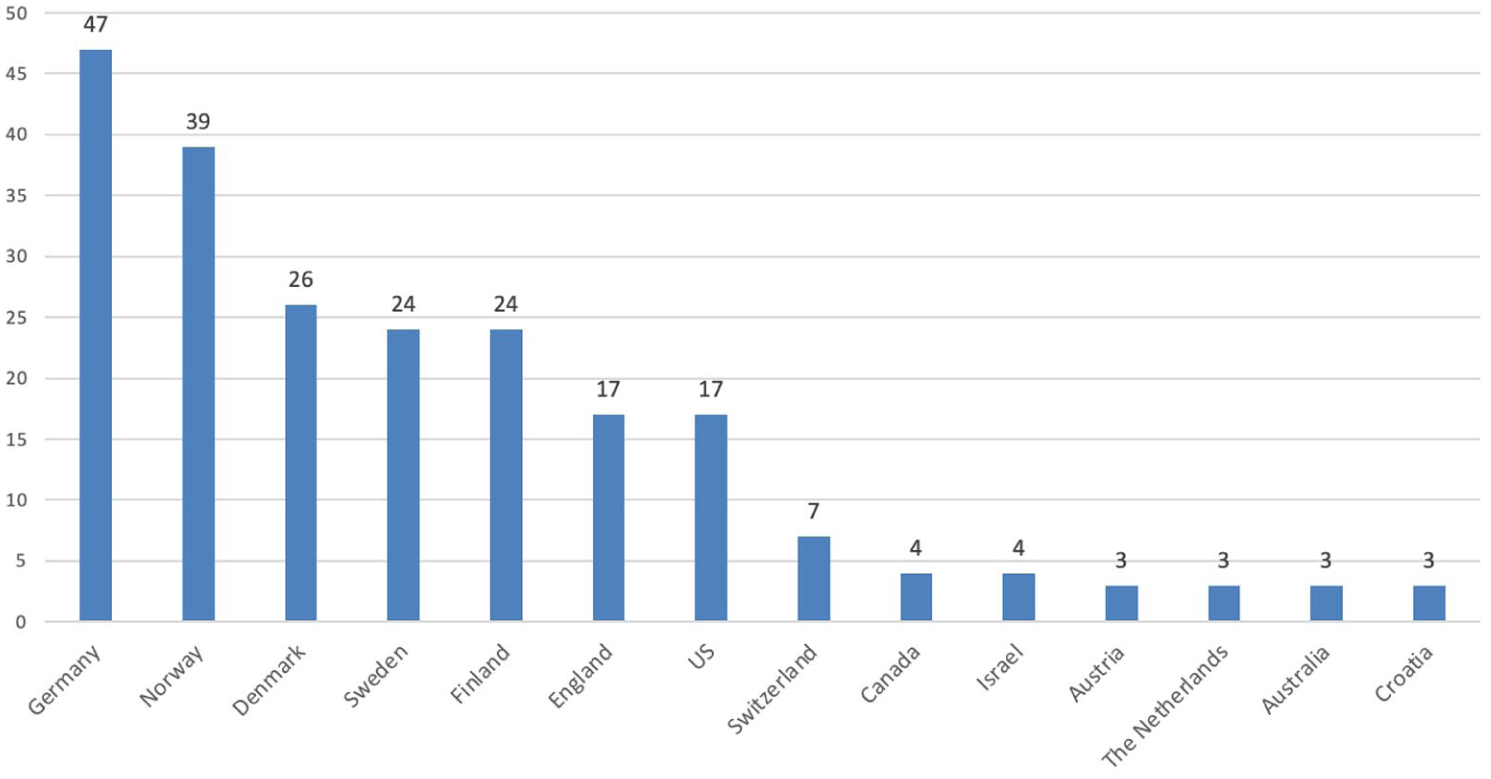
Country of the author(s) based on the affiliation’s location.
The results in Figure 4 were expected and yet revealing. First, they show that the authors who engage with Bildung in their research are predominantly located in the Western hemisphere, delineating Bildung as a Western philosophical and educational ideal. Second, the countries with 20+ records are all in Germany and four Nordic countries – Norway, Denmark, Sweden, and Finland. This result confirms the geography of Bildung as part of Didaktik education tradition that has been and is present in Continental and Nordic Europe (Tahirsylaj, 2019). Third, the results capture the representation of authors’ countries which had also been part of the Didaktik-Curriculum dialogue during the 1990s, as England and the US are the next two countries with largest records in our sample outside of Germany and Nordic countries. On the other hand, while it is expected that Germany would have the largest number of records on Bildung, being the conceptual ‘birthplace’ of Bildung, within the Nordic countries it was interesting to observe that Norway has far more records than the other three included. We also found it interesting that no record from Iceland, the fifth Nordic country, was present in our sample. Still, the results cannot be read as a representation of the entire volume of research on Bildung from the given countries. Rather, we interpret them as the volume of research from authors (and their affiliation countries) who decided to publish in English to reach other audiences than those normally reading books and book chapters. We suspect that if our inclusion criteria included research published in local languages, the graph representing research from Germany and Nordic countries for example, would look different. A surprising result here was that there were no records that met our criteria representing France and Italy, and there was only 1 from Spain. This indicates again that Bildung is primarily bounded geographically and linguistically to Continental/German speaking countries (e.g. Germany, Switzerland, Austria) and Nordic countries (e.g. Norway, Denmark, Sweden, Finland).
A15 esearch methodologies
Under A15, we coded for specific research methodologies applied in the texts. Figure 5 shows the results.
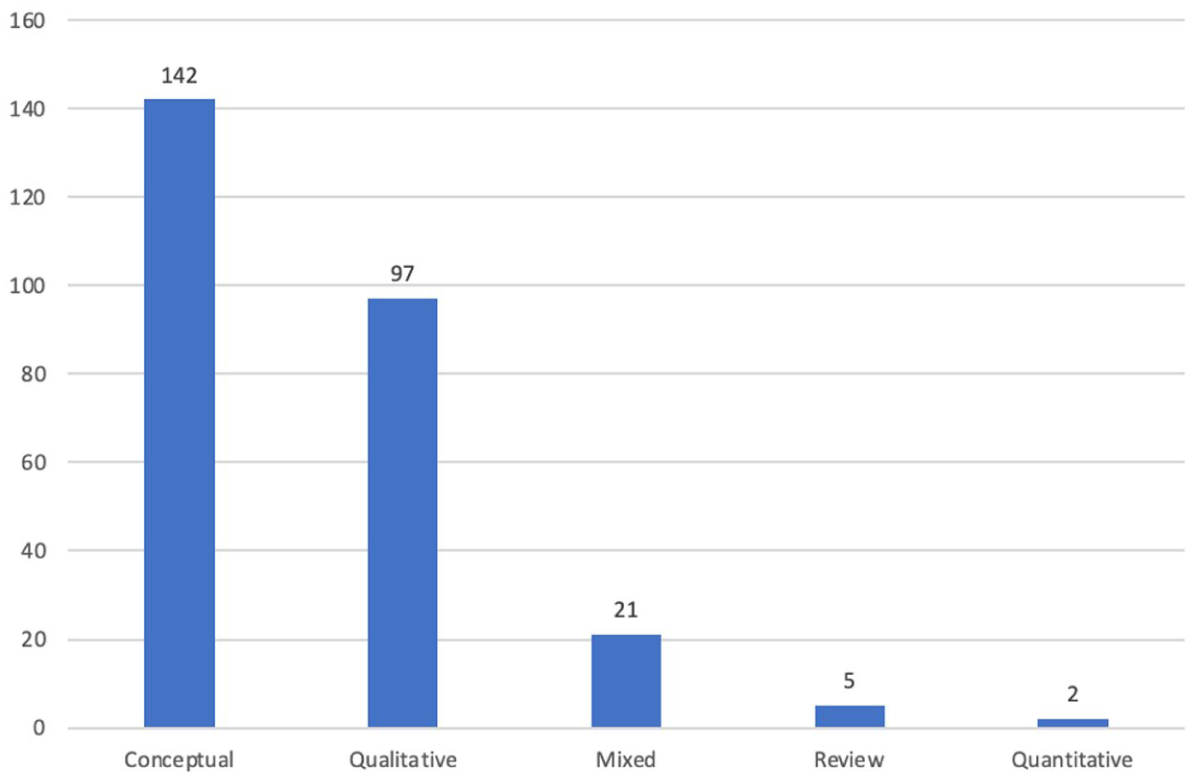
Research methodologies of the texts in the final sample (total n = 267).
The graph in Figure 5 shows that most texts in our sample belonged to what was coded as Conceptual texts (142), meaning that texts were written in an essayistic form. Texts coded as Qualitative constituted the second largest group (97), with Mixed category next (21), and a few texts were based on Review (5) and Quantitative (2) methodologies. The results indicate that authors writing about Bildung and/or integrating Bildung in their academic work predominantly do so from a theoretical/conceptual perspective. Following the distinctions between empirical and humanities-oriented research of the American Research Education Association (AERA) regarding standards for reporting research, our results show that most Bildung-related texts in our sample follow the humans-oriented approach (American Educational Research Association [AERA], 2009), which, among else, includes conceptual/theoretical research in the traditions of philosophy and history. Still, the texts following empirical research as per AERA (2006) standards in our sample are still significant. Such texts of empirical research approach contain texts that are based on social science-oriented research using quantitative or qualitative methods for data collection/analyses.
A16 academic discipline
Under A16, we coded for what academic discipline texts in our final sample belonged to. As shown in Figure 6, about half of the texts (137, 51%) were coded as belonging to education, 97 (36%) within philosophy (of education), and the rest were coded as history (of education; 11%), sociology (of education; 4, 2%), STEM (3, 1%), psychology (of education; 2, 1%), and mixed (13, 5%) as per our coding protocol.
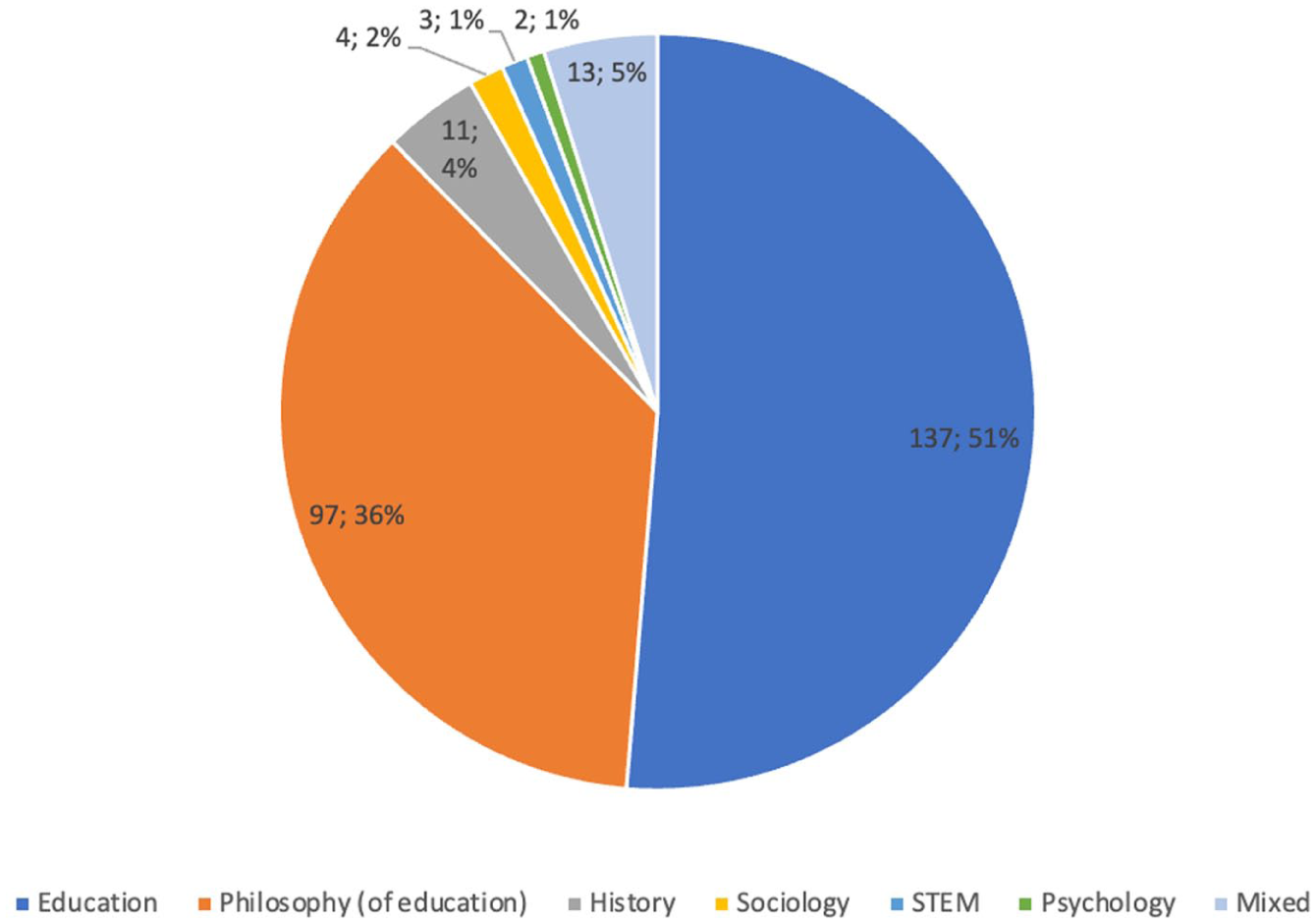
Academic disciplines of the texts in the final sample (total n = 267).
While as per our inclusion and exclusion criteria, the results shown in Figure 5 are expected since we focussed our search within the field of education broadly defined, it is surprising that Bildung has been part of a discussion in a few cases in other disciplines. This result shows that based on the texts in our study, Bildung is still primarily connected to broader pedagogical and general didaktik conceptions of education, and less integrated in the scholarly work of specific subject disciplines.
A21 education level
Under A21, we coded for what education level texts belonged to. Here we found that more than half of the texts (156) were coded as general, meaning we could not assign a specific code to one of the education levels as per our coding protocol. Next, we found that outside of the general category most texts belonged to higher education (44), and then mixed (27). The remaining texts belonged to all other levels of education: early childhood (6), primary/elementary (13), lower secondary (5, upper secondary (7), and adult education (6). Again, based on the texts in our study, scholarship on Bildung is linked to general discussions of education, not necessarily linked to any specific education level. Nevertheless, we do find a lower number of texts linked to all education levels, indicating that Bildung is, as it should be we argue, a part of ongoing academic debates representing all education levels.
A24 educational actions
Under A24, we coded for educational actions. Here we aimed to identify whether the texts were addressing any specific educational actions and how Bildung is brought into those discussions. Figure 7 shows the results of our coding based on the texts in our sample.
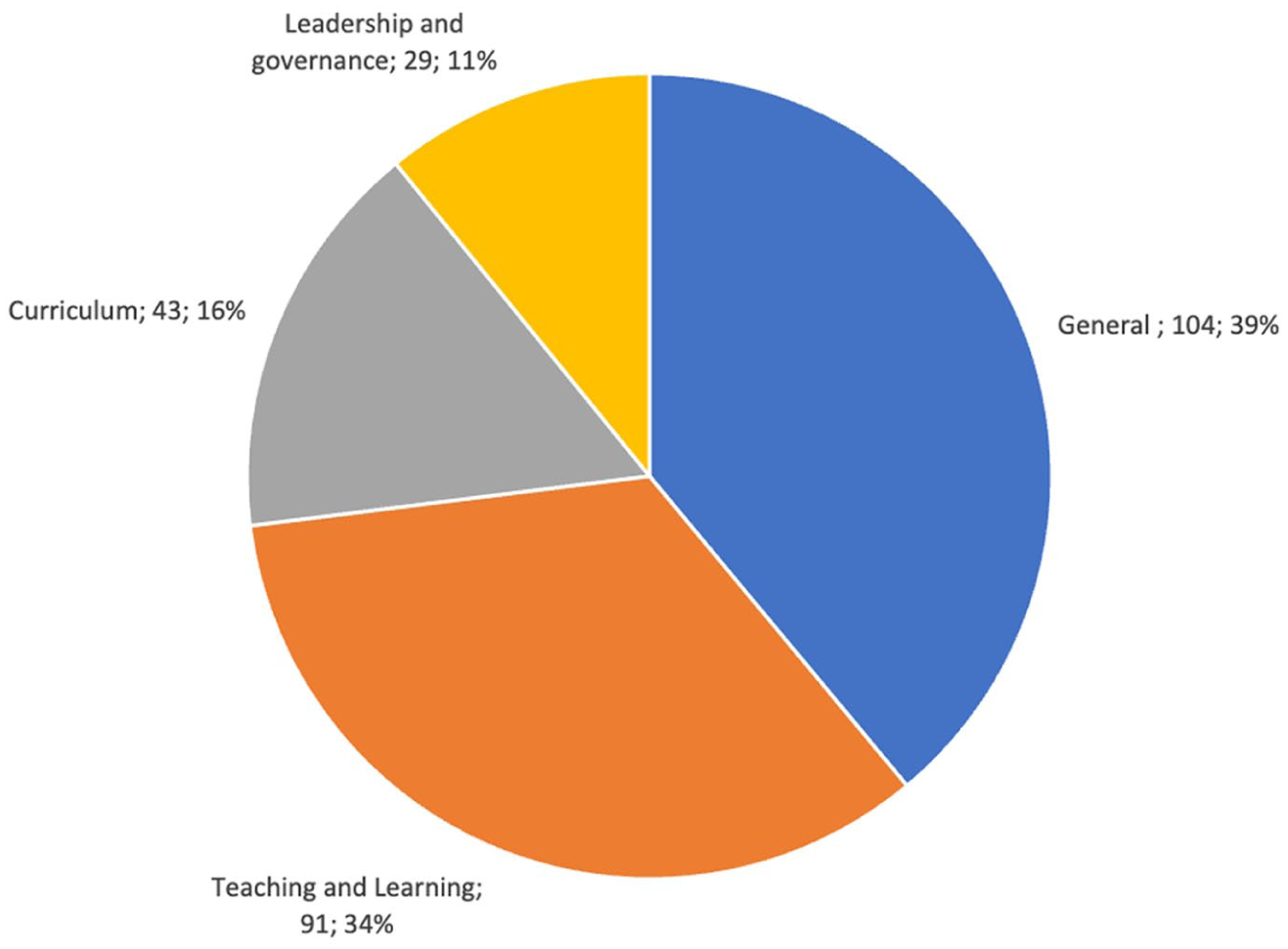
Coding for educational actions of the texts in the final sample (total n = 267).
As shown in Figure 7, we identified four groups of texts based on our coding, after merging some of the categories identified in the initial coding, such as leadership and governance and teaching and learning. In our final categorization, texts coded as general (104, 39%) constituted the largest group, followed with those coded as teaching and learning (91, 34%), curriculum (43, 16%) and leadership and governance (29, 11%). Again, the texts coded as general dominate, however the specific discussion of Bildung in the context of teaching and learning, curriculum, and leadership and governance is substantial.
A25 and (partially) B9 definitions of Bildung
Under A25, we coded texts if they included a specific definition of Bildung or not. We found that 258 texts did and 9 did not. We also identified this coding as relevant for our research work.
Relatedly, under Part B/B9 of the Coding Protocol, we coded all 258 texts for ‘Definitions of Bildung’, which were initially coded to have a definition of Bildung under A25. The main purpose of this coding was to unpack various notions of Bildung as found in the educational research included in our study, however, for this article, we searched the text to extract information in the form of a bibliometric characteristic as to which scholars/authors are most mentioned. Figure 8 shows partial results of our search as it only presents top ten most mentioned authors in the coded text (more detailed results are available upon request).
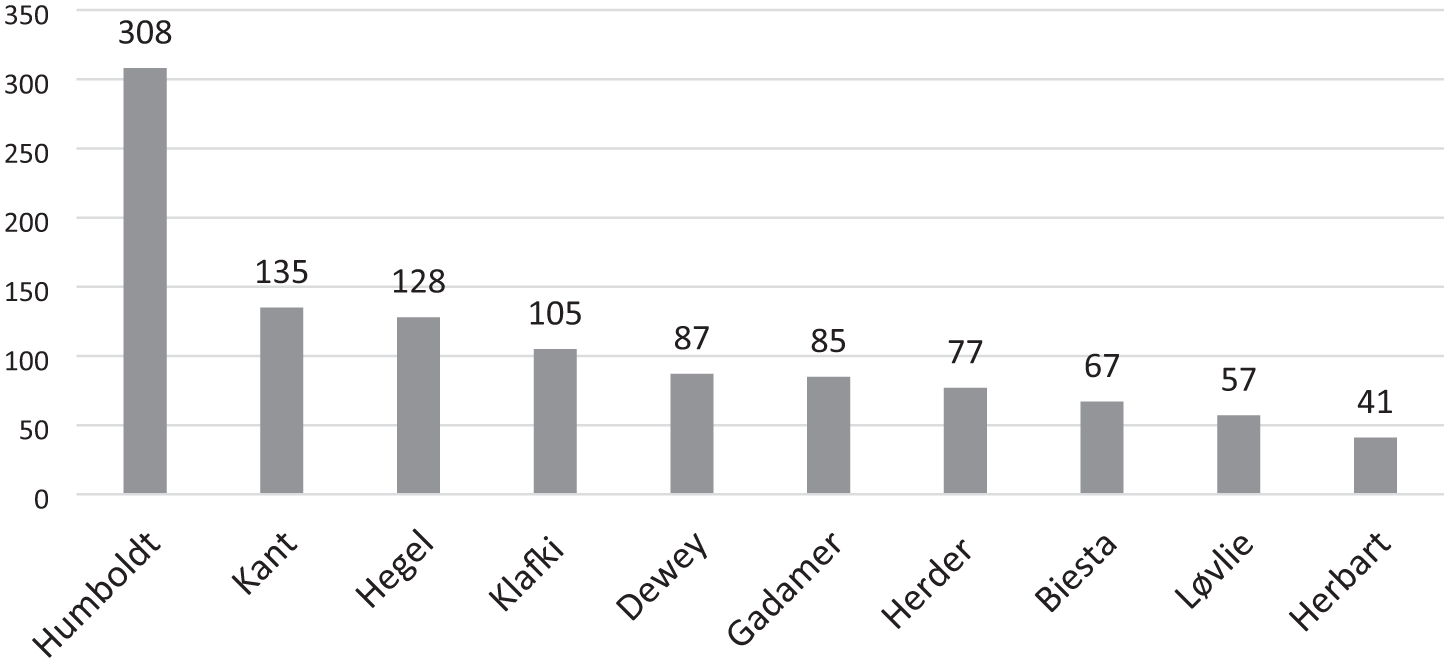
Top ten most mentioned scholars in the coded text for Definitions of Bildung (PartB/B9).
As shown in Figure 8 the top ten most mentioned authors in the coded text for Definitions of Bildung include Wilhelm von Humboldt, Immanuel Kant, Georg Wilhelm Friedrich Hegel, Wolfgang Klafki, John Dewey, Hans-Georg Gadamer, Johann Gottfried von Herder, Gert Biesta, Lars Løvlie, and Johann Friedrich Herbart. Humboldt, by far, is the most mentioned reference, showing the educational research scholars refer to him most often when addressing Bildung. Further, the most frequent reference to Humboldt across the coded texts is made to Humboldt’s text on Theory of Bildung (1793/2000) included in Westbury et al. (2000) publication that emerged from the Didaktik-curriculum dialogue project. Together with Kant and Hegel, Humboldt represents references that go back to the German Enlightenment era, where the modern notions of Bildung have been initially conceptualized. Another reading of these results shows that 7 out of 10 most mentioned references are German, one American (Dewey), one Dutch (Biesta) and one Norwegian (Løvlie). These results reconfirm Bildung is primarily a European educational idea rooted in the German Enlightenment, that is, socially-constructed in a specific time and space – in history. Lastly, we want to acknowledge that an author’s prominence does not necessarily reflect their theoretical/philosophical standing, rather they become known either due to their writing being more accessible, due to their work being more practice-oriented, or due to reference practices.
A26 attitude towards Bildung
Under A26, we coded texts for their overall attitude towards Bildung. Here, 213 (80%) texts were coded as supportive, 31 (11%) as neutral, and 23 (9%) as critical. While it might be expected that scholars who choose to write about Bildung already have a positive outlook on it, it is still revealing that most texts share supportive arguments in favour of Bildung, while only a small fraction are critical. The results show that scholars integrating Bildung in their research work affirm Bildung as a central educational concept with potential to contribute to ongoing debates in educational theory, research, policy, and practice.
Discussion, conclusions, limitations and further research
As noted in the Introduction, the curiosity for our research project lies in the spectrum of the ‘Promise of Bildung’ (Løvlie, 2002) and ‘Do we (still) need the concept of Bildung?’ (Masschelein and Ricken, 2003). These two titles were only referred to here to exemplify the wide – and sometimes opposing and contradictory – variety of perspectives on Bildung. Our curiosity and motivation derived from an interest in getting a better grip on the multitude and variety of positions and arguments aimed at addressing the concept of Bildung from educational research perspectives. In our reading and interpretation of Løvlie (2002) and Masschelein and Ricken (2003) arguments, we find that they engage with critical analyses and interpretations of Bildung for post-modern times from philosophical perspectives and its implications for developing subjectivity and individuality in post-modernity. In our view, and in line with Løvlie and Masschelein and Ricken, Bildung has its limits when framed through post-modernist assumptions, as such assumptions in principle reject all grand narratives. Thus, it is possible to reject Bildung as a ‘grand narrative’ of the Enlightenment era that does not fit with postmodernist views either epistemologically or methodologically. While for Løvlie (2002), the promise of Bildung remains a relevant concept for education, and yet an unfulfilled one since that’s the condition for it to remain a promise, Masschelein and Ricken (2003) argue for abandoning the concept entirely since, Bildung has long since lost the possibility of functioning as a point of resistance and critical principle for analysing the ways in which we conduct our lives and the ways in which our conduct is itself conducted, i.e. the ways we are governed and also govern ourselves. (p. 139)
In our view, both Løvlie and Masschelein and Ricken texts focus on relational aspects of Bildung and both refer to Wilhelm Von Humboldt’s work. They develop their arguments and interpretations about the development of subjectivity with reference to the self (Løvlie, 2002) and to external structures (Masschelein and Ricken, 2003). Further, we find it both interesting and revealing that neither of the texts makes a reference to Klafki’s work. As we argue above, Klafki’s work has been influential in the Didatik tradition primarily because he has operationalized the concept of Bildung for educational purposes through teaching and learning. He not only set it up as a critical concept for the individual to maintain distance from and resistance to the broader ‘constraining’ society. This is not to say that Klafki’s conception of Bildung lacks criticality. In our view, none of the three aspects of Bildung that Klafki (1998) offers – self-determination, co-determination, solidarity – can be developed without criticality. Indeed, it is primarily through critical reflection on one’s intersubjective relations with others (interlinking of the self to the world in Humboldt sense) that Klafki’s Bildung can be promoted and eventually be in constant development.
Here, we highlight again some aspects of our methodology, which itself is a result of this study. We want to acknowledge the methodological challenges with conducting a systematic review in education. As already recognized by other scholars, systematic review methodology has been primarily developed to cover ‘empirical’ and ‘experimental/quasi-experimental’ studies in natural and medical sciences. Because the texts that met our inclusion and exclusion criteria do not strictly fit within those categories and for the most part do not follow the scientific research templates with having clearly defined research questions or research methodologies, we ended up in a ‘no-man’s land’ situation, where neither PRISMA systematic review framework nor other types of reviews entirely fit. To try to address and solve this challenge, we engaged in a bottom-up (and eclectic) approach using different elements from different review types, as noted in detail under Research Methodology. The conclusion from our research process is not to suggest any specific approaches on how to handle systematic reviews in education. Instead, we invite other colleagues to also embark on their own pursuits for other ways to make this type of work possible and learn through the inevitable trial and error process that follows. Our methodology can potentially serve as a model for other researchers on how to deal with various issues in conducting educational reviews. Our detailed account of methodological decisions could help avoid pitfalls that can routinely hinder and derail review processes, such as those related to decisions regarding inclusion and exclusion criteria.
Next, discussed in light of our theoretical points of departure hinted at in the Introduction, the results of our mapping of educational research on Bildung lent themselves for a number of claims. First, to respond to the titles of Løvlie’s (2002) and Masschelein and Ricken’s (2003) texts on the ‘The Promise of Bildung’ and ‘Do we still need the concept of Bildung?’, the results reported in terms of the increasing volume of research on Bildung from year to year indicate that educational researchers are increasingly responding in favour of continued need for the concept of Bildung. Second, the results show that Norway has the second most texts included in our sample with 39 texts – slightly behind Germany as the first with 47 texts, and significantly ahead of Denmark with 26, Sweden and Finland with 24 texts respectively. Also, Løvlie is the only Nordic/Norwegian scholar included in the top ten most mentioned authors in coded text on ‘Definitions of Bildung’. In turn, these results show that outside Germany, Norwegian researchers, with Løvlie as an authoritative reference, have been most active in integrating Bildung in their published research in English, and thus contributing to both the increased presence of Bildung in the international educational literature and keeping ‘the promise of Bildung’ alive. Methodologically read, these results validate the notion of Bildung as a socially-constructed concept that maintains its relevance within education as a result of researcher’s individual and collective work on invoking Bildung to address various research problems in the field. Third, our elaboration on Humboldt and Klafki as a way to position our primary lineage towards Bildung also connects with the results reported here. Humboldt is the most frequent reference in relation to the definitions of Bildung (as shown on Figure 8 results) and Klafki is the fourth most mentioned reference and the only one of the more recent educational scholars with more than 100 mentions after the ‘big three’ of German Enlightenment era, that is, Humboldt, Kant, and Hegel. One conclusion drawn here is that Klafki’s operationalization of Bildung into self-determination, co-determination and solidarity within his critical-constructive Didaktik has contributed the most to an understanding and interpretation of Bildung as an educational concept with relevance for teaching and learning practices. In one interpretation, this means that with his work on critical-constructive Didaktik and didaktik analysis on lesson preparation, Klafki has contributed to an ‘educationalization’ of Bildung with implications for lesson planning, and in turn, for teaching and learning in classroom settings. Through his work then, Klafki contributes to an understanding and interpretation of Bildung not only as a philosophical and abstract concept, but as an educational and practice-oriented concept for teachers and other educators in school contexts.
Overall, the conclusion that we draw from this systematic research review on research on Bildung is a reconfirmation of Bildung as a spatially- and temporally-bounded concept. As we show in results, the geography of Bildung, if we are to follow the spatial distribution of where the authors who published on Bildung in our sample were from, is bounded primarily within the German-speaking Europe and Nordic Europe. Also, the illustrative results from Part B/B9 indicate that the present-day conceptions of Bildung stem from the German enlightenment era, with Humboldt as a the most referenced scholar. Lastly, our review also shows that the Didaktik-Curriculum dialogue of the 1990s, which included texts from both Humboldt and Klafki, might have contributed to the continued increase of the publications in English language that integrate conceptions of Bildung in them.
Limitations and further research
As is routinely noted, all reviews suffer from various limitations, often concerning resources available within the research team. In our review, several limitations are already hinted at in our list of exclusion criteria. For example, we have not been able to include in the study print publications on Bildung or all other texts that were not published in English language. However, we want to point out that when the number of texts is reduced from 4702 (in the first step of the screening stage) to 267 (texts included in the final sample) as it did in our review, it indicates that this research field is rich and diverse, and it invites for other research explorations and pursuits that follow other sets of inclusion and exclusion criteria. In this review project, we will continue with in-depth analyses and syntheses of main themes in the texts as categorized through our own educational actions grouping on curriculum, teaching and learning, and governance. Beyond our research review project, we suggest that further research efforts are directed towards examining the role that Bildung plays in educational practices of teachers and students in various contexts, but primarily in the German-speaking and Nordic Europe, where we observe that Bildung continues to be part of educational research discourses on education governance, curriculum, and teaching and learning. We strongly recommend research work that explores the uses and implications, or lack thereof, of Bildung in various educational policy and political contexts affected and disrupted by climate change, technological advancements, anti-democratic movements, and wars.
Supplemental Material
sj-docx-1-eer-10.1177_14749041251379633 – Supplemental material for Mapping scholarship on Bildung in educational research: A systematic research review 1990–2020
Supplemental material, sj-docx-1-eer-10.1177_14749041251379633 for Mapping scholarship on Bildung in educational research: A systematic research review 1990–2020 by Armend Tahirsylaj, Elisabeth Rønningen, Dagrun Astrid Aarø Engen, Anabel Corral Granados, Halvor Hoveid, Marit Honerød Hoveid, Solvor Solhaug, Nicole Veelo and Magnus Rom Jensen in European Educational Research Journal
Supplemental Material
sj-docx-2-eer-10.1177_14749041251379633 – Supplemental material for Mapping scholarship on Bildung in educational research: A systematic research review 1990–2020
Supplemental material, sj-docx-2-eer-10.1177_14749041251379633 for Mapping scholarship on Bildung in educational research: A systematic research review 1990–2020 by Armend Tahirsylaj, Elisabeth Rønningen, Dagrun Astrid Aarø Engen, Anabel Corral Granados, Halvor Hoveid, Marit Honerød Hoveid, Solvor Solhaug, Nicole Veelo and Magnus Rom Jensen in European Educational Research Journal
Footnotes
Acknowledgements
A prior version of this paper was presented at the 2023 Nordic Education Research Association (NERA) annual conference in Oslo, Norway, and the authors wish to thank session participants for their comments and feedback. Authors also wish to thank Abdulghani Muthanna, a former guest scholar at Department of Teacher Education, NTNU, for his contribution to the screening process of texts in the early stages of the Bildung review project within the Integrated Education Studies (InEdS) research group.
Declaration of conflicting interests
The authors declared no potential conflicts of interest with respect to the research, authorship, and/or publication of this article.
Funding
The authors received no financial support for the research, authorship, and/or publication of this article.
Ethical approval and informed consent statements
Not applicable.

Data availability statement
There is no specific data associated with the study. However the references included in the final sample of the study are presented in the Supplemental Appendix 2 of the article.
Supplemental material
Supplemental material for this article is available online.
Notes
Author biographies
References
Supplementary Material
Please find the following supplemental material available below.
For Open Access articles published under a Creative Commons License, all supplemental material carries the same license as the article it is associated with.
For non-Open Access articles published, all supplemental material carries a non-exclusive license, and permission requests for re-use of supplemental material or any part of supplemental material shall be sent directly to the copyright owner as specified in the copyright notice associated with the article.
