




Abstract
In this paper we present experiences from a joint collaborative research project which may be described as an encounter between a school science teaching practice and a university science didactics research practice. We provide narratives which demonstrate how the encounter between these two communities of practice interacted to produce hybridization between the two in terms of mutual influences, resulting in the conceptual and practical development of both communities of practice. We argue that what happened in the project suggests one way of reducing the gap between educational research and teaching through the emergence of practices where the roles of teachers and researchers become blurred.
Keywords
Introduction
In this study we address the long-standing issue of the gap between educational research and teaching (McIntyre, 2005). Our main objective is to show that this gap may be productively handled and reduced if the encounter between teaching and educational research is approached as a matter of two equal practices interacting with each other, and which both may need to change as a result of the interaction. We do this by presenting empirically grounded narratives of observed changes to both teaching and research practice during teacher–researcher collaboration.
The regularities displayed by teachers and their teaching have received considerable theoretical and empirical interest from educational researchers. Seminal studies such as those by Lortie (1975) and Elbaz (1983) were driven by a genuine interest in teachers and their profession, and together with numerous later studies laid the foundation for a rich understanding of the conditions that shape teachers’ professional lives and create different practices.
Apart from the ‘pure’ interest in teachers and their profession, another strong motivator for this kind of research has been a concern for how to effect curricular change in the face of new educational research or policy (cf. Blanchard et al., 2009; Borko, 2004; Buczynski and Hansen, 2010; Putnam and Borko, 2000). This is the area where research or policy comes into direct contact with the practices of teachers and schools, and where teacher practice, consequently, acquires more than a scholarly interest because this practice often seems to resist the kinds of change that research or policy intends. This focus on teacher practice as something that needs to change according to research or policy may take various forms. Teacher practice may simply be treated as that which is different from a certain, research-based teaching intervention – the ‘traditional’ way of teaching certain content which, almost by default, needs to change (e.g. Akkus et al., 2007; Christianson and Fisher, 1999; Slater et al., 1997). In other instances practices are acknowledged, identified, and sometimes even found to be highly elaborated (e.g. Baggott la Velle et al., 2007; Borg et al., 2012; Molin and Grubbström, 2013). Yet, they are still treated primarily as foci for change.
The research that is often invoked as an agent or reason for changing a teaching practice is seldom described in a similar manner. That is, educational research is not approached as a practice that may need to change and learn from teaching practice. Yet, McIntyre (2005) contended that Just as teachers may have things to learn about the limitations of their existing practice, and the merits of the research-based proposals, so equally the researchers will have things to learn about the limitations of the proposals (and of the research), and about the merits of teachers’ existing practices (p. 366, emphases added).
Indeed, the School-Based Research Consortium Initiative which took place in England between 1998 and 2001 is an early example of an effort to increase teachers’ control over educational research (Simons et al., 2003). A central idea was that teachers would generate, critically examine, and validate educational research in relation to local contexts. Today, similar initiatives involving professional learning communities (PLCs), action-research projects and the like are common all over the world, often as large-scale projects run by entire school districts. Still, change of existing teaching practice constitutes an underlying assumption of these programmes, not change of the proposals coming from research (cf. Olson, 2002). To the extent that the research-based ideas are modified it is in order to adapt them to local contexts and needs, not to change their underlying principles.
However, there are some exceptions. Signs of a growing interest in teachers’ role for changing research practice are, for example, Educational Design Research (The Design-Based Research Collective, 2003), where ‘design principles’ are the prime focus of research (Reeves, 2006). Another is the discussion of what a professional science of teachers may amount to within the didactics tradition (Seel, 1999), where didactic modelling is the focus (Duit et al., 2012; Wickman, 2015). In these orientations contributions from both teachers and researchers to the design principles or didactic models are fundamental. It is therefore of interest to study closer how such mutual exchanges between teacher and researcher practices could be manifested. Our research question is: What changes to teaching and research become visible during teacher–researcher collaboration, when approached as an encounter between two practices?
Context for the study
The collaboration between the teachers and the researchers took place within the TALES-project. The project was financed by a 3-year grant from the Swedish Research Council between 2010 and 2013, and comprised two researcher teams and two middle-school science teacher teams, situated in Stockholm and Gothenburg, respectively. In Stockholm, which is the part of the project dealt with here, the researcher team consisted of three science-education researchers and one chemistry expert. The objectives of the project were (1) to study teacher professional growth in collaboration with researchers as the teachers incorporated new research-based didactic models into their practice, and (2) to study also whether and how the introduced models were changed in the process.
The project was planned to move through three consecutive cycles of planning, teaching and evaluation. The idea was that the teachers and the researchers would plan teaching together, then one of the teachers would teach the unit to a class, after which followed joint evaluation coupled with joint planning of the next cycle. Important starting points based on particular tenets of the research practice (see below) were (a) to begin the developmental work (i.e. the introduction of the research-based didactic model) from teachers’ existing practice, thereby honouring the teachers as experts in their field, in particular in relation to the local context in which they worked, (b) that the introduced didactic model would be such as to increase teachers’ agency and ownership over their own teaching (rather than introduce more or less ready-made units or ideas which may instead decrease teachers’ space for making professional decisions about their teaching), and (c) that the introduced didactic model, at the same time, would be such that it made it possible for the teachers to plan also for increased student agency.
The teaching practice
Over the last 15 years a progressivist teaching practice has developed in the Stureby school. The central idea is to engage students in science projects containing assignments for which scientific knowledge is required. Each assignment is chosen so that students can easily relate to it. Examples of assignments developed within this community is ‘Build a box camera, take pictures with it, and make an exhibition’ and ‘Produce your own moisturizer with a self-made perfume’. Over the years, developing and working with such science projects has generated the general opinion among the science teachers that the projects are a good way to get pupils engaged in learning science and get them to learn science meaningfully. Providing students with assignments in which a need for knowledge is established does not have to be directly linked to a spontaneous interest that the students already have. All students will not be interested in everything that is done in each science project. Nevertheless, every student will be able to see the point of what they are doing. The assignment provides, thus, a necessary context for the students to work within.
Another characteristic of this teaching practice is a structure with five checkpoints. This structure has developed in order to help both the teacher and the students to move through the project without getting into too many side tracks. The first checkpoint is an introduction where the students are given the assignment together with information of the aims of the project as they relate to the national curriculum. Care is taken to organize this first checkpoint so that it is inspiring and gives the students a sense of a journey on which they are about to embark. The second checkpoint is a creative stage of coming up with ideas in order to cope with the assignment. The third checkpoint involves starting to organize ideas and problems, ending in choosing one idea that is critically reviewed from four aspects: time, material, economics, and if it may actually solve the assignment. This checkpoint results in a work plan and sketches describing how the idea is supposed to be completed. Thereafter follows a fourth checkpoint where students construct, build, make, interview, or whatever is needed in order to complete the assignment. The fifth and last checkpoint is an exhibition, including celebrating that the assignment is completed, and a joint evaluation of the project as a whole.
Over the years, this teaching practice has encountered several difficulties which have been important to deal with. The strategies that have evolved constitute an important part of the teaching practice of this community. To work with projects which the students can relate to opens up for a variety of questions and constitutes ground for student inquiry and exploration. But dealing with them all risks extending project time, and may result in less time for the later checkpoints. Therefore, it has become important practice to categorize the questions and choose which to follow up and which to save for later. Another strategy is to decide if the assignment for the project is expressed in a way that both the students and the teacher can relate to. As new projects are completed and assessed, the way in which assignments are given to students is continually refined.
Investing time in planning and formulating aims also helps the teachers to retain an alignment between the project, the national curriculum and what knowledge that is eventually required to be assessed. Building a box camera does not necessarily mean learning the characteristics of light. If that is an aim it is important to express and emphasize this, primarily for the teachers but also for the students. Formatively assessing when and how aims are expressed to the pupils is an important focus in the Stureby school teaching practice. For a teacher it is essential to decide on the most important learning objectives and keep the pupils focused on these, while other difficulties are put in the background.
With the strategy to focus on a purpose that engages the pupils, formative assessment on aims related to the purpose, and planned deadlines for the checkpoints, this teaching practice helps students find the beauty in science, and so becomes a meaningful part of their education.
As is evident from this account, the teaching practice concerns not only ‘actual’ teaching in the classroom, but also ideas about content selection and how to frame that content during the planning of a new teaching unit. This is important to keep in mind throughout the paper, especially since in this project it was the teachers’ planning practice rather than classroom practice that was primarily in focus.
The research practice
The practice of which the researchers are part developed over a period of around 20 years, especially at the universities of Stockholm, Uppsala, and Örebro. It is part of a broader tradition of didactics in Sweden, which in turn belongs to the European didactics tradition (Hudson, 2007; Klafki, 1958; Wickman, 2015). The research is built around a pragmatist understanding of human knowledge and action, based in particular on the writings of John Dewey and the later Wittgenstein, but also on other pragmatist scholars such as Richard Rorty, Cleo Cherryholmes, and Jim Garrison. It also has close kinship with sociocultural theory and ethnomethodology (cf. Wickman, 2006).
Within the research practice, the responsibilities connected to didactics, as the unique science of the teaching profession (Wickman, 2012), have always been heavily stressed. One central aspect of this responsibility is the importance of recognizing the unique expertise within the teaching profession in general and of experienced teachers in particular. This was an important starting point for the teacher–researcher collaboration, and also became an important issue once the collaboration got off the ground.
Another aspect of the research practice important for the present study is its stress on the school subject as an integral part of the didactics tradition of which it is part, thus making it something quite else than general pedagogy. This is, among other things, visible in that it is often referred to as subject didactics. The importance of the subject was, moreover, the reason why it was entirely natural, and seen as necessary, to include a subject expert, Marcus, in the project. As we will see, this had interesting consequences for the encounter between the two practices during the collaboration.
Finally, an important part of the research practice is to develop didactic models that enable teachers to modify their teaching on empirical and rational grounds (Wickman, 2015). This focus on didactic modelling is closely connected to the idea of didactics as the science of the teaching profession. It played a major part of the collaboration, as this was built around the introduction of one such model into the teaching practice, namely the model of organizing purposes (Johansson and Wickman, 2011).
The model of organizing purposes introduces a distinction between two kinds of purposes that are characteristic of teaching activities in school settings. One set of purposes is tied to activities which the students are eventually expected to be able to partake in, as part of learning certain content as stipulated in the curriculum. Such purposes are called ultimate purposes. At the beginning of a new topic an ultimate purpose cannot be intelligible to the students, since it involves precisely that which the students are going to learn. Thus, an ultimate purpose is initially only able to organize the teacher’s actions in the activity. This, however, is an important function, since without a clearly formulated ultimate purpose the teacher will have difficulty knowing how to respond to all the contingencies occurring in class in order to support students’ learning progressions.
The other set of purposes specific to the model is called proximate purposes. Proximate purposes are characterized by being intended to be already intelligible for the students as they begin an activity in the classroom. Thus, a well-conceived proximate purpose provides continuity between the activity and students’ previous experiences. If such continuity is established and the proximate purpose is helping students to see what it is they are involved in, it is said to have become an end-in-view. Having an end-in-view, students are better able to take ownership over their actions, since they understand what they are up to, and thereby are able to pose relevant questions to peers and the teacher, as well as judging for themselves how the activity is proceeding. The teacher’s job is to see to it that the students are able to make proximate purposes continuous with the ultimate purpose. How this might play out in actual planning was one of the issues affecting both practices during the collaboration, as we will show in the findings.
Analytical approach
In this study we use the terms practice and communities of practice to describe the collaboration between teachers and researchers. Compared with other concepts employed to describe regularities of, in particular, teachers’ work, such as culture (Childs et al., 2013; Hargreaves, 1994), sub-culture (Baggott la Velle et al., 2004, 2007; Goodson and Mangan, 1995), tradition (Lundqvist et al., 2012; Pomson, 2002; Östman, 1995), and discourse (Buxton et al., 2013), the term practice seems to be the most general. This can be seen, for instance, in that practice is often used ‘non-operationally’ also in studies that have defined some other term in more detail (see for example Baggot la Velle et al., 2007 and Goodson and Mangan, 1995). Thus, we can easily talk about the research group at the university as one community of practice normally separated from the community of practice at the Stureby school practice without having to define beforehand what would have distinguished them as discourses, traditions, or cultures.
We acknowledge the usage of practices and communities of practices departing from Lave and Wenger’s (1991) ideas. In particular, the concept of practice does not include any distinct separation between action, thought, feeling and value, focusing rather on peoples’ actions with various sociocultural tools, cognitive as well as physical (Lave, 1993; Säljö, 1999). Consequently, in the analyses we do not make any sharp distinctions between the more theoretical aspects of the teaching practice, for instance to teach all science content through a particular form of projects involving assignments which create a need to know among the students, and other, more concrete aspects of the practice, such as helping students retain focus on the assignment and move them through explicit checkpoints. Similarly, in the research practice we do not distinguish between the more theoretical aspects connected to the researchers’ use of the didactic model of organizing purposes, and other more concrete ones, such as keeping a low profile so as not to disempower teachers by suppressing their contributions in the collaboration.
At the same time our usage should be understood as more open and less theoretically committed as compared with theirs. In particular, we are not focusing how participants slowly move into one, fixed practice, but rather how two practices hybridize and, thus, slowly change as a result of their transactions. Here we are especially influenced by Buxton et al. (2013) who looked for interdiscursivity and hybridity between three different discourses during collaboration between teachers and researchers. Buxton et al. (2013) defined interdiscursivity as the semiconscious inclusion of traces from one discourse in another, whereas hybridization is characterized by the ‘conscious appropriation of one Discourse while trying to work within another’ (Buxton et al., 2013: 8, emphases added). Thus, hybridization in this sense does not entail the emergence of new, stand-alone discourses at the expense of the old ones, but rather the increased appearance and deliberate use of elements from one discourse within another. In a similar manner, we were able to describe the changes in the two practices within our collaboration in terms of such hybridity, observed as the deliberate use of elements of one practice within the other. In the analysis, we will refer to this exchange between the two practices (that is, the conscious use of elements from the other practice while still continuing to work within your own) as hybridization, in line with Buxton et al. (2013).
Primary data for the project were field notes and video recordings of the joint teacher–researcher meetings during the collaboration. During the teaching of a unit, the researchers also video recorded all teaching taking place. These recordings constituted secondary data, primarily functioning as a basis for the joint evaluation of the teaching within one cycle.
Analyses were planned to take place in two ways. First, we used Clarke and Hollingsworth’s (2002) interconnected model of teacher professional growth. This model construes teacher learning precisely as growth within already functional practices. In other words, it views teacher professional growth pretty much as transformation of existing practice. Second, we employed the analytic framework native to the research group, namely Practical Epistemology Analysis (PEA) ( Östman and Wickman, 2014; Wickman and Östman, 2002). This framework enables the detailed analysis of how practices gradually change.
These formal analyses were complemented in important ways by additional analyses in the course of the project. The complementary analyses successively took the form of narratives, checked within the team of teachers and researchers against the recordings. In this study, we draw primarily on these narratives, as we analyse the developments in the project as hybridization of two practices. At the same time, the more formal analyses that have been made using the two analytic frameworks presented above (Hamza et al., 2013, 2015, in press; Ingerman and Wickman, 2015; Martins et al., 2015; Piqueras et al., 2013, 2015) have informed the details of these narratives in significant ways.
Experiences from the encounter
The collaboration between the teacher and researcher teams went on for over 2 years, and although there is a global story to be told, it is so complex that it may easily be recounted with different emphases in focus. For instance, one of our main objectives with the entire project was to describe more specifically the ways in which the teachers changed as a result of the collaboration (Hamza et al., in press), whereas another interest was to analyse in detail the bit-by-bit linguistic changes in our, the teachers’ and researchers’, use of the particular concepts from the framework (Hamza et al., manuscript). Here, we take a broader look at the collaboration and frame it as an encounter between one particular teaching practice and one particular research practice, tracking some salient aspects of that encounter (cf. also Ingerman and Wickman, 2015).
We present our experiences of this encounter through a series of narratives that have developed alongside the collaboration itself. In short, these narratives concern (1) the first preliminary contacts between our groups and, accordingly, between the two practices, revealing different priorities and interests; (2) the early phases of the collaboration, before any real teaching had taken place, when the two practices mainly lived alongside each other; and (3) the later phases of the collaboration, in which there were distinct, joint experiences of beginning of exchange, or hybridization, between the practices.
Different priorities between practices
Although there were already established contacts between the Stureby school and the department to which the three science-education researchers belonged, both on a formal and on a personal level, these previous collaborations had not concerned research but rather school development on a more general level. As in most school–university partnerships, it was the researchers who approached the teachers once the grant for the 3-year project had been awarded. As described above, the overall objective for the project was to study teacher professional growth as a consequence of introducing research-based didactic models into existing teaching practice. As also made clear above, the model to be introduced (the organizing-purposes model) is a central part of the research practice represented by the three researchers in the collaboration. The teachers responded positively to the invitation to join the project, in particular because the model held promise to help them fine-tune their existing science projects, something that they had wanted to do for some time. As was also made clear above, these science projects, in turn, are the defining element of the teaching practice represented by the three teachers in the collaboration.
At the same time, certain differences between the two practices also became visible. One such, although perhaps a mundane one, was agreeing on the amount of time to be allocated to the collaboration. Simply put, the researchers were both able to and benefited from allocating considerable time for meeting the teachers and jointly plan and evaluate the cycles, whereas the teachers were neither able to, nor would they obviously benefit from, allocating too much time for meeting with the researchers. Of course, we reached a compromise that was reasonable to both teams.
At the very first meeting, another difference became immediately visible, namely between the different interests and purposes of the two practices. This difference appeared as we began to discuss the content of the teaching cycles that we were going to plan together. A central idea guiding the research practice is that people never begin anything from scratch, but rather gradually transform already existing practices. For that reason, the researchers wished that the teachers choose a well-known science project that they needed to adjust. However, an equally central aspect of the Stureby school teaching practice is to continually develop new science projects until there is one for every part of the national curriculum. Now the presence of a chemistry expert, Marcus, became crucial, since the teachers in him saw a real opportunity to, eventually, pull off a long-wanted science project that could accommodate curriculum chemistry content related to human health and nutrition. In the course of the three spring meetings, it became gradually more and more clear that the project would begin with the development of an entirely new science project, in line with the needs of the teachers but to some extent at odds with the expressed wishes of the researchers.
This may be seen as a choice between two aims that the teachers identified for the collaboration, (1) the initial one, to learn about a new didactic model for fine-tuning teaching (i.e. the organizing-purposes model) and (2) the emerging one, to get expert assistance in developing a new, much needed science project in chemistry. As it turned out, developing a new science project had a much higher priority within the Stureby school teaching practice. At the same time, it may be seen as a choice between what was seen as central for the collaboration from the point of view of the research practice, namely to get data on teacher growth as a gradual change of existing practice, and what was considered most central from the point of view of the teaching practice, namely to have science projects that cover all content in the curriculum.
The practices work in parallel
Another narrative emerging alongside the first one about different interests and purposes with the collaboration concerns how the two practices lived on alongside each other but without much exchange between them. This was true of the first three meetings in the spring as well as the fourth one in the fall, just before Ola was to begin teaching the first cycle.
To a certain extent, this is a narrative of how the didactic model introduced by the researchers became insignificant for the collaboration during its early phases, as a result of intense interaction between the teachers and Marcus, the chemistry expert. This, in turn, has of course everything to do with the choice of focus that the teachers made, that is, to put their effort into developing the new science project in chemistry rather than fine-tuning an existing one. At the same time, the model was present all the time also during this early phase of the collaboration. Indeed, the second meeting in the spring was primarily devoted to discussing the model on the basis of a Swedish translation of the article (Johansson and Wickman, 2011) that first laid out the model. The teachers had read the article before the meeting, and were keen to discuss the new concepts. As we show in more detail in another study (Hamza et al., in press), the discussion during the meeting showed that the teachers could readily use the new concepts (i.e. ultimate purpose, proximate purpose, end-in-view, and continuity) to talk about their existing teaching.
However, this conceptual appreciation of the model had virtually no impact on the way that the teachers discussed the content in the following two meetings, in which the new science project was planned. From the recordings it is rather amusing to see how the practices lived alongside each other, the teachers and the chemist talking about the new science project mainly without regard to the organizing-purposes model, while the science-education researchers deliberately tried to refer to the didactic model as much as they could.
It may be worth noting that there was no deliberate decision from the teachers to ignore the introduced model at the expense of making use of the chemistry expert to develop the new science project. This ‘choice’ is, of course, something that is seen only on reflection. Still, what we see is the work of a strong practice that is explicitly embraced by the science teachers at the school. Within this practice, no content should be taught in its own right, but should always be framed as a project in which something meaningful, often a product (e.g. a moisturizer or an electric car), should be produced. In other words, the science knowledge has to have an explicit use that is apparent to the students, or else they cannot be motivated. The lack of such a project for the chemistry of health and nutrition thus constituted a much more powerful purpose for the teachers than ‘just’ fine-tuning already existing projects.
At the same time, the parallel lives of the two practices may be traced also to the research practice and the researchers’ ways of approaching the collaboration at these early stages. As described above, an important aspect of the research practice is to recognize that teachers are competent and skilled at what they do, and that this is especially true for the local settings in which they work. In fact, the didactics tradition of which the research practice is part carries a strong sense of responsibility for giving agency to teachers, and avoid going into the researcher-as-expert and teacher-deficiency trap. Therefore, the researchers deliberately held a low profile concerning the development of the collaboration, primarily taking as their responsibility to explain the model when needed and indirectly push the discussion in the direction of the model by using the concepts themselves. However, as will be explained below, these aspects of the research practice also meant that the teachers were left entirely on their own when it came to actually implementing the framework in their planning. Consider this in comparison with the very concrete support that the teachers received from Marcus, the chemistry expert.
Hybridization between practices
The last and most important narrative concerns real exchange, or hybridization (Buxton et al., 2013), between the two practices. Not surprisingly, this hybridization began to appear in the later phases of the collaboration. It seems to have begun in response to three distinct, yet interrelated, changes in the form and/or content of the collaboration. We have labelled these three changes accordingly: (1) Joint experience of concrete practice, (2) Recognition of salient outcomes, and (3) Risk-taking and responsibility. However, just because they were interrelated, below we will present the three changes as a whole, along with other, more minor, ones.
To some extent one might say that the overarching change that led to the eventual hybridization between the practices was that after Ola had finished teaching the new science project (which had eventually got the name ‘Why can’t we survive exclusively on French Fries?’), we suddenly had concrete examples of teaching to take our departure from. This had several consequences.
To begin with, the researchers were now able to conduct a thorough and detailed analysis of Ola’s teaching in the first cycle, explicitly using the organizing-purposes model in the analysis. The aim of the analysis was to assess to what extent the students experienced ends-in-view through the purposes that were given to them in the course of Ola’s teaching, to what extent proximate purposes were made continuous with ultimate ones, and to suggest modifications to the unit based on that analysis.
In that process, the researchers ‘got to know’ the Stureby school teaching practice from within, and they were able to relate that knowledge to the application of the organizing-purposes model. In fact, one may argue that this was not really analytic work in terms of research, but the kind of didactic analysis envisioned within the Didaktik-tradition of which the research practice was part (see for instance Klafki, 1958). Thus, here the two practices became intertwined, in that the researchers did some of the work that normally belonged to the teachers, namely to analyse one’s teaching. One important consequence of the analytic work itself was actually the realization that certain aspects of the didactic model needed to be adjusted to fit into the teaching practice in which it was used. For instance, the necessity and benefit of distinguishing between levels of ultimate purposes was established. This idea had already been put forth by a master student (Firozi, 2013), who introduced the concept of main purpose to talk about the ultimate purposes of single lessons. Another similar modification that was more closely tied to the Stureby school teaching practice concerned how to cope with the overarching purpose for a science project. These purposes, for instance ‘to make a moisturizer that smells good’, are meant to give the students a clear sense of where they are going. But they are not really proximate purposes, since they are still too complicated for the students to understand fully to begin with; that is, there are a number of things that the students need to learn in order to accomplish them. But nor are they really ultimate purposes, since those tend to lie closer to the knowledge stipulated in the syllabus. During the project, they were alternately labelled ‘project purposes’ and ‘recurring proximate purposes’. Finally, during the analytic work the very concept of purposes, proximate as well as ultimate, became more explicitly defined. In particular, in coping with concrete examples of Ola’s teaching, the researchers began to treat purposes not first and foremost as something that is said to the students (‘the purpose with this activity is…’), but rather something that is done together with the students. Indeed, this notion of purpose was not at all new to the model from a theoretical point of view, but it became obvious that it had not, up till then, been made an explicit part of the researchers’ practice of using the model.
These changes to the framework may all be seen as hybridization between the two practices. Here, the teaching practice practically enforced changes in the research practice (in particular in relation to the conceptual framework that had been developed within it) as the latter was invoked to cope with the former.
The analysis made by the researchers was subsequently presented to the teacher team in the first of three meetings that took place after Ola’s teaching but before Jenny was to teach the same unit to her class. Here, we may instead say that the teachers, much more thoroughly than in the earlier parts of the collaboration, ‘got to know’ the research practice, as they experienced some of the consequences of the didactic model as a tool for assessing and modifying teaching. Indeed, as we have shown elsewhere (Hamza et al., in press), there were significant changes in the teachers’ way of handling the organizing-purposes framework in the course of the three meetings. Already during the first meeting, the teachers began to envision clear consequences, or salient outcomes (Clarke and Hollingsworth, 2002) in terms of improvements of the unit. And during the third meeting, the last one before Jenny began her teaching of the new science project (‘Why can’t we survive exclusively on French Fries’), the three teachers actively used the framework between themselves as they finished up the last aspects of the planning of the modified unit (Hamza et al., in press).
Here, then, one may argue that the exchange was such that the research practice effected changes in the teaching practice, and especially those parts of it concerned with planning and assessing one’s teaching. The framework within the Stureby school tradition with checkpoints was successively translated into different purposes to give to the students. Moreover, Jenny undertook to produce a graphic representation of the proximate, main, and ultimate purposes making up her final planning of the unit (Figure 1). This representation may be viewed both as a change in the teaching practice in Stureby school, and as a change in the organizing-purposes model of the research practice, which had never before been represented in that way. In that way, one may say that the teachers actually did some work normally confined to the research practice, namely to produce analytic tools. Indeed, this way of representing the organizing purposes has now become a formalized part of the Stureby school teaching practice, and it has a role in the research practice as a complementary way of using the model in analyses of teaching. The didactic model also became functional in the teaching practice as a way of talking about ongoing teaching, that is, during or right after a lesson.
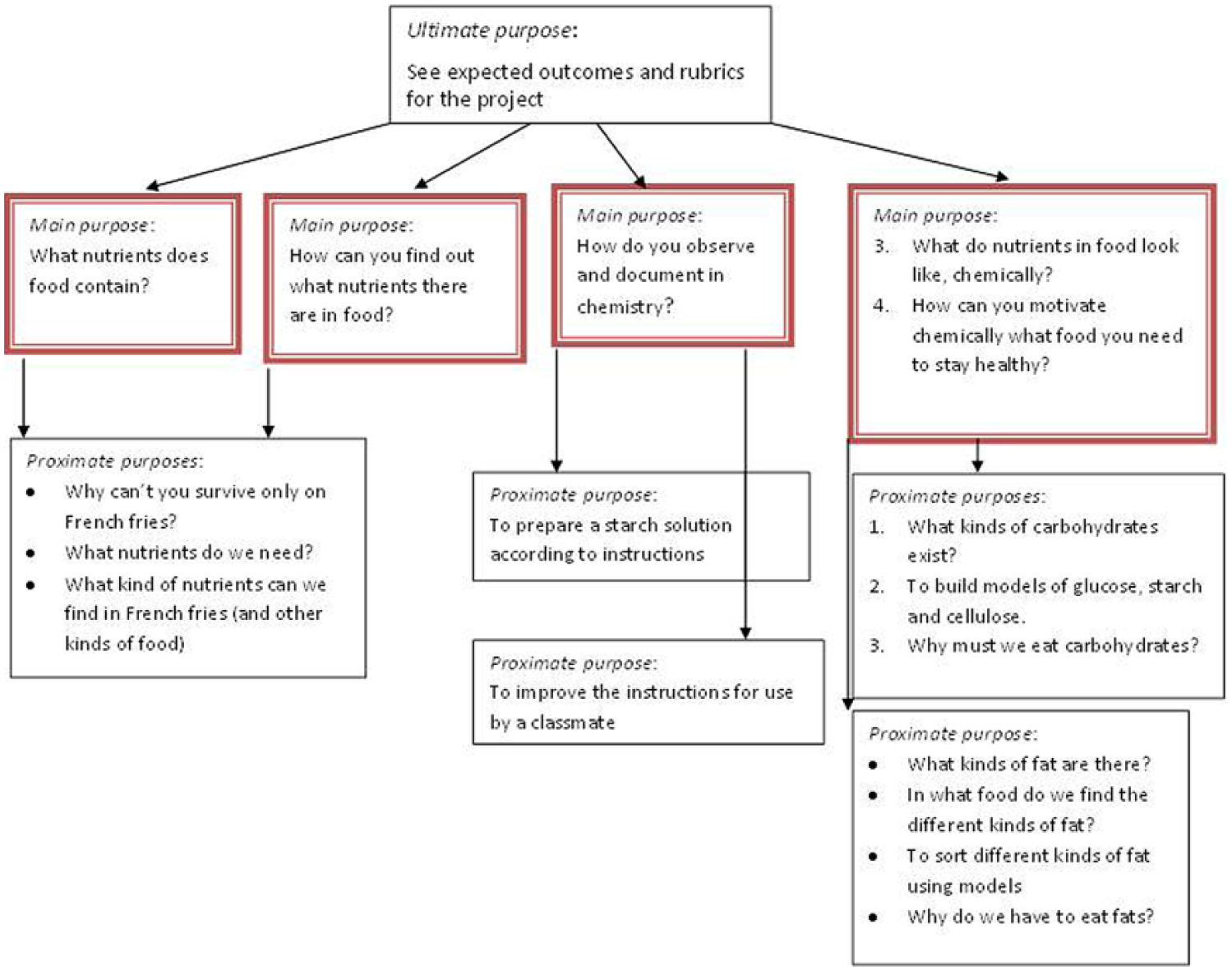
A representation of organizing purposes in relation to a specific teaching unit, as it emerged as a result of the encounter between teaching and research.
Chronologically, however, another change, one concerning responsibility for and risk-taking in the collaboration, preceded the two changes concerned with acquiring common experiences of each practice and appreciating salient outcomes. As Ola was about to begin teaching the new science project at the beginning of the fall semester, the teachers felt that they might not be able to allocate as much time to joint meetings as during the spring, and they expressed that to the researchers at the first fall meeting. From the teachers’ point of view, this was nothing more than information connected to changed directions from the school management concerning what the teachers in the school needed to accomplish during their regular meeting time one afternoon each week. They now had a new project going and they had secured assistance from the chemistry expert for the realization of the science project. Therefore, they thought that they would be better off allocating more time to other competing duties during the school’s official meeting time. From the researchers’ point of view, however, this was a considerable setback for the entire project, elsewhere referred to as a ‘crisis’ in the project (Hamza et al., 2013, in press). After having received this information, the researchers sat down to consider the fact that was recounted above concerning the early phases of the collaboration, namely that the introduced model did not play virtually any part in the teachers’ planning of the new science project. The result was to reconsider the researchers’ own role in the collaboration. Thus, they made a conscious decision to take increased responsibility for the implementation of the model and to take a greater risk in the collaboration by making a number of commitments to the teachers concerning how this increased responsibility would play out as positive outcomes for the new science project and the teachers’ ability to further modify it. The teachers responded by reconsidering their time allocation to the collaboration. It was decided that we would have three more meetings during the fall, in which we would jointly evaluate Ola’s teaching, revise the unit accordingly, and plan Jenny’s teaching of the same unit, all on the basis of the organizing-purposes framework. Thus, the changes described above initially came about as a result of this change in the researchers’ approach to the collaboration.
This change in how the researchers took part in the project may be seen as a change in some of the assumptions within the research practice, namely to keep a low profile in the collaboration in order to acknowledge and preserve teachers’ expertise and ownership over their practice. Although the need to acknowledge teachers’ expertise was never at stake, the ways in which the researchers may act in collaboration with teachers were. In particular, the researchers realized that keeping the original low profile in order to preserve teachers’ ownership at the same time left the teachers entirely on their own when it came to facing all the risks connected to invoking new ideas into their teaching (Hamza et al., in press). It seemed reasonable, on reflection, that those vouching for the benefits of a certain innovation should also be those initially taking responsibility for its implementation. Interestingly, the teachers had, all along, wondered why the researchers had not come forth more powerfully with their knowledge about the new didactic model. When they did, it was thus something that the teachers had lacked from the beginning, although they had not expressed that wish to the researchers.
Summary of findings
To sum up, the encounter between the two practices was taking at least three main paths in the course of the collaboration: (1) initial minor differences in interest related to certain differences between the practices, (2) the two practices living alongside each other during the early phases of the collaboration, and (3) the practices eventually reciprocally influencing each other. As to the research practice, the researchers emerged from the collaboration with both more diversified and more succinct ways of using the concept of purposes within the organizing-purposes model. This was a consequence of the realities imposed on the model from the teaching practice with which it interacted. The researchers also emerged from the encounter with a reframed notion of the responsibilities that come with introducing new research to a well-functioning practice (see also Hamza et al., in press). As to the teaching practice, the teachers emerged from the collaboration with modified ways of describing the science projects that define the practice, namely in terms of organizing purposes, as well as new ways of modifying the projects, also in terms of organizing purposes. In a more general sense, the teachers became somewhat more aware of their practice, its strengths and weaknesses, as they acquired a modified language to express what it was that they did.
The changes in the two practices constitute hybridization in the sense that each incorporated elements from the other (Table 1). Moreover, the idea of hybridization emphasizes that these particular changes could not have developed within either practice alone, but crucially depended on the encounter between the two. The hybridization is most clearly visible within the teaching practice through the incorporation of the concepts from the organizing-purposes model to talk about teaching in general, and to reconceptualize and modify aspects of the science projects typical of the practice. But also other, less explicit, changes to the teaching practice constitute hybridity, most notably the teachers’ modified way of treating the role of the assignment of the science project. Initially seeing it as the primary goal guiding their students’ work in the projects, at the end the teachers talked about the assignment as a particular kind of purpose that may not initially work as an end-in-view for the students.
Changes in each practice expressed as hybridization between them.
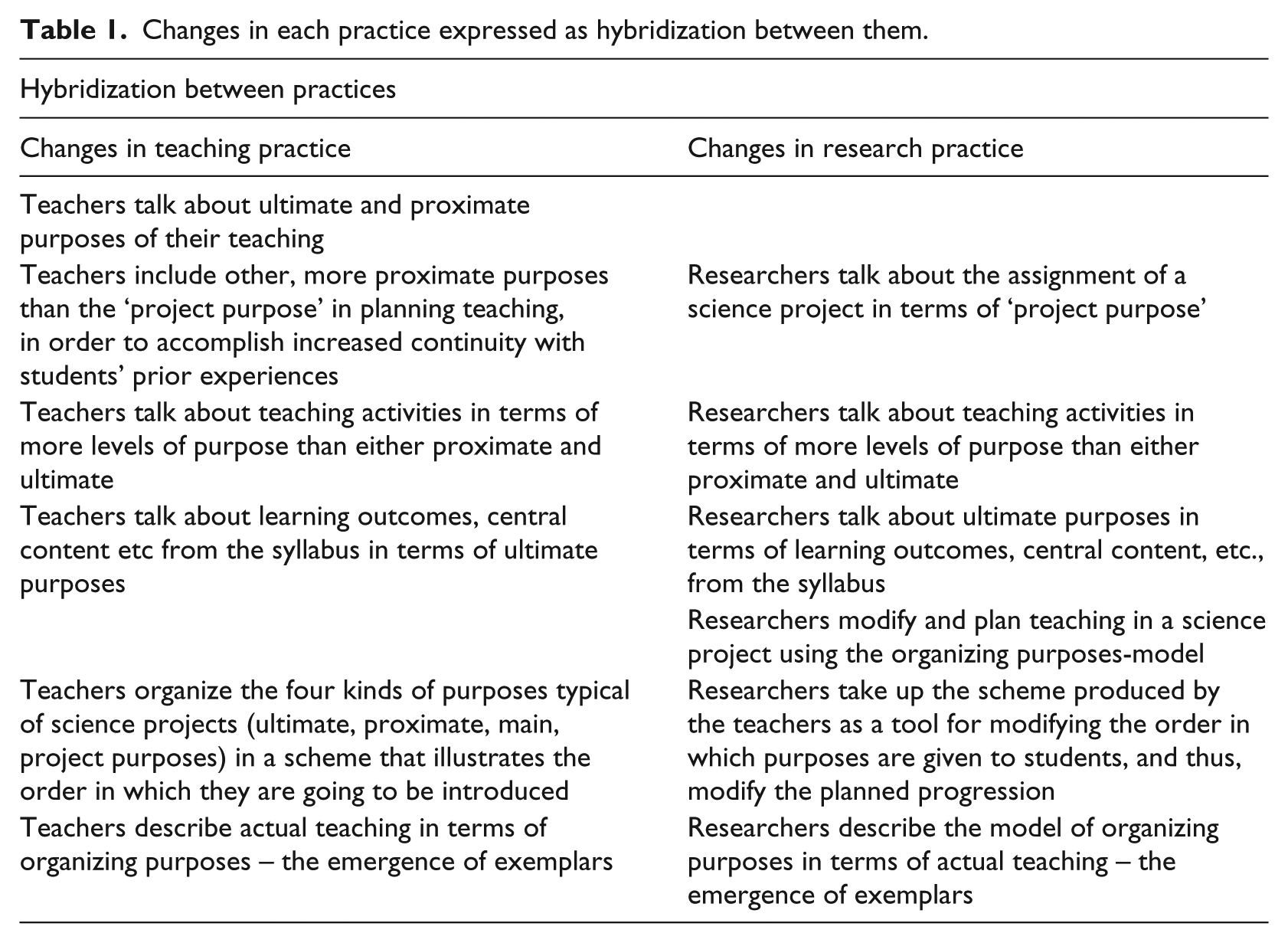
The changes to the research practice were characterized partly by incorporating particular elements of the science projects into the terminology for the organizing-purposes model, seen for instance in the realization that some purposes do not fall neatly into the original categories (exemplified by the ‘project purposes’ of the Stureby school practice), partly by accommodating more general experiences from the encounter with the teaching practice, for instance that there is a need to distinguish between more than two levels of purpose in actual teaching.
Another aspect of hybridization between practices was that activities more aligned with one practice were taken up by the other in the course of the collaboration. The representation developed during the collaboration is an example of an innovation coming about because the teachers engaged in activities coming from the research practice, such as producing tools for analysis of teaching. It then was incorporated as a tool in both practices (Table 1). That the researchers produced a teaching plan for Jenny’s cycle is an example of the reverse, that is, the researchers engaging in activities belonging to the teaching practice.
Finally, a body of exemplars of teaching developed and were incorporated into both practices. These exemplars continue to work as a kind of bridge between the practices; the teachers talking about their teaching in terms of the didactic model, and the researchers talking about the model in terms of the actual teaching experienced during the collaboration.
Discussion
Our interest in this article has been to show how the gap between educational research and teaching may be handled and reduced if research and teaching are treated as two practices interacting with each other. Specifically we asked what changes may be observed in teacher–researcher collaboration when the collaboration is analysed as hybridization between these two practices, which meant looking for the appropriation of elements from one practice in the other. Note that this does not mean that we observed a merging of the two practices, but the conscious and deliberate inclusion of various elements from one practice while continuing to work within the other (cf. Buxton et al., 2013). We found that both practices showed distinct signs of hybridization, partly by incorporating elements of the other practice, partly as participants from one practice engaged in activities from the other practice. The latter sometimes led to particular innovations to solve emerging issues arising from the collaboration, and which then became part of both practices. Thus, and most importantly, hybridization was distinctly reciprocal (Table 1). This reciprocity constitutes an original result from the study, and has implications for the discussion of the theory–practice gap in education.
Thus, the changes illustrated in Table 1 may be seen as the two practices having come closer to each other, in terms of ways of talking and making distinctions, in terms of shared activities, and in terms of common experiences and exemplars of teaching. This, in turn, may be interpreted as a beginning reduction of the theory–practice gap in the sense that the two practices have become somewhat less different from each other.
We do not suggest that this reduction is larger, more definite, or more significant than what may have been accomplished through other efforts described in the literature. We grant that over the past 20 years, the development of PLCs, action research, and other similar possibilities and incitements for teachers to research their own practice have all contributed to decreasing the theory–practice gap in education in different ways (e.g. Bleicher, 2013; Butler et al., 2004; Callahan and Martin, 2007; Penuel et al., 2015; Richmond and Manokore, 2011; Stolk et al., 2011; Tytler et al., 2009). Yet, we cannot escape the conclusion that the gap between research and practice in these and other studies is reduced primarily through change in the practice of teaching. To the extent that teaching practice informs the invoked research, this is mostly limited to steering the research questions into paths more relevant for the profession, rather than elements of the teaching practice having any substantial influence on the research. This claim should not be confused with the kind of ‘influence’ arising from collecting empirical data in schools, as is regularly done in mainstream educational research. What we have in mind here is the extent to which experiences and knowledge within teachers’ practice are allowed to influence research practice, which is something quite different from researchers analysing data collected within that same practice.
Even when teachers are researching their own practice, this has been viewed more as professional development than as significant contributions to educational research (Ruthven, 2005). It is true that Hargreaves (1999) presented a different and radical vision of schools as places not only for teaching but also for the main research into teaching, thus replacing the universities as the primary knowledge-creating institutions in education. What we have in mind, however, is the possibility of a practice which has emerged through the kind of hybridization between teaching and research suggested in our data, rather than the radical takeover of the aims and goals of another practice. Indeed, one might envision this hybridization going on until it makes sense to talk, not about two practices hybridizing by taking up elements from each other, but about one new practice which may trace its origins in the convergence of these two original practices. Such a practice may be thought of as the kind characteristic of a science concerned with the needs unique to teachers (analogous to medicine as a science concerned with the needs unique to physicians). This is also what is envisioned by educational design researchers (McKenney and Reeves, 2014) and in didactics research (Ingerman and Wickman, 2015). And just as medical knowledge cannot function solely on theoretical grounds, but also needs to be carefully developed and adjusted in relation to actual medical practice, so didactic knowledge (e.g. the organizing-purposes model of the present study) needs to be modified in interaction with teaching practice. Such a practice is concerned neither with simply educating teachers, nor with converting research into practice, nor with having teachers double their efforts by also becoming full-fledged educational researchers. Institutionally, the common ground of shared experiences demonstrated in our data gives a glimpse of how research and teaching could exist as one professional practice. So, teachers may continue teaching and researchers may continue doing research. But the gap between teaching and research does not need to be worked each and every time.
We have still to come across serious discussions in the literature concerning the possible changes to existing educational research practice, including how theories and models are treated, in the face of the experiences and knowledge existing within teaching practice in schools. This, on the other hand, is the kind of discussion that we have provided here. We have tried to outline the idea that the gap between theory and practice may be productively reduced by the successive transformation of teaching and research practice through hybridization. Possibly, this would eventually lead to a situation in which practitioners, teachers as well as researchers, concerned with questions about teaching interact and collaborate within one and the same practice, didactics.
Footnotes
Declaration of Conflicting Interest
The author(s) declared no potential conflicts of interest with respect to the research, authorship, and/or publication of this article.
Funding
The author(s) disclosed receipt of the following financial support for the research, authorship and/or publication of this article: This study is part of the project Supporting Teachers’ Agency and Learning in Teaching Secondary School Science (TALES), funded by the Swedish Research Council (VR-UVK: 2010-5171). We acknowledge the contributions of all participants in the collaboration: teachers not part of this publication, the principal, and the project members Marcus Angelin, Åke Ingerman, Clas Olander, Anette Olin and Marlene Sjöberg, who have contributed in discussions and development of ideas during the project.
This study is also part of the project Teaching Traditions and Learning, funded by the Swedish Research Council (VR-UVK: 2012-5023).