




Abstract
This article examines the spread of new public management (NPM) across European education systems as it has traversed national boundaries. While recognising the transnational dimensions of the spread of NPM, the authors offer new insights into the importance of national contexts in mediating this development in educational settings by focusing upon NPM within three European countries (England, Italy and Norway). We reveal its recontextualisation in these sites and the interplay between NPM, and local and national conditions. This analysis is underpinned by a theoretical framework that seeks to capture the relationship between education and the state and to reveal tensions produced by NPM both as a shaping force and an entity shaped by local conditions in these contexts. The article concludes by focusing upon the complexities and specificities of NPM recontextualisation in the three countries as a basis for a reflection upon possible future policy trajectories.
Introduction
In November 2011 a new network,
Over ten years have passed since NPM emerged as the ‘dominant paradigm’ (McLaughlin et al., 2002) for the reform of public sector provision and it is now over three decades ago that NPM initially emerged in Australia, New Zealand and the UK in the 1980s as part of what are now to a contemporary observer as familiar efforts to control public expenditure and related attempts to exert managerial control over public services (Hood, 1991). Since those early days, NPM has taken on a variety of guises as it has moved to middle age (Hood and Peters, 2004) associated with its characterisation as a slippery phenomenon (Savoie, 1995). Nevertheless the defining features of NPM, central to the discussion within this paper, are commonly recognised across extant literature. These include, in particular, policies and associated practices that have prioritised marketisation and choice, the use of management techniques developed in the private sector and the measurement of performance (Clarke and Newman, 1997). Such policies and practices have sought to transform public service provision via the replacement of public administration, now discursively positioned as out of date. Consequently, NPM is understood within the education sector as being, at least in part, an attempt to reculture and restructure educational provision around marketised and managerialist approaches to educational systems and organisations in ways that emphasise a new set of educational imperatives linked to standardised measures of educational performance. Although the demise of NPM has been announced by those positing alternative arrangements such as digital era governance (Dunleavy et al., 2006), we believe that the central tenets of NPM as described above remain key to understanding developments in the three countries reported upon. Indeed, there is some evidence that the processes underpinning this development have, if anything, been strengthened in recent years as the effects of the financial crisis of 2007/8 continue to have important implications both within and outside of the education sector.
In seeking to better understand NPM within the education sector we reveal the complexities of the rise of NPM in these three countries and its effects upon policy actors and institutions. We offer accounts of the manner in which NPM has been interpreted in these contexts and its interplay with local and national conditions that have characterised its travel across national boundaries within Europe. In so doing we provide evidence both of the shaping forces of NPM and how it has been shaped by local conditions and of the discursive shifts that have accompanied its arrival in the field of education. Through an examination of managerialism and leadership, processes of centralisation and decentralisation, and the subjectivities of policy actors including education professionals and young people we identify and explore tensions generated by the unleashing of NPM. In undertaking this analysis we recognise NPM as a travelling policy (Ball, 1998; Flynn, 2000; Ozga and Jones, 2006) and as a globalising and policy construct that is worked and reworked through European and international bodies such as the OECD and the World Bank. In doing so we do not believe that such an approach is incompatible with how ‘embedded’ contexts read, interpret and shape NPM within context and over time.
The three countries of England, Italy and Norway were chosen on account of their governmental diversity, with England as a liberal state, Italy as a Mediterranean state with a Napoleonic legacy, and Norway as a social-democratic state. In locating our analysis within these three very different states, the intention was to enable a more powerful understanding of how NPM plays out in the education sector in differing contexts, without seeking to make wider claims about the specifics of the recontextualisation of NPM in all European contexts.
Our reflections upon NPM in Europe are intended to offer new insights into the educational reform process that have wider implications for the development of education systems. We seek to encourage discussion about the role of the nation state in contemporary European education policy, the mediating role of the local and the capacity of current policy trajectories to address marked and widening social and economic divisions within European society. This will, we hope, contribute to a deeper understanding of the implications of public sector reform within the field of education.
The first step in our analysis of and reflections upon NPM was to provide a country analysis based on data collected primarily from policy documents and interviews with key informants and educational practitioners in each of the three countries (Grimaldi and Serpieri, 2013; Hall et al., 2012; Møller and Skedsmo, 2013). In England this evidence is drawn from a study investigating the emergence of distributed leadership in schools that located this development within the wider emergence of NPM. In Italy the analysis draws on findings from research on the changing governance scenario, the formation of head teachers’ subjectivity and the increasing displacement of NPM evaluation technologies in the Italian education system. In Norway the analysis draws on findings from qualitative studies examining recent educational reforms, including the increasing use of evaluation technologies and new constructions of educational leadership and professionalism. The findings from all three countries highlighted the ways ideas connected to NPM reforms had been introduced and interpreted quite differently across the three countries, and how these ideas are translated to align with existing norms and values. Based on these analyses of national cases, we developed a framework for systematic comparison across countries. This was developed iteratively as discussion within and between the writing teams from the three countries sought to capture and analyse the development of NPM in these contexts. This article presents the comparative analysis.
The first part of the article introduces the framework for comparison referred to above. Then each country case will be presented with an accompanying summary table to provide the basis for the discussion across countries that draws upon an analytical review of literature relevant to the development of NPM in educational contexts in the three countries.
A framework for comparison
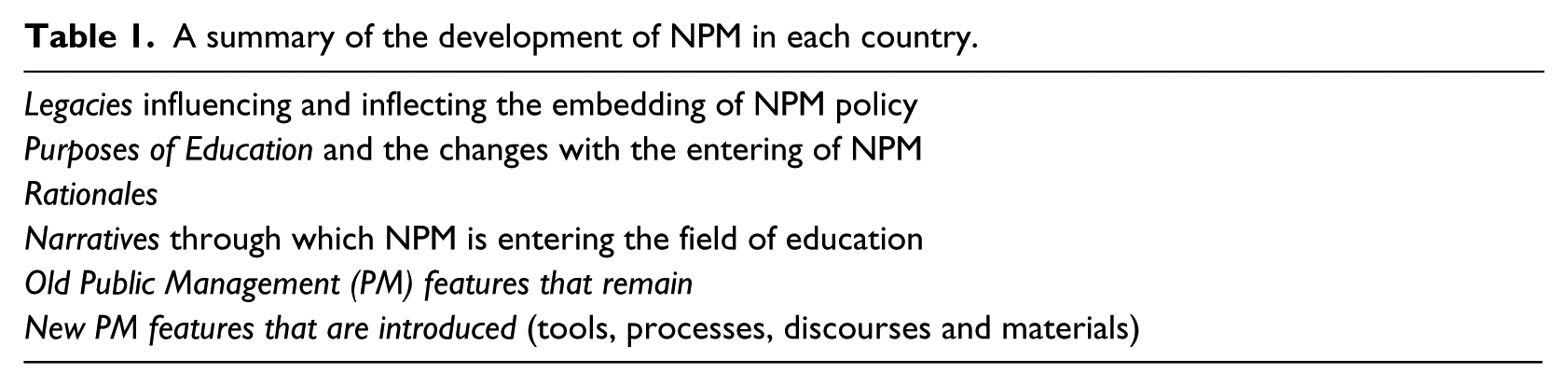
In order to lay the basis for comparison in terms of a reflection on the commonalities and differences of local inflections, we decided to organise our findings around three different sections. For each country we have provided an overview (see Table 1) linked to the following structure based upon Dale’s (1989) analysis of the relationship between state and education.
A summary of the development of NPM in each country.
Based on these national summaries we chose to use Newman’s framework (Newman, 2001) (see Figure 1) to offer a dynamic account of the tensions, paradoxes and surprises produced by the different inflections of NPM in the three countries. This seeks to unravel some of the complexities of the process of institutional change as new discourses are enacted and policies implemented and show how overlaps between outlined tensions and dilemmas produced tensions and disjunctures as different sets of norms and assumptions were overlaid on each other.
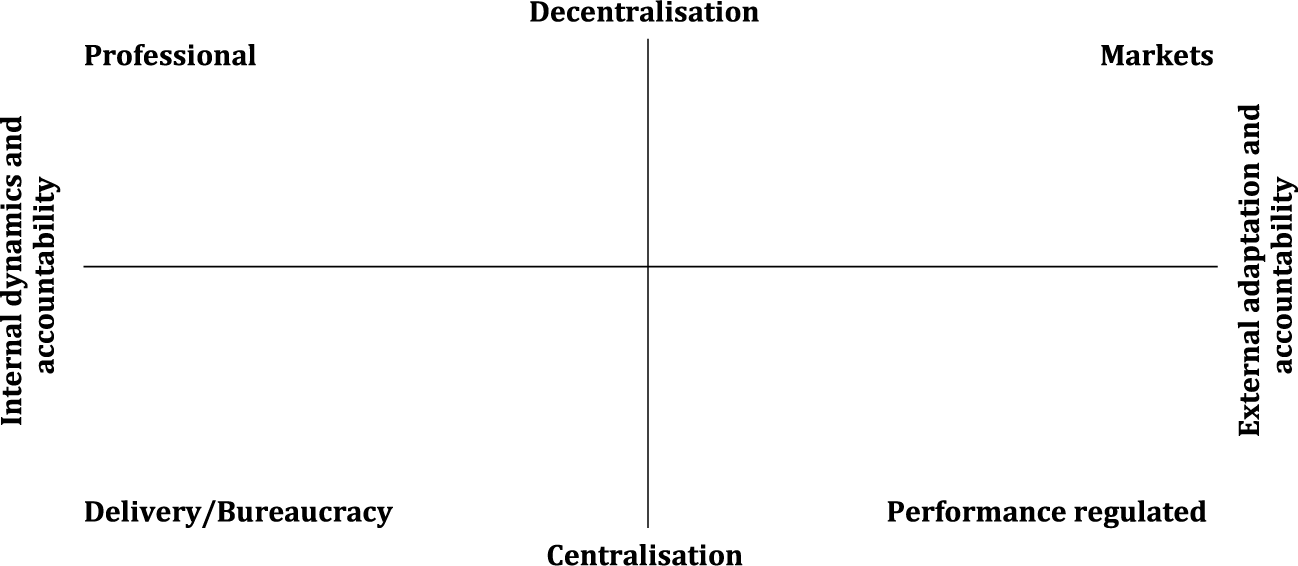
Framework for mapping changes and tensions in the development of NPM in each country.
The matrix was derived from the intersection between two interpretative dimensions and/or continuums:
the vertical axis, which represents the degree to which power is centralised or decentralised, where high centralisation corresponds to structural integration of governance and decentralisation exploits the differentiation of governance arrangements;
the horizontal axis, which focuses on the nature of change and, more precisely, on the endogenous or exogenous dynamics fostering change itself, exploring the extent to which pushes towards change are originated by internal (professional or bureaucratic) versus external (market-driven; managerialist) tensions.
The intersection of the two continuums provided us with a ‘ground’ to map the changes relating to modalities of state control (delivery/bureaucracy and/or performance regulated), the re-imagining of the professional space (professional), the developing of (quasi)markets and the unveiling of hybrid and contested transformations through which the field of education is being restructured and recultured in the three countries.
The case of England: NPM and leaderism
The UK has been at the forefront of what have now become widespread shifts in the nature and character of public sector provision. As an early adopter of NPM, the UK along with other anglophone countries came to be viewed as a ‘mover and shaker’ (Hood and Peters, 2004), encouraging and celebrating the adoption of NPM in other parts of the world (Pollitt and Bouckaert, 2011). The rapidity and scope of the public sector modernisation process in the UK has been such that the initiatives and reforms underpinning this movement have led to what has been referred to as a ‘permanent revolution’ (Pollitt, 2007) of change.
This determined and unrelenting approach to public sector reform across the UK has unsurprisingly led to dramatic changes in public service provision, although it must be noted that in the case of education, the respective parliaments of Northern Ireland, Scotland and Wales have been granted devolved powers by the UK state. In the education sector in England where both Conservative and New Labour administrations have been engaged in radically reforming schooling through a bewildering array of developments, these changes have been especially marked. Central to these shifts was the 1988 Education Reform Act enacted under the Thatcher-led Conservative administration.
Within the 1988 Act it is possible to discern some of the key characteristics of NPM in education in England. First, the creation of a national curriculum can be viewed as reflecting earlier models of public sector management in which planning based upon rational and scientific means of controlling activities were predominant (Pollitt and Bouckaert, 2011). Because of the manner in which the school system had both evolved at a local level and had national state powers devolved to it, for example through the 1944 Education Act, the education sector had to some extent evaded the rational, hierarchical national planning process that pre-dated NPM. The 1988 Act corrected this anomaly by creating the means by which centralised authority could exert much greater control over both the outcomes and processes of schooling. This Act also enabled the expression of the second key characteristic of NPM in England: a nascent neo-conservatism, which in an educational context, as referred to above, manifested itself in a rejection of progressivism and sought to re-establish traditional conservative values. Interestingly, this educational version of neo-conservatism emerged strongly in the pre-Thatcher Labour administration led by James Callaghan. Callaghan’s proposed ‘great debate’ about education offered the foundation for the rolling back of the programme of comprehensivisation and developments in teaching and learning that accompanied this restructuring of education in England and, at the time, in pre-devolution Wales. Third, the decentralising aspects of the 1988 Act and the associated marketisation of schooling unleashed a neo-liberal revolution in education with dramatic implications, in particular, for children, teachers, parents and schools. Evolving out of these three key characteristics was what has come to be recognised as the classic NPM troika of markets, metrics and managers (O’Reilly and Reed, 2010).
The emergence of markets, metrics and managers as key features of education in England have their origins in the 1988 Act, but their continued domination and persistence are testament to a political consensus that has eluded several changes of government, including wholesale changes of political parties. Central to this turn of events has been a continuing commitment of different governments to NPM.
The educational reforms discussed above, and summarised in Table 2, reveal two important dimensions of NPM in England post-1944: the emergence of marked discursive tensions within and about education policy, and the importance of layering (Newman, 2001) in making sense of this period of rapid policy change.
Summary of NPM in England.
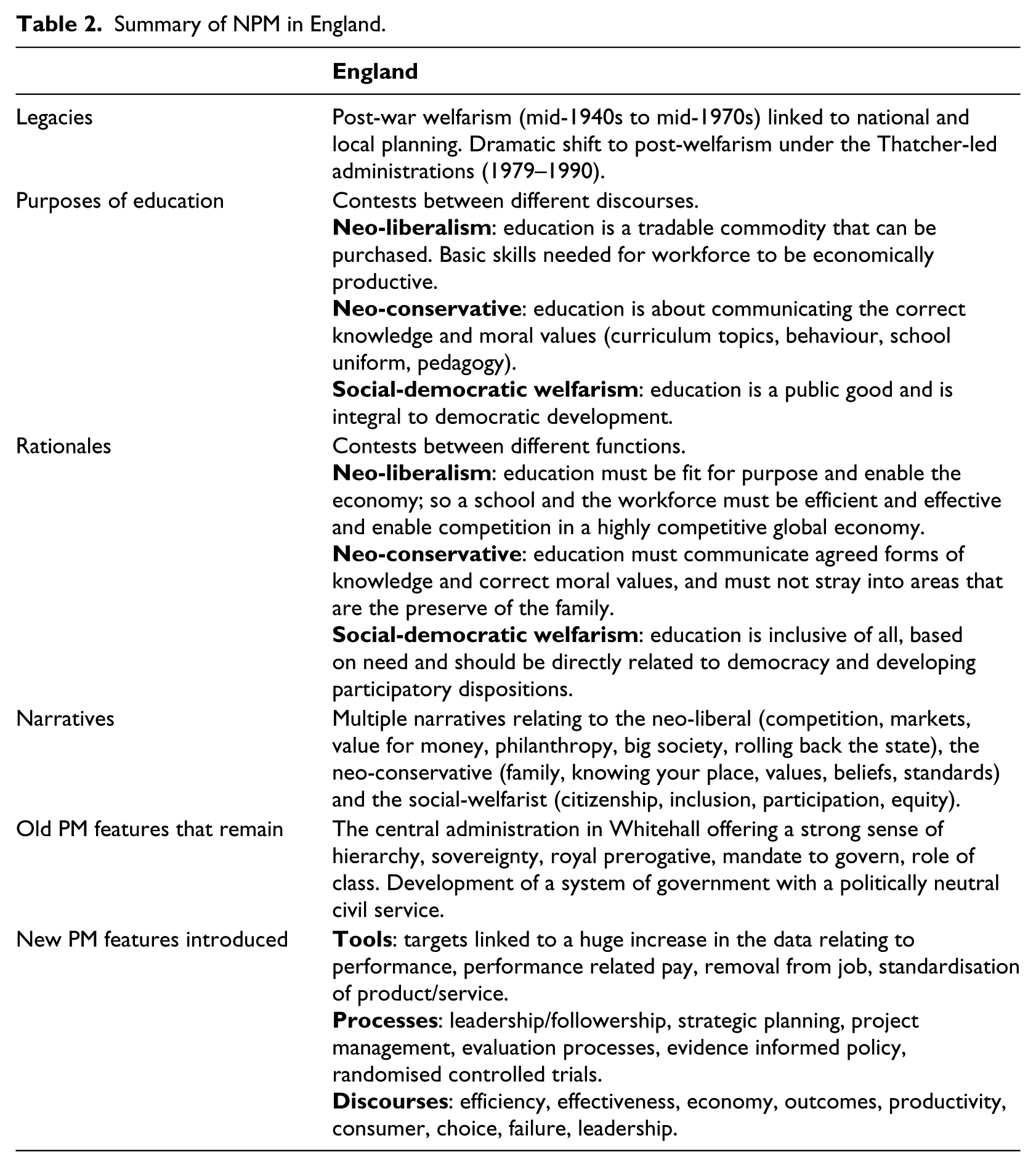
The emergence of discursive tensions in England centre upon disjunctures between longer and more settled aspects of the state’s role and apparently newer shifts in policy. The centralisation of education from 1988 reflected at least in part the shifting of education to a nationally planned approach whereby local powers were transferred to national bodies and the Ministry, a reform method that was foreshadowed in the creation and development of a National Health Service in the immediate post-war period. This discourse of bureaucratised, rationally planned approaches to education was evident in 1988 in the creation of a national curriculum and in New Labour’s subsequent national strategies, which sought to create uniform and standardised approaches to the teaching of literacy and numeracy in classrooms throughout the country (Moss, 2009). However, this centralisation was, as has been referred to above, accompanied by a very different discourse. This was a discourse linked to the marketisation of education, positioning parents as consumers and schools as business units operating in deliberately constructed markets ironically underpinned by performance data produced through the centralised mechanisms. This latter approach to the reform of schools as part of the NPM was directly associated with what have subsequently emerged as well established and politically dominant neo-liberal attempts to roll back the frontiers of the state. These tensions are diagrammatically represented in Figure 2.
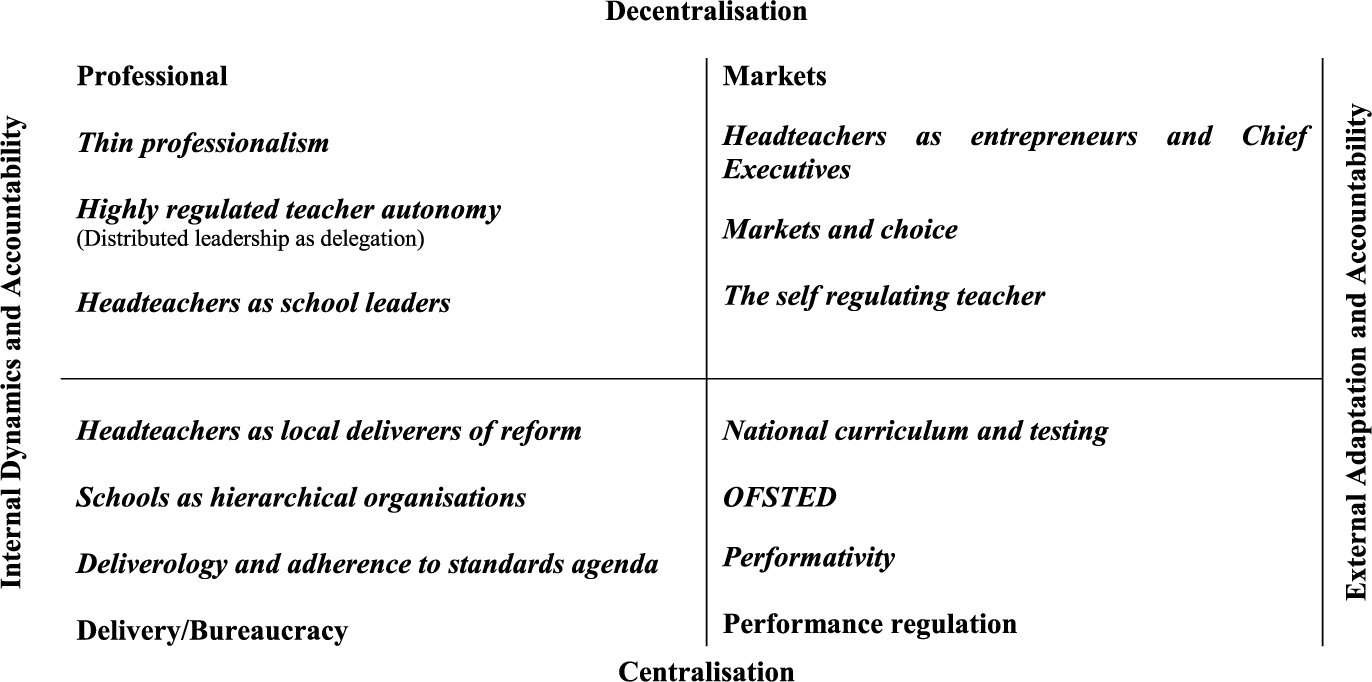
Changes and tensions in the development of NPM in England.
For those working within the system and, in particular, head teachers charged with the task of locally managing these radical policy changes, such discursive tensions frequently remained buried beneath the surface and veiled (Hall, 2013) by a model of transformational leadership championed by the National College for School Leadership (NCSL). This veiling of discursive tensions has enabled the continued commitment of those education professionals attached at least in part to welfarist models of educational provision. As can be discerned from the above, these discursive tensions are most dramatically represented by contradictory and divergent aspects between different education policies in England. This has been none more so than in the production of a ‘standards agenda’ intimately linked to a form of NPM that has enabled the narrowing of debates about education in England to a limited range of data generated from national, and increasingly international via PISA, tests at different ages. This relentless focus upon standards as manifested by test scores has fed the centralising fantasies of successive Secretaries of State for Education, eager to demonstrate political success through securing ‘improvements’ in the ‘quality’ of schooling. Yet, as well as feeding the centralisation of schooling, the standards agenda has also enabled marketisation by providing the performance data upon which the operation of quasi markets and the allocation of parental ‘choice’ has come to depend. Herein lies one of the paradoxes of educational marketisation in England. In order to enable the functioning of educational markets, the state must intervene heavily in order to ensure that the market is provided with the kind of performance data that underpins their operation. Further paradoxes abound, although two particular examples help to illustrate this dimension of NPM. First, the creation of free schools in England as part of the Conservative-Liberal Democrat Coalition Government’s vision for educational reform has potentially at least enabled the provision of greater choice for parents at a local level. This has the simultaneous effect of generating difficulties in terms of planning for school places at a local level, leading to potential surpluses of school places at a time when economies in educational expenditure are required in a programme of government spending cuts. Second, NPM has been accompanied by an increase in the quantity of evaluation data in the form of instruments such as school improvement plans and data required through audits such as the panoply of information required of schools during OFSTED inspections. This has meant that schools operate far more closely to the kinds of rules-based procedures characteristic of the discursively outmoded public administration that NPM itself was expected to displace.
Closely associated with these discursive tensions has been a process of ‘layering’ (Newman, 2001), whereby new ways of thinking and working have been over layered with previous ones through a gradual process of accretion. This can perhaps best be demonstrated through the manner in which the work of those responsible for running schools in England have been recipients of layers of discursive change. Following reforms of education from 1988, and in line with their historically dominant role within schools, head teachers were positioned as managers of their institutions responsible for the implementation of reforms and as local carriers of NPM. This role for head teachers became associated with the rise of managerialism in schools (Gewirtz, 2002) placing head teachers as the ‘lone rangers’ (Gronn, 2000) of educational modernisation. Yet, under New Labour, it was leadership that emerged in the conceptual ascendance (Hall et al., 2012), reflected in the creation of NCSL under the first New Labour administration. This began as transformational leadership and subsequently morphed into distributed leadership (Hall et al., 2011). So what can be seen in the English context is a traditional discourse of hierarchy and control linked to a discourse of managerialism that actively sought to secure the success of NPM reforms. This was subsequently overlaid by a discourse of transformational leadership and, later, distributed leadership.
The NPM reform process in England has largely positioned teachers as the implementers of externally determined changes with concomitant implications for their autonomy. This has led to restricted (Hoyle, 1975) and organisational (Evetts, 2003) forms of professionalism in which the role of teachers has been focused upon securing a narrow and instrumental set of educational outcomes linked to centralised performance systems. This shift from licensed to regulated autonomy (Dale, 1989) has meant that much greater control is exerted over a range of professional practices previously subject to the professional judgement of teachers. While the veiling of NPM through discourses of leadership (Hall, 2013) and standards have to some extent distracted and possibly cushioned this dramatic change in teachers’ work, they have nevertheless been unable to prevent the terror (Ball, 2003) experienced by those teachers required to perform in ways inimical to their personal and professional values and frequently rendered fearful of being regarded as failures.
The case of Italy: NPM, school autonomy and the evaluation taboo
The introduction of NPM reforms in the Italian education system, where education remains a power in tension between contradictory processes of devolution and (re)centralisation, can be seen as a peculiar process of the vernacularisation of a global policy trend in the field of education and, more generally, in the reform of the public sector. In fact, Italy has been among the slowest European countries to introduce NPM reforms (Hood and Peters, 2004; Grimaldi and Serpieri, 2013) not least because welfarism and bureau-professionalism have strongly opposed and/or mediated the entering of NPM, creating stop-go dynamics of change and contested processes of policy enactment.
Uncertainty seems to be the main trait characterising the processes through which NPM is embedded in the Italian education system. Changes encounter significant resistance exerted by the bureau-professional block. Political instability also makes it difficult for governments to launch system reform projects and to give continuity to initiatives in order to institutionalise new practices and devices. Although all of this results in what appears to be a ‘continuous impasse’, the increasing centrality of the NPM discourse is having some implications for the transformation of expertise and the regulation of professionals in education.
When NPM first appeared in the Italian policy landscape during the 1990s, the main traits of the welfarist Italian education system were: (a) the state as promoter of mass education as a public good and for means of emancipation; (b) bureau-professionalism as a mode of regulation; and (c) high levels of autonomy for head teachers and teachers within their ‘professional space’ (Jones et al., 2008).
It was in the late 1990s that these features started to be questioned thanks to the increasing influence exerted by NPM in shaping the policy agenda. Since then, there has been an intense transformation of the deeper texture of the Italian welfarist education system. In the last two decades, in fact, policy change has been inspired by a set of global policy ideas:
modernising educational governance through the creation of devolved environments and redesigning professional subjectivities with a specific focus on headship within an NPM-inspired new moral environment;
building an ‘evaluation machinery’ to measure and make a spectacle of the systems’ effectiveness, as a way of regaining central control.
Table 3 summarises the tools, processes and discourses of the Italian inflection of NPM, together with the legacies which, during these two phases, have mediated its entry into the education system and the changes, surprises and paradoxes it has produced.
A summary of NPM in Italy.
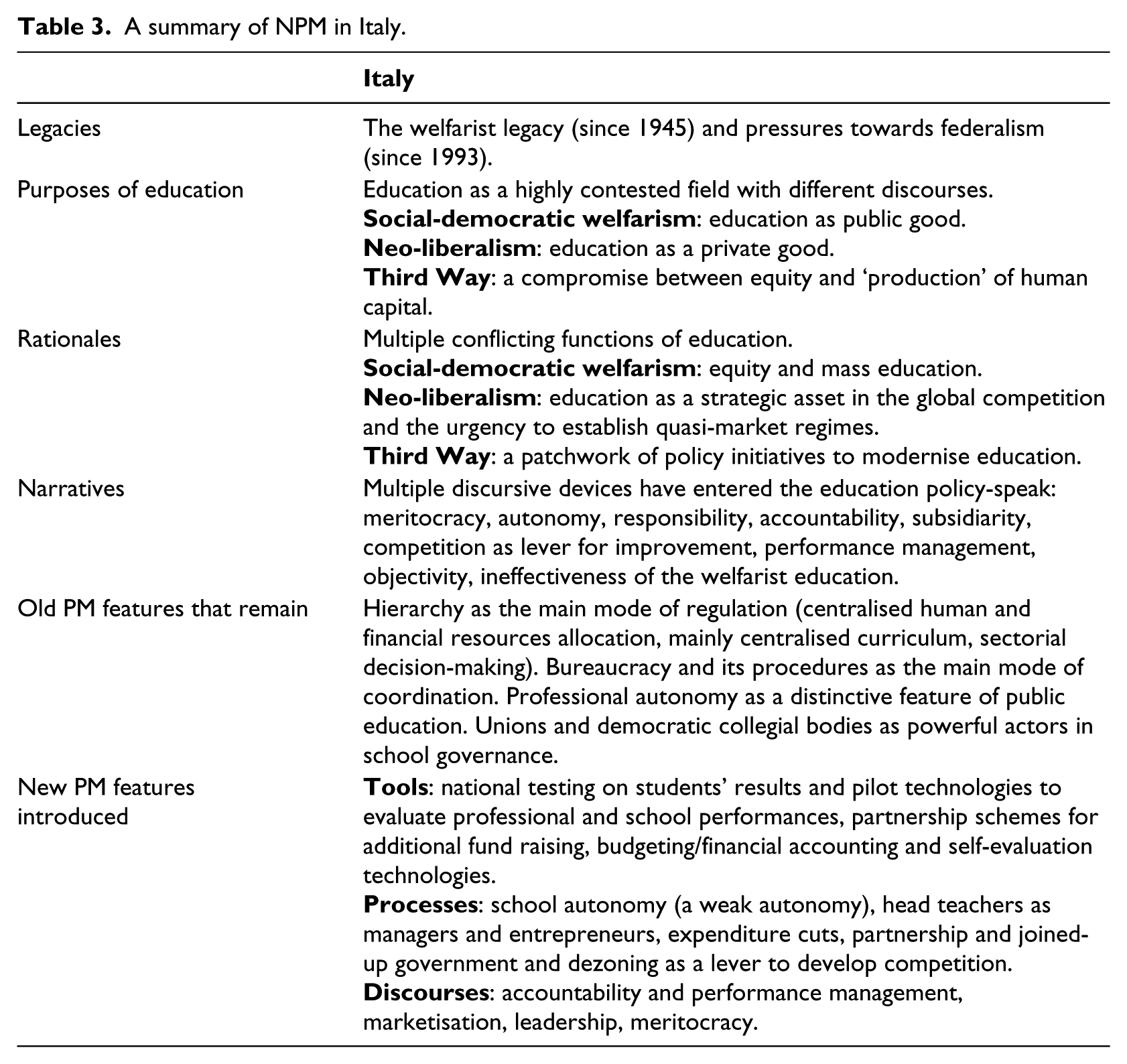
A key step in NPM entering the Italian education system was the 1997 reform labelled as ‘school autonomy’ (see Table 3). This autonomy reform was promoted by a centre-left government, heavily influenced by the Third Way discourse, and framed within a wider restructuring of public administration more generally. The main change concerned the introduction of a ‘weak’ site-based management (Grimaldi and Serpieri, 2010), where schools were entitled to greater room for manoeuvre in relation to financial, organisational and educational issues, although not for human resources management (Landri, 2009). A further innovation was the formation of a new headship role (in 2000), inspired by the main tenets of NPM (Serpieri, 2009).
It is in the last decade, however, that the project of modernisation has moved to its crucial stage through the building up of an ‘evaluation machinery’ to appraise system, organisational and individual performances. At the same time, the NPM agenda has permanently entered the system, and its sacred principles have been put at the centre of the education debate. In fact, since 2001, Conservative ministers of education have tried to introduce NPM reforms promoting cost-cutting, standardisation and evaluation policies. Riding on the wave of the international prominence of the OECD-PISA tests, the need for a new culture of evaluation has been strongly emphasised. In the last decade, the national agency for evaluation (INVALSI) has pushed the ongoing creation of national standard tests (Italian and maths), which are now a permanent feature of the Italian system, whereas recently NPM and fashionable neo-liberal key themes have been put at the centre of the education debate. These themes have included meritocracy, excellence, individuals’ and families’ responsibility for education, parents’ choice and the blaming of ineffective schools and teachers.
Finally, in Italy increasing efforts are also in progress to break up the historical taboo of evaluation. Since 2000, diverse experimental attempts have been made to introduce mechanisms for evaluating head teachers, teachers and schools. Although many of them have failed, nowadays a national evaluation system has been introduced and the country seems to be ready for the conclusive introduction of mechanisms to: (a) evaluate schools and head teachers through the matching of tests data and inspection results; and (b) evaluate teachers, providing incentives to the ‘best’ ones.
All these NPM-inspired policies are still in progress and some of them are at a pilot stage. However, they have been announced through, and accompanied by, media campaigns of blaming and shaming schools and teachers that have highlighted their perceived resistance to evaluation. A new shift is clearly recognisable towards a governing-by-numbers mode of educational governance (Grek, 2009).
Figure 3 points to some paradoxical implications of the increasing influence exerted by NPM in Italian education. The main two concern governance and the formation of headship.
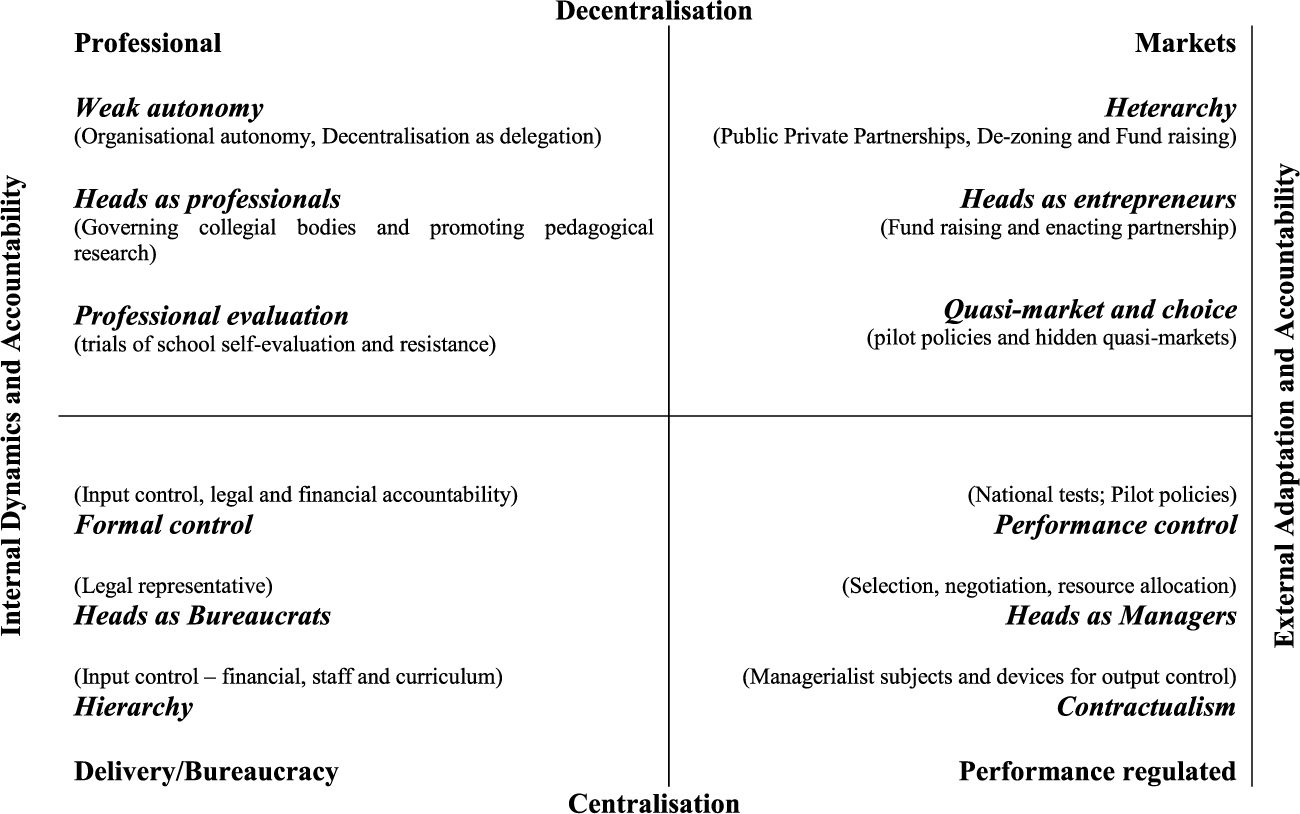
Changes and tensions in the development of NPM in Italy.
In relation to governance, the Italian education system can be defined as a peculiar and hybrid form of centralised decentralisation (Karlsen, 2000), where the state still exerts a strong and pervasive influence on local authorities and schools through the definition of the national curriculum, the control of human and financial resources and, finally, the exercise of its regulative powers through standard setting and incentives distribution. A weak school autonomy coexists with the permanence (and the reinforcing of) centralised control, through neo-centralistic policies, the introduction in the public sector of the managerialist logic of contractualism and the relentless introduction of a performance management system (anchored to the new evaluative standards). Paradoxically, NPM coexists with hierarchy, and the attempts to introduce decentralised forms of governance and empower self-regulating actors coexist with the tightening of hierarchical ties through the introduction of new coercive ‘meta-governmental’ mechanisms of control such as setting standards and designing subjectivities (Grimaldi and Serpieri, 2010).
However, divergent trends and pressures are recognisable in this shifting scenario of educational governance. In fact, spaces for quasi markets are increasingly opening at the local level thanks to the layering of policies that: (a) have deregulated school catchment areas; (b) introduced mechanisms of additional funding on a competitive basis; and (c) stimulated the formation of public-private partnership in the provision of educational services. As a result, new actors are called to enter the education field, opening spaces for ‘heterarchical governance’ (Jessop, 2002).
The head teacher is also a ‘character in tension’ within this scenario. The policies promoted after 1997 strongly renewed headship by defining new practices and procedures associated with NPM values and ethics (entrepreneurship, efficiency and effectiveness, innovation, strategic management, improvement and accountability). The hierarchical ruling of schools and a bureaucratic understanding of headship were identified as the main problems affecting the Italian system. The Italian ‘war’ of discourses on leadership (Serpieri, 2009) resembles the New Labour policies intended to subjectify head teachers as ‘levers of change’ (Gunter, 2012).
However, as in the case of New Labour discourse in England, in Italy the repeated efforts to introduce a new regulation of professional groups are underpinned by different and conflicting discourses of change. Professionalism, whose legacies are still visible in the dynamics of resistance, is increasingly colonised by a discourse of ‘compulsory innovation’, where continuity and stability become the moral imperative to achieve good performance. Such colonisation is leading to a moral environment where responsibility for the achieved outcomes is completely delegated to the ‘committed professional’, whose successful performance depends on motivation and disposition towards innovation and flexibility. The autonomous, enterprising and managerial self-regulating subject is, however, increasingly externally regulated through the technologies of performance management, being asked to respond to results in a contract-like relation with the state. Recent policy developments seem to reveal the will to extend to teachers the same mode of regulation.
Summing up, the Italian education system seems to be in the middle of a meaningful transformation of its deeper texture, and the debate around the future direction to be undertaken is still fierce. It is not only the modes of governing and the whole structure of the education system that is under (re)construction but also the discursive definition of the purposes of education. A ‘war’ between discourses is in place, where the global trends towards managerialist accountability and performance control try to penetrate the welfarist arrangement. Those discourses that promote the adoption of a democratic form of professional accountability, based on peer-to-peer and self-evaluation, are increasingly marginalised.
Despite the diffuse resistances and the repeated failures that the coalitions supporting the NPM in turn have encountered in enacting policies, some of the NPM-inspired discursive problematisations have successfully entered the education field, becoming taken for granted and indisputable cornerstones of the political, technical and even academic debates on educational professionals’ evaluation. One of the main features of the performative power of NPM discourse and tools is that of silencing opposite and alternative voices, co-opting democratic and progressive discursive devices to its cause and masking its biases under the neutrality of technical voices. This seems to be the main dynamic of change in the Italian education field.
The case of Norway: Modernising education
Since the end of the 1980s, the Norwegian education system, a national-level non-federated entity, has gone through major reforms, influenced largely by NPM, which was introduced in two waves as part of modernisation programmes for the public sector in general and, in particular, for local government (Christensen and Lægreid, 2011). In the education sector, the first wave components mainly produced consequences for the restructuring of local school administration in terms of deregulation, horizontal specialisation and management by objectives. The second wave of NPM aimed to address problems of fragmentation caused by initiatives in the first wave through balancing centralisation and decentralisation and by introducing value-based management to increase understanding of collective goals and norms (Christensen and Lægreid, 2011). Examples of initiatives that can be seen as part of the second wave are the establishment of the national quality assessment system (NQAS) and the latest reform, the ‘knowledge promotion’. They represent centralised coordinating initiatives that aim to balance decentralised elements and apply more output-orientated ways of governing schools in combination with input-orientated means. This movement represents international and global movements related to education and economic competiveness other than NPM reforms, although the ideas on which they are based may correspond (Møller and Skedsmo, 2013).
The mid-1980s signified a key shift in policy when the emerging change towards NPM in Norway was initiated by a Conservative-led coalition government with a modernisation programme at the beginning of 1986. This programme brought ideas about structural devolution, horizontal specialisation, efficiency and management principles. In the autumn of the same year, there was a shift in government, and the Labour Party came into office, but the new government continued the modernisation programme along the same lines. Numerous programmes have been launched since then by various governments pushing for reforms in the public sector, and they have tended to be loose collections of reform ideas. Public commissions, including experts and representatives from civil service unions (especially when the Labour Party has been in power), have also played a role in pushing for public sector reforms. The Norwegian version of NPM was accompanied by introducing management by objectives (MBO) as a governing system (Christensen, 1991).
NPM did not directly challenge the established tradition of schooling, since it was introduced more indirectly. However, the development of NPM changed direction and sped up during the second wave, when Norway was listed among the ‘lower-performing’ countries according to PISA and other international tests. School leadership and accountability became key issues in the public debate. Prior to the reforms, trust was invested by the public and parents in professionals above all, but more recently attention has increasingly been directed towards trust in performance measurements.
Table 4 summarises the processes and discourses connected to the development of NPM in Norway, together with norms, purposes and legacies that have mediated the translation of new managerialist ideas in the Norwegian compulsory school system.
A summary of NPM in Norway.
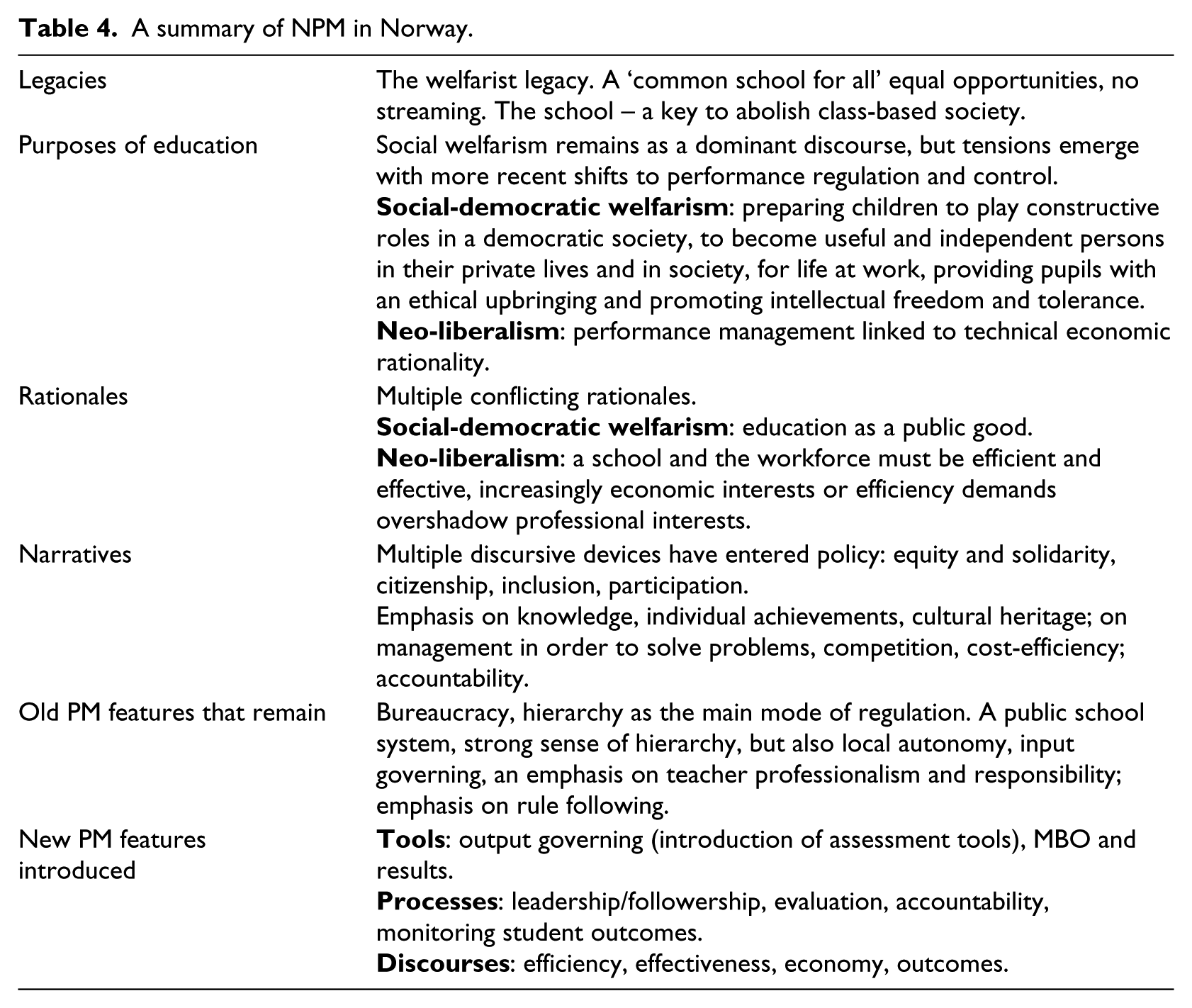
In the education sector, MBO appeared in the national curriculum of 1987 as a guiding principle (Sivesind, 2008). The curriculum also emphasised the responsibility of schools and municipalities to carry out local curriculum work based on national aims, school-based evaluation and local development. In 1988 OECD conducted a review of the Norwegian education system. Questions were raised concerning how central authorities can form an opinion of and influence the level of quality in a school system as strongly decentralised as the Norwegian school system (OECD, 1988). Reviewers emphasised that their concern was not to reintroduce national control, but rather to consider ways in which: ‘good norms of educational practice’ (OECD, 1988: 46) could be established and disseminated. This required that more attention be paid to educational processes and outcomes. Various state initiatives came as responses to the questions raised by OECD reviewers. White Paper No. 37 (1990–1991) formally introduced MBO as the new governing system in education and drew up division of tasks and responsibilities for the various levels of the school system. Although this White Paper also introduced the need for a national assessment system, it took more than a decade before it became a reality. Many new initiatives were launched, resulting in a big public debate about what this assessment system should look like, and external evaluation became a contested issue (Skedsmo, 2009).
The first PISA report became a turning point in public debates about educational quality, which centred increasingly upon students’ academic achievements. The debates accelerated and the Norwegian parliament was ready to decide upon a system for assessing national education quality, which would become the NQAS.
White Paper No. 30 (2003–2004), Culture for Learning, launched by a Conservative-led coalition government, introduced a new governing model for education with a focus on deregulation, efficiency, competition, learning outcomes and accountability. While arguments in White Paper No. 37 (1990–1991) were linked to internal organisation and structures of the education system, the arguments put forth in White Paper 30 (2003–2004) related to challenges in the global world to which the education system must respond (Skedsmo, 2009). It is argued that the new governing model was motivated by the problematic PISA findings and concerns about reducing disparities in educational outcomes across different social groups. According to arguments put forward in this document, it emerged as obvious that teachers and school leaders needed to do better than before, and that they must be more able and willing (Møller, 2007). This directly suggested that schools had previously failed in certain important respects. In order to make good use of the knowledge produced by the NQAS, each school would need ambitious school leaders with positive attitudes towards change and improvement. Leadership and accountability became the new panacea for school improvement.
Following these changes, it is possible to highlight a shift in dominant ways of understanding and framing accountability and leadership. Different labels are constructed to capture different conceptualisations of leadership and accountability at different times and via different ideologies. While head teacher as primus inter pares and legal accountability were in the forefront in the 1960s within a centralised model of education, intellectual and professional accountability became part of the dominant discourse of the 1970s and 1980s within a decentralised model where trust in the teaching profession was taken for granted both among educational authorities and parents. The beginning of the new millennium signified a change in the dominant discourse towards trust in data-based decision-making and performative accountability. Economic interests or efficiency demands overshadowed professional interests and benchmarking, and test scores were emphasised. Increasingly, school leadership became framed as both a problem and as a solution in educational policy, and output management has gradually replaced input governing. Neo-liberalism in terms of technical, economic rationality gained terrain, and the PISA results legitimated new forms of bureaucracy by demanding continuous documentation and monitoring of work.
Figure 4 indicates some implications of NPM’s influence in the provision of education in Norway. It also demonstrates how there are multiple and conflicting rationales in the current education policy. Multiple discursive devices have entered the policy speech, but the narrative of a common public school for all is still strong. Teachers still enjoy considerable trust and autonomy in most municipalities, and the relationship between leaders and teachers is not very hierarchical in practice. A possible direction of future education policy is also indicated in Figure 4, although this is subject to the usual caveats regarding future events.
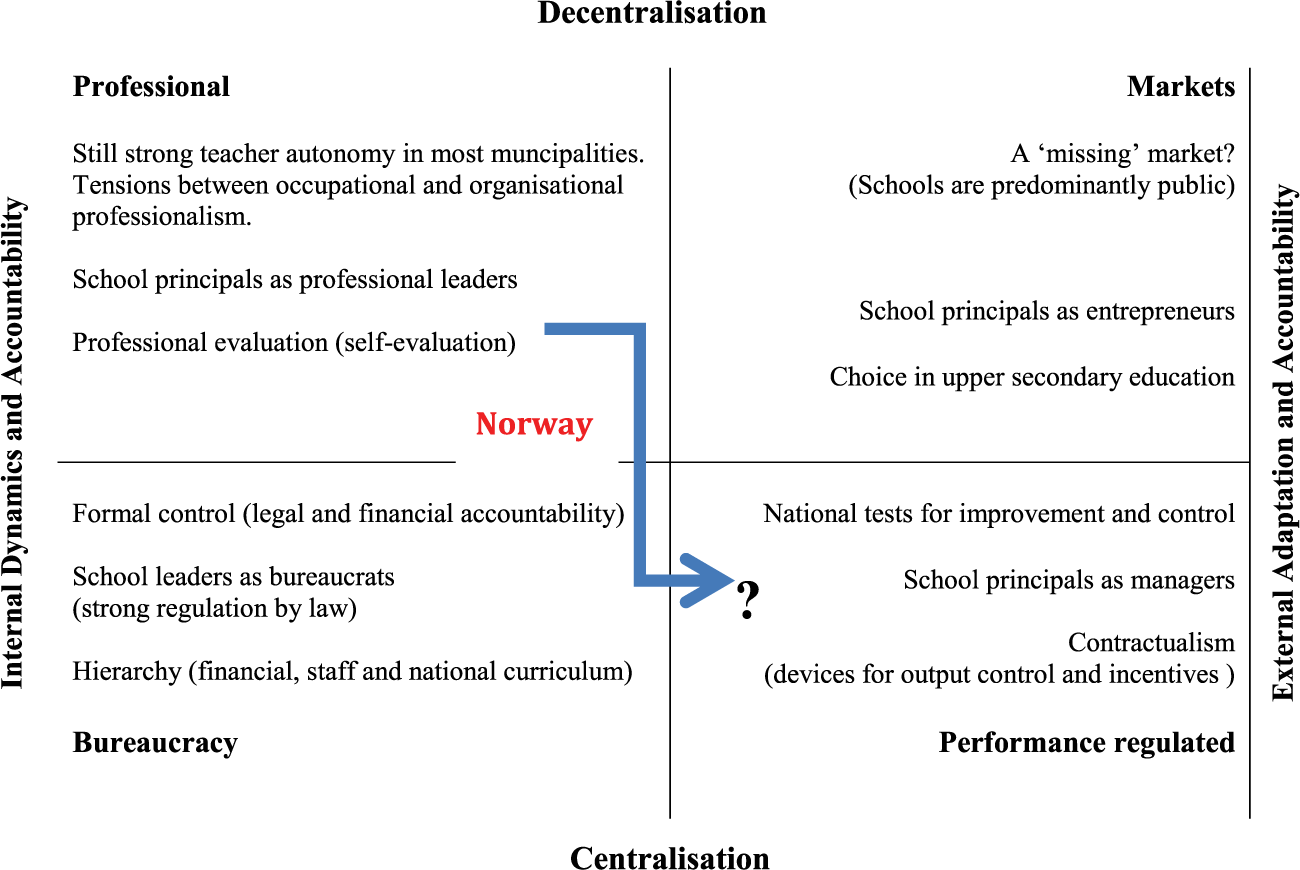
Changes and tension in the development of NPM in Norway.
Figure 4 highlights areas of discursive struggle within the Norwegian context. The first one is linked to ideologies and the national history of schooling. Analysis of Norwegian policy documents reveals, at least on a discursive level, that the NPM reform elements have followed user-responsive strategies rather than competition and marketisation strategies. The comprehensive education system is still strongly rooted in ideologies and norms, emphasising various aspects of equity that are linked to social-democratic values. It is also linked to participation and the importance of providing equal access to education regardless of geographic location, gender, social or cultural background or ability. These norms and values are in contrast to some elements emphasised in NPM reforms, such as privatisation, competition and the market. Since the education system in Norway is predominantly public, the elements linked to a market ideology have to date had limited influence.
Second, monitoring of education outcomes was initially added to the public agenda in Norway after the OECD review in 1988. Such monitoring is also a key element of the framework of NPM, but generally, during the 1990s, Norway could be described as reluctant about this development. However, when the PISA results were announced, a discourse emerged about making teachers accountable, which was more insistent compared to previously. Even though professional autonomy was still emphasised, there was a shift in how trust in teachers was communicated when the NQAS was introduced. This discourse also included strong leadership as a vehicle for the modernisation project in education and, as such, reconfigured hierarchical relationships in schools and redefined teachers as followers.
The third area of discursive struggle is connected to introducing privatisation and competition in education. An issue on which the political parties in Norway disagree is the degree of privatisation required to increase competition among schools. A recent example of NPM reform initiatives that have been rolled back includes changes in the law on private schools. A proposition making it easy to establish private schools with public support was promoted when the Conservative-led coalition was in office in 2004, but immediately after the red-green coalition government took office in 2005, the law was changed. Since then, approval procedures for private schools have been strictly regulated, and there are low levels of discretion in interpreting the law. The last election in 2013 resulted in a Conservative, right-wing coalition in the government, which has already announced that there will be less regulation in the future.
Discussion
The accounts provided offer a thick ‘cross-section’ of the commonalities and differences of three diverse policy trajectories. The NPM global discourse has inspired educational reforms and the restructuring and reculturing of historically diverse educational systems on the one hand and, on the other, the key tenets of NPM have been shaped and inflected through the mediation of structural and discursive country-specific path dependencies.
Interestingly enough, in all three countries NPM has acted as a bipartisan discourse, entering as a tool of neo-liberal or neo-conservative projects of modernisation, but also showing a surprising capacity: ‘to reinvent itself as part of a centre-Left third way’ (Hood and Peters, 2004: 271). There seems to be a similarity between:
England, where a continuing commitment to NPM over the last three decades resulted in the establishment of a pervasive machinery composed of markets, metrics and performance management;
Italy, where NPM entered softly through a Third Way style project of modernisation, a subsequent neo-liberalist appropriation, but encountered restless resistance resulting in a continuous impasse; and
Norway, where the clash between the social-democratic imaginary and NPM discourse originated multiple fields of tensions and struggle.
The comparative framework adopted has allowed us to propose a dynamic picture of the complexities of the rise of NPM in the three countries in terms of tensions, paradoxes and surprises, focusing on: (a) the effects on policy actors and institutions produced by the enactment of NPM policies and, more specifically, on their capacity to erode professional autonomy; (b) the opening up of areas of discursive struggle concerning the purposes of education, the tension towards marketisation, and the introduction of technologies of performance management, as result of the interplay between NPM and the institutionalised features of the educational fields; and (c) the possible future of these policy trajectories in the three countries.
The erosion of professional autonomy?
A common trait of the three policy trajectories analysed is the performative power that NPM discourse, with its tools and processes, has proved to have in challenging professional autonomy and its key pillars. Professional self-regulation and freedom to operationalise control by professional groups are key targets of the NPM ‘offensive’, although with different intensity and inflections. Contract, as an NPM technology of agency (Olssen et al., 2004), plays a key role in this respect, reshaping the relationship between the state and the educational workers, questioning the reliability of professional ethics and undermining the bureau-professional compromise (Evetts, 2009). This process appears as mainly accomplished in England, where heads and teachers have been subjected: ‘to the micro-management of ever-tightening regulations and controls that are the very antithesis of any kind of professionalism’ (Hargreaves, 2006: 686) and: ‘to the terrors of performativity’ (Ball, 2003).
In the Italian and Norwegian cases, on the contrary, resistances from the professional world are still effective in counteracting the NPM assault to professional self-regulation. However, even in these two countries the logic of contractualism has been successfully institutionalised, and the introduction of new evaluation technologies can be read as the first step in a wider effort to ‘de-professionalise’ education (Olssen et al., 2004: 185; Reed, 2007). It could also be envisaged as shifting the field towards an organisational professionalism (Evetts, 2009), where the reliability of professional ethics is replaced by the ‘functional imperatives’ of externalised forms of regulation and accountability, target-setting and performance review. It should, however, be mentioned that the extent to which these externalised forms of regulations have been institutionalised in Norway vary largely from municipality to municipality.
NPM policies also implicitly reject the second pillar of professionalism under liberal governmentality, which is trust. Although in different historical phases, all the three countries have undergone a public campaign of blaming and shaming the teaching profession, conveying a view of professions as self-interested groups, whose work needs to be organised in a management line and monitored if the quality of services is to be guaranteed. The moral agency of education professionals, as individuals working in the ‘public interest’ or for the ‘public good’ remains unacknowledged and, at worst, is denied (Newman and Clarke, 2009). Or, somehow more subtly, as in the case of Norway, Trust is separated from professional ethics and submitted to objective and measurable proofs of the goodness of professional work.
Here, as an apparent paradox, managerialism encounters standardisation. On the one hand, professional practice is put under a pervasive scrutiny through evaluation, in a tighter logic of vertical integration. On the other, the focus of the scrutiny moves from the achievement of outcomes to the delivery of outputs, reflecting: ‘the panoply of targets, goals, plans, performance indicators cascading from the centre and the explosion of audit’ (Newman, 2001: 96). This represents a need to make the work of educators visible and transparent to ensure educational quality as well as the public trust. However, the reverse is also possible, that audit practices are an indication of the absence of trust (Strathern, 2000). The result of such processes is the ‘production’ of new regulated self-regulating professionals, who are governed at a distance (Miller and Rose, 2008) and act on the basis of a inner-directed control (Evetts, 2009), are paradoxically asked to be the creative levers of change and modernisation and to act as ‘untrustworthy’ deliverers of externally designed curricula, educational methodologies and practices. But also another risk seems to be very real, which Hood and Peters (2004: 273) name as the: ‘bureaucratic paradox or irony’. The explosion of auditing, performance indicators, improvement plans and evaluation reports (the constitutive elements of the evaluation models underpinning both of the pilot evaluation projects launched in Italy through the last decade) unintentionally produces: ‘a style even more rules based and process driven than the traditional forms of public bureaucracy that NPM was meant to supplant’ (Hood and Peters, 2004: 271).
Discursive tensions
In each of the three countries examined in this paper the introduction of NPM has been accompanied by, and generative of, discursive tensions that both reflect educational practices and reveal important features of and changes in public education in these contexts. In Norway and Italy where the power of the NPM discourse has been strongly mediated by alternative and resistant discourses these tensions have been largely manifested in marked disjunctures between discourses of NPM and those that they have sought to displace.
In Norway, where multiple and conflicting rationales compete in the shaping of public education, one of the prime tensions is between discourses rooted in socially democratic ideologies linked to notions of equity, participation and comprehensive education, and discourses of competition, marketisation and privatisation underpinning NPM. In part, at least, this discursive struggle plays out in terms of the approaches to public education adopted by major political groupings in this context, with Conservative political parties seeking to privatise and marketise education and red-green parties committed to opposing them and, when necessary, overturning such moves. A second arena of discursive tension in Norway, between the professional autonomy of educators on the one hand, and the construction of teachers as followers of school principals as managers on the other, is currently being played out against a background of markedly enhanced national concerns about the performance of the Norwegian education system. Discursive tensions in Norway are mediated by a continued and strong commitment to common schooling and extant practices within schools that elevate trust and collaboration above hierarchy and control. The speed and extent of response to a relatively low national set of PISA scores, reflecting and associated with a marked movement towards measurement by results, suggests that the strength of these discursive tensions may well intensify in the future.
In Italy, as in Norway, discursive tensions reflect ongoing struggles between existing discourses linked to the earlier development of public education in this context and the potentially transformatory power of NPM discourses as they variously silence, co-opt and replace alternative discourses. These discursive tensions in Italy take the form of struggles between managerialist accountability and performance control on the one hand, and welfarist arrangements on the other. They are also manifested in struggles between democratic and progressive discourses regarding education and discourses of marketisation. Unlike Norway, the extent of NPM-inspired discourses in entering the field of education in Italy and their success in acquiring the status of taken for granted, and unquestionable cornerstones of educational debates and practices echoes to some extent the experience in England where discourses of NPM have become strongly rooted in public education. However, the continued strength of welfarist legacies in Italy and their recalcitrance in the face of the turn towards NPM, combined with paradoxes associated with the hybridised governance of education in this context, suggests that these discursive struggles will continue to play an important role in the shaping of Italian public education.
England is now best described as having post-welfarist public education (Ball, 1997) in which alternative and progressive discourses have been severely weakened by the advanced and strongly established position of powerful NPM discourses. Consequently, and in contrast to Norway and Italy, discursive tensions are focused upon strains generated between discourses arising out of NPM itself and those that are linked to the extent and nature of the state’s continued involvement in education. Such discursive tensions take on two main forms in this context. First, between discourses of NPM that stress the importance of developing innovative and flexible responses to emerging educational problems, and discourses of state regulation of education as a means of providing performance data that serve those educational markets established as part of an NPM-inspired modernisation programme. Second, between discourses of NPM that stress the rolling back of the frontiers of the state and those neo-conservative discourses that view education as being about passing on the correct knowledge and moral values to future generations. Other than the political settlement of these discursive tensions, there seems to be little to prevent a wholesale shift of educational provision away from the public sector by centre-right and right-wing administrations, and the election of a Conservative majority administration in 2015 makes this eventuality ever more likely.
In this article we have offered accounts of the different ways in which NPM has been mediated in Italy, Norway and England through local and national conditions, and associated processes of inscription and resistance linked to its travel across national boundaries within Europe. Although it is impossible to predict with certainty the future of NPM in these contexts, nor the outcome and processes of the discursive struggles that will help to shape its fate, we have offered evidence that the discourses underpinning NPM remain powerful in the education sector and consequently warrant close attention by academics and others engaged in educational debates.
Footnotes
Acknowledgements
We would like to acknowledge the support, encouragement and friendship of our colleagues in the
Declaration of conflicting interest
The author(s) declared no potential conflicts of interest with respect to the research, authorship, and/or publication of this article.
Funding
The author(s) received no financial support for the research, authorship, and/or publication of this article.