




Abstract
In recent times, education policy and reform discourses have become increasingly politicised by neo-liberalism, with critical policy methodologies struggling to catch up. Critical policy sociologists have noted that critical commentaries rarely succeed in changing or impacting dominant education policy pathways. This article presents a framework for critical engagement in education policy drawing on Foucauldian notions of governmentality, with the aim to imagine a path to policy discourse intervention, or truth-telling. The ‘affirmative discourse intervention’ model comprises three interrelated processes to engage and respond to discourse as a function of governmentality: discourse recognition, discourse disruption and discourse agency. The article outlines the affirmative discourse intervention model and its theoretical underpinnings, then draws on data from the recent and ongoing Australian early childhood quality reform policy to illustrate the affirmative discourse intervention processes in application. The final section offers possibilities that emerge when re-imagining discourse agency in early childhood education and invites further commentary.
‘Truth-telling’ through ‘thick’ and ‘thin’ democracies
This article is a response to the emerging and ‘unfinished project of resisting the de-democratisation of education’ (Riddle and Apple, 2019: 4), the focus of the Re-imagining Education for Democracy Summit in 2017 in Brisbane, Australia, and an edited book by the same name (Riddle and Apple, 2019). In this article, we respond to the summit’s provocations, which asked: What and where are the spaces for change, affirmative interference and democratic alternatives in education? (Riddle and Apple, 2019: 5). We do this by proposing a methodological frame for critical policy analysis called ‘affirmative discourse intervention’ (ADI), which draws on Foucault’s (1988: 154) assertion that we must work with power to avoid either subjection or acceptance, and to create change. Part of this critical engagement and re-imagining work involves applying ‘discourse’ in new ways, an endeavour that intentionally raises more questions than it answers. We offer our thinking as a starting point for further commentary and discussion, situated within the wider project of re-democratising education policy discourse.
Neo-liberal logic thrives in the current Australian educational context, as is evident in the changing policy landscape where commodification and privatisation, managerialism, performativity and market logics are affecting services (Connell, 2013; Kilderry, 2015). These changes reflect global trends towards neo-liberal policy packages for education governance (Ball, 2012) that encompass changes to the processes and nature of contemporary education policymaking. Critical policy sociologists are now faced with the complex challenge of developing methodologies that can traverse the opaque, shifting local and global fields of education policy (Rappleye et al., 2011; Zajda, 2015). As Dahlberg et al. (2013) note, critical policy studies have contributed greatly to our understandings of contemporary education policy governance, discourse and reform agendas yet appear to have had little impact on policy wisdom and pathways over time. Similarly, Apple writes: While it pains me to say this, all too much of the existing literature in critical education and ‘critical pedagogy’ has been overly rhetorical. It is almost as if the realities of actual schools and actual policies might serve as a threat to theoretical purity. Powerful theory is important of course. But it is most influential when it is organically connected to the ‘stuff’ of schools, political and pedagogical actions, and the lives of individuals and groups trying to deal with the ways in which a socially critical democracy is contested. (Apple, 2018: 5)
In the quotation above, Apple highlights a disconnect between critical education research and the everyday ‘actions’ and ‘lives’ of those in contemporary education settings (4–5). This is a ‘contest over different versions of democracy’ (4), according to Apple, wherein critical policy studies assume or aspire to ‘thick democracy’ (4) by casting education as a common good. ‘Thick democracies’ in education are recognised by their collective and participatory elements, aiming for the common good. In contrast, education policy pathways progress the ‘thin democracy’ (4) market version of education, where neo-liberal tenets such as individualism and capitalist ideologies prevail. In this context, ‘thin’ democracies operate ‘as a tool for meeting a set of limited economic needs as defined by the powerful’ (5), such as in early childhood contexts where ‘thin’ democratic market policies typically evaluate the ‘quality’ of operations through a standardised evaluation, despite the ‘thick’ democratic view interpreting quality as a contextualised, personal and relational endeavour that is categorically unmeasurable (Moss, 2014; Penn, 2011). The daily reality of policy compliance pressures ensures that staff heed the former interpretation, no matter their context, or private pedagogy and values (Kilderry, 2015; Penn, 2011). Thus, the ‘thick’ rhetoric of critical education theory cannot always traverse the ‘thin’ reality of education settings and their challenges.
‘Thinly’ democratic policies are progressed and intensified by ‘thinly’ democratic policymaking processes, which have created a neo-liberal education policy path dependency. Scholars such as Grieshaber and Ryan (2018), Sahlberg (2016) and Zajda (2015) note the emergence of a coordinated global reform movement that promotes and sustains certain policy discourses and trends globally, such as standardisation and accountability. Within this movement, the role of large and diffuse global policy networks or policy ‘sub-industries’ (Penn, 2011: 39) has increased, comprising public and private policy agents whose varied vested interests include monetary income and tend to rely on the same ideological frame (Ball, 2012). This leads Penn to assert that
[education] policy stagnates partly because efforts to change it fail to recognize what really needs to be changed . . . It requires a very concerted policy momentum to recognize path dependency and to deal with it. Policies appear to unaccountably stagnate at the same time as they are being advanced. (Penn, 2011: 10; original emphasis)
The ideological stagnation of education policy around the ‘contest’ of democracies (Apple, 2018) has created new challenges and aims for critical policy scholars that require creative responses. The ADI model is one such response and aims to open up new possibilities for discourse intervention and action by framing policy discourse as a function of governmentality.
Foucault (1991) used governmentality to describe the way that modern governments deployed power, not to force or coerce but, rather, to subjectify – the ‘art’ of conducting the way that individuals conduct themselves. This constitutes a type of ‘ensemble’ of government or, as Doherty (2007: 196) puts it, a blend of ‘techniques, schemes, structures and ideas deliberately mobilised in attempting to direct or influence the conduct of others’. By taking a governmentality view of discourse, the ADI model frames investigation of the role of policy discourse in this ensemble and how it operates as a ‘field of power’ (Peck and Theodore, 2010: 169). In doing so, it is a methodological frame that highlights how engaging agentically with education policy discourse – Foucault (2011a: 2) calls this ‘truth-telling’ – must be preceded by supported opportunities for educators and other education stakeholders to reflect critically on that discourse (Nolan and Molla, 2018).
In order to create this opportunity for action, we draw on Foucault’s (2011a) notion of parrhesia or ‘truth-telling’ to frame speaking back to discourse as a political, democratic act, since truth and knowledge are bound by power. Within a political institution like an education setting, telling one’s truth is a risk; it ‘involves some type of courage’ (Foucault, 2011a: 12) because one cannot control how truth-telling will be received by those incumbents to listen. It sits in contrast to rhetoric, because truth-telling involves a strong and constitutive bond between the person speaking and what he [sic] says, and, through the effect of the truth, of the injuries of truth, it opens up the possibility of the bond between the person speaking and the person to whom he [sic] has spoken. (Foucault, 2011a: 14)
Foucault’s notion of a ‘constitutive bond’ is important to education research in that ‘education institutions and the people that work in them are key parts of society’ (Riddle and Apple, 2019: 7). Moreover, it highlights the importance of creating common understandings across the rhetoric-laden concepts of critical theory that, Apple (2018) points out, are generally difficult to comprehend. To that end, we have developed the ADI model with the view to support shared understanding and the sharing of knowledge. We envisage that the model could be used by a ‘more expert’ theoretical facilitator with collaborators to untangle complex ideas over time and support communities in critical commentary and action.
We appreciate that the notion of a model or frame applying post-structural theories may seem contradictory, perhaps even a misapplication of the post-structural agenda of freedom from the ‘domination by reason’ (Foucault, 2000: 273). However, since the methodology is intended to enable new ways of thinking – not to limit or restrict, or to perpetuate the status quo – we seek to stretch the boundaries of what a model is and does. We also pose that the work of re-democratising education is more urgent and necessary than theoretical purity – or, as Riddle and Apple (2019: 7) put it, ‘we must start somewhere’. With that in mind, we present the ADI model hereafter, noting that it represents our thinking in progress.
The article first outlines the theoretical framework and the ADI model, which comprises three interrelated non-linear processes that support critical engagement with policy discourse as a function of governmentality: discourse recognition, discourse disruption and discourse agency. Second, we draw on the findings of the lead author’s PhD study to illustrate the ADI model in application in the context of Australian early childhood quality reform discourse, as that study was the catalyst for many of the ideas presented in this article. Last, we conclude our thoughts with an invitation for further comment.
Critical policy analysis as critique and intervention
The ADI model is inscribed in the post-structural tradition, which conceptualises policy as process and text – a non-linear tangle of competing power struggles made manifest in a final political product imbued with a government agenda. If the aim of critical policy analysis is to bring those discursive truths and biases to light (Osgood, 2009), the ADI model takes on the further challenge of framing both policy critique and engagement. Thinking around education policy engagement – what it is, how it can occur, by whom and when – is complex and can lack the methodological attention of policy analysis or critique. A notable exception is Bacchi (2009), whose work over the years has used Foucault’s notion of genealogy to critically analyse policy and unravel ‘taken-for-granted’ beliefs and understandings (2). One of Bacchi’s central questions when conducting critical policy analysis is to ask: what is the “problem” represented to be [in policy]?. The purpose of this type of questioning is to investigate problematisations over time, generating further knowledge about how a ‘problem’ ‘took on a particular shape’, how it was codified, and how it was constructed and reconstructed (11). This form of policy analysis brings ‘into discussion issues and perspectives that are silenced in identified problem representations’ (13) by identifying where the use of simplification of certain issues causes distortion or misrepresentations. In doing so, it highlights contradictions in how policy ‘problems’ are represented. Bacchi’s work is useful as it focuses on both methodology and application, and incorporates key theoretical terms such as governmentality, power, subjectivity and reflexivity to identify and analyse ‘assumed’ policy problems (31). The ADI model draws on Bacchi’s work to traverse similar ground and, through a focus on unpacking how policy discourse is deployed as a function of governmentality, frames critical policy analysis processes to create opportunities for ‘truth-telling’.
Discourse as a function of governmentality
Foucault (1972: 22) used discourse to allude to the multiple chains of understandings and associations that shape the way we think, feel and behave, or the ‘collective consciousness’. This means that discourse is more than signs, text or talk; it encompasses the conditions in which we consider something to be true and has real effects on the social world (Ball, 2013). Discourse is always changing and evolving, even contradicting (Foucault, 1991), and driving that change are the interrelations between power/knowledge and truth. Since power is exercised through the production of knowledge (Foucault, 1980: 39), the strategic deployment of power/knowledge can establish certain truths over others, shaping discourse. This does not mean that discourse is all-powerful or translates reality, only that it structures a certain picture of it (Mills, 2003). Populations and individuals then enact the discursive truths that they choose to apply to themselves, exercising what Foucault called ‘agency’. Agency means that there is no guarantee that a discursive statement will become truth, no matter the power/knowledge mechanisms deployed alongside it. On the other hand, this relationship between power/knowledge and truth means that discourse is rules-based (Mills, 1997), sustained over time by a ‘regime of truth’ or the ‘truth politics’ (Foucault, 1984: 74) that govern it.
In recent times, discourse has become increasingly politicised by the progression of neo-liberal globalism, wherein language is a top (private) commodity in knowledge-based economies (Fairclough, 2006). If new knowledge is produced, endorsed and circulated through discourse, the cultural and political economy relies on and is expanded through discourse (Fairclough, 2006). Hence, understandings of discourse need to expand to encompass something that represents how things are and have been, as well as various ‘imaginaries – representations of how things might or could or should be’ (Fairclough, 2001: 233). In policy, this has led to more deliberate attempts to shape and control discourse, as governments need to actively shape policy discourse and its dominant truths in ways that progress its agenda (Fairclough, 2006); ‘governmentality’ describes how the discursive field has become a context in which technologies of power are exercised (Ball, 2013). By promoting certain values and visions of the way things are, government/s establish policy problems and solutions that mobilise the policy discourse in ways that seek to manage populations (Foucault, 2009a). To re-democratise education policy, educators and stakeholders must build a critical understanding of education policy as a site of knowledge production, agenda setting, truth politics and state intervention. We see this critical understanding of how policy discourse is protected by government, and also protects government (its interests, agenda, networks and so on), as requisite to truth-telling and agentic action.
Whilst discourse is rules-based, the rules of discourse do not prevent any multitude of truths from being spoken. However, the further a ‘truth’ sits outside of the rules of discourse, the more likely it is to stagnate ‘beyond the true’ (Foucault, 1971). As Foucault (1971: 17; original emphasis) explained: ‘it is always possible one could speak the truth in a void; one would only be in the true, however, if one obeyed the rules of some discursive “policy” which would have to be reactivated every time one spoke’.
Our contention is that if educators and stakeholders can invoke the rules of discourse by situating truth-telling within those truth policies – at its boundaries – it may be possible to stretch the emerging, shifting field of discourse in ways that create the conditions for change. We wonder if, through connection, truth-telling can pass through the protective borders of governmentality forces. We also wonder about the extent of the truth politics that must be invoked to situate oneself ‘within the true’, particularly if one is presenting counterdiscursive perspectives. To support investigation into these complex processes, we present the non-linear ADI methodological model.
The ADI model
The ADI model comprises three interrelated processes, each framed by guiding questions: discourse recognition, discourse disruption and discourse agency. Figure 1 depicts the three ADI processes as interrelated, free-flowing and unending, highlighting how a shift in understanding or critique in any process will likewise influence the others. We note that an individual might enter the ADI model at any stage of any process.
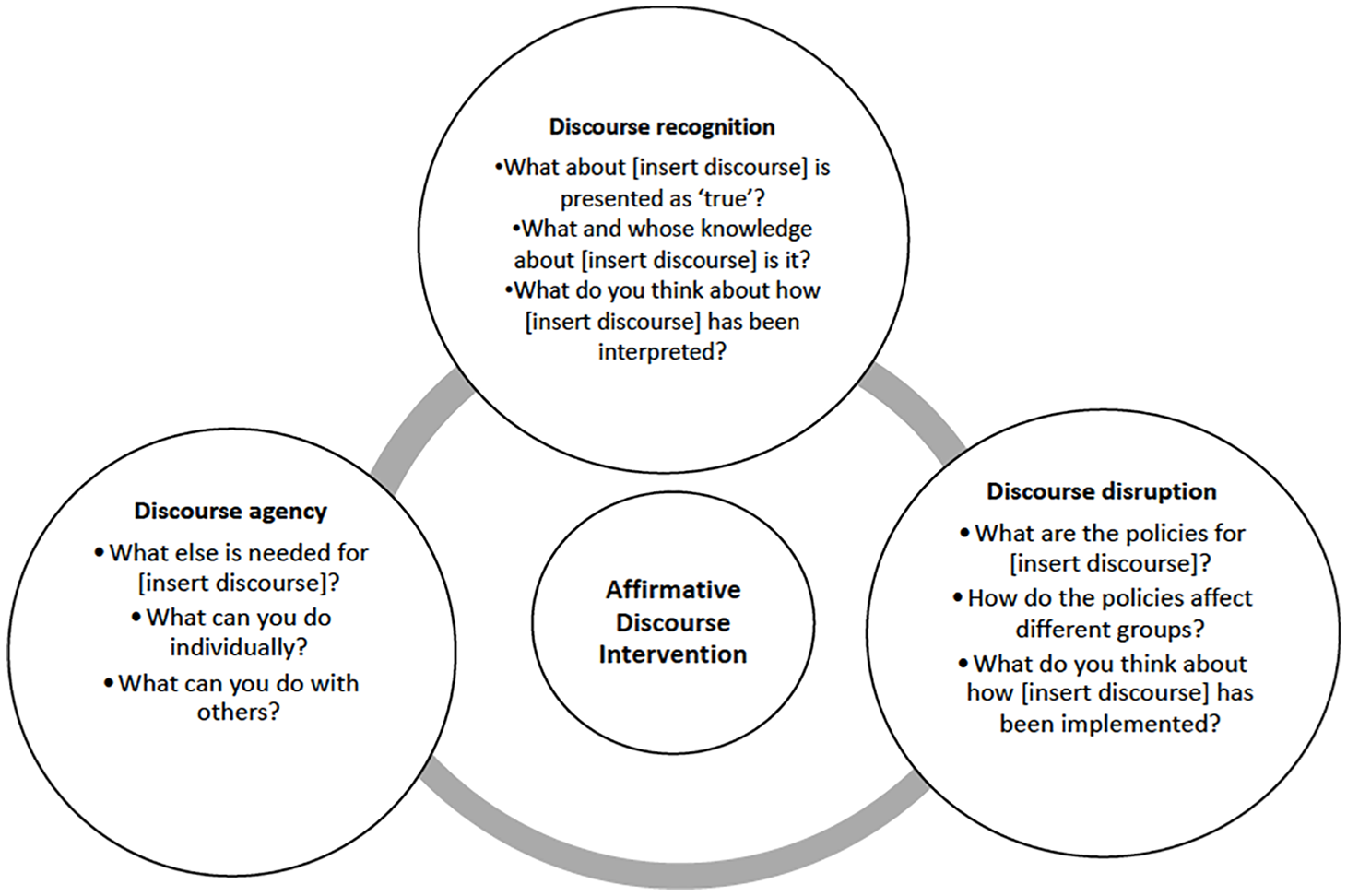
The ADI model.
The model utilises guiding questions written in everyday language as a way to help unpack rhetoric and provide concise, accessible points of reference into deeper thinking, understanding and critical action. It is an exercise in codifying theory so as to focus thinking and critical reflection on particular dimensions of policy discourse and how these act as a function of governmentality. We developed the guiding questions by distilling the dominant theoretical ideas and concerns of each process of the ADI model into its key foci, and while the processes and questions are interconnected, we see separating the inquiry as a way to create points of entry, as well as support the translation into action. The guiding questions are not intended to oversimplify critique or limit thought, but rather to provide key theoretical markers around which new thought and agentic action can be anchored. As the ADI processes are not linear, neither are the guiding questions, which should be considered active, changing and evolving as the research progresses.
At the topmost point of Figure 1 is discourse recognition, a process that involves an investigation of government’s (or governments’) knowledge production and promotion activities at a specific time point. To ‘recognise’ discourse is to uncover (to see and to recognise) how and why that particular policy discourse has come about, and not another – that is, how and why the discourse is interpreted by policy as one set of understandings at a point in time, and not another. The aim is to identify and critique which truths and ideology have been privileged by and through the process and text of policy, and how (the power relations that accompany them). The guiding questions of discourse recognition therefore prompt critical thinking and reflection around what has been presented as ‘true’, by whom and to what end (the implications of these politicised dimensions of discourse). This process may involve a review of policy events and critical readings of key policy texts or statements, which Foucault (2009b: 37) theorises can provide insight into the rules that govern discourse, such as ‘its objectives, the strategies that govern it, and the program of political action it proposes’.
The next process is called ‘discourse disruption’ because it considers how the policy discourse has been operationalised through the resultant policy solutions and assemblages of the policy discourse, or what Zittoun (2014: 73) calls the policy discourse ‘in action’. To disrupt policy discourse is to dismantle the ‘taken-for-grantedness’ of the policy problem and policy solutions by critically reflecting on how those assemblages encourage subjects to think about and act on the policy discourse in ways that meet the policy agenda – the view of policy discourse as a function of governmentality.
Finally, discourse agency is a process of identifying countertruths and accompanying opportunities for truth-telling. Here, the word ‘agency’ is broadly applied in that the agency may be internal or external, as subtle as a shift in the way an individual and/or their colleagues relate to or understand something, or as overt as an advocacy campaign or change in behaviour. Discourse agency is a process of distilling complex ideas into everyday acts of resistance and change.
Applying the ADI model to ‘quality’ reform in Australian early childhood policy
The second half of this article applies the ADI model by drawing on the findings of the lead author’s PhD study, a Foucauldian genealogy of the discourse of quality in Australian early childhood education and care policy (Council of Australian Governments, 2009), because it was from this research that the ADI model emerged. Through the application of ADI processes, the genealogical inquiry was inductively refocused and our thinking was expanded, particularly as we considered discourse agency. Although we present a local context hereafter, the ADI model frames thinking, and so we do not see it as context-dependant. It could be applied to local or global policy contexts, the macro or the micro, as well as finer-grained analysis or broader considerations of movements, and so on. This application is offered as a starting point for further commentary.
Discourse recognition
Discourse recognition is a process of investigating government knowledge production and activities with the view to better understand whose and what truth assumptions and agenda are being promoted as ‘within the true’. Therefore, we commence our inquiry in 1994, when the notion and language of ‘quality’ first emerged in the Australian early childhood policyscape. At the same time as the Commonwealth Labor government announced the shift to a childcare ‘market’, the development of a childcare Quality Improvement and Accreditation System (Brennan, 1998) was signalled. The Quality Improvement and Accreditation System (National Childcare Accreditation Council, 2001) was the first of its kind in the world and, in its first iteration, encompassed the evaluation of 52 Quality Principles by an independent assessor, with a written contribution from staff. Families ‘choosing’ unaccredited services were not eligible for government subsidies. Thus, from the outset, Australian policy interpreted ‘quality’ in early childhood settings as known, salient, measurable and based on universal factors. This is a view of quality that repositions government as a regulator rather than co-contributor or co-provider of quality – a neo-liberalist agenda that validated not only marketisation, but also policies that steered that market by influencing sector and consumer behaviour, such as funding and subsidies (Brennan et al., 2012).
In 2007, a change of Commonwealth government heralded the new era of quality reform in Australian education and early childhood settings. Over time, the neo-liberalist policy agenda had strengthened across the Australian care sectors, including education (Connell, 2013), but the incoming Commonwealth Labor government quality reform agenda promised a shift towards social investment and increased public expenditure (Council of Australian Governments, 2009). Counter to neo-liberal theory, social investment approaches contend that state expenditure in some types of public services can generate economic dividends through the growth of human capital (Moss, 2014).
Prior to the election in January 2007, the Labor Party’s policy reform statement, The Australian economy needs an education revolution, argued that: We need to set for ourselves a new national vision – for Australia to become the most educated country, the most skilled economy and the best trained workforce in the world. The argument advanced in this policy paper is twofold: • First, Australia’s long term prosperity can only be guaranteed by long term productivity growth. • Second, this productivity growth is best underpinned (consistent with the OECD [Organisation for Economic Co-operation and Development] consensus) by a large scale, sustained investment across the human capital spectrum. (Rudd and Smith, 2007: 3)
The above quotation signals human capital theory as underpinning the social investment approach. Championed by economists, academics and powerful international organisations like the OECD since the late 1990s (Adamson and Brennan, 2014; Mahon, 2010: 174), social investment policy approaches that utilise human capital theory do so in order to distinguish between the aspects and outcomes of public services that are deemed investment-worthy and those that are not (Moss, 2014).
At the national, state and territory levels, there is evidence of Australian Labor governments promoting human capital research and agendas in the lead-up to the 2007 federal election. In 2005, the Labor government of the state of Victoria presented a human capital reform initiative to the Council of Australian Governments, with representatives from all the Australian governments (Department of Premier and Cabinet, 2005), which was ratified in 2006 (Council of Australian Governments, 2006). In February 2006, Nobel Laureate James Heckman was invited to be the keynote speaker at the National Institute for the Early Years annual conference in New South Wales, also a Labor Party state. Heckman’s economic research draws on preschool data from the USA to show the high returns from investment in high-quality (early intervention) early years programs, compared to the middle or adult years of education (Heckman, 2000; Heckman et al., 2010). In addition to the keynote address, Bown’s (2014: 58) interviews with Australian policy actors indicated that Heckman also met with ‘Australian Government officials’ (who are not specified) and was highly influential. On 3 March 2006, the Victorian Labor government’s Office for Children, in partnership with the Royal Children’s Hospital, hosted a day-long conference event called ‘Putting children first: Their future, our future’. The conference was attended by more than 1000 early childhood professionals and government staff from Victoria and other states (Victorian Curriculum Assessment Authority, 2006). Professor John Shonkoff (with Phillips, 2000) presented research that drew on neuroscience to emphasise the role of early experiences in brain development and later life. Shonkoff was also invited to meet with the Victorian government, and policy actors identified his research as highly influential (Bown, 2014; Hunkin, 2016). Last, in October 2006, the South Australian Labor government appointed Dr Frasier Mustard as the ‘Adelaide thinker in residence’ (see Bown, 2014). Mustard’s early childhood research linked brain malleability to the notion of early childhood as a sensitive period of development (McCain and Mustard, 1999) and hence, an optimal time for investment in human capital (Shonkoff and Phillips, 2000).
The knowledge-promotion activities undertaken by the Australian Labor governments contributed to a clear message that human capital investment in early childhood services was economically worthwhile when made strategically (for human capital growth), whereby the policy discourse of quality expressed that human capital growth strategy (Hunkin, 2018). For example, prior to the election, the Commonwealth Labor government’s policy manifesto, New directions for early childhood education, argued that: When brain research is combined with economic analysis of the benefits of early childhood education, the case for greater investment in childhood learning becomes overwhelming . . . Heckman particularly emphasises the exponential impact of quality learning, that early learning in life means later educational experiences have greater impact: ‘Childhood is a multistage process where early investments feed into later investments’. (Rudd and Macklin, 2007: 4; original emphasis)
This quotation highlights the assumption – but not the qualification – of quality as a lever for human capital growth returns on investment. By not qualifying key notions implicit to ‘the exponential impact of quality learning’ (What constitutes quality? Or impact? Or early learning?), the reform policy discourse of quality continued existing policy assumptions of quality as universal, measurable, observable and salient. Similar to the Quality Improvement and Accreditation System policy initiative (National Childcare Accreditation Council, 2001), the reform discourse assumed that quality was measurable, along with being economically quantifiable. For example, New directions for early childhood education drew on cost/benefit analysis research from the USA, as follows: Cost/benefit analysis of high quality early learning is also highly supportive of investment in young children, particularly in disadvantaged communities . . . the Perry Preschool Project returned $7.16 in public benefits and $8.74 in total benefits for every dollar invested. The Abecedarian Project returned $2.69 in public benefits and $3.78 in total benefits. And the Chicago Child-Parent Centres produced $6.87 in public benefits and $10.15 in total benefit for each dollar invested. While these were high quality early intervention programs, they also demonstrate the strong economic benefits of early learning. (Rudd and Macklin, 2007: 6)
This shows how the reform discourse of quality provided a site, language and unit of measurement through which social investment could be executed (see Hunkin, 2018). However, this was a fundamental continuation of the neo-liberal agenda insofar as all policy questions and answers were understood as economic, regardless of the social investment approach (Mahon, 2010).
Researchers have noted that the conceptualisation of ‘quality’ in early education settings as a measurable, universal and observable entity is globally oriented, originating in positivist psychology and economics research literature, then filtering into neo-liberal and social investment intersections of policy rhetoric (Dahlberg et al., 2013; Moss, 2014; Penn, 2011). This raises questions about how useful the policy discourse of quality is from the perspective of the early childhood profession and its stakeholders, whose understandings and expressions of quality are typically complex, contextual, personal and changeable across place and time (Dahlberg et al., 2013; Moss, 2014).
Reflecting on governments’ knowledge production, policies and initiatives, the guiding questions listed in Table 1 are a way to draw the critique together as part of discourse recognition.
Discourse recognition: early childhood quality reform.
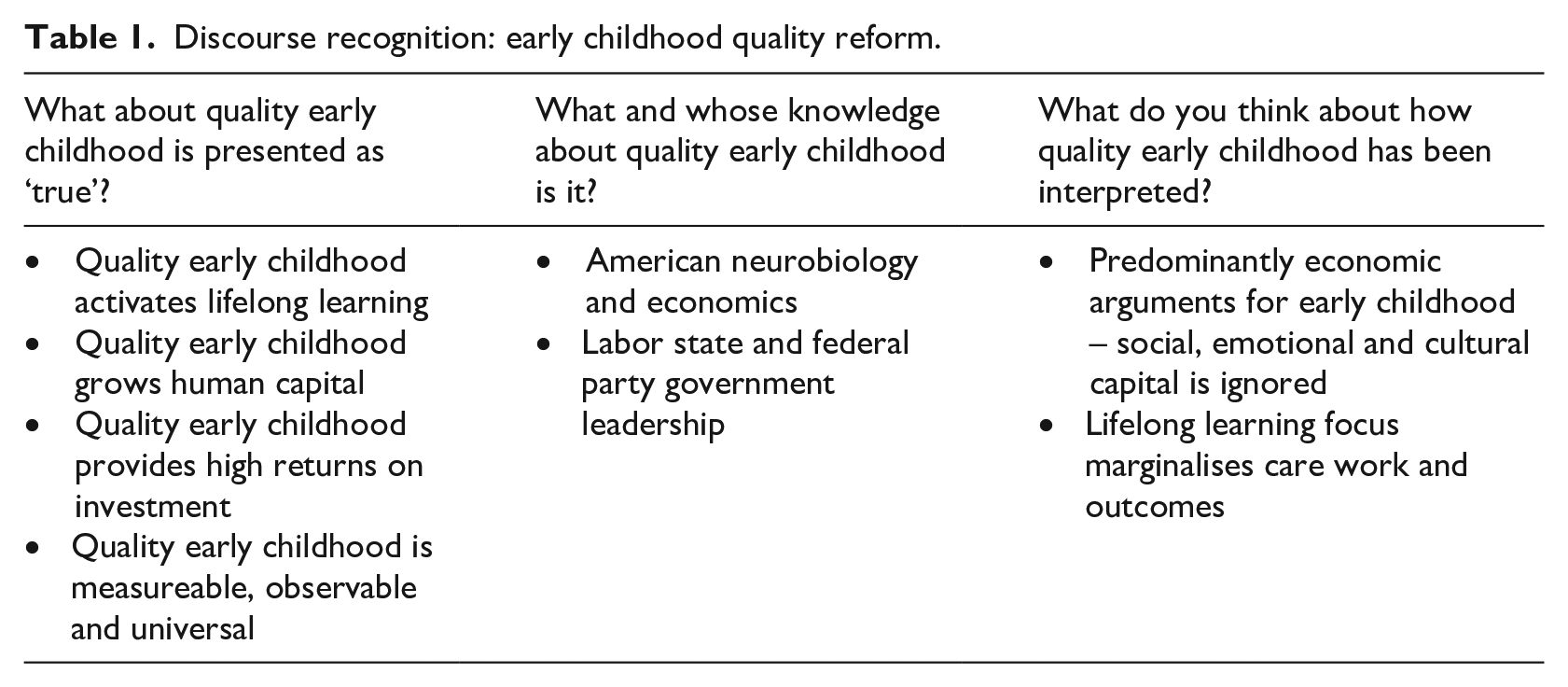
Table 1 presents an example of our responses to the guiding questions at a point in time, noting that the ADI processes are not linear and so these responses would likely shift and change.
Discourse disruption
Discourse disruption processes take a view of policy discourse in action (Zittoun, 2014) by identifying and critiquing the resultant policy assemblages. In Australia, the incoming Commonwealth Labor Party sought to coordinate early childhood quality reform across all states and territories by establishing National Partnership Agreements, with the first being the National Partnership Agreement on Early Childhood Education in 2009 (Council of Australian Governments, 2008, 2009). The National Partnership Agreements outlined a shared commitment to develop a National Quality Framework (NQF) suite of policies and combined financial injection of AU$970 million (Council of Australian Governments, 2009).
The NQF (Australian Children’s Education and Care Quality Authority, 2012) policy assemblages included the production of Australia’s first national Education and Care Services National Regulations (previously state and territory). 1 To guide quality educational planning, a national Early Years Learning Framework (Department of Education, 2009) was developed. The Quality Improvement and Accreditation System (National Childcare Accreditation Council, 2001) was revised and redeveloped into the National Quality Standard (Australian Children’s Education and Care Quality Authority, 2011). Active from 2010 (with first visits commencing in 2012), the National Quality Standard comprises seven quality areas against which services are externally assessed and awarded a national quality rating (Australian Children’s Education and Care Quality Authority, 2020; Council of Australian Governments, 2009). In addition to a quality rating for each quality area, services also receive an overall quality rating based on a five-point quality rating scale. This quality rating is published in a national registry via the mychild.gov.au website, and it is a requirement that this information is displayed at the service. A new national governing body was established – the Australian Children’s Education and Care Quality Authority – which is an independent national quality authority charged with improving outcomes in children’s education and care.
The policies discussed are not exhaustive but together reflect how the increase in investment in quality in early childhood went hand in hand with an agenda to manage the human capital investment by managing subjectivities. Policies of standardisation (nationalised regulations, nationalised curriculums) and accountability (accreditation) control the inputs and outputs of early childhood services – what happens before, during and after the children arrive – in order to shape experiences in that context, and therefore the behaviours, values and relations of staff, children and their families. For staff, the new accountability pressures occur at the same time as the standardised evaluations, outcomes and/or quality indicators reduce the value of immeasurable but crucial aspects of quality early childhood settings, such as child happiness and opportunities, and other care-related duties (Penn, 2011). Moreover, in the current context, families have limited opportunities to voice their opinions about what they deem quality in early childhood education encompasses, positioned instead as the ‘uniformed consumers of childcare’ (Fenech, 2012: 327). Children are acted on by the policies that seek to shape their daily experiences towards economic ends (Hunkin, 2016).
Last, the reform era also shifted Australian early childhood and the other education sectors into a nationalised policy field, which, as Lingard (2010) points out, was a way to resituate local policy within the global. The NQF policy assemblages sat alongside other western, and particularly anglophone, countries that increasingly responded to advice from the international ‘sub-industry’ (Penn, 2011) of quality by adopting similar policy packages and models for quality reform. One key example is Starting Strong III – A Quality Toolbox for Early Childhood Education and Care (Organisation for Economic Co-operation and Development, 2012).
Expanding global interests and networks around the quality policy discourse served to strengthen it over time (Ball, 2012). In fact, although more than a decade has passed, no substantive changes have been made to the NQF policies by incoming governments. A recent review of the NQF (Productivity Commission, 2014) considered the cost-to-benefit profiles of aspects of the NQF policies but did not seek to review its dominant policy pathways and wisdoms – that is, the relationship between childcare markets and quality. This raises questions about the extent to which the NQF social investment era represented policy reform, since the social expenditure was executed by expanding and existing neo-liberal policy pathways.
Bringing these complex ideas together through the guiding questions allows for coherence and clarity, as outlined in Table 2.
Discourse disruption: early childhood quality reform.
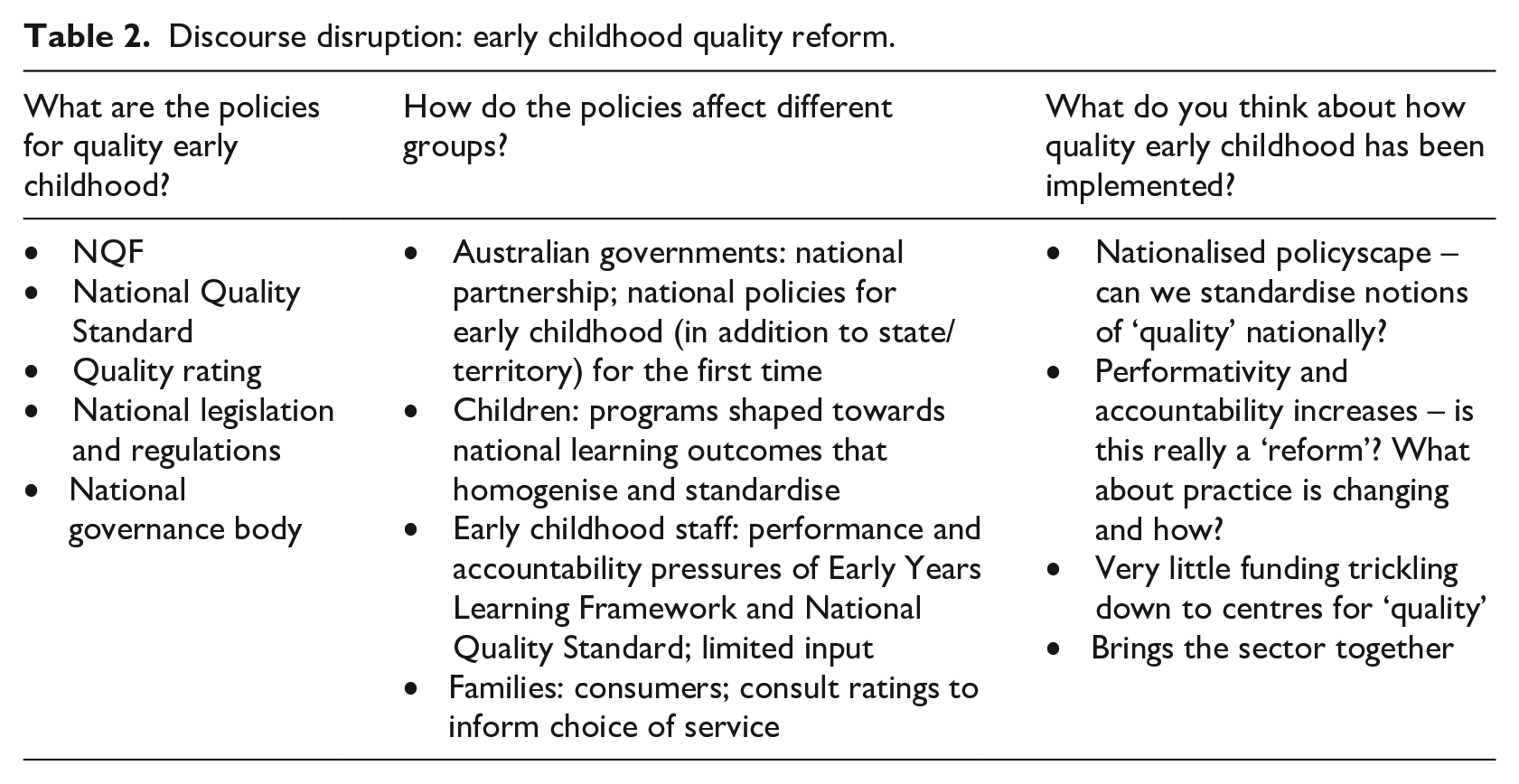
Table 2 shows how our responses at a point in time provide an opportunity to reflect and review in a balanced way, which also begins to identify patterns and tensions.
Discourse agency
As Dahlberg et al. (2013) remind us, discourse is neither good nor bad, but neither is it neutral, particularly when it is deployed through policy as part of neo-liberal policy regimes that are ‘working hard to change education so that it meets their own needs’ (Apple, 2018: 4). Discourse agency processes engage the education stakeholder in truth-telling – speaking to discourse – which is a type of activism, as Apple describes it, since
the role of educator activism is crucial to progressing telling the truth about what is happening in education and the larger society; showing spaces of possibility where critically democratic policies and practices might flourish; and acting as critical secretaries of the actual realities of these possibilities as people build these more progressive policies and practices in the real world. (Apple, 2018: 4)
Discourse agency builds on Apple’s (2018) notion of activism by framing the work of truth-telling at the discursive level. Within a democracy – be it thick or thin – an individual can and might invoke the courage to speak the ‘true discourse’ of their own experience and still fail to be heard due to ‘a contextual powerlessness’ (Foucault, 2011b: 40). The truth-telling does not lack power because it is untrue – for what would it mean to be true or untrue? Rather, the ‘true discourse is powerless due to the institutional framework in which it emerges and tries to assert its truth’ (Foucault, 2011b: 40). Democratic institutions can struggle to accommodate truth-telling because to do so requires myriad differentiations, some of which may be counter to the interests of the powerful, and democratic governance hinges on the representation of a majority (Foucault, 2011b). Hence, truth-telling is more likely to change or to convince when it is accompanied by relationship-building with the powerful and works to shift their ideas about governing. As Foucault (2011c: 64) puts it, truth-telling ‘is possible and necessary . . . [through] the bond, the point of connection between truth- telling and governing well’. This frames discourse agency as a process of working to speak back to discourse by invoking its rules and then stretching those rules in tandem with relationship-building. This is a return to Foucault’s (1988: 154) notion that a voice of dissent can still locate itself alongside governments.
In the context of Australian early childhood quality reform, the nationalising of the policy field provides a context around which early childhood stakeholders, such as academics and professionals, can come together to engage in activism, with the view to expand and/or trouble notions of quality. Existing research highlights how this has already happened, detailing impressive national leadership, collaboration and consultation between and within early childhood groups and policy agents (government and non-government) during moments of NQF policymaking (Bown, 2014; Sumsion et al., 2009). We note also that the NQF (Australian Children’s Education and Care Quality Authority, 2012) can be considered to have created opportunities for advocacy and change in that it has established quality discourse at the forefront of national policy and, in doing so, has consigned responsibility for quality in early childhood to all early childhood stakeholders.
Truth-telling about quality in early childhood needs to focus on invoking but rebalancing the privileging of human capital outcomes in quality reform discourse by finding new, diverse ways of representing notions of quality as cost and benefit in early childhood settings. Dahlberg et al. (2013) describe this work of constructing subjective understandings of quality as ‘meaning making’ and provide the example of participatory documentation that is prepared collaboratively with early childhood educators, families and children to create robust profiles of quality teaching and learning. For us, there is scope to further this type of action in ways that involve researchers and expanded networks of early childhood professionals and advocates, so that the truth-telling finds pathways through to those in power. Currently, the NQF supports ‘meaning making’ in that the pedagogical practices required by the National Quality Standard (Australian Children’s Education and Care Quality Authority, 2011) and Early Years Learning Framework (Department of Education, 2009) are contextualised, participatory (educator, child and family) documentation and planning practices. Considering this, discourse agency can focus on generating ongoing robust conversations about quality in early childhood settings that sit within existing policy frames but, in doing so, also stretch beyond them.
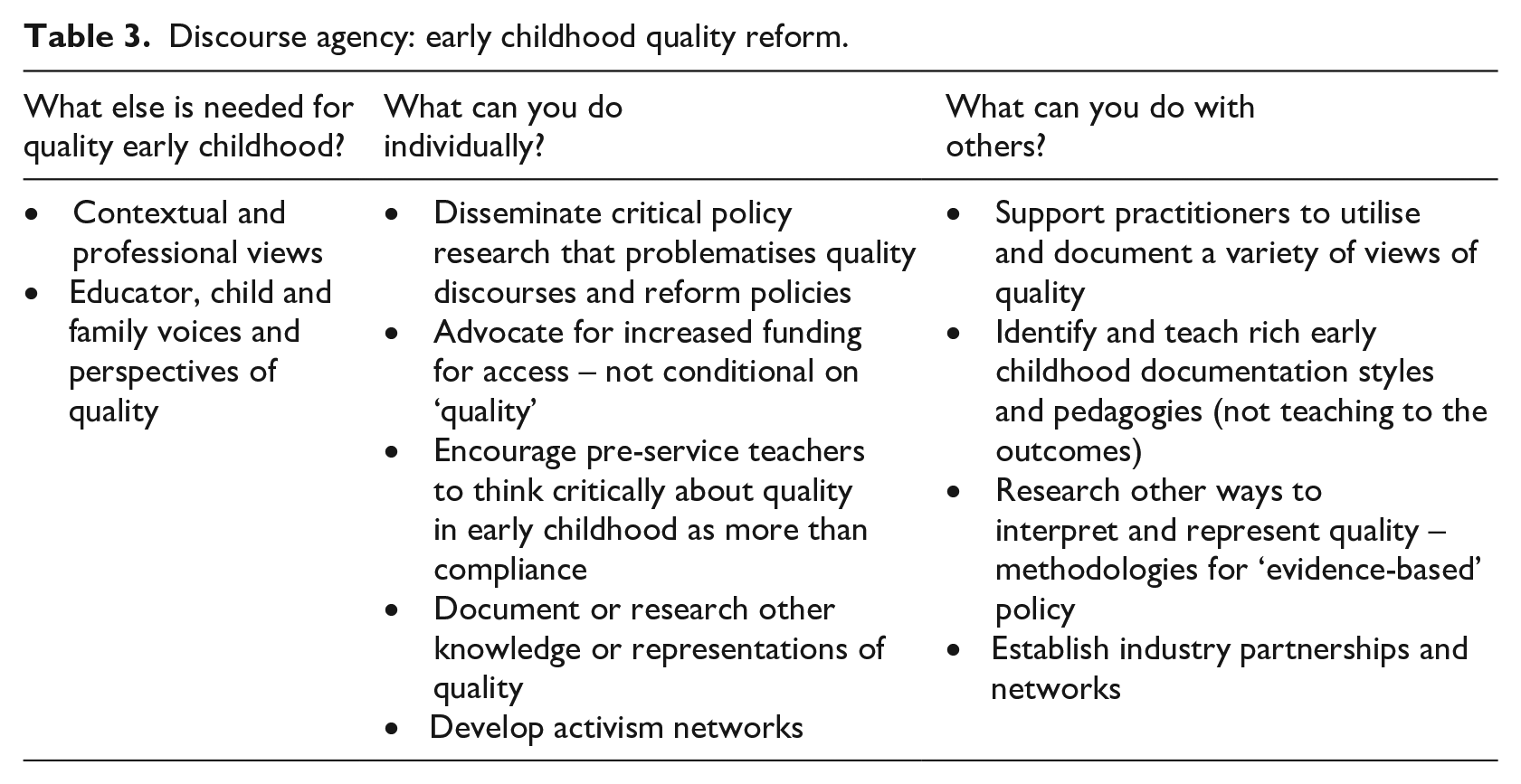
At a point in time, we summarise our reflections as per the guiding questions, as shown in Table 3.
Discourse agency: early childhood quality reform.
Moving forward: discourse agency and re-imagining early childhood education
During the preparation of this article, we realised that we had set ourselves quite an ambitious task, which was to develop a fit-for-purpose model that allows us to critique, unsettle and intervene in education policy discourse, in order to disrupt the stranglehold of neo-liberalism. That said, Connell maintains: Education needs invention, and there are certainly enough lively minds in the teaching workforce to be confident that invention will come. Education needs coalitions of social groups able to create the spaces in which educational invention will work. Those requirements are clear enough. How they can be turned into practice, we still have to discover. (Connell, 2013: 111)
The ADI model that we have presented in this article is our attempt at framing how analysis can be ‘turned into [the] practice’ of affirmative truth-telling (Foucault, 2011a). We see this discussion as part of a wider project where the re-democratisation of education policy discourse takes place, and welcome commentary on this issue.
Supplemental Material
CIE_19_0102__Table_of_amendments – Supplemental material for Affirmative discourse intervention: A framework for re-democratising engagement with education policy discourse
Supplemental material, CIE_19_0102__Table_of_amendments for Affirmative discourse intervention: A framework for re-democratising engagement with education policy discourse by Elise Hunkin, Anna Kilderry and Andrea Nolan in Contemporary Issues in Early Childhood
Footnotes
Acknowledgements
Ethics approval was granted for the PhD study, entitled HAE-14-033, by the Human Ethics Advisory Group of Deakin University’s Faculty of Arts and Education on 1 July 2014.
Funding
The authors received no financial support for the research, authorship and/or publication of this article.

Notes
Author biographies
References
Supplementary Material
Please find the following supplemental material available below.
For Open Access articles published under a Creative Commons License, all supplemental material carries the same license as the article it is associated with.
For non-Open Access articles published, all supplemental material carries a non-exclusive license, and permission requests for re-use of supplemental material or any part of supplemental material shall be sent directly to the copyright owner as specified in the copyright notice associated with the article.
