



Abstract
Human developmental goals are both flexible and highly individualized, yet long-term cooperation requires behavioral predictability. This raises the question of whether goals that prioritize personal autonomy and independence (“ego-goals”) might hinder or even contribute to cooperative behavior. Building on the assumption that predictability of action, rather than social content of goals, is a key prerequisite for successful cooperation, this study examined whether ego-goals predict cooperative behavior in novel social environments. In a two-wave longitudinal design (Nt1 = 155, Nt2 = 48), participants transitioning from school to university reported their developmental goals and self-perceived behavioral reliability as well as their cooperative activities. Cooperation was measured via self-report and external assessments by close others at both time points. Regression analyses revealed that ego-goals at t1 significantly predicted cooperative activity at t2, even when controlling for prior cooperation. Including behavioral reliability as a mediator reduced but did not annihilate this effect, supporting the hypothesis that goal-driven predictability facilitates cooperation regardless of goal content. These findings challenge the assumption that only prosocial goals foster cooperation, suggesting that the signaling function of consistent behavior, even when rooted in non-cooperative goals, can promote cooperation in new social settings. From an evolutionary perspective, these findings align with theoretical accounts highlighting behavioral consistency's role as a basis for social bonding and cooperation. Stable goals, regardless of their social direction, may serve as reliable predictors of future behavior, reducing uncertainty and facilitating partner selection, thereby supporting the evolutionarily adaptive function of cooperation, even amid variation in goal content.
A trait will only escape selection if it is sufficiently functional or, at any rate, does not too severely restrict other functional traits. At first glance, it would seem that the regulation of human behavior by goals is functional because it allows behavior to be regulated in a flexible manner. Goals are open to variations in detailed control and flexible adaptation to situational requirements, which reflexes and other automatic responses often do not allow (Austin & Vancouver, 1996). Goals can be postponed or deferred, changed or adjusted, or even abandoned altogether, if paths are blocked or alternatives are more useful or attractive (Brandtstädter & Rothermund, 2002; Heckhausen et al., 2026): goals, and hence goal-directed behavior, are adaptive. The resulting behavioral flexibility is an essential component of the individual adaptivity of humans throughout their lifespan (Moran, 2008): it reduces their dependence on specific niches, while at the same time increasing their opportunities and scope for utilizing resources, both social and other.
On closer consideration, however, highly flexible control of individual behavior may also have potentially dysfunctional aspects. We do not live and act alone: humans are a social species (Buss, 2016, 2019; Deacon, 1998; Dunbar, 1998; Ellis & Bjorklund, 2005; Tomasello, 2009, 2014). Social cooperation has always been essential for human survival (Nowak, 2011; Richerson et al., 2021; Sober & Wilson, 1998), in forager groups, for ensuring the protection of the group, or for caring for offspring (Allen-Arave et al., 2008; Cashdan, 2013; Tomasello, 2009; Tomasik et al., 2017; Weissner, 1982). We, as many other species (famously: Wilson, 1975), are prepared for, and inclined toward, sociality (Baumeister, 2005). In fact, we have always depended on mutual support and cooperation (Lewis, 1974); we live and prosper by, and hence for, cooperation (Cosmides & Tooby, 2016; Forgas et al., 2014; Sober & Wilson, 1998; Tomasello, 2009). Certainly, flexibility in goal adjustment can also be useful for cooperation with others: one's own goals can also be adapted to the goals and strategies of others (or to their changed behavior). Actually, cooperation entails coordination of common decisions (Tindale & Kameda, 2017) and planned interaction under this perspective (Dollhausen & Mickler, 2012).
But if our goals and actions are flexibly adjustable and changeable, this individual adaptability of goals and actions makes our actions less predictable for others: the more flexible an individual's behavior is regulated, the less potential partners can predict with sufficient certainty whether their counterpart will still be pursuing a certain path tomorrow, or how he or she will respond to obstacles or changed opportunity structures. Reliability and predictability, however, are important prerequisites for cooperation, that is, alignment of interests (Milner, 1992; Spieß, 2021). Whereby the attainment of one's objectives is contingent upon the fulfillment of the collaboration partner's goals (Johnson & Johnson, 2005), the predictability of every participant's behavior and the reliability of the goals of everyone involved become necessary. Both conformity within cooperative groups and “shared intentionality” (Tomasello, 2009) as a particular condition for advanced forms of cooperation entail the reliability and predictability of each partner's goals and, thus, behavior. This creates a functional tension: the very flexibility that enhances individual adaptivity may undermine the predictability required for reliable cooperation.
Even more difficult for cooperation to succeed might be the fact that people are able to choose their goals independently, which opens up the possibility of deciding against cooperation, either before or even during an ongoing cooperation. We all pursue sometimes goals that potentially conflict with the interests of others and might run against cooperation. Personal independence, the ability to resist social influences, or the desire to achieve important goals alone and without help are examples of this. Such goals are certainly no exceptions: in particular, in individualistic cultures, they often are a defining aspect of identity (in particular, during adolescence; McLean & Syed, 2015). Sometimes, goals are even directly opposed to the interests of others (e.g., the intention to make a good deal, or a plan for intrigue or deception; Nowak, 2011). This raises a fundamental question: if cooperation depends on reliable alignment, why has a species relying so heavily on cooperation evolved a system of individually chosen and flexibly adjustable goals, including the option of selecting goals that may conflict with others’ or collective interests? The coexistence of high goal flexibility and stable cooperation constitutes an apparent selective tension that calls for explanation.
The starting point for the following argument is the assumption that, regardless of their content, goals, especially long-term goals, generate behavioral patterns that are relatively stable across situational fluctuations, which are difficult to fake and thus allow for a sufficiently reliable prediction of the long-term behavior of other people. In many respects, our cognitive capabilities are shaped precisely in order to aptly perceive and evaluate social actions (i.e., goal-directed behavior) of others (including attempts to cheat us; for an overview, Cosmides & Tooby, 2016). Actually, long-term goals, in particular, developmental goals (Freund & Baltes, 2005; Havighurst, 1948; Heckhausen, 1999), enable predictability precisely because they guide actions in a flexible, situationally adapted, but directionally predictable manner (Brandtstädter, 2006; Brandstädter & Lerner, 1999). Reliable predictability, in turn, should be particularly advantageous for cooperation in contexts where all potentially involved individuals can or must adapt their goals flexibly to the circumstances. For cooperation, it is not the precise anticipation of specific micro-actions that matters, but the expectation of consistent long-term orientation and behavior. In dynamic environments, such stability reduces uncertainty for interaction partners and provides a basis for coordinated action.
As a consequence, the acknowledgement that a possible partner's behavior is goal-oriented and, in particular, the understanding of the directing goal might support the decision to cooperate with this particular partner. Even egocentric goals that focus predominantly or even exclusively on the other person's own interests (goals) allow others to reliably predict his or her behavior if these goals guide her or his behavior in the long term. For instance, I may even support my partner's egocentric goal and thus confirm our cooperation, for instance, by offering information that can help my partner and does not entail (unbearable) costs on my side (Tomasello, 2009). In addition, all goals, including egocentric goals, could promote cooperation by allowing potential cooperation partners to discover similarities (to their own goals), which could increase their willingness to cooperate. Individuals who share and reveal their goals tend to be perceived as more socially reliable (Freund & Riediger, 2006).
The present study claims that, with respect to enabling cooperation, the advantages of behavioral predictability outweigh the potential obstacles associated with flexibility, particularly the non-social (ego-centered) direction of goals. If predictability reduces the risks of uncertainty for cooperation, then the stabilizing function of long-term goals should facilitate cooperative behavior regardless of their social direction. In this case, even ego-centered goals would not undermine cooperation but may indirectly support it through their signaling function. This could help to understand why behavioral control through individual and flexible goals is typical for the highly social species of homo sapiens. The present study aims to test this using the example of ego-centered personal development goals.
Empirical Study
The present study is designed to examine the extent to which social cooperation in a new environment, in which the willingness of a target person to cooperate is not already known for the potential cooperation partners, on the basis of previous experiences of cooperation, can be predicted by developmental goals of the target person. In particular, we claim that even goals that are explicitly not aimed at or even potentially directed against cooperation with others (“ego-goals”) could predict cooperation equally well as cooperation-oriented goals (“alter-goals”).
Method
The study follows a longitudinal design that focuses on a developmental transition (from school [t1] to university [t2]), in which a change of residence ensures that potential cooperation partners (t2) have no substantial prior knowledge and long-term personal experiences regarding the cooperative behavior of the target person. In particular, we examine whether ego-goals (at t1) predict cooperation with new partners (at t2) independent from and beyond socially cooperative goals (alter-goals).
The target persons’ developmental goals as well as their cooperative behavior were recorded via self-report. In order to estimate the validity of this information, a supplementary external rating was collected at each of the two measurement points, particularly with regard to the cooperative behavior of the target persons. At the first measurement point (t1), the target person was asked to nominate a person they trusted (friend, sibling, etc.) in order to obtain a sufficiently valid (albeit selective) external assessment of the target person's cooperation behavior. At t2, the target person was asked to nominate a person among their present (i.e., new) social contacts; the assumption here was that people would potentially be nominated who are new cooperation partners, to examine the actual cooperation behavior beyond the target person's self-assessment.
Material
Individual goals. In order to cover the widest possible range of individual development goals and to include a broad selection of both “ego-goals” and “alter-goals,” we asked about goals concerning a variety of life aspects derived from Klusmann et al. (2005). The aim was not to predefine or identify content-based groupings (“sub-scales”; e.g., work, leisure, or family), but merely to group these goals (a priori) according to whether they could be categorized as explicitly cooperative (alter-goals), non-cooperative (ego-goals), or socially undirected (i.e., neither cooperation-focused nor aiming at independence, etc.). Forty goals were given, including personal growth, family, relationships, society, health, wealth, attractiveness, hedonism, and professional performance. Ten goals were identified as “ego-goals” (non-cooperative; sample item: “I want to be independent of other people”), nine as “alter-goals” (cooperative; sample item: “I want to make lots of friends”), and the remaining 21 goals as “socially undirected” (not explicitly cooperation-focused; sample item: “I want to enjoy my life to the full”). All items are shown in Table1. Participants could choose whether the goal is an individual goal for themselves or not, and how important the goal is on a seven-point scale from “not important at all” to “extremely important” The following is a list of different things that people consider to be more or less important in their own lives. What is it like for you? There is no right or wrong answer; we are interested in your personal opinion. Please tick first whether the following statements apply to you or not…
Included Developmental Goals.

Note. (A) = alter-goal, (E) = ego-goal, (R) = socially undirected goal.
and if they have an idea about how to achieve this goal on a seven-point scale from “I have no idea at all” to “I have a precise idea.”
Eight of the 40 goals exhibited minimal variance in our sample (e.g., “I want to keep myself healthy and in good shape,” M = .99, standard deviation = .115), as nearly all respondents shared these goals (Table 2). These goals were excluded from the analyses, resulting in the final calculation with seven ego-goals, eight alter-goals, and 17 socially undirected goals (Table 1). We calculated the number of goals in the specific categories (alter-, ego-, and all socially undirected goals) as predictors.
Excluded Developmental Goals.
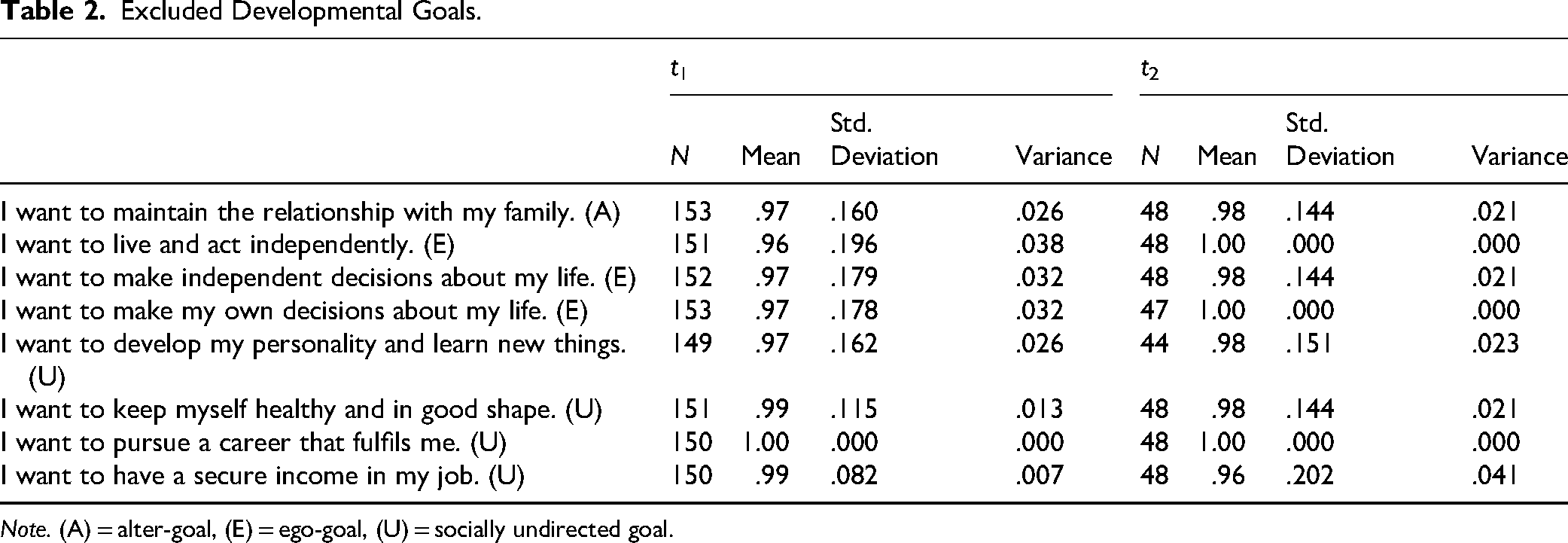
Note. (A) = alter-goal, (E) = ego-goal, (U) = socially undirected goal.
Reliability of behavior. The subjectively (target person) estimated reliability of one's own behavior as a potential influencing factor of the assumed effect was assessed using a seven-point rating scale. (“In cooperations, people value my reliability.”)
Cooperation. Seven-point scales assessed cooperative behavior (of the target person) concerning a broad range of domains (including family, voluntary work, the workplace, friendships, etc.). 1 Participants were asked to indicate the frequency of specific forms of cooperation over the previous six months on a five-point scale from “never” to “always” (e.g., “I met up with my friends”).
Subjects
The survey was conducted online via social media using a snowball sampling method. The aim was to obtain a sample of young people (adolescents and emerging adults), because in this group, egocentric goals (autonomy, independence, etc.) were expected to be particularly prominent, and possibly even dominant over cooperative intentions (McLean & Syed, 2015). Participants were encouraged to invite a close other to complete an observer rating. Participation was incentivized through a donation-based reward system, with up to €15 donated to a charitable organization depending on full participation across both time points. A total of n = 155 students participated in the survey at t1, and n = 48 (31%) of them participated at t2. The drop-out rate is likely due to the significantly reduced commitment to previous contacts (including the survey) associated with the change of location and social network. The participation rate for the external assessments (nominees) was N = 60 (38.7%) at t1 and N = 43 (89.6%) at t2.
Results
Conditions and Constraints
Given the relatively modest sample size for longitudinal analyses, calculating structural equation models was not feasible. Instead, we conducted cross-sectional and longitudinal regression analyses (using IBM SPSS 29 software).
Since the collinearity diagnosis revealed no multicollinearity (variance inflation factor [VIF] of all predictors <10, tolerance of all predictors >0.1), this condition can be regarded as fulfilled. Homoscedasticity of the residuals was assumed to be given based on the scatter plot (Figure 1). Finally, the assumption of the normal distribution of the residuals was checked both graphically by looking at the histogram and using the Kolmogorov–Smirnov test, D(47) = .09, p = .200. As a result, the normal distribution of the residuals can be regarded as given.

Scatter plot for homoscedasticity.
Missing values. Among the N = 155 participants at t1, 5 (3.23%) exhibited missing values. The proportion of missing values at the variable level was analyzed, revealing that none of the included variables had more than 5% missing values (no missing values were observed at t2). Consequently, the utilization of case-by-case exclusion to address missing values appears appropriate (Lüdtke et al., 2007). In calculating the bivariate correlations, pairwise case exclusion was used to optimize the utilization of the sample size at both survey time points (Leonhart, 2021). Consequently, the number of subjects included in the subsequent analyses varies depending on whether only values from t1 are used (cross-sectional analyses) or from both measurement points (longitudinal analyses).
Selectivity and drop out. Target persons for whom an external assessment was available at t1 did not differ significantly in the variables examined from those without an external evaluation.
To examine the selectivity of the drop-out, T-tests for independent samples were employed. However, it is essential to note that the standard distribution assumption cannot be applied to all data. Nevertheless, the planned analyses were carried out, given that most of the variables are normally distributed and the selected methods are relatively robust against violating the standard distribution assumption, provided the sample is sufficiently large (cf. Eid et al., 2017). The Durbin–Watson (DW) statistic, carried out in preparation for the multiple regression, indicated independence of the residuals (DW = 2.03). Additionally, no significant patterns were observed in the missing values for age, gender, or the specification of specific values (see Table 3).
Independent Samples Test.

Validity. As already mentioned, the external assessment results are not systematically included in our analyses due to the low response rate for t1 (t1 = 38.7%). 2 However, the convergence of the target persons’ self-assessments with external assessments at t1 indicates a corroboration and, hence, sufficient validity of the self-assessments. In particular, the correlation between the self-assessed external perception of one's own behavioral reliability and the actual external assessment of the respondent's behavioral reliability is significant (rt1 = .37; p = .008; rt2 = .63; p < .001), indicating acceptable validity for the target person's self-assessment of reliability. In particular, a sufficiently valid self-assessment for t2 (which is the dependent variable) is important for the present study.
Cross-Sectional Analyses
On average, approximately 83% of all ego-goals, 77% of the alter-goals, and 71% of the socially undirected goals were selected. The overall importance ranged from an average of 5.25 to 5.99, with no significant differences between the two measurement points (Table 4).
Importance of goals.

Note. *Correlation is significant at the .05 level; **correlation is significant at the .01 level (1-tailed).
Regarding the research question, the synchronous relationships between the goal groups and the cooperative activity at each measurement point were examined (see Table 5 for t1 and Table 6 for t2). As expected, the correlation between the number of alter-goals and the synchronous cooperative activity proved significant (t1: r = .297, p < .001; t2: r = .293, p = .043). More importantly, as predicted, the synchronous correlation for the ego-goals at t2 is significantly positive as well (r = .395, p = .005). The correlation of socially undirected goals with actual cooperation proved non-significant for both measurement points (t1: r = .127, t2: r = .167; both p > .05).
Synchronous Bivariate Correlations t1 (Pearson Correlation).

*Correlation is significant at the .05 level (2-tailed).
**Correlation is significant at the .01 level (2-tailed).
Synchronous Bivariate Correlations t2 (Pearson Correlation).

**Correlation is significant at the .01 level (2-tailed).
*Correlation is significant at the .05 level (2-tailed).
Longitudinal Analyses
The central research question assumes a prediction of cooperative behavior in a new social environment (t2) by “ego-goals” at t1 (Tables 7 and 8). A regression analysis reveals a significant longitudinal prediction of cooperative behavior at t2, controlling for cooperative behavior at t1 (β = .384, p = .006). Additionally, as expected, cooperative activities at t1 point were significant predictors of cooperation at t2 (β = .413, p = .002).
Diachronous Regressions Predicting Cooperation (Frequency) at t2, Excluding Self-Perceived Reliability of Behavior.

Note. VIF = variance inflation factor.
Diachronous Regressions Predicting Cooperation (Frequency) at t2, Including Self-Perceived Reliability of Behavior.

Note. VIF = variance inflation factor.
To explore the assumption that the predictability (reliability) of one's own behavior might be a reason why ego-goals predict cooperative behavior at a later point in time, even for new partners, the (self-perceived) reliability was included in these analyses. If (perceived) predictability of one's behavior contributes to the explanation of (later) cooperation, then the prediction of (t2) cooperation should decrease when behavioral predictability is controlled for. The assumption that including predictability in the regression analysis would reduce, but not annihilate, the predictive value of the ego-goals was confirmed (β = 0.295, p = .029).
Furthermore, the prediction from the socially undirected goals when behavioral reliability was included remained non-significant (β = .049, p = .695). The calculated overall model, including all variables, explained 30% of the variance in the frequency of cooperative activities at the second measurement point (R2corr = .308). Multicollinearity among the individual development goals can be excluded (tolerance = .790; VIF = 1.266). Significant values are also found without the inclusion of cooperation. The significant overall model, without the addition of cooperation at t1, F(46,4) = 4.994, p = .002, still explains 32% of the total variance. Significant predictors are the ego-goals (β = .329; p = .028) and the self-assessed behavioral reliability (β = .341; p = .014).
Exploratory Analyses
In addition, we exploratively investigated the extent to which self-perceived behavioral reliability at t2 was correlated with the goals and whether these could predict behavioral reliability (Tables 9 and 10). The results show that behavioral reliability at t2 is correlated with ego-goals (t1: r = .255, p = .042), but in a multiple regression, only the socially undirected goals predicted behavioral reliability (β = .422, p < .001), in addition to the self-assessed behavioral reliability at t1 (β = .674, p < .001).
Exploratory Correlation Analyses.

Exploratory Multiple Regression Predicting Self-Perceived Reliability at t2.

Note. VIF = variance inflation factor.
Discussion
The present results show that ego-goals—“against their content,” as it were—positively predict the number of cooperative activities (self-assessed) in a different social environment both synchronously and longitudinally. The assumption that the predictability (reliability) of a target person's behavior might be a significant part of the explanation for this pattern is supported by the fact that including behavioral reliability in the regression reduces (but does not eliminate) this prediction.
Given the relatively small sample size and the resulting limitations in statistical power, the longitudinal findings in particular should be interpreted with caution. Although the predictive effects reached statistical significance, they must be regarded as preliminary and ask for replication in larger samples and across extended time spans and other situational constellations. Accordingly, claims regarding predictive relationships are not meant to imply strong causal inferences but rather to indicate patterns that appear consistent with the theoretical assumptions and warrant further empirical examination.
Although the confirmatory value of the mutual partners’ assessments (both at t1 and t2) is limited, the positive correlations support the assumption that these self-assessments are sufficiently valid. In particular, the corroboration of self-assessed behavioral reliability through the mutual partners’ judgment is worth noting because this judgment is available for almost all (89%) t2 participants.
These results fit the hypothesis that even such developmental goals that are self-centered, perhaps even directed against the interests of possible partners, do not hinder or restrict social cooperation. This supports the guiding assumption that the informative value of “ego-goals,” perhaps by shaping potential partners’ expectations, might outweigh the adjustability of individual goals and even an ego-centered direction. This may contribute to the explanation why the individual's capability of selecting goals which might foster conflicts with possible cooperation partners (e.g., independence) actually does not seem to seriously detriment actual cooperation. The advantage of behavioral predictability might reduce the price (risk) of non-standardized behavior for the planning of social cooperation. Certainly, this does not prove any theory of the evolution of individual goal selection and pursuit. However, the present data suggest that individual, even ego-centered goals, do not necessarily entail the price of “bowling alone.”
As expected, alter-goals predict social cooperation at a later point in time and in new contexts as well, supporting the validity of the assessment format (any other result would have indeed raised serious suspicion against the validity of the participants’ responses). Somewhat surprisingly, socially undirected (“neutral”) goals did not predict cooperative behavior. The general argument that the mere predictability of individual behavior resulting from their goals would apply to such goals as well. This result, if it were to prove replicable, should be further investigated, perhaps in a more fine-grained categorization of this large group of “socially undirected” goals (e.g., differentiating with respect to behavioral specificity).
Limitations
Several limitations of the present results have to be kept in mind. First, the small sample size limits the generalizability of the results. It is worth noting that the predicted pattern of results was significant despite the low test power. Unfortunately, testing the various correlations in a generally comprehensive model (e.g., using a structural equation model) was impossible. Certainly, replicational studies utilizing larger samples and spanning longer periods are necessary.
Second, it is essential to emphasize that the participants were relatively young (from 19 to 21 years of age). Actually, the aim of the study was precisely to obtain a sample of young adults, because in this group, ego-centered goals (independence, autonomy, and shaping one's own identity) were expected to be common and socially accepted. At least in “individualistic” cultures, the shaping of one's own identity is an essential developmental task during adolescence. According to Arnett (2014), the developmental stage of emerging adulthood can be characterized by identity exploration, instability, self-centeredness, a sense of being in transition, and a variety of options. On the other hand, however, it is pertinent to consider the extent to which developmental goals, and hence behavioral reliability, have already become firmly established in young adulthood. This again underscores the necessity of replication studies at later developmental stages.
Although a goal is assigned importance, it remains to be seen to what extent the respondents perceive these goals as a meaningful part of themselves and pursue them with dedication. Incorporating this perceived centrality for the self in future research may provide further insight into this phenomenon (in particular, regarding a sample encompassing a larger age span). The survey of external perceptions may offer an initial proxy, but again, the sample size needs to be increased to derive firm conclusions. One potential method for circumventing this confounding variable in future studies could be to consider selecting older samples and different context shifts, for instance, the transition from the end of university education to employment. In addition, a higher average age among respondents may correspond with more established life goals and perhaps even more stable and hence predictable behavioral patterns.
One possible objection relates to the question of whether the prediction reported here might also be caused by another aspect of the target person's goals (mentioned above): the potential similarity of goals between the cooperation partners. Within an academic and young population, it is not unlikely that cooperation partners of the same age also value and pursue ego-goals highly, and that this similarity favors cooperation. On the one hand, this perceived similarity might be precisely a reason for cooperation with (potentially) selfish partners. On the other hand, in this case, not the predictability (alone), but the similarity would explain cooperation. Note, however, that not all goals predicted cooperation; in particular, “neutral” goals unexpectedly failed to do so, although the basic probability of goal similarity between cooperation partners seems to be equal. Since only self-reported cooperation behavior could be recorded here, this could only be investigated by a study in which (a) actual cooperation behavior (with several partners) would be examined and (b) the similarity of goals (especially about ego-goals) between mutual partners would be controlled.
In addition, some methodological limitations of the present study deserve to be mentioned. First, the central variables of the study are based on self-assessments of the target persons. Although the positive correlations with the assessments of the (self-nominated) partners indicate that these assessments might be sufficiently reliable, it cannot be ruled out that the relationships found between these self-assessments can be partially attributed to shared method variance. As a consequence, further studies should add independent behavioral measures. The question of whether social desirability could explain some of the correlations found is not easily answered. As mentioned above, one reason to recruit participants in the adolescence and “emergent adulthood” age groups was the assumption that talking about one's own ego-goals would be more acceptable in this developmental stage. Furthermore, if there was a tendency (e.g., at t1, in the “familiar” social environment) to adjust statements according to social desirability (i.e., to mix them with other motives, thereby making these statements less reliable [“noisy”]), this should rather impede the prediction (i.e., have a conservative effect), making our findings a little more trustable. Moreover, behavioral reliability was assessed by a single-item measure in the present study, which limits its reliability (in a technical sense). For these reasons, too, it would be important to replicate the study with both a more elaborated scale for behavioral reliability and with more extensive and heterogeneous samples (adult age groups and various life contexts). The findings of the present study suggest that this would be worthwhile.
Another methodological consideration concerns the operationalization of developmental goals as simple counts within categories (ego-, alter-, and socially undirected goals), without weighting them by subjective importance. Although the importance of each endorsed goal was assessed, we decided not to construct importance-weighted indices. Besides general difficulties associated with multiplicative terms, such a procedure (presence × importance) would implicitly assume a linear relation between goal existence and importance. In the present data, this assumption does not appear warranted: goals coded as “not present” are not necessarily goals of zero importance, but may rather reflect goals of low or moderate relevance that do not reach the threshold for active pursuit. Furthermore, the distribution of importance ratings was skewed (M = 5.32), such that weighting procedures would disproportionately amplify already highly endorsed goals and potentially introduce additional interpretational ambiguity.
Moreover, the present study primarily focused on the variability and diversity of goals within categories rather than their relative subjective weight (given a sufficient weight). The count-based operationalization was therefore considered a more parsimonious and conceptually consistent indicator of this variability. Nevertheless, the assumption of comparable variability across goals, as well as the exclusion of subjective importance from the primary index, constitutes a limitation that deserves to be explicitly acknowledged. Future research might therefore explore alternative operationalizations, including importance-weighted indices or measures of perceived centrality, to further refine the construct representation. This again would be somewhat easier to obtain in a sample including a larger age span.
Finally, the historical context of the survey has also been taken into account in light of the ongoing coronavirus pandemic (time of assessment: October 2020 to June 2021). Given that some lockdown measures were still in place at the time of the study, respondents were predominantly engaged in digital learning at university, which made it challenging for them to establish new friendships and acquaintances in person. It could be argued that this circumstance renders the associated findings of increased cooperative activity all the more astonishing. However, this pattern of results again asks for replication (e.g., it could be assumed that cohesion is required to a greater extent than usual in such an exceptional situation).
Conclusion
The present study supports the assumption that individual development goals, even if they appear rather uncooperative in terms of content, apparently have a social and cooperative behavior-regulating function (at least among young adults). The informative effect of goals, even if they aim at social independence, might overrule the possible damaging effect of the adjustability and individuality of developmental goals chosen by every individual among a wide range of possibilities.
Supplemental Material
sj-sav-1-evp-10.1177_14747049261436250 - Supplemental material for Predictability Outweighs Individuality of Developmental Goals With Respect to Their Functional Value: The Sample Case of Non-Cooperative Goals
Supplemental material, sj-sav-1-evp-10.1177_14747049261436250 for Predictability Outweighs Individuality of Developmental Goals With Respect to Their Functional Value: The Sample Case of Non-Cooperative Goals by Chantal Janßen and Werner Greve in Evolutionary Psychology
Supplemental Material
sj-sav-2-evp-10.1177_14747049261436250 - Supplemental material for Predictability Outweighs Individuality of Developmental Goals With Respect to Their Functional Value: The Sample Case of Non-Cooperative Goals
Supplemental material, sj-sav-2-evp-10.1177_14747049261436250 for Predictability Outweighs Individuality of Developmental Goals With Respect to Their Functional Value: The Sample Case of Non-Cooperative Goals by Chantal Janßen and Werner Greve in Evolutionary Psychology
Footnotes
Acknowledgements
The study reported here was planned and conducted in close collaboration with Alexandra M. Freund; WG is particularly grateful to her for numerous ideas, comments, advice, and objections. Mona Vongries and Annika Rode were also closely involved in all phases of the study's planning and implementation; we are very grateful to both of them for their many contributions and, in particular, their organizational commitment to the study's realization.

Ethical Approval and Informed Consent Statements
This study was approved by the Ethics Committee of Department 1 for Education and Social Sciences at the University of Hildesheim (approval no. 135) on April 13, 2020. All participants provided written informed consent prior to enrolment in the study. This research was conducted ethically in accordance with the World Medical Association Declaration of Helsinki.
Funding
The authors received no financial support for the research, authorship, and/or publication of this article.
Declaration of Conflicting Interests
The authors declared no potential conflicts of interest with respect to the research, authorship, and/or publication of this article.
Data Availability Statement
All data are available as preliminary material and are free to use.
Supplemental Material
Supplemental material for this article is available online.