




Abstract
This narrative review aims to contribute to the scientific literature on awe by reviewing seven perspectives on the evolutionary function of awe. Each is presented with accompanying empirical evidence and suggestions for research investigating unanswered questions. Based on the existing perspectives, this review proposes an integrated evolutionary model of awe, postulating the evolutionary selection of awe through three adaptive domains: (1) social cooperation, (2) reflective processing, and (3) signaling suitability as a potential mate.
“The fairest thing we can experience is the mysterious. It is the fundamental emotion which stands at the cradle of true art and true science. He who knows it not and can no longer wonder, no longer feel amazement, is as good as dead, a snuffed-out candle.” Albert Einstein (1935)
From marveling at the beauty of the Himalayan mountains in the sunlight, admiring the complexity of Chopin's Preludes, being fascinated by a ground-breaking idea to watching in astonishment as the death star blows up Alderaan, we are all familiar with the feeling of awe. Stunning scenes of nature, innovative ideas, fascinating pieces of art, music or film, pioneering scientific inventions, religious or supernatural experiences or breath-taking architecture, these are all capable of making us stop in wonder and awe.
The current review aims to shed further light on the nature of awe by examining its possible evolutionary function, that is, the reason(s) why awe may have been selected in our ancestral past. While the recent years have seen an increasing interest of the scientific world in the cognitive and emotional properties of awe (e.g., Cordaro et al., 2016; Maruskin et al., 2012; Rudd et al., 2012; van Elk et al., 2016; Yaden et al., 2018), it remains an elusive and under researched emotion. Although a multitude of researchers have sought to investigate the evolutionary function of awe (e.g., Keltner & Haidt, 2003; Konečni, 2005), thus far there seems to be no consensus on the conditions and adaptive properties which led to its selection. This review aims to provide an overview of the current field of research regarding the evolutionary function of awe, by reviewing seven evolutionary perspectives on the selection of awe and presenting each along with accompanying empirical evidence. Additionally, this review aims to combine the existing perspectives into an integrated theoretical model outlining the evolutionary function of awe.
In the following sections we will first attempt to define awe and subsequently place it in context to other emotions. Next, seven perspectives on the evolutionary function of awe will be discussed: awe as a reinforcer of social hierarchies, awe and its effect on prosocial emotions, awe as a meaning making emotion, awe as a promotor of reflective processing, the contribution of awe to creativity, awe as a signal for the selection of potential mates and awe as an indicator of psychological health. Lastly, this review will propose an integrated evolutionary model of awe, postulating the evolutionary adaptiveness of awe in three functional domains: (1) social cooperation, (2) reflective processing, and (3) sexual and romantic suitability.
Defining Awe
While the experiences and stimuli that elicit awe all seem exceedingly different, they do share some crucial common features. One attempt to define these central features comes from Keltner and Haidt's (2003) revolutionary paper on the psychology of awe. Keltner and Haidt (2003) suggest that a stimulus that is awe-inspiring possesses the characteristic of vastness. Beyond the objective physical size of a stimulus (i.e., a waterfall or a cliff), the concept of vastness refers to anything that is larger than one's usual experience, encompassing displays of social, symbolic, or conceptual size in the definition of vastness. Associated with this perception of vastness is the feeling of self-diminishment that accompanies the awe experience. Several experimental studies have demonstrated this effect. For instance, Shiota et al. (2007) established that the induction of awe (by instructing participants to think back of an impressive nature scene they had experienced) lead to greater self-reports of smallness and insignificance; and exposure to an awe-evoking nature video has been shown to cause participants to underestimate the size of their own body (van Elk et al., 2016). In addition, recent neuro-imaging research has established reduced activation in the default mode network (DMN) during experiences of awe (van Elk et al., 2019); the DMN in turn is associated with self-reflective and self-focussed thinking (Mak et al., 2017).
The second core concept of awe defined by Keltner and Haidt (2003) is the need for accommodation, which refers to the process that is triggered within the individual following the exposure to an awe-evoking stimulus. Keltner and Haidt (2003) suggest that any experience of awe requires the individual to make changes to their pre-existing knowledge structures and schemas. The experience of awe has been associated with self-report statements such as: “I felt challenged to mentally process what I was experiencing” and “I found it hard to comprehend the experience in full” (Awe Experience Scale; Yaden et al., 2018). An author who discusses the consequences of the accommodation process is Louise Sundararajan, who proposes an expanded model of awe. According to this model, successful accommodation will lead to a feeling of awe and wonder. In contrast, failing to accommodate the experience may result in negative emotional consequences, including post-traumatic stress disorder (PTSD) (Sundararajan, 2002). To our knowledge as of yet there are no empirical studies that test this hypothesis. Related to the concept of accommodation, awe is often characterized to have a transformative effect, profoundly changing how individual sees themselves or the world around them (Chirico & Yaden, 2018).
Related to the negative emotional consequences of failed accommodation proposed by Sundararajan (2002) there is a recent empirical discussion on the negative or dark side of awe. Destructive forest fires, floods, distressing thunderstorms, or a powerful and vengeful god can all bring about this negatively valanced feeling of awe (Gordon et al., 2017). This negative awe is thought to be accompanied the experience of fear and threat, thus also referred to as threat-based awe (Gordon et al., 2017). Individual dispositions regarding either positive or negative awe, have not only been shown to be empirically distinct constructs (Nakayama et al., 2020), but also, have been shown to be associated with different structural brain regions (Guan, et al., 2019). Empirical research has suggested that threat-based awe is associated with decreasing feelings of personal control and greater feelings of powerlessness (Gordon et al., 2017).
Another author discussing the central features of awe is Vladimir Konečni (2005), who asserts that esthetic awe (i.e., in response to nature or art) arises in response to a sublime stimulus. According to Konečni, a stimulus is defined as sublime if it meets three criteria: physical grandeur, rarity, and beauty (Konečni, 2005). The perception and evaluation of a stimulus as sublime is argued to be culture-independent (Konečni, 2005). For example, the Niagara Falls, which are thought by many to be awe-inspiring, come to a height of more than 50 m, with up to 168,000 m3 of water dropping down the falls every minute (Niagara Parks, 2020). It is one of the few gigantic waterfalls in the world and provides the observer with a stunning scenery. These three features proposed by Konečni (2005) seem to parallel the idea of vastness proposed by Keltner and Haidt (2003), demonstrating a degree of overlap between the authors.
In addition to the antecedents of the awe experience, authors have also discussed the physiological components of awe. On a physiological level awe has been associated with the sensation of “goosebumps” or piloerection (Maruskin et al., 2012). Furthermore, Shiota, et al. (2006) determined an awe-specific facial expression, which involves widening of the eyes, a raised inner eye-brow and an open slightly dropped jaw and mouth. Moreover, a substantial number of participants, asked to nonverbally express awe, displayed a small forward movement of the head as well as visible inhalation. In addition to this distinct facial expression, awe also seems to be expressed by a specific vocalization. In a study by Simon-Thomas et al. (2009) participants were instructed to express emotion specific vocal bursts. Awe was described to the participants as: “You feel that you are in the presence of something greater than yourself.” These vocalizations were subsequently presented to another group of participants, who were then asked to match them to the emotion they thought best fit the sound vocalization. Awe was accurately identified significantly above chance level. This finding was extended upon in a study by Cordaro et al. (2016), which investigated the recognition of nonverbal vocal bursts of different emotions in 10 diverse cultures, including cultures from five different continents. Additionally, the vocal bursts were presented to individuals endemic to a remote and isolated village in Bhutan. Awe, which was expressed as “Wow,” was correctly identified significantly above chance level in all eleven cultures. This suggests that the vocalization of awe is not only specific but also universal across a variety of diverse cultures. This apparent universality of the awe experience and its specific facial expression suggests that we might be able to observe awe at a relatively early stage in ontogenetic development (e.g., in infants) as is the case with other emotions (e.g., Tronick, 1989). While to our knowledge no studies have investigated the developmental trajectory of awe, this could be a fruitful area of interest to further examine the emotion awe. Notably, awe-like responses toward waterfalls or weather phenomena, such as rain or thunder have been also observed in chimpanzees (Goodall, 2005).
Another feature of awe that has been identified through empirical research is an altered perception of time. The awe experience has been associated with self-report statements as: “I sensed things momentarily slow down” (Awe Experience Scale: Yaden et al., 2018). Exposure to nature, which is often the cause of awe, for instance has been shown to extend subjective time perception (Davydenko & Peetz, 2017). Furthermore, an experiment by Rudd et al. (2012) demonstrated that eliciting awe led to an increased feeling of availability of time (“I have lots of time in which I can get things done”; “Time is boundless”) as well as reduced self-reported impatience. Importantly, in this experiment awe was compared to happiness, as to rule out the possibility that positive valence is responsible for the time perception altering effect of awe (Rudd et al., 2012). A recent study by van Elk and Rotteveel (2019) however was unable to replicate the effect of awe on time perception; the researchers found that experimental induction of awe did not have an effect on implicit measures of time perception. Therefore, more empirical research is needed to clarify the role of awe in time perception. Notably, time dilation has also been reported to accompany a variety of self-transcendent experiences such as mystical experiences, experiences of flow, and peak experiences (Wittmann, 2020; Yaden et al., 2017). One hypothesis as to why the emotion of awe could produce effects on time perception is through bodily sensations that are accompanying it. It has been hypothesized that time perception depends on interoception, specifically that intense bodily arousal dilates time perception (Craig, 2009). Furthermore, a recent account suggests that the subjective expansion of time may be associated with the extent to which new experiences require accommodation of one's beliefs about the world and the self (Pink-Hashkes et al., 2017). Both aspects, that is, an increase in bodily arousal and a need for accommodation, could explain the dilation of time as reported during awe.
In an attempt to decipher the experience of awe, researchers have thus identified several crucial components; the stimuli that elicit awe are vast, rare, beautiful, and require a process of accommodation; in addition to a physiological response (goose bumps) awe is associated with a specific facial expression and vocalization, which seems universal across cultures. Lastly, awe experiences seem to bring about a sense of a smaller or diminished self and alter the perception of time. When considering these findings, it seems reasonable to assume that awe is a specific and distinct emotion. Akin to other specific emotions (e.g., anger, fear, disgust, and happiness), for which specific adaptive benefits have been suggested by evolutionary psychologists (Beall & Tracy, 2017; Tracy, 2014; Waller et al., 2017), we believe identifying the potential adaptive properties of awe is relevant if not critical for the advancement of the scientific study of awe. We will now turn to the broader study of emotions, by attempting to place awe in relation to other emotions.
Awe as a Distinct Primary Emotion?
While we all have an intuitive understanding of what an emotion is, within the scientific realm there is an overwhelming lack of consensus regarding the definition of emotion, with Kleinginna and Kleinginna (1981) finding 92 different definitions of the term. Due to the evolutionary focus of this paper the term emotion will be conceptualized from an evolutionary perspective, focusing on the adaptive and functional nature of emotions (Nesse, 1990). Evolutionary psychologists further distinguish between primary and secondary emotions. Primary or basic emotions are thought to be innate, hardwired, automatic, fast, and universal across cultures (Kowalska & Wróbel, 2017). One of the first and most influential categorizations includes the six basic emotions anger, disgust, fear, happiness, sadness, and surprise (Ekman et al., 1969). Many authors have sought to expand the list by proposing emotions such as relief (Levenson, 2011) as basic emotions. In contrast, secondary emotions are thought to be more complex, slower acting and brought about by socialization thus emerging later in life (Kemper, 1987). As with many other emotions there seems to be no clear agreement on the classification of awe as either a primary or secondary emotion. While authors such as Kemper (1987) have argued for the classification of awe as a secondary emotion, specifically as a combination of fear and happiness, others contend that awe is a primordial or basic emotion (Konečni, 2005). Even others have proposed a two-fold nature of awe as both a primary and a secondary emotion (see further explanation below under Awe Reinforces Social Hierarchies; Keltner & Haidt, 2003).
The view of awe as basic, innate, hardwired, clearly distinct and universal across cultures has not been left uncontested. This view of emotions, which has been termed as the “classical view of emotions” (Barrett, 2017), is supported by accounts of the awe specific facial expression (Shiota, Campos, et al., 2006) and vocalization (Simon-Thomas et al., 2009), the physiological correlates of awe (Maruskin et al., 2012), the observed cultural invariance of awe (Cordaro et al., 2016) as well as the findings of expressions of awe in chimps (Goodall, 2005). Contesting this view of awe, some accounts also suggest a constructionist account of awe, proposing that awe is not innate but learned, and not universal but represented differently across cultures (Silva Luna et al., 2022; Silva Luna & Bering, 2021; Silva Luna & Bering, 2022). Constructionist accounts argue that awe serves more than one unique function (Silva Luna & Bering, 2021) and is more frequently utilized in some context (i.e., science communication) than in others (Silva Luna & Bering, 2022). In regard to awe, these perspectives are not necessarily mutually exclusive. That is, it is likely that genetic programming is responsible for the universal base capacity for awe and its accompanying facial expression, vocalization, and physiological response, which then interacts with cultural experiences, influencing in which contexts awe is experienced and expressed. More research is needed to clarify how the interaction between genetic and cultural factors influences awe.
In the field of evolutionary psychology there is substantial debate on the modularity, that is the specificity of emotional and cognitive functions for solving specific adaptive challenges. When reviewing the literature on awe we were unable to come to a solid conclusion regarding the modularity of awe. When considering the various features of awe (see section Defining Awe) there appear to be some that are specific to the awe experience (i.e., the feeling of vastness); while others are shared with other emotions (i.e., piloerection and fear). Furthermore, the same neural region that is involved in an aspect of awe may support a variety of cognitive and emotional functions (Guan et al., 2019; van Elk et al., 2019) which makes it increasingly hard for modern neuroscience to draw a one-to-one mapping between functions and structure. Moreover, although we acknowledge that evolution is characterized by the successive (and often gradual) addition of new functions and exaptations of existing functions, on top of the previously evolved brain mechanisms, these new functions typically build on existing functions which makes it very hard to isolate functional modules at a neural level. Hence, although the experience of awe can be seen as a distinct (modular) emotion in that it is accompanied by a clearly demarcated facial expression, physiological response, and cognitive state, it is difficult with our modern neuroimaging techniques to find evidence supporting a separate module for awe in the brain. In the future perhaps, genetic research could be more effective in finding evidence for a distinct genetic basis of awe. First work in this direction by Anderson (2016) suggests that individual differences in the experience of awe are associated with the length of the DRD4 gene that codes for the D4 dopamine receptors that are involved in human exploration, novelty seeking and hyperactivity. Interestingly, work by Chen et al. (1999) suggests that more lengthy alleles of the DRD4 gene specifically originated in prehistoric migrating groups in the past 30,000 years, arguing for natural selection and adaptation to continuingly novel environments.
In the following sections we will outline seven theoretical perspectives that have proposed different ultimate explanations for the evolutionary selection of awe. Some of the perspectives presented in this paper were proposed explicitly as evolutionary accounts on the selection of awe by the original authors; others are a cumulation of empirical literature that taken together, point to an adaptive function of awe. The expression of awe in nonhuman primates (Goodall, 2005) as well as the apparent universality of the facial expression and vocalization of awe in humans (Cordaro et al., 2016; Shiota, et al., 2006; Simon-Thomas et al., 2009), suggests that awe has been evolutionarily selected. Furthermore, nonadaptive traits emerging in organisms by chance has been argued to play a limited role in evolutionary history, as they are not expected to be effectively compatible with the organism's other traits and structures (Tooby & Cosmides, 2000). A combination of random traits is thus unlikely to have formed complex and sophisticated functional systems, underlining the central role of natural selection (Tooby & Cosmides, 2000). While improbable based on this evidence, there remains the possibility that the emotion awe was not evolutionarily selected but is a merely a by-product of evolution. Thus far, to our knowledge no authors have made claims about this possibility and it will therefore not be discussed further in this review.
The aim of this paper is to present, review, and integrate the current state of the literature on the evolutionary function of awe. As such the literature on awe is viewed and interpreted from the perspective of adaptationism, intending to determine the factors responsible for the selection of awe. This adaptationist perspective has been criticized to prematurely accept narratives of evolutionary functions, without sufficient evidence and without the consideration of alternative explanations (Andrews et al., 2002). Adaptationist accounts of evolution have been referred to as “just-so-stories,” which in a derogatory or negative sense is taken to mean, a speculative, unproven, and unscientific account of an evolutionary function (Hubálek, 2020). In a more positive sense, the term is used to refer to evolutionary hypotheses, emphasizing the need for further empirical research to validate or falsify the hypothesized evolutionary functions (Hubálek, 2020). This paper draws from the latter interpretation of the term, viewing adaptations as hypotheses to be verified or disproven (Fitch, 2012). As such the proposed evolutionary functions of awe are based on the current state of the literature, which we do not suggest to be unequivocal or infallible. Throughout the paper we present many open questions and hypotheses, which we urge to be tested to further validate and falsify the different accounts on the evolutionary function of awe.
Evolutionary Theories of Awe
Awe Reinforces Social Hierarchies
The first evolutionary theory of awe is brought forward by Keltner and Haidt (2003). They propose that primordial awe, which is the evolutionarily selected and universal experience of awe, arises as a reaction to power. Specifically, when we come into contact with someone who is powerful, dominant, and has a high status in the social hierarchy (Keltner & Haidt, 2003). This theory argues that this reaction of a subordinate to social dominance results in the reinforcement of social hierarchies, consequently stabilizing the social group. A stable hierarchy results in fewer power struggles or attempts to overthrow the leadership, subsequently increasing the likelihood of survival for the members of the group, which in turn makes the emotion of awe adaptive (Keltner & Haidt, 2003). The fact that hierarchies are universally present in almost all human groups and societies (Cummins, 2000) provides further evidence for this theory. While not explicitly discussed by Keltner and Haidt (2003), according to this account, awe might have benefitted from selection at the group level. Group selection refers to the theory according to which traits are advantageous or valuable for a population due to their beneficial effect on the group (Wilson et al., 2008).
The authors themselves propose some testable hypotheses that result from their theory. For instance, being exposed to a dominant and powerful individual should result in a feeling of awe (Keltner & Haidt, 2003). Furthermore, there should be an effect of the social context on awe, so that people experience more awe in times when they are confronted with a new hierarchy (e.g., adolescence, switching schools, and new job). Lastly, the authors suggest that awe experiences should be more frequent in times of instability or conflict, due to the fact that these conditions necessitate a social hierarchy (Keltner & Haidt, 2003). Regarding the first hypothesis, a study by Schurtz et al. (2011) determined that social experiences (“thinking about a remarkable person” or “hearing an eloquent speech”) were more frequently causes of goose bumps relative to esthetic (e.g., music or art) or nature (e.g., sunset) stimuli, providing some evidence for the social hierarchies theory. Despite the fact that it has been 20 years since the original publication of the theory by Keltner and Haidt, thus far, to our knowledge, there have been no empirical studies examining the second or third prediction.
According to this theory, primordial awe as a reaction to power is then extended upon by culture to what is referred to as an “elaborated” form of awe, involving an experience of awe in response to buildings, nature, human made art, theories, or concepts (Keltner & Haidt, 2003). The authors argue that this extension of the awe reaction to additional stimuli is made possible due to the fact that these new stimuli share the features of vastness and the need for accommodation.
Criticism toward this theory is brought forward by Sundararajan (2002), who asserts that the fact that exposure toward a powerful individual maintains existing hierarchies is incompatible with one of the core concepts of awe, which is the need for accommodation (see above; Keltner & Haidt, 2003). The need for accommodation requires an adjustment of current mental structures; according to Sundararajan stable hierarchies do not challenge previously set mental structures but instead preserve them (Sundararajan, 2002). To our knowledge, the original authors have not responded to this criticism. Somewhat mitigating Sundararajan’s criticism is that Keltner and Haidt’s theory suggests that awe aids in the process of stabilization of a social group. That itself is a dynamic process in which the group hierarchy changes from instability to stability and as such does not exclude processes of accommodation. Furthermore, continuous changes in the structure of the social group, such as deaths or births, as well as changes in the social role of members due to ageing (e.g., children coming of age), would have required recurring stabilization of the group hierarchy.
Awe Promotes Prosociality
Another mechanism by which awe is proposed to be adaptive is through its effect on prosocial emotions. Awe-evoking nature scenes have been shown to increase prosociality (Joye & Bolderdijk, 2015; Zhang et al., 2014). Moreover, as described in the first section Defining Awe, awe is related to altered time perception, specifically people perceiving time to be more abundant (Rudd et al., 2012). Complementary to this finding, participants experiencing awe reported that they were more inclined to volunteer their time for a good cause (Rudd et al., 2012). These results suggest that people not only perceive themselves to have more time available, but that they are also more willing to spend that time in a prosocial manner. Furthermore, Piff et al. (2015) have demonstrated that awe proneness is associated with greater generosity, specifically sharing a greater amount of value (raffle tickets to win a monetary prize) with a partner, and experimental induction of awe has been shown to increase generosity (Prade & Saroglou, 2016). Moreover, thinking back to a personal experience of awe caused participants to overlook their own personal gain in favor of group norms and interests (Piff et al., 2015) and exhibit reduced aggression (Yang et al., 2016). The association between awe and prosocial behavior has been shown to be mediated by the feeling of self-diminishment (Bai et al., 2017; Piff et al., 2015). In addition to the previously discussed research in Western cultures, the effect of awe on prosociality has been shown to extend to a Chinese collectivistic culture (Guan, et al., 2019).
Research by Stellar et al. (2018) has established the association between awe and humility. Their results show that those who are more prone to experience awe (“I often feel awe”; “I see beauty all around me”), are judged by their friends as being more humble (Stellar et al., 2018). Furthermore, after experimentally inducing awe (by watching a video showing the vastness of the universe), participants rated their personal strengths and weaknesses in a more balanced way, specifically naming fewer strengths than participants in the control condition (Stellar et al., 2018). Paralleling the relationship between awe and prosocial behavior, the effect of awe on humility is mediated by the subjective feeling of self-diminishment.
Authors have argued that humility, prosociality and reduced self-interest facilitate cooperation within a group by allowing the individual to put their own personal interest behind the collective interest (Stellar et al., 2018). Awe could thus have been adaptive through group selection (see also previous section Awe Reinforces Social Hierarchies), as improved intragroup cooperation could thus have facilitated the reproductive success of awe-prone individuals in conditions where intergroup competition was high (Eckel et al., 2016; Wilson, 1975). Group selection has been argued to be a potential driving force behind prosocial traits, such as altruism and cooperation (Cooper & Wallace, 2001; Sober & Wilson, 1998). The selection of awe could thus have been interrelated to the group level selection of prosocial traits and behaviors. Future studies could look into the possible interdependencies of awe and prosociality on the level of gene expression or neural mechanisms, akin to previous studies that have reported on the neural mechanisms and genes associated with social behavior (Ebstein et al., 2010; Numan & Young, 2016). Furthermore, it might be interesting to investigate the correlations between awe and altruism, generosity, or general prosociality at the levels of traits (as in Stellar et al., 2018), as these might point to a shared evolutionary origin.
Awe as a Meaning Making Emotion
A recent contribution to the literature about the evolutionary function of awe comes from Ihm et al. (2019), who propose the role of awe as a meaning-making emotion. According to this theory, the nature of awe-eliciting stimuli to initiate an accommodation process causes people to adapt or update their meaning systems in response to an awe-inspiring experience (Ihm et al., 2019). This process of “meaning making” is thought to result in positive emotions, due to an increased sense of predictability and comprehensibility of the external world as well as an enhanced perception of personal significance (Ihm et al., 2019). Both aspects could contribute to reduced stress and better psychological and physical health (Anderson et al., 2018; Bai et al., 2021; Kay et al., 2009; Steptoe & Appels, 1989; also see section Awe as a signal of psychological health).
Building on these findings, the authors suggest that awe does not only result in meaning making on an individual level, but that awe has the capacity to bring about shared meaning making, which occurs at the level of the group. Thus, according to this theory, shared experiences of awe will result in a meaning system that is shared among the group members and which encompasses collective beliefs and values. While the paper by Ihm et al. (2019) focusses on religion as an example of a shared meaning system, the theory can also be applied to other groups or collectives. A shared meaning system (sometimes also referred to as shared reality) has been associated with increased perspective taking and empathy among the members of the group as well as enhanced group cohesiveness (Echterhoff et al., 2009; Ihm et al., 2019). This in turn is considered to facilitate cooperation among the group members, improving their chances of survival (Ihm et al., 2019). Awe could thus have been selected for on the group level, through its capability to produce a shared meaning system among members of a particular group.
The value of cohesiveness for group performance has been established in a study by Martens and Peterson (1971) who sought to investigate the effectiveness of basketball teams. Results suggest that teams who score higher on group cohesiveness win significantly more basketball games than those with lower scores on group cohesiveness. While these findings could also imply an inverse relationship, whereby success increases cohesiveness, experimental studies have demonstrated that experimentally inducing a high level of group cohesion (by encouraging group discussion on things such as hobbies, home towns, or academic majors) was related to better performance on a group task (Zaccaro & McCoy, 1988). These findings suggest a causal role of group cohesion for joint performance and thus provide evidence for the meaning making theory.
A testable prediction that results from this theory would be that a shared experience of awe (e.g., visiting a waterfall together) is expected to increase cohesiveness among group members, which consequently should result in better performance on a joint task. To our knowledge to date no empirical studies have tested this prediction.
Awe Promotes Reflective Processing
Another proposed mechanism for the functionality of awe is its effect on the reflective processing of external stimuli. Research has shown that participants who were asked to re-imagine an experience of awe were subsequently less convinced by weak arguments and more convinced by strong arguments (Griskevicius et al., 2010). This suggests that being in a state of awe facilitates careful consideration and weighting of arguments. In contrast, positive emotions, such as enthusiasm or amusement were shown to facilitate heuristic processing, suggesting that the effect on reflective processing is specific to awe and is not due to the positive valence of the emotion (Griskevicius et al., 2010). This association between awe and the reflective, careful, and thorough processing of stimuli relates to dual process theory. Dual process theory proposes a distinction between intuitive, quick, and heuristic thinking on the one hand and deliberate, slow, and effortful thinking on the other (sometimes also referred to as systems 1 and 2; De Neys, 2017). Both reflective thinking and heuristic thinking, or both systems 1 and 2, are thought to have been relevant in our evolutionary past, and are thus suggested to have both been necessary to solve different adaptive challenges (De Neys, 2017). Related to this, Satpute and Lieberman (2006) have suggested contrasting neural systems for automatic/reflexive social evaluation of others and controlled/reflective social evaluation. The authors also propose that the neural regions responsible for reflective processing (i.e., lateral prefrontal cortex, posterior parietal cortex, and rostral anterior cingulate cortex) are phylogenetically newer, that is they appeared relatively late in the evolution of our species (Satpute & Lieberman, 2006). Human evolution is strongly characterized by advances in reflective processing as reflected in self-consciousness, the capacity for theory of mind, the development of executive functions, such as working memory, planning, and problem solving as well as the capability for future-oriented thought and self-reflection (Ardila, 2008; Baron-Cohen, 1999; Terrace & Metcalfe, 2005). The ability of awe to promote this reflective way of processing could thus have contributed to its evolutionary selection. Additionally, the name of our species “homo sapiens” from the Latin for wise or sensible man (“Homo sapiens,” 2020) already alludes to the importance of reflection, contemplation, and cognition in our evolutionary past. Building on these findings, researchers have demonstrated a positive relationship between dispositional awe and a greater understanding of scientific theory (e.g., “scientific hypotheses and theories may be modified over time”), as well as reduced endorsement of creationism, which is widely regarded as an unscientific theory (Gottlieb et al., 2018).
Looking at individual differences in dispositional awe, Shiota et al. (2007) found a negative correlation between how frequently one experiences awe and need for cognitive closure, reflecting discomfort with uncertainty and a need for consistency (Webster & Kruglanski, 1994). Individuals with a high need for cognitive closure prefer unambiguous situations and are more comfortable in situations in which the rules and expectations are clear (“I think that having clear rules and order at work is essential for success”). This result suggests that those who are prone to experiencing awe are more comfortable with ambiguity and thus should have an increased willingness and openness to adjusting their previously held beliefs and mental structures when confronted with new information (Shiota et al., 2007). Awe proneness has further been associated with personality characteristics that favor discovery and exploration of new opportunities and (Mehlhorn et al., 2015), such as extraversion, openness to experiences (Shiota, et al., 2006) and curiosity (Anderson et al., 2019). Basing their assertions on many of the aforementioned results, a recently published paper by Richesin and Baldwin (2023) theorizes that the adaptive benefit of awe lies in its effect of cognition. The authors propose that, in contrast to curiosity, which can lead to an impulsive approach of an unknown stimulus, awe stimulates systematic and planned exploration. Thus awe-prone individuals should have been contemplative and deliberate in their interaction with unknown stimuli, leading to a distinct evolutionary advantage (Richesin & Baldwin, 2023).
Exploration of novel territory, discovery of new resources, and finding solutions to novel challenges may have further stimulated evolution of human cognition and have contributed to advances in the culture of our early ancestors. For instance, scholars have argued that human's cognitive abilities were crucial for construction and use of tools (Vaesen, 2012). Effective hunting tools, such as spears or axes would have aided our awe-prone ancestors in their survival, consequently making awe adaptive. Future studies should investigate the effect of an awe experience on subsequent performance on an exploration versus exploitation task. Additionally, one could investigate the correlation between individual differences in awe-proneness and a tendency to explore or exploit.
Although dispositional awe may be associated with a relative comfort in experiencing ambiguity, the immediate effect of experiencing awe may be enhanced uncertainty and a desire for accommodation (Keltner & Haidt, 2003). Valdesolo and Graham (2014) found that experiencing awe enhances individuals’ intolerance for uncertainty and motivates a need for compensatory control (Kay et al., 2009) in the form of belief in supernatural agents or the detection of intentionality in random number sequences. These findings suggest that the experience of awe may trigger a need to find meaning and structure in experiences and worldly events (cf. Kay et al., 2008; Nieuwboer, 2015). In line with these findings, McPhetres (2019) found that experiencing awe caused individuals to acknowledge their existing knowledge gaps and express a stronger interest in science, among others in opting to receive tickets to a local science museum as compensation for their participation in the study. Taken together, these findings provide a clear picture: awe experiences aid in drawing attention to information-filled stimuli within the external world and processing them in an attentive, open and selfless manner. The resulting insights and new perspectives on the self-demand subsequent accommodation (Keltner & Haidt, 2003) in the form of enhanced search for structure and meaning through reflective processing and scientific thought.
Awe Increases Creativity
Some authors have argued that the ability for creative thinking was a key factor for determining the evolutionary success of the human race (Puccio, 2017). The ability to find creative solutions to novel problems (e.g., by creating innovative tools) would have provided our more creative ancestors with a survival advantage. Interestingly, a number of recent empirical studies have found that awe may enhance creativity, which suggests that awe may have indirectly increased the reproductive fitness of early humans by stimulating creativity. A study by Chirico et al. (2018) established that an experimental awe induction (through virtual reality exposure to nature scenes) led participants to perform better on a product improvement task. Those in the awe condition scored higher on all three components of creativity, fluency, flexibility, and elaboration, providing evidence for the causal role of awe in generating creative ideas. In addition, immersion in nature, where experiences of awe are expected to be frequent, has been shown to increase performance on both creativity and problem-solving tasks (Atchley et al., 2012). Moreover, research by Zhang (2017) has established a positive association between dispositional awe and creativity, providing further support for the possible co-evolution of awe and creativity.
This capability for the invention of creative, original, and advantageous solutions to problems related to tools, medicine, food sources, techniques, or collaborative action would not only have been advantageous to our awe-prone ancestors on an individual level, but also could have been relevant on the level of cultural evolution. Cumulative cultural evolution refers to the process by which information is shared among individuals and their offspring, through social learning, imitation, and teaching (Richerson & Boyd, 2005). Evolved mechanisms of imitation, joint action, teaching, and observational learning (Boyd & Richerson, 1995; Caldwell et al., 2017; Castro & Toro, 2014; Newman-Norlund et al., 2007; Van der Helden et al., 2010; van Schie et al., 2004) could have allowed other group members to quickly copy new and effective solutions to any pressing problems in the environment. Related to the discussion on creativity is the discourse on the evolutionary function of art. Displays of art are universally present across all human cultures, with prehistoric cave paintings being found from modern day France (Valladas et al., 2001) to Australia (Mathew, 1894). Art has long been associated with awe, as remarkable pieces of art have the ability to elicit awe (Shiota et al., 2007). In turn, awe may stimulate the creation of art. That is, Rudd et al. (2018) found that the experimental induction of awe increased desire for experiential creation. Following the induction of awe, participants were more likely to choose a present that required their own active input in creating the outcome (e.g., make a coaster instead of receiving one; Rudd et al., 2018). Authors have argued that the evolution of art may lie in the fact that art requires a capacity for imagination, that is, the ability to hold a fictional representation of the world that differs from reality (Gazzaniga, 2009). Imagination is considered to play a crucial role in a variety of cognitive functions that are important for survival and reproduction such as fantasy play, language, planning, and theory of mind (Barresi & Moore, 1996; Corballis, 2019; Dor, 2017; Nowell, 2016). Considering the need for accommodation that characterizes awe (Keltner & Haidt, 2003), and the strong relation between awe and absorption in external stimuli (Lifshitz et al., 2019; van Elk et al., 2016), awe evoking art may enhance mental imagery and meaning making in both the creators and the observers of art. In line with this idea, Wild et al. (1995) found trait absorption to be associated with self-reported importance and participation in art, in addition to enhanced ability for figure ground segregation and cross-modal elaboration of attentional objects. Other studies have reported similar correlations between absorption and the capacity for mental imagery (see review in Lifshitz et al., 2019). The role of awe in the creation and the consumption of art therefore suggests that awe could have been adaptive through its positive effects on imagination and mental imagery. Future studies should focus on testing if an induction of awe will enhance one's tendency to engage in mental imagery or if trait level differences in awe and mental imagery are correlated. Additionally, research could further disentangle the connections between creativity and awe by investigating whether effects of awe on creativity are mediated by enhanced imagination (cf. Ritter et al., 2018).
Awe Aids Selection of Potential Mates
Another explanation for the evolutionary adaptiveness of awe is proposed by Vladimir Konečni, who argues that “esthetic awe” (e.g., in response to art or nature) is a primordial and fundamental emotion that is sexually selected 1 (Konečni, 2005). According to Konečni, those that have access to awe-inspiring experiences are deemed to be suitable partners by others in their social surroundings. The first supporting argument brought forward by this theory constitutes that those with access to esthetic awe are thought to display reverence, that is, the “the presumed private access to the supernatural” (Konečni, 2005, p.31). The ability to have self-transcendent, mystical or cosmic experiences (Yaden et al., 2017) in which the sense self is attenuated and one perceives connection with or becomes one with a larger entity, has been associated with enhanced well-being, meaning in life, reduced stress, anxiety and depression, and better physiological health (Anderson et al., 2018; Chirico & Gaggioli, 2021; Hendricks, 2018; Zhao et al., 2019). Consequently, the perception of awe may present a reliable signal that a potential romantic partner is of a healthy mental and physical condition. In addition, a capacity to access the supernatural would probably have been regarded a favorable trait in shamanistic hunter gatherer communities in the Upper Paleolithic period (Winkelman, 2002).
Furthermore, individuals experiencing awe are thought to display behaviors that show emotional and intellectual sensitivity, which, according to Konečni (2005), is a desirable quality in a potential mate, as it shows the capability for effective child-rearing. As discussed earlier in the section Awe Promotes Prosociality, research has made extensive connections between awe and prosocial traits and behaviors, such as empathy, generosity, humility, and reduced self-interest (Piff et al., 2015; Stellar et al., 2018). It is thus reasonable to assume that the expression of awe (i.e., vocalization and facial expression; Cordaro et al., 2016; Shiota, et al., 2006; Simon-Thomas et al., 2009) would present a reliable signal for prosociality, a trait that would be beneficial not only to potential mates but also to offspring. The selection of prosocial and altruistic traits is especially important in light of the rather early ontogenetic delivery of human infants—which has been argued to accommodate the evolution of strong encephalisation in humans—and their exceptional vulnerability that requires extensive care taking over a prolonged period of time with dedicated support from both parents as well as alloparents (Neubauer & Hublin, 2012; Trevathan, 2011; Wittman & Wall, 2007). Emotional sensitivity, empathy, and other prosocial tendencies would clearly benefit the survival changes of offspring, resulting in the selection of these traits. Considering the prehistoric dependency of human offspring on intense parental care, psychological health, and reliability as a caring parent are arguably important factors that influence the fitness of both parents and their offspring. As psychological health cannot reliably be assessed on the basis of appearance, the facial and behavioral expression of awe could provide a reliable signal that may have been used as a criterium for mate selection, as has been suggested by Konečni (2005).
Lastly, according to Konečni (2005) those with the capability of experiencing awe are considered to possess the necessary resources (e.g., monetary or physical fitness) to gain access to awe-inspiring experiences or stimuli. This in turn suggests an elite-membership of the group, which is thought to be a favorable trait in a potential mate. A caveat to be considered in regard to this assertion by Konečni (2005), is that a wide range of relatively easily accessible stimuli can produce an experience of awe (i.e., nature, music, and art). The necessity to invest resources might thus be particularly relevant to obtain exceptional awe experiences that are not as easily accessible and require travel or physical fitness to access (e.g., traveling to the ruins in Petra or hiking up a mountain for the view from the top).
The proposal of awe as a characteristic that supports the selection of potential mates, brings about a number of testable predictions: for instance, hearing a potential sexual partner recall a personal experience of awe should lead to a more positive evaluation in terms of sexual and romantic compatibility. However, to date, to our knowledge, no empirical studies have tested this prediction.
Awe as a Signal of Psychological Health
Awe has been associated with increased well-being and psychological health. Curtin (2009) for instance determined that those taking trips to experience nature and wildlife reported positive effects on their psychological well-being and happiness. Nature is often a source of awe, which is also paralleled by the experiences described by Curtin’s (2009) participants (“I loved watching the hundreds of seabirds which would follow the boat in the Antarctic…I could watch them for hours it was like a ballet. So beautiful.” p. 457, Curtin, 2009). Furthermore, a nature-based awe experience (going white-water rafting) has been shown to improve well-being and reduce psychological stress (Anderson et al., 2018).
Experiences of nature have further been shown to have the ability to bring about “peak” experiences (McDonald et al., 2009). The concept of peak experiences was first termed by Maslow in 1964 who described peak experiences as powerful, intense moments of happiness, ecstasy, absolute life satisfaction, and self-actualization. These moments are thought to be the epitome of happiness and self-fulfillment and exist at the top of the needs hierarchy, that is they can only be experienced if all other more basic needs (i.e., physical safety, belongingness, and feelings of accomplishment) are met (Maslow, 1943, 1964). Peak experiences have been associated with improved psychological health (Noble, 1987). Additionally, frequent practicing of transcendent meditation, which is thought to result in peak experiences, has been shown to positively correlate with measures of psychological well-being (Gelderloos et al., 1990), providing further evidence for the relationship of peak experiences and psychological health.
In addition to nature scenes, psychedelic and hallucinogenic drugs (i.e., psilocybin) have also been reported to have the capacity to bring about peak experiences (Barrett & Griffiths, 2017). Administration of psilocybin has been shown to have promising therapeutic effects, including reduction of symptoms of depression and anxiety (Johnson & Griffiths, 2017). Authors have argued that this effect of psychedelic psychotherapy is mediated trough the intense, emotional experiences (see peak experiences above) brought about by the psychedelic drug (Roseman et al., 2018). Additionally, Hendricks (2018) proposed that the experience of awe produced by the psychedelic drug is responsible for the psychological health benefits.
Taken together, and reiterating Konečni's (2005) first argument for why awe might aid the selection of potential mates, these findings suggest that experiences of awe can have positive effects on psychological health and well-being and that awe can be seen as a signal of a healthy psychology. Psychological health would have been an attractive quality in a potential partner, thus promoting the selection of awe.
It is important to mention here that while there is extensive evidence for the relationship between psychological well-being and positive awe, the same cannot be said for the negative variant of awe. As described in the section Defining Awe, threat-based awe is characterized by feelings of fear and powerlessness (Gordon et al., 2017); the latter has been suggested to be partially responsible for the lack of association between threat-based awe and well-being (Gordon et al., 2017).
Integrated Model
When examining the differing perspectives on evolutionary function of awe, one can discern a degree of overlap and compatibility. The following section will thus attempt to integrate the seven presented perspectives into a combined model that outlines the functionality of awe from an evolutionary perspective. Specifically, we propose that awe is adaptive in three adaptive domains: (1) social cooperation, (2) reflective processing, and (3) signaling suitability as a potential mate (see Figure 1).
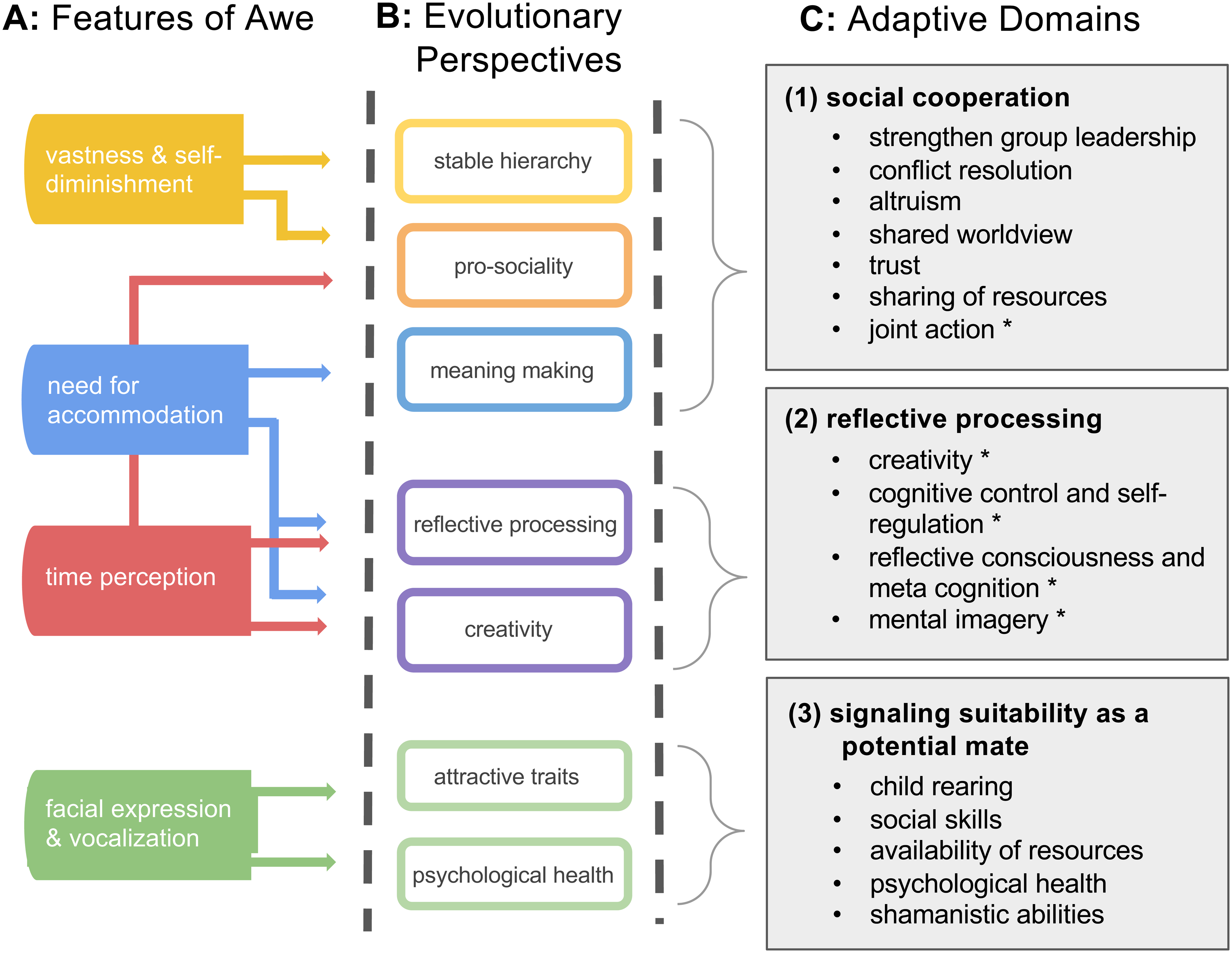
Integrated model of seven evolutionary perspectives (B) and their associated features of awe (A) in three adaptive domains (C). Note. Additional sublevels of adaptive domains (indicated by *), not all of which are discussed in the text, are included here for further illustration and to guide future research. Joint action: defense from predators and outgrips, exploration, hunting, specialization and cultural evolution, trade, warfare, communitas. Creativity: discovery, problem solving, tool construction, hunting, medicine. Cognitive control and self-regulation: tool-use, agriculture, trade, monogamy, productivity, food storage, emotion regulation. Reflective consciousness and meta cognition: social networking, self-presentation, skill acquisition, group coordination. Mental imagery: art, ceremonial ritual, simulation of past and future scenarios.
Considering the wide variety of functional domains through which awe might have been adaptive, that are presented throughout this paper, it is important recognize that from an evolutionary perspective these domains are not mutually exclusive. In contrast, we propose that these domains could well have operated in parallel, all contributing to the adaptiveness of awe in our evolutionary past. A genetic mechanism in support of the heterogeneity of the adaptive functions of awe, is that merely all genes are pleiotropic (Fitch, 2012). Pleiotropy signifies that single genes will influence the expression of multiple traits. Mutations at the genetic level, which form the primary source for phylogenetic change, will thus have an influence on the expression of multiple traits (Fitch, 2012). While many mutations will result in nonadaptive or nonviable traits, in some cases, (a combination of) modified traits may benefit the fitness of the organism, resulting in the promotion and preservation of the mutated genome in subsequent generations through the process of natural selection (Fitch, 2012). Moreover, even in the case where genomic change is associated with a single trait, the new trait would be added on top of the collection of previously acquired traits that make up the phylogeny of the organism (Tooby & Cosmides, 2000). In order for this new trait to be selected, the fitness effect associated with this new trait should have a net benefit across multiple traits. Consequently, this drives the selection of traits that have beneficial effects across multiple functional domains. Considering the adaptive domains of various other evolved human capacities, such as working memory and language, which, in addition to their mutual benefits (Gathercole & Baddeley, 1993), have been argued to support diverse cognitive functions and adaptive behaviors (in the case of working memory: observational learning (Afsharpour et al., 2018), goal-directed action (Quaedflieg et al., 2019), self-consciousness (Ardila, 2008), creativity (Wynn & Coolidge, 2014), problem-solving (Solaz-Portoles & Sanjosé-López, 2009), and tool construction (Coolidge & Wynn, 2005); in the case of language: joint action (Clark, 1996), self-regulation (Vallotton & Ayoub, 2011), and mate selection (Rawal et al., 2014), from a genetic point of view, as well as from an evolutionary perspective, it is unrealistic to assume that the adaptive effect associated with the evolution of awe should be limited to a single function, but instead should be expected to affect multiple functional domains.
The first domain in which we propose that awe may be adaptive is social cooperation (see Figure 1C, social cooperation). Scholars have suggested that the evolutionary function of awe lies in its ability improve cohesion and cooperation within social groups (Stellar et al., 2017). This sentiment can be found in three of the theories presented in this paper: Awe Reinforces Social Hierarchies, Awe Promotes Prosociality and Awe as a Meaning Making Emotion. Firstly, Keltner and Haidt (2003) propose that awe can be experienced toward a powerful individual within the social group (i.e., a leader; see Figure 1A, vastness and self-diminishment), consequently, giving awe the ability to stabilize social hierarchies (see Figure 1B, social hierarchy). Having a common leader can facilitate cooperation between group members. A leader can delegate and coordinate group resources effectively (King et al., 2009), which minimizes duplication of labor and improves intergroup cooperation. Furthermore, a common leader can enforce punishments and aid in conflict resolution (van Vugt & Ronay, 2013), thus stabilizing the social group. Sharing a common leader could thus have been adaptive to our awe-prone ancestors through the facilitation of social cooperation. Social cooperation also plays a central role in the second theoretical perspective presented in this paper, Awe Promotes Prosociality. That is, awe has been associated with a range of prosocial emotions, such as humility, generosity, and reduced self-interest (Piff et al., 2015; Stellar et al., 2018). These prosocial emotions have been associated with both time perception and self-diminishment (Bai et al., 2017; Piff et al., 2015; Rudd et al., 2012; Stellar et al., 2018; see Figure 1A, time perception; vastness and self-diminishment). Prosocial emotions furthermore aid group cooperation as they allow group interests to be placed before personal interests and promote a level of trust between the members of the group (Figure 1C, social cooperation). This relates to the discussion on the evolutionary function of altruism, which has been argued to be adaptive through kin selection as well as direct and indirect reciprocal exchange (Kurzban et al., 2015). The last theory that relates to social cooperation is the theory by Ihm et al. (2019) which presents Awe as a Meaning Making Emotion. This theory suggests that the process of accommodation that accompanies the awe experience (see Figure 1A, need for accommodation) brings about a shared meaning system or shared reality, which leads to the development of group cohesiveness and consequently facilitates social cooperation. Evolutionary psychologists have proposed a multitude of factors that favored living in social groups, including advantages in foraging for food and defending the group from predators (Majolo & Huang, 2017). Improved intragroup cooperation would have aided our ancestors in efficiently sharing their joint resources for best outcomes. Taking these theories together, awe could thus have been a driver for inclusion in the social group.
The second domain in which we propose that awe may have adaptive value is reflective processing, as seen in the perspectives Awe Increases Reflective Processing and Awe Increases Creativity. The nature of awe is to trigger a process of attentive self-absorption in sublime stimuli stimulating mental imagery and meaning making in artists and observers, that may demand subsequent accommodation in the form of reflective processing (Figure 1C, reflective processing) including the revision of previously held beliefs and mental structures. It is relevant to mention here as well that while awe can promote reflective and scientific thinking as well as creativity, awe can also be the end product of a cognitive or creative progress. When working long hours on a demanding project finding a solution or an innovative idea can produce a feeling of relief and awe; thoughts and pieces that were in disarray before now suddenly fit perfectly together. This idea is paralleled by a recent study by Cuzzolino (2021), who interviewed scientist from different disciplines on how they experience awe as it relates to their work. A substantial number of participants named awe as a motivation to learn and to discover more within their fields as well as a something that gets them through hardships and frustrations.
Notably, the relationship of awe with reflective as well as creative thinking is compatible with the enhanced capacity for mental imagery and elaborate attentional processing that have been associated with trait absorption (Lifshitz et al., 2019; van Elk et al., 2016). More specifically, the capacity for absorption in captivating stimuli that are beautiful, vast or rare may reflect the ability for elaborate attentional processing that connects modality specific sensory and conceptual representations in a unified multimodal conscious representation (Baars et al., 2013). The ability to maintain and manipulate information in working memory is considered central in reflective processing and creativity (De Dreu et al., 2012; Ritter et al., 2018) and may also contribute to scientific thinking (Dunbar & Fugelsang, 2005) and scientific reasoning (Gottlieb et al., 2018). Hence, the ability to imagine, that is to attend, process and attribute meaning to mental representations in working memory, is an essential cognitive function that may have driven the selection of awe in our ancestral past. Complementing the research on absorption and mental imagery, future studies may investigate the proposal that the capacity for awe is associated with individual differences in mental imagery and working memory. This relationship could be investigated in developmental research. That is, if the development of awe is associated with enhanced capacity for mental imagery, one might expect developmental periods with frequent experiences of awe to be accompanied by advances in working memory skills, and fantasy play in children.
An interesting feature of awe, related with reflective processing, is that it has been associated with subjective dilation of time, specifically the feeling that one has more time available (Davydenko & Peetz, 2017; Rudd et al., 2012; Yaden et al., 2018). The subjective feeling of boundlessness of time (also referred to as timelessness) has been suggested to play a crucial role in the creative process (Mainemelis, 2002), thus pointing to a connection between time perception and creativity (see Figure 1A, time perception). Previous research on dual processing has pointed out that reflective processing is a serial and slow process as compared with reflexive or automatic processing which is largely parallel and fast (Evans, 2008). Studies have found that manipulations of time may influence the use of system 1 or 2 processes, with excess time stimulating reflective analytic processing and time pressure resulting in the use of heuristics and intuitive decision making (Evans & Curtis-Holmes, 2005; Ritter et al., 2010). Analogously, the perceived availability of time or the experience of timelessness could lead individuals to engage in reflective processing including the careful weighing of arguments and systematic analysis. Future studies may investigate whether the relationship between awe and reflective processing is meditated by the time dilating effect of awe.
Lastly, the third domain in which we propose that awe may be adaptive is its potential to signal suitability or attractiveness as a potential mate. This domain addresses the conceptual overlap between the perspectives Awe Aids Selection of Potential Mates and Awe as a Signal of Psychological Health. Konečni (2005) has proposed that awe is sexually selected; specifically, individuals who experience awe are deemed suitable partners, as they have the capacity to display reverence as well as emotional and intellectual sensitivity to support care taking of infants. This theory is supported by research suggesting that females of a range of animal species have been shown to value quality of parental care over dominance in mate selection (Qvarnström & Forsgren, 1998). In human females, the preference for dominant and aggressive or subordinate, caring and sensitive features has been shown to vary based on ecological circumstances and ovulation cycle, leading researchers to suggest a pluralistic mating strategy, whereby both the selection of dominant as well as subordinate and caring males would have been adaptive in different circumstances (Penton-Voak et al., 2004).
Moreover, according to Konečni (2005) in order to gain access to awe-inspiring experiences our ancestors would have had to possess the necessary monetary and bodily resources (i.e., physical fitness), making them attractive as potential mates. Konečnìs assertions parallel the association of awe with improved psychological health and well-being (Curtin, 2009; Gelderloos et al., 1990; Hendricks, 2018), which suggest that awe has the ability to signal psychological health. Taken together these perspectives suggest that awe-prone individuals were considered as attractive by their peers due to their assumed adaptive traits and psychological health. As described in the first section, Defining Awe, humans seem to have a distinct and universal facial expression as well as vocalization for the emotion of awe (Cordaro et al., 2016; Shiota, et al., 2006; Simon-Thomas et al., 2009), which signals to others that one is experiencing awe (see Figure 1A, facial expression and vocalization). This suggests that communicating an experience of awe may have presented an adaptive signal for early humans to convey their attractiveness as a psychologically healthy mate. Furthermore, we can also experience awe toward exceptionally attractive people. In addition to physical attractiveness, people who have a special skill or are admired for their outstanding morality can elicit a feeling of awe (Graziosi & Yaden, 2019; Keltner & Haidt, 2003). Interestingly, there is also an empirical connection between mate selection and creativity, with research indicating creativity as a relevant trait for mate selection (Griskevicius et al., 2006; Kaufman et al., 2014), and creativity having been hypothesized to be a signal of fitness (Galasinska & Szymkow, 2021). This demonstrates a level of association between the two adaptive domains Reflective Processing and Signaling Suitability as a Potential Mate. Furthermore, empirical research has shown that an archetypal awe experience (video depicting the earth from space) in addition to awe also elicited greater feelings of love (Nelson-Coffey et al., 2019), providing some tentative initial evidence for the connection between awe and love. This implies that awe might not only play a role in signaling attractiveness to others but that it could also aid in selecting an appropriate partner. While this connection between awe and love should of course be further investigated before making concrete assertions, it provides an interesting and potentially fruitful basis for further disentangling the evolutionary function of awe.
Conclusion
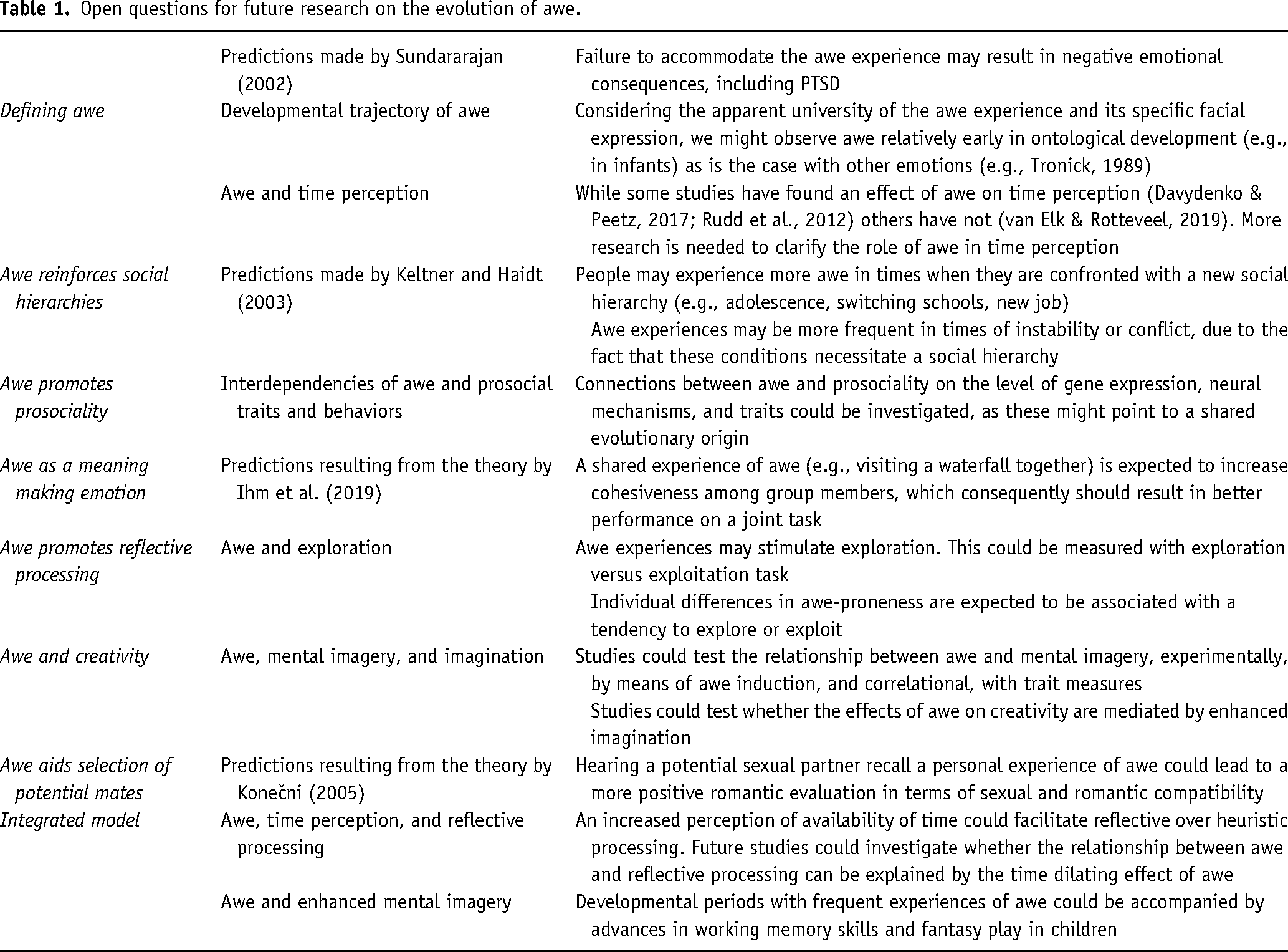
To conclude, while the emotion of awe has gained increasing interest in the scientific literature, there thus far has been no consensus on the mechanisms that led to its evolutionary selection, with many authors suggesting differing theoretical accounts. This narrative review aims to contribute to the scientific literature on awe by providing an overview of the existing perspectives on the evolutionary function of awe and combining them into an integrated theoretical model. This review proposes that awe is adaptive through three mechanisms (1) it promotes social cooperation, (2) it stimulates reflective processing, and (3) it signals suitability as a potential mate. Identifying these three adaptive domains may be advantageous for guiding and structuring future research on the evolutionary function of awe. A number of testable predictions resulting from the different theories have been presented throughout this review and are summarized above in Table 1. Future research should attempt to answer these open questions in order to gain additional clarity on the evolutionary selection of awe.
Open questions for future research on the evolution of awe.
Footnotes
Declaration of Conflicting Interests
The authors declared no potential conflicts of interest with respect to the research, authorship, and/or publication of this article.
Funding
The authors received no financial support for the research, authorship, and/or publication of this article.
