



Abstract
Creativity offers both survival and reproductive benefits, being a desirable trait in potential mates and linked to fertility and sexuality. We investigated whether viewing attractive faces of potential short-term or long-term partners in a simulated dating portal enhances participants’ creativity. We also explored possible mediators (arousal, mood, sexual arousal, motivation, and attraction) and moderators (relationship status, satisfaction, mate value, and sociosexual orientation). In Study 1, 483 participants (Mage = 30.06, SD = 6.37; 242 women, 241 men) viewed either four attractive or four unattractive opposite-sex potential partners and wrote self-promotional bios. No significant creativity differences were found between the attractive and unattractive groups. However, men were more flexible and produced more original ideas than women, while women showed greater fluency and self-creativity promotion. In Study 2, 494 participants (Mage = 30.84, SD = 6.06; 258 women, 236 men) viewed profiles of attractive potential partners for either short-term or long-term inclined relationships. Women's fluency and originality were higher in the long-term condition, but sexual arousal negatively impacted both fluency and originality when choosing an attractive partner for a long-term relationship, particularly when a real date desirability with the mate was high. Overall, the results suggest that creativity is influenced by the mating context, though the effects were modest. Future studies should increase sample sizes, geographic diversity, and experimental settings.
Introduction
Despite its multifaceted nature, creativity is broadly conceptualized as the ability to use free associations to recombine mental information, resulting in original and effective or appropriate outcomes (Beaty & Kenett, 2023; Runco & Jaeger, 2012). Research suggests that creativity is ancient (dating back 77,000 years, Henshilwood et al., 2002), universal (Groyecka-Bernard et al., 2024; Guo et al., 2024), and present in both closely and distantly related species (Hill et al., 2022; Kaufman & Kaufman, 2015), reflecting homology and adaptive convergence. Creativity also shows early developmental emergence (Hui et al., 2019) and neurocognitive specificity (Gonen-Yaacovi et al., 2013; Liu et al., 2018; Takeuchi et al., 2017). Furthermore, it is heritable (Roeling et al., 2017; Sotiropoulos & Anagnostouli, 2021) and relatively independent of intelligence (Kim, 2005), likely because intelligence is necessary but not sufficient for creativity (Karwowski et al., 2016). This body of convergent evidence (Schmitt & Pilcher, 2004) supports the view that creativity is an evolved psychological capacity fundamental to human nature (Carruthers, 2002; Gabora & Kaufman, 2010; Kozbelt, 2019).
Furthermore, paleoanthropological evidence (Fuentes, 2017) and paleogenomic findings (Zwir et al., 2022) suggest heightened selection for creativity in the phylogenetic lineage of Homo sapiens. The broader context of Plio-Pleistocene hominin evolution indicates that increasing savannization in Africa, leading to resource scarcity, may have driven selection for greater dispersal into novel environments (Carotenuto et al., 2016; Tobler et al., 2023). This environmental shift likely favored the emergence of social monogamy, characterized by mate guarding and biparental care of offspring (Eastwick, 2009; Schacht & Bell, 2016). Together, these new survival and reproductive challenges may have strongly favored the evolution of pronounced creativity in the human lineage.
Creativity is often regarded as a key advantage for survival (Fuentes, 2017; Puccio & Modrzejewska-Świgulska, 2022). From developing new foraging techniques and tools to devising innovative social structures, strategies to deter predators, and methods for treating diseases, creativity has likely played a crucial role in enhancing the survival of ancient human populations (Gabora & Kaufman, 2010; Kozbelt, 2019; Morriss-Kay, 2010). Beyond its survival benefits, evidence suggests that sexual selection has also influenced human creativity, co-opting it as a form of ornamentation that enhances mate value, which is essential for both mate selection and relationship maintenance (Karamihalev, 2013; Miller, 2001; Novaes & Natividade, 2023).
Creativity is one of the most preferred traits in potential mates across cultures, valued by both men and women (Buss et al., 1990; Buss & Barnes, 1986; Kamble et al., 2014; Souza et al., 2016). Both genders tend to prioritize artistic and ornamental forms of creativity—such as composing music, writing poetry, or drawing—over practical or everyday creative skills. However, women exhibit a stronger preference for artistic creativity, while men are more inclined to value everyday or domestic creativity in a potential partner (Kaufman et al., 2016). Although creativity is not considered as essential as kindness, physical attractiveness, or financial prospects, it is regarded as a desirable “luxury trait” once these fundamental necessities are fulfilled (Thomas et al., 2020). Notably, creativity can even compensate for lower facial attractiveness (Watkins, 2017). Partners tend to assortatively match based on their creative achievements (Kaufman et al., 2016) as well as shared musical and artistic talents (Bongard et al., 2019; De Moor et al., 2013) and vocational interests, including those related to creative professions (Etzel et al., 2019; Banov et al., 2023). Beyond mate selection, creativity plays a vital role in relationship maintenance. Research shows that it can help sustain romantic passion over time, serving as a buffer against the natural decline of passion as relationships grow longer (Carswell et al., 2019).
Creativity is strongly linked to mating success and sexual strategies. Both male and female poets and artists report having more sexual partners compared to control groups, with increased creative engagement associated with a higher number of sexual partners (Nettle & Clegg, 2006). Humor, as a creative skill, is also associated with casual sexual encounters in both men and women, acting as a mediator between intelligence and mating success (Greengross & Miller, 2011). Similarly, adult playfulness correlates positively with the number of short-term and long-term partners among men and with the number of short-term relationships among women (Moraes et al., 2021, 2022). Additionally, artistic tendencies reflect elements of both intrasexual and intersexual selection: women's artistic talents are often linked to mate attraction, while men's artistic expressions are more commonly tied to intrasexual competition (Varella et al., 2022).
Furthermore, if ancestral sexual selection consistently acted upon human creativity, then creative displays should both engage and influence the mating mind of perceivers, while mating contexts should, in turn, activate and shape creative expression and display. This is because mental mechanisms evolved to address specific adaptive problems or opportunities, making them particularly sensitive to socioecological cues that signal such challenges or opportunities, such as potential threats or mating prospects (Barrett, 2005; Gillath et al., 2008; Tooby & Cosmides, 1990). Indeed, goal activation and its persistence, which can lead to behavioral changes, can be triggered by simple word primes related to important outcomes or values (Weingarten et al., 2016). Perceiving displays of ornamental creativity, such as listening to enjoyable background music, has several effects on women's mating psychology. For example, it enhances attractiveness ratings of male photos (May & Hamilton, 1980; Marin et al., 2017; Marin & Rathgeber, 2022) and increases women's desire for romantic dates with men (Chang et al., 2021; Marin et al., 2017; Marin & Rathgeber, 2022). Conversely, priming mating motivations enhances creative expression in both men and women. However, while men's creativity increases in both short-term and long-term mating contexts, women's creativity only rises when a high-quality mate is present in a long-term mating context (Griskevicius et al., 2006). Additionally, women's fertility status influences both their preference for creativity and their own creative displays. During their most fertile phase, women prioritize creativity over wealth in short-term partners (Haselton & Miller, 2006) and show a preference for composers of intricate music for short-term relationships (Charlton, 2014). Fertile women also exhibit heightened creativity (Galasinska & Szymków, 2021, 2022; Krug et al., 1994) and display more attractive dance movements (Miller et al., 2007; Fink et al., 2012).
Current Issues and Debates
Despite the available evidence pointing to ornamental functions of human creativity, there are at least four ongoing relevant issues and debates pertinent to creativity research in the literature. Because intrasexual competition drives the development of dimorphic traits known as weapons, whereas intersexual competition favors the emergence of ornaments (Andersson, 1994; Trivers, 1972; Darwin, 1859), the first debate is about whether sexual selected traits are mostly armaments (weapon-like) or ornaments in humans. Some authors support the notion that intersexual selection was more prevalent in ancestral humans, so that we have many physical and psychological ornaments (Miller, 2000, 2001; Roberts & Little, 2008; Varella, 2023), while others argue that ancestral intrasexual selection was stronger, so that humans have more armaments than ornaments (Puts, 2010; Puts et al., 2023). Because even typical armaments, such as height or low vocal fundamental frequency, can also be appreciated in mate choice (Valentova et al., 2016, 2019), intersexual selection can add new ornamental functions to armaments. Conversely, because ornaments, such as artistic creativity, can make a difference in the social competition for prestige influencing mate value, they can also accumulate armament functions (De Block & Dewitte, 2009; Varella et al., 2017; Winegard et al., 2018). Indeed, there is evidence suggesting that both intrasexual and intersexual selection influence human artistry (Varella et al., 2022), creativity (Chen & Chang, 2015), and creative self-grooming, such as makeup usage (Biesiadecka et al., 2023; Mafra et al., 2020). In both sexes, aggressive humor is more related with intrasexual contests than with mate choice (Duarte & Zhang, 2023). Although the notion of creativity as ornament is more prevalent in the literature, researchers should be aware of the dual utility of displays as armaments and ornaments (Berglund et al., 1996) and try to investigate both inter- and intrasexual selection processes.
The second debate is about why certain traits are attractive and desirable after all. It involves both physical and psychological traits, including creativity. This debate concerns the possibilities that ornaments might have evolved mostly as fitness indicators, within the “good sense” category of adaptive values put forward by Wallace, or as mere aesthetic preference, within the “good taste” class of adaptive values put forward by Darwin (cf. Cronin, 1991; Davis & Arnocky, 2022; Novaes & Natividade, 2023; Prum, 2010, 2012). Some authors argue that ornaments might indicate good genes related to intelligence and health (Klasios, 2013, Miller, 2000, 2001; Roberts & Little, 2008), while others support the notion that ornaments can evolve by runaway selection (i.e., “sexy sons”) and other mechanisms such as sensory exploitation (Dubourg & Baumard, 2022; Verpooten & Nelissen, 2012). Both class options are possible and not mutually exclusive (Sefcek et al., 2007). There is evidence offering some support of the fitness indicator position for creativity (e.g., Clegg et al., 2008; Howrigan & MacDonald, 2008). There is good evidence offering just little support, for instance, regarding the small positive relationship between creativity and intelligence being stronger in males (Gerwig et al., 2021; Mosing et al., 2015; Xu et al., 2019), but there is also lack of support (Camargo et al., 2013). Moreover, a meta-analysis including 55 species supported “sexy sons” Fisherian models of female mate preference evolution by finding heritable male attractiveness but offers mixed evidence for the “good genes” hypothesis, with no clear link between attractiveness and life-history traits related to fitness (Prokop et al., 2012). In humans, there is even a positive genetic correlation between being “artistic and creative” and preferring an “artistic and creative” romantic mate (Verweij et al., 2014), which is an important ingredient of Fisherian runaway sexual selection. Although the incoming accumulating evidence will ultimately show the class of adaptive values under which evolved ornaments mostly fall, researchers should keep an open mind and refrain from assuming that fitness indicators are the only option within sexual selection or the most supported line of reasoning available.
The third ongoing issue and debate relates to the degree of sexual dimorphism in ornaments exhibited by humans. In general, because of the costs of internal gestation and lactation on top of the costs of anisogamy, female mammals, including humans, have a higher minimum obligatory parental investment than males, which puts a stronger sexual selection pressure on males for exhibiting more armaments and/or ornaments (Janicke et al., 2016; Mogilski, 2021; Trivers, 1972). However, this is not the entire picture because humans also evolved monogamous inclinations with low levels of extra pair paternity, mutual mate choice, high paternal investment in the offspring, mate guarding, alloparental care, which tend to reduce sexual dimorphism (Plavcan, 2018; Schacht & Kramer, 2019; Stewart-Williams & Thomas, 2013a, 2013b). In birds, social monogamy, biparental care, cooperative defense of territories and cooperative breeding are related to mutual ornamentation: increased female ornamentation and decreased sexual dimorphism (Dale et al., 2015; Ota et al., 2015; Tobias et al., 2011). Mutual mate choice and assortative mating can generate mutual ornamentation and exaggerated signaling even under monogamy (Hooper & Miller, 2008; Wachtmeister, 2001). Indeed, in humans, the bulk of the evidence on creativity and artistic vocational interests, including meta-analyses, consistently show small sex differences, with a slight superiority of females, on average (Alabbasi et al., 2022; Baer & Kaufman, 2008; Nakano et al., 2021; Su et al., 2009; Taylor et al., 2024; Varella et al., 2017) and a small greater variability in males (Alabbasi et al., 2022; He & Wong, 2011; Taylor et al., 2024). Basically both sexes have their relative specificities in creative thinking: females excel on thoroughness of thinking, and adaptability, creative poems, creativity in general life, creativity in social occasions, humor, creative behaviors, mathematical creativity, artistic creativity, creativity self-assessment, and narrative creativity, while males excel on boundary-breaking thinking, and on total creativity, self-perception of creativity, solving scientific creative problems, innovation in arts, creative achievement, and mechanical/scientific creativity (He & Wong, 2011; Nakano et al., 2021). In a cross-cultural study, Du et al. (2025) found that women express higher artistic interests although this difference decreases in more egalitarian societies. The meta-analysis of Su et al. (2009) involving over 500,000 individuals showed that women choose artistic professions more often than men and are also more likely to have artistic hobbies. According to the report by Ellis et al. (2012), women are more likely to prefer being actresses, artists, dress designers, writers, or makeup artists. This indicates that humans are not really like peacocks, bowerbirds, or birds of paradise, because both sexes are creative with slight differences and specificities (Miller, 2013; Stewart-Williams & Thomas, 2013a, 2013b). Even with somewhat similar creative capacities, men and women might be motivated to use them in different contexts, such as men being more interested in public performances to access higher variety of mates (Miller, 1999, 2001), which they indeed do (Greengross et al., 2020; Hora et al., 2022; Mehr et al., 2018, 2019; Savage et al., 2015). Therefore, researchers should keep in mind that women also evolved the tendency to display creativity (Varella et al., 2017; Rosenthal & Ryan, 2022) and always try to include men and women into their investigations exploring different types of creative endeavors and different social contexts.
The fourth and final issue concerns the inconsistency of results and research designs. Although in most part the evolutionary literature examining creativity through the lens of sexual selection is well corroborated (Karamihalev, 2013; Novaes & Natividade, 2023), it has also produced varied and sometimes inconsistent findings, some contrary to what the theory would predict. For instance, individuals with higher musical skills may experience lower mating success than nonmusicians in a study (Mosing et al., 2015), but in another study there was no difference in the number of sexual partners between musicians and nonmusicians (Harrison & Hughes, 2017). Additionally, visually creative individuals within a seminomadic and naturally fertile African tribe tend to have fewer offspring than less creative individuals (Lebuda et al., 2021). Levels of creativity and of sexual desire are not correlated (Barazandeh et al., 2023), but creativity may contribute to a broader repertoire of sexual behaviors (Eisenman, 1982). These and other contradictory results may indicate the necessity for theoretical improvement and further research. However, they might also occur due to disparities in research designs and measures of creativity and mating preferences/success. Studies have often operationalized creativity differently: some focus on general creative “processes,” such as divergent thinking or originality, while others focus on creative “domains,” such as artistry or everyday and practical creativity, hindering generalizations (Karamihalev, 2013; Novaes & Natividade, 2023; Gabora & Kaufman, 2010). Moreover, even creative processes and domains are approached at different conceptual levels: Some focus on creative potential, predispositions, artisticality, while others focus on manifested creative achievement, actual scientific discoveries, and art prizes received, further complicating direct comparisons across studies and general conclusions (Novaes & Natividade, 2023; Gabora & Kaufman, 2010; Piffer, 2011). Furthermore, reliance on correlational design, variations in sample demographics, and contextual factors (e.g., short-term vs. long-term mating motivations) add layers of complexity that limit robust conclusions. Addressing these issues requires replications, standardized methodologies, such as consistent creativity measures, clearer distinction of mating contexts, and more cross-cultural samples to account for ecological variability (Karamihalev, 2013; Novaes & Natividade, 2023; Varella et al., 2022). Future research should incorporate longitudinal and new experimental designs to observe creativity's role over time and under more controlled settings as close as possible to real-world mating conditions, which may yield insights more representative of evolutionary processes in human behavior.
The Current Study
In this study, we made an effort to tackle some of those issues while contributing to expanding the sexual selection research on mate priming and creativity. We investigate the general ornamental functions of creativity in both sexes across two studies using different measures of creativity within a controlled experimental design that simulates a dating website. This presents high ecological validity given that a significant portion of the modern mating landscape involves online dating (Finkel et al., 2012; Sharabi & Dorrance-Hall, 2024). Moreover, we sampled a Polish population, and the use of an East European sample adds some diversity to the literature heavily biased toward North American and West European populations.
As previous research has shown that the general creative process—specifically divergent thinking, which includes fluency, flexibility, and originality (Guilford, 1950)—increases during the fertile phase of the menstrual cycle (Galasinska & Szymkow, 2021, 2022; Krug et al., 1994), we decided to focus on general creative processes rather than specific aesthetic expressions. By emphasizing an underlying process, we aimed to test whether sexual selection influences not only aesthetically pleasing abilities but also the fundamental capacity for general innovativeness. In Study 1, participants were asked to create a self-promotional bio for their “dating profiles”—an open-ended and ill-defined task requiring substantial creativity to stand out among others. In Study 2, we employed the Alternative Uses Test (Guilford, 1967; Silvia et al., 2009), in which participants generated as many possible uses for everyday objects as they could. By utilizing two distinct measures of general creativity, we were able to broaden the operationalization of creativity and increase the likelihood of uncovering potential dynamics associated with mating activation.
Goal activation or mental priming has been successfully applied to creativity, as demonstrated by Griskevicius et al. (2006). In their study, priming participants with mating motivations by having them read a romantic story enhanced creative expression in both men and women. For men, any short-term or long-term mating context was sufficient to activate creativity. However, for women, creativity was only enhanced when imagining a specific mating context, such as a high-quality mate in a committed long-term relationship (Griskevicius et al., 2006). Despite the study's successful results and promising research design, no subsequent studies have explored this area in the nearly two decades since its publication. Given that this line of research remains in its early stages, we opted not to conduct a direct replication. Instead, we sought to enhance ecological validity by investigating the core idea using visual stimulation in a laboratory setting. We argue that the more researchers explore the various ways romantic contexts relate to creativity activation, the faster a comprehensive understanding will emerge. This broader perspective can guide future research, helping to identify specific dynamics and contexts more effectively.
If sexual selection played a role in the ancestral evolution of human creativity, we would expect creativity to be more activated in the presence of attractive potential partners. This effect is expected to be particularly pronounced among singles. To test this, we placed singles and partnered participants in conditions simulating a dating site, where they were shown photos of potential partners of the opposite sex. In Study 1, we compared responses to viewing photos of attractive versus unattractive potential mates. In Study 2, we used only attractive photos and contrasted short-term versus long-term relationship contexts. The concept of a simulated dating platform was well received by participants, as online dating sites and apps have become an integral part of modern life. We also investigated the mechanisms behind the anticipated effects on creativity by examining affective states associated with mood. Specifically, we tested arousal and valence, as these states are known to enhance creativity (Baas et al., 2008). General arousal is a key determinant of motivation, referring to the organism's level of responsiveness to stimuli (Agmo, 2011), and its increase may also boost sexual motivation. Additionally, we included measures of sexual arousal and the motivation to perform well. While both states represent forms of promotive motivation, they differ in their focus, with one oriented toward sexual contexts. Sexual arousal is also related to directed attentional focus (de Jong, 2009), which facilitates convergent rather than divergent thinking (Colzato et al., 2012).
To identify potential moderators of the effect, we included individual differences such as mate value, sociosexual orientation, relationship status, and relationship satisfaction. These variables may influence the expression of sexual behavior by shaping sexual needs. Our data are freely available at: https://osf.io/7aycg/.
Study 1
In this study, we hypothesized that participants would exhibit higher creativity after viewing photos of attractive (vs. unattractive) potential mates. We predicted no significant differences in creative dimensions between men and women. However, we expected single participants to display greater creativity compared to those in relationships, particularly in the attractive mate condition. We anticipated that mood arousal, mood valence, sexual arousal, and motivation to perform well would mediate the relationship between viewing mate photos and creative dimensions. Additionally, we hypothesized that relationship status and relationship satisfaction would moderate these mediations. Finally, we proposed that sociosexual orientation and mate value would moderate the relationship between mate attractiveness and creativity.
Method
Participants
The data were collected anonymously through an online survey administered by the Polish Research Panel Ariadna. From an initial sample of N = 500 heterosexual participants, 17 were excluded due to incomplete or irrelevant responses. The final sample consisted of N = 483 participants aged 18–40 years (M = 30.06, SD = 6.37). This included 242 Polish women, of whom 70 reported being single or in a casual relationship, and 172 were in a committed partnership, as well as 241 men, of whom 134 were single and 107 were in a partnership. Most of the participants reported not using dating portals at all (N = 298; 61%), using it seldom (N = 145; 30%), often (N = 27; 5.6%), or very often (N = 13; 2.7%).
An a priori calculation of the required sample size was conducted using G*Power 3.1.9.7 (Faul et al., 2009). Based on an estimated small effect size (f = 0.20) and a desired power of 0.80, the analysis determined a minimum sample size of 199 participants for each sex. The study procedure was approved by the Institutional Ethical Review Board (the name of the university has been omitted due to the peer-review process).
Materials and Procedure
Mate-Attractiveness Manipulation. Participants were randomly assigned to one of two experimental conditions: viewing photos of either four attractive or four unattractive potential opposite-sex partners on a simulated dating portal. The photos had been prerated for attractiveness in a pilot study. Participants were asked to rate the attractiveness of each potential partner on a scale from 1 (very unattractive) to 10 (very attractive) and to select the person they liked the most (with an option to choose “none”). Information about the pilot study and its results is included in the Supplementary Material.
Creative Thinking. Participants were instructed to write a self-promotional bio intended for their dating profiles (we have included the instructions for the participants in the Supplementary Material). The bios were evaluated by four independent raters, with inter-rater reliability assessed using a two-way random-effects intraclass correlation coefficient (ICC) model for average consistency. The bios were treated as examples of creative potential, which was defined by researchers as divergent thinking (Runco & Acar, 2012). Due to this assumption, the raters evaluated bios in terms of cognitive fluency (the number of all generated ideas), flexibility (the number of unique themes the responses were drawn from), and originality (statistical rarity, surprising and unique ideas on a scale from 1 to 5; Guilford, 1967; Saretzki et al., 2024). In samples of divergent thinking in the form of bios, fluency was defined as the number of self-presentation elements included in a bio, ICC = .74; 95% CI [0.37, 0.46]. Flexibility was defined as the number of different thematic categories of the self within the bio, ICC = .67; 95% CI [0.62, 0.72]. For example, if a participant wrote, “Like everyone, I have certain expectations of the other person,” the judges considered this as one piece of information. If they then wrote, “My expectations may change depending on the situation,” the judges considered this as another piece of information. Therefore, for fluency, the participant received two points, but since both pieces of information concerned the same matter, for flexibility the participant received 1 point. Originality was assessed by evaluating each self-presentation element in terms of how much it stood out and demonstrated surprising uniqueness, using a scale from 1 (very low) to 5 (very high); ICC = .56; 95% CI [0.49, 0.62]. To conduct the statistical analysis, the total originality and flexibility scores were averaged by the number of self-presentation elements (fluency) to control for the confounding effect of fluency, which may covary with other dimensions of divergent thinking (Runco & Acar, 2012; Forthmann et al., 2020). Additionally, the overall creativity of the bios was evaluated on a scale from 1(very low) to 5(very high), ICC = .53; 95% CI [0.48, 0.62]. The average scores for each factor were then calculated for all participants.
Self-Creativity Promotion. The bios were also rated based on the extent of self-promotion of creativity, which was determined by the average number of self-creativity-related elements included in the bio, ICC = .52; 95% CI [0.45, 0.59].
Motivation to Perform Well. We assessed participants’ motivation by asking them to rate how much they tried to appeal to potential partners on a 10-point scale ranging from 0 (not at all motivated) to 10 (extremely motivated).
Mediators and Moderators
Arousal and Mood Valence. To examine participants’ emotional states after viewing the photos of potential mates—since emotions may contribute to the creativity of their bios—we asked them to assess their level of arousal and mood valence using picture form the Self-Assessment Manikin (SAM; Bradley & Lang, 1994). Participants rated each on a scale from 1 (low) to 5 (high).
Sexual Arousal. Participants rated their level of sexual arousal after viewing the photos of potential mates on a scale from 1 (very low) to 10 (very high).
Sociosexual Orientation. Participants completed the Revised Sociosexuality Orientation Inventory (SOI-R; Penke & Asendorpf, 2008; Cronbach's α = .85). A higher score on the SOI-R indicates a greater tendency toward promiscuity.
Mate Value. Participants completed a self-report measure assessing their perceived mate value using the Mate Value Scale (Edlund & Sagarin, 2014; Cronbach's α = .91).
Relationship Satisfaction. We asked partnered participants to rate their relationship satisfaction on a 10-point scale ranging from 1 (very low) to 10 (very high).
Procedure
The study simulated a dating portal experience. Participants were informed that the study focused on decision-making processes on dating platforms. They were introduced to the concept of dating apps and websites, described as widely used tools for finding potential partners, catering to both short-term and long-term relationship goals.
Participants were shown photos of four alleged users from a popular dating platform and asked to indicate whether they would be interested in matching with these profiles. They also rated the attractiveness of each individual based on their personal perceptions. Following this, participants assessed their levels of arousal, mood valence, and sexual arousal using corresponding scales.
Next, participants were given five minutes to create a self-promotional bio for their dating profile. They were informed that these bios would be used in the second phase of the study, where the users depicted in the photos would make hypothetical dating decisions based solely on the bios, without seeing profile photos. Participants were encouraged to emphasize diverse traits to make their bios stand out as original. Before starting, they rated their motivation to perform well on a scale.
Finally, participants completed the Revised Sociosexuality Orientation Inventory (SOI), the Mate Value Scale, and provided demographic information, including sex, age, relationship status, relationship satisfaction, sexual orientation, and the frequency of their dating app use.
Results
We conducted Student's t-tests for dependent samples as a manipulation check and performed a General Linear Model (GLM) analysis with a 2 (sex: women vs. men) × 2 (mate: attractive vs. unattractive) × 2 (relationship status: yes vs. no) design. This analysis was applied separately for five dependent variables: fluency, flexibility ratio, originality ratio, self-creativity promotion, and overall creativity.
In the next step, mediation analyses were performed using the PROCESS Macro (Hayes, 2013; Model 4) to test potential mediators separately for men and women. The mediators included motivation to perform well, arousal, mood valence, and sexual arousal. For significant mediations, we added relationship status and relationship satisfaction as moderators and conducted moderated mediation analyses (Model 7). Additionally, we used PROCESS Model 1 to examine the moderating roles of mate value and sociosexual orientation in the relationship between viewing the photos and the creative dimensions.
Mate-Attractiveness Manipulation Check
Women. Photos of attractive mates’ faces received significantly higher ratings compared to those of unattractive ones. Correspondingly, mood valence and sexual arousal were higher after viewing and choosing attractive mates compared to unattractive ones. However, there was no effect of motivation to perform well or general arousal among women. Detailed results are presented in Tables 1 and 2.
Manipulation effects comparison for women.

Note: 95% CI: confidence interval; LL and UL: lower and upper level of confidence interval; Cohen’s d: effect size.
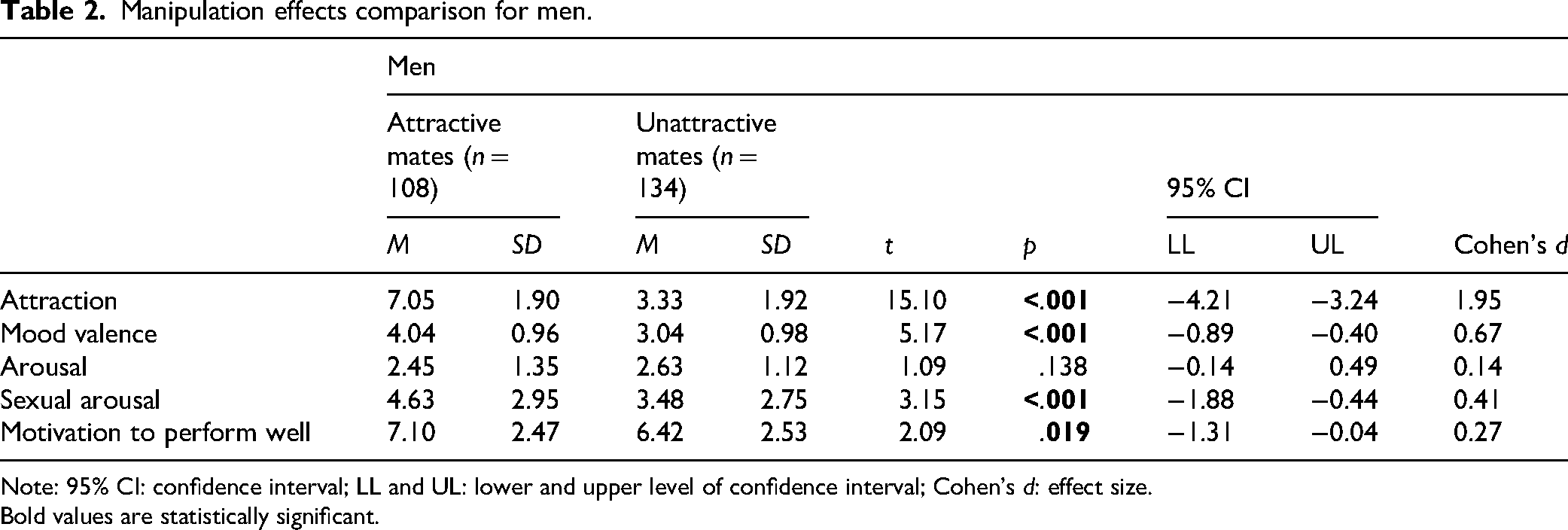
Manipulation effects comparison for men.
Note: 95% CI: confidence interval; LL and UL: lower and upper level of confidence interval; Cohen’s d: effect size.
Bold values are statistically significant.
Men. Similarly, photos of attractive mates’ faces received significantly higher ratings compared to those of unattractive ones. Mood valence, sexual arousal, and motivation to perform well were all higher after viewing and choosing attractive mates compared to unattractive ones. The only variable with no significant effect among men was general arousal. Detailed results are listed in Table 1 and 2.
Effects of Mate-Attractiveness, Relationship Status, and Sex on Creativity
Fluency. No differences in fluency were observed between mate attractiveness conditions, F(1, 475) = 0.28, p = .594, or between relationship statuses, F(1, 475) = 1.21, p = .271. Additionally, there was no significant interaction effect, F(1, 475) = 1.66, p = .198. However, we found a main effect of sex, with women demonstrating greater fluency compared to men, M = 9.17, SD = 3.43 vs. M = 7.37, SD = 3.12, F(1, 475) = 37.61, p < .001, η2p = 0.07.
Flexibility Ratio. No differences in flexibility were observed between mate attractiveness conditions, F(1, 475) = 0.38, p = .537, or between relationship statuses, F(1, 475) = 0.40, p = .528. Additionally, there was no significant interaction effect, F(1, 475) = 0.04, p = .834. However, we found a main effect of sex, with men demonstrating greater flexibility compared to women, M = 0.76, SD = 0.09 vs. M = 0.80, SD = 0.08, F(1, 474) = 17.35, p < .001, η2p = 0.04.
Originality Ratio. No differences in originality were observed between mate attractiveness conditions, F(1, 475) = 1.64, p = .201, or between relationship statuses, F(1, 475) = 2.56, p = .110. Additionally, there was no significant interaction effect, F(1, 475) = 3.59, p = .059. However, a main effect of sex was found, with men demonstrating greater originality in their ideas compared to women, M = 1.29, SD = 0.29 vs M = 1.21, SD = 0.20, F(1, 475) = 9.52, p = .002, η2p = .02.
Overall Creativity. No differences in originality were observed between mate attractiveness conditions, F(1, 475) = 0.26, p = .608, or between relationship statuses, F(1, 475) = 3.16, p = .076. There was no effect of sex, F(1, 475) = 0.00, p = .973. Additionally, there was no significant interaction effect, F(1, 475) = 0.85, p = .356.
Self-Creativity Promotion. No differences in originality were observed between mate attractiveness conditions, F(1, 475) = 0.06, p = .807, or between relationship statuses, F(1, 475) = 0.98, p = .323. Additionally, there was no significant interaction effect, F(1, 475) = 1.00, p = .319. However, a main effect of sex was found, with women demonstrating greater self-creativity promotion compared to men, M = 0.23, SD = 0.40 vs M = 0.06, SD = 0.16, F(1, 475) = 33.78, p < .001, η2p = .07.
Testing Potential Mediators Between Mate-Attractiveness and Creativity
All detailed mediation coefficients for women and men are listed in Tables 1‒3, respectively, in the Supplementary Material.
Comparison of creativity of women choosing short- and long-term inclined mates.

95% CI: confidence interval; LL and UL: lower and upper level of confidence interval; Cohen’s d: effect size.
Bold values are statistically significant.
Mood Valence
Women. Mood valence mediated the relationship between mate attractiveness and ideational originality, b = -0.02; 95% CI [-0.037, −0.002], indicating that the more positive mood valence women experienced after choosing a mate, the less original bios they created. No other significant mediation effects were observed.
Men. Mood valence mediated the relationship between mate attractiveness and fluency, b = 0.44, 95% CI [0.018, 0.78], indicating that the more positive mood men reported after choosing a mate, the more self-presentation elements they included in their bios. No other significant mediation effects were observed.
Motivation to Perform Well
Women. Motivation to perform well did not mediate any relationship between mate attractiveness and indices of creative potential.
Men. Motivation to perform well mediated the relationship between mate attractiveness and men's fluency, b = 0.013; 95% CI [0.001, 0.330], indicating that higher motivation was associated with men including more self-presentation elements in their bios.
Arousal. No significant effects were observed in either women or men.
Sexual arousal. No significant effects were observed in either women or men.
Testing Potential Moderators of the Relationship Between Mate-Attractiveness and Creativity
Relationship Status. We extended models with significant mediation indices by adding relationship status as a moderator to test its interaction with mate attractiveness (Model 7).
Women. No significant moderated mediation effects were found. This indicates that the motivation to perform well predicted ideational fluency in both single and partnered individuals.
Men. The index of moderated mediation was significant for men's ideational fluency, b = 0.30, 95% CI [0.010, 0.748], as was the interaction between relationship status and motivation to perform well, b = 1.50, 95% CI [0.225, 2.773]. Specifically, attractive mates predicted higher motivation to perform well, which in turn enhanced fluency, but only for single men. None of the independent variables alone predicted fluency in this model. Detailed results of this analysis are presented in Table 3 of the Supplementary Material. No other significant models of moderated mediation were found for any other dependent variable.
Sociosexual Orientation. No effects were found for sociosexuality.
Mate value. No effects were found for mate value.
Relational Satisfaction. Reported relationship satisfaction was M = 8.24, SD = 1.63 for women, and M = 8.10, SD = 1.85 for men (on a 10-point scale). No significant effects were found for relationship satisfaction.
Discussion
The study aimed to investigate whether exposure to attractive mate faces could influence creativity, specifically looking at creative thinking dimensions (fluency, flexibility, originality, and overall creativity) and self-creativity promotion. We hypothesized that these aspects of creativity would vary in the context of viewing attractive versus unattractive potential mates, with mediators (arousal, mood valence, sexual arousal, and motivation to perform well) and moderators (relationship status, satisfaction, mate value, and sociosexual orientation) also examined.
Our hypothesis was not supported. No significant differences in creative thinking or self-creativity promotion were found between participants exposed to attractive versus unattractive potential mates. However, for women, an interesting pattern emerged: in the presence of an attractive mate, they seemed to emphasize their creativity verbally rather than demonstrating it through tangible creative output. Among men, fluency was associated with their positive mood, which may suggest that their creative performance is influenced by the emotional boost derived from mating opportunities. Additionally, men's motivation to perform well - and thus engage in longer self-presentations - was most pronounced when they were single.
In conclusion, our findings suggest that, at least within this Polish sample, the mere presentation of potential partners’ faces in a simulated dating portal does not activate creativity in the way predicted by the sexual selection literature on mating priming. From an evolutionary standpoint, it seems that for women, factors such as a partner's ability to contribute to a long-term relationship may be more important than facial attractiveness, as these traits are more directly relevant to supporting offspring rearing (Buss & Schmitt, 2019; Walter et al., 2020).
An important limitation of our study is that we did not account for the level of genuine interest participants had in the potential mates they selected, which may have impacted the results. Furthermore, we were unable to assess whether participants’ creativity was influenced by the chosen mate, as we did not measure their divergent thinking abilities prior to the manipulation. These factors should be considered in future studies to better understand the dynamics between mate selection and creativity.
Study 2
To test the hypothesis regarding differences in creativity between long-term and short-term mate orientations, we conducted a second study examining creative thinking among women and men using a repeated-measures experimental design. Based on Griskevicius et al. (2006), we predicted that women's creative thinking would increase in the context of a potential long-term partner and that women selecting a long-term inclined mate would be more creative than those selecting a short-term inclined mate. For men, we did not predict differences in creativity between the long-term and short-term mate conditions. In this study, we presented only mates who were expected to be rated as attractive; however, their perceived attractiveness may have been influenced by the temporal orientation of the relationship they expressed. Therefore, we incorporated attractiveness ratings as a mediator. After all, people differ in what they consider attractive. Additionally, we hypothesized that dating desirability for the chosen mate would mediate the relationship between activation of a long-term attractive mate and creative thinking.
Method
Participants
As in the previous study, data were collected online through the Ariadna Research Panel. The initial sample included N = 518, but after excluding incomplete responses, the final sample comprised N = 494 heterosexual participants aged 18–40 (M = 30.84, SD = 6.06). This group included 258 women (single: n = 124; partnered: n = 134) and 236 men (single: n = 118; partnered: n = 118), 21.7% of them (N = 107) reported using dating sites.
Materials and Procedure
Relationship Temporal Inclination (Short vs. Long). From the pool of potential mates’ photos used in Study 1, we selected only the attractive ones and supplemented each photo with a short bio to create profiles depicting the individuals as either short-term or long-term inclined (the bios have been included in the Supplementary Material). Participants were randomly assigned to one of two experimental conditions: they viewed four profiles of opposite-sex individuals who presented themselves as either short-term or long-term inclined in their bios.
Attractiveness rate. The participants evaluated the perceived attractiveness of the potential mates from 1 (very low) to 10 (very high).
Dating Desirability. Participants reported their level of interest in going on a real date with each potential mate from 1 (very low) to 10 (very high).
Creative Thinking. We used the classic Alternative Uses Test (Guilford, 1967; Silvia et al., 2009) to evaluate creative (divergent) thinking both before and after the manipulation of attractive mates’ profiles, aiming to examine changes in creative thinking as a result of the manipulation. Participants were tasked with generating unusual uses for common objects. Both the test and retest phases involved two objects, randomly selected without repetition from a pool of four items (shoe, hammer, towel, lipstick). Participants had 2 min to work on each object before the program automatically advanced to the next page of the survey. The responses were scored by three trained, independent raters who were blind to the hypothesis. The raters were tested for consistency and cohesion in their evaluations.
Rates were based on fluency (the average number of ideas; ICC = .94; 95% CI [0.929, 0.946]), flexibility (the number of unique themes the responses were drawn from; ICC = .93; 95% CI [0.922, 0.940]), and originality (statistical rarity, surprising and unique ideas on a scale from 1 to 5; ICC = .89; 95% CI [0.876, 0.905]). Using the top-two scoring method (Silvia et al., 2009), participants were asked to select their two best ideas, which were then rated for average originality. This approach minimizes the correlation between originality and fluency. In case of flexibility, we adjusted for fluency by dividing the number of distinct semantic categories by the total number of ideas generated.
Additional Measures. As in Study 1, we tested participants’ self-reported arousal and mood valence on a scale from 1 (low) to 5 (high) using images from the Self-Assessment Manikin (SAM; Bradley & Lang, 1994), in this study, we included these as additional measures. We also controlled for variables such as sexual arousal, stress, fatigue, and tiredness, each rated on a scale from 1 (low) to 5 (high), to account for their potential influence on creative performance.
Procedure
The procedure replicated the dating portal experience, introduced as a popular way to find both short- and long-term partners. Participants first rated their mood and arousal, then generated creative uses for two everyday objects, spending 2 min on each. Afterward, they selected their two best ideas. Next, they viewed profiles of attractive opposite-sex mates, rated their attractiveness and desirability as a date, and briefly described their imagined perfect date. We then asked participants to generate creative uses for the other two everyday objects, spending two minutes on each. They also reassessed their mood in terms of arousal and valence, along with other emotional states we wanted to control for, such as motivation, fatigue, stress, and sexual arousal.
Results
To obtain the results for creativity, we conducted a General Linear Model with a mixed design: 2 (long-term vs. short-term mate) × 2 (sex: women vs. men) × 2 (repeated measures of creative divergent thinking: before vs. after manipulation), applying Bonferroni correction for post hoc effects. This analysis was applied separately for three dependent variables: fluency, flexibility ratio and originality ratio. Next, we performed Student's t-tests to compare creative thinking after selecting long-term versus short-term inclined mates. We used the PROCESS Macro (Hayes, 2013; Model 4) to test mediation effects. We also tested relationship satisfaction as a moderator (Model 1).
Ideational Fluency Dependent on a Mate's Long-Term or Short-Term Inclination, Relationship Status, and Sex
We found a significant main effect of the time of measurement: independent of other variables, fluency decreased after the manipulation, M = 5.07, SD = 3.28 versus M = 4.25, SD = 2.50, F(1, 490) = 53.22, p < .001, η2p = .10. This decline was dependent on sex, F(1, 490) = 8.51, p = .004, η2p = .02. Before the manipulation of mates, women were more fluent than men (M = 5.52, SD = 3.56 vs. M = 4.58, SD = 2.88, p = .002), but after the manipulation, the difference was no longer significant (p = .169). There were no other main effects or interactions.
When we inserted tiredness as a potential confounder due to the experimental design - the decline in fluency disappeared (p = .584).
Ideational Flexibility Ratio Dependent on a Mate's Long-Term or Short-Term Inclination, Relationship Status, and Sex
No effects for flexibility were found.
Ideational Originality Ratio Dependent on a Mate's Long-Term or Short-Term Inclination, Relationship Status, and Sex
No effects for originality were found.
Comparison of Creative Thinking After the Manipulation of Long and Short–Term Inclined Mates
Women. We found that women's fluency was higher after choosing long-term inclined mates compared to short-term ones, M = 4.78, SD = 2.43 vs. M = 4.03, SD = 2.31, t(256) = 2.55, p = .006, d = 0.32. However, women's flexibility did not differ when comparing short-term to long-term inclined mates, M = 1.75, SD = 0.39 vs. M = 1.68, SD = 0.39, t(255) = 1.29, p = .099, d = 0.16. As predicted, the originality of women's ideas was higher in the long-term (vs. short-term) mate condition, M = 4.28, SD = 1.46 vs. M = 3.94, SD = 1.53, t(256) = 1.84, p = .034, d = 0.23. The results are presented in Table 3.
Men. Among men, no differences were found between the long-term and short-term mate conditions.
Testing Dating Desirability and Attractiveness Ratings as Mediators of the Link Between Relationship Temporal Inclination and Creative Thinking
We present the details of the analyses in Tables 4 and 5 of the Supplementary Material.
Fluency
Women. When attractiveness ratings were included as a mediator in the model, we observed that long-term inclined mates predicted higher attractiveness ratings, b = 1.50, 95% CI [1.003, 2.001]. However, these ratings did not predict ideational fluency of women choosing mates, b = 0.09, 95% CI [–0.054, 0.233]. The indirect effect was not significant, b = 0.13, 95% CI [–0.096, 0.387], indicating that attraction did not mediate the relationship between the temporal inclination and women's ideational fluency.
In the model with dating desirability as a mediator, we observed that long-term mate inclination predicted greater date desirability, b = 2.43, 95% CI [1.920, 2.934], but this desirability did not predict ideational fluency, b = -0.05, 95% CI [0.454, 0.087]. The indirect effect was not significant, b = –0.13, 95% CI [–0.549, 0.290], indicating that dating desirability did not mediate the relationship between the temporal inclination of mates and women's ideational fluency.
Men. The temporal inclination of mates did not affect men's attractiveness ratings, b = 0.49, 95% CI [–0.053, 1.028], and these ratings did not predict men's fluency in thinking, b = 0.048, 95% CI [–0.038, 0.122]. The indirect effect was not significant, b = 0.02, 95% CI [–0.023, 0.089], indicating that attraction did not mediate the relationship between the temporal inclination and men's ideational fluency.
When we tested dating desirability as a mediator, we observed no effect of temporal inclination on dating desirability, b = 0.98, 95% CI [0.239, 1.618], and no effect of dating desirability on fluency of thinking, b = –0.03, 95% CI [–0.094, 0.043]. The indirect effect was not significant, b = -0.03, 95% CI [–0.126, 0.056], suggesting that dating desirability did not mediate the relationship between the temporal inclination of mates and men's ideational fluency.
Flexibility Ratio
Women. The model with attractiveness rating as a mediator showed that long-term inclined mates significantly predicted higher attractiveness ratings, b = 1.49, 95% CI [0.990, 1.991], but these ratings did not predict flexibility of thinking, b = -0.01, 95% CI [–0.038, 0.009]. The indirect effect was not significant, b = -0.02, 95% CI [–0.066, 0.019], indicating that attraction did not mediate the relationship between the temporal inclination of mates and women's ideational flexibility.
The model with dating desirability as a mediator showed that long-term inclined mates predicted greater dating desirability, b = 2.41, 95% CI [1.902, 2.918], but dating desirability did not predict ideational flexibility, b = –0.01, 95% CI [–0.034, 0.013]. The indirect effect was not significant, b = -0.03, 95% CI [–0.090, 0.032], indicating that dating desirability did not mediate the relationship between the temporal inclination of mates and women's ideational flexibility.
Men. Long-term inclined mates did not predict higher attractiveness ratings, b = 0.49, 95% CI [–0.050, 1.036], and these ratings did not predict flexible thinking, b = –0.00, 95% CI [–0.032, 0.023]. The indirect effect was not significant, b = –0.00, 95% CI [–0.025, 0.016], indicating that attraction did not explain the relationship between the temporal inclination of mates and men's ideational fluency.
Long-term inclined mates predicted higher dating desirability of men, b = 0.99, 95% CI [0.350, 1.625], but such desirability did not predict flexibility of thinking, b = -0.01, 95% CI [–0.030, 0.017]. The indirect effect was not significant: b = –0.01, 95% CI [–0.038, 0.020], indicating that dating desirability did not explain the relationship between the temporal inclination of mates and men's ideational flexibility.
Originality Ratio
Women. When we introduced attractiveness ratings as a mediator, long-term inclined mates predicted higher ratings, b = 1.50, 95% CI [1.004, 2.001], but these ratings did not predict originality of women's ideas, b = –0.04, 95% CI [–0.130, 0.051]. The indirect effect was not significant, b = –0.06, 95% CI [–0.216, 0.079], indicating that attraction did not mediate the relationship between the temporal inclination of mates and originality of women's ideas.
The model with dating desirability as a mediator revealed that long-term inclined mates predicted greater dating desirability, b = 2.43, 95% CI [1.920, 2.934]. However, unexpectedly, higher dating desirability was associated with lower ideational originality, b = –0.12, 95% CI [–0.211, −0.035]. The direct effect was significant, b = 0.64, 95% CI [0.219, 1.060] as was the indirect effect, b = –0.30, 95% CI [–0.554, −0.084], suggesting that dating desirability acted as a suppressor in the relationship between long-term mate inclination and the originality of women's ideas. The mediation model is illustrated in Figure 1.
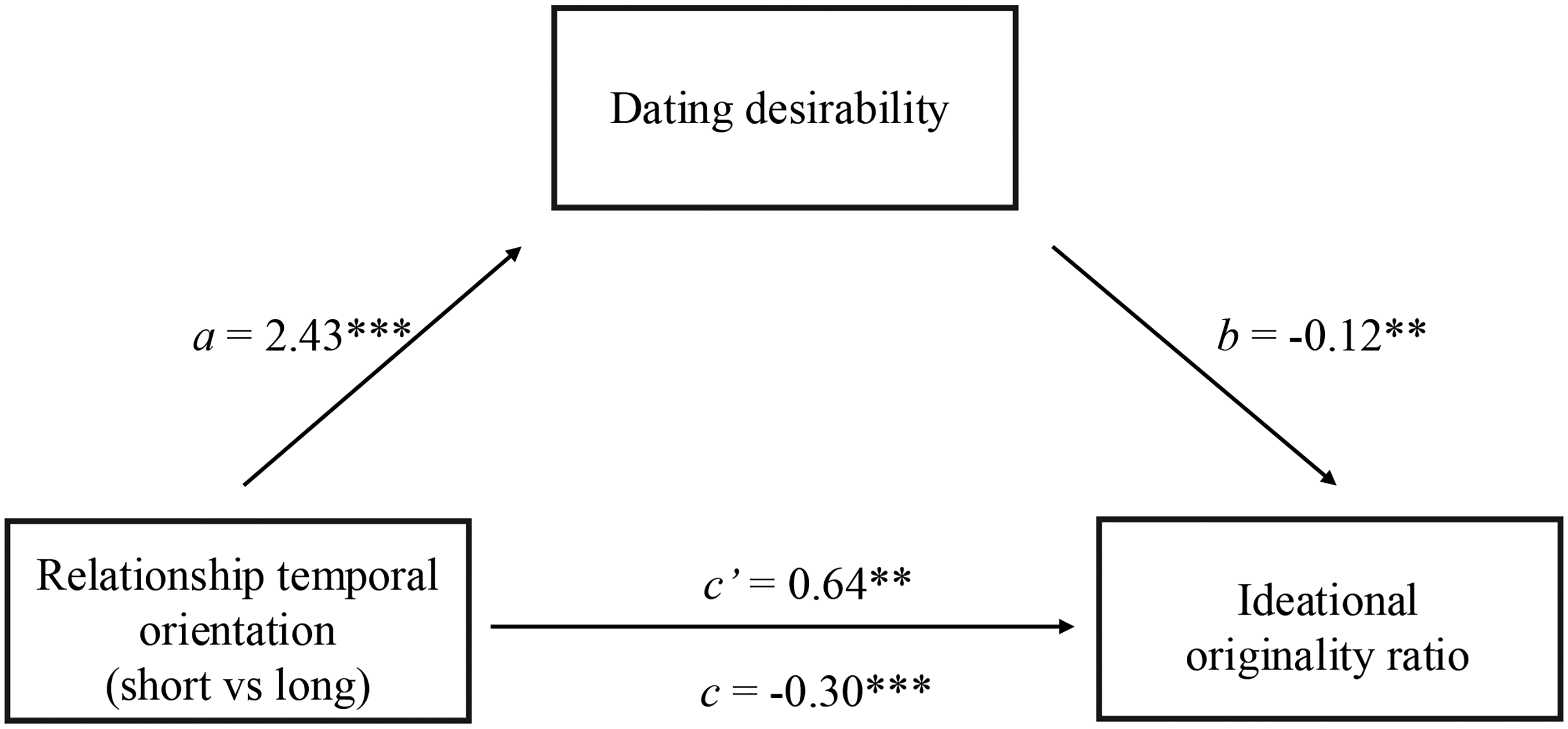
Mediation effect of dating desirability between the temporal inclination of the relationship and ideational originality ratio for women.
Men. When we tested dating desirability as a mediator, we observed no effect of temporal inclination on attractiveness ratings, b = 0.49, 95% CI [–0.053, 1.028] and consequently, the attraction did not predict men's ideational originality, b = -0.01, 95% CI [–0.112, 0.101]. The indirect effect was not significant, b = –0.00, 95% CI [–0.074, 0.059], indicating that attractiveness ratings did not mediate the relationship between the temporal inclination of mates and men's ideational originality.
In the model with dating desirability as a mediator, we found that men showed greater interest in dating mates with a long-term inclination, b = 0.98, 95% CI [0.349, 1.618]. However, dating desirability did not affect their originality of ideas, b = –0.07, 95% CI [–0.160, 0.020]. The indirect effect was not significant, b = –0.07, 95% CI [–0.204, 0.020], indicating that dating desirability did not mediate the relationship between the temporal inclination of mates and men's ideational originality.
The Suppressing Role of Dating Desirability Between Temporal Inclination of a Mate and Ideational Originality Ratio Among Women: The Role of Sexual Arousal
To further explore the suppressing role of dating desirability among women, we conducted a serial mediation analysis, incorporating sexual arousal as an additional mediator between dating desirability and the originality of ideas. We hypothesized that sexual arousal, as a response to dating desirability for an attractive man and linked to sexual motivation, might impair divergent thinking by facilitating more convergent thinking (Colzato et al., 2012).
The serial mediation model, which incorporated dating desirability as the predictor, sexual arousal as the first mediator, and originality of ideas as the outcome variable, was statistically significant, F(1, 256) = 88.86, p < .001. Long-term inclined mates predicted greater dating desirability, b = 2.43, 95% CI [1.920, 2.934], and dating desirability positively predicted sexual arousal, b = 0.24, 95% CI [0.171, 0.304]. However, sexual arousal negatively influenced originality women's ideas, b = -0.28, 95% CI [–0.438, −0.118]. The total model was not significant, b = 0.34, 95% CI [−0.025, 0.708], but the direct effect was significant, b = 0.48, 95% CI [0.063, 0.906], indicating that choosing long-term inclined mates for a date predicted greater originality of women's ideas. In this model, the indirect pathway with dating desirability as a single mediator ceased to be significant, b = –0.14, 95% CI [–0.407, 0.088], and the second pathway with sexual arousal as a single mediator was significant b = 0.15, 95% CI [0.051, 0.285]. At the same time, the whole pathway with two mediators was significant, b = –0.16, 95% CI [–0.275, −0.065], indicating that sexual arousal disrupted the divergent thinking of women choosing an attractive partner for a long-term relationship, when they desirability of a date was high. We present the serial mediation model for originality in Figure 2.
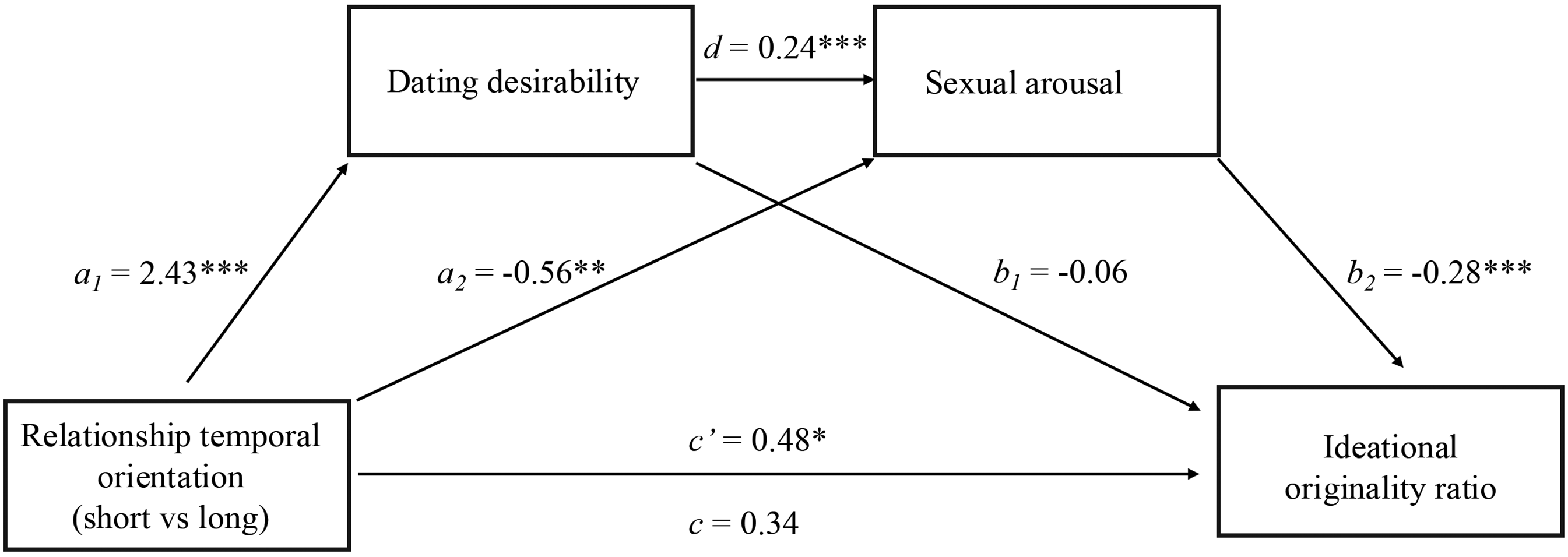
Serial mediation effects of dating desirability and sexual arousal between temporal inclination of the relationship and ideational originality ratio of women.
The similar pattern of serial mediation results was observed in the case of fluency (indirect effect for fluency was significant: b = –0.22, 95% CI [–0.383, −0.072]), but not for flexibility as the outcome variables (indirect effect for flexibility was not significant: b = –0.02, 95% CI [–0.046, 0.004]). We present the serial mediation model for fluency in Figure 3.

Serial mediation effects of dating desirability and sexual arousal between temporal inclination of the relationship and ideational fluency of women.
Relationship Satisfaction
For women, the reported relationship satisfaction was M = 7.37, SD = 2.18, and for men, it was M = 7.36, SD = 1.99 (on a 10-point scale). No significant effects were observed for relationship satisfaction when tested as a moderator.
Discussion
Using a repeated measures and between-subjects design, we aimed to investigate whether attractive mates, presented as options for either long-term or short-term relationships, could influence creativity. The analysis was conducted separately for men and women, with a specific focus on women, whose evolved sexual strategies are generally more long-term inclined compared to men (Schmitt, 2023). Beyond the previously introduced mediators and moderators, we also examined dating desirability as an indicator of women's interest in a particular mate, hypothesizing that it might serve as a mediator between mate selection and self-promotion behaviors.
The findings partially support the hypothesis that mate-related contexts influence creativity, as measured by divergent thinking. While overall creative performance did not directly increase following the selection of long- or short-term inclined mates, women demonstrated significantly greater fluency and originality after selecting long-term inclined mates compared to short-term ones. This result aligns with the idea that women may use creative displays as a strategy to signal qualities desirable in long-term partnerships (Griskevicius et al., 2006).
However, contrary to our predictions, women's dating desirability for a chosen mate negatively impacted their fluency and originality of ideas. This suppressing effect was mediated by sexual arousal: the more sexually aroused women felt after choosing a desirable long-term inclined partner, the fewer ideas they generated overall, and the less original those ideas were. These findings suggest that while long-term mate selection contexts can enhance creative output in women, heightened sexual arousal might counteract this effect. Maybe sexual arousal distracts women from displaying and has put them into fantasizing mode or maybe in an in-person situation sexual arousal would put women into nonverbal display mode. This indicates that women's creative self-presentation in front of a potential partner may involve a trade-off and can be suppressed by competing motives. On one hand, they may aim to stand out to attract an appealing mate; on the other hand, they might restrain themselves to avoid succumbing to intense passions that could lead to mostly irreversible life changes.
We did not find any mediating effects for attraction or dating desirability among men, which suggests that their creative thinking operates through different mechanisms.
General Discussion
In two experimental studies, we examined the ornamental role of creative thinking in men and women selecting potential mates for a date within a simulated dating portal context. In Study 1, we explored the influence of attractive versus unattractive faces of potential mates but found no significant differences in the creative self-presentation of men and women toward their chosen candidates. We also tested relationship status, which turned out to be significant only for men, with singles being more motivated to perform well and exhibiting greater fluency in their thinking. As mate attractiveness showed no direct impact on creativity, Study 2 focused on the temporal inclination of attractive mates. Participants viewed bios of attractive potential partners who described themselves as seeking either long-term or short-term relationships and completed a classic creative task (the Alternative Uses Test) by generating alternative uses for common objects before and after selecting their favorite candidate. For women, we hypothesized that creative performance would improve after selecting a potential long-term inclined mate, but we did not expect differences in creativity among men. While we observed a decrease in divergent fluency of women between pre- and post-test measurements, no such decrease was found in flexibility or originality of ideas. Interestingly, when controlling for tiredness—a potential confounder due to the experimental design—the decline in fluency disappeared. For men, no changes in any dimension of creativity were observed. We also anticipated differences between women choosing long-term versus short-term candidates. Results showed that women's ideas were more fluent and original, though not more flexible, after selecting long-term inclined (versus short-term) mates. No such differences were observed for men. However, a surprising finding emerged: the more dating desirability women reported after viewing long-term inclined mate profiles, the lower their ideational fluency and originality. A serial mediation analysis revealed that this decrease was explained by women's sexual arousal. Specifically, dating desirability after selecting long-term inclined mates predicted increased sexual arousal, which in turn negatively impacted both originality and the number of ideas generated (i.e., fluency). This pattern was not observed for ideational flexibility or for men.
The combined findings of the two studies offer nuanced insights into the interplay between mate selection and creativity. Our studies indicate that the context of long and short-term relationships can affect creative thinking specifically for women. In the light of evolutionary trade-offs, it is expected strategy of women, as they should prefer long-term relationships due to high minimal obligatory parental investments they face (Mogilski, 2021; Trivers, 1972). However, their creative potential in such a context is oriented toward fluency and originality, but not flexibility (i.e., different categories of insights). Thus, to achieve originality, they chose a strategy based on exploring a few content categories in great depth (i.e., persistence; Nijstad et al., 2010) rather than on high diversity of categories. The way of persistence may also reflect their mating strategy, as women on average increase their reproductive success by securing a partner who will invest in her and her future offspring, opposite to men, who may experience incremental gains with every sexual encounter they have with a fertile female (Crosby, 2021). Studies on sex differences in the desire for sexual variety (Buss & Schmitt, 1993, 2019; Vance et al., 2020; Varella et al., 2014) support such variety as not very characteristic of women's sexual strategy.
However, when a woman chooses a potential partner, an overly high level of romantic interest may suppress her creative potential, as our study found that this effect is due to sexual arousal. Sexual arousal generally depletes executive functioning and decision making, suppressing certain types of reflexive emotional responses (Arnell et al., 2007; Suchy et al., 2019). It may also deplete self-control resources or hinder access to cognitive capacities for self-control, potentially leading to riskier sexual decisions (Skakoon-Sparkling & Cramer, 2016). Such a risk is not aligned with women's sexual strategies and thus may inhibit strategies based on creative self-presentation. Sexual arousal may also be influenced by directed attentional focus (de Jong, 2009), which facilitates rather convergent than divergent thinking (Colzato et al., 2012). Overall, in the evolutionary past of our species, it was not in women's interest to overtly display motivations with sexual connotations (Buss, 2000; Thornhill & Gangestad, 2015), that is because sexual arousal of women usually leads to sexual desire and emotional intimacy (Basson, 2000). This could lead to choosing a low-quality mate, to risk having unwanted pregnancy or sexually transmitted diseases. Perhaps, therefore, a prevalent sexually neutral state allows women to maintain decision-making abilities and self-control in the challenging context of potential pregnancy. Women's creativity seems to be the result of a trade-off, as they face a significant risk of higher costs when selecting a long-term mate who may not commit (Kenrick et al., 1990). In this context, it makes sense that women seek reassurance that a potential mate is genuinely committed to investing in offspring before channeling their energy into creative displays (Griskevicius et al., 2006). The absence of similar suppression effects in men suggests sex-specific strategies in mating contexts, possibly shaped by distinct evolutionary pressures.
It should be noted that we found a difference in creativity between women and men (please check the analyses in the Supplementary Material). Women were more fluent compared to men, which indicates that they were more expressive. This effect has already been found in previous studies (Peter et al., 2021; Scheuringer et al., 2017), which may be related to the influence of estrogen (Schultheiss et al., 2021). Research generally shows higher verbal abilities in women compared to men (Barel & Tzischinsky, 2018; Hirnstein et al., 2023). This may be consistent with the hypothesis that women, throughout evolution, developed communication skills as their infants’ survival depended critically on mothers’ ability to engage in sustainable partnerships with group members other than the biological father (Hrdy, 2009). In our study, Women were also more likely to present their creative features to attract potential mates, which suggests that creativity may serve as their ornament, enhancing attractiveness more frequently than in men. Men, on the other hand, had more original ideas and demonstrated greater cognitive flexibility, allowing them to better shift to different perspectives, surprise the perceiver and communicate a wider range of traits about themselves, and enhance their originality. This could function as their armament, helping them stand out and gain an advantage in the competition for mates. However, men reported higher levels of sexual arousal and motivation to perform well, likely because they rated potential female partners as more attractive than women rated potential male partners. Men had also better moods after choosing a mate, and mood can promote creativity (Baas et al., 2008). Indeed, this positive mood explained men's fluency. Men are generally more concerned with a mate's attractiveness (Walter et al., 2020), so we would expect them to react more strongly.
In general, our modest results and the overall lack of support for most mating prime hypotheses, combined with the absence of similar studies in the literature over the past 20 years, could suggest publication bias and a general lack of replicability in this line of research. However, the absence of published (and successful) replications does not, in itself, serve as direct evidence of publication bias, nor should it completely refute this entire line of research. Moreover, our study was not necessarily an exact replication of the well-known article by Griskevicius et al. (2006). Instead, we conducted a conceptual replication, aiming to develop a new methodological approach. More studies are still needed, particularly preregistered investigations, including exact replications and those using meta-analytical approaches, to further establish the actual replicability rate of this research area. Until then, we can only propose hypotheses to make sense of the available and limited findings. (1) It is possible that laboratory experiments do not prime mating motivation as effectively as real-life mating situations. Future studies might benefit from sampling participants at night, when most flirting and mating interactions occur (cf. Varella, 2023; Varella et al., 2021). In this case, more research should focus on establishing and validating methodological approaches that create more ecologically relevant laboratory experiments. By simulating an online dating app in this two-study investigation, we have taken a first step toward this methodological contribution. (2) It is also possible that when selecting a partner in constrained contexts, where little information is available about potential partners, individuals prioritize self-similarities in personality traits and educational level (Conroy-Beam et al., 2019; Štěrbová et al., 2017), as well as other “necessities” in mate preference, such as good looks, earning potential, and kindness, over “luxuries” like creativity (Li et al., 2002). Future studies should better control for participants’ mate value and personality, ensuring homogamy and fulfilling mate preference necessities while testing whether creativity is preferred and activated in a mating context. (3) Cultural differences may also play a role. In some cultures, non-verbal signs of mate value and romantic interest, such as charm, charisma, perfume, voice pitch, and eye contact, may be more relevant for activating individuals’ creativity than purely verbal descriptions. Future studies should consider experiments with attractive confederates in contexts with a favorable atmosphere, such as dim lighting and background music. (4) Finally, it is possible that an individual's level of creativity, being a trait similar to personality, does not fluctuate significantly across situations, even in response to mating primes or flirting scenarios. Perhaps creativity is primarily assessed indirectly through social reputation or tangible creative outputs, such as innovative solutions or artistic works. Future studies should aim to disentangle these possibilities and contribute to advancing the field.
We should also acknowledge several limitations of our study. It examined creativity within the very specific context of a dating site. On one hand, this context is tied to sexual selection and mating motivation; on the other hand, it can trigger various associations that may encourage some individuals to express their creativity while inhibiting others. In Study 1, a key limitation may have been the requirement to write about oneself. While creativity, understood as a form of sexual ornamentation, can be a self-promotion tactic, it does not necessarily correlate with more creative or better self-reflection. Focusing on the “self” can disrupt mental flow or enhance it only in individuals with narcissistic traits (Nevická et al., 2016). Creativity thrives in states of emotional relaxation and playfulness (Proyer et al., 2019). Additionally, the element of evaluation introduced in the experimental manipulation (where women were asked to create a description that would later be rated by men based on photographs) may have affected their thinking, paradoxically reducing creativity among those who viewed photos of attractive candidates. The evaluation, when given by an attractive partner, may have caused more stress than one from an unattractive partner, especially when writing about oneself. Furthermore, the activation of “mating” motivation through reference to a potential date may not have had the intended effect for everyone. We showed participants only the faces of potential partners which differs from a real-life encounter. Direct contact with an attractive individual who sparks interest, including all nonverbal and multimodal communication self-presentation (Valentova et al., 2022), can have a much stronger influence on thinking and behavior. Across the two studies, we used different creativity measures, each assessing potentially distinct abilities. In Study 1, participants were asked to write a short bio, which may be associated with artistic abilities. In Study 2, we administered the Alternative Uses Test, which is more closely related to problem-solving abilities.
Conclusions
In conclusion, our findings provide mixed evidence for the context-dependent influence of mate selection on creative expression, particularly in women. Across two studies, we observed that women's creative output, measured through fluency and originality, was more pronounced when selecting long-term mates, highlighting the potential ornamental function of creativity in choosing long-term partnerships. However, this enhancement was disrupted by heightened sexual arousal linked to dating desirability, suggesting an inhibitory effect of physiological arousal on certain aspects of divergent thinking. The absence of similar effects in men underscores the sex-specific dynamics of creativity in mating contexts, shaped by distinct evolutionary pressures and strategic goals. Despite the modest findings and overall lack of replication of mating prime hypotheses, these results deepen our understanding of the interplay between cognitive processes, emotional states, and mating strategies, pointing to future avenues for exploring how situational and individual differences influence the adaptive use of creativity in human social interactions. Together, these studies highlight the importance of examining both psychological and physiological mechanisms to understand the ornamental role of creativity in human mating strategies and invite further investigation.
Supplemental Material
sj-docx-1-evp-10.1177_14747049251337983 - Supplemental material for The Influence of Mating Context on Creativity: Insights from Simulated Dating Scenarios
Supplemental material, sj-docx-1-evp-10.1177_14747049251337983 for The Influence of Mating Context on Creativity: Insights from Simulated Dating Scenarios by Katarzyna Galasinska, Aleksandra Szymkow and Marco Antonio Correa Varella in Evolutionary Psychology
Footnotes
Acknowledgements
The authors would like to thank the divergent thinking raters: Joanna Helska, Gniewomir Jachlewski, Małgorzata Osowiecka, Julia Piątek, Julia Sachar, and Urszula Sikora i Damian Stankiewicz.

Ethical Considerations
The studies involving human participants were reviewed and approved by the Ethical Review Board of the Faculty of Psychology in Sopot at SWPS University, Poland.
Consent to Participate
The participants provided their written informed consent to participate in this study.
Funding
The research was funded in whole by National Science Centre, Poland (grant numbers: 2021/41/HS6/02697). For the purpose of Open Access, the author has applied for a CC-BY public copyright license to any Author Accepted Manuscript (AAM) version arising from this submission.
Declaration of Conflicting Interests
The authors declared no potential conflicts of interest with respect to the research, authorship, and/or publication of this article.
Data Availability Statement
The datasets presented in this study can be found in the online repository: https://osf.io/7aycg/
Supplemental Material
Supplemental material for this article is available online.
References
Supplementary Material
Please find the following supplemental material available below.
For Open Access articles published under a Creative Commons License, all supplemental material carries the same license as the article it is associated with.
For non-Open Access articles published, all supplemental material carries a non-exclusive license, and permission requests for re-use of supplemental material or any part of supplemental material shall be sent directly to the copyright owner as specified in the copyright notice associated with the article.
