




Abstract
Evolutionary theory predicts the existence of relatively stable sex differences in partner preferences with, for example, males being more concerned with traits predicting high fertility and females with traits predicting high resource availability. We tested three predictions using personal advertisements from both traditional newspapers and internet dating services. In accordance with predictions, men offered resources more often than did women, and women requested resources more often than did men. Males in all age-categories preferred younger partners. Young females preferred older males, but the pattern was reversed for the majority of females past their fertile period. In contrast to predictions, there was no difference between males and females in the degree to which they offered, or asked for, physical attractiveness. Based on our results and a review of previous studies, we suggest that sex differences in factual or advertised preference for physical attractiveness may be more labile than sex differences in preference for resources and status across societies.
Introduction
Evolutionary psychology provides a framework in which to understand human behavior (Barkow, Cosmides and Tooby, 1995; Buss, 2007). One of the central tenets of this approach is the prediction that human behavior will reflect past (and to some extent present) selection pressures (Tooby and Cosmides, 1995). Thus, the brain is considered to consist of problem-solving modules that would have allowed our ancestors to cope with fundamental problems, such as food acquisition, predators, and social interactions including reproduction.
Sexual selection provides some of the best examples of adaptive evolution (Andersson, 1994). Furthermore, sexual selection theory and related fields (e.g., parental investment theory, Trivers, 1972) have generated some very general predictions with respect to differences between males and females. For example, a sex difference in reproductive investment, as in most mammals, predicts a sex difference in mate preferences, with females generally paying more attention to the resource holding potential (including social status) of a potential mate than should males (Andersson, 1994). The degree of sex differences could, however, be modulated by environmental factors, such as the temporal and spatial variation in resource distribution, which affects the extent to which male or female traits are indicative of genetic or phenotypic quality (e.g., Hill and Reeve, 2004; Jennions and Petrie, 1997). Furthermore, studies have shown that mate preferences depend on the type of relationship that is sought. For example, both men and women seem to put relatively more emphasizes on physical attractiveness for short-term sexual relationships than long-term relationships (Li and Kenrick 2006; Maner, Rouby and Gonzaga, 2008). Thus, it is an important task for evolutionary psychologists to address to what extent general predictions hold true in humans across social and environmental contexts and to what extent the degree of difference between males and females can be explained by context variation.
Many studies using different approaches have shown that there is general sex difference in mate preferences (e.g., Buss, 1989; Buunk, Dijkstra, Fetchenhauer, and Kenrick, 2002; Feingold, 1990; Gottschall, Martin, Quish, and Rea, 2004; Wiederman, 1993). Males are more concerned with phenotypic attributes that are considered ‘attractive’ and that have been shown to be honest indicators of female fertility (including age as one of the prime indicators of fertility; e.g., Jasienska, Ziokiewicz, Ellison, Lipson, and Thune, 2004; Kenrick and Keefe, 1992; Symons 1979) and that perhaps could serve as indicators of female and, ultimately, offspring health (e.g., good genes; Tovée, Maisey, Emery, and Cornelissen, 1999). Females, on the other hand, are more concerned with resources and status in a partner, which should provide important resources for parental care (e.g., Ellis, 1992). However, there are good reasons to believe that the strength, and perhaps even the direction, of the sex difference in preferences or mating strategies may be modulated by environmental factors (Gangestad and Simpson, 2000). In particular, it is important to examine mate preferences in societies that show limited differences between males and females in terms of how power and resources are distributed, since they are frequently inferred as an important confounder of evolved preferences per se (Low, 2007). In the present study, we tested three general predictions from sexual selection theory in the Swedish population, one of the most egalitarian societies in the world (Hausmann, Tyson, and Zahidi, 2007):
Men, more so than women, should value physical attractiveness indicative of high fertility.
Specific predictions: Men should more often request, and women more often offer, physical attractiveness in advertisements.
Men, more so than women, should search for youthful (and hence fecund) mates.
Specific predictions: Male advertisers should list age as a preferred trait more often than females and seek younger partners, whereas females should seek older partners. With increasing age, men should seek women that are increasingly younger than themselves.
Women should prefer men with strong resource-holding potential.
Specific predictions: Women, more so than men, will list good economic and social status as a requested trait in their advertisements. Men, more so than women, should provide information about resources and social status.
In addition, we were interested in whether the results were consistent across forums (internet or newspapers) and across ages and to what extent self-reported attractiveness and resource holding potential were correlated with preference for the same traits. We used data collected from personal advertisements, which has the benefits that they are free from any bias introduced by experimenters, that basic data on mate preferences can easily be extracted, and that it is highly repeatable across populations as many cultures have similar practices, thereby facilitating future application of meta-analysis (Feingold, 1990; Lynn and Bolig, 1985).
Materials and Methods
Data were collected from two types of media: online dating-services and Swedish daily papers. Four different sources were used: GöteborgsPosten (paper), Aftonbladet (paper), Match.com (www) and SprayDate.se (www). All four sources are directed towards a broad readership/client group. All advertisers were heterosexual in the age-range 20–79 years, and collected from November 2006 to February 2007. The advertisers were chosen as the first 50 ones for each sex and source, yielding a total of 400 ads. The information level of the data varied both within and between sources. To allow inclusion of all advertisements in the analyses data were therefore categorized (see below). Note that the sources could have pre-selected advertisements by criteria not known to the researcher.
The following traits were analyzed for male and female advertisers:
Physical attractiveness: advertisers describing themselves in terms of, or expressing a preference for, physical attractiveness (e.g., athletic, beautiful, pretty, tall, handsome, body well exercised, etc.) were classified as offering or wanting good looks.
Resources: advertisers describing access to, or preference for, resources or resource potential (e.g., financially stable, intelligent, professional, no financial problems, big house) were classified as offering or wanting resources.
Age: the age preference of the advertiser was classified into three categories: preference for older, similar or younger partner. When the preferred age was not specified, but given as a range by the advertiser, the midpoint value of the range was calculated, compared to the advertisers own age and then categorised as younger, similar or older. Advertisements that did not provide any preference for age were treated as missing values. Ambiguous information (e.g., retired, recently retired, mature, appropriate, middle aged etc.) was not used for age classification. To allow statistical analysis of differences among age-groups, advertisers were classified into three age groups: a = 20–39, b = 40–59, c = 60–79. If advertisers' age was provided as +50, it was set to category b, 40–59 etc.
Thus, the data were categorized as follows for the statistical analysis:
Sex: male or female
Age category: a; 20–39, b; 40–59, c; 60–79
Age preference: older / younger / similar / missing
Looks offered: present = 1 / absent = 0
Looks wanted: present = 1 / absent = 0
Resource offered: present = 1 / absent = 0
Resource wanted: present = 1 / absent = 0
Statistical analysis
The data were analyzed in SPSS statistical software (v. 15) using Pearson Chi-Square tests for independence, or Fisher's exact test when required (according to Siegel and Castellan, 1988). For multiple tests on the three age categories, or the four sources, α-values were Bonferroni-adjusted. The data was initially analyzed for variation among the four sources (two papers, two web sites), using multilevel logistic regression. These analyses, which are not detailed here to simplify presentation, showed that variation among sources had no significant effect on the main hypotheses tested (i.e. the sex effects). This suggests that the four sources attract clients from a similar range of socio-economic groups. Therefore sources were pooled for the final analyses to simplify presentation and increase statistical power.
Results
Table 1 presents a summary of all data collected.
Frequencies of men (n = 200) and women (n = 200) offering and wanting age, looks and resources. For more detailed information, see Table 2 and text.

The first hypothesis was not supported by our data, as there was no significant difference between males and females in the proportion of advertisements seeking good looks (χ2 = 0.82, p = 0.37). Furthermore, there was no significant sex difference in the proportions of advertisements that offered good looks (χ2 = 1.38, p = 0.24). On average 67.8% of the advertisers offered good looks, whereas 44.8% wanted good looks.
There were no differences between the sexes in their propensity to list age as a preferred trait (χ2 = 0.36, p = 0.55). In both sexes about half of the advertisers listed age preferences. Of a total of 97 (48.5%) males that included age in their advertisements, only three wanted older partners and none wanted similar-aged partners. As for females, 43 out of 92 (46%) asked for older, 34 asked for younger, and 15 for similar-aged men (significantly different from males, χ2 = 77.8, p < 0.001). However, this pattern differed between age categories (Table 2).
Frequencies of men (n = 200) and women (n = 200) in three age categories wanting younger, older or similar-aged partners.
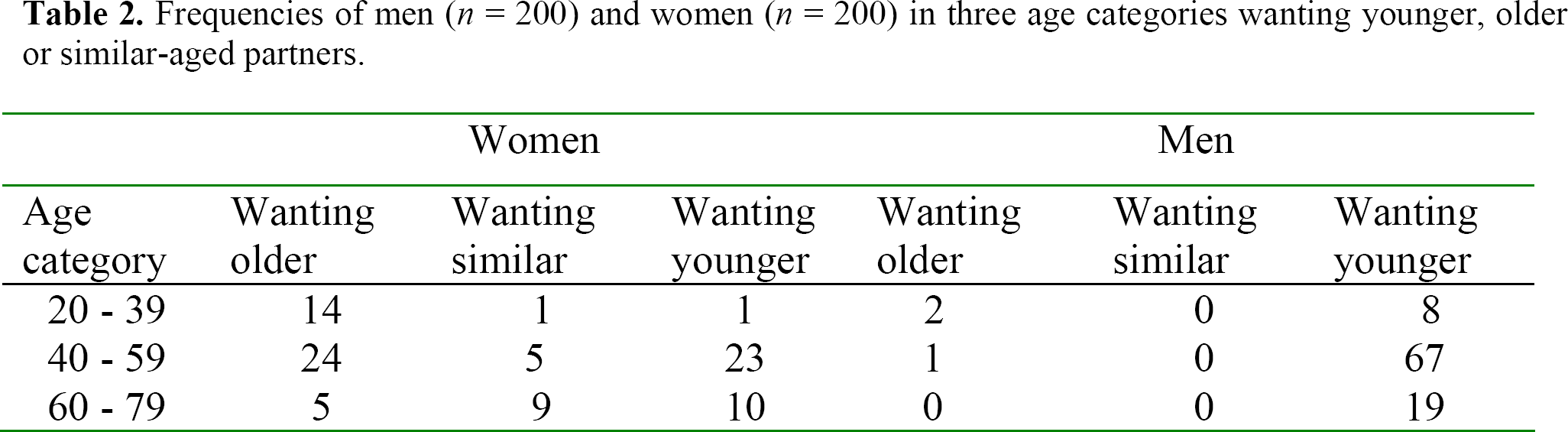
Older women preferred younger men, whereas approximately 50% of middle-aged women asked for younger men and the majority of younger women asked for older or similar-aged men (χ2 = 23.1, p < 0.001). There was a strong sex-difference in the extent to which advertisers offered resources, with 110 (55%) males including resources in their advertisements compared to 46 (23%) females (χ2 = 43.0, p < 0.001). Also in line with predictions, more females (80 or 40%) asked for resources than did men (30 or 15%) (χ2 = 32.8, p < 0.001). Advertisers that offered good looks also asked for good looks to a larger extent (female: χ2 = 14.62, p < 0.001; male: χ2 = 23.88, p < 0.001) and the same pattern was found for resources (female: χ2 = 13.2, p < 0.001; male: χ2 = 13.3, p < 0.001). Females that offered good looks tended to be more likely to demand resources than females not offering looks, but this was not significant (χ2 = 2.29, p = 0.13). Finally, men offering resources were not significantly more interested in good looking females than men not offering resources (χ2 = 1,50, p = 0.22).
Discussion
Our data on Swedish personal advertisements showed mixed support for broad predictions from sexual selection theory. Females asked for resources to a greater extent than did males, whereas males offered resources to a greater extent than did females, which is confirmed by all similar studies to date that we are aware of. In contrast to predictions, however, males and females did not differ in the proportion of advertisers asking for physical attractiveness and both sexes were more likely to offer attractiveness than seeking it.
There are several potential explanations for a difference in the strength of different mate preferences between males and females. For example, preferences for physical attributes are perhaps more readily modulated by social factors that vary more across cultural contexts. Arguably, preferences for physical attributes could be influenced by cultural practices, such as the exposure to physically attractive people in media (e.g., Hetsroni, 2000), which would suggest that it is highly dependent on societal values and practices. Although most studies have found sex differences in the preference for, and offer of, physical attractiveness, negative results from this, and some other studies (e.g., Badahdah and Tiemann, 2005; Gil-Burmann, Peláez, and Sánchez, 2002; Marlowe, 2004; Neto, 2005; Oda, 2001), may indeed suggest that the sex difference in resource preference is stronger and less flexible than the sex difference in preference for physical attractiveness, and that it is more strongly affected by the age of the advertiser. However, the finding that sex does not affect the perceived attractiveness of facial symmetry (Rhodes, 2006) may suggest that males and females share the same basic cognitive adaptations for detecting cues for genetic and phenotypic quality through good looks. Furthermore, the available evidence suggest that females in more egalitarian situations tend to put relatively more emphasis on attractiveness than on resources in a mate (Eagly and Wood, 1999; Koyama, McGain, and Hill, 2004; Moore and Cassidy, 2007; Moore, Cassidy, Smith and Perrett, 2005), perhaps as a result of a more causal attitude towards relationships that are primarily sexual. However, more long-term relationships seem to be protected by evolved psychological mechanisms reducing the attention of both sexes to the physical attractiveness of alternative partners (Maner, Rouby, and Gonzaga, 2008). Alternatively, if highly attractive males are more likely to desert and females with relatively high amount of resources may be better able to cope with loss of male investment, this could modify the cost-benefit calculations of employing a specific mating strategy (Gangestad and Simpson 2000; Waynforth, 2001). Although it is uncertain if the effect of resource status is sufficiently large to eliminate sex differences in partner preferences within populations, it would predict an opposite pattern to the one observed here since Sweden has one of the highest gender equality worldwide (Hausmann, Tyson, and Zahidi, 2007). Thus, our results imply that changes in the relative social and economic standing of males and females do not necessarily lead to a reduction in sex differences in preference for resources or social status, which may therefore be a relatively canalized preference in the human population. Our study also suggests that yet unidentified cultural factors influence male and female preferences for physical attractiveness. Furthermore, both sexes were more likely to offer than to seek physical attractiveness, which may suggest that men have responded to an increased female interest in physical attractiveness. To what extent different mate preferences and mating strategies are coupled and affected by the same environmental and cultural factors remains to be seen. A potentially useful approach to address some of these issues would be to use advertisements collected from newspapers archives to investigate to what extent preferences vary on a temporal scale within a given society, such as Sweden.
Importantly, although virtually all studies agree on the direction of sex differences in mate preferences, the degree of differences shows substantial variation across (and within) human populations (e.g., Buss, 1989; Eagly and Wood, 1999; Feingold, 1990; Johannesen-Schmidt and Eagly, 2002). An important challenge is to explain to what extent this reflects flexible adjustment to local conditions that would increase the ability to secure high quality mates and if such plasticity have been under selection in human populations (see Gangestad and Simpson, 2000). We argue that this requires a shift in research focus to emphasize the dynamics of mating strategies as outcomes of past selection and interactions between individuals and their social and asocial environment within societies, rather than attempting to separate origins of sex differences into evolved preferences versus social constructions across societies (see e.g., Eagly and Wood, 1999; Gangestad and Simpson, 2000, and the associated commentaries on their paper for discussion). For example, variation in mating strategies within each sex could represent adaptive adjustment in relation to individual costs and benefits of employing a specific strategy in a given context (Gangestad and Simpson, 2000), including one's own age (see below). Such flexibility may also reduce between sex differences at the population level if population-wide environmental effects (or cultural practices) on cost-benefit ratios are sex-specific. Although this is likely to affect the strategy employed, it should not affect the preference in idealized situations where costs are negligible. Consequently, studies of sex differences in romantic or sexual fantasies (Buunk, Dijkstra, Kenrick, and Warntjes, 2001; Ellis and Symons, 1990; Kenrick, Gabrielidis, Keefe, and Cornelius, 1996) could potentially serve as a complementary approach that would help to understand the extent to which mating strategies (but not preferences per se) are adjusted in relation to local conditions.
Our results also suggested that age preferences change across age groups in different ways for men and women, parallel to previous findings (e.g., Bereczkei, Voros, Gal, and Bernath, 1997; Buunk, Dijkstra, Kenrick, and Warntjes, 2001; Campos, Otta, and Siquierra, 2002; De Sousa Campos and de Oliviera Siqueira, 2002). Similar to all previous studies, young men had an overall preference for younger females and vice versa. However, whereas males consistently preferred younger females as predicted by evolutionary theory, this preference was reversed in older females. In other words, females in the age group 40–79 frequently preferred younger males, possibly as a result of the sex difference in survival and its related decline in health with increasing age (see also Bereczkei et al., 1997), or a decline in resource availability for the oldest age group of males. Indicators of high male fertility or genetic quality obviously should play little role in mate choice for females past their reproductive age. In fact, its seems difficult to make a case for a directional prediction for changes in mate choice with increasing age in women, except for the general expectation that resources should continue to be important. However, in both men and women, our results show that one's own age is a strong predictor of the preferred age of a partner in personal advertisements. Although this has been suggested to support social theories rather than evolutionary (to the extent that they are incompatible) (Rasmusson et al., 1998), the most parsimonious explanation is probably that it simply reflects the fact that personal advertisements are often used to find social, as well as sexual, partners (where similarity in personality is a more important factor). This will clearly apply to women past their fertile period. However, each individual also has an own (perceived) mate value that determines the range of available mates (e.g., Buunk, Dijkstra, Kenrick and Warntjes, 2001). In other words, older men and women may prefer even younger partners than expressed in advertisements, but this would result in a very low rate of answers. When asked about the age of sexual partners without restrictions (i.e., fantasies), both old and young men tend to prefer females in their peak of fertile years (Buunk, Dijkstra, Kenrick and Warntjes, 2001; Ellis and Symons, 1990; Kenrick et al., 1996). Social effects on perceived mate value and the degree to which it affects mate choice in humans have only recently been subject to detailed studies (Jones, DeBruine, Little, Burriss, and Feinberger, 2007; Little, Burriss, Jones, DeBruine, and Caldwell, 2008; Uller and Johansson, 2003; Waynforth, 2007).
Although the primary aim of the present study was to provide tests of simple and broad predictions, there may be substantial variation also at a smaller scale, such as in relation to population density or social group (e.g., Koyama, McGain, and Hill, 2004; McGraw, 2002). Unfortunately, advertisements in the present study did not include sufficient information to allow ambiguous classification of many potentially interesting aspects (such as factual income, population density etc). However, there was no evidence that advertisements from internet or traditional newspapers differed in any respects except in the quality of the information provided. Thus, if this result is consistent across cultures, internet-based surveys are unlikely to yield biased estimates of the population as a whole. Data from advertisements are easily collected and widely available in different countries and further accumulation of studies such as the present one will allow meta-analytical approaches to the study of human mate preferences across cultural contexts (Feinberg, 1990; Lynn and Bolig, 1985). Ideally, such studies should be combined with more detailed studies of within-cultural variation to provide a better understanding of plasticity in preferences in males and females and their adaptive significance.
Footnotes
Acknowledgements
JIJ was supported by the Swedish Research Council for Environment, Agricultural Sciences and Spatial Planning. TU was supported by the Wenner-Gren Foundations. We are very grateful for the constructive criticism by the anonymous reviewers that helped us improve the paper.