



Abstract
Differentiation of self refers to the capacity of individuals to manage their emotions, remain thoughtful in strong emotional experiences, and the ability to experience intimacy and independence in relationships. Individual differences in differentiation of self may influence the performance of mate retention behaviors. Because poorly differentiated individuals find separation and rejection unbearable and anxiety-provoking, we hypothesized that different levels of differentiation is related to different strategies of mate retention behaviors. However, little empirical attention has been given to the relationship between differentiation of self and mate retention behaviors, particularly in non-individualistic cultures. We aimed to investigate the mediating role of communication patterns in the relationship between differentiation of self and mate retention behaviors. The sample included 282 married individuals from Community Centers (some neighborhoods in Tehran, Iran). The results supported the associations between mate retention behaviors and differentiation of self, and also showed that communication patterns mediate this relationship. This study improves our understanding of differentiation of self and mate retention behaviors in the context of long-term committed relationships from an evolutionary psychological perspective.
Introduction
The concept of differentiation of self (DOS), first introduced in Bowen’s family systems theory (BFST), involves the ability to balance the intrapsychic and interpersonal dimensions of the self (Bowen, 1978; Kerr & Bowen, 1988). In the intrapsychic realm, differentiation of self refers to the ability to distinguish intellectual processes from feeling processes. Differentiation on the intrapersonal level involves the ability to experience both intimacy with others and autonomy from others. There are at least four components of differentiation: emotional cutoff (fear of intimacy and feeling vulnerable in relationship with others), emotional reactivity (oversensitivity in response to strong emotions), fusion with others (excessive involvement with others in close relationships and a desire to gain their acceptance and approval), and the ability to take an “I-position” (preserving a clear sense of self and advocating one’s beliefs when expected by others to act otherwise) (Kerr & Bowen, 1988). According to Bowen’s theory (1978), a healthy balance between independence and interdependence with important others indicates a person’s level of differentiation. Greater differentiation allows one to be an emotionally separate person with the ability to experience strong feelings or transition to calm, logical reasoning considering the circumstances. They are better capable of regulating their emotions and coping with life stresses. In contrast, poorly differentiated people are emotionally reactive, and have difficulty thinking clearly in stressful situations since most of their energy is spent on the experience, expression, and intensity of their feelings. They find separateness or intimacy threatening, and subsequently, tend to engage in fusion or emotional cutoff. Thus, differentiation of self can be considered effective in establishing the form and intensity of a romantic relationship which involves a great deal of emotional intimacy.
Consistently, differentiation has been found to be an important factor in relationship satisfaction (Peleg, 2008; Skowron & Friedlander, 1998; Skowron, 2000). Moreover, Bowlby’s (1969) attachment theory and Bowen’s family systems theory share two similar underlying dimensions, that is, the dialectic needs for autonomy and intimacy in important relationships (Skowron & Dendy, 2004). Attachment theory conceives of attachment behaviors as a result of an evolutionary biobehavioral system between primary caregivers and young children. Family systems theory is considered to contribute to attachment theory to create an explanatory model of relationship outcomes (Hooper, 2008). Demidenko et al. (2010) found attachment avoidance to be negatively associated with differentiation of self in a clinical sample of women with eating disorders. Research also suggests that attachment anxiety is negatively related to differentiation of self (Simon et al., 2019).
Anxiously attached individuals who are characterized by their excessive dependence on romantic partners for confidence and stability report more frequent implementation of various mate retention behaviors (Barbaro et al., 2015). Mate retention tactics comprise a broad menu of behaviors ranging from acts of kindness and resource provisioning, to vigilance, manipulation, and violence. Mate retention effort often occurs in response to a perceived or actual relationship threat (Buss, 1988). Mate retention behaviors are subsumed by two superordinate domains of Benefit-Provisioning mate retention and Cost-Inflicting mate retention (Atari et al., 2017a; Miner et al., 2009). Benefit-Provisioning mate retention includes behaviors that reduce the likelihood of partner infidelity by increasing relationship satisfaction. Cost-Inflicting mate retention includes behaviors that reduce the likelihood of partner infidelity by lowering the partner’s self-esteem (Miner et al., 2009).
Individuals lower on differentiation of self are more concerned about being rejected and abandoned by their partners, which is similar to poorly differentiated people who are emotionally reactive and fuse with partners because they experience separation, distance, and rejection as overwhelming (Kerr & Bowen, 1988), as is typically seen in anxious attachment. Anxiously attached individuals, therefore, perform mate retention tactics such as controlling behaviors to obtain reassurance and support from their partner (Barbaro et al., 2015). Thus, poorly differentiated individuals may perform more of both benefit-provisioning and cost-inflicting mate retention behaviors. In contrast, highly differentiated people may perform less of mate retention behaviors.
Communication in long-term relationships may partially explain the theoretical relationship between self-differentiation and mate retention behaviors. Couples with higher differentiation try to express warmth and affection when they communicate with each other (Schnarch, 1997). Regardless of differences, they embrace each other and enjoy high levels of closeness and intimacy without any fear of abandonment or engulfment (Bowen, 1978). According to family systems theory, high levels of differentiation is an essential condition for intimacy in marriages and long-term relationships (Guerin et al., 1996; Titelman, 1998). Despite the inconsistencies in definitions of intimacy, a couple’s level of closeness, connection, and sharing of values and ideas that develops through communication is the most general conceptualization of intimacy (Laurenceau et al., 2005). Researches have shown communication to be an important factor; high levels of intimacy in couples can be predicted by positive experiences of communication. For instance, when couples disclose thoughts or feelings and both of them validate or accept each other’s self-disclosure, they feel more intimate (Laurenceau et al., 1998, 2005; Mitchell et al., 2008; Reis & Shaver, 1988). Communication has been a focus for researchers in marriage and relationship issues and a substantial body of research has found an association between communication patterns and relationship satisfaction (Bradbury & Karney, 1993; Christensen & Shenk, 1991; Christensen et al., 2006; Lavner et al., 2016). The studies which focus on a family systems perspective conceptualize marital interaction as interdependent communication patterns among partners. Some couples openly discuss problems, express feelings and negotiate during conflicts to form a mutual constructive communication that helps to achieve higher relationship satisfaction. While other couples who report a tendency to be mutually avoidant in problems and conflicts or the ones who engage in a pattern of demanding and withdrawing, experience lower marital satisfaction (Bradbury & Karney, 1993).
From an evolutionary psychological perspective (see Buss, 1988), marital satisfaction is a mental state regulated by different mechanisms that reflect the benefits and costs of a marriage. Across cultures, people perform mate retention behaviors that either provision a benefit to partners or inflict a cost on them to maintain a long-term relationship, prevent infidelity and avoid relationship dissolution (Barbaro et al., 2015; Buss, 1988; Buss & Shackelford, 1997). Mate retention tactics range from positive or benefit-provisioning tactics, such as buying a gift, to negative or cost inflicting tactics, such as violence against the partner or rival (Buss & Shackelford, 1997). Studies have demonstrated that the mate retention strategies partners use depends on several factors such as personality traits (Atari et al., 2017a; De Miguel & Buss, 2011; Holden et al., 2014), gender (Buss, 1988; Buss & Shackelford, 1997), age (De Miguel & Buss, 2011), religiosity (Karimi-Malekabadi & Esmaeilinasab, 2019), and attachment orientation (Barbaro et al., 2019). In the past few years, some researches have studied mate retention strategies in Iran. For example, benefit-provisioning mate retention was found to be positively related to consideration of cosmetic surgery in Iranian women (Atari et al., 2017b). In another study, Karimi-Malekabadi et al. (2019) have shown that self-promotion intrasexual rivalry is associated to benefit-provisioning mate retention behaviors whereas rival-derogation attitudes in intrasexual rivalry is correlated with performance of cost-inflicting mate retention behaviors among Iranians.
Several researches have examined the association between mate retention strategies and marital satisfaction. To our knowledge, no study has investigated the relationship between mate retention tactics and differentiation of self and the hypothesized mediating role of communication in this relationship. The current study seeks to investigate this relationship in Tehran, which is considered to be the political and social capital of Iran. It is the most populous city in Western Asia, and it has a substantial diversity in religiosity. We also investigate the mediating role of communication patterns and propose a structural mediating model (see Figure 1).

Proposed mediating model.
Method
Participants
In this study, we recruited married participants from Community Centers. We invited a randomized sample of 60 individuals from each Community Centers (north, south, east, west, and center of Tehran) and the data collection process lasted about one month. The final sample consisted of 282 participants aged between 18 to 50 years (M = 29.0). Of these individuals, 48.6% were female and 51.4% were male. The relationship length was between 1 to 13 years (M = 4.5). With respect to education, six participants had some school education, 32 had a high school diploma, 37 had an associate’s degree, 128 had a bachelor’s degree, 65 had a master’s degree, 14 had a doctorate degree.
Measures
Differentiation of self
The Differentiation of Self-Inventory-Revised (DSI-R; Skowron & Schmitt, 2003) was used to measure the construct of differentiation. The DIS consists of 46 items and four subscales, including emotional reactivity (ER), “I” position (IP), emotional cutoff (EC), and fusion with others (FO). Each item was rated from 1 (not at all true of me) to 6 (very true of me). Yousefi et al. (2009) has demonstrated satisfactory reliability and validity of the scale in Iran. Cronbach’s α for the full-scale score was 0.82, and the correlation coefficients were 0.74, 0.80, 0.70, and 0.67 for ER, IP, EC, and FO, respectively.
Mate retention
We used the Mate Retention Inventory-Short Form (MRI-SF; Buss et al., 2008) which is a 38-item measure used to assess 19 mate retention tactics clustered under two superordinate categories of benefit-provisioning and cost-inflicting. Participants reported how frequently they performed each behavior in the last year, on a 4-point likert scale ranging from 0 (never) to 3 (often). Atari et al. (2017) reported satisfactory psychometric properties of the Persian translation of the MRI-SF in the Iranian context. The Persian version of the MRI-SF confirmed two superordinate factors: benefit-provisioning and cost-inflicting, found by Miner et al. (2009) and Lopes et al. (2016). Reliability coefficients of Benefit-Provisioning (α = 0.86) and Cost-Inflicting (α = 0.79) components were calculated by averaging the appropriate items.
Communication patterns
We used the Communication Patterns Questionnaire (CPQ; Christensen & Sullaway, 1984) which has been designed to assess how couples communicate in three stages of marital conflict: (1) when a problem arises; (2) during the discussion of the problem; (3) after the discussion is over. It is a 35-item measure to indicate how couples typically behave in their relationship, on a 9-point Likert scale from 1 (very unlikely) to 9 (very likely). CPQ has five subscales: (1) mutual constructive communication, (2) mutual avoidance-withholding, (3) total demand/withdraw, (4) man demand-woman withdraw, and (5) woman demand-man withdraw. Rezaian et al. (2017) showed satisfactory psychometric properties of the Persian translation of this questionnaire. In this sample, the Cronbach’s α for the full-scale, mutual constructive communication, mutual avoidance-withholding communication, and demand /withdraw subscales were 0.80, 0.61, 0.50, and 0.62, respectively.
Results
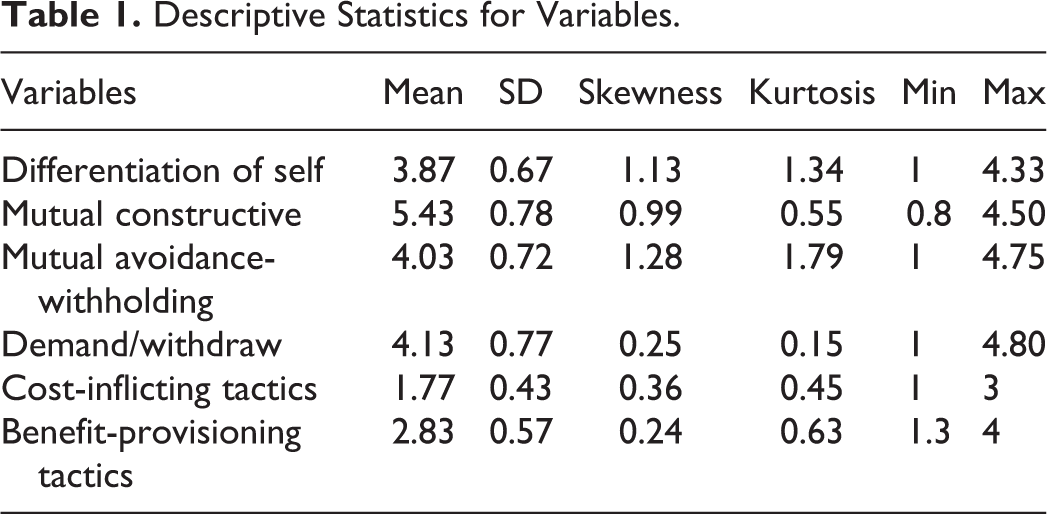
Descriptive statistics for all variables are presented in Table 1. Skewness and Kurtosis coefficients were used to assess the normality of the data. According to Curran et al. (1996), skewness <± 2 and kurtosis <± 7 are indicative of normal distributions, so all of the variables conformed to assumptions of normality.
Descriptive Statistics for Variables.
As shown in Table 2, differentiation of self was positively correlated with mutual constructive communication, whereas it was negatively associated with mutual avoidance-withholding and demand/withdraw communication. In addition, differentiation of self is positively associated with benefit-provisioning and negatively associated with cost-inflicting mate retention tactics. Mutual constructive communication was positively correlated with benefit-provisioning tactics, and negatively correlated with cost-inflicting tactics. Additionally, mutual avoidance-withholding and demand/withdraw communication were positively correlated with cost-inflicting, and negatively correlated with benefit-provisioning mate retention behaviors.
Correlation Coefficients Between Research Variables.

* p < .05, **p < .01.
In order to analyze the mediating effects of communication patterns in the relationship between differentiation of self and mate retention strategies, LISREL software package was used to test the proposed model. Standardized coefficients for the direct, indirect and total effects of variables on two different components of mate retention strategies are shown in Figures 2 and 3.

Combined direct and indirect effects on cost-inflicting tactics: β (t-value). *p < .05, **p < .01.
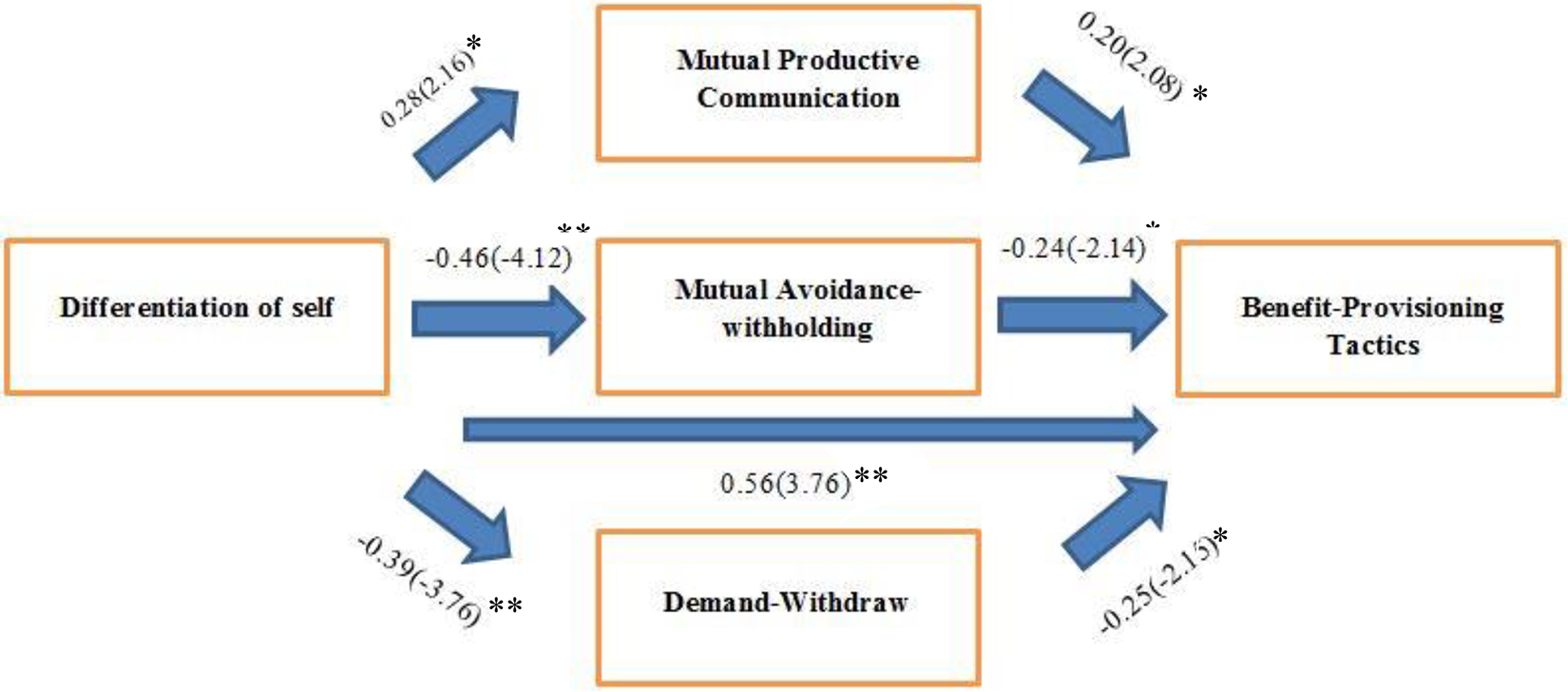
Combined direct and indirect effects on benefit-provisioning tactics: β (t-value). *p < .05, **p < .01.
Figure 2 shows that all path parameters are significant. Regarding direct effects, both differentiation of self and mutual constructive communication were negatively correlated with cost-inflicting tactics. However, demand/withdraw and mutual avoidance-withholding communication were positively correlated with cost-inflicting tactics. Indirect effect of differentiation of self on cost-inflicting tactics was also significant (β = −0.25, t = −2.18, p < .05). This suggests that all three communication patterns mediated the relationship between differentiation of self and cost-inflicting tactics.
Figure 3 shows the path parameters of the other mediating model. Regarding direct effects, both differentiation of self and mutual constructive communication were positively associated with benefit-provisioning tactics. Nonetheless, demand/withdraw and mutual avoidance were negatively associated with cost-inflicting tactics. Indirect effect of differentiation of self on benefit-provisioning tactics was also significant (β = −0.25, t = −2.18, p < .05), which suggests that all three communication patterns mediated the relationship between differentiation of self and benefit-provisioning tactics.
We have also conducted the sobel test (Preacher & Leonardelli, 2001) to confirm that the mediation effect was statistically significant. Table 3 shows the results of the mediation analyses.
Sobel Test Results for Mediation Effects.

Note: SE = standard error
* p < .05.
** p < .01.
*** p < .001.
The goodness of fit indices are presented in Table 4. The fit indices for the constructed model indicate a reasonably good fit. The χ 2 /df ratio (χ 2 = 7.03, df = 3, χ 2 /df = 2.34) is less than the recommended threshold of 4.0 (Kline, 2011). The root mean square error of approximation (RMSEA = 0.048) met the recommended maximum threshold of 0.05 for satisfactory fit (Hooper et al., 2008). According to Hu & Bentler (1999), for comparative fit index (CFI = 0.96) and goodness-of-fit index (GFI = 0.93), values more than 0.9 are considered acceptable, which is also satisfied in this model.
Goodness of Fit Indices.

Discussion
The purpose of this study was to investigate the association between differentiation of self and mate retention behaviors, and the mediating role of communication patterns in this relationship. The results revealed a statistically significant association between differentiation of self and the type of mate retention strategies a person chooses to retain their mate. Highly differentiated individuals chose more of benefit-provisioning, while less differentiated individuals preferred cost-inflicting strategies. These findings are consistent with previous research on differentiation of self and its role on marital adjustment, suggesting couples in less differentiated marriages lack emotional maturity and possess a limited capacity for separateness (Bowen, 1978; Kerr & Bowen, 1988; Schnarch, 1997), requiring husbands and wives to perform negative mate retention tactics to maintain stability in their romantic relationships. In contrast, greater differentiation is thought to allow for greater intimate contact, greater tolerance, and less emotional reactivity (Bowen, 1978; Kerr & Bowen, 1988) to motivate couples to perform positive mate retention strategies aimed at preventing their partner’s defection from the marriage. Many tactics in the benefit-provisioning domain of mate retention, such as “Love and Care,” and “Sexual Inducements” (see Buss et al., 2008) require physical and emotional closeness with the partner (Miner et al., 2009). The positive association between differentiation of self and benefit-provisioning mate retention or that less differentiated individuals choose cost-inflicting strategies over benefit-provisioning strategies may stem from persistent fear of physical and emotional closeness, and intimacy in less differentiated individuals, and the capability of highly differentiated individuals to experience intimacy and strong emotions without being consumed by them. Differentiation of self appears to relate to a person’s ability in preserving an intimate relationship and how to manage it throughout unpleasant events and conflicts.
Concerning the association between differentiation of self and communication patterns (i.e., Mutual constructive communication, Mutual avoidance-withholding, and Demand/withdraw), our results demonstrate that highly differentiated individuals engage in more mutual constructive communications, whereas poorly differentiated individuals communicate with their spouses in a mutual avoidant-withholding or demanding/withdrawn way. These findings can be explained by Bowen’s theory of differentiation of self (1978), which expresses that differentiation as an interpersonal feature refers to the balance between independence and intimacy. Communication can facilitate intimacy in relationships, in other words, couples’ positive communication is associated with high levels of intimacy (Laurenceau et al., 1998, 2005). Highly differentiated partners who do not find intimacy threatening, remain calm, and choose to enjoy open communication with each other out of love and kindness, therefore, they tend to engage in mutual constructive communications. In contrast, poorly differentiated partners, particularly emotionally cutoff partners, are not comfortable with intimacy and communication of personal feelings and information. These poorly differentiated individuals, therefore, choose to take part in negative communication patterns: mutual avoidance-withholding and demand/withdraw communication. Furthermore, rejection sensitivity may account for the relationship between communication patterns and differentiation of self. Individuals who are highly sensitive to rejection tend to self-silence more than individuals who are less sensitive to partner rejection (Harper et al., 2006). Sensitivity to rejection was found to be associated to differentiation of self (Norona & Welsh, 2016) and the balance of independence and interdependence (Wismeijer et al., 2014), which is a core concept in Bowen’s theory of differentiation. When at least one partner decides to self-silence, which happens more when that individual is highly sensitive to rejection, it is more likely that the couple engage in mutual avoidance and demand/withdraw communication. Because positive communication is considered to be an important factor in marital satisfaction, these findings align with previous researches indicating differentiation of self and marital satisfaction are positively associated (Peleg, 2008; Skowron & Friedlander, 1998; Skowron, 2000). It can be concluded that higher levels of differentiation might enable a person to engage in mutual constructive communication, which leads to higher marital satisfaction.
The results of this study also demonstrated that mutually constructive communication correlated positively with benefit-provisioning tactics, and correlated negatively with cost-inflicting tactics, whereas mutual avoidance-withholding and demand/withdraw communication correlated positively with cost-inflicting tactics, and correlated negatively with benefit-provisioning tactics. While no study we are aware of has investigated the relationship between communication patterns and mate retention strategies, there is a body of research regarding mate retention strategies and relationship satisfaction (Conroy-Beam et al., 2016; Salkicevic et al., 2014).
Finally, our study indicated that the three communication patterns play a mediating role between differentiation of self and mate retention behaviors. Mutual constructive communication mediates the relationship between differentiation of self and benefit-provisioning mate retention, and mutual avoidance-withholding and demand/withdraw mediate the relationship between differentiation of self and cost-inflicting mate retention. This is the first study to suggest such a structural model. Indeed, the direct effect of differentiation of self on mate retention domains remained significant after including communication patterns as the mediator of their relationship. Other dimensions of differentiation of self (e.g., intrapersonal characteristics of differentiation), may be responsible for the remaining direct effect of differentiation of self on mate retention behaviors.
Limitations
A limitation to the current research is homogeneity of the sample with regard to geography and race. Consequently, researchers should be cautious when generalizing these results to Western cultures. The fit of the proposed model needs to be investigated in more diverse samples. We collected data from married heterosexual couples. Investigating this model with same-sex married or nonmarried couples and nonmarried heterosexual couples can add valuable information.
The results of the present study are correlational in nature, and causality cannot be determined by the data. Future research could design experiments to support causal claims. For instance, fusion with others (a subcomponent of differentiation of self) can be manipulated by having fused individuals remember and write about a time when they were separated from their partner, and then assess the likelihood of performing mate retention behaviors.
Furthermore, there is also great value in exploring gender differences in this model, because there are sex differences in motivations for performing mate retention behaviors due to the different sex-specific costs of partner infidelity in men and women—losing partner-provisioned resources for women and cuckoldry risk for men (Barbaro et al., 2015; Buss & Shackelford, 1997; Buss, 1988; Buss et al., 2008).
Conclusion
The present research investigated the relationship between differentiation of self and performance of benefit-provisioning and cost-inflicting mate retention, and the mediating role of communication patterns on these relationships in an Iranian sample. Differentiation of self was positively associated with benefit-provisioning mate retention, and negatively associated with cost-inflicting mate retention. Communication patterns (mutual constructive, mutual avoidance-withholding, and demand/withdraw) mediated the relationship between differentiation of self and mate retention dimensions. We also suggested some explanations for the direct and indirect effects of differentiation of self on mate retention behaviors. Results of the current research advance our understanding of differentiation of self in the context of marriage from an evolutionary psychological perspective.
Footnotes
Declaration of Conflicting Interests
The author(s) declared no potential conflicts of interest with respect to the research, authorship, and/or publication of this article.
Funding
The author(s) received no financial support for the research, authorship, and/or publication of this article.
