



Abstract
We investigated the relationship between Brazilian women’s reported reasons for pretending orgasm, their performance of mate retention behaviors, and their relationship satisfaction. Additionally, we secured evidence of the validity and reliability of a Brazilian-Portuguese adaptation of the Reasons to Pretend Orgasm Inventory (RPOI). Participants were 295 Brazilian women in a heterosexual relationship (Mage = 24.9 years, SDage = 5.4 years). Participants completed a Brazilian-Portuguese adaptation of the Mate Retention Inventory-Short Form, and the translated RPOI (the Escala de Razões para Fingir Orgasmo; ERFO). The resulting 47-item ERFO represents well the original 63-item RPOI. The frequency with which Brazilian women pretend orgasm was negatively associated with their relationship satisfaction. Our sample size may not be sufficient to detect small effects. In addition, due to the exploratory nature of the study, the results should be interpreted with caution and future research may attempt to replicate these findings with larger samples and in other countries.
Over human evolutionary history, long-term mating produced benefits for both men and women (see Buss & Schmitt, 2019, for review). For men, these benefits included an increase in paternity certainty and, for women, these benefits included reliable partner investment in the woman and her children (Gallup & Frederick, 2010). Accordingly, a partner’s infidelity generates costs for the betrayed partner. A man whose long-term partner is sexually unfaithful risks cuckoldry (i.e., unwitting investment in a child to whom he is genetically unrelated; Buss & Shackelford, 1997), and a woman whose long-term partner is emotionally unfaithful risks losing partner-provisioned resources (Buss, 2016).
Continued receipt of benefits associated with long-term mating may have selected for psychological mechanisms in men and women that motivate efforts to retain a long-term partner—for example, behaviors deployed to reduce the risk of partner infidelity or relationship defection (i.e., mate retention behaviors; Buss, 1988). Buss (1988) identified specific mate retention behaviors in humans, and these can be organized into two domains. Mate retention behaviors may reduce the likelihood of partner infidelity, for example, by inflicting costs on a partner (cost-inflicting; e.g., “Cried in order to keep him with me”), or by increasing a partner’s relationship satisfaction (benefit-provisioning; e.g., “Made sure that I looked nice for my partner”; Miner et al., 2009).
One class of behaviors not originally identified by Buss (1988), but that may also be associated with mate retention, is “pretending orgasm.” Frequent female copulatory orgasm is positively associated with her partner’s relationship satisfaction (Brody & Weiss, 2011), and men’s relationship satisfaction is negatively associated with their likelihood of committing infidelity (Marín et al., 2014). Men who report that their partner more frequently achieves orgasm also report a lower likelihood of committing infidelity (Kaighobadi et al., 2012). The costs associated with a partner’s infidelity may have selected for psychological mechanisms in women that motivate them to pretend orgasm to decrease the likelihood of their partner’s infidelity and thereby continue as the sole beneficiary of his investment (McCoy et al., 2015).
Kaighobadi et al. (2012) reported that (a) women who perceived higher risk of their partner’s infidelity are more likely to report pretending orgasm, (b) women who reported greater likelihood of pretending orgasm reported performing more frequently mate retention behaviors, and (c) women’s perceptions of partner infidelity risk mediated the relationship between their reports of pretending orgasm and their performance of cost-inflicting mate retention behaviors. The authors used a sample of participants drawn from universities and surrounding communities in the southeastern United States. Cross-cultural research is an important avenue for accumulating evidence that might strengthen evolutionary hypotheses. Investigating whether pretending orgasm is associated with women’s mate retention behaviors in different cultural contexts would offer an opportunity to assess whether the findings documented in the North American context are replicated in other cultural contexts.
Previous research has reported differences in interpretation and performance frequency of mate retention behaviors among Americans and Brazilians. These differences include, for example, that Brazilian women punish a mate’s infidelity threat more frequently than do Brazilian men (e.g., “I became angry when my partner flirted too much;” Lopes et al., 2016), contrary to results reported for Americans (Buss et al., 2008). Brazilian men commit infidelity more frequently than do Brazilian women (Abdo, 2004). In addition, women in developing countries are typically more financially dependent on their male partners than are women in wealthier countries (Demirgüç-Kunt et al., 2013; Thapa & Niehof, 2013), and so women in Brazil—a developing country—may have more to lose in terms of partner investment than their American counterparts. Therefore, Brazilian women may be more sensitive to men’s behaviors that may indicate infidelity relative to American women (e.g., “He flirted with another woman in front of me”). Moreover, some behaviors considered cost-inflicting in the American context are interpreted as benefit-provisioning in Brazil (Lopes et al., 2016). For example, emotional manipulation (e.g., “Pleaded that I could not live without my partner”) was interpreted by Brazilians as benefit-provisioning, in that these behaviors may demonstrate commitment and devotion to the relationship. In addition, previous research has documented differences between Brazilian and British women in their performance of mate retention behaviors. Specifically, British women who rated their partners as more attractive engaged more frequently in mate retention behaviors, such as jealousy induction and emotional manipulation. In contrast, women’s perception of their partner’s attractiveness was unrelated to performance frequency of mate retention behaviors among Brazilian women (Nascimento & Little, 2019).
Because there are reported differences in interpretation and performance frequency of mate retention behaviors between Brazilians samples and those from other contexts, such as American and British samples (Lopes et al., 2016; Nascimento & Little, 2019), and because previous research suggest that pretending orgasm is associated with mate retention behaviors (Kaighobadi et al., 2012), it is possible that Brazilian women differ in the reasons that motivate them to pretend orgasm.
No previous research has investigated the relationship between reasons to pretend orgasm and mate retention behaviors in Brazil (or any other South American country). We queried, in 2020, Google Scholar, PsycINFO, PubPsych, and SciELO, using the keywords “pretend orgasm,” “fake orgasm,” and “mate retention” (and their respective Brazilian-Portuguese translations), and the searches returned no original empirical research addressing the association of pretending orgasm and women’s mate retention behaviors in the Brazilian context. In the current study, we investigate associations of reasons why Brazilian women pretend orgasm with their mate retention behaviors and their relationship satisfaction.
McCoy et al. (2015) identified and assessed reasons that a woman might pretend orgasm. They developed the Reasons to Pretend Orgasm Inventory (RPOI), which assesses the frequency with which 63 reasons to pretend orgasm applied to a woman’s sexual experiences. The reasons for pretending orgasm are organized into three factors: (a) Improve Partner’s Sexual Experience, which reflects interest in increasing the quality of the sexual and emotional experience for her partner (e.g., “I want my partner to think I am sexy”); (b) Deception and Manipulation, which reflects manipulative motivations, such as hiding insecurity and a partner’s poor sexual performance (e.g., “I am insecure because I do not have orgasms”); and (c) Hiding Sexual Disinterest, which reflects a desire to end a specific sexual event for lack of enjoyment (e.g., “I don’t want my partner to know that the sex is not pleasurable”).
McCoy et al. (2015) reported associations between mate retention behaviors and pretending orgasm. Specifically, RPOI scores and scores on each of the three components of the RPOI correlated positively with the total scores and with scores of the major domains (i.e., Cost-Inflicting and Benefit-Provisioning) of the Mate Retention Inventory-Short Form (McCoy et al., 2015). Reasons included in Deception and Manipulation reflect manipulative motivations—such as ending sex sooner due to a partner’s poor sexual performance, and cost-inflicting mate retention behaviors are also manipulative (i.e., they reduce partner self-esteem to decrease a partner’s likelihood of infidelity; Miner et al., 2009). Therefore, women who more often pretend orgasm with manipulative motivations (i.e., Deception and Manipulation) also may perform more frequently cost-inflicting mate retention behaviors. Reasons included in Improve Partner’s Sexual Experience reflect an interest in increasing the quality of the experience for the partner, and, therefore, women who more often pretend orgasm to improve their partner’s sexual experience may also perform more frequently benefit-provisioning mate retention behaviors. In addition, Hiding Sexual Disinterest indicates an attempt to conceal sexual disinterest—perhaps because men’s perception of their partner’s sexual interest increases men’s relationship satisfaction (Yoo et al., 2014). Thus, women who more often pretend orgasm to hide their sexual disinterest may also perform more frequently benefit-provisioning mate retention behaviors. Moreover, cost-inflicting and benefit-provisioning mate retention behaviors are positively correlated (McCoy et al., 2015; Sela et al., 2017).
Benefit-provisioning and cost-inflicting mate retention strategies are positively and negatively associated with relationship satisfaction, respectively (Atari et al., 2017; Salkicevic et al., 2014). Women may have different reasons for pretending orgasm based on their relationship satisfaction. For instance, one of the domains of the RPOI is Improve Partner’s Sexual Experience, which includes reasons for pretending orgasm that reflect an interest in increasing the sexual and emotional experience for the male partner and, to a lesser degree, an interest in increasing the pleasure in the sexual event for both partners. Similarly, the Hide Sexual Disinterest domain includes reasons for pretending orgasm that reflect a desire to end a specific sexual event for lack of enjoyment, such that greater frequency of pretending orgasm to hide sexual disinterest may be associated with lower relationship satisfaction.
In addition, a woman’s (apparent) copulatory orgasm increases their partner’s relationship satisfaction (Brody & Weiss, 2011). Therefore, pretending orgasm may be motivated by a woman’s perception that her partner is dissatisfied with their relationship. A person’s relationship satisfaction is strongly associated with their partner’s relationship satisfaction (Gonzaga et al., 2007), and relationship satisfaction for both sexes is associated with the frequency with which the woman achieves copulatory orgasms (Brody & Weiss, 2011; Hevesi at al., 2020). Therefore, pretending orgasm may reflect a woman’s attempt to increase her own relationship satisfaction by increasing her partner’s relationship satisfaction.
Previous research indicates that the frequencies of different strategies to maintain relationships vary across cultures, as does the association of relationship satisfaction with the performance frequency of mate retention behaviors. Therefore, the current research investigates associations of reasons why Brazilian women pretend orgasm with their mate retention behaviors and their relationship satisfaction, by first adapting and validating the Reasons to Pretend Orgasm Inventory in the Brazilian context, which we refer to as the Escala de Razões para Fingir Orgasmo (ERFO).
Method
Participants
Participants were 295 women born and residing in Fortaleza (Brazil), aged between 18 and 52 years (M = 24.9, SD = 5.4) and currently in a committed, long-term relationship with a man lasting at least three months (following Buss et al., 2008). The mean relationship length was 41.2 months (SD = 41.7). This sample size is above the minimum suggested for factor analyses (i.e., at least n = 100, and minimum of 2 participants-to-variables ratio; Kline, 1979).
Materials
Participants completed an on-line survey that included the following parts:
Escala de razões para fingir orgasmo (ERFO)
This is a Brazilian-Portuguese adaptation of the Reasons for Pretending Orgasm Inventory (RPOI; McCoy et al., 2015), and includes 63 items describing reasons that a woman might pretend to have an orgasm (e.g., “I want to make sex better for my partner”). The original scale (α = 0.97) indexes three factors: (1) Improve Partner’s Sexual Experience (α = 0.98), (2) Deception and Manipulation (α = 0.92) and (3) Hiding Sexual Disinterest (α = 0.93). Women provided self-reports of how frequently in the past month each item applied to their sexual experiences, on a 10-point Likert scale (0 = Never and 9 = Every time we had sex).
Escala de retenção de parceiros reduzida (ERP-R; Lopes et al., 2016)
This is a Brazilian-Portuguese adaptation of the MRI-SF (Buss et al., 2008), and includes 38 items (e.g., “I performed sexual favors to keep my partner around”). The items index two domains of mate retention behavior (i.e., Cost-inflicting, α = 0.89; Benefit-provisioning, α = 0.90). Participants indicated the frequency with which they performed each act in the past six months on a 4-point Likert scale (0 = Never and 3 = Often).
Relationship satisfaction index
We included questions about the romantic relationship. Specifically, questions to which participants responded on a 10-point Likert scale with 1 = Low and 10 = High: “What are the odds that your relationship will exist in 12 months?” “To what extent are you satisfied with your relationship?” “What is the average level of physical intimacy in your current relationship?” and “What is the average level of emotional intimacy in your current relationship?” We used responses to these four questions to create an index of relationship satisfaction (α = .84).
Demographic questions
We included several demographic questions (e.g., age, sex). Finally, participants were asked to indicate the length of their current romantic relationship [“What is your relationship length (in months)?”].
Procedure
Translation of the RPOI
The translation followed the guidelines suggested by Borsa et al. (2012). Specifically: (a) two bilingual translators translated the RPOI from English to Brazilian-Portuguese, resulting in two translated adaptations; (b) two new bilingual translators synthesized the adaptations by comparing them and evaluating semantic, idiomatic, conceptual, linguistic, and contextual discrepancies, resulting in a single Brazilian-Portuguese version; (c) a fifth bilingual translator compared this adaptation and the English version, suggesting semantic adjustments; (d) we administered the translated adaptation to five residents of Fortaleza to identify abstruse terms, which were replaced with synonyms (semantic validation); (e) two new bilingual translators performed the back translation; and (f) an author of the original version (McCoy et al., 2015) compared the original and the back-translated versions, indicating minor modifications to improve the translated version.
Data collection
Participants were invited to participate in this study through messages on Facebook student groups of several universities in Brazil, and through posts on Instagram from the authors’ personal accounts and laboratory profiles. In addition, we encouraged participants to share the research link on their social media accounts to facilitate snowball sampling. Participation was anonymous and participants were not compensated to limit responses motivated by social desirability concerns. Only women at least 18 years old, in a heterosexual relationship for at least three months, and who provided informed consent, were allowed to participate.
The survey included several measures not related to the current study. Therefore, we did not include additional questions that could afford secondary exploratory analysis, such as investigations of associations between reported frequencies of specific reasons to pretend orgasm and perceived risk of infidelity.
Data analysis
We assessed the discriminative power of the items from the Brazilian-Portuguese adaptation of the RPOI via Multivariate Analysis of Variance (MANOVA) using SPSS software. We performed Exploratory Factor Analysis (EFA) to investigate the factor structure of the scale using the FACTOR software. Dimensionality testing was performed using Robust Parallel Analysis (RPA) through optimal implementation of Parallel Analysis (PA), which minimizes the common variance of residuals (Timmerman & Lorenzo-Seva, 2011). Factor extraction was conducted using Unweighted Least Squares with Promin rotation to achieve factor simplicity (Lorenzo-Seva, 1999). In addition, we assessed the goodness-of-fit index (GFI) and the adjusted goodness-of-fit index (AGFI), which indicate the proportion of variance accounted for in the estimated population covariance. GFI and AGFI range from 0 to 1 and a good model fit is indicated by values greater than .90 (Hooper et al., 2008). The Generalized GH index was also assessed, and provides an indication of the generalizability of the resulting factor structure to other populations. The Generalized GH index ranges from 0 to 1 with a cut-off of .80 (Ferrando & Lorenzo-Seva, 2017). We also assessed Cronbach’s α and composite reliability to verify the scale’s reliability. Finally, we calculated Pearson’s correlations to estimate the associations between scores on the Brazilian-Portuguese adaptation of the RPOI – ERFO and scores on the MRI-SF and the Relationship Satisfaction Index. Due to the exploratory nature of the study, we set two-tailed p-values and used bootstrapping procedures (with 1,000 re-samples) to estimate the magnitude and significance of correlations, considering 95% confidence interval (CI) levels (see Introduction).
Results
Validation of the Brazilian-Portuguese adaptation of the RPOI
We first evaluated the discriminative power of the items, considering the median score as the dividing point for each original factor of the scale, (1) Improve Partner’s Sexual Experience (Mdn = 4.62), (2) Deception and Manipulation (Mdn = .52), and (3) Hiding Sexual Disinterest (Mdn = .75). We then calculated the mean score for each of the 63 items and categorized the items into two criterion groups for each factor, i.e. those above and those below each factor’s median score. We entered the items into a MANOVA to evaluate differences in mean scores of the 63 items (outcomes) between the criterion groups (predictor). The results supported rejection of the null hypothesis of no difference in mean scores of the items for the criterion groups for Improve Partner’s Sexual Experience, Wilks’ Lambda = .186, F(29, 264) = 40.083, p < .001,
MANOVA to Evaluate Differences in Mean Scores of the 63 Items Between the Criterion Groups.
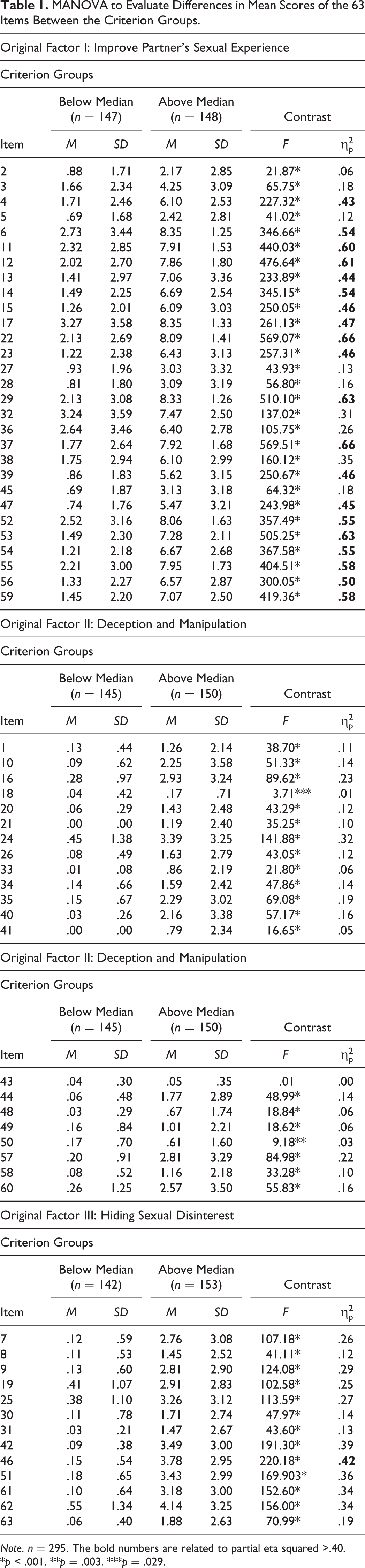
Note. n = 295. The bold numbers are related to partial eta squared >.40.
*p < .001. **p = .003. ***p = .029.

Scree plot of the items of the Escala de Razões para Fingir Orgasmo.
Following the original version (RPOI; McCoy et al., 2015), we labeled Factor 1 Improve Partner’s Sexual Experience (M = 4.24; SD = 2.83) because the 25 constituent items suggest an interest in increasing the quality of the sexual and emotional experience for the male partner (e.g., “I want my partner to think I am sexy”). We labeled Factor 2 Hiding Sexual Disinterest (M = 1.65; SD = 1.81) because the constituent items indicate a desire to end a specific sexual event for lack of interest (e.g., “I don’t want my partner to know that he is not satisfying me sexually.”). We labeled Factor 3 Deception and Manipulation (M = .98; SD = 1.49) because it includes 6 items reflecting manipulative motivations, including hiding infidelity and homosexual attraction (e.g., “I don’t want my partner to know that I am having sex with another man.”).
For parsimony and cohesion of the three factors, we retained only items that added unique information to the constitutive definition of each factor. The excluded items, although statistically acceptable, were not essential to the constitutive definition of the factor on which they loaded. For example, items 44 (“I want to get something from my partner”) and 49 (“I want my partner to be able to brag to his friends”) were not originally included in the factor Improve Partner’s Sexual Experience, and do not add unique or specific information to this factor’s constitutive definition. Some items did not load on their original factors, but we decided to retain them given their relevance to the scale. For example, on the Hiding Sexual Disinterest factor, items 1 (“I am mad at my partner”), 16 (“I am insecure because I do not have orgasms”), 34 (“I don’t want my partner to know that he is not a good sexual partner”), and 57 (“I feel ashamed because I rarely have an orgasm”) originally were included in the Deception and Manipulation factor. In addition, items 3 (“I don’t want to ruin the moment.”), 27 (“My partner expects me to have an orgasm.”), and 28 (“I want my partner to think we are having an orgasm together.”) were originally included in the Improve Partner’s Sexual Experience factor. However, we retained these items in the Hiding Sexual Disinterest factor because they reflect reasons to hide sexual disinterest that are not directly associated with the intent to manipulate or to improve the partner’s sexual experience—i.e., women may pretend orgasm because they feel ashamed if they do not orgasm (Harris et al., 2016). The remaining items’ factor loadings and each factor’s explained variance, internal consistency, and Generalized GH index are summarized in Table 2. The factors showed satisfactory Generalized GH indexes, suggesting generalizability of this factor structure to other populations (see Table 2; Ferrando & Lorenzo-Seva, 2017); and acceptable Model Fit (GFI = .98; AGFI = .98) of the factorial structure.
Factor Structure and Loadings of the Reasons to Pretend Orgasm.

Note. n = 295. The bold numbers refer to the loading of each item in its respective factor. I—Improve Partner’s Sexual Experience; II—Hiding Sexual Disinterest; III—Deception and Manipulation.
As part of the evaluation of the construct validity of the ERFO, we correlated the identified factors with the RPOI original three-factor structure identified by McCoy et al. (2015). The results indicated that the factors of the ERFO are significantly and positively correlated with the factors of the original structure of the RPOI; Improve Partner’s Sexual Experience (r = .99; p < .001), Deception and Manipulation (r = .78; p < .001) and Hiding Sexual Disinterest (r = .93; p < .001), suggesting that the 47-item ERFO (Cronbach’s α = .97; composite reliability = .98) represents well the 63-item scale introduced by McCoy et al. (2015).
Correlations between reasons to pretend orgasm, mate retention behaviors, and relationship satisfaction
Additionally, we correlated scores on the ERFO factors with performance frequency for cost-inflicting and benefit-provisioning mate retention behaviors. The results indicated non-significant correlations between the ERFO factors and mate retention behaviors (see Table 3).
Correlation Matrix of Reasons to Pretend Orgasm, Mate Retention Behaviors, and Relationship Satisfaction.

Note. n = 295. two-tailed p values.
*p = .029. **p < .001. ***p = .002.
We correlated scores on the Relationship Satisfaction Index with scores on the ERFO factors and with performance frequency for cost-inflicting and benefit-provisioning mate retention behaviors. The results indicated a negative correlation between a woman’s relationship satisfaction and her scores on the total 47-item ERFO (r = −.24; p < .001), Improve Partner’s Sexual Experience (r = −.13; p = .029), Deception and Manipulation factor (r = −.28; p < .001), and Hiding Sexual Disinterest factor (r = −.40; p < .001). Finally, a woman’s relationship satisfaction was positively correlated with performance frequency of benefit-provisioning mate retention behaviors (r = .19; p = .002), but not significantly correlated with performance frequency of cost-inflicting mate retention behaviors (r = −.10; p = .11). The correlation matrix is presented in Table 3.
Discussion
We investigated associations of reasons why Brazilian women pretend orgasm with their mate retention behaviors and their relationship satisfaction, by first adapting and psychometrically validating a Brazilian-Portuguese adaptation of the Reasons for Pretending Orgasm Inventory (RPOI; McCoy et al., 2015), which we label the Escala de Razões para Fingir Orgasmo (ERFO). Similar to McCoy et al. (2015), the results suggested a three-factor structure, with the factor contents of the Brazilian-Portuguese adaptation (ERFO) resembling the factor contents of the RPOI. For example, both the ERFO and the original RPOI include a factor labeled Improve Partner’s Sexual Experience that reflects an interest in increasing the quality of the sexual and emotional experience for the male partner (e.g., “I want my partner to feel confident”). Additionally, the factors in the shorter Brazilian-Portuguese adaptation (ERFO) were significantly and positively correlated with their respective factors in the longer original version (see McCoy et al., 2015), suggesting that the 47-item ERFO (see Table 4) reliably represents the original version (RPOI; 63 items) in the Brazilian context.
Escala de Razões Para Fingir Orgasmo— Brazilian-Portuguese Version.

Note. Improve Partner’s Sexual Experience: 03, 04, 08 – 12, 14, 17, 18, 23, 24, 26 – 29, 32, 34, 36, 38 – 42, 44.
Hiding Sexual Disinterest: 01, 02, 05, 06, 13, 15, 20, 21, 22, 25, 33, 37, 43, 45 – 47.
Deception and Manipulation: 07, 16, 19, 30, 31, 35.
The ERFO is more parsimonious than alternative assessments. For example, the Pretending Orgasm Reasons Measure (Goodman et al., 2017) includes six factors: Feels Good, For Partner, Not into Sex, Manipulation/Power, Insecurity, and Emotional Communication. However, the factors identified by Goodman et al. (2017) are well represented by the RPOI factors—for example, the RPOI factor Improve Partner’s Sexual Experience captures the factors Feels Good and For Partner, and the RPOI factor Deception and Manipulation captures the factors Manipulation/Power and Insecurity. The Motives for Feigning Orgasms Scale (Séguin et al., 2015) includes six factors: Intoxication, Partner Self-Esteem, Poor Sex/Partner, Desireless Sex, Timing, and Insecurity. The factors identified by Séguin et al. (2015), however, are captured by the RPOI—for example, the RPOI factor Deception and Manipulation captures the factors Intoxication and Insecurity, and the RPOI factor Hiding Sexual Disinterest captures the factors Desireless Sex and Poor Sex/Partner. Future research may compare the goodness of fit of these measures in the Brazilian context.
The results indicated possible cross-cultural differences, including, for example, that Brazilian women’s reports of reasons to pretend orgasm to hide sexual disinterest is not correlated with their performance frequency of mate retention behaviors, contrary to previous findings using reports from American women (Kaighobadi et al., 2012).
Our results also showed similarities with the research using American samples. For example, both Brazilian and American women pretend orgasm to increase the quality of the sexual and emotional experience for her and their male partner (McCoy et al., 2015)—a finding that supports an evolutionary hypothesis that women evolved psychological mechanisms to keep their partner invested in the relationship (Buss, 2016).
Scores on the Improve Partner’s Sexual Experience factor were not associated with performance frequency of benefit-provisioning mate retention behaviors. Although some reasons for pretending orgasm may be benevolent (e.g., improving a partner’s sexual experience), pretending orgasm is a deceptive behavior in that a woman is willfully displaying false signals to her partner. Therefore, it is possible that some women perform deceptive behaviors (i.e., pretending orgasm), while rationalizing these as motivated by conflict-avoidance intentions (e.g., women may pretend orgasm to hide their relationship dissatisfaction from their partners). Because intentions and behaviors are not always consistent (e.g. women may perform deceptive behaviors with benefit-provisioning intentions; Montano & Kasprzyk, 2015), future research might investigate women’s behaviors and intentions with regard to pretending orgasm.
Scores on the Deception and Manipulation factor did not correlate with performance frequency nor with the domains of mate retention, in contrast to the results reported by McCoy et al. (2015) for an American sample. Some reasons for pretending orgasm may not be accounted for by the reasons that motivate the performance of mate retention behaviors. For example, the cost-inflicting mate retention behavior “Told other women that my partner was stupid” thwarts intrasexual competition, but the deceptive and manipulative reasons to pretend orgasm do not include thwarting intrasexual competition—the ERFO items constituting Deception and Manipulation are mostly related to attempts to hide sexual disinterest or infidelity, e.g., “I don’t want my partner to know that I am having sex with another man” and “I don’t want my partner to know that I have feelings for another man”. Individuals who perceive that they could easily replace their partner less frequently perform mate retention behaviors (Sela et al., 2017). Consistent with this interpretation, women’s sexual disinterest is associated with a disengaged strategy of mate retention (i.e., infrequent use of both benefit-provisioning and cost-inflicting behaviors; Lopes & Shackelford, 2019).
Similar to the results for the Deception and Manipulation factor, scores on the Hiding Sexual Disinterest factor did not correlate with performance frequency of mate retention behaviors, differing from results reported by McCoy et al. (2015) for an American sample. One possible explanation is that sexual disinterest may indicate relationship dissatisfaction (Yoo et al., 2014), and relationship dissatisfaction is related to less frequent performance of benefit-provisioning behaviors (Sela et al., 2017). For example, individuals who perceive their partner to have lower mate value—a predictor of relationship dissatisfaction (Conroy-Beam et al., 2016)—also less frequently perform benefit-provisioning mate retention behaviors (Sela et al., 2017).
Our results also demonstrated that relationship satisfaction positively correlated with benefit-provisioning behaviors. In addition, the results revealed that women’s frequency of use of reasons to pretend orgasm is negatively associated with their relationship satisfaction. Specifically, we found moderate correlations between relationship satisfaction and scores on the factors Deception and Manipulation and Hiding Sexual Disinterest. Previous research documents that orgasmic difficulty and orgasmic pleasure for women are predicted by women’s relationship satisfaction (Hevesi at al., 2020). Therefore, women with lower relationship satisfaction may have more difficulty achieving an orgasm during sexual intercourse. Alternatively, women might not have the sexual stimulation required to achieve orgasm during sexual intercourse (Mahar et al., 2020). Insufficient or poor sexual stimulation has been suggested to be accounted for by one or more cultural factors—e.g., lack of women’s sexual pleasure entitlement, alongside a poor sexual education system (Mahar et al., 2020).
Our findings indicate that women who more frequently pretend orgasm are less satisfied with their relationship. Therefore, it is possible that Brazilian women pretend orgasm to hide their sexual dissatisfaction from their partner, a benefit-provisioning behavior that may be perceived as less costly than other benefit-provisioning behaviors (e.g., “Had a physical relationship with my partner to deepen our bond”). In addition, the Improve Partner’s Sexual Experience factor showed the highest scores in our sample, suggesting that Brazilian women pretend orgasm to increase their partner’s relationship satisfaction in addition to attempting to avoid conflict (by hiding their relationship dissatisfaction). Future research may investigate the efficacy of pretending orgasms as a conflict avoidance strategy considering additional demographic characteristics (e.g., age and past relationships) and psychological features (e.g., personality traits).
The current study has several limitations. First, our sample size may not be sufficient to detect small effects. Due to the exploratory nature of our study, our results should be interpreted with caution. Future research might secure a larger sample and samples from different contexts—for example, newly post-partum mothers (e.g., 9-months postpartum couples report decreased relationship satisfaction compared to 1-month postpartum couples; Don & Mickelson, 2012). Some of the questions comprising “relationship satisfaction” may not be excellent proxies for relationship satisfaction, e.g., a person may report a high level of physical intimacy but be dissatisfied with their relationship. However, the Relationship Satisfaction Index items showed good internal consistency (Cronbach’s α = .84), and physical intimacy is an important aspect of couples’ overall relationship (Montesi et al., 2011). The current study did not assess perceived risk of infidelity, and previous research has found that women’s perceptions of partner infidelity risk mediate the relationship between pretending orgasm and performance frequency of cost-inflicting mate retention behaviors (Kaighobadi et al., 2012). Future research may test the role of perceived risk of partner infidelity as a mediator of the relationship between frequency of pretending orgasm and deployment of mate retention behaviors in different contexts—for example, domestic violence against women is socially tolerated in some cultures, provided that the cause is considered “legitimate” (e.g., wife’s sexual infidelity; Hackett, 2011).
The current study may have applied value. For example, the results of research addressing the links between mate retention behaviors, relationship satisfaction, and reasons to pretend orgasms may be useful in practical contexts such as in developing educational programs, marital counseling, and marital therapy. The current study documents reasons for pretending orgasm in the Brazilian context and suggests that relationship satisfaction is an important factor underlying the frequency and reasons to pretend orgasm among Brazilian women, highlighting the importance of cross-cultural research addressing women’s sexual psychology and behavior.
Footnotes
Declaration of Conflicting Interests
The author(s) declared no potential conflicts of interest with respect to the research, authorship, and/or publication of this article.
Funding
The author(s) disclosed receipt of the following financial support for the research, authorship, and/or publication of this article: This research was supported with funding from the Brazilian Council for Scientific and Technological Development (CNPq).
